



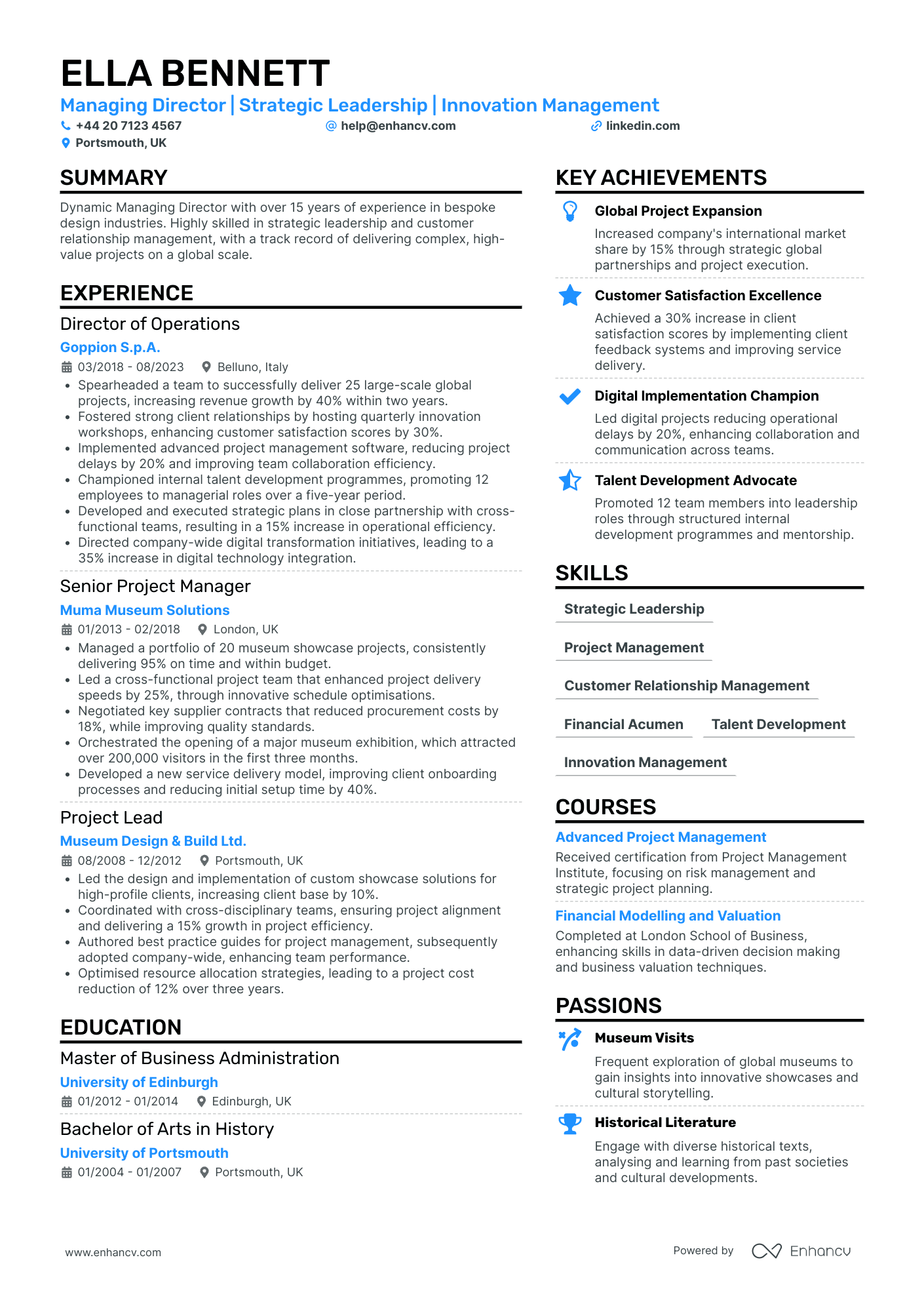
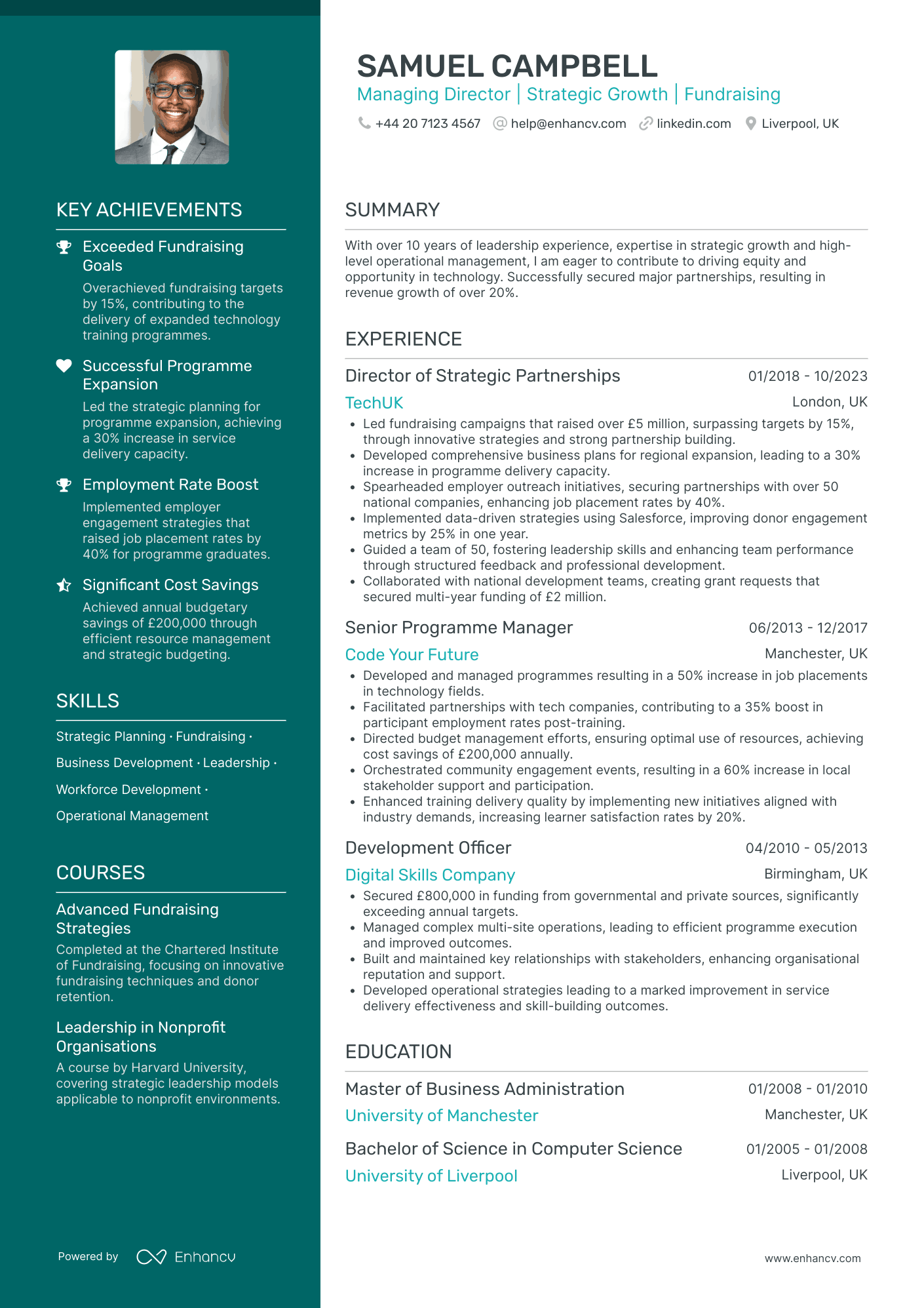
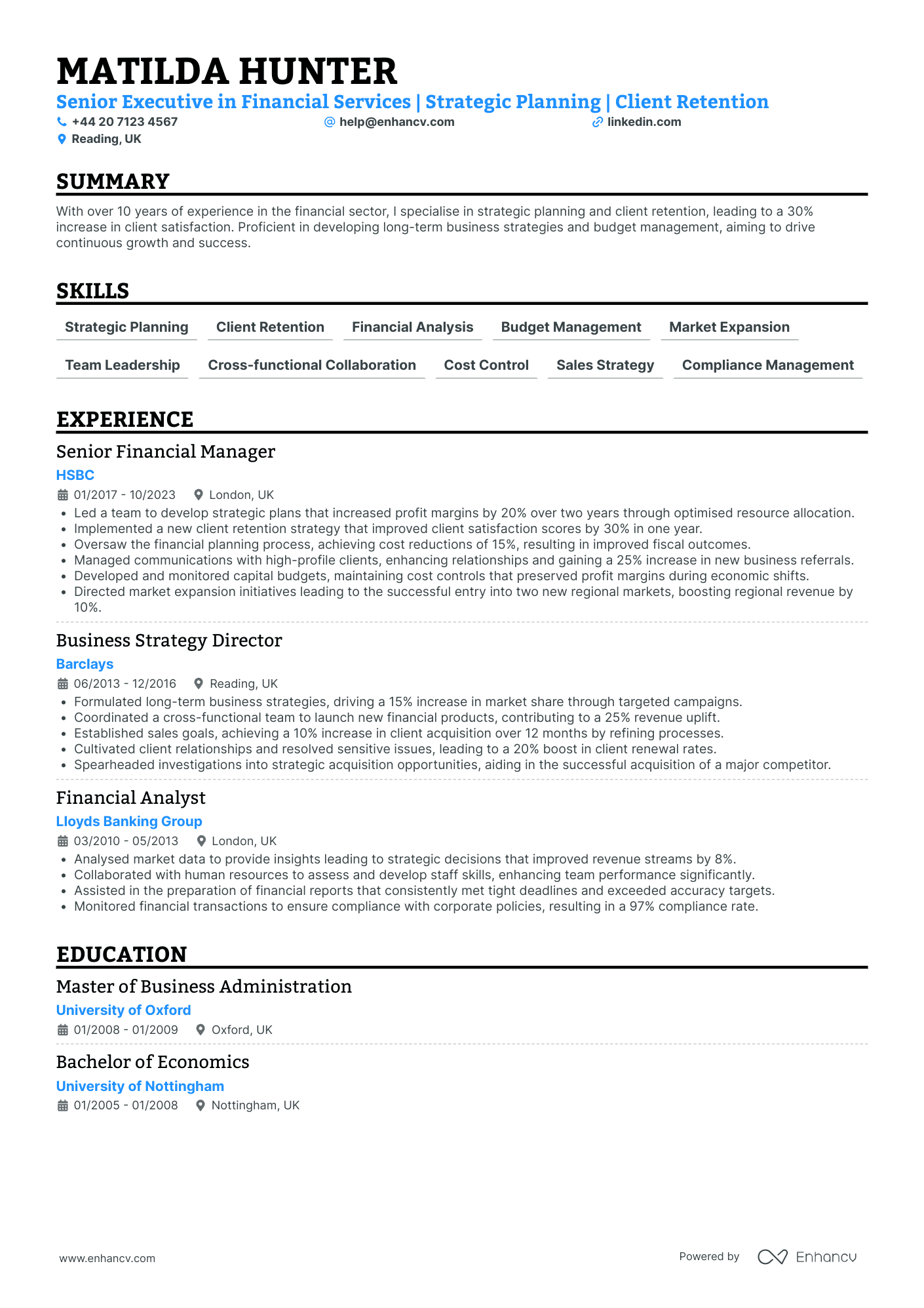
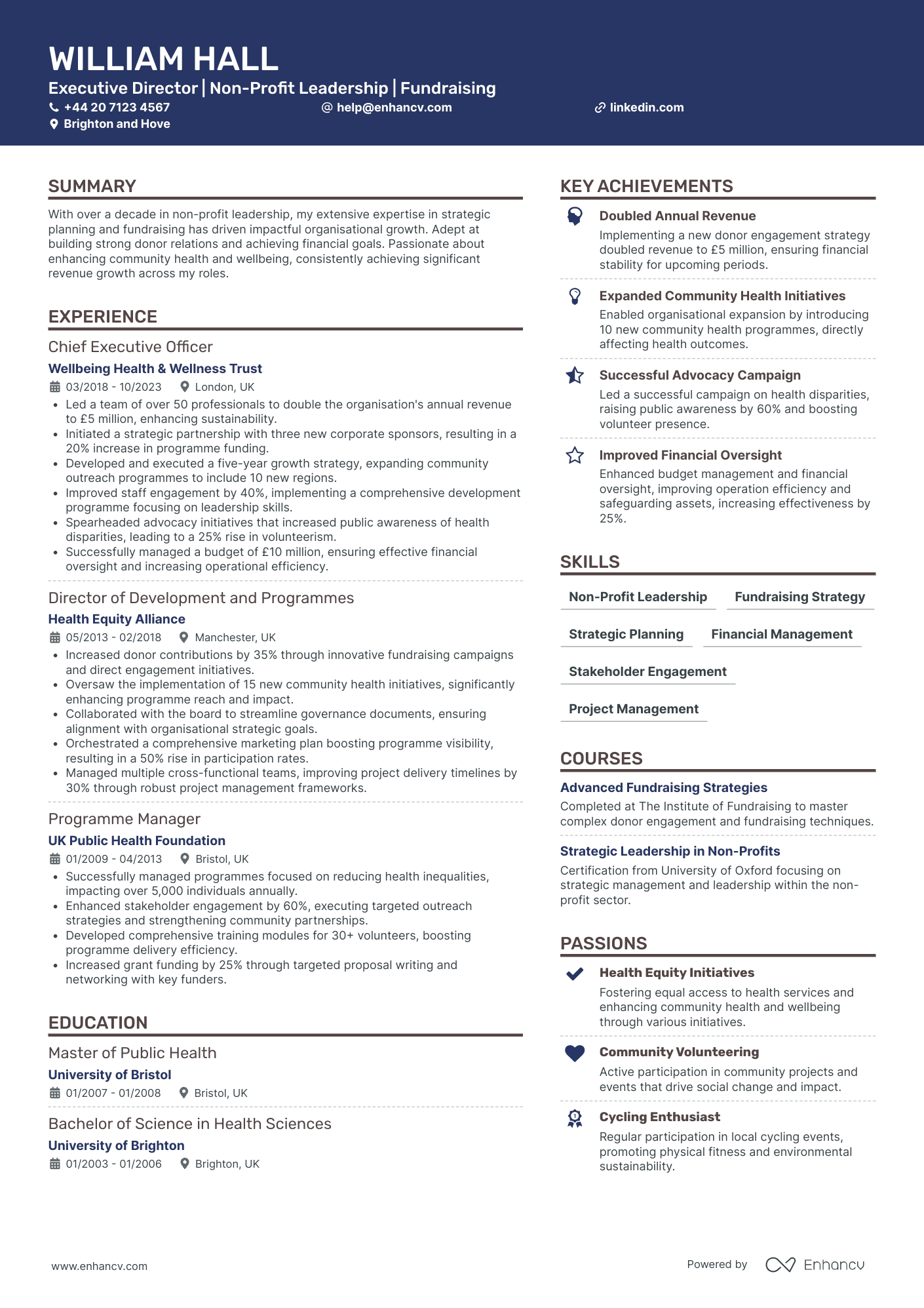
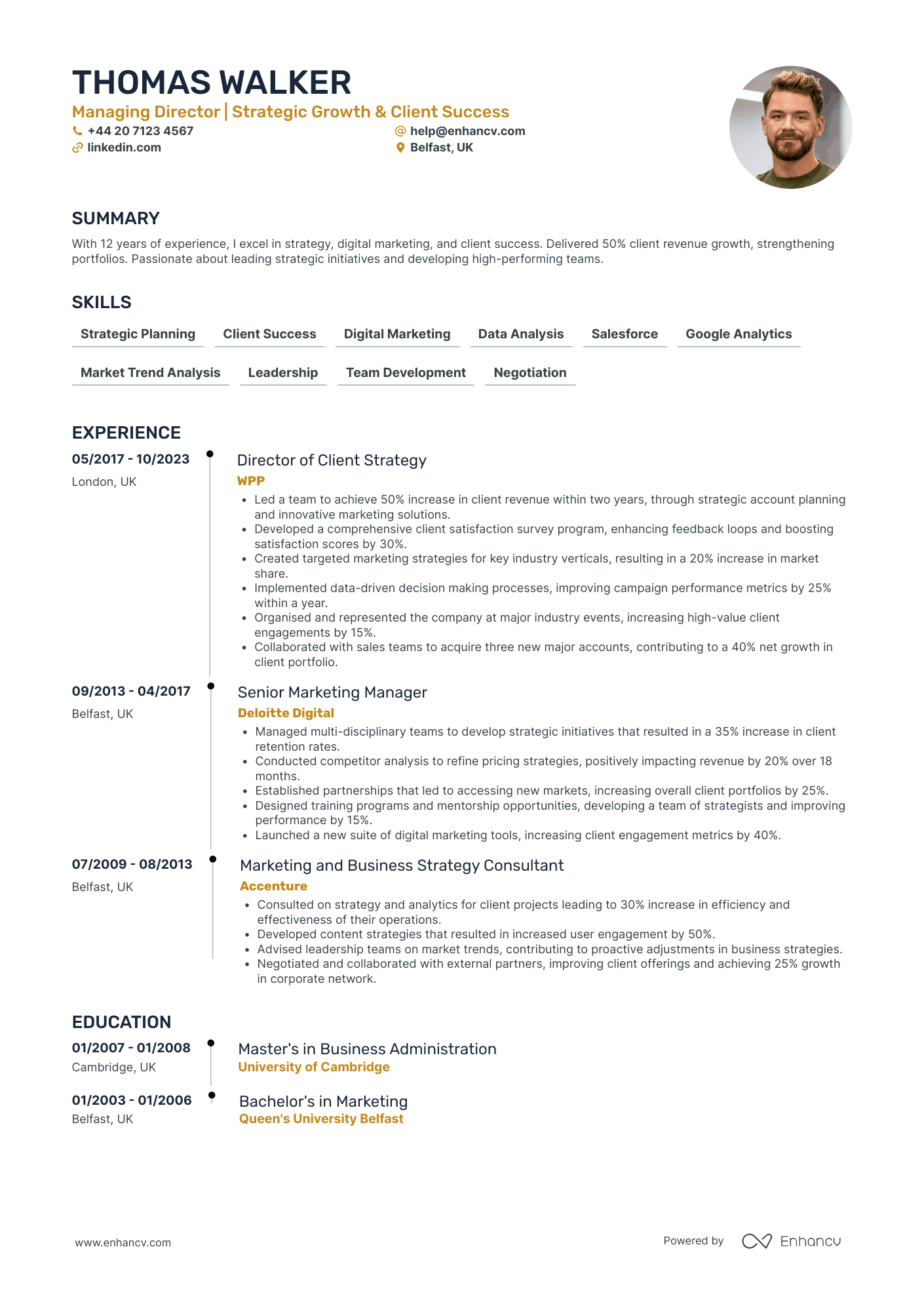
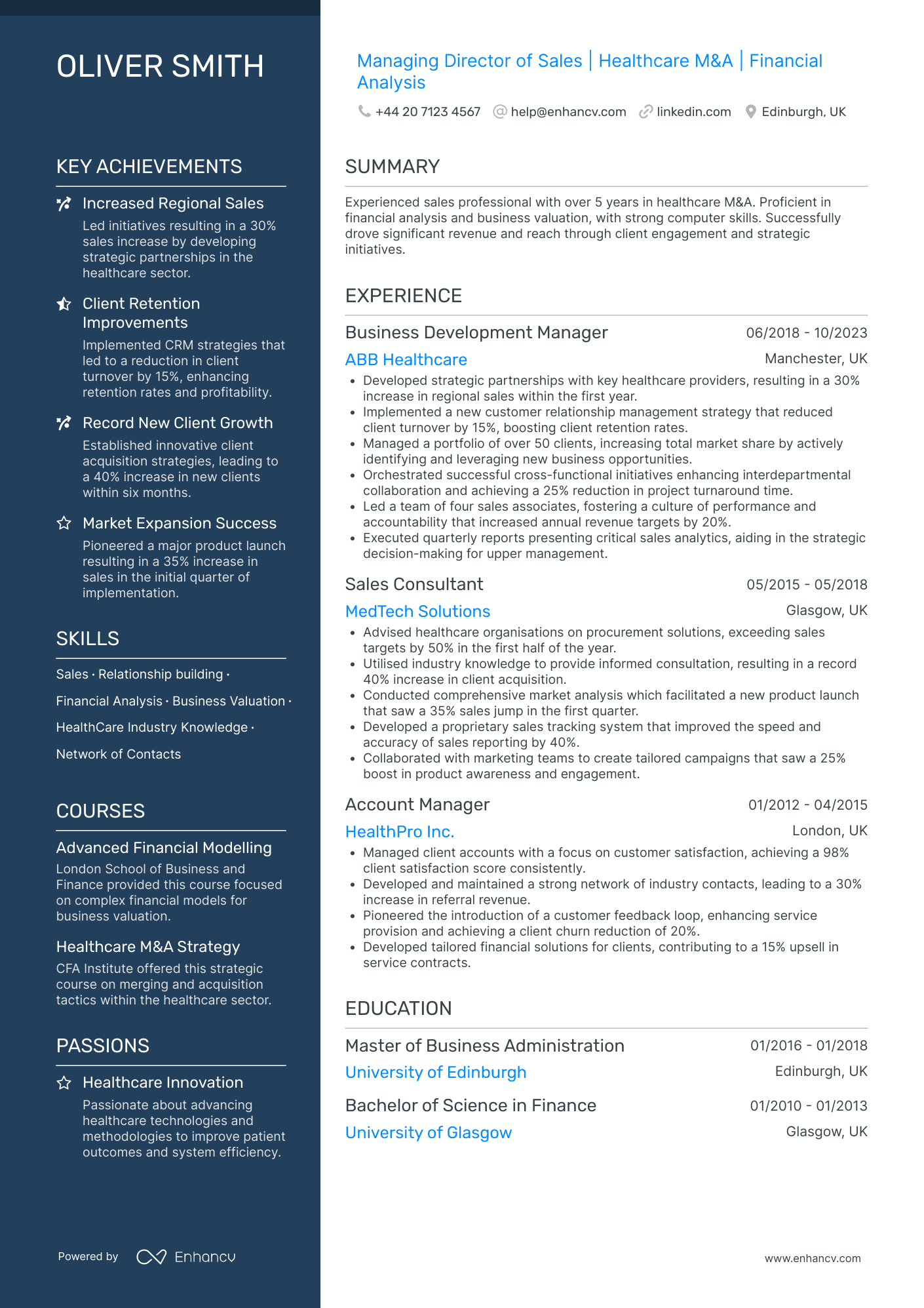
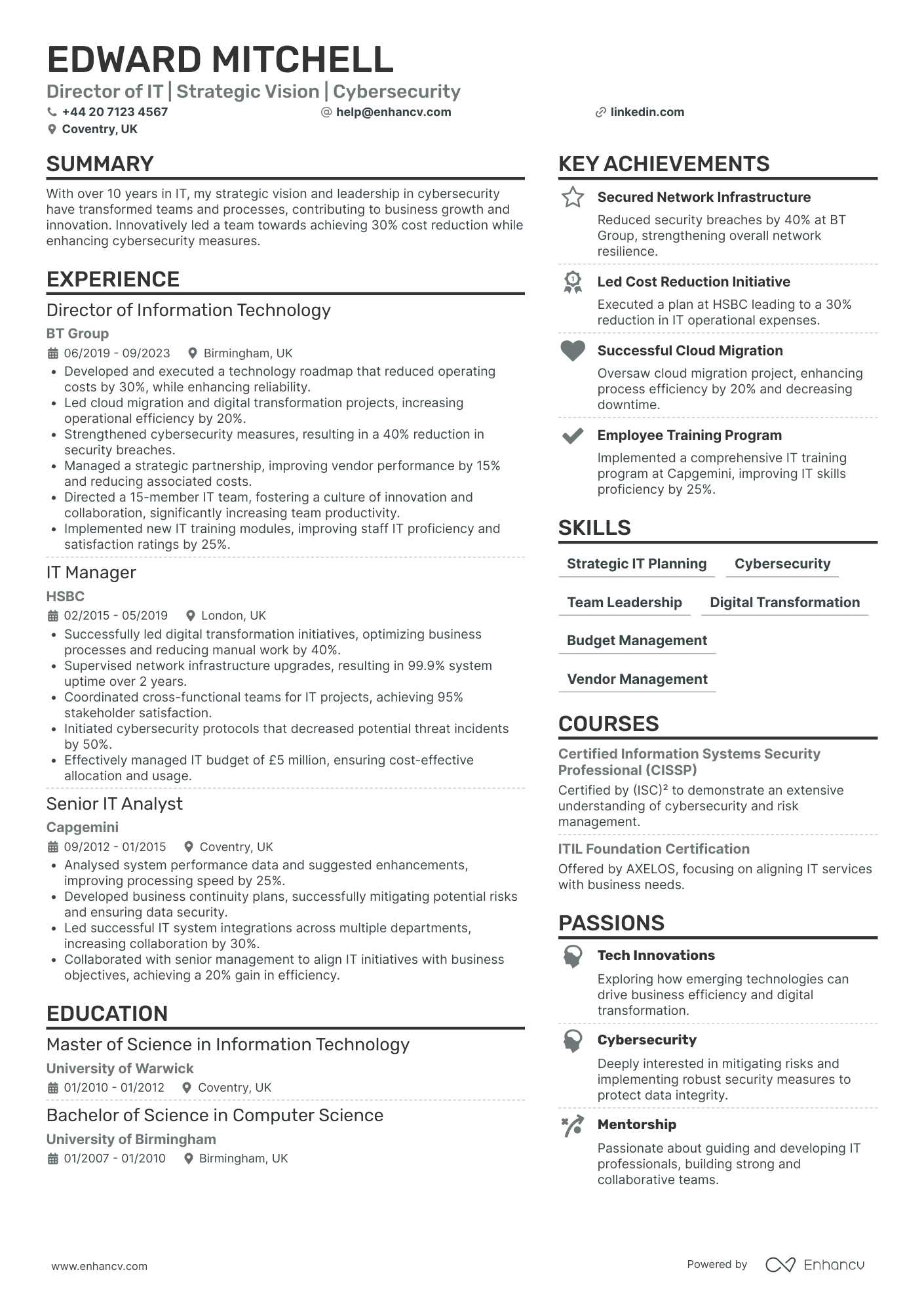
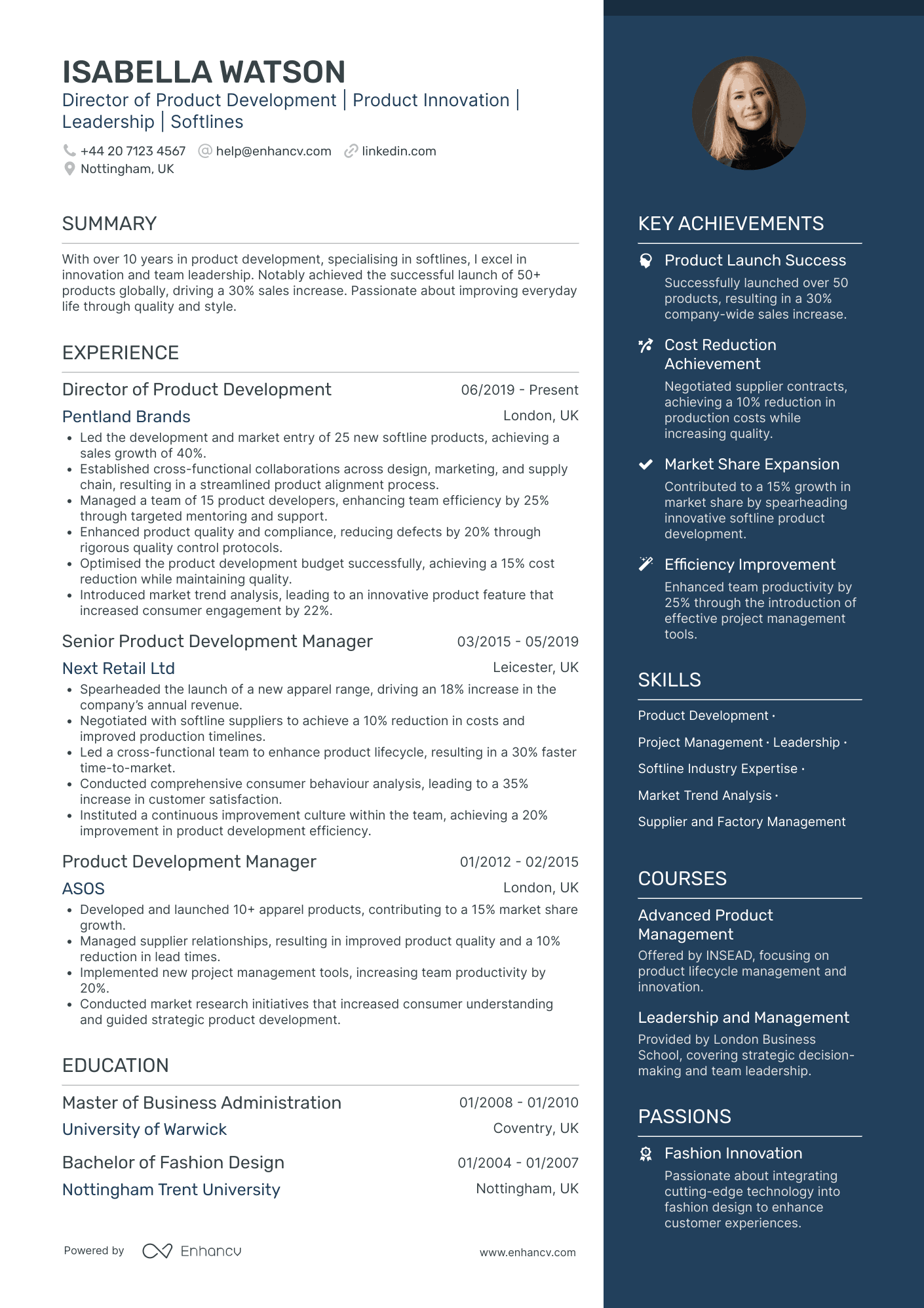
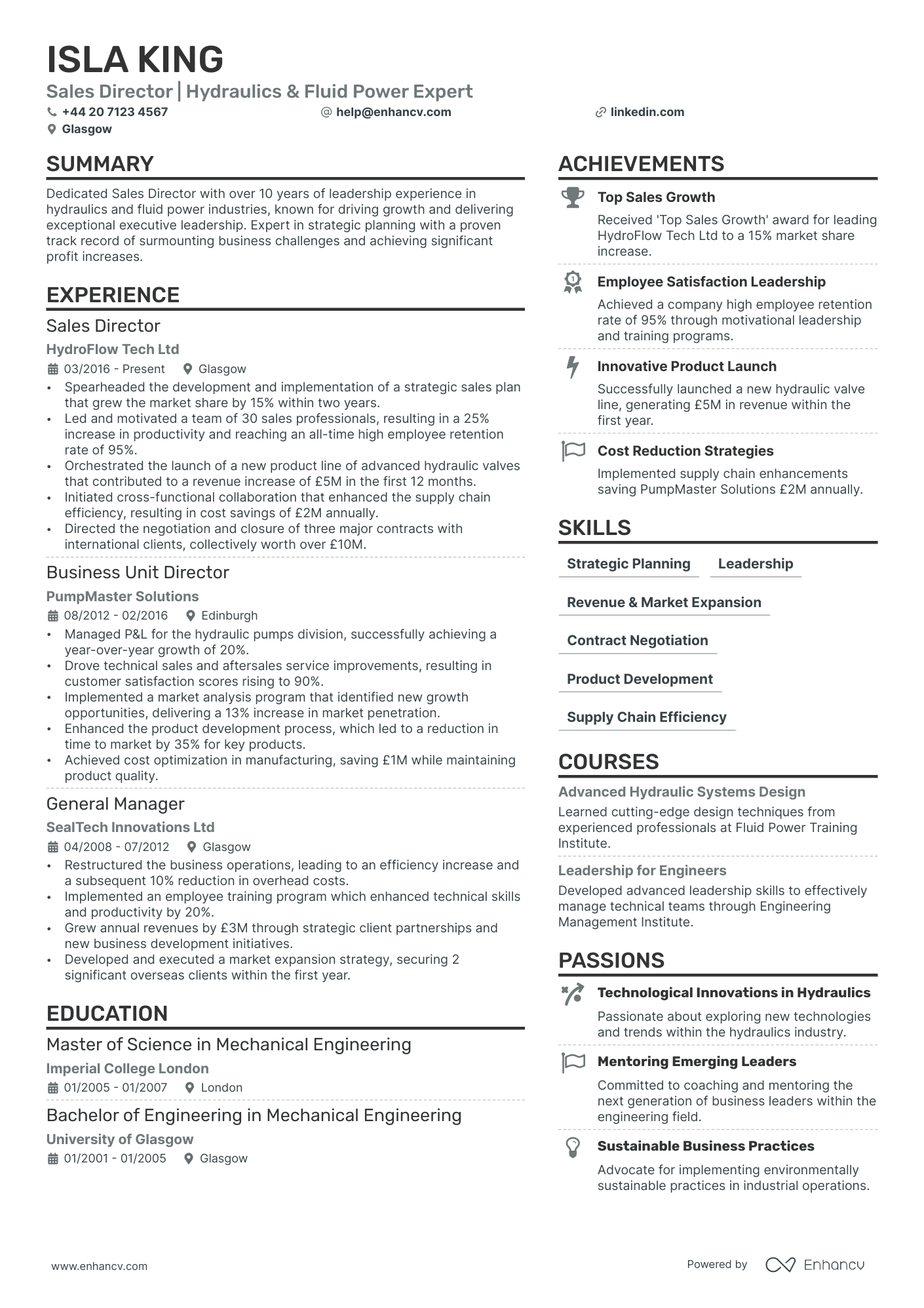
The last managing director CV that made me stop and read led with a single number: a division taken from loss to profit in eighteen months. No title, no adjectives, just the result.
At this level a chair or a headhunter already assumes you can run a function. What they are weighing is scope, the size of the budget you owned, the size of the team you led, and whether you set the direction or delivered someone else's. Your CV has to answer that in the first third of page one.

Key takeaways
- Lead with scope. P&L owned, headcount led, revenue or budget controlled, and the mandate you held are what separate a managing director CV from a senior manager one.
- Know where you sit. A managing director runs a business or a business unit, a CEO holds ultimate accountability to the board. Pitch the CV at the level the role actually carries.
- Keep it to two pages, reverse chronological, sent as a PDF unless the advert asks otherwise.
- Open with a personal statement built on outcomes: growth delivered, turnarounds led, and the boards you reported to.
- Most UK managing director roles are on-site and executive-level, so put your base location and board-level scope near the top.
- Cut the red flags a chair screens for: vague scope, unexplained gaps, and duties with no results attached.
Pitching your managing director CV at the right level
A managing director CV lives or dies on scope. Two people can both have run a business, and the one who makes the size of that business obvious takes the shortlist spot.
In the UK the title carries real weight. A managing director usually runs a company or a business unit day to day, often as a statutory director with a board seat and legal responsibility. Spell out which version you were, because MD of a six-person consultancy and MD of a 200-person division are different jobs.
Recruiters read seniority through scope, not through adjectives. Put four facts where they cannot be missed: revenue or P&L owned, budget controlled, headcount led, and the growth or turnaround you delivered.
Then show the level of the decisions, not just their outcome. Owning the pricing model, signing off the annual plan, hiring the leadership team, and answering to the board for the result are managing director decisions. Recommending them to someone more senior is not, and a chair can tell the difference in one line.

Managing director or CEO?
A CEO holds ultimate accountability to the board and shareholders and sets the overall strategy. A managing director runs the business or a division and delivers against that strategy, and in many UK firms the two titles overlap or the MD is the most senior operational role. If you carried the top mandate, say so plainly. If you ran a unit inside a larger group, name the group and the unit so the level reads true.
Stepping up to managing director for the first time? Lead with the leadership scope you already carry, the board or shareholders you answer to, and the decisions you own outright. A director moving up has to show they already operate at MD altitude.
Moving between businesses as an experienced MD? Foreground breadth: the sectors you have run, the transformations you have led, and the through-line that says you scale and fix things whatever the industry.
Whichever you are, keep the structure reverse chronological so your most senior, most recent role does the arguing first. A board reads top-down and rarely reaches the bottom of page two, so the strongest evidence has to sit in the roles they see first.
One more level to get right is the shape of the business you ran. Running a stable, profitable company is a different story from turning one around or scaling one fast, and a chair is hiring for a specific one of those. Name the situation you inherited and the situation you left behind, because the gap between them is the argument.
What the UK managing director market looks like
How these roles are advertised tells you where to spend space on the CV. Here is what the current crop of UK postings shows.
| What | UK managing director postings |
|---|---|
| Where the work happens | Mostly on-site (18 of 29 UK postings in the last ~30 days, Enhancv's internal job feed), with some hybrid and a few remote |
| Seniority asked for | Almost all executive-level (24 of 29 postings), with a handful pitched at lead level |
| Skills that recur most | Risk management, stakeholder management, and strategic planning, then change management and regulatory compliance |
| Typical pay | Varies too widely by sector, company size, and equity to stand behind a single reliable figure |
Two patterns matter for your CV.
First, most managing director postings are on-site. At this level presence is part of the mandate, so a board wants to see you can be in the building with the team and the customers. Put your base location near the top and resist hiding behind a remote-first line.
Second, the demand clusters around risk, stakeholders, and strategy. Risk management, stakeholder management, and strategic planning are the skills that recur most often across UK managing director postings on Enhancv's internal job feed in the last 30 days, with change management and regulatory compliance close behind. Mirror the ones you can evidence.
On pay, treat any single headline figure with caution. Managing director salaries swing enormously with sector, company size, and equity, so no reliable number stands in for a whole role. Anchor your worth in the scope you ran, not a benchmark.
The mix of demands also tells you how to weight the CV. Risk, compliance, and change come up often because boards hire managing directors to steady or reshape a business, not simply to keep it ticking over. If your record includes a turnaround, a restructure, or a regulated environment handled cleanly, give it room near the top.
Formatting your managing director CV in 2026
Use a reverse chronological format, every time. At this stage your track record is the argument, so lead with your current role and work back.
Keep it to two pages. An executive career will not fit on one, and a third page signals you cannot prioritise. Front-load page one with your current role and your headline results.
Send a PDF so the layout holds wherever it lands. Keep a Word copy for the executive search firms and agencies that reformat CVs into their own template. If the advert names a file type, follow it.
Standard headings, a clean single column, a readable font. The look that wins at board level in 2026 is confident and plain, not designed, and it stays ATS-friendly when a larger firm runs it through tracking software. Build it from a tested layout rather than a blank page: Enhancv's CV templates export to a clean PDF.
Use the top of page one deliberately. A tight CV headline that names the level and the scope, something like "Managing director, £40m consumer division", orients the reader before they read a word of prose. Follow it with your base location and contact details, and leave the older conventions such as a photo, a full home address, and a date of birth off entirely.
Writing your managing director personal statement
Three or four sentences at the top: the businesses you have run, the scale, the results, and what you want to lead next. Every clause should carry a fact a board could check. For more on the opening lines, see these personal statement examples.
Skip the adjective pile-up. "Dynamic, results-driven leader" is what every weak executive CV says, and it proves nothing a recruiter can act on.
Lead with evidence instead:
Managing director personal statement example
Managing director with 12 years running consumer businesses, most recently a £40m home-goods division of 180 staff. Took the unit from a £2m operating loss to £5m profit in two years by resetting pricing, exiting three loss-making lines, and rebuilding the leadership team. Reported to the group board and chaired the divisional executive. Now looking to lead a mid-market business through its next growth phase.
Managing director personal statement to avoid
Dynamic and results-driven managing director with a proven track record of delivering excellence and driving growth across multiple sectors. A strategic thinker and inspirational leader, passionate about building high-performing teams and exceeding targets in fast-paced environments.
When we read a managing director CV, the first thing we look for is scope we can size in seconds. Revenue owned, people led, the state of the business when you arrived and when you left. A statement full of "strategic" and "dynamic" tells us nothing, because every other candidate wrote the same words. One line like "took a £40m division from loss to profit in two years" does more than a whole page of adjectives. Lead with the number, then show how you got there.
Writing your managing director experience section
Give each role a dated heading with the company, your reporting line, and the scope in one line, then the bullets that show what changed because you were there. The mechanics of a strong work experience section still apply at the top.
Lead every bullet with a strong action verb and land it on a result. At MD level the results are commercial: revenue, margin, market share, cost, and valuation.
Frame the scope before the win. A board needs to know you ran a £40m business before it can judge that you grew it by 20%. Attach a number to the responsibility and it becomes a quantified achievement rather than a claim.
Where a number is commercially sensitive, use a range or a percentage instead of the raw figure. "Grew revenue by a third" or "managed a budget in the low tens of millions" still gives a board the scale without breaching a confidentiality clause.
Keep early roles short. Once you are three or four jobs back, a chair cares about the trajectory, not the detail, so two lines of scope and one standout result are enough per role.
Tailor every application to the business you are targeting. Pull the language of the advert into the CV where it is true of you, and Enhancv's CV tailoring feature reads the advert and suggests the edits that match.
- Run a £40m home-goods division of 180 staff, reporting to the group board and chairing the divisional executive team
- Turned the division from a £2m operating loss to £5m profit in two years by resetting pricing, exiting three unprofitable product lines, and restructuring the senior team
- Grew online sales from 15% to 40% of revenue by rebuilding the digital operation and renegotiating carrier contracts
- Led the integration of an £8m bolt-on acquisition, retaining 95% of key staff and hitting synergy targets a quarter early

PRO TIP
Executive readers scan for the shape of the business before the wins. In the first bullet of each role, state revenue or budget, headcount, and who you reported to. Once the scale is clear, every percentage after it carries weight.
Skills for a managing director CV
The market tells you what to list. Across UK managing director postings on Enhancv's internal job feed, the demands that recur most are risk management, stakeholder management, and strategic planning, with change management and regulatory compliance following.
Those are hard skills at this level, so list them in the language the adverts use and prove each one in an experience bullet. AI is starting to surface in these postings too, so if you have driven an automation or AI agenda, name it.
The soft skills count, but only when evidenced. Board-level influence, decision-making under pressure, and the judgement to know which battles to fight read as real when a bullet backs them, and as filler when they do not.
Top skills for your managing director CV:
Strategic planning
P&L and financial management
Risk management
Stakeholder management
Change management
Regulatory compliance
Client relationship management
Mergers and acquisitions
Board-level communication
Decision-making
Commercial judgement
Leadership
Negotiation
Education and credentials for a managing director CV
By this stage your track record outweighs your degree, so keep education short and factual: degree, institution, classification if it is strong, and the year.
An MBA or a relevant professional qualification earns a line, especially from a school a board will recognise. Governance credentials such as an IoD Chartered Director qualification are worth naming in full.
List non-executive directorships, board memberships, and sector bodies here or in a short appointments section. At MD level they signal reach, and any certificates you hold save a board a question.
Skip the modules, the grades from twenty years ago, and the short courses that pad rather than prove. A board reading an executive CV wants the qualification that still matters and nothing that dilutes it.
Red flags a chair screens for on a managing director CV
At executive level the screening is ruthless, and a handful of things get a CV set aside fast. Most of them are CV mistakes of omission.
- Vague scope. "Responsible for the business" with no revenue, budget, or headcount reads as a manager inflating a title.
- Duties with no results. A list of what you were accountable for, with nothing that changed because of you.
- Unexplained gaps or a run of short tenures with no context. Name the reason in a line rather than leaving a board to guess.
- Anything that will not survive a reference check. Overstating scope or inventing figures is caught quickly at this level, and lying on a CV ends candidacies.
The fix for all of them is the same: concrete scope, a result attached to every responsibility, and a clean, honest timeline.
Conclusion
A managing director CV is a scope document. Make the size of what you ran obvious, attach a result to every responsibility, and pitch it at the exact level the role carries.
Pair it with a short cover letter that says why this business and why now, and you give a board an easy yes.
Author's take - The Enhancv team
When we read a managing director CV, the first thing we look for is scope we can size in seconds. Revenue owned, people led, the state of the business when you arrived and when you left. A statement full of "strategic" and "dynamic" tells us nothing, because every other candidate wrote the same words. One line like "took a £40m division from loss to profit in two years" does more than a whole page of adjectives. Lead with the number, then show how you got there.