



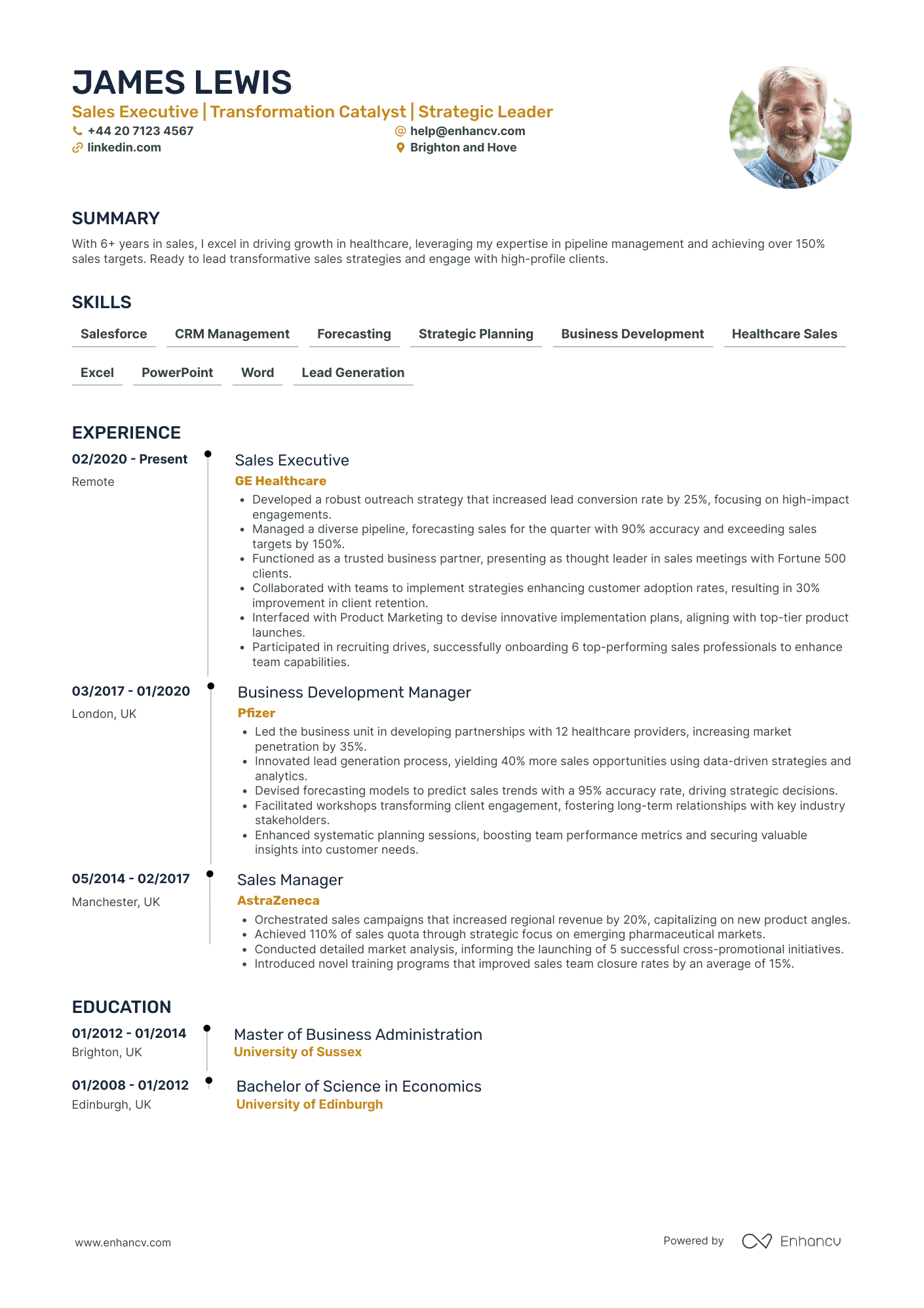
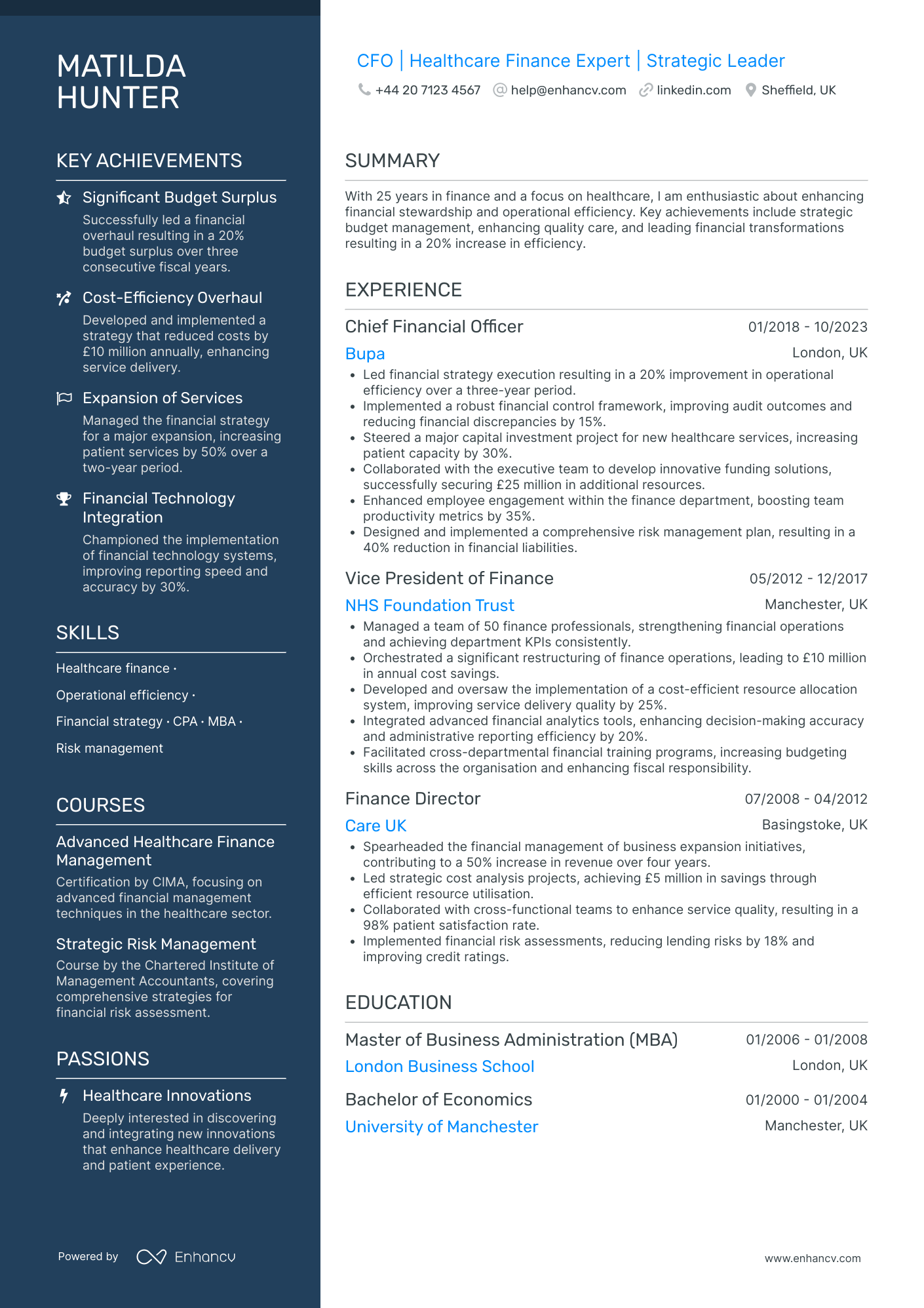
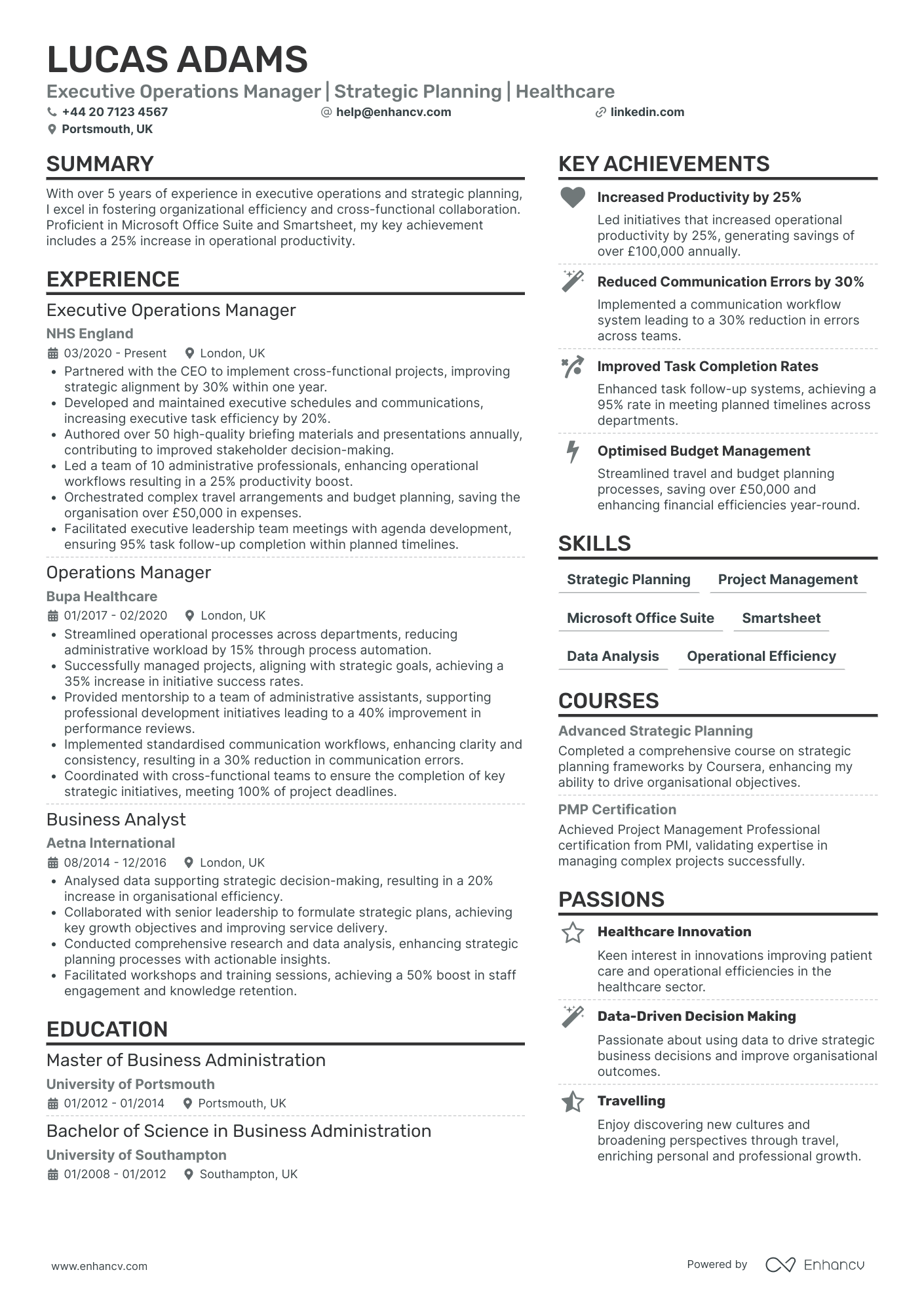
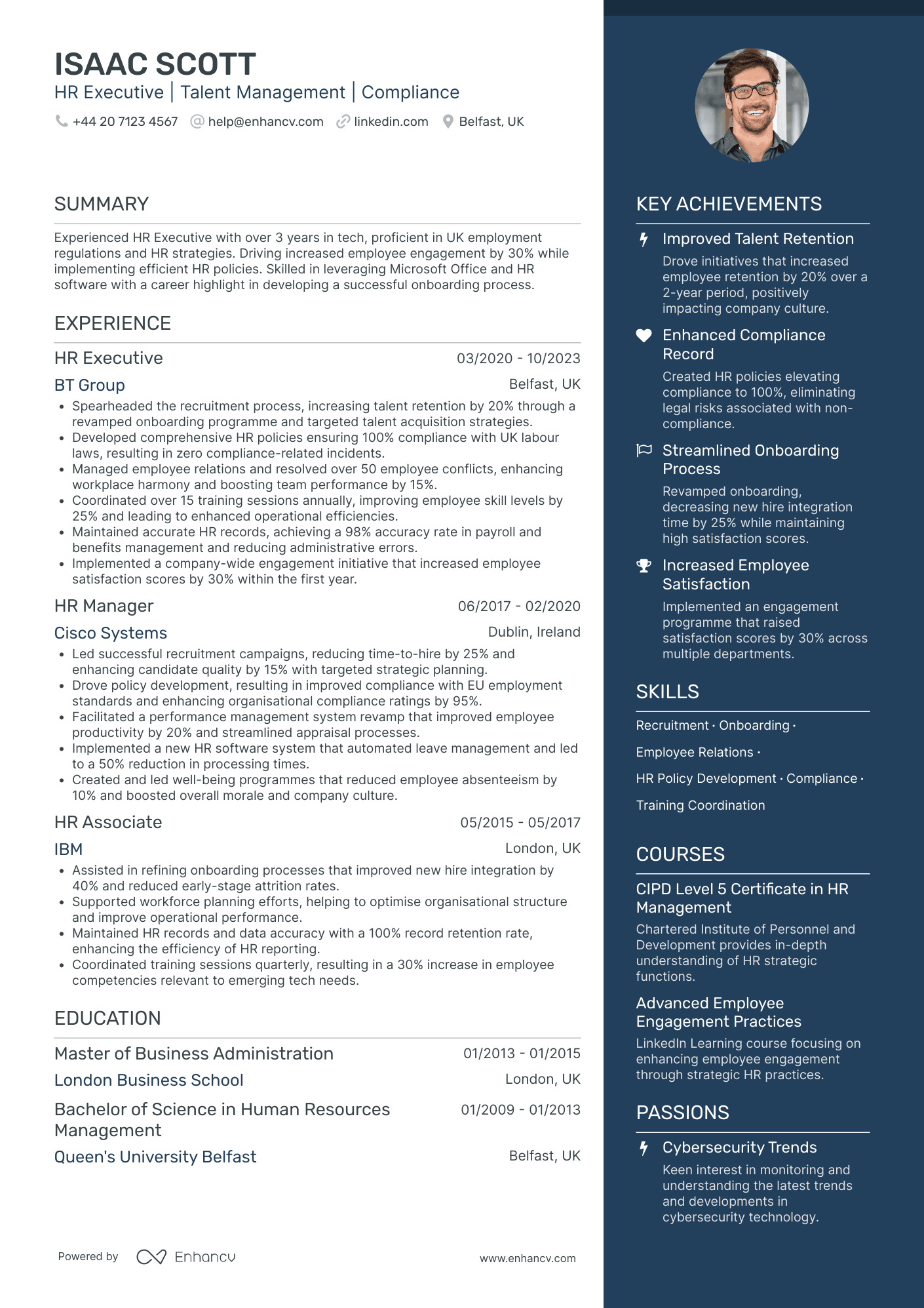
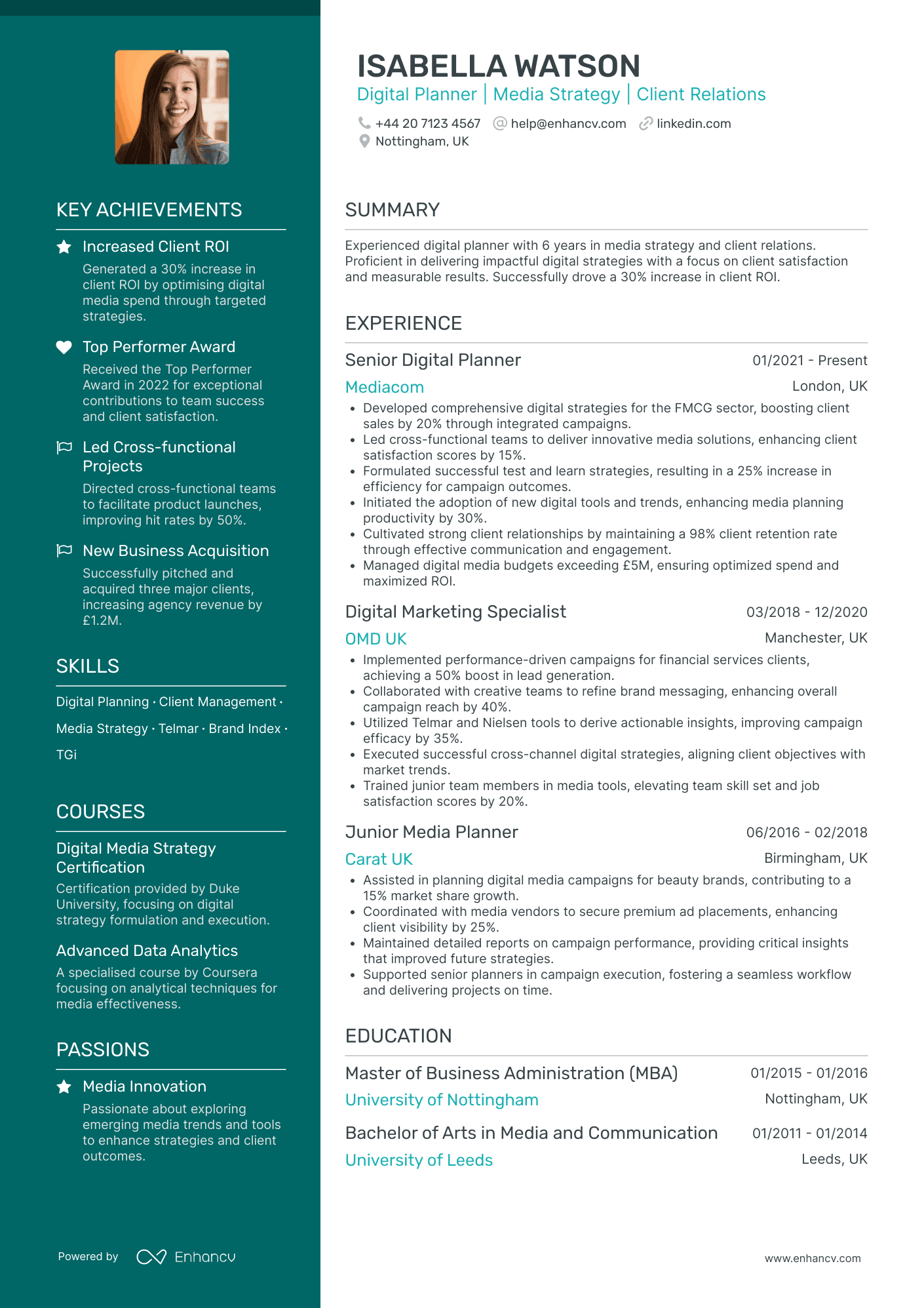
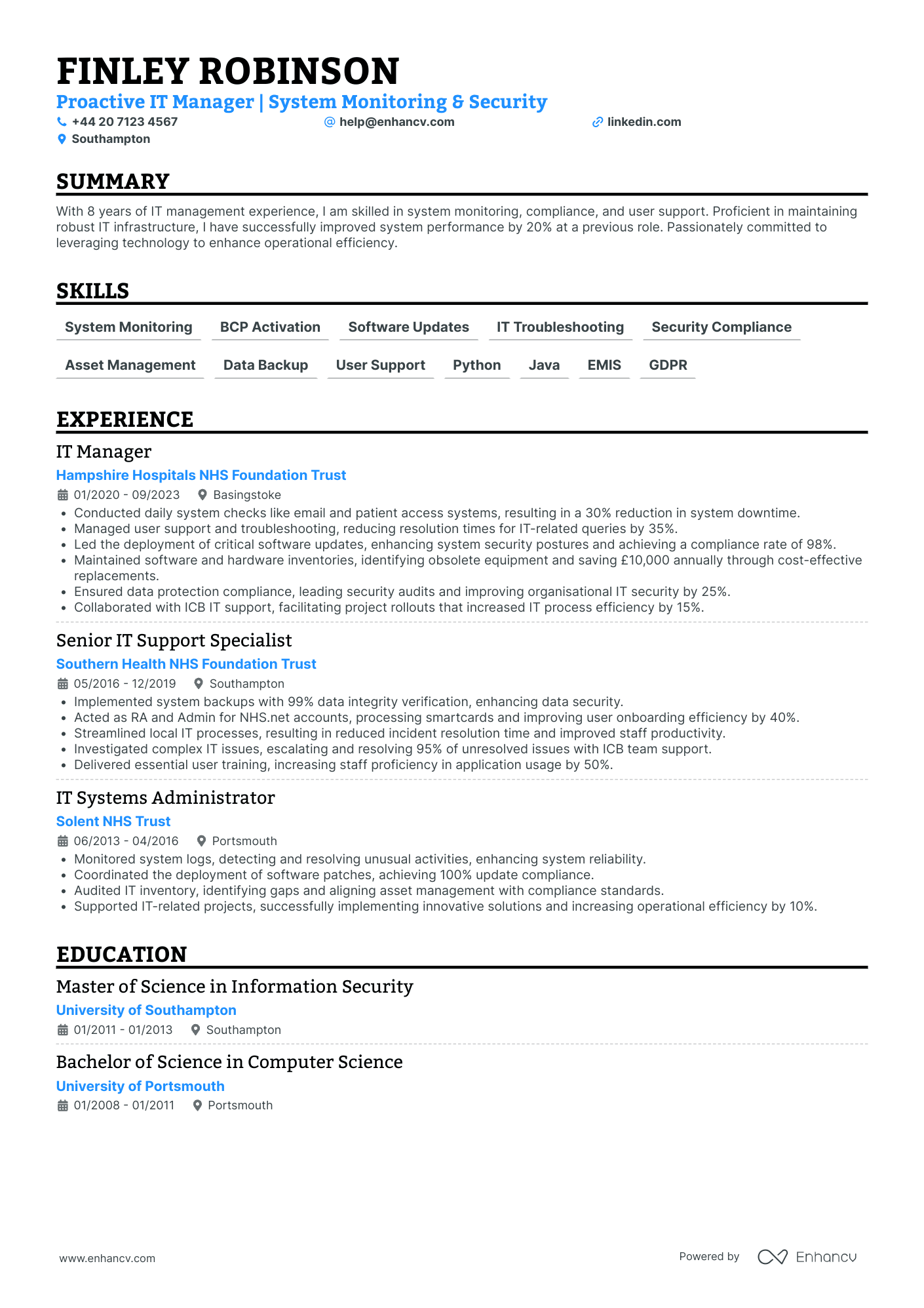
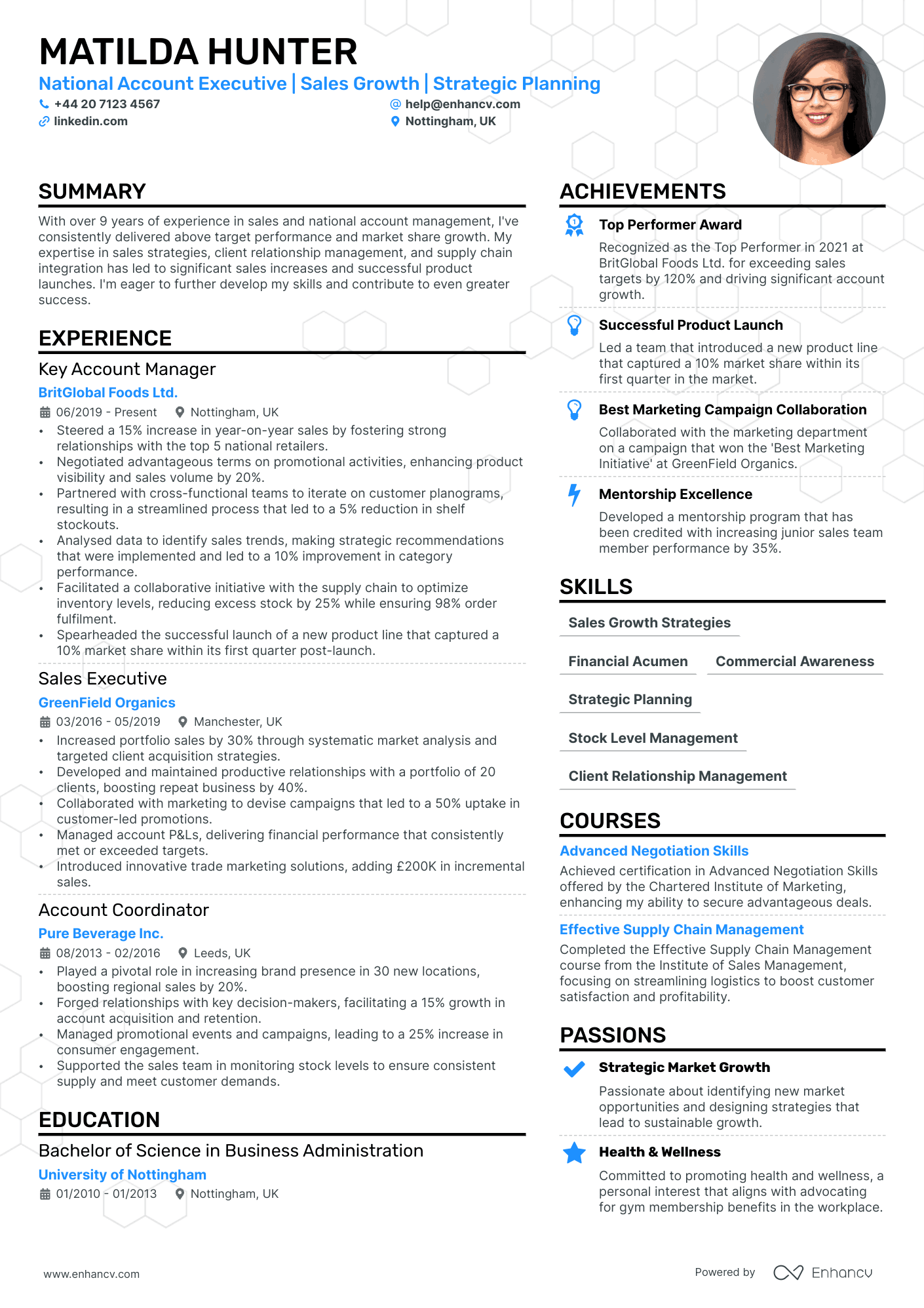
The executive CV that gets shortlisted opens with what changed on the person's watch, not a list of responsibilities. The P&L that turned, the function that got built, the one number the board actually cared about.
The reader changes at this level too. A chair, a chief executive, or a search consultant scans for scope, judgement, and results, so the mechanics of how to write a CV matter less than the altitude you write at. Get the top third of page one right and the rest is a formality.

Key takeaways
- Lead with scope and results, not responsibilities. A chair reads the top third of page one and decides whether to carry on.
- Two pages is the executive standard. A third page has to earn its place with board or P&L detail, never more duties.
- Open with a five-line executive summary: your remit, the scale you run, one signature result, your sector, and the role you are targeting.
- Quantify at boardroom altitude. Revenue, margin, headcount, and market share, not tasks completed.
- Name the leadership currency the market lists: stakeholder management, P&L ownership, transformation, and board reporting.
- Cut the red flags that sink senior CVs: unexplained gaps, vague strategic-leader adjectives, and duties with no outcome.
Writing a CV at executive level
An executive CV is a different document from a manager's CV, not a longer version of one. Its job is to prove you can carry accountability for a whole function, a P&L, or an entire organisation.
The shift is from doing to owning. A senior manager lists what they ran, while an executive shows what they were accountable for and what it returned, which is the heart of how to sell yourself on a CV at this level.
Three things separate the two at a glance:
- Scope: the size of what you owned, in revenue, budget, headcount, or geography.
- Judgement: the calls you made under uncertainty, and what they returned.
- Board-level results: outcomes a chair or an investor would recognise, not internal task metrics.
Position all of it against your career stage. A first-time director earning their first board audience writes differently from a portfolio chair with three non-exec seats, and the CV should signal exactly where you sit.
The three common stages each need a different emphasis. A first-time executive should foreground the P&L or function they already own and the scale of the decisions they carry, closing the gap between their current title and the role they want. A seasoned director competes on breadth, so a run of quantified turnarounds matters more than any single headline. A portfolio or non-executive candidate leads with governance, chairing, and the boards they have sat on, not operational detail.
The CV structure stays familiar: a short personal statement, a career-highlights block, then experience weighted to outcomes, with education and non-exec roles last. What changes is that every line is measured against the weight it carried.

The career-highlights block
Under the personal statement, add three or four one-line highlights that carry your best numbers. It is the section a chair reads second, and it lets your strongest results sit above the chronology instead of staying buried inside a role from four years ago.

PRO TIP
Put your scope in the role heading, not just the bullets. 'Managing Director, UK and Ireland (£240m revenue, 900 staff)' tells a chair the weight of the job before they read a single achievement.
What the UK executive market looks like
Knowing the market shapes the CV. Here is where executive-level work happens and what employers list most.
| What | UK executive-level roles |
|---|---|
| Where the work happens | Onsite 58%, hybrid 40%, remote 2% (999, 691, and 35 of 1,725 UK postings with 'executive' in the title, last ~30 days, Enhancv's internal job feed) |
| Most-listed skills | Excel, CRM, Salesforce, data analysis, stakeholder management, and project management |
| How postings split by seniority | Mid 44%, lead 21%, entry 21%, senior and executive 13% combined |
| Verified pay benchmark | None quoted. Executive pay ranges too widely by sector and scope to reduce to one figure, so anchor on the role's remit instead. |
Two of those rows should shape your CV.
Executive work is mostly onsite or hybrid, and fully remote is rare at 2%. If you need a specific arrangement, state it near the top rather than leaving a chair to guess.
The skills the feed surfaces most often, Excel, CRM, and Salesforce, tilt commercial, a reminder that many roles carrying an executive title are revenue jobs. Read each advert and mirror the currency it actually uses, whether that is pipeline and quota or margin and integration.
The seniority split is worth reading carefully. Only 13% of postings sit at senior or executive grade, and mid-level roles make up 44%, which tells you the title alone is a weak filter. A genuine C-suite CV has to signal its level through scope and results in the first few lines, because a recruiter will not assume seniority from the word 'executive' in your last job title.
How long should an executive CV be
Two pages is the executive standard, and it is enough to tell a full career through outcomes rather than duties. A two page CV signals editorial judgement, which is itself an executive trait.
A third page is defensible only for a genuine board portfolio, a long non-exec record, or research-heavy sectors. If page three is just more responsibilities, cut it.
Keep the format reverse chronological, with the recent decade carrying the weight and older roles compressed to a line or two. A search consultant and their tracking software both need clean CV formatting and standard headings to read it, so keep it ATS-friendly.
Decide what earns a place on page one. The personal statement, the career highlights, and your current or most recent role should all sit above the fold, because a search consultant may never reach page two on a first pass. Push early-career roles, education, and non-exec listings to the back.
One column reads more cleanly for a text-heavy senior CV, though a narrow sidebar for skills and board memberships works if it stays parsable. Choose a conservative font and generous margins so nothing about the design distracts from the numbers.
Send it as a PDF so the layout holds on any screen. Build it from a tested layout rather than a blank page, since Enhancv's CV templates export to a clean, ATS-parsable PDF.
Writing your executive personal statement
Four or five lines at the very top, and it is the most valuable space on the CV. A chair often decides whether to keep reading on the strength of this personal statement alone.
A strong executive summary carries five parts: your remit, the scale you operate at, one signature result, your sector, and the mandate you are targeting next. Miss any one and the reader has to hunt for it.
Rewrite the last line for every application. The remit, scale, and result stay constant, but the mandate you name should match the specific role, so a chair sees a candidate aiming at their brief rather than broadcasting to the market.
Kill the adjective soup. 'Visionary, results-driven strategic leader' is the opening every weak executive CV shares, and it gives a board nothing to verify. Lead with evidence instead:
Executive CV personal statement example (COO track)
FTSE 250 Operations Director with P&L accountability for a £180m division and 600 staff across four UK sites. Cut fulfilment cost per unit by 18% in two years while lifting on-time delivery to 98%. Twelve years in industrial manufacturing, now targeting a COO remit in a scaling private-equity-backed business.
What to avoid
Visionary and results-driven strategic leader with a proven track record of delivering excellence and driving transformation. A passionate, dynamic team player who thrives in fast-paced environments and consistently exceeds expectations.
When a CV crosses my desk for a director or C-suite role, I read the first five lines and give it nothing else until it earns the sixth. If those lines tell me the scope you carried and one number that moved because of you, I keep going. If they tell me you are a visionary, results-driven leader, I have learned nothing, and neither has the chair you are trying to reach. Lead with the remit and the result, and save the adjectives for people who have no evidence.
Writing your executive experience section
Every role gets the same spine: a heading with the scope built in, then bullets that pair a decision with an outcome. This is where work experience on a CV either proves accountability or reads like a job description.
Put the scale in the role title itself, then lead each bullet with the result rather than the task. Strong action verbs and a hard number beat a paragraph of context every time.
Quantify at boardroom altitude. Revenue, margin, cost, market share, retention, headcount, and integration value are the achievements a board recognises.
Write each bullet as a decision and its consequence, not a responsibility. 'Responsible for cost reduction' is a duty, while 'renegotiated the top 20 supplier contracts to lift operating margin four points' is a decision you made and a result you owned. The second version survives a reference check because there is something real behind it.
Keep the recent decade rich and compress everything before it. Two or three roles from the last ten years can each carry four or five outcome bullets, while a first job from twenty years ago needs a single line, if it appears at all. The reader is buying your judgement now, not the person you were as a graduate.
- Rebuilt the operating model across 11 UK sites, lifting EBITDA margin from 6% to 11% in three years
- Led the integration of two £40m acquisitions and delivered £7m of synergies six months ahead of the board's plan
- Cut serious safety incidents by 62% by rewiring the frontline reporting culture, not just the written policy
- Owned the operational case to the board and private-equity investors for a successful 2023 refinancing
- Turned a loss-making supply chain to a 4% operating margin within 24 months by renegotiating the top 20 supplier contracts
- Consolidated three regional warehouses into one automated hub, cutting fixed cost by £3.2m a year
- Built and mentored a six-strong senior team, three of whom were promoted into director roles
Tailor the section to each mandate rather than sending one generic CV. Enhancv's CV tailoring feature reads the job spec and flags the achievements and language that match, so each application speaks to that specific board's priorities.
Show the shape of your rise as well. A clear promotion from divisional to group level tells a chair more about your ceiling than any adjective.
PRO TIP
One board-level number outranks five activity bullets. 'Lifted EBITDA margin from 6% to 11%' says more than a paragraph about strategic leadership and cross-functional collaboration ever will.
Skills for an executive CV
At executive level the skills section proves you own the currency of leadership rather than dumping keywords. Each entry should be something you could defend across a two-hour board interview.
The hard skills here are accountabilities: P&L ownership, strategic planning, change and transformation, M&A and integration, and board reporting. In the UK feed, the recurring commercial skills are Excel, CRM, and Salesforce, so include them where the mandate is revenue-facing.
The soft skills that matter are the ones a chair actually screens for and can check: stakeholder management, judgement, and influence. Prove each in an experience bullet rather than only listing it, the same discipline behind strong leadership skills on a CV.
Do not let the skills list do the work the experience section should. A chair reads the list to confirm what the roles have already shown, so a skill that appears in the list but never surfaces in a single achievement reads as a claim you cannot back. Keep the two in step, and the CV holds together under scrutiny.
Top skills for your executive CV:
P&L ownership
Strategic planning
Change and transformation
M&A and integration
Board reporting
Data analysis
Stakeholder management
CRM and Salesforce
Leadership
Judgement
Influence
Negotiation
Communication
Red flags on an executive CV
Senior CVs get rejected for a short list of avoidable things, and search firms spot them in seconds. Clear these before you send, and you clear most of the field's CV mistakes.
- Unexplained gaps. At this level a silent gap reads as a story you are hiding, so name it in a line and move on. A well-handled employment gap is rarely the problem the applicant fears.
- Duties with no outcome. 'Responsible for the P&L' without a number is a title, not evidence.
- Adjective soup. 'Visionary, dynamic, strategic' gives a chair nothing checkable.
- Inflated titles or dates that do not reconcile. Search firms verify everything, and lying on a CV ends a senior candidacy fast.
- Burying the recent decade. The board cares most about what you did last, so let your latest results carry the seniority rather than padding early history.
It is about signal, not just honesty
Every line either builds the case that you can be trusted with more scope or quietly undermines it. Search consultants read for the second kind first, so audit your CV as though someone is looking for a reason to say no, then remove each one you find.
Conclusion
Lead with scope and one number that moved because of you, hold it to two pages, and cut every adjective a chair cannot verify.
Pair the CV with a short cover letter that says why this board, this mandate, and why now, and you give a search consultant a reason to make the call.
Author's take - the Enhancv team
When a CV crosses my desk for a director or C-suite role, I read the first five lines and give it nothing else until it earns the sixth. If those lines tell me the scope you carried and one number that moved because of you, I keep going. If they tell me you are a visionary, results-driven leader, I have learned nothing, and neither has the chair you are trying to reach. Lead with the remit and the result, and save the adjectives for people who have no evidence.