



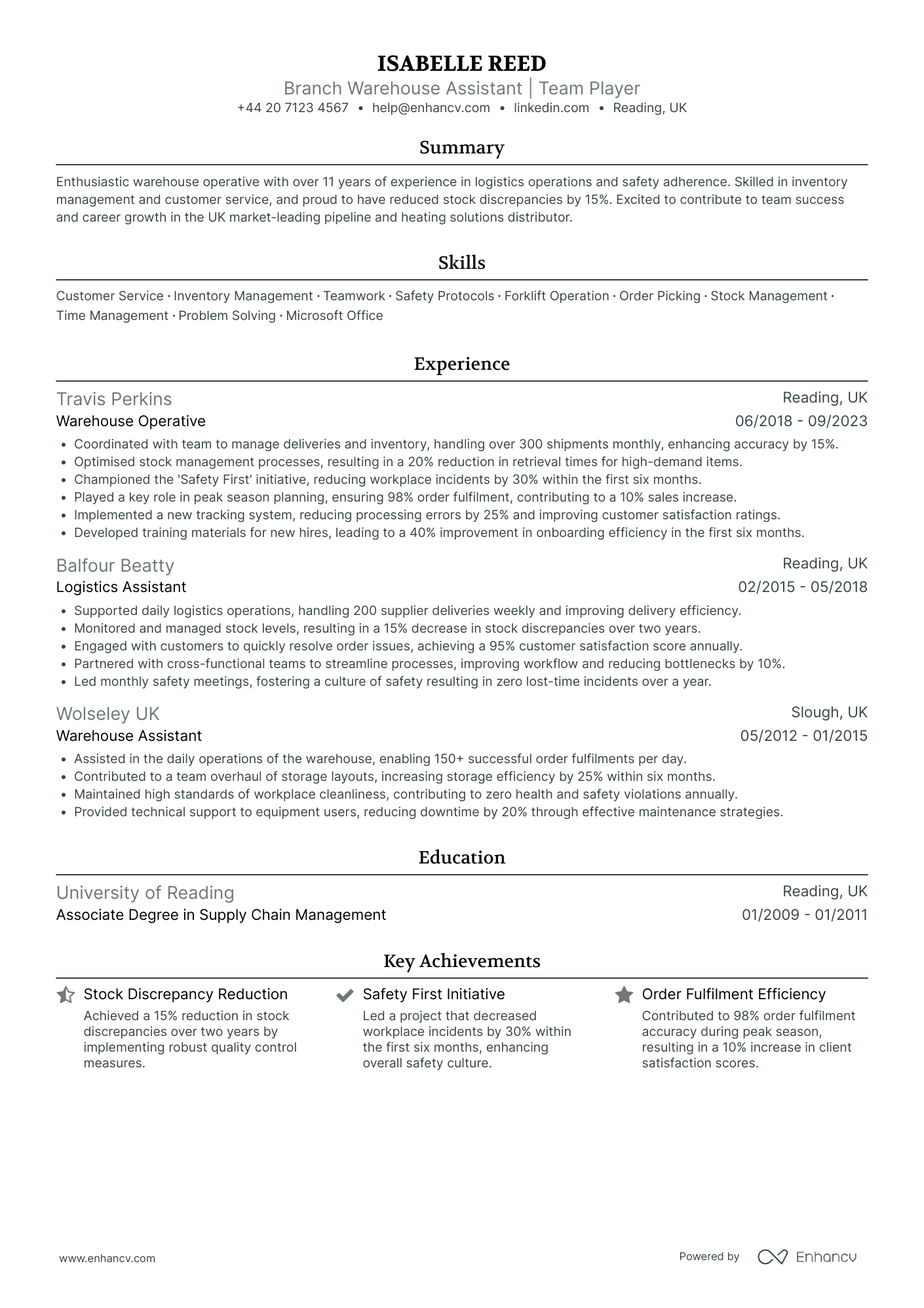
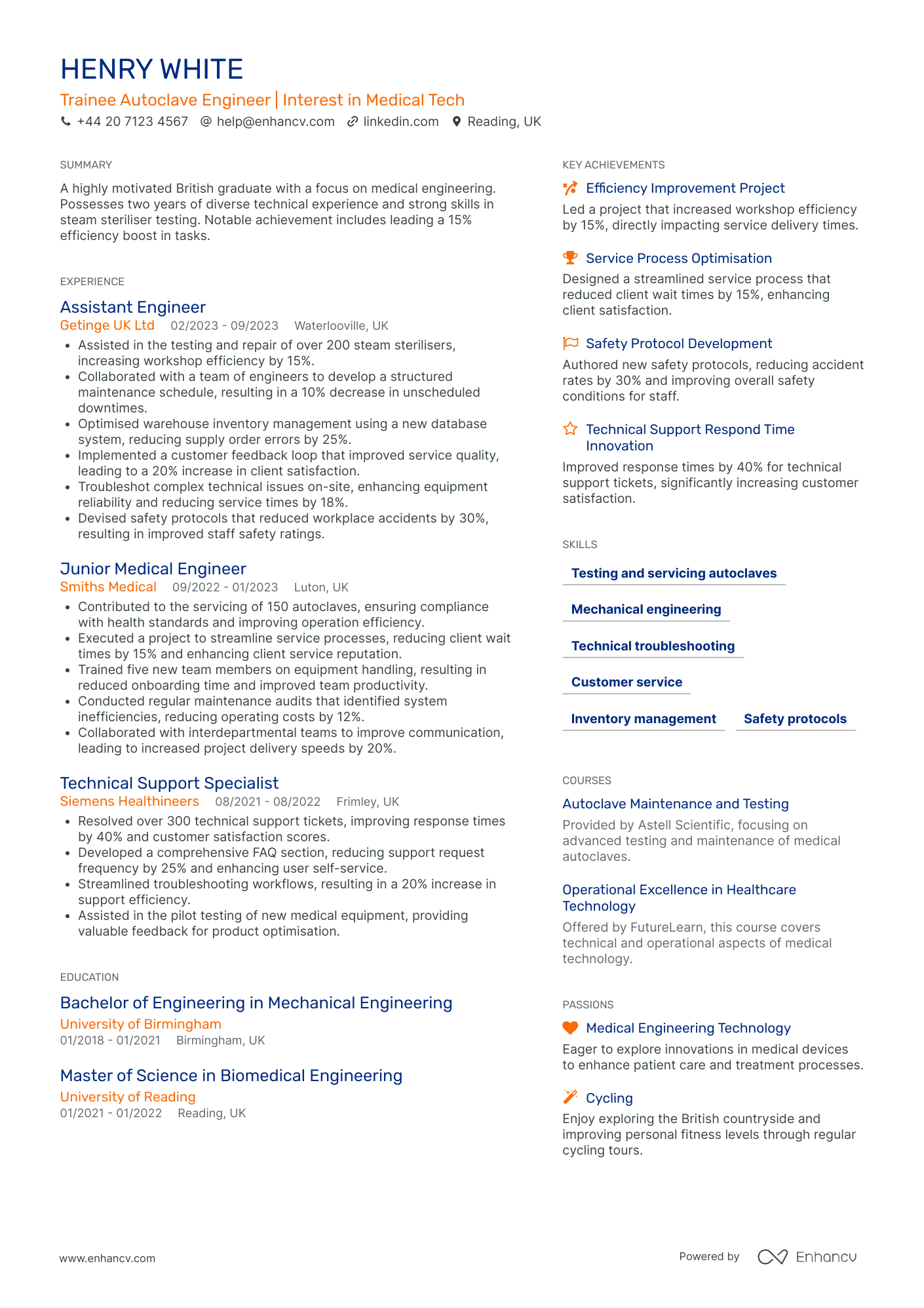
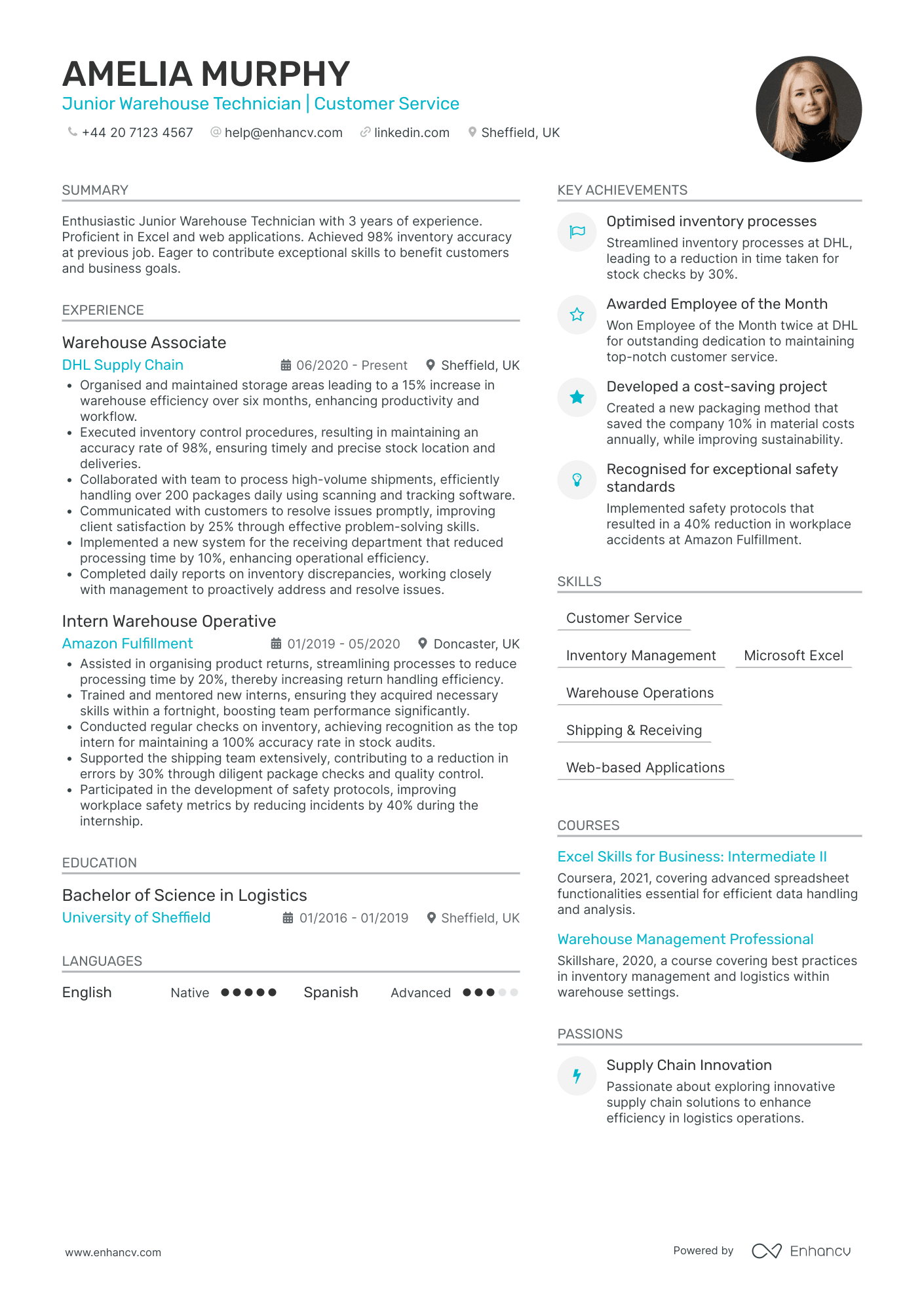
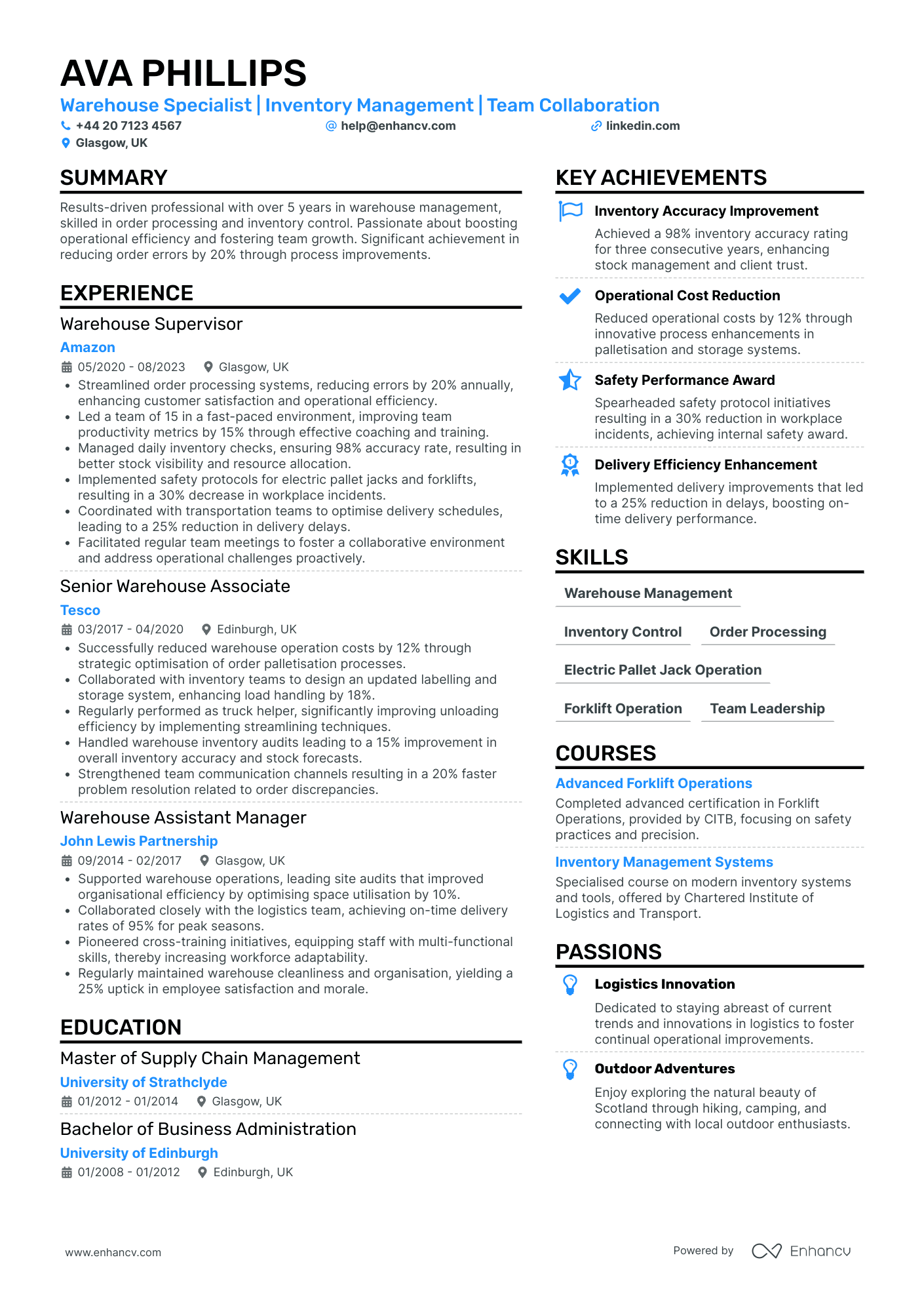
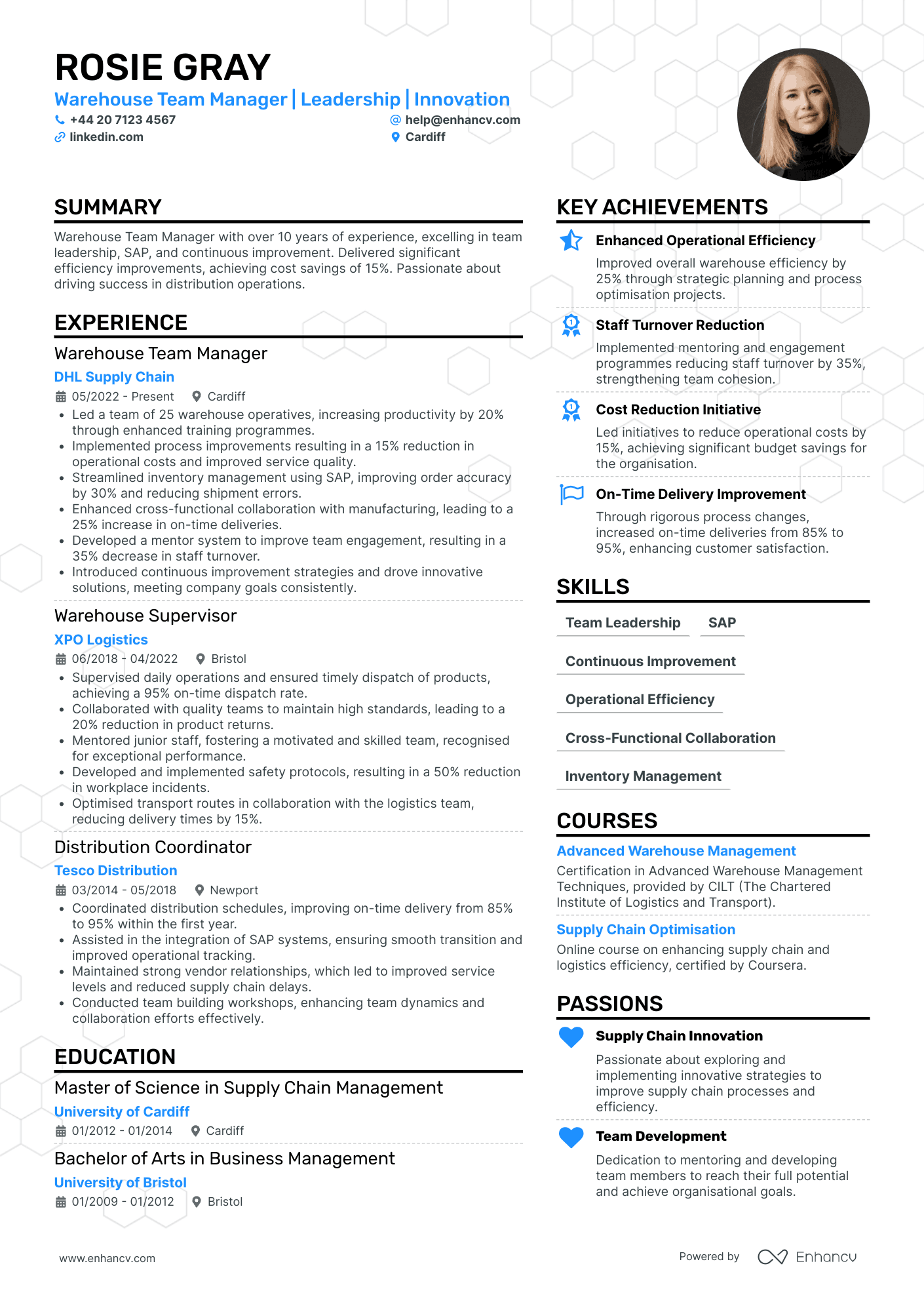
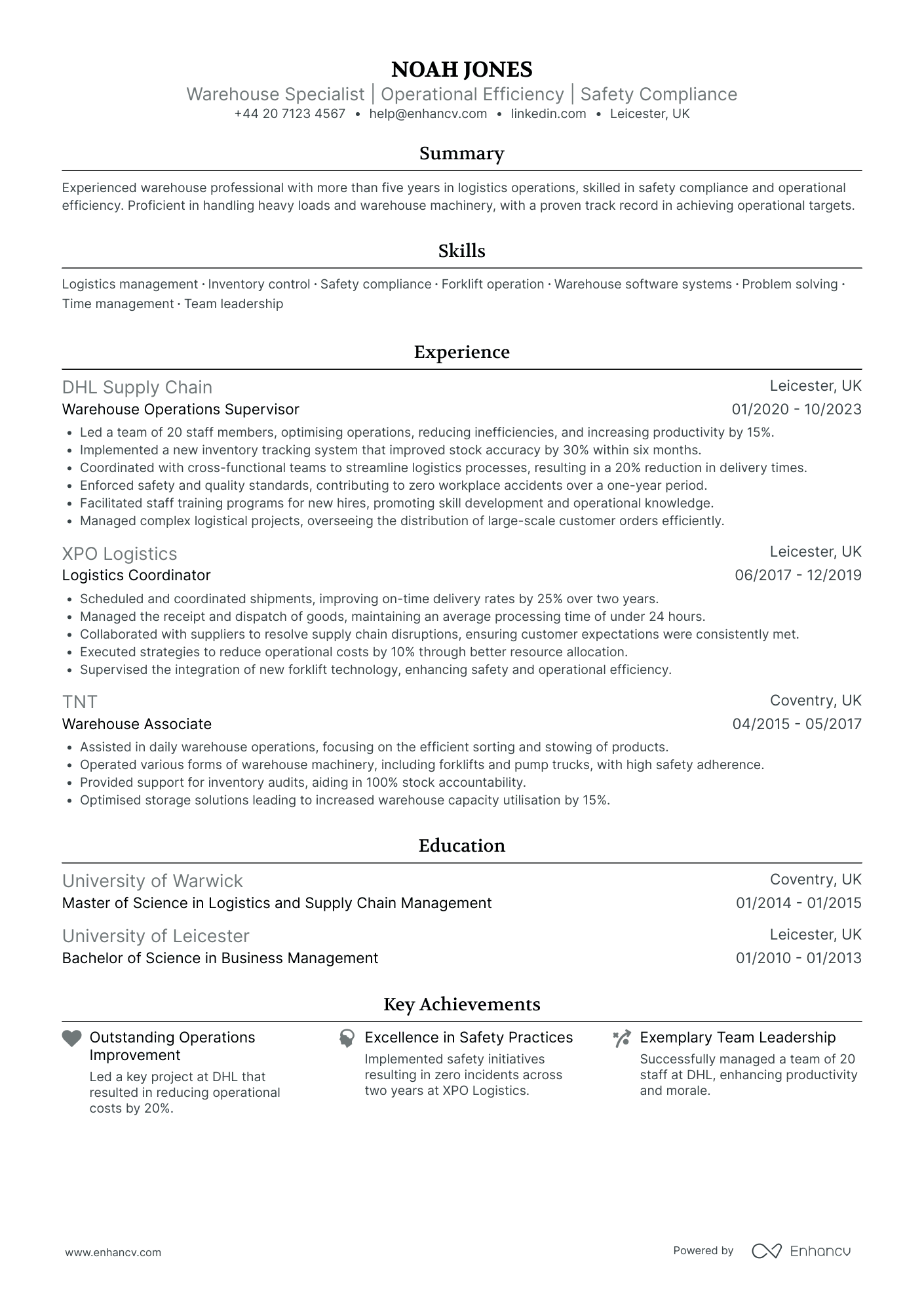
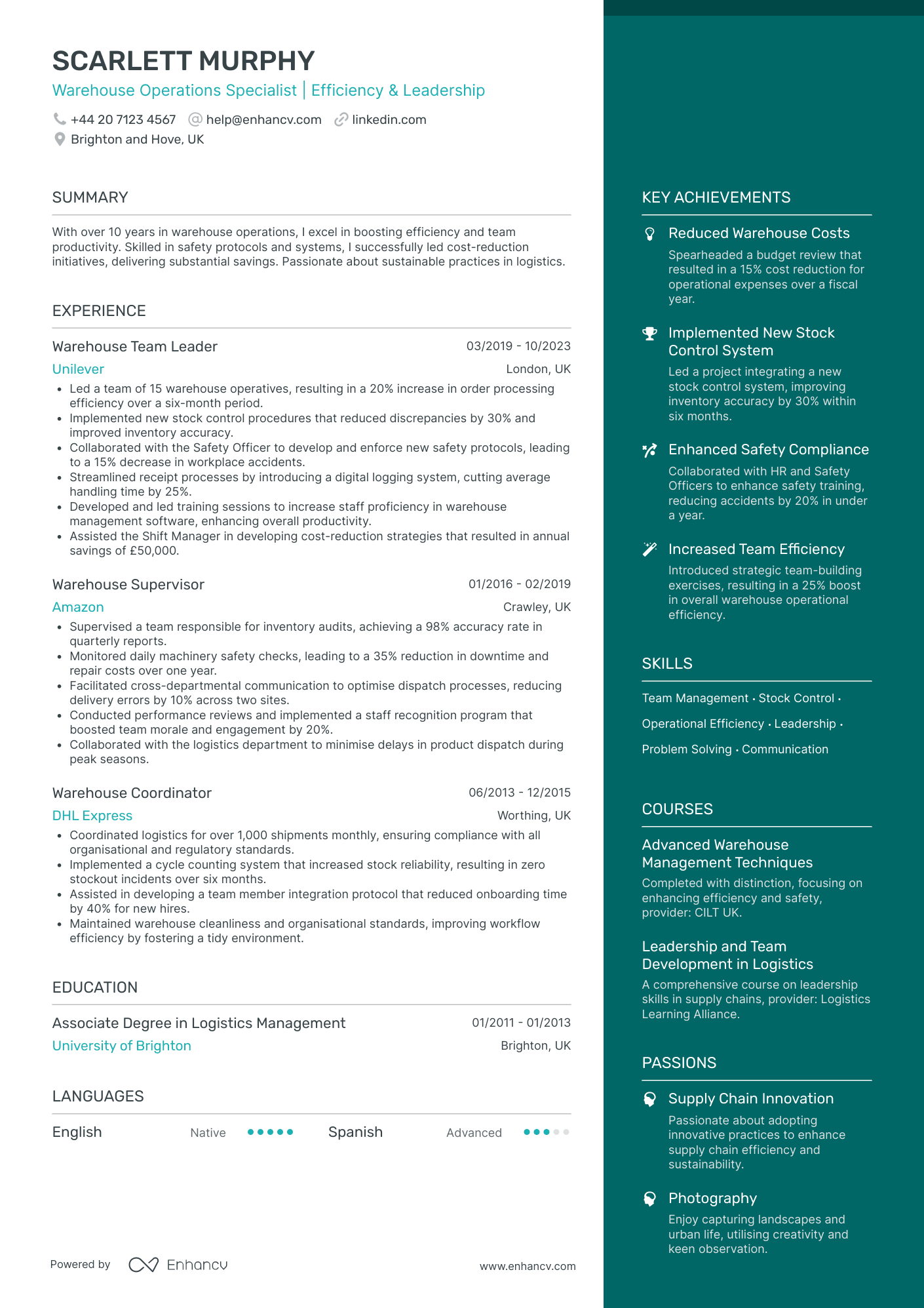
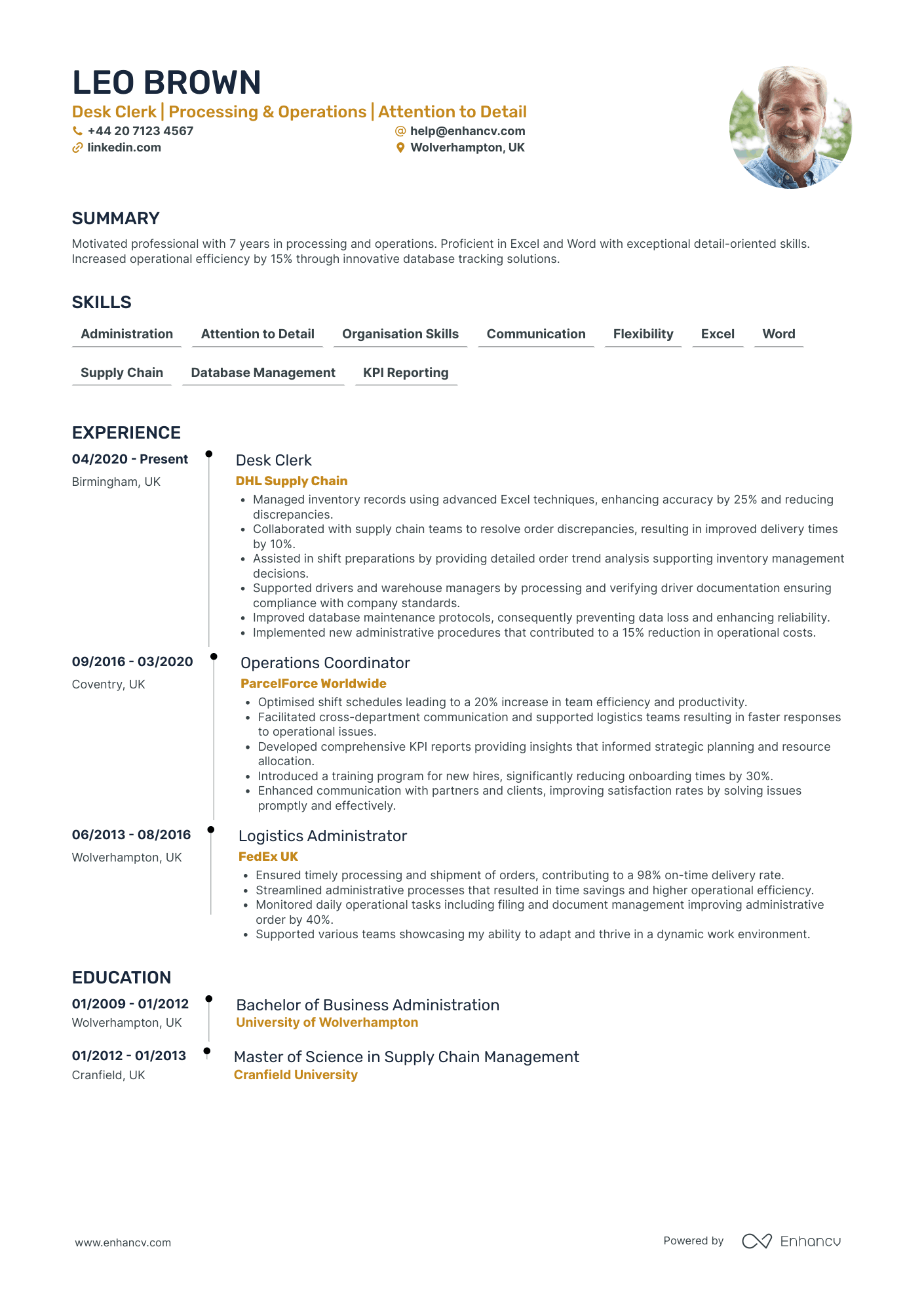
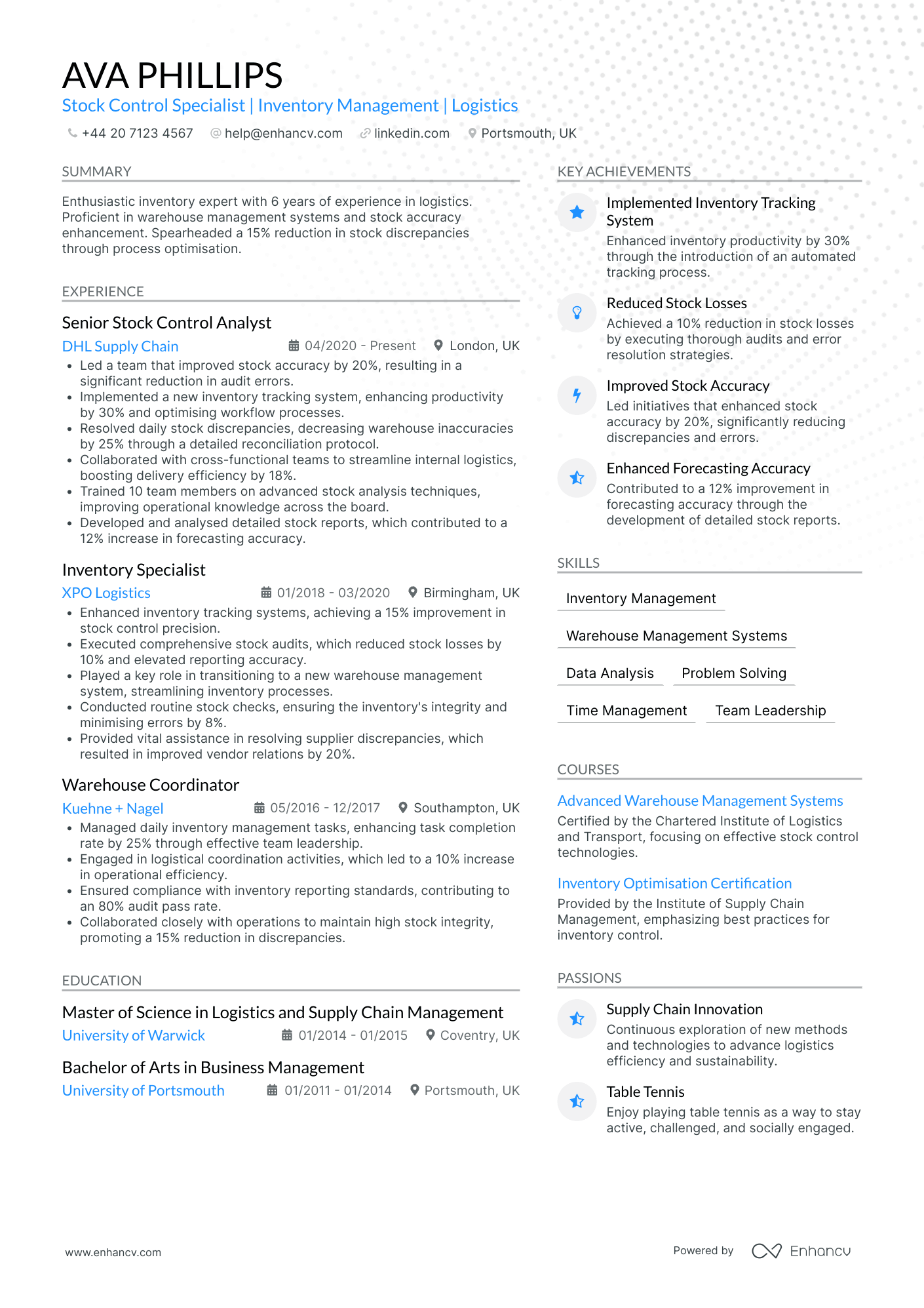
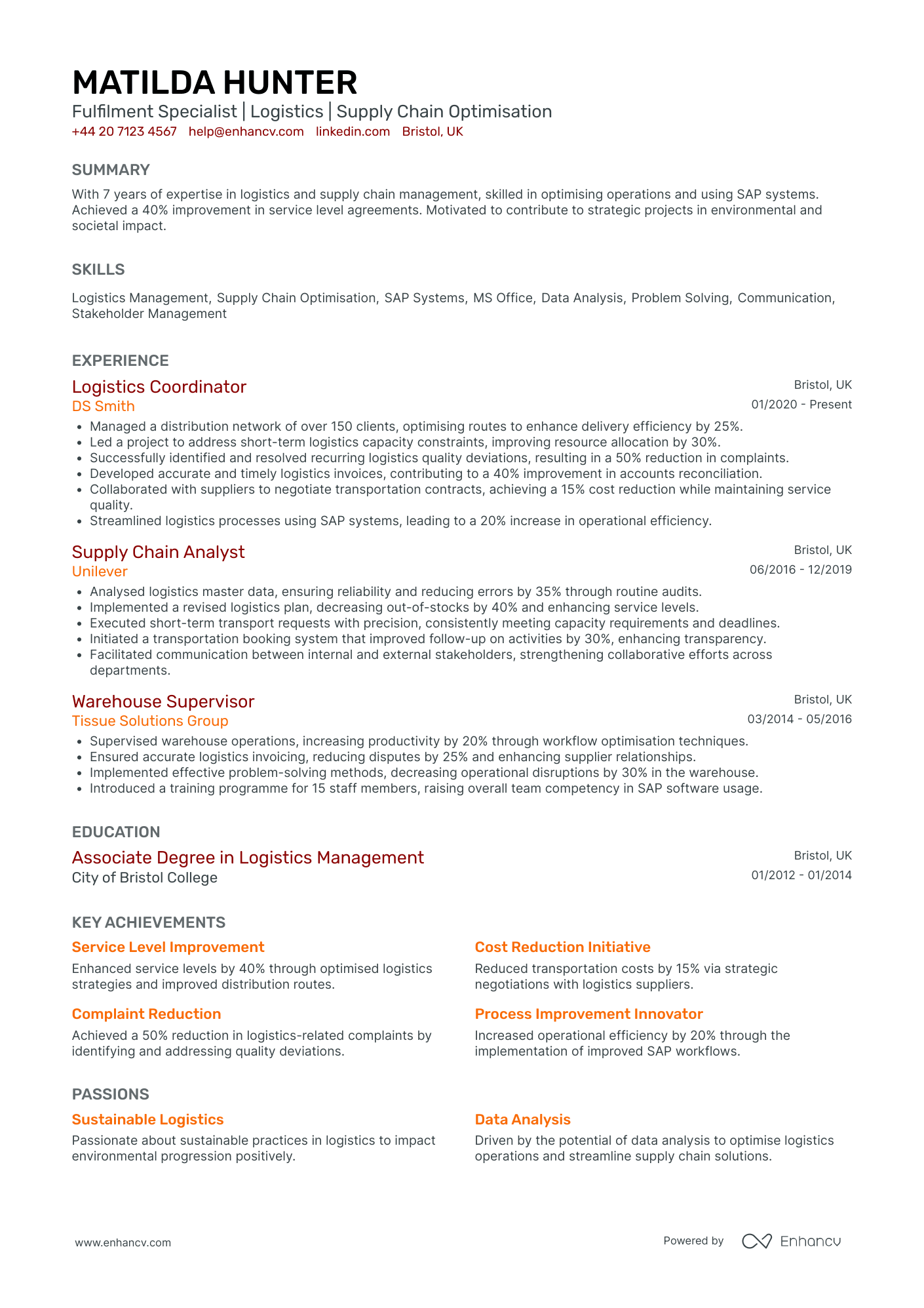
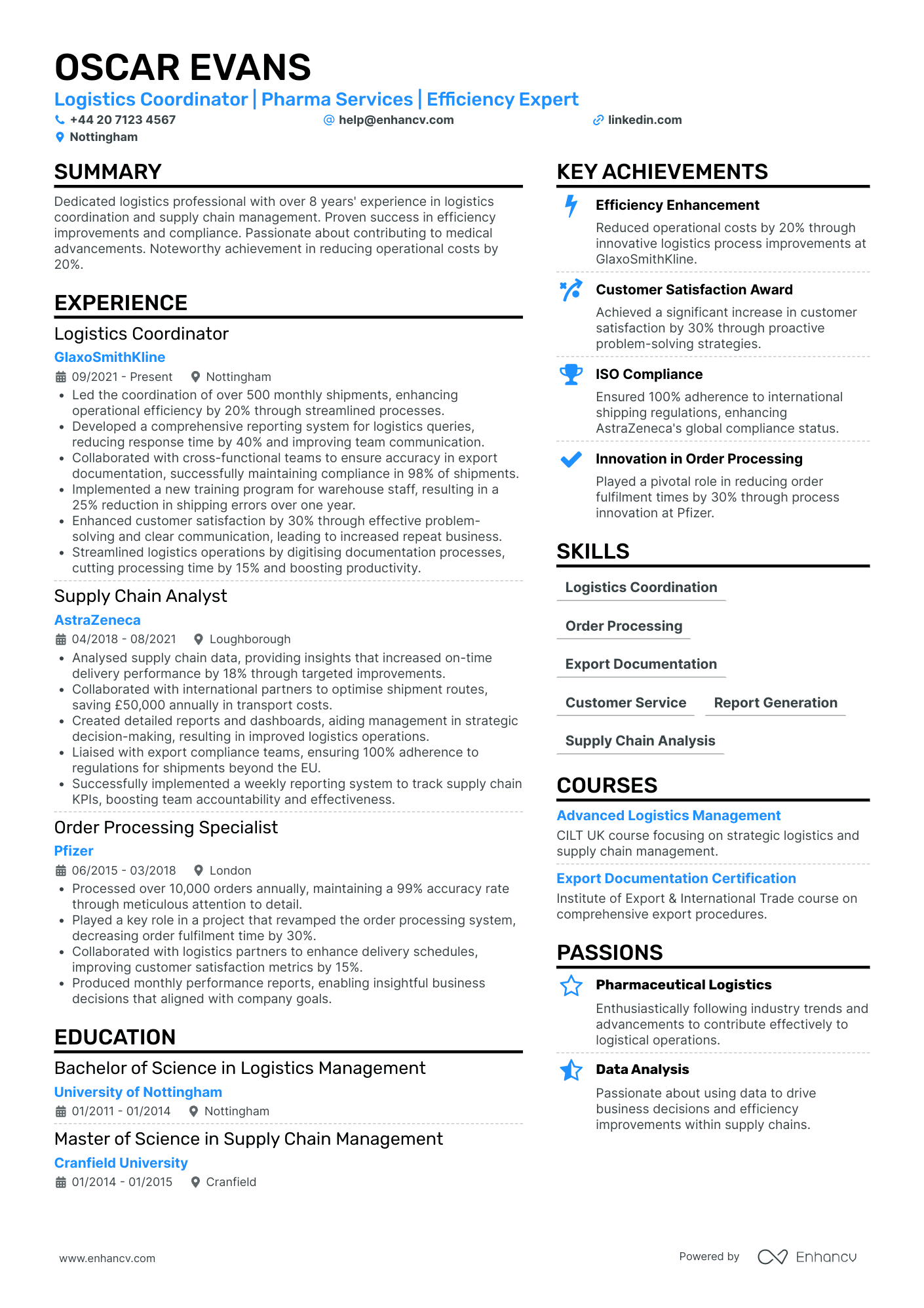
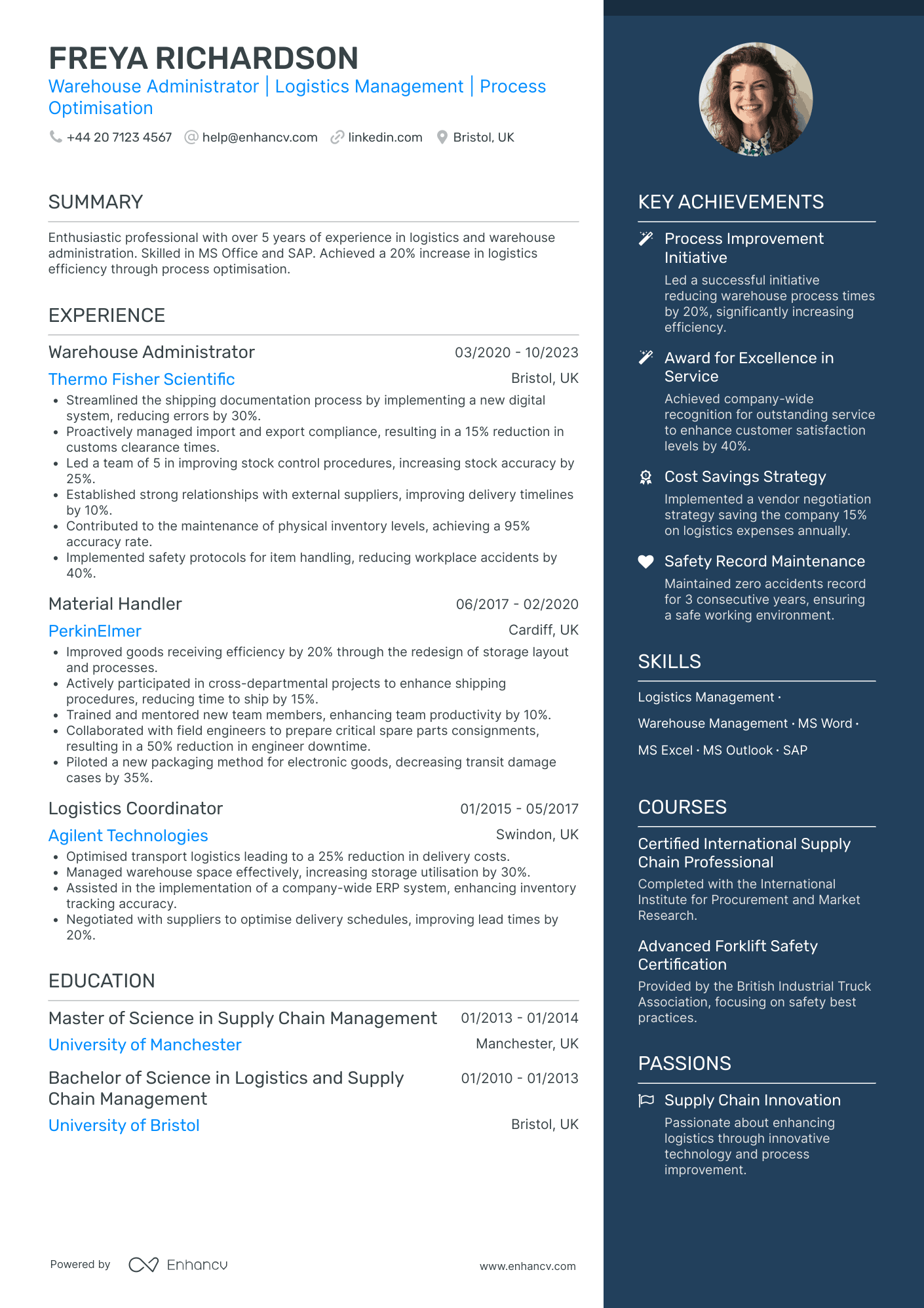
98% of UK warehouse postings are on-site (Enhancv's internal job feed, last ~30 days). A shift manager's first question is whether you can reliably get to the unit and pass the induction, so your CV has to answer it in the top third of the page.
Most warehouse CVs bury that answer under a vague profile and a wall of duties nobody asked for. The ones that get the call lead with the equipment they can operate, the shifts they can cover, and a clean safety record.

Key takeaways
- Warehouse work is almost always on-site, so put your location and the shifts you can cover near the top.
- Lead with the tickets and certificates you hold: forklift, counterbalance, reach truck, and manual handling.
- Name the skills adverts repeat, which are health and safety, inventory management, and stock control.
- Keep it to one or two pages, reverse chronological, one column, and sent as a PDF unless the advert asks for Word.
- Quantify the work: units picked per shift, pick accuracy, and stock discrepancies cut.
- No warehouse experience is fine here. Lead with reliability, any lifting or stockroom work, and a willingness to train.
Formatting your warehouse CV
A warehouse CV gets read in under a minute, often on a phone by a team leader between deliveries. Build it so the essentials survive a fast skim.
Use a reverse chronological layout once you have warehouse or manual work behind you, listing your most recent role first. If you are just starting out, a skills-led structure puts your certificates and reliability ahead of a thin work history.
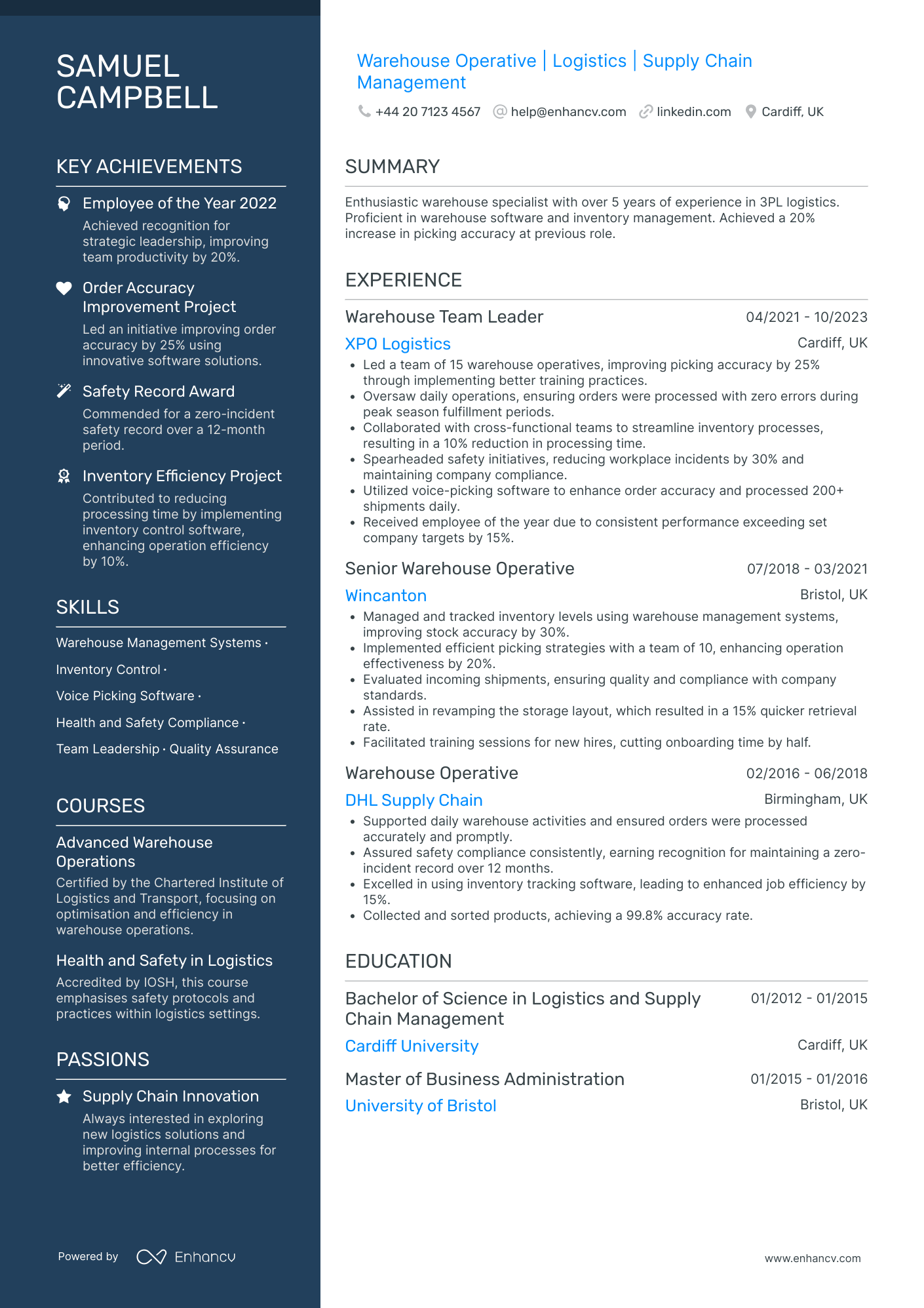
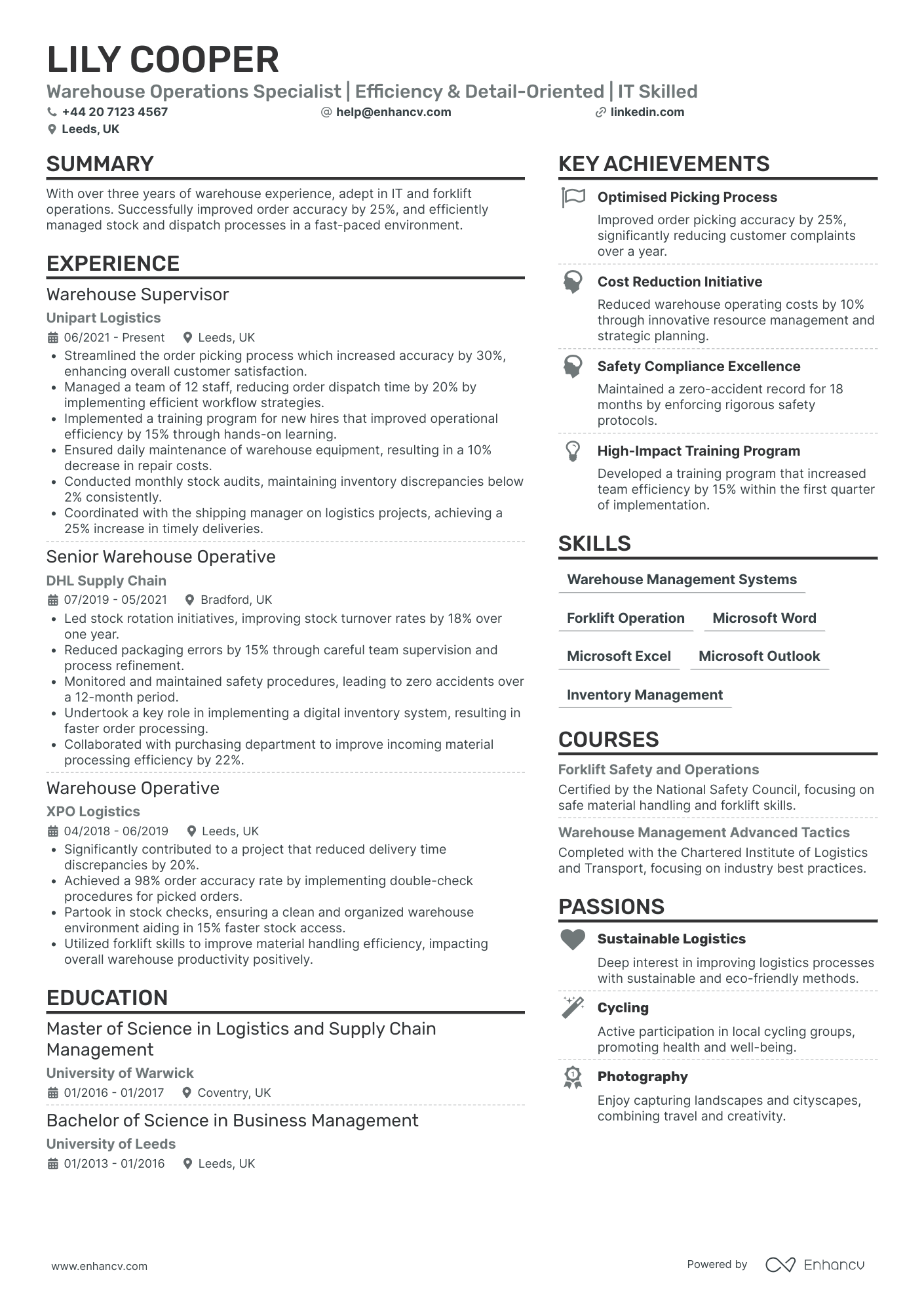
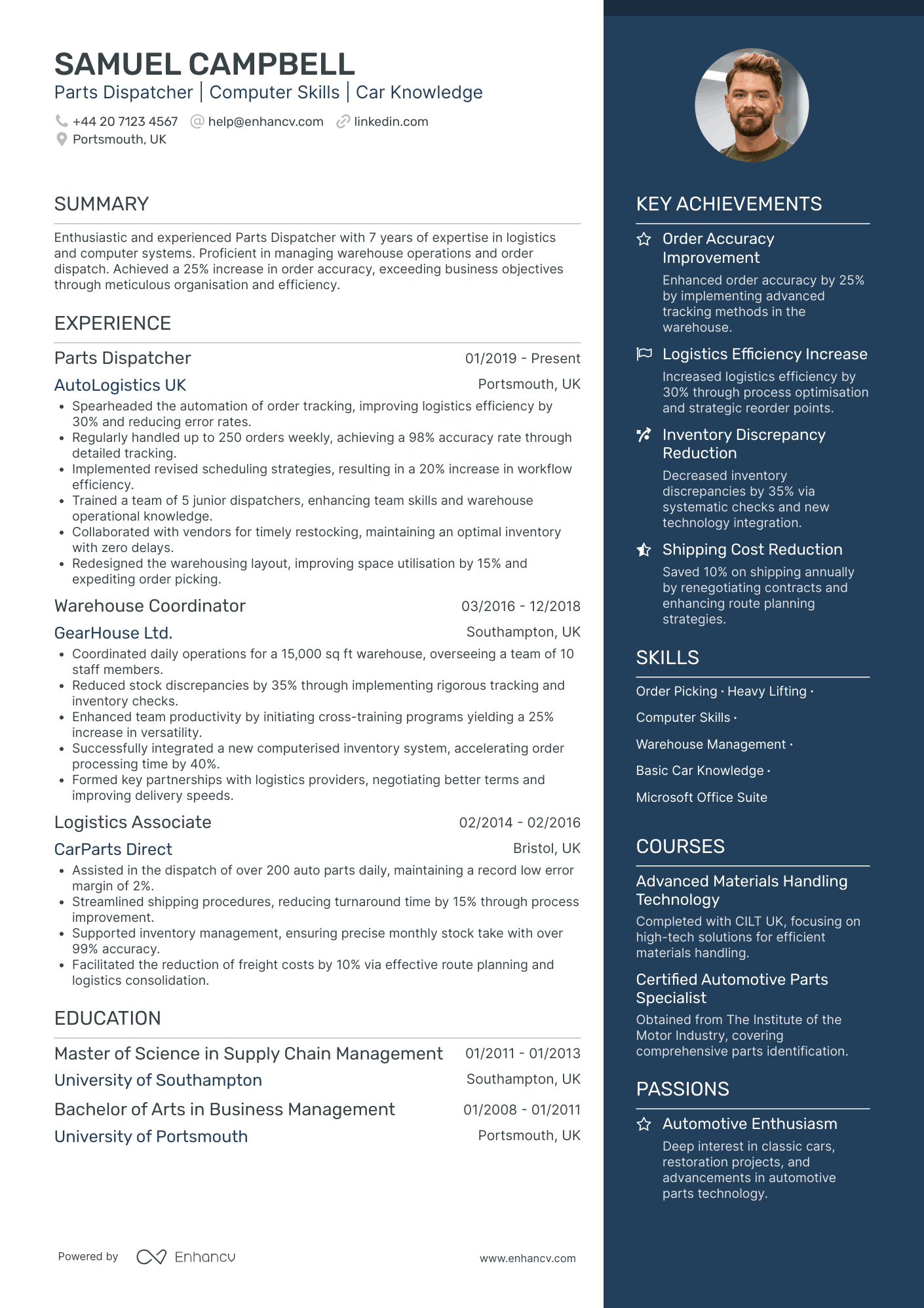
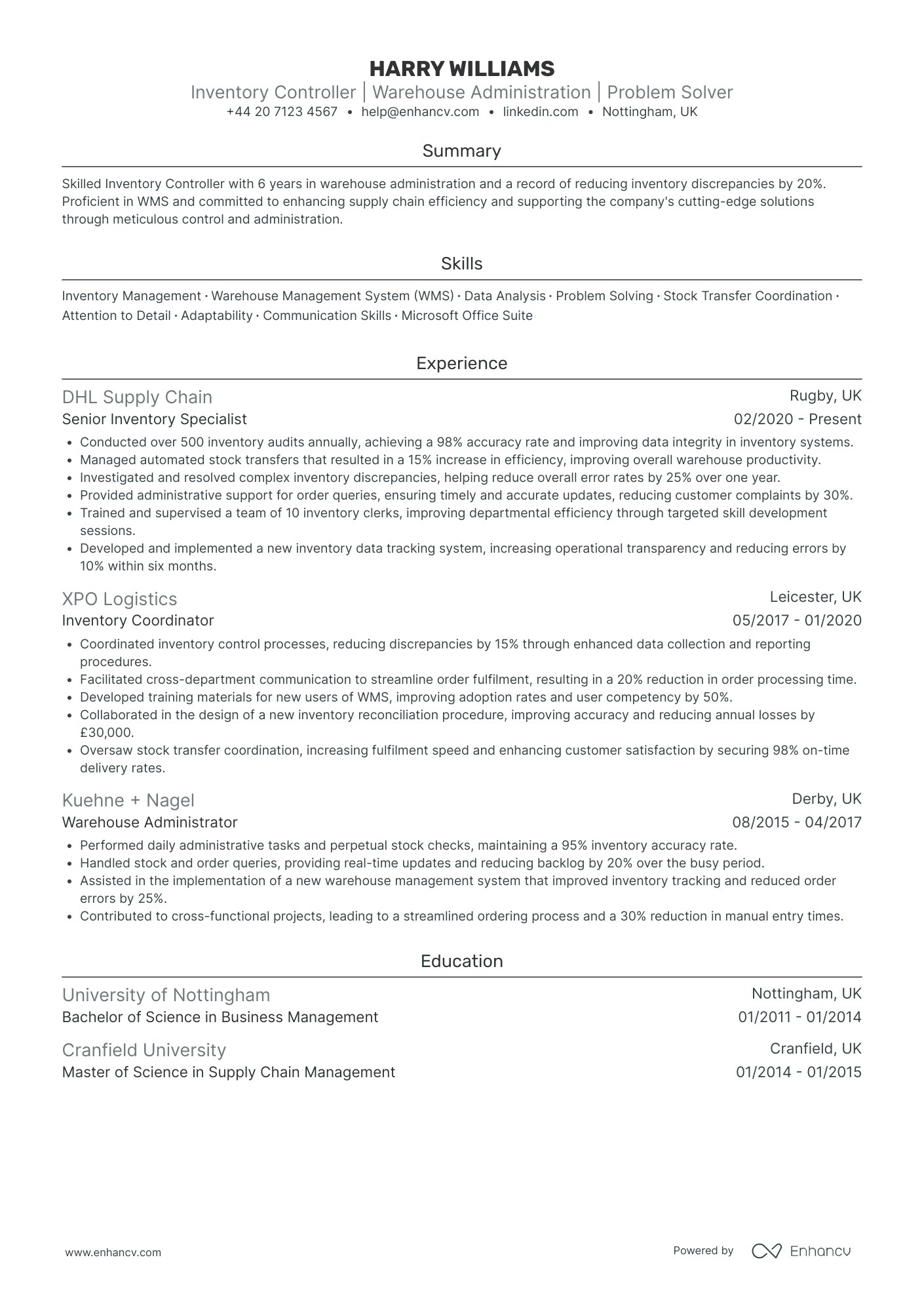
Keep it to one or two pages, one column, with standard headings and a readable font at 10 to 12 point. Colour blocks, icons, and two-column designs slow the read and confuse tracking software, so leave them out.
Order the page the way a warehouse recruiter reads it: header, personal statement, licences and certificates, key skills, then experience. The parts that decide the shortlist belong in the top third.
Your header does the heavy lifting on a warehouse CV. Name, phone, email, town, and the shifts you can cover, kept to a line or two. If you can work nights, weekends, or a 4-on-4-off pattern, say so here, because shift flexibility is often what separates two otherwise identical CVs.
One column beats two for this role. Tracking software reads a single column top to bottom without scrambling the order, and a human reading on a phone does not have to jump between panels.
Give the page room to breathe. Margins of around 2 cm, clear space between sections, and bold headings let a tired reader find the forklift line at a glance.
Put a licences and certificates line high on the page. A forklift ticket or an in-date manual handling certificate is often the first thing a warehouse recruiter checks, so it should never sit at the bottom next to your hobbies.
Send a PDF for direct applications so the layout holds on any screen. Keep a Word copy for agencies, which place a large share of warehouse roles and paste your CV into their own template. If the advert names a file type, follow it exactly.
Applications to the large logistics employers usually pass through tracking software, so keep the headings standard and the layout clean for an ATS-friendly CV. Build it from a tested layout rather than a blank page. Enhancv's CV templates export to a clean, one-column PDF that reads the same on a warehouse office monitor as it does on a phone.
Name the file so a busy recruiter can find it later. "Jordan-Smith-Warehouse-CV.pdf" beats "cv-final-v3.pdf", and it looks tidy in an inbox of two hundred applications. Small thing, but the sloppy ones lose out on small things.

PRO TIP
Warehouse adverts list equipment, not adjectives. If you hold a licence, name it exactly as the advert does: counterbalance forklift, reach truck, LLOP, or PPT. Recruiters and tracking software search for the precise term, not a paraphrase.
Is your CV good enough?
Drop your CV here or choose a file. PDF & DOCX only. Max 2MB file size.
What to put on a warehouse CV
A warehouse CV has a predictable shape, and recruiters skim the sections in the same order every time.
Include these, top to bottom:
- A header with your name, phone, email, town, and the shifts or hours you can work.
- A short personal statement, three or four lines, built on reliability and what you can operate.
- A licences and certificates block: forklift categories, manual handling, and any health and safety training.
- A key skills section using the terms straight from the advert.
- Work experience in reverse chronological order, with quantified bullets.
- Education, kept brief, plus a driving licence if you hold one.
Leave off a photo, your date of birth, and a full home address. A town and postcode area is enough, and it tells the recruiter how far you would travel to each shift.

What a warehouse recruiter checks first
A shift manager reads a warehouse CV in a fixed order, and drops out fast if the answer is missing. In roughly this sequence they look for:
- Can you get here for every shift, including the awkward ones?
- What can you legally and safely operate, and is the ticket in date?
- Have you done the pace before, and can you prove it with a number?
- Is your record clean on safety and attendance?
Answer those four in the top half of the page and the rest of the CV is a formality.
Writing your warehouse personal statement
Three or four sentences at the top: who you are, what you can operate, the shifts you can cover, and one concrete result. Keep it specific. Browse more personal statement examples if the opening line will not come.
Avoid the adjective soup every other CV opens with. "Hard-working, reliable team player" tells a recruiter nothing they can check.
Lead with evidence instead.
Warehouse operative CV personal statement example
Reliable warehouse operative with three years in high-volume distribution, holding a valid counterbalance forklift licence and manual handling certification. Consistently picked 180 to 200 orders a shift at 99.6% accuracy across days and nights. Comfortable with RF scanners and warehouse management systems, and available for rotating shifts within 20 minutes of Coventry.
What to avoid
Hard-working and motivated team player looking for a challenging warehouse role in a dynamic company where I can use my skills and grow. Passionate about logistics and always willing to go the extra mile.
When we read a warehouse CV, we are hunting for three things in the first ten seconds: what you can drive, when you can work, and whether the numbers are real. A line like "picked 190 orders a shift at 99.6% accuracy" beats a paragraph of adjectives every time. Put the forklift categories and the shift availability where a phone screen shows them without scrolling, and you have already beaten most of the pile.
the Enhancv team
Writing your warehouse experience section
Write each role as a dated heading, then bullets that lead with an action verb and end in a result. For the mechanics, see work experience on a CV.
Warehouse work is more measurable than it feels. Units picked, pick accuracy, stock discrepancies cut, vehicles loaded, and shifts covered are all CV achievements a recruiter can weigh.
Build each bullet as verb, task, then number. "Picked" plus "orders using RF scanners" plus "at 99.6% accuracy" reads as a fact a manager can check, where "responsible for picking duties" reads as a job description. Drop the duties nobody rewards, like "kept the area tidy", unless you can tie them to a result.
Tailor every application by pulling the equipment and duties from the advert and mirroring the ones that are true of you. Enhancv's CV tailoring feature reads the job ad and suggests the matching edits, which saves rewriting from scratch each time.
- Pick and pack 180 to 200 orders per shift using RF scanners, holding 99.6% pick accuracy over the last 12 months
- Operate a counterbalance forklift to load and unload up to 26 pallets a shift, with zero reportable incidents
- Cut stock discrepancies by 22% by tightening the cycle-count routine on the mezzanine racking
- Train two to three new starters each quarter on manual handling and safe use of the reach truck
- Packed and labelled up to 500 items a shift during peak, meeting the daily dispatch cut-off every day
- Checked inbound deliveries against purchase orders and flagged shortages, keeping goods-in records accurate
- Kept pick faces replenished and aisles clear, supporting a team of 15 across a two-shift operation
PRO TIP
One real number beats five lines about being a team player. If you do not track your own figures, ask your team leader for pick rate, accuracy, or loading targets. Most warehouses measure them, and a single verified stat lifts a CV above the stack.
Skills for your warehouse CV
Read a dozen live warehouse adverts and the same demands repeat. Health and safety, inventory management, forklift operation, warehouse operations, and stock control come up again and again, and they are the skills that recur most often in UK warehouse postings (Enhancv's internal job feed, last ~30 days).
List those hard skills in the exact words the adverts use, and only the ones you can stand behind. If you hold the ticket, name it. If the training is booked but not finished, put it under "in progress" rather than skills.
The soft skills that matter on the floor are checkable ones: communication, teamwork, and reliability. Prove each in a bullet rather than just claiming it.
Turn each skill into proof. Health and safety becomes "held a clean incident record across 18 months of forklift operation". Inventory management becomes "ran weekly cycle counts that kept discrepancies under 1%". Stock control becomes "managed replenishment for 400 pick faces to a daily deadline". The skill names get you past the filter, and the numbers get you the interview.
Top skills for your warehouse CV:
Health and safety
Inventory management
Forklift operation (counterbalance, reach)
Warehouse operations
Stock control
Manual handling
RF scanning and WMS
Order picking and packing
Communication
Teamwork
Reliability
Attention to detail
Time management
What the UK warehouse market looks like
Knowing the market shapes the CV. Here is what UK employers are asking for right now, and two of these numbers should change what you put near the top.
| What | UK warehouse roles |
|---|---|
| Where the work happens | On-site (735 of 749 UK postings in the last ~30 days, Enhancv's internal job feed) |
| Experience level asked for | Entry 67% · lead 19% · mid 14% |
| Most-listed skills | Health and safety, inventory management, forklift, warehouse operations, and stock control |
Warehouse work is almost entirely on-site, so a recruiter needs to see you can get there and back for every shift. Put your town and travel radius in the header, and add a driving licence if you hold one.
Two thirds of postings are pitched at entry level, which is why the no-experience route below is realistic rather than wishful. Employers here hire for reliability and train for the rest.
Writing a warehouse CV with no experience
Warehousing is one of the most entry-friendly sectors in the UK. Most employers train you on the equipment and the systems once you start, so your first CV carries its weight differently.
Lead with a skills-led structure: personal statement, then skills and any physical or stockroom work, then education, with work history lower down. See CV examples for a first job for the full layout.
Mine your history for real evidence. It is usually there:
- Retail or supermarket stockroom work: deliveries, replenishment, and stock rotation.
- Any lifting or on-your-feet role: hospitality, removals, construction labouring, or grounds work.
- Delivery driving or courier work: routing, load security, and hitting a drop schedule.
- Volunteering at a food bank, charity shop, or community warehouse, given a dated entry with hours.
Write those in warehouse language. "Unloaded and checked deliveries against invoices, then replenished shelves to a daily deadline" is a warehouse bullet that happened in a shop.
One line lifts a no-experience CV up the pile: "Forklift training booked" or "manual handling certificate completed". It shows you are already on the path.
Then say plainly what you offer while you learn the kit: full availability, physical fitness, and a clean attendance record. Warehouses lose money to no-shows, so a candidate who turns up on time for every shift is worth training.
Warehouse CV personal statement example (no experience)
Reliable and physically fit school leaver seeking a first warehouse role, with a year of Saturday stockroom work at a busy supermarket covering deliveries, replenishment, and stock rotation. Manual handling certificate completed and forklift training booked for next month. Available for early, late, and weekend shifts within easy reach of Leeds.
Conclusion
Lead with what you can operate and when you can work, name the skills the adverts repeat, and keep the format clean and on-site-friendly.
Back the CV with a short cover letter that names the shift pattern you want, and you turn a stack of duties into a CV that gets the call.
Author's take - the Enhancv team
When we read a warehouse CV, we are hunting for three things in the first ten seconds: what you can drive, when you can work, and whether the numbers are real. A line like "picked 190 orders a shift at 99.6% accuracy" beats a paragraph of adjectives every time. Put the forklift categories and the shift availability where a phone screen shows them without scrolling, and you have already beaten most of the pile.