



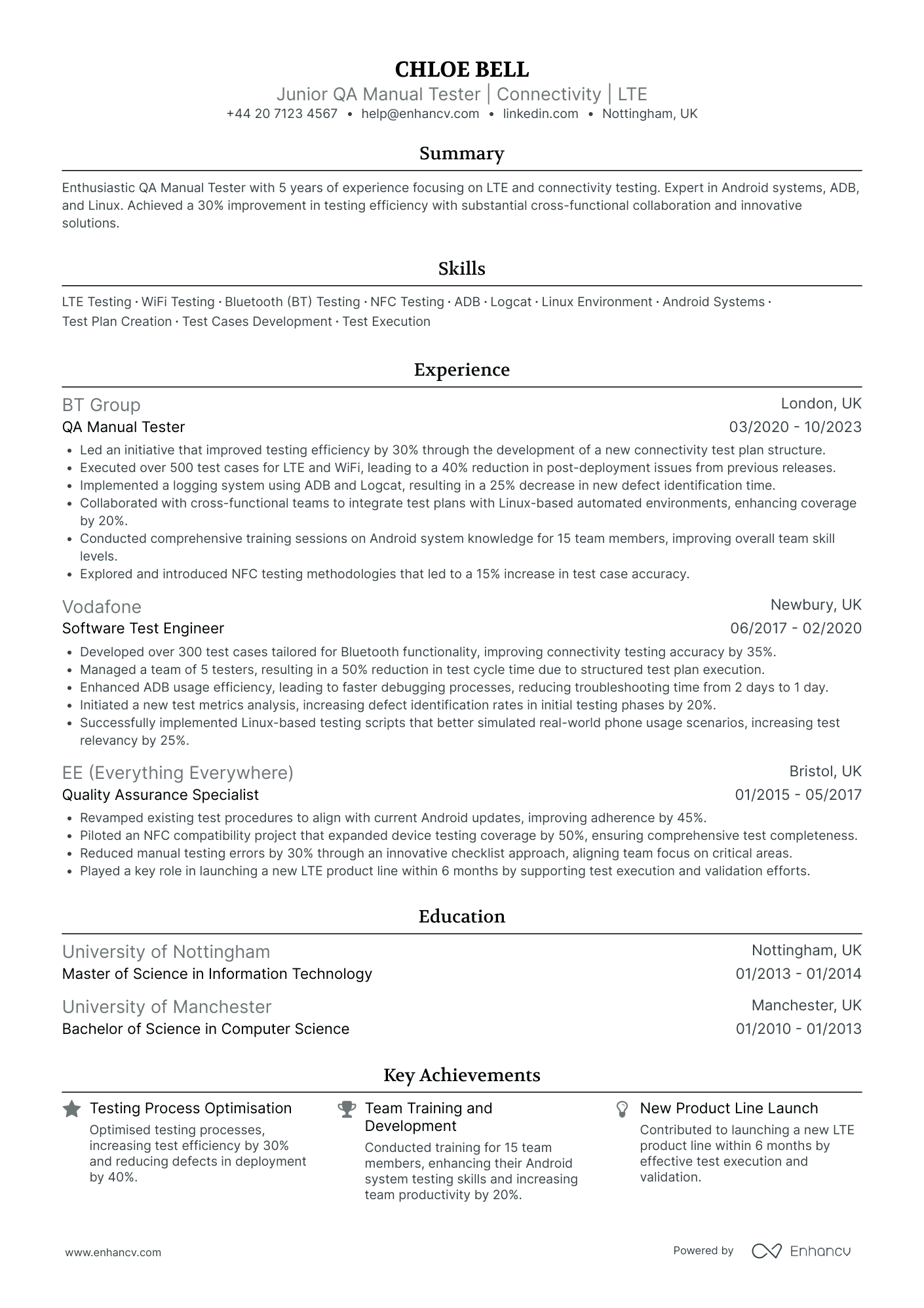
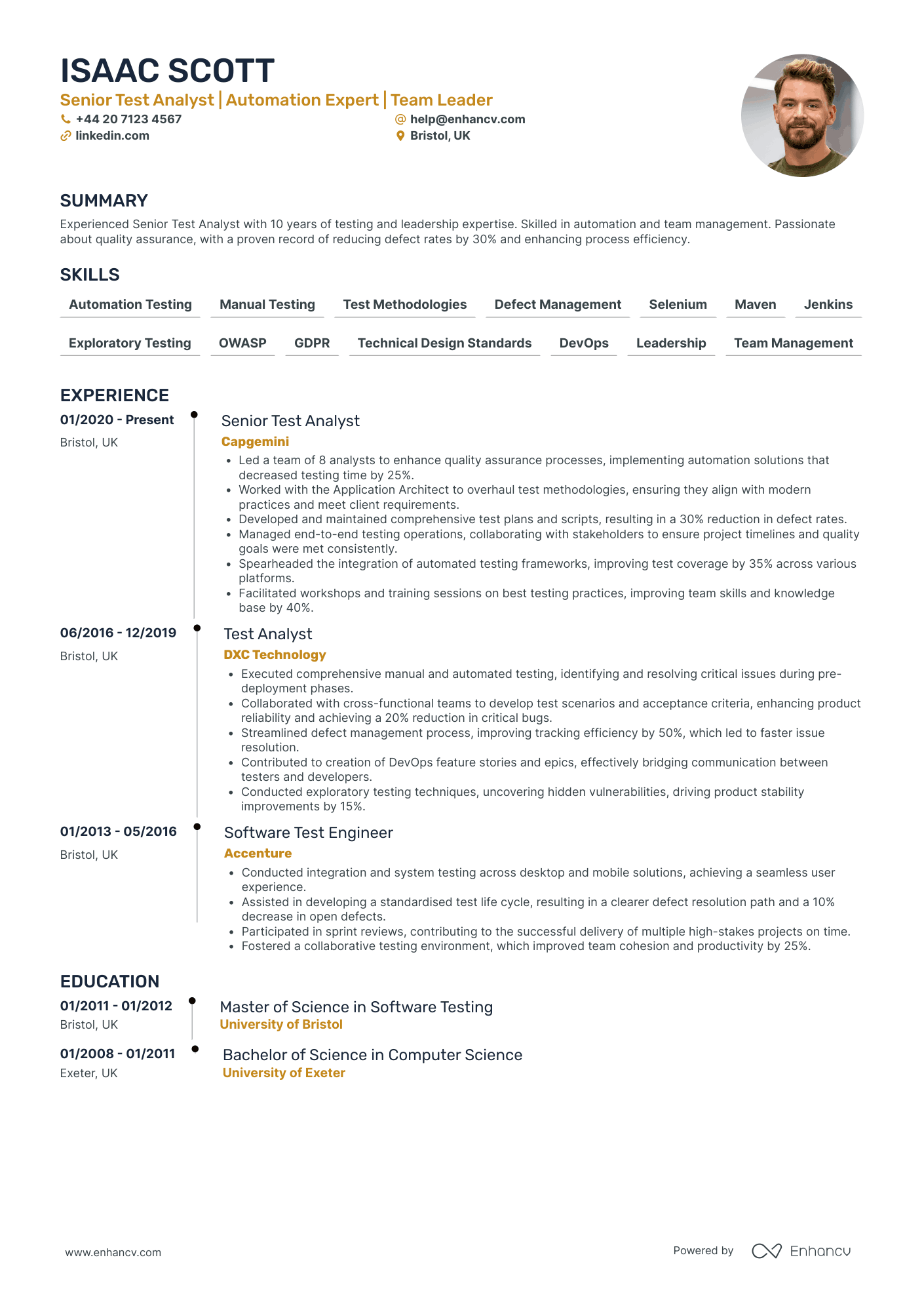
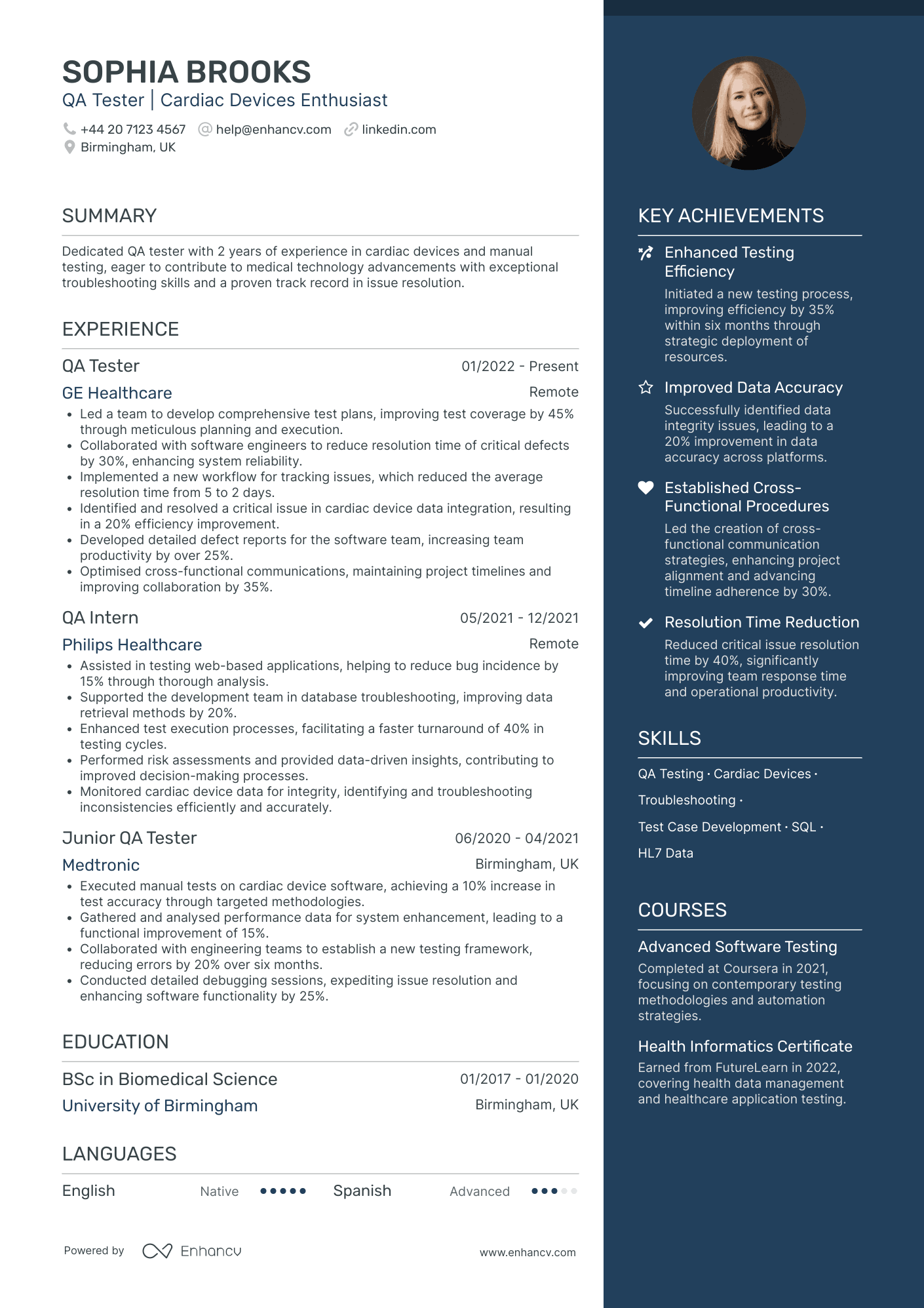
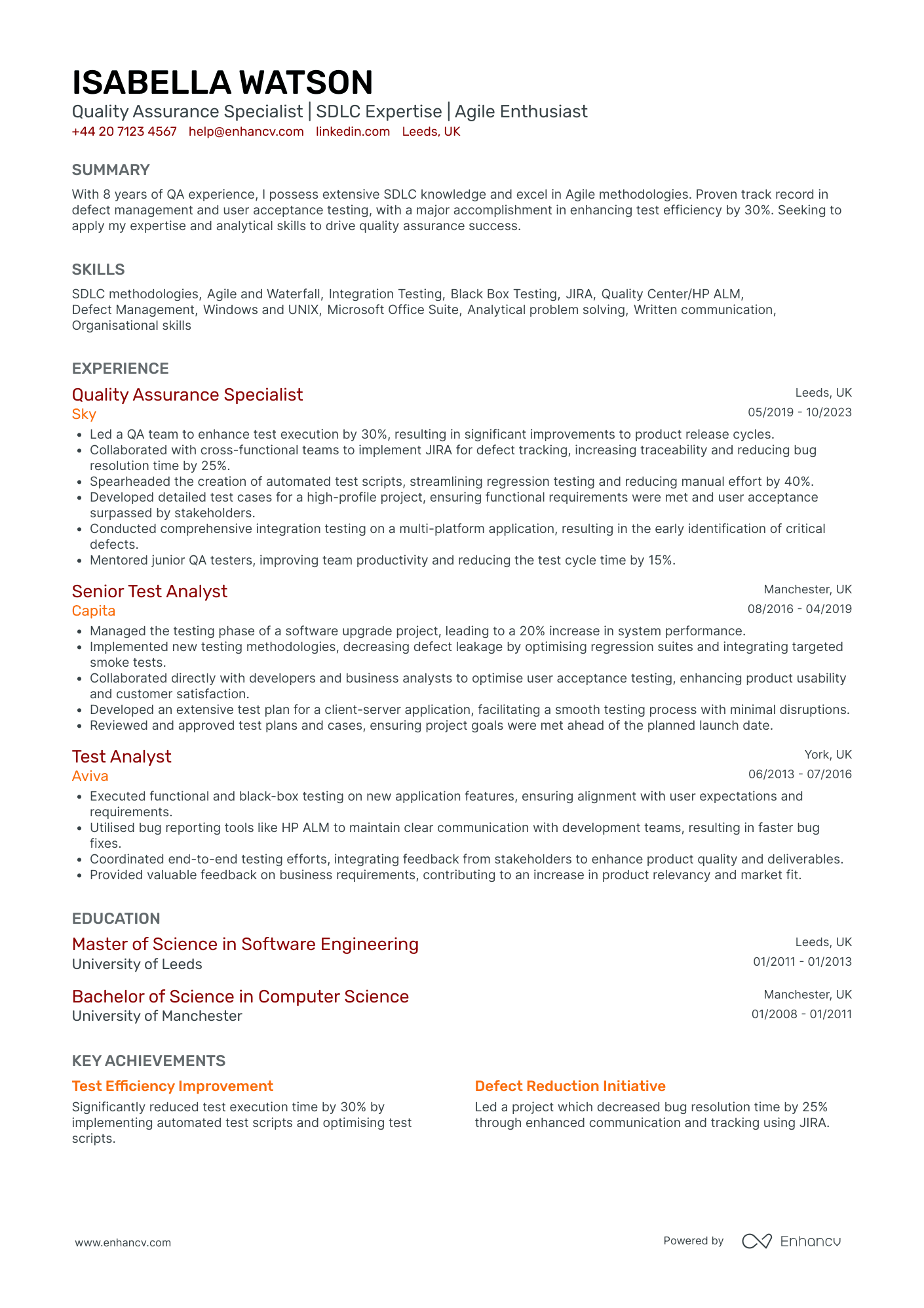
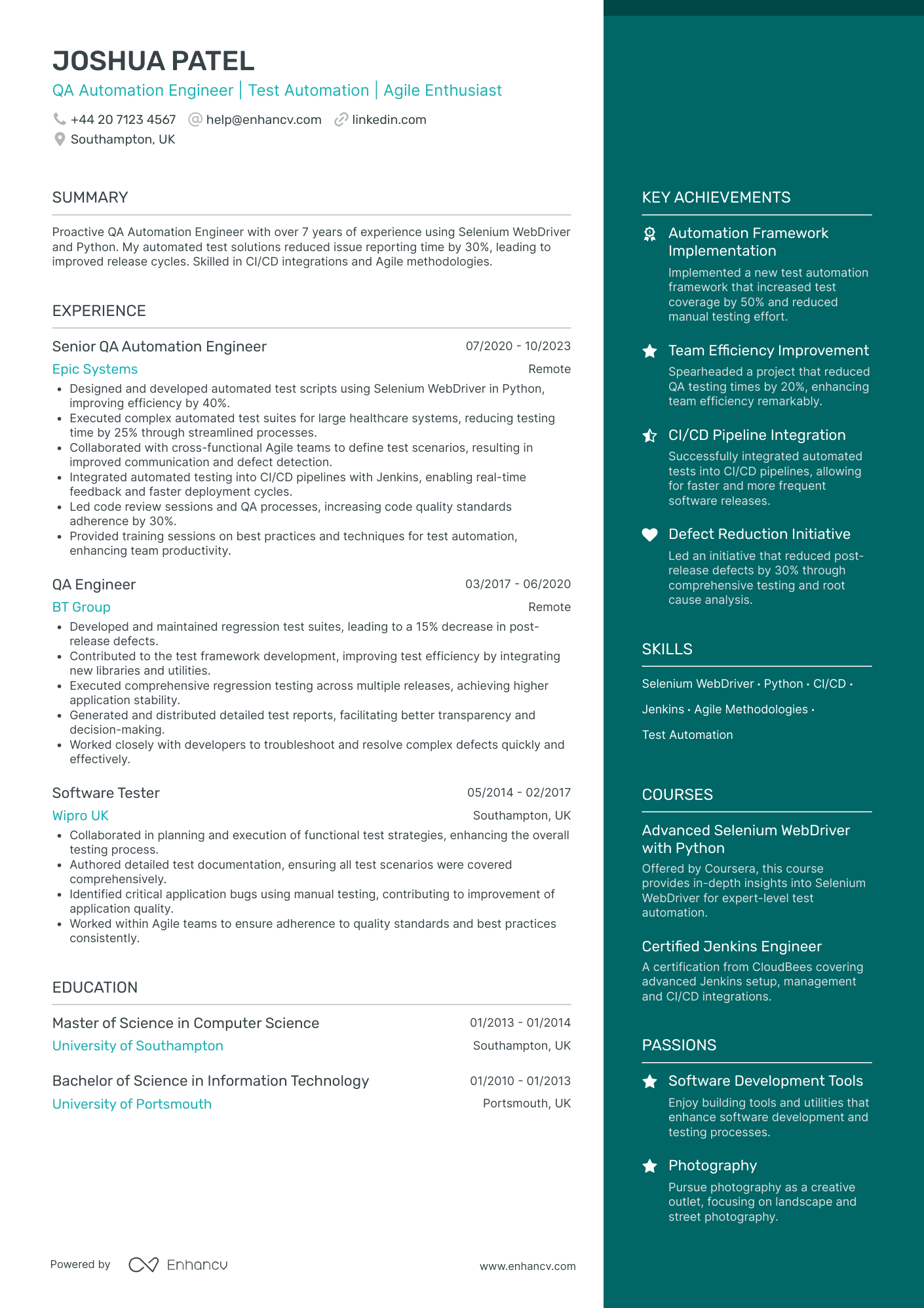
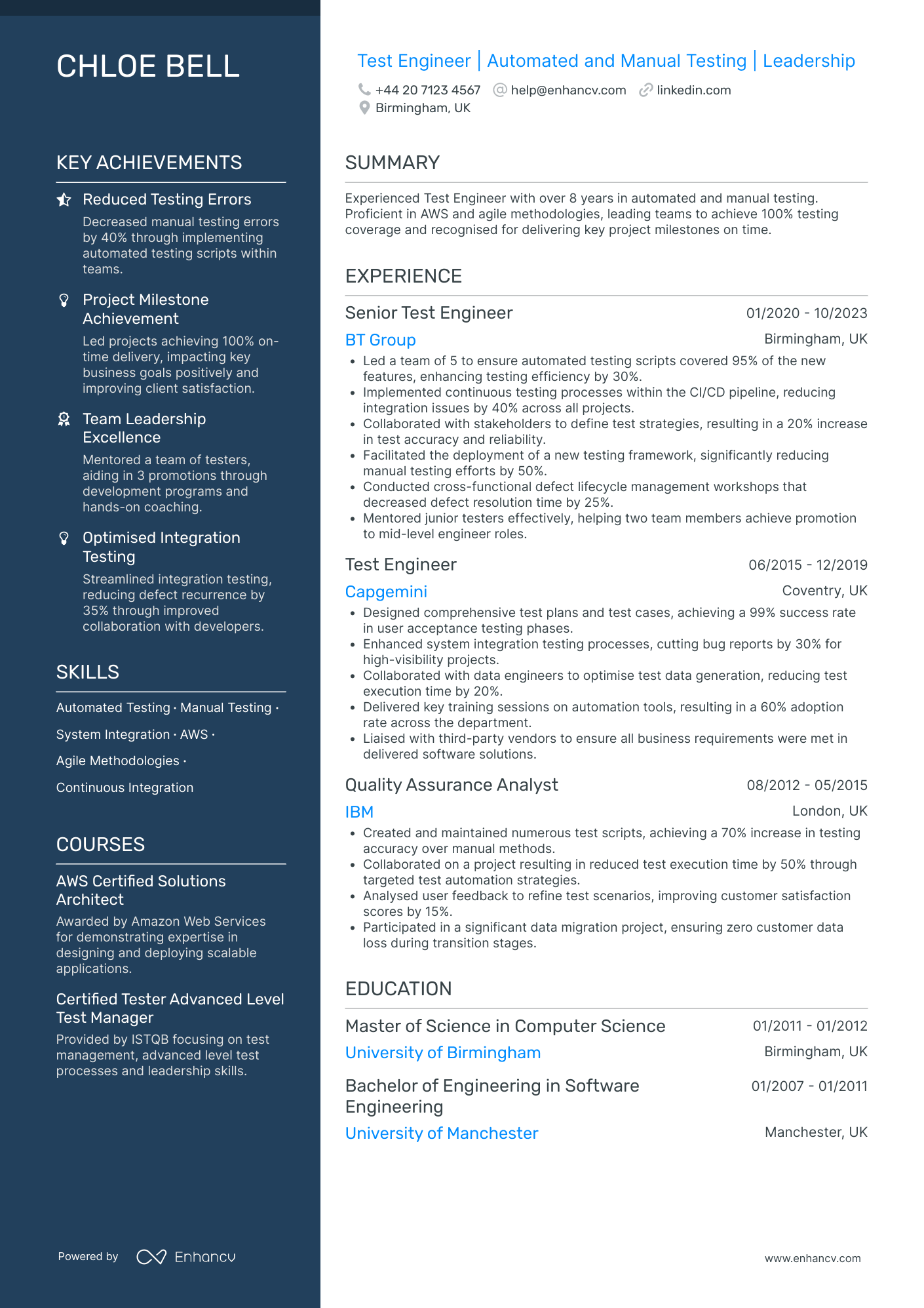
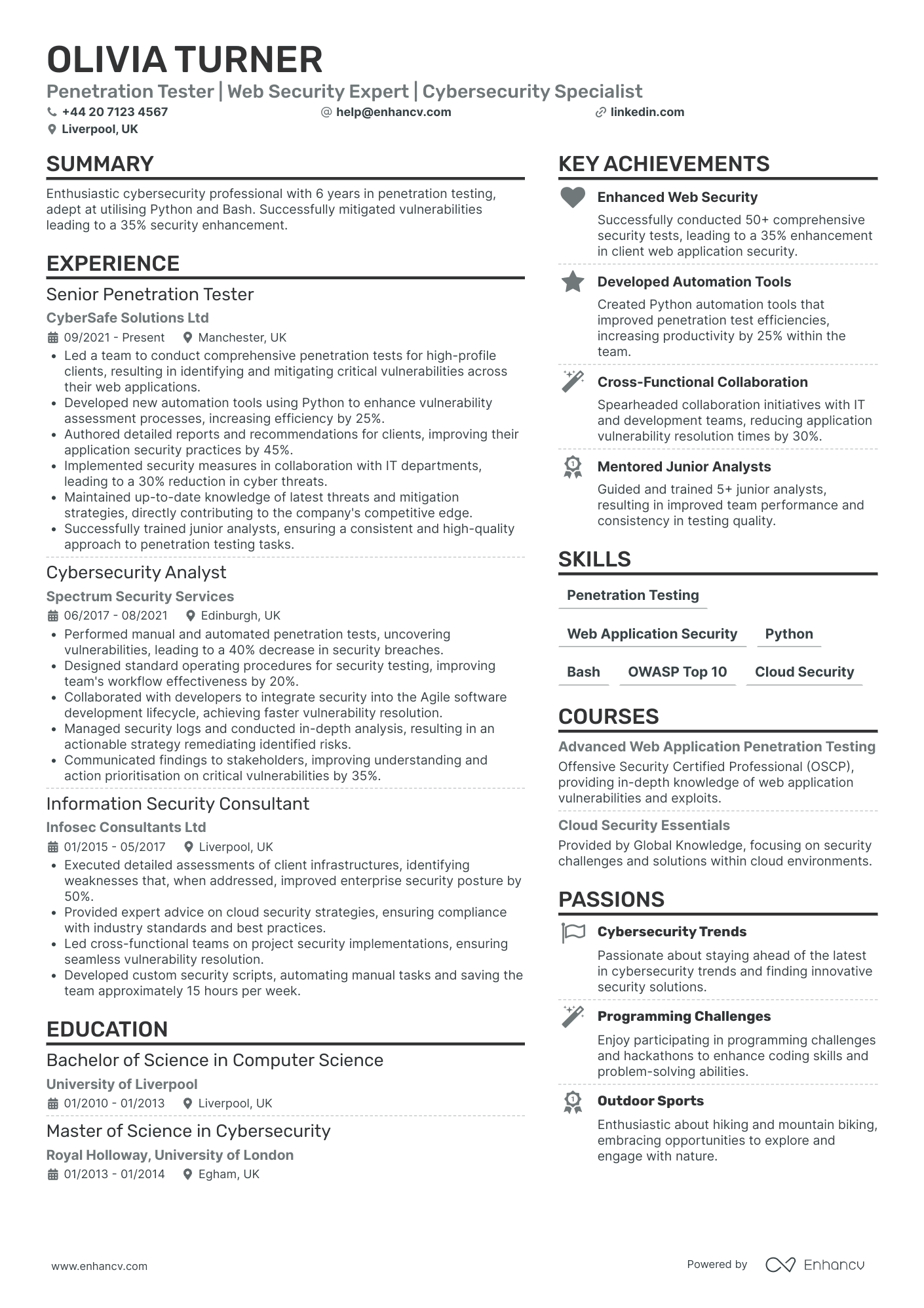
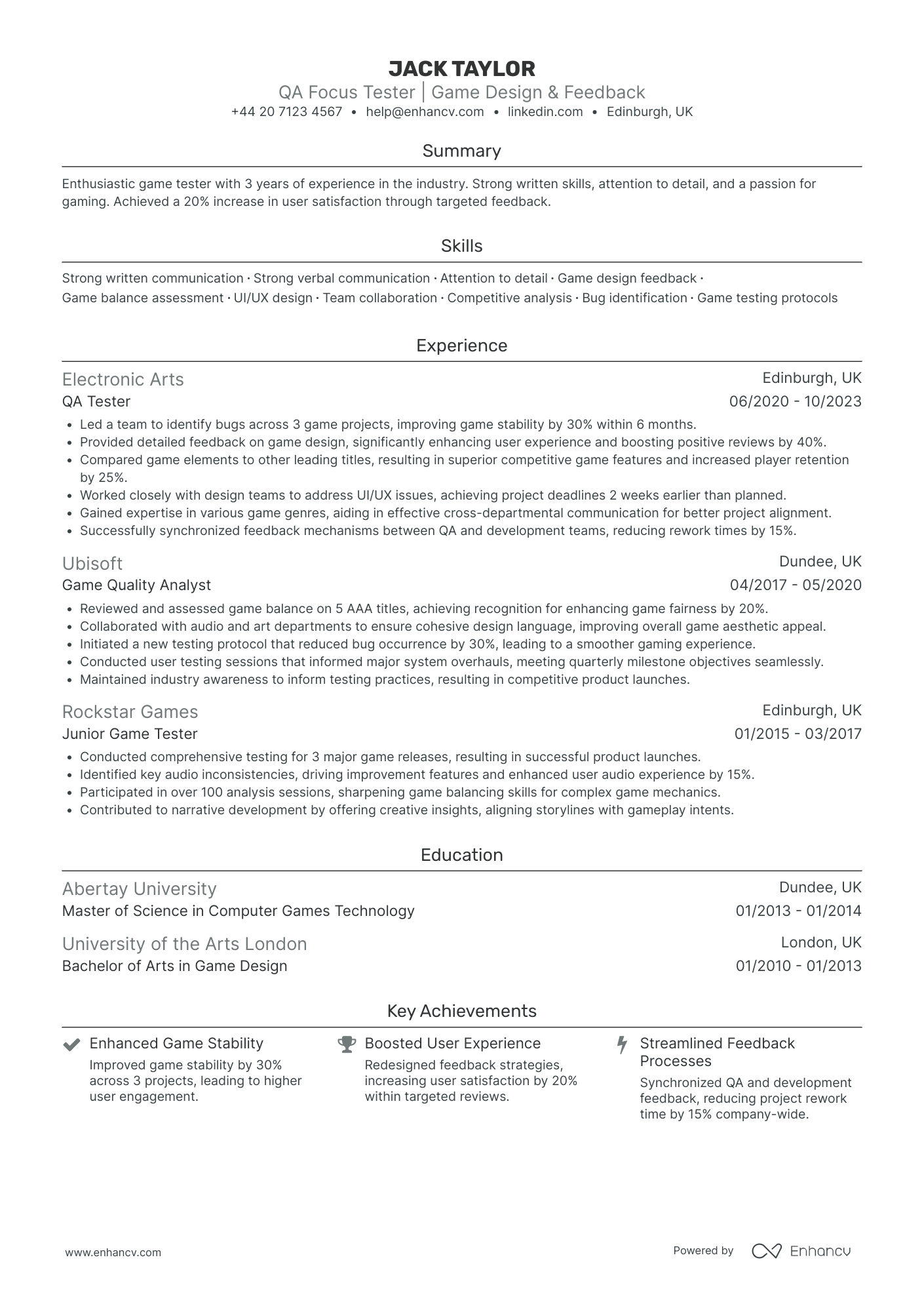
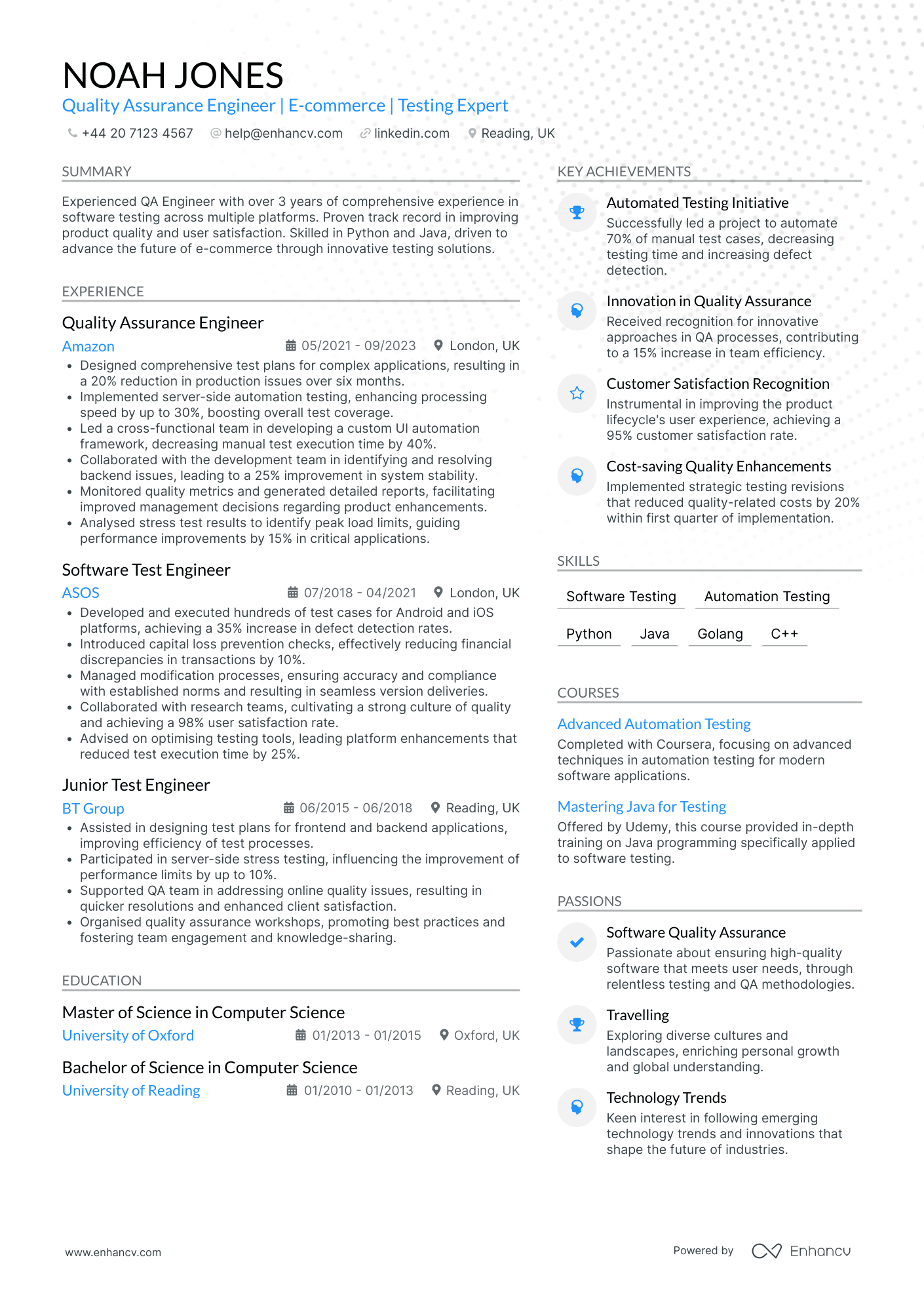
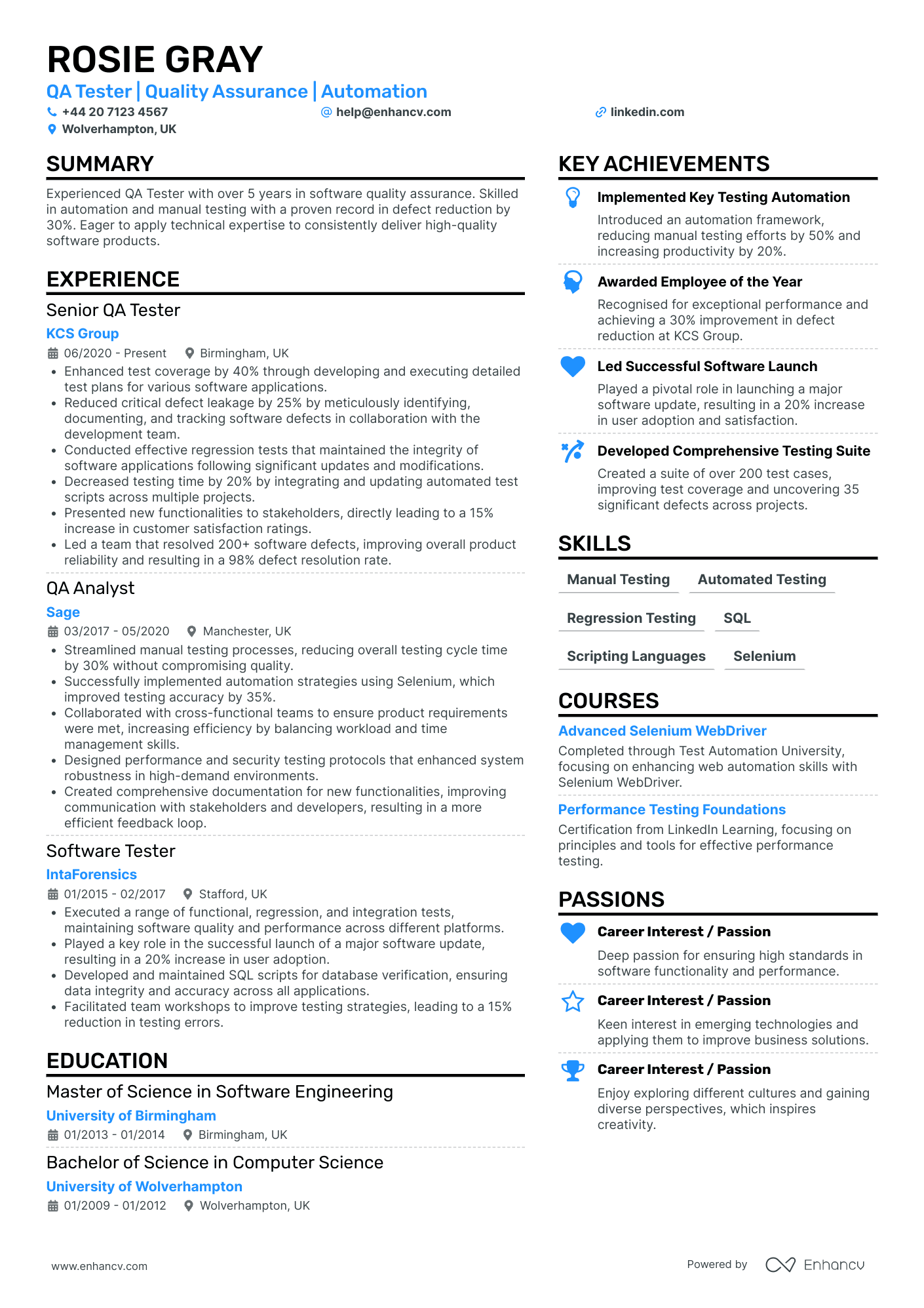
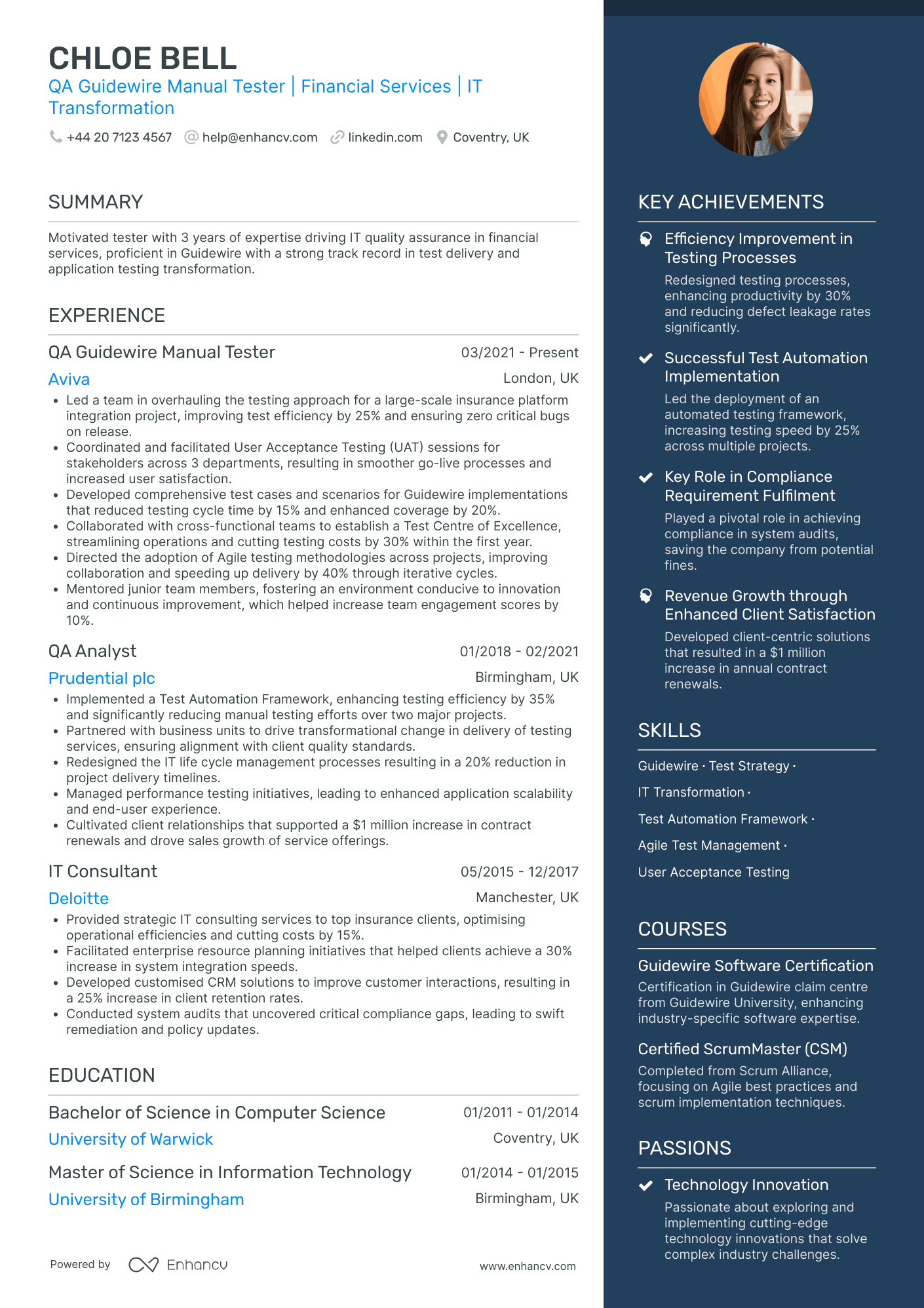
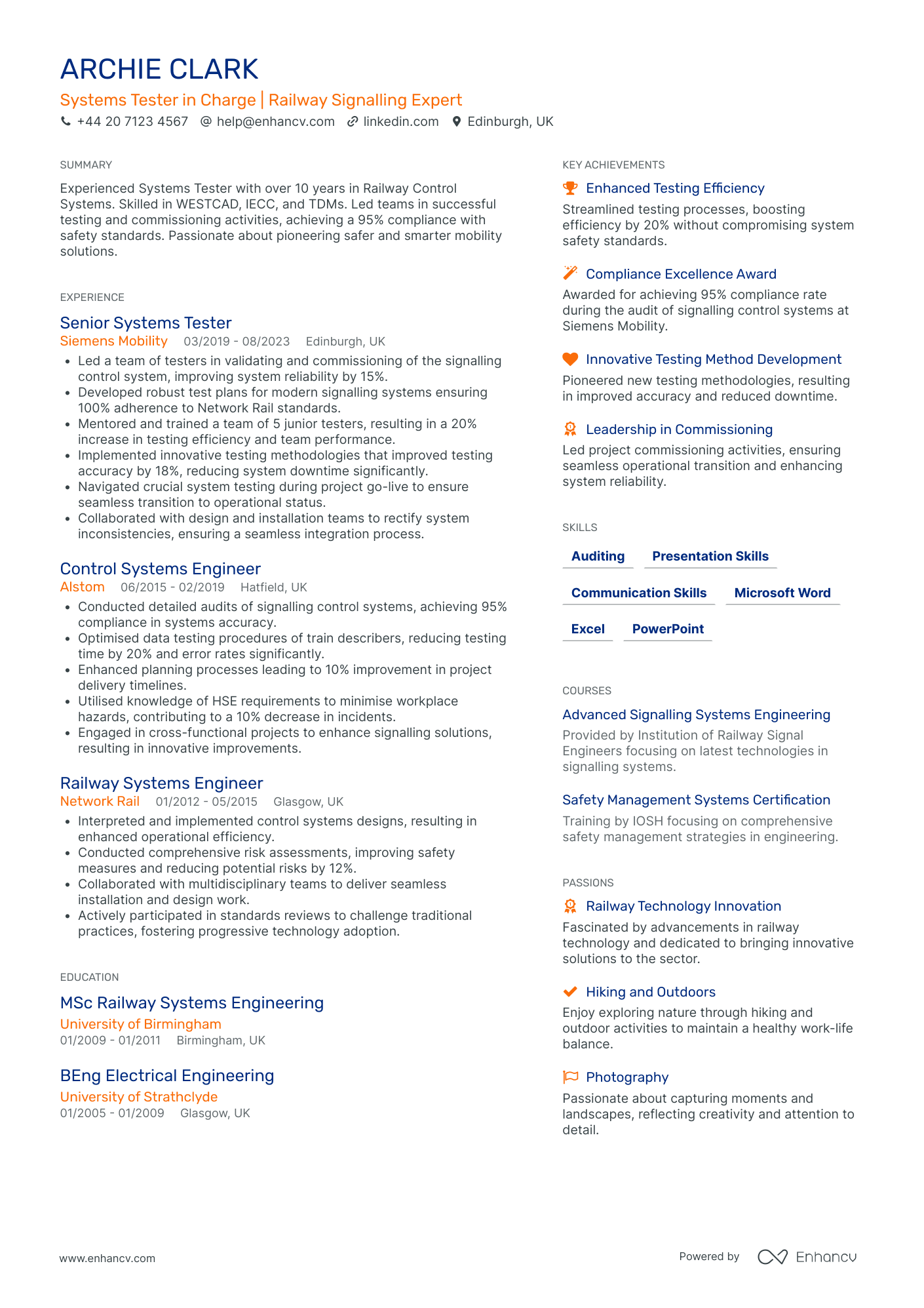
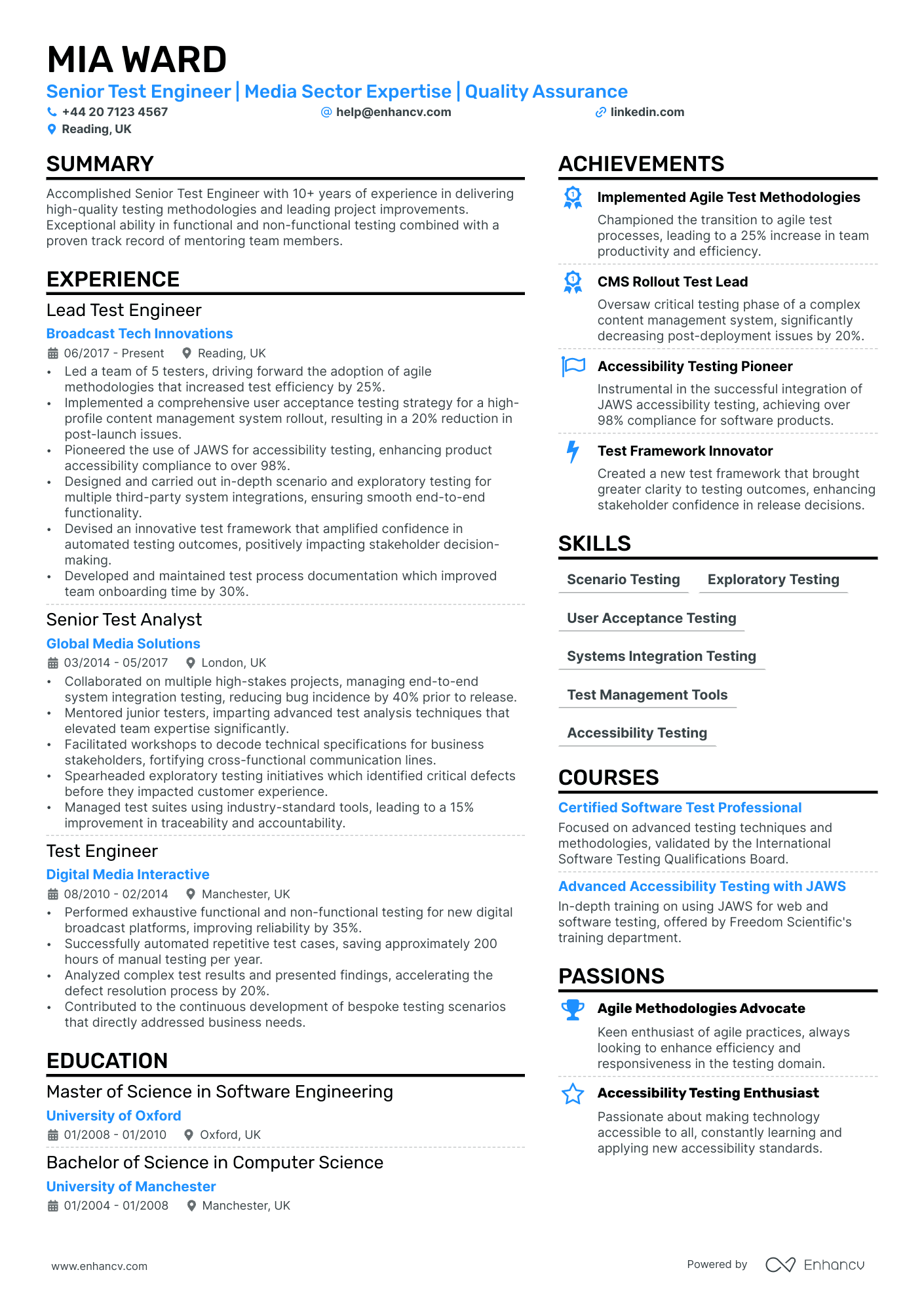
Most manual tester CVs read like the job description copy-pasted into bullet form. Ran test cases, logged defects, attended stand-ups. Every applicant writes the same three lines, so none of them tell a hiring manager anything.
The manual tester CVs that get shortlisted do two things. They show what the testing actually caught, a release protected, a regression stopped, a defect found before a customer hit it. And they arrive in a clean, standard format that a QA lead and an applicant tracking system can both read on the first pass. Get the how to write a CV basics right first, then make every line earn its place.

Key takeaways
- Lead with what your testing caught, defects found, releases protected, coverage improved, not a copy of your duties.
- Manual testing is detail work, so a clean, ATS-friendly layout in a standard format matters as much as the words.
- Name the tools and methods adverts list: test case design, Jira, regression testing, exploratory testing, and the SDLC.
- Send a PDF unless the advert asks for a Word file, and keep it to two pages.
- Put ISTQB Foundation Level near the top if you hold it. UK QA adverts screen for it.
- Open with a short personal statement backed by one concrete testing result, not a string of adjectives.
Formatting your manual tester CV
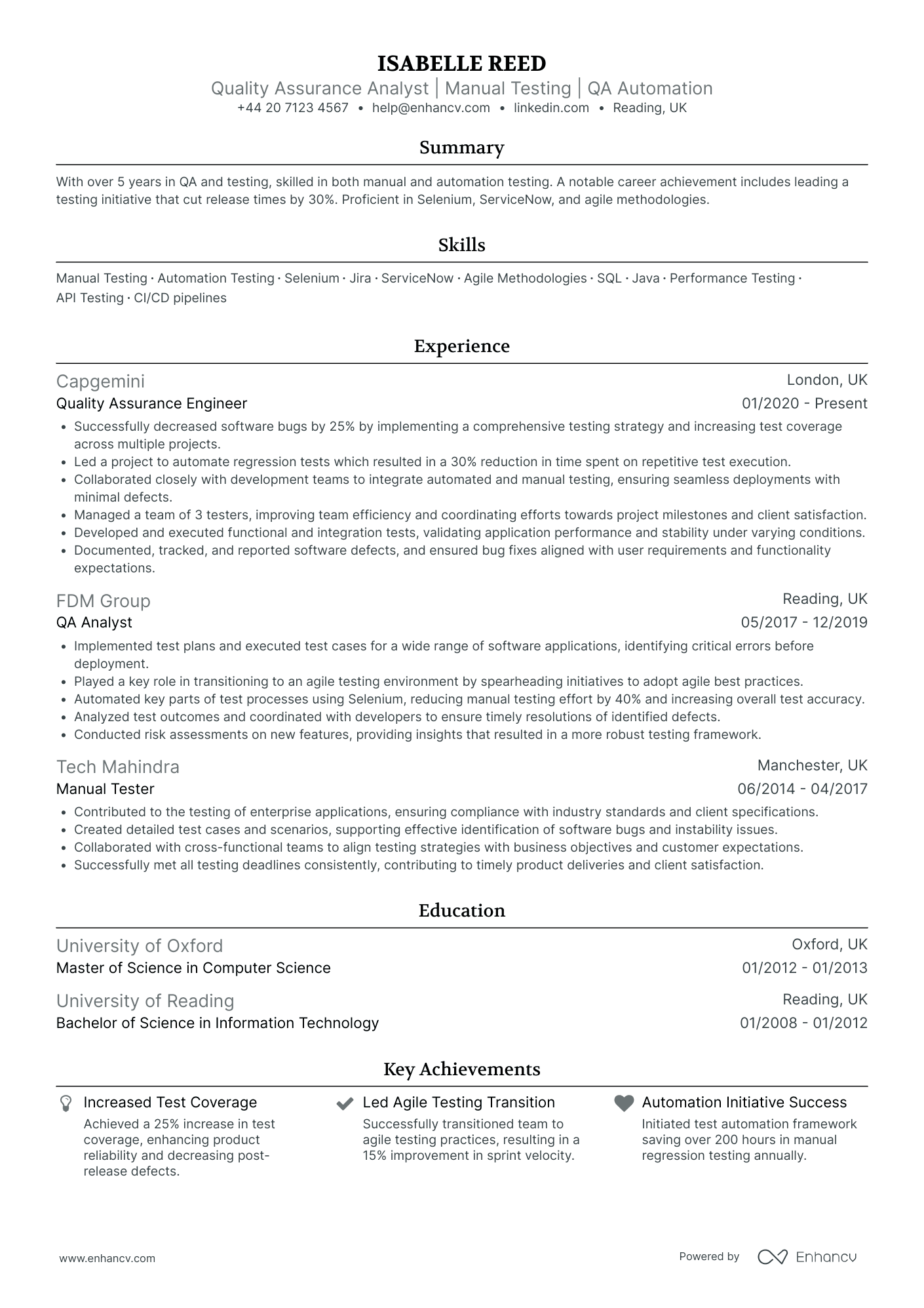
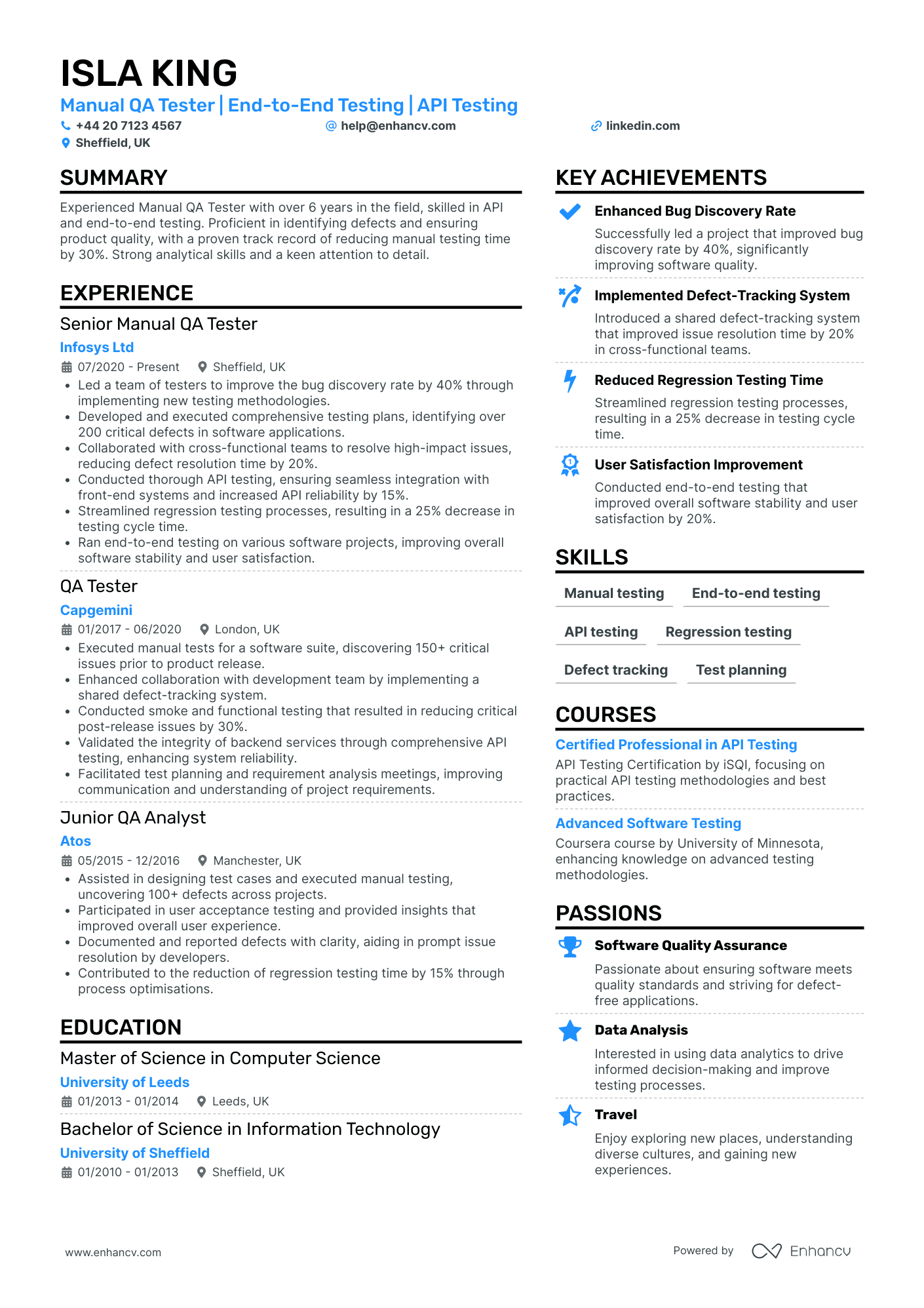
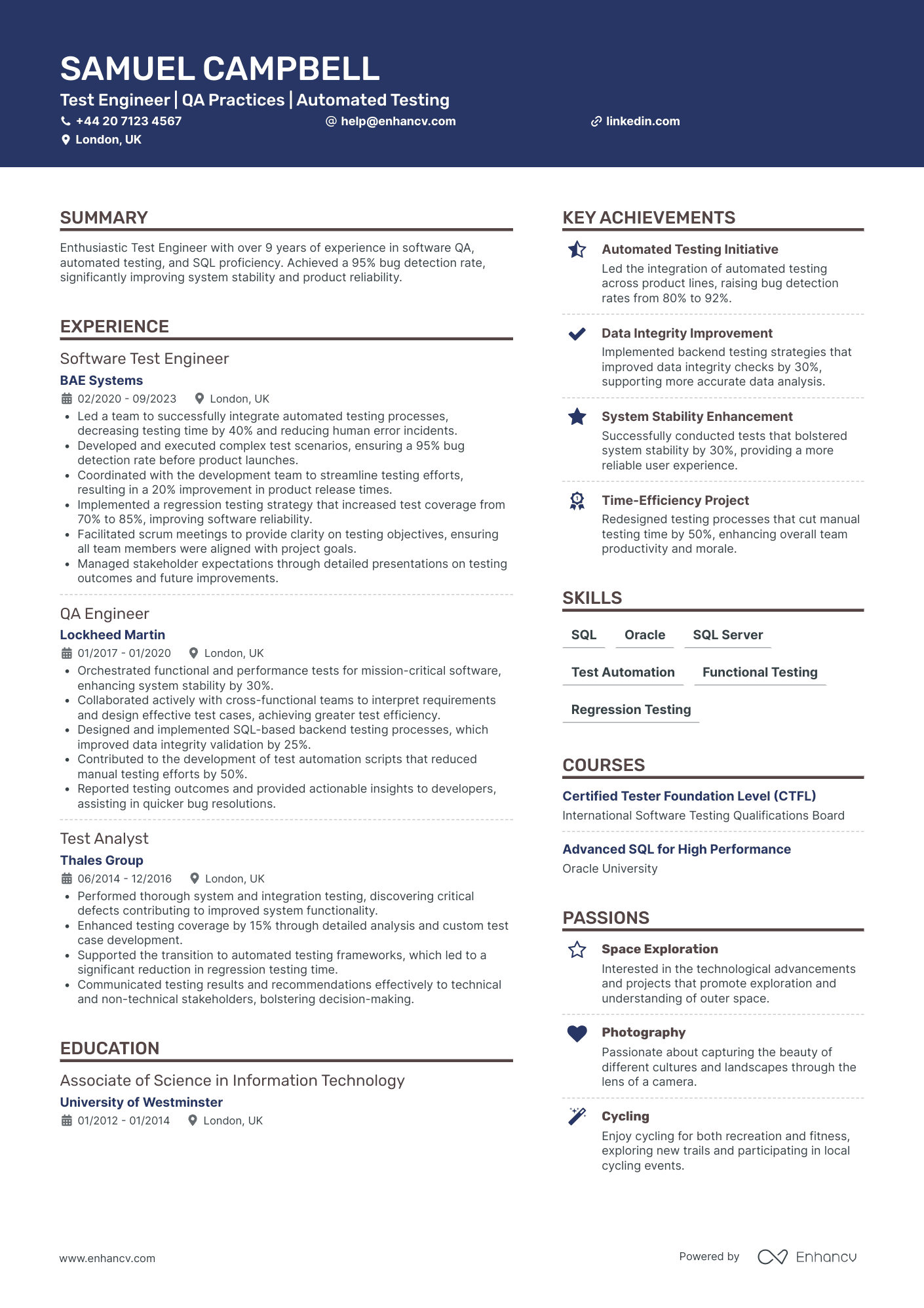
Manual testing is a documentation job. A CV with inconsistent dates, mixed fonts, and a three-column layout tells a QA lead you might do the same to a test report. The format is the first thing it is judged on.
If you have testing experience, use a reverse chronological structure so your most recent QA role sits at the top. If you are moving into testing, a skills-led structure puts your tools and any certifications before a thin work history.
Order the sections the way a QA lead reads them: contact details, a short personal statement, a skills section, then experience, certifications, and education. Front-load the skills, because that is where a recruiter checks for a tool match before reading a single bullet.
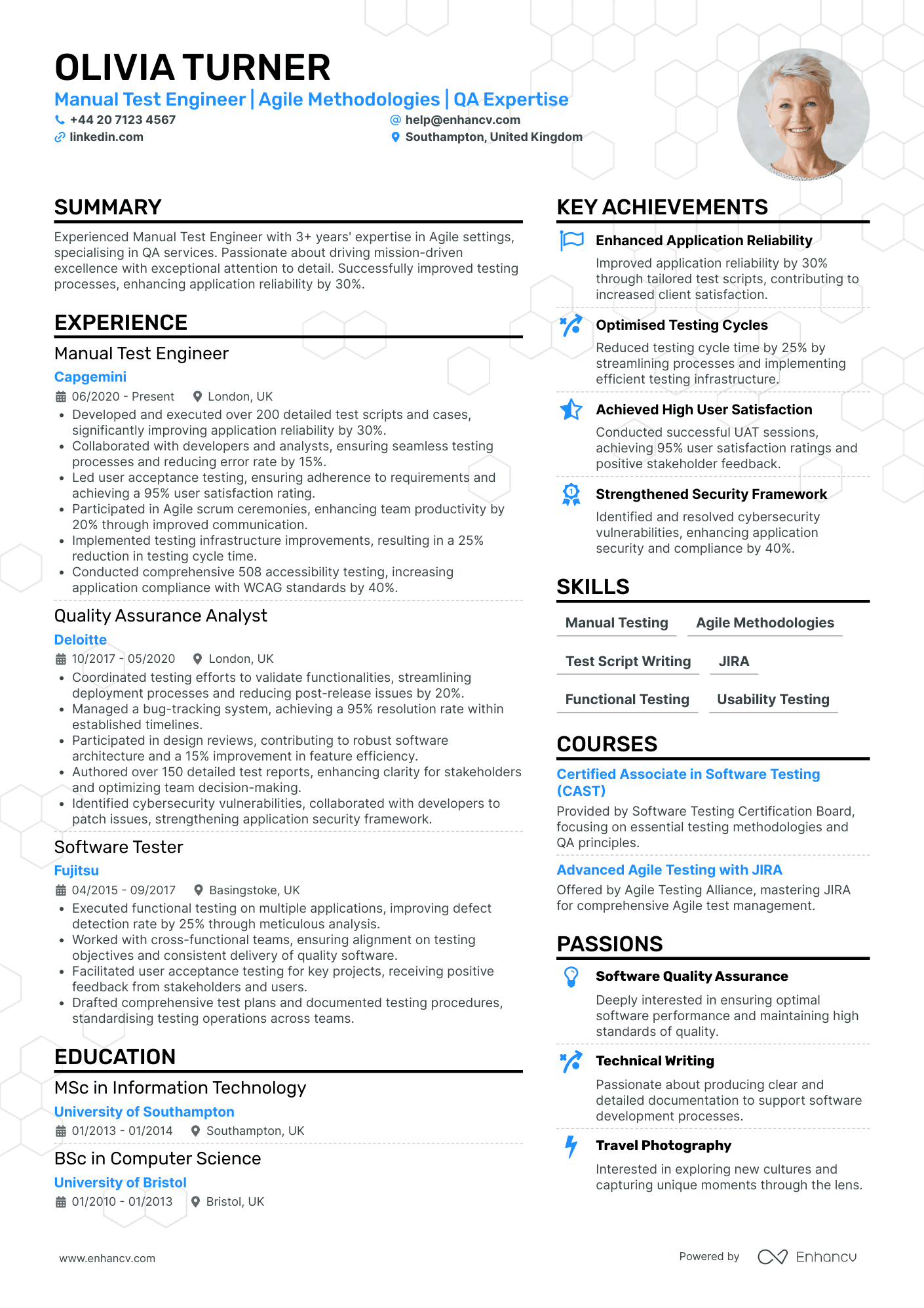
Keep the header lean. Your name, a job title line such as "Manual QA Tester", a phone number, a professional email, your town, and a LinkedIn URL are enough. Leave off your full address, date of birth, and a photo, none of which a UK employer needs.
Keep it to two pages, one column, standard headings, and a readable font. A hiring manager skims a QA CV in seconds before deciding whether to read the detail, so give it generous margins and white space rather than cramming every role onto one page.
QA applications almost always pass through tracking software, so keep the layout clean and the headings standard for an ATS-friendly CV. Put your tools in a dedicated skills section where a parser can find them, and spell out an acronym once, for example user acceptance testing (UAT), so both the software and the human catch it.
Be consistent in the small things, because a tester who is not tells on themselves. Keep every date in the same format, every job title styled the same way, and every bullet in the past tense except your current role. The care you show on the page is the care an employer is hiring you to apply to their product.
Word or PDF: which manual tester CV template to use
Send a PDF for any direct application. It locks the layout so your CV looks the same on the hiring manager's screen as it did on yours, and it survives most parsers cleanly.
Keep a Word copy for recruitment agencies, which place a large share of UK QA and testing roles and often reformat your CV into their own template before sending it on. If the advert names a file type, follow it exactly.
Name the file so a busy inbox can find it, something like Jane-Smith-Manual-Tester-CV.pdf rather than cv-final-v3. And avoid text boxes, tables, and columns for your core content, because older parsers read them out of order and can scramble your dates.
If you have testing artefacts worth showing, a GitHub repository of test cases or a public bug tracker, add the link as plain text in your header or skills section. A reader can copy it, and a recruiter reads it as proof rather than a claim.
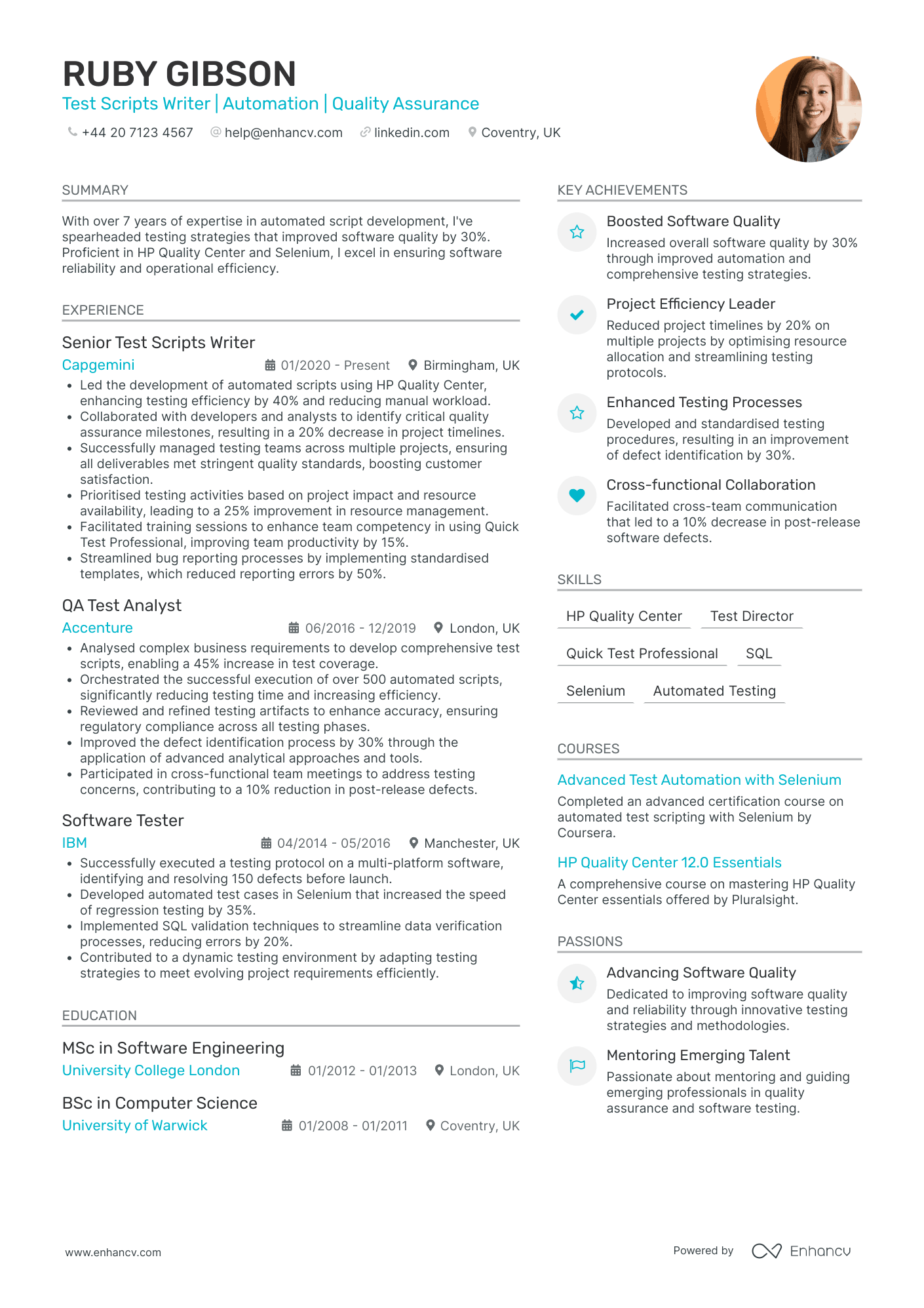
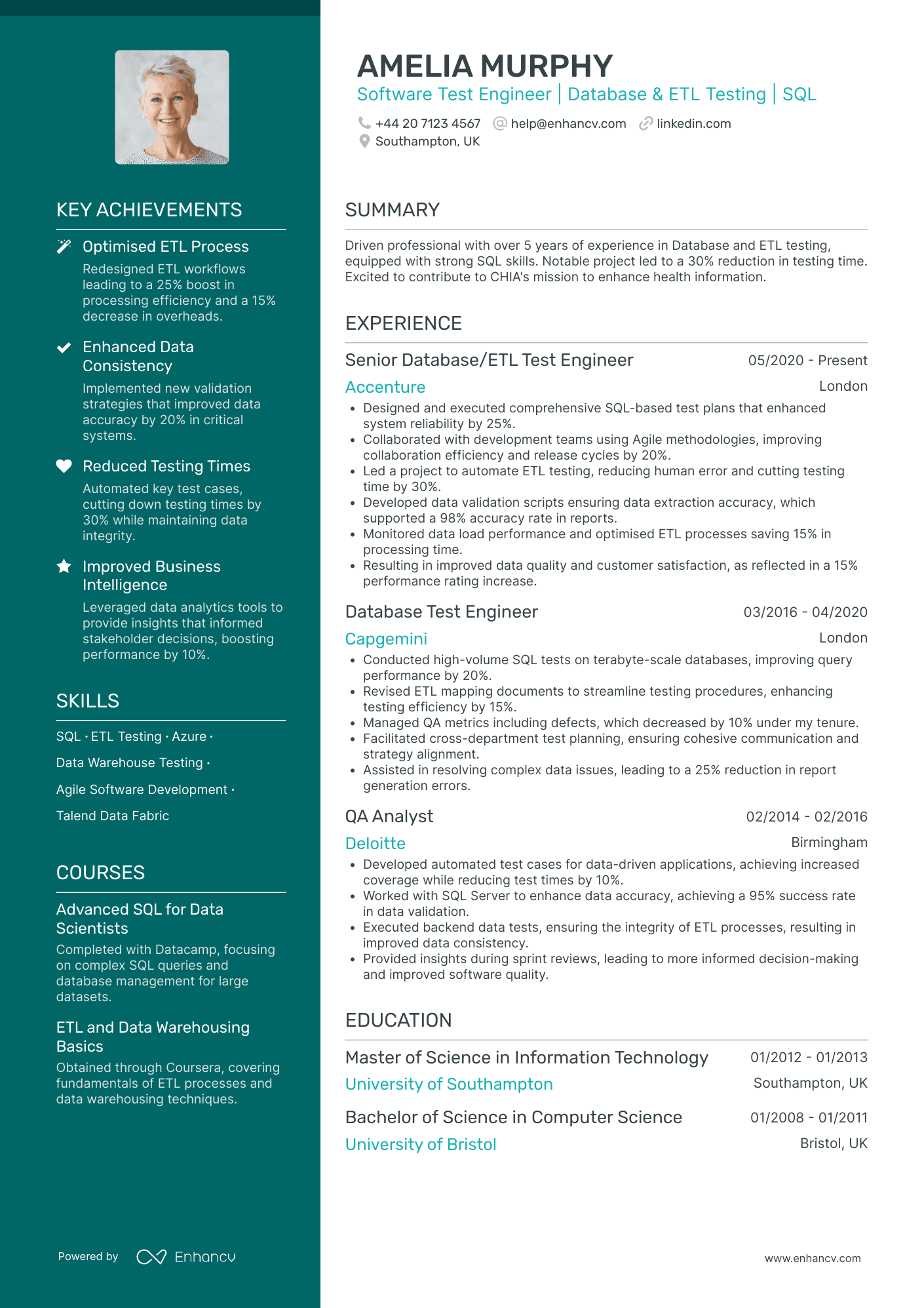
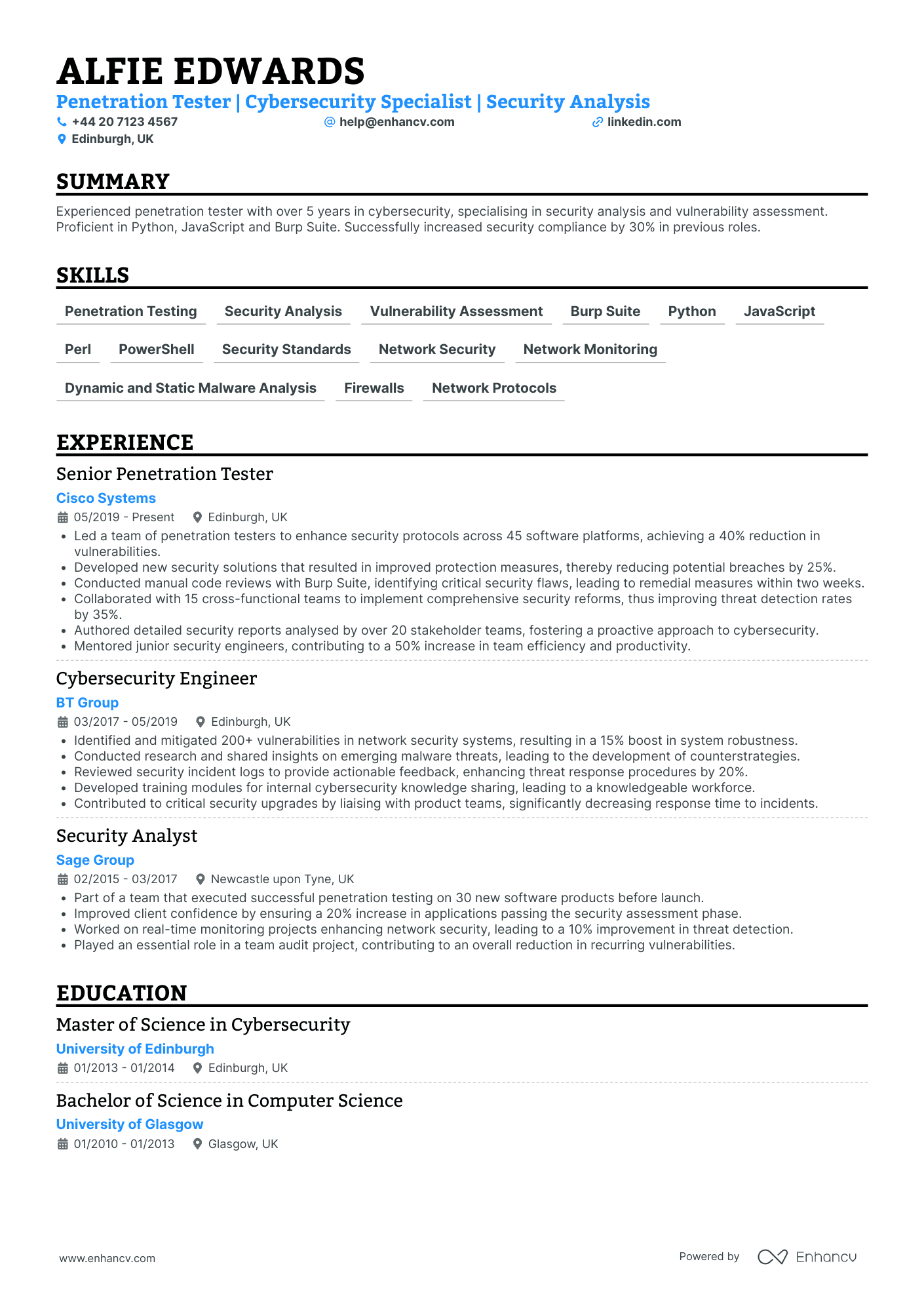
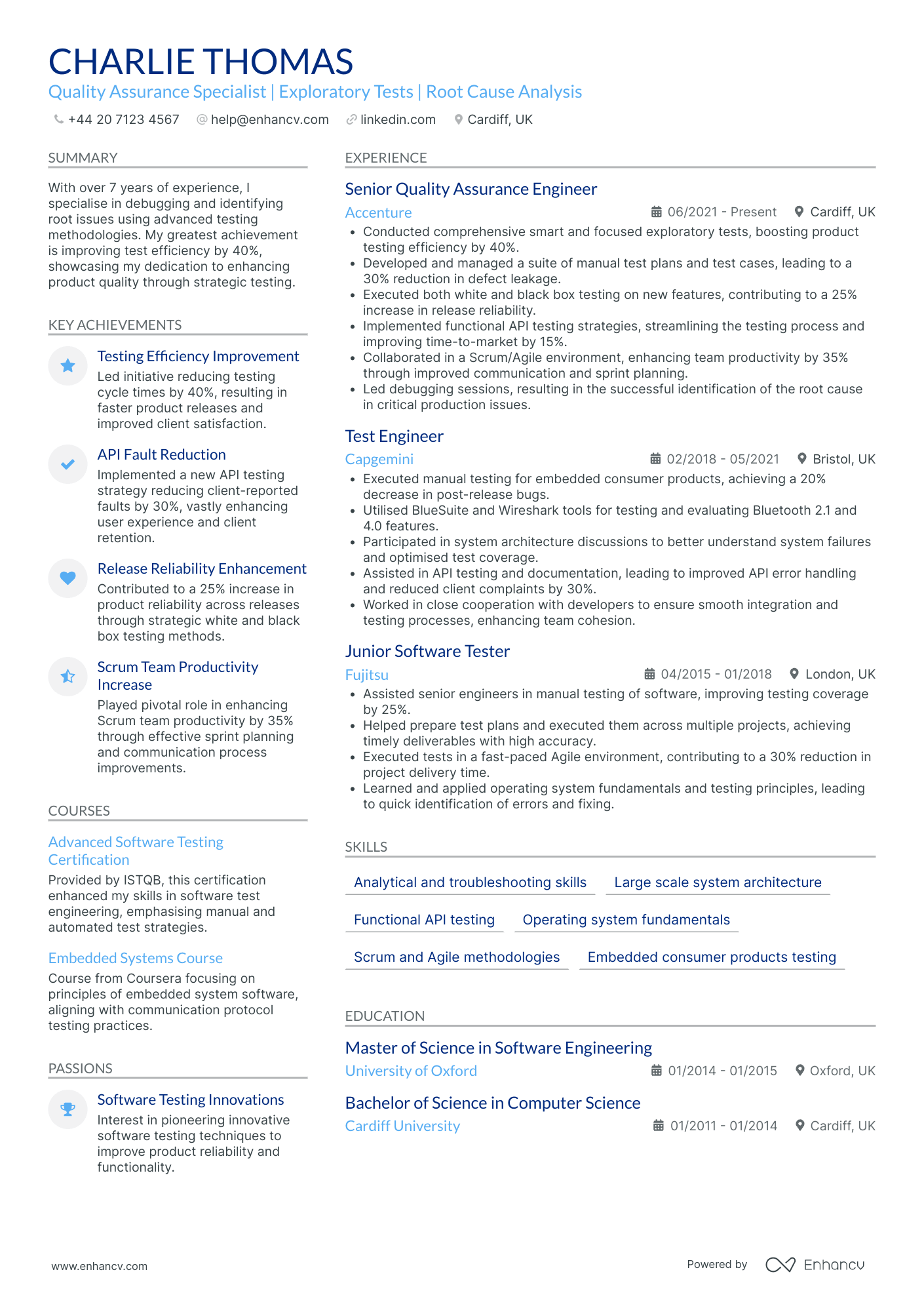
Whichever you send, build it from a tested layout rather than a blank page. Enhancv's CV templates use standard headings and export to a clean PDF, which keeps the structure ATS-safe without you formatting margins by hand.
Writing your manual tester personal statement
Three or four sentences at the top: who you are, how long you have tested, the tools and methods you know, and one concrete result. See more personal statement examples if the opening line is hard to start.
This is the first block a hiring manager reads, so treat it as your case in miniature. If it names a real result and the type of testing you are strongest at, the reader already wants to check your experience section. If it lists traits, they skim past it.
Skip the adjective soup that opens most QA CVs. "Detail-oriented and passionate QA professional with excellent communication skills" is a sentence a recruiter has read a hundred times and cannot check.
Tailor the opening to the advert too. A statement that names the sector you are applying into, fintech, healthtech, or e-commerce, reads as deliberate, where a generic one reads as mass-sent.
Here is the opening to avoid, and the one to aim for:
Manual tester personal statement to avoid
Detail-oriented and passionate QA professional with excellent communication skills and a strong work ethic, seeking a challenging manual testing role in a dynamic company where I can grow and utilise my abilities.
Manual tester CV personal statement example
ISTQB-certified manual tester with four years testing web and mobile applications in Agile teams. Designed and executed over 400 test cases across functional and regression suites, and logged defects in Jira that helped cut post-release bug reports by a third. Looking to bring rigorous exploratory testing and clear defect reporting to a QA role in a Manchester fintech team.
When I read a manual tester CV, I skip past the list of tools and look for one line: a defect the tester caught that mattered. "Found a rounding error in the payment flow during exploratory testing, before it reached production" tells me more than any certification. Name the bug, where you found it, and what it would have cost. That is the difference between someone who runs test cases and someone who actually tests.
Writing your manual tester experience section
Write each role as a dated heading, then bullets that lead with a verb and end in a result. For the mechanics, see work experience on a CV.
Testing is more measurable than most testers admit: test cases written, defects found, coverage reached, regression cycles run, a release protected. Those numbers are your CV achievements, and they beat a paragraph describing the QA process in the abstract.
If your work does not feel measurable, these are the numbers hiding in a testing role:
- Test cases designed, executed, or reused across a cycle.
- Defects found, and how many were critical or release-blocking.
- Requirement or regression coverage reached, as a percentage.
- Sprints or release cycles supported, and any you signed off.
- Time saved by a reusable test suite or a cleaner defect report.
Lead each bullet with an action verb: designed, executed, logged, triaged, verified. Then tailor each application by pulling the tools and methods from the advert and mirroring the ones you genuinely use. Enhancv's CV tailoring feature reads the job ad and flags the matching terms, which saves rewriting from scratch each time.
Include contract and agency roles the same way, with the client or sector named where you can. Short testing stints are normal in QA, and a clear line of dated roles reassures a hiring manager more than a gap you have tried to smooth over.
- Designed and executed 450+ manual test cases across web and mobile releases, covering functional, regression, and cross-browser testing
- Logged and triaged defects in Jira with clear reproduction steps and screenshots, cutting developer clarification requests by around 30%
- Ran exploratory testing on new payment features and caught 12 critical defects before release, protecting the checkout flow
- Wrote test plans mapped to acceptance criteria and raised requirement coverage to 95% across two quarterly releases
- Executed functional and regression test cases for an e-commerce website across each fortnightly sprint
- Reported and verified 200+ defects in Bugzilla, working with developers to confirm each fix before release
- Supported user acceptance testing with business stakeholders and documented sign-off for two major releases

PRO TIP
QA adverts list specific tools and methods, not vague qualities. Mirror the ones you can back: "test case design", "regression testing", "Jira", "exploratory testing", "SQL", "API testing". Name the exact tool where the advert does, and never list one you could not use in an interview.

Common manual tester CV mistakes
- Listing the QA process instead of what you actually found or fixed.
- Claiming automation tools you have only watched a tutorial on.
- Burying ISTQB and your tools at the bottom, where a parser misses them.
- Sending one generic personal statement to every advert.
- Using a two-column template that scrambles in an older ATS.
Skills to put on a manual tester CV
Read a dozen live UK testing adverts and the same demands repeat. Test case design, regression testing, exploratory testing, defect tracking in Jira, and a working knowledge of the SDLC come up again and again. Those are your hard skills, listed in the words the adverts use.
Back them with the soft skills that testing actually rewards: attention to detail, analytical thinking, clear communication, and the curiosity to ask what happens if. Prove each one in a bullet rather than just claiming it.
Group the tools so a parser reads them cleanly. Test management, defect tracking, and any scripting or database skills each earn their own short cluster rather than one long comma-separated line.
Evidence each skill rather than declaring it. "Exploratory testing" means little on its own, but "ran exploratory testing that surfaced a session-timeout bug missed by the scripted suite" shows the skill in use. Let your experience bullets carry the proof and keep the skills section as the quick-scan index.
List only what you can stand behind in an interview. A little SQL and some IT skills like API testing in Postman go a long way, and if you are learning automation, put it under a "developing" line rather than in your core skills.
Top skills for your manual tester CV:
Test case design
Regression testing
Exploratory testing
Functional testing
Defect tracking (Jira)
Test management (TestRail)
SDLC and STLC
Cross-browser testing
API testing (Postman)
SQL
User acceptance testing (UAT)
Agile and Scrum
Attention to detail
Analytical thinking
Communication
Curiosity
Collaboration
Certifications that strengthen a manual tester CV
You do not need a certification to test, but one carries real weight in UK QA shortlisting. The ISTQB Foundation Level (CTFL) is the baseline most adverts recognise, and it signals you know the vocabulary of testing before you walk in.
List it near the top if you hold it, and put it under "in progress" if you are studying for it. From there, the ISTQB Agile Tester extension and a BCS qualification in software testing are the natural next steps, and any course in SQL, API testing, or a test management tool is worth a line.
Domain knowledge counts as a credential too. Certificates in SQL, ISTQB specialist modules, or a tool such as Selenium or Postman tell an employer where you can add value fastest, especially in a regulated sector like finance or healthcare where testers are expected to understand the rules they are testing against.
Keep them in a dedicated section so a parser and a reader both find them fast. Give each one its awarding body and year, and mark anything expired or lapsed honestly. Naming the certificates you hold saves the employer a question and marks you as someone who takes the craft seriously.
Writing a manual tester CV with no experience
Testing is one of the more accessible ways into tech, because the core skill, methodical attention to detail, shows up in plenty of other work. Lead with a skills-led first CV and prove the mindset rather than the job title.
Do the work you cannot yet claim. Pick a live app or an open-source project, write a small suite of test cases, run them, and log the defects you find with clear reproduction steps. A short testing portfolio or a public bug report is evidence no course certificate can match.
Then add the ISTQB Foundation Level, in progress or passed, and any relevant background: a QA-adjacent support role, data entry that demanded accuracy, or a degree with a dissertation you can frame as structured investigation. That combination, a certification on the way plus real documented testing, beats a polished CV with nothing behind it.
Look at the routes in too. A testing bootcamp, a QA apprenticeship, or a junior test analyst role can be the first line on your CV, and many teams will take a careful, curious tester and train the tooling. Frame yourself as someone who breaks things methodically and writes down exactly how.
Conclusion
Lead with the defects you caught and the releases you protected, name the tools and methods UK adverts screen for, and keep the format clean enough to survive a parser.
Pair the CV with a short cover letter that names one bug you are proud of catching, and you turn a generic QA application into one a hiring manager remembers.
Author's take - the Enhancv team
When I read a manual tester CV, I skip past the list of tools and look for one line: a defect the tester caught that mattered. "Found a rounding error in the payment flow during exploratory testing, before it reached production" tells me more than any certification. Name the bug, where you found it, and what it would have cost. That is the difference between someone who runs test cases and someone who actually tests.