



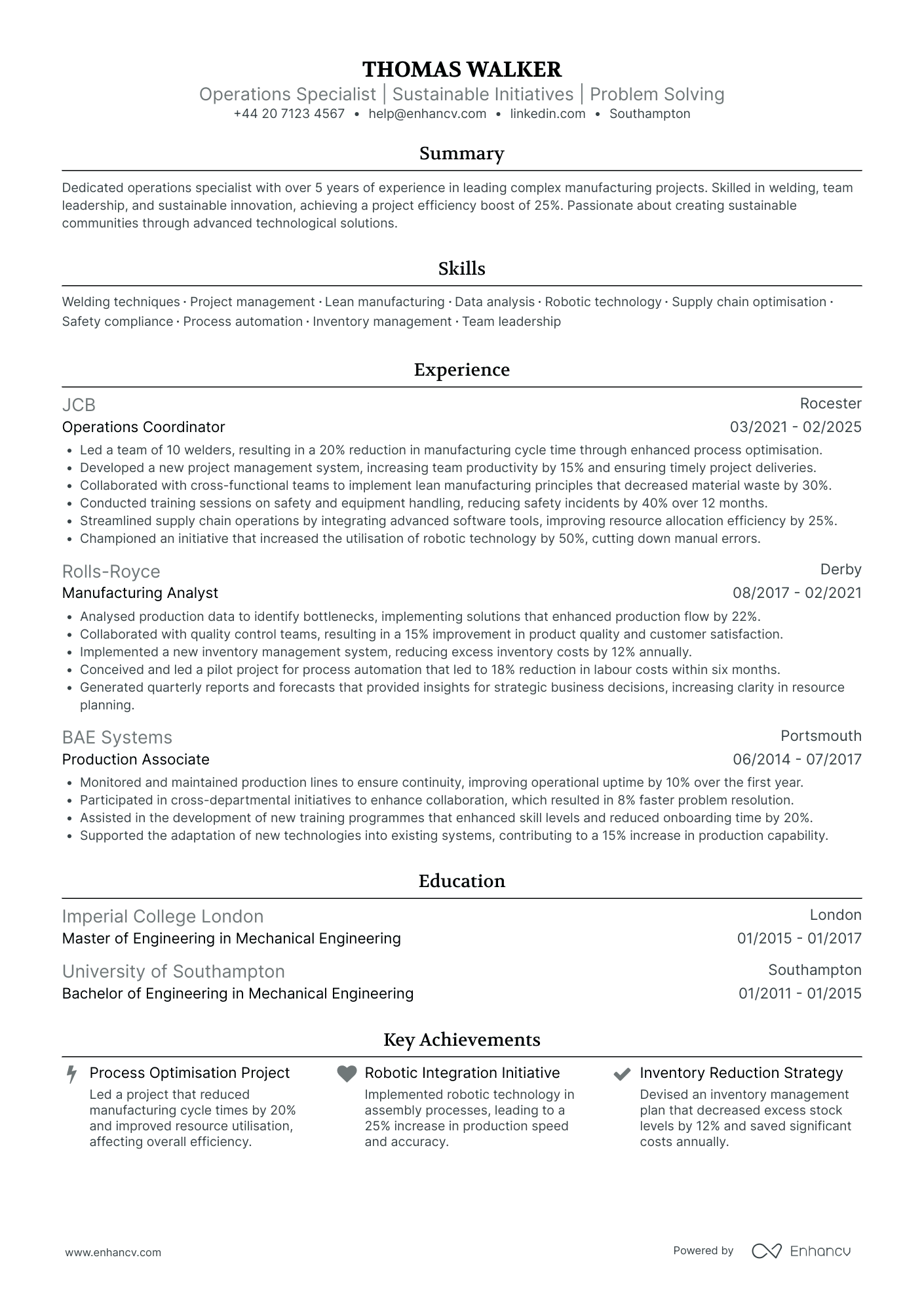
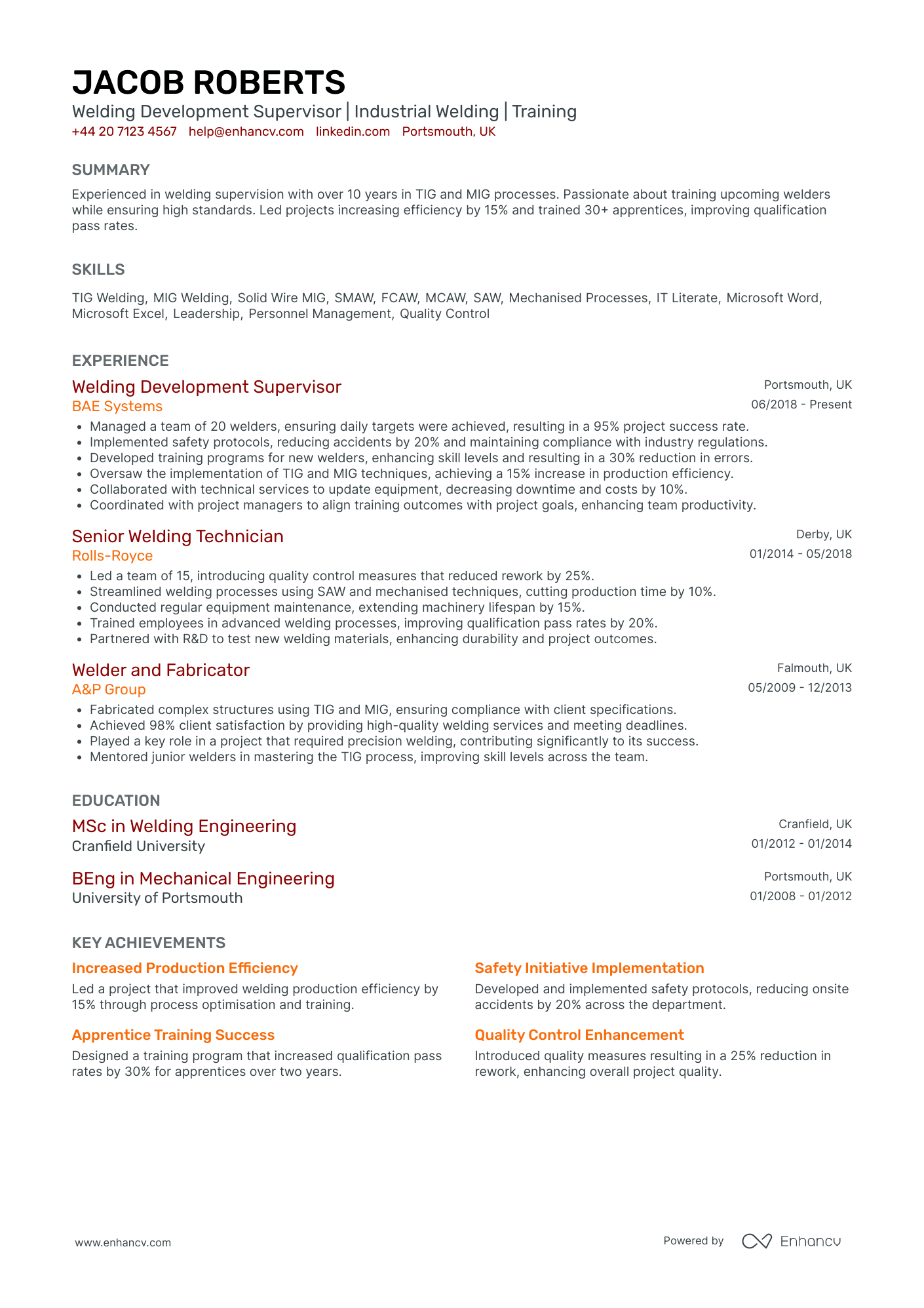
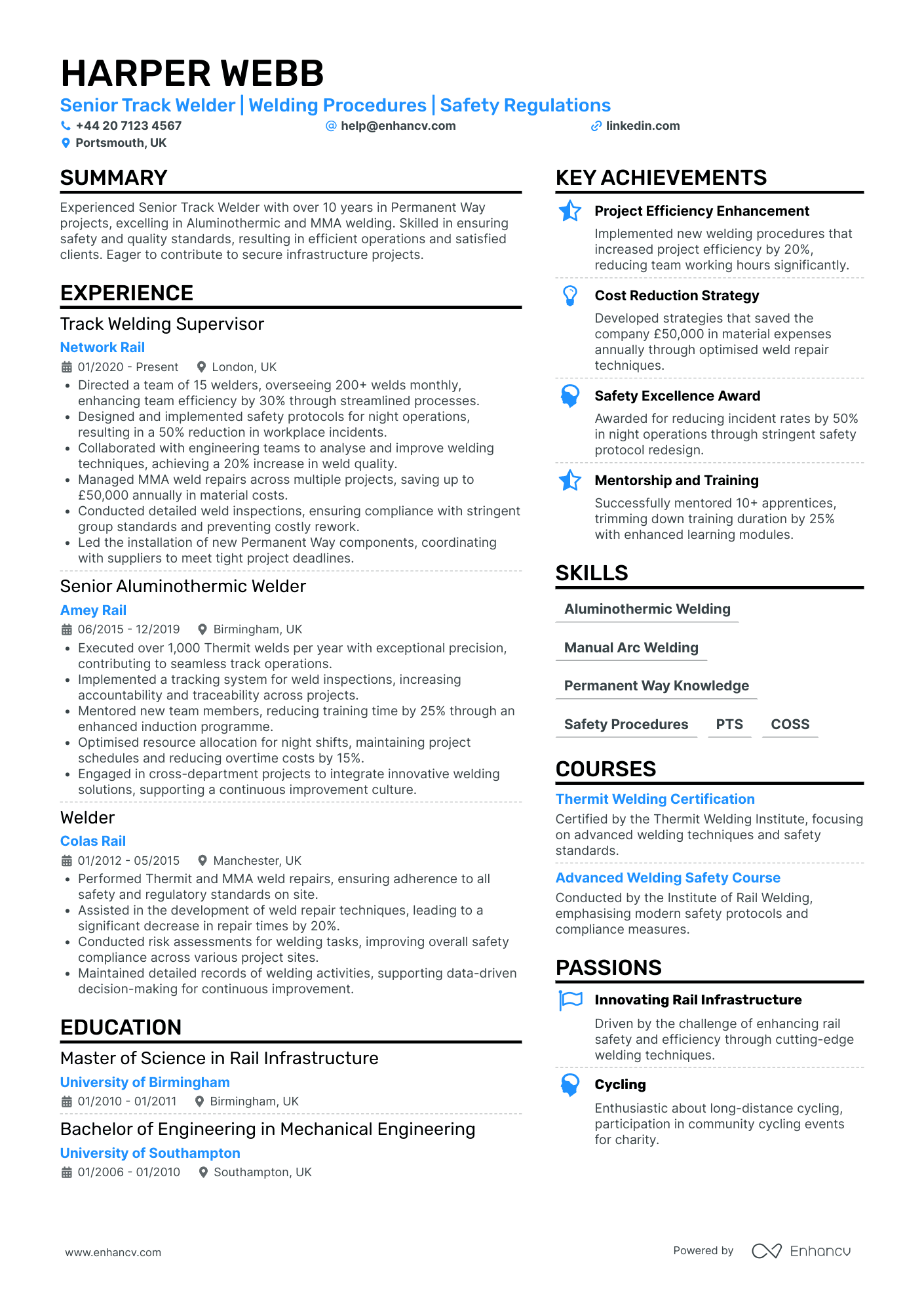
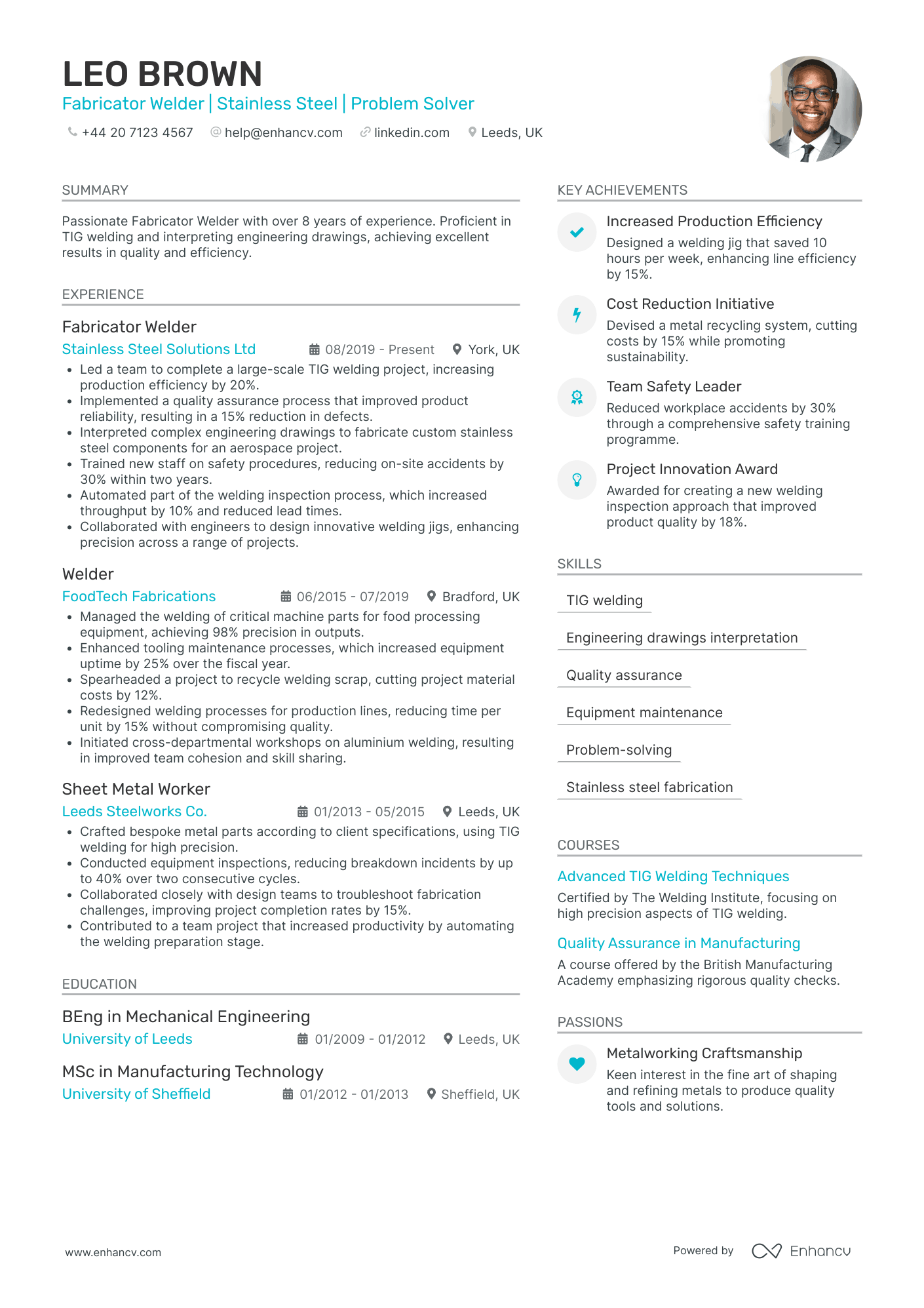
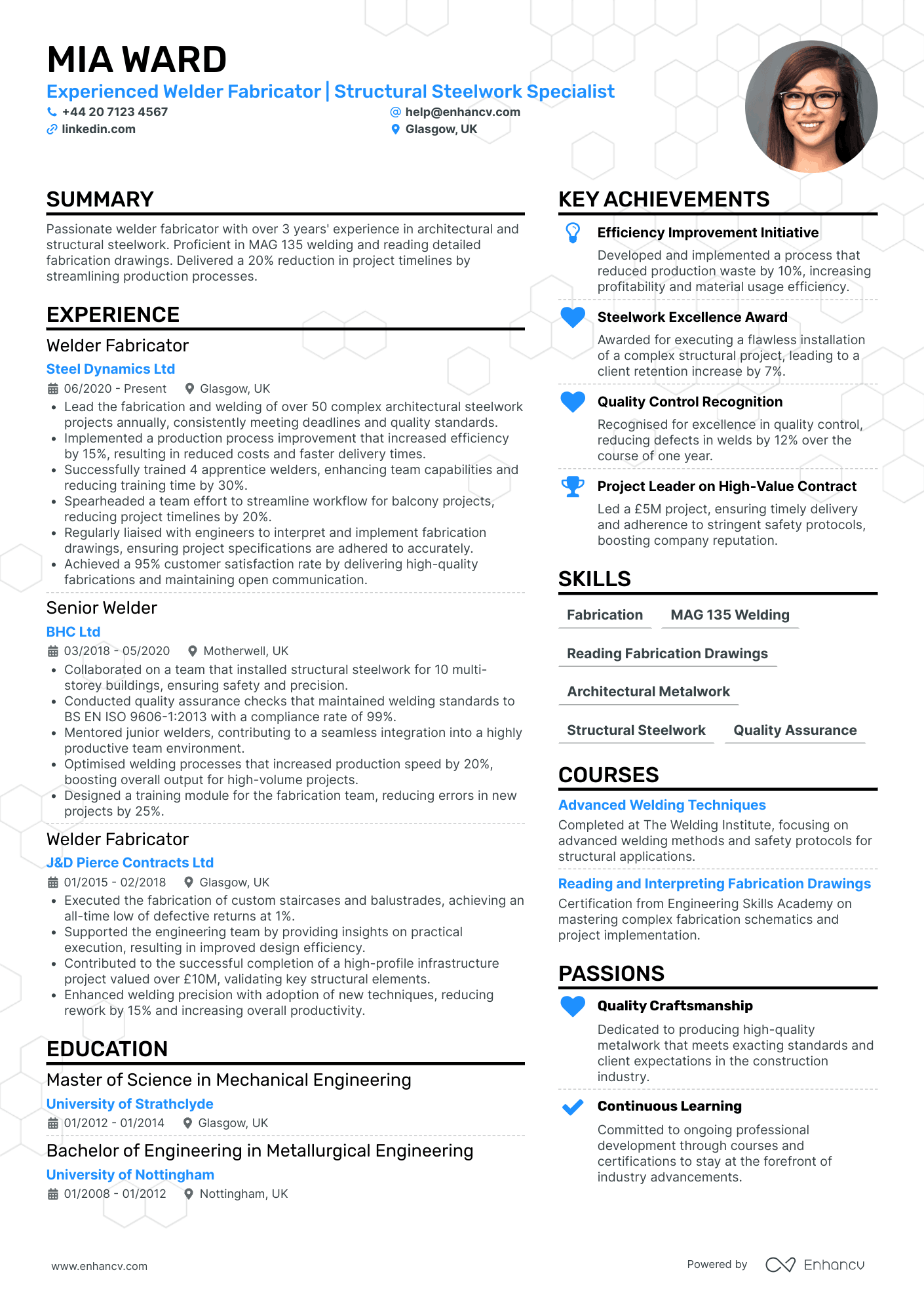
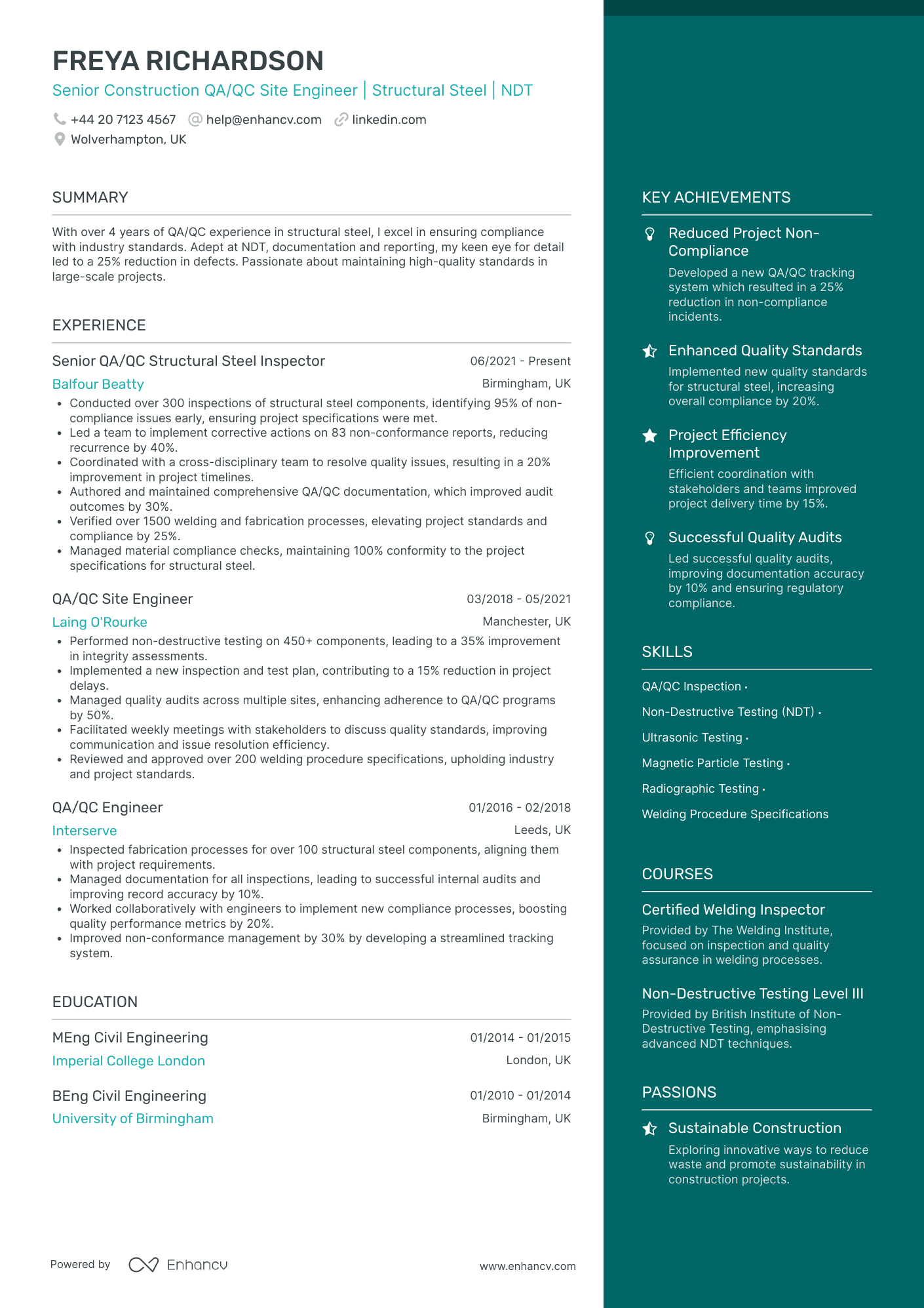
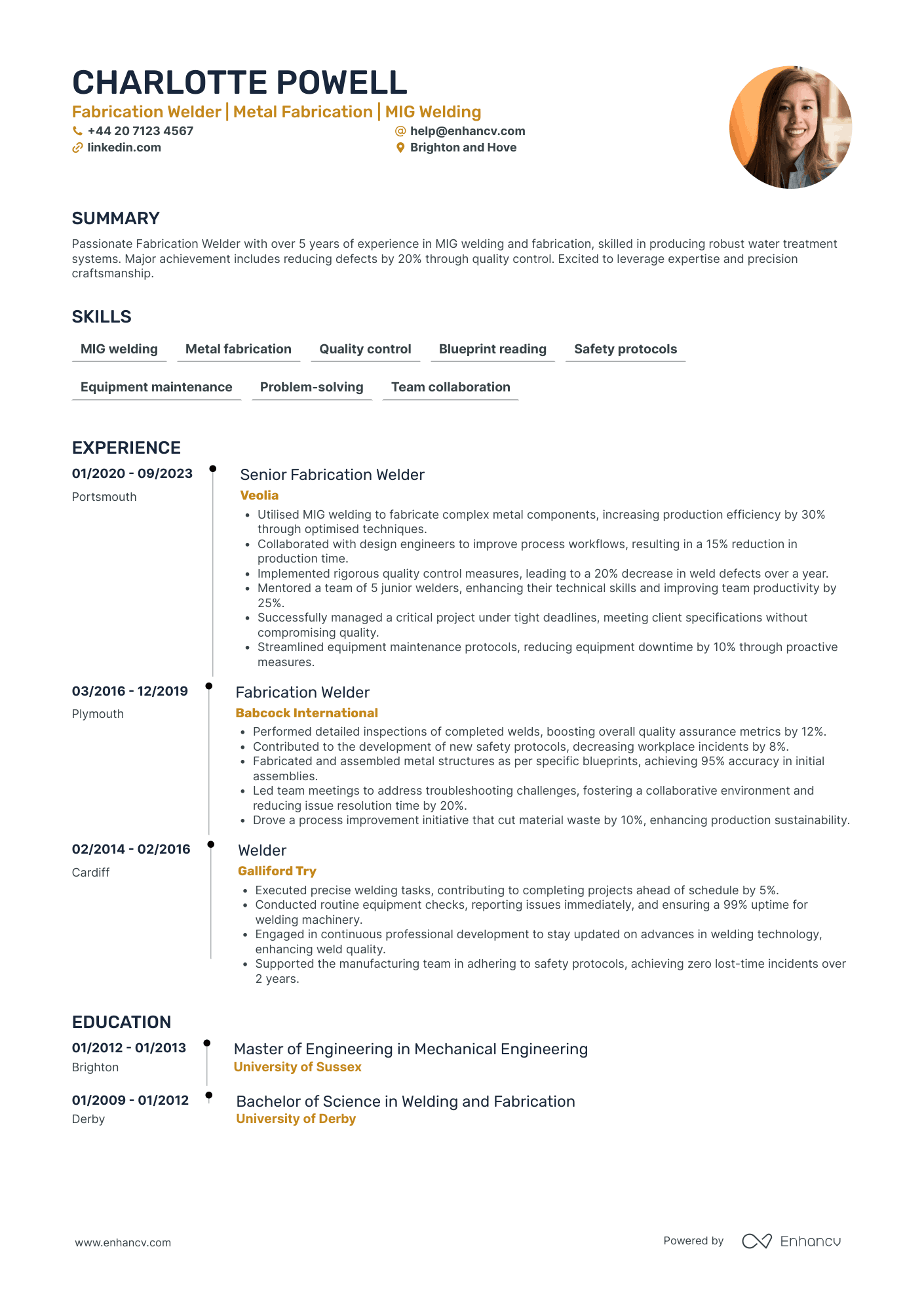
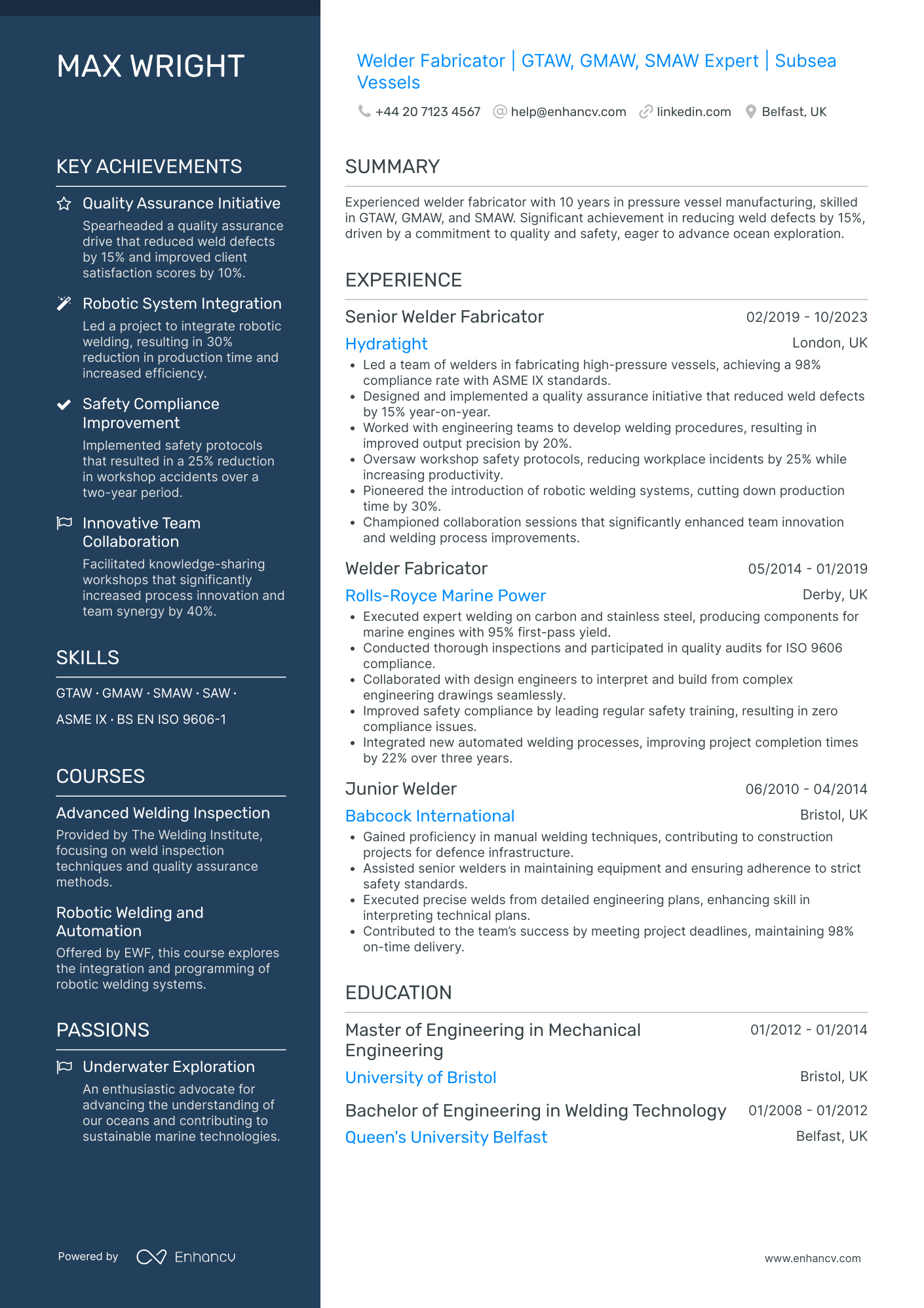
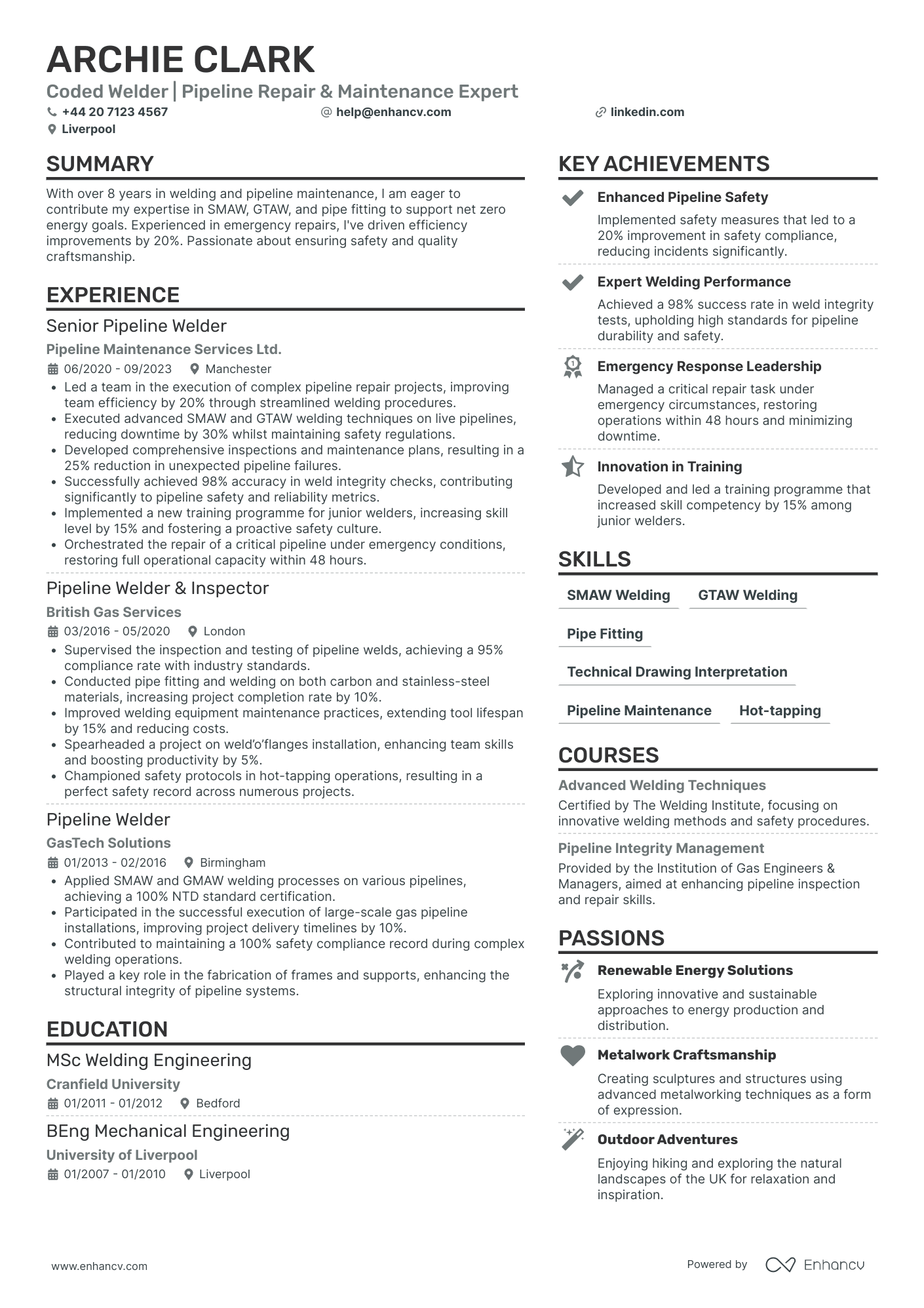
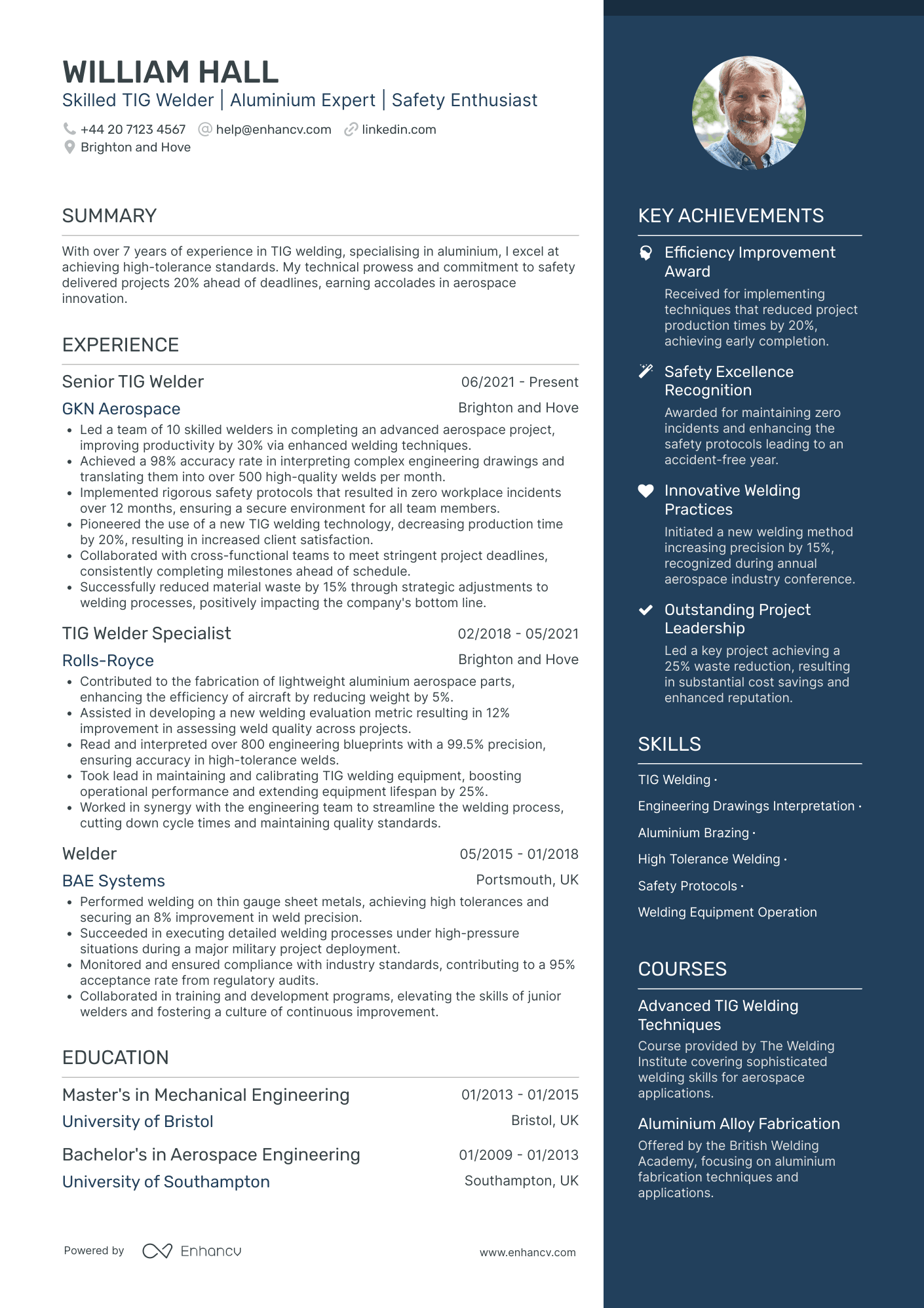
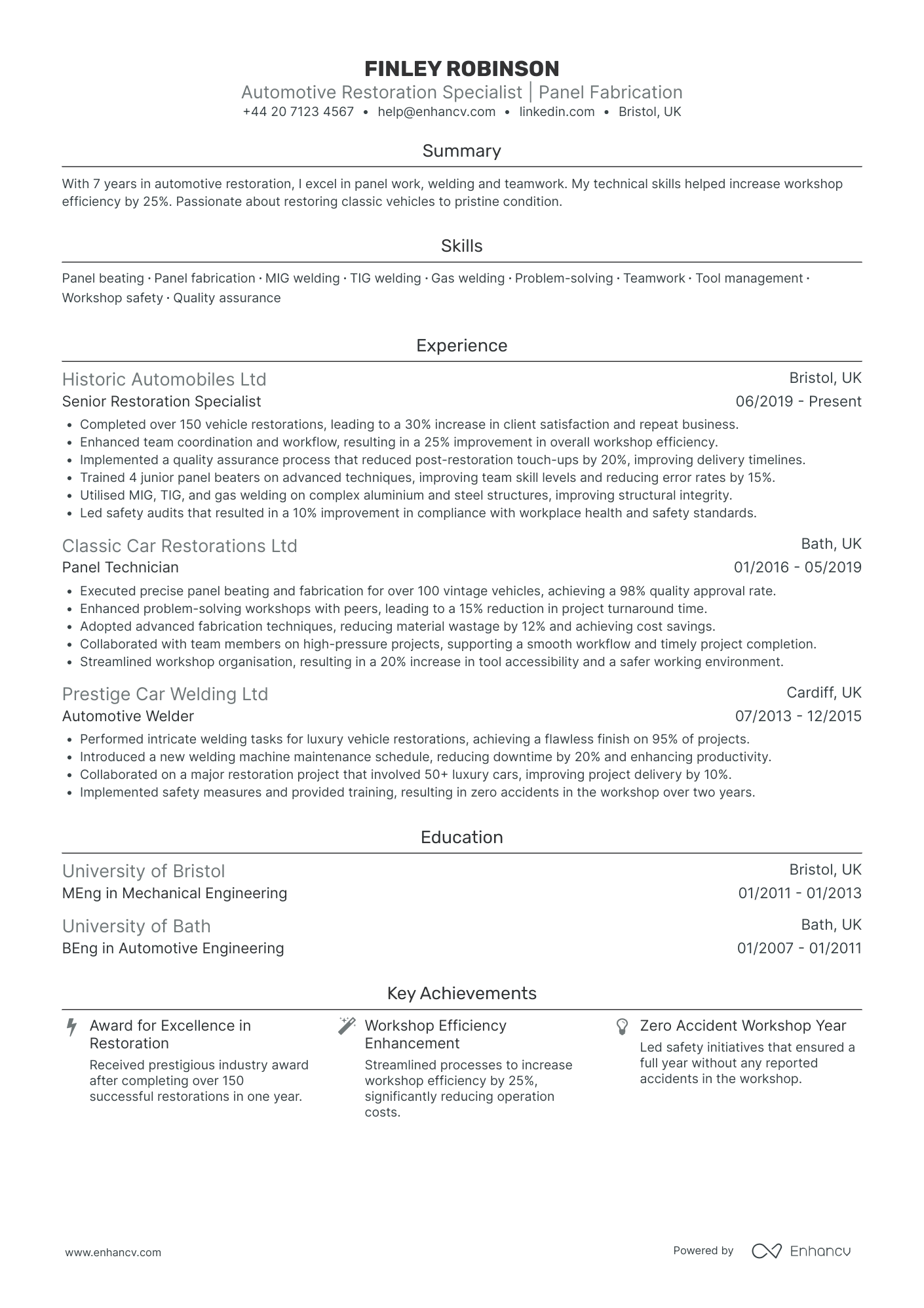
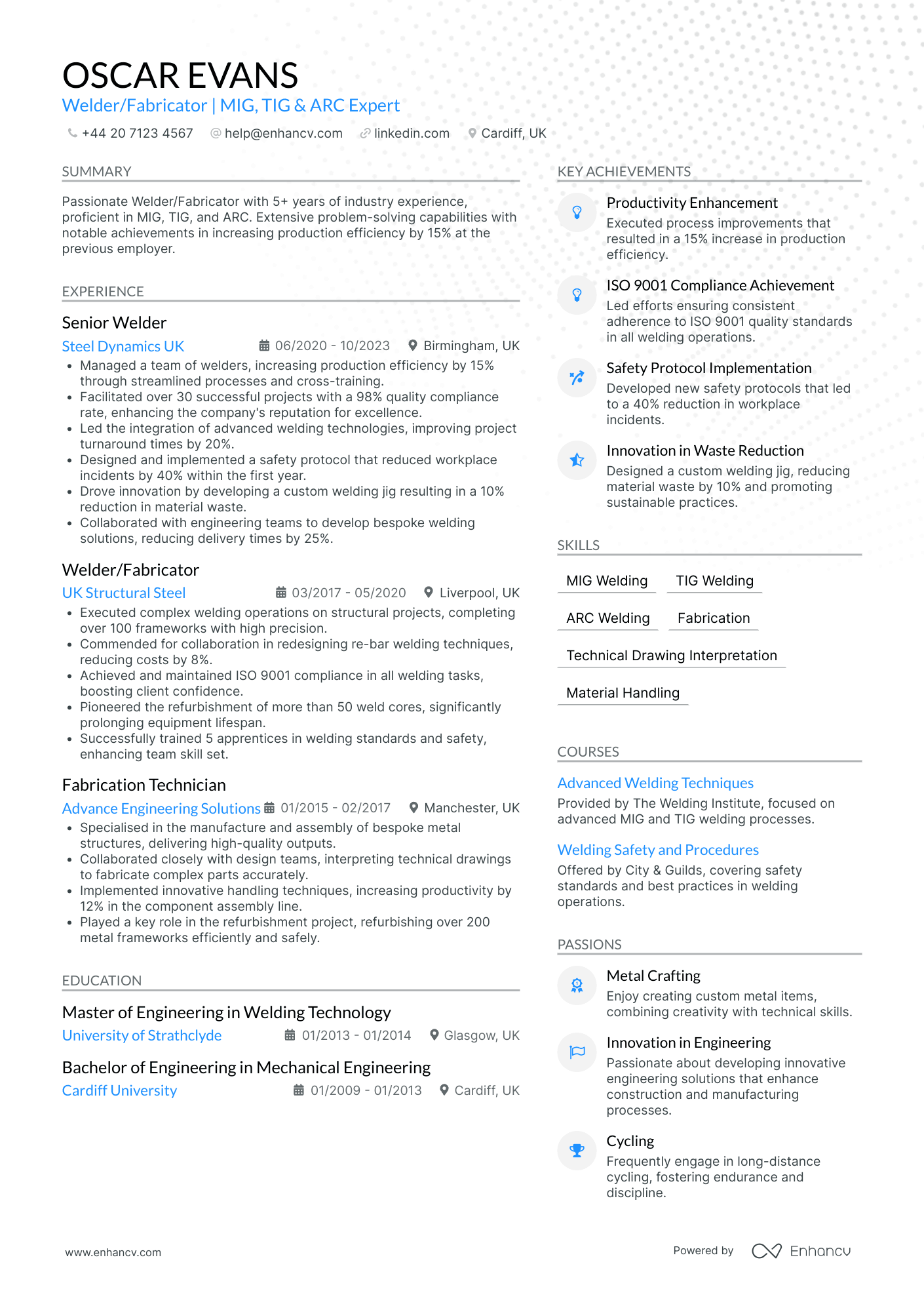
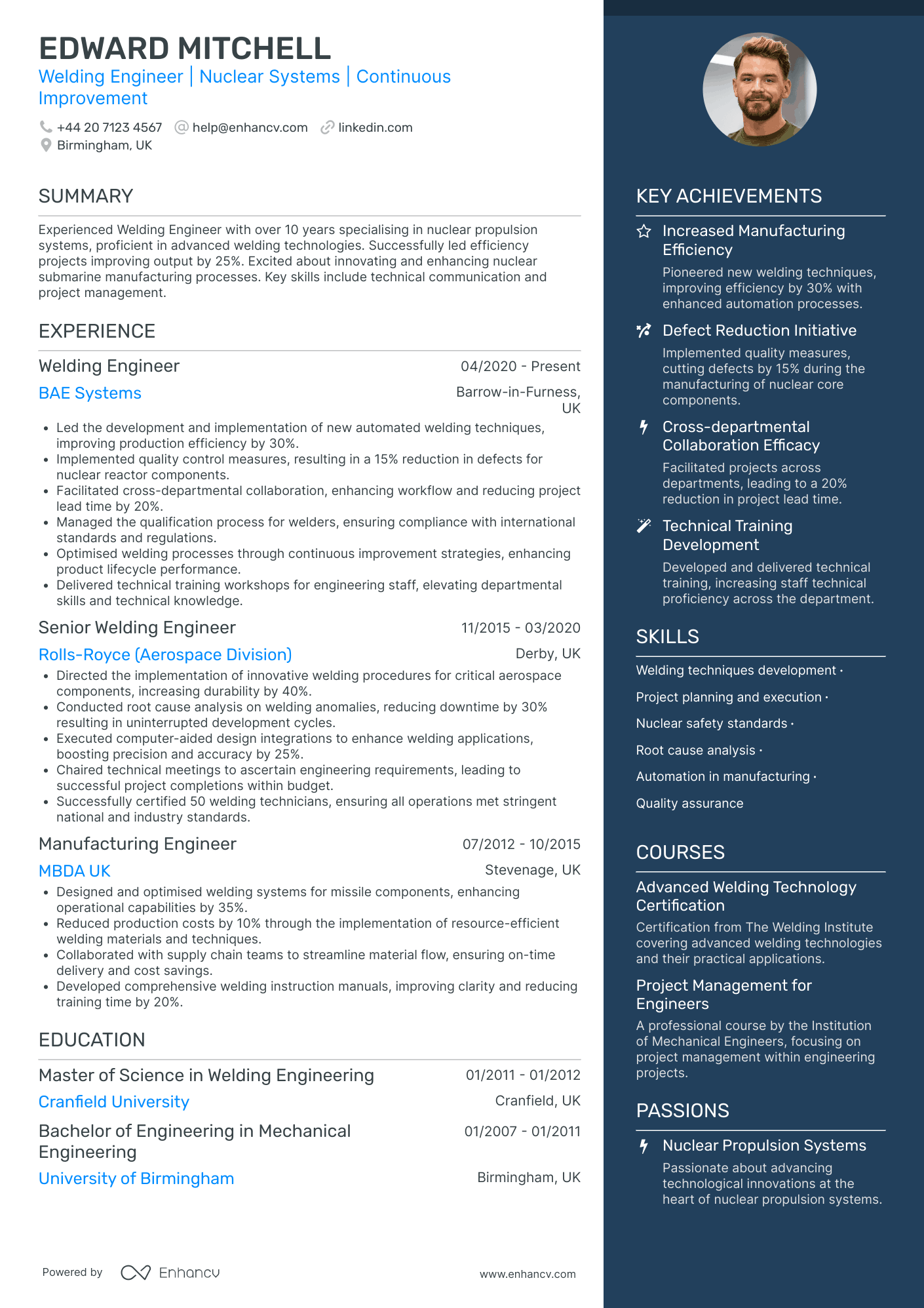
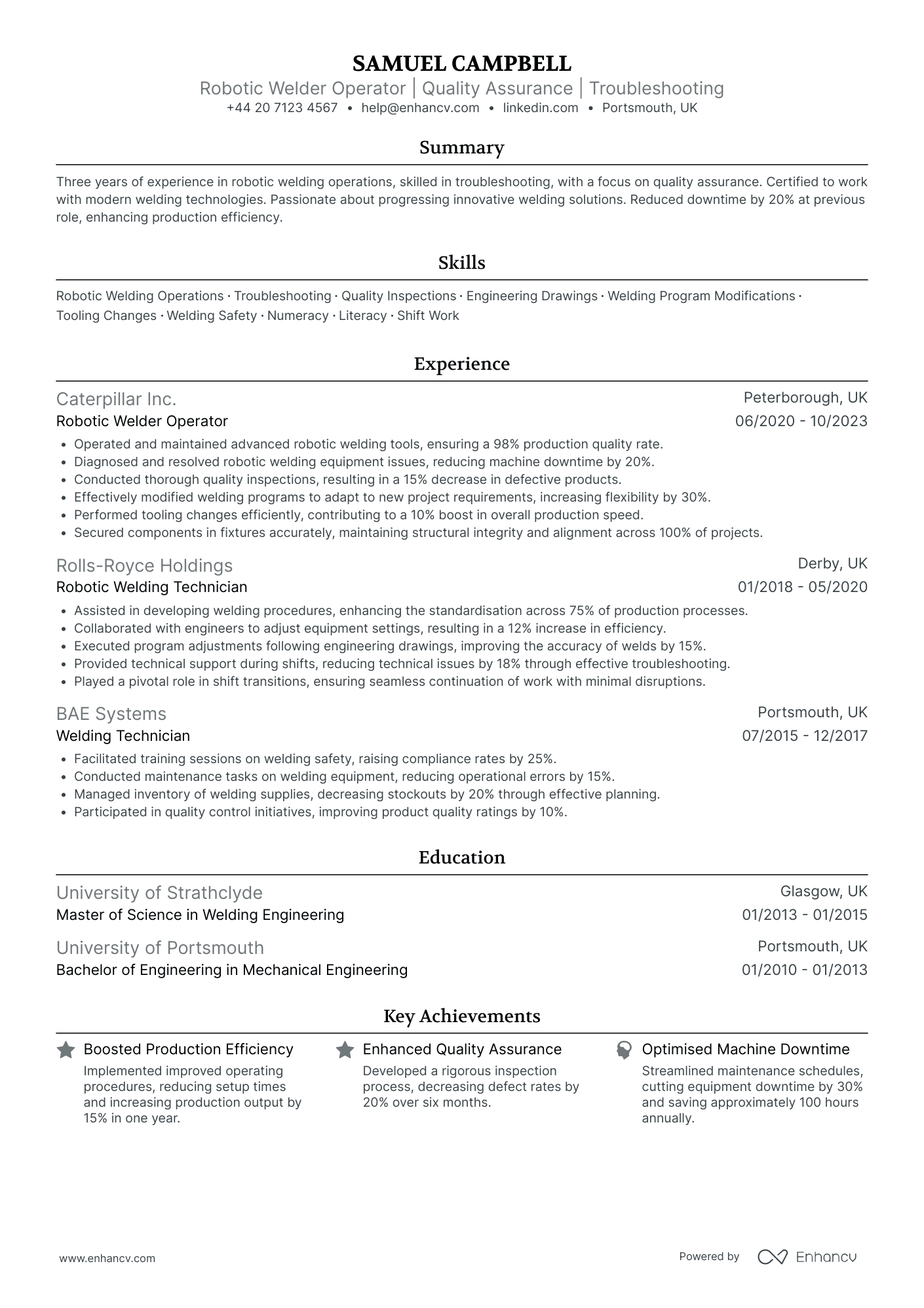
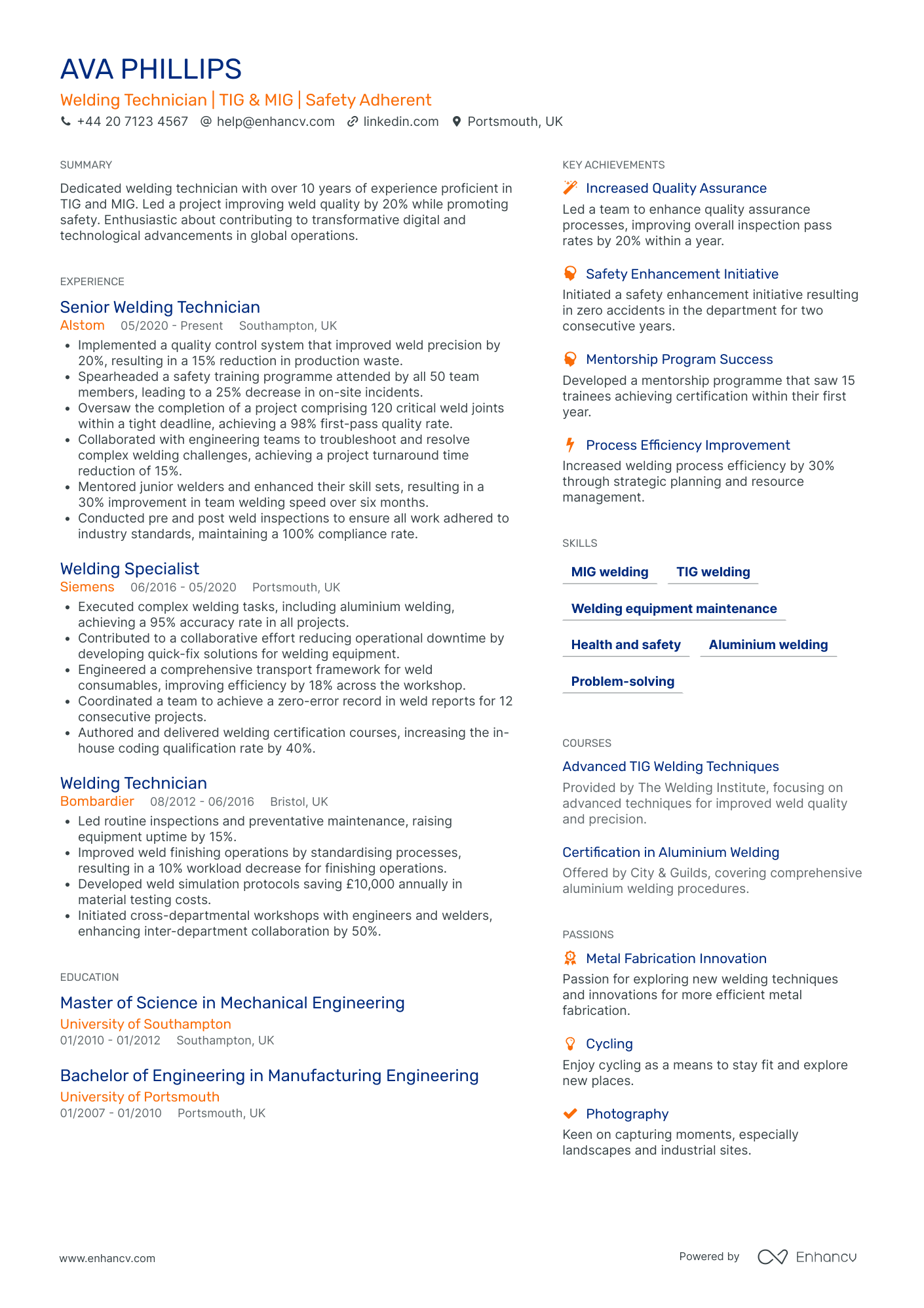
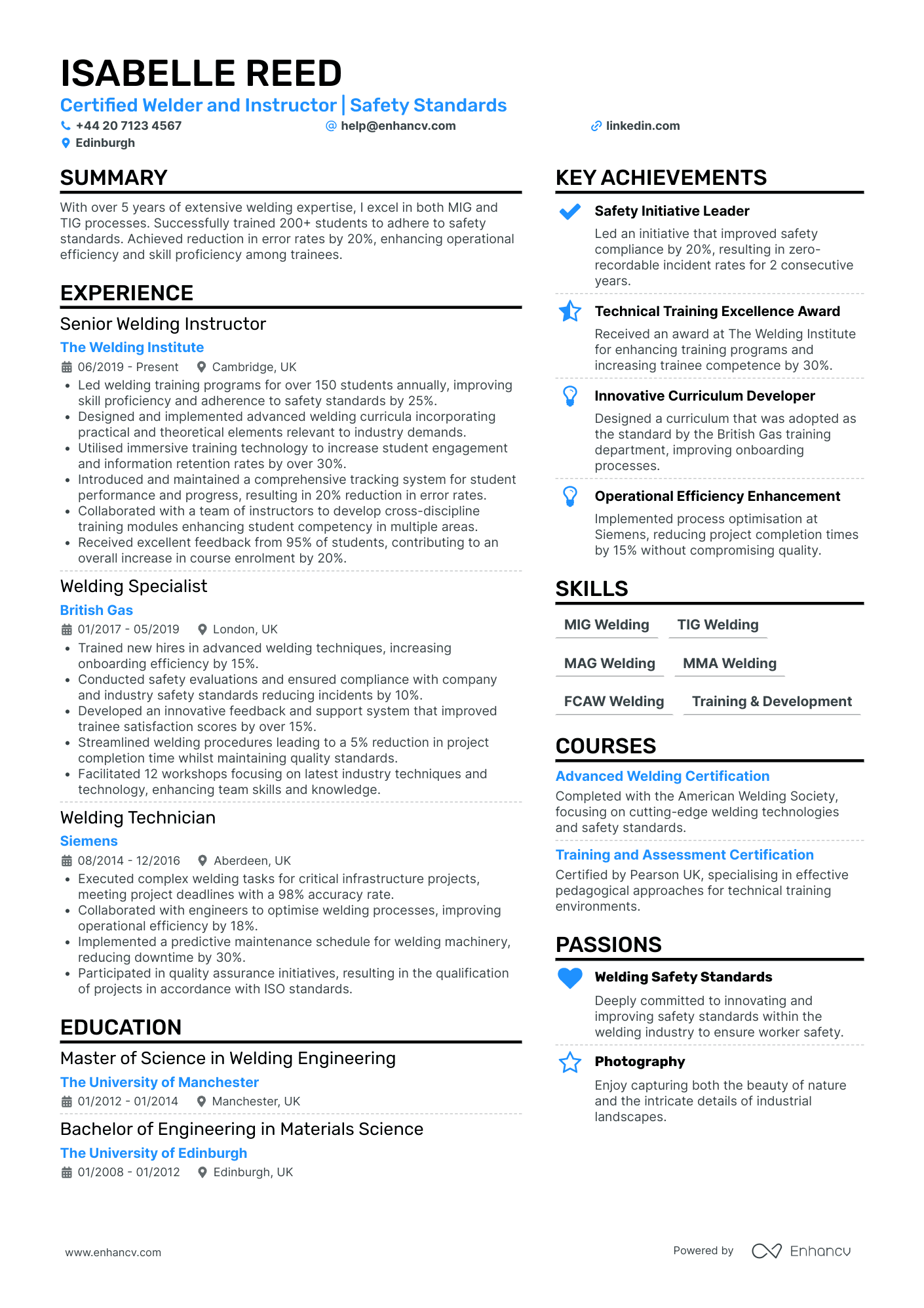
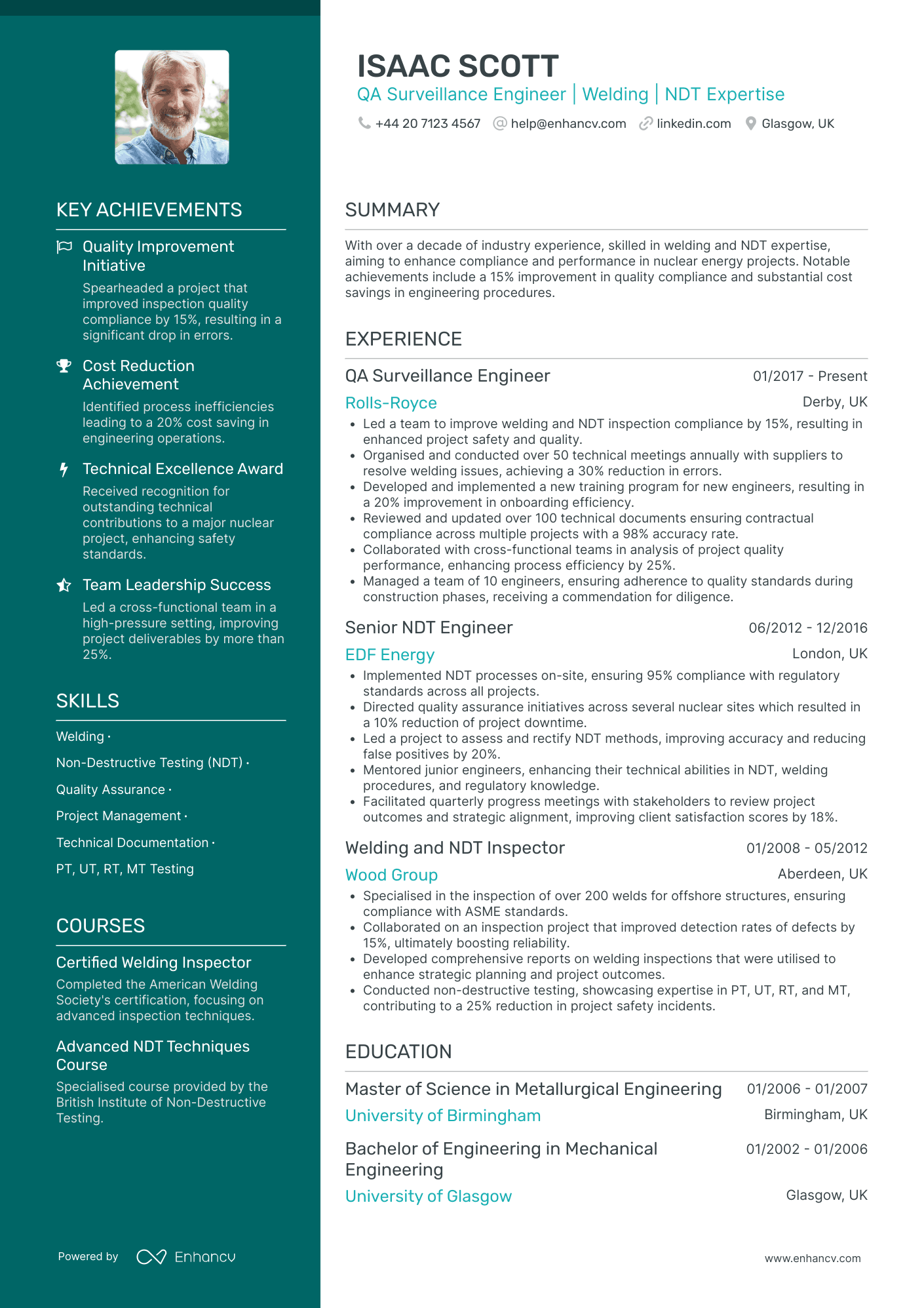
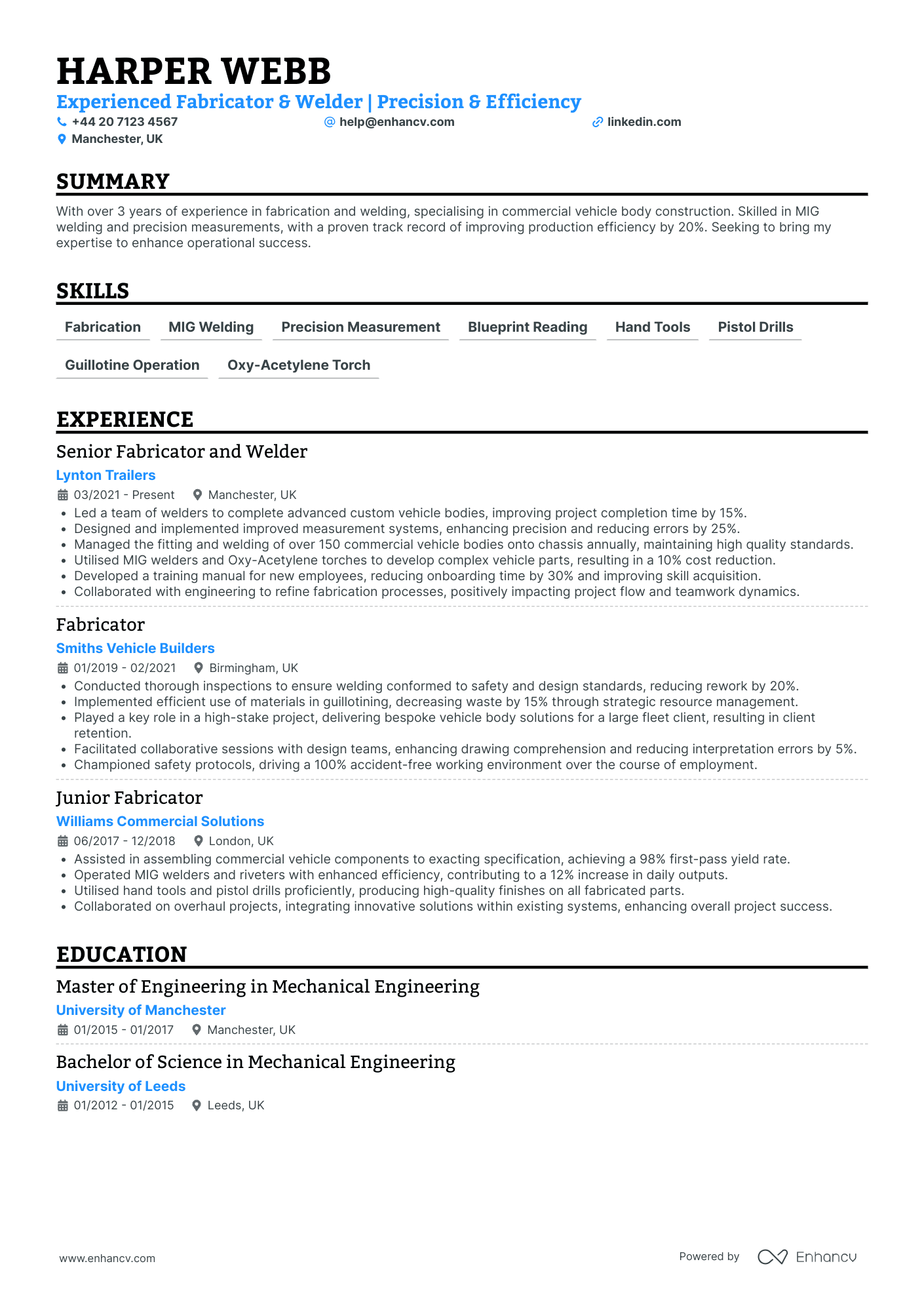
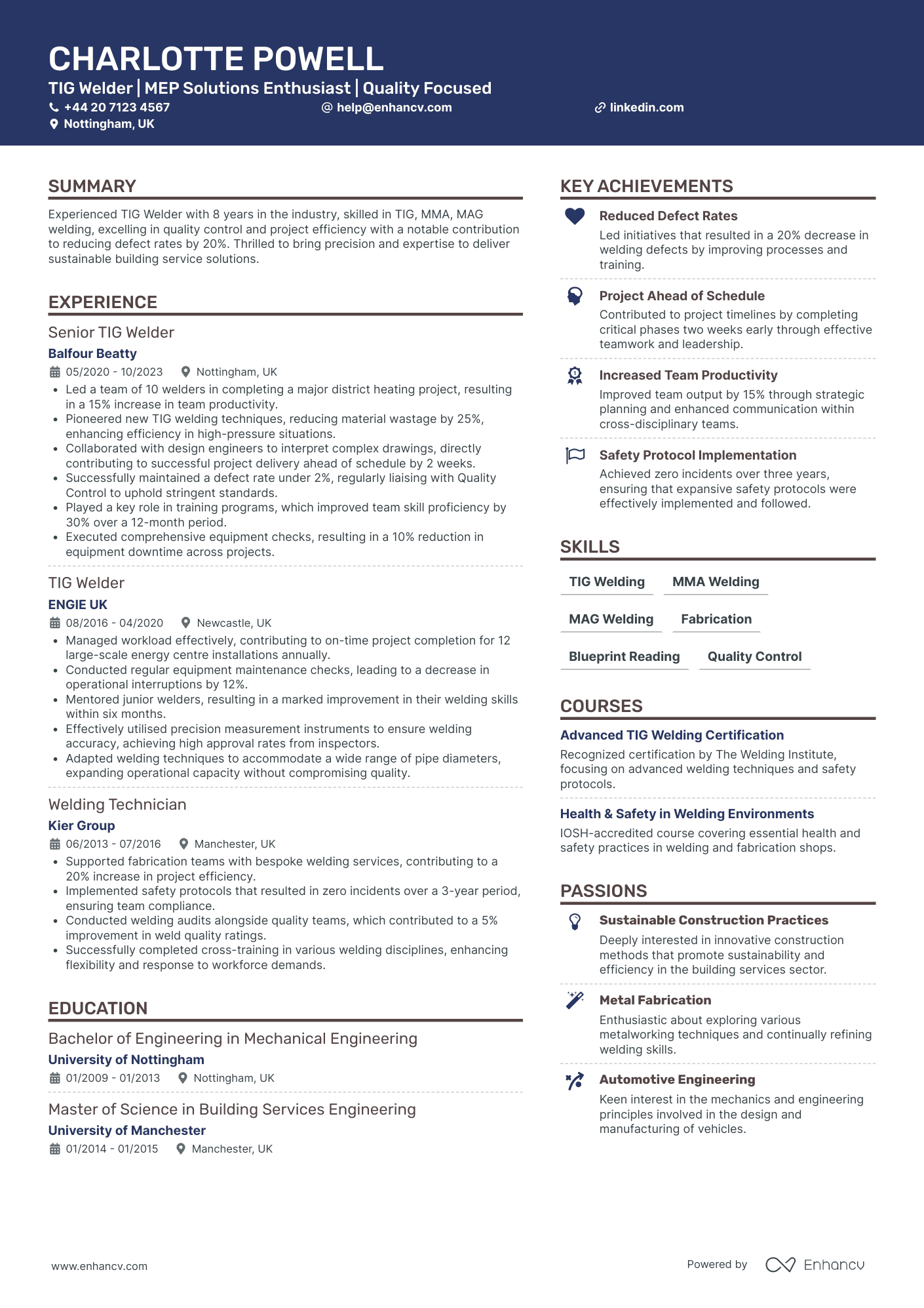
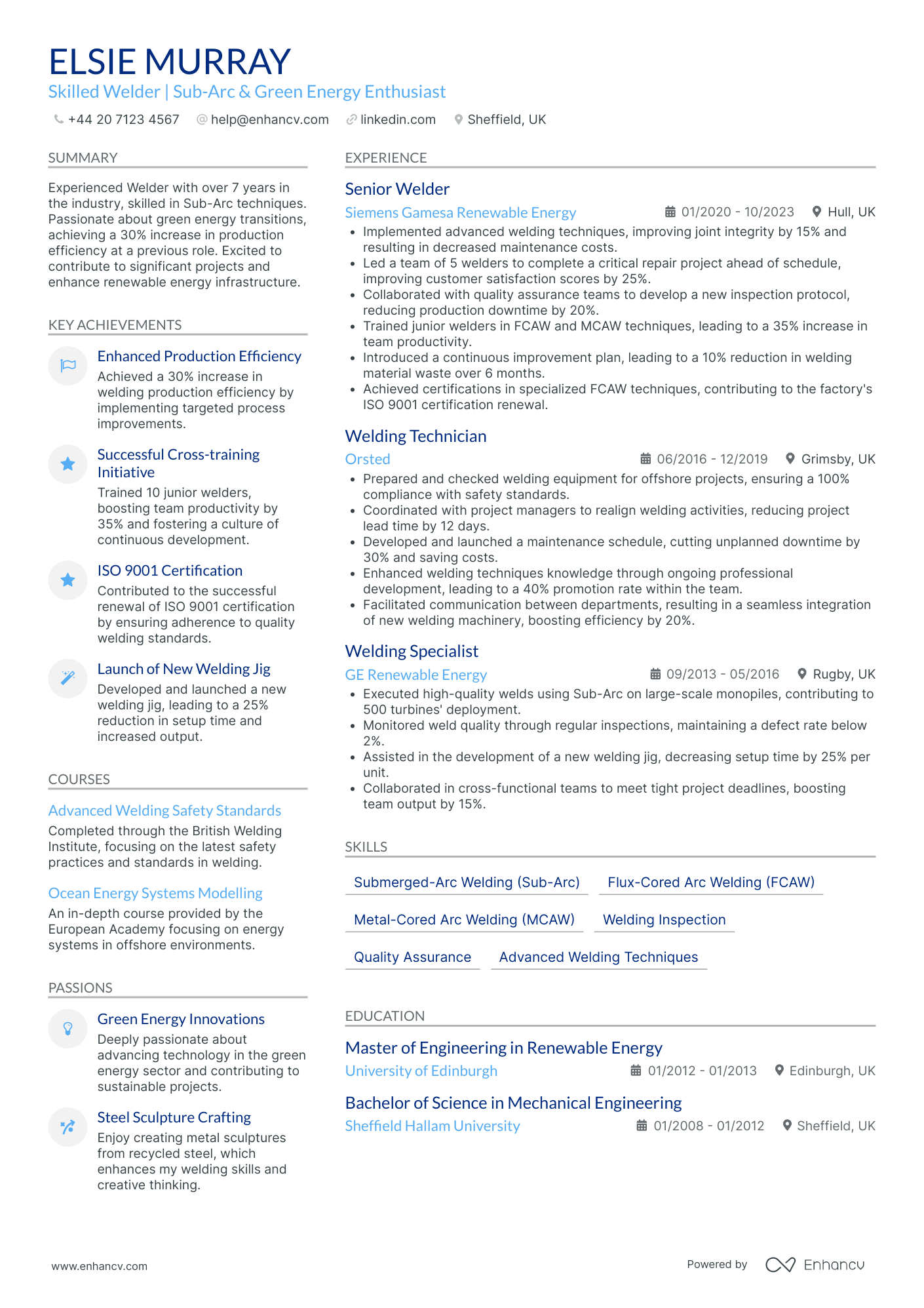
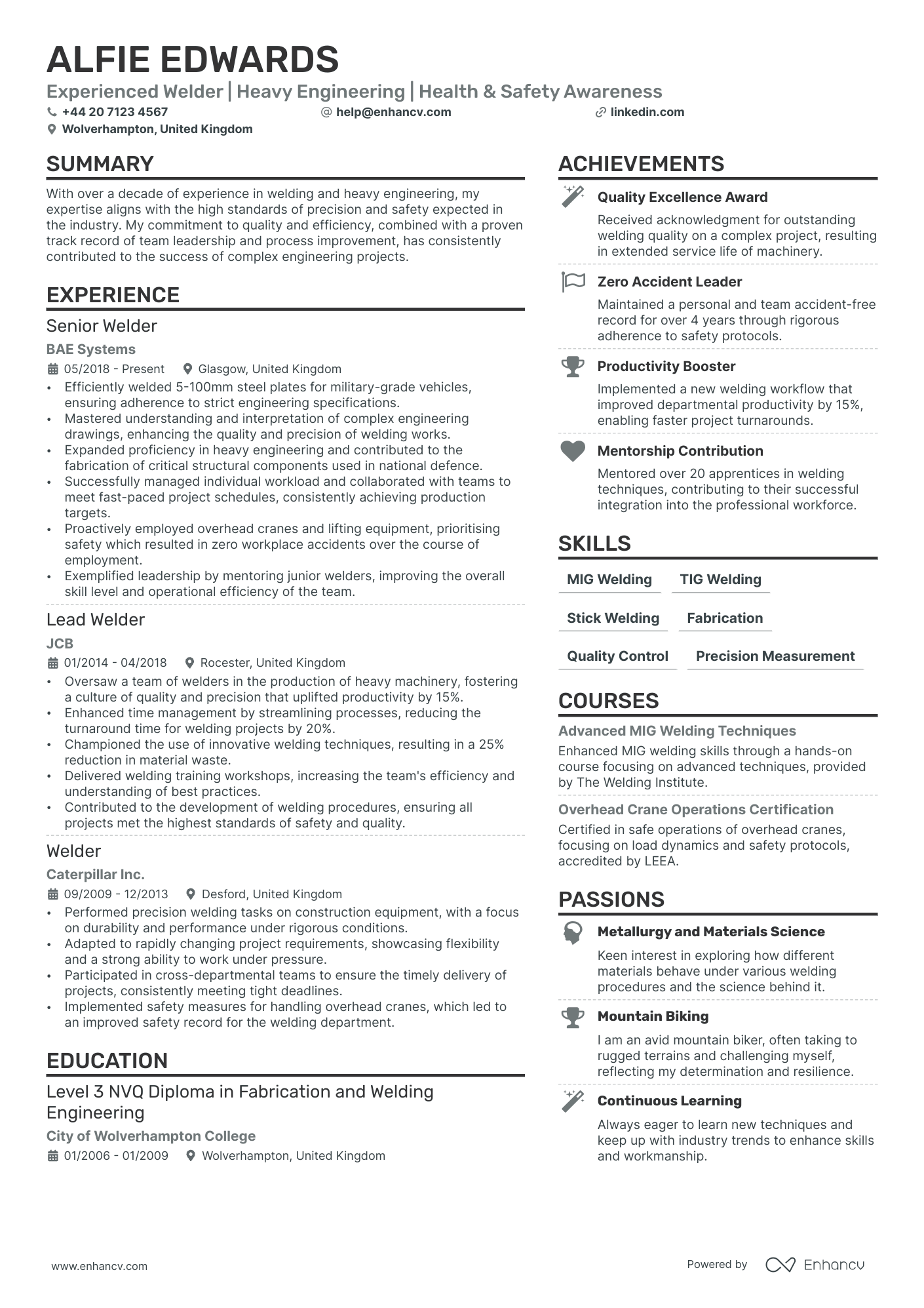
The last welder CV that made me stop and read opened with the tickets. Coding qualifications, processes, and materials, right at the top, before a single line of prose about being hard-working.
Most welder CVs bury that under a generic profile and a duties list copied from the advert. The ones that get called back lead with what a shop foreman actually checks: which processes you run, what you are coded to, and whether the format survives a print.

Key takeaways
- Lead with your welding processes and coding tickets. A foreman scans for those in the first few seconds.
- Send a PDF for direct applications so the layout holds. Keep a Word copy for agencies that reformat CVs into their own template.
- One or two pages, one column, standard headings. Make it easy to skim on a phone or a workshop terminal.
- Name the processes in the advert's words: MIG, TIG, MMA, fabrication, and reading engineering drawings.
- Put your tickets, CSCS card, and location near the top. Welding is on-site work.
- Quantify the shop floor: joints per shift, pass rates on inspection, and the materials and thicknesses you run.
Formatting your welder CV
Format is the whole game for a welder CV, because a foreman decides in seconds whether you can do the job. Get the structure right and the rest of the CV does its work.
Use a reverse chronological layout once you have jobs behind you, with your most recent role first. If you are just out of college, switch to a skills-led structure so your processes and tickets come before a thin work history.
Keep it to one or two pages, one column, standard headings, and a readable font. Welder CVs are usually short, and a clean single page beats a padded two-pager early in a career. Save the second page for when you have the roles and the tickets to fill it.
Order the sections so a busy foreman never has to hunt. Header, a short personal statement, your tickets and certifications, then experience, skills, and education. The two blocks that decide the interview, your coding qualifications and your processes, should sit in the top third of page one.
Your header does the first job. Name, phone number, email, town, and a note that you drive and have your own transport. Skip a photo and your date of birth, because neither helps and both take space a UK employer does not expect.
On the look of the page, use a plain font at 10 to 12 point, sensible margins, and bold only for headings and job titles. No coloured banners, no two-column grids that scramble in a reformat, and no clip-art tools down the side. A welder CV should read like a job sheet, not a poster.
Put a dedicated tickets and certifications block near the top, not buried under education. Your coding qualifications and CSCS card are the first thing an employer wants to confirm, so do not make them scroll.
On the file type, the question in most welding adverts comes down to PDF or Word. Send a PDF for direct applications so the layout holds on any screen. Keep a Word version too, because recruitment agencies place a large share of welding and fabrication roles and reformat CVs into their own template before sending them on. A CV built as a clean single column copies across without breaking. If the advert names a file type, follow it.
Welding applications often pass through tracking software, so keep the layout clean and the headings standard for an ATS-friendly CV. Build it from a tested layout rather than a blank page: Enhancv's CV templates export to a clean PDF and download as a Word file from the same CV.

PRO TIP
Keep two copies of the same welder CV ready: a PDF for applying direct to fabricators, and a Word (.docx) version for agencies that drop your details into their own template. A locked-down PDF that an agency cannot edit often gets retyped, and that is where the tickets and processes go missing.
What the UK welder market looks like
Knowing the market shapes the CV. Here is what the role pays and where the work sits.
| What | UK welder roles |
|---|---|
| Typical pay | £25,000 to £45,000 a year (National Careers Service (gov.uk)) |
| Where the work happens | On-site (29 of 30 UK welder postings in the last ~30 days, Enhancv's internal job feed) |
| Experience level asked for | Mostly mid-level, with entry-level the next largest group |
| Most-listed skills | MIG welding, TIG welding, reading engineering drawings, and fabrication |
Two things in that table should shape your CV.
Welding is almost entirely on-site work, so an employer needs to see you can reliably get to the shop. Put your town near the top, and mention a driving licence and your own transport if you have them.
MIG welding, TIG welding, and reading engineering drawings are the skills that recur most often in UK welder postings on Enhancv's internal job feed. Name the ones you run in the advert's own words, and put them where they are read first.
The pay range is wide because it tracks your tickets and the processes you hold. Coded welders on pipework and pressure work sit at the top of that band, so make your qualifications easy to find.
Most of the roles on the feed are pitched at mid-level, with a solid share of entry-level openings, so there is real room for a welder building up their tickets. Tailor the CV to where you sit: a mid-level welder leads with coded work and pass rates, while an entry-level applicant leads with training, test pieces, and a willingness to sit the next coding test.
Writing your welder personal statement
Three or four sentences at the top: who you are, the processes and tickets you hold, the materials you have run, and the kind of work you want next. See more personal statement examples if the opening line is holding you up.
Skip the adjective soup every other CV opens with. "Hard-working, reliable, and a team player" tells a foreman nothing he can check.
Name the processes, the standards you are coded to, and one number that proves the work. A recruiter reading fifty CVs remembers the one that opened with a pass rate.
Lead with the specifics instead:
Welder CV personal statement example
Time-served welder-fabricator with eight years across MIG, TIG, and MMA on mild steel and stainless. Coded to ASME IX and confident reading engineering drawings on structural and pipework jobs. Consistent first-time pass rates on visual and X-ray inspection. Looking to bring precision and a clean safety record to a fabrication role near Sheffield.
When I read a welder CV, I go straight to two things: what you are coded to and what you have actually welded. A line like "coded to ASME IX, MIG and TIG on stainless up to 12mm" tells me more than a paragraph of adjectives. Put the processes, the tickets, and the materials where I can see them in the first six seconds, then let the experience back them up.
Writing your welder experience section
Write each role the same way: a dated heading, then bullets that show what you welded and how well. Lead each bullet with a verb. For the mechanics, see work experience on a CV.
Welding is one of the easiest trades to quantify, so use numbers. Joints per shift, pass rates on visual or X-ray inspection, materials and thicknesses, tolerances held, and downtime avoided are all CV achievements. A single reject rate or first-time pass figure carries more weight than three lines describing how careful you are.
Start each bullet with a strong action verb: welded, fabricated, fitted, tacked, inspected, or set up. Then name the process, the material, and the result. "Welded" on its own is a duty, while "welded stainless pipework to ASME IX with a first-time X-ray pass" is an achievement.
If you are wondering which duties to list, the core five are running your processes from drawings, fabricating and fitting assemblies, inspecting and preparing welds for testing, setting up and maintaining plant, and working to safety method statements. Pull the exact wording from the advert and mirror the duties that are true of you. Enhancv's CV tailoring feature reads the ad and suggests the matching edits, which saves rewriting from scratch for every job.
- Run MIG, TIG, and MMA welding on mild steel and stainless from engineering drawings, producing 40 to 60 joints a shift
- Hold a first-time pass rate above 95% on visual and X-ray inspection across structural and pipework contracts
- Fabricate and fit assemblies to tolerances of plus or minus 1mm, working from technical drawings and cut lists
- Set up and maintain plant, changing consumables and adjusting settings for each material and thickness
- Work to method statements and toolbox talks, keeping a clean safety record across four years on site
- Welded structural steel to CE-marked standards, working from cut lists and fabrication drawings on a two-shift line
- Cut, prepared, and tacked assemblies before final weld, reducing rework sent back from the inspection bay
- Passed the company coding test for MIG on mild steel within the first month and re-tested on schedule each year
- Trained two apprentices on machine set-up, consumables, and reading weld symbols on drawings
PRO TIP
Welding adverts list processes and materials, not soft-skill clouds. Mirror the ones you can back: "MIG", "TIG", "MMA", "flux-cored", "stainless", "aluminium", "pipework", "structural". If you are coded for it, name the standard exactly as the advert does.
Top skills for your welder CV
Read a dozen live welder adverts and the same demands repeat, and they are technical, not generic. MIG welding, TIG welding, reading engineering drawings, and fabrication come up again and again. Those are your hard skills, listed in the words the adverts use.
The soft skills that matter here are real and checkable: attention to detail, hand-eye coordination, and the reliability to turn up and hit a deadline. Prove each one in a bullet rather than just claiming it. "Held plus or minus 1mm tolerance on repeat production" is attention to detail an employer can weigh.
Evidence beats a list every time. Instead of writing "TIG welding" and moving on, tie it to a material and a result: "TIG on stainless and aluminium up to 10mm, passed on visual and dye-penetrant inspection". A skill with a material, a thickness, and a pass rate against it reads as fact, not a claim.
List only what you can stand behind. If you are coded for a process, name the standard. If you are not yet, put it under training in progress rather than skills.
Top skills for your welder CV:
MIG welding
TIG welding
MMA (stick) welding
Reading engineering drawings
Fabrication
Mild steel and stainless
Hand and power tools
Weld inspection and NDT prep
Attention to detail
Hand-eye coordination
Reliability
Teamwork
Problem solving
Certifications and tickets for a welder CV
Tickets are what separate one welder CV from the next, so give them their own block near the top. This is the section an employer checks before they read anything else.
List your coding qualifications with the standard and process spelled out, such as ASME IX or BS EN ISO 9606, and note the materials and thicknesses each covers. Add a CSWIP qualification if you hold one, and any NVQ Level 2 or 3 in Fabrication and Welding.
A current CSCS card belongs here too, along with any site tickets like an IPAF or abrasive wheels certificate. Naming the certificates you hold saves the employer a question and keeps you in the pile.
Dates matter with tickets, because a coding qualification lapses if you do not re-test. Put the standard, the process, the material and thickness range, and the date each was last renewed. An employer reading "BS EN ISO 9606-1, 141 TIG, stainless 3mm to 12mm, renewed 2025" knows exactly what you can pick up on day one.
If a coding test has lapsed, say so plainly and note when you can retest, and keep any general qualifications and college courses in your education section.
Writing a welder CV with no experience
No shop-floor history yet is normal straight out of college, and there is a route through it. Lead with a skills-led structure so your welding qualification and processes come before a short work history.
Mine your training for real evidence. It is almost always there:
- College coursework and test pieces: the processes you learned, the materials you welded, and the coupons you passed.
- Work placements or a week's trial in a fabrication shop, written up like a job with dates and duties.
- Hobby or home fabrication: gates, trailers, repairs, or motorsport work you have actually welded.
- Any job that shows reliability and working to procedure, from warehouse work to labouring.
Write those in welding language. "Fabricated and welded a box-section trailer chassis from my own drawings" is a welder bullet that happened in a garage. "Passed college coupons on MIG and TIG in fillet and butt positions" is a skill an employer can picture.
Give any work placement a dated entry like a job, with the shop, the processes you were let loose on, and the hours. A week in a real fabrication shop counts as experience for this role, not filler.
One line moves a no-experience CV up the pile: "NVQ Level 2 in Fabrication and Welding in progress" or "coding test booked for MIG on mild steel". It signals you are already on the path. If you need the fundamentals first, see how to write a CV.
Conclusion
Lead with your processes and tickets, quantify the shop floor, and send the file type the advert asks for.
Pair the CV with a short cover letter that names the work you want, and a clean welder CV turns into interviews.

Author's take - the Enhancv team
When I read a welder CV, I go straight to two things: what you are coded to and what you have actually welded. A line like "coded to ASME IX, MIG and TIG on stainless up to 12mm" tells me more than a paragraph of adjectives. Put the processes, the tickets, and the materials where I can see them in the first six seconds, then let the experience back them up.