



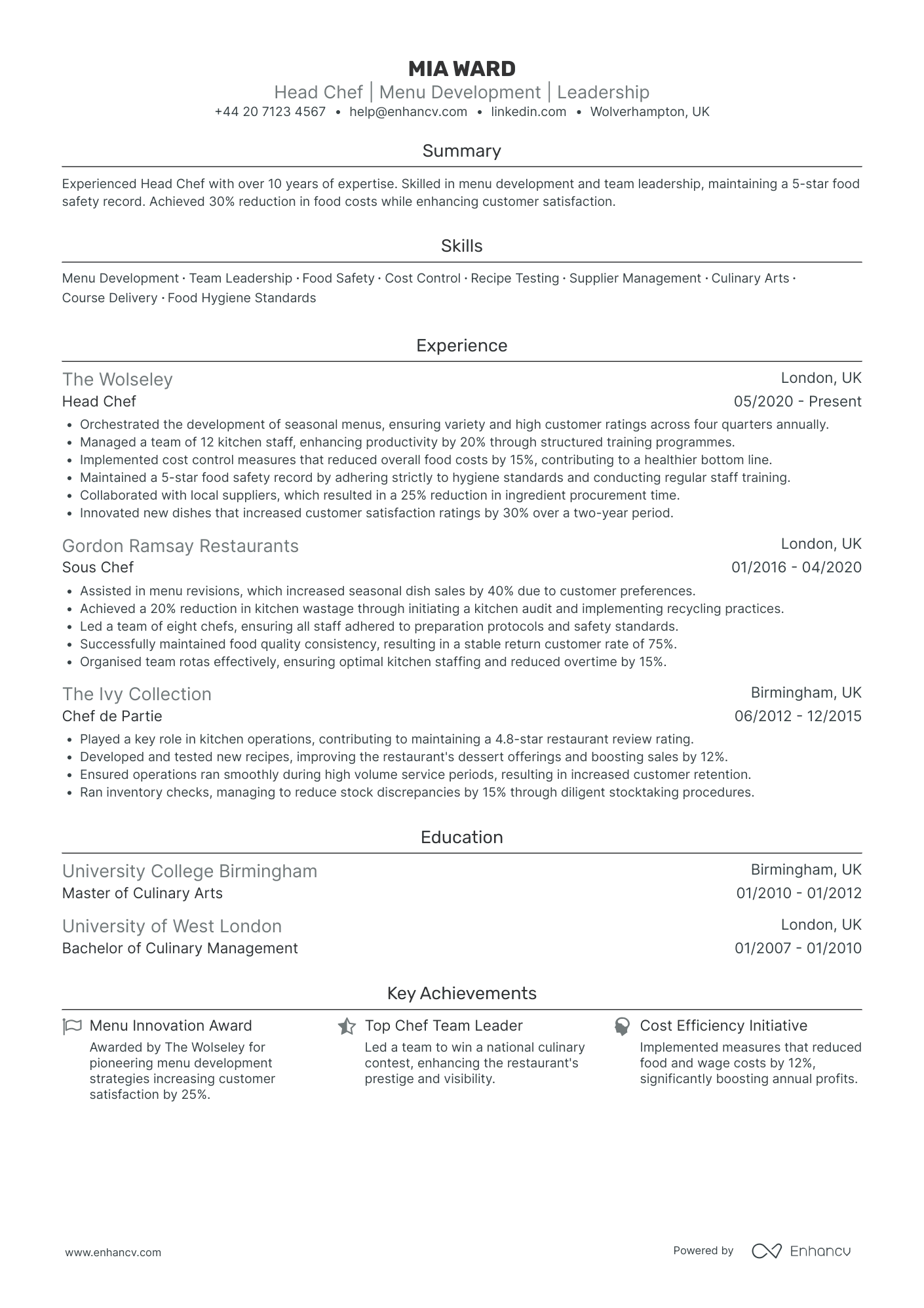
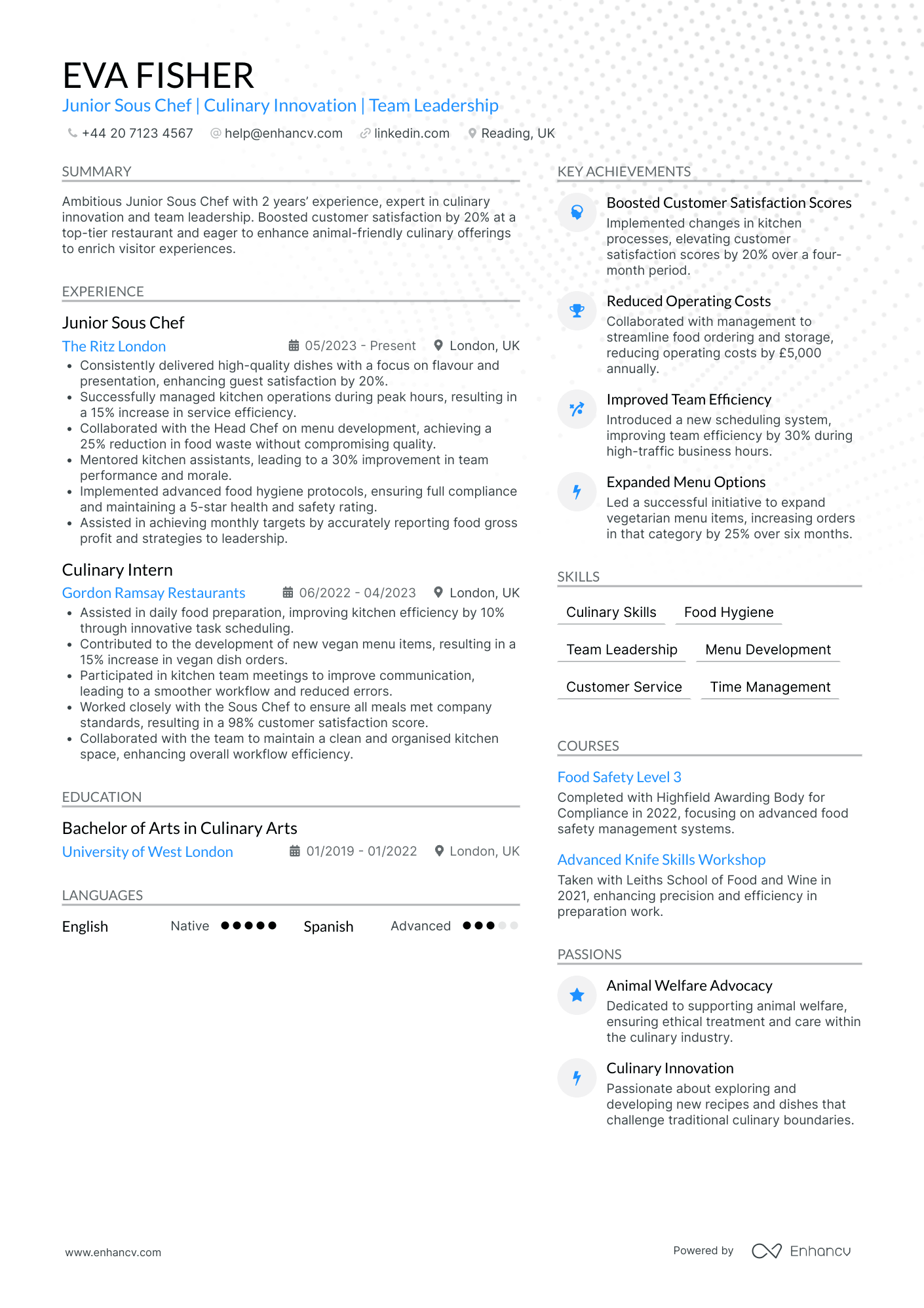
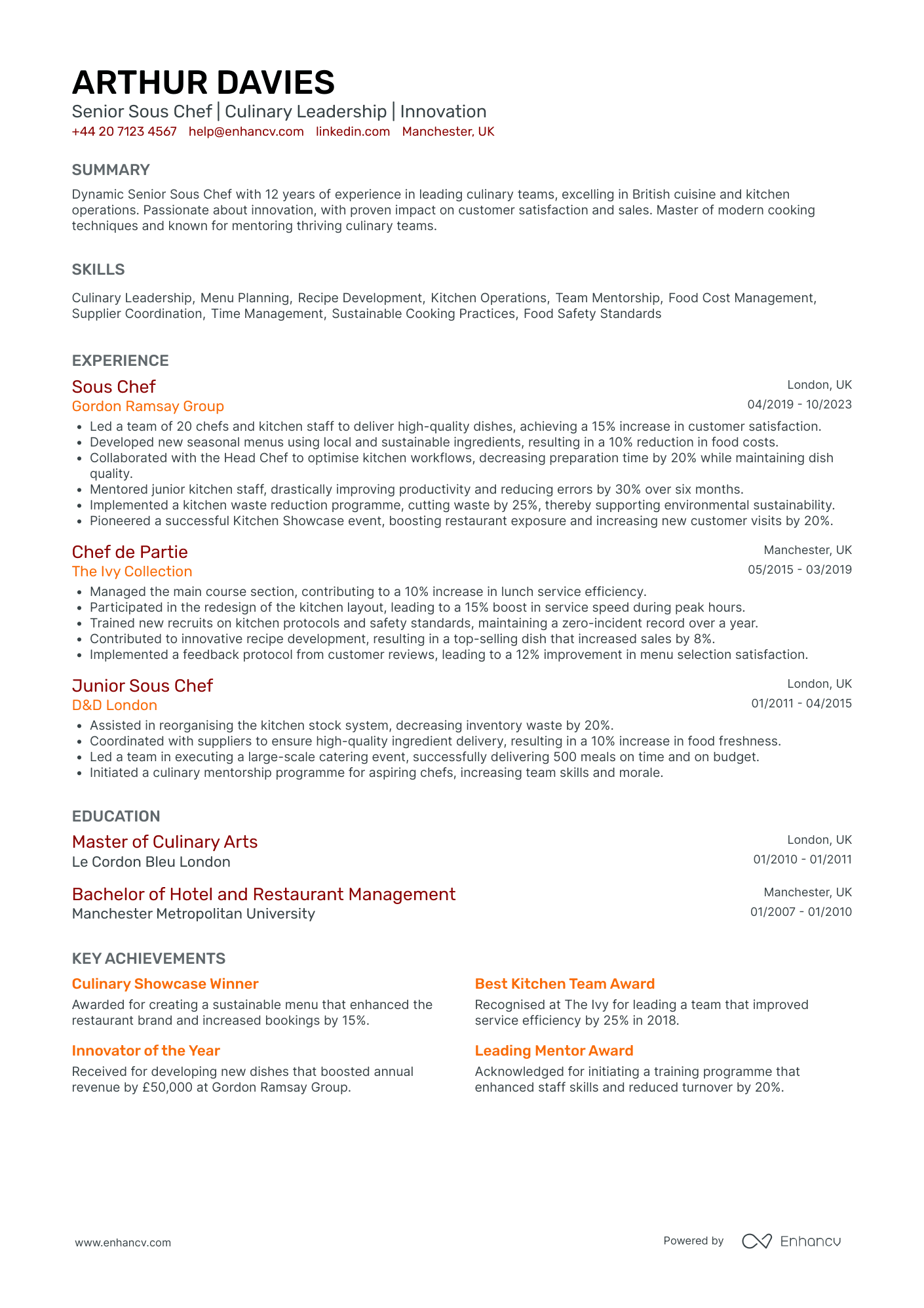
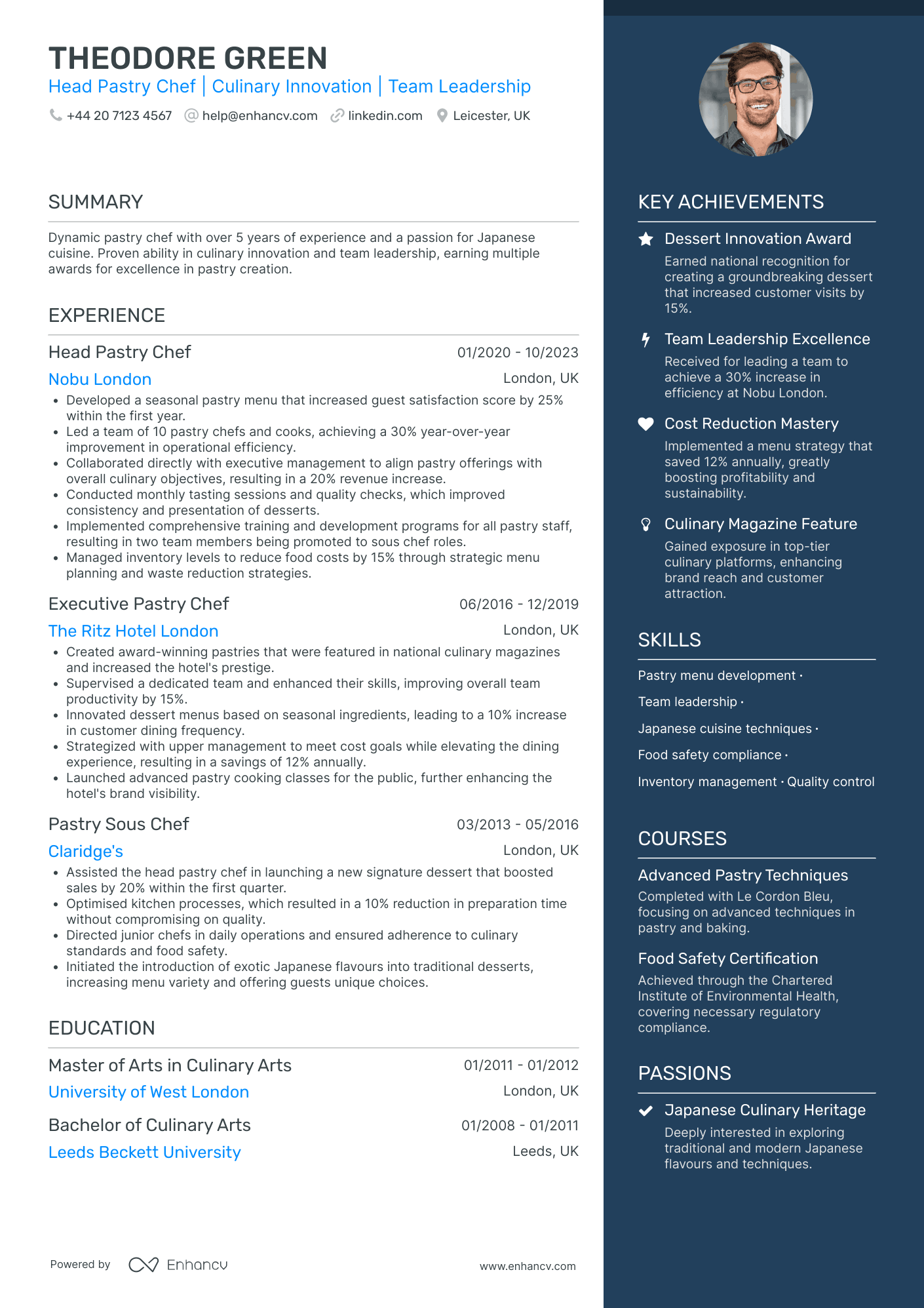
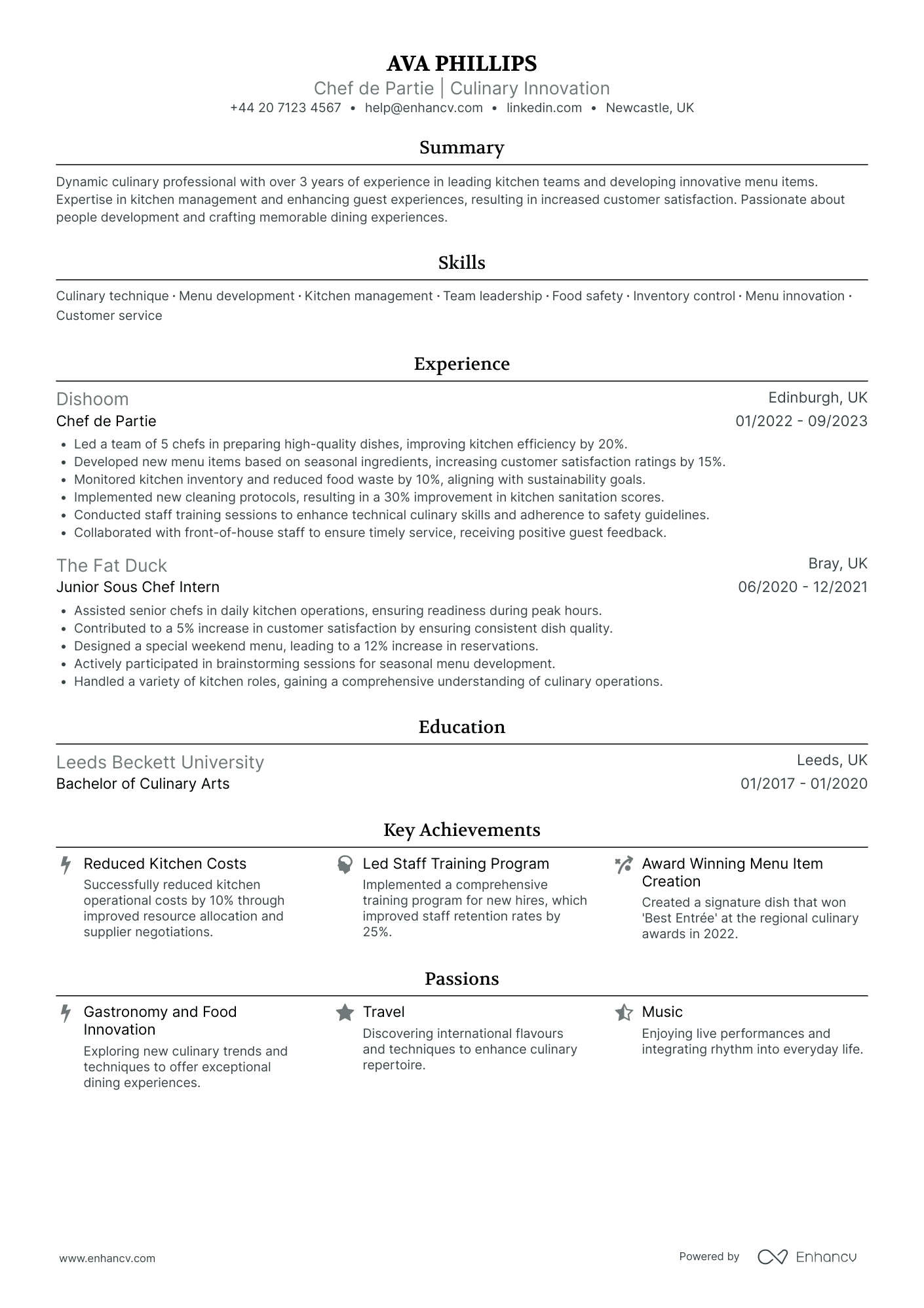
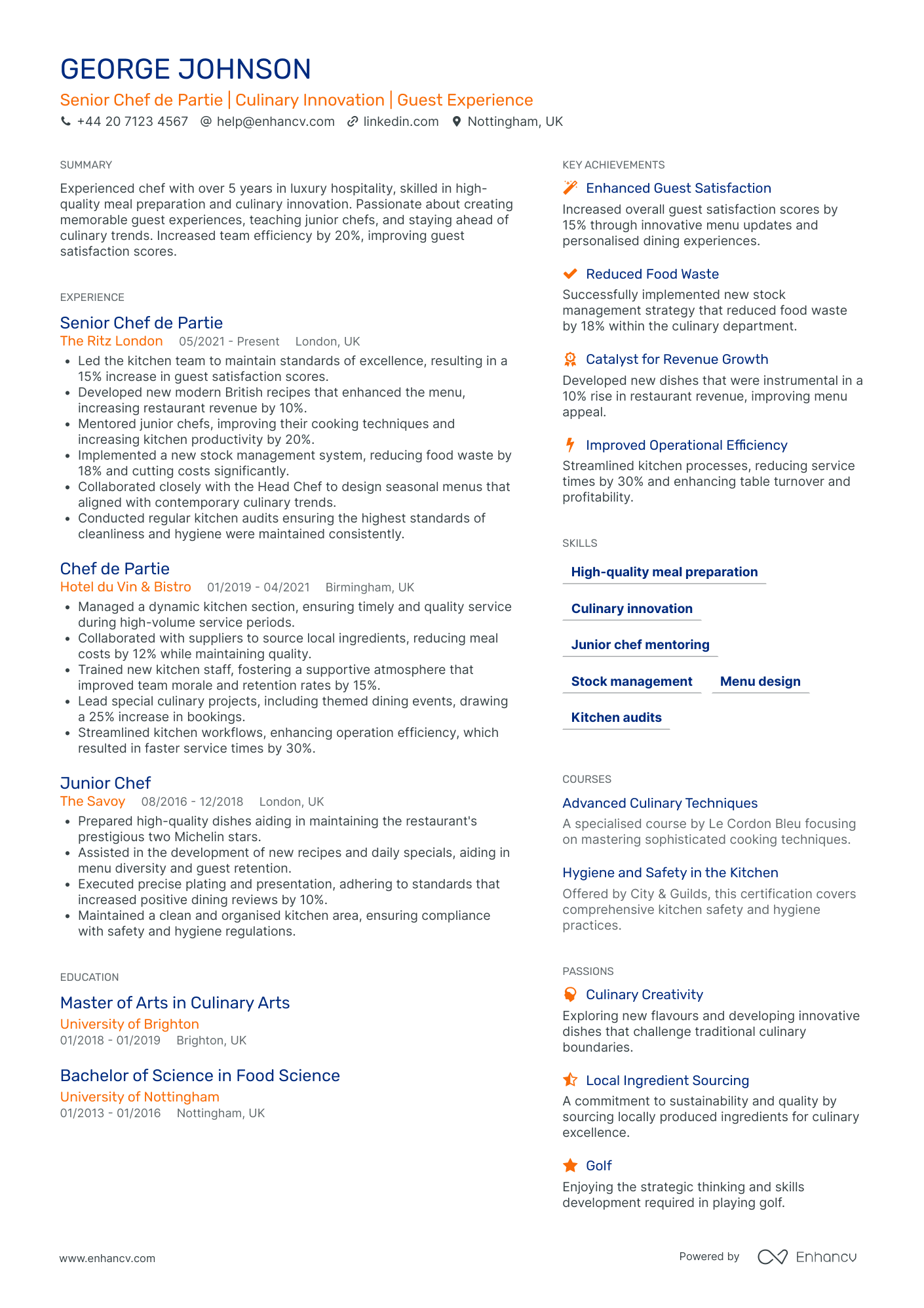
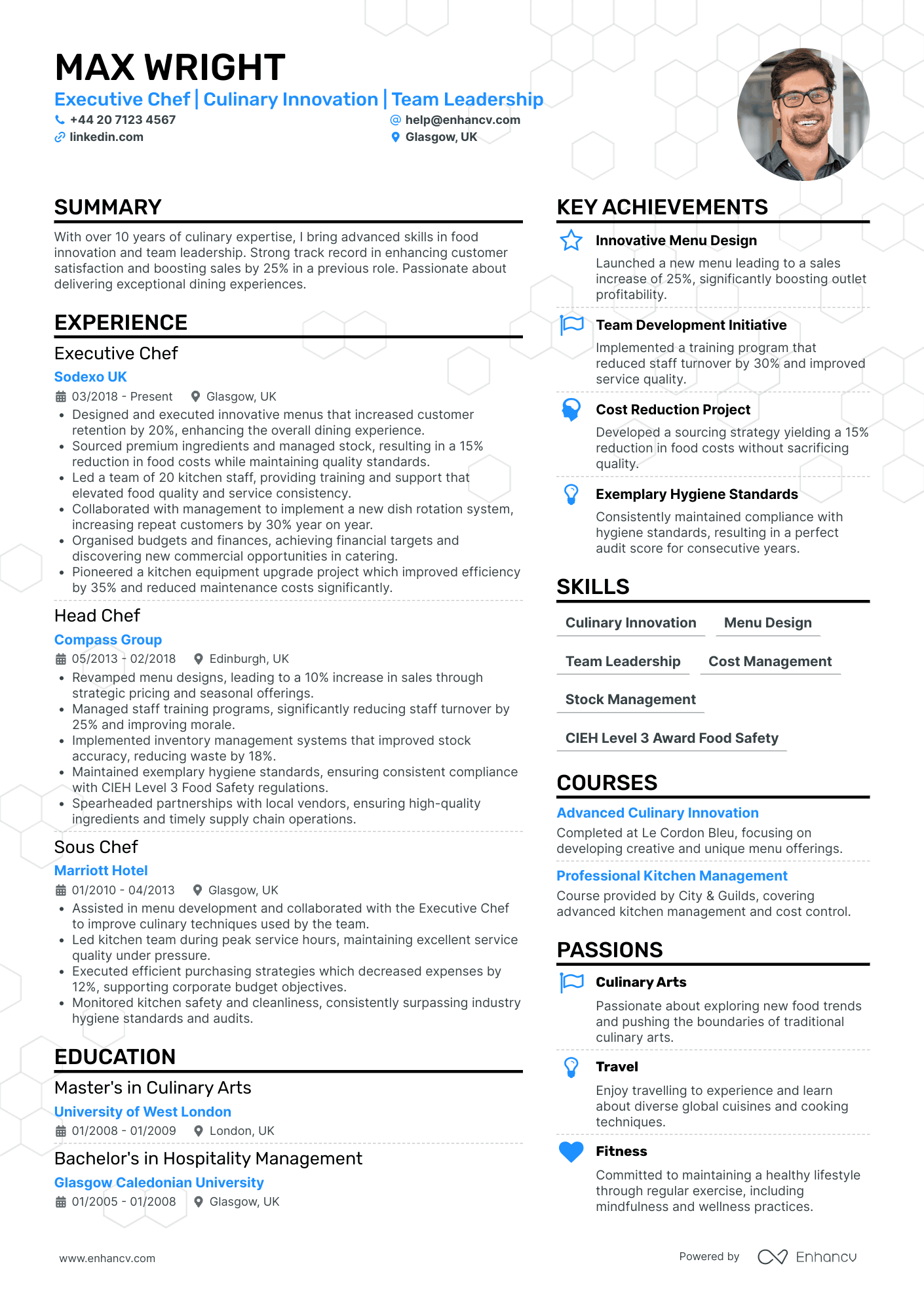
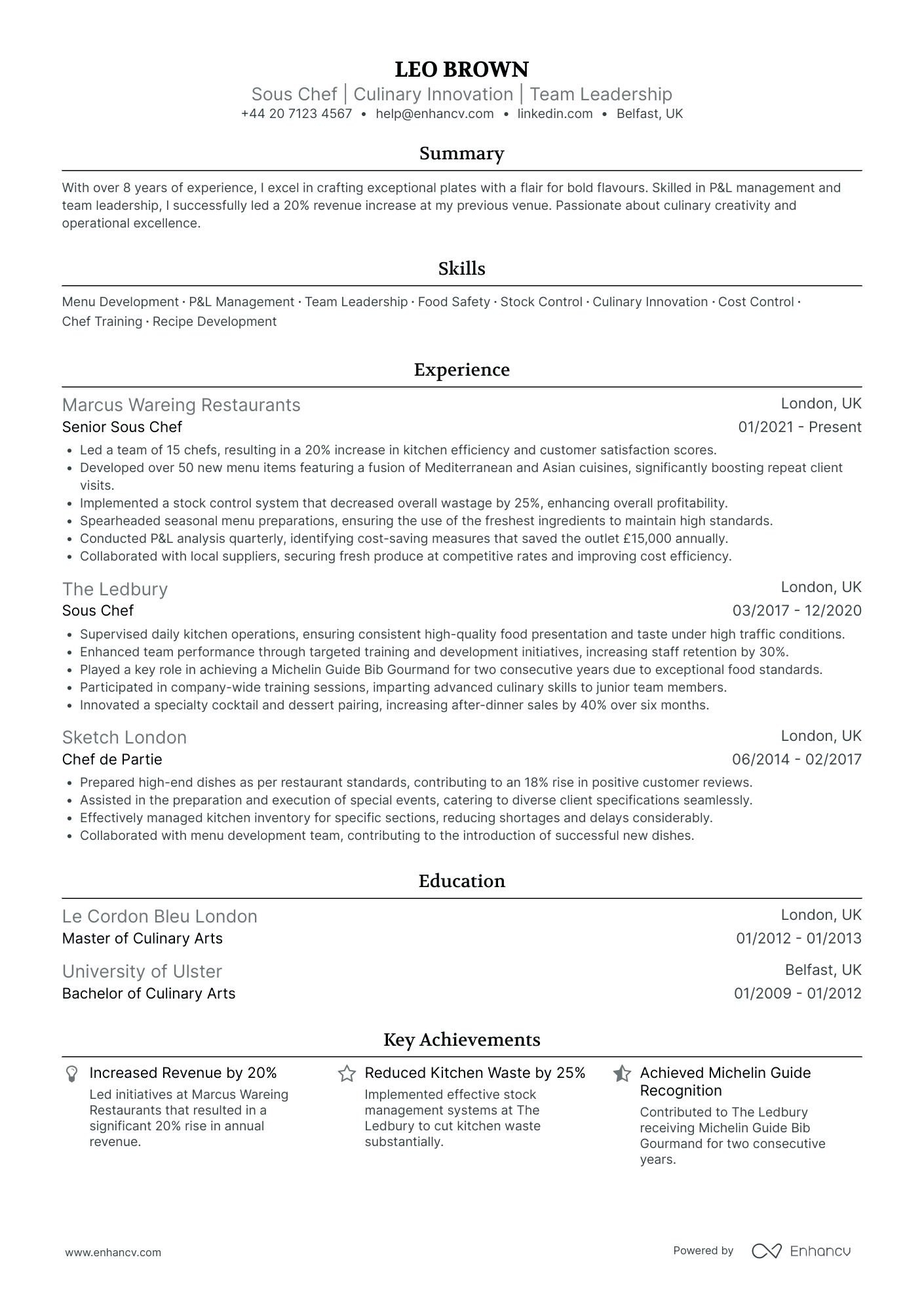
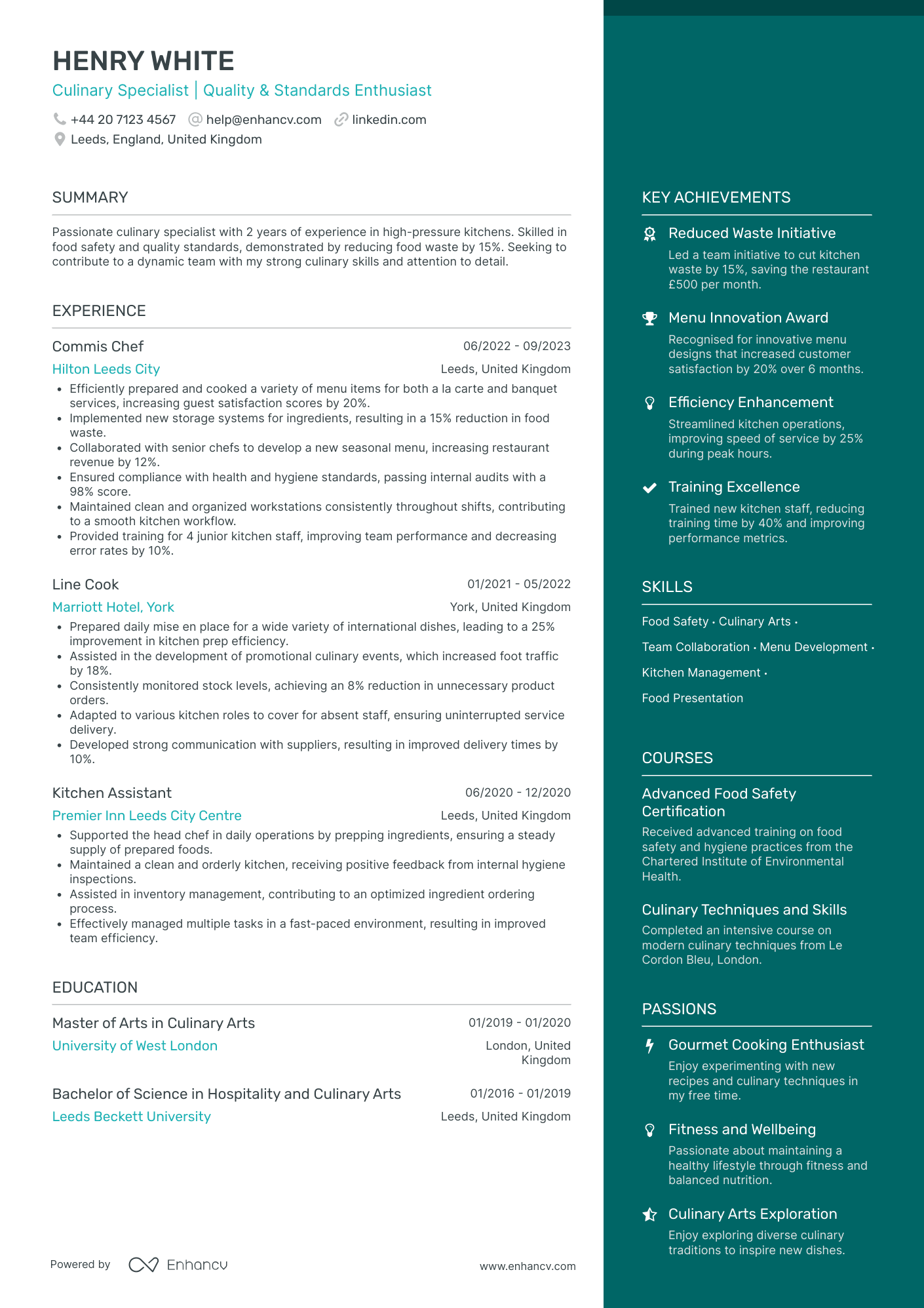
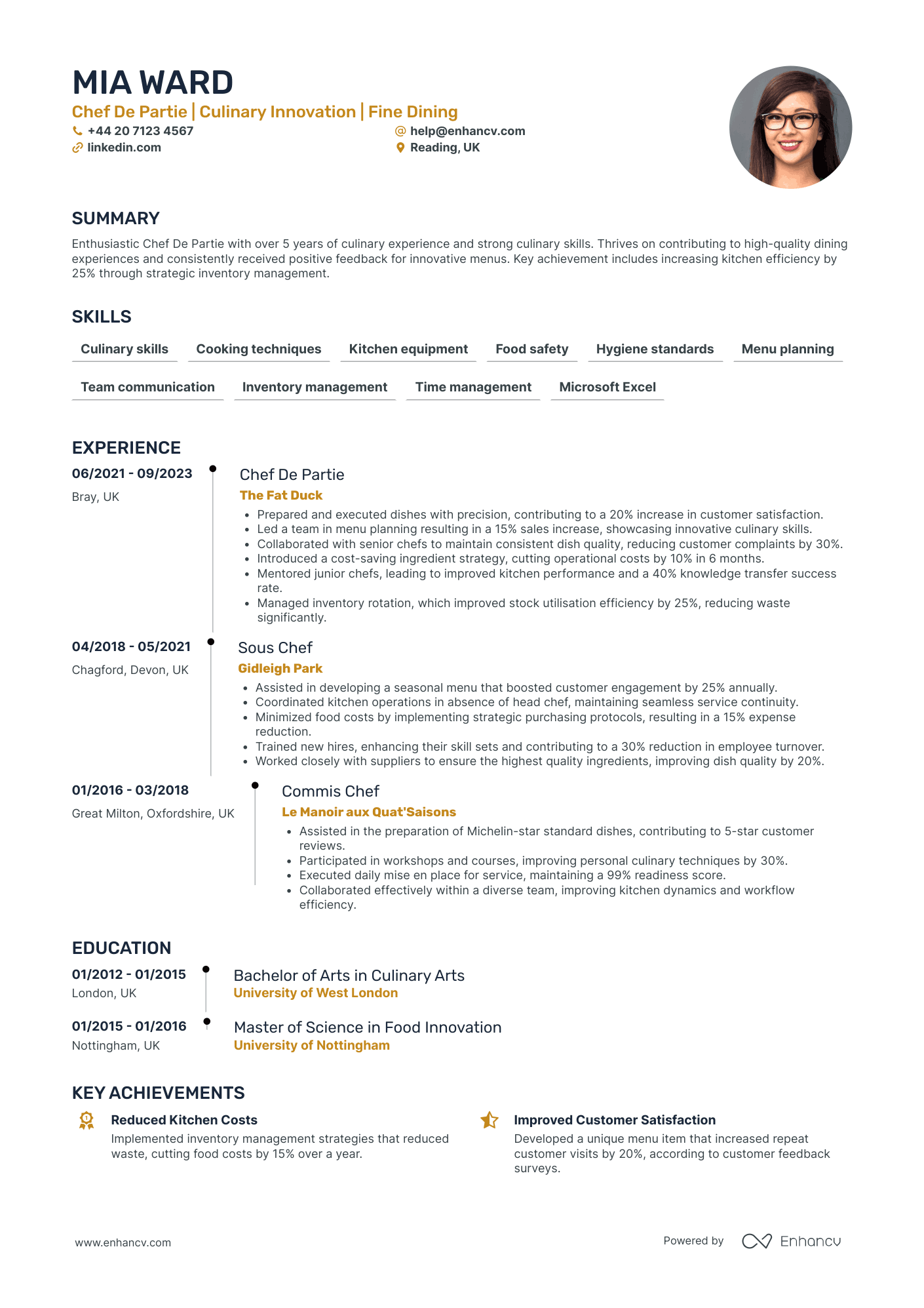
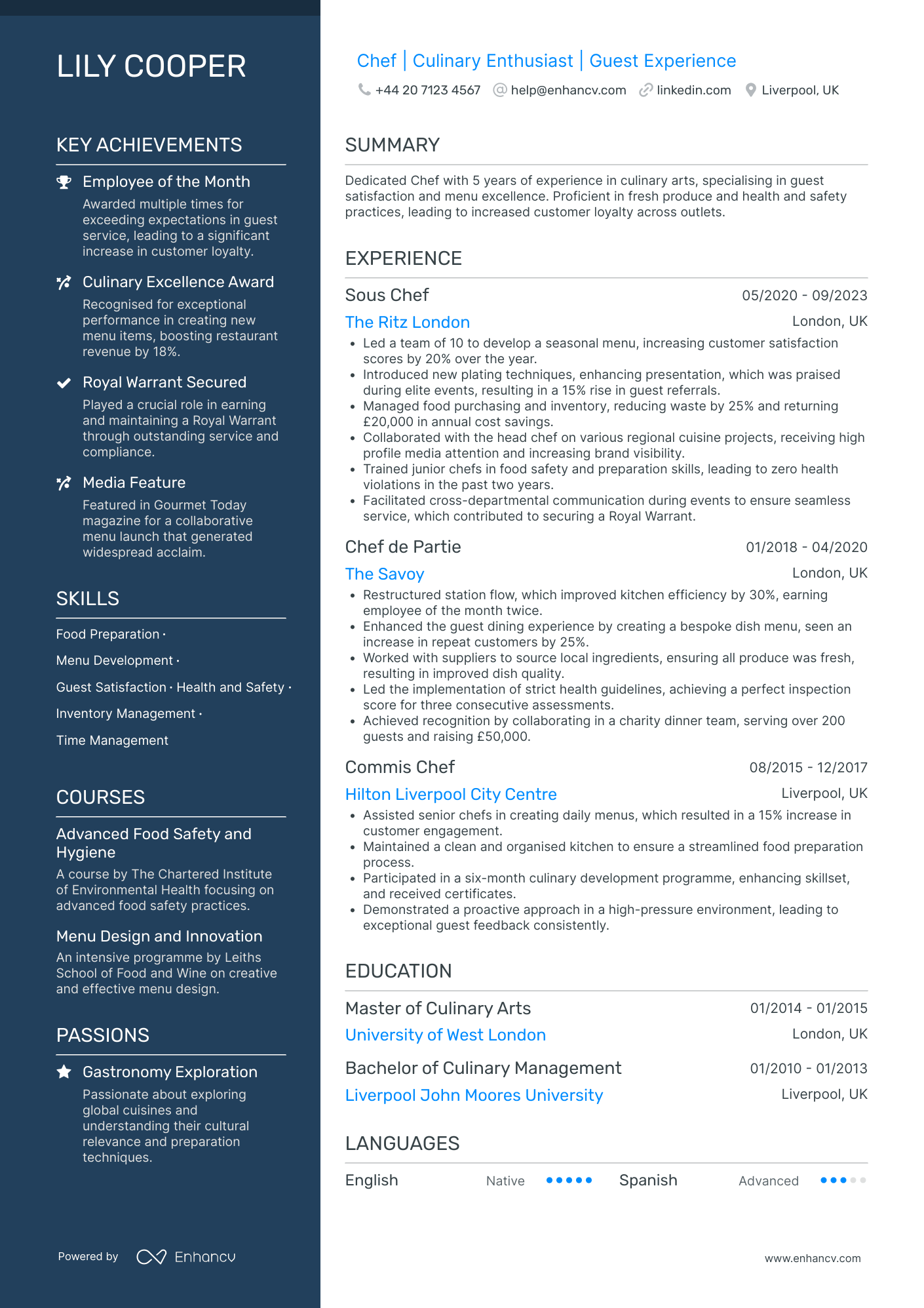
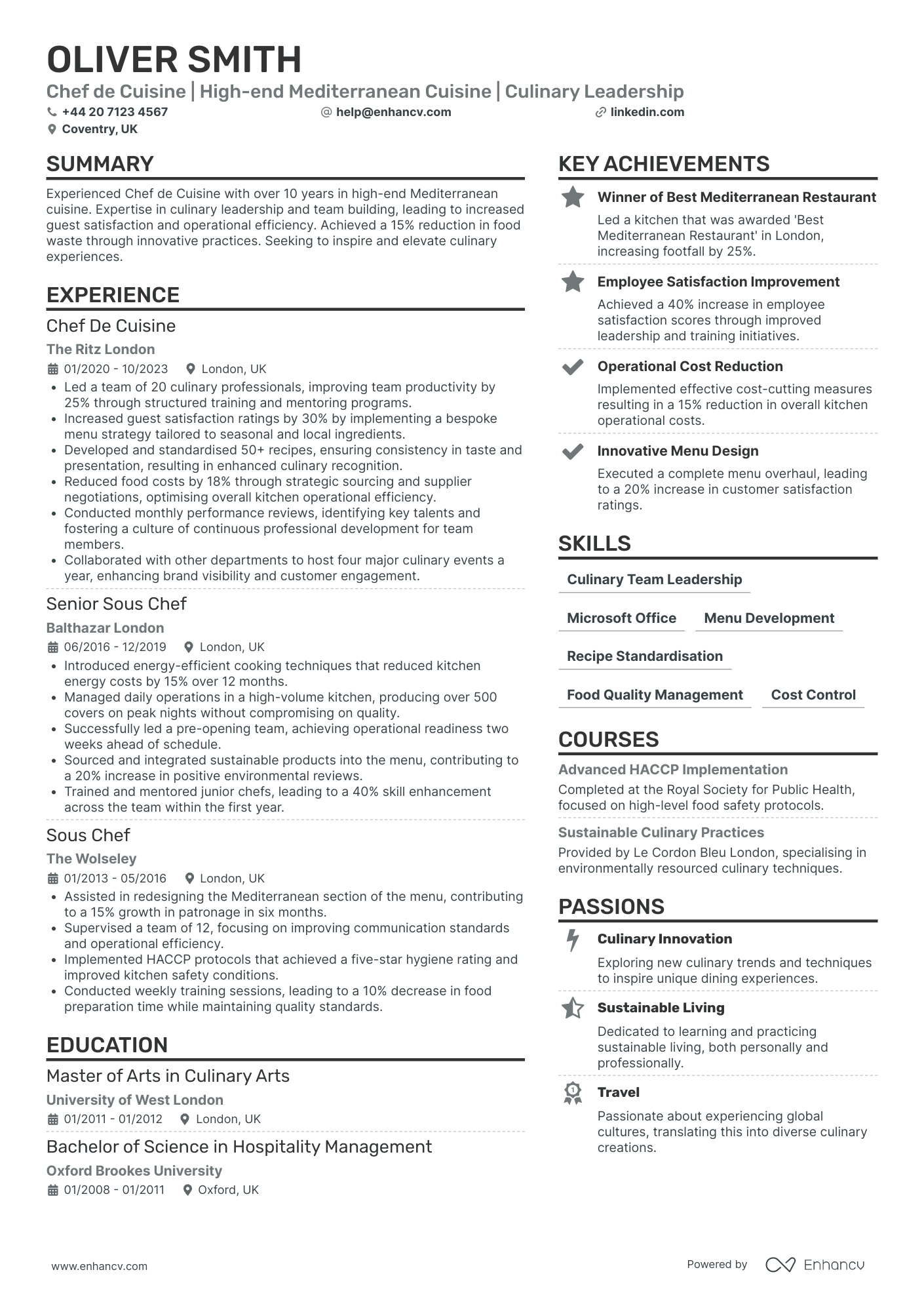
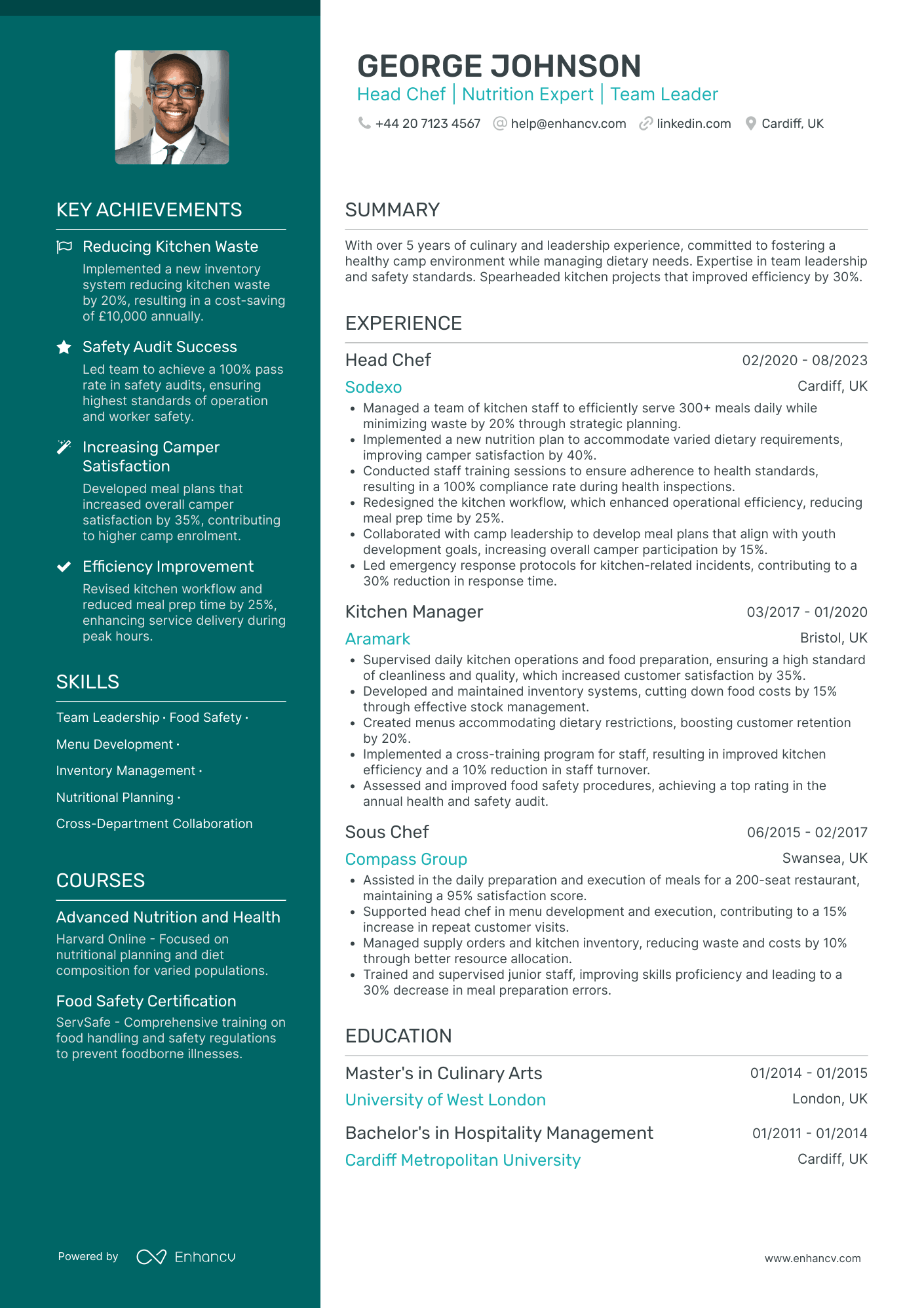
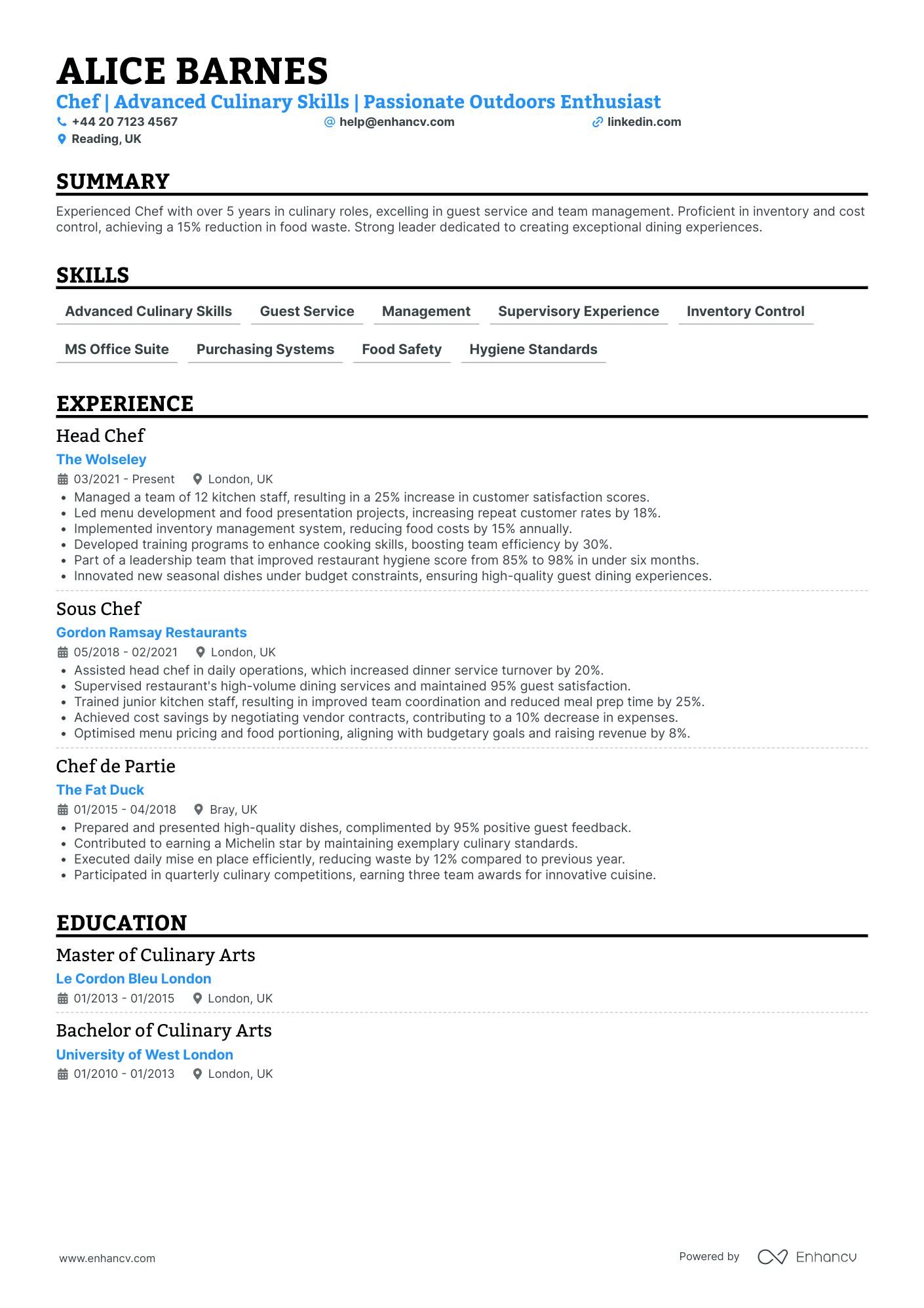
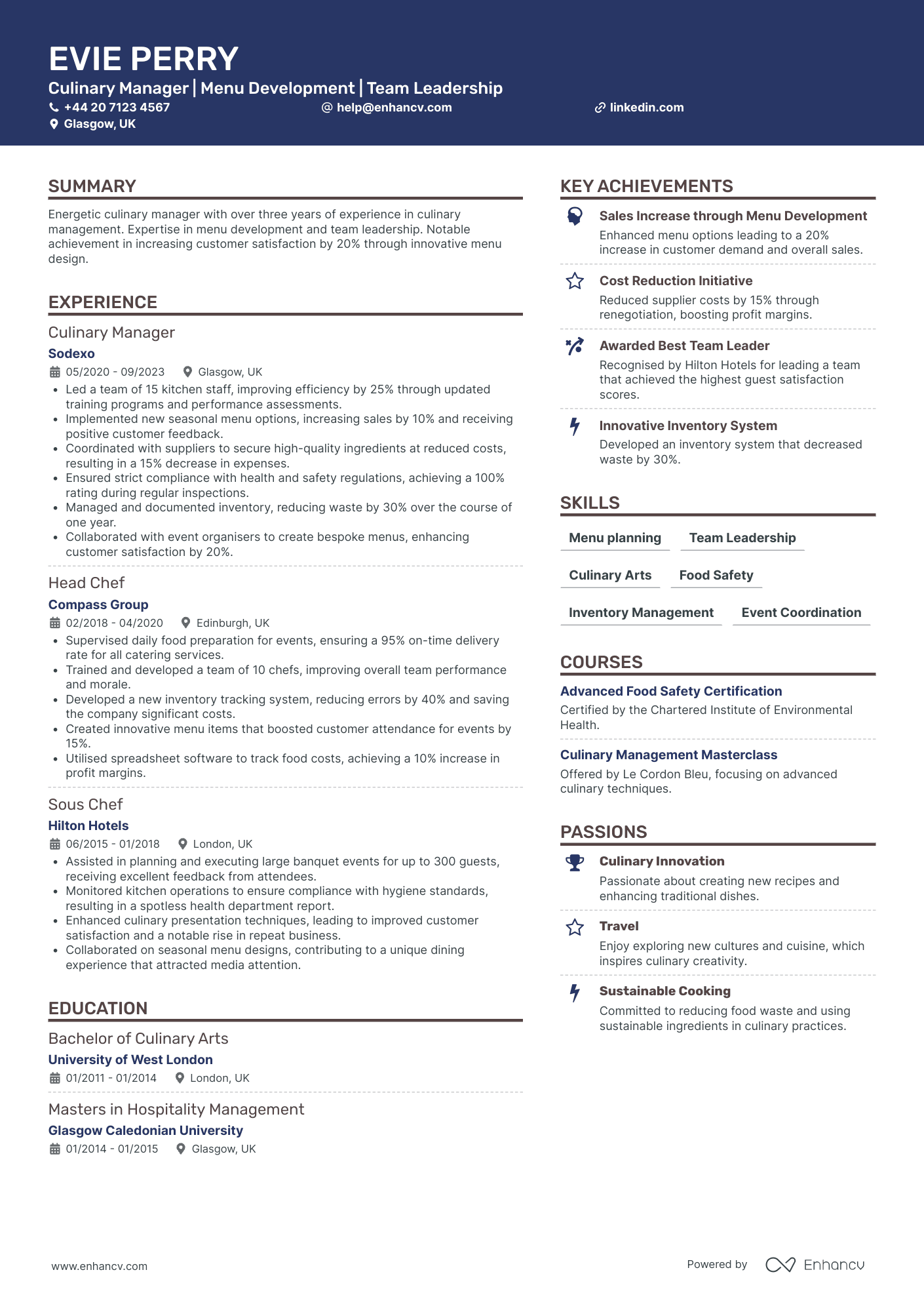
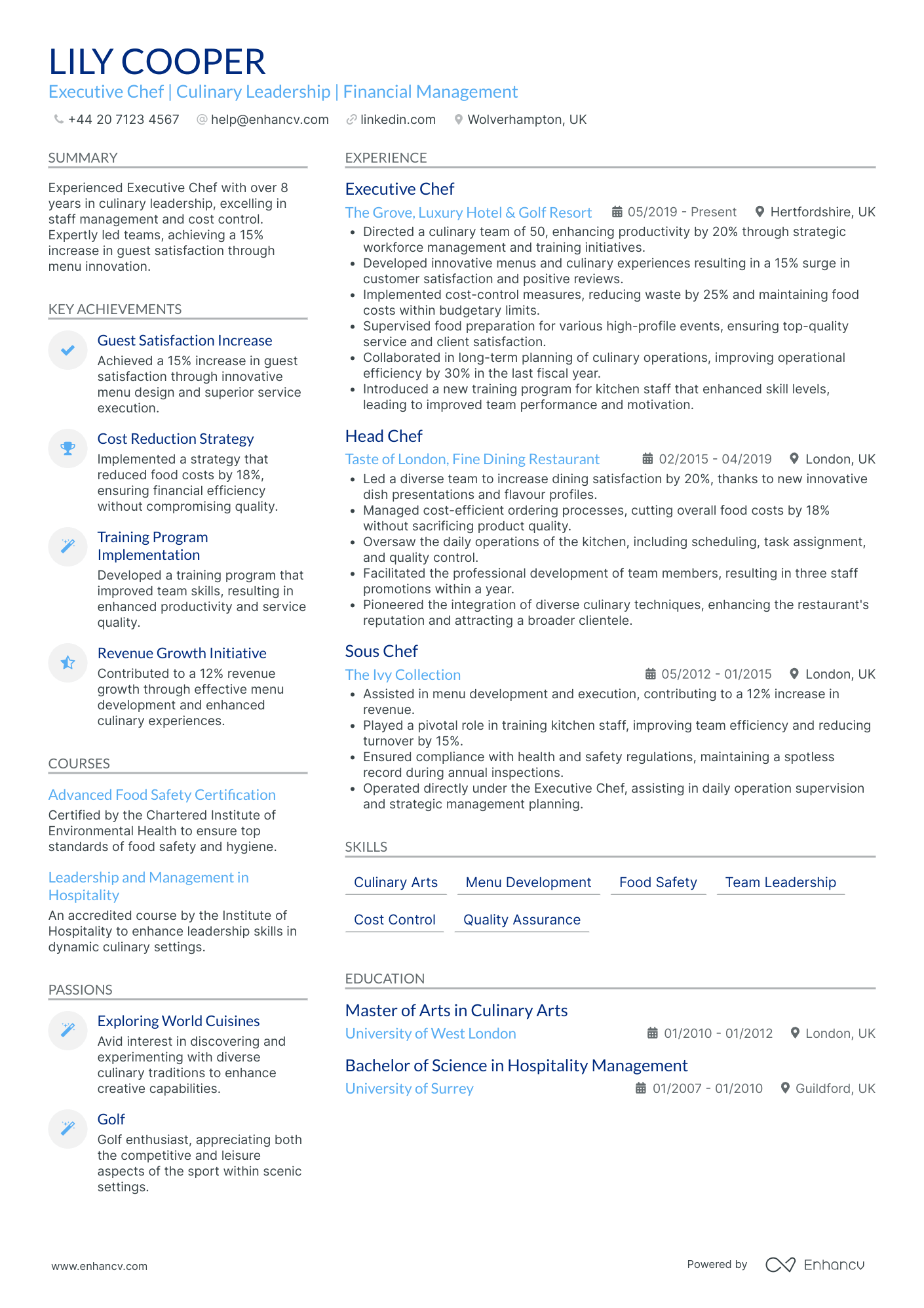
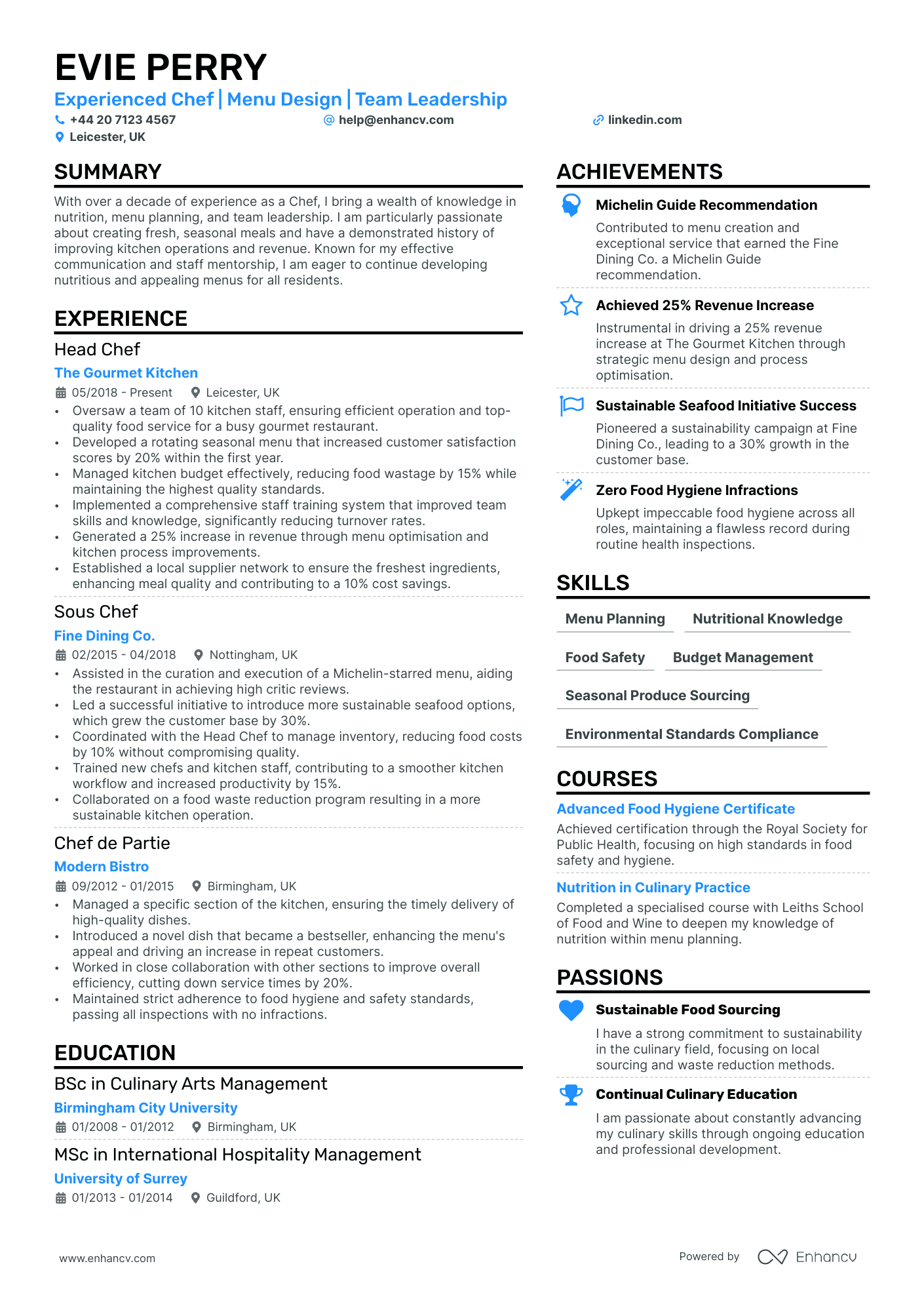
Most chef CVs read like a station rota. Every kitchen worked, every cuisine touched, and not a single line about covers held, food cost controlled, or a hygiene rating defended through an inspection.
A head chef skims for proof you can run a section under pressure and keep the kitchen legal. Lead with the skills they screen for, back each one with a number, and put your food safety training where they can find it in seconds. If you want the fundamentals first, see how to write a CV.

Key takeaways
- Lead with the skills a head chef screens for. Food safety, food preparation, and menu planning top the UK adverts.
- Chef work is on-site and physical, so put your location and shift flexibility near the top.
- Prove each skill with a number: covers per service, food cost percentage, gross profit, waste reduced, a Food Standards Agency rating held.
- Name your food hygiene level. Level 2 is the baseline most UK kitchens expect before you touch a section.
- Two pages, reverse chronological once you have kitchens behind you, sent as a PDF unless the advert asks for a Word file.
- Open with a short personal statement built on your section, your cuisine, and one measurable result.
Top skills for a chef CV
The skills that decide a chef CV are not "hardworking" and "team player". They are the ones a head chef can check against a live service.
Across 3,101 UK chef postings in the last ~30 days on Enhancv's internal job feed, food safety, food preparation, and menu planning are the three skills that recur most often, followed by stock control and team leadership. Those are your headline hard skills, and they belong in the words the adverts use.
List them, then earn them lower down the CV:
- Food safety and hygiene. Name your level (Level 2 as standard, Level 3 for supervisors) and mention HACCP and allergen management. This is the first thing that gets checked.
- Food preparation and knife skills. Say which sections you have run, larder, sauce, grill, pastry, and the volume you prepped to.
- Menu planning and development. Dishes you designed, the gross profit you built them to, and any seasonal or dietary range you added.
- Stock control and ordering. Food cost percentage held, waste cut, supplier relationships, and stocktakes run to a rota.
- Kitchen and team leadership. Brigade size, rotas written, commis chefs trained, and how you kept a section moving on a full book.
The soft skills employers actually reward here are checkable too. Communication on a hot pass, composure under a full book, and consistency service after service. Prove each one in a bullet rather than listing skills on a CV and hoping. For the section on wording them, see soft skills on a CV.
Those soft skills also answer the "characteristics of a successful chef" question that recruiters and search engines ask. A successful chef is consistent, calm under pressure, disciplined about cleanliness, precise with a palate, and able to lead a section without losing the plate. None of that lands as an adjective, so anchor each trait to a moment: a service you held together, a rating you defended, or a commis you brought up to speed.
Team leadership deserves its own line if you have it. Naming the brigade size you supervised, the rotas you wrote, or the commis chefs you trained turns a vague claim into evidence, and it maps neatly onto how head chefs read leadership skills on a CV. Whatever you claim, back it with a quantified result lower down so the skills list and the experience section tell the same story.
Top skills for your chef CV:
Food safety and hygiene (Level 2)
HACCP
Food preparation and knife skills
Menu planning and development
Stock control and ordering
Food cost and gross profit management
Allergen management
Kitchen management
Team leadership
Communication under pressure
Time management
Consistency and attention to detail
Palate and seasoning
Stamina

The five culinary skills to show on a chef CV
When an advert asks for "strong culinary skills", these are the five it means:
- Knife skills and prep - speed and consistency across cuts, portioning, and mise en place.
- Stocks, sauces, and foundations - the base work that a section is built on.
- Temperature and timing control - cooking to spec and sending a whole table together.
- Plating and presentation - consistent, on-brand plates, service after service.
- Palate and seasoning - tasting, adjusting, and holding a dish to the same standard every time.

PRO TIP
Chef adverts name specifics, not soft-skill clouds. Mirror the ones you can back: "Level 2 Food Safety", "HACCP", "allergen management", "gross profit", "food cost control", "chef de partie". If you have trained in it or hit the number, write it exactly as the advert does.
What the UK chef market looks like
Knowing the market shapes the CV. Here is what the role pays and what UK kitchens actually ask for.
| What | UK chef roles |
|---|---|
| Typical pay | £22,000 to £40,000 a year (National Careers Service, gov.uk) |
| Where the work happens | On-site (3,099 of 3,101 UK postings in the last ~30 days, Enhancv's internal job feed) |
| Experience level asked for | Entry 41% · mid 40% · lead 17% |
| Most-listed skills | Food safety, food preparation, menu planning, stock control, team leadership |
Two of those numbers should shape your CV.
Chef work is almost entirely on-site, so a recruiter needs to see you can get to the kitchen for early prep and late service. Put your town and your shift flexibility in the header, and mention a driving licence if late finishes rule out public transport.
And roughly four in five postings sit at entry or mid level, from commis to chef de partie, which is why a clear section-by-section history matters more than a long list of job titles. The pay band runs wide because it tracks the section you run and the standard you hold, not the years you have served.
Food safety, food preparation, and menu planning lead the skills employers name, so those three should be visible on your CV without a recruiter having to hunt. Put them in the skills list, then prove them again in the experience that follows. A skill named once and evidenced once reads as real, where a skill listed and never shown reads as filler.
Formatting your chef CV
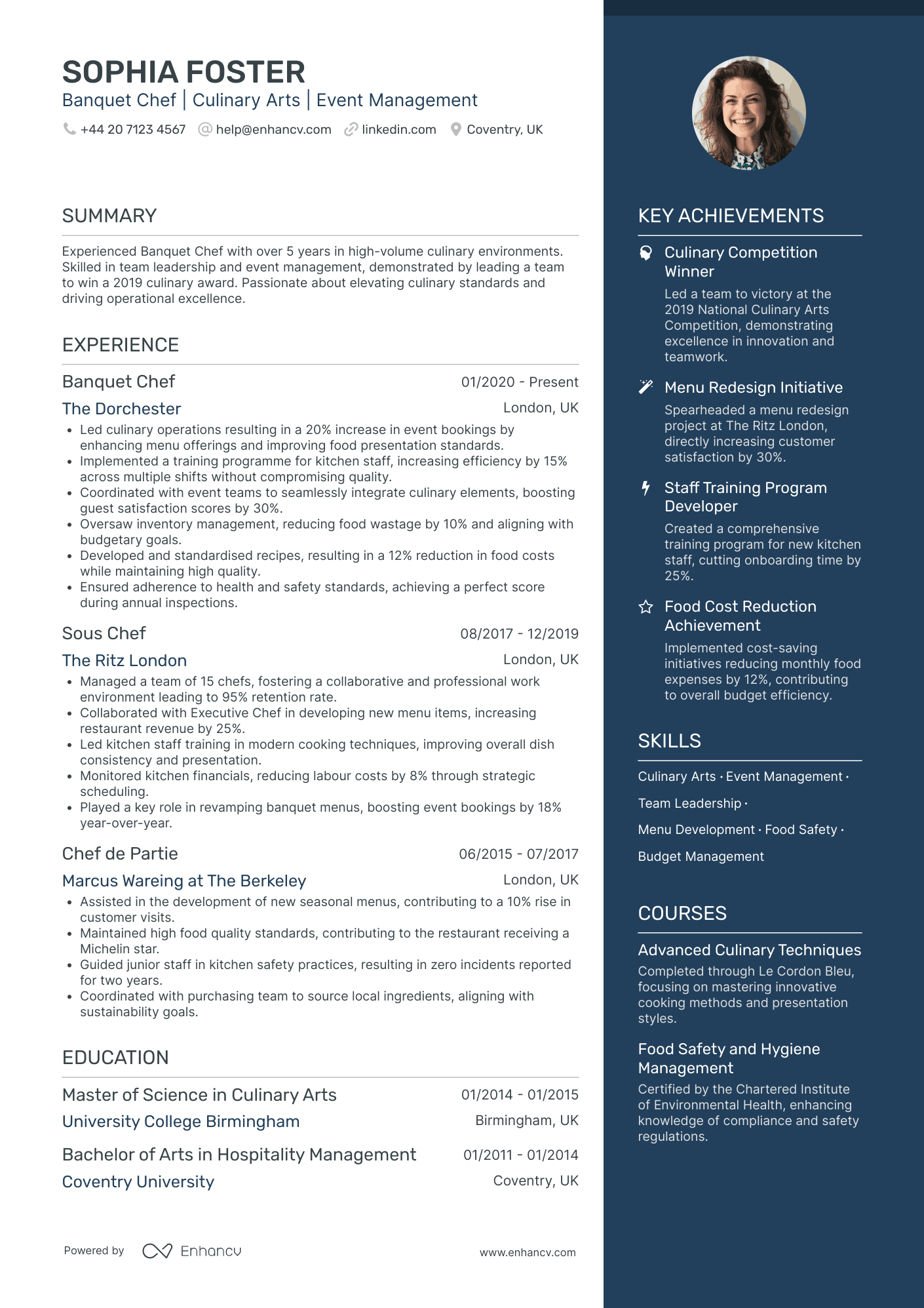
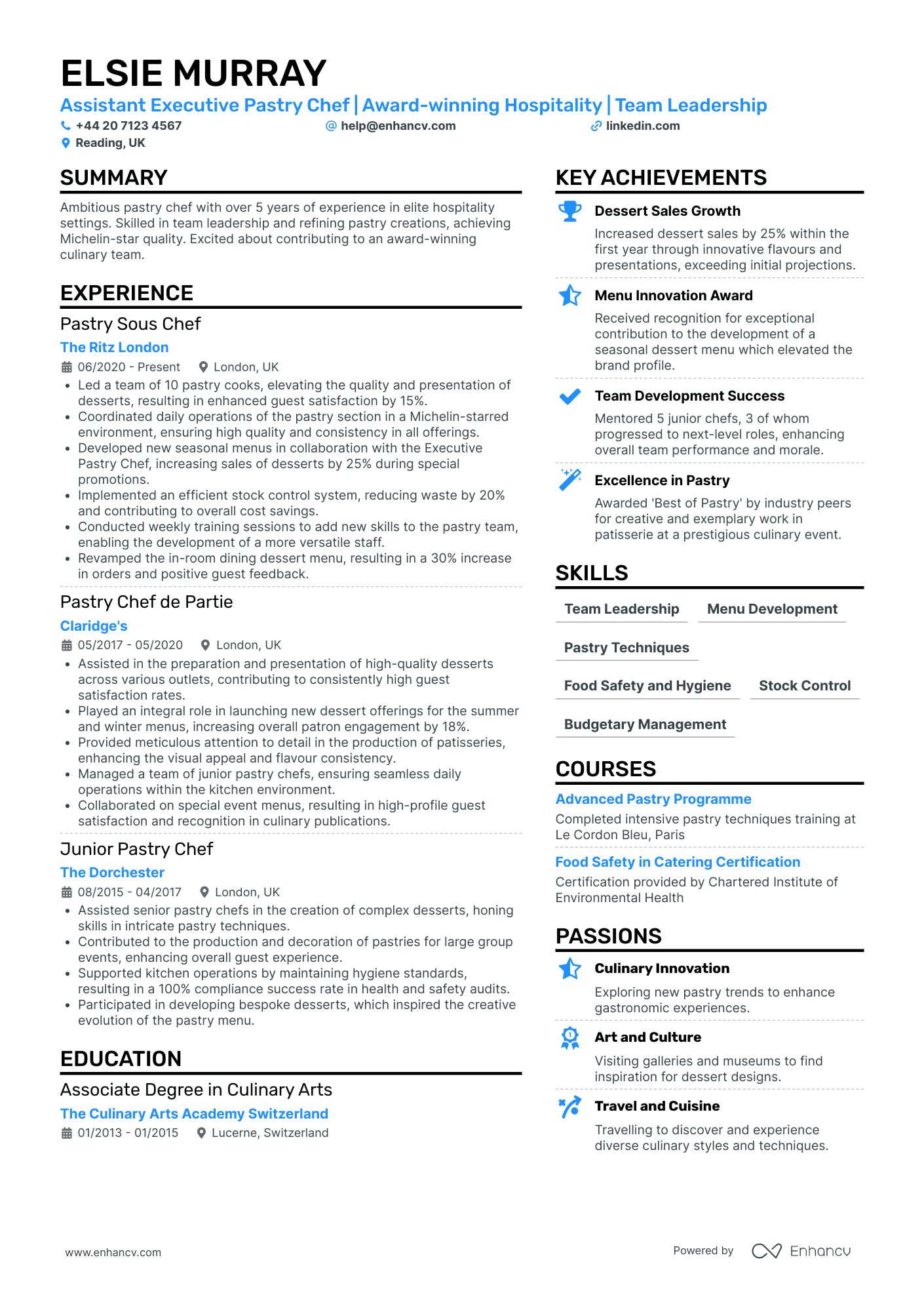
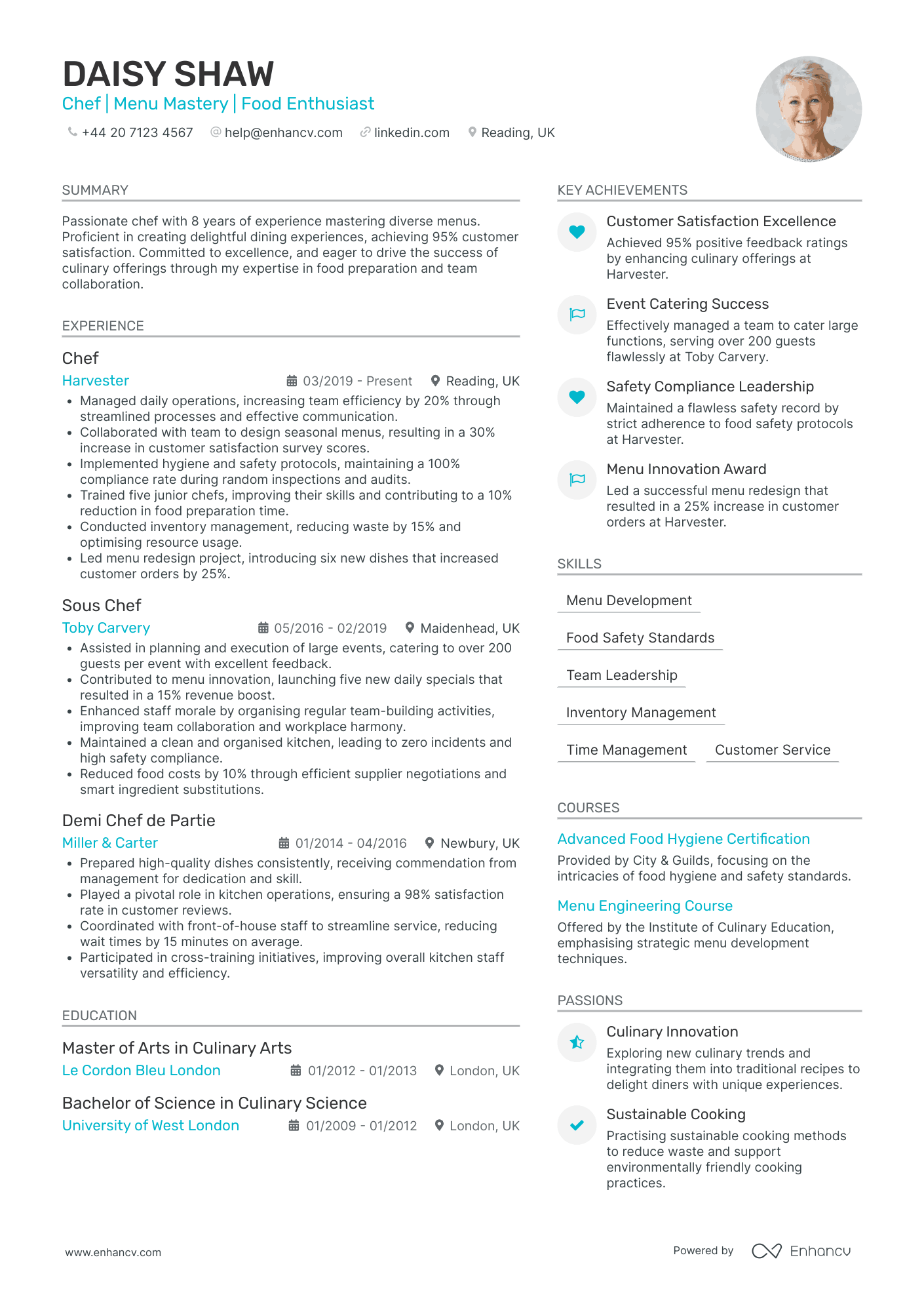
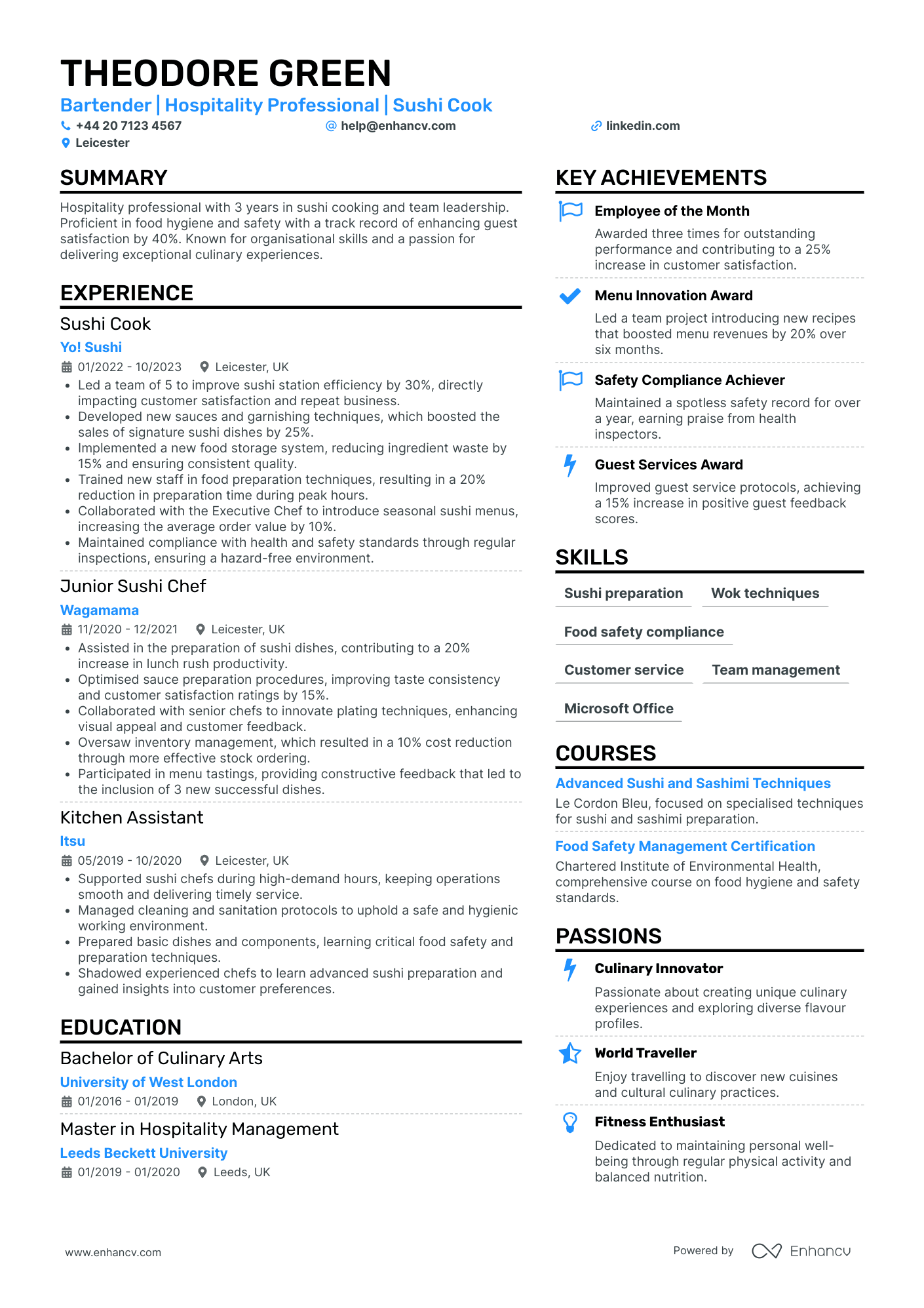
Once you have kitchens behind you, use a reverse chronological CV so your most recent section and your current standard lead. If you are moving in from catering college or another trade, lead with a skills-based CV so training and transferable skills come before a thin work history.
Keep it to two pages, one column, standard headings, and a readable font. Head chefs skim between prep and service, so make the sections you have run and your hygiene level easy to spot.
Send a PDF for direct applications so the layout holds on any screen. Keep a Word copy for agencies, which place a large share of kitchen roles and reformat CVs into their own template. If the advert names a file type, follow it.
Larger groups and hotel kitchens often screen through tracking software, so keep the layout clean and the headings standard for an ATS-friendly CV. Build it from a tested layout rather than a blank page. Enhancv's CV templates export to a clean, single-column PDF that a kitchen inbox can open.
Skip the design flourishes that do not survive a scan. A plain, legible CV font, sensible CV margins, and consistent dates read better than a photo of a plated dish or a two-column grid that breaks in an inbox. Save the visuals for a portfolio link or a trial shift, where they actually count.
Writing your chef personal statement
Three or four sentences at the top: your role and level, the kitchens and cuisine you know, one measurable result, and the section you want next. Keep it concrete. For more openers, see these CV personal statement examples.
This also answers the question recruiters and search engines ask, "what is a short description of a chef?". A good one is not a job title. It is a snapshot of the section you run and the standard you keep.
Match the statement to the job you want, not the one you have. If you are chasing a sous chef role, foreground the leadership and cost control. If you are moving cuisines, name the transferable craft and the volume you can handle. One tailored opener beats a generic paragraph you paste into every application.
Lead with evidence, not adjectives:
Chef CV personal statement example (chef de partie)
Chef de partie with six years across two AA-rosette kitchens, running the larder and sauce sections for services of up to 120 covers. Held food cost at 28% and kept a 5-star food hygiene rating through two EHO inspections. Level 3 Food Safety certified and looking to step up to junior sous chef in a seasonal, fresh-produce kitchen in Bristol.
What to avoid
Passionate and hardworking chef with a love of food and a great team player. Experienced in all areas of the kitchen and able to work well under pressure. Seeking a challenging role in a busy kitchen where I can grow.
The weak version could belong to any chef at any level. It names no section, no cuisine, no volume, and no standard. The strong one tells a head chef exactly where you would slot in and what you would hold.
When I read a chef CV, I skip the adjectives and look for three things: the sections you have run, the covers you have held, and your food hygiene level. A line like "ran the sauce section for 130 covers with a 5-star rating held through two inspections" tells me more than a paragraph about passion. Give me the station, the volume, and the standard you kept, and you are already ahead of most of the pile.
Writing your chef experience section
Write each kitchen the same way: a dated heading with the venue and your role, then bullets that show what you ran and the result. Lead each bullet with a verb. For the mechanics, see work experience on a CV and this list of CV action verbs.
Kitchen work is measurable even when it does not feel like it. Covers per service, food cost percentage, gross profit on a dish, waste cut, a hygiene rating held, commis chefs trained. Those numbers are your CV achievements, and they answer the "five responsibilities of a chef" question far better than a duties list: running a section, controlling food cost and stock, holding food safety, developing the menu, and leading the brigade.
Give each kitchen its own dated block rather than merging years into one paragraph. A head chef wants to see the section you held at each venue and how the responsibility grew, from commis to chef de partie to sous. If you moved up within one kitchen, show the progression as separate roles so the trajectory is obvious at a glance.
Two or three sharp bullets per role beat six vague ones. Open with the verb, name the section, add the number, and stop. "Ran", "held", "cut", "trained", and "costed" carry more weight than "responsible for" or "helped with".
- Run the sauce section for dinner service of up to 130 covers, six nights a week, with zero food safety breaches across three EHO inspections
- Cut section food waste by 18% by tightening prep lists and rotating stock to a strict first-in, first-out system
- Held gross profit at 68% on mains by rewriting three dishes around seasonal, lower-cost produce with the head chef
- Trained and mentored four commis chefs, two of whom progressed to chef de partie within a year
Tailor every application. Pull the section, the cuisine, and the exact skills from the advert and mirror them where they are true of you. Enhancv's CV tailoring feature reads the ad and suggests the matching edits, which saves rewriting from scratch for each kitchen you apply to.
Qualifications and food safety training for a chef CV
You rarely need a degree to cook professionally, but a UK kitchen expects proof you can work legally and safely. That is what your education section should carry.
List these where you have them: Level 2 Food Safety and Hygiene for Catering as the baseline, Level 3 if you supervise, allergen awareness training, and any NVQ or Diploma in Professional Cookery, City and Guilds, or a chef apprenticeship. Name the level and the awarding body, exactly as it appears on the certificates on a CV.
If a qualification is still in progress, say so rather than leaving it off. "Level 3 Food Safety in progress" is a stronger line than silence, and it shows a head chef where you are heading. The same goes for any other qualifications on your CV.
You do not need to date every certificate to the day, but do give the level, the awarding body, and the year. A Food Safety qualification from a decade ago carries less weight than a recent refresher, and kitchens know it. If yours is old, a short line noting a recent update or ongoing training keeps it credible.
Writing a chef CV with no experience
Kitchens are one of the more entry-friendly trades in the UK. Most postings sit at commis to chef de partie level, and many employers will train the right person from the plonge up.
So a first chef CV carries its weight differently. Lead with a skills-led structure: a short personal statement, then food safety training and any kitchen exposure, then education, with paid work lower down. A first-job CV can still show a section you know.
Mine real kitchen evidence wherever it lives. A catering course with a practical portfolio, a stage or trial shift, a summer in a pub kitchen, or a part-time job on the pass or the plonge. Write it in kitchen language: sections worked, covers handled, and the prep you were trusted with.
Stages and trial shifts are worth a dated entry of their own, with the kitchen, the dates, and what you were trusted to prep. A head chef reads a two-day trial in a busy brasserie as real evidence, not filler, because it shows you can hold your own on a live section.
One line moves a no-experience chef CV up the pile: "Level 2 Food Safety and Hygiene certified" or "in progress". It tells a head chef you can step onto a section on day one without a compliance risk.
Conclusion
Lead with the skills a head chef screens for, prove each one with a number, and name your food hygiene level where it cannot be missed. Keep the format clean, two pages, and on-site friendly.
Pair the CV with a short cover letter that says which kitchen you want and why, and you turn a station history into an interview.
Author's take - The Enhancv team
When I read a chef CV, I skip the adjectives and look for three things: the sections you have run, the covers you have held, and your food hygiene level. A line like "ran the sauce section for 130 covers with a 5-star rating held through two inspections" tells me more than a paragraph about passion. Give me the station, the volume, and the standard you kept, and you are already ahead of most of the pile.