



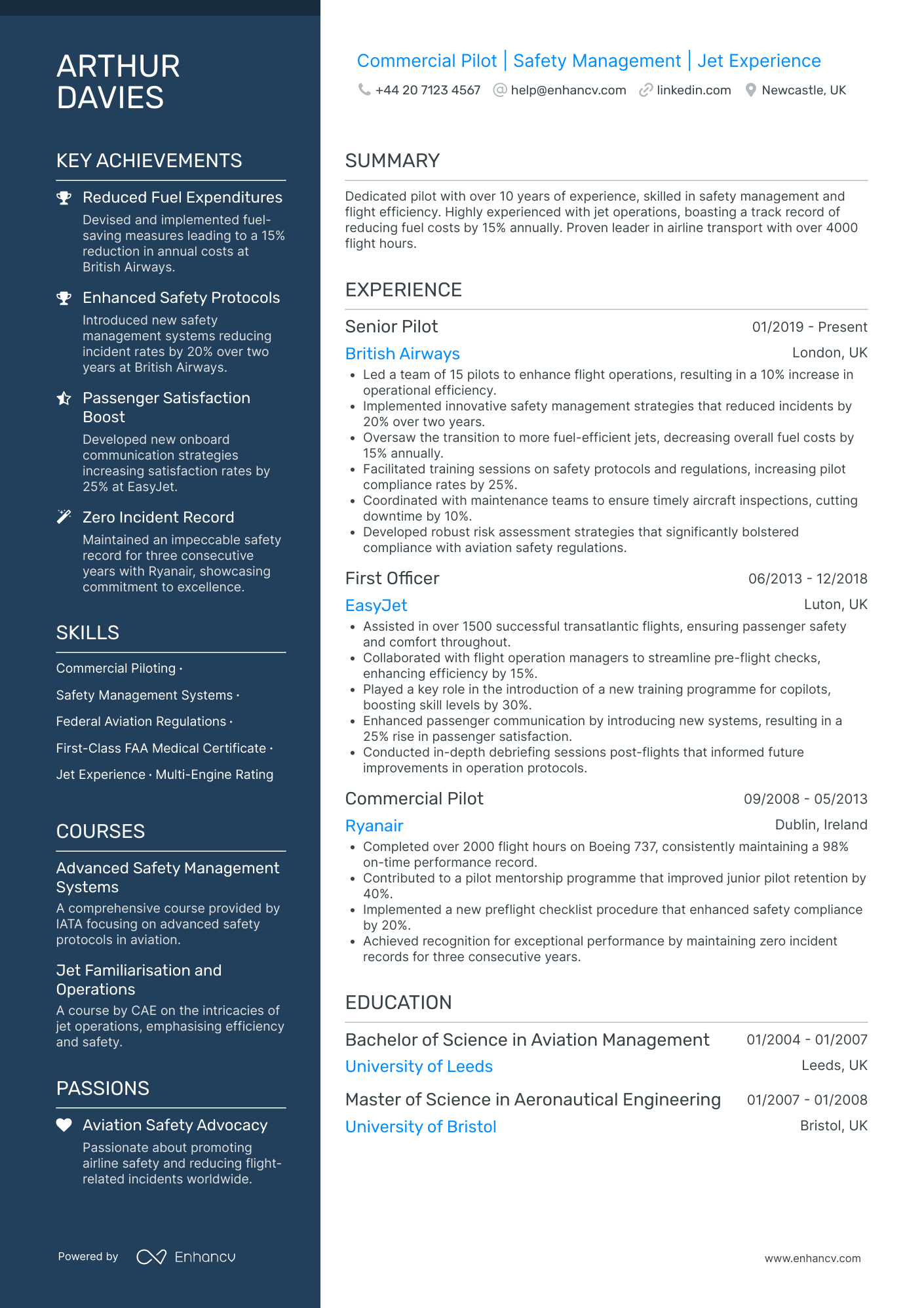
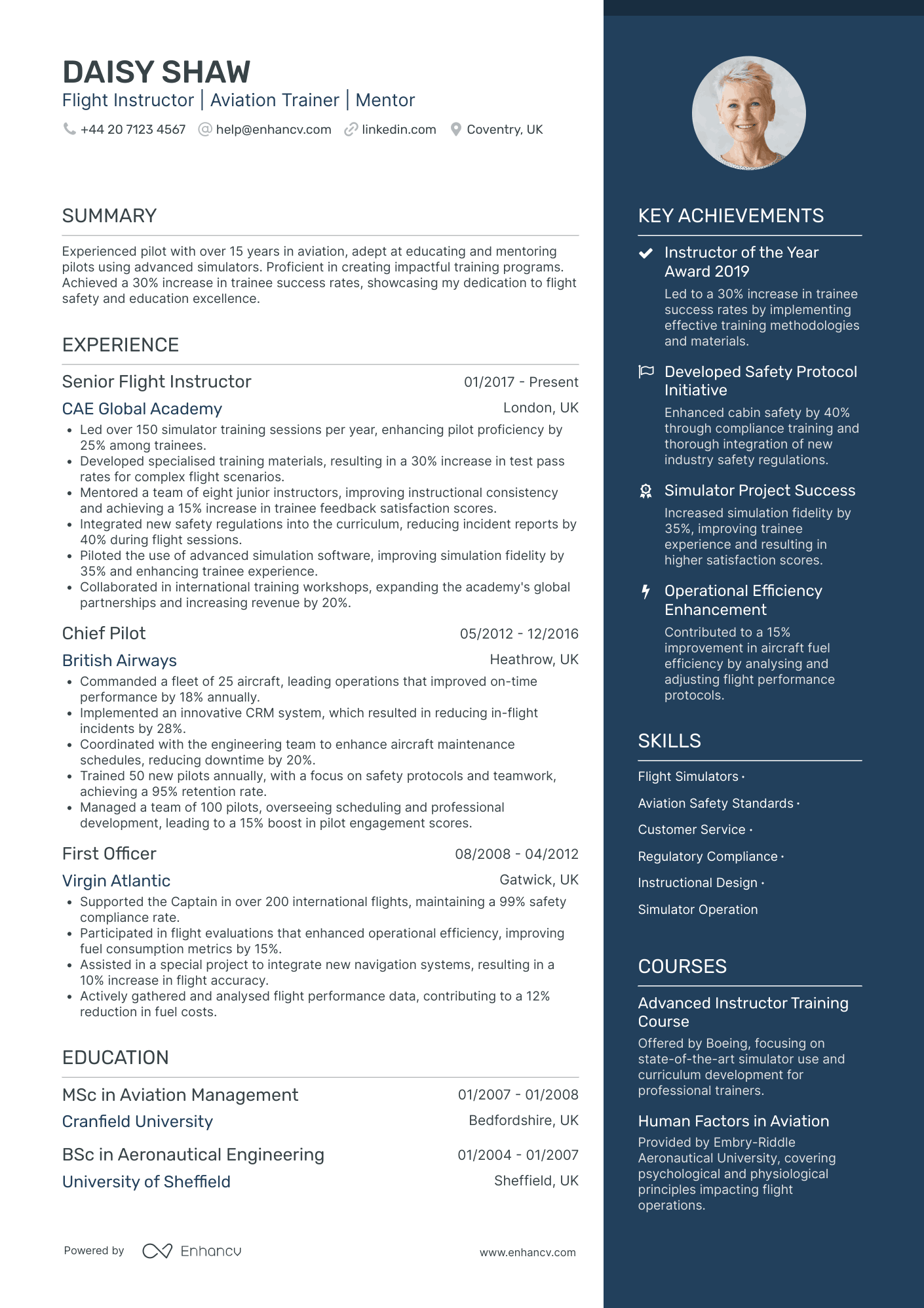
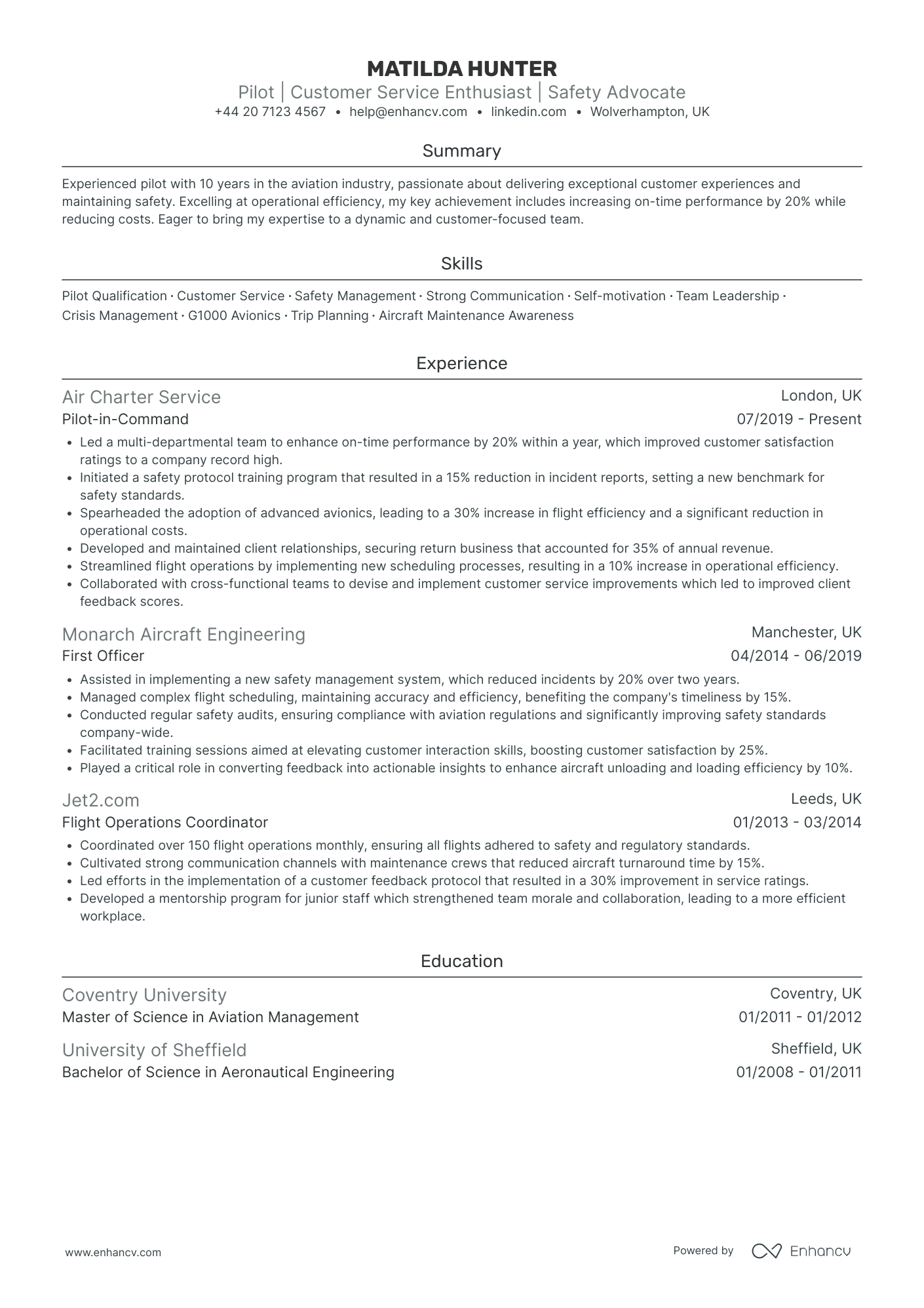
An airline recruiter spends longer hunting for your licence, ratings, and total hours than reading anything else on your CV. Bury those three numbers on page two and you have already dropped off the shortlist.
Most pilot CVs open with a paragraph about a lifelong passion for aviation and leave the logbook maths for the bottom. The ones that get called put the flying credentials in the first third and treat everything else as evidence for them. For the underlying mechanics, read our guide on how to write a CV.

Key takeaways
- Lead with your licence type, ratings, medical class, and total and PIC hours. Assessors screen for these before anything else.
- Give a clean hours summary: total, PIC, multi-engine, instrument, night, and hours on type. Numbers beat adjectives.
- Name your type ratings and current aircraft exactly as the operator writes them in the advert.
- Keep your Class 1 medical, licence state, and issuing authority visible near the top.
- Two pages for an established pilot, one for a cadet. Send a PDF unless the advert asks for a Word file.
- Weave the nine core competencies into your experience bullets rather than listing them as buzzwords.
Licences, ratings, and flight hours: what a pilot CV leads with
A pilot CV is a licensing document before it is anything else. The first block a recruiter wants is what you are legally cleared to fly and how much you have flown.
State your licence in full: CPL, MPL, or ATPL, whether it is frozen or unfrozen, the issuing authority such as the UK CAA or EASA, and its validity. Add your instrument rating, multi-engine rating, and MCC or JOC where you hold them.
List every current type rating the way the fleet is written, for example A320, B737, or ATR 72. If a rating has lapsed, say so rather than leave the reader guessing.
Your Class 1 medical belongs here too, with its expiry. A recruiter needs to see it is current before they invest a single minute more.
Then the hours. This is the figure an operator filters on, so make it effortless to find near the top rather than something the reader has to reconstruct from your logbook. Break the total into the categories a crewing team compares against its minima: total time, PIC, P1 under supervision, multi-engine, multi-crew, instrument, night, and hours on each type. Keep the licence and ratings in a dedicated block, separate from your general education and any certificates you hold, so nothing gets hunted for.
Recency counts as much as totals. Show your hours in the last 90 days and your last line check or LPC, because a current pilot who is flying now reads as a lower risk than a bigger logbook that has gone cold. Group your qualifications tightly and keep every figure exact, because an assessor who spots one inflated number will start to doubt the rest.

A sample hours summary block
Total time 3,200 hrs · PIC 1,150 hrs · Multi-engine 2,400 hrs · Instrument 900 hrs · Night 620 hrs · On type (A320) 1,800 hrs · Last 90 days 140 hrs. Keep it to one line per figure and update the numbers before every application.

PRO TIP
Read the minimum hours and ratings in the advert, then mirror them in your top block using the operator's own words. If a carrier asks for 500 hours on type and an unfrozen ATPL, those exact figures should be the first thing their assessor sees.
The nine pilot competencies and how to evidence them
Modern airline assessment is built on the nine core competencies from the ICAO and IATA framework. Recruiters and simulator assessors think in this language, so your CV should speak it.
The nine are:
- Application of procedures and compliance
- Communication
- Aircraft flight path management, automation
- Aircraft flight path management, manual control
- Leadership and teamwork
- Problem solving and decision making
- Situation awareness and management of information
- Workload management
- Knowledge
Do not paste the list into a skills box and call it done. Prove one competency inside a bullet: a diversion you managed, a technical fault you handled, a crew you led through a busy approach. A line such as "coordinated a weather diversion into an alternate, briefing cabin crew and passengers and landing with reserves intact" shows communication, decision making, and workload management at once.
Assessors trained in evidence-based training will map your bullets to these headings whether you name them or not, so give them the raw material. One evidenced competency carries more weight than all nine claimed, so pick the moments that show judgement under load and write them as outcomes rather than duties.
The five P's and what an assessor reads into them
The five P's are a preflight risk model: Plan, Plane, Pilot, Passengers, and Programming. Pilots use them to run a personal minimums check before committing to a flight.
They rarely appear on a CV by name, and that is fine. What matters is that your experience bullets show the airmanship behind them: a go or no-go call you made on the weather, a tech-log entry you refused to accept, a decision that put safety ahead of the schedule.
The same goes for the crew resource management the model sits inside. A recruiter cares less that you can recite the theory and more that you have used it, so a bullet about briefing a junior First Officer through a demanding sector says more than the phrase itself ever could.
An assessor reading a well-judged decision sees a pilot who thinks in risk, not one who recites a checklist. That is the signal the framework is really testing for.
What the UK pilot market looks like
A quick read of current demand helps you decide what to put near the top. Here is what the postings show right now.
| What | UK pilot roles |
|---|---|
| Sample | 20 UK pilot postings in the last ~30 days (Enhancv's internal job feed) |
| Where the work happens | On-site and base-bound. Pilot roles are tied to an airport or crew base, not remote. |
| Skills tagged most often | Microsoft 365, Copilot, and project management, general workplace tools rather than flight-specific competencies |
| Typical salary | No single verified UK figure. Pay swings widely with licence, type rating, hours, and operator. |
Two things follow from that.
Pilot work is base-bound, so make your location and your willingness to relocate or commute obvious. An operator recruiting for a specific base needs to know you can be there.
The skills a general feed tags for pilots skew towards office tools, which tells you something useful. An automated scan of a pilot advert misses the licences, ratings, and hours that actually gate the role, so those numbers have to be explicit and easy to parse on your CV rather than implied.
Formatting your pilot CV
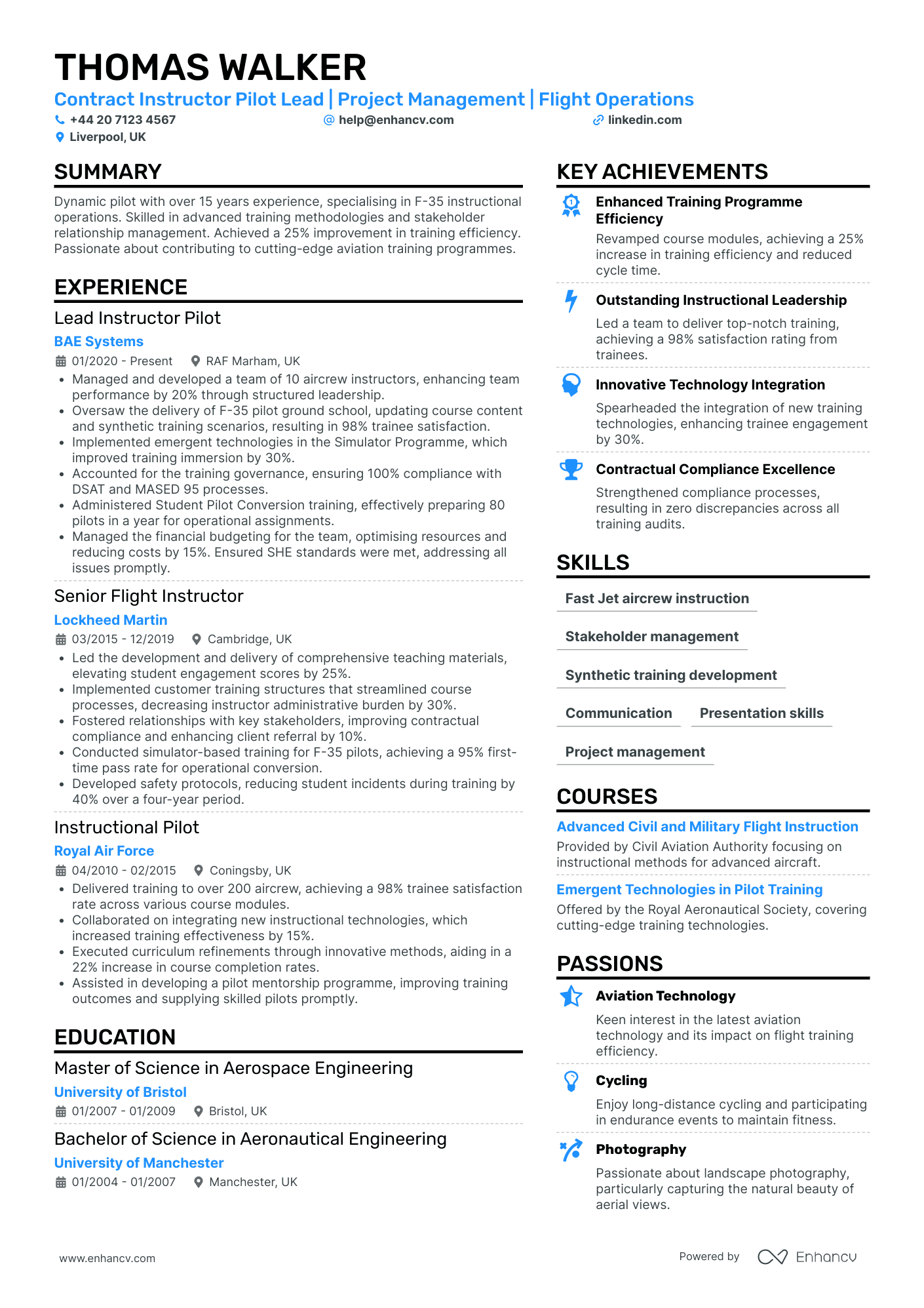
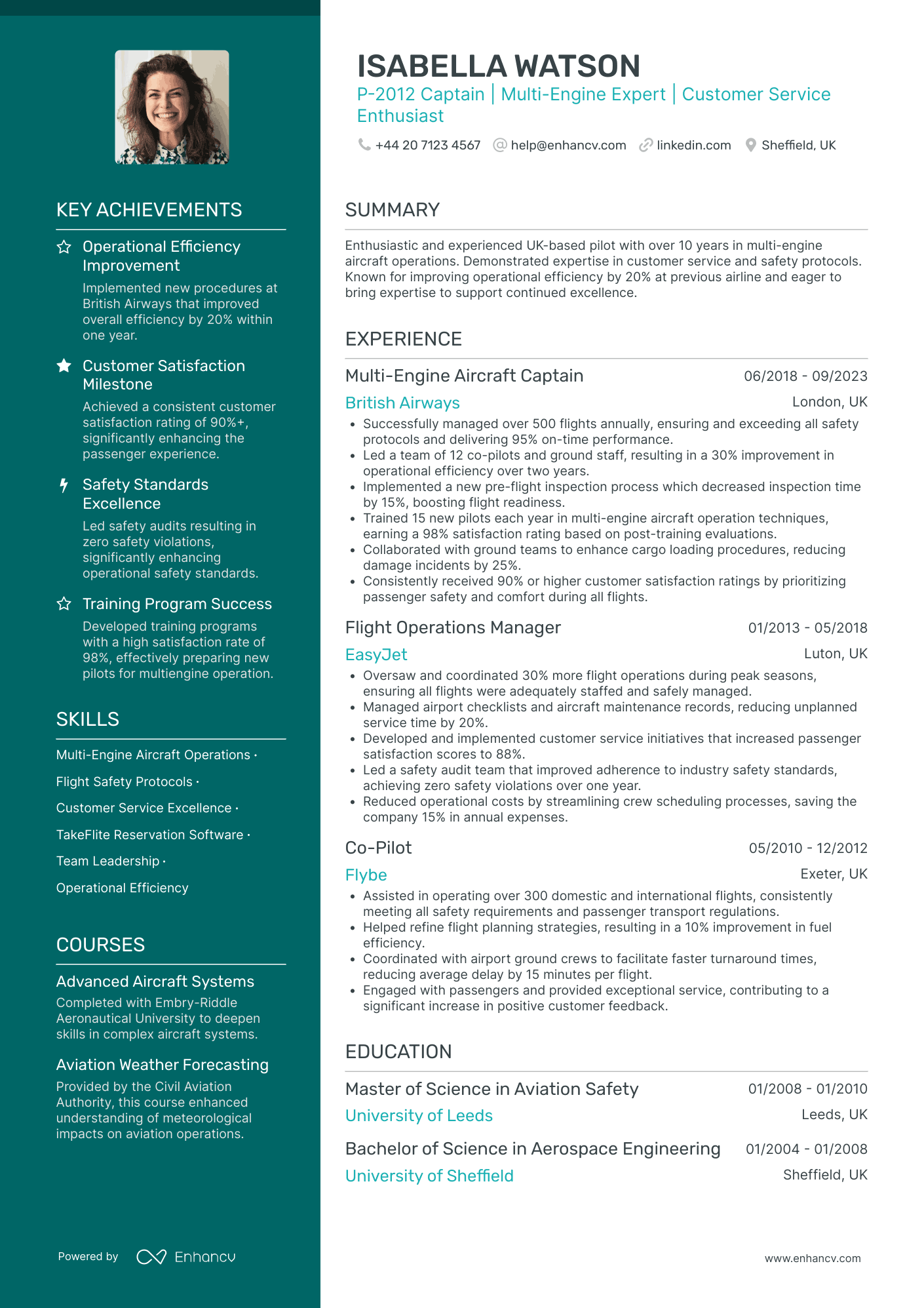
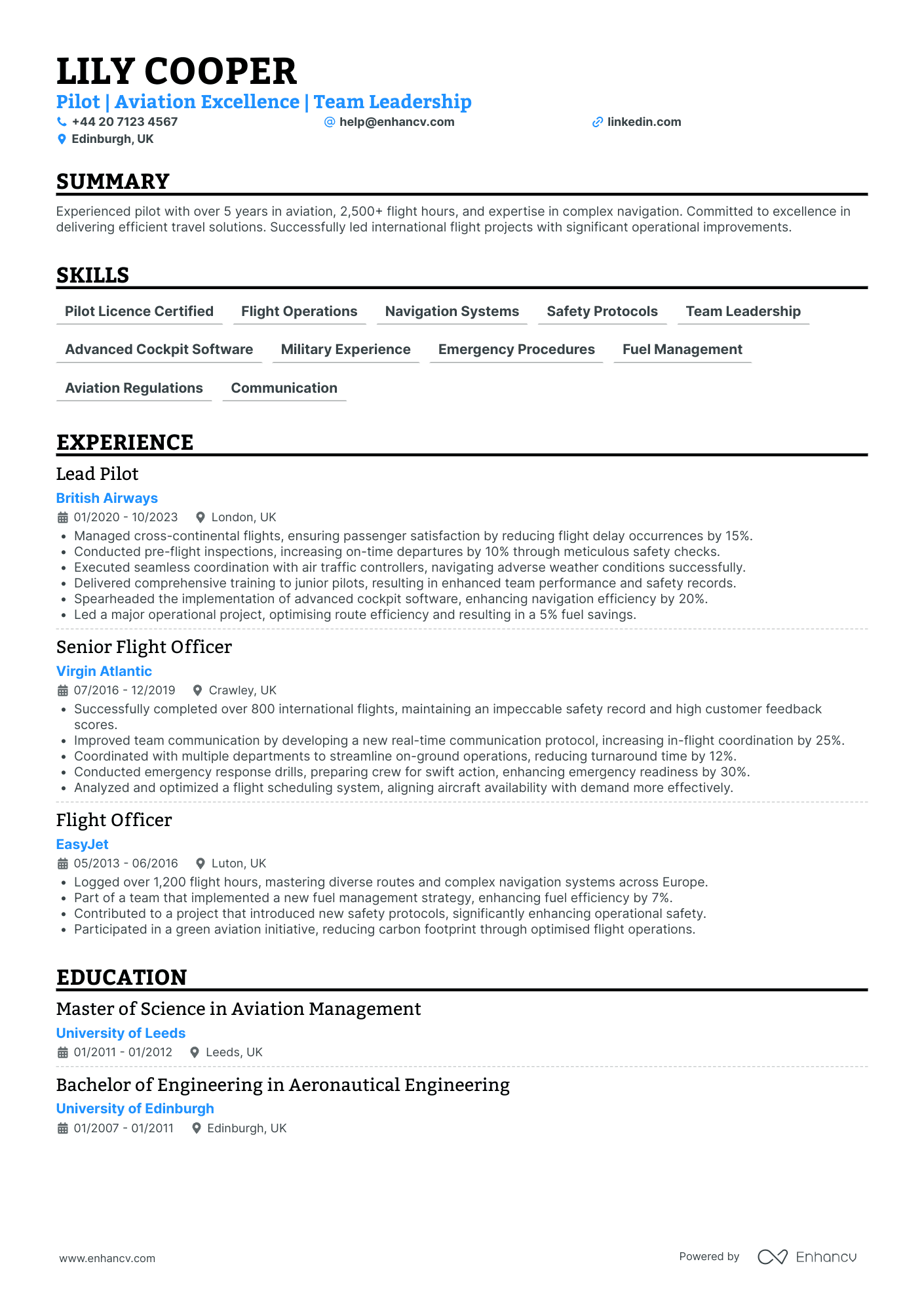
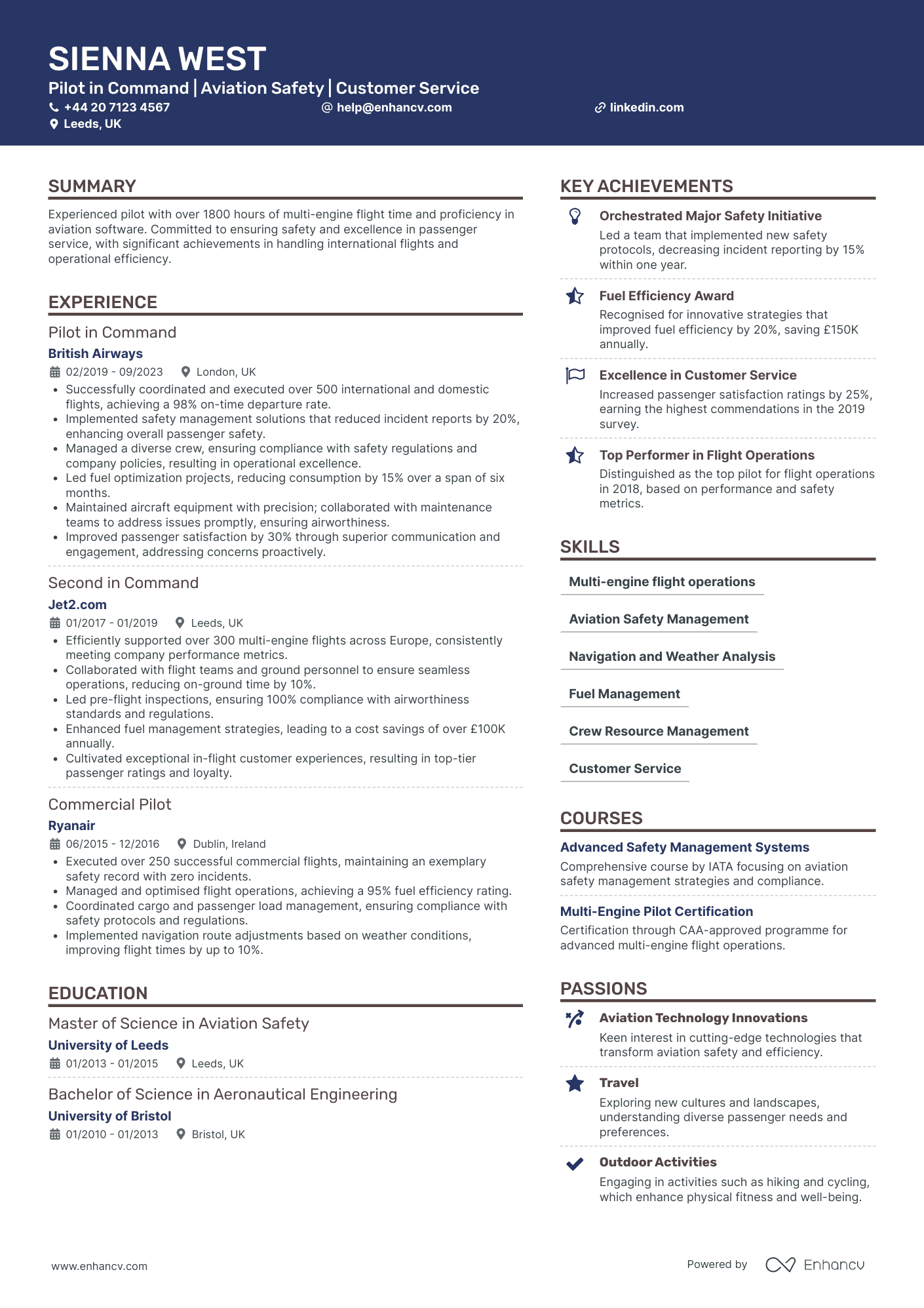
Keep it to two pages once you have a few thousand hours, and to one page as a cadet or fresh CPL holder. UK recruiters expect two and will not reward a third, so if you are unsure how long a CV should be, err on the shorter side.
Put the licence, ratings, medical, and hours block at the top of page one. Below it, run your flight experience in reverse chronological order, most recent aircraft and operator first.
Use one column, a readable font, and standard headings. A crewing officer skims dozens of applications between duties, so make yours effortless to scan.
Some operators ask for a scanned licence, medical, and logbook summary alongside the CV. Keep those ready as separate files and reference them on the CV rather than pasting tables of raw logbook data into the document itself.
Send a PDF so the layout holds when it lands in a crewing inbox. Keep the structure clean so an ATS can read it, because large operators screen applications through one. Build it from a tested layout rather than a blank page: Enhancv's CV templates export to a clean PDF.
Writing your pilot personal statement
Three or four sentences at the top: your licence and hours, your current type, and why this operator. Keep it factual and let the numbers do the persuading. For more openings, see our personal statement examples.
Skip the lifelong-dream narrative. A recruiter cannot screen on a dream, and every other applicant has already written that sentence.
Name the operator and the base if you know them, and match the type you fly to the fleet they recruit for. A First Officer applying to an A320 operator should say so in the first line, not the last.
Lead with what you fly and how much, like this:
Pilot CV personal statement example (First Officer)
First Officer with an unfrozen ATPL and 3,200 total hours, 1,800 of them on the A320, and a current UK CAA Class 1 medical. Line experience across short-haul European operations with a clean check record and a recent LPC pass on the first attempt. Seeking a First Officer position with a UK short-haul carrier from a London base.
The version that gets skimmed past
Highly motivated and passionate pilot with a lifelong love of aviation, excellent communication skills, and a strong work ethic, looking for an exciting opportunity to grow with a dynamic airline.
When I read a pilot's CV, I go straight to the top block for the licence, the type ratings, and the hours. If I have to hunt for them, the CV is already working against you. Put the numbers where an assessor expects them, name the aircraft the way the advert does, and let one well-told decision show your airmanship. That combination gets you to the sim assessment faster than any paragraph about passion.
Writing your flight experience section
Write each role like a logbook entry with context: operator, aircraft, base, and dates, then bullets that show what you flew and how well. Lead every bullet with a strong action verb. For the mechanics, see work experience on a CV.
Flying is measurable, so quantify it: sectors flown, hours on type, on-time performance, fuel savings, a clean safety and check record. Those are your achievements.
Show progression too. A move from turboprop to jet, from right seat to line training, or from short-haul to long-haul tells a recruiter you take on more responsibility and pass the checks that come with it. Date each step so the arc is obvious.
Tailor each application to the operator by pulling the aircraft, base, and hour thresholds from the advert and mirroring them where they are true of you. Enhancv's CV tailoring feature reads the advert and suggests the matching edits, which saves rewriting from scratch for every carrier.
- Fly 60 to 70 sectors a month on the A320 across European short-haul routes, holding a clean check and safety record throughout
- Manage busy single-runway approaches into Gatwick and continental hubs, coordinating with the Captain and cabin crew under tight slot pressure
- Passed the most recent LPC and OPC on the first attempt, with assessor notes on calm workload management
- Reduced fuel burn on assigned routes by applying reduced-flap approaches and single-engine taxi procedures where conditions allowed
Skills for your pilot CV
A pilot's hard skills are largely licences, ratings, and systems, listed in the words operators use. Type ratings, MCC and JOC, CRM, threat and error management, RVSM and ETOPS operations, and MEL and tech-log handling all belong here when you hold them.
The soft skills that matter map straight onto the core competencies: communication, decision making, situation awareness, teamwork, and workload management. Prove each in a bullet rather than claiming it.
List only what you can stand behind in a sim check. If a rating is expired or a skill is aspirational, leave it off your skills section or mark it clearly as in progress.
Match the wording to the advert. If an operator asks for RVSM and ETOPS experience or Airbus automation, use those exact terms where they are true of you, because that is what an assessor and an automated scan both look for.
Top skills for your pilot CV:
Type ratings (e.g. A320, B737)
Instrument rating (IR)
Multi-crew cooperation (MCC/JOC)
Crew resource management (CRM)
Threat and error management (TEM)
RVSM and ETOPS operations
MEL and tech-log handling
Radiotelephony (RT)
Communication
Decision making
Situation awareness
Teamwork
Workload management
Leadership
Writing a pilot CV with little or no experience
A low-hours or cadet CV carries its weight differently. Lead with your training, your licences in progress, and your hours however modest, because that is the evidence an airline cadet scheme screens for.
Put your frozen ATPL, MPL cadet status, or CPL front and centre, along with your Class 1 medical and total hours to date. Then list your training provider, sim types, and any hour-building, instructing, or PPL flying you have done.
University aviation study, a flight instructor rating, or strong ground-school results all count as evidence here, not filler. Write them like the first job CV that they are, with dates and outcomes.
Hour-building tells its own story. A season of banner-towing, aerial survey, or flight instructing shows real command time and decisions made alone in the cockpit, which is exactly the airmanship a cadet assessor is trying to read. Quantify it: solo hours, cross-country legs, students signed off.
One line lifts a low-hours CV: a specific number of hours towards a rating, or a scheme place secured. It signals momentum towards the flight deck, which is what a cadet CV is judged on, not total hours.
Conclusion
Lead with the licence, ratings, medical, and hours, prove one or two core competencies with a real decision, and keep the format clean enough for a crewing inbox to read in seconds.
Pair the CV with a short cover letter that names the operator and the base, and you turn a stack of numbers into an application an assessor wants to meet.
Author's take - The Enhancv team
When I read a pilot's CV, I go straight to the top block for the licence, the type ratings, and the hours. If I have to hunt for them, the CV is already working against you. Put the numbers where an assessor expects them, name the aircraft the way the advert does, and let one well-told decision show your airmanship. That combination gets you to the sim assessment faster than any paragraph about passion.