Data Entry Skills for a Resume: A Complete Guide in 2026
Simplify even the most complex boards and tables with professional data entry skills.
Simplify even the most complex boards and tables with professional data entry skills.




Drop your resume here or upload a file to find out if the skills in your resume are readable by an ATS.
Data entry might not sound like the flashiest job skill, but in today’s fast-paced world, it’s the backbone of efficient business operations. From organizing vital company data to ensuring accuracy across platforms, data entry skills are in high demand.
Employers are looking for candidates who can handle massive amounts of information with speed and precision reliability.
So, how can you present these skills in the most impactful manner? This guide will show you how to present your data entry expertise in a way that grabs attention.

Data entry focuses on efficiently processing and organizing information into digital systems, ensuring it’s accurate, accessible, and easy to analyze.
This skill set involves handling data from multiple sources, such as documents, spreadsheets, or digital records, and converting it into usable formats. It’s a key component in keeping operations smooth across industries like finance, healthcare, and business administration.
When listing data entry skills on your resume, focus on clarity and relevance. Tailor your skills to the job description, emphasizing those most valued by the employer. Hard skills work best in their own skills section, while soft skills come to life when paired with examples in your experience section.
Below is a list of must-have hard skills for any data entry role. Highlight these with measurable outcomes in your resume.
These are the most common soft skills in data entry roles. Incorporate them into your resume summary and work experience descriptions.

The fastest typist, according to the Guinness World Records, reached a speed of 212 words per minute, proving the extreme efficiency possible in the field of data entry.
With the rise of artificial intelligence and automation, many industries now integrate AI-powered tools to enhance data entry tasks. Outlining your ability to use AI tools, such as optical character recognition (OCR) systems or machine learning-based automation software, can set you apart.
If you’ve worked with AI-enhanced systems, mention these to prove your adaptability to evolving technologies. Even for entry-level roles, knowledge of how AI can optimize workflows demonstrates a forward-thinking mindset.
As industries increasingly rely on data accuracy and speed, your familiarity with AI tools positions you as a valuable candidate who can navigate and optimize technology-driven environments.
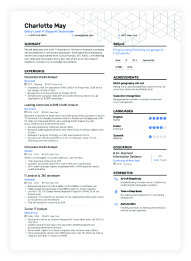
Underlining your accuracy and AI expertise is key. Here’s a sample resume to guide you.
Tina Gable’s resume shows how simple and effective a resume can be. With our free template and AI resume builder, you’ll have no trouble putting together one that reflects your own strengths.
Tina Gable
Data Processing Clerk
(512) 555-9876 | t.gable@enhancv.com | @LinkedIn | Austin, TX
Summary
Detail-oriented Data Processing Clerk with 4 years of experience managing and analyzing datasets exceeding 50,000 entries per month. Streamlined data entry processes to reduce processing time by 30% while maintaining 99% accuracy under tight deadlines. Proficient in using specialized software and tools, including Excel, SQL, and ERP systems, to optimize workflows. Collaborated with cross-functional teams to enhance data-driven decision-making and improve operational efficiency by 20%.
Experience
Data Processing Clerk
Dell Technologies, Austin, TX
January 2023 – Present
Junior Data Processing Clerk
Hewlett-Packard (HP), Houston, TX
June 2020 – December 2022
Education
Bachelor’s Degree in Information Systems
University of Texas at Austin
Graduated: 2020
Certifications
Skills
Languages
See how ATS-friendly your resume is with Enhancv’s free and fast checker.
Drop your resume here or choose a file. PDF & DOCX only. Max 2MB file size.
You might be wondering how to effectively showcase your data entry skills in today’s AI-driven job market.
Highlight your expertise in automating tasks and ensuring seamless information flow to make a strong impression and secure your next role.

Boost your resume with certifications in Excel, SQL, or AI-driven data tools from platforms like Coursera or LinkedIn Learning to display your commitment to growth.
The resume summary is your spotlight moment to shine as a data entry pro. It’s your chance to draw attention to your razor-sharp precision and mastery of modern tools like AI-powered software.
Here you should outline standout achievements, name-drop tools that show your expertise, and tweak it to mirror what the employer is really after.
The example below works because it combines proven achievements, tool expertise, and alignment with key employer priorities like efficiency and accuracy.
Your experience section is where you bring your data entry skills to life. Explain how you’ve applied these skills in previous roles, using specific numbers and examples. Underscore your ability to handle large volumes of data, ensure accuracy, and streamline processes. Include action verbs and metrics to make your accomplishments stand out.
Here’s an example:
 03/2019 - 02/2024

Tailoring your achievements section to the job you’re applying for is a smart move. Let’s consider, for example, an accounts clerk's resume. Focus on how your data entry skills have contributed to accurate financial records, on-time reporting, and smoother processes.
Here’s how they illustrated their achievements:
Let’s explore how data entry skills evolve from interns to junior professionals.
Starting a career in data entry often begins with learning the basics and builds toward more complex tasks as you gain experience. As an intern, you may focus on mastering foundational tools and processes, while junior professionals take on responsibilities that involve greater independence and impact.
Intern examples:
Junior examples:
Quantifying your achievements makes your resume stand out. Numbers provide clear evidence of your impact and show how you save time or improve accuracy. All this adds credibility and highlights your value.
No matter whether you’re a seasoned pro or new to the data entry field, it’s normal to feel a little unsure of your skills—especially with AI evolving so fast. But here’s the good news: there are plenty of ways to level up and stay ahead of the game.
With data driving so much of what we do today, strong data entry skills ensure you remain relevant and ready to adapt to new challenges.
Read our practical tips below:
To show your ability to manage confidential information, underline roles where you worked with sensitive data and adhered to privacy regulations or protocols. Mention any training or certifications in data security or compliance, as these reinforce your reliability in handling such responsibilities.
Including volunteer work in data entry is valuable, especially for those with limited professional experience. It demonstrates the practical application of your skills, showcases your initiative, and provides examples of your ability to contribute meaningfully to an organization’s goals.
While not mandatory for basic data entry roles, familiarity with programming languages like Python or SQL can be an asset, especially for roles involving automation and data processing. Learning these skills can also create career opportunities in data-related fields.
Data entry skills are foundational in today’s tech-driven world, valued across industries for ensuring accuracy and efficiency. With the right approach, you can open doors to roles where precision is key, establishing yourself as a valuable contributor in any organization.