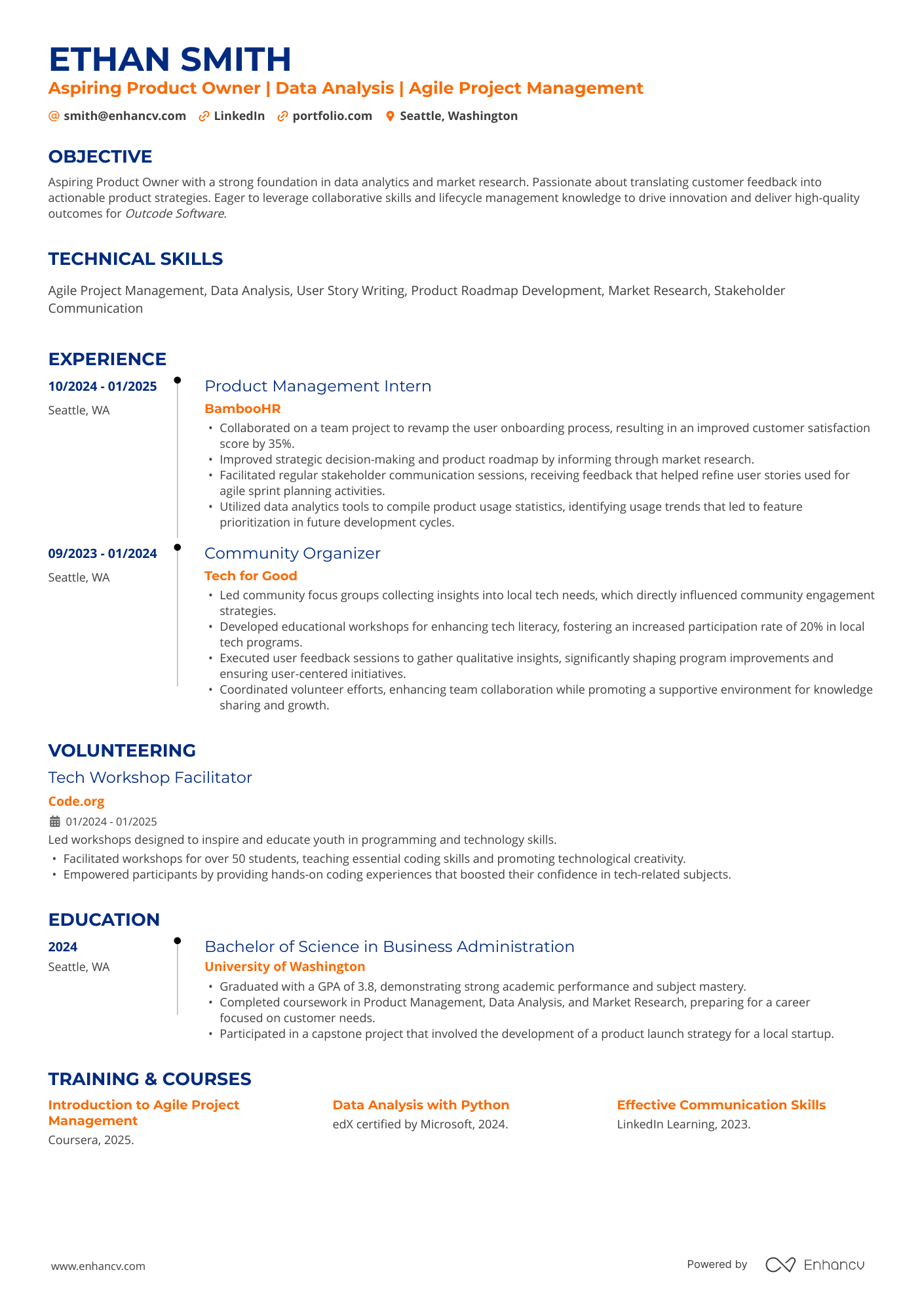
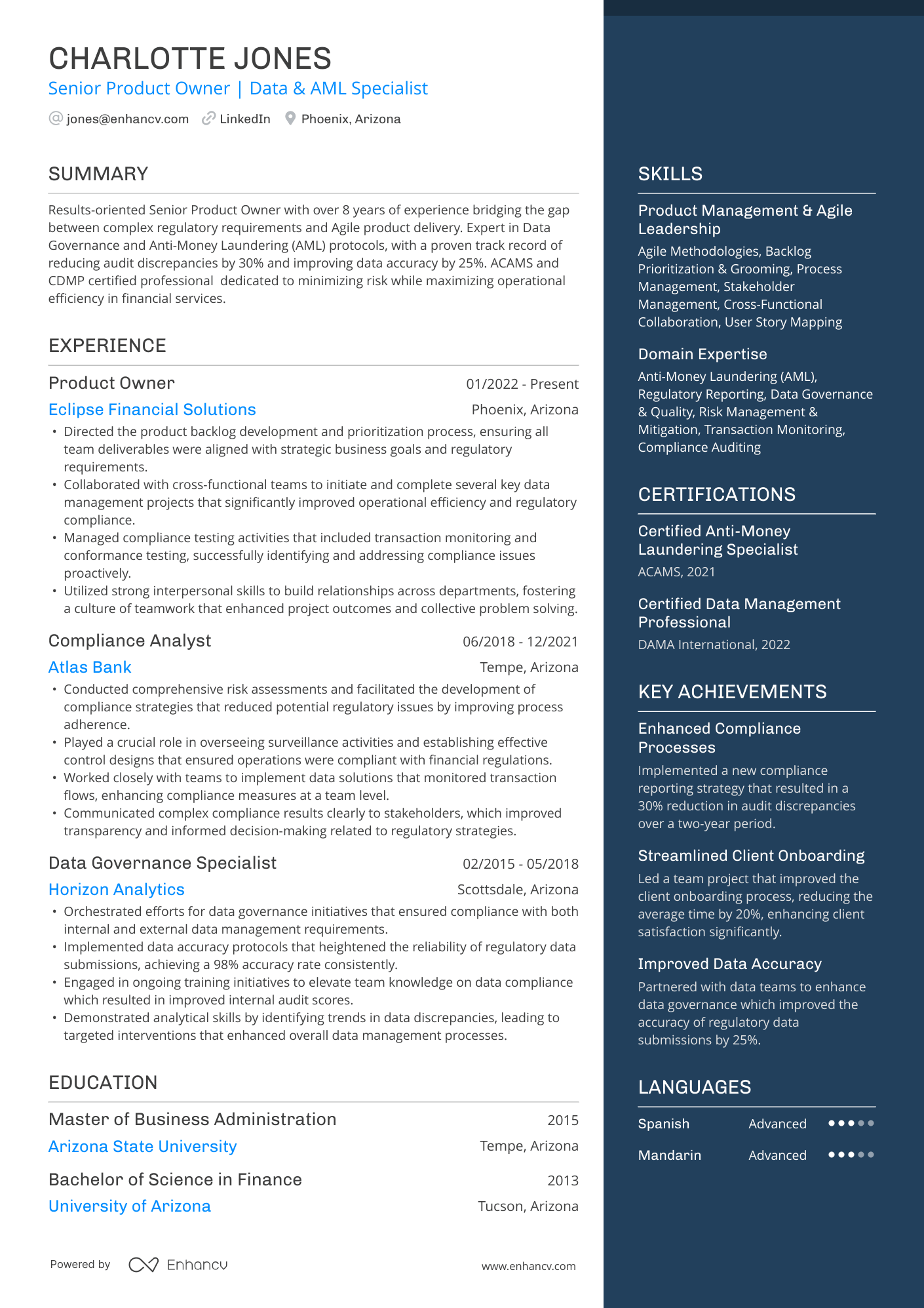
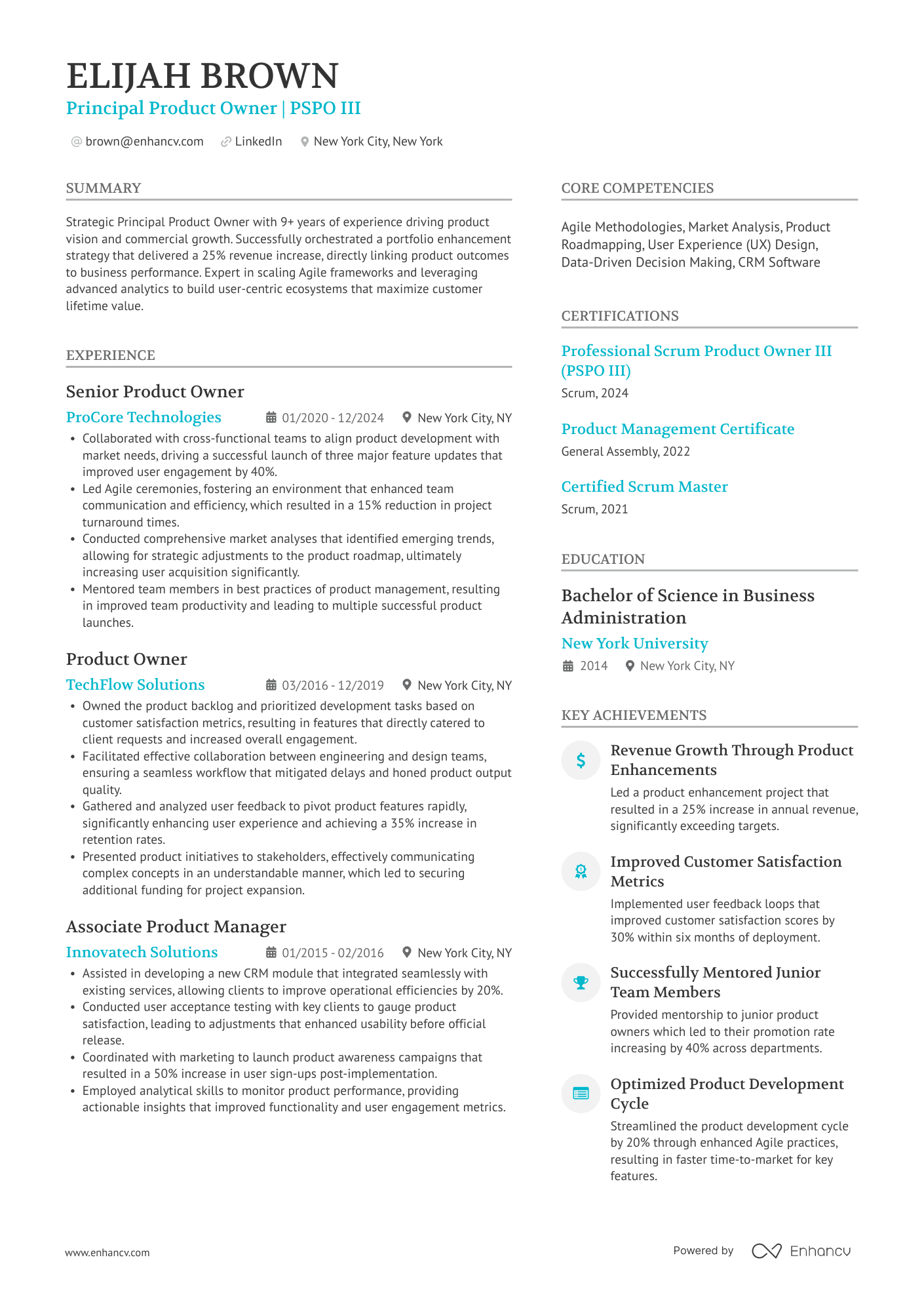
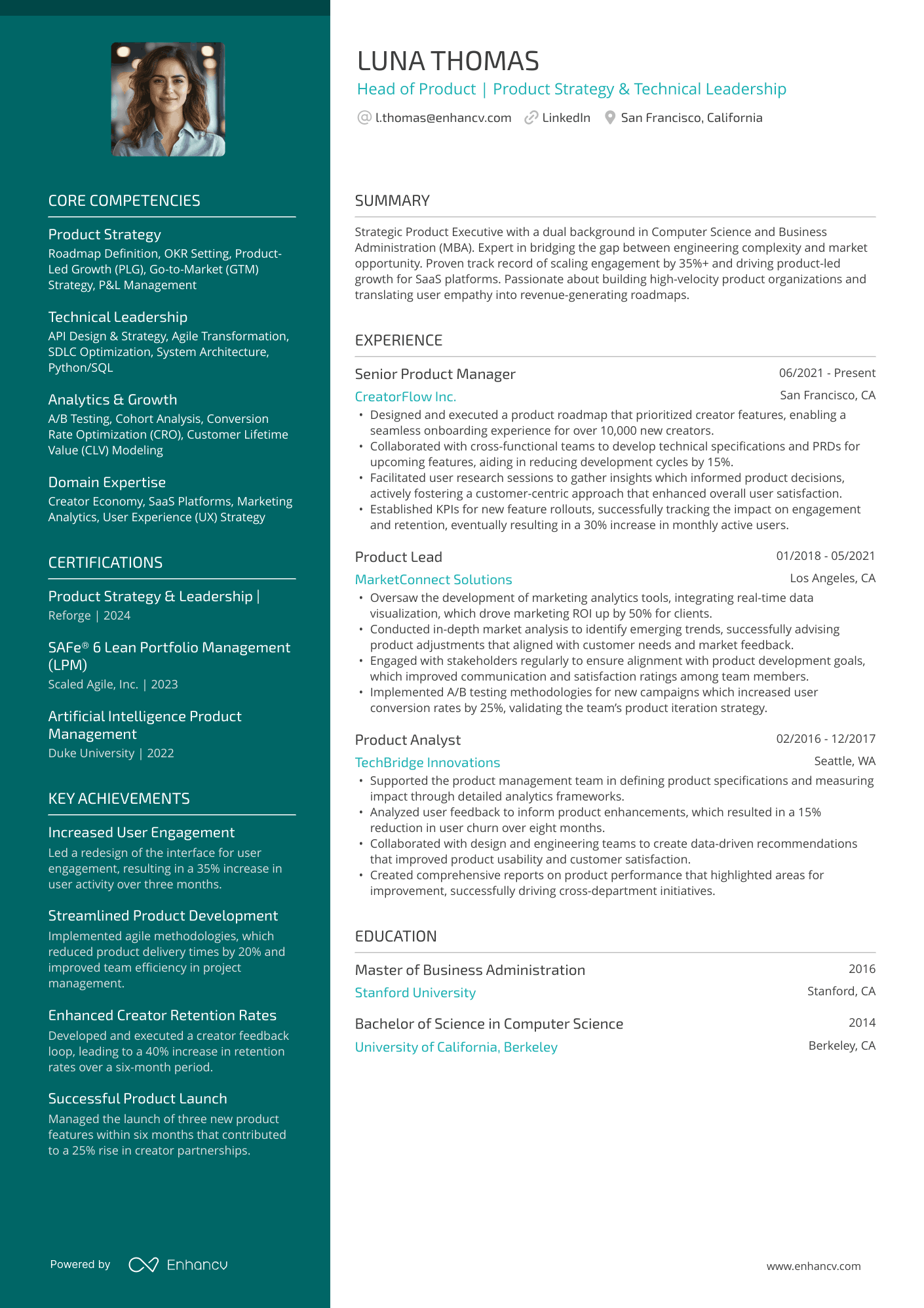
Being a product owner (PO) comes with an inherent branding problem. You aren't quite a "manager" with budget authority, yet you aren't an engineer building the code. You live in the messy middle.
Consequently, most PO resumes fall into a fatal trap: they list mechanics instead of outcomes. They obsess over managing Jira tickets and running stand-ups, effectively painting themselves as administrative assistants rather than product leaders.
The struggle isn’t showing you know Agile. It’s proving you can influence without authority. Your resume must stop apologizing for your tactical role and start highlighting how your decisions directly printed money, saved time, or retained users.
With Enhancv, we’ll help you groom your professional backlog and ensure your resume meets the ultimate Definition of Done.

Key takeaways
- Stop listing administrative duties like "running stand-ups" and focus on quantifiable wins like revenue growth, user retention, and cycle time reduction.
- Analyze the job description and adjust your narrative to match its specific language.
- Combine a skills-heavy functional top section with a reverse-chronological work history to satisfy ATS algorithms while telling a coherent career story.
- Use certifications like CSPO, PSPO, or SAFe POPM to objectively prove your command of Agile frameworks.
- Don't waste hours formatting—use Enhancv’s AI Resume Builder to instantly tailor your bullet points, check your ATS score, and ensure your resume meets your field’s standards.
Тhe best product owner resume format
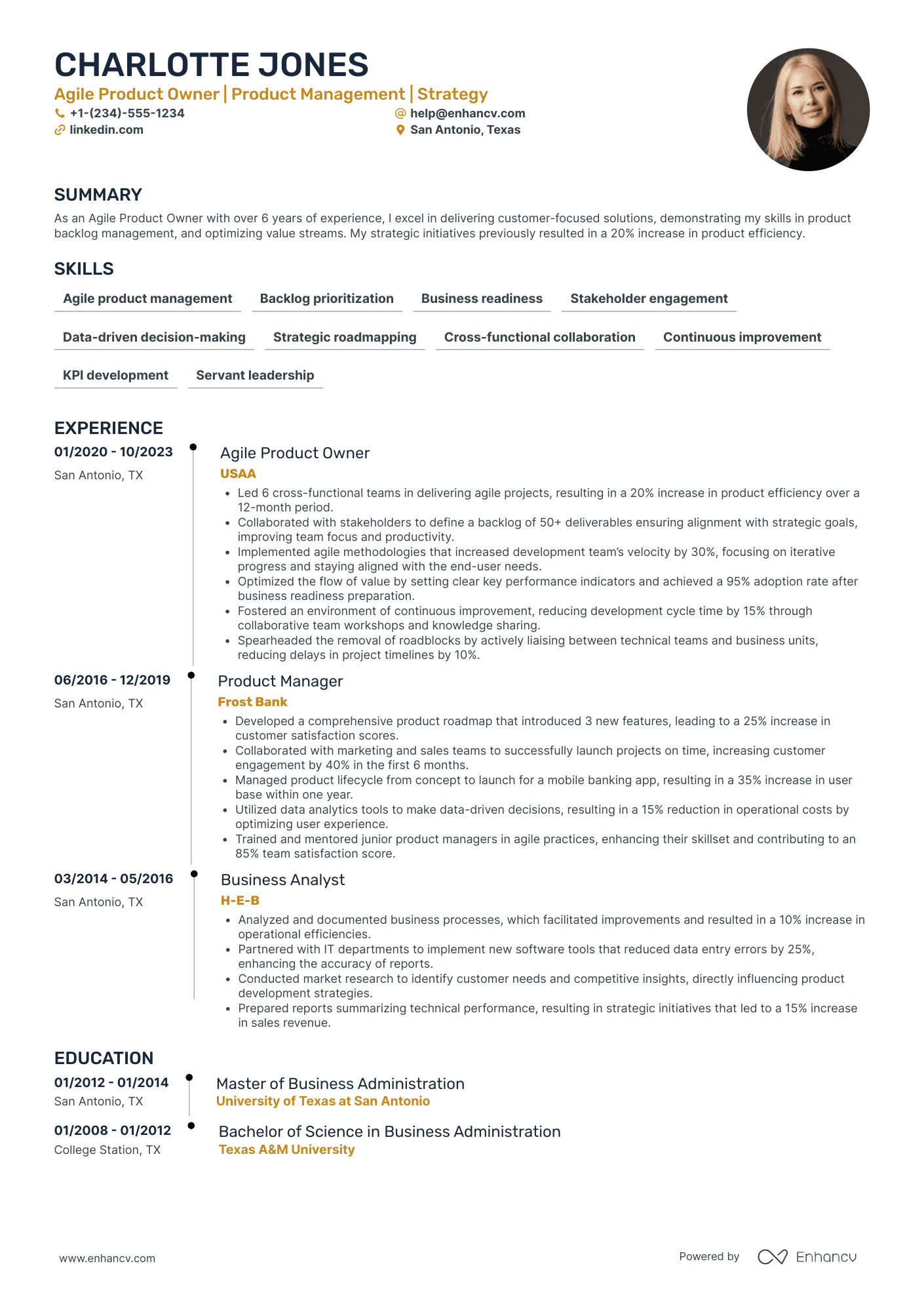
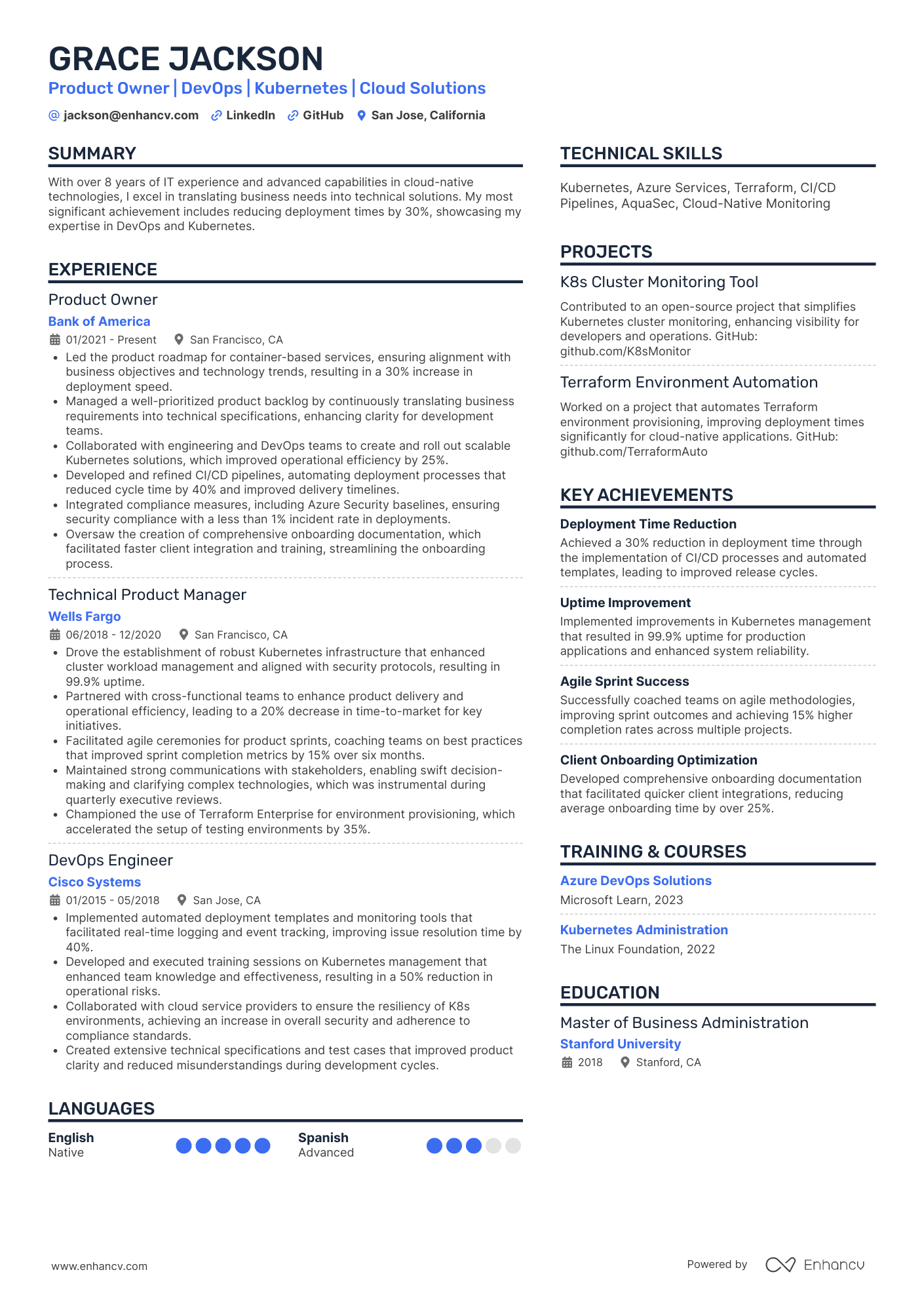
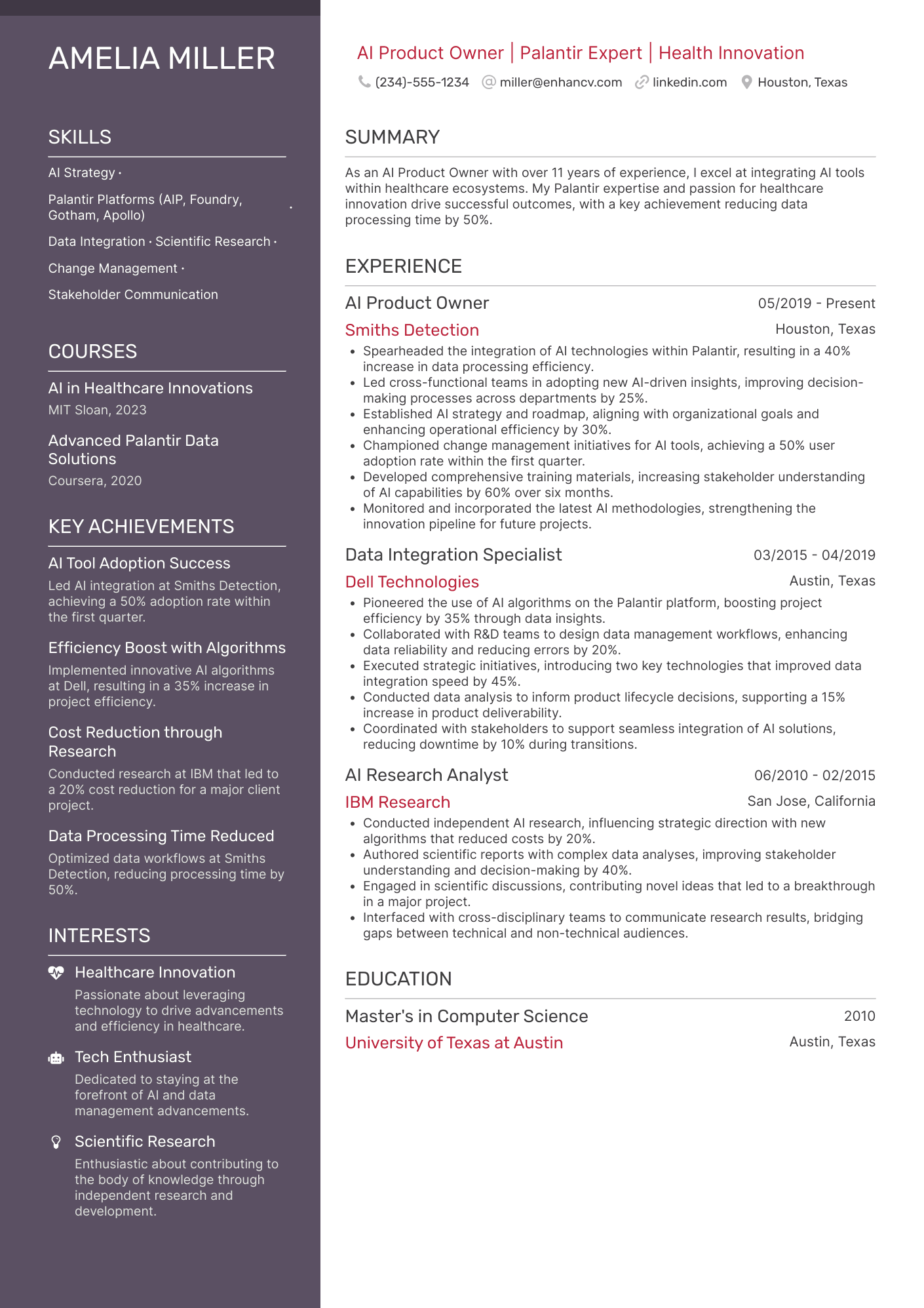
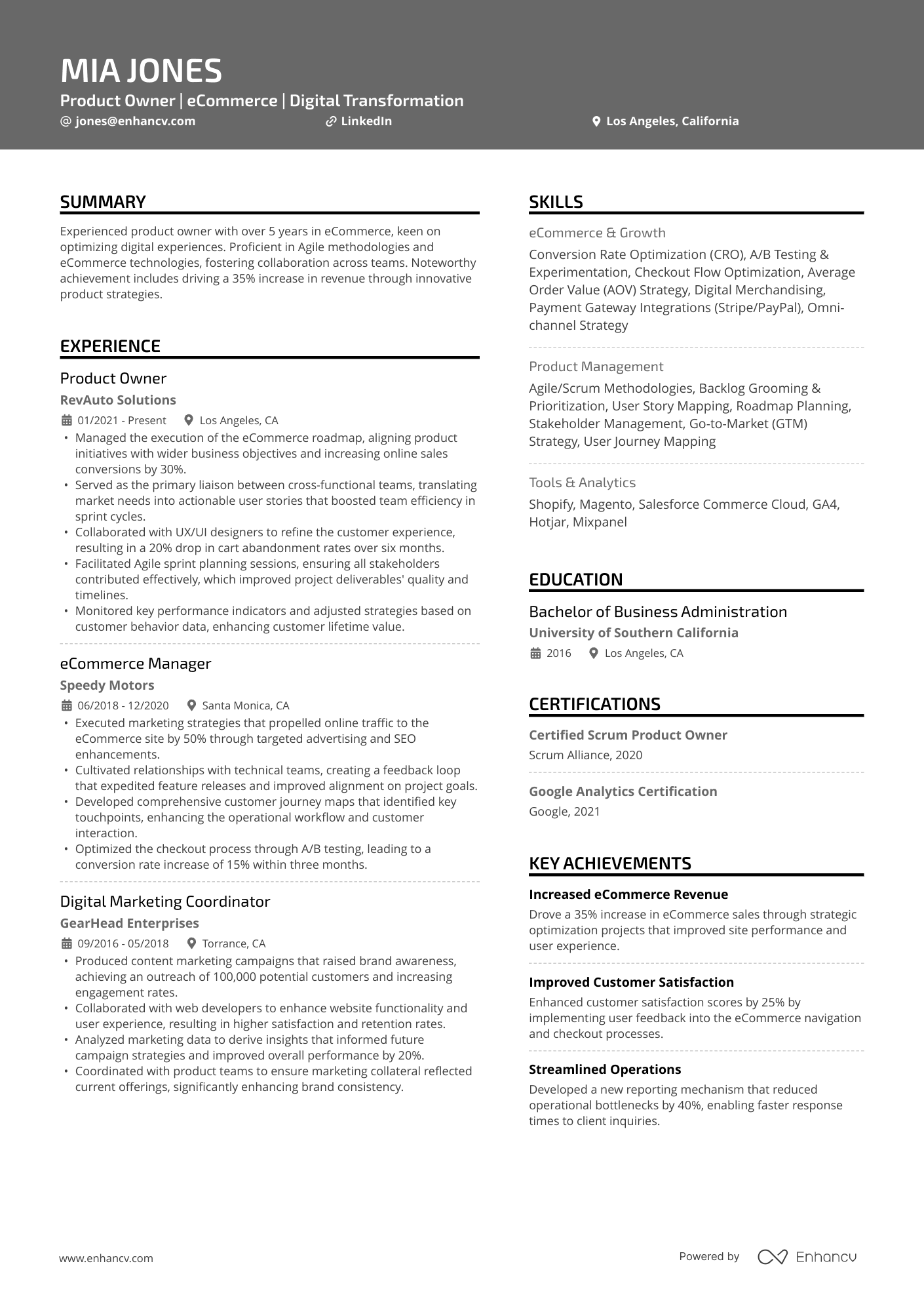
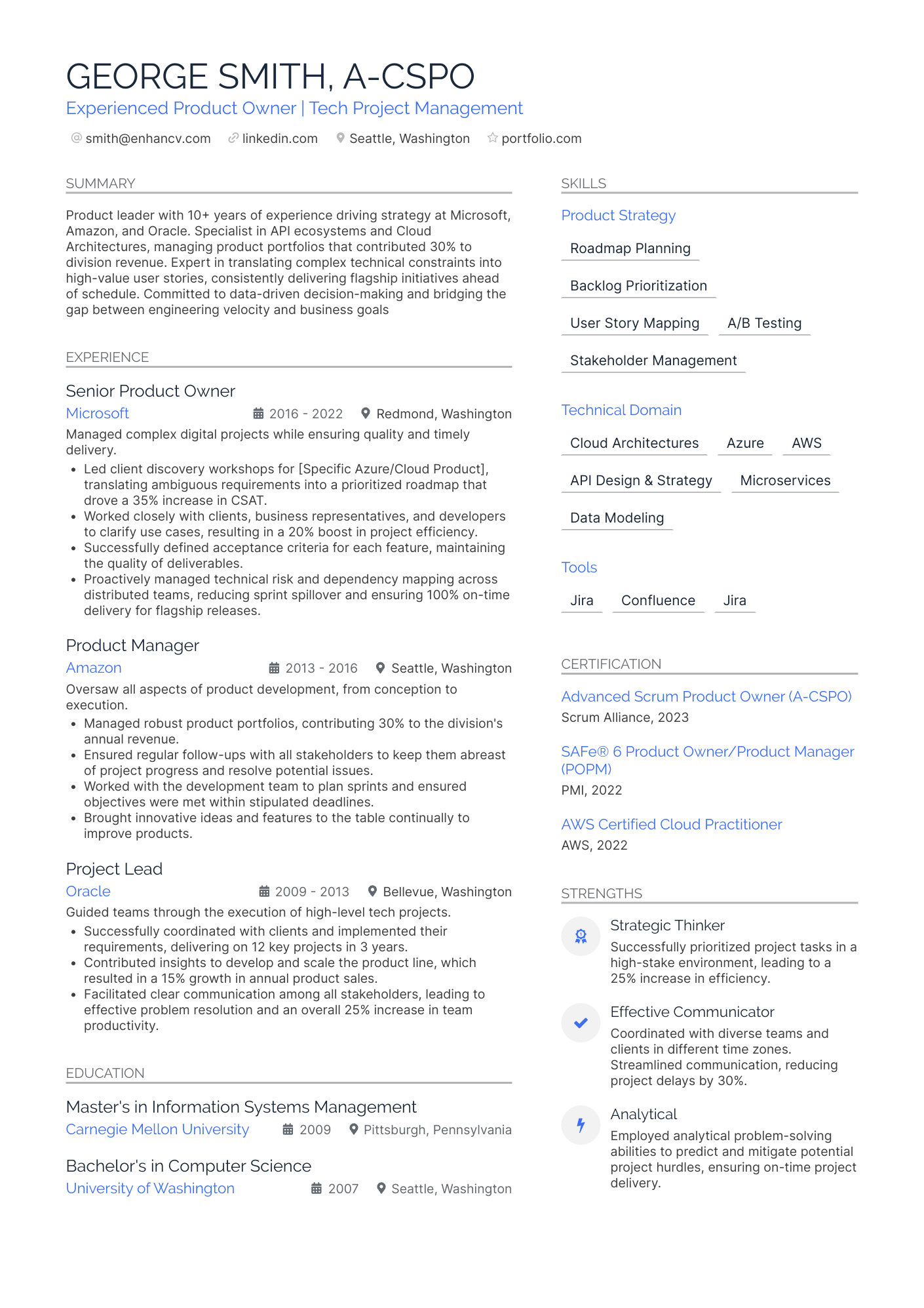
Most successful PO resumes rely on the combination (hybrid) format. This approach merges a distinct Skills & Domain section at the very top with a strict reverse-chronological work history.
It gives you the best of both worlds. The skills section acts as an immediate snapshot of your product toolkit (e.g., SQL, Jira, Market Research) for applicant tracking systems (ATS). Meanwhile, your most recent and relevant experience proves those skills were used to ship real software.
What sections should you include on a product owner resume?
The recommended section order prioritizes your ability to deliver value. You must ensure your domain expertise is immediately visible to both the ATS and the Head of Product.

PRO TIP
ATS systems scan your text for specific match criteria rather than reading your story. According to our recent survey, when recruiters toggle "auto-rejection" for missing hard skills, a resume without the right keywords is archived instantly before a human ever sees it.
This makes precise keyword optimization a survival mechanism, ensuring your file clears the algorithm to reach the hiring manager's screen.
With this in mind, you should include:
- Header: Name, contact info, and crucial links to your portfolio, LinkedIn, or a live product you shipped.
- Resume summary: A brief, three-line pitch defining your industry niche, your scale, and your top metric.
- Skills and tools: A categorized list (e.g., Methodologies, Analytics, Design Tools) that acts as your main keyword filter.
- Professional еxperience: The core of your resume. This demonstrates the "build-measure-learn" loop in action and anchors every role to business results.
- Certifications: Validation of your framework knowledge (e.g., CSPO, PSPO, SAFe POPM).
- Education: Documents your degrees or relevant product bootcamps.
Ready to ensure your PO resume is fully optimized to clear ATS? Upload it to Enhancv’s Resume Checker, which runs 19 scans of your document and gives you a credible AI score.
Is your resume good enough?
Drop your resume here or choose a file. PDF & DOCX only. Max 2MB file size.
How to write your product owner resume experience
For a product owner, the experience section must move beyond "managing the backlog" to demonstrating quantifiable commercial value.
What you must show:
- ROI and business value: Focus on results that moved the needle, such as increased conversion rates, revenue growth, or cost savings.
- Scope and complexity: Contextualize your product. Was it a zero-to-one launch, a legacy migration, or a feature for 1M+ users?
- Process efficiency: Show how you reduced cycle time or improved sprint velocity.
- User outcomes: Emphasize adoption rates, retention spikes, or NPS improvements, rather than just the number of features shipped.
- STAR method: The Situation-Task-Action-Result framework is your best bet when writing your bulleted entries.
Here’s how this looks in practice:
Good example of a product owner experience section
Senior Product Owner
FinTech Solutions | Chicago, IL
01/2023 – 12/2025
- Owned the roadmap for a B2B payments platform serving 50k+ daily users, directly contributing to a 15% YoY revenue increase.
- Prioritized and launched a "One-Click Checkout" feature, reducing cart abandonment by 12% within the first quarter.
- Optimized backlog management processes in Jira, reducing sprint carry-over by 20% and increasing team velocity.
- Collaborated with UX/UI to overhaul the onboarding flow, improving new user retention from 45% to 60%.
PRO TIP
If you can't access financial metrics, pivot to efficiency metrics.
Did you reduce the number of clicks for a user workflow? Did you cut bug reports by 30%?
Even "soft" wins have hard numbers—calculate the hours saved for your team or users and annualize them. In product, time saved is money earned.
With your key metrics identified, the next step is ensuring your narrative aligns perfectly with what the recruiter is hunting for.
How to tailor your product owner resume experience
Tailoring is critical because "product owner" can mean very different things depending on the company. A technical PO role requires an engineering-focused narrative, whereas a growth PO position demands a commercial one.
Recruiters compare your resume against the job description (JD). If they want API integration and you focus on UI polish, you’ll be ignored.
To effectively translate your product experience and achieve a high match score, follow these steps:
- Analyze the JD: Pinpoint the specific operational focus of the position—is it weighted heavily towards technical mechanics or commercial outcomes (growth metrics?
- Identify keywords: Look for specific methodologies (SAFe, Kanban) or industry terms (HIPAA, KYC) listed as "Required."
- Adapt bullet points: Rewrite your experience to mirror their language. Don't just write "stakeholder management." Say "cross-functional collaboration with Sales."
- Leverage AI tailoring tools:Enhancv’s One-Click Tailoring Tool automatically aligns your experience and summary with the job requirements. Simply paste the description, then refine the output by injecting your specific metrics.
PRO TIP
Using AI to tailor your resume isn't cheating—it’s modern efficiency. According to a recent study, workers in IT and business services are the most likely to resort to AI when building a resume.
However, recruiters have developed a radar for the “ChatGPT glaze”—a generic, overly polished resume that lacks personality.
Use AI tools to structure your thoughts or suggest keywords, but ruthlessly edit the final output. If your resume sounds like a robot wrote it, hiring managers will assume a robot does your job, too.
Check out three examples of tailored experience section bullets:
Resume tailoring examples for product owners
| Job description excerpt | Untailored bullet | Tailored bullet |
|---|---|---|
| "Define and drive the vision, strategy, and roadmap for both Scheduling and Attendance products." | Created product roadmaps and strategies for various software features to ensure team alignment. | Architected the 12-month strategic roadmap for a complex Workforce Management suite, launching key Scheduling features that reduced overtime costs by 15%. |
| "Gather and prioritize healthcare-specific requirements, with a focus on SNF and long-term care." | Gathered requirements from stakeholders and prioritized the backlog for development teams. | Prioritized a regulatory-compliant backlog for SNF (Skilled Nursing Facilities), delivering critical long-term care workflows that ensured 100% HIPAA compliance. |
| "Guide BAs on user story development to ensure alignment with the product vision." | Worked with business аnalysts to write user stories and manage the team's output. | Mentored a team of 4 BAs on value-driven user story creation, reducing requirements churn by 30% and aligning all deliverables with the Q4 strategic vision. |
Bullet points like these—where hard metrics meet strategic keywords—are your strongest asset. If you're struggling to find the right phrasing, let Enhancv’s Bullet Point Generator do the heavy lifting. It instantly transforms your raw input into lean, high-impact accomplishments that prove your ROI.
How to list skills on a product owner resume
Your skills section is the most keyword-dense real estate on the page. It’s designed to satisfy the ATS and give hiring managers a quick snapshot of your toolkit.
But here is the catch: Precision beats volume.
A common mistake POs make is dumping every tool they’ve ever touched (like Microsoft Word or Zoom) into this section. This dilutes your impact. You must curate a list that directly addresses the employer's specific pain points—whether that's scaling a platform, navigating compliance, or integrating AI.
Depending on your specialization, organize this section into distinct categories. This saves the recruiter from hunting for the specific tech stack they need.
How to build your PO skills section
- Group skills by function: Avoid the "wall of text." Create logical sub-groups like "Product Management," "Technical & Data," and "AI & Innovation." This structure proves you’re organized—a core PO trait.
- Prioritize hard skills: While leadership is crucial, this specific list is for methodologies, software, and programming languages. Save the soft skills for your work experience bullets, where you can prove them.
- Mirror the JD: If the job description asks for user story mapping and Jira discovery, those exact terms should be at the front of your list.
- Skip the basics: Remove entries like MS Office, email, or Slack. These are assumed. Use that space for differentiating skills like SQL or Figma.
Below are the high-value keywords currently dominating the market. Select the ones that match your actual experience.

Core product management and methodology
- Agile (Scrum, Kanban, XP)
- Backlog grooming / Refinement
- User story writing (Gherkin syntax)
- Acceptance test-driven development (ATDD)
- Roadmap strategy
- Release planning
- Stakeholder management
- Market research and competitive analysis
- Design thinking
Here are some more essential hard skills for product owners:
Technical, data, and tools
- Workflow: Jira, Linear, Azure DevOps, Monday
- Analytics: GA4, Mixpanel, Amplitude, Pendo
- Visualization: Tableau, Power BI, Looker
- Design: Figma, Miro, Balsamiq
- Tech literacy: SQL, API Integration, JSON, HTML/CSS basics
In 2026, AI literacy is a baseline expectation. Companies are specifically hunting for POs who understand how to leverage AI, not just build it.
They want to know: Can you use AI to write specs faster? Do you understand the constraints of LLMs when proposing features? Including a dedicated AI category signals that you’re a future-proof operator.
AI and emerging tech skills
- Large Language Models (LLM) concepts
- Generative AI application
- Prompt engineering
- AI product ethics
- Data privacy (GDPR/CCPA for AI)
- Conversational AI design
- Copilot/AI coding assistants
Including soft skills on your resume, however, takes a little more strategy. They’re abstract, so you need to make them concrete.
The best place to prove your soft skills is in your work experience, weaving them into your accomplishments.
Look at the table below to see how to translate generic traits into high-impact resume bullets:
Top 5 soft skills for product owners
| Soft skill | How to frame it |
|---|---|
| Negotiation | "Negotiated with Sales and Engineering to cut low-value scope, delivering the MVP 2 weeks ahead of schedule." |
| Empathy | "Led 20+ user interviews to identify friction points, resulting in a redesign that increased customer satisfaction (CSAT) by 15 points." |
| Communication | "Translated complex API documentation into plain-English guides for the marketing team, reducing launch confusion." |
| Adaptability | "Pivoted the quarterly roadmap mid-sprint in response to new competitor data, minimizing wasted development hours." |
| Decisiveness | "Made critical trade-off decisions during a blockage, re-prioritizing the backlog to ensure the core payment feature shipped on time." |
While your tech skills prove you can do the job, your credentials answer the question hiring managers really want to ask: “Does this person actually know the rules?”
Certifications vs. education: what’s best for a product owner's resume
In a field riddled with self-taught experts, formal education and certifications provide the objective proof that you understand the framework behind the chaos.
For product owners, certifications are often more scrutinized than university degrees. The market is flooded with "accidental" POs, so a recognized credential validates that your knowledge is intentional and standardized.
Here’s what you should know:
Best certifications for your product owner resume
- Certified Scrum Product Owner (CSPO): The most recognized entry-level credential. It signals you’ve been trained by the Scrum Alliance in the core mechanics of the role.
- Professional Scrum Product Owner (PSPO): It’s often viewed as more rigorous than the CSPO because it requires a difficult exam, not just class attendance.
- SAFe Product Owner/Product Manager (POPM): Essential for corporate gigs. If you’re applying to large enterprises (banking, insurance, aerospace), this certification is often a hard requirement.
If you hold multiple certifications, it’s worth listing them in a dedicated section. Keep it clean and list the certification name, the certifying body, and the year obtained.
Like so:
Good example of a product owner certifications section
CERTIFICATIONS
- Certified Scrum Product Owner (CSPO) | Scrum Alliance | 2024
- SAFe® 6 Product Owner/Product Manager | Scaled Agile, Inc. | 2023
- Google Data Analytics Certificate | Coursera | 2022
As for formal training, unless you’re a recent graduate, your education sectionbelongs at the bottom of your resume.
Why? While a technical background helps, the best POs often come from diverse backgrounds like business, psychology, or design. If you have a non-technical degree, your work experience and skills sections must work harder to prove your tech literacy.
What about bootcamps?
If you pivoted into product from another career, list your bootcamp prominently. It effectively bridges the gap between your past life and your future role.
In case your degree is relevant, make sure you include the following details:
- Degree name and major
- University name
- Location (city, state)
- Graduation year (optional if >10 years ago to avoid ageism).
Education entry sample
EDUCATION
Bachelor of Science in Business Administration
University of Illinois, Chicago, IL
2018
- Product Management Bootcamp General Assembly | 2021
We’ve established your credentials and your toolkit. Now, we need to distill that entire package into a six-second elevator pitch that sits at the very top of the page.
How to write your product owner resume summary
Treat your professional summary as your personal User Value Proposition. It’s a tight, 3-4 sentence statement that accomplishes two critical goals: defining your operational niche and headlining your biggest commercial win.
If this paragraph is engaging enough to convert a recruiter’s casual skim into a deep read, you’ve already won the first battle.
Here’s a formula for a winning summary:
[Adjective] Product Owner with [Number] years of experience in [Industry/Domain]. Proven track record of [Major Quantifiable Win or Metric]. Expert in [Key Methodology] and [Top Technical Skill]. Committed to [Specific Value Proposition, e.g., maximizing ROI or user retention].
Below are three examples of how to adapt that template depending on your seniority and target role.
1. Senior/Growth PO (focus on ROI)
"Results-oriented Senior Product Owner with 7+ years in FinTech. Successfully scaled a B2B payment platform to 50k+ daily users, driving a $2M revenue increase. Expert in Agile/Scrum, data-driven backlog prioritization, and reducing churn. Passionate about building seamless, compliant financial products."
2. Technical PO (focus on stack)
"Certified SAFe Product Owner with a background in software engineering. Specialized in API integration and backend architecture for healthcare SaaS. Reduced technical debt by 30% while leading a cross-functional team of 12 developers. Fluent in SQL, Jira, and HIPAA compliance protocols."
3. Career changer/Junior PO (focus on transferable skills)
"CSPO-certified Product Owner with 5 years of experience in Business Analysis. Skilled in translating vague business goals into actionable user stories. Led the digital transformation of a legacy CRM, improving staff efficiency by 20%. Adept at bridging the gap between non-technical stakeholders and engineering teams."
Why these work:
- They’re short (three to four lines).
- They mention the industry (FinTech, healthcare).
- They include hard numbers ($2M revenue, 30% debt reduction).
- They list the specific tools (SQL, SAFe) that the ATS is hunting for.
Get a resume summary that defines the vision and ships value.
Drop your resume here or choose a file.
PDF & DOCX only. Max 2MB file size.
How do I write a product owner resume with no direct experience?
Product ownership is a destination role, not an entry-level one. Most professionals pivot here from customer support, QA, or operations. If you lack the title, your resume must prove you possess the mindset by translating your past into a product future.
- Monetize your domain knowledge: Apply to industries where you are already a subject matter expert (e.g., a former teacher applying to EdTech). This will help you frame your background as a shortcut to deep user empathy.
- Translate your terminology: Audit your past roles for "shadow" product work. For example, "handling client complaints" becomes "conducting user research," and "managing schedules" turns into "backlog prioritization."
- Create a mock portfolio: Document a case study for a popular app (e.g., "Improving Spotify's Search"), writing out the actual user stories and acceptance criteria to link in your header.
- Earn the credentials: Obtaining a CSPO or PSPO certification signals to hiring managers that while you haven't driven the car yet, you’ve studied the manual and know the rules of the road.
PRO TIP
If you have no experience in product roles, consider using a skills-based (functional) resume format.
Instead of leading with job titles that might confuse the recruiter, this structure groups your experience into skill categories (like "Project Leadership" or "User Research"). This allows you to foreground your transferable wins while downplaying a non-linear career path.
Staring at a blank cursor is the hardest part of the sprint, regardless of your seniority. But as a product owner, you know the value of automation.
Instead of writing from scratch, use the following generative AI prompts to unblock your process and reach your DoD faster.
10 AI prompts to upgrade your product owner resume
Use these specific prompts in your AI tool of choice to transform a generic list of duties into a high-impact product narrative.
1. Turning administrative tasks into strategic wins
Your resume makes you sound like a secretary for the dev team. You need to elevate execution to strategy.
Prompt:
"I’m a product owner. Rewrite these three bullet points to sound less like administrative tasks and more like strategic product leadership. Instead of 'managed the backlog,' focus on how my prioritization decisions maximized value and reduced waste. [Insert Bullets]"
2. Generating metrics when you lack revenue data
You don't have access to P&L numbers, so your resume lacks punch. You need to identify "proxy metrics" like efficiency or adoption.
Prompt:
"I need to add metrics to my PO resume, but I don't have access to revenue data. Ask me 5 specific questions about my feature launches, team velocity, bug rates, and user feedback to help me uncover measurable efficiency or quality wins I can include."
3. Rewriting business analyst experience for product roles
You’ve done the work, but your title says "Analyst." You need to reframe requirement gathering as product discovery.
Prompt:
"I’m transitioning from a business analyst to a product owner. Rewrite my experience section to replace passive terms like 'gathered requirements' and 'documented needs' with active product ownership terms like 'led product discovery,' 'defined user value,' and 'owned the roadmap.’"
4. Tailoring your resume for technical product owner roles
You’re applying to an API or backend-heavy role, but your resume feels too "front-end" or business-focused.
Prompt:
"I’m applying for a technical product owner role that requires knowledge of APIs and backend systems. Review my current bullet points and rewrite them to highlight my technical literacy, my ability to converse with engineers, and my experience managing non-visual backlogs."
5. Differentiating product ownership from project management
Your experience sounds like you just tracked deadlines rather than built value.
Prompt:
"Critique my resume bullet points. Identify where I sound too much like a project manager focusing on timelines and schedules. Rewrite those sections to sound like a product owner focusing on outcomes, MVPs, and market fit."
6. Framing a cancelled or failed product positively
You managed a product that didn't succeed, and you’re afraid to list it. You need to pivot the story to the "Build-Measure-Learn" cycle.
Prompt:
"I was the PO for a product that was sunsetted/cancelled. Help me write a resume entry that focuses on the successful processes I implemented—such as failing fast to save budget, validating assumptions early, and pivoting based on data—rather than the product's ultimate cancellation."
7. Describing stakeholder negotiation and saying "no"
Recruiters want to know if you can say "No" to stakeholders. Your resume needs to prove negotiation skills.
Prompt:
"Write a bullet point using the STAR method that demonstrates my ability to manage difficult stakeholders. Focus on a scenario where I had to reject a feature request from senior management to protect the sprint goal or technical integrity of the product."
8. Highlighting AI literacy and tool usage
You want to show you’re future-proof, even if you haven't built an AI model.
Prompt:
"I want to position myself as a modern, AI-literate product owner. Suggest three bullet points I could add based on my experience using tools like ChatGPT for drafting specs, analyzing user feedback with AI, or automating backlog administrative tasks."
Prompt:
"I worked in a startup where I did everything. Please summarize my diverse tasks into a cohesive 'Product Owner' narrative. Group my marketing and sales experience under 'Market Research' and 'Customer Feedback Loops' to make it relevant to product management."
10. Drafting a domain-specific professional summary
Your professional summary is generic. You need a unique value proposition.
Prompt:
"Write three variations of a product owner professional summary for me.
- Focus on my FinTech domain expertise.
- Focus on my technical background in engineering.
- Focus on my track record of growth and user acquisition. Here are my key skills and years of experience: [Insert Info]"
Frequently asked questions about product owner resumes and job applications
Still have questions about the nuances of the role?
Here are quick, definitive answers to some other common queries regarding the product owner career path.
What are the best formatting rules for a product owner resume?
- Keep it clean and organized: As a PO, you create order from chaos—your resume must reflect that structure.
- Use modern sans-serif fonts: Stick to clean typefaces like Arial, Rubik, or Helvetica at 10–12 pt.
- Set standard margins: Maintain a balance of text and white space with margins between 0.5 and 1 inch.
- Stick to professional colors:Use subtle accents like navy blue, slate, or teal, or keep it classic black and white.
- Save as PDF: Unless the job posting explicitly demands a Word doc, always submit a PDF to preserve your layout across different devices.
- Name your file clearly: Don't just save it as "Resume.pdf." Use a professional file name like JaneDoe_ProductOwner_Resume.pdf.
Is a cover letter required for product owner applications?
Yes. Product ownership is fundamentally a communication role. Writing a tailored cover letter is your first opportunity to demonstrate your ability to articulate a vision, define value, and engage an audience—skills you’ll use daily with stakeholders.
Drop your resume here or choose a file.
PDF & DOCX only. Max 2MB file size.
What distinguishes a good product owner from a great one?
A good product owner manages the backlog. A great one maximizes value. Top-tier POs are defined by their ability to say "no" to low-value features, their obsession with user outcomes rather than output, and their skill in rallying engineers around a shared goal.
Product owner vs. product manager: Who is more senior?
In strict Scrum terms, they’re different roles, not a hierarchy. However, in the corporate job market, the product manager (PM) is often viewed as the more strategic, senior role, responsible for the why, while the product owner is responsible for the how and execution. Many companies blend these titles.
What is the typical career path for a product owner?
The standard trajectory moves from junior PO to senior product owner. From there, the path often splits: you can move into management as a head of product, or deepen your craft as a principal product owner. Many also pivot laterally into full product management roles.

What is the typical product owner salary in the U.S.?
According to Built In's 2026 report, the average base salary for a U.S. product owner is $108,192, but the ceiling is significantly higher.
Top earners in the field report salaries as high as $344,000. Location and flexibility play a huge role: remote workers earn a premium, averaging $126,668 (14% above the national average).
It’s also worth noting the career progression gap. Product managers average $133,186, highlighting the financial incentive to move from execution (PO) to strategy (PM).
Final thoughts
Think of your resume as the Minimum Viable Product of your career. Just like the software you manage, it shouldn't be a static document—it requires iteration, testing, and constant refinement based on market feedback.
The difference between a rejected application and an interview often comes down to a single narrative shift: moving from "I managed the process" to "I delivered the value." When you stop listing duties and start proving ROI, you stop looking like an administrator and start looking like a leader.