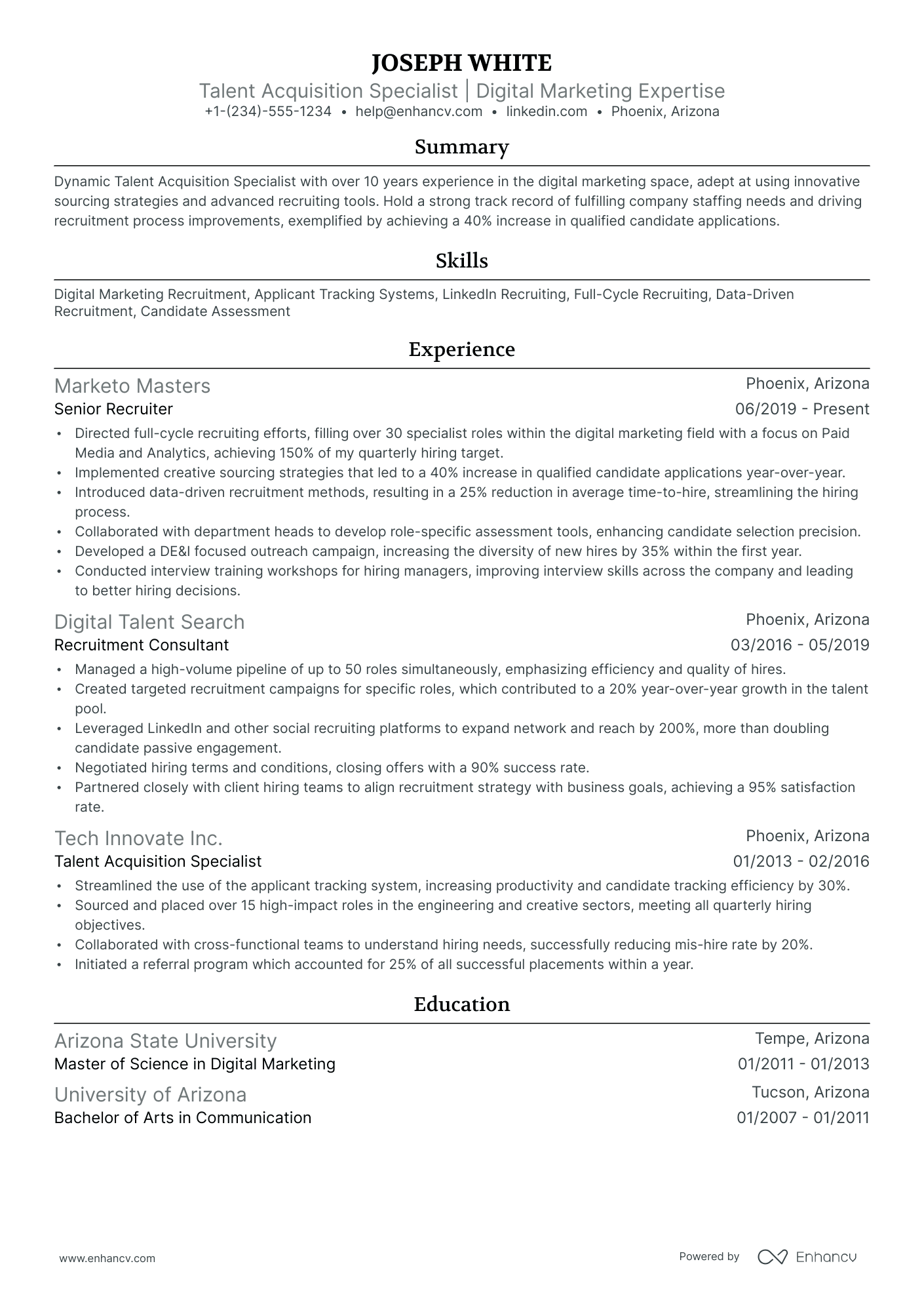
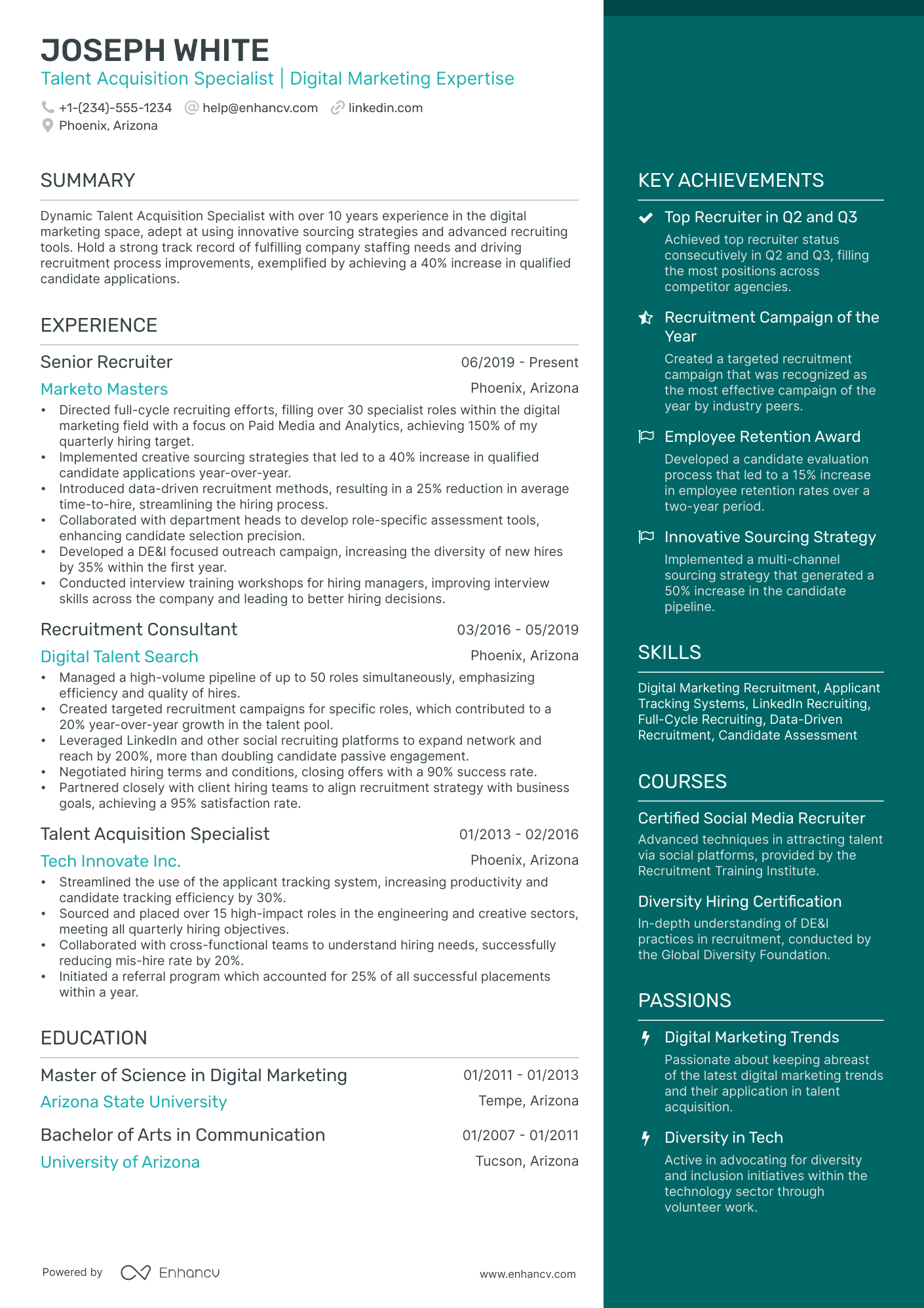
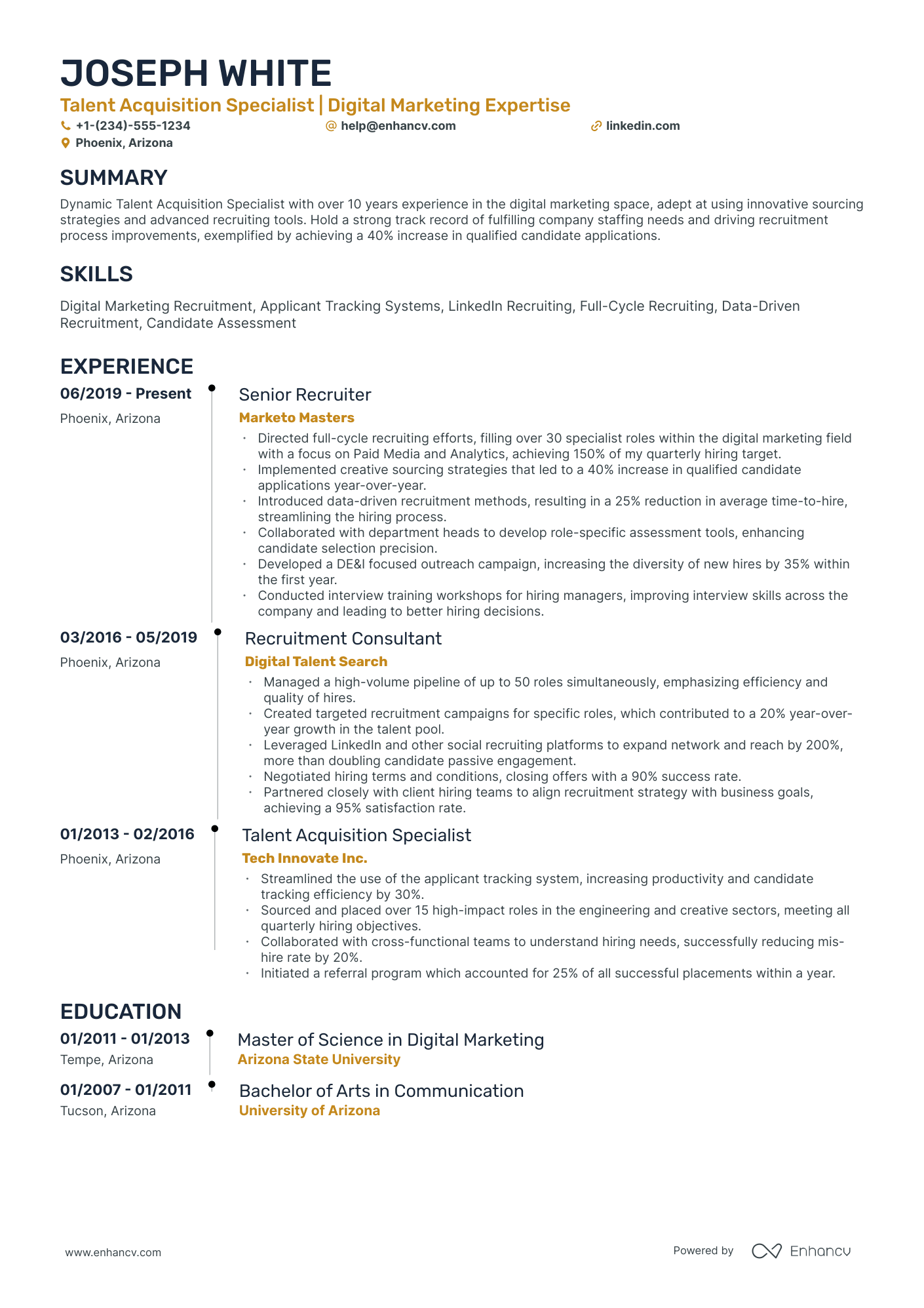
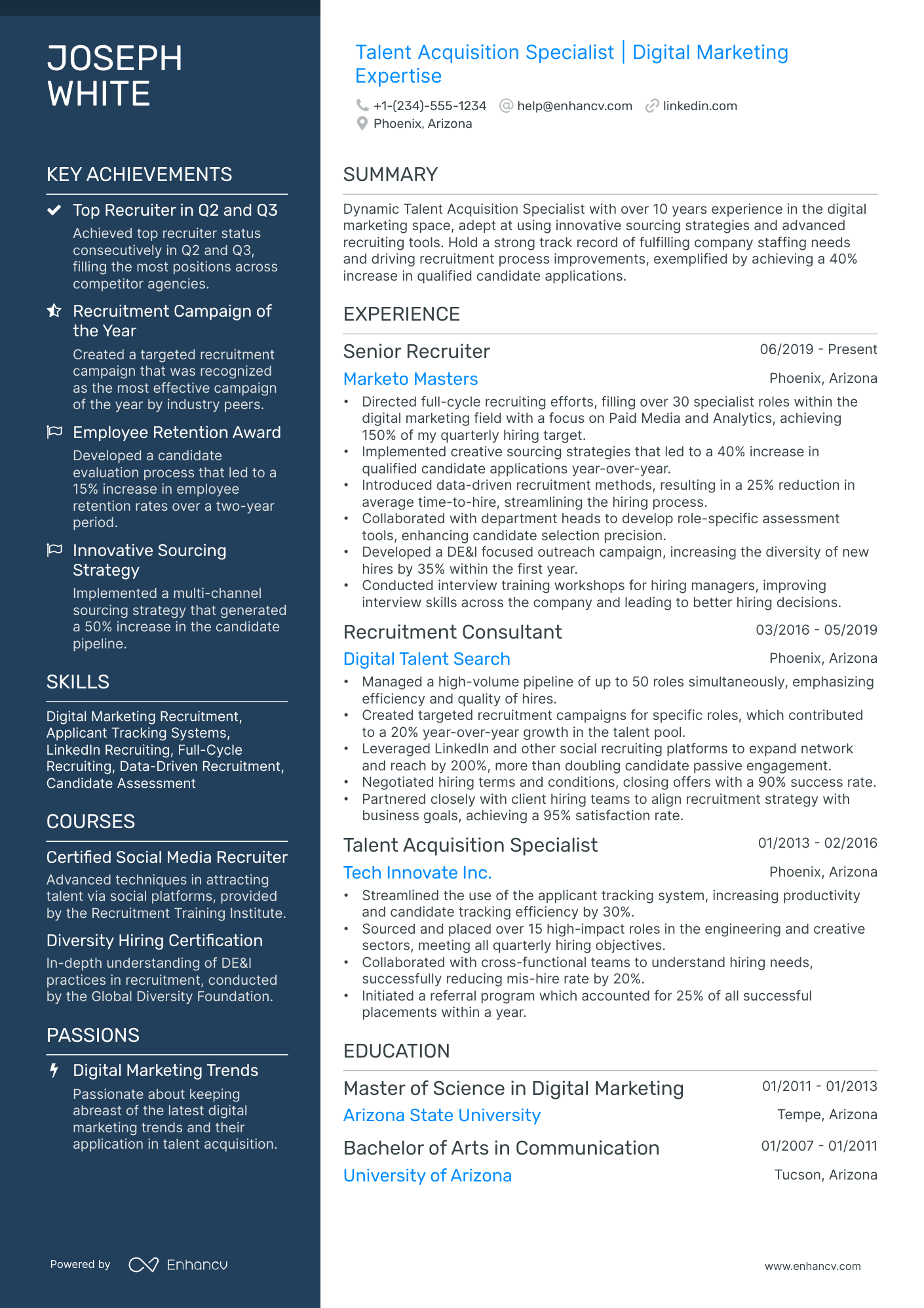
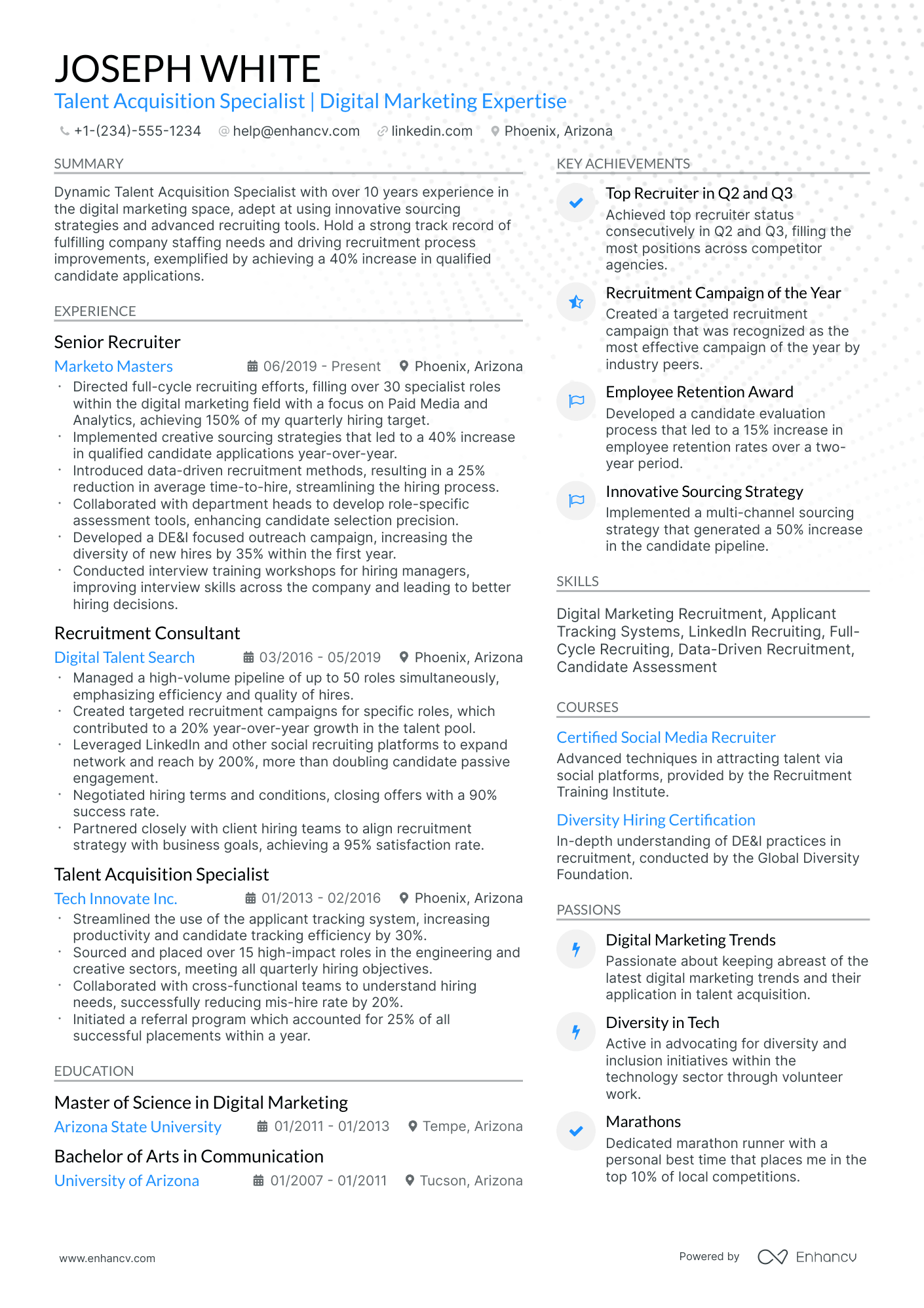
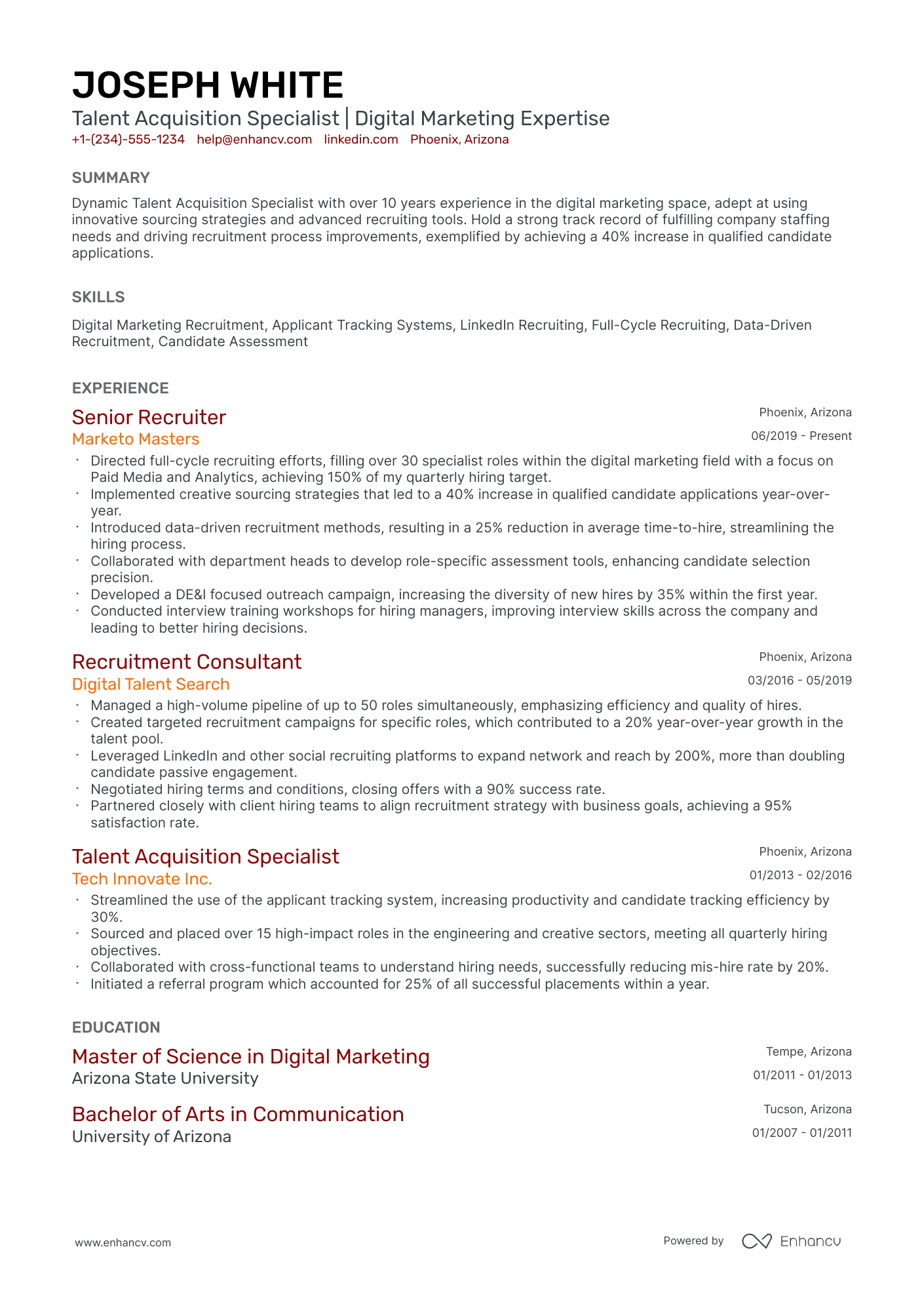
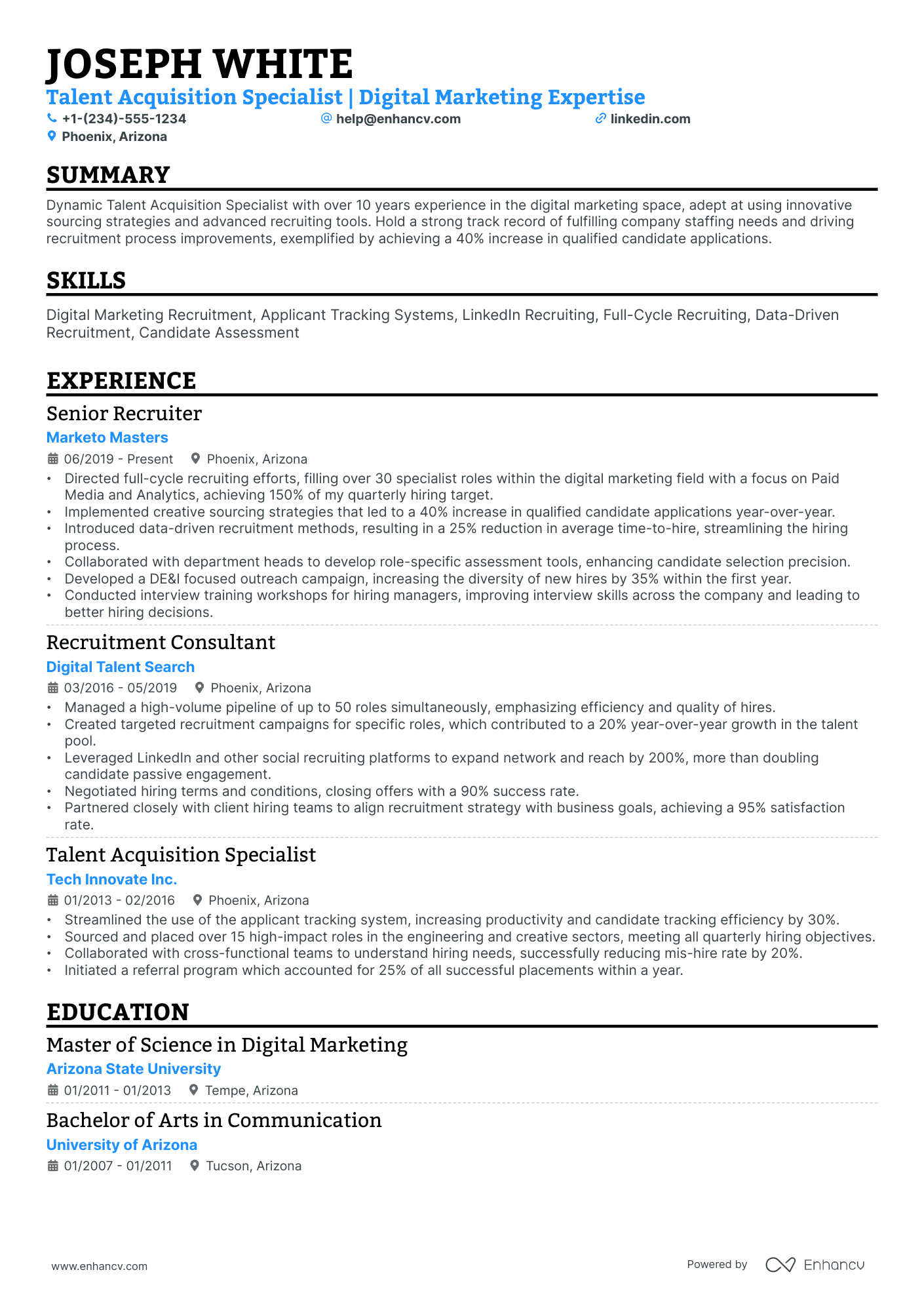
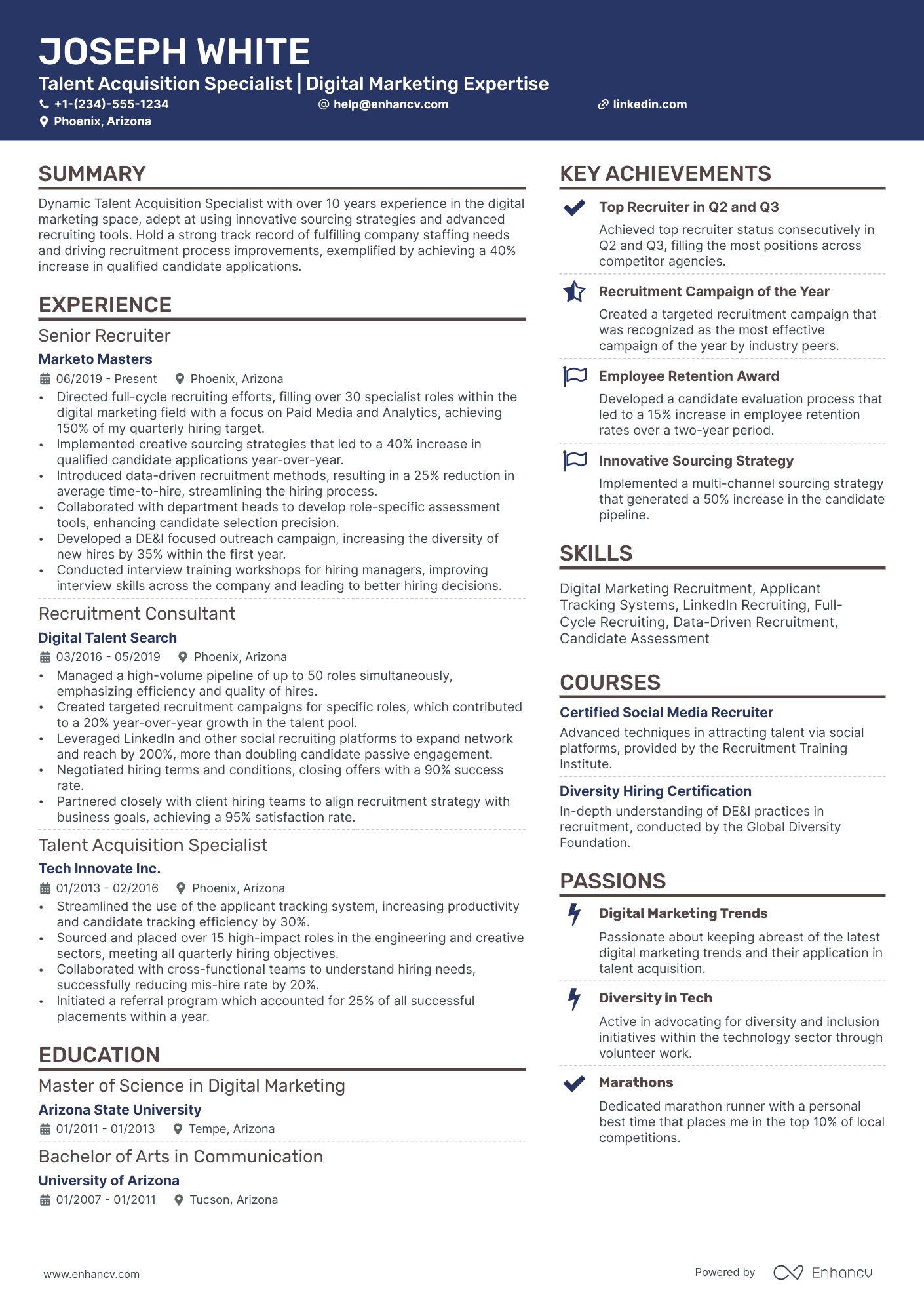
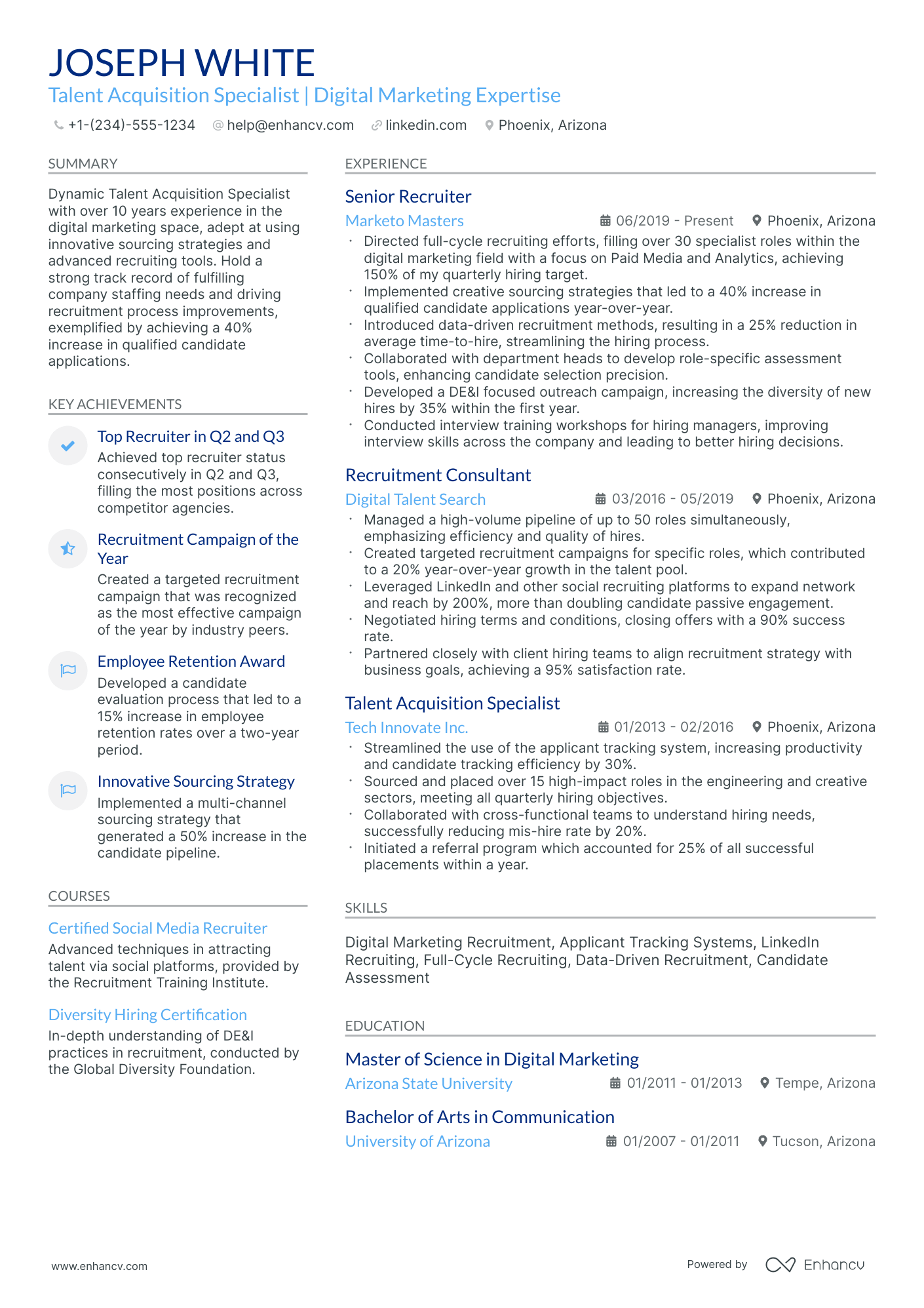
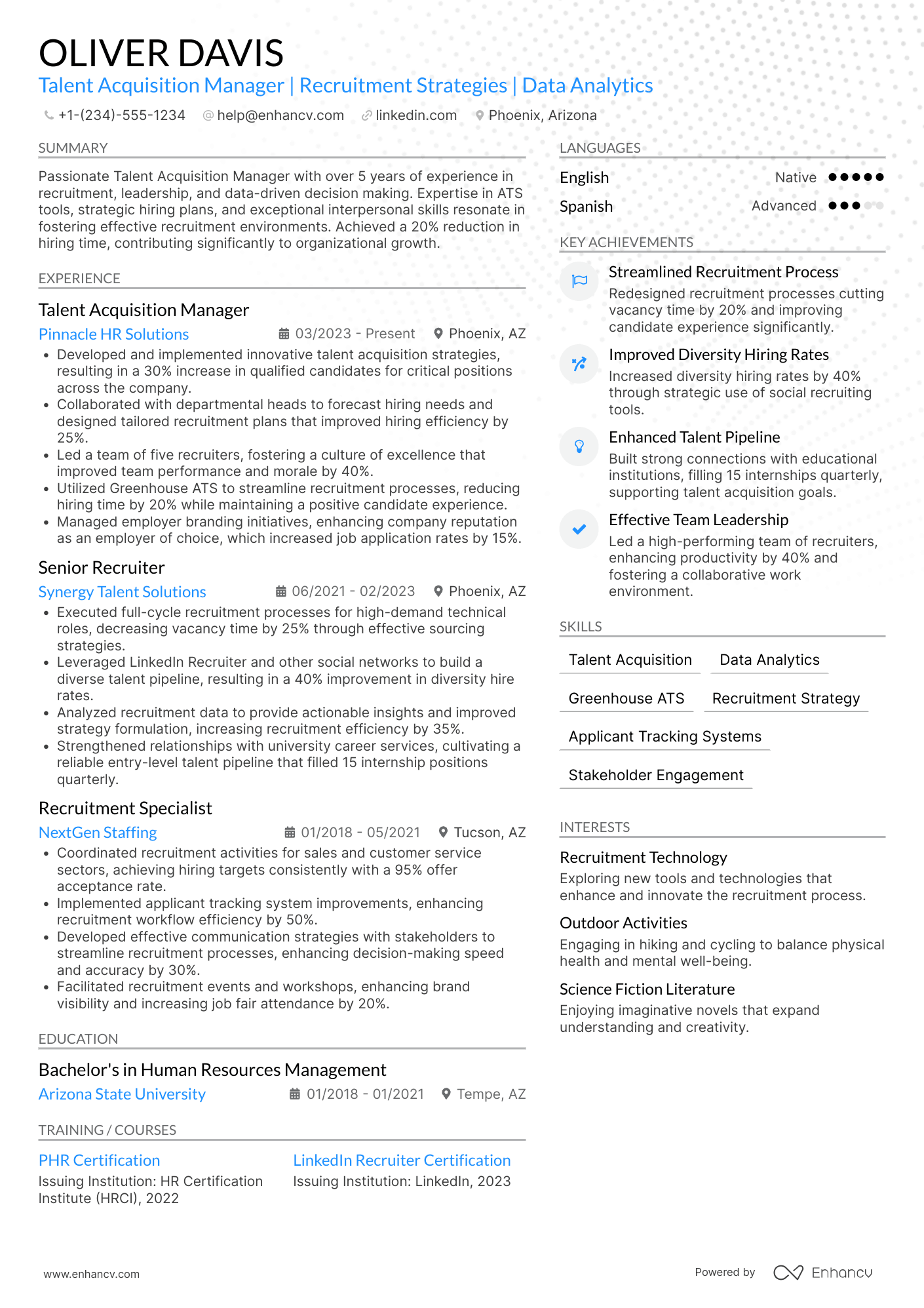
Many talent acquisition manager resume drafts count requisitions closed and skip the hiring strategy and team results behind them. Hiring leaders skim fast, and applicant tracking system (ATS) filters match your resume against the posting first.
When you write your own resume, lead with the hiring results your team delivered. Show faster time-to-fill, lower cost-per-hire, stronger offer acceptance, better quality of hire, and more diverse candidate slates.

Key takeaways
- Lead with hiring results such as time-to-fill and offer acceptance.
- Show the size of the team and hiring plan you managed.
- Use reverse-chronological order to show your path from recruiter to manager.
- Name the ATS, sourcing tools, and metrics each posting lists.
- Quantify cost-per-hire, quality of hire, and pipeline diversity.
- Use Enhancv's Bullet Point Generator to turn recruiting work into measurable bullets.
Job market snapshot for talent acquisition managers
We analyzed 138 recent talent acquisition manager job ads from major US job boards. The largest group (42.0%) asks for five to six years of experience, and professional services firms posted 22.5% of them. Use these numbers to gauge employer expectations, target the right industries, match the experience bar, and find the companies hiring now.
What level of experience employers are looking for in talent acquisition managers
| Years of Experience | Percentage found in job ads |
|---|---|
| 1–2 years | 2.2% (3) |
| 3–4 years | 11.6% (16) |
| 5–6 years | 42.0% (58) |
| 7–8 years | 18.1% (25) |
| 10+ years | 5.1% (7) |
| Not specified | 21.0% (29) |
Talent acquisition manager ads by area of specialization (industry)
| Industry (Area) | Percentage found in job ads |
|---|---|
| Professional services | 22.5% (31) |
| Real estate & construction | 15.2% (21) |
| Manufacturing | 12.3% (17) |
| Technology | 7.2% (10) |
| Finance & insurance | 7.2% (10) |
| Healthcare | 7.2% (10) |
Top companies hiring talent acquisition managers
| Company | Percentage found in job ads |
|---|---|
| Legence | 7.2% (10) |
Role overview stats
These tables show what talent acquisition managers do day to day and how employers set up the role. Building sourcing strategies appears in 95.7% of ads, and tracking hiring metrics appears in 81.9%. Use the list to choose which recruiting results to feature, and note that 76.1% of these roles are on-site.
Day-to-day activities and top responsibilities for a talent acquisition manager
| Responsibility | Percentage found in job ads |
|---|---|
| Build sourcing strategies | 95.7% (132) |
| Track hiring metrics | 81.9% (113) |
| Partner with hiring managers | 78.3% (108) |
| Improve the candidate experience | 77.5% (107) |
| Negotiate offers | 72.5% (100) |
| Lead the recruiting team | 71.7% (99) |
| Lead full-cycle recruiting | 68.8% (95) |
| Manage the ATS and recruiting tools | 59.4% (82) |
| Plan workforce hiring needs | 55.1% (76) |
| Run campus and diversity recruiting | 46.4% (64) |
| Improve recruiting processes | 46.4% (64) |
| Ensure hiring compliance | 42.0% (58) |
Type of employment (remote vs on-site vs hybrid)
| Employment type | Percentage found in job ads |
|---|---|
| On-site | 76.1% (105) |
| Hybrid | 16.7% (23) |
| Remote | 7.2% (10) |
How to format a talent acquisition manager resume
Hiring leaders look first for the hiring results you delivered, the team you managed, and how you built the recruiting process. A clear resume layout keeps those results at the top of each role.
Resume formatting strategy for talent acquisition managers
| Category | Senior & leadership strategy | Entry to mid-level strategy |
|---|---|---|
| Recommended format | Reverse-chronological | Reverse-chronological or hybrid |
| Core dos | Lead each role with hiring volume, team size, and the business units you supported. Name the recruiting programs you built, such as campus or diversity hiring. Tie every bullet to time-to-fill, cost, or quality of hire. | Put sourcing and ATS skills near the top. Count recruiter, sourcer, or HR generalist work as transitional experience. Link each action to a result such as faster fills or higher offer acceptance. |
| Example bullet | Led a 9-person recruiting team to fill 640 roles in one year, cutting average time-to-fill from 52 days to 34. | Boolean sourcing → built talent pools for 4 hard-to-fill engineering roles → filled all 4 in under 30 days. |
| Format to avoid | Hybrid and functional formats separate your hiring results from the companies and years that produced them. Hiring leaders lose sight of how your scope grew from requisitions to a full function. Keep a non-chronological layout off the table at this level. | A functional format hides when and where you recruited. Edge cases: a move from HR, sales, or staffing agencies into in-house recruiting, or a return after a career gap. |
A functional resume fits edge cases only, and each skill on it needs a project and a hiring outcome behind it.
With your growth easy to follow, the next step is choosing the sections that hold your proof.
What sections should go on a talent acquisition manager resume?
Hiring leaders expect a talent acquisition manager resume to follow a clear resume outline that puts hiring results and team scope up front.
Use this structure for maximum clarity:
- Header
- Summary
- Experience
- Skills
- Education
- Certifications
- Optional sections: Awards, Languages, Volunteer work
Strong experience bullets should emphasize hiring volume, time-to-fill and cost results, quality of hire, and the team you led.
Is your resume good enough?
Drop your resume here or choose a file. PDF & DOCX only. Max 2MB file size.
Experience carries the most weight with hiring leaders, and it's where your recruiting results need proof.
How to write your talent acquisition manager resume experience
Your work experience should show the hiring programs you ran, the tools behind them, such as Greenhouse, Workday, or LinkedIn Recruiter, and the results. Hiring leaders prioritize demonstrated impact on speed, cost, and quality of hire over a list of requisitions you handled.
Each entry should include:
- Job title
- Company and location (or remote)
- Dates of employment (month and year)
Three to five concise bullet points showing what you owned, how you executed, and what outcomes you delivered:
- Ownership scope: the recruiting team, hiring volume, and business units you were accountable for as a talent acquisition manager
- Execution approach: the sourcing strategies, ATS workflows, and interview processes you used to fill roles
- Value improved: changes to time-to-fill, cost-per-hire, candidate experience, or pipeline diversity
- Collaboration context: how you worked with hiring managers, HR business partners, finance, and agencies on hiring plans
- Impact delivered: results stated as roles filled, offer acceptance, quality of hire, or recruiting costs saved

Experience bullet formula
A talent acquisition manager experience example
✅ Right example - modern, quantified, specific.
Talent Acquisition Manager
Calverton Building Group | Charlotte, NC
2021–Present
Commercial construction firm with 2,800 employees across 11 regional offices.
- Led a team of 6 recruiters filling 450+ craft, project management, and engineering roles a year across 11 offices.
- Cut average time-to-fill from 48 days to 29 by rebuilding Greenhouse workflows and launching structured interview kits with hiring managers.
- Reduced agency spend by $780K a year by building talent pools and an employee referral program that now drives 31% of hires.
- Partnered with HR and finance on quarterly workforce plans, forecasting hiring needs within 5% for three straight years.
- Launched trade-school partnerships with 4 colleges, raising apprentice hires by 60% and women in craft roles from 4% to 11%.
You know better than most that a generic resume falls flat, and tailoring makes each entry speak to one employer.
How to tailor your talent acquisition manager resume experience
Recruiters screen talent acquisition manager resumes in an ATS, then HR leaders read the shortlist closely. Using keywords from the posting ties your real experience to the hiring problems that company needs solved.
Ways to tailor your talent acquisition manager experience:
- Match the ATS and sourcing tools the posting names.
- Use the company's terms for hiring metrics and stages.
- Mirror the role types and volumes the team hires for.
- Highlight campus or diversity recruiting when the posting mentions it.
- Emphasize compliance experience for regulated or government hiring.
- Name the leaders you'd partner with as the role describes.
- Reflect the employer brand goals the job lists.
Tailoring presents your real hiring record in the employer's language without stuffing in keywords.
Resume tailoring examples for talent acquisition managers
| Job description excerpt | Untailored | Tailored |
|---|---|---|
| "Develop and execute sourcing strategies to attract top talent for hard-to-fill technical roles." | Sourced candidates for open roles. | Built sourcing plans for 25 hard-to-fill engineering roles using LinkedIn Recruiter and talent communities, filling 22 within 45 days. |
| "Track and report recruiting metrics including time-to-fill, cost-per-hire, and quality of hire." | Reported on recruiting data. | Built a Greenhouse dashboard tracking time-to-fill, cost-per-hire, and 90-day retention, cutting cost-per-hire by 18% in a year. |
| "Partner with hiring managers to define role requirements and improve interview processes." | Worked with managers on hiring. | Ran intake meetings and interviewer training for 40 hiring managers, raising offer acceptance from 74% to 89%. |
Once your bullets fit the posting, numbers show how much your recruiting changed the business.
How to quantify your talent acquisition manager achievements
Quantifying your recruiting results proves your impact in the language hiring leaders already track. For this role, the numbers that matter most are time-to-fill, cost-per-hire, offer acceptance, quality of hire, and hiring volume.
Quantifying examples for talent acquisition managers
| Metric | Example |
|---|---|
| Time-to-fill | "Cut average time-to-fill from 51 to 33 days by adding structured intake meetings and interview scorecards in Lever." |
| Cost-per-hire | "Lowered cost-per-hire from $6,200 to $4,100 by shifting 40% of hiring from agencies to direct sourcing." |
| Offer acceptance | "Raised offer acceptance from 71% to 90% by speeding approvals and coaching managers on closing calls." |
| Quality of hire | "Improved 12-month retention of new hires from 78% to 91% by adding skills assessments for high-volume roles." |
| Hiring volume | "Scaled hiring from 120 to 380 roles a year without adding recruiters by automating scheduling and screening." |
Turn requisition counts and recruiting projects into measurable, recruiter-ready bullets with Enhancv's Bullet Point Generator.
Those numbers prove your results, and your skills section shows the tools and judgment behind them.
How to list your hard and soft skills on a talent acquisition manager resume
Hiring leaders and ATS filters scan your resume skills section for recruiting tools and strategy, and the best lists pair hard skills like Boolean sourcing with soft skills like advising hiring managers.
Talent acquisition manager roles require a blend of:
- Sourcing and recruiting strategy skills
- Recruiting technology and analytics skills
- Team and program leadership skills
- Soft skills
Your skills section should be:
- Scannable (bullet-style grouping)
- Relevant to the job post
- Backed by proof in experience bullets
- Updated with current tools
Place your skills section:
- Above experience if you're junior or switching careers
- Below experience if you're mid/senior with strong achievements

Hard skills
- Full-cycle recruiting
- Boolean and X-ray sourcing
- LinkedIn Recruiter
- ATS administration: Greenhouse, Workday, iCIMS
- Recruiting metrics and dashboards
- Workforce planning
- Structured interviewing
- Offer negotiation
- Employer branding
- Campus and diversity recruiting
- EEO and OFCCP compliance
- Recruitment marketing
Soft skills
- Advising hiring managers
- Coaching recruiters
- Negotiating with candidates
- Influencing senior leaders
- Prioritizing competing requisitions
- Delivering hard news with care
- Building trust with candidates
- Running efficient intake meetings
- Handling confidential searches
- Staying calm during hiring surges
How to show your talent acquisition manager skills in context
Listing resume skills is a start, but your summary and bullets are where hiring leaders see them in action.
Show them in:
- Your summary (high-level professional identity)
- Your experience (proof through outcomes)
Here's how a talent acquisition manager can do that.
Summary example
Talent acquisition manager with eight years in healthcare and tech recruiting, leading teams of up to seven recruiters. Uses Greenhouse and LinkedIn Recruiter to run high-volume hiring, cutting time-to-fill by 35% across 300 annual hires.
- States level and team size
- Names tools recruiters search for
- Proves impact with a metric
- Shows high-volume hiring experience
Experience example
Talent Acquisition Manager
Ashgrove Senior Living | Remote
June 2020–Present
- Partnered with 25 community directors to forecast caregiver hiring, filling 1,100 roles a year with a team of 5.
- Moved interview scheduling into Workday with HR operations, cutting candidate wait time from 9 days to 3.
- Coached 5 recruiters on structured screening, raising 90-day retention for new caregivers from 64% to 79%.
- Each bullet proves results with numbers
- Skills appear inside real hiring work
Those examples come from experienced leaders, and recruiters stepping into management need a different way to show readiness.
How do I write a talent acquisition manager resume with no experience?
Even without full-time experience, you can demonstrate readiness through:
- Recruiter or sourcer roles
- HR generalist hiring work
- Agency or staffing recruiting
- Campus recruiting programs
- Leading interview training sessions
- Hiring for a student organization
- HR internships with recruiting duties
Focus on:
- Roles you filled and how fast
- Hiring processes you improved
- Tools you used every day
- People you trained or led
Resume format tip for entry-level talent acquisition manager
Start with a hybrid format: recruiting skills and results first, then your recruiter or HR roles. As with any resume without work experience at a new level, tie every skill to a hiring result. Do:
- Lead with your strongest hiring metrics.
- Show any time you trained or led other recruiters.
- List the ATS and sourcing tools you use.
- Add a summary that targets recruiting leadership.
- Include HR certifications near the top.
- Trained 8 new recruiters on Boolean sourcing as a senior recruiter, raising the team's submit-to-interview rate from 22% to 37%.
Recruiting results show readiness, and your education section shows the HR and business training behind them.
How to list your education on a talent acquisition manager resume
An education section on a resume confirms your training in human resources, psychology, or business, the foundation behind fair and effective hiring.
Include:
- Degree name
- Institution
- Location
- Graduation year
- Relevant coursework (for juniors or entry-level candidates)
- Honors & GPA (if 3.5 or higher)
Show only the graduation year, without months or days.
Here's an education entry for a talent acquisition manager:
Example education entry
Bachelor of Science in Human Resource Management
Pennsylvania State University, University Park, PA
Graduated: 2016
GPA: 3.6/4.0
- Relevant Coursework: Talent Management, Employment Law, Organizational Psychology, HR Analytics
- Honors: Dean's List (five semesters)
Certifications usually follow education, and current HR credentials show you know employment law and hiring best practices.
How to list your certifications on a talent acquisition manager resume
Strong resume certifications show a talent acquisition manager keeps learning, knows recruiting tools and compliance rules, and understands the wider HR function.
Include:
- Certificate name
- Issuing organization
- Year
- Optional: credential ID or URL
- Place certifications below education when they're older or less tied to recruiting.
- Place certifications above education when they're recent, recruiting-specific, or named in the posting.
Best certifications for your talent acquisition manager resume
- SHRM Certified Professional (SHRM-CP)
- Professional in Human Resources (PHR)
- SHRM Talent Acquisition Specialty Credential
- LinkedIn Certified Professional – Recruiter
- AIRS Certified Internet Recruiter (CIR)
- AIRS Certified Diversity and Inclusion Recruiter (CDR)
A current credential adds credibility, and your summary is where hiring leaders form their first impression.
How to write your talent acquisition manager resume summary
Your resume summary gives hiring leaders a quick read on your recruiting scope and results. On a talent acquisition manager resume, those lines show you'd hire the way they want to hire.
Keep it to three to four lines, with:
- Your title and years in recruiting.
- The industries or role types you hire for, such as tech or healthcare.
- Core tools and methods, like Greenhouse or structured interviewing.
- One or two quantified results, such as time-to-fill or cost-per-hire.
- Leadership tied to outcomes, like recruiters you coached.

PRO TIP
At the mid level, lead with hiring volume, team size, and one speed or cost result. Skip phrases like "people person" or "talent champion," and let your metrics show how you hire.
Example summary for a talent acquisition manager
Talent acquisition manager with seven years in technology recruiting. Lead a team of five recruiters hiring 250+ engineers a year, cutting time-to-fill from 47 to 31 days and agency spend by $600K.
Optimize your resume summary and objective for ATS
Drop your resume here or choose a file.
PDF & DOCX only. Max 2MB file size.
With your summary in place, the header above it should make you easy to verify and reach.
What to include in a talent acquisition manager resume header
A strong resume header gives your name, title, and contact details, and recruiters judge your attention to detail there first.
Essential resume header elements
- Full name
- Tailored job title and headline
- Location
- Phone number
- Professional email
A LinkedIn link lets hiring leaders verify your experience quickly and see the network you recruit from.
Leave the photo off a talent acquisition manager resume unless the role is explicitly front-facing or appearance-dependent.
Put your hiring specialty in the headline, such as high-volume or executive recruiting, to show the fit at a glance.
Example
Talent acquisition manager resume header
Rachel Kim
Talent acquisition manager | Technical hiring, sourcing strategy, and team leadership
Atlanta, GA | (404) 555-01XX | rachel.kim@enhancv.com linkedin.com/in/rachelkim
With the essentials covered, a few extra sections can show the reach and range recruiters value.
Additional sections for talent acquisition manager resumes
Additional sections help when they add proof of reach, such as language skills for bilingual hiring or talks at recruiting conferences.
- Languages
- Conference talks
- Professional associations
- Awards and recognition
- Volunteer work
- Employer branding projects
Those extras round out your profile, and a cover letter shows how you'd approach this company's hiring.
Do talent acquisition manager resumes need a cover letter?
Many talent acquisition manager postings treat a cover letter as optional. A short one helps when you're moving from agency to in-house, changing industries, or applying to a company you know well.
Keep the cover letter focused on:
- Team fit: Explain how your recruiting approach matches the company's growth plans.
- One hiring win: Describe a hard search you filled and the result.
- Business understanding: Show you know the roles, markets, and talent competition the company faces.
- Career moves: Explain a move from agency recruiting or HR in one sentence.
Drop your resume here or choose a file.
PDF & DOCX only. Max 2MB file size.
Your letter tells the story, and AI can help tighten the resume behind it.
Using AI to improve your talent acquisition manager resume
AI can tighten phrasing, improve structure, and surface the hiring results in your talent acquisition manager resume. Run AI resume writing prompts on drafts you've written, and stop before the language turns generic.
Use these prompts one section at a time:
- Lead with results: "Rewrite my talent acquisition manager resume summary to lead with hiring volume, team size, and one time-to-fill or cost result."
- Quantify hiring impact: "Review my talent acquisition manager experience bullets and suggest where to add time-to-fill, cost-per-hire, or offer acceptance numbers."
- Show team leadership: "Rewrite my talent acquisition manager bullets so each one shows how I led recruiters or hiring managers."
- Fix weak verbs: "Replace weak verbs in my talent acquisition manager experience section with precise verbs that show ownership and results."
- Match the posting: "Compare my talent acquisition manager skills section with this job description and list the tools and skills to add or remove."
- Tailor by industry: "Adjust my talent acquisition manager resume for recruiting in this industry, keeping only claims my experience supports."
- Tighten program entries: "Edit the recruiting programs on my talent acquisition manager resume to show the problem, my approach, and the result."
- Polish the headline: "Rewrite my talent acquisition manager resume headline to name my hiring specialty in under 12 words."
- Connect certifications: "Rewrite my certifications section so each credential ties to a talent acquisition manager skill such as compliance or sourcing."
- Remove filler: "Scan my talent acquisition manager resume for filler, passive voice, and vague phrases, and suggest direct replacements."
Stop using AI once your resume sounds accurate, specific, and grounded in your real hiring record. AI should never invent experience or inflate claims: if it didn't happen, it doesn't belong on your resume.
Conclusion
A strong talent acquisition manager resume proves hiring results with numbers, shows the team you led, and scans fast.
Companies will keep competing for talent, and they need leaders who hire well. Keep your resume focused on that skill, and you'll be ready for the role you want next.