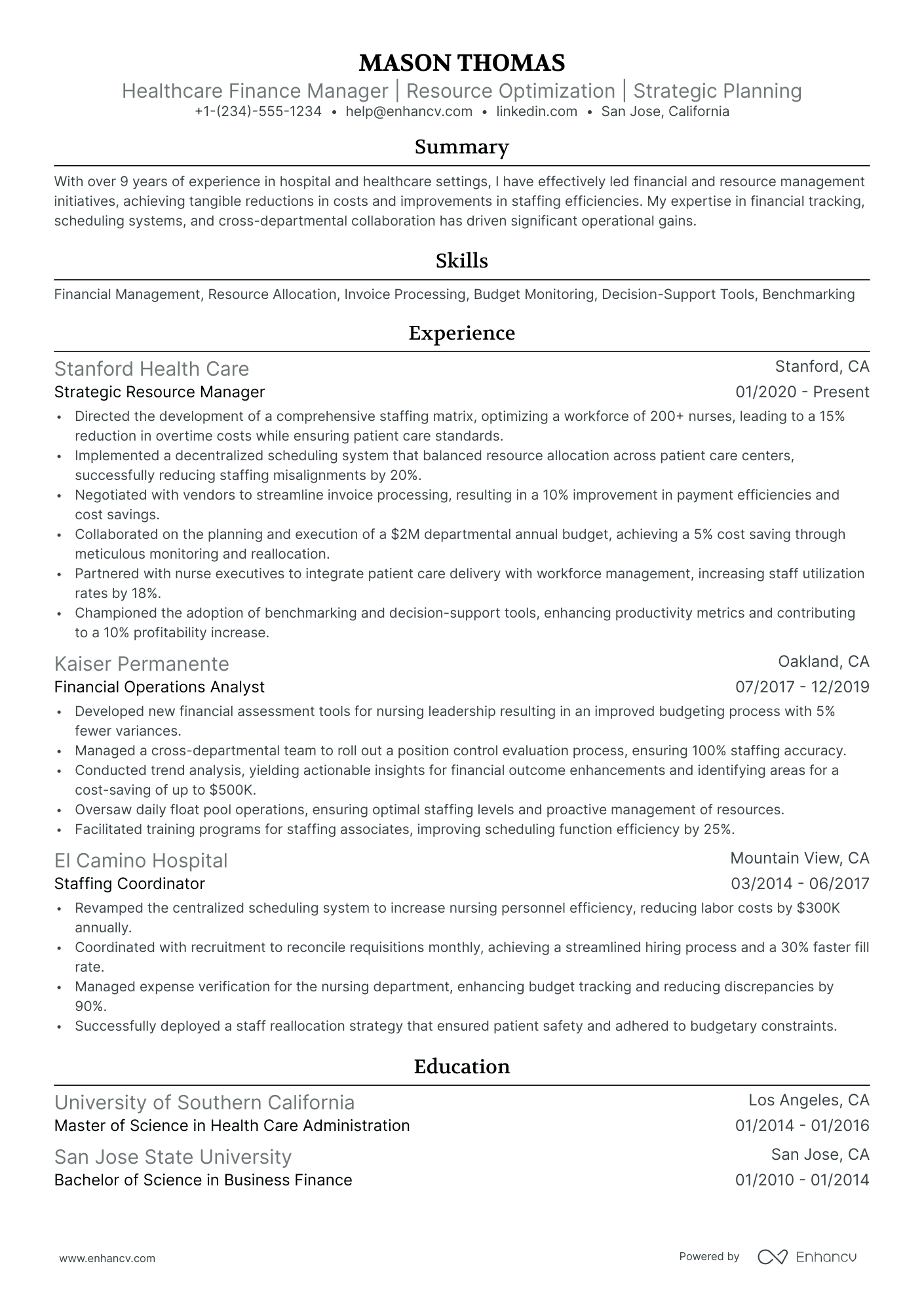
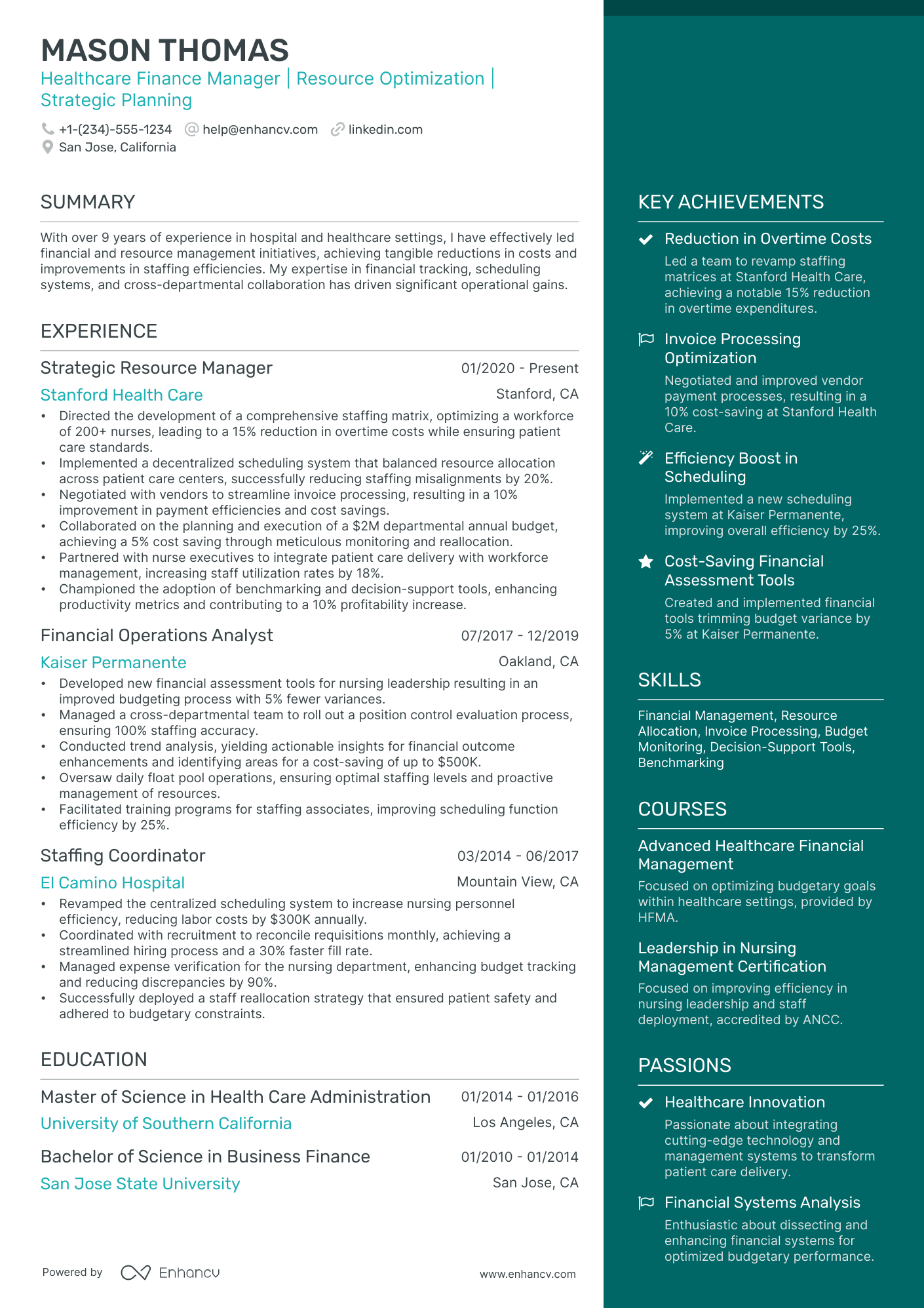
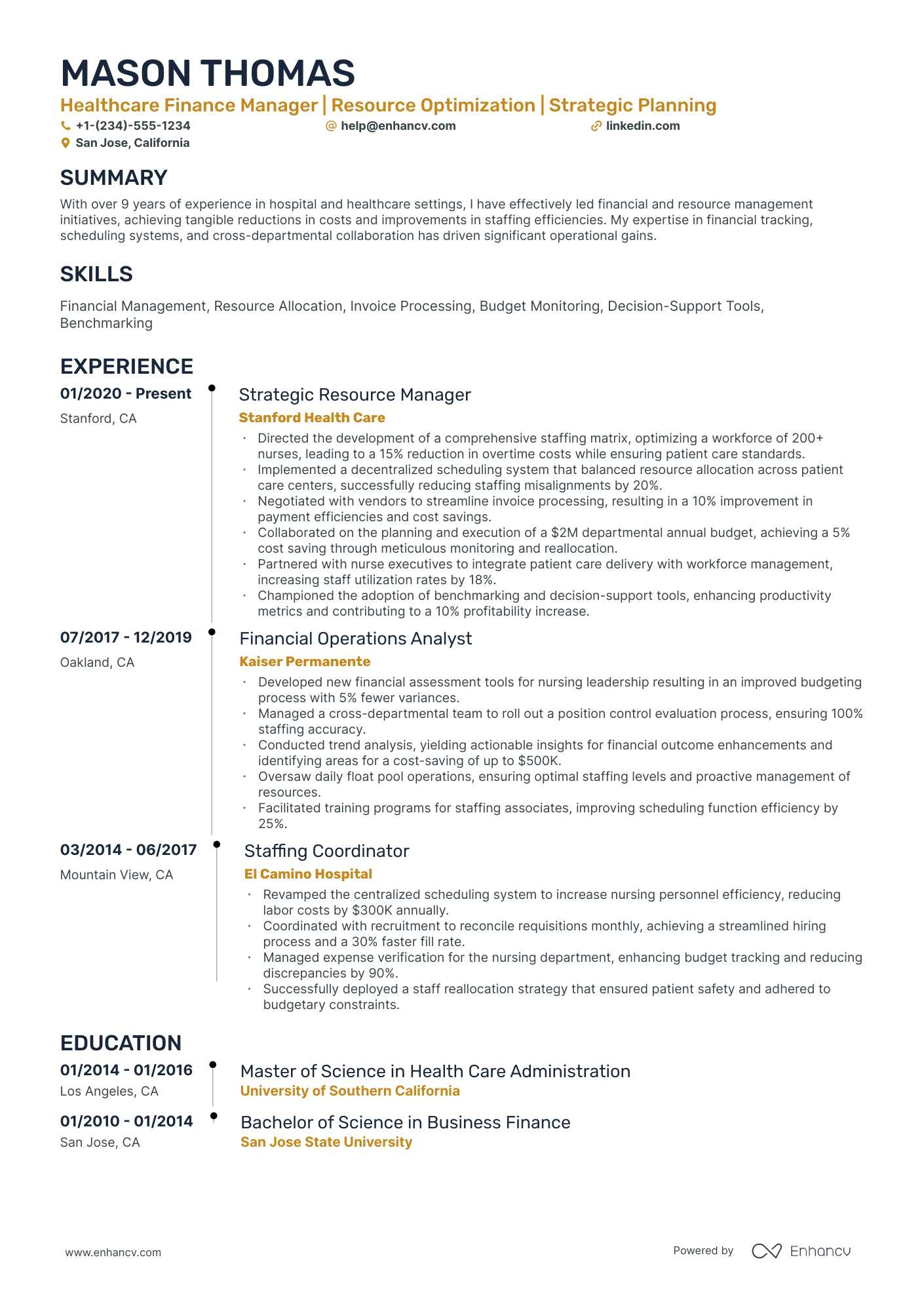
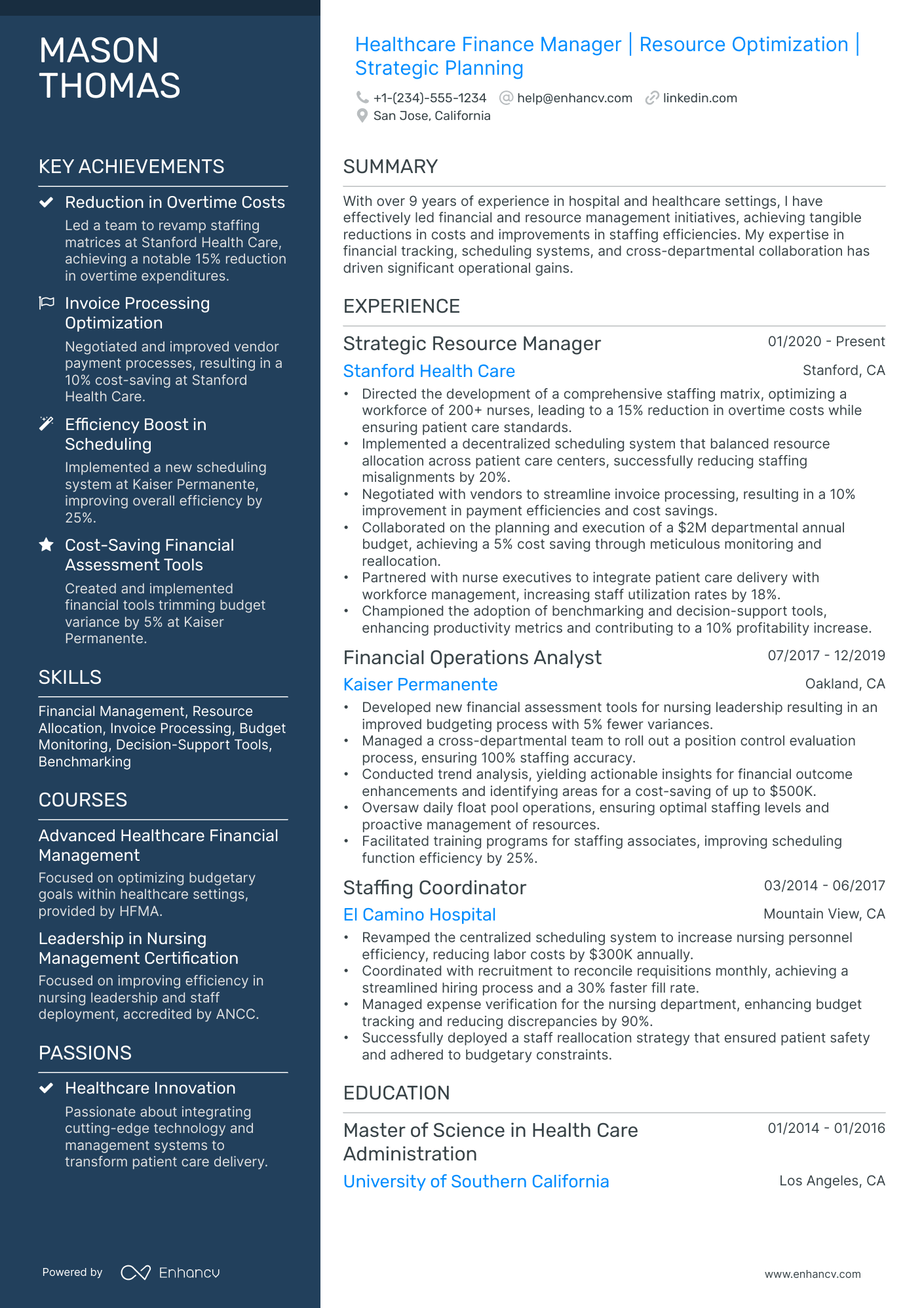
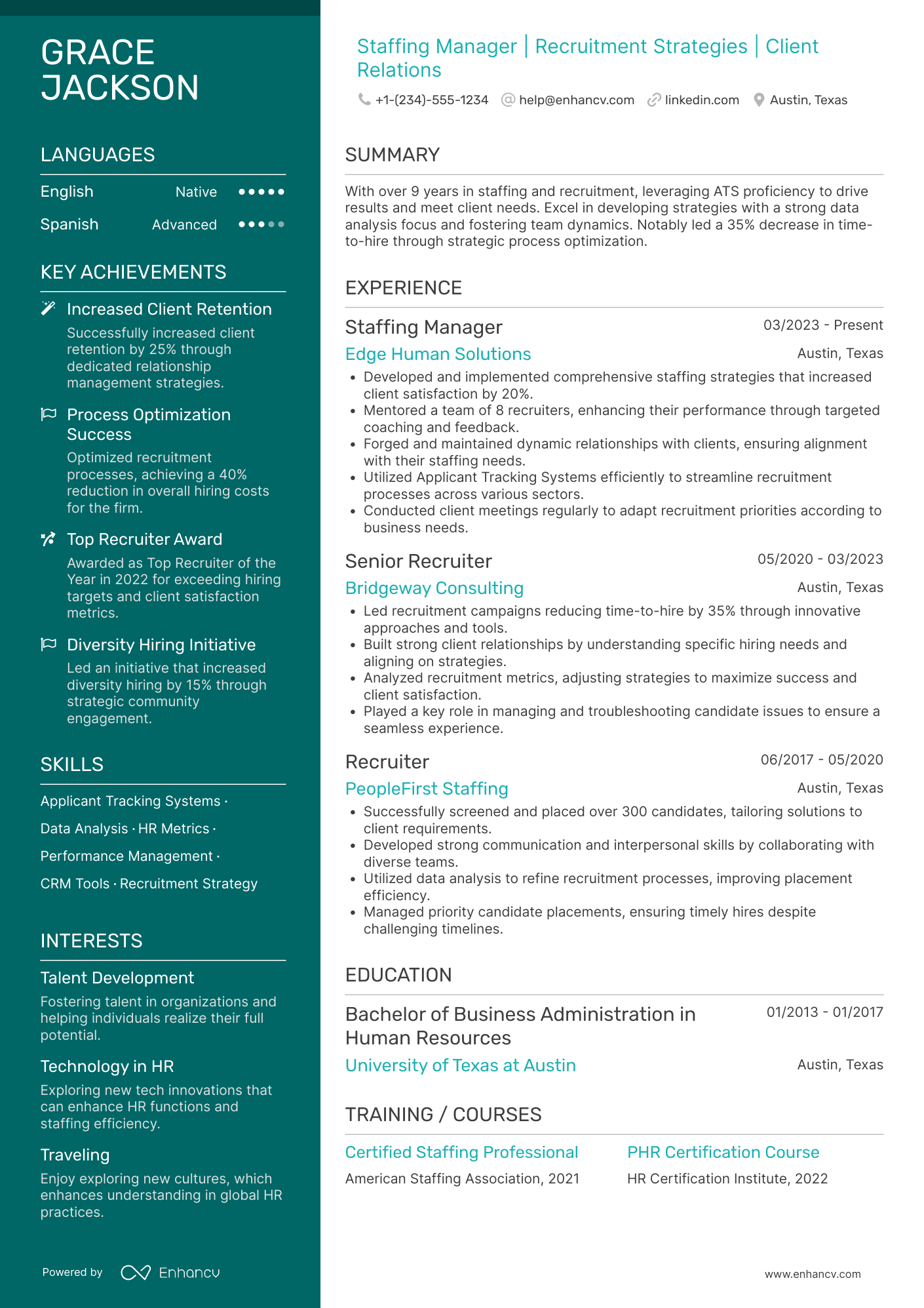
Most staffing manager resume submissions fail because they read like task lists and bury measurable hiring impact. That hurts in today's hiring process, where applicant tracking system screening and fast recruiter scans filter out unclear results.
A strong resume shows how you improved outcomes, not just what systems you used. Knowing how to make your resume stand out starts with highlighting time-to-fill reductions, cost-per-hire savings, offer-acceptance gains, retention improvements, requisition volume managed, and quality-of-hire results.

Key takeaways
- Quantify hiring impact with metrics like time-to-fill, retention, and cost-per-hire in every bullet.
- Use reverse-chronological format to showcase leadership progression and scaling achievements clearly.
- Tailor experience bullets to mirror exact keywords, platforms, and KPIs from each job posting.
- Show skills in context through your summary and experience—not just in a standalone list.
- Tie every listed skill or project to a specific action and a measurable result.
- Enhancv's Bullet Point Generator helps turn vague duties into recruiter-ready, quantified resume bullets.
- Pair your resume with a cover letter when your career path needs additional context.
How to format a staffing manager resume
Recruiters evaluating staffing manager candidates prioritize operational efficiency metrics, team leadership scope, and the ability to manage high-volume hiring pipelines across multiple departments or clients. A clean reverse-chronological format ensures these signals—career progression, growing accountability, and measurable recruiting outcomes—are immediately visible to both human reviewers and applicant tracking systems. Choosing the right resume layout is critical to making your qualifications easy to scan.

I have significant experience in this role—which format should I use?
Use a reverse-chronological format—it's the strongest choice for experienced staffing managers because it foregrounds your leadership trajectory and scaling impact across roles. Do:
- Lead each role entry with your management scope: team size, number of requisitions owned, client accounts managed, and budget authority.
- Highlight domain-specific expertise including ATS platforms (Bullhorn, iCIMS, Workday), workforce planning methodologies, vendor management systems, and compliance frameworks.
- Quantify business impact through fill rates, time-to-fill reductions, cost-per-hire improvements, retention metrics, and revenue influenced by placement volume.
I'm junior or switching into this role—what format works best?
A hybrid format works best because it lets you lead with transferable staffing and recruiting skills while still presenting your work history in chronological order. Do:
- Place a skills section near the top featuring recruiting coordination, candidate sourcing, ATS proficiency, and workforce analytics to pass initial screening filters.
- Include project-based experience such as internship hiring programs you supported, onboarding process improvements, or temporary staffing campaigns you contributed to—even if they weren't in a staffing manager title.
- Connect every skill and project to a concrete action and a measurable or observable result.
Why not use a functional resume?
A functional resume strips away the timeline and context that hiring teams rely on to assess how your staffing skills developed and scaled in real work environments.
- Career changers with recruiting-adjacent experience: You managed vendor relationships, coordinated large-scale onboarding, or oversaw contract labor but never held a formal staffing title.
- Limited staffing work history: You completed a staffing or HR internship or handled recruiting tasks within a broader administrative role.
- Resume gaps with continued skill development: You earned an SHRM, AIRS, or staffing-specific certification during a career break and completed project-based recruiting work.
- A functional resume is acceptable only when you have no direct staffing management experience and are pivoting from a related field—but even then, every listed skill must be tied to a specific project, placement outcome, or operational result.
With a clean, well-organized format in place, the next step is filling it with the right sections to showcase your qualifications effectively.
What sections should go on a staffing manager resume
Recruiters expect a staffing manager resume to show measurable hiring outcomes, client and stakeholder management, and team leadership at a glance. Understanding which resume sections to include ensures maximum clarity:
- Header
- Summary
- Experience
- Skills
- Projects
- Education
- Certifications
- Optional sections: Awards, Leadership, Languages
Strong experience bullets should emphasize hiring volume and quality, time-to-fill improvements, retention outcomes, client satisfaction, pipeline health, and the scope of teams, regions, and budgets you managed.
Is your resume good enough?
Drop your resume here or choose a file. PDF & DOCX only. Max 2MB file size.
Once you’ve organized your resume with the right core components, the next step is to write your staffing manager experience section to show impact within that structure.
How to write your staffing manager resume experience
Your experience section should demonstrate the recruiting initiatives, workforce strategies, and staffing operations you've delivered—not just the responsibilities you held. Hiring managers prioritize demonstrated impact, looking for evidence that you drove measurable improvements in talent acquisition, fill rates, and client satisfaction over descriptive task lists.
Each entry should include:
- Job title
- Company and location (or remote)
- Dates of employment (month and year)
Three to five concise bullet points showing what you owned, how you executed, and what outcomes you delivered:
- Ownership scope: the staffing programs, client accounts, recruiter teams, candidate pipelines, or talent verticals you were directly accountable for as a staffing manager.
- Execution approach: the applicant tracking systems, sourcing platforms, workforce planning frameworks, compliance protocols, or hiring methodologies you used to make placement decisions and manage staffing operations.
- Value improved: changes to time-to-fill, placement quality, candidate retention, process efficiency, compliance accuracy, or client satisfaction that resulted from your staffing leadership.
- Collaboration context: how you partnered with hiring managers, HR business partners, account executives, vendors, or onboarding teams to align staffing efforts with organizational or client workforce needs.
- Impact delivered: outcomes expressed through business results—such as revenue growth, headcount targets met, turnover reductions, or pipeline expansion—rather than a summary of daily staffing activities.
Experience bullet formula
A staffing manager experience example
✅ Right example - modern, quantified, specific.
Staffing Manager
Apex Talent Partners | Austin, TX
2022–Present
High-volume staffing firm supporting healthcare, light industrial, and customer support clients across Texas with rapid-fill, compliance-driven hiring.
- Led end-to-end staffing for fifteen client accounts, filling 420 roles annually and improving time-to-fill from twelve to eight days by standardizing intake calls, scorecards, and service-level agreements in Bullhorn (applicant tracking system) and Google Sheets.
- Built a sourcing engine using LinkedIn Recruiter, Indeed, and TextUs, increasing qualified applicant flow by thirty-five percent and reducing cost-per-hire by eighteen percent through channel attribution and weekly funnel reviews.
- Partnered with client hiring managers and HR to launch structured interview guides and compliance checklists, cutting offer declines from twenty-two percent to fourteen percent and reducing onboarding errors by forty percent.
- Implemented weekly workforce planning with account executives and operations, improving fill-rate from eighty-one percent to ninety-one percent and protecting $1.2M in annual revenue tied to contract performance.
- Trained and coached a team of six recruiters on Boolean search, candidate experience scripts, and pipeline hygiene, increasing submittal-to-interview conversion by twenty-three percent and raising candidate satisfaction to 4.6 out of five via post-placement surveys.
Now that you've seen how a strong experience section comes together, let's look at how to adjust yours to match the specific staffing manager role you're targeting.
How to tailor your staffing manager resume experience
Recruiters evaluate your staffing manager resume through both human review and applicant tracking systems. Tailoring your resume to the job description increases your chances of passing both.
Ways to tailor your staffing manager experience:
- Match the ATS or recruitment platforms named in the job description.
- Mirror the exact staffing methodologies or workforce planning terms used.
- Reflect specific KPIs like time-to-fill or retention rates mentioned.
- Highlight industry experience that aligns with the employer's sector.
- Emphasize compliance practices or labor regulations referenced in the posting.
- Incorporate the collaboration structures or team models they describe.
- Address vendor management or managed services programs if specified.
- Showcase quality assurance or performance benchmarking they prioritize.
Tailoring means aligning your real accomplishments with what the role demands, not forcing keywords where they don't belong.
Resume tailoring examples for staffing manager
| Job description excerpt | Untailored | Tailored |
|---|---|---|
| Manage full-cycle recruiting for high-volume warehouse and logistics roles using Bullhorn ATS, maintaining a fill rate of 95% or higher across 12+ client accounts. | Helped with recruiting and hiring for various open positions. | Managed full-cycle recruiting for 200+ warehouse and logistics roles monthly through Bullhorn ATS, sustaining a 97% fill rate across 14 client accounts. |
| Develop and execute staffing strategies to reduce time-to-fill for light industrial placements, partnering with branch managers to forecast seasonal workforce needs. | Worked on staffing plans and coordinated with internal teams. | Built seasonal staffing strategies with three branch managers that cut average time-to-fill for light industrial placements from 12 days to seven during peak Q4 demand. |
| Supervise a team of five recruiters, conduct weekly pipeline reviews, and ensure compliance with EEOC and state-specific employment regulations across multi-state operations. | Led a team and made sure all processes followed company rules. | Supervised five recruiters across four-state operations, led weekly pipeline reviews to maintain 300+ active candidates, and ensured full compliance with EEOC and state-specific employment regulations during two consecutive audits with zero findings. |
Once you’ve aligned your experience with the role’s priorities, quantify your staffing manager achievements to show the measurable impact behind those choices.
How to quantify your staffing manager achievements
Quantifying your achievements shows how your staffing decisions improved speed, quality, and compliance. Focus on time-to-fill, submittal-to-hire conversion, retention, hiring manager satisfaction, and cost per hire across roles, regions, and high-volume requisitions.
Quantifying examples for staffing manager
| Metric | Example |
|---|---|
| Time-to-fill | "Cut average time-to-fill from 38 to 24 days across 60 requisitions by standardizing intake meetings and using Greenhouse scorecards." |
| Quality of hire | "Improved ninety-day retention from 82% to 92% for warehouse hires by adding skills tests and tightening interview rubrics." |
| Compliance risk | "Reduced audit findings from six to zero by enforcing I-9 timelines, documenting disposition reasons, and running biweekly compliance checks in the applicant tracking system." |
| Pipeline conversion | "Raised submittal-to-interview conversion from 28% to 41% by calibrating requirements with hiring managers and revising job ads and screening questions." |
| Cost efficiency | "Lowered agency spend by $180,000 annually by shifting 35% of hires to direct sourcing using LinkedIn Recruiter and a referral bonus program." |
Turn vague job duties into measurable, recruiter-ready resume bullets in seconds with Enhancv's Bullet Point Generator.
Once you've crafted strong bullet points for your experience section, it's equally important to highlight the specific hard and soft skills that qualify you for the staffing manager role.
How to list your hard and soft skills on a staffing manager resume
Your skills section shows how you drive hiring outcomes, and recruiters and ATS scan it to confirm role fit fast, so aim for a balanced mix of hard skills like recruiting systems and soft skills like stakeholder management. staffing manager roles require a blend of:
- Product strategy and discovery skills.
- Data, analytics, and experimentation skills.
- Delivery, execution, and go-to-market discipline.
- Soft skills.
Your skills section should be:
- Scannable (bullet-style grouping).
- Relevant to the job post.
- Backed by proof in experience bullets.
- Updated with current tools.
Place your skills section:
- Above experience if you're junior or switching careers.
- Below experience if you're mid/senior with strong achievements.

Hard skills
- Applicant tracking systems (ATS)
- Workday Recruiting, Greenhouse
- LinkedIn Recruiter, Indeed Resume
- Boolean search, X-ray sourcing
- Workforce planning, headcount forecasting
- Requisition intake, job leveling
- Interview design, structured scorecards
- Offer management, compensation benchmarking
- Talent pipeline reporting, funnel metrics
- Compliance: Equal Employment Opportunity, Fair Credit Reporting Act
- Vendor management, staffing agencies
- Onboarding coordination, background checks
Soft skills
- Align hiring managers on priorities
- Run tight intake meetings
- Set clear service-level expectations
- Communicate hiring tradeoffs early
- Influence without authority
- Resolve candidate and manager escalations
- Build trust with cross-functional partners
- Drive interview loop accountability
- Make fast, data-informed decisions
- Negotiate offers and close candidates
- Coach recruiters and coordinators
- Protect candidate experience under pressure
How to show your staffing manager skills in context
Skills shouldn't live only in a dedicated skills list. Explore resume skills examples to see how top candidates weave competencies throughout their resumes.
They should be demonstrated in:
- Your summary (high-level professional identity)
- Your experience (proof through outcomes)
Here's what that looks like in practice.
Summary example
Senior staffing manager with 10+ years in healthcare workforce solutions. Skilled in Bullhorn, vendor management, and full-cycle recruiting. Reduced average time-to-fill by 32% while managing a team of 12 recruiters across three regional offices.
- Signals senior-level experience immediately
- Names industry-relevant tools directly
- Quantifies a key hiring metric
- Highlights leadership and team coordination
Experience example
Senior Staffing Manager
BrightPath Talent Solutions | Remote
March 2019–Present
- Redesigned candidate screening workflows in Bullhorn, cutting time-to-fill from 28 to 19 days across 400+ annual placements.
- Partnered with hiring managers at 15 client accounts to align staffing strategies, improving client retention rates by 24%.
- Trained and mentored a team of eight recruiters on compliance protocols and Boolean sourcing techniques, boosting qualified submittals by 37%.
- Every bullet includes measurable proof
- Skills surface naturally through achievements
Once you’ve demonstrated your staffing manager strengths through relevant examples, the next step is translating those same capabilities into a resume when you don’t have direct staffing manager experience.
How do I write a staffing manager resume with no experience
Even without full-time experience, you can demonstrate readiness. Building a resume without work experience is possible through:
- Campus recruiting event coordination
- HR internship candidate screening support
- Volunteer hiring for nonprofit roles
- Retail or hospitality shift scheduling
- Applicant tracking system data entry
- Interview scheduling and follow-ups
- Job posting and sourcing projects
- Employee referral program administration
Focus on:
- Applicant tracking system usage evidence
- Sourcing methods and pipeline metrics
- Compliance steps and documentation
- Hiring coordination across stakeholders
Resume format tip for entry-level staffing manager
Use a combination resume format because it highlights staffing manager skills and projects first, while still showing steady work, internships, or volunteering. Do:
- Add a "Projects" section with hiring work.
- List tools: ATS (applicant tracking system), spreadsheets.
- Quantify volume: applicants, interviews, fills.
- Mirror keywords from staffing manager postings.
- Include compliance tasks: I-9, EEO logs.
- Managed ATS (applicant tracking system) updates for a campus recruiting drive, tracking 120 applicants and scheduling 30 interviews, cutting follow-up time by 25%.
Even without direct experience, your educational background can strengthen your candidacy—so presenting it effectively on your resume is essential.
How to list your education on a staffing manager resume
Your education section helps hiring teams confirm you have the foundational knowledge needed for a staffing manager role. It validates your background in HR, business, or related fields quickly.
Include:
- Degree name
- Institution
- Location
- Graduation year
- Relevant coursework (for juniors or entry-level candidates)
- Honors & GPA (if 3.5 or higher)
Skip month and day details—list the graduation year only.
Here's a strong education entry tailored for a staffing manager resume.
Example education entry
Bachelor of Science in Human Resource Management
University of Georgia, Athens, GA
Graduated 2019
GPA: 3.7/4.0
- Relevant Coursework: Workforce Planning, Talent Acquisition Strategies, Employment Law, Organizational Behavior
- Honors: Magna Cum Laude, Dean's List (six consecutive semesters)
How to list your certifications on a staffing manager resume
Listing certifications on your resume shows a staffing manager's commitment to learning, proficiency with key tools, and alignment with current hiring standards and compliance expectations.
Include:
- Certificate name
- Issuing organization
- Year
- Optional: credential ID or URL
- Place certifications below education when they are older, less relevant to staffing manager work, or already supported by strong recent experience.
- Place certifications above education when they are recent, highly relevant to staffing manager goals, or required for the roles you target.
Best certifications for your staffing manager resume
- SHRM Certified Professional (SHRM-CP)
- SHRM Senior Certified Professional (SHRM-SCP)
- Professional in Human Resources (PHR)
- Senior Professional in Human Resources (SPHR)
- Certified Staffing Professional (CSP)
- AIRS Certified Internet Recruiter (CIR)
- LinkedIn Certified Professional–Recruiter
Once you’ve positioned your credentials where recruiters can spot them, you can use your staffing manager resume summary to reinforce that expertise up front and set context for the rest of your resume.
How to write your staffing manager resume summary
Your resume summary is the first thing a recruiter reads. A strong one immediately signals you have the experience, skills, and results a staffing manager role demands.
Keep it to three to four lines, with:
- Your title and total years of staffing or recruitment experience.
- The industries or domains you've supported, such as healthcare, logistics, or tech.
- Core tools and skills like applicant tracking systems, workforce planning, or vendor management.
- One or two measurable achievements, such as reduced time-to-fill or improved retention rates.
- Soft skills tied to real outcomes, like stakeholder communication that streamlined hiring workflows.

PRO TIP
At a mid-level staffing manager position, emphasize operational results and team coordination. Highlight metrics like fill rates, cost savings, or process improvements you owned. Avoid vague phrases like "passionate leader" or "results-driven professional." Recruiters want proof, not personality slogans.
Example summary for a staffing manager
Staffing manager with six years of experience in healthcare and logistics recruitment. Reduced average time-to-fill by 30% through ATS optimization and vendor consolidation. Skilled in workforce planning, compliance, and cross-departmental hiring coordination.
Optimize your resume summary and objective for ATS
Drop your resume here or choose a file.
PDF & DOCX only. Max 2MB file size.
Now that your summary captures your staffing expertise at a glance, make sure your header presents the essential contact and professional details recruiters need to reach you.
What to include in a staffing manager resume header
A resume header is the contact and role summary at the top of your resume, and it drives visibility, credibility, and fast recruiter screening for a staffing manager.
Essential resume header elements
- Full name
- Tailored job title and headline
- Location
- Phone number
- Professional email
- GitHub link
- Portfolio link
A LinkedIn link helps recruiters confirm titles, dates, and scope quickly, which supports faster screening decisions.
Don't include a photo on a staffing manager resume unless the role is explicitly front-facing or appearance-dependent.
Match your header title to the job posting and keep formatting consistent so recruiters can scan and contact you without friction.
Example
Staffing manager resume header
Jordan M. Rivera
Staffing manager | High-volume hiring, vendor management, and workforce planning
Austin, TX
(512) 555-01XX
jordan.rivera@enhancv.com github.com/jordanrivera yourwebsite.com linkedin.com/in/jordanrivera
Once your header clearly identifies you and makes it easy to reach you, you can strengthen the rest of your resume with additional sections that support your staffing manager experience.
Additional sections for staffing manager resumes
When your core sections don't fully capture your expertise, additional sections help you stand out and reinforce your staffing manager credibility.
- Languages
- Professional affiliations (e.g., American Staffing Association)
- Industry certifications
- Volunteer experience in workforce development
- Awards and recognitions
- Publications or speaking engagements
- Hobbies and interests
Once you've strengthened your resume with relevant additional sections, pairing it with a well-crafted cover letter can further set your application apart.
Do staffing manager resumes need a cover letter
A cover letter isn't required for a staffing manager, but it often helps. If you're unsure what a cover letter is and when it adds value, it matters most in competitive searches or when hiring teams expect a clear fit story. It can also help when your resume needs context.
Use a cover letter to add details your resume can't show:
- Explain role and team fit by linking your staffing approach to the team's hiring goals, operating model, and stakeholder expectations.
- Highlight one or two outcomes, such as reducing time to fill, improving offer acceptance, or increasing quality of hire for hard-to-fill roles.
- Show you understand the business context by referencing the product, users, and how hiring supports growth, retention, or delivery timelines.
- Address career transitions or non-obvious experience by connecting prior work to staffing manager responsibilities and measurable results.
Drop your resume here or choose a file.
PDF & DOCX only. Max 2MB file size.
Whether you include a cover letter or not, using AI to improve your staffing manager resume helps you sharpen the document that hiring teams will review first.
Using AI to improve your staffing manager resume
AI can sharpen your resume's clarity, structure, and impact. It helps tighten language and highlight results. But overuse strips authenticity. If you're wondering which AI is best for writing resumes, choose tools that enhance your real experience rather than fabricate it. Once your content is clear and role-aligned, step away from AI.
Here are 10 practical prompts to strengthen specific sections of your staffing manager resume:
Strengthen your summary
Quantify experience bullets
Tighten action verbs
Align skills section
Improve project descriptions
Refine education details
Spotlight certifications
Remove redundant phrasing
Tailor for ATS
Clarify career progression
Conclusion
A strong staffing manager resume leads with measurable outcomes and stays focused on the role. It highlights hiring volume, time-to-fill, retention, and cost control. It shows role-specific skills, including sourcing, interviewing, onboarding, compliance, and stakeholder management.
Clear structure makes your impact easy to scan. Use a clean summary, targeted skills, and results-first experience with consistent formatting. This approach shows you’re ready for today’s hiring market and near-future demands.