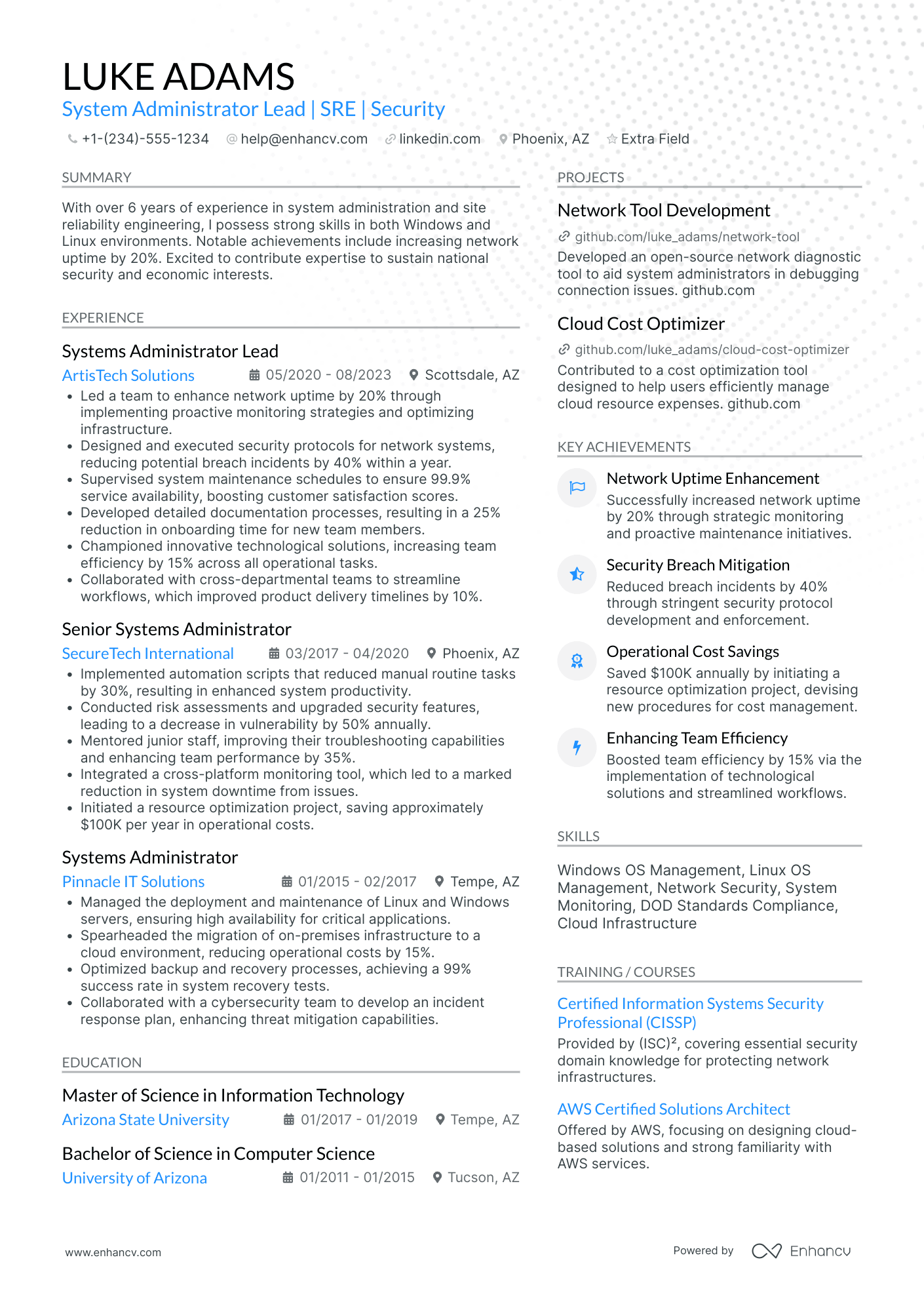
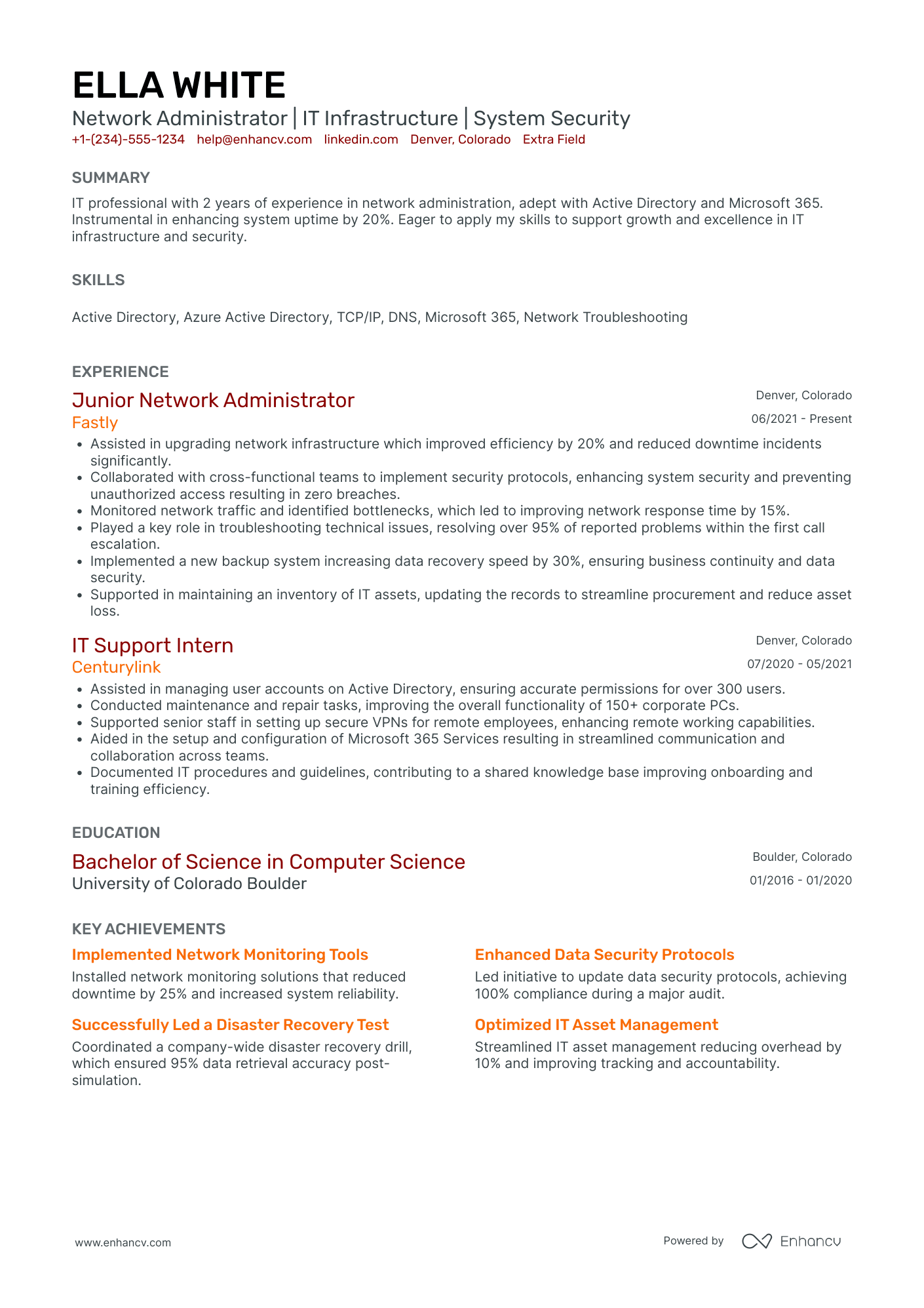
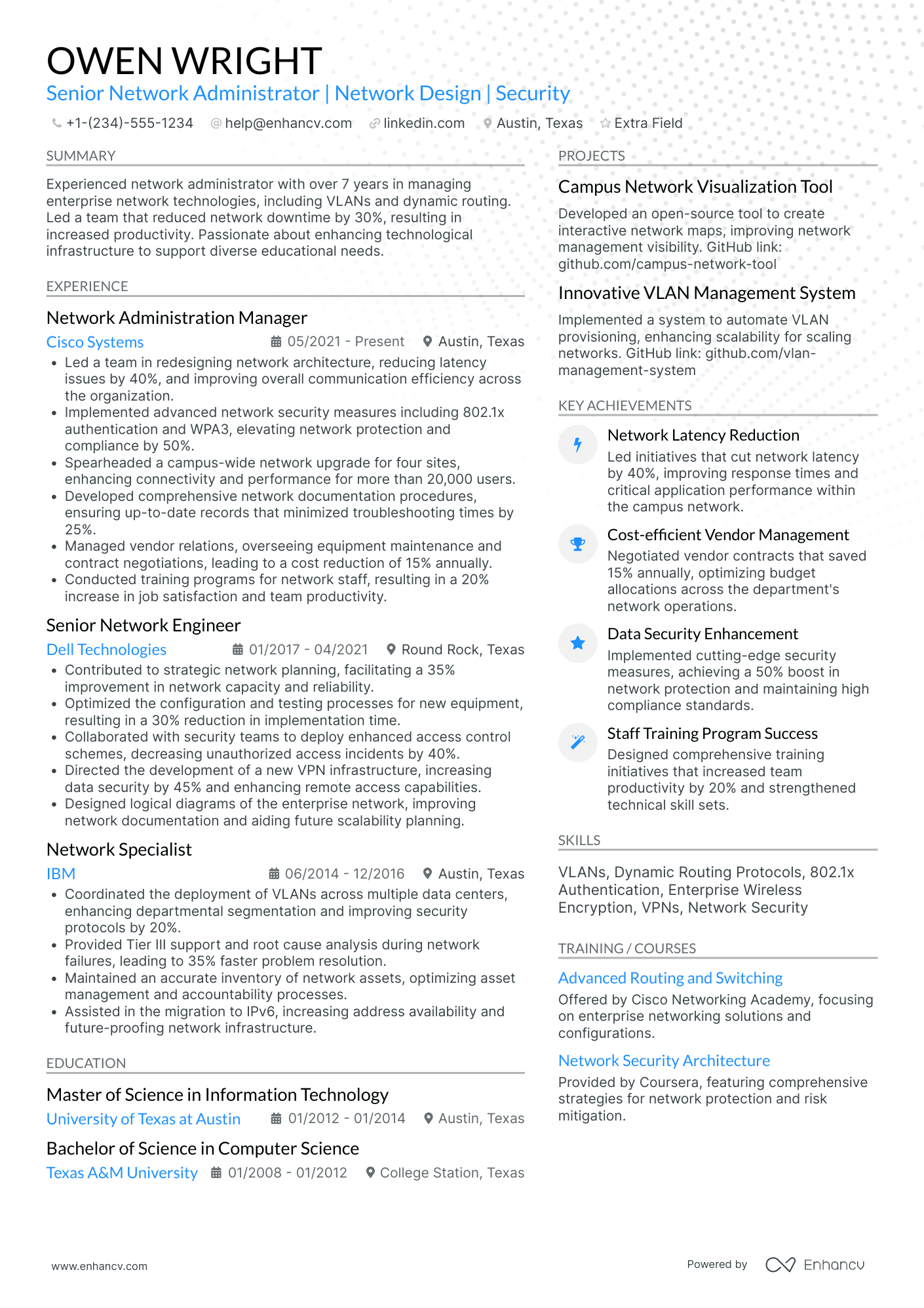
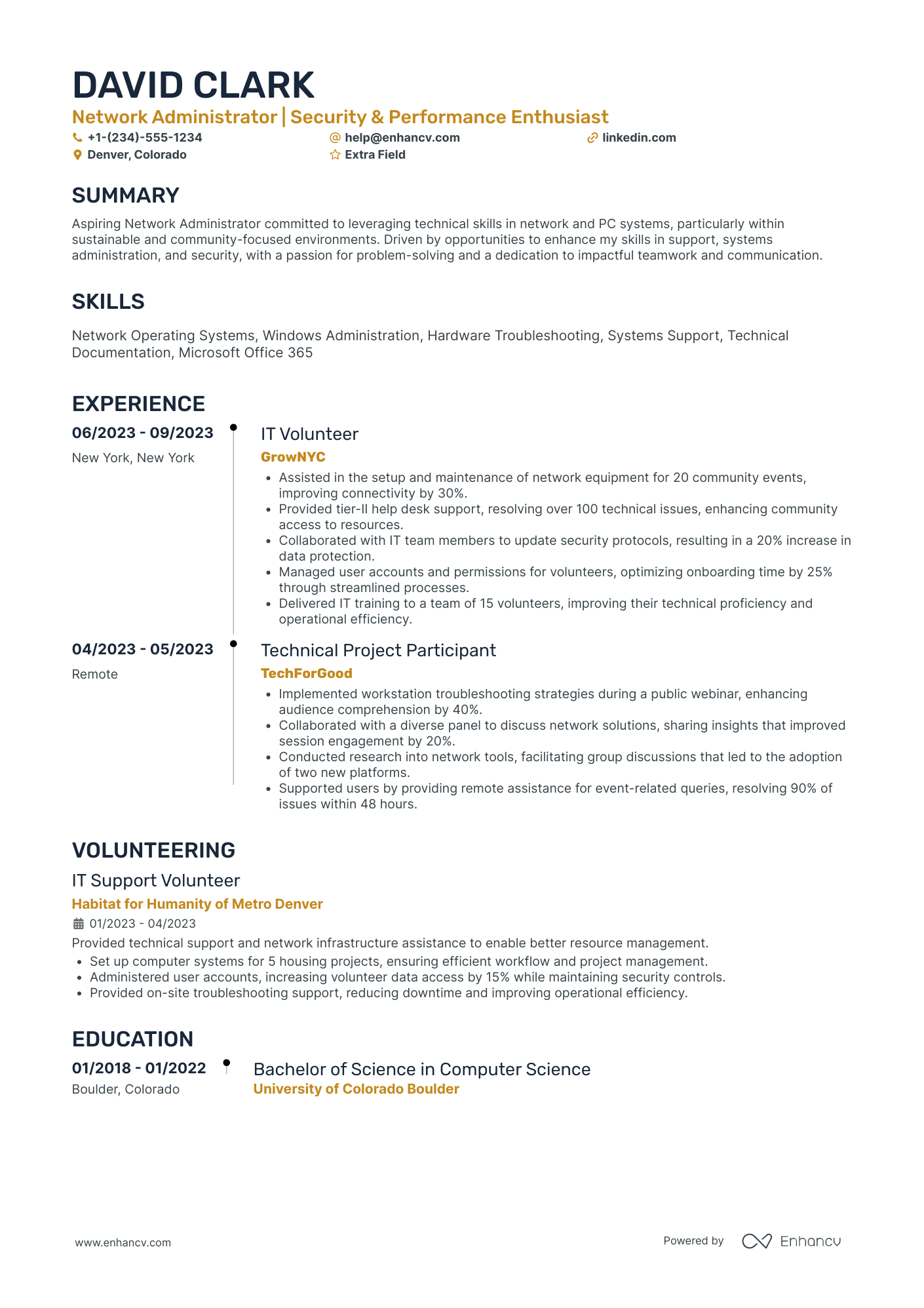
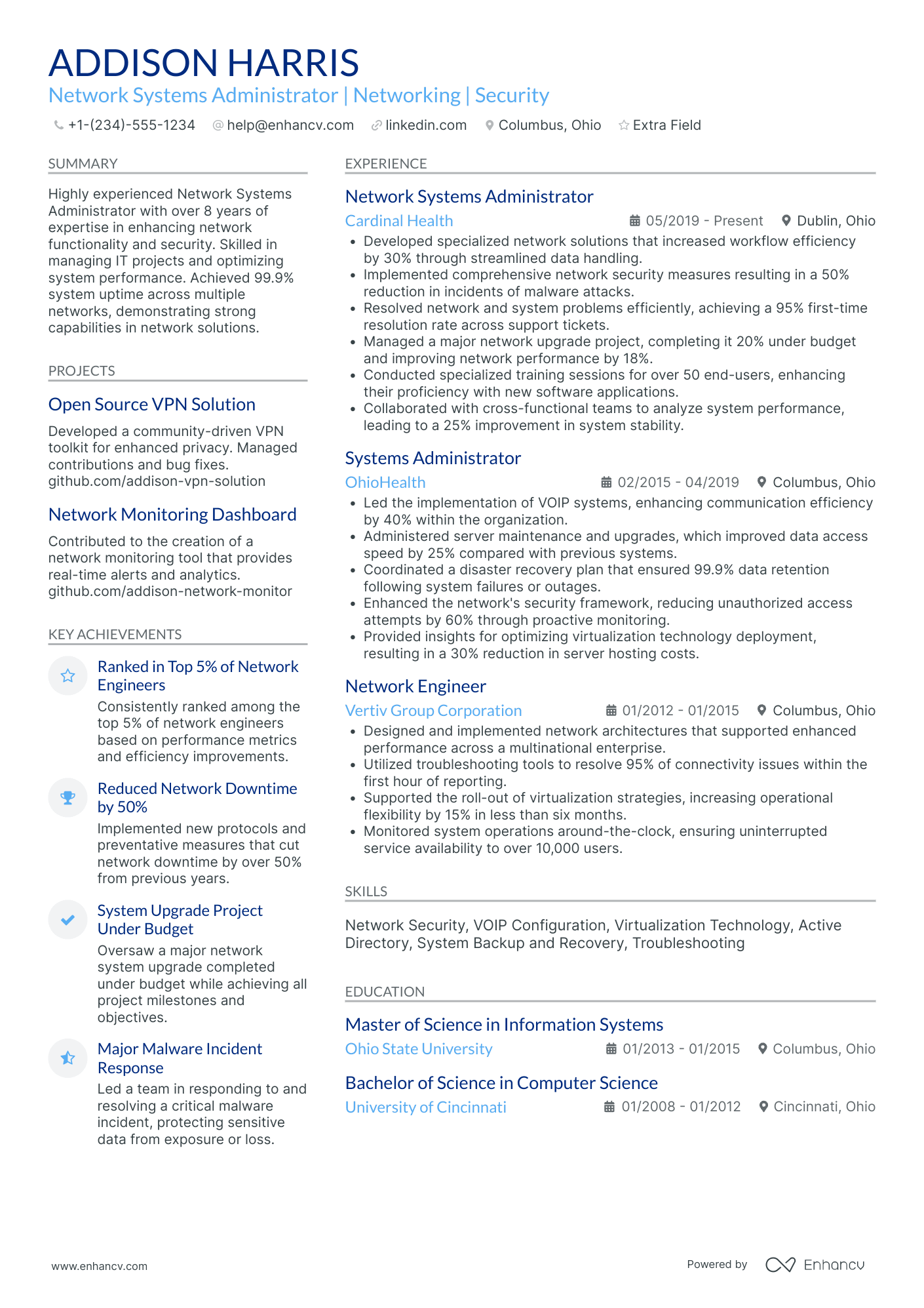
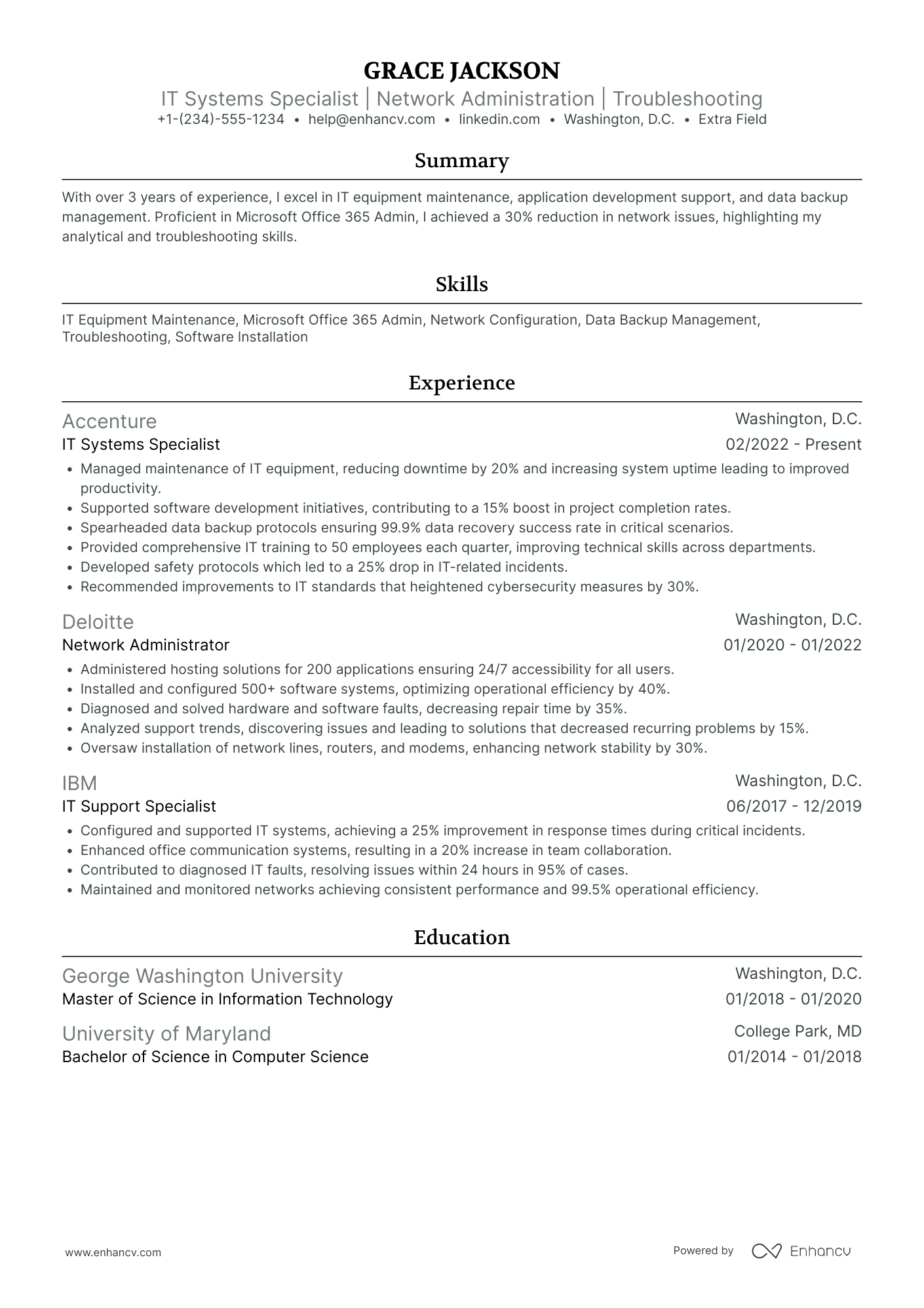
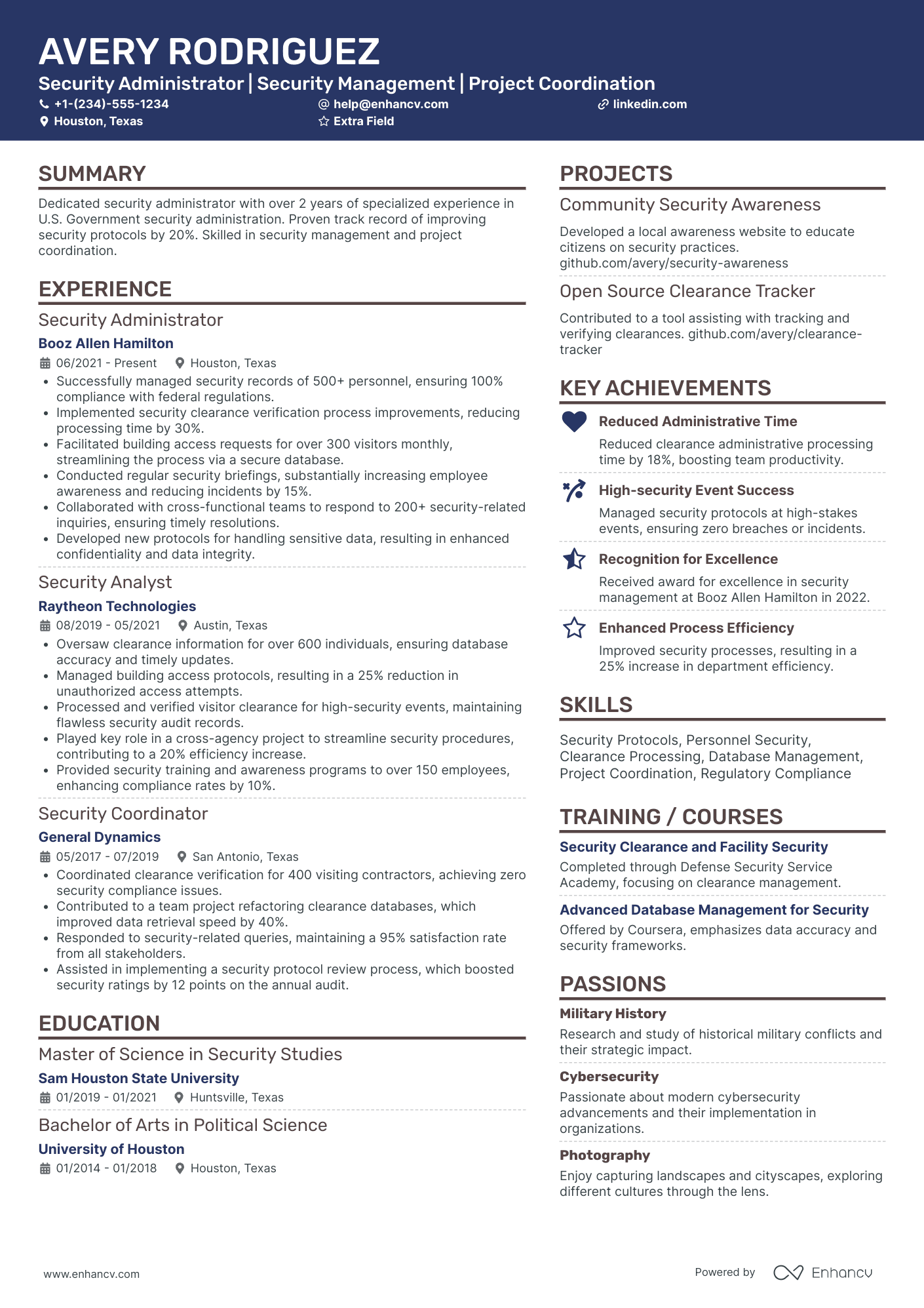
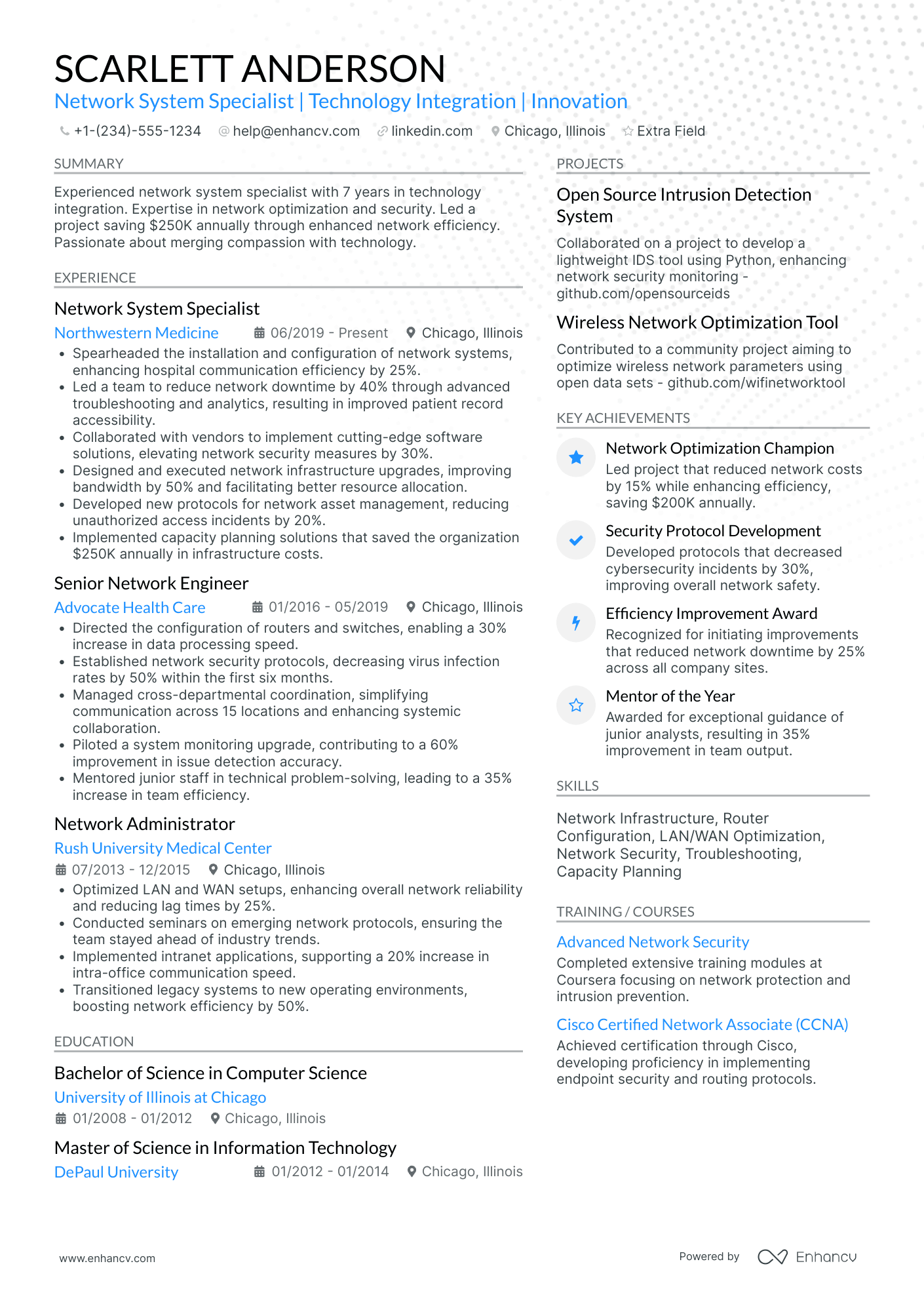
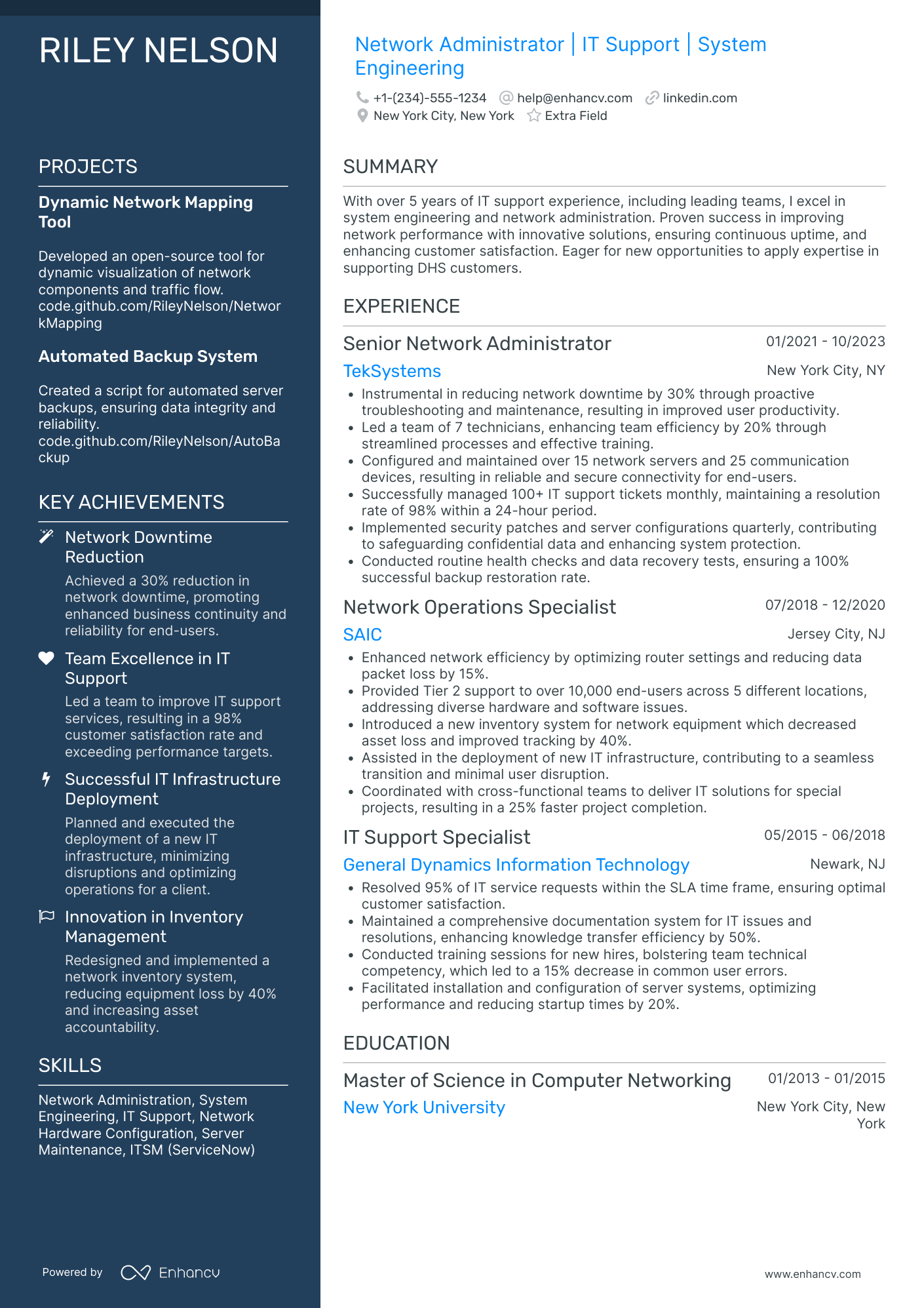
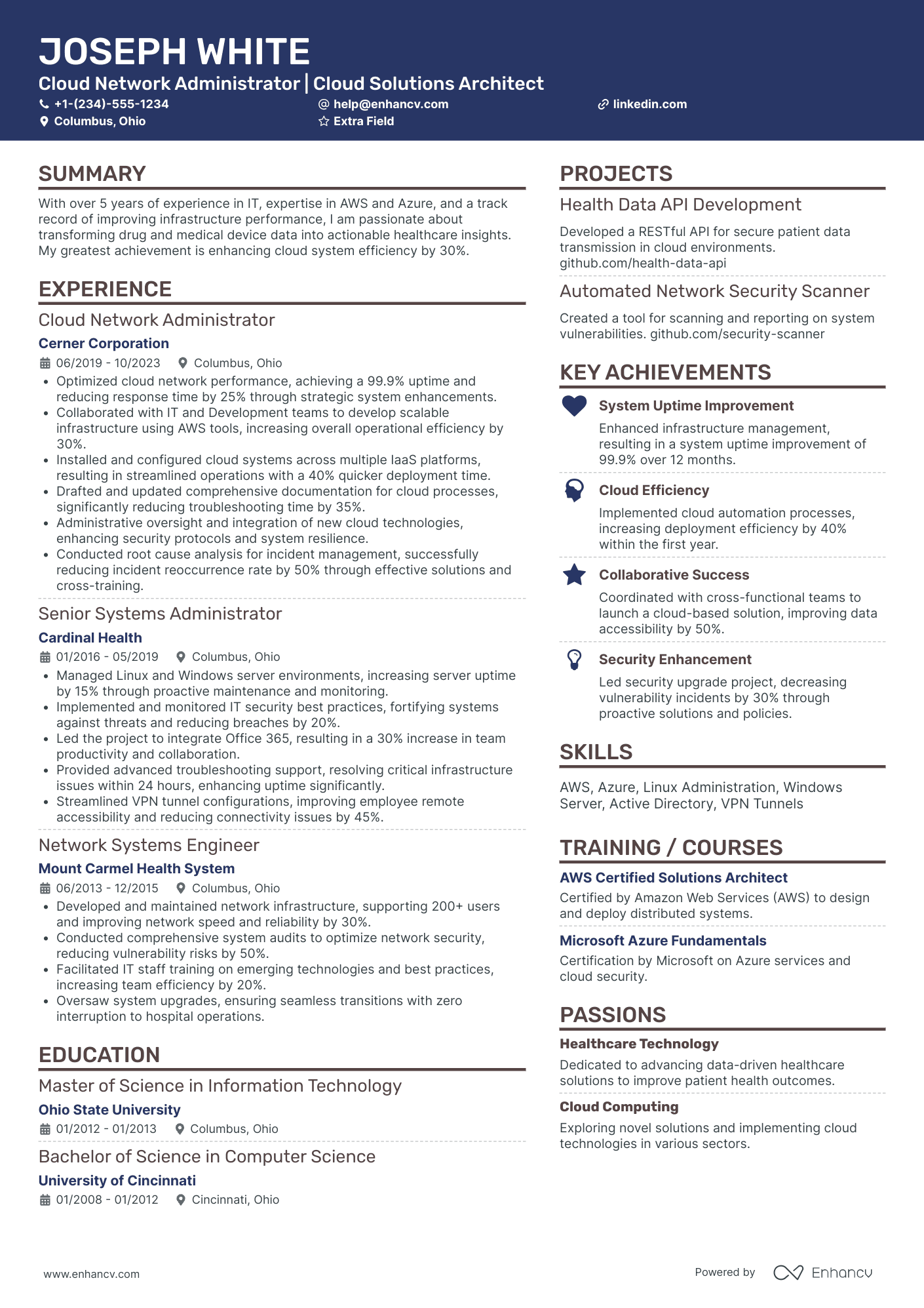
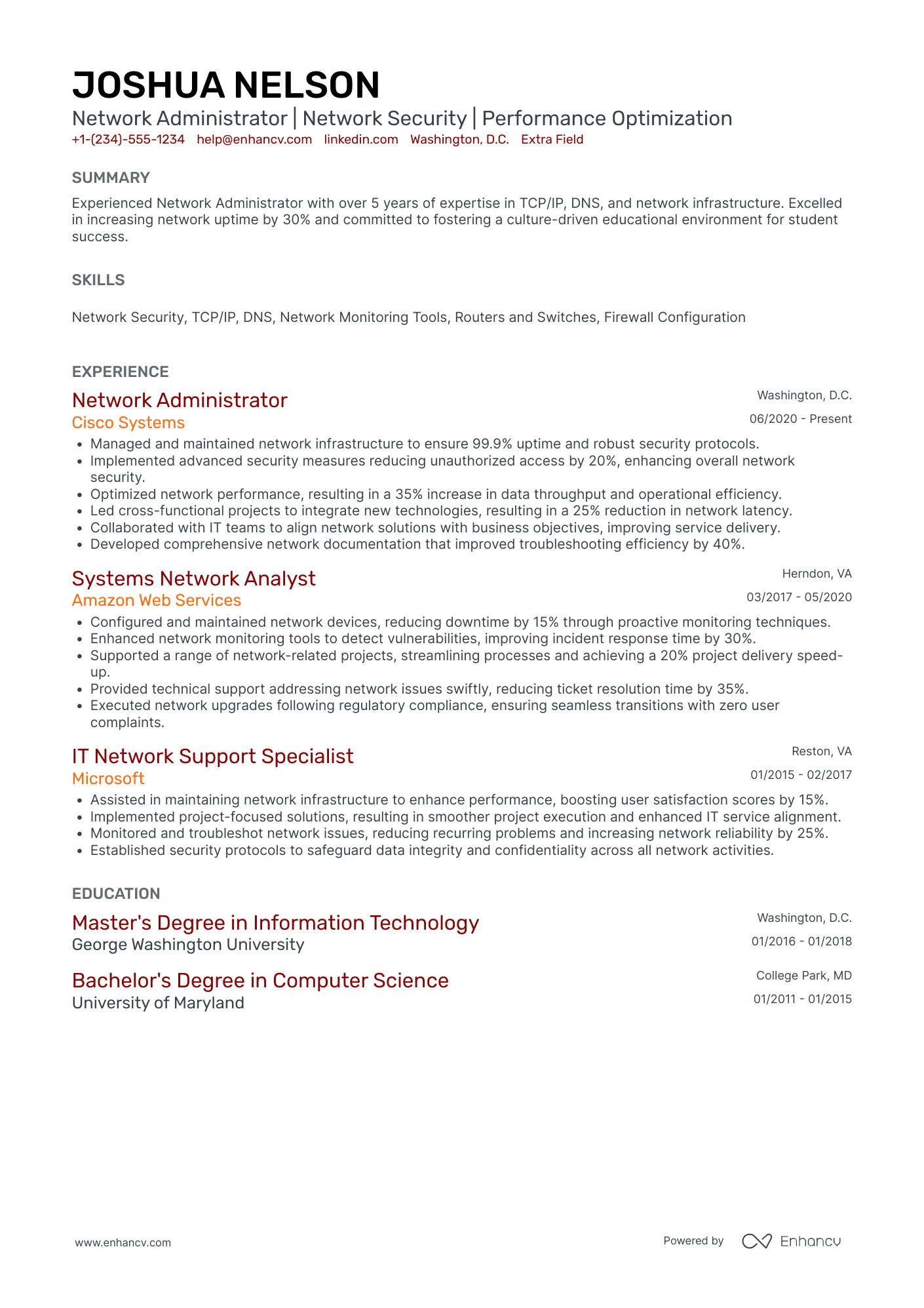
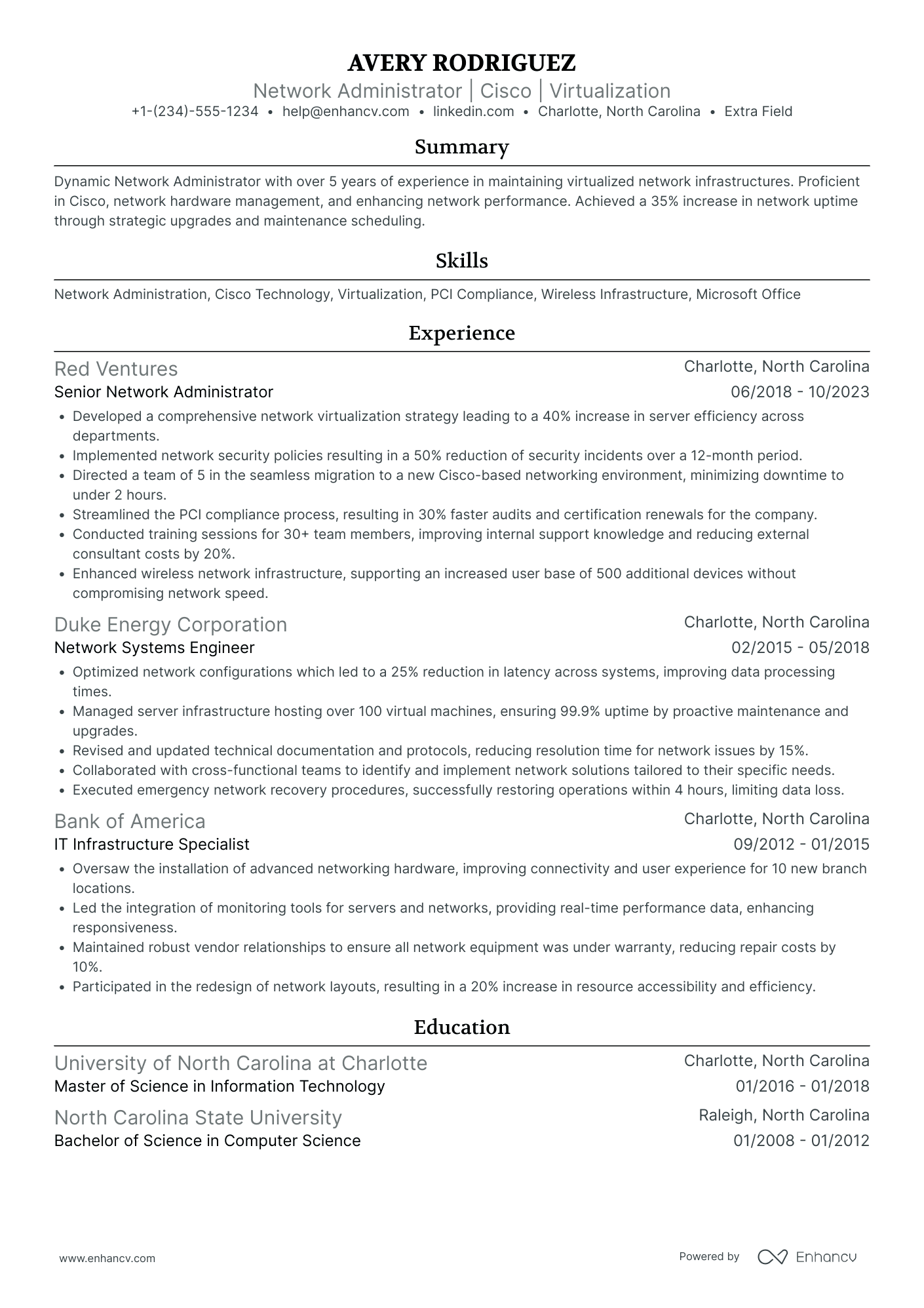
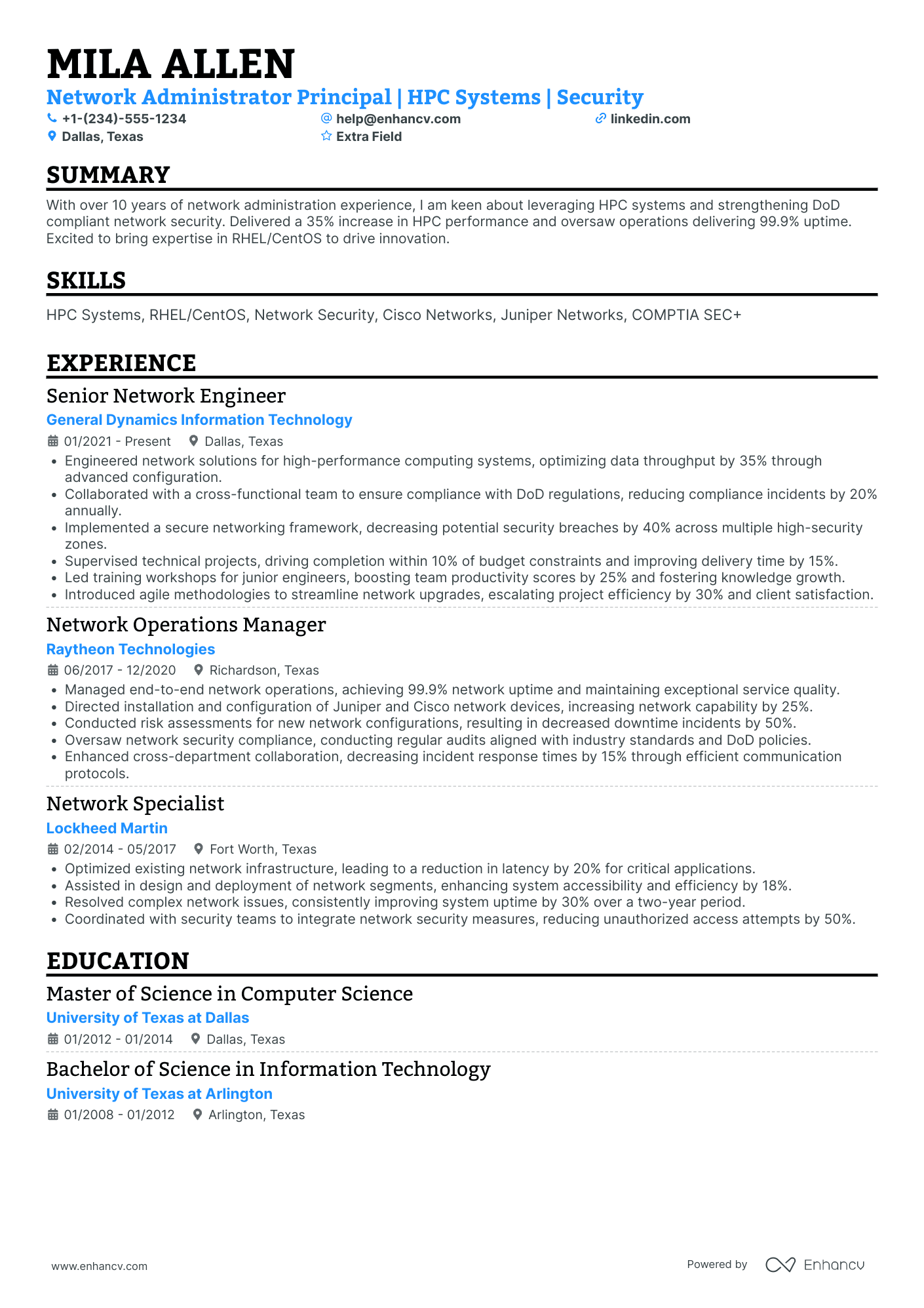
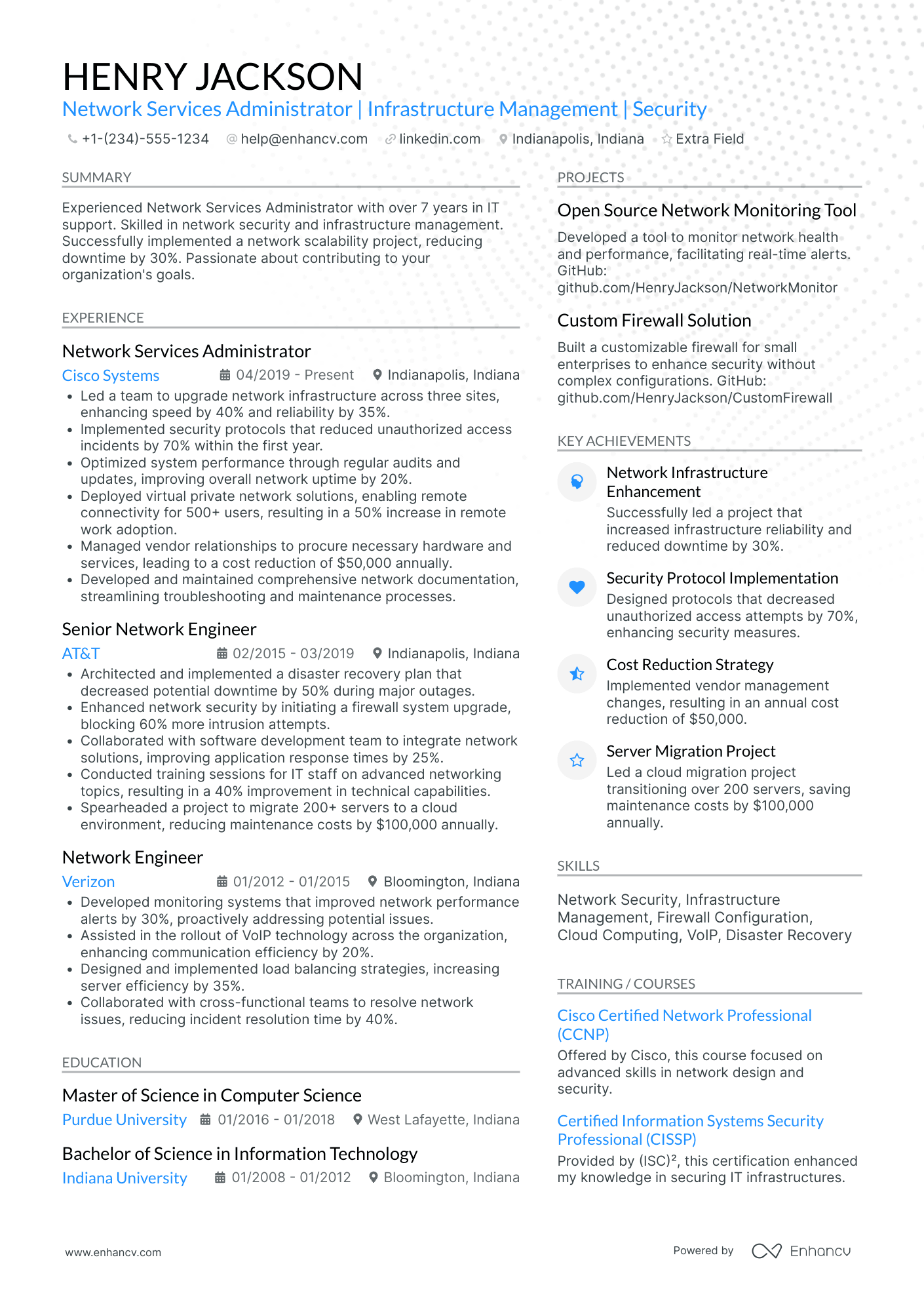
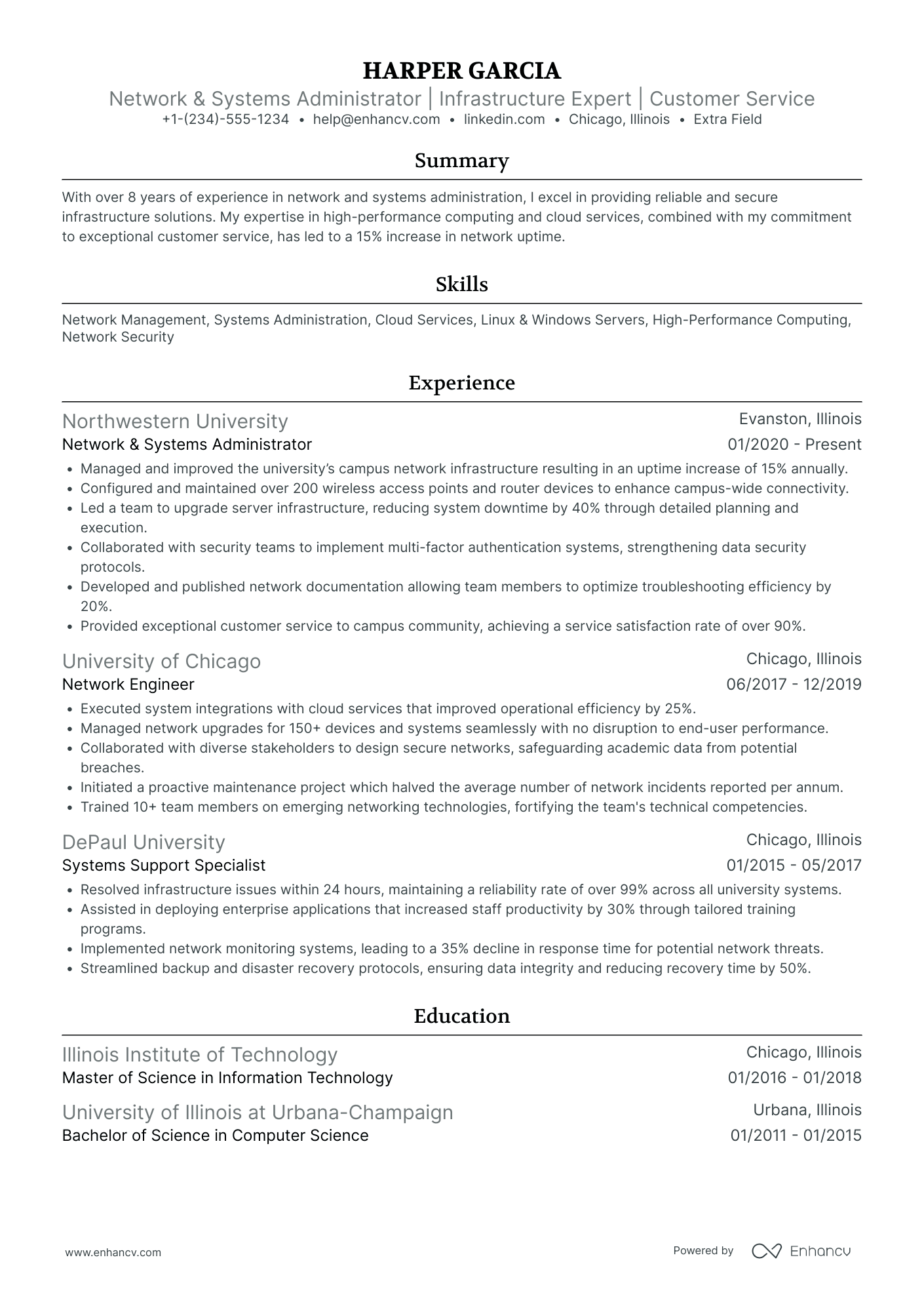
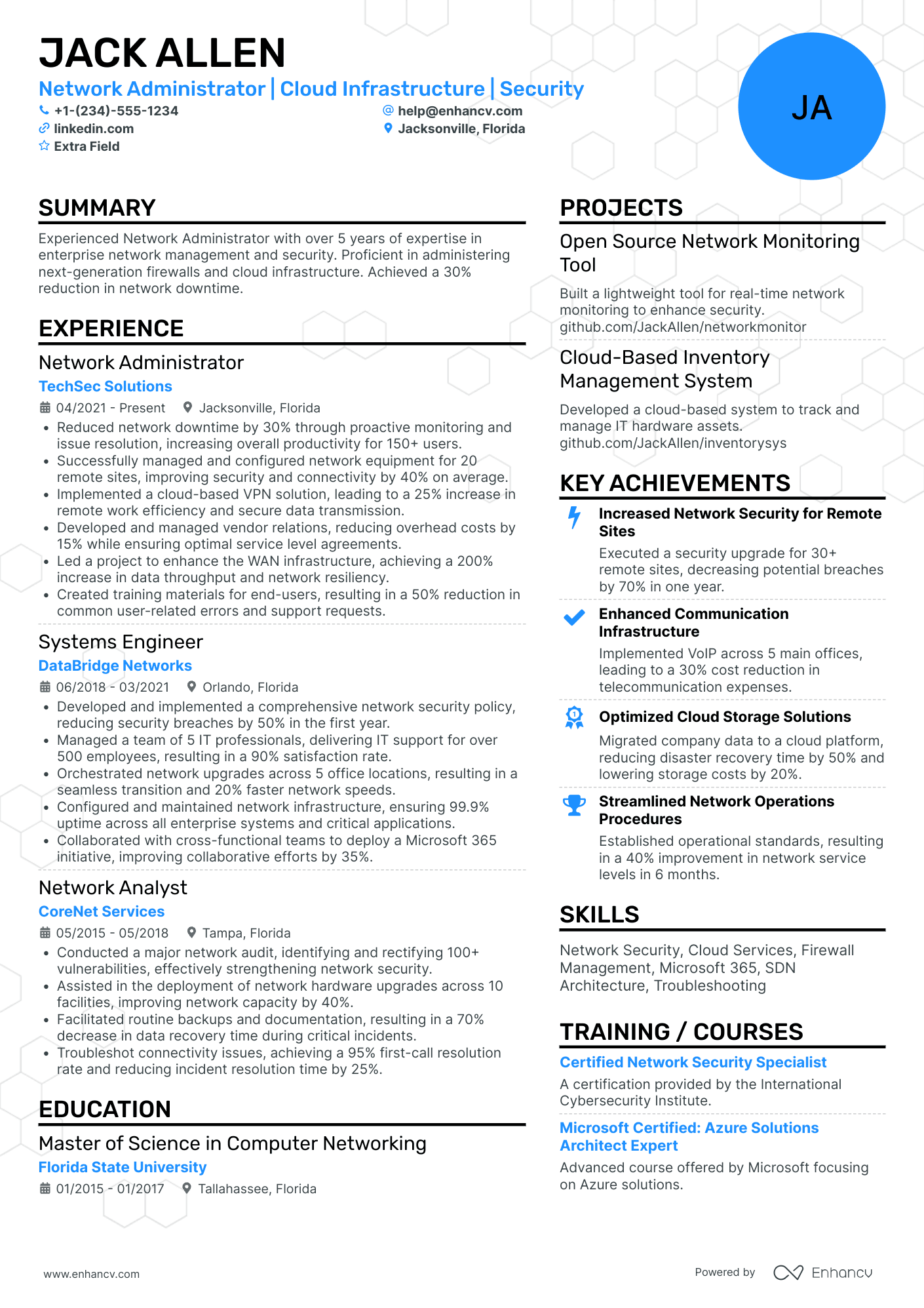
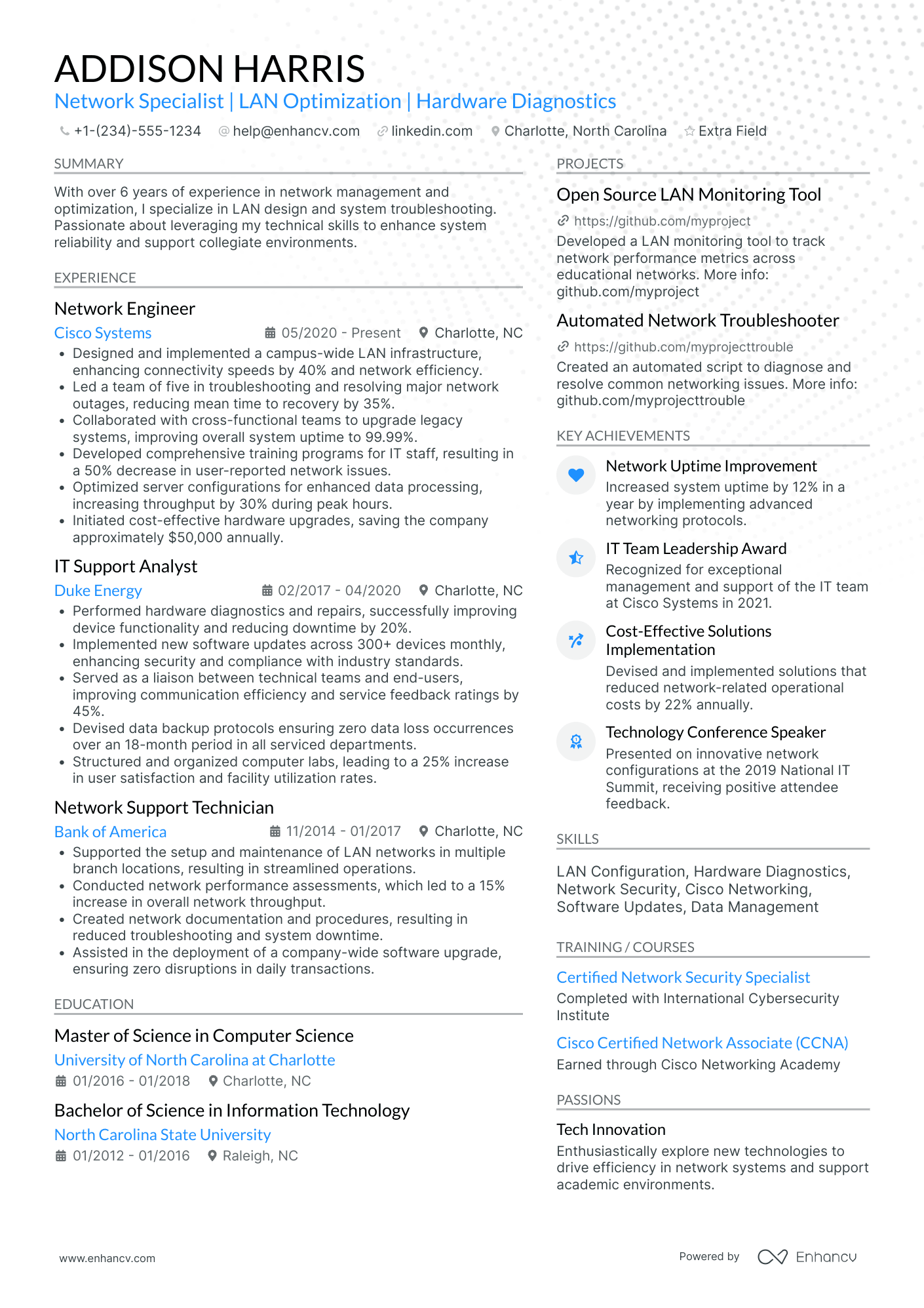
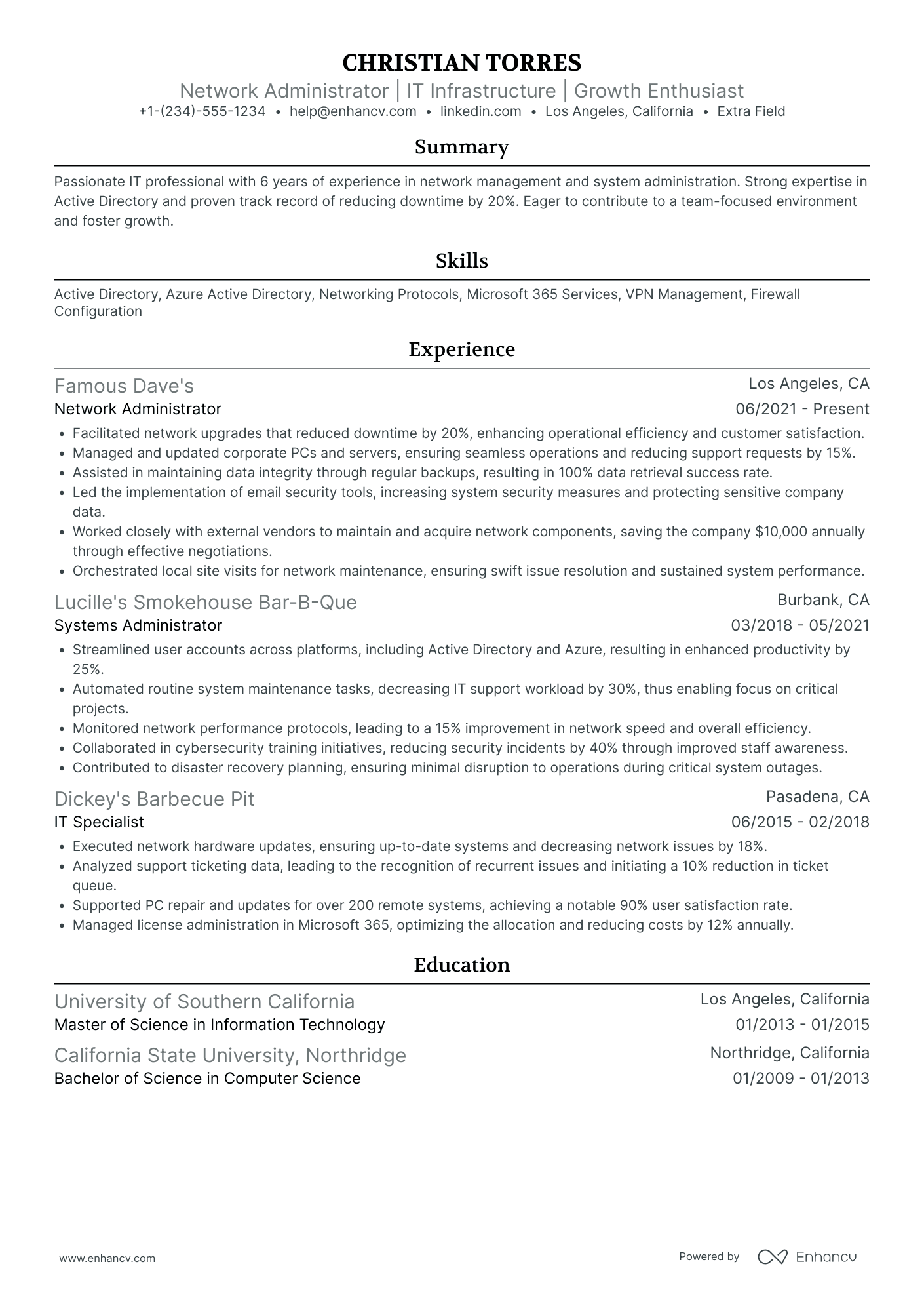
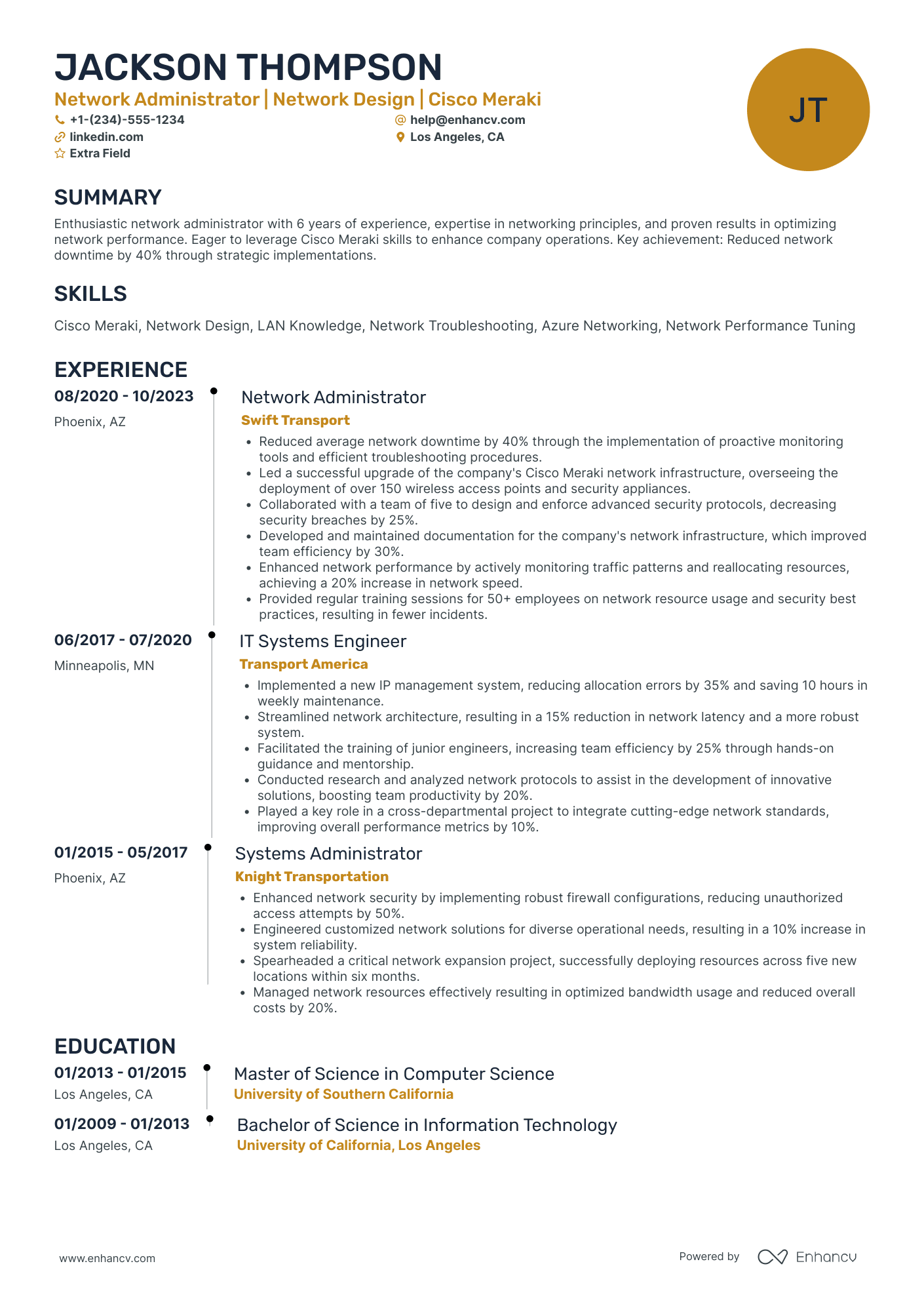
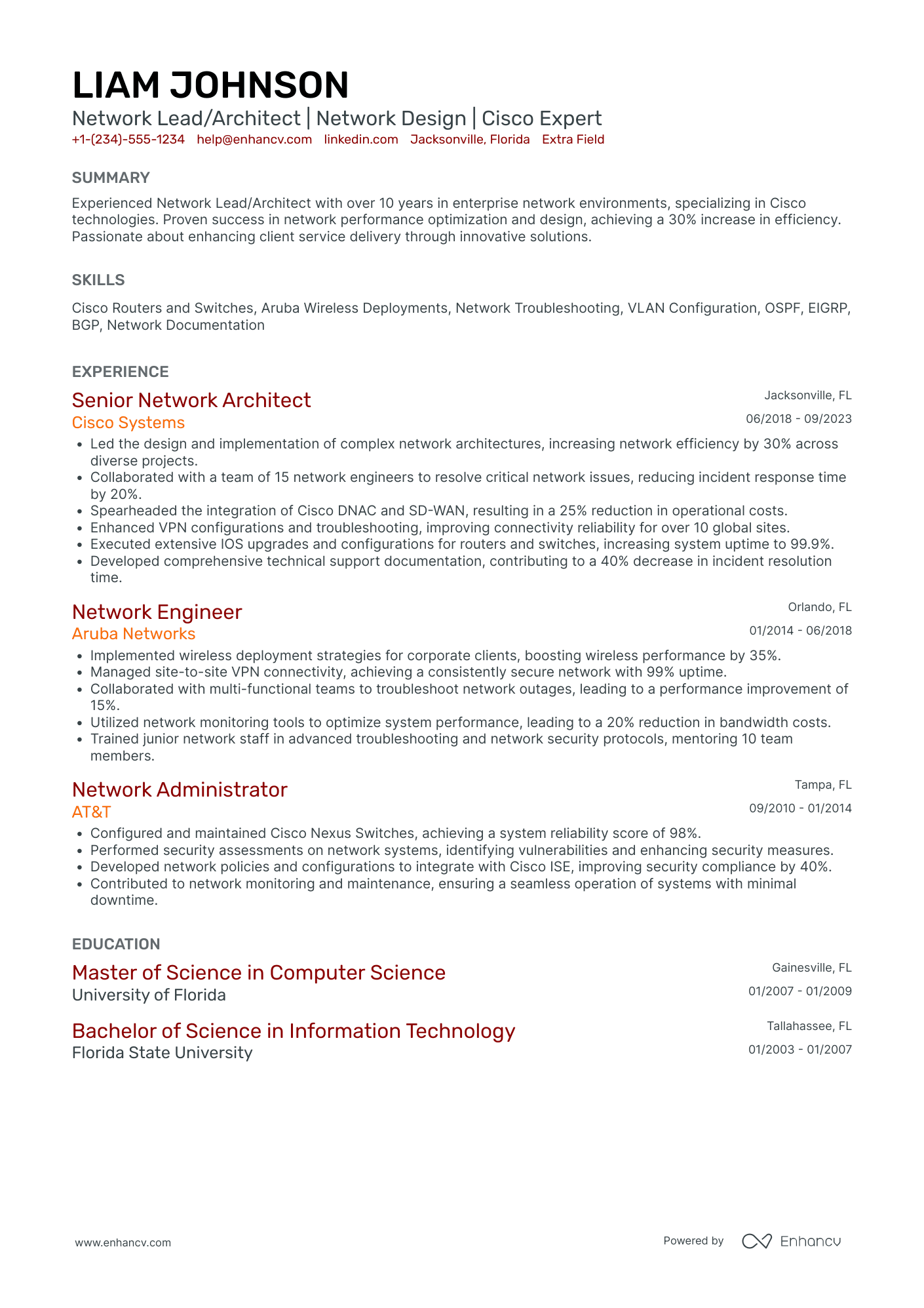
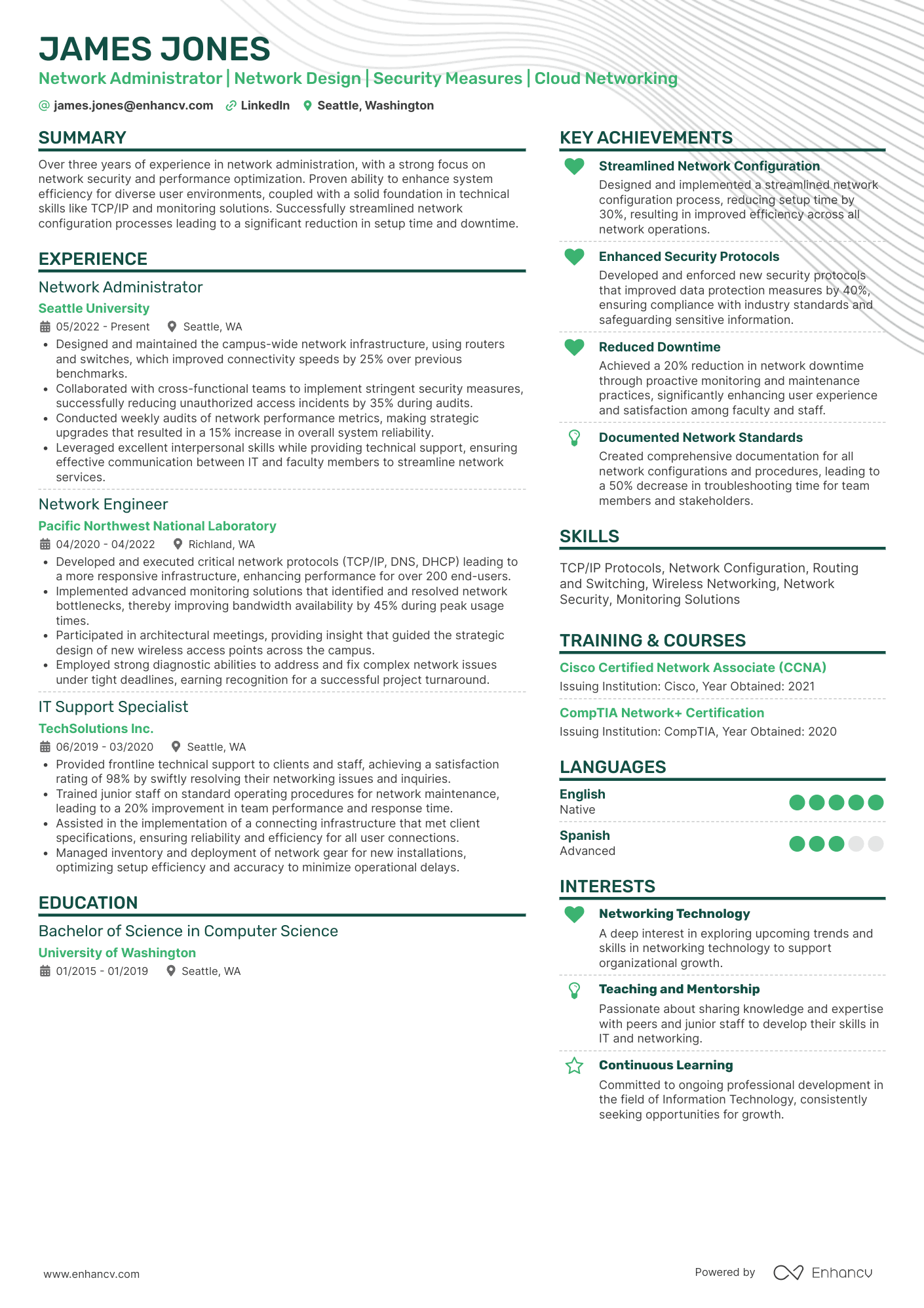
As a network administrator, you’re the unseen force ensuring systems run smoothly and connections stay stable. Your technical expertise is central to landing your next role—but you also need to show impact, reliability, and problem-solving skills.
IT leads want more than just a list of tools and protocols. A top candidate is someone who can anticipate issues before they arise, and support business goals through secure and efficient network management. Your resume should present a balance of deep technical skill and proactive thinking.
In this guide, we’ll show you how to build your network administrator resume. It’s all about connecting your experience, certifications, and results so employers see the value you bring.

Key takeaways
- Credentials like CCNA, Network+, Security+, Azure Administrator, and AWS Advanced Networking often determine shortlist eligibility.
- A reverse-chronological resume works best for this role. A hybrid format can work for IT industry newcomers.
- Frame your experience around stability, security, and continuous improvement.
- Show how your work improved uptime, reduced incidents, or optimized bandwidth.
- Mirror the job description’s technologies, environments, and metrics to align with the employer’s needs.
- Communication, collaboration, and problem-solving remain essential—employers want admins who can explain issues clearly and work across teams.
Add title of section here
By Experience
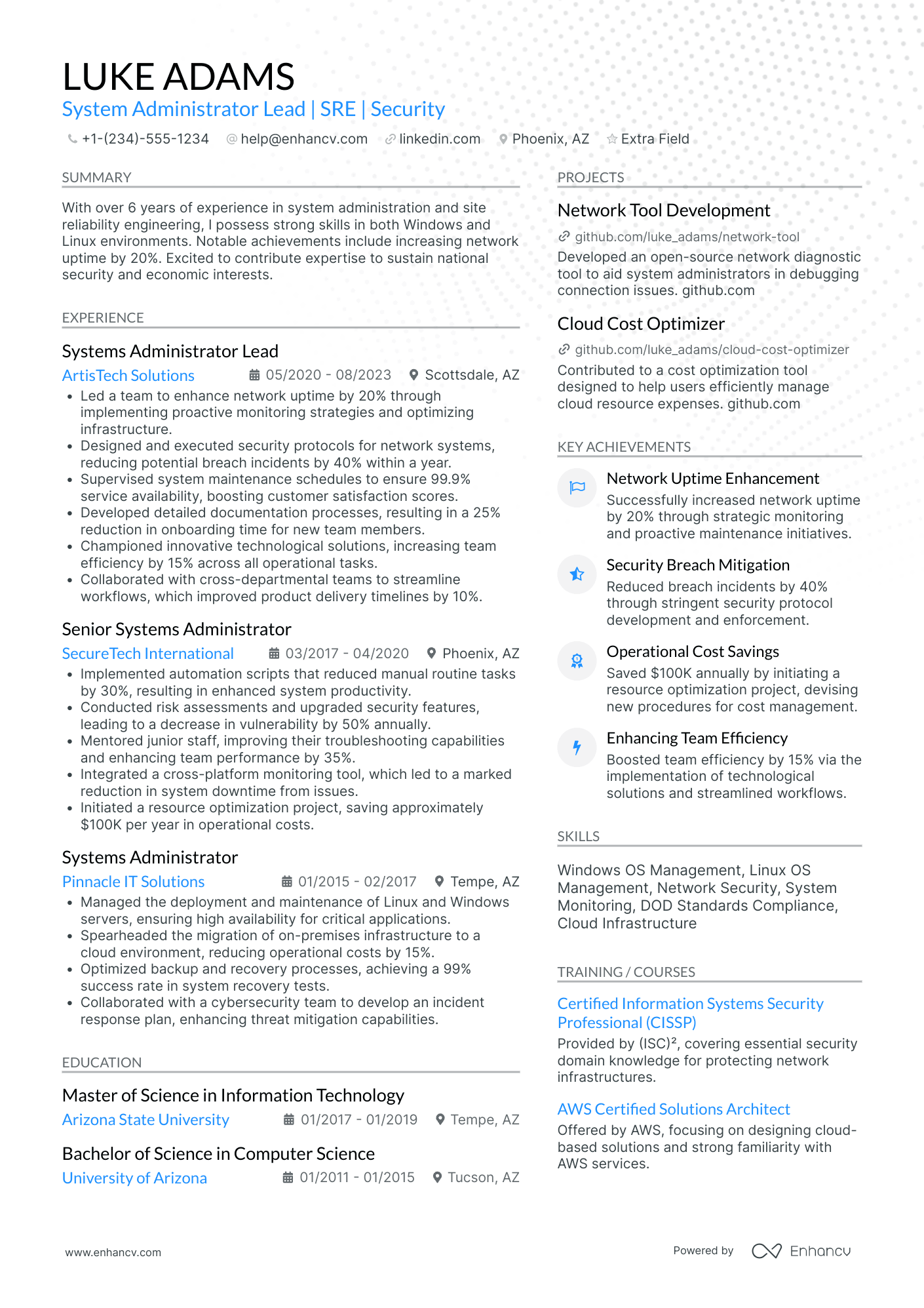
Lead Network Administrator
- Mention your experience in budget management and vendor negotiations related to procuring network hardware.
- Describe projects where you increased overall network uptime from X% to Y%.
- List your abilities in enterprise-wide networking standards, architecture roadmaps, and lifecycle management policies.
- Showcase experience in leading technical teams, performance reviews, and mentoring junior administrators.
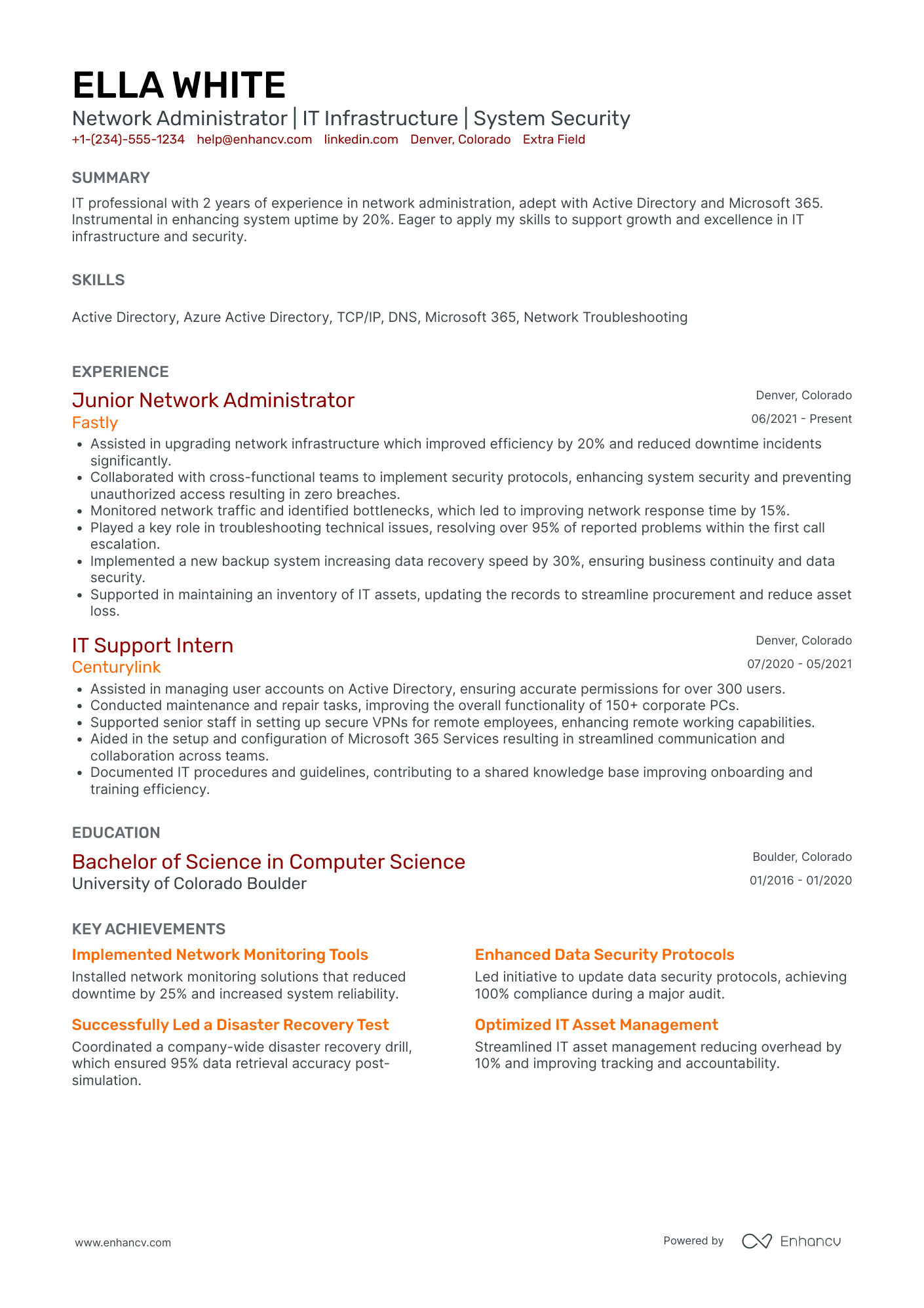
Junior Network Administrator
- Describe direct experience with basic network monitoring tools (e.g., Nagios, Zabbix).
- List knowledge of cabling standards, patch management, and documenting network closet layouts and inventory.
- Detail troubleshooting achievements, such as resolving DHCP/DNS issues, fixing VLAN tagging errors, or resetting network equipment configurations.
- Know-how in essential networking concepts like the OSI model, subnetting, and TCP/IP fundamentals is an advantage.
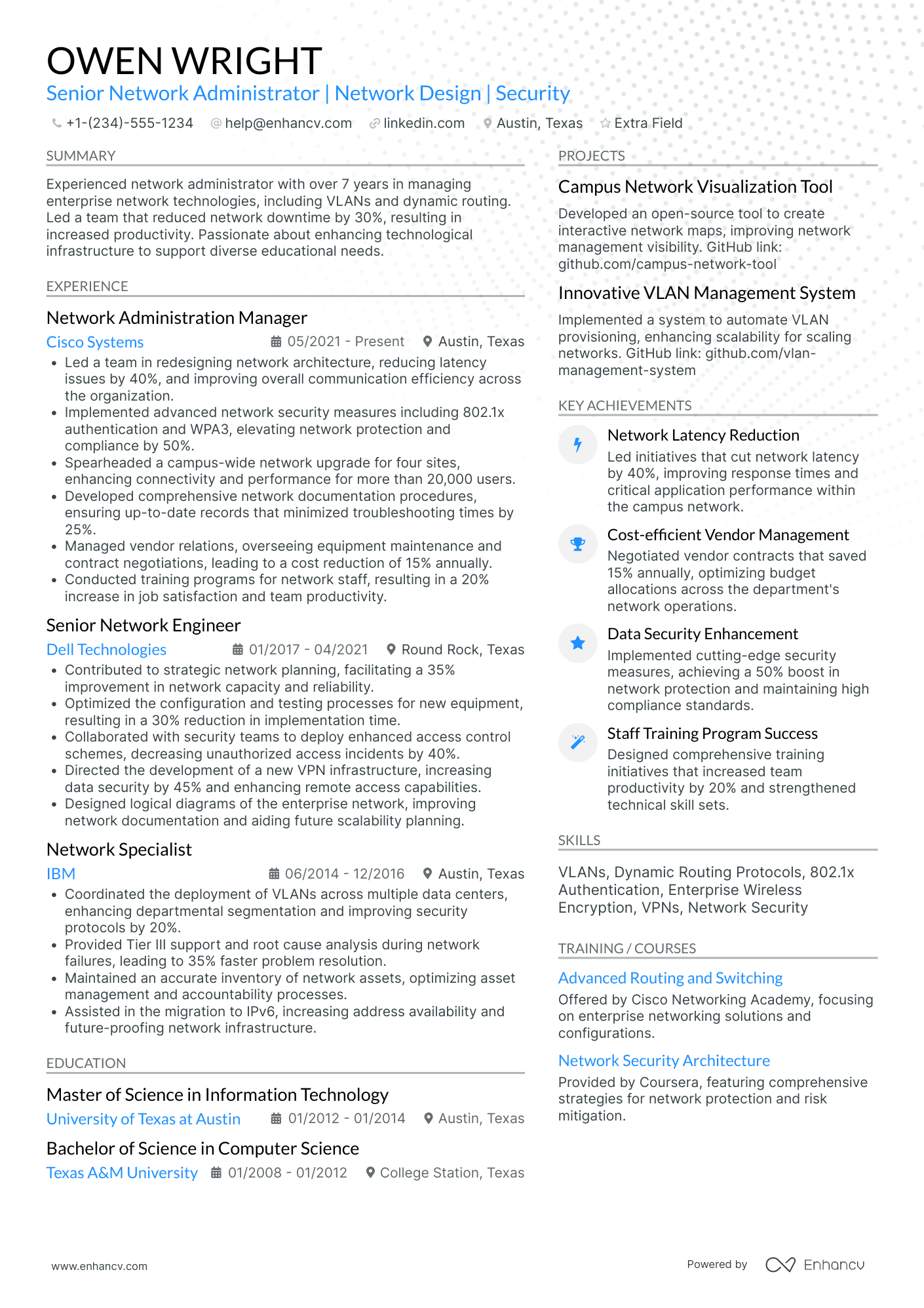
Senior Network Administrator
- Reference specific projects where you designed resilient networks with N+1 or clustered technologies.
- You should describe complex BGP or OSPF routing implementations you handled to improve inter-site connectivity or failover performance.
- Expertise in managing and securing network access control (NAC) systems (e.g., Cisco ISE, Aruba ClearPass) is a must.
- List network automation projects (e.g., using Python, Ansible, or Netmiko) that reduced configuration change time.
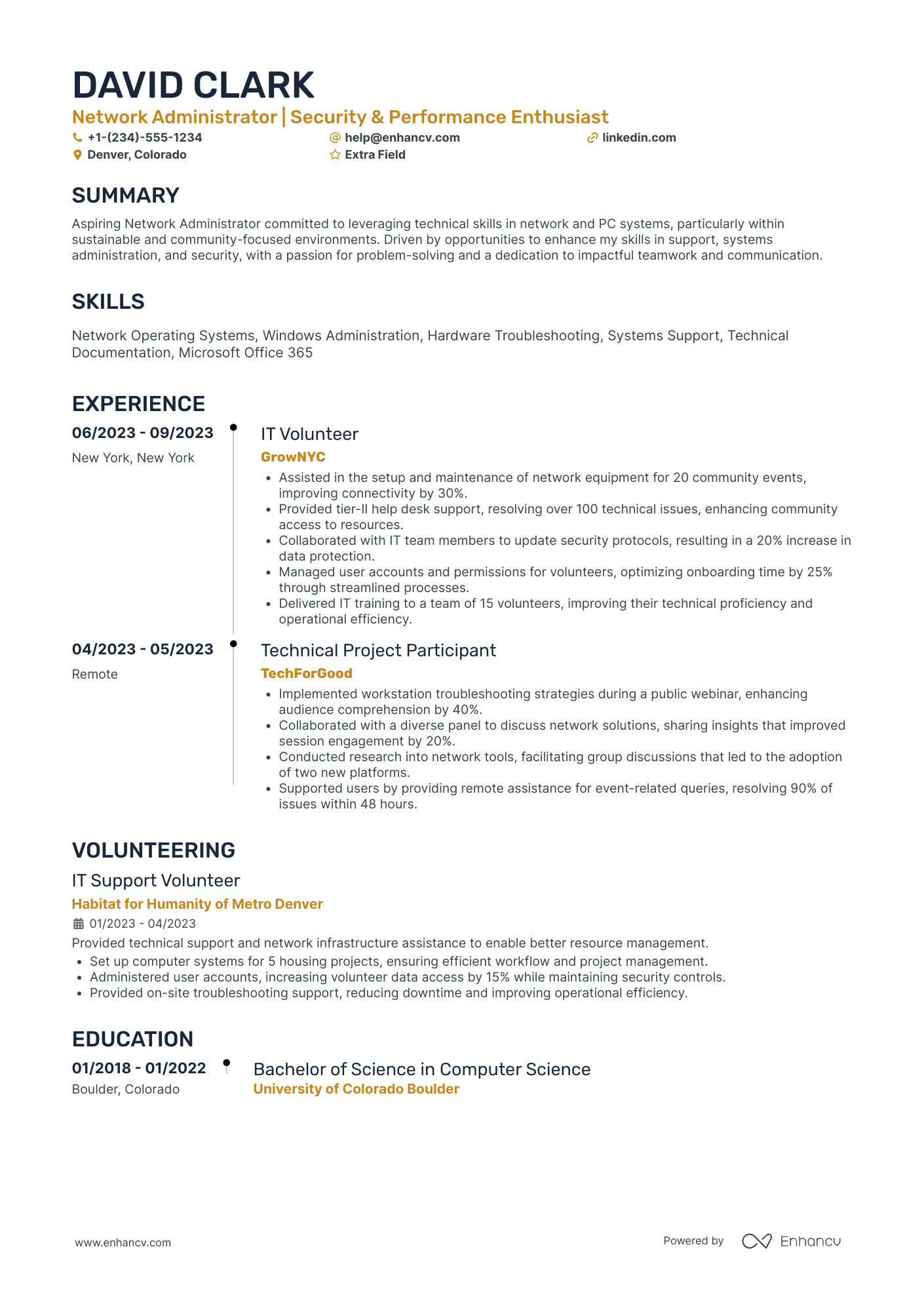
Network Administrator Intern
- Mention completion of help-desk tickets that involved direct interaction with end-users to resolve connectivity issues.
- Detail any exposure you had to a professional firewall or switch configuration console.
- Include any specific scripting projects or personal home lab setups you used to simulate enterprise network environments (e.g., using GNS3 or EVE-NG).
- List the specific network documentation you contributed to or updated, such as IP addressing schemes, change logs, or runbooks.
By Role
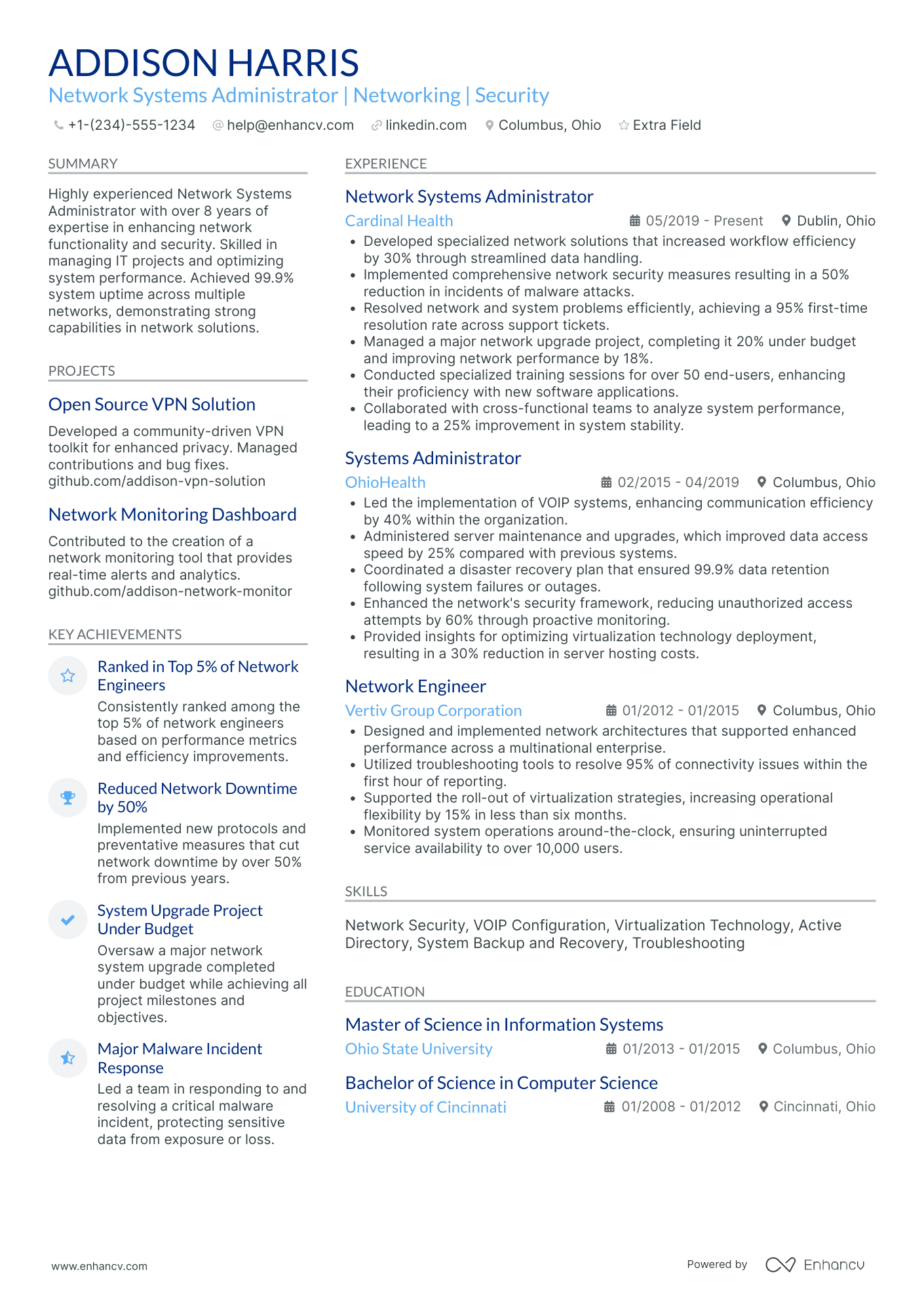
Network Systems Administrator
- Show expertise in integrating network components with directory services (e.g., LDAP, Active Directory).
- Detail your ability to manage the interplay between network performance and virtualized environments (like setting up VLANs for VMs on a Hyper-V or ESXi host).
- Experience with storage networking technologies is an advantage. For example, iSCSI or Fibre Channel connections, or ensuring high-throughput data transfer.
- Describe proficiency in managing server operating systems (Windows Server, Linux), combined with network devices know-how.
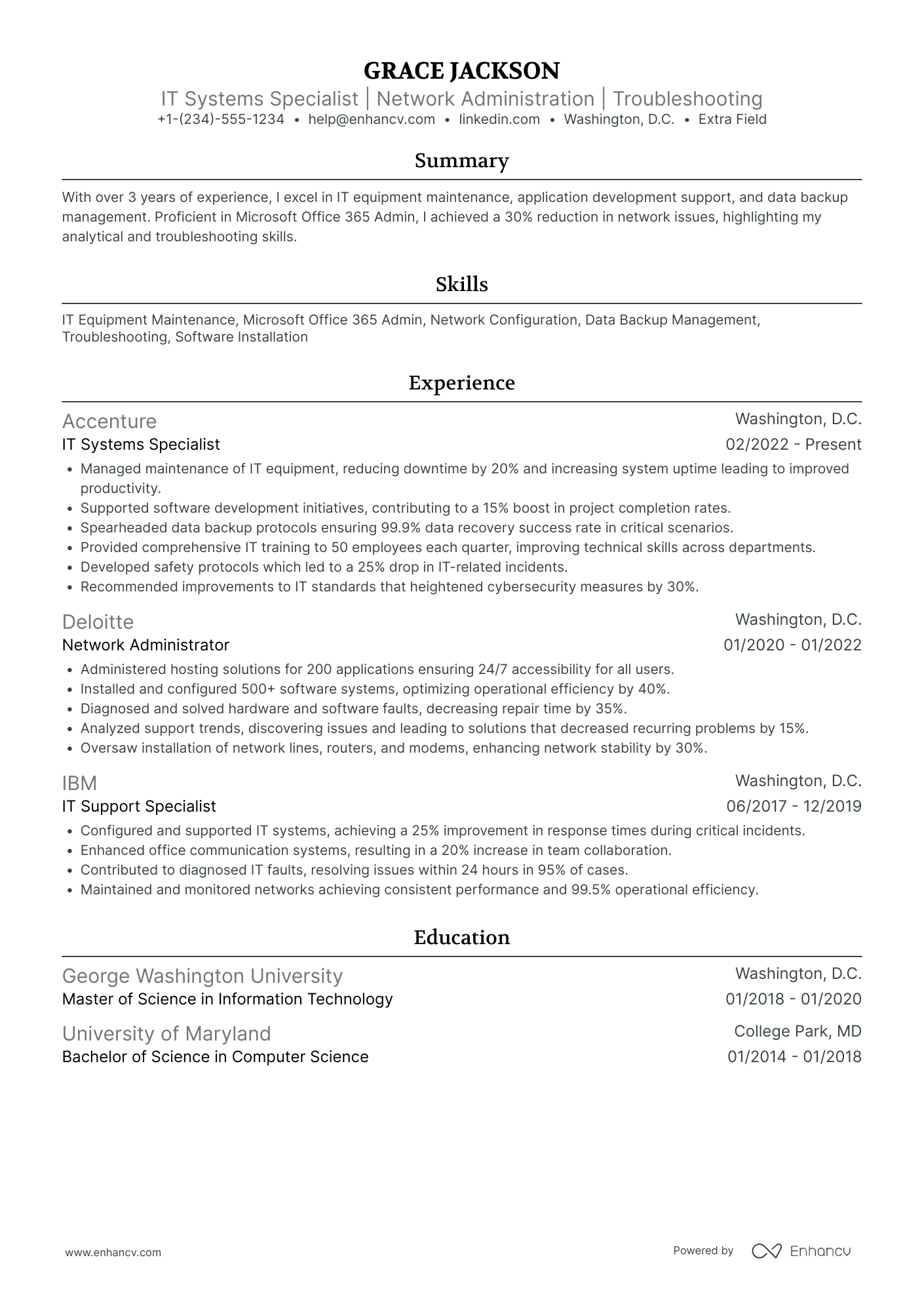
IT Network Administrator
- Describe yourself as the primary technical contact for general networking issues across the organization.
- Experience in managing internal and external DNS, email routing, and certificate management is an advantage.
- Detail specific disaster recovery or business continuity planning activities you participated in.
- Reference high resolution rates or low mean-time-to-resolution (MTTR) figures to show your ability to manage tickets.
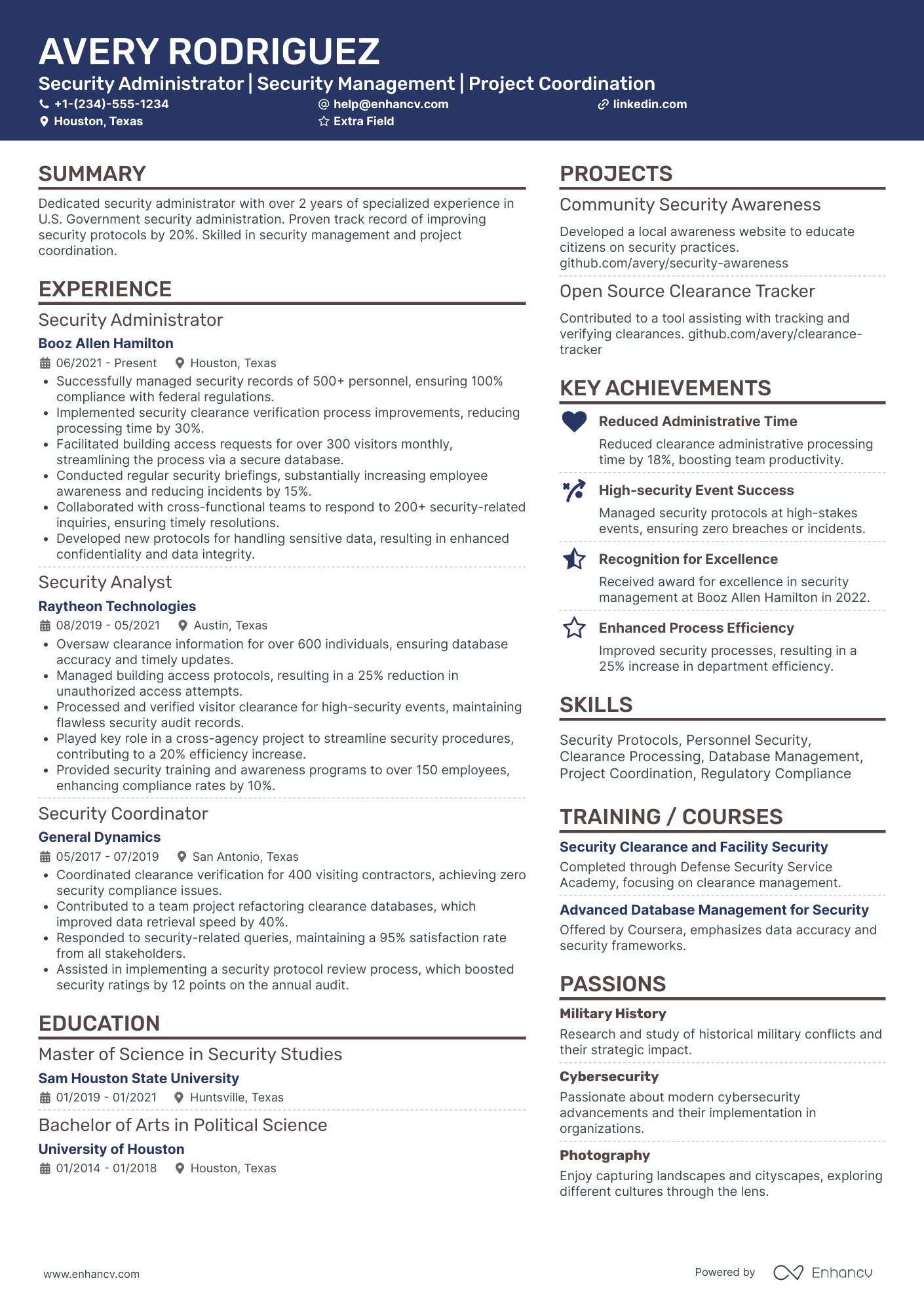
Network Security Administrator
- Write about security policies you implemented by listing specific Web Application Firewall (WAF) or Next-Generation Firewall (NGFW) platforms.
- Detail your hands-on experience with intrusion detection/prevention systems (IDS/IPS).
- Describe secure remote access solutions, specifically how you configured IPsec, SSL VPN, or ZTNA solutions.
- Mention participation in security audits, vulnerability assessments, and hardening network devices.
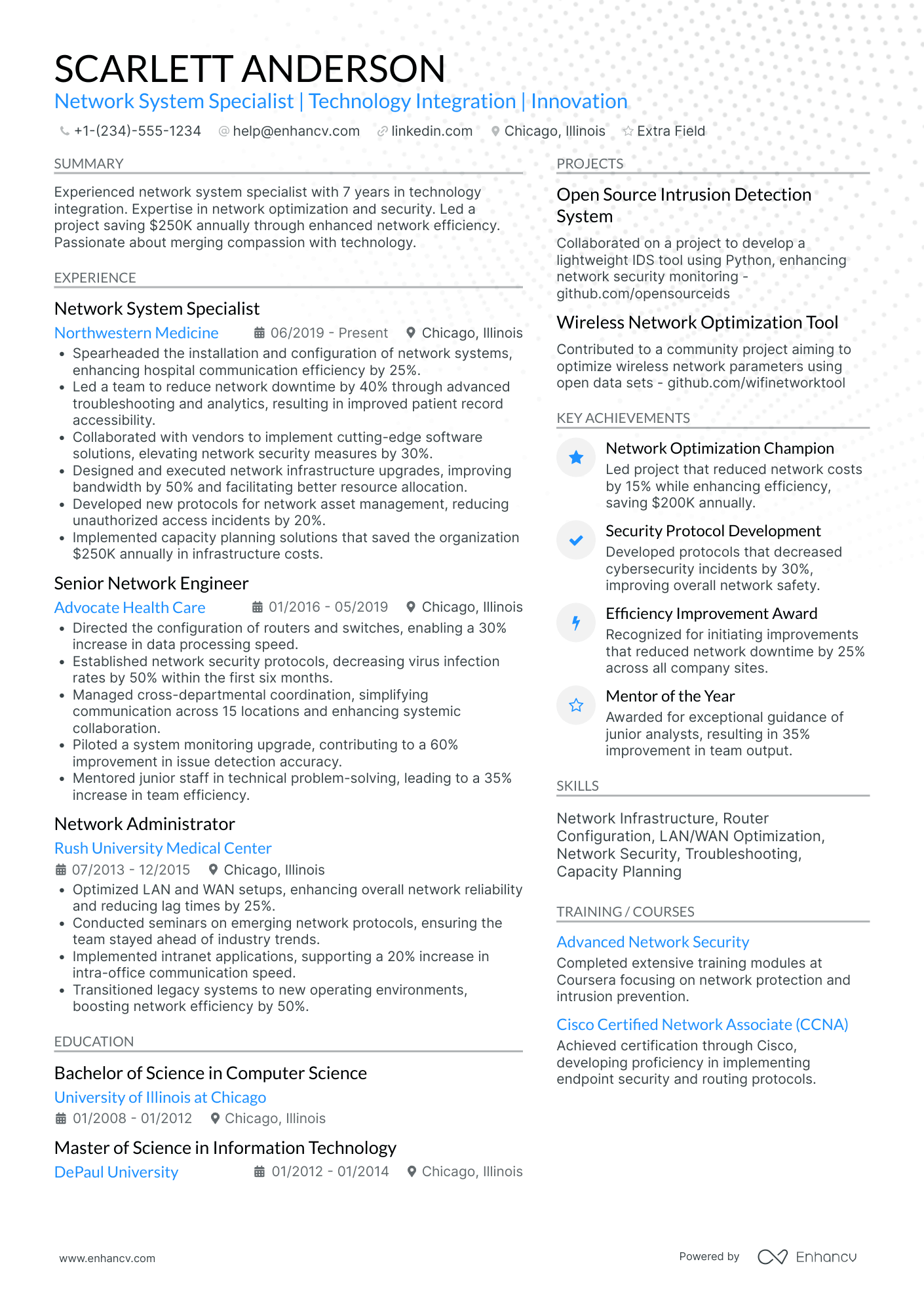
Wireless Network Administrator
- Your troubleshooting skills related to wireless interference, channel planning, and solving high-density client connection issues should be prominently displayed.
- You can also mention specific vendor platforms you are an expert in (e.g., Cisco Meraki, Aruba, Ruckus).
- Experience with site surveys is an advantage. Also, heat-mapping tools (e.g., Ekahau), and deploying complex wireless networks across large physical spaces.
- Specific experience with advanced authentication methods for Wi-Fi, such as 802.1X, RADIUS is particularly helpful.
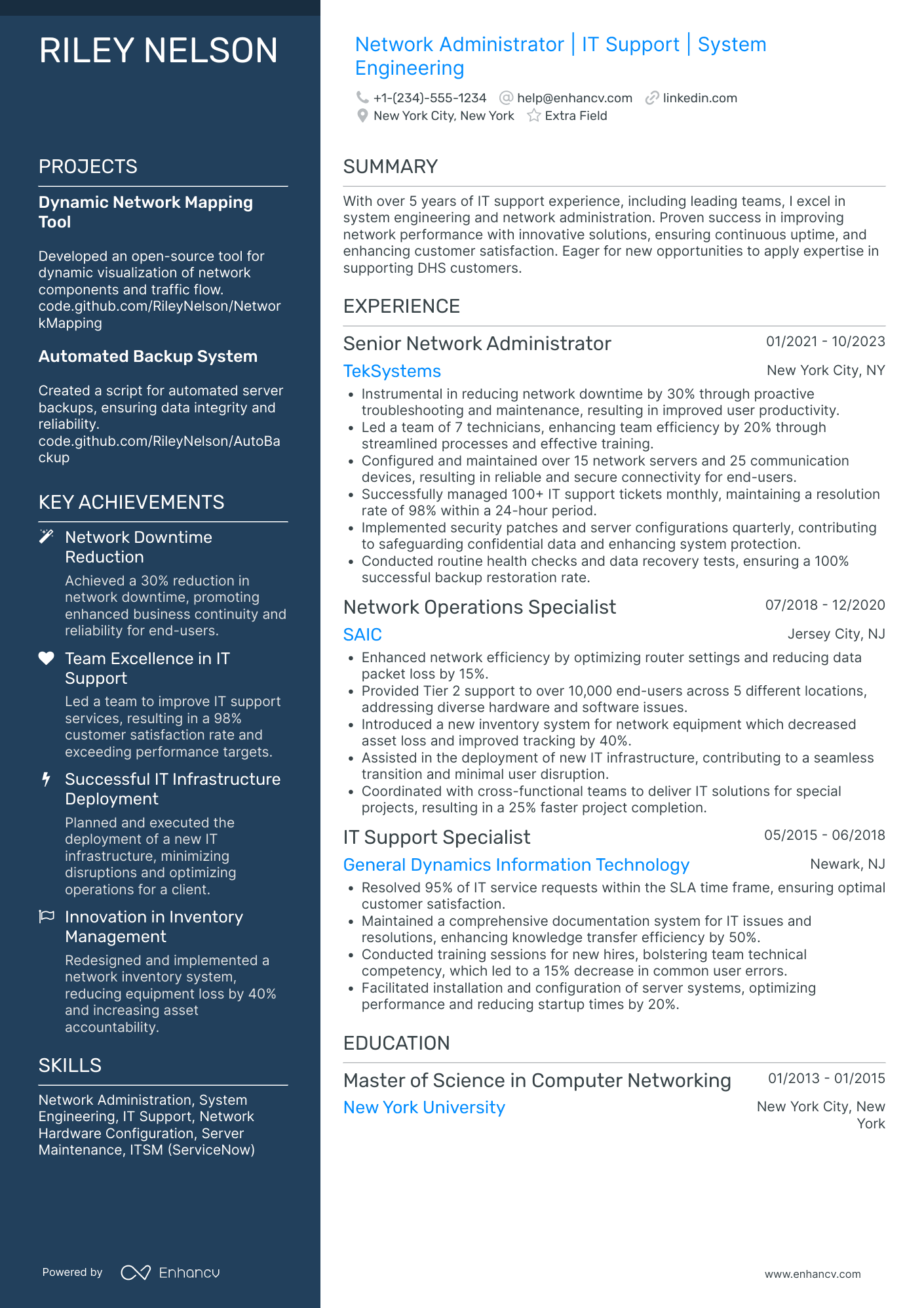
Enterprise Network Administrator
- Describe large-scale WAN/LAN migration projects you led, specifically detailing the number of sites or endpoints that were involved.
- Experience with carrier-grade technologies like MPLS, SD-WAN, or high-speed fiber interconnects and managing relationships with telecommunications vendors is a huge advantage.
- Expertise in managing sophisticated QoS policies is important. Prioritize business-critical traffic, such as VoIP and video conferencing.
- List experience managing centralized configuration and monitoring platforms used to oversee thousands of distributed network devices.
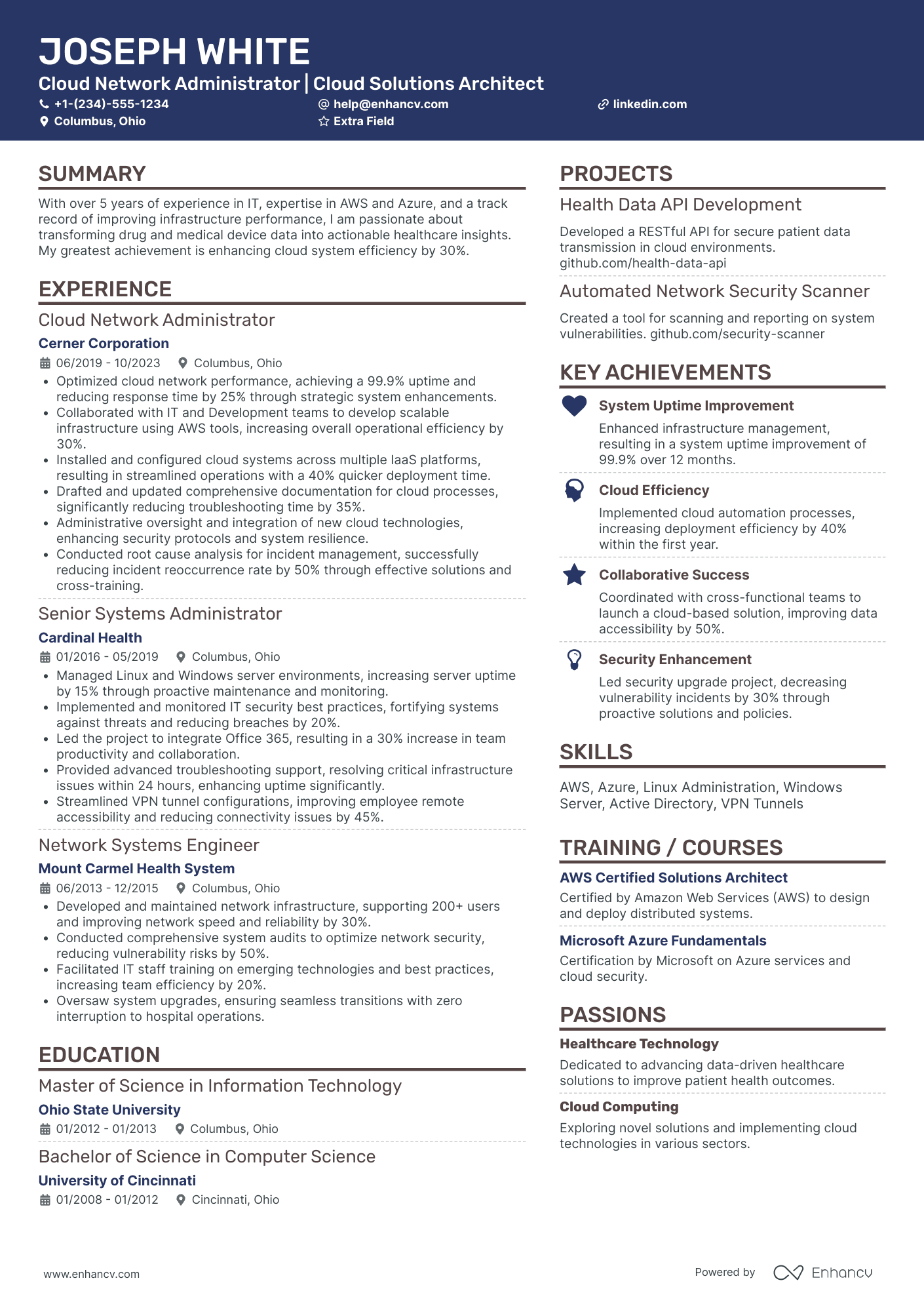
Cloud Network Administrator
- Focus on how you configured and managed virtual private clouds (VPCs), subnets, route tables, and network gateways in major public clouds (e.g., AWS, Azure, GCP).
- Experience with advanced cloud networking services, such as AWS Transit Gateway, Azure Virtual WAN, or GCP Cloud VPN/Interconnect would be considered an advantage.
- It would be great if you can show proficiency in leveraging cloud automation tools (e.g., CloudFormation, Azure Resource Manager).
- In addition, you can list specific projects where you implemented hybrid connectivity solutions.
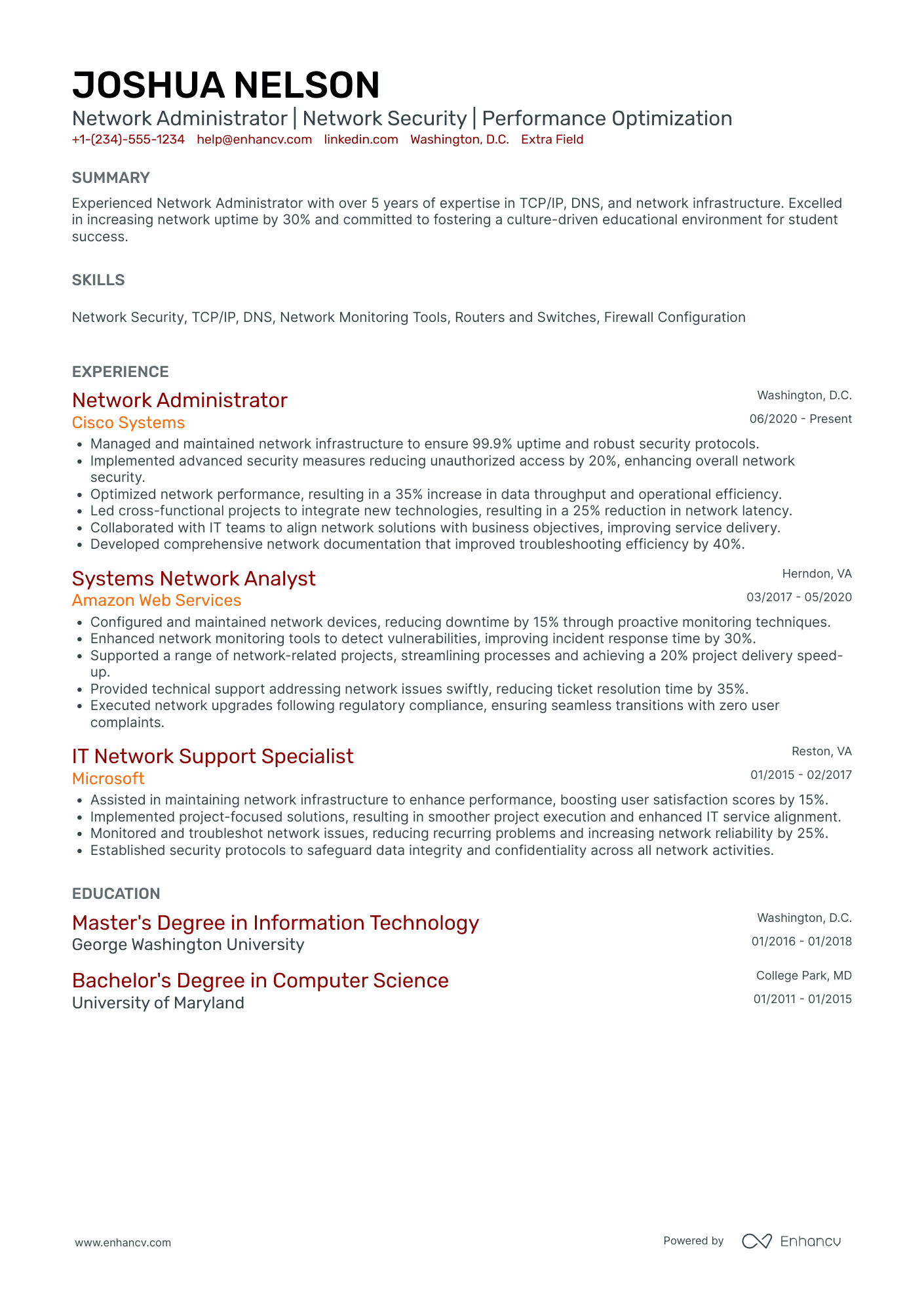
Network Operations Administrator
- Show experience managing incident bridges and coordinating multiple teams (e.g., servers, application, security) to resolve high-severity network outages.
- Emphasize your role in maintaining the health of the network through proactive monitoring.
- Detail your experience creating and optimizing dashboards and reports.
- List successful major change implementations that required rigorous testing.
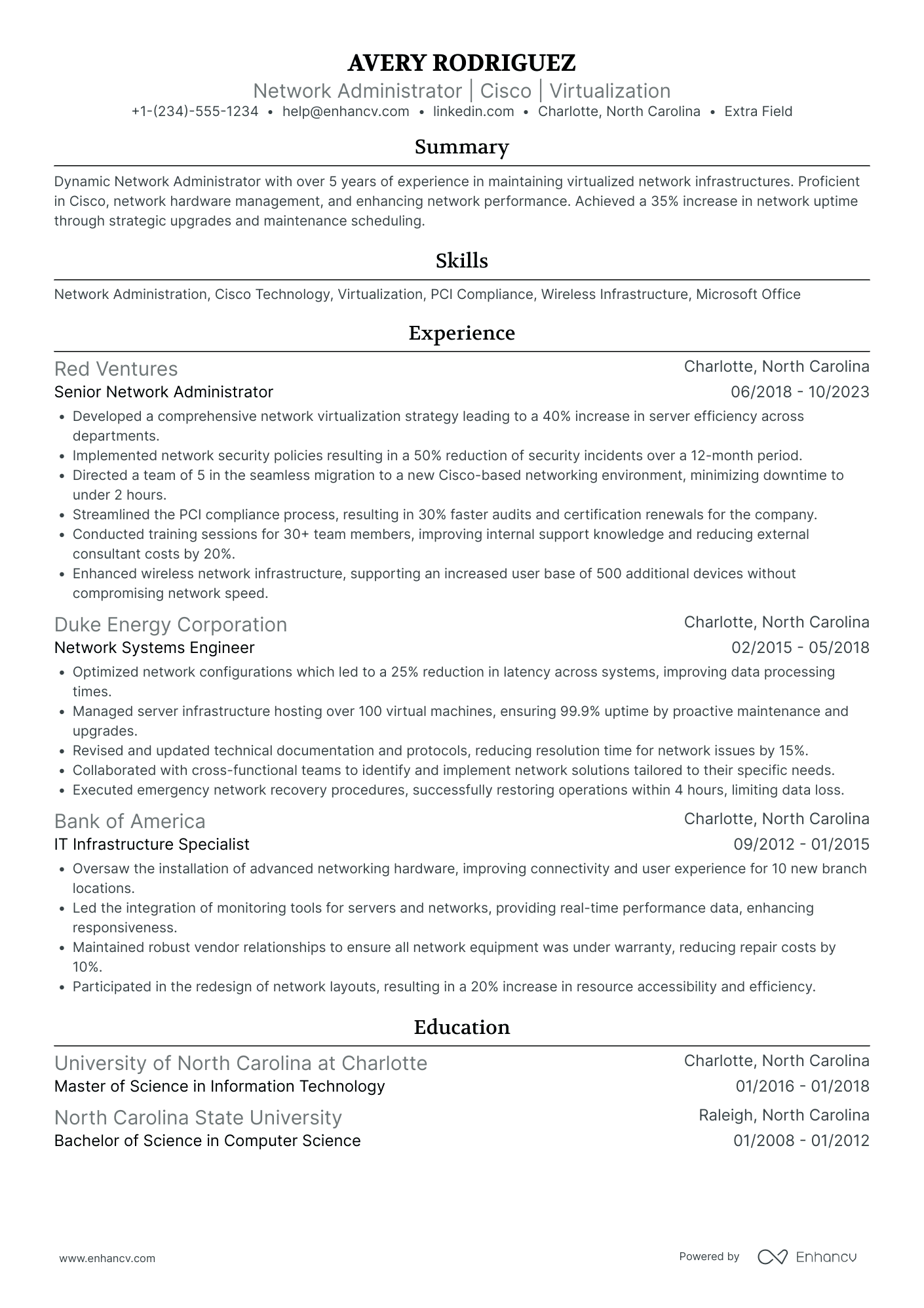
Network Infrastructure Administrator
- List specific experience with load balancing technologies (e.g., F5, Citrix ADC) and configuring complex VIPs, health monitors, and persistence profiles.
- Show proficiency in fiber optic technologies, including fusion splicing, OTDR testing, and managing high-speed (e.g., 40G, 100G) data center fabrics.
- Experience in managing the physical infrastructure, including designing and maintaining data center networks, rack/stack/cabling, and power distribution is a must.
- Deploying and maintaining core services like centralized DNS/DHCP (DDI) solutions (e.g., Infoblox, BlueCat) across the network is non-negotiable.
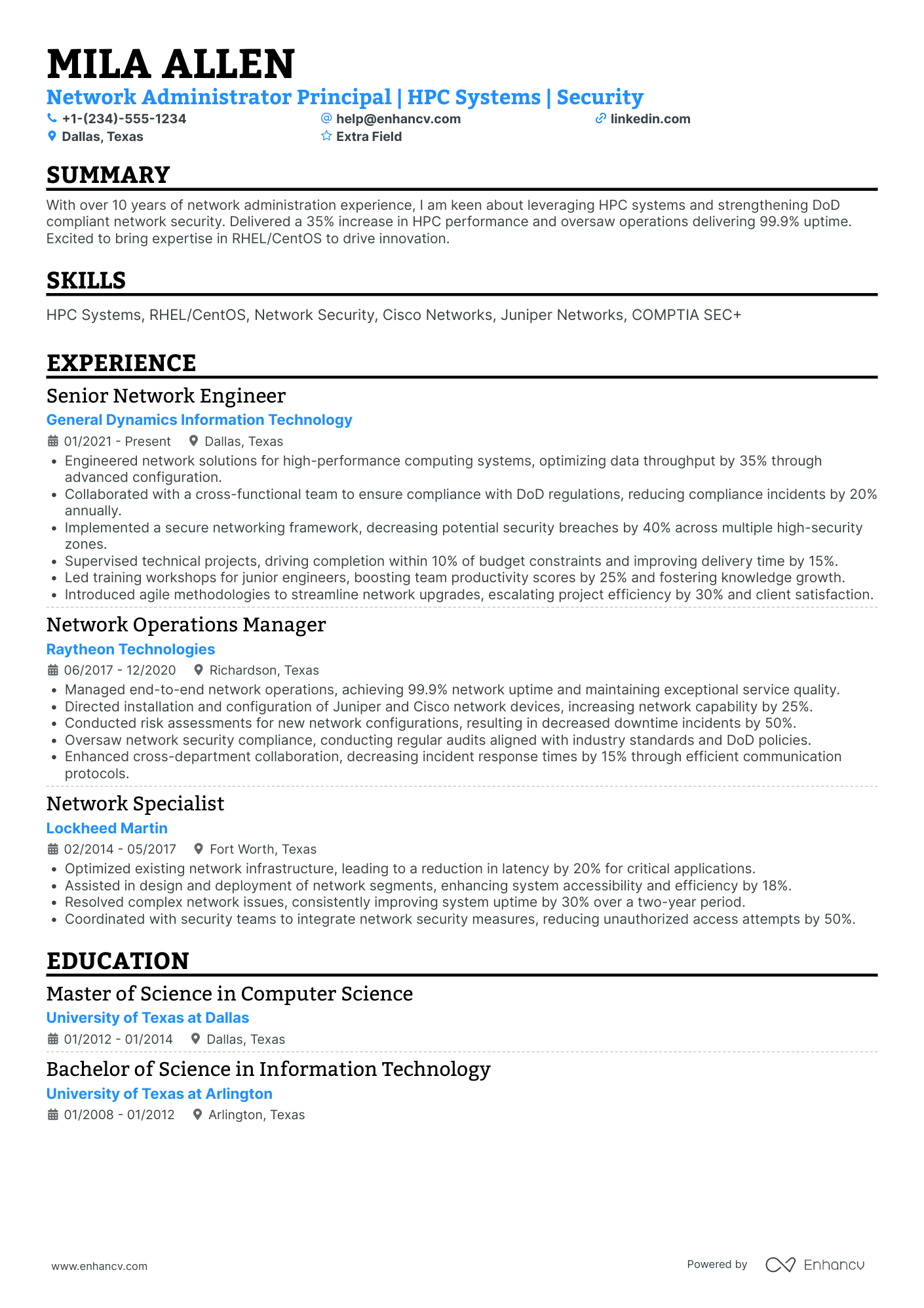
Network Support Administrator
- Emphasize your documentation skills. Reference detailed knowledge articles or troubleshooting guides you created for common network issues.
- List successful resolution of Tier 2 and Tier 3 network tickets. Address the technical complexity of the problems solved (e.g., routing loops, ACL conflicts).
- Focus on customer service and communication skills. Describe how you clearly articulated complex network problems and solutions to non-technical users.
- Detail your participation in on-call rotation schedules. Rapid response to after-hours network incidents will be seen as an advantage by hiring decision-makers.
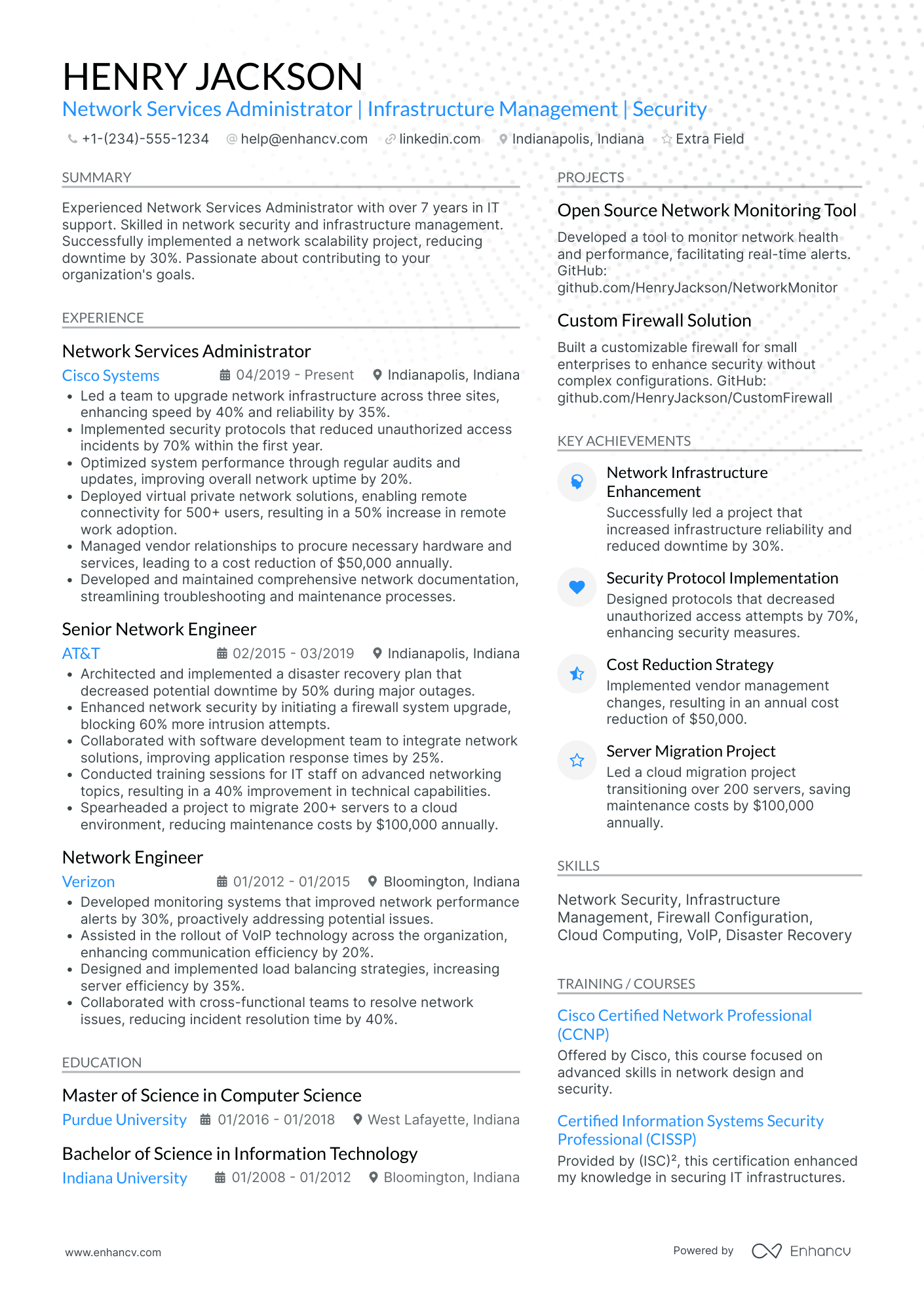
Network Services Administrator
- Detail experience in deploying and optimizing converged network services. Particularly important would be voice over IP (VoIP) or video conferencing platforms across the infrastructure.
- List specific protocols and tools used for network quality assurance. Such include IP SLA, jitter buffers, and traffic shaping for real-time applications.
- Focus on the network stack supporting application delivery. Write about managing firewalls, load balancers, and reverse proxies.
- Show expertise in managing network services. Mention both virtualized and containerized environments (e.g., Kubernetes networking, service mesh configuration).
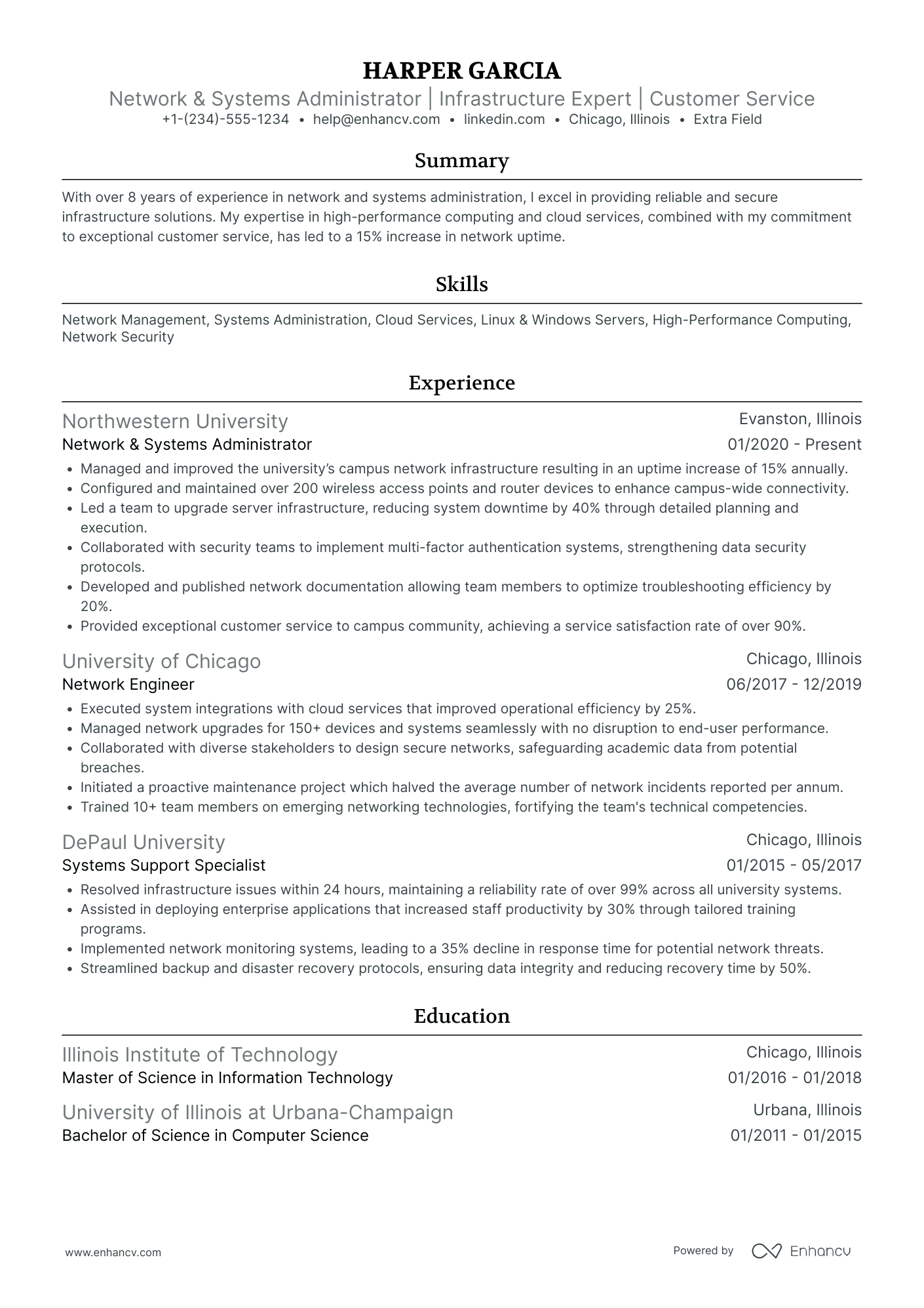
Network and Systems Administrator
- List specific hardware and software inventory management systems you administered for both network devices and compute infrastructure.
- Describe projects where you managed the network device configurations and the corresponding server or application deployments that relied on them.
- Experience writing cross-platform scripts (e.g., Python, PowerShell) that automate maintenance tasks spanning both network and operating systems is an advantage.
- Mention administration of hypervisor networking, including virtual switches, distributed switches, and ensuring proper network isolation for virtual environments.
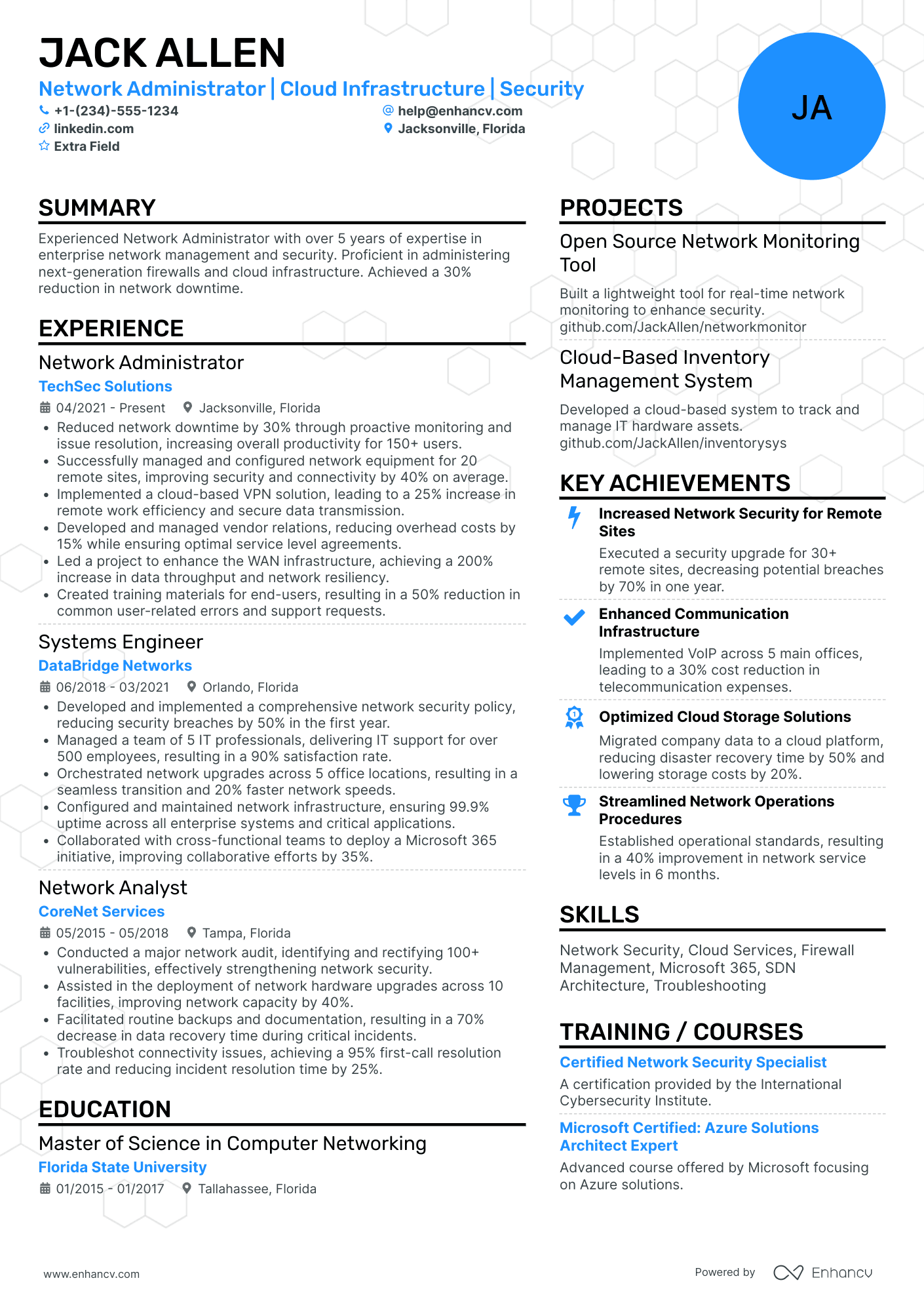
Network Administrator Consultant
- Describe your experience in pre-sales engineering, gathering client requirements, and designing greenfield or overhaul network solutions that cater to specific business needs.
- Showcase your ability to manage multiple concurrent client projects, providing specific examples of deliverables like network design documents or executive summaries.
- Focus on financial aspects. For example generating Bills of Materials (BOMs), calculating ROI for proposed network upgrades, and presenting cost justifications.
- List your skills in network health checks, performance baselining, and providing authoritative recommendations for risk mitigation to external clients.
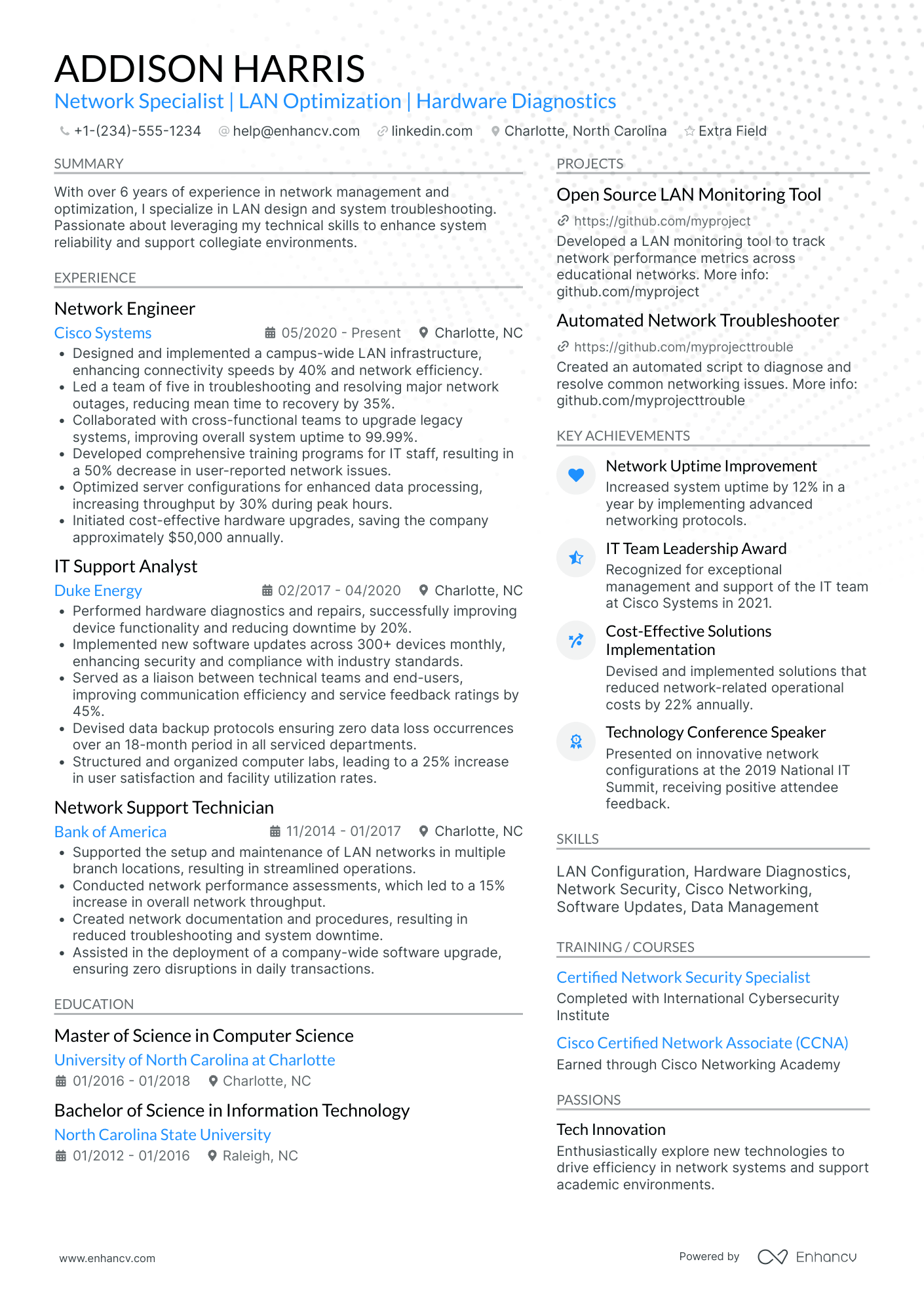
Network Administrator Specialist
- List certifications or training that signify expert-level knowledge in a particular vendor platform or technology (e.g., Cisco CCIE, Juniper JNCI).
- Focus on a specific network niche, such as Software-Defined Networking (SDN) or Network Function Virtualization (NFV).
- Detail your skills in network performance analysis using packet capture tools (e.g., Wireshark) to diagnose elusive Layer 2/Layer 3 issues.
- Show expertise in developing custom monitoring scripts or APIs to pull complex metrics that standard NMS tools cannot provide.
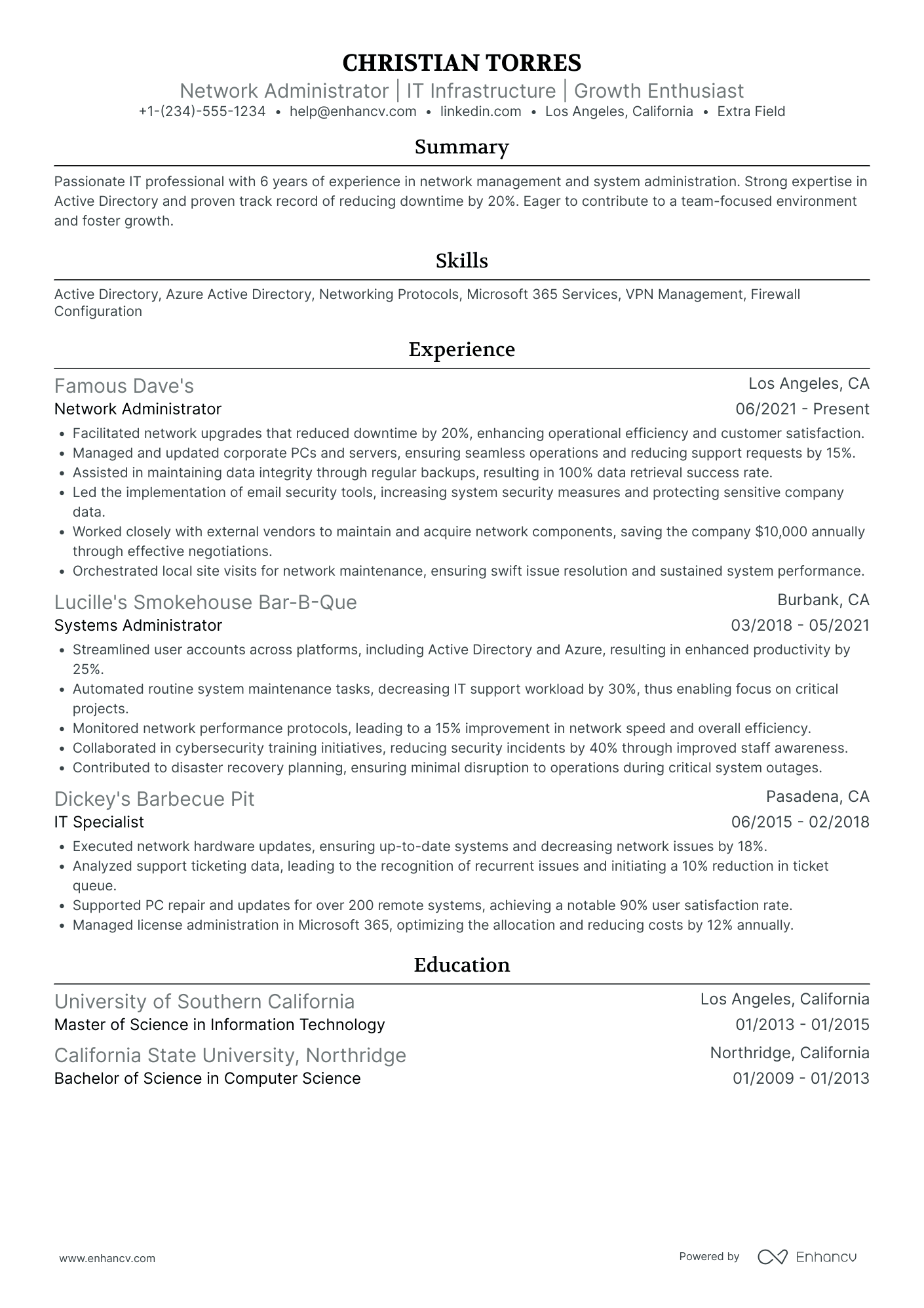
Network Performance Administrator
- Write about projects where you successfully reduced application load times or network latency by a measurable percentage.
- Detail your hands-on experience with advanced packet-loss and jitter mitigation techniques specifically for sensitive traffic like financial transactions or medical imaging.
- Focus on your use of high-end network probes, synthetic transaction monitoring, and other advanced diagnostic tools to preemptively identify bottlenecks.
- List specific optimization techniques you applied to network protocols or configuration settings to maximize the throughput of existing bandwidth.
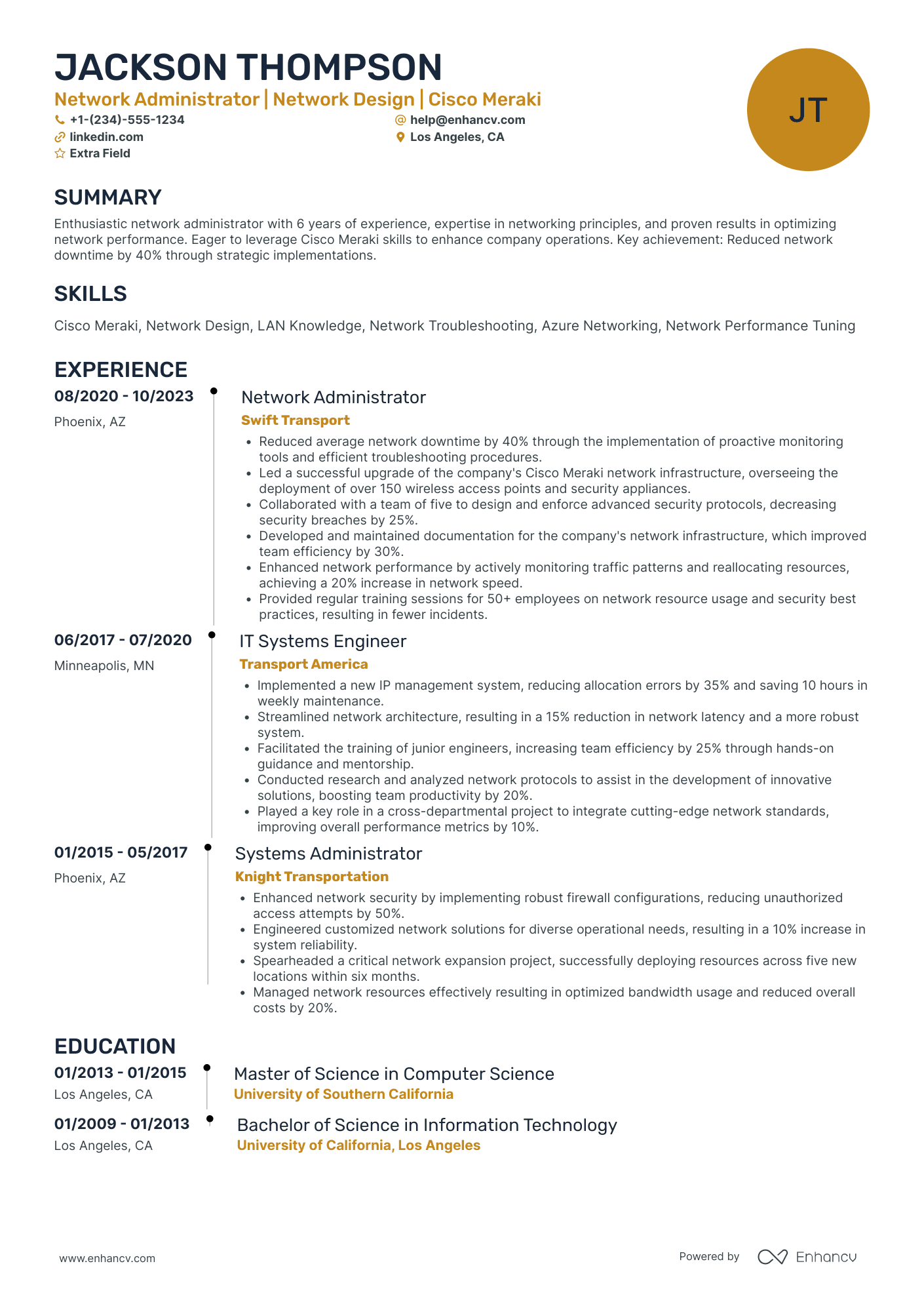
Network Configuration Administrator
- Adherence to change management procedures and your experience in leading the technical review and approval process for network changes play a big part in your resume.
- Detail your use of Network Configuration and Change Management (NCCM) tools (e.g., SolarWinds NCM, RANCID) for automated backups and configuration auditing.
- Experience in developing and maintaining standardized gold configurations or configuration templates across different models and vendors of network gear will be seen as an advantage.
- Showcase your ability to perform configuration compliance checks against mandated security or internal policy baselines.
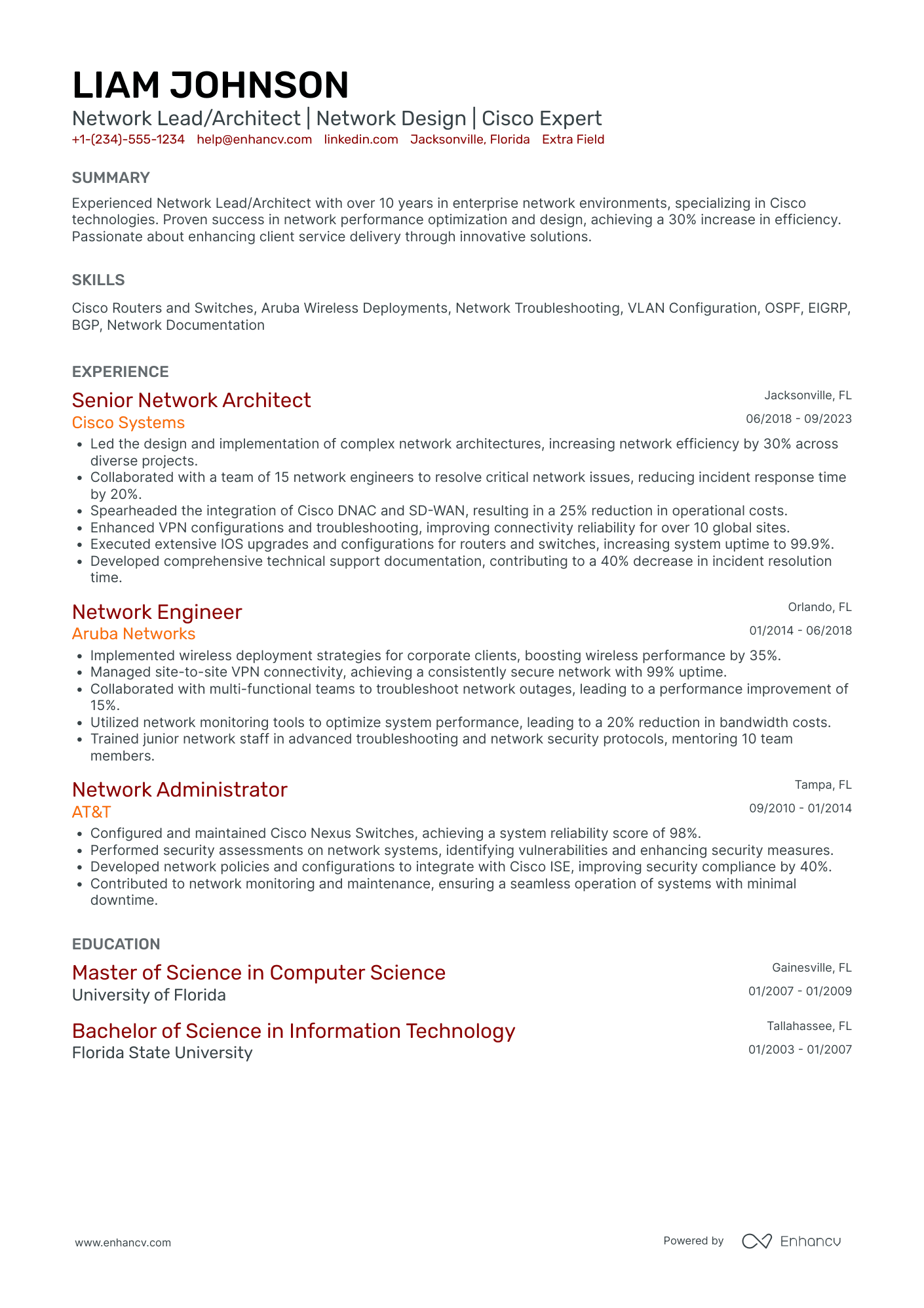
Network Architecture Administrator
- Focus on showcasing mastery of diagramming tools (e.g., Visio, draw.io) to create clear, multi-layered documentation of complex network topologies.
- Involvement in translating high-level business requirements into deployable, low-level network design documents and diagrams is seen as an advantage by recruiters.
- Specific experience selecting new network technologies or vendors after conducting extensive market research, proof-of-concept testing, and capacity modeling would boost your chances.
- You can also describe projects where you designed network segmentation (e.g., micro-segmentation, isolated DMZs) to meet Zero Trust principles.
Which resume format should a network administrator use?
If you’ve held recent hands-on infrastructure roles, then use a reverse-chronological format.
If you’re a recent graduate or moving from help desk/system admin, a hybrid format allows you to front-load certifications, lab projects, and toolstack while keeping your experience scan-friendly.
Avoid using a purely functional format—it’s best to present change control, incident history, and environment scope through chronological accountability.
What sections should go on a network administrator’s resume?
- Resume header (name, cert post-nominals like CCNA/Network+, location, contact, LinkedIn/GitHub or homelab)
- Summary (years of experience, one or two quantified accomplishments, two or three soft skills mentioned)
- Work Experience (three to six bullets each: scope, tech, impact—uptime %, MTTR, tickets/week, sites/users supported)
- Skills section (routing/switching, firewalls, wireless, cloud networking, monitoring, automation, troubleshooting)
- Education (degree, institution, graduation year, GPA if above 3.5)
- Certifications (CCNA/CCNP, CompTIA Network+/Security+, JNCIA-Junos, AWS SysOps or Azure Administrator, ITIL)
- Projects & Labs (IaC, topology diagrams, On-call/Incident Playbooks)
Is your resume good enough?
Drop your resume here or choose a file. PDF & DOCX only. Max 2MB file size.
Now that you know what you need on your resume, let’s see how to write it well.
How to write your network administrator resume experience
In network administration, it is all about keeping systems stable, secure, and scalable—your experience section should reflect exactly that.
IT recruiters scan for impact in measurable terms, such as:
- Uptime percentages
- Network size
- Users supported
- Incident response efficiency
Each bullet in your experience section should show how your technical actions drove reliability and business continuity.
For example, if you’ve listed one of your responsibilities such as “Managed company routers and switches,” use metrics to make it tangible:
“Configured and maintained Cisco routers across 12 branch offices, sustaining 99.98% uptime and reducing latency by 20%.”
Here’s a step-by-step breakdown:
- Focus on your achievements in network performance, cybersecurity collaboration, and automation.
- Mention technologies and environments such as firewalls (Fortinet, Palo Alto), monitoring systems (SolarWinds, Nagios), virtualization (VMware, Hyper-V), and cloud networking (AWS, Azure).
- Use action verbs for stronger impact, like optimized, implemented, mitigated, deployed, secured, etc.
- Have three to six bullet points per role, focusing on outcomes that translate technical reliability into organizational trust.
Good example of a network administrator experience section
Network Administrator
Horizon Data Systems | Austin, TX
June 2019 – Present
- Administer and maintain LAN/WAN infrastructure supporting 1,800+ users across 6 locations with consistent 99.99% uptime.
- Deploy new Cisco Meraki firewalls and switches, reducing network latency by 25% and improving data throughput.
- Implement automated monitoring and alerting using SolarWinds and Python scripts, cutting incident response time by 35%.
- Collaborate with cybersecurity and DevOps teams to harden access controls, perform vulnerability assessments, and achieve SOC 2 compliance.
- Migrate legacy on-prem servers to AWS VPC, enhancing scalability and reducing annual maintenance costs by $40,000.
- Mentor junior technicians on troubleshooting, ticket prioritization, and change management best practices.
How to tailor your network administrator resume experience
Recruiters and applicant tracking systems (ATS) evaluate how your resume meets the job description. You become relevant to the hiring organization when your bullet points mention the exact technologies, tools, and outcomes found in the ad.
Tailoring your resume ensures your experience matches what the employer values most. Whether that’s large-scale infrastructure management, network security, or cloud integration.
Here are the best ways to tailor your network administrator resume experience:
- Use the same network management tools and monitoring systems listed (SolarWinds, Wireshark, Nagios, or Zabbix).
- Highlight environments and scales similar to theirs (enterprise, multi-site, hybrid cloud, or data center).
- Show results the employer can measure (uptime, MTTR, throughput optimization, or reduced incident volume).
- Include relevant compliance or security frameworks (SOC 2, ISO 27001, or NIST).
- Quantify impact using the same metrics they reference (percentages, endpoints managed, response time improvements).
Here’s a real job ad excerpt. Mind the technologies, network scale, security priorities, and performance metrics the employer cares about.

Network administrator description from a real posting
We’re seeking a Network Administrator to support a hybrid cloud infrastructure spanning AWS and on-prem data centers. The ideal candidate will manage Cisco and Palo Alto devices, implement network segmentation, and maintain 99.99% uptime across all corporate sites. Experience with automation tools like Ansible or PowerShell is a plus. Familiarity with monitoring platforms such as SolarWinds and knowledge of security frameworks (SOC 2, NIST) preferred.
Here’s how to turn weak bullet points into high-impact, tailored achievements that directly match the job description.
Resume tailoring examples for network admins
| Job description excerpt | Untailored bullet | Tailored bullet |
|---|---|---|
| Manage Cisco and Palo Alto devices. | Managed network hardware and firewalls for company sites. | Configured and maintained Cisco 9300 switches and Palo Alto NGFWs across 6 branch offices, improving throughput and segmentation efficiency. |
| Maintain 99.99% uptime across all corporate sites. | Responsible for keeping the company network online. | Monitored and optimized LAN/WAN performance, sustaining 99.98% uptime across multi-site infrastructure through proactive maintenance and redundancy planning. |
| Hybrid cloud infrastructure spanning AWS and on-prem data centers. | Supported company servers and network connections. | Managed hybrid AWS–on-prem infrastructure, deploying secure IPsec VPNs between data centers and cloud environments to ensure consistent connectivity. |
| Implement network segmentation. | Separated departments into different networks for security. | Designed and implemented VLAN-based segmentation to isolate production, guest, and development traffic—reducing broadcast traffic by 18% and improving security posture. |
| Experience with automation tools like Ansible or PowerShell. | Used scripts to automate some tasks. | Built Ansible playbooks to standardize switch configuration and automate nightly backups, cutting manual maintenance time by 40%. |
| Monitoring platforms such as SolarWinds. | Monitored network performance and alerts. | Utilized SolarWinds and Wireshark for continuous performance monitoring, reducing average incident detection time by 30%. |
| Knowledge of security frameworks (SOC 2, NIST). | Familiar with security standards. | Applied SOC 2 and NIST SP 800-53 controls to network configuration policies, strengthening compliance and audit readiness. |

PRO TIP
Use Enhancv’s one-click tailoring feature to automatically match your bullet points, skills, and sections to any job description.
The next step is to prove the positive impact you bring with metrics that companies care about.
How to quantify your network administrator resume experience
Make your technical impact tangible by using numbers in your resume. Recruiters and IT leads will quickly trust you if you translate configuration work into measurable results.
To make your bullet points even more effective, include:
- Action verbs
- Tools or technologies
- Quantifiable outcomes
This is how you show your work improved uptime, reduced incidents, or strengthened security. Even if you haven’t tracked everything precisely, estimate realistic performance gains or cost savings.
Network administrator quantified achievements
| How to quantify | Example bullet point |
|---|---|
| 1. Demonstrate network scale and uptime | “Administered LAN/WAN infrastructure supporting 1,800+ users across five locations, maintaining 99.99% uptime through proactive monitoring and redundancy planning.” |
| 2. Show performance or cost optimization | “Redesigned routing topology and bandwidth allocation, reducing latency by 22% and cutting monthly ISP costs by $14K.” |
| 3. Highlight incident response efficiency | “Resolved critical network outages with an average MTTR of 20 minutes, improving service restoration speed by 35%.” |
| 4. Quantify automation impact | “Deployed Ansible-based configuration automation, eliminating manual switch updates and saving 10 staff hours weekly.” |
| 5. Prove security and compliance results | “Implemented firewall rule audits and VPN hardening aligned with SOC 2 standards, reducing unauthorized access attempts by 40%.” |
Metrics in your resume are a strong sign of accountability. Use them to transform regular responsibilities into evidence of expertise and results.
Not sure how to phrase your bullet points? With Enhancv’s AI Bullet Point Generator, you can quickly turn standard network administration tasks into metrics-driven statements. Just enter your role and key responsibilities—the integrated AI generates tailored bullets in seconds.
How to list your technical skills on your network administrator resume
As an experienced network administrator, place a dedicated technical skills section after your work history.
If you’re entry-level, or transitioning into IT, then put your skills near the top of your document to reassure recruiters.
Here are the core technical abilities top network administrators exhibit.
Best hard skills for your network administrator resume
- Network design and topology planning
- Routing and switching (Cisco, Juniper, HP)
- Firewall configuration and management (Palo Alto, Fortinet)
- VPN and remote access setup
- Cloud networking (AWS, Azure, GCP)
- Network monitoring and diagnostics (SolarWinds, Nagios, Wireshark)
- Automation and scripting (Ansible, PowerShell, Python)
- Virtualization (VMware, Hyper-V)
- Wireless networking and security
- Disaster recovery and redundancy planning
- Compliance frameworks (SOC 2, NIST, ISO 27001)
- Identity and access management (Active Directory, LDAP)
- Incident response and change control
- Load balancing and bandwidth optimization
- Documentation and topology mapping tools (Visio, Lucidchart)
How to integrate your soft skills into a network administrator resume
Soft skills are best presented through actions. Place communication, teamwork, and problem-solving within your summary or experience section.
Connect them to measurable results—like faster issue resolution, smoother cross-team collaboration, or improved system reliability.
Best soft skills for your network administrator resume
- Analytical thinking
- Problem-solving under pressure
- Communication and collaboration
- Time management
- Attention to detail
- Adaptability to new technologies
- Customer service mindset
- Multitasking
- Documentation and knowledge sharing
- Accountability and reliability
The next step is to detail your educational background and qualifications so recruiters can quickly confirm you’re competent in managing network infrastructure.
How to list certifications and professional licenses
Certifications and licenses are highly important for network administrators. Nowadays, employers focus on verified technical competence and security compliance over purely academic credentials.
List each certification with:
- Full title
- Issuing organization
- Year obtained
Example: Cisco Certified Network Associate (CCNA), 2023
This transparency confirms that your credentials are current.
If you hold region- or vendor-specific credentials, include them as well. These prove your readiness to operate within the organization’s exact technical ecosystem.
Best certifications for your network administrator resume
How to list your education on your network administrator resume
Your education and certifications verify that you have the technical foundation and credentials to manage complex IT environments.
Keep your education section concise, including:
- Degree
- Institution
- Location
- Year of graduation
State your GPA if it’s 3.5 or higher or if you’re a recent graduate.
Education entry sample
Bachelor of Science in Information Technology | University of California, Berkeley, 2018
Associate of Applied Science in Network Systems Administration | Austin Community College, 2016, GPA: 3.8
If you’re early in your career, then you can expand your education section to back up your qualifications.
Mention relevant coursework such as:
- Network Security
- Systems Administration
- Cloud Computing
- Data Communications
Now let’s see how to write one of the smallest but highly impactful resume sections.
How to write your network administrator resume summary
Use your resume summary to quickly point out that you’re more than technically capable—you’re efficient, dependable, and business-impact driven.
It should exude technical command, reliability, and mention measurable results you deliver through network performance, security, and uptime.
This section can make or break your resume, so keep it focused, confident, and outcome-oriented.
A strong network administrator resume summary includes:
- Current role and years of experience
- Environment type or specialization (enterprise, cloud, security, or data center)
- Key technologies and tools
- One to two quantified results
- Soft skills connected to real outcomes
Example summary
Network administrator with 5+ years of experience managing enterprise LAN/WAN and hybrid cloud environments. Proficient in Cisco, Juniper, and Palo Alto systems, network automation with Ansible, and performance monitoring through SolarWinds. Proven track record of maintaining 99.99% uptime, reducing latency by 20%, and implementing secure, scalable infrastructures that align with business objectives.
Why it works:
The example establishes experience level, technical specialization, and proficiency with industry-standard tools. It shows measurable impact through quantified performance outcomes—uptime, latency reduction, and scalability.
It’s best to write in first person without pronouns. For example, “Implemented automated monitoring with Ansible” instead of “I implemented.” This way, your summary feels confident and focused.
Perfect your network administrator resume summary for clarity, impact, and ATS success.
Drop your resume here or choose a file.
PDF & DOCX only. Max 2MB file size.
We covered how to approach resume writing from a position of experience. But you can have a compelling application even if you’re just starting your network administration career.
How do I write a network administrator resume with no experience?
Even without years in an IT environment, you can build a persuasive resume by focusing on your technical readiness for system reliability.
Shift the focus to your coursework, certifications, and practical skills gained through academic projects, homelabs, or volunteer IT work. This way, you show foundational knowledge and commitment to professional growth.
What to include in place of full-time network administration experience:
- Certifications and training: List relevant credentials (Network+, CCNA, Azure Administrator, etc.) to show verified technical ability.
- Academic projects or labs: Detail simulated environments, network topologies configured, and tools used (e.g., Cisco Packet Tracer, GNS3, or VMware).
- Internships or IT support roles: Highlight troubleshooting, device setup, and ticket resolution to show transferable experience.
- Personal or homelab projects: Describe how you configured routers, built virtual networks, or automated backups to demonstrate initiative.
- Volunteer IT support: Include examples of helping nonprofits or schools with connectivity, hardware, or network upgrades.

Resume format tip for entry-level network administrators
A hybrid resume format works best when you don’t have direct experience. Place your technical skills, certifications, and education at the top, followed by any practical experience from internships, lab projects, or volunteer IT work. This structure helps you appear job-ready by showcasing verified technical ability and hands-on exposure.
This concludes the essential resume guidance but we can’t leave anything out so let’s go over the details as well.
Frequently asked questions about network administrators and job applications
Let’s go over common concerns of network administrators about resume formatting, cover letters, and other best practices.
What should your network administrator resume header include?
Have your full name, professional title, phone number, and email address.
Kirby Swanson | Network Administrator
(303) XXX-0184 | kirby.swanson@email.com | linkedin.com/in/kirbyswanson | Austin, TX
Include your LinkedIn profile link if it’s current—make sure your work history and certifications match your resume.
If you maintain a GitHub, portfolio site, or homelab documentation, include that too to show your hands-on ability and initiative.
What design rules should you follow for a network administrator resume?
Here’s how to keep your resume professional and ATS-friendly:
- Use 1-inch margins, single spacing, and a 10–12 pt resume-friendly font (Arial, Rubik, Montserrat).
- You can have subtle accent colors on your resume to make it pop out.
- Avoid heavy graphics as they make your document visually busy and could confuse ATS.
- Export as a PDF file to preserve layout across devices and applicant tracking systems.
How should you save and name your network administrator resume file?
Go for a clear file name to make your resume easily searchable within ATS and email systems.
Example: henry_steinberg_network_administrator.pdf
What should a network administrator cover letter include?
Use your cover letter to connect with employers on a personal level by telling your career story.
Focus on:
- Why you’re drawn to that specific organization or IT environment.
- How your approach to network security, automation, or uptime management improves reliability.
- Expand context around one or two quantified results from your resume.
You can create one tailored to your resume using Enhancv’s Cover Letter Generator.
Drop your resume here or choose a file.
PDF & DOCX only. Max 2MB file size.
How do I show career progression on a network administrator resume?
If you’ve advanced from support or junior admin roles to senior responsibilities, structure your experience chronologically and focus on:
- Expansion of system scope (e.g., from local network to enterprise or hybrid cloud).
- Leadership in deployments, migrations, or security initiatives.
- Quantified performance outcomes like uptime improvements or reduced downtime.
Use metrics in each role to make your growth tangible.
What additional sections work well on a network administrator resume?
Stick to sections that support your technical expertise, such as:
- Projects (network upgrades, automation scripts, or security audits).
- Professional Memberships (CompTIA IT Pro, ISACA, or IEEE).
- Awards or Achievements for performance or innovation in IT operations.
Do I need specific certifications to work as a network administrator in the U.S.?
Yes. While not legally required, most employers expect or prefer credentials like CompTIA Network+, Cisco CCNA, or Microsoft Azure Administrator Associate. Security-focused environments may also require Security+, CCNP, or ITIL Foundation certifications.

How much do network administrators earn, and should salary expectations appear on the resume?
As of October 2025, the U.S. Bureau of Labor Statistics reports a $96,800 median annual wage (May 2024) for network and computer systems administrators. Employment is projected to grow 2% from 2023 to 2033—according to the BLS Occupational Outlook Handbook.
You should not include salary expectations on your resume, but knowing these figures helps you benchmark value and frame achievements in terms of efficiency and cost savings.
In conclusion: Technical excellence and accountability are key
Your resume should be like a well-managed network: structured and optimized for performance. Quantify your impact, align your experience with the company’s environment, and prove your value through measurable outcomes.
PRO TIP
Further your professional journey with Enhancv’s free AI Resume Builder. You can create a personalized, ATS-ready network administrator resume and impress any recruiter with your technical skills, certifications, and reliability.