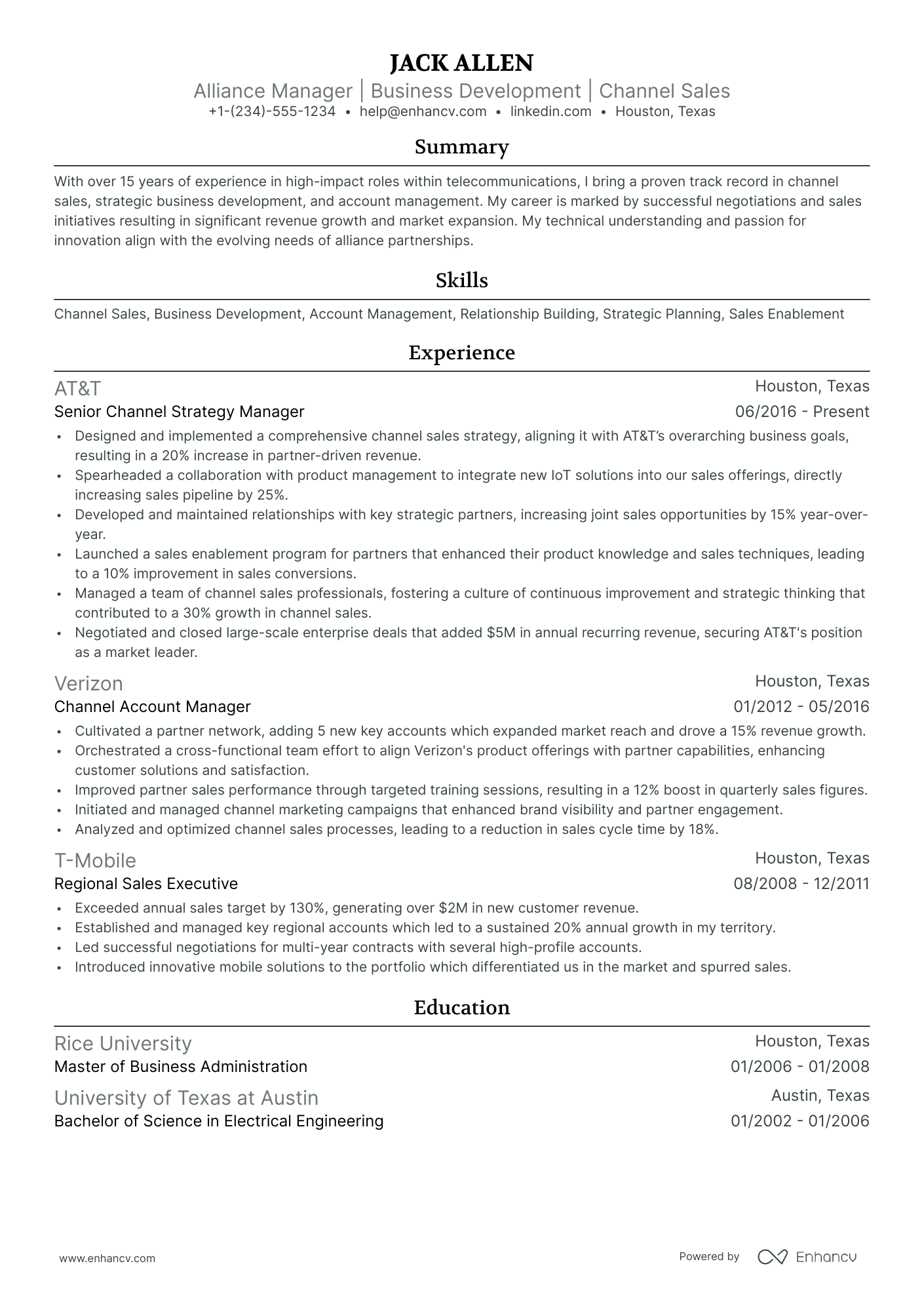
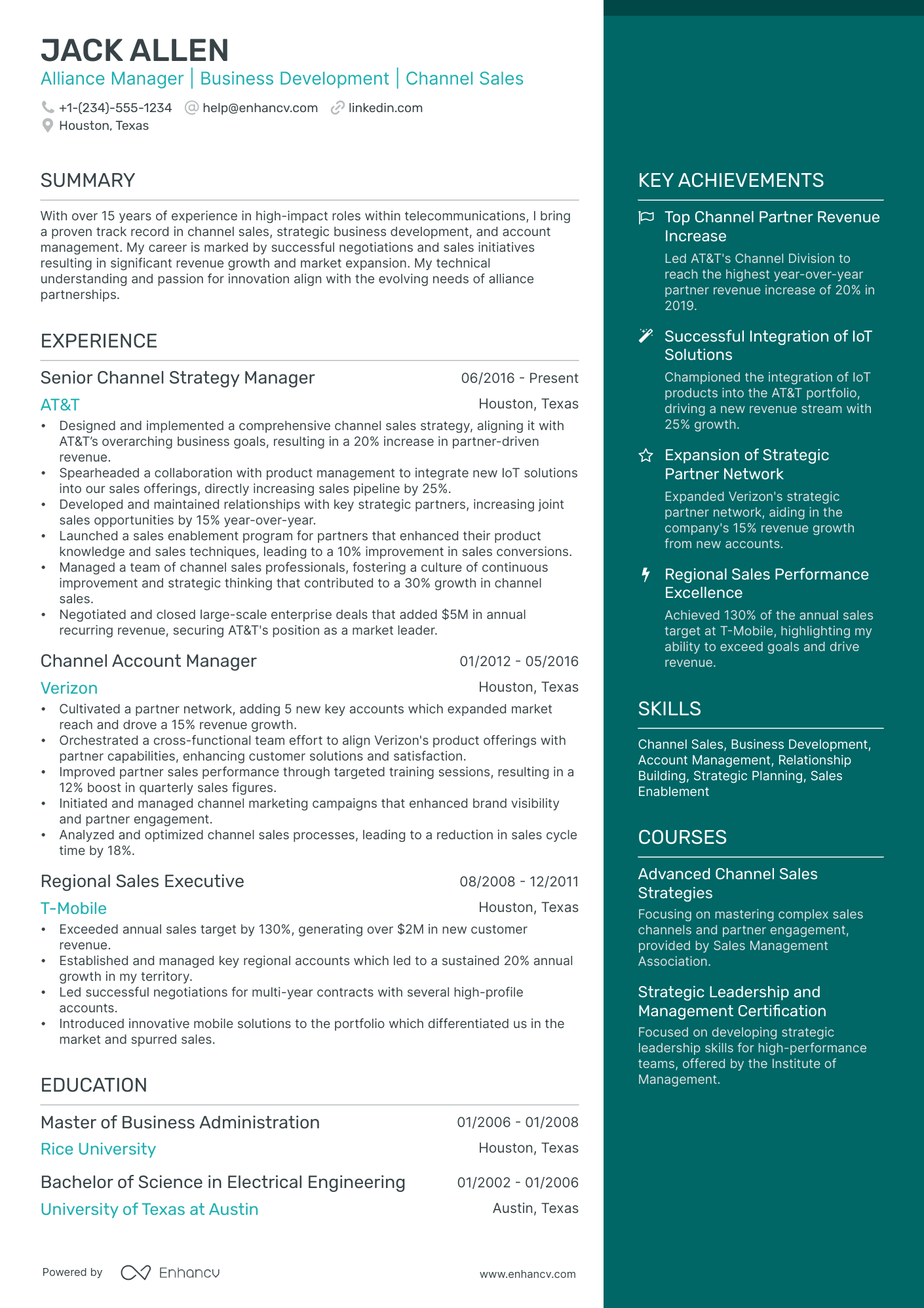
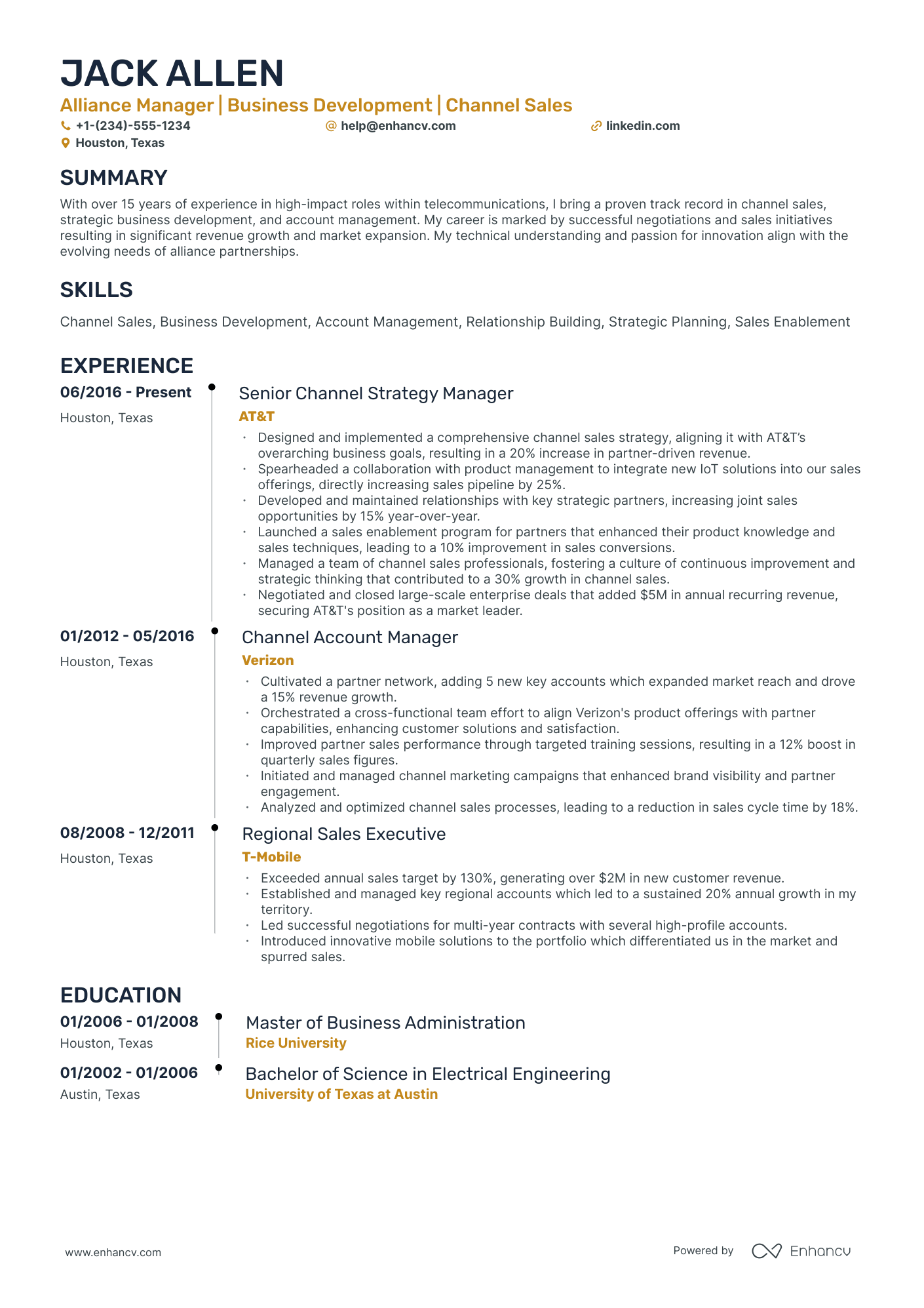
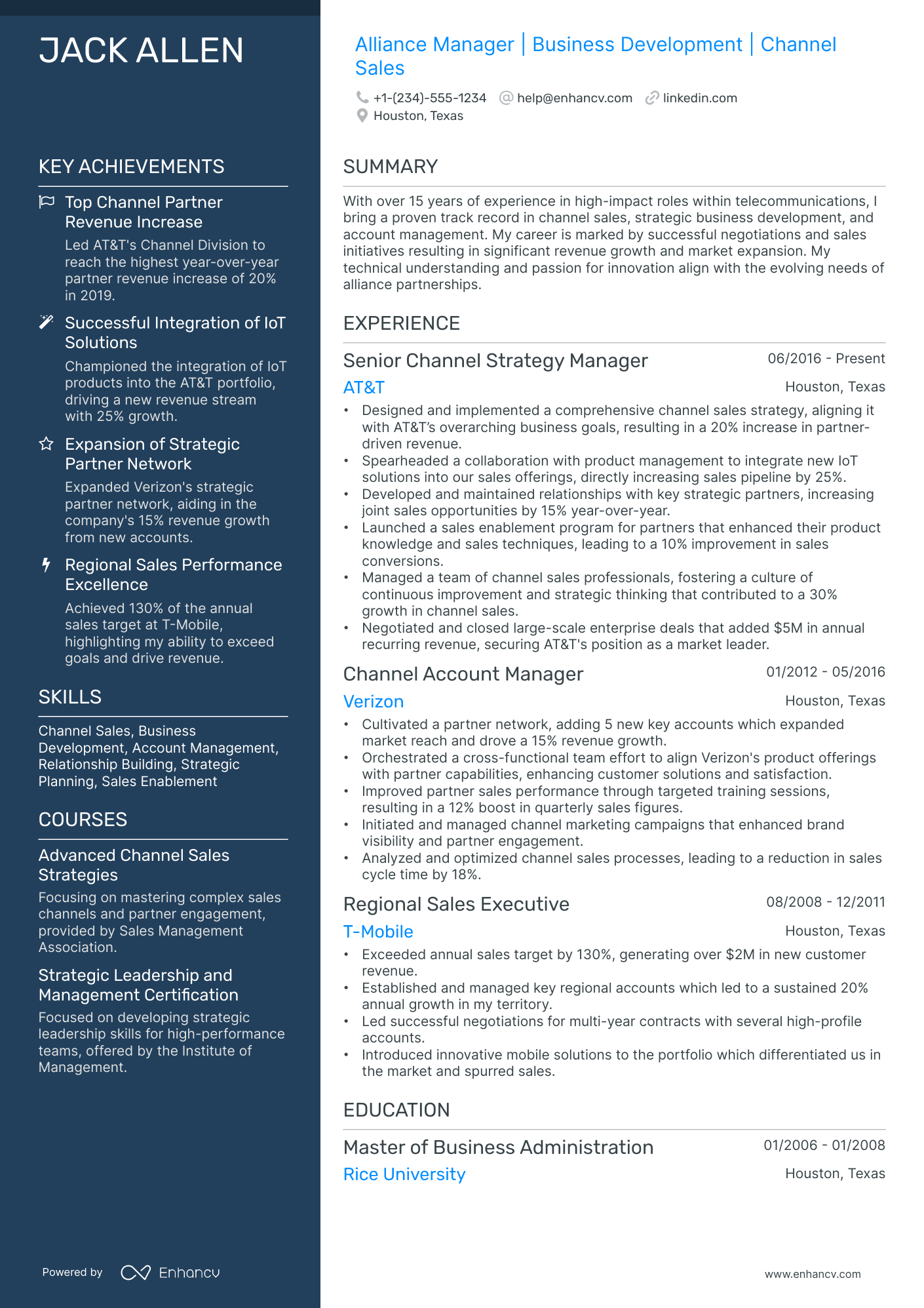
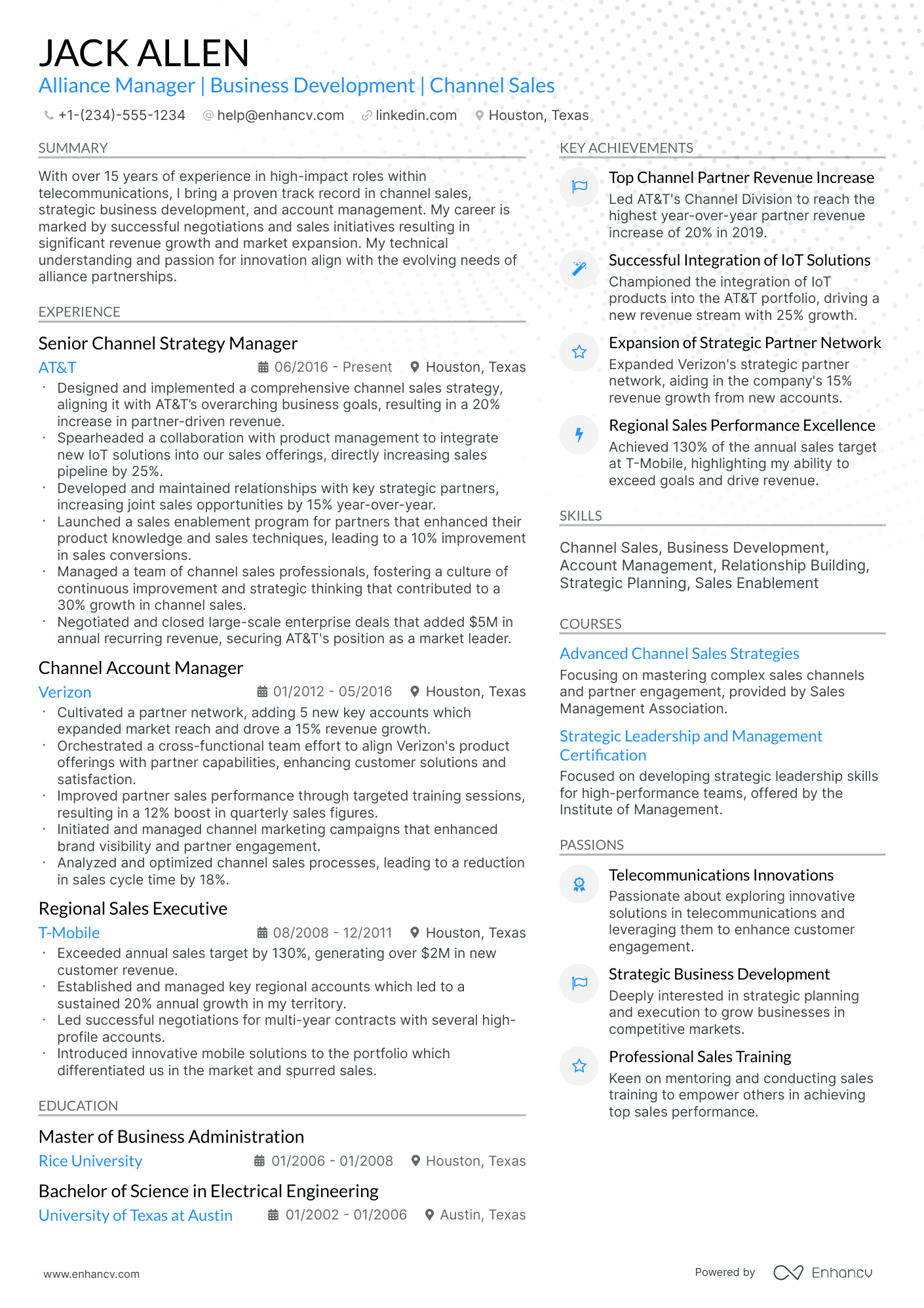
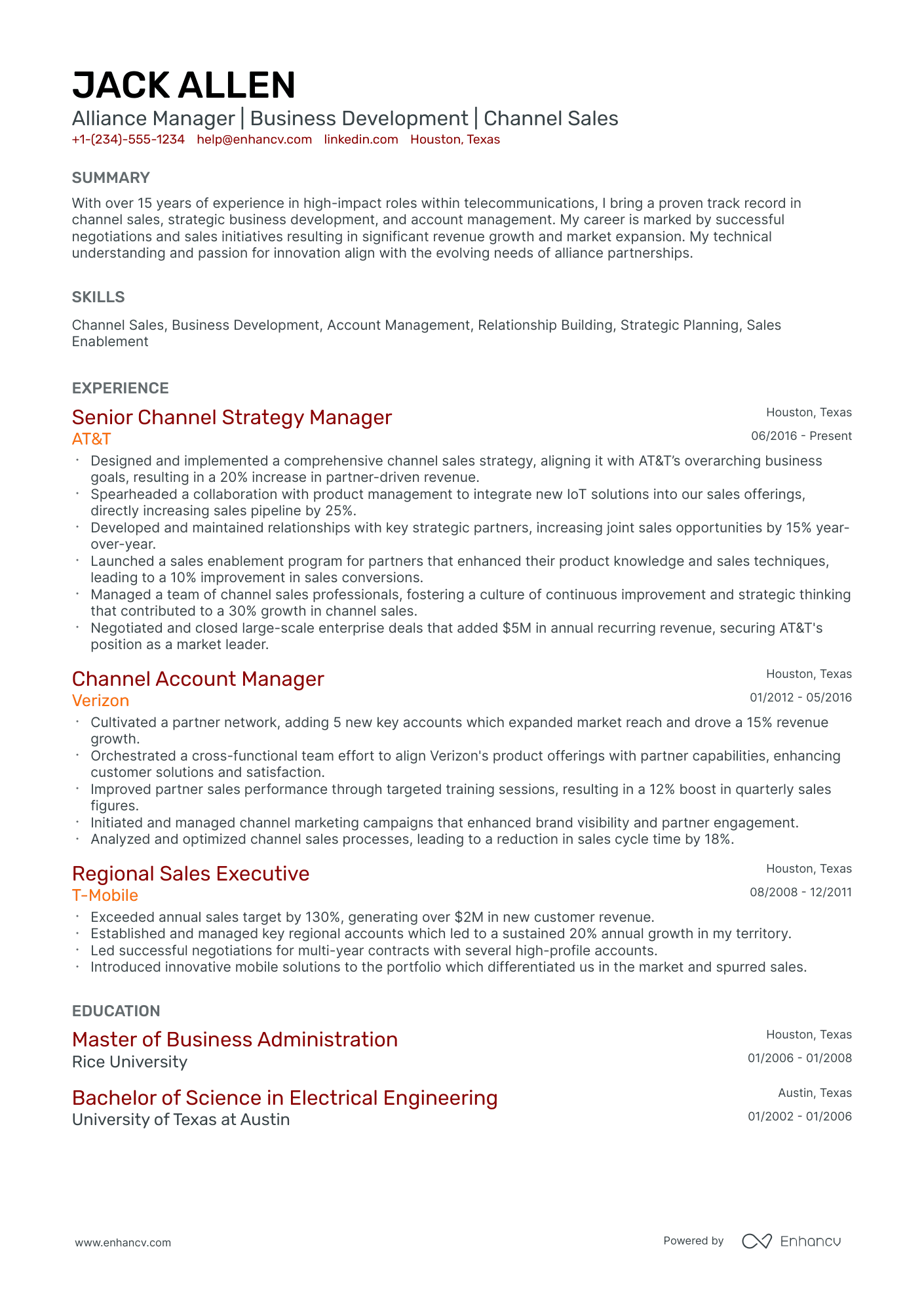
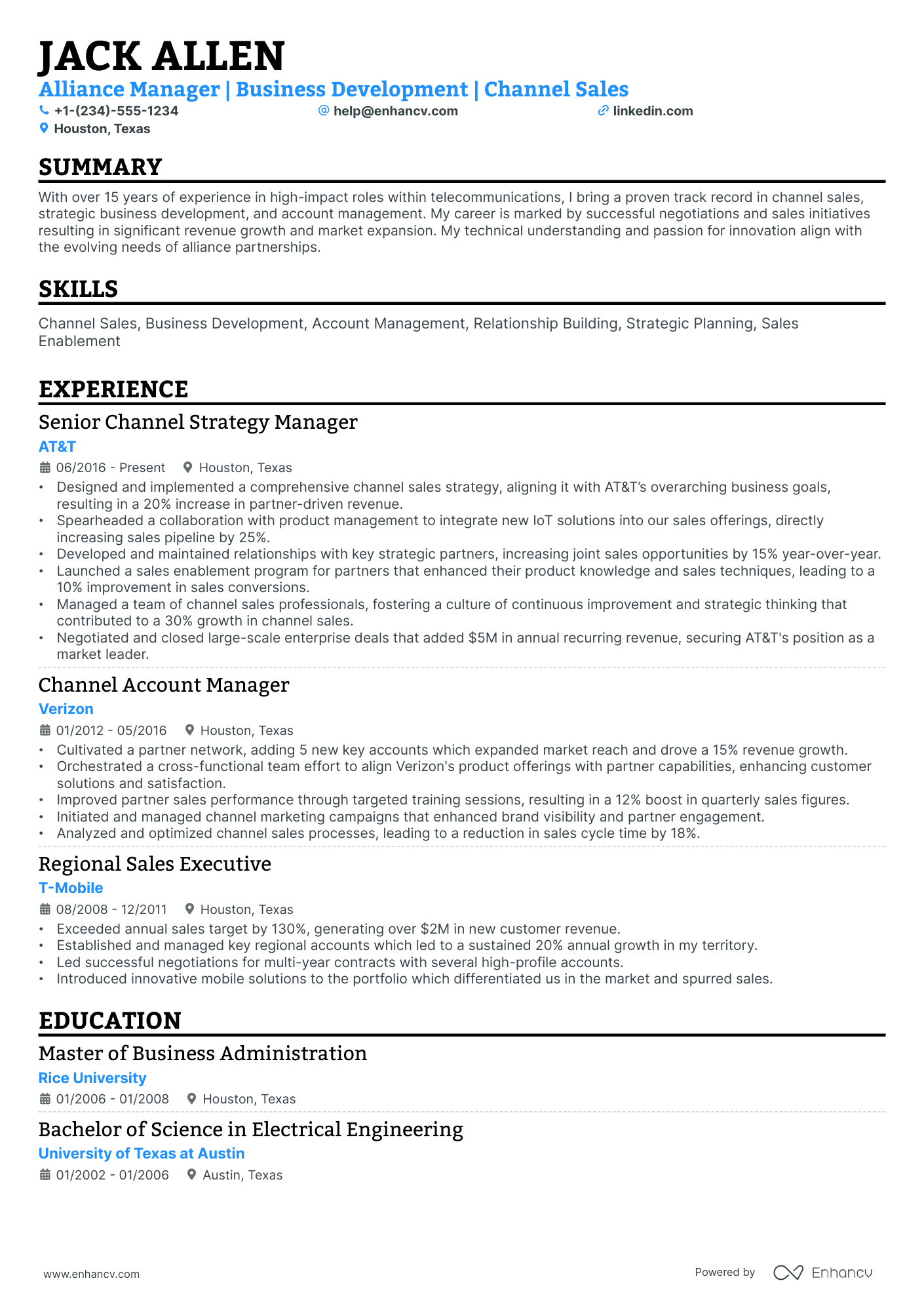
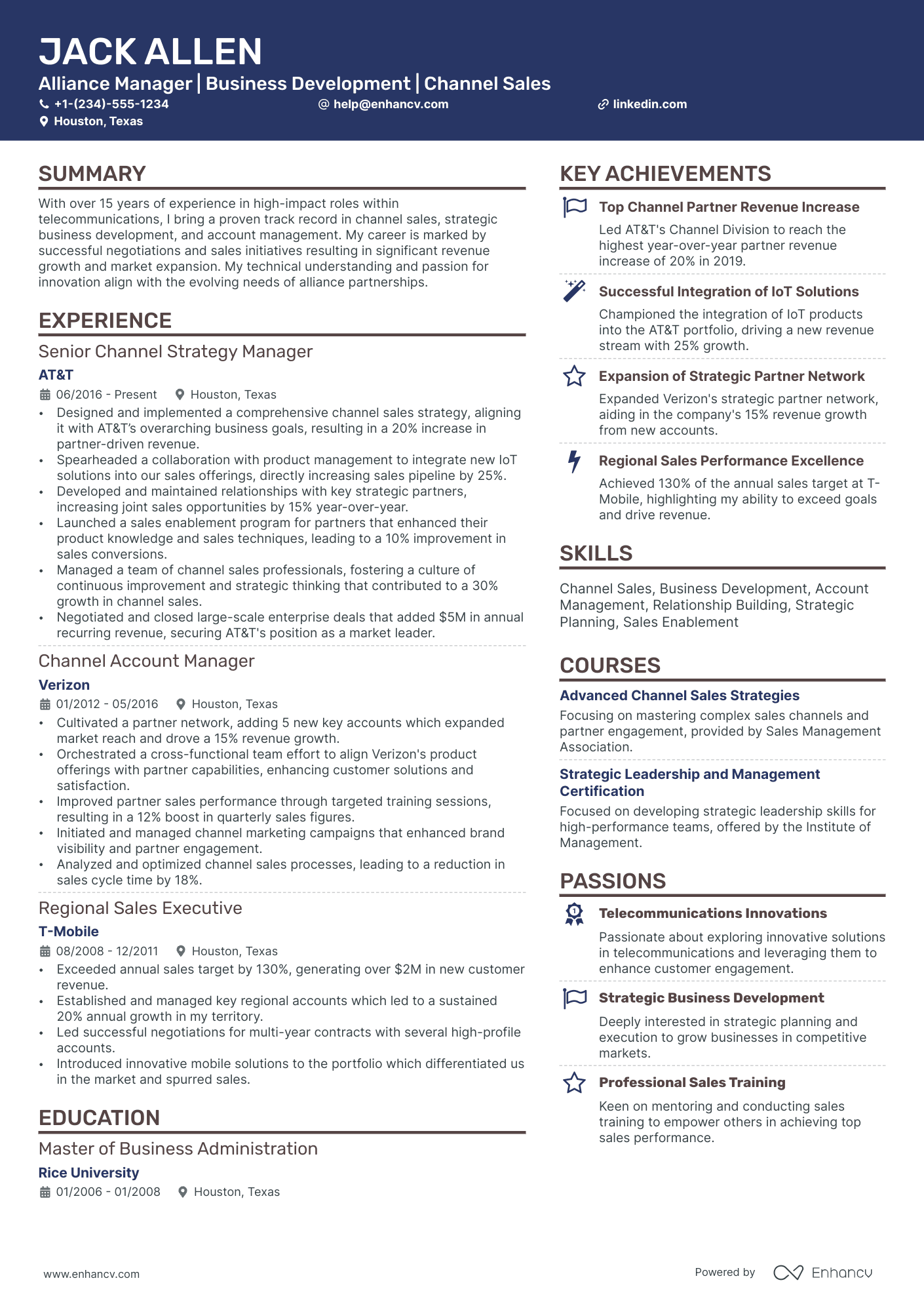
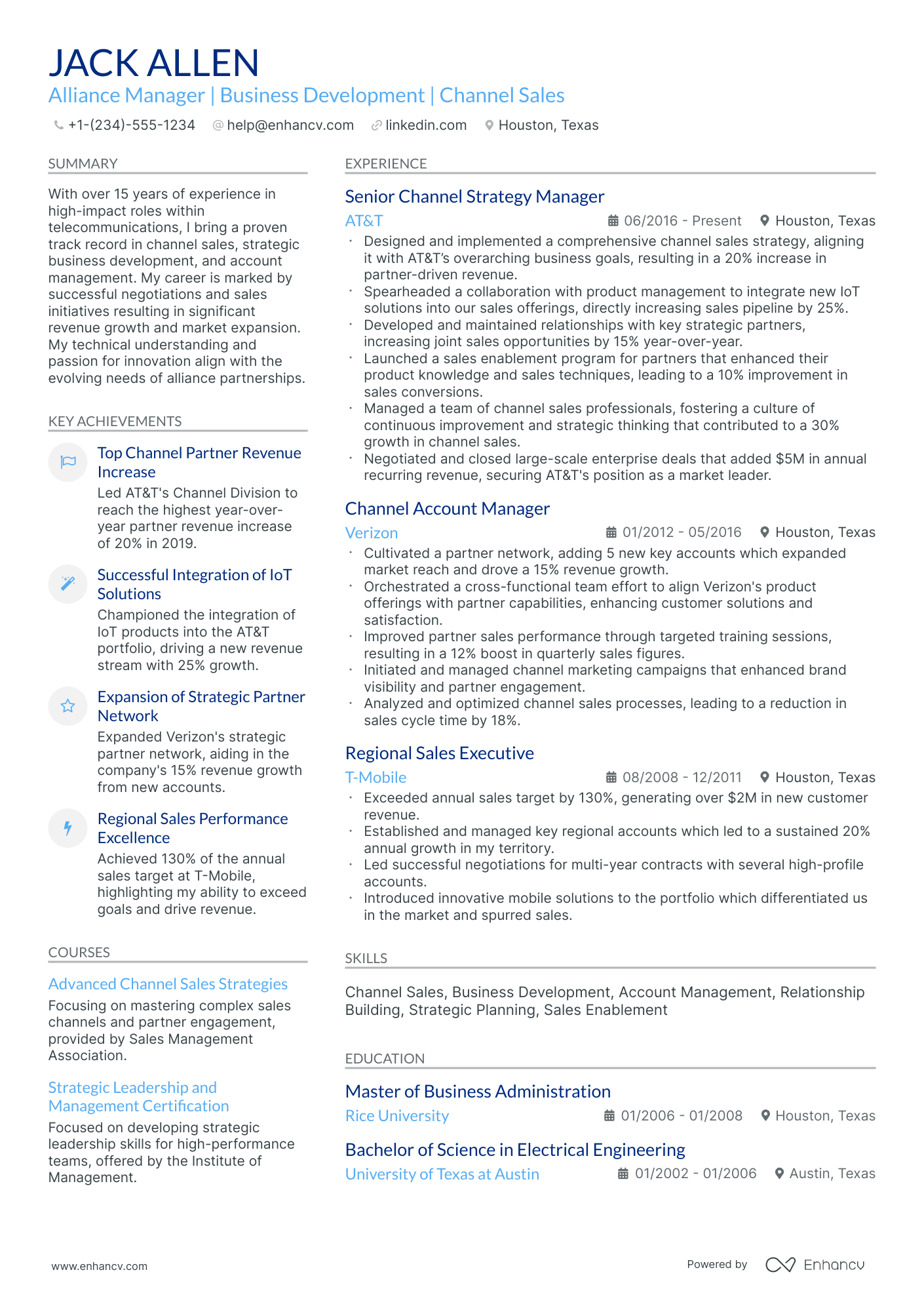
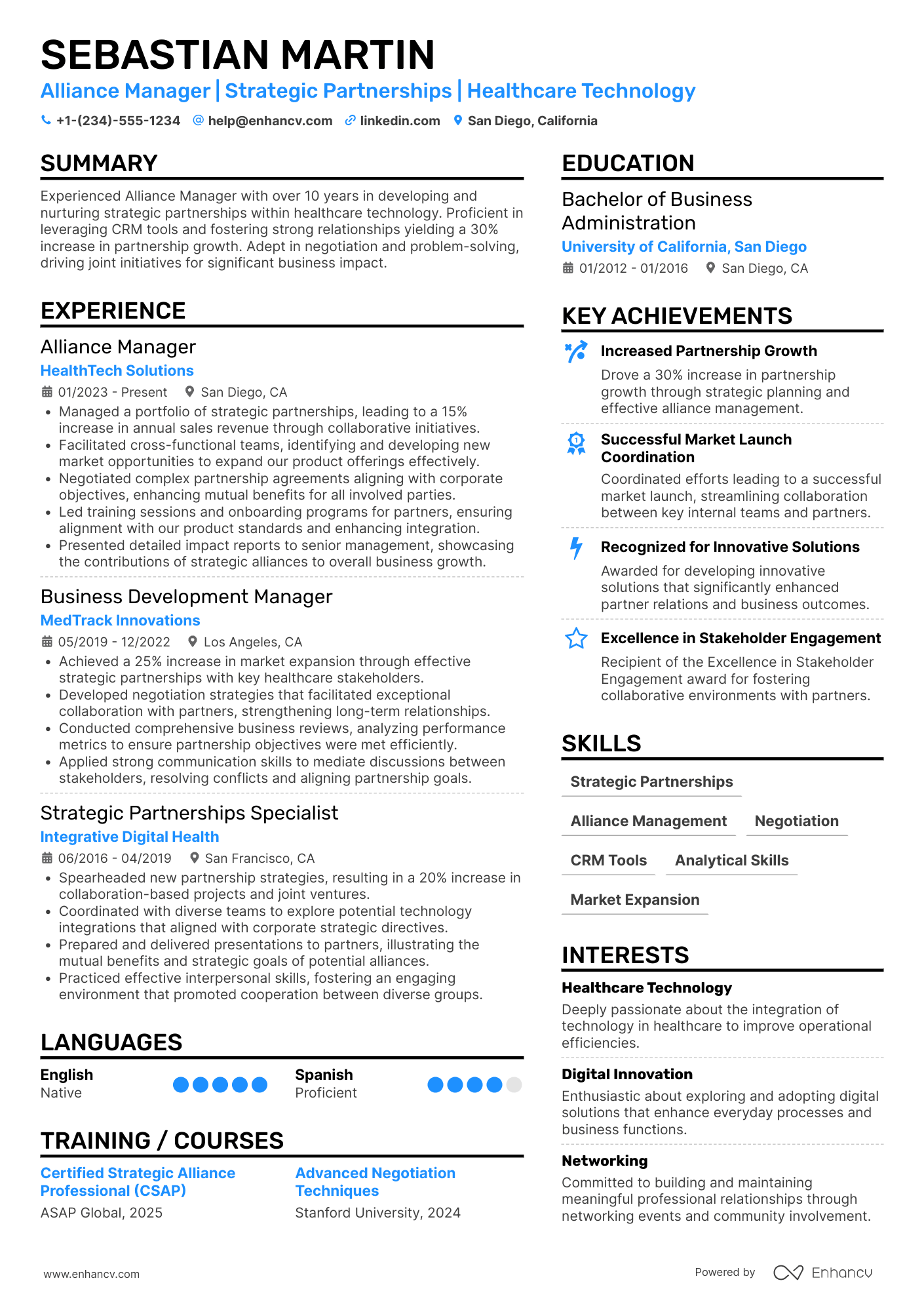
Most alliance manager resumes fail because they describe partnerships without proving strategic impact—no revenue influence, pipeline attribution, or joint go-to-market results. In today's hiring process, that vagueness gets filtered by ATS screening and lost in rapid recruiter scans.
A strong resume shows what changed because of your alliances. Knowing how to make your resume stand out means you should quantify partner-sourced pipeline, closed-won revenue, renewal lift, and launch timelines, and name the scope you led. Highlight deal cycles shortened, co-sell adoption, escalations resolved, and partner satisfaction gains.

Key takeaways
- Quantify partner-sourced revenue, pipeline growth, and retention lift in every experience bullet.
- Use reverse-chronological format for experienced candidates and hybrid format for career changers.
- Tailor each resume to the job posting's specific tools, frameworks, and partnership terminology.
- Demonstrate skills through measurable outcomes in your summary and experience, not just a skills list.
- Add certifications like CSAP or Salesforce Administrator directly after education to reinforce credibility.
- Use AI to tighten language and add metrics, but stop before it overrides your authentic voice.
- Build your resume faster with Enhancv to keep formatting clean and content aligned with recruiter expectations.
Job market snapshot for alliance managers
We analyzed 72 recent alliance manager job ads across major US job boards. These numbers help you understand experience requirements, salary landscape, industry demand at a glance.
What level of experience employers are looking for alliance managers
| Years of Experience | Percentage found in job ads |
|---|---|
| 1–2 years | 1.4% (1) |
| 3–4 years | 5.6% (4) |
| 5–6 years | 15.3% (11) |
| 7–8 years | 11.1% (8) |
| 9–10 years | 12.5% (9) |
| 10+ years | 18.1% (13) |
| Not specified | 48.6% (35) |
Alliance manager ads by area of specialization (industry)
| Industry (Area) | Percentage found in job ads |
|---|---|
| Finance & Banking | 55.6% (40) |
| Healthcare | 18.1% (13) |
Role overview stats
These tables show the most common responsibilities and employment types for alliance manager roles. Use them to align your resume with what employers expect and to understand how the role is structured across the market.
Day-to-day activities and top responsibilities for a alliance manager
| Responsibility | Percentage found in job ads |
|---|---|
| Business development | 19.4% (14) |
| Alliance management | 15.3% (11) |
| Saas | 15.3% (11) |
| Business intelligence | 9.7% (7) |
| Sales | 9.7% (7) |
| Analytics tools | 8.3% (6) |
| Data management | 8.3% (6) |
| Communication | 6.9% (5) |
| Contract negotiations | 6.9% (5) |
| Presentation | 6.9% (5) |
| Salesforce | 6.9% (5) |
| Channel sales | 5.6% (4) |
Type of employment (remote vs on-site vs hybrid)
| Employment type | Percentage found in job ads |
|---|---|
| On-site | 50.0% (36) |
| Remote | 27.8% (20) |
| Hybrid | 22.2% (16) |
How to format a alliance manager resume
Recruiters evaluating alliance manager resumes look for evidence of cross-functional relationship management, partner ecosystem development, and revenue or strategic outcomes tied to specific alliances. A clean, well-structured resume format ensures these signals surface quickly during both human review and applicant tracking system (ATS) parsing.

I have significant experience in this role—which format should I use?
Use a reverse-chronological format to present your alliance management career in a clear, progression-driven narrative. Do:
- Lead each role entry with the scope of your alliance portfolio—number of partners, deal size, geographic reach, or business unit coverage.
- Highlight partner relationship management platforms and frameworks you've worked with, such as Salesforce PRM, partner scorecards, joint business planning processes, or channel enablement tools.
- Quantify outcomes in terms of revenue influence, partner-sourced pipeline growth, retention rates, or co-sell conversion metrics.
I'm junior or switching into this role—what format works best?
A hybrid format works well here, letting you lead with relevant skills and partnership-adjacent experience before your work history fills in the timeline. Do:
- Place a skills section near the top that highlights partner engagement, stakeholder communication, contract coordination, and CRM proficiency.
- Include cross-functional projects, channel support roles, or business development experience that demonstrates your ability to manage multi-party relationships.
- Connect every listed skill or project to a specific action and a measurable or observable result.
Why not use a functional resume?
A functional format strips away the timeline context that recruiters need to evaluate how your alliance management capabilities developed and scaled across roles.
- Career changers with no direct alliance experience who need to reframe adjacent skills (business development, vendor management, channel sales) as transferable competencies.
- Candidates with significant employment gaps who want to foreground partnership projects, certifications, or consulting work completed during the gap period.
Once your layout and formatting establish a clean, readable foundation, the next step is filling it with the right sections to showcase your qualifications effectively.
What sections should go on a alliance manager resume
Recruiters expect a clear snapshot of your partner strategy, relationship management, and measurable business impact. Understanding what to put on a resume helps you prioritize the most relevant details.
Use this structure for maximum clarity:
- Header
- Summary
- Experience
- Skills
- Projects
- Education
- Certifications
- Optional sections: Awards, Leadership, Languages
Strong experience bullets should emphasize partnership outcomes, revenue or pipeline impact, program scope, stakeholder alignment, and results against targets.
Is your resume good enough?
Drop your resume here or choose a file. PDF & DOCX only. Max 2MB file size.
Once you’ve organized your resume with the right components, the next step is to write your alliance manager experience section so each role clearly supports that structure.
How to write your alliance manager resume experience
The experience section of your alliance manager resume should spotlight partnerships you've built, strategic alliances you've managed, and the measurable business outcomes those relationships produced—using role-relevant frameworks, partner management platforms, and negotiation methodologies. Hiring managers prioritize demonstrated impact on revenue growth, partner satisfaction, and joint go-to-market success over descriptive task lists that merely catalog daily responsibilities.
Each entry should include:
- Job title
- Company and location (or remote)
- Dates of employment (month and year)
Three to five concise bullet points showing what you owned, how you executed, and what outcomes you delivered:
- Ownership scope: the alliance portfolios, partner ecosystems, joint ventures, channel programs, or strategic accounts you were directly accountable for as an alliance manager.
- Execution approach: the partner relationship management tools, contract negotiation frameworks, co-selling methodologies, or alliance governance structures you used to drive decisions and deliver on partnership objectives.
- Value improved: changes to partner revenue contribution, deal pipeline quality, alliance retention rates, time-to-market for joint solutions, or risk mitigation across your partner portfolio.
- Collaboration context: how you worked with internal stakeholders—such as sales, product, marketing, and legal teams—alongside external partner organizations to align on shared business plans and co-developed offerings.
- Impact delivered: outcomes expressed through alliance-generated revenue, expanded market reach, partner program growth, or strengthened competitive positioning rather than a summary of relationship management activities.
Experience bullet formula
A alliance manager experience example
✅ Right example - modern, quantified, specific.
Alliance Manager
CloudRoute | Remote
2022–Present
B2B software-as-a-service integration platform serving mid-market logistics and retail teams across North America.
- Negotiated and launched eight strategic alliances using Salesforce, DocuSign, and mutual success plans, generating $3.6M in partner-sourced annual recurring revenue and lifting pipeline conversion by 14%.
- Built a partner onboarding and enablement program in Notion and Google Workspace, cutting time-to-first-deal from twelve weeks to seven weeks and improving partner certification completion to 92%.
- Operationalized quarterly business reviews with Tableau dashboards and standardized scorecards, reducing churn risk by 18% across top twenty partners and increasing renewal rate from 86% to 91%.
- Co-led joint go-to-market campaigns with marketing and product managers, tracking attribution in HubSpot and Salesforce, driving 1,150 marketing-qualified leads and $1.1M in influenced bookings.
- Partnered with solutions engineers and customer success to prioritize integration roadmap in Jira and Confluence, decreasing partner-reported integration defects by 27% and improving implementation satisfaction from 4.1 to 4.6 out of five.
Now that you've seen how a strong experience section comes together, let's look at how to adjust yours to match the specific role you're targeting.
How to tailor your alliance manager resume experience
Recruiters evaluate your alliance manager resume through both applicant tracking systems and manual review, so tailoring your resume to the job description is essential. Tailoring ensures the partnerships, tools, and strategic processes you've managed directly mirror what the hiring organization needs.
Ways to tailor your alliance manager experience:
- Match partner relationship management platforms and CRM tools listed in the posting.
- Mirror the exact terminology used for joint business planning processes.
- Reflect revenue sharing models or co-selling frameworks the role references.
- Include industry or vertical experience when the posting specifies a domain.
- Highlight governance structures and escalation workflows mentioned in the description.
- Align your KPIs with the partner performance metrics the employer tracks.
- Reference compliance or contractual standards the organization prioritizes by name.
- Emphasize cross-functional collaboration models that match their alliance structure.
Tailoring means connecting your real partnership achievements to each role's stated requirements, not forcing keywords where they don't belong.
Resume tailoring examples for alliance manager
| Job description excerpt | Untailored | Tailored |
|---|---|---|
| Manage strategic partnerships with SaaS vendors, driving co-sell revenue through Salesforce PRM and quarterly business reviews (QBRs) | Worked with partners to grow revenue and maintain relationships. | Managed 12 SaaS vendor alliances through Salesforce PRM, facilitating QBRs that increased co-sell revenue by 34% year over year. |
| Develop joint go-to-market plans with cloud hyperscaler partners (AWS, Azure) and track pipeline influence using Crossbeam | Helped create marketing plans and tracked results with partners. | Built joint go-to-market plans with AWS and Azure partner teams, using Crossbeam to track $8.5M in influenced pipeline across 45 shared accounts. |
| Negotiate alliance agreements, manage MDF budgets, and align internal stakeholders across sales, product, and marketing to execute partner programs | Coordinated with internal teams and handled partner contracts and budgets. | Negotiated alliance agreements with three tier-one partners, allocated $1.2M in MDF budgets, and aligned sales, product, and marketing stakeholders to launch two partner programs that generated 600+ qualified leads. |
Once you’ve aligned your experience with the role’s partnership priorities, the next step is to quantify your alliance manager achievements so hiring teams can see the impact of that work.
How to quantify your alliance manager achievements
Quantifying your achievements proves partner impact beyond relationship building. Focus on revenue influenced, pipeline velocity, renewal and retention lift, integration delivery time, and risk reduction from better governance and compliance.
Quantifying examples for alliance manager
| Metric | Example |
|---|---|
| Revenue influenced | "Co-sold with five strategic partners to influence $3.2M in annual recurring revenue, tracked in Salesforce with partner-sourced attribution." |
| Pipeline velocity | "Cut partner deal cycle time from 78 to 54 days by standardizing joint qualification in HubSpot and running biweekly pipeline reviews." |
| Retention lift | "Improved renewal rate from 86% to 92% across two channel partners by launching a quarterly business review cadence and shared success plans." |
| Delivery speed | "Reduced partner onboarding from 30 to 14 days by building a checklist in Asana and automating contract routing in DocuSign." |
| Risk reduction | "Lowered contract exceptions by 35% by adding a compliance checklist and redline playbook, aligning legal, procurement, and partner teams." |
Turn vague job duties into measurable, recruiter-ready resume bullets in seconds with Enhancv's Bullet Point Generator.
With strong bullet points in place, the next step is ensuring your alliance manager resume highlights the right mix of hard and soft skills to back them up.
How to list your hard and soft skills on a alliance manager resume
Your skills section shows you can build, grow, and govern partnerships, and recruiters and ATS scan this section to confirm role-fit fast; aim for a balanced mix of partnership hard skills and execution-focused soft skills.
alliance manager roles require a blend of:
- Product strategy and discovery skills.
- Data, analytics, and experimentation skills.
- Delivery, execution, and go-to-market discipline.
- Soft skills.
Your skills section should be:
- Scannable (bullet-style grouping).
- Relevant to the job post.
- Backed by proof in experience bullets.
- Updated with current tools.
Place your skills section:
- Above experience if you're junior or switching careers.
- Below experience if you're mid/senior with strong achievements.

Hard skills
- Partner strategy and segmentation
- Alliance pipeline management
- Partner onboarding and enablement
- Co-sell motions with sales
- Joint business planning
- Partner contract negotiation
- Revenue attribution and forecasting
- Salesforce, HubSpot CRM
- Partner relationship management platforms
- Tableau, Looker reporting
- OKRs and KPI design
- API and integration fundamentals
Soft skills
- Executive stakeholder alignment
- Cross-functional influence without authority
- Partner escalation management
- Negotiation and trade-off decisions
- Clear partner-facing communication
- Internal alignment and expectation setting
- Structured problem solving
- Ownership of outcomes and follow-through
- Prioritization under competing demands
- Meeting facilitation and action tracking
- Conflict resolution across teams
- Customer and partner empathy
How to show your alliance manager skills in context
Skills shouldn't live only in a bulleted list on your resume. Explore examples of resume skills to see how top candidates present theirs effectively.
They should be demonstrated in:
- Your summary (high-level professional identity)
- Your experience (proof through outcomes)
Here's what strong, skills-rich entries look like in practice.
Summary example
Alliance manager with 12 years in SaaS partnerships, skilled in joint business planning, Salesforce PRM, and stakeholder alignment. Built a partner ecosystem generating $18M in co-sell revenue across North America and EMEA.
- Signals senior-level depth immediately
- Names role-relevant tools and methods
- Leads with a measurable revenue outcome
- Highlights cross-functional soft skills
Experience example
Senior Alliance Manager
Meridian Cloud Solutions | Remote
March 2019–Present
- Grew partner-sourced pipeline by 42% in two years through structured joint business planning and quarterly reviews with eight strategic partners.
- Launched a co-marketing program using Crossbeam and Salesforce PRM, driving $6.2M in influenced revenue during the first fiscal year.
- Collaborated with product, sales, and customer success teams to align partner enablement resources, reducing onboarding time by 30%.
- Every bullet includes measurable proof.
- Skills appear naturally within achievements.
Once you’ve demonstrated your partnership-building strengths through relevant examples, the next step is to apply that same approach to structuring an alliance manager resume when you don’t have direct experience.
How do I write a alliance manager resume with no experience
Even without full-time experience, you can demonstrate readiness through:
- University partnership strategy capstone
- Internship in partner operations
- Student organization sponsor management
- Vendor onboarding and enablement project
- Cross-functional project coordination role
- Contract review support with legal
- Customer success or account support work
- CRM pipeline tracking for partnerships
If you're building a resume without work experience, focus on:
- Partner pipeline creation and tracking
- Deal support, terms, and compliance
- Cross-functional execution with clear metrics
- Industry-relevant partnership research outputs
Resume format tip for entry-level alliance manager
Use a hybrid resume format to highlight projects and relevant experience substitutes before work history. It helps recruiters see partnership outcomes and tools fast. Do:
- Lead with a "Partnership Projects" section.
- Quantify results with revenue, adoption, or time saved.
- Name tools used: Salesforce, HubSpot, Asana.
- Mirror alliance manager keywords from postings.
- Add a "Partner Enablement" skills subsection.
- Built and tracked a partner pipeline in Salesforce, qualified 25 targets, and secured three campus vendor introductions, cutting outreach-to-meeting time by 30%.
Even without direct experience, your education section can demonstrate the foundational knowledge and relevant coursework that qualify you for an alliance manager role.
How to list your education on a alliance manager resume
Your education section helps hiring teams verify the foundational knowledge you bring to the alliance manager role. It confirms relevant training in business strategy, partnerships, and management.
Include:
- Degree name
- Institution
- Location
- Graduation year
- Relevant coursework (for juniors or entry-level candidates)
- Honors & GPA (if 3.5 or higher)
Skip month and day details—list the graduation year only.
Here's a strong education entry tailored for an alliance manager resume.
Example education entry
Bachelor of Science in Business Administration
University of Michigan, Ann Arbor, MI
Graduated 2019
GPA: 3.7/4.0
- Relevant Coursework: Strategic Partnership Development, Negotiation & Conflict Resolution, Cross-Functional Team Leadership
- Honors: Magna Cum Laude, Dean's List (six consecutive semesters)
How to list your certifications on a alliance manager resume
Certifications on a resume show an alliance manager's commitment to ongoing learning, proficiency with partner tools, and alignment with industry standards that employers trust.
Include:
- Certificate name
- Issuing organization
- Year
- Optional: credential ID or URL
- Place certifications below education when they are older, less relevant, or you want your degree to lead the page.
- Place certifications above education when they are recent, role-critical, or required for the alliance manager roles you target.
Best certifications for your alliance manager resume
- Certified Strategic Alliance Professional (CSAP)
- Strategic Account Management Association (SAMA) Certified Strategic Account Manager (CSAM)
- Certified Partner Program Professional (CPPP)
- HubSpot Solutions Partner Certification
- Salesforce Certified Administrator
- Project Management Professional (PMP)
- Certified Professional in Supply Management (CPSM)
Once you’ve placed your credentials where recruiters can scan them quickly, you can highlight their impact in your alliance manager resume summary.
How to write your alliance manager resume summary
Your resume summary is the first thing a recruiter reads, so it must instantly communicate your value. A strong opening sets the tone and determines whether the rest of your alliance manager resume gets attention.
Keep it to three to four lines, with:
- Your title and total years of experience in alliance or partner management.
- The industry or domain where you've built partnerships, such as SaaS, healthcare, or consulting.
- Core skills like contract negotiation, joint business planning, or CRM platforms.
- One or two measurable achievements, such as revenue generated or partnerships scaled.
- Soft skills tied to real outcomes, like cross-functional collaboration that shortened deal cycles.

PRO TIP
At this level, focus on clarity and relevance over broad claims. Highlight specific partnership skills, tools you've used, and early wins that show initiative. Avoid vague phrases like "passionate team player" or "results-driven professional." Recruiters want proof, not personality summaries.
Example summary for a alliance manager
Alliance manager with four years of experience in SaaS partner ecosystems. Skilled in joint business planning and Salesforce PRM. Grew channel partner revenue by 30% year over year through structured co-selling programs.
Optimize your resume summary and objective for ATS
Drop your resume here or choose a file.
PDF & DOCX only. Max 2MB file size.
Now that your summary communicates your value as an alliance manager, make sure your header presents the essential contact and professional details recruiters need to reach you.
What to include in a alliance manager resume header
A resume header is the top section with your identity and contact details, and it boosts visibility, credibility, and recruiter screening for a alliance manager.
Essential resume header elements
- Full name
- Tailored job title and headline
- Location
- Phone number
- Professional email
- GitHub link
- Portfolio link
A LinkedIn link helps recruiters verify experience fast and supports screening with consistent titles, dates, and recommendations.
Do not include photos on a alliance manager resume unless the role is explicitly front-facing or appearance-dependent.
Match your headline to the alliance manager role and keep all links clickable, current, and consistent with your resume details.
Example
Alliance manager resume header
Jordan Lee
Alliance Manager | Partner Growth and Strategic Relationships
Austin, TX
(512) 555-01XX
jordan.lee@enhancv.com
github.com/jordanlee
yourwebsite.com
linkedin.com/in/jordanlee
Once your name and key contact details are set up for quick identification, you can strengthen your application with additional sections that add relevant context to your experience.
Additional sections for alliance manager resumes
When your core sections don't fully capture your partnership expertise, additional sections help differentiate you from other alliance manager candidates.
- Languages
- Industry conferences and speaking engagements
- Professional affiliations and partnership networks
- Certifications in strategic alliance management
- Publications on business development or partner ecosystems
- Volunteer board memberships
- Awards for revenue growth or partner program excellence
Once you've strengthened your resume with relevant additional sections, the next step is pairing it with a well-crafted cover letter to complete your application.
Do alliance manager resumes need a cover letter
A cover letter isn't required for an alliance manager, but it helps in competitive searches or when hiring teams expect one for partner-facing roles. If you're unsure what a cover letter is or how it complements your resume, it can make a difference when your resume doesn't clearly show fit, scope, or impact.
Use a cover letter to add context your resume can't:
- Explain role or team fit by naming the partner types, internal stakeholders, and operating cadence you've managed.
- Highlight one or two relevant projects or outcomes, with clear metrics like pipeline influenced, renewals improved, or partner-sourced revenue.
- Show understanding of the product, users, or business context by connecting the alliance motion to customer needs and go-to-market priorities.
- Address career transitions or non-obvious experience by mapping transferable skills to alliance manager work, such as negotiations, enablement, and joint planning.
Drop your resume here or choose a file.
PDF & DOCX only. Max 2MB file size.
Whether you include a cover letter or let your resume stand alone, AI can help you strengthen your alliance manager resume faster and more consistently.
Using AI to improve your alliance manager resume
AI can sharpen your resume's clarity, structure, and impact. It helps tighten language and highlight results. But overuse strips authenticity. Once your content feels clear and aligned with the alliance manager role, step away from AI. If you're wondering which AI is best for writing resumes, focus on tools that enhance rather than replace your voice.
Here are ten practical prompts to strengthen specific sections of your resume:
- Sharpen summary statement. "Rewrite my alliance manager resume summary to emphasize strategic partnership outcomes and measurable business growth in under four sentences."
- Quantify experience bullets. "Review my alliance manager experience bullets and suggest where I can add specific metrics, percentages, or revenue figures to show impact."
- Align skills section. "Compare my skills section against common alliance manager job descriptions and flag any missing or irrelevant skills I should address."
- Strengthen action verbs. "Replace weak or repetitive verbs in my alliance manager experience section with stronger, more precise action verbs tied to partnership management."
- Refine project descriptions. "Edit my alliance manager project descriptions to clearly state my role, the partnership involved, and the measurable result delivered."
- Tighten certification details. "Rewrite my certifications section so each entry clearly connects to alliance manager responsibilities like partner enablement or channel strategy."
- Improve education relevance. "Revise my education section to highlight coursework, research, or leadership activities directly relevant to an alliance manager career path."
- Remove filler language. "Identify and remove vague or redundant phrases across my entire alliance manager resume without changing the core meaning of each bullet."
- Tailor to job posting. "Map my alliance manager resume content against this job posting and suggest specific wording changes to improve keyword alignment and relevance."
- Clarify partnership scope. "Rewrite my alliance manager experience bullets to clearly define the size, type, and strategic importance of each partnership I managed."
Stop using AI once your resume sounds accurate, specific, and true to your real experience. AI should never invent experience or inflate claims—if it didn't happen, it doesn't belong here.
Conclusion
A strong alliance manager resume proves impact with measurable outcomes, such as revenue influenced, retention gains, or partner pipeline growth. It highlights role-specific skills, including partner strategy, stakeholder management, negotiation, and cross-functional execution, in a clear structure.
Keep each section scannable and results-focused, with consistent formatting and direct language. This approach shows hiring teams you can build and grow partnerships now and adapt to the near-future market.