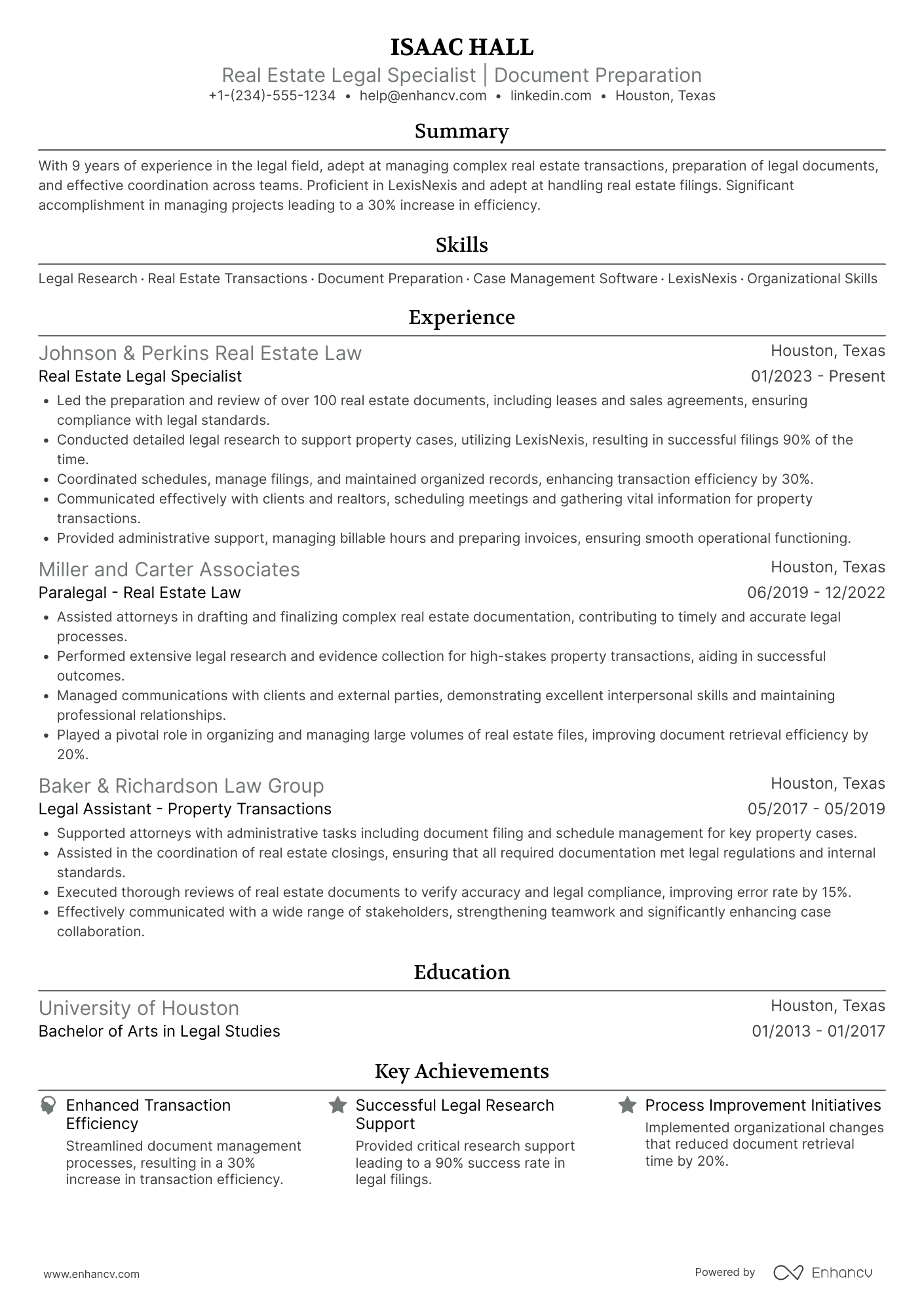
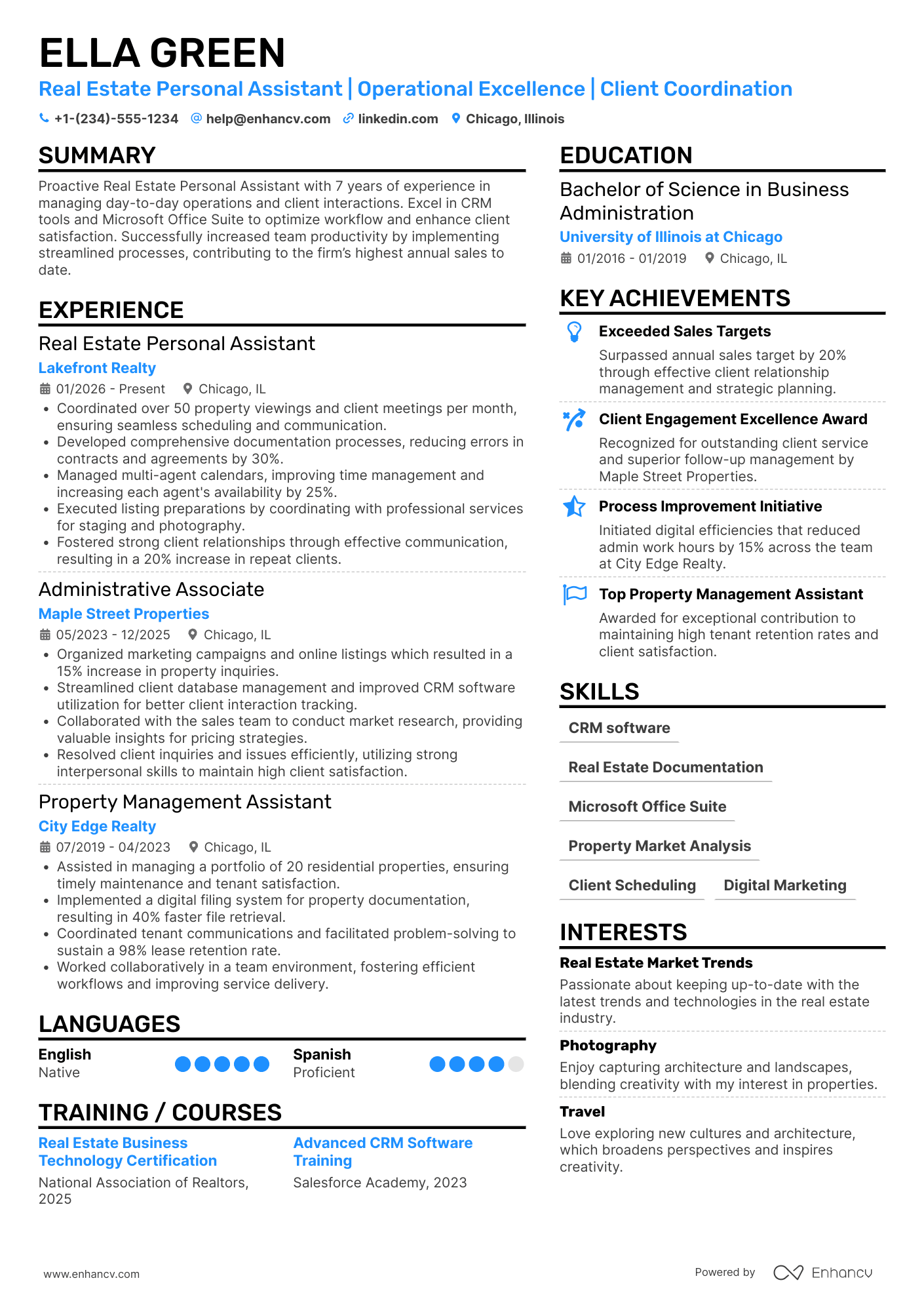
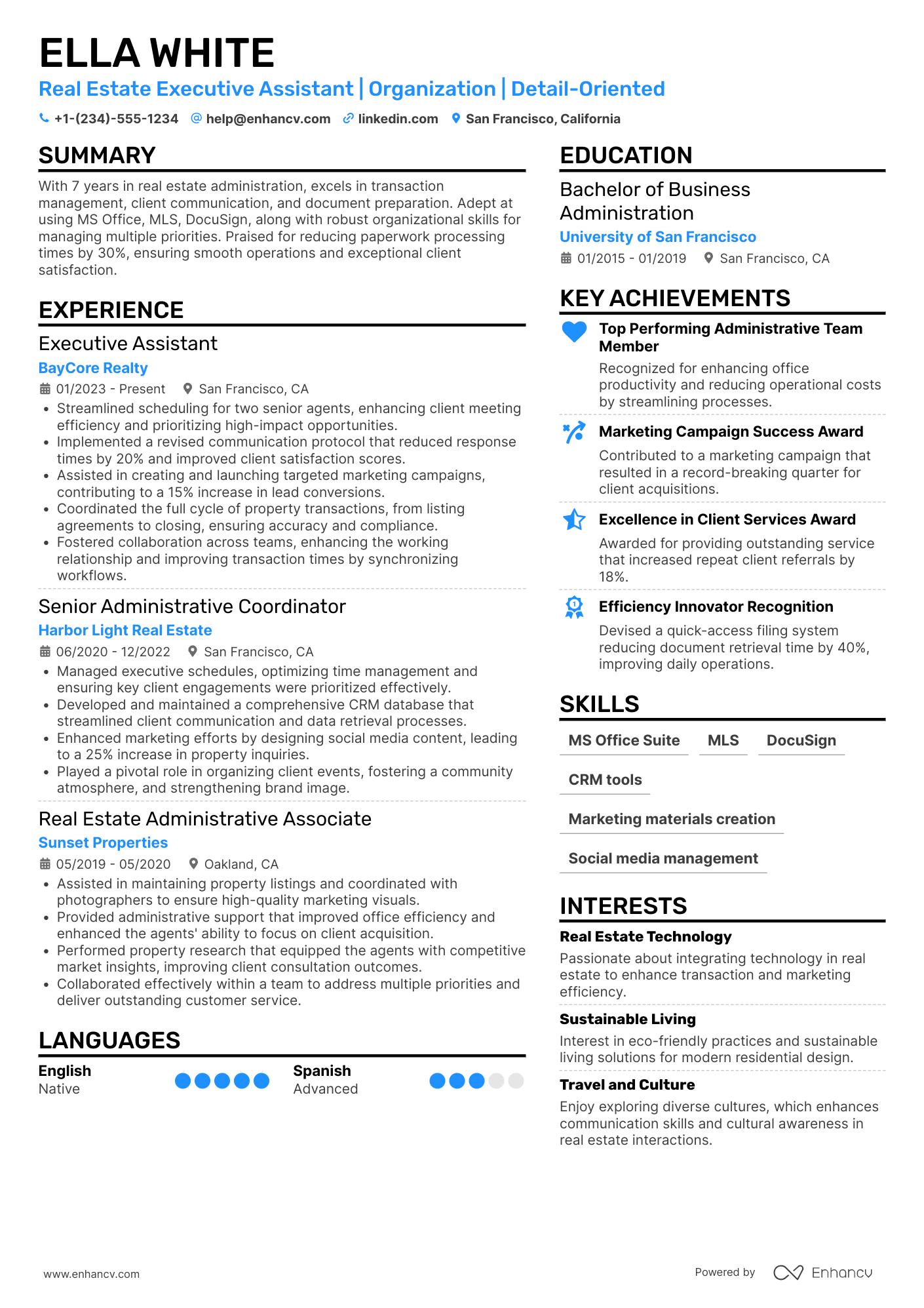
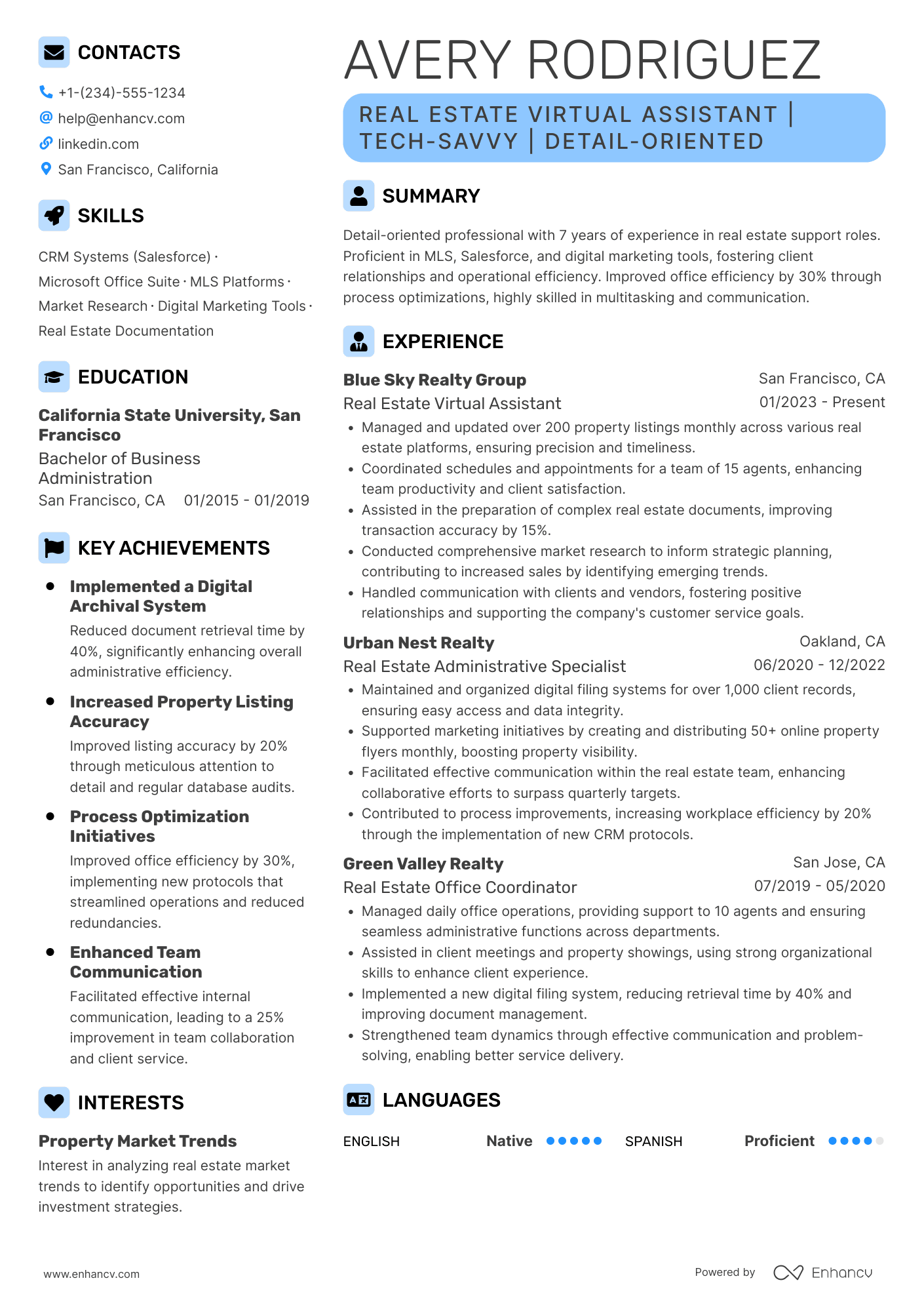
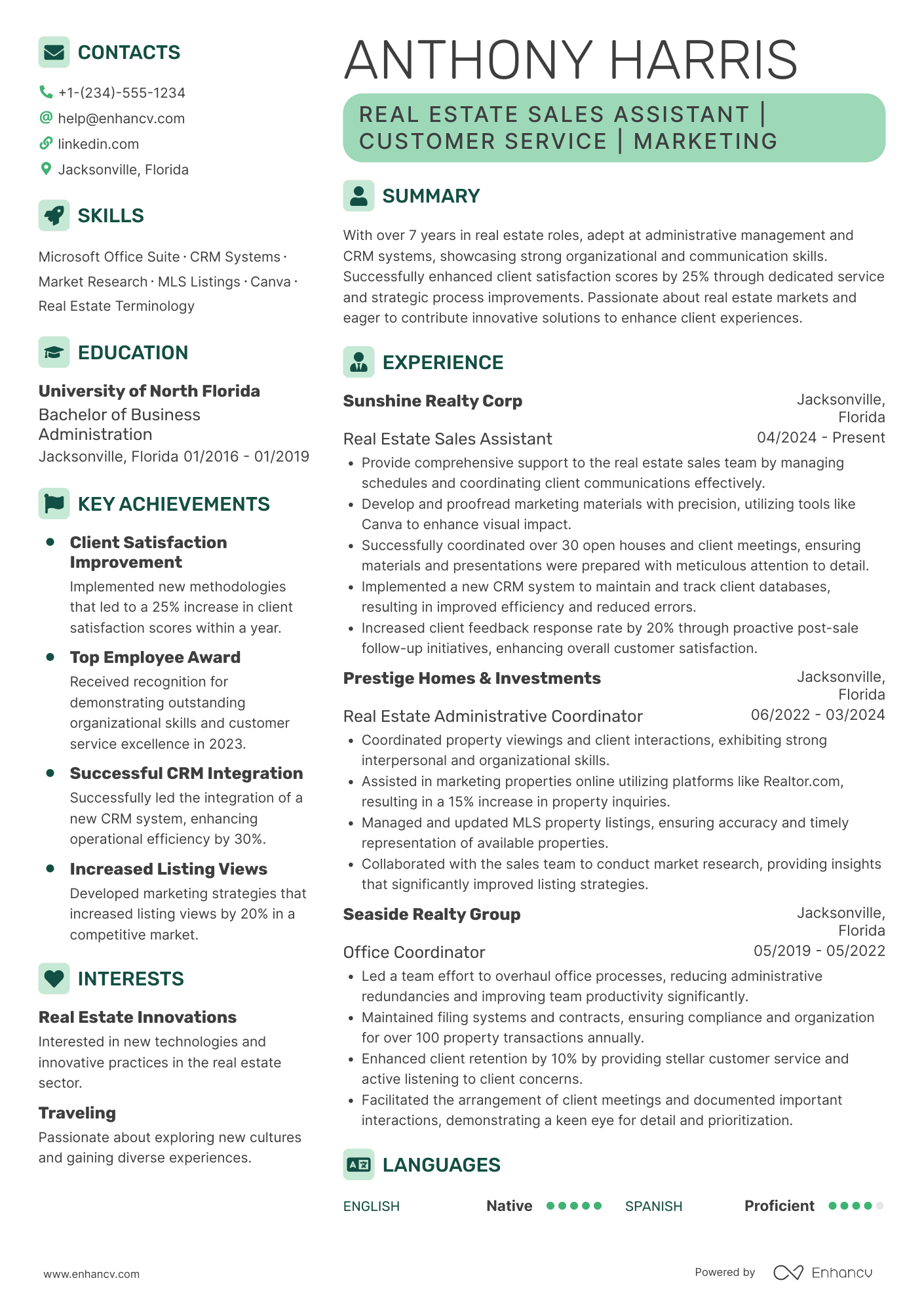
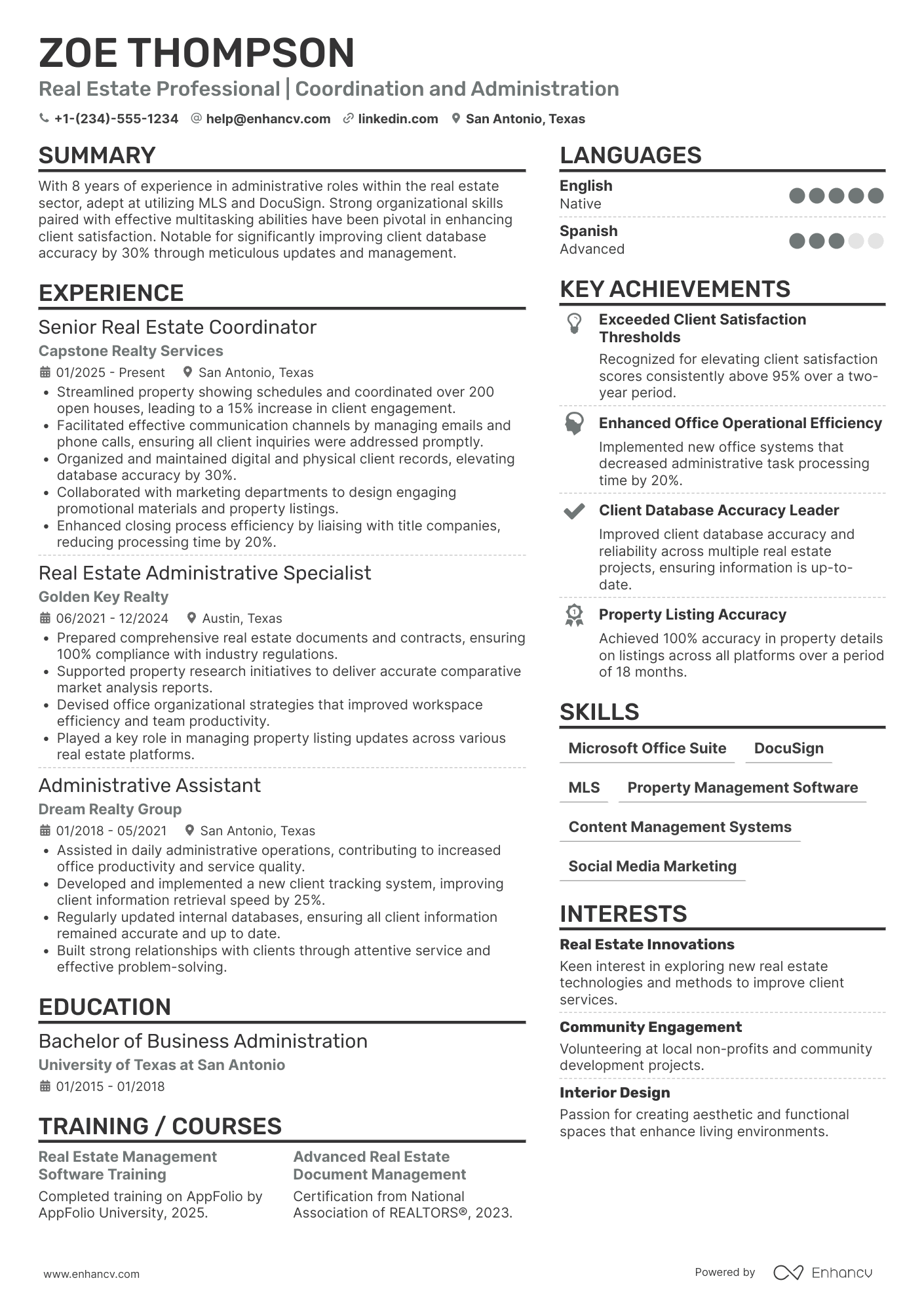
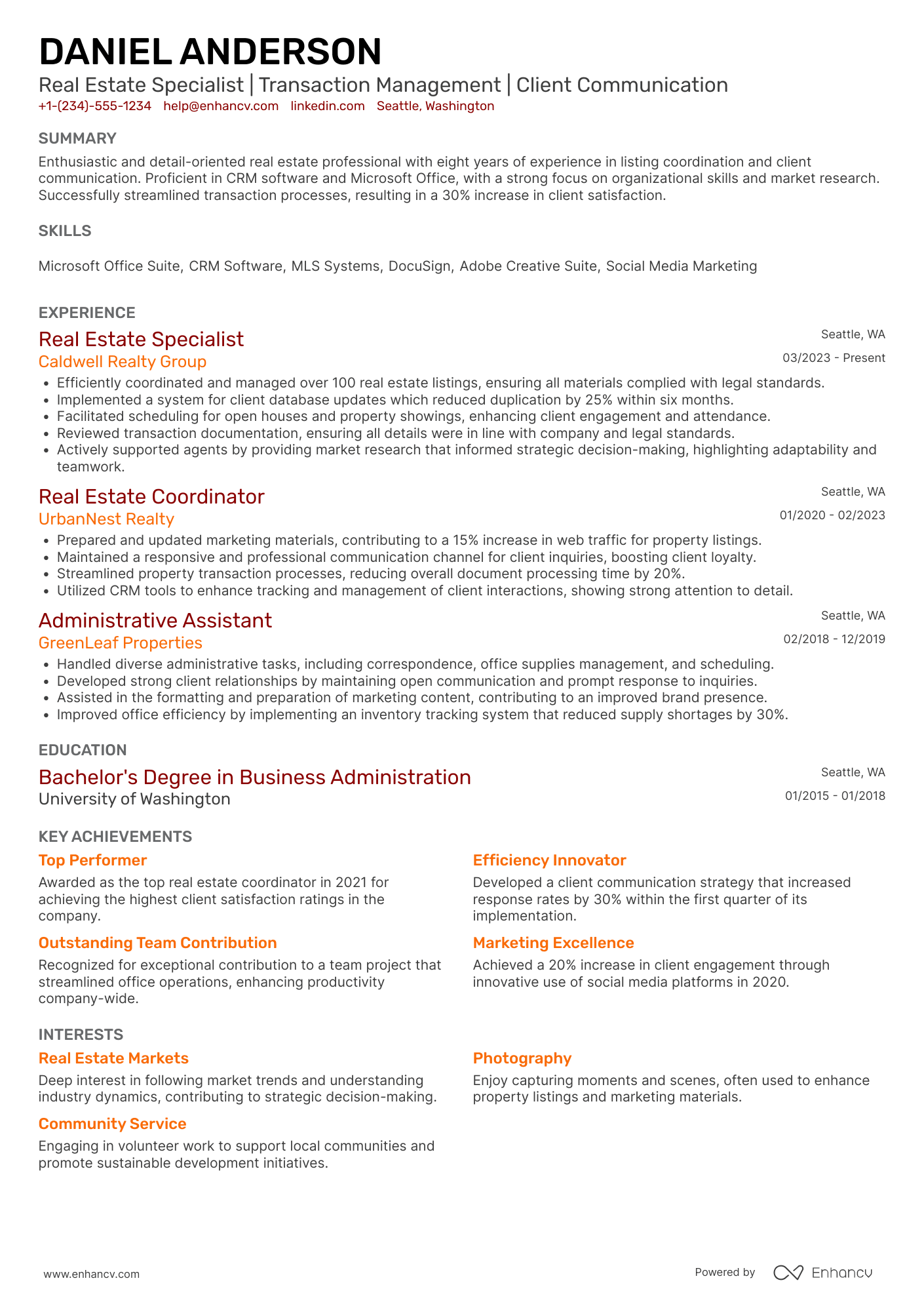
Most real estate assistant resume drafts fail because they read like task lists and bury transaction support, client coordination, and compliance details. That hurts in ATS screening and rapid recruiter scans, especially when competition is high.
A strong resume shows what changed because you were there, not what software you used. Knowing how to make your resume stand out means you should highlight faster contract-to-close cycles, fewer document errors, higher showing-to-offer conversion, smoother escrow coordination across multiple listings, and stronger client satisfaction.

Key takeaways
- Quantify transaction volume, turnaround times, and error reductions in every experience bullet.
- Tailor your resume to each posting by mirroring its exact tools, platforms, and terminology.
- Use reverse-chronological format with experience; switch to hybrid only if you're entry-level.
- Pair every listed skill with a concrete outcome in your summary or experience section.
- Place certifications above education when they're recent, role-specific, or employer-required.
- Stop using AI once your resume accurately reflects real experience without inflated claims.
- Enhancv can help you turn vague duties into measurable, recruiter-ready bullet points faster.
How to format a real estate assistant resume
Recruiters hiring for real estate assistant roles prioritize organizational skills, transaction coordination experience, and proficiency with real estate-specific tools like MLS platforms and CRM software. A clean, well-structured resume format ensures these signals surface quickly during both automated screening and the brief manual review most resumes receive.

I have significant experience in this role—which format should I use?
Use a reverse-chronological format to lead with your most recent and relevant real estate support experience. Do:
- Highlight the scope of your responsibilities, such as the number of agents supported, listings managed, or transaction volume handled.
- Feature real estate tools and platforms you've used consistently, including MLS databases, DocuSign, Dotloop, Salesforce, or property management software.
- Quantify outcomes that show your direct impact on office efficiency, deal closings, or client satisfaction.
I'm junior or switching into this role—what format works best?
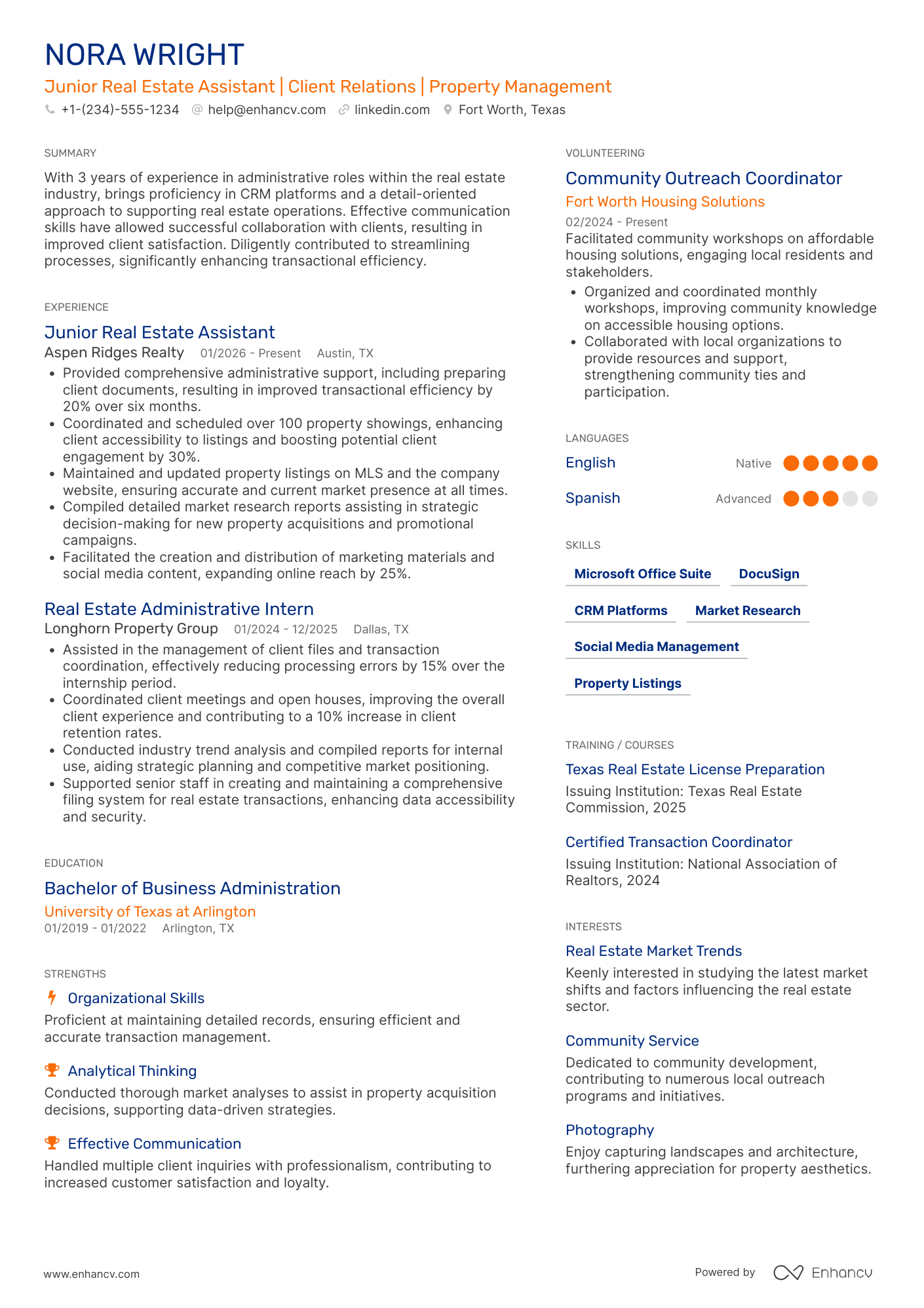
Use a hybrid format that leads with a focused skills section, followed by any relevant work or project experience in reverse-chronological order. Do:
- Place core competencies like scheduling, client communication, document preparation, and CRM management near the top of your resume so they're immediately visible.
- Include internships, administrative roles, volunteer coordination, or real estate coursework that demonstrates transferable organizational and client-facing experience.
- Connect every skill or action to a concrete result, even from non-real estate contexts.
Why not use a functional resume?
A functional format strips away the timeline and context recruiters need to understand where and how you developed your real estate support skills, making it harder to verify your experience during screening.
- Career changers with strong administrative backgrounds: If you've managed calendars, coordinated transactions, or handled client communications in another industry, a functional format can group these transferable skills to demonstrate readiness for a real estate assistant role.
- Candidates with limited work history: Recent graduates or re-entering professionals who completed real estate licensing coursework, internships, or relevant volunteer work can use a functional layout to foreground applicable skills over a thin employment section.
- Professionals with resume gaps: If gaps in employment make a chronological timeline distracting, a functional format lets you direct attention to demonstrated competencies instead.
Once you've established a clean, professional layout, the next step is deciding which sections to include so each one earns its place on the page.
What sections should go on a real estate assistant resume
Recruiters expect a real estate assistant resume to show clear support for transactions, listings, client communication, and office operations. Understanding what to put on a resume helps you prioritize the right details.
Use this structure for maximum clarity:
- Header
- Summary
- Experience
- Skills
- Projects
- Education
- Certifications
- Optional sections: Languages, Volunteering, Awards
Strong experience bullets should emphasize measurable impact—faster closings, higher listing volume, improved client response times, and error-free documentation across a defined scope.
Is your resume good enough?
Drop your resume here or choose a file. PDF & DOCX only. Max 2MB file size.
Once you’ve organized your resume with the right core components, the next step is to write your real estate assistant experience section in a way that fits that structure and shows your impact.
How to write your real estate assistant resume experience
The experience section is where you prove you've delivered real results—through transaction coordination, client communication, listing management tools, and measurable contributions to a brokerage's operations. Hiring managers prioritize demonstrated impact over descriptive task lists, so every bullet should connect your work to outcomes that moved the business forward.
Each entry should include:
- Job title
- Company and location (or remote)
- Dates of employment (month and year)
Three to five concise bullet points showing what you owned, how you executed, and what outcomes you delivered:
- Ownership scope: the listings, transaction files, client databases, marketing materials, or administrative systems you were directly accountable for within the brokerage or real estate team.
- Execution approach: the tools, platforms, and methods you used to carry out your work—such as MLS databases, CRM software, transaction management systems, scheduling platforms, or document coordination workflows.
- Value improved: the specific changes you drove in transaction turnaround time, listing accuracy, client response rates, compliance reliability, scheduling efficiency, or operational consistency across the office.
- Collaboration context: how you worked alongside agents, brokers, title companies, lenders, inspectors, photographers, or other stakeholders to keep deals on track and communications aligned.
- Impact delivered: the tangible outcomes your work produced, expressed through closed transaction volume, client retention, error reduction, process improvements, or revenue support rather than a list of daily tasks.
Experience bullet formula
A real estate assistant experience example
✅ Right example - modern, quantified, specific.
Real Estate Assistant
HarborView Realty Group | Austin, TX
2022–Present
High-volume residential real estate team supporting five agents across Austin’s fast-moving market.
- Streamlined listing intake and launch using Google Workspace, DocuSign, and a shared checklist in Asana, cutting time-to-market from three days to twenty-four hours across one hundred twenty-plus listings.
- Managed CRM hygiene and lead routing in Follow Up Boss, building automations and tags that improved lead response time by forty-two percent and increased appointment set rate by twelve percent.
- Coordinated showings, inspections, and closings in ShowingTime and Google Calendar, reducing scheduling conflicts by seventy percent while supporting an average of twenty-five active transactions per month.
- Produced weekly pipeline and pricing reports in Excel and Google Sheets, partnering with agents and lenders to identify stalled deals and recover eight at-risk transactions worth $3.1M in total volume.
- Drafted and quality-checked MLS entries and marketing collateral in Canva and the MLS platform, reducing listing errors by sixty percent and improving photo-to-live compliance to ninety-eight percent.
Now that you've seen how a strong experience section comes together, let's look at how to adjust yours to match the specific job posting you're targeting.
How to tailor your real estate assistant resume experience
Recruiters evaluate your real estate assistant resume through both applicant tracking systems and manual review. Tailoring your resume to the job description ensures you pass both screenings.
Ways to tailor your real estate assistant experience:
- Match the MLS platforms and CRM tools named in the posting.
- Mirror the listing coordination or transaction management terms used.
- Reflect specific client communication methods the employer prioritizes.
- Highlight property management software experience when the role requires it.
- Align your scheduling and calendar coordination language with the description.
- Include compliance or fair housing knowledge if the posting mentions it.
- Emphasize the lead generation or follow-up workflows they reference.
- Reference document preparation processes using the employer's exact phrasing.
Tailoring means aligning your real accomplishments with the role's stated requirements, not forcing disconnected keywords into your experience.
Resume tailoring examples for real estate assistant
| Job description excerpt | Untailored | Tailored |
|---|---|---|
| Manage property listings using MLS databases, coordinate open houses, and ensure all listing photos and descriptions are accurate and up to date. | Helped with various administrative tasks and data entry for the team. | Managed 45+ active property listings in MLS databases, coordinated weekly open houses, and maintained accurate listing photos and descriptions to reduce time-on-market by 18%. |
| Schedule property showings, communicate with buyers and sellers, and assist agents with transaction coordination from offer through closing using Dotloop. | Provided customer service and supported daily office operations. | Scheduled 30+ property showings per week, served as the primary point of contact for buyers and sellers, and coordinated transactions from offer through closing using Dotloop. |
| Prepare comparative market analysis reports, track lead activity in Follow Up Boss CRM, and support agents in meeting quarterly sales targets. | Assisted with reports and helped the sales team stay organized. | Prepared comparative market analysis reports for 10+ properties monthly, tracked 200+ leads in Follow Up Boss CRM, and supported agents in exceeding quarterly sales targets by 12%. |
Once you’ve aligned your experience with the role’s priorities, the next step is to quantify your real estate assistant achievements so employers can see the measurable impact of that fit.
How to quantify your real estate assistant achievements
Quantifying your achievements proves you drive faster closings, cleaner paperwork, and happier clients. Focus on volume handled, turnaround time, accuracy, compliance, and revenue impact across listings, showings, contracts, and transaction coordination.
Quantifying examples for real estate assistant
| Metric | Example |
|---|---|
| Volume handled | "Coordinated 25 to 35 showings per week for two agents using ShowingTime and Google Calendar, keeping scheduling conflicts under two per month." |
| Cycle time | "Cut listing-to-MLS posting time from two days to six hours by standardizing intake checklists and building templates in Canva and DocuSign." |
| Accuracy rate | "Reduced contract and disclosure errors by 40% by introducing a pre-submission audit in DocuSign and tracking corrections in a shared spreadsheet." |
| Compliance risk | "Maintained 100% on-time file compliance for 60 transactions by organizing disclosures, inspection reports, and addenda in Dotloop with weekly audits." |
| Revenue impact | "Supported $6.2M in closed volume over one quarter by managing transaction milestones and coordinating vendors, helping prevent three delayed closings." |
Turn vague job duties into measurable, recruiter-ready resume bullets in seconds with Enhancv's Bullet Point Generator.
With strong bullet points in place, it's time to ensure your skills section highlights the right mix of hard and soft skills that real estate employers look for.
How to list your hard and soft skills on a real estate assistant resume
Your skills section shows you can keep transactions, listings, and client communications moving, and recruiters and an ATS (applicant tracking system) scan this section to confirm role fit fast—aim for a mix of role-specific hard skills and execution-focused soft skills. real estate assistant roles require a blend of:
- Product strategy and discovery skills.
- Data, analytics, and experimentation skills.
- Delivery, execution, and go-to-market discipline.
- Soft skills.
Your skills section should be:
- Scannable (bullet-style grouping).
- Relevant to the job post.
- Backed by proof in experience bullets.
- Updated with current tools.
Place your skills section:
- Above experience if you're junior or switching careers.
- Below experience if you're mid/senior with strong achievements.

Hard skills
- Multiple listing service (MLS) data entry
- Listing management, syndication
- Transaction coordination, timelines
- Contract, addenda preparation
- DocuSign, Adobe Acrobat
- ShowingTime, Calendly scheduling
- Customer relationship management: Follow Up Boss, kvCORE, Salesforce
- Google Workspace, Microsoft Office
- Canva, listing flyers
- Comparative market analysis support
- Zillow, Realtor.com lead management
- Basic bookkeeping, invoicing
Soft skills
- Client-ready email writing
- Phone screening and routing
- Calendar ownership and prioritization
- Deadline-driven follow-through
- Detail checks on listings
- Clear status updates to agents
- Vendor coordination and escalation
- Confidential handling of documents
- Fast context switching
- Proactive issue spotting
- Calm conflict de-escalation
- Process improvement mindset
How to show your real estate assistant skills in context
Skills shouldn't live only in a bulleted list on your resume. Browse examples of effective resume skills to see how top candidates present theirs.
They should be demonstrated in:
- Your summary (high-level professional identity)
- Your experience (proof through outcomes)
Here's what that looks like in practice.
Summary example
Detail-oriented real estate assistant with eight years supporting high-volume brokerages. Skilled in MLS management, transaction coordination, and Dotloop. Streamlined closing workflows to reduce processing time by 30%, consistently managing 50+ active listings while delivering exceptional client communication.
- Reflects senior-level experience clearly
- Names role-specific tools and platforms
- Includes a concrete, measurable outcome
- Highlights client-facing soft skills
Experience example
Senior Real Estate Assistant
Harmon & Voss Realty Group | Austin, TX
March 2019–Present
- Coordinated 60+ monthly transactions using Dotloop and DocuSign, reducing contract errors by 25% through standardized review checklists.
- Partnered with a five-agent team to launch a CRM migration to Follow Up Boss, improving lead response time by 40%.
- Managed MLS listings, open house scheduling, and vendor communication, helping the brokerage close $18M in annual sales volume.
- Every bullet includes measurable proof
- Skills appear naturally within real achievements
Once you’ve anchored your abilities in real examples and outcomes, the next step is applying that approach to writing a real estate assistant resume with no experience so you can present transferable strengths convincingly.
How do I write a real estate assistant resume with no experience
Even without full-time experience, you can demonstrate readiness through:
- Real estate coursework and labs
- Leasing office volunteer support
- CRM data entry for clubs
- Open house event coordination
- Property listing audit projects
- Customer-facing retail scheduling
- Document scanning and filing work
- Appointment setting for services
If you're in this situation, our guide on writing a resume without work experience walks you through how to position these activities effectively.
Focus on:
- Accurate CRM and spreadsheet work
- Clean document and file management
- Scheduling and calendar coordination
- Listing and marketing task support
Resume format tip for entry-level real estate assistant
Use a combination resume format, so you can lead with skills and projects while still showing steady work history and reliability. Do:
- Lead with a skills summary tied to tasks.
- Add two to four relevant projects.
- List tools: Excel, Google Workspace, Canva.
- Quantify outputs: records, calls, deadlines met.
- Match keywords from the job posting.
- Built and maintained a HubSpot CRM contact list for a student housing club, cleaning 250 records and improving email deliverability by 12%.
Even without direct experience, your education section can demonstrate relevant knowledge and qualifications that strengthen your candidacy—here's how to present it effectively.
How to list your education on a real estate assistant resume
Your education section helps hiring teams confirm you have the foundational knowledge needed for a real estate assistant role. It signals relevant training in business, communications, or property management.
Include:
- Degree name
- Institution
- Location
- Graduation year
- Relevant coursework (for juniors or entry-level candidates)
- Honors & GPA (if 3.5 or higher)
Skip month and day details—list the graduation year only.
Here's a strong education entry tailored for a real estate assistant resume.
Example education entry
Bachelor of Science in Business Administration
University of Central Florida, Orlando, FL
Graduated 2022
GPA: 3.7/4.0
- Relevant coursework: Real Estate Principles, Property Law, Marketing Communications, Business Writing
- Honors: Magna Cum Laude, Dean's List (six semesters)
How to list your certifications on a real estate assistant resume
Certifications show your commitment to learning, your proficiency with real estate tools, and your understanding of industry standards as a real estate assistant.
Include:
- Certificate name
- Issuing organization
- Year
- Optional: credential ID or URL
- Place certifications below education when your degree is recent and more relevant than older credentials.
- Place certifications above education when they're recent, role-specific, or required by the employer for a real estate assistant.
Best certifications for your real estate assistant resume
- Real Estate License
- Certified Administrative Professional (CAP)
- Notary Public Commission
- Certified Real Estate Assistant (CREA)
- QuickBooks Certified User
- Microsoft Office Specialist (MOS)
- Google Workspace Certification
Once you’ve positioned your credentials where hiring managers can spot them fast, shift to your real estate assistant resume summary to show how those qualifications support the value you’ll deliver.
How to write your real estate assistant resume summary
Your resume summary is the first thing a recruiter reads. A strong one instantly signals you're qualified for the real estate assistant role.
Keep it to three to four lines, with:
- Your title and years of experience in real estate support roles.
- Domain focus, such as residential sales, commercial leasing, or property management.
- Core tools like MLS platforms, CRM software, transaction management systems, and scheduling tools.
- One or two measurable achievements, such as transactions coordinated or listing accuracy rates.
- Soft skills tied to real outcomes, like client communication that improved response times.

PRO TIP
At this level, emphasize specific tools you've used, tasks you've owned, and early wins you can quantify. Avoid vague phrases like "passionate self-starter" or "eager to learn." Recruiters want proof you can handle listings, coordinate showings, and keep transactions moving without hand-holding.
Example summary for a real estate assistant
Real estate assistant with two years of experience supporting residential agents using MLS and Dotloop. Coordinated 85+ transactions annually while maintaining 98% document accuracy and reducing scheduling conflicts by 30%.
Optimize your resume summary and objective for ATS
Drop your resume here or choose a file.
PDF & DOCX only. Max 2MB file size.
Now that your summary is ready to showcase your qualifications at a glance, it's time to ensure your header presents the essential contact details hiring managers need to reach you.
What to include in a real estate assistant resume header
A resume header is the contact and identity block at the top of your resume, and it boosts visibility, credibility, and recruiter screening for a real estate assistant.
Essential resume header elements
- Full name
- Tailored job title and headline
- Location
- Phone number
- Professional email
- GitHub link
- Portfolio link
A LinkedIn link helps recruiters verify your experience fast and supports screening.
Do not include a photo on a real estate assistant resume unless the role is explicitly front-facing or appearance-dependent.
Match your header job title to the posting and use a clear headline that reflects real estate assistant work, like scheduling, listings, and client support.
Example
Real estate assistant resume header
Jordan Taylor
Real Estate Assistant | Transaction coordination, listings, and client support
Austin, TX
(512) 555-01XX
your.name@enhancv.com github.com/yourname yourwebsite.com linkedin.com/in/yourname
Once your contact details and key identifiers are set at the top, add optional sections to highlight relevant strengths and fill in supporting context.
Additional sections for real estate assistant resumes
When your core qualifications match other applicants, well-chosen extra sections can set your real estate assistant resume apart with relevant credibility. For example, listing language skills can be especially valuable if you work with diverse client populations in your market.
- Languages
- Certifications and licenses
- Professional affiliations
- Volunteer experience
- Awards and achievements
- Hobbies and interests
- Continuing education
Once you've strengthened your resume with relevant additional sections, the next step is pairing it with a cover letter that ties your qualifications together for hiring managers.
Do real estate assistant resumes need a cover letter
A cover letter isn't required for a real estate assistant, but it helps in competitive roles or when hiring managers expect one. If you're unsure where to start, learn what a cover letter is and when it adds the most value. It can make a difference when your resume needs context or you want to show fit fast.
Use a cover letter when it adds clear, specific value:
- Explain role or team fit by matching your strengths to the agent's workflow, client volume, and priorities, such as listings, transactions, or client care.
- Highlight one or two relevant projects or outcomes, like reducing listing-to-live time, improving showing coordination, or tightening transaction document accuracy.
- Show you understand the business context by referencing the market, client expectations, and tools, like a customer relationship management system and listing platforms.
- Address career transitions or non-obvious experience by connecting past work to real estate assistant tasks, such as scheduling, vendor coordination, and compliance paperwork.
Drop your resume here or choose a file.
PDF & DOCX only. Max 2MB file size.
Even if you choose to skip a cover letter and rely on your resume to carry the application, using AI to improve your real estate assistant resume helps you strengthen that document quickly and consistently.
Using AI to improve your real estate assistant resume
AI can sharpen your resume's clarity, structure, and impact. It helps tighten language and highlight relevant strengths. But overuse strips authenticity. Once your content feels clear and role-aligned, step away from AI. If you want to explore this approach, check out ChatGPT resume writing prompts tailored for different resume sections.
Here are 10 practical prompts to strengthen specific sections of your real estate assistant resume:
- Sharpen your summary: "Rewrite my real estate assistant resume summary to highlight my top three relevant skills in under four sentences."
- Quantify your impact: "Add measurable results to these real estate assistant experience bullets using numbers, percentages, or dollar amounts."
- Tighten bullet points: "Shorten each of my real estate assistant experience bullets to one concise line starting with a strong action verb."
- Align with listings: "Compare my real estate assistant resume skills section against this job description and identify missing keywords."
- Strengthen project descriptions: "Rewrite my real estate assistant project entries to emphasize outcomes, scope, and tools used."
- Improve skills relevance: "Remove generic skills from my real estate assistant resume and suggest industry-specific replacements."
- Refine education details: "Rewrite my education section to highlight coursework and achievements most relevant to a real estate assistant role."
- Showcase certifications clearly: "Format my real estate assistant certifications section for easy scanning, including issuing body and date earned."
- Eliminate filler language: "Identify and remove vague or redundant phrases from my real estate assistant resume without losing meaning."
- Improve role descriptions: "Clarify each job title and responsibility in my real estate assistant experience section using plain, direct language."
Stop using AI once your resume sounds accurate, specific, and aligned with real experience. AI should never invent experience or inflate claims—if it didn't happen, it doesn't belong here.
Conclusion
A strong real estate assistant resume proves impact with measurable outcomes, role-specific skills, and clean structure. Highlight scheduling, transaction coordination, listings support, client communication, and document accuracy. Use clear headings, tight bullets, and consistent formatting so hiring teams can scan fast.
Today’s market rewards real estate assistant candidates who show results and steady execution. Quantify volume, turnaround times, error reductions, and client satisfaction where possible. With focused content and a clear layout, your resume shows you’re ready now and adaptable for what’s next.
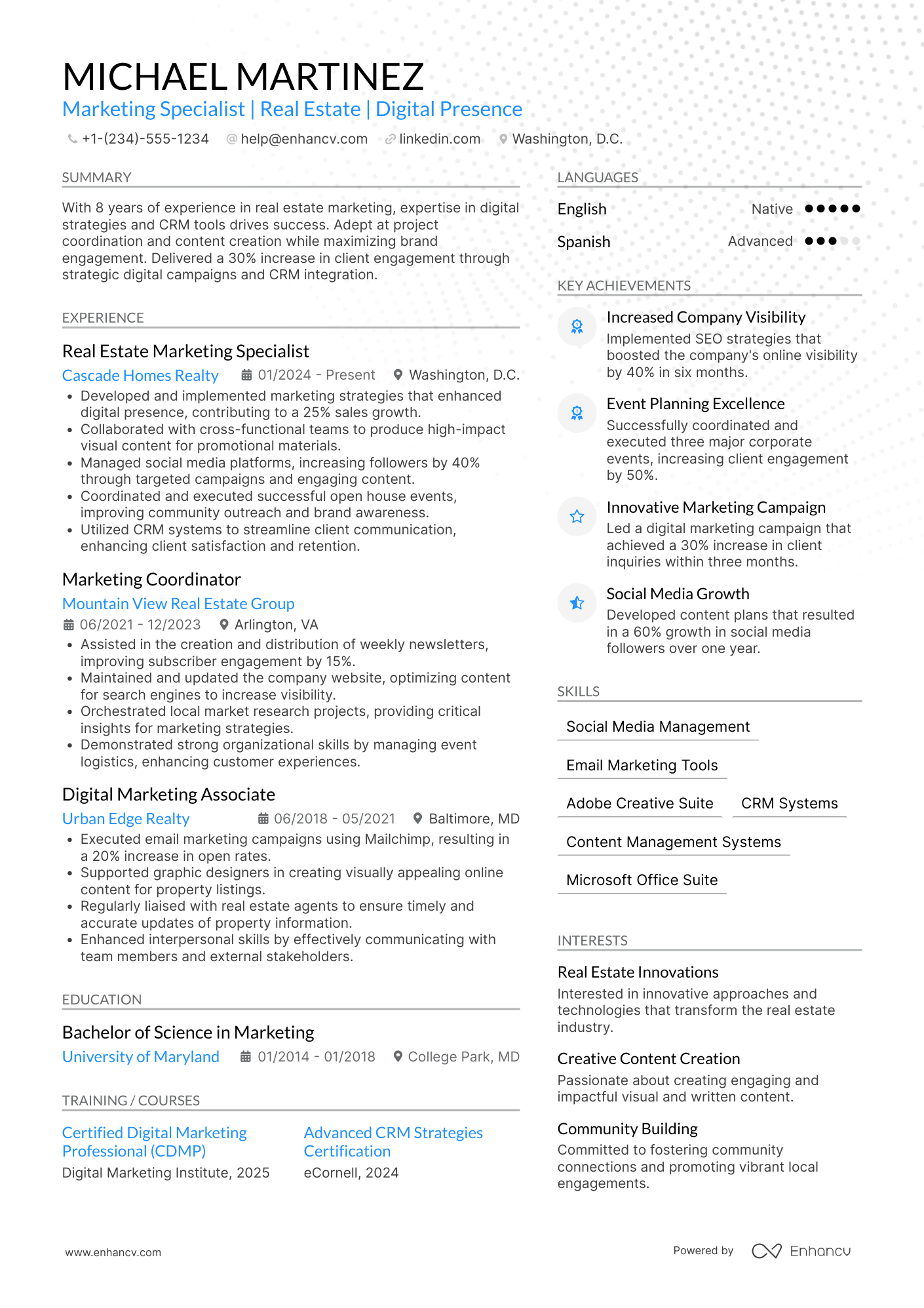
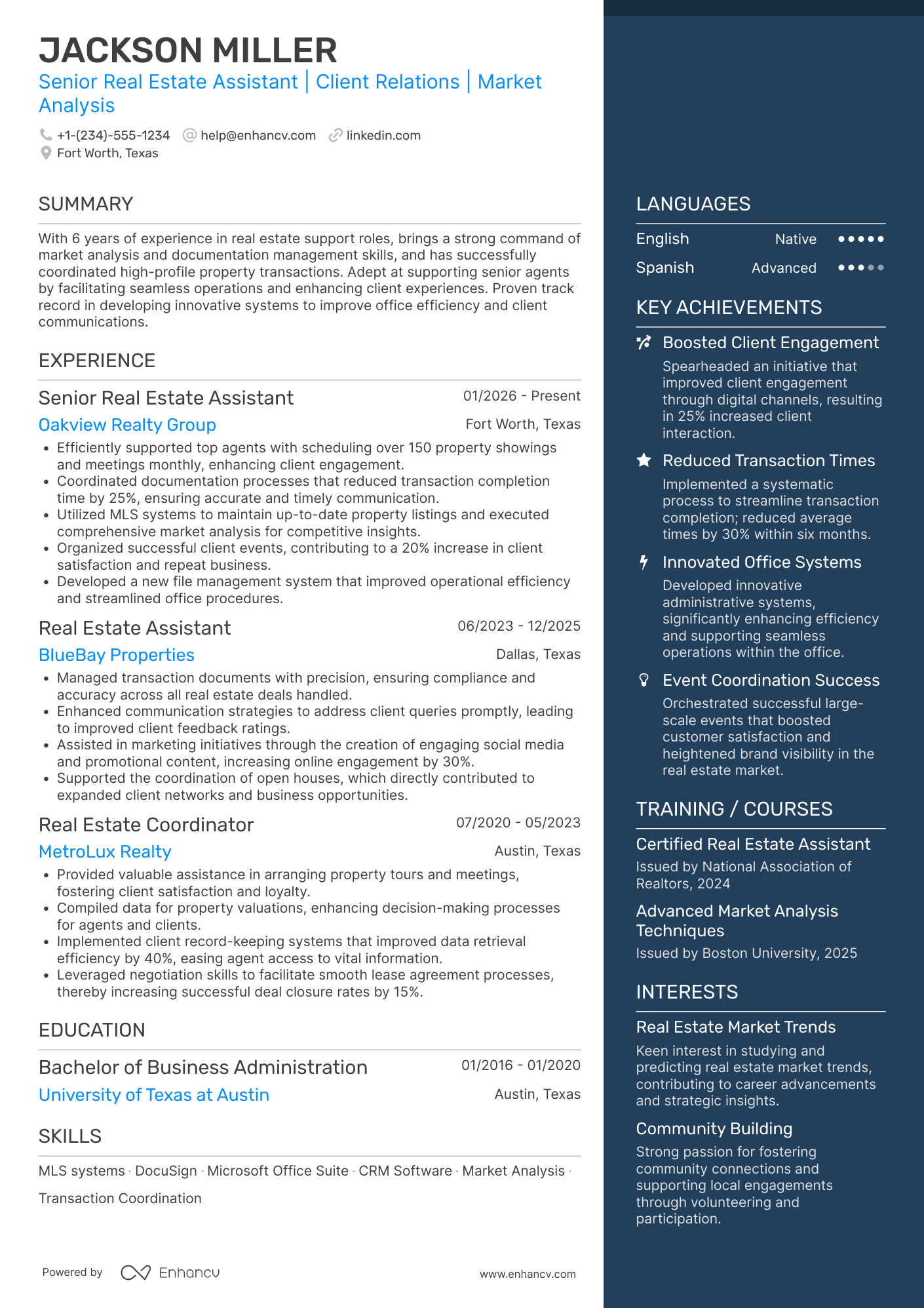
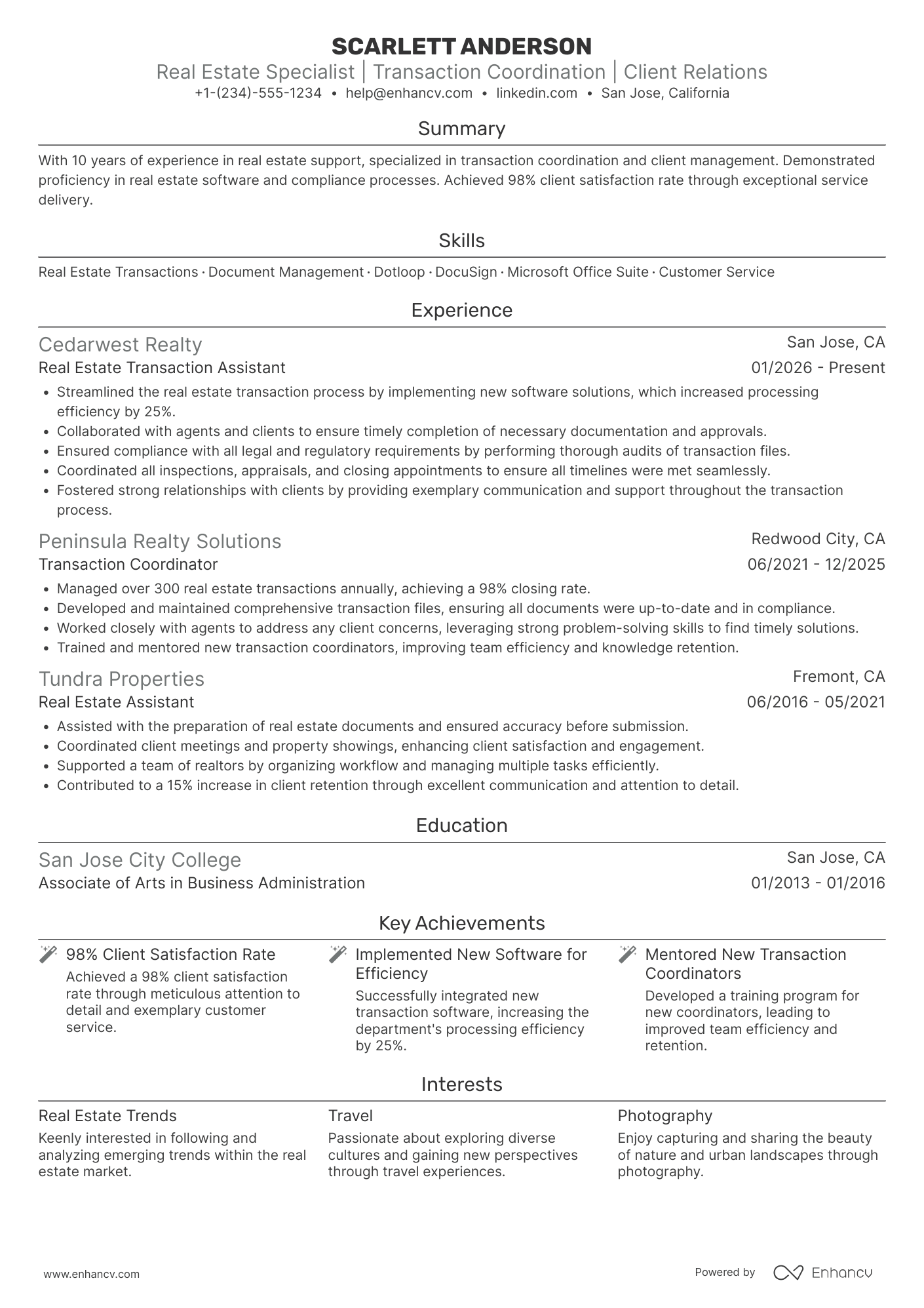
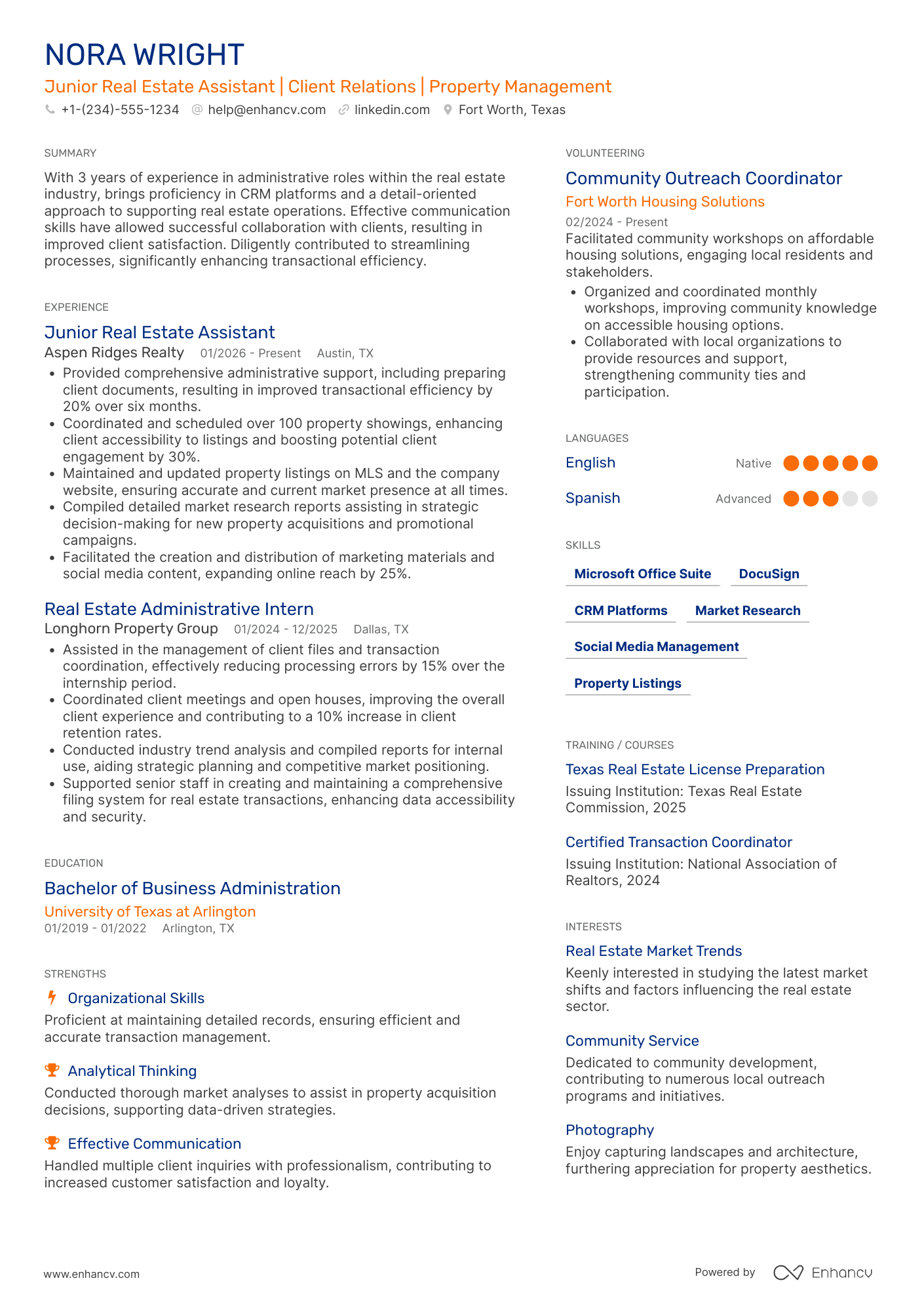
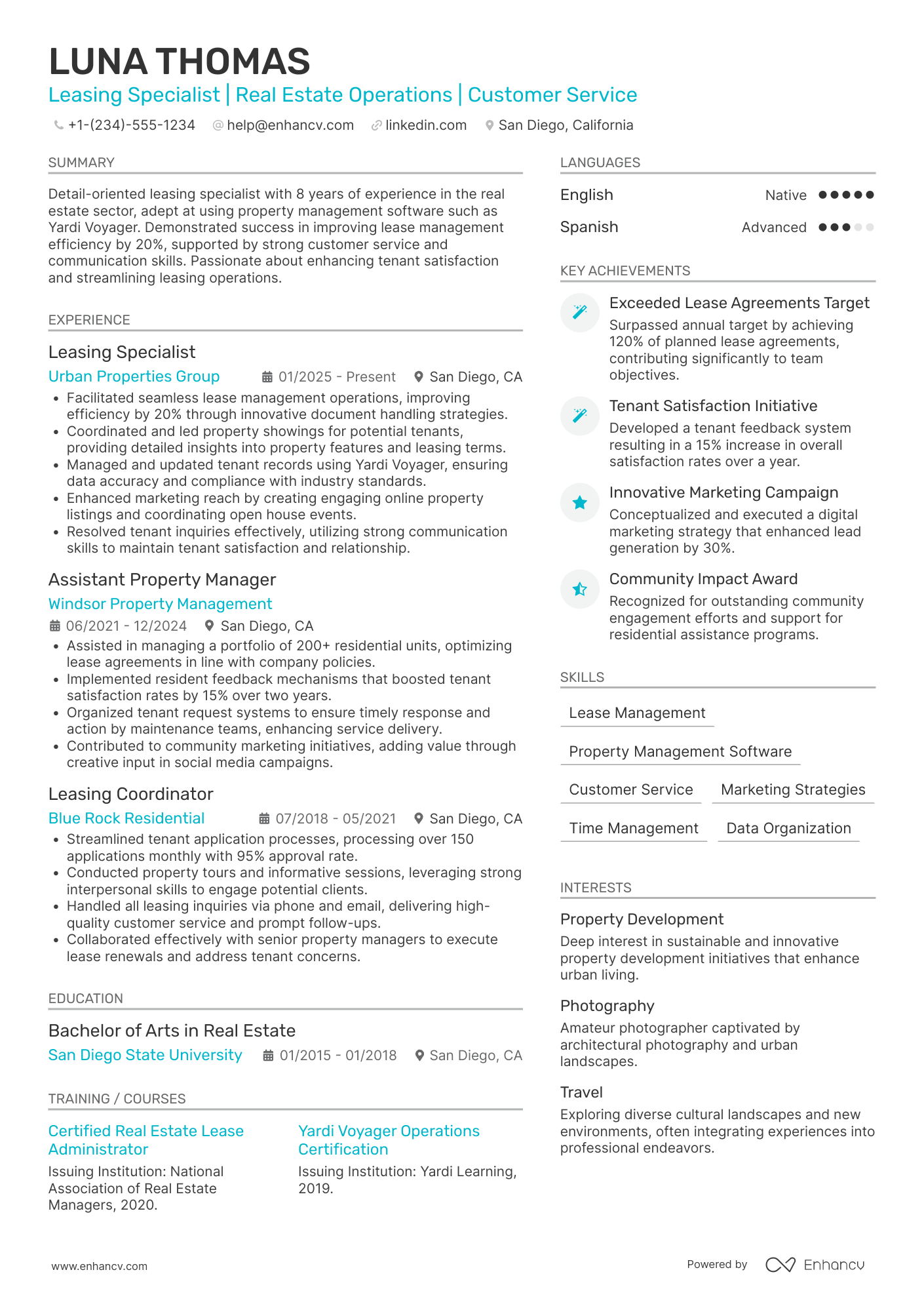
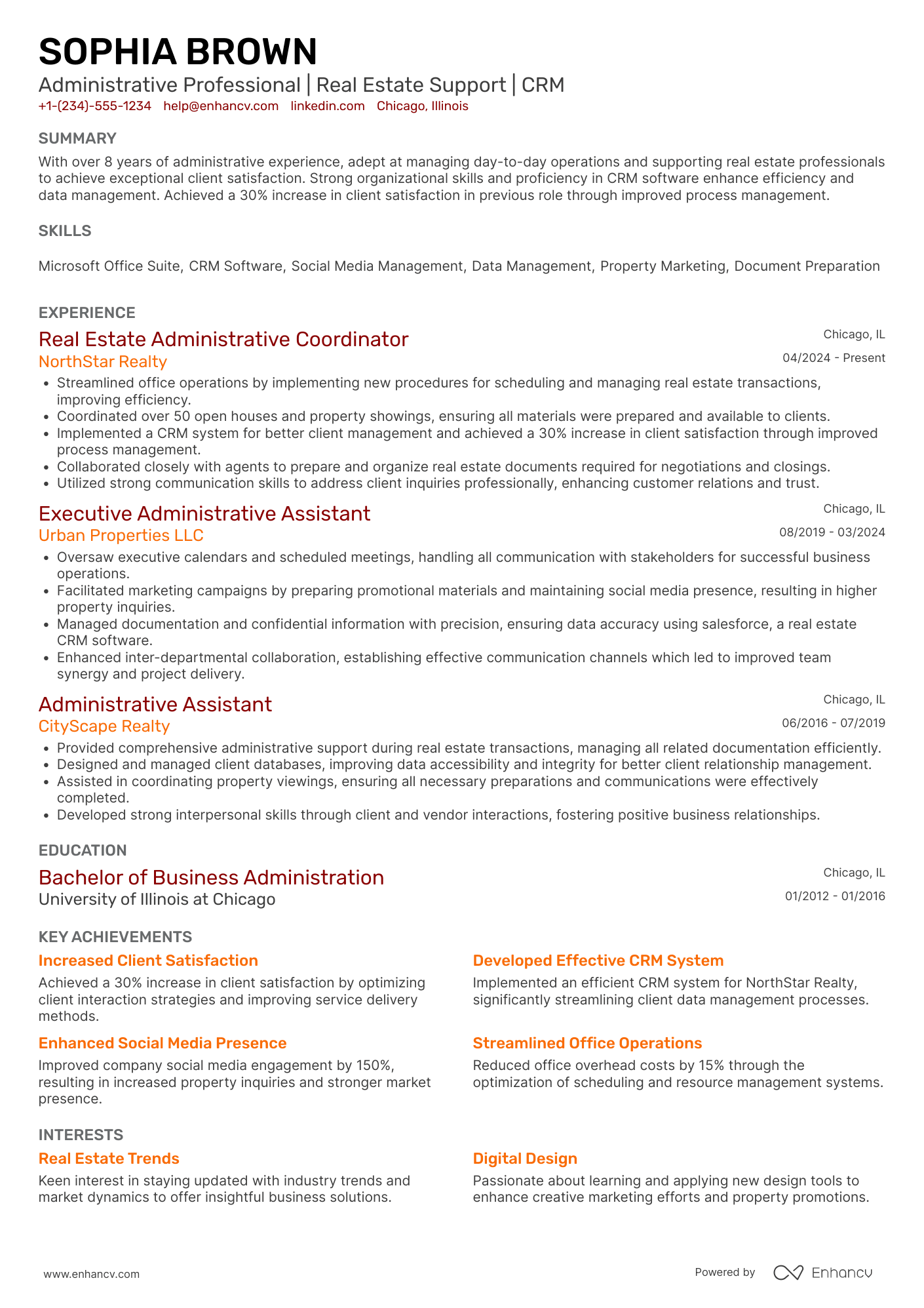
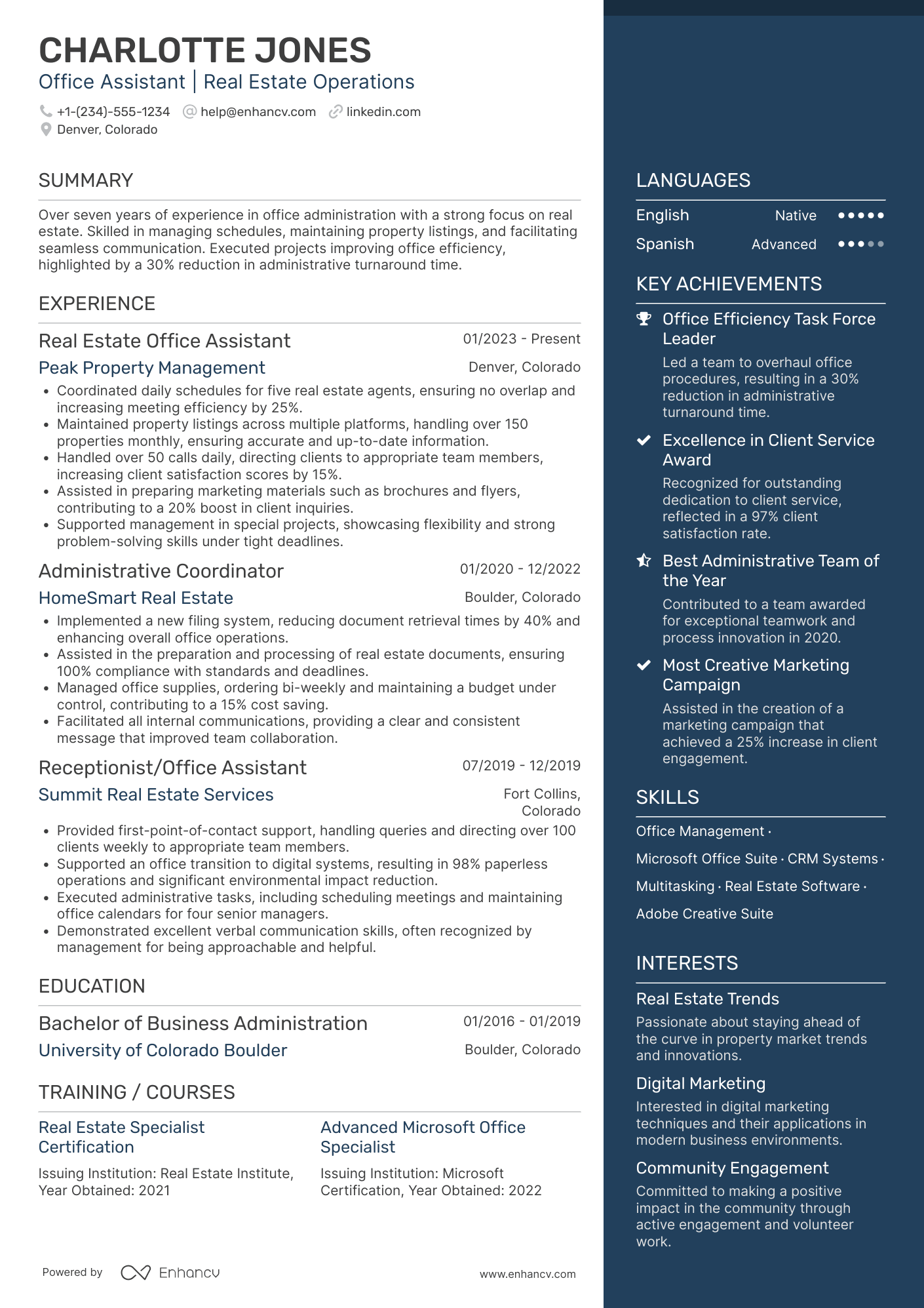
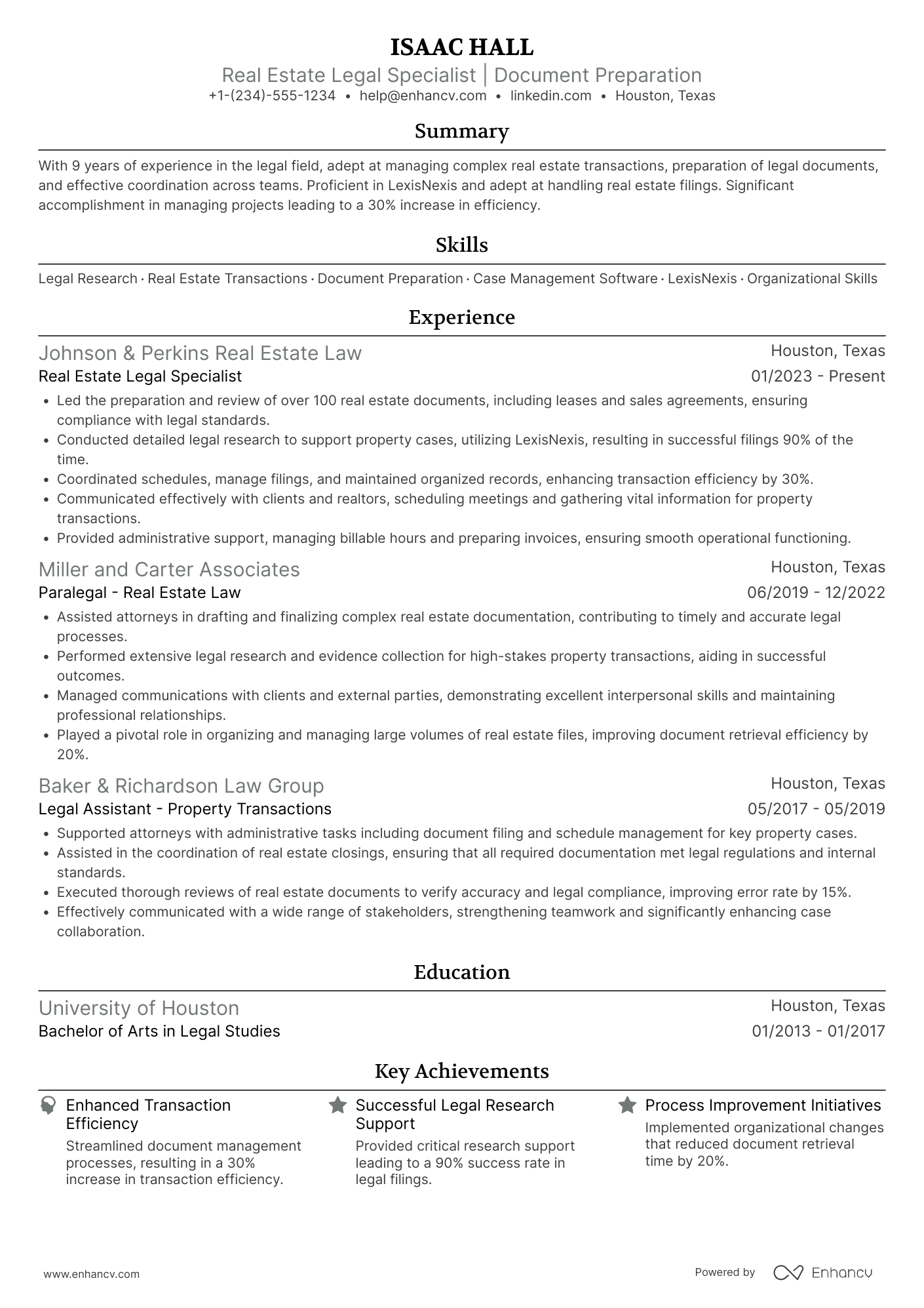
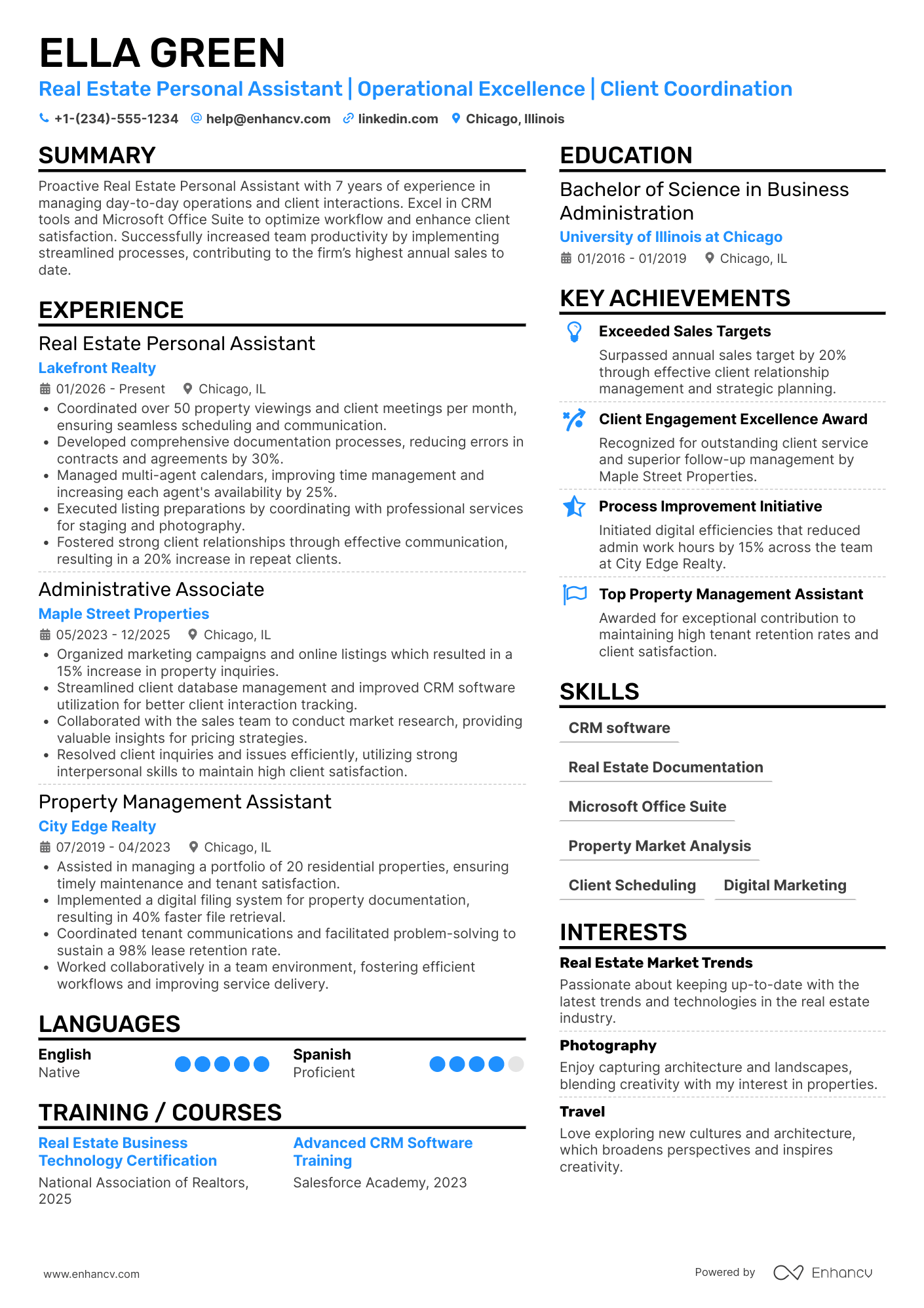
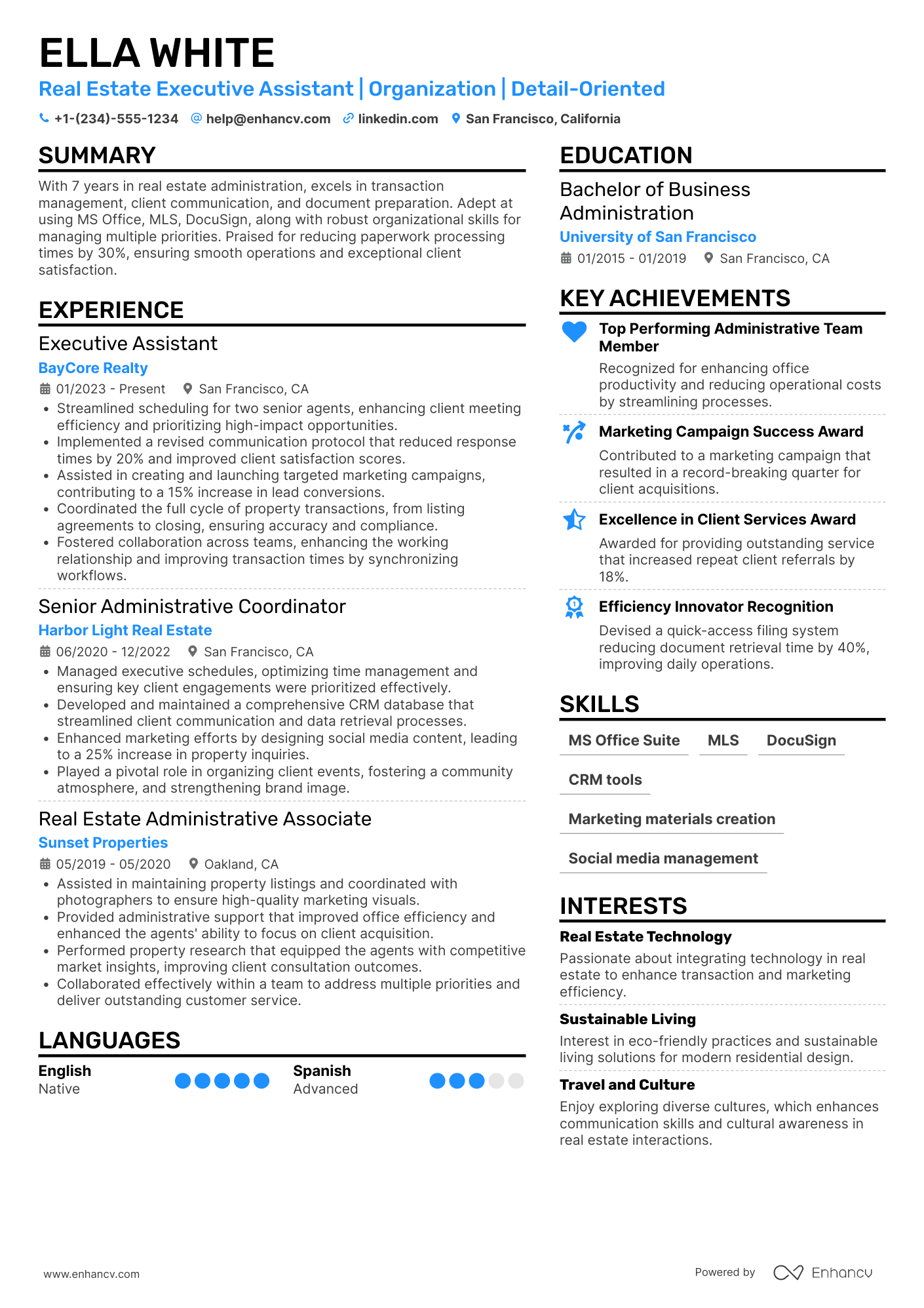
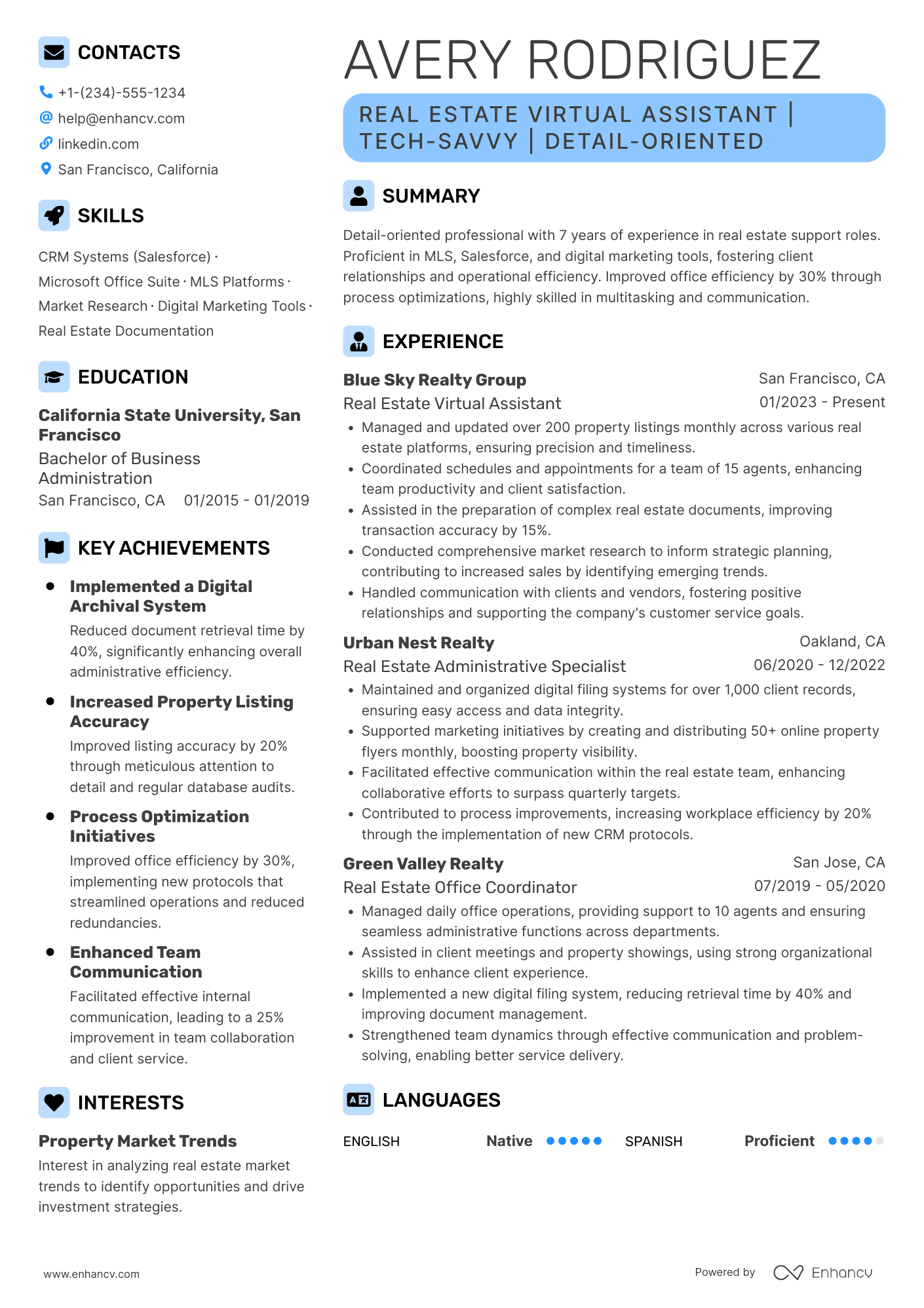
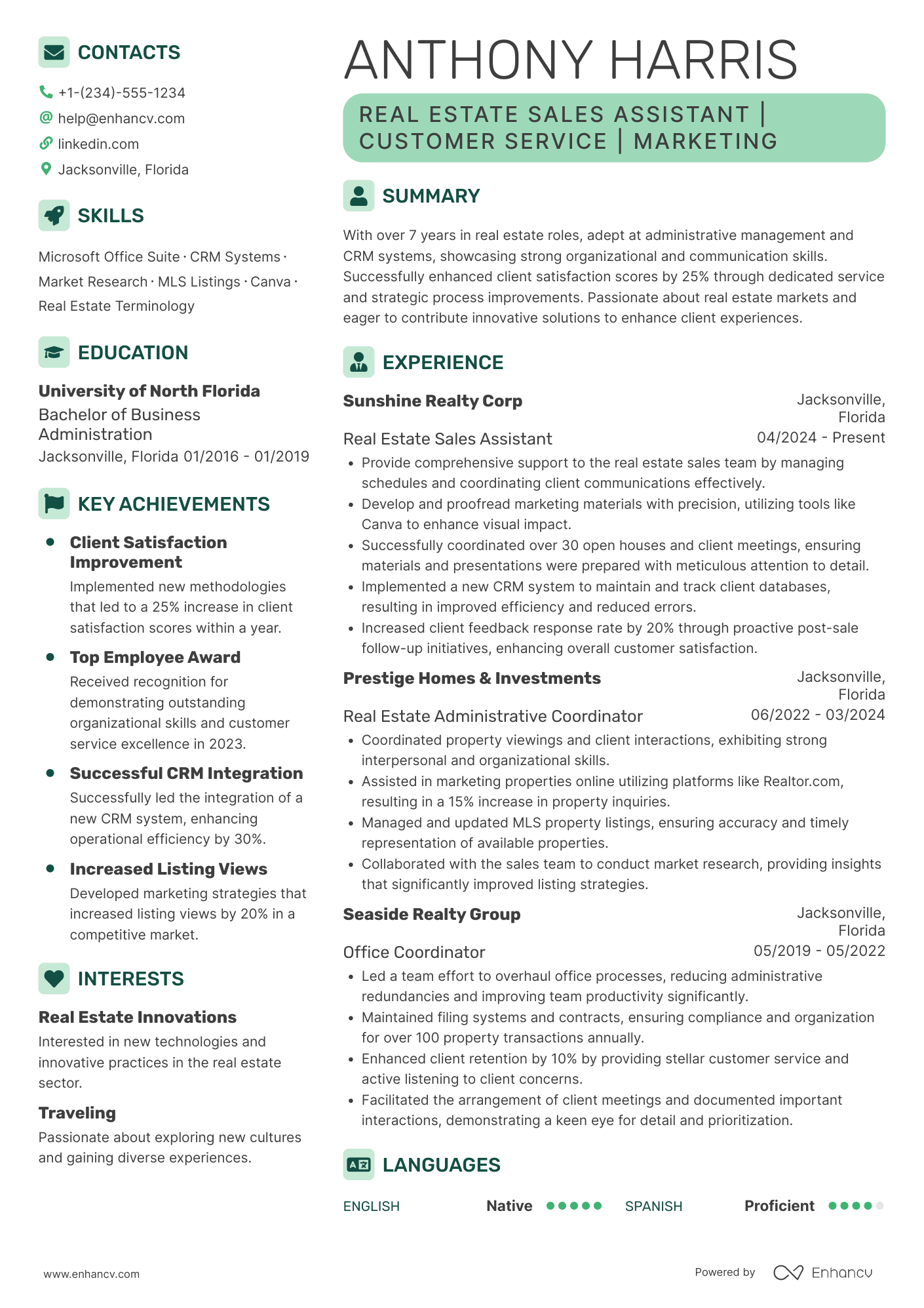
Real Estate Assistant resume examples
By Experience
By Role