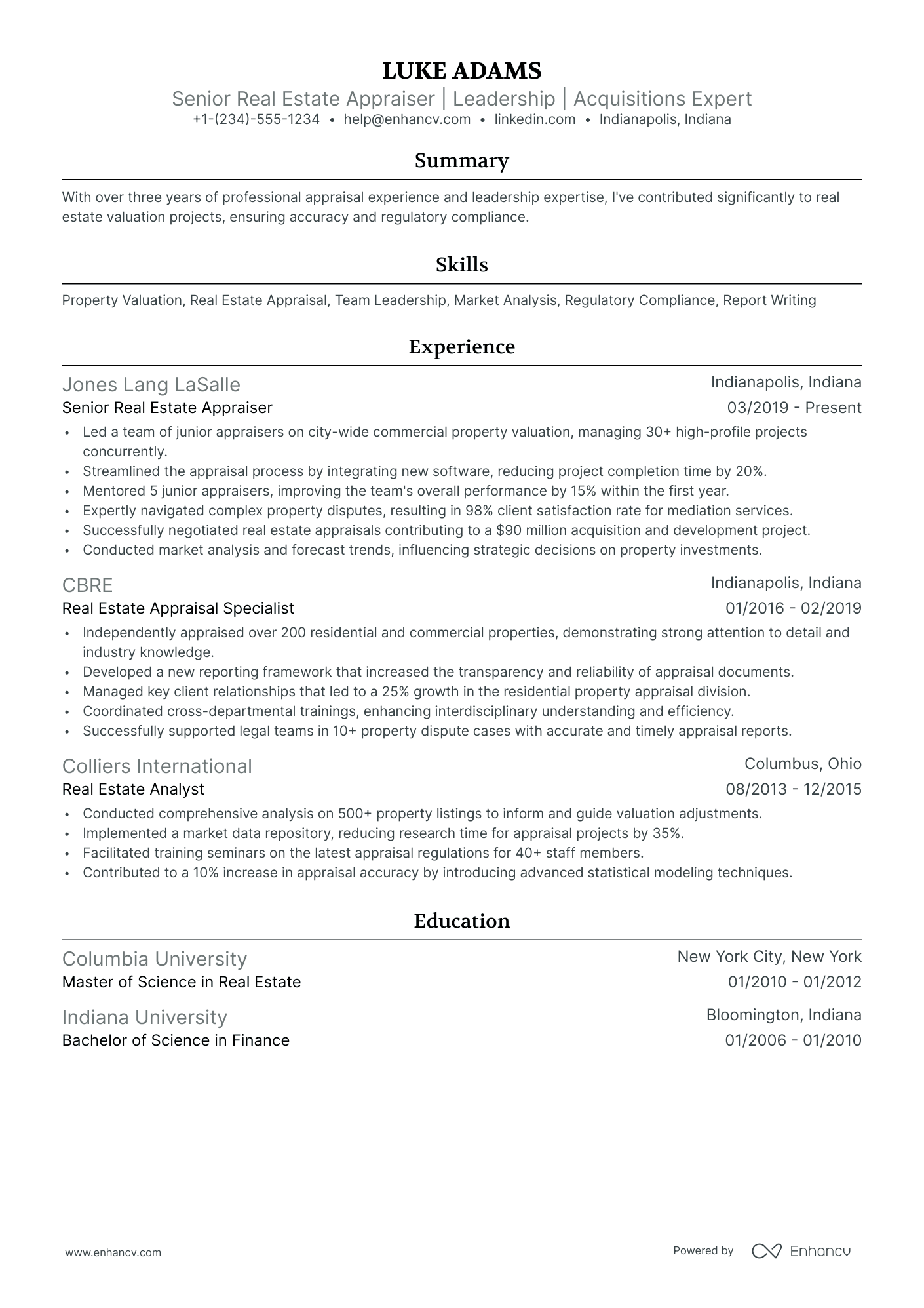
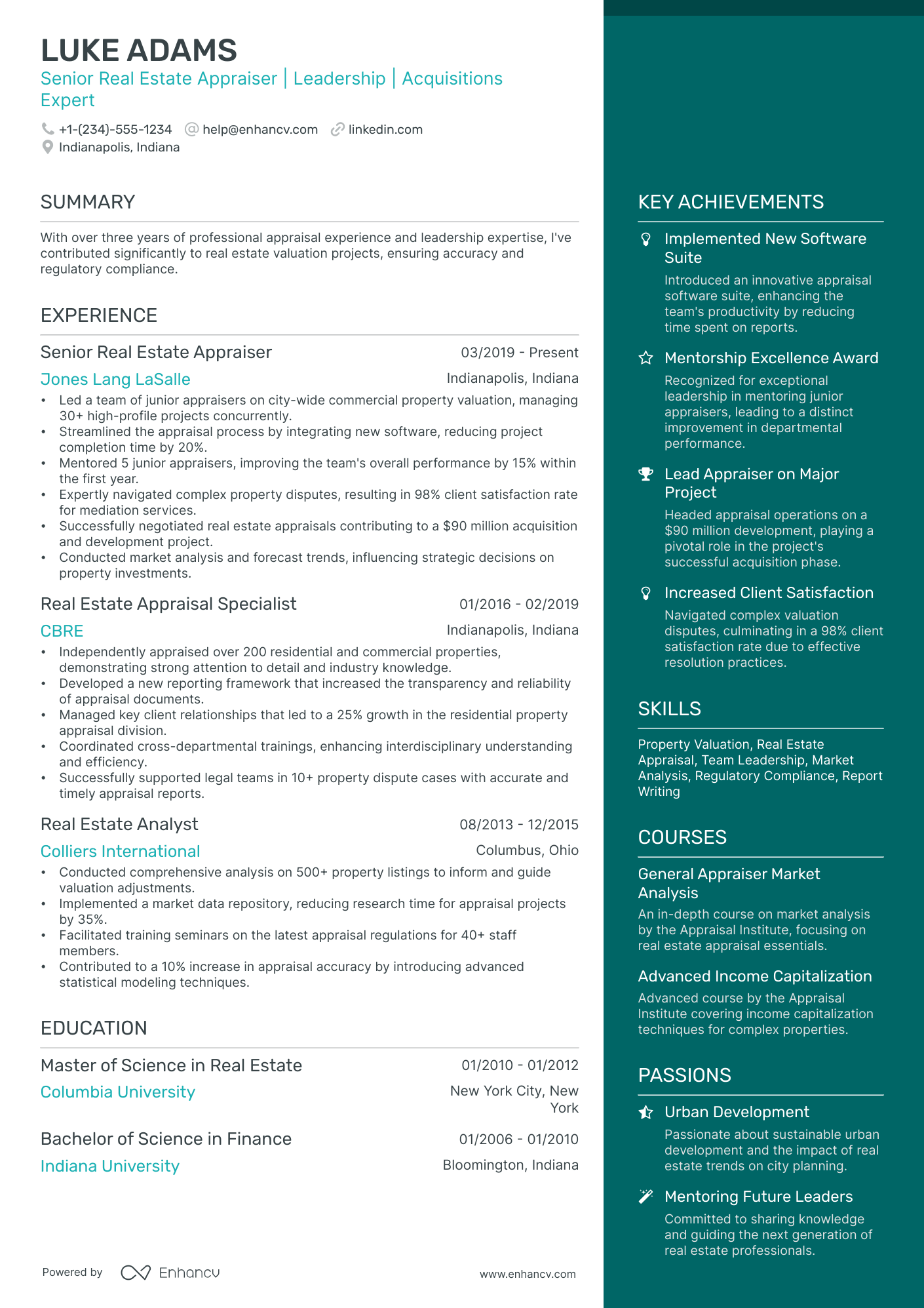
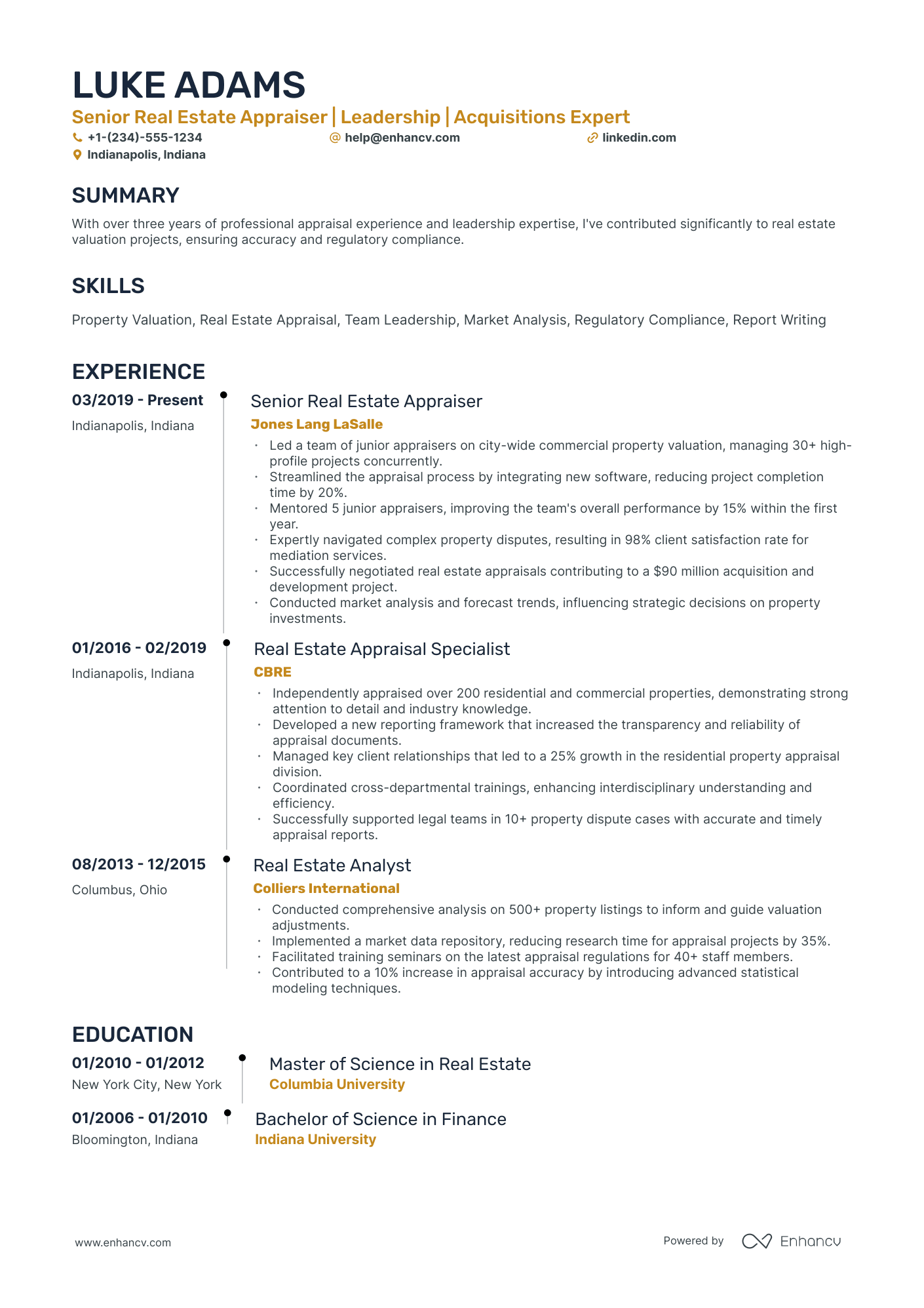
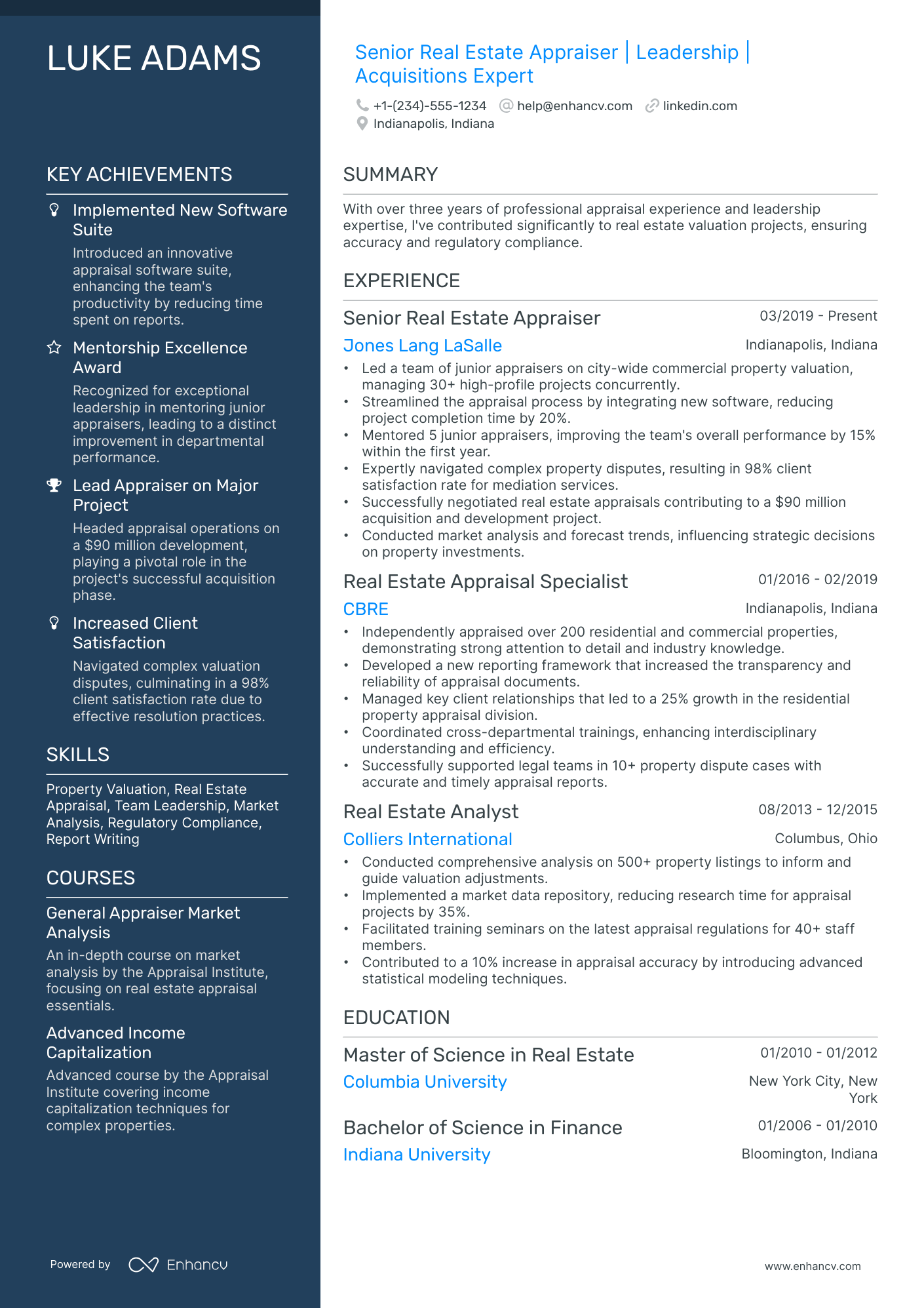
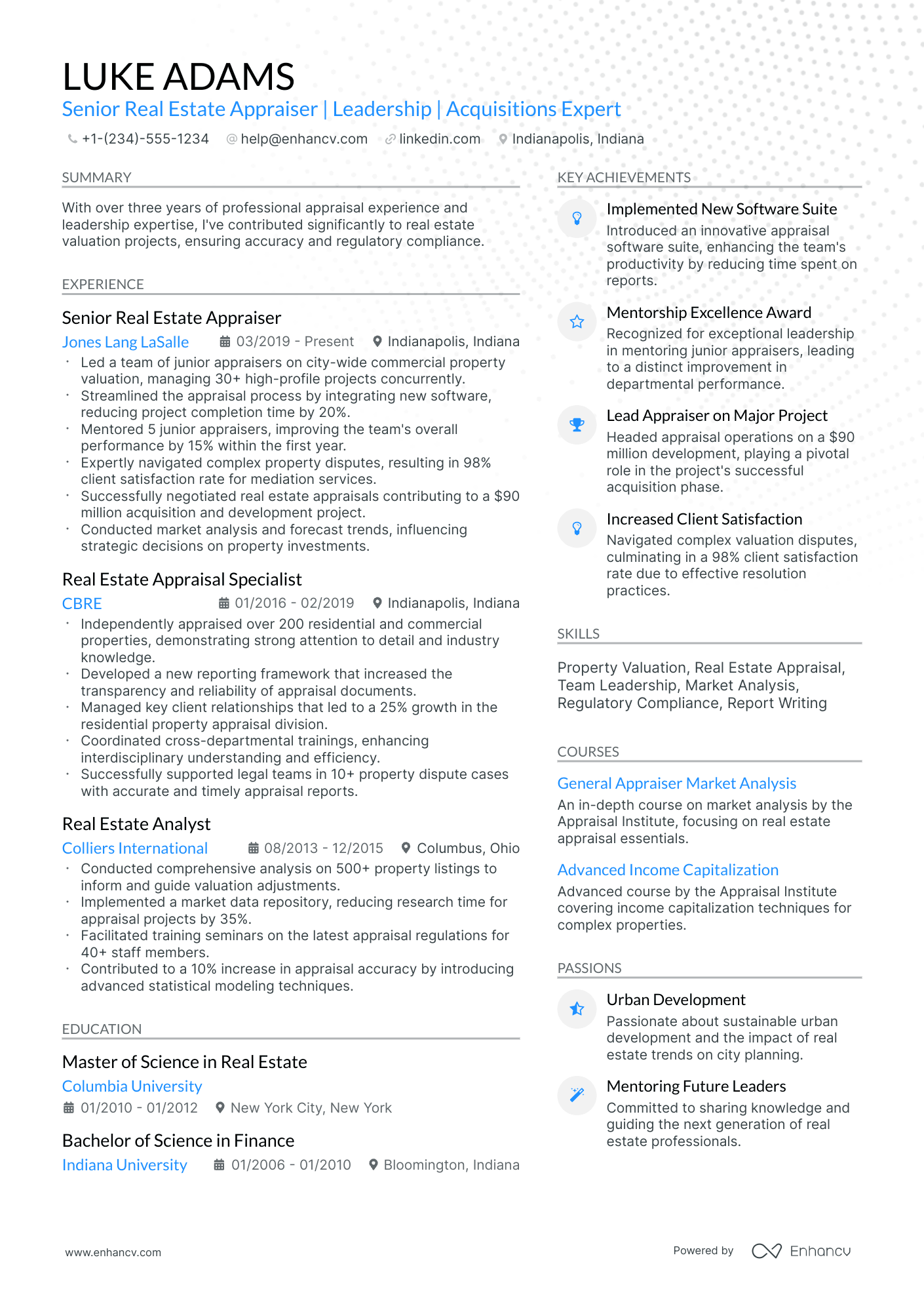
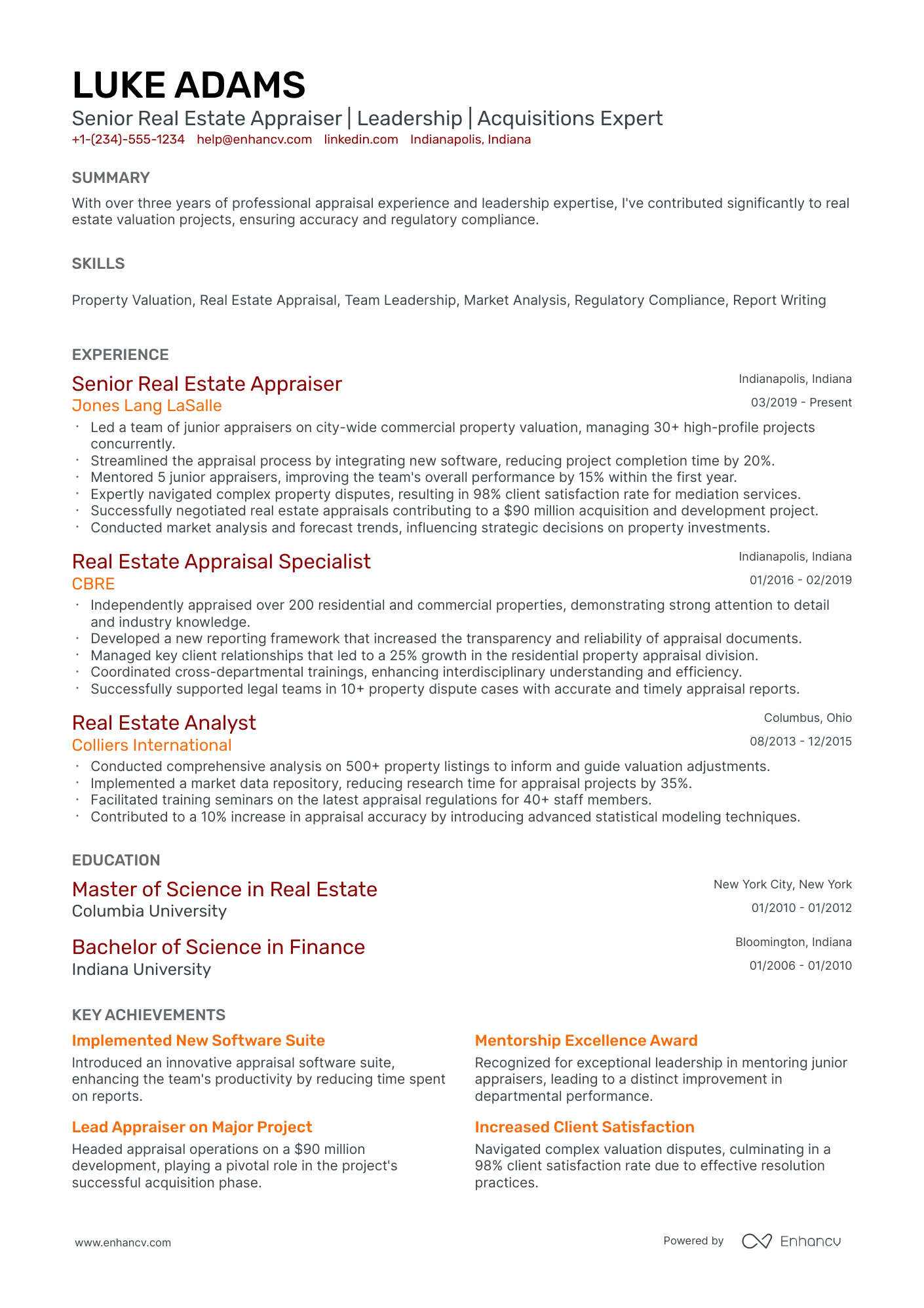
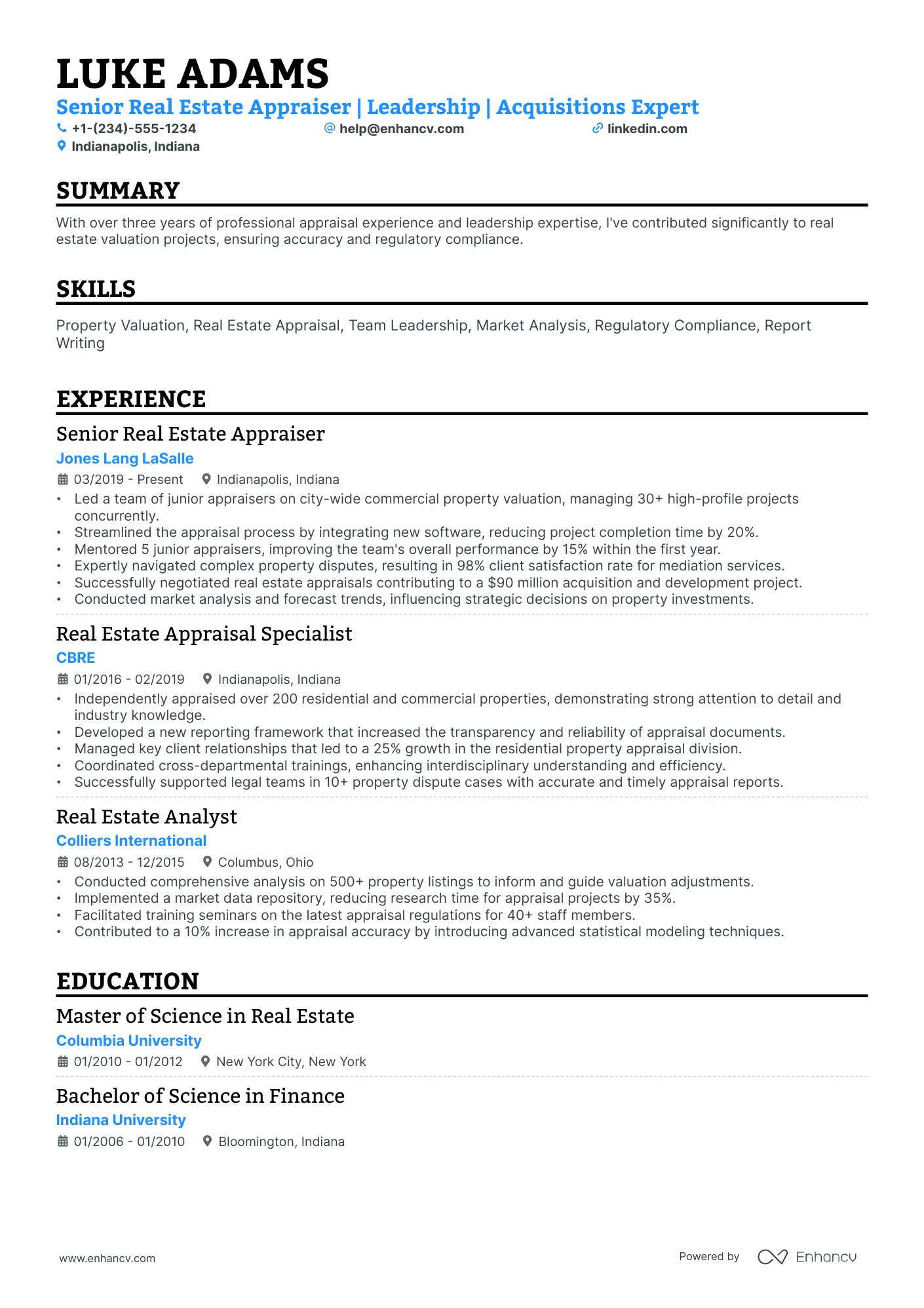
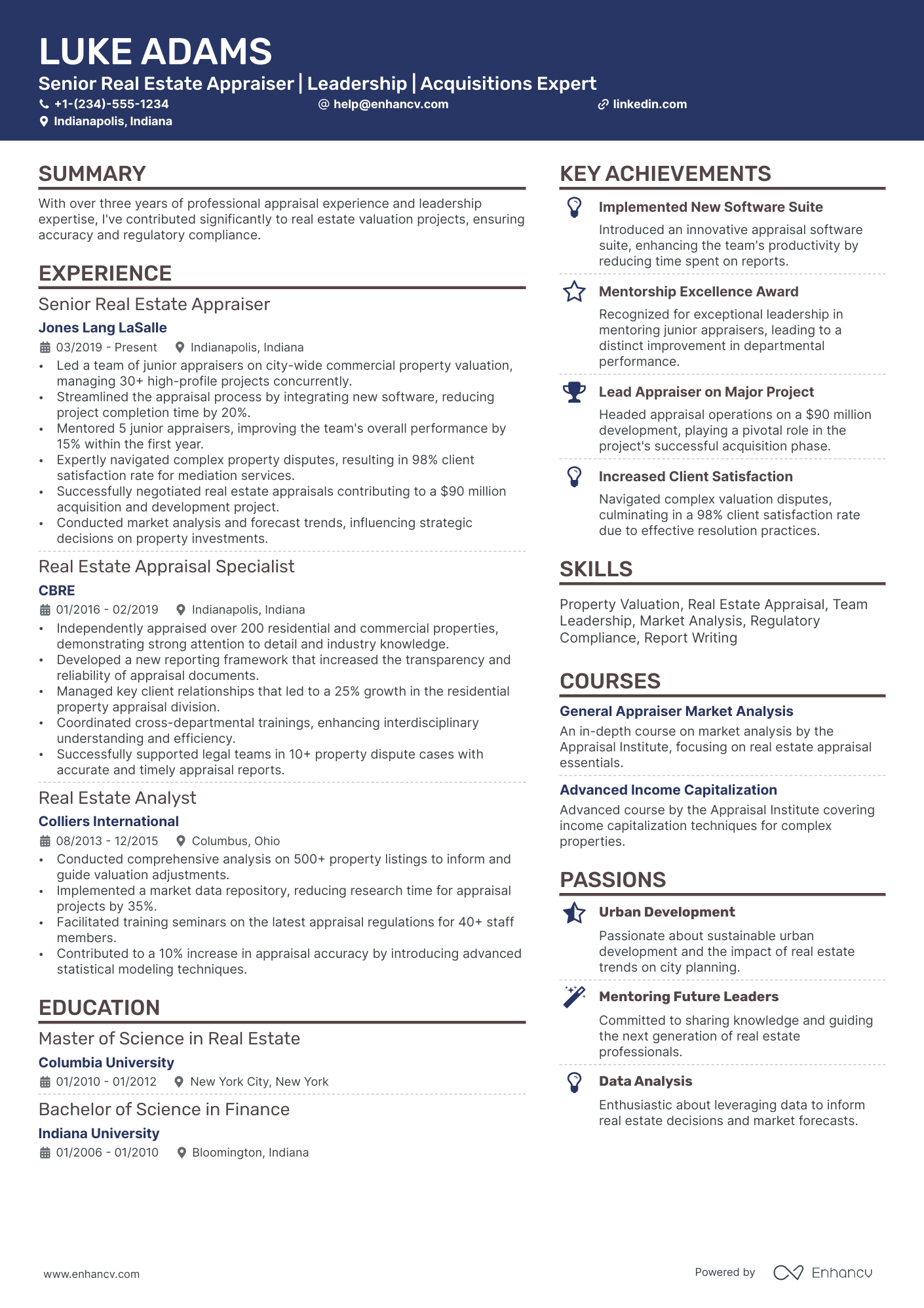
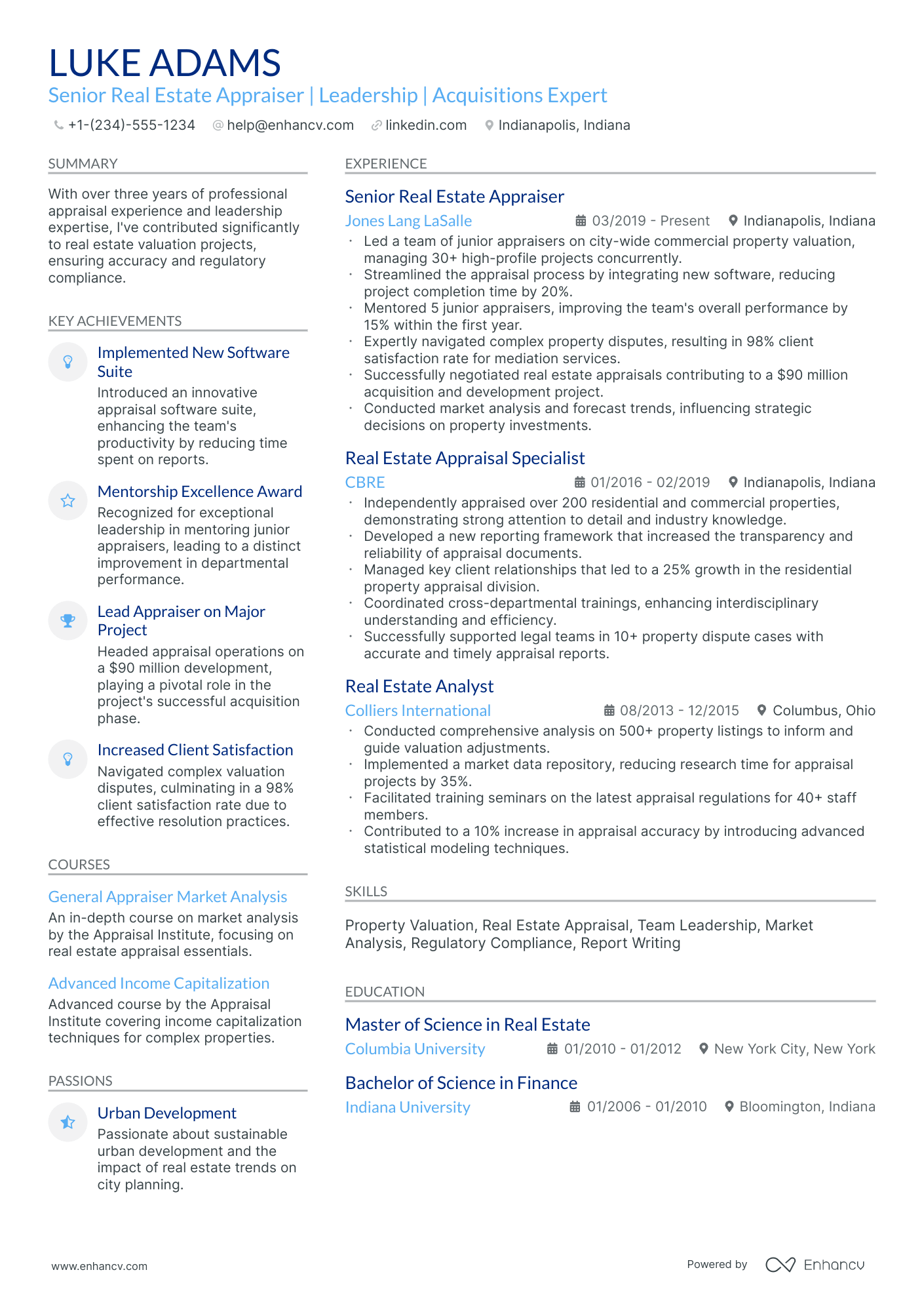
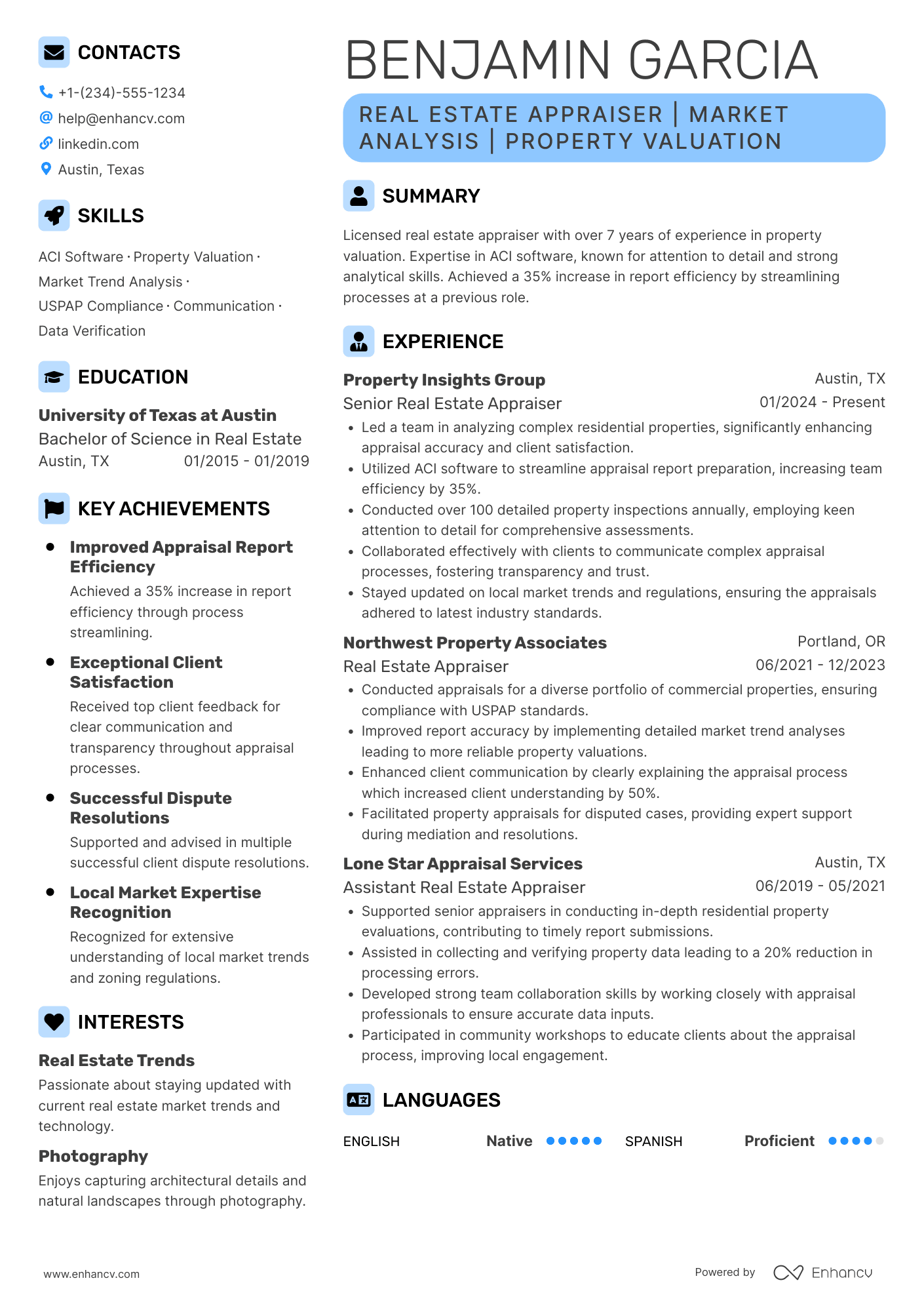
Most real estate appraiser resume drafts fail because they bury valuation decisions and compliance details in generic task lists. That makes them hard for an ATS to parse and easy to miss in quick recruiter scans in a crowded market.
A strong resume shows what changed because of your work, not just the forms you used. Understanding how to make your resume stand out starts with highlighting appraisal volumes, property types, and dollar ranges, plus on-time delivery rates, revision reductions, dispute outcomes, and audit pass rates.

Key takeaways
- Quantify appraisal volume, turnaround time, revision rates, and accuracy to prove measurable impact.
- Use reverse-chronological format if you have experience; use hybrid format if you're entering the field.
- Tailor every experience bullet to mirror the job posting's tools, property types, and compliance standards.
- List hard skills like USPAP, cost approach, and MLS research backed by proof in your experience section.
- Place certifications above education when they're recent or required for the target role's license level.
- Write a three- to four-line summary that names your specialty, tools, and one quantified achievement.
- Use Enhancv's tools to refine bullet points and eliminate vague language before submitting your resume.
How to format a real estate appraiser resume
Recruiters hiring real estate appraisers prioritize verifiable licensing and certifications, property valuation experience across specific asset classes, and compliance with USPAP standards. A clean, well-structured resume format ensures these credentials and your depth of fieldwork are immediately visible during both automated screening and manual review.

I have significant experience in this role—which format should I use?
Use a reverse-chronological format to present your appraisal career in a clear, linear progression that highlights growing expertise and expanding property portfolios. Do:
- Lead with your most recent role, emphasizing the scope of assignments—property types covered, geographic markets served, and volume of appraisals completed annually.
- Feature your licensing tier (e.g., Certified General, Certified Residential), USPAP compliance record, and proficiency with tools like ACI, Bradford Technologies, or Argus Enterprise.
- Quantify outcomes that reflect accuracy, efficiency, or business impact tied to your appraisal work.
I'm junior or switching into this role—what format works best?
A hybrid format works best, letting you spotlight appraisal-related skills and certifications at the top while still providing a chronological work history section. Do:
- Place your appraiser trainee license, relevant coursework (e.g., USPAP, market analysis, highest and best use), and technical skills in a prominent skills section above your experience.
- Include supervised appraisal fieldwork, internships, or real estate-adjacent roles (such as title research, loan processing, or property inspection) as transitional experience.
- Connect every listed skill or project to a concrete action and a measurable or observable result.
Why not use a functional resume?
A functional format strips away the timeline and context that hiring managers need to verify your supervised hours, licensing progression, and hands-on appraisal volume—all of which are non-negotiable in this field.
- Career changers entering appraisal: You hold a trainee license and have transferable experience in real estate, banking, or construction but no independent appraisal history.
- Recent graduates: You've completed appraisal coursework and USPAP training but have limited or no supervised fieldwork logged yet.
- Returning after a gap: You stepped away from appraisal work and need to foreground updated certifications and continuing education over an employment gap.
With your format established, the next step is choosing the right sections to showcase your qualifications effectively.
What sections should go on a real estate appraiser resume
Recruiters expect to see clear proof you can complete compliant valuations, support your conclusions, and deliver accurate reports on time.
Use this structure for maximum clarity:
- Header
- Summary
- Experience
- Skills
- Projects
- Education
- Certifications
- Optional sections: Awards, Publications, Languages
Knowing what to put on a resume matters—strong experience bullets should emphasize appraisal volume, property types covered, report turnaround times, quality and compliance outcomes, and measurable results for clients and stakeholders.
Is your resume good enough?
Drop your resume here or choose a file. PDF & DOCX only. Max 2MB file size.
Now that you’ve organized the key resume components, the next step is to write your real estate appraiser resume experience section so your qualifications come through clearly and consistently.
How to write your real estate appraiser resume experience
Your work experience section is where you prove you've delivered accurate, defensible property valuations—not just performed them. Hiring managers prioritize demonstrated impact over descriptive task lists, so focus on the appraisal tools, valuation methods, and measurable outcomes that show you've contributed to sound real estate decisions.
Each entry should include:
- Job title
- Company and location (or remote)
- Dates of employment (month and year)
Three to five concise bullet points showing what you owned, how you executed, and what outcomes you delivered:
- Ownership scope: the property types, geographic markets, appraisal portfolios, or client accounts you were directly accountable for as a real estate appraiser.
- Execution approach: the valuation methodologies, comparable analysis techniques, appraisal software, regulatory standards, or inspection protocols you applied to reach reliable property assessments.
- Value improved: the changes you drove in appraisal accuracy, turnaround time, report quality, compliance adherence, risk mitigation, or client satisfaction within your appraisal work.
- Collaboration context: how you coordinated with lenders, underwriters, real estate agents, property owners, legal teams, or regulatory bodies to support appraisal-dependent transactions and decisions.
- Impact delivered: the outcomes your appraisal work produced—expressed through portfolio scale, review pass rates, process improvements, or contributions to lending, investment, or compliance goals rather than routine task descriptions.
Experience bullet formula
A real estate appraiser experience example
✅ Right example - modern, quantified, specific.
Certified Residential Real Estate Appraiser
North Ridge Valuation Group | Phoenix, AZ
2021–Present
Independent appraisal firm delivering lender, private-party, and estate valuations across Maricopa County.
- Produced one hundred eighty-plus URAR appraisals per year using ACI Sky and UAD-compliant workflows, cutting revision requests by 28% through tighter condition and quality rating support.
- Modeled sales comparison adjustments in Microsoft Excel with paired-sales and regression checks, reducing review-to-delivery time by 18% while improving reconciliation consistency across complex property types.
- Verified comps and market trends with MLS, CoreLogic, and county assessor records, lowering unsupported-data flags by 35% and strengthening defensibility for underwriter and auditor reviews.
- Completed on-site inspections with Total for Mobile and laser measurement tools, improving sketch accuracy and gross living area variance to under 2% on post-review spot checks.
- Partnered with loan officers, underwriters, and homeowners to resolve scope and access issues within forty-eight hours, increasing on-time delivery from 86% to 95% and preventing rate-lock extension costs on thirty-plus files annually.
Now that you've seen how a strong experience section comes together, let's look at how to adjust yours to match the specific job you're targeting.
How to tailor your real estate appraiser resume experience
Recruiters evaluate your real estate appraiser resume through both applicant tracking systems and manual review. Tailoring your resume to the job description ensures you pass both screening stages.
Ways to tailor your real estate appraiser experience:
- Match appraisal software and tools named in the job description.
- Mirror the exact property types listed such as residential or commercial.
- Use the same compliance standards referenced like USPAP or FIRREA.
- Reflect valuation methodologies the posting specifies for comparable analysis.
- Highlight experience with market areas or regions the employer serves.
- Align your inspection and reporting workflows with their stated process.
- Emphasize quality assurance practices if the posting mentions review accuracy.
- Include relevant licensing or certification levels the role requires.
Tailoring means aligning your real accomplishments with the employer's stated requirements, not forcing keywords where they don't belong.
Resume tailoring examples for real estate appraiser
| Job description excerpt | Untailored | Tailored |
|---|---|---|
| Perform residential and commercial property appraisals using USPAP standards and Marshall & Swift cost estimation tools. | Conducted property appraisals for various clients across multiple locations. | Appraised 200+ residential and commercial properties annually in compliance with USPAP standards, leveraging Marshall & Swift cost estimation tools to deliver accurate valuations within 48-hour turnaround windows. |
| Prepare detailed appraisal reports for FHA, VA, and conventional loan products, ensuring compliance with lender and regulatory guidelines. | Wrote appraisal reports and submitted them to lending institutions on time. | Prepared 15+ detailed appraisal reports per week for FHA, VA, and conventional loan products, maintaining a 99.2% compliance rate with lender-specific and federal regulatory guidelines. |
| Analyze comparable sales data, local market trends, and zoning regulations to determine accurate property values using ACI software. | Researched market data and used software to help determine property values. | Analyzed comparable sales, absorption rates, and municipal zoning regulations across three counties using ACI software, reducing valuation disputes by 30% through data-driven market trend adjustments. |
Once you’ve aligned your experience with the role’s requirements, the next step is to quantify your real estate appraiser achievements so hiring managers can see the measurable impact of your work.
How to quantify your real estate appraiser achievements
Quantifying your achievements proves your valuations drive faster decisions, lower risk, and stronger compliance. Focus on turnaround time, report accuracy, revision rates, volume, and audit outcomes across your property types, lenders, and appraisal tools.
Quantifying examples for real estate appraiser
| Metric | Example |
|---|---|
| Turnaround time | "Cut average appraisal turnaround from five days to three days by standardizing comp selection in Total and using MLS saved searches across four counties." |
| Accuracy rate | "Maintained 98% acceptance on first submission across 220 lender appraisals by tightening reconciliation notes and photo documentation to Uniform Standards of Professional Appraisal Practice standards." |
| Compliance | "Achieved zero material findings in two investor quality-control reviews by adding a Uniform Appraisal Dataset checklist and documenting adjustments with paired-sales support." |
| Volume handled | "Completed 360 residential appraisals in twelve months across single-family and condominiums, averaging thirty reports per month while meeting all lender due dates." |
| Revision reduction | "Reduced lender revision requests from 18% to 7% by pre-validating sketches in Apex and running a final narrative review against lender overlays before delivery." |
Turn your everyday tasks into measurable, recruiter-ready resume bullets in seconds with Enhancv's Bullet Point Generator.
Once you've crafted strong, impactful bullet points for your experience section, it's equally important to strategically showcase the hard and soft skills that qualify you for the role.
How to list your hard and soft skills on a real estate appraiser resume
Your skills section shows you can produce credible valuations, meet compliance requirements, and communicate findings—recruiters and applicant tracking systems scan this section for role keywords, then confirm them in your experience; aim for a hard-skill-heavy mix with targeted soft skills. real estate appraiser roles require a blend of:
- Product strategy and discovery skills.
- Data, analytics, and experimentation skills.
- Delivery, execution, and go-to-market discipline.
- Soft skills.
Your skills section should be:
- Scannable (bullet-style grouping).
- Relevant to the job post.
- Backed by proof in experience bullets.
- Updated with current tools.
Place your skills section:
- Above experience if you're junior or switching careers.
- Below experience if you're mid/senior with strong achievements.

Hard skills
- Uniform Standards of Professional Appraisal Practice (USPAP)
- Residential appraisal reporting
- Comparable sales selection
- Cost approach valuation
- Sales comparison approach
- Income approach basics
- Market rent analysis
- Highest and best use analysis
- Adjustments and reconciliation
- Automated valuation models, regression analysis
- Multiple Listing Service research, public records
- Appraisal management platform workflows
Soft skills
- Defend value conclusions clearly
- Ask precise scope questions
- Manage revisions and disputes
- Prioritize deadlines across orders
- Communicate limitations and assumptions
- Align with lender and client needs
- Document decisions for audit trails
- Collaborate with agents and homeowners
- Handle property access professionally
- Maintain independence under pressure
- Resolve data conflicts quickly
- Write concise, objective narratives
How to show your real estate appraiser skills in context
Skills shouldn't live only in a dedicated skills list. Explore resume skills examples to see how top candidates weave competencies throughout their applications.
They should be demonstrated in:
- Your summary (high-level professional identity)
- Your experience (proof through outcomes)
Here's what that looks like in practice.
Summary example
Senior real estate appraiser with 12 years of experience in commercial and residential valuations. Skilled in USPAP compliance, regression analysis, and CoStar. Reduced report revision rates by 30% through standardized quality controls and stakeholder collaboration.
- Reflects senior-level expertise clearly
- Names industry-standard tools and methods
- Includes a concrete, measurable outcome
- Highlights collaboration as a soft skill
Experience example
Senior Real Estate Appraiser
Crestline Valuation Group | Denver, CO
March 2018–Present
- Completed 1,200+ commercial and residential appraisals using ARGUS and CoStar, maintaining a 98% client acceptance rate.
- Collaborated with underwriters and loan officers to streamline review workflows, cutting average turnaround time by four days.
- Developed internal comparable-sales databases that reduced data-gathering time by 25% across a six-person appraisal team.
- Every bullet includes measurable proof.
- Skills surface naturally through real outcomes.
Once you’ve demonstrated your appraisal abilities through relevant examples, the next step is to apply that same approach to writing a real estate appraiser resume with no experience.
How do I write a real estate appraiser resume with no experience
Even without full-time experience, you can demonstrate readiness through:
- Appraisal coursework with graded reports
- Property data collection field assignments
- Comparable sales analysis class projects
- GIS mapping labs and exercises
- Excel valuation models and templates
- Shadowing a licensed real estate appraiser
- County records research and summaries
- Volunteer housing inventory surveys
Our guide on writing a resume without work experience covers additional strategies for building a compelling application from scratch.
Focus on:
- Accurate comparable selection and adjustments
- Clean, auditable data sources cited
- USPAP training and ethics awareness
- Report writing with clear valuation logic
Resume format tip for entry-level real estate appraiser
Use a combination resume format to spotlight appraisal projects and technical skills above limited work history. It lets you prove valuation ability with evidence first. Do:
- Add a "Projects" section with appraisal-style deliverables.
- List tools: Excel, GIS, MLS, public records.
- Show methods: highest and best use, adjustments.
- Quantify scope: properties reviewed, comps analyzed.
- Cite relevant coursework and USPAP training.
- Built an Excel sales comparison grid using MLS data and county records, analyzed twelve comps, and reduced adjustment errors by 15% after instructor review.
Since your education and certifications carry even more weight when you lack hands-on experience, presenting them effectively on your resume is essential.
How to list your education on a real estate appraiser resume
Your education section helps hiring teams confirm you have the foundational knowledge needed. It validates your academic background in valuation principles, finance, and real estate analysis.
Include:
- Degree name
- Institution
- Location
- Graduation year
- Relevant coursework (for juniors or entry-level candidates)
- Honors & GPA (if 3.5 or higher)
Skip month and day details—list the graduation year only.
Here's a strong education entry tailored to a real estate appraiser resume.
Example education entry
Bachelor of Science in Real Estate
University of Georgia, Athens, GA
Graduated 2021
GPA: 3.7/4.0
- Relevant coursework: Property Valuation, Real Estate Finance, Land Use Economics, Statistical Analysis for Appraisers
- Honors: Magna Cum Laude, Dean's List (six semesters)
How to list your certifications on a real estate appraiser resume
Certifications on your resume show a real estate appraiser's commitment to ongoing learning, proficiency with valuation tools, and alignment with current industry standards and regulations.
Include:
- Certificate name
- Issuing organization
- Year
- Optional: credential ID or URL
- Place certifications below education when they're older, less relevant to your target role, or mainly support foundational knowledge.
- Place certifications above education when they're recent, required for your license level, or closely match the appraisal work in the job posting.
Best certifications for your real estate appraiser resume
- Licensed Residential Appraiser
- Certified Residential Appraiser
- Certified General Appraiser
- Uniform Standards of Professional Appraisal Practice (USPAP) Certification
- Appraisal Institute—MAI
- Appraisal Institute—SRA
- Federal Housing Administration (FHA) Appraisal Certification
Once you’ve shown your credentials in a clear, verifiable way, move to your real estate appraiser resume summary to connect those qualifications to the value you bring.
How to write your real estate appraiser resume summary
Your resume summary is the first thing a recruiter reads. A strong one instantly signals you have the skills and experience to deliver accurate property valuations.
Keep it to three to four lines, with:
- Your title and total years of experience in real estate appraisal.
- Domain focus, such as residential, commercial, or mixed-use properties.
- Core tools and skills like URAR forms, MLS databases, and comparable sales analysis.
- One or two quantified achievements that show accuracy or efficiency.
- Soft skills tied to real outcomes, such as attention to detail that reduced revision requests.

PRO TIP
At this level, emphasize technical competence, relevant certifications, and early wins. Highlight specific property types you've appraised and tools you use daily. Avoid vague phrases like "passionate self-starter" or "eager to grow." Recruiters want proof of skills, not motivation.
Example summary for a real estate appraiser
Licensed real estate appraiser with two years of experience in residential valuations. Completed over 300 appraisals using MLS and URAR forms. Reduced report revision rates by 15% through detailed comparable sales analysis.
Optimize your resume summary and objective for ATS
Drop your resume here or choose a file.
PDF & DOCX only. Max 2MB file size.
Now that your summary captures your professional value, make sure the header above it presents your contact details clearly and correctly.
What to include in a real estate appraiser resume header
A resume header lists your key contact and professional details, and it boosts visibility, credibility, and recruiter screening for a real estate appraiser role.
Essential resume header elements
- Full name
- Tailored job title and headline
- Location
- Phone number
- Professional email
- GitHub link
- Portfolio link
A LinkedIn link helps recruiters verify experience quickly and supports screening.
Don't include a photo on a real estate appraiser resume unless the role is explicitly front-facing or appearance-dependent.
Match your job title and headline to the posting and include your license level to avoid confusion during recruiter screening.
Example
Real estate appraiser resume header
Jordan Taylor
Certified Residential Real Estate Appraiser | FHA, URAR, and UAD Reporting
Austin, TX
(512) 555-01XX
jordan.taylor@enhancv.com github.com/jordantaylor yourwebsite.com linkedin.com/in/jordantaylor
Once your contact details and professional identifiers are in place at the top, you can strengthen the rest of your resume with additional sections that add relevant context and support your qualifications.
Additional sections for real estate appraiser resumes
Adding extra sections helps you stand out when your core qualifications match other candidates and you need an edge.
- Languages
- Professional affiliations (e.g., Appraisal Institute membership)
- Continuing education and coursework
- Publications or market analysis reports
- Volunteer work in housing or community development
- Awards and recognitions
- Software proficiencies (e.g., ARGUS, ACI, WinTOTAL)
Once you've rounded out your resume with the right supplementary sections, it's worth pairing it with a strong cover letter to make an even greater impression.
Do real estate appraiser resumes need a cover letter
A cover letter isn't required for a real estate appraiser, but it helps in competitive searches or when hiring managers expect one. If you're unsure where to start, learn what a cover letter is and how it complements your resume. It can make a difference when your resume needs context or when the role demands specific market or property expertise.
Use a cover letter to add details your resume can't:
- Explain role and team fit: Match your appraisal focus to the employer's property types, coverage area, and workflow, including turnaround and quality expectations.
- Highlight one or two relevant projects or outcomes: Cite a complex valuation, a dispute resolved, or a process improvement, and quantify impact where possible.
- Show understanding of the business context: Reference how your work supports lending decisions, risk controls, compliance, and customer experience for borrowers and underwriters.
- Address career transitions or non-obvious experience: Connect related work, licensing progress, or gaps to appraisal tasks, standards, and tools you use today.
Drop your resume here or choose a file.
PDF & DOCX only. Max 2MB file size.
Even if you choose to skip a cover letter and rely on your resume to carry the application, AI can help you strengthen your real estate appraiser resume so it communicates your value clearly and quickly.
Using AI to improve your real estate appraiser resume
AI can sharpen your resume's clarity, structure, and overall impact. It helps you refine language and highlight relevant accomplishments. If you're wondering which AI is best for writing resumes, the answer depends on your needs—but the prompts below work across most tools. Once your content is clear and role-aligned, step away from AI.
Here are 10 practical prompts to strengthen specific sections of your real estate appraiser resume:
Sharpen your summary
Quantify experience bullets
Tighten skills relevance
Strengthen action verbs
Align with job postings
Improve certification clarity
Refine education details
Highlight project impact
Eliminate redundancy
Improve formatting consistency
Conclusion
A strong real estate appraiser resume proves impact with measurable outcomes, such as valuation accuracy, turnaround time, and volume handled. It highlights role-specific skills, including market analysis, report writing, compliance, and clear client communication.
Keep the structure clean and easy to scan, with focused experience, relevant credentials, and consistent formatting. This approach shows you’re ready for today’s hiring market and the next hiring cycle.