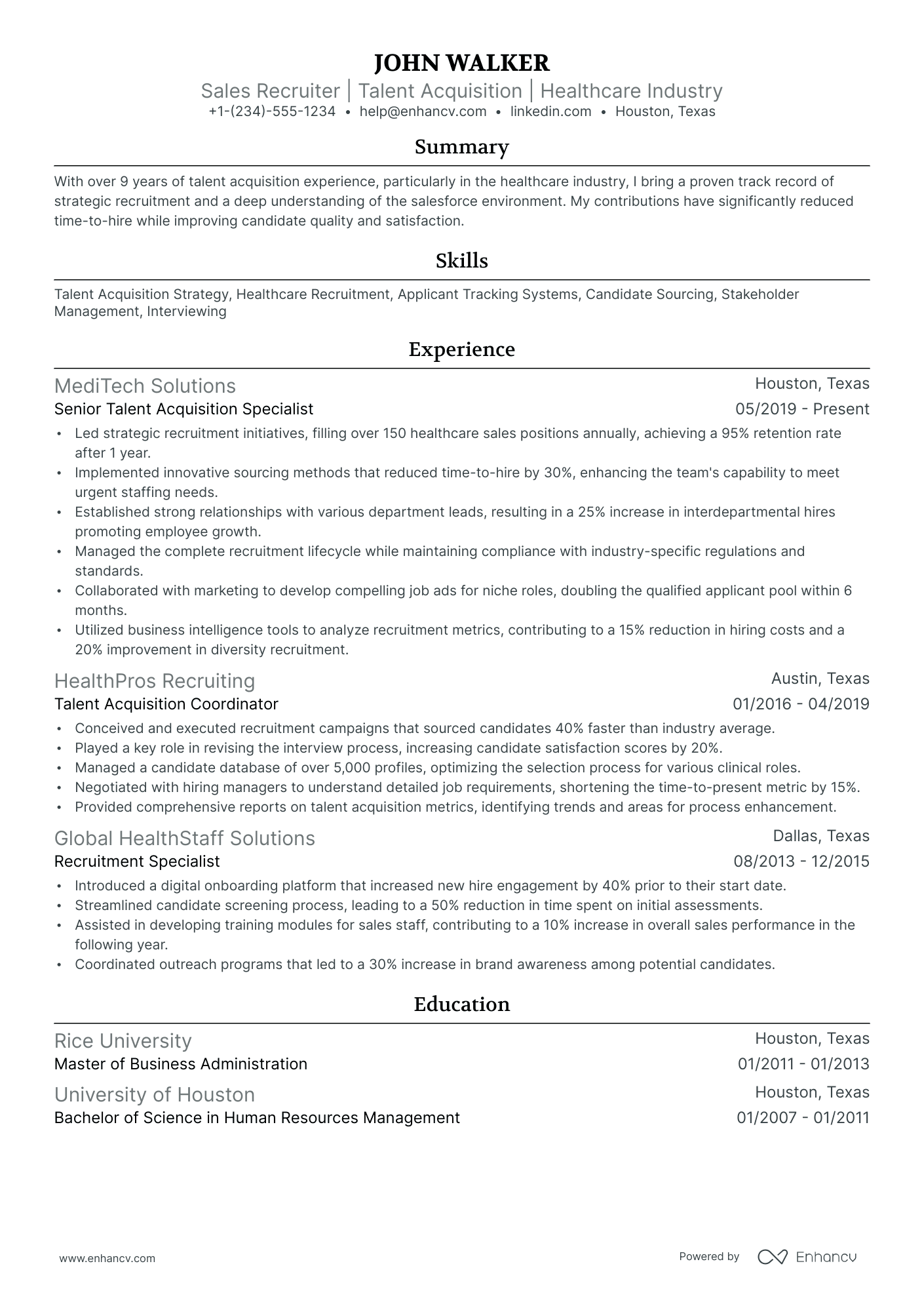
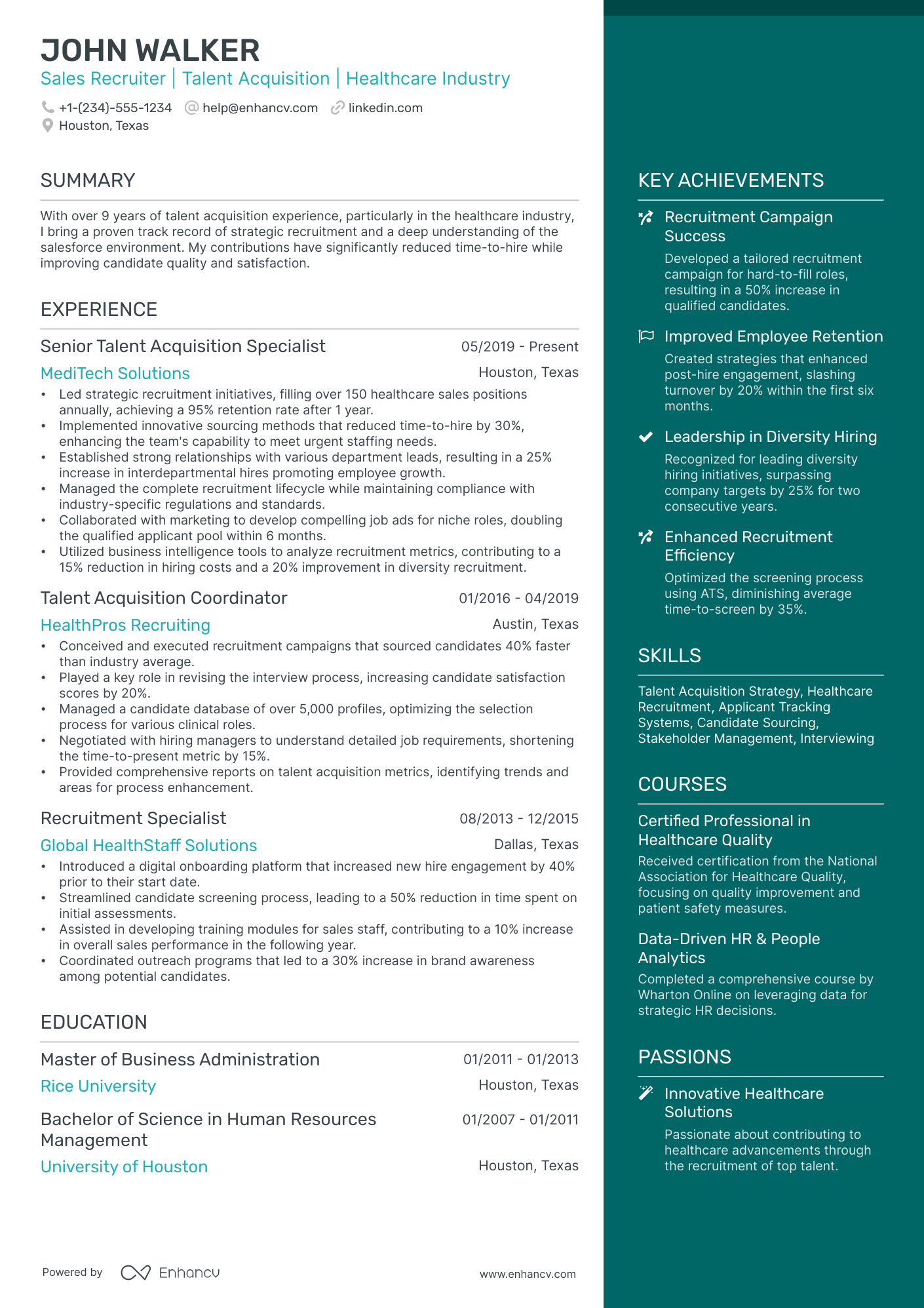
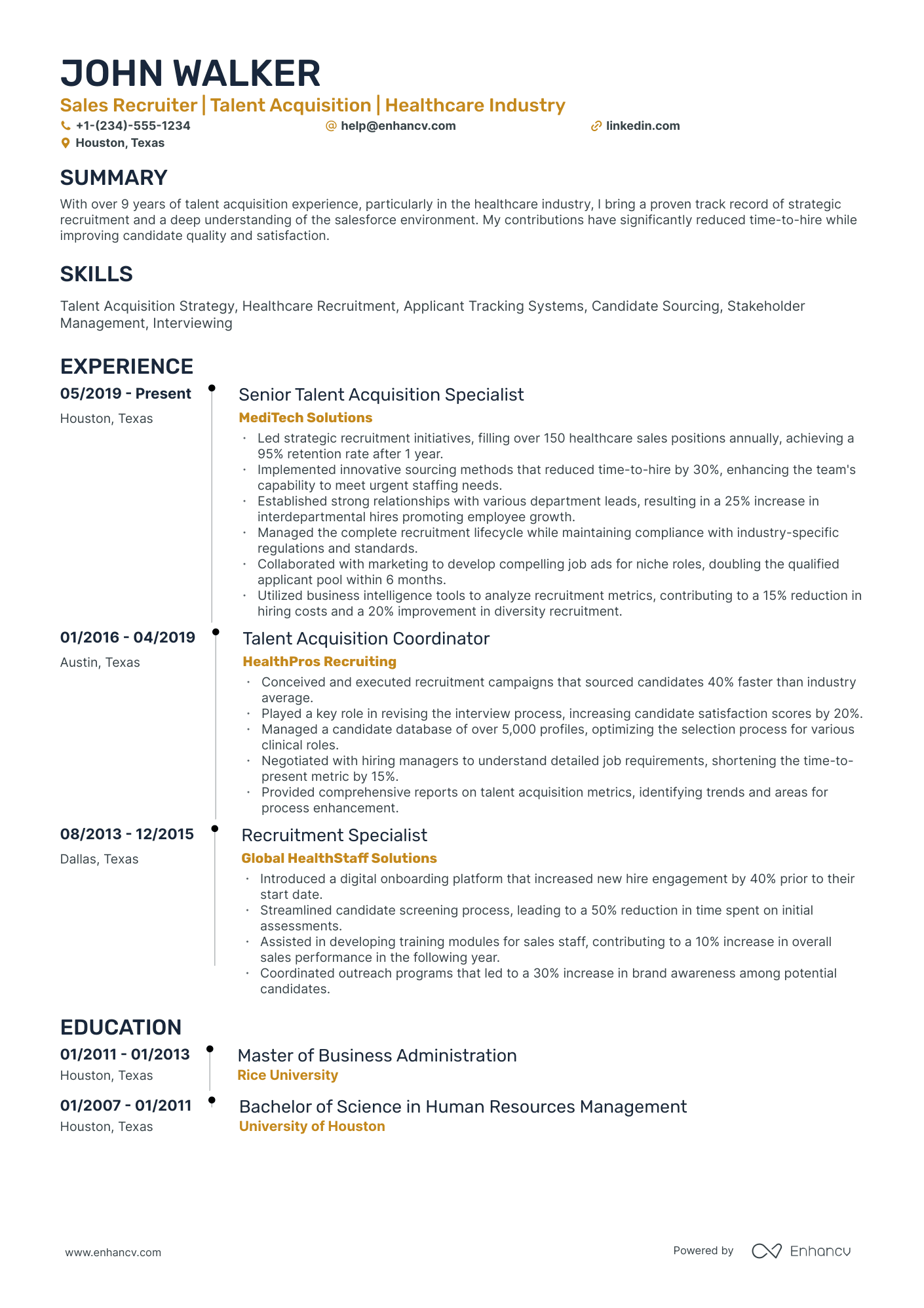
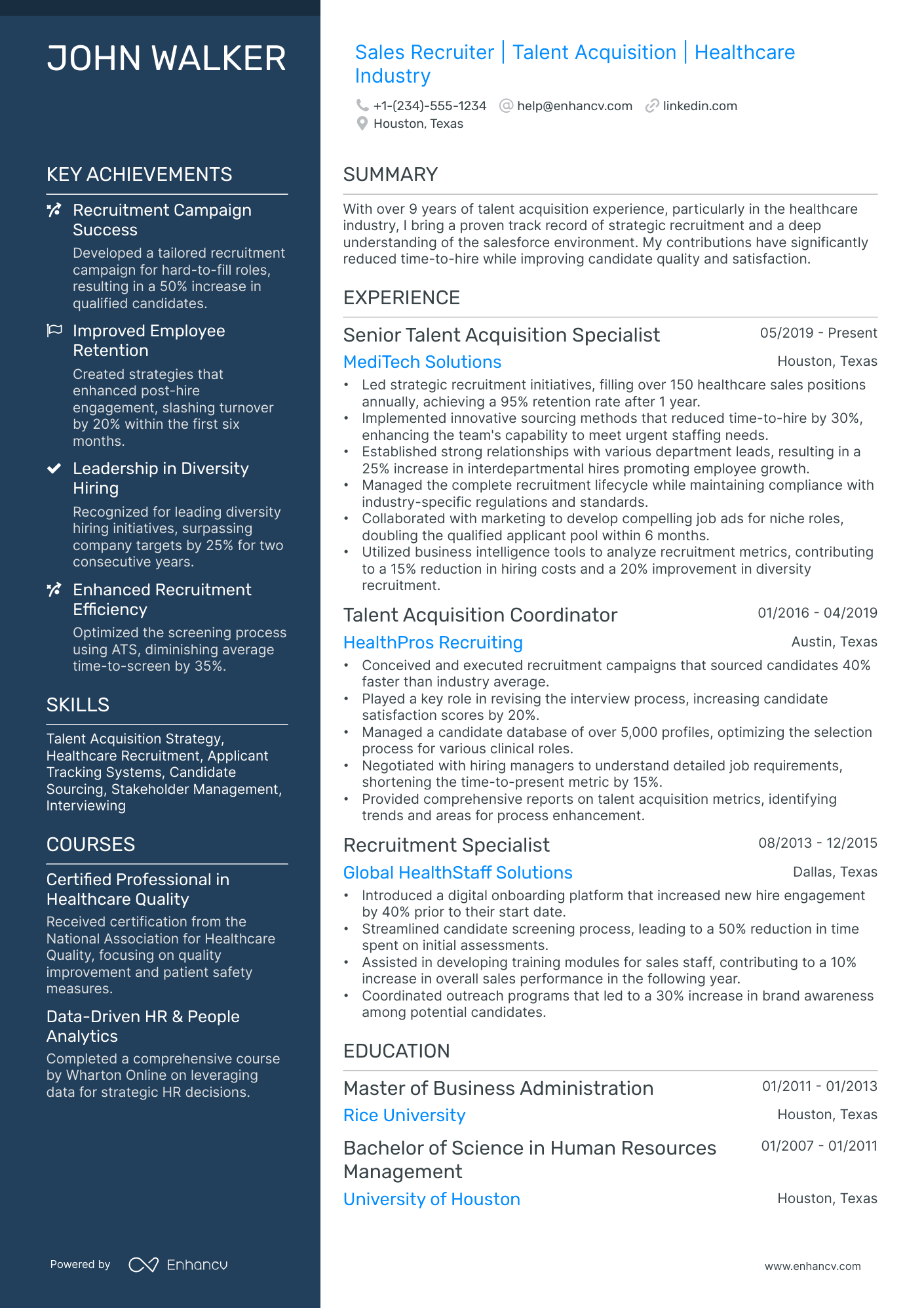
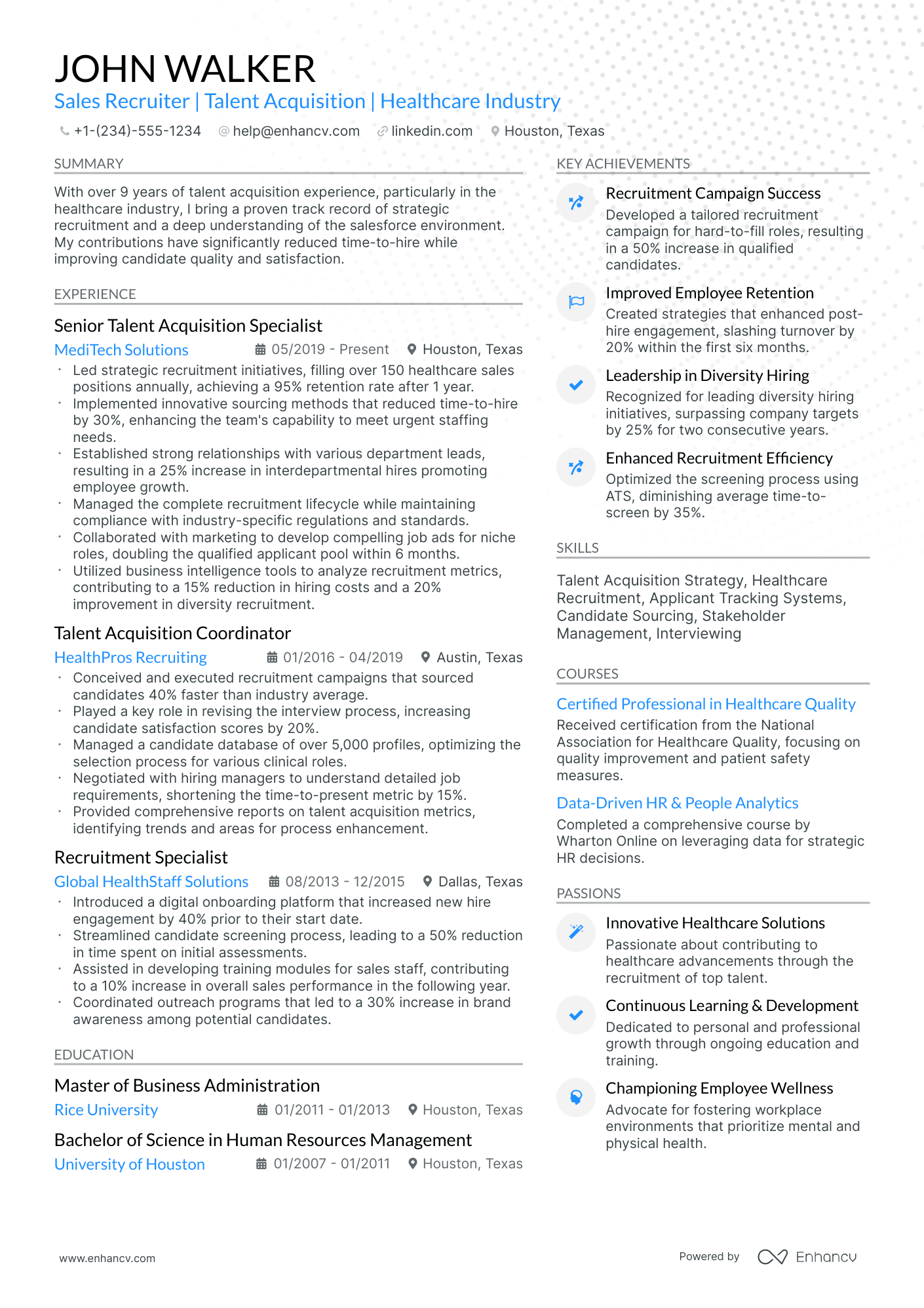
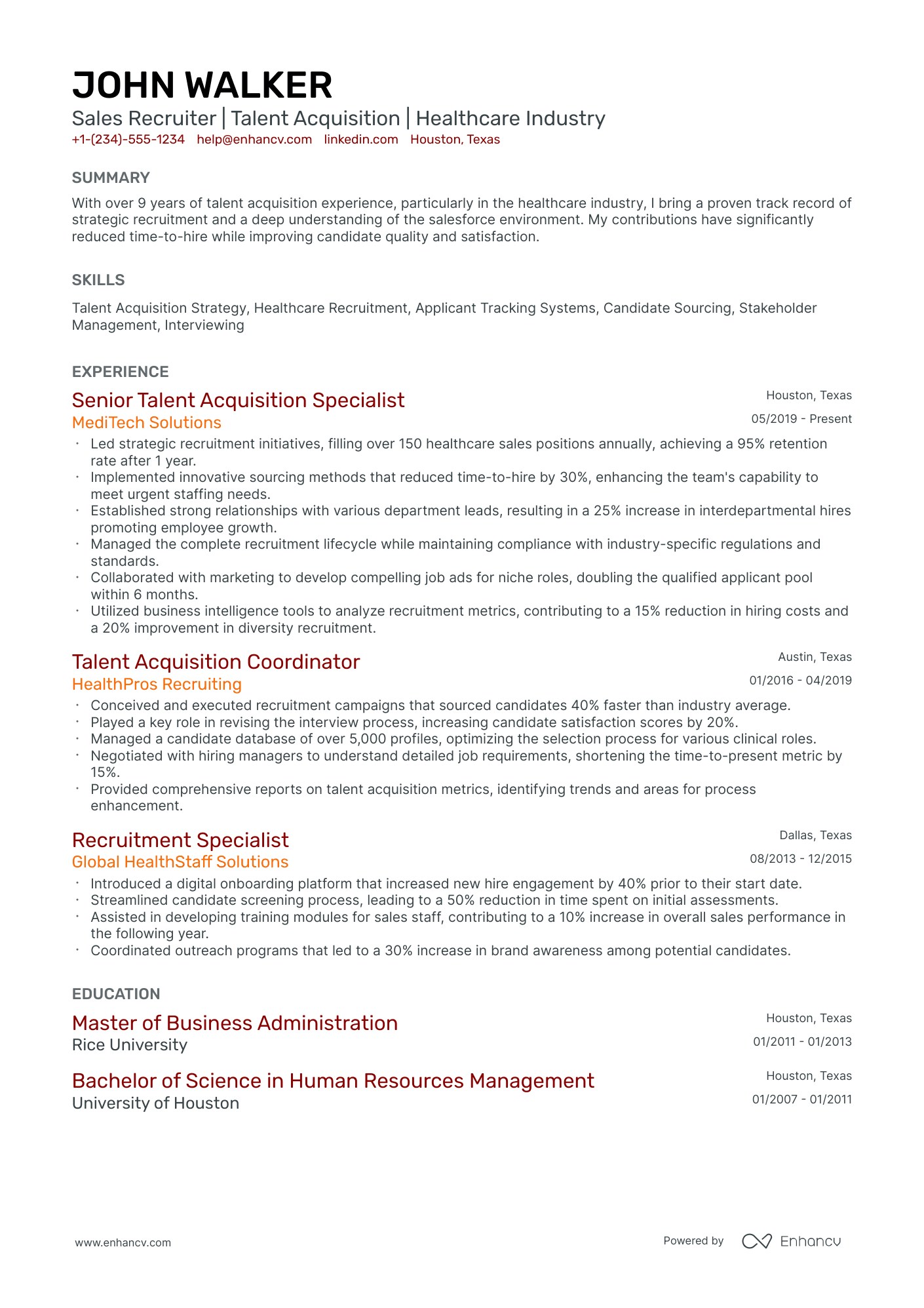
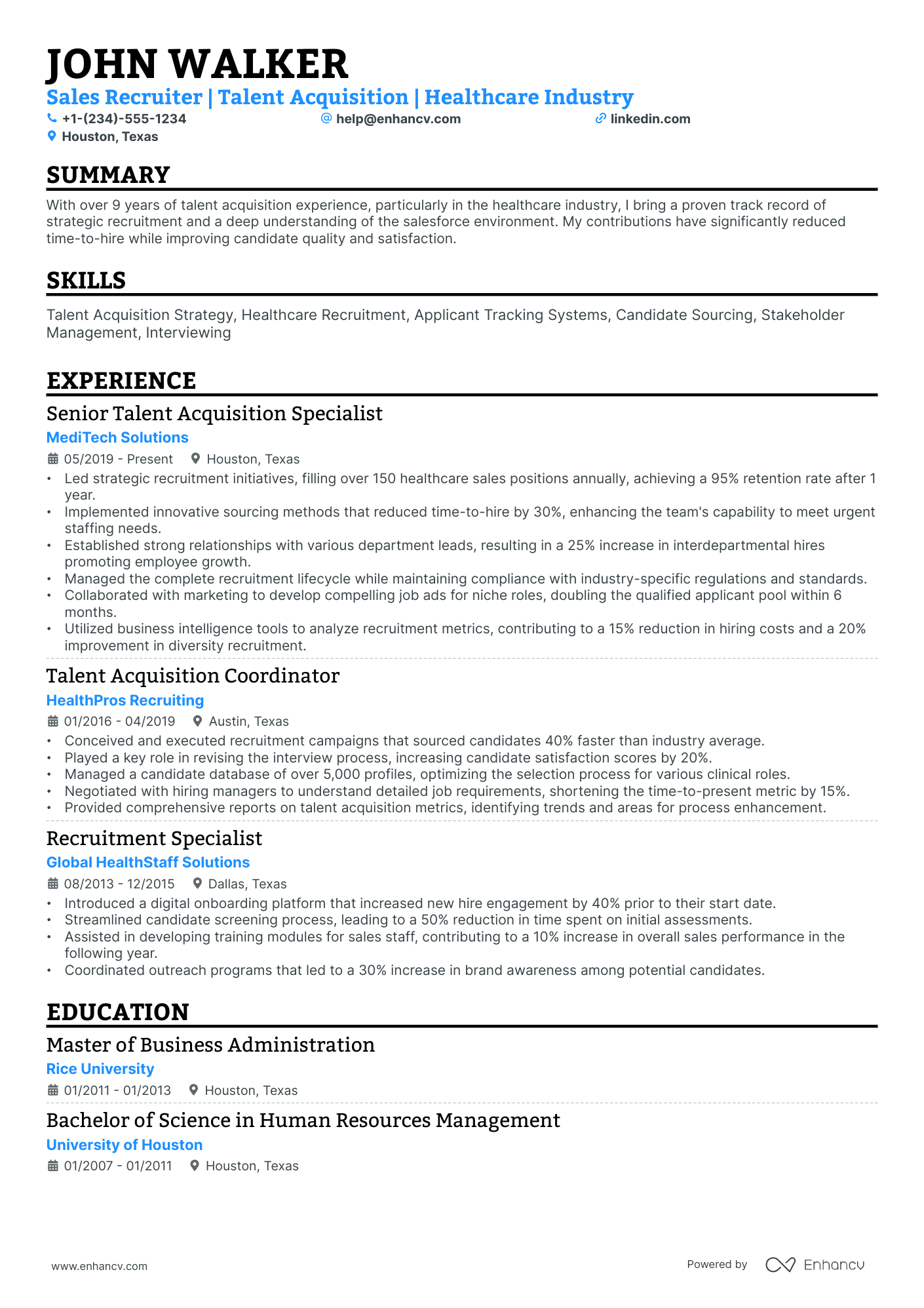
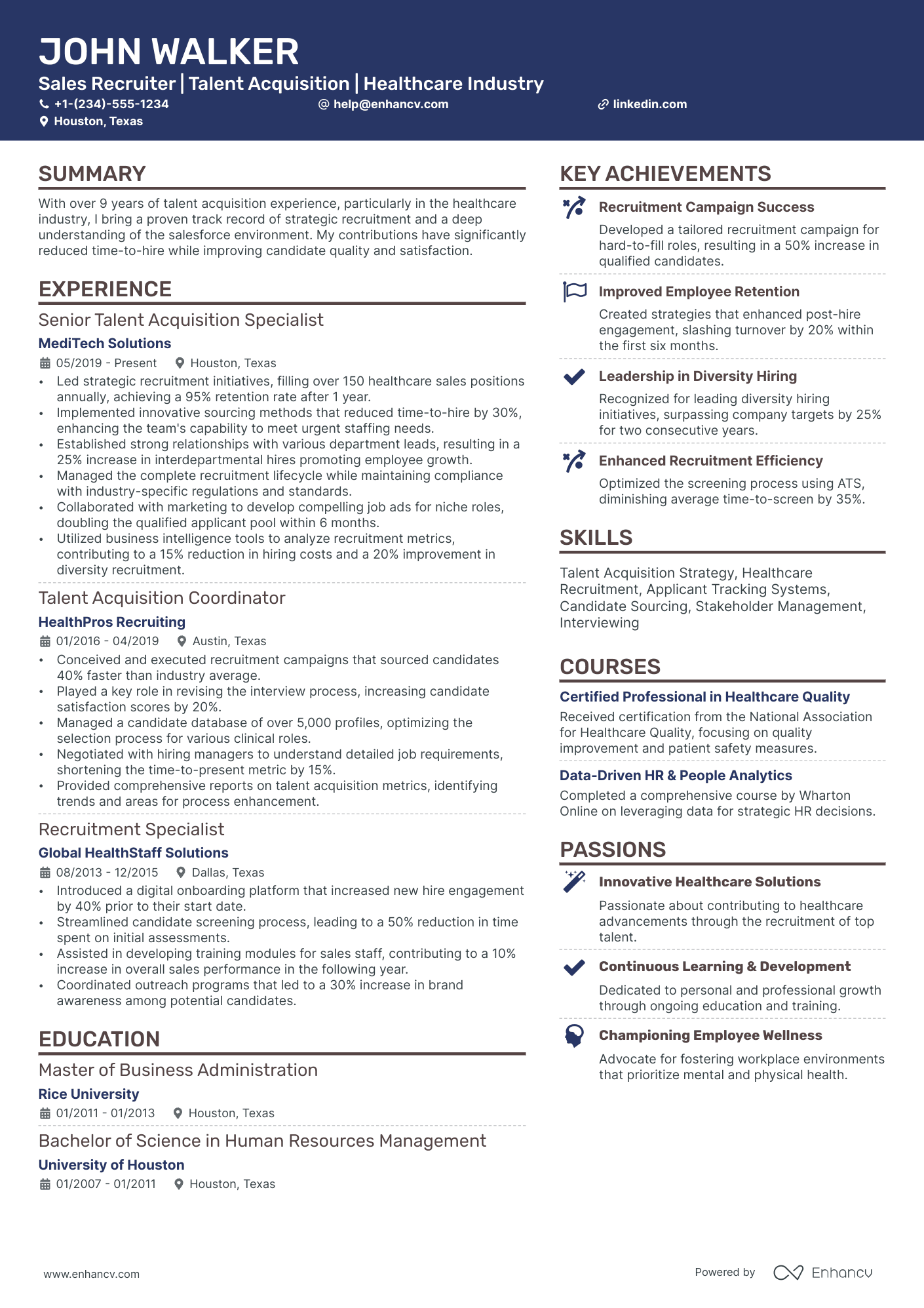
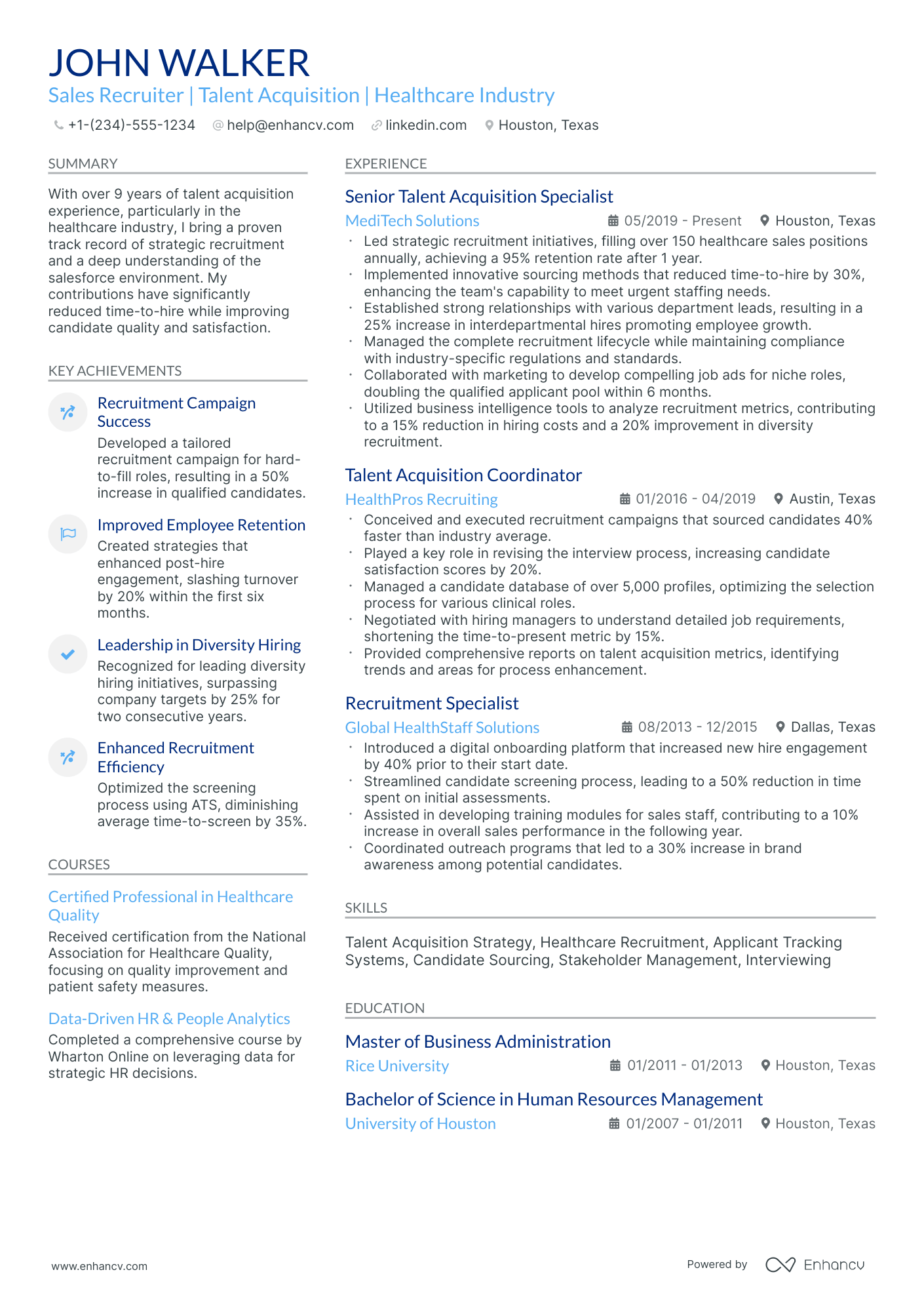
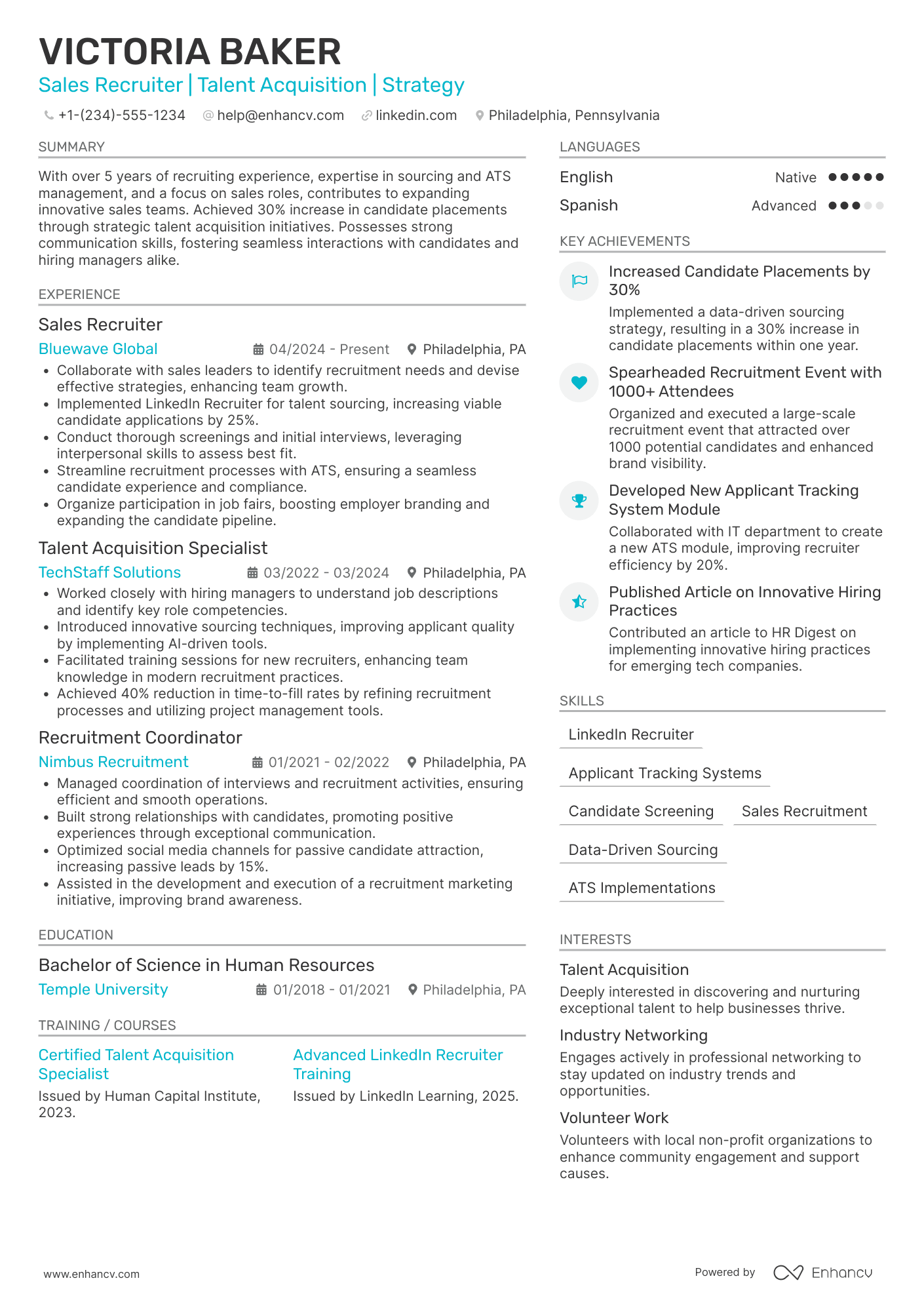
Many sales recruiter resume drafts fail because they read like task logs and bury hiring outcomes. That hurts when an ATS (applicant tracking system) filters quickly and recruiters scan in seconds amid heavy competition. Understanding how to make your resume stand out is essential in this competitive landscape.
A strong resume shows how you deliver hires and revenue impact, not just tools you used. Highlight time-to-fill improvements, offer-acceptance rates, pipeline conversion, headcount delivered across regions, quality-of-hire signals, and candidate experience results.

Key takeaways
- Quantify hiring outcomes like time-to-fill, offer acceptance, and pipeline conversion in every experience bullet.
- Use reverse-chronological format if you have recruiting experience; use hybrid format if switching careers.
- Tailor each resume to the job posting by mirroring its tools, KPIs, and sales domain language.
- Demonstrate skills through measurable achievements in your summary and experience, not just a skills list.
- Pair each responsibility with ownership scope, execution method, and a specific business result.
- Add certifications like SHRM-CP or AIRS above education when they're recent and role-relevant.
- Use Enhancv to turn vague duties into sharp, metric-driven bullets that pass ATS screening.
Job market snapshot for sales recruiters
We analyzed 88 recent sales recruiter job ads across major US job boards. These numbers help you understand employer expectations, salary landscape, experience requirements at a glance.
What level of experience employers are looking for sales recruiters
| Years of Experience | Percentage found in job ads |
|---|---|
| 1–2 years | 17.0% (15) |
| 3–4 years | 9.1% (8) |
| 5–6 years | 9.1% (8) |
| Not specified | 64.8% (57) |
Sales recruiter ads by area of specialization (industry)
| Industry (Area) | Percentage found in job ads |
|---|---|
| Finance & Banking | 59.1% (52) |
| Manufacturing | 11.4% (10) |
Top companies hiring sales recruiters
| Company | Percentage found in job ads |
|---|---|
| Total Quality Logistics, Inc. | 33.0% (29) |
| Google LLC | 11.4% (10) |
Role overview stats
These tables show the most common responsibilities and employment types for sales recruiter roles. Use them to align your resume with what employers expect and to understand how the role is structured across the market.
Day-to-day activities and top responsibilities for a sales recruiter
| Responsibility | Percentage found in job ads |
|---|---|
| Applicant tracking system | 28.4% (25) |
| Avature | 26.1% (23) |
| Ats | 14.8% (13) |
| Linkedin recruiter | 13.6% (12) |
| Crm | 10.2% (9) |
| Greenhouse | 10.2% (9) |
| Indeed | 9.1% (8) |
| 9.1% (8) | |
| Applicant tracking systems | 8.0% (7) |
| Boolean search | 8.0% (7) |
| Excel | 6.8% (6) |
| Outlook | 6.8% (6) |
Type of employment (remote vs on-site vs hybrid)
| Employment type | Percentage found in job ads |
|---|---|
| On-site | 65.9% (58) |
| Hybrid | 19.3% (17) |
| Remote | 14.8% (13) |
How to format a sales recruiter resume
Hiring managers reviewing sales recruiter resumes look for a proven ability to source, screen, and close candidates in competitive sales hiring environments—along with evidence of quota attainment, pipeline management, and stakeholder collaboration. Choosing the right resume format puts these signals front and center, ensuring both human reviewers and applicant tracking systems can quickly identify your qualifications.

I have significant experience in this role—which format should I use?
Use a reverse-chronological format to lead with your strongest and most recent recruiting achievements in sales hiring. Do:
- Open each role entry with your hiring scope and ownership—number of requisitions managed, departments supported, and seniority levels filled.
- Highlight sales-specific recruiting tools and domains: applicant tracking systems (Greenhouse, Lever, iCIMS), CRM platforms, Boolean sourcing techniques, and familiarity with sales compensation structures.
- Quantify outcomes tied to business impact—time-to-fill reductions, offer acceptance rates, diversity hiring metrics, or revenue influence from key sales hires.
I'm junior or switching into this role—what format works best?
A hybrid format works best because it lets you lead with transferable recruiting or sales skills while still showing a clear work history. Do:
- Place a skills section near the top of your resume featuring sourcing techniques, ATS proficiency, candidate screening methods, and any sales or HR certifications.
- Include internships, staffing agency projects, volunteer recruiting efforts, or sales roles that demonstrate pipeline thinking and people evaluation.
- Connect every listed skill to a specific action and a measurable result so hiring managers see practical application, not just keywords.
Why not use a functional resume?
A functional resume strips away the timeline and context hiring managers need to evaluate how your recruiting skills developed, making it harder to trust your readiness for a sales recruiter role.
- Career changers from sales or HR-adjacent roles who have no direct recruiting job titles but have completed sourcing projects, talent-related coursework, or contract recruiting assignments.
- Candidates with resume gaps who still completed freelance recruiting work, staffing agency placements, or relevant volunteer hiring initiatives during those periods.
- Recent graduates who gained recruiting exposure through internships or campus hiring programs but lack full-time experience.
Once you've locked in the right format, the next step is deciding which sections to include so each one earns its place on the page.
What sections should go on a sales recruiter resume
Recruiters expect a sales recruiter resume to show clear hiring outcomes, sales talent expertise, and measurable pipeline impact. Knowing which resume sections to include ensures maximum clarity:
- Header
- Summary
- Experience
- Skills
- Projects
- Education
- Certifications
- Optional sections: Awards, Leadership, Languages
Your experience bullets should emphasize hires and quality metrics, pipeline volume and conversion, role scope, stakeholder alignment, and time-to-fill improvements.
Is your resume good enough?
Drop your resume here or choose a file. PDF & DOCX only. Max 2MB file size.
Once you’ve organized your resume with the right components, the next step is to write your sales recruiter experience section so it supports each part with clear, role-relevant results.
How to write your sales recruiter resume experience
Your experience section is where you prove you've delivered results—not just performed tasks. Hiring managers scanning sales recruiter resumes prioritize demonstrated impact, including the sourcing strategies you executed, the recruiting tools you leveraged, and the measurable hiring outcomes you drove, over generic descriptions of daily responsibilities.
Each entry should include:
- Job title
- Company and location (or remote)
- Dates of employment (month and year)
Three to five concise bullet points showing what you owned, how you executed, and what outcomes you delivered:
- Ownership scope: the requisitions, talent pipelines, candidate pools, or sales hiring programs you were directly accountable for, including the seniority levels, territories, or business units you supported.
- Execution approach: the applicant tracking systems, sourcing platforms, screening frameworks, Boolean search techniques, or assessment methods you used to identify, evaluate, and advance sales candidates.
- Value improved: the changes you drove in time-to-fill, candidate quality, offer acceptance rates, pipeline conversion, hiring manager satisfaction, or retention for sales roles.
- Collaboration context: how you partnered with sales leaders, HR business partners, compensation teams, or external agencies to align hiring strategies with revenue goals and headcount plans.
- Impact delivered: the recruiting outcomes you produced expressed through hiring volume, pipeline growth, revenue team readiness, or organizational scale rather than a list of activities you performed.
Experience bullet formula
A sales recruiter experience example
✅ Right example - modern, quantified, specific.
Sales Recruiter
CloudRidge CRM | Austin, TX (Remote)
2022–Present
B2B software-as-a-service company serving mid-market revenue teams across North America.
- Built a repeatable sourcing engine in LinkedIn Recruiter and Gem, raising qualified pipeline by 45% and cutting time-to-fill from forty-eight to thirty-one days across sales development representative, account executive, and sales manager roles.
- Partnered with sales leadership and HR (human resources) to calibrate scorecards and structured interviews in Greenhouse (applicant tracking system), improving onsite-to-offer conversion from 22% to 34% while maintaining a 90-day new-hire retention rate of 96%.
- Launched a weekly talent dashboard in Google Sheets and Greenhouse reports—tracking stage conversion, source yield, and diversity mix—reducing offer approval cycle time by 30% through tighter stakeholder alignment.
- Led offer strategy and closing for competitive account executive hires using compensation benchmarking and scenario modeling, increasing offer acceptance from 68% to 81% and supporting a $6.2M annual recurring revenue growth target.
- Implemented hiring manager enablement—intake meetings, interview training, and debrief facilitation—reducing interview loop length by 20% and improving candidate experience survey scores from 4.1 to 4.6 out of five.
Now that you've seen how a strong experience section comes together, let's break down how to tailor each element to match the specific sales recruiter role you're targeting.
How to tailor your sales recruiter resume experience
Hiring managers and applicant tracking systems (ATS) both screen your resume for relevance to the specific role. Tailoring your resume to the job description ensures your qualifications stand out during every stage of review.
Ways to tailor your sales recruiter experience:
- Match the ATS or CRM platforms listed in the job description.
- Mirror the exact sourcing channels and recruitment methods referenced.
- Use the same terminology for sales hiring stages or workflows.
- Reflect specific KPIs like time to fill or offer acceptance rate.
- Highlight experience recruiting for the industry or sales domain mentioned.
- Incorporate referenced collaboration models with sales leadership or HRBPs.
- Emphasize full-cycle or high-volume recruiting if the posting specifies either.
- Align your pipeline management approach with their stated methodology.
Focus on connecting your real accomplishments to the job's stated requirements rather than forcing keywords where they don't naturally belong.
Resume tailoring examples for sales recruiter
| Job description excerpt | Untailored | Tailored |
|---|---|---|
| Source and screen high-volume sales candidates using LinkedIn Recruiter and Greenhouse ATS to fill 15+ roles per quarter across inside sales and account executive teams. | Helped with recruiting efforts and screened candidates for open positions. | Sourced and screened 60+ inside sales and account executive candidates quarterly through LinkedIn Recruiter and Greenhouse, consistently filling 15–20 roles per quarter. |
| Partner with regional sales leaders to define hiring profiles, build diverse candidate pipelines, and reduce average time-to-fill for quota-carrying roles to under 35 days. | Worked with hiring managers to support the recruitment process. | Collaborated with four regional sales directors to build competency-based hiring profiles for quota-carrying roles, reducing average time-to-fill from 52 to 31 days while increasing pipeline diversity by 40%. |
| Drive full-cycle recruitment for SaaS sales teams, managing offer negotiations, compensation benchmarking with Pave, and onboarding coordination to improve 90-day retention rates. | Managed the hiring process from start to finish and helped with onboarding. | Led full-cycle recruitment for a 200-person SaaS sales organization, using Pave for compensation benchmarking during offer negotiations and coordinating structured onboarding that lifted 90-day retention from 74% to 91%. |
Once your experience aligns with the role’s priorities, the next step is to quantify your sales recruiter achievements to show the measurable impact of that work.
How to quantify your sales recruiter achievements
Quantifying your achievements proves you drive hires that grow revenue, not just activity. Focus on time-to-fill, offer acceptance, pipeline conversion, hiring manager satisfaction, and compliance accuracy across your requisition load.
Quantifying examples for sales recruiter
| Metric | Example |
|---|---|
| Time-to-fill | "Cut average time-to-fill for SDR roles from 38 to 26 days by rebuilding outreach sequences in Gem and tightening weekly intake with sales leaders." |
| Pipeline conversion | "Increased phone screen-to-onsite conversion from 32% to 45% by adding scorecards in Greenhouse and calibrating profiles with three regional sales managers." |
| Offer acceptance | "Raised offer acceptance from 78% to 90% by standardizing compensation alignment calls and using DocuSign turnaround tracking across fifty offers." |
| Volume handled | "Managed twenty-five concurrent requisitions and delivered sixty-two sales hires in twelve months while maintaining a weekly slate of eight to ten onsite interviews." |
| Compliance accuracy | "Reduced background-check and I-9 exceptions from 6% to 1% by adding a pre-start audit checklist and coordinating with HR in Workday." |
Turn vague job duties into measurable, recruiter-ready resume bullets in seconds with Enhancv's Bullet Point Generator.
Once you've crafted strong, results-driven bullet points, pairing them with the right mix of hard and soft skills ensures your resume presents a complete picture of your qualifications.
How to list your hard and soft skills on a sales recruiter resume
Your skills section shows you can source, assess, and close revenue talent; recruiters scan them for fit while an ATS (applicant tracking system) matches keywords, so aim for a balanced mix of role-specific hard skills and job-relevant soft skills.
sales recruiter roles require a blend of:
- Product strategy and discovery skills.
- Data, analytics, and experimentation skills.
- Delivery, execution, and go-to-market discipline.
- Soft skills.
Your skills section should be:
- Scannable (bullet-style grouping).
- Relevant to the job post.
- Backed by proof in experience bullets.
- Updated with current tools.
Place your skills section:
- Above experience if you're junior or switching careers.
- Below experience if you're mid/senior with strong achievements.

Hard skills
- Applicant tracking systems
- Greenhouse, Lever
- LinkedIn Recruiter
- SeekOut, HireEZ
- Boolean and X-ray search
- Sales role calibration
- Competency-based interviewing
- Structured scorecards
- Pipeline funnel reporting
- Offer strategy and closing
- Compensation benchmarking
- Background and reference checks
Soft skills
- Stakeholder intake and alignment
- Hiring manager influence
- Candidate trust-building
- Objection handling and negotiation
- Crisp, timely communication
- Prioritization under deadlines
- Follow-through on commitments
- Data-informed decision-making
- Cross-functional collaboration
- High-judgment escalation
- Candidate experience ownership
- Process discipline and consistency
How to show your sales recruiter skills in context
Skills shouldn't live only in a dedicated skills list. Browse examples of how other professionals present their resume skills for inspiration on effective formatting.
They should be demonstrated in:
- Your summary (high-level professional identity)
- Your experience (proof through outcomes)
Here's what that looks like in practice.
Summary example
Senior sales recruiter with eight years in B2B SaaS, specializing in full-cycle hiring through LinkedIn Recruiter and Greenhouse. Built and led a 12-person sales org in under nine months, cutting average time-to-fill by 35%.
- Reflects senior-level experience clearly
- Names industry-relevant tools directly
- Includes a specific, measurable outcome
- Signals leadership and relationship-building
Experience example
Senior Sales Recruiter
Vantage Talent Partners | Remote
March 2020–August 2024
- Filled 95% of open sales roles within 30 days by streamlining sourcing workflows in Greenhouse and LinkedIn Recruiter.
- Partnered with VP of Sales and hiring managers to redesign interview scorecards, improving new-hire quota attainment by 22%.
- Launched a referral incentive program across three regional teams, generating 40% of all qualified candidates within the first quarter.
- Every bullet contains measurable proof.
- Skills surface naturally through achievements.
Once you’ve demonstrated your sales recruiter strengths through targeted examples, the next step is to apply that same approach to building a sales recruiter resume when you don’t have direct experience.
How do I write a sales recruiter resume with no experience
Even without full-time experience, you can demonstrate readiness through:
- Campus recruiting event coordination
- Sourcing practice on LinkedIn Recruiter
- ATS (applicant tracking system) projects
- Sales cold calling or lead gen
- Interview scheduling for student groups
- CRM (customer relationship management) data cleanup
- Staffing agency shadowing or internship
- Referral program support and tracking
Our guide on writing a resume without work experience covers additional strategies for showcasing your potential.
Focus on:
- Sourcing volume and response rates
- ATS workflow and clean notes
- Sales pipeline metrics and follow-ups
- Candidate screening with scorecards
Resume format tip for entry-level sales recruiter
Use a hybrid resume format to highlight projects and skills first, then list experience. It helps when your strongest proof sits in coursework, projects, and volunteer work. Do:
- Add a "Recruiting Projects" section.
- Quantify outreach, screens, and fills.
- Name tools: LinkedIn Recruiter, ATS.
- Mirror job posting keywords in bullets.
- Include a simple sourcing workflow.
- Built a LinkedIn Recruiter sourcing list of 120 SDR candidates, ran three-message outreach, and booked nine screening calls in two weeks.
Even without direct experience, your education section can demonstrate the foundational knowledge and relevant skills that make you a strong candidate—here's how to present it effectively.
How to list your education on a sales recruiter resume
Your education section helps hiring teams confirm you have the foundational knowledge needed for a sales recruiter role. It validates your background in talent acquisition, business, or related fields.
Include:
- Degree name
- Institution
- Location
- Graduation year
- Relevant coursework (for juniors or entry-level candidates)
- Honors & GPA (if 3.5 or higher)
Avoid listing specific months or days for your graduation. Use the year only to keep things clean.
Here's a strong education entry tailored for a sales recruiter resume.
Example education entry
Bachelor of Business Administration in Human Resources Management
University of Georgia, Athens, GA
Graduated 2021
GPA: 3.7/4.0
- Relevant Coursework: Talent Acquisition Strategies, Sales Management, Organizational Behavior, Compensation & Benefits
- Honors: Magna Cum Laude, Dean's List (all semesters)
How to list your certifications on a sales recruiter resume
Certifications show a sales recruiter's commitment to learning, proficiency with recruiting tools, and up-to-date industry knowledge that supports stronger hiring decisions.
Include:
- Certificate name
- Issuing organization
- Year
- Optional: credential ID or URL
- Place certifications below education when they're older, less relevant, or secondary to your degree and core recruiting experience.
- Place certifications above education when they're recent, highly relevant to sales recruiting, or required for the roles you target.
Best certifications for your sales recruiter resume
- LinkedIn Certified Professional–Recruiter
- SHRM Certified Professional (SHRM-CP)
- Professional in Human Resources (PHR)
- AIRS Certified Internet Recruiter (CIR)
- Certified Staffing Professional (CSP)
- Certified Personnel Consultant (CPC)
- HubSpot Sales Software Certification
Once you’ve added your credentials in a clear, easy-to-scan way, you can use that credibility to shape a sales recruiter resume summary that highlights your value upfront.
How to write your sales recruiter resume summary
Your resume summary is the first thing a hiring manager reads. A strong one instantly signals you have the skills and drive to fill competitive sales roles.
Keep it to three to four lines, with:
- Your title and relevant years of experience in recruitment.
- The sales domains you recruit for, such as SaaS, enterprise, or retail.
- Core tools and skills like LinkedIn Recruiter, ATS platforms, and Boolean search.
- One or two measurable wins, such as hires made or time-to-fill reductions.
- Soft skills tied to outcomes, like stakeholder communication that shortened hiring cycles.

PRO TIP
At this level, focus on specific tools you've used, the types of sales roles you've filled, and early results that prove your impact. Avoid vague phrases like "passionate team player" or "motivated self-starter." Concrete numbers and clear skills matter far more than enthusiasm statements.
Example summary for a sales recruiter
Sales recruiter with two years of experience sourcing SaaS account executives through LinkedIn Recruiter and Greenhouse. Reduced average time-to-fill by 18% while maintaining a 92% offer-acceptance rate.
Optimize your resume summary and objective for ATS
Drop your resume here or choose a file.
PDF & DOCX only. Max 2MB file size.
Now that your summary is crafted to highlight your recruiting strengths, let's ensure your header presents the essential contact details hiring managers need to reach you.
What to include in a sales recruiter resume header
A resume header is the top section with your identity and contact details, and it boosts visibility, credibility, and fast screening for a sales recruiter.
Essential resume header elements
- Full name
- Tailored job title and headline
- Location
- Phone number
- Professional email
- GitHub link
- Portfolio link
A LinkedIn link lets recruiters verify your experience quickly and supports screening with consistent dates, titles, and scope.
Don't include a photo on a sales recruiter resume unless the role is explicitly front-facing or appearance-dependent.
Keep the header to one or two lines, mirror the job title, and use links that open directly to updated, public profiles.
Example
Sales recruiter resume header
Jordan Taylor
Sales recruiter | B2B SaaS and enterprise sales hiring
Austin, TX | (512) 555-01XX | your.name@enhancv.com
github.com/yourname yourwebsite.com linkedin.com/in/yourname
Once your header quickly establishes your identity and contact details, add the following optional sections to reinforce your qualifications and relevance.
Additional sections for sales recruiter resumes
When your core sections look similar to other candidates, additional sections help you stand out with role-specific credibility and personality.
- Languages
- Certifications (e.g., AIRS, LinkedIn Recruiter, SHRM)
- Industry conferences and events
- Professional affiliations
- Hobbies and interests
- Volunteer experience
- Publications
Once you've rounded out your resume with the right supplementary sections, it's worth turning your attention to the document that often accompanies it—the cover letter.
Do sales recruiter resumes need a cover letter
A cover letter isn't required for a sales recruiter, but it helps in competitive searches or when hiring managers expect context. If you're unsure where to start, learn what a cover letter is and how it complements your resume. It can make a difference when your resume needs a quick explanation of fit, scope, or impact.
Use a cover letter to add detail your resume can't show:
- Explain role and team fit: Align your recruiting focus with the sales motion, hiring plan, and stakeholder needs.
- Highlight one or two outcomes: Share a project that improved pipeline quality, shortened time to fill, or raised offer acceptance.
- Show product and business understanding: Reference the target users, sales cycle, and how those factors shape candidate profiles.
- Address career transitions: Clarify non-obvious experience, industry changes, or gaps, and connect them to sales recruiter requirements.
Drop your resume here or choose a file.
PDF & DOCX only. Max 2MB file size.
Even if you skip a cover letter and let your resume carry the pitch, using AI to improve your sales recruiter resume helps you sharpen the content and align it with what hiring teams scan for.
Using AI to improve your sales recruiter resume
AI can sharpen your resume's clarity, structure, and impact. It helps tighten language and highlight results. But overuse strips authenticity. Once your content is clear and role-aligned, step away from AI. For detailed guidance, explore our resource on ChatGPT resume writing prompts tailored for job seekers.
Here are 10 prompts you can copy and paste to strengthen specific sections of your resume:
Sharpen your summary
Quantify experience bullets
Tighten action verbs
Align skills section
Strengthen project descriptions
Improve education relevance
Refine certification details
Remove filler language
Focus on hiring impact
Tailor for ATS
Conclusion
A strong sales recruiter resume shows measurable outcomes, role-specific skills, and a clear structure. Lead with results, then prove them with metrics like hires, time-to-fill, and pipeline conversion. Use clean headings, consistent formatting, and focused bullets.
This approach shows you can deliver in today’s hiring market and adapt to what comes next. It helps hiring teams scan fast, trust your impact, and understand your fit. Keep it direct, specific, and easy to follow.