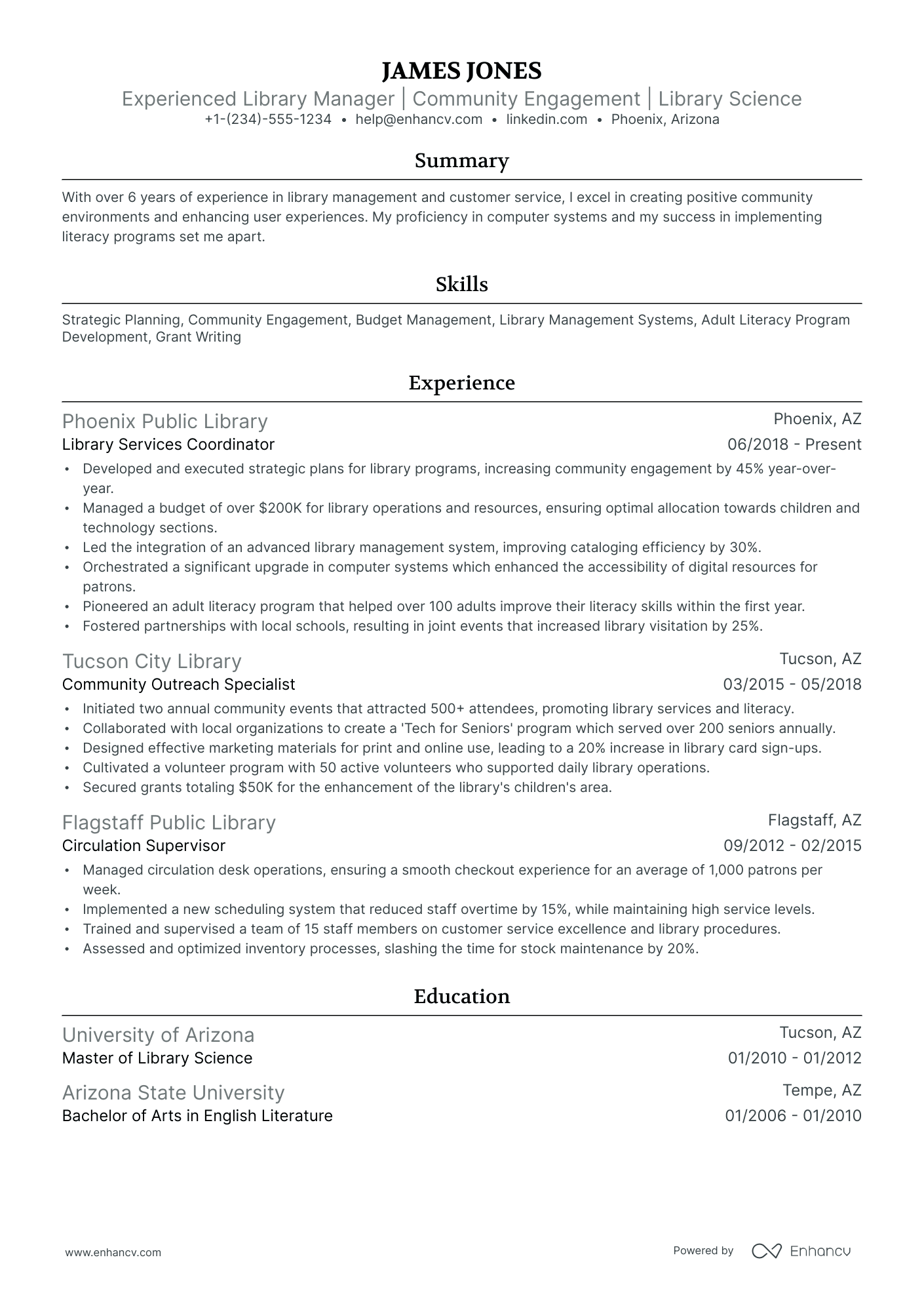
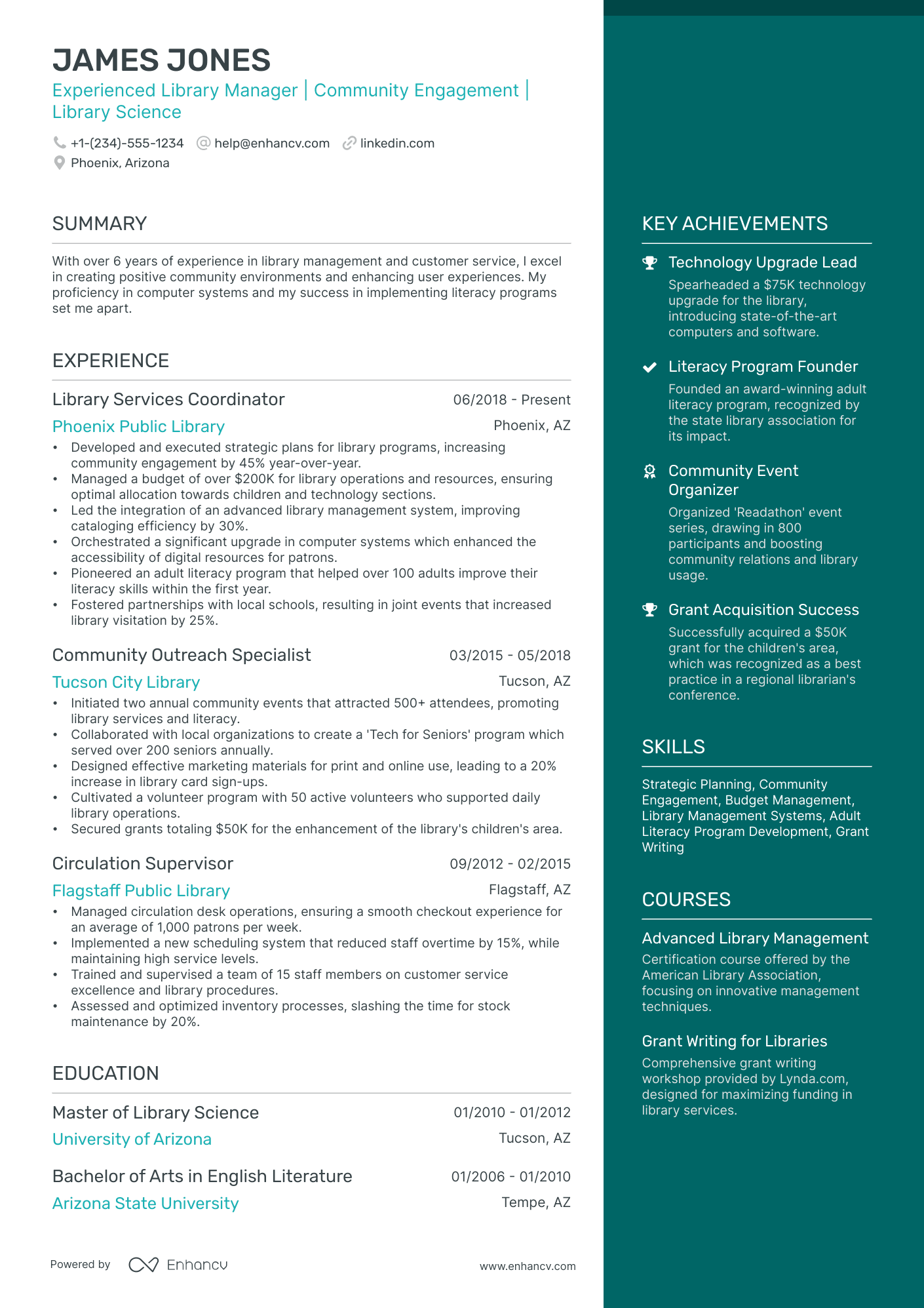
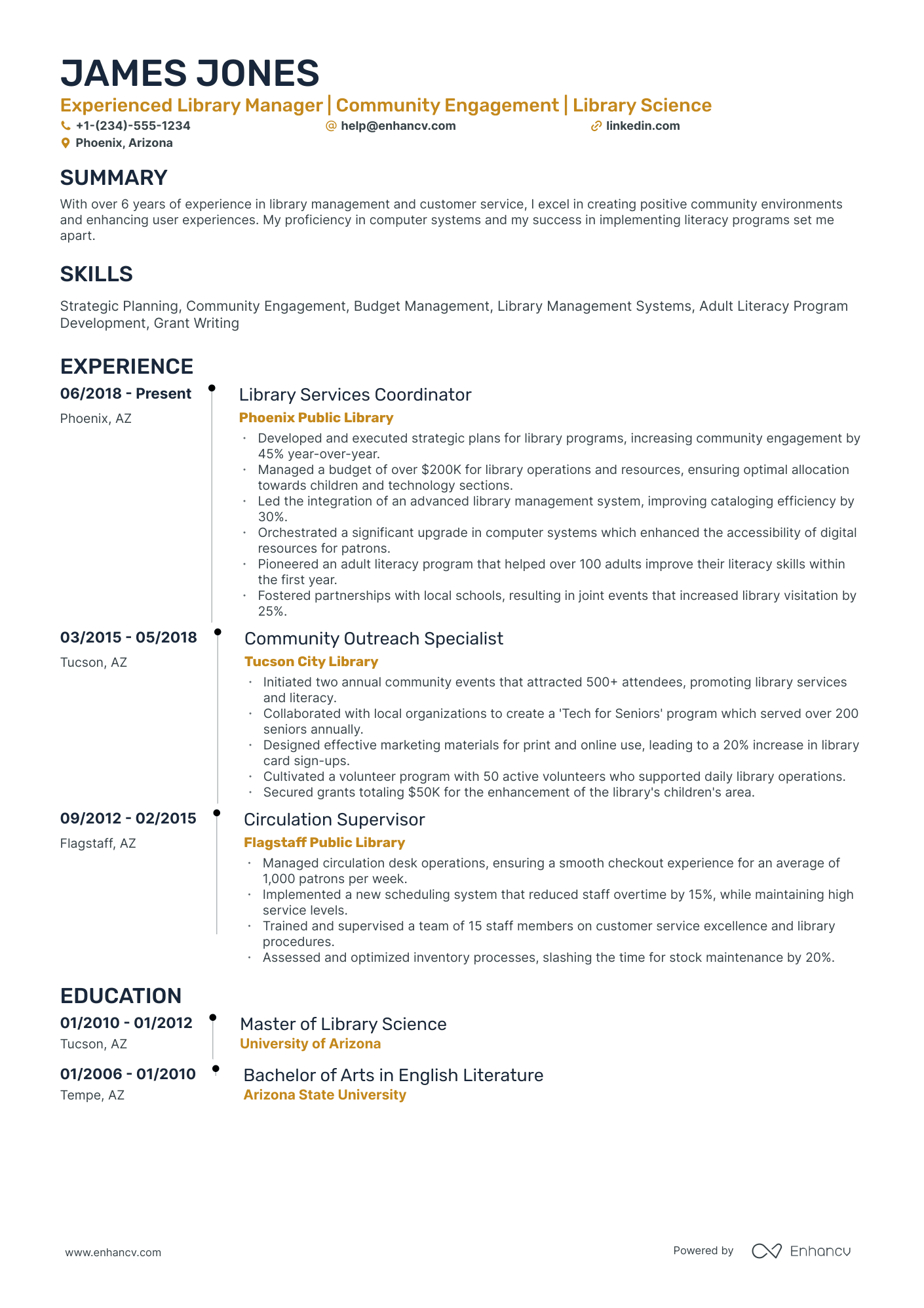
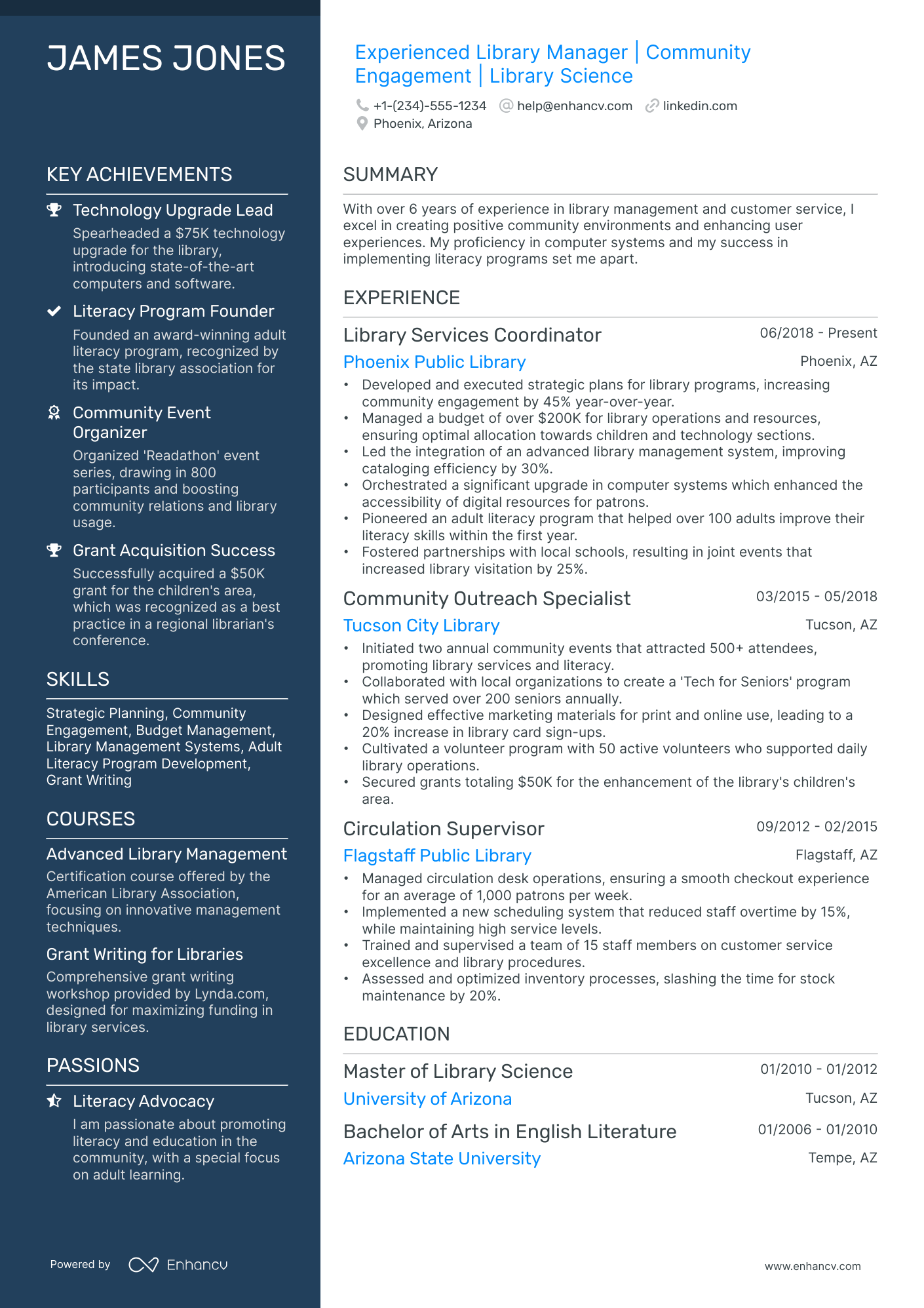
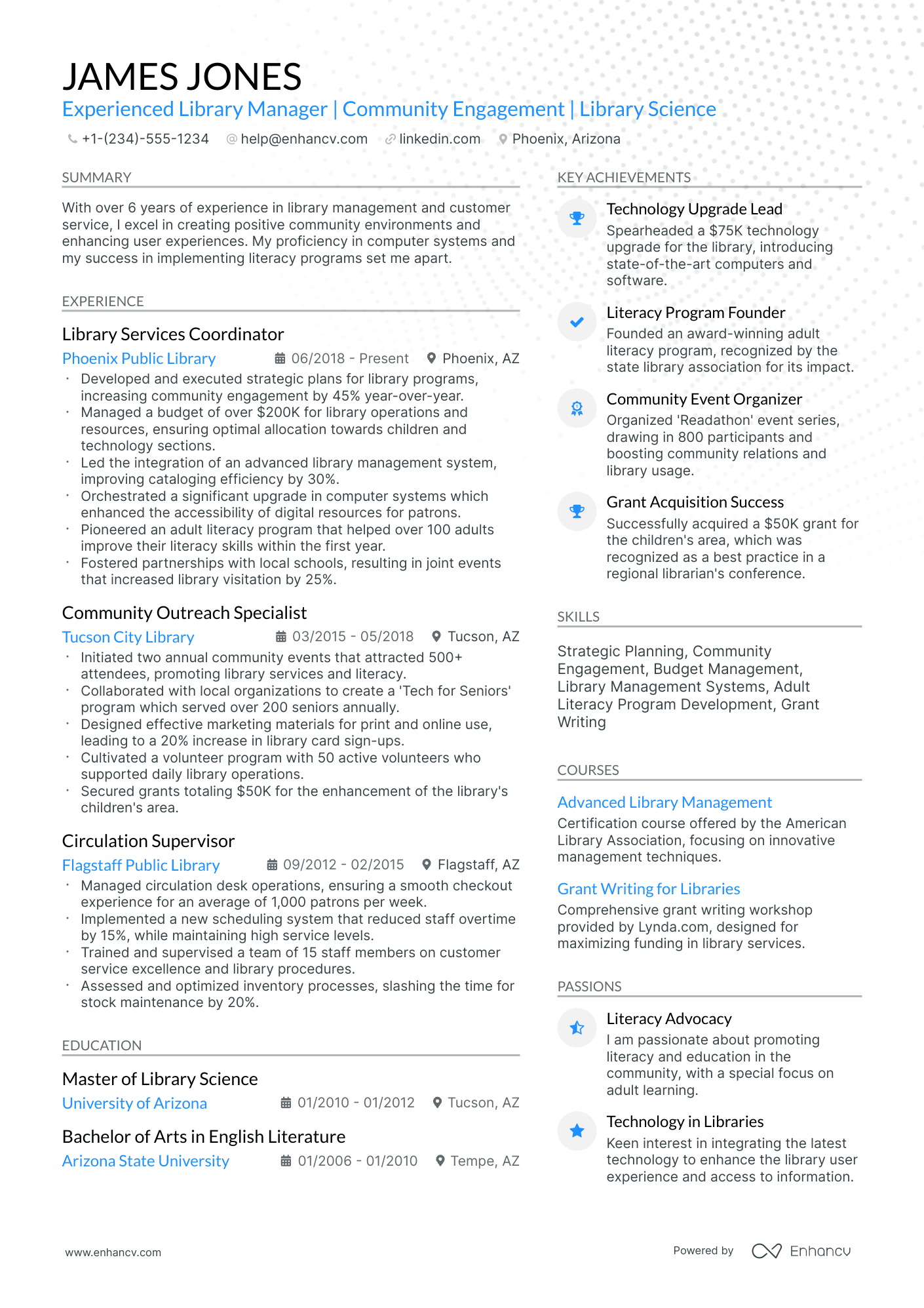
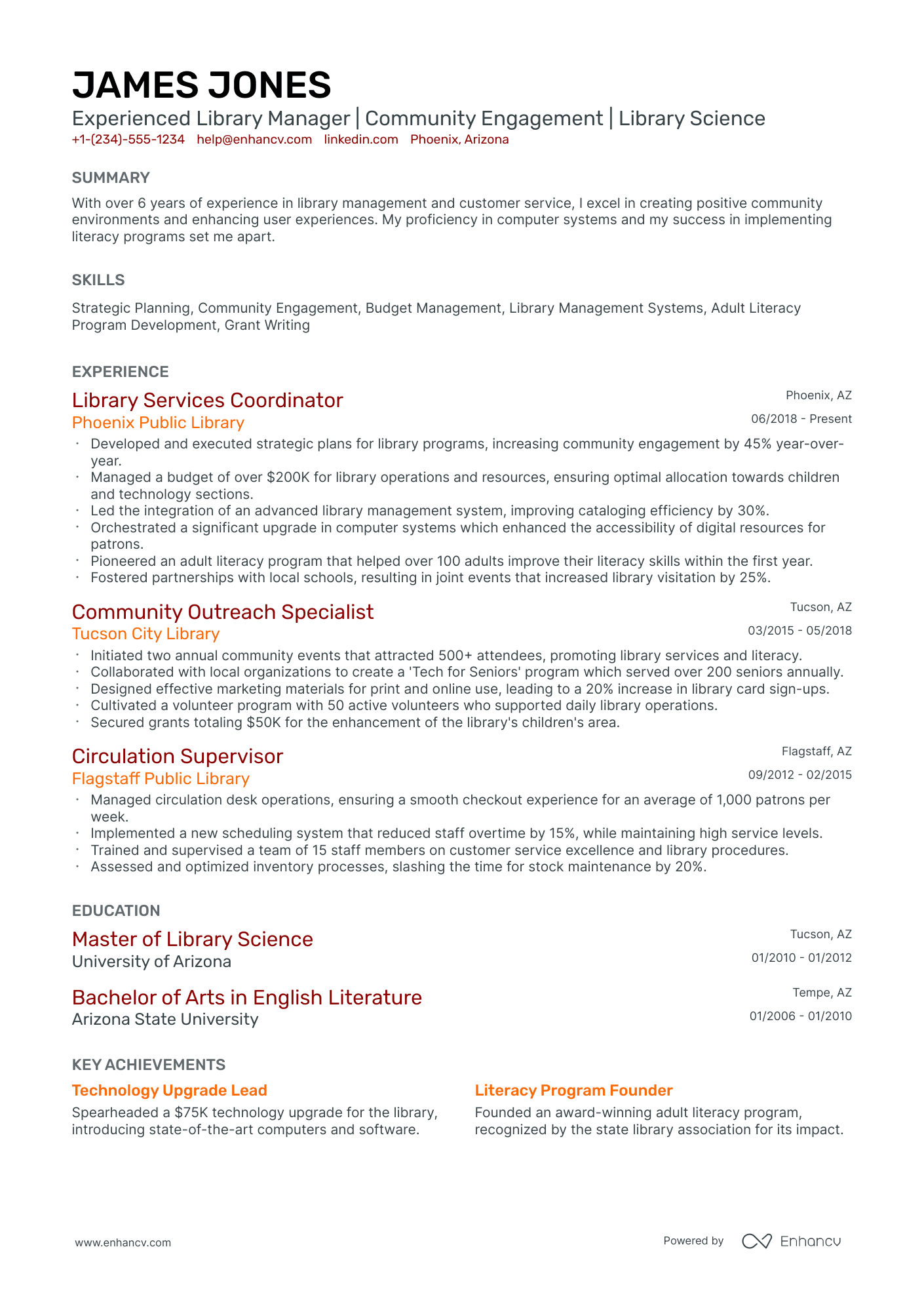
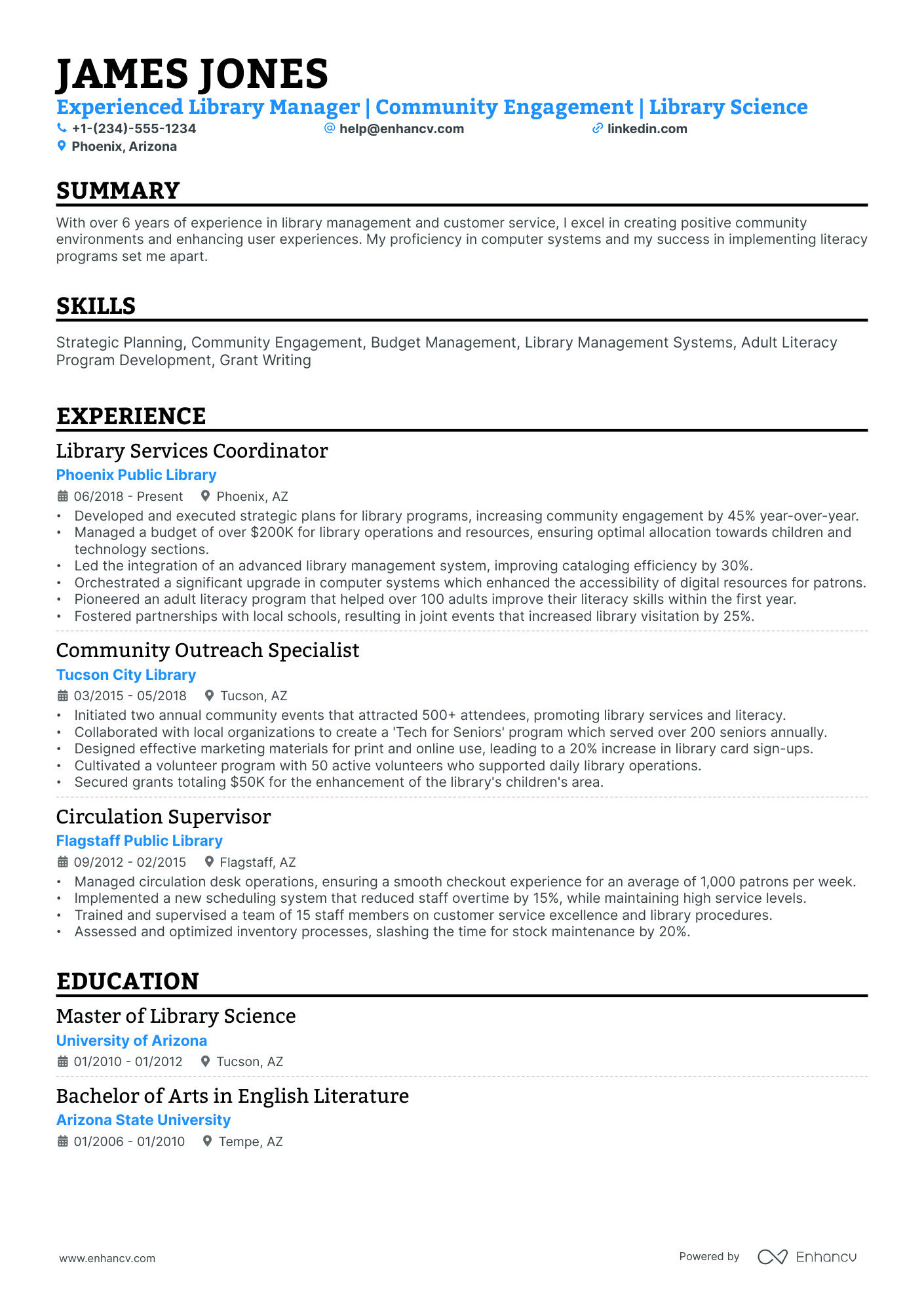
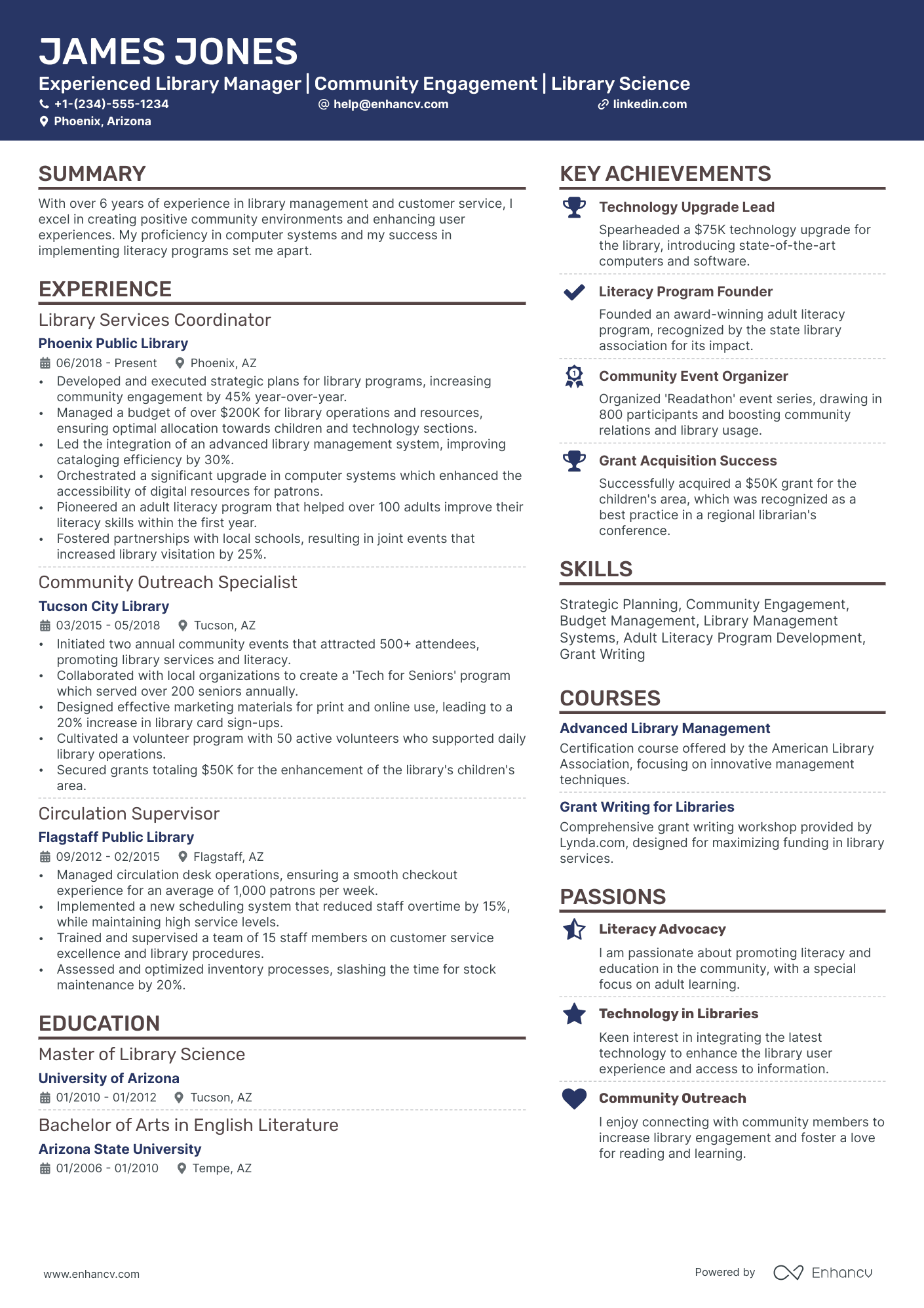
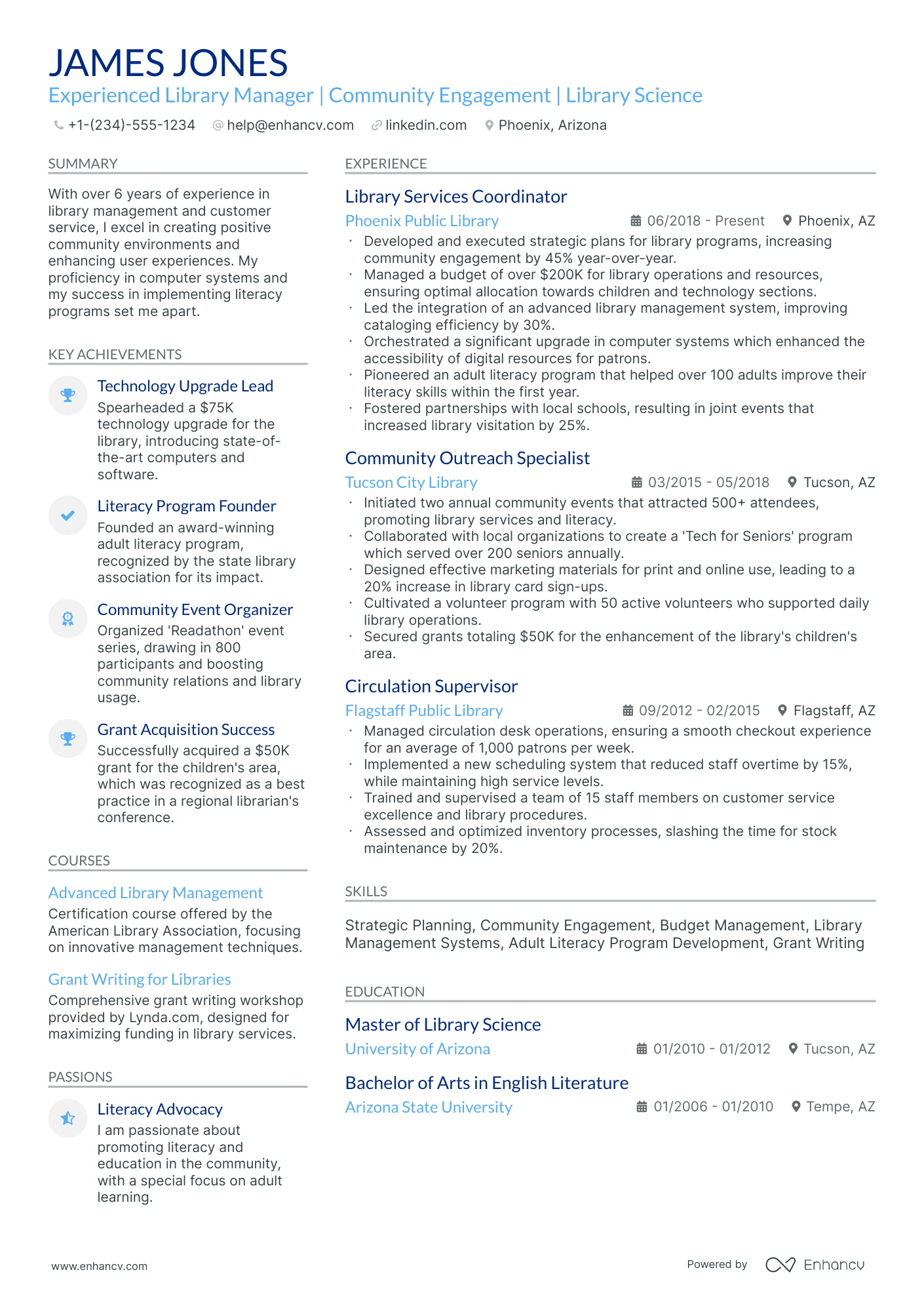
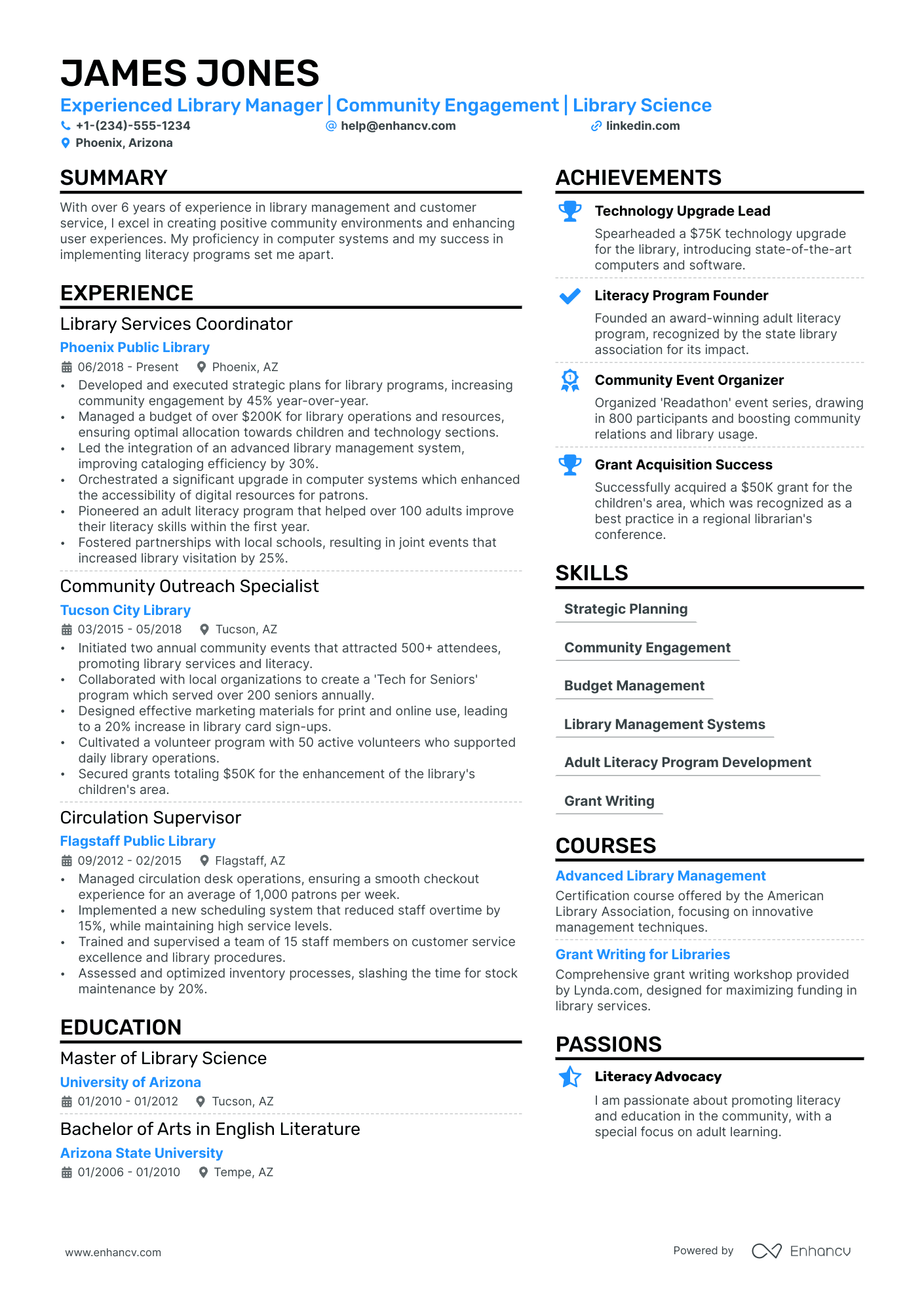
Many library director resume drafts fail because they read like duty logs and bury leadership results under program lists and systems. That matters when an ATS filters quickly and recruiters scan in seconds amid strong competition.
A strong resume shows how you deliver outcomes: budget stewardship, staff performance, and community impact. Knowing how to make your resume stand out means you should quantify circulation growth, improved program attendance, reduced wait times, secured grant dollars, expanded digital access, strengthened partnerships, and improved patron satisfaction.

Key takeaways
- Quantify budget scope, staff size, and community outcomes in every experience bullet.
- Use reverse-chronological format—hybrid and functional layouts weaken director-level candidacies.
- Tailor resume language to each posting's systems, frameworks, and strategic priorities.
- Pair hard skills like ILS administration with soft skills demonstrated through measurable results.
- Lead your summary with leadership scope and impact, not vague descriptors.
- Use AI to tighten language and align keywords, but stop before it inflates claims.
- Enhancv's Bullet Point Generator helps convert routine duties into recruiter-ready, metric-driven statements.
How to format a library director resume
Recruiters evaluating library director candidates prioritize evidence of strategic leadership, budget oversight, staff management, and measurable institutional impact. A well-chosen resume format ensures these signals surface immediately, giving hiring committees a clear picture of your progression and decision-making authority.

I have significant experience in this role—which format should I use?
Use a reverse-chronological format—it's the strongest choice for a library director resume. Do:
- Lead each role entry with your scope of oversight: number of staff managed, branches supervised, and annual budget controlled.
- Highlight domain expertise in areas such as integrated library systems (ILS), collection development strategy, community programming, and grant administration.
- Quantify outcomes tied to institutional goals, including circulation growth, funding secured, cost reductions, and patron engagement metrics.
Why hybrid and functional resumes don't work for senior roles
Hybrid and functional formats fragment your career timeline, obscuring the leadership progression and expanding institutional accountability that hiring committees need to evaluate for a director-level appointment. These formats dilute the visibility of decision ownership—such as budget authority, policy development, and strategic planning—by scattering accomplishments away from the roles where they occurred. Avoid hybrid and functional formats entirely when applying for director or executive library positions, as they raise concerns about gaps in leadership tenure and weaken your candidacy against candidates who present a clear, linear record of growing responsibility.
- Edge-case exception: A functional format may be acceptable only if you're transitioning into library leadership from a related field (such as academic administration or nonprofit management) with no prior library director title, but you must still anchor every listed skill to a specific project, institutional outcome, or measurable result.
With your format established, the next step is filling it with the right sections to present your qualifications effectively.
What sections should go on a library director resume
Recruiters expect to see clear evidence that you've led library operations, people, budgets, and community impact at scale. Understanding what to put on a resume at the director level is critical. Use this structure for maximum clarity:
- Header
- Summary
- Experience
- Skills
- Projects
- Education
- Certifications
- Optional sections: Awards, Publications, Volunteer leadership
Strong experience bullets should emphasize measurable outcomes, budget and staff scope, service improvements, stakeholder partnerships, and community impact.
Is your resume good enough?
Drop your resume here or choose a file. PDF & DOCX only. Max 2MB file size.
Once you’ve organized your resume with the right structure and supporting details, focus next on writing your experience section to show how you’ve delivered results in library leadership roles.
How to write your library director resume experience
The experience section is where you prove you've delivered results—not just held a title. Hiring managers reviewing library director candidates prioritize demonstrated impact through strategic leadership, collection development, community programming, and budget stewardship over descriptive task lists that simply catalog daily duties. Building a targeted resume ensures each entry speaks directly to the role you're pursuing.
Each entry should include:
- Job title
- Company and location (or remote)
- Dates of employment (month and year)
Three to five concise bullet points showing what you owned, how you executed, and what outcomes you delivered:
- Ownership scope: the library systems, branches, collections, budgets, staff teams, or community programs you were directly accountable for as a library director.
- Execution approach: the strategic planning frameworks, integrated library systems, data-driven assessment methods, grant writing processes, or policy development practices you used to guide decisions and deliver work.
- Value improved: changes to patron access, collection relevance, operational efficiency, staff retention, program participation, digital resource availability, or fiscal sustainability tied to your leadership.
- Collaboration context: how you partnered with boards of trustees, municipal governments, community organizations, academic departments, donors, vendors, or cross-departmental teams to advance the library's mission.
- Impact delivered: outcomes framed through measurable results—such as funding secured, service expansion, circulation growth, or strategic milestones reached—rather than routine activity descriptions.
Experience bullet formula
A library director experience example
✅ Right example - modern, quantified, specific.
Library Director
Riverview Public Library | Riverview, OH
2021–Present
Mid-sized public library system serving seventy-five thousand residents across three branches with a strong focus on digital access and community learning.
- Led a Polaris integrated library system (ILS) migration and data cleanup using SQL exports and MARCEdit, cutting holds processing time by 28% and reducing catalog error reports by 41%.
- Negotiated OverDrive, Hoopla, and EBSCO renewals using COUNTER reports and cost-per-circulation analysis, reallocating $120K annually and increasing digital checkouts by 22% without raising the materials budget.
- Implemented RFID self-check (Bibliotheca) and optimized SIP2 workflows with the vendor and information technology team, increasing self-service circulation from 46% to 71% and reducing average lobby wait time by three minutes.
- Built a Power BI dashboard fed by ILS and program registration data to track circulation, foot traffic, and program outcomes, improving monthly board reporting cycle time by 60% and enabling branch-level staffing adjustments that cut overtime by 14%.
- Partnered with city leadership, school district stakeholders, and community organizations to launch a bilingual early-literacy initiative, boosting program attendance by 35% and increasing new juvenile card registrations by 18% year over year.
Now that you've seen how a strong experience section comes together, let's look at how to adjust those details to match a specific job posting.
How to tailor your library director resume experience
Recruiters evaluate your library director resume through both applicant tracking systems and manual review, so tailoring your resume to the job description is essential. Tailoring ensures the language, priorities, and qualifications on your resume directly reflect what the hiring institution needs.
Ways to tailor your library director experience:
- Match the integrated library system or platform named in the posting.
- Mirror the exact strategic planning framework the job description references.
- Reflect collection development methodologies using the posting's own terminology.
- Highlight accreditation or compliance standards specified in the listing.
- Emphasize community engagement models the institution prioritizes.
- Include budget oversight scope that aligns with stated fiscal responsibilities.
- Reference digital accessibility or equity initiatives when the role requires them.
- Align staff development or team leadership structure to their organizational model.
Tailoring means connecting your real accomplishments to the role's stated requirements, not artificially inserting keywords where they don't belong.
Resume tailoring examples for library director
| Job description excerpt | Untailored | Tailored |
|---|---|---|
| "Lead strategic planning for library services, including development of a five-year plan aligned with community needs assessments and city council priorities." | Helped with planning and goal-setting for library programs. | Led the development of a five-year strategic plan for a public library system serving 120,000 residents, aligning service priorities with community needs assessment data and city council funding goals. |
| "Oversee a $4.2M annual operating budget, manage grant funding from IMLS and state sources, and ensure fiscal accountability across all branches." | Managed budgets and handled financial tasks for the library. | Directed a $3.8M annual operating budget across four branches, secured $600K in IMLS and state grant funding over three years, and maintained full compliance during independent fiscal audits. |
| "Supervise 45+ staff, foster a culture of professional development, and implement DEI initiatives in hiring, programming, and collection development." | Supervised employees and supported team growth. | Supervised 52 full-time and part-time staff, launched a mentorship program that reduced turnover by 18%, and implemented DEI-focused collection development guidelines that increased multilingual holdings by 35%. |
Once you’ve aligned your experience with the library’s priorities, the next step is to quantify your library director achievements so hiring teams can quickly see the impact of that work.
How to quantify your library director achievements
Quantifying your achievements turns library leadership into clear outcomes. Track circulation and program attendance, budget and cost savings, service speed, patron satisfaction, and compliance or incident reductions to show operational, community, and financial impact.
Quantifying examples for library director
| Metric | Example |
|---|---|
| Budget savings | "Reduced annual materials spend by 12% ($85K) by renegotiating vendor contracts and shifting 18% of purchases to demand-driven acquisition." |
| Service speed | "Cut average hold-to-shelf time from 3.2 days to 1.9 days by redesigning workflows and adding daily pull lists in Polaris." |
| Program reach | "Increased program attendance 28% (from 6,400 to 8,200 yearly) by launching monthly partner events with schools and senior centers." |
| Patron satisfaction | "Raised patron satisfaction from 4.1 to 4.6 out of 5 by adding 10 hours of weekly service and implementing a ticketed feedback loop." |
| Compliance risk | "Achieved 100% compliance on the annual state audit and reduced overdue notices returned undeliverable by 35% after address verification updates." |
Turn vague job duties into measurable, recruiter-ready resume bullets in seconds with Enhancv's Bullet Point Generator.
With strong, well-crafted bullet points in place, the next step is making sure your skills section highlights the right mix of hard and soft skills for a library director role.
How to list your hard and soft skills on a library director resume
Your skills section shows how you run library operations, services, and budgets, and recruiters and applicant tracking systems scan this section for role keywords and fit—aim for a balanced mix of hard skills, with targeted soft skills that support leadership and execution. library director roles require a blend of:
- Product strategy and discovery skills.
- Data, analytics, and experimentation skills.
- Delivery, execution, and go-to-market discipline.
- Soft skills.
Your skills section should be:
- Scannable (bullet-style grouping).
- Relevant to the job post.
- Backed by proof in experience bullets.
- Updated with current tools.
Place your skills section:
- Above experience if you're junior or switching careers.
- Below experience if you're mid/senior with strong achievements.

Hard skills
- Integrated library systems: Alma, Sierra, Polaris
- Discovery layers: Primo, EBSCO Discovery Service
- MARC 21, RDA, BIBFRAME basics
- OCLC WorldCat, authority control
- Electronic resources management, link resolvers
- Collection development, acquisitions, weeding
- Vendor management, contract negotiation
- Budget forecasting, fund accounting
- Grant writing, grant compliance reporting
- Copyright, licensing, fair use
- Program evaluation, logic models, outcomes measurement
- Policy development, governance, strategic planning
Soft skills
- Align stakeholders on service priorities
- Lead cross-branch change management
- Translate community needs into services
- Make evidence-based budget tradeoffs
- Communicate policy decisions clearly
- Coach managers and build accountability
- Negotiate with vendors and partners
- Handle escalations and patron complaints
- Facilitate productive staff meetings
- Build partnerships with schools and agencies
- Present to boards and city leadership
- Drive execution through clear timelines
How to show your library director skills in context
Skills shouldn't live only in a bulleted list on your resume. Explore resume skills examples to see how top candidates integrate competencies throughout their documents.
They should be demonstrated in:
- Your summary (high-level professional identity)
- Your experience (proof through outcomes)
Here's what both look like in practice.
Summary example
Library director with 15 years leading public library systems, specializing in strategic planning, community engagement, and integrated library system administration. Drove a 32% increase in digital resource usage through data-informed collection development and cross-departmental programming initiatives.
- Reflects senior-level experience clearly
- Names role-relevant tools and methods
- Includes a concrete, measurable outcome
- Signals leadership and collaboration skills
Experience example
Library Director
Hennepin County Library | Minneapolis, MN
June 2017–Present
- Restructured collection development using Sierra ILS analytics, reducing acquisition costs by 18% while expanding digital holdings by 4,200 titles.
- Partnered with county leadership and local nonprofits to launch literacy outreach programs, increasing library card registrations by 25% over two years.
- Implemented staff training protocols for RFID circulation systems, cutting average checkout processing time by 34% across 12 branch locations.
- Every bullet includes measurable proof.
- Skills surface naturally through real outcomes.
Once you’ve demonstrated your library director capabilities through relevant achievements and examples, the next step is to apply that same approach to building a library director resume when you don’t have direct experience.
How do I write a library director resume with no experience
Even without full-time experience, you can demonstrate readiness through transferable projects and leadership roles. Our guide on writing a resume without work experience walks you through this approach in detail.
- Library internship leading daily operations
- Graduate assistant supervising student staff
- Volunteer program coordinating community events
- Cataloging project using MARC records
- Collection development plan with budget
- Grant proposal writing and reporting
- Makerspace or technology lab oversight
- Library committee leadership in school
Focus on:
- Operational leadership with documented outcomes
- Budgeting, grants, and resource allocation
- Systems experience with library software
- Policy, compliance, and reporting samples
Resume format tip for entry-level library director
Use a combination resume format because it highlights leadership projects and library systems skills before limited work history. Do:
- Lead with a targeted summary and keywords.
- Add a projects section with metrics.
- List library systems, standards, and tools.
- Quantify budgets, usage, and turnaround time.
- Include leadership scope and stakeholders.
- Built a collection development plan with a $5,000 budget, analyzed circulation data, and improved adult nonfiction checkout by 18% in one semester.
Even without direct experience, your educational background can demonstrate the knowledge and qualifications that make you a strong candidate for a library director role.
How to list your education on a library director resume
Your education section lets hiring teams confirm you hold the academic foundation a library director needs. It validates your expertise in library science, management, and information systems.
Include:
- Degree name
- Institution
- Location
- Graduation year
- Relevant coursework (for juniors or entry-level candidates)
- Honors & GPA (if 3.5 or higher)
Skip month and day details—list the graduation year only.
Here's a strong education entry tailored for a library director resume.
Example education entry
Master of Library and Information Science
University of Illinois at Urbana-Champaign, Champaign, IL
Graduated 2016
GPA: 3.8/4.0
- Relevant Coursework: Collection Development, Library Administration, Digital Archives Management, Information Policy
- Honors: Beta Phi Mu International Library Science Honor Society
How to list your certifications on a library director resume
Certifications on your resume show a library director's commitment to ongoing learning, proficiency with modern tools, and alignment with current standards in libraries and information services.
Include:
- Certificate name
- Issuing organization
- Year
- Optional: credential ID or URL
- Place certifications below education when they're older, less relevant to leadership, or secondary to your degree and core library credentials.
- Place certifications above education when they're recent, directly tied to library director priorities, or required for the role you're targeting.
Best certifications for your library director resume
- Certified Public Library Administrator (CPLA)
- Project Management Professional (PMP)
- Certified Records Manager (CRM)
- Certified Information Professional (CIP)
- Lean Six Sigma Green Belt
- CompTIA Security+
Once you’ve positioned your credentials where hiring managers can quickly verify them, you can write your library director resume summary to highlight those qualifications upfront.
How to write your library director resume summary
Your resume summary is the first thing a recruiter reads, so it must immediately signal leadership credibility. A strong opening positions you as a strategic decision-maker, not just an experienced librarian.
Keep it to three to four lines, with:
- Your title and total years of library leadership experience.
- The type of institution or library system you've directed.
- Core competencies such as budget management, strategic planning, or collection development.
- One or two measurable achievements that reflect organizational impact.
- Leadership soft skills tied to real outcomes, such as staff development or community engagement.

PRO TIP
At the director level, lead with scope and outcomes—budgets managed, teams built, programs launched. Avoid vague descriptors like "passionate leader" or "motivated professional." Recruiters want evidence of institutional impact and strategic ownership, not aspirational language.
Example summary for a library director
Library director with 12 years leading public library systems and 45-person teams. Secured $2.1M in grant funding and increased community program attendance by 38%. Expert in strategic planning, budget oversight, and digital resource expansion.
Optimize your resume summary and objective for ATS
Drop your resume here or choose a file.
PDF & DOCX only. Max 2MB file size.
Now that your summary captures your leadership strengths and library expertise, make sure your resume header presents your contact details clearly so hiring managers can easily reach you.
What to include in a library director resume header
A well-structured resume header lists your key identity and contact details, helping a library director stand out in searches, build credibility, and pass recruiter screening fast.
Essential resume header elements
- Full name
- Tailored job title and headline
- Location
- Phone number
- Professional email
- GitHub link
- Portfolio link
A LinkedIn link helps recruiters verify your experience quickly and supports screening.
Don't include a photo on a library director resume unless the role is explicitly front-facing or appearance-dependent.
Match your header title to the posting and align it with your strongest library director specialty, such as public services, collections, or operations.
Example
Library director resume header
Jordan M. Reed
Library Director | Public Library Operations, Community Programs, and Budget Oversight
Chicago, IL
(312) 555-78XX
jordan.reed@enhancv.com
github.com/jordanreed
jordanreedlibrary.com
linkedin.com/in/jordanreed
Once your contact details and role focus are clearly established at the top, you can strengthen the resume’s impact with additional sections that support and reinforce that information.
Additional sections for library director resumes
Well-chosen additional sections can set you apart by showcasing expertise that standard resume categories don't fully capture for a library director. For example, listing language skills can highlight your ability to serve diverse patron communities.
- Languages
- Publications
- Professional affiliations
- Conference presentations
- Community engagement
- Grants and funded projects
- Honors and awards
Once you've rounded out your resume with relevant additional sections, pairing it with a strong cover letter can further distinguish your candidacy.
Do library director resumes need a cover letter
A cover letter isn't required for every library director role, but it often helps. If you're unsure where to start, understanding what a cover letter is and how it complements your resume can clarify its value. It matters most for competitive searches or employers that expect one. It can tip decisions when your resume doesn't clearly show fit or context.
Use a cover letter to add details your resume can't:
- Explain role and team fit by linking your leadership style to the library director priorities, governance model, and stakeholder expectations.
- Highlight one or two projects with outcomes, such as service redesign, budget savings, collection strategy results, or measurable community impact.
- Show you understand the users and context by referencing the patron base, digital services, equity goals, and partner organizations.
- Address career transitions or non-obvious experience by connecting adjacent work to core library director responsibilities and decision-making.
Drop your resume here or choose a file.
PDF & DOCX only. Max 2MB file size.
Even if you choose not to submit a cover letter, you can use AI to improve your library director resume by strengthening the same role-specific details and alignment employers expect.
Using AI to improve your library director resume
AI can sharpen your resume's clarity, structure, and impact. It helps tighten language and highlight achievements. But overuse strips authenticity. If you're wondering which AI is best for writing resumes, focus on tools that refine rather than fabricate. Once your content reads clearly and fits the role, step away from AI.
Here are 10 practical prompts you can copy and paste to strengthen specific sections of your library director resume:
- Strengthen your summary: "Rewrite my library director resume summary to emphasize leadership scope, community impact, and strategic vision in under four sentences."
- Quantify experience bullets: "Add measurable outcomes to these library director experience bullets using percentages, dollar amounts, or volume metrics where possible."
- Tighten wordy bullets: "Shorten each of these library director experience bullet points to one concise line without losing key accomplishments or context."
- Align skills strategically: "Compare my skills section against this library director job description and suggest which skills to add, remove, or reorder."
- Improve action verbs: "Replace weak or repetitive verbs in my library director experience section with stronger, more precise action verbs."
- Refine project descriptions: "Rewrite these library director project descriptions to clearly state my role, the challenge addressed, and the result achieved."
- Tailor education details: "Suggest how to present my education section to best support a library director application, including relevant coursework or honors."
- Highlight certifications: "Rewrite my certifications section to clarify how each credential directly supports my qualifications as a library director."
- Remove filler language: "Identify and remove vague or filler phrases from my library director resume that don't add specific value or meaning."
- Check role alignment: "Review my full library director resume and flag any bullet points that don't clearly connect to library leadership responsibilities."
Stop using AI once your resume sounds accurate, specific, and aligned with real experience. AI should never invent experience or inflate claims—if it didn't happen, it doesn't belong here.
Conclusion
A strong library director resume highlights measurable outcomes, role-specific skills, and a clear structure. It shows leadership, budget and resource management, staff development, collection strategy, and community partnerships with results you can quantify.
Keep each section easy to scan, and connect achievements to the needs of the role. This approach shows you’re ready for today’s hiring market and the next hiring cycle.