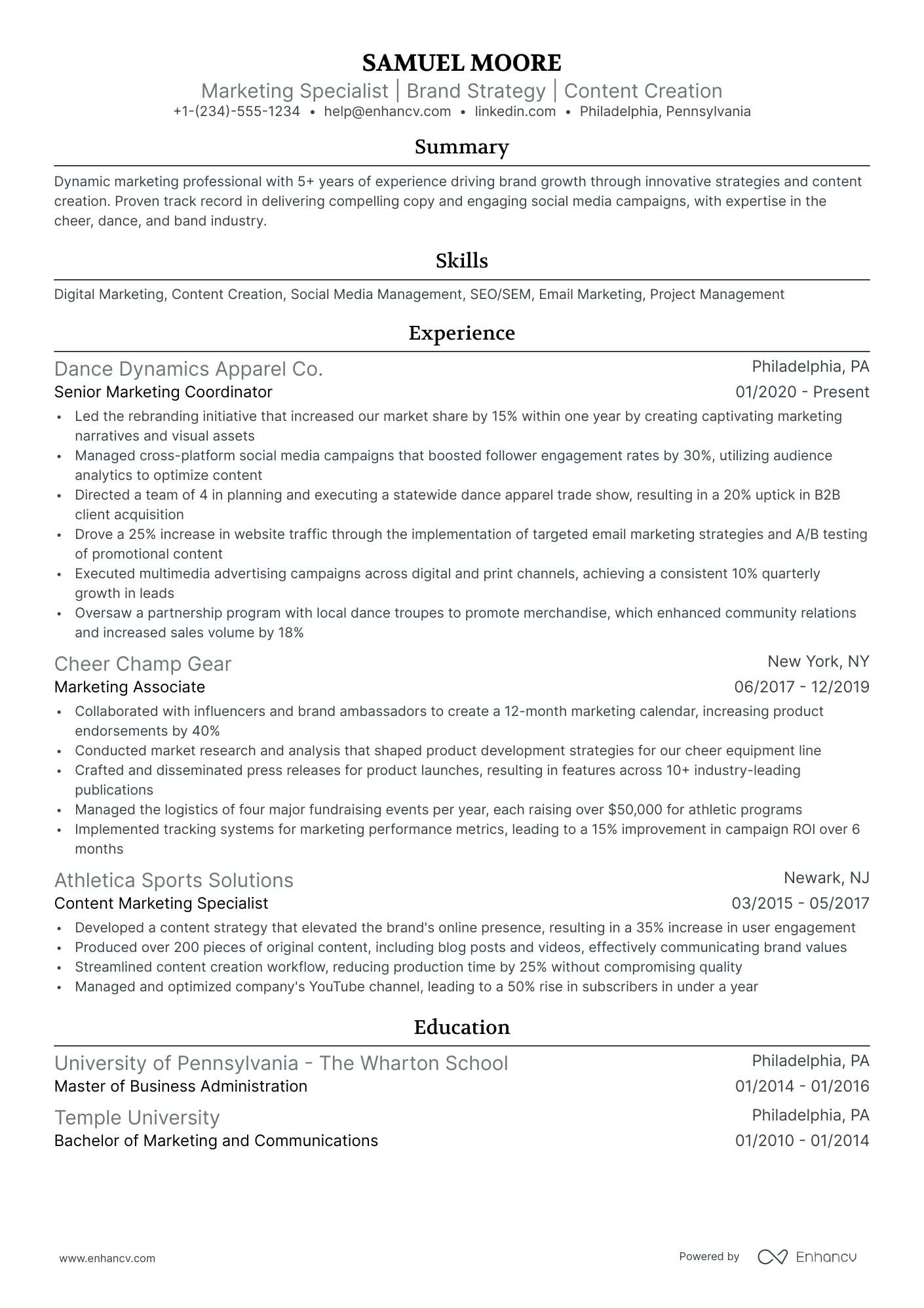
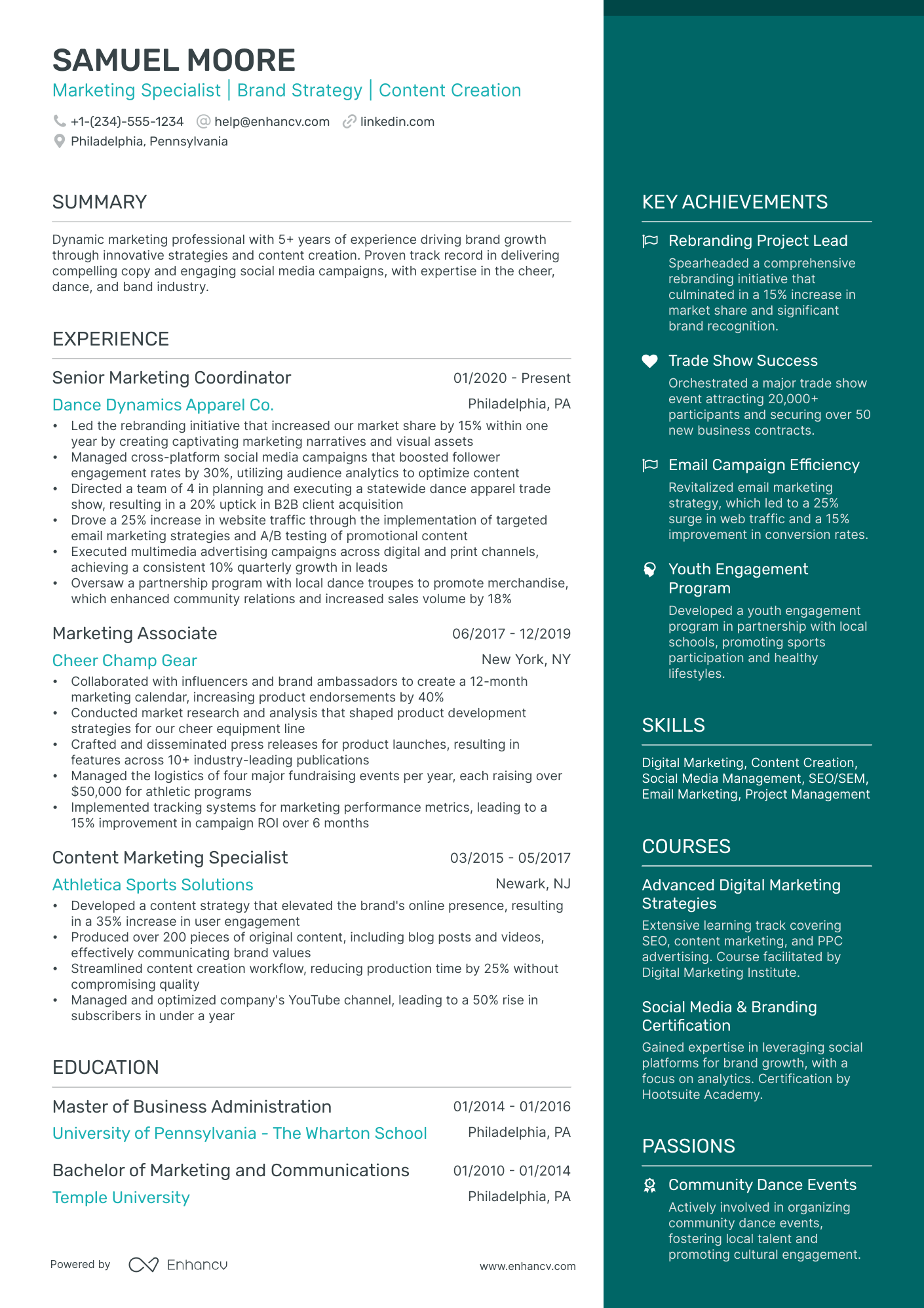
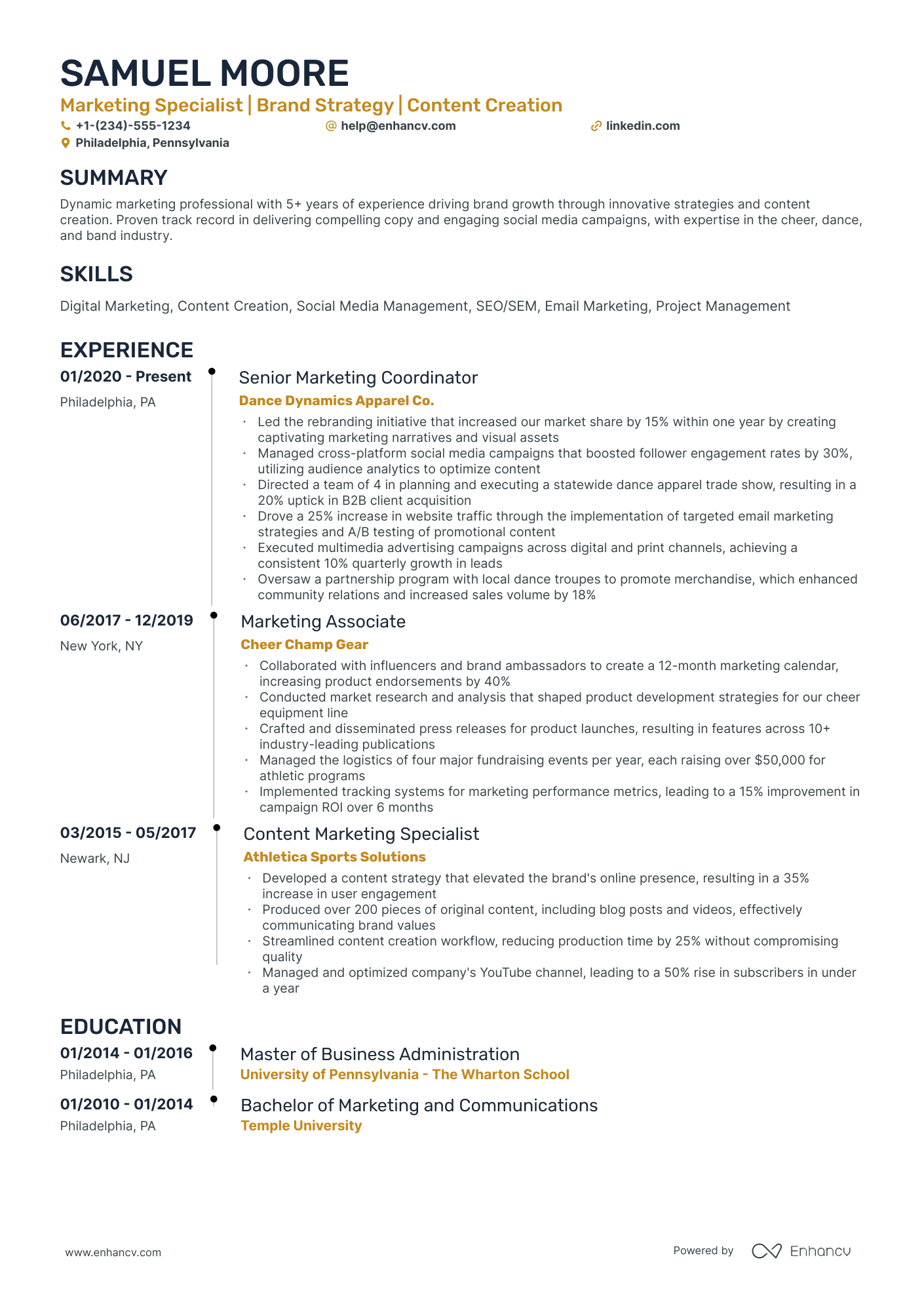
Many fashion marketing resume drafts fail because they list campaigns and tools without proving business impact. That leaves little for ATS screening and fast recruiter scans to match. In a crowded market, that gap costs interviews.
A strong resume shows what you moved and why it mattered. Knowing how to make your resume stand out means you'll highlight revenue lift, conversion gains, return on ad spend, audience growth, and launch speed. You'll quantify budget size, channel mix, market reach, and how your work improved brand health.

Key takeaways
- Anchor every resume bullet to measurable business impact like revenue, ROAS, or conversion lift.
- Use reverse-chronological format for progressive careers and hybrid format for career changers.
- Tailor experience bullets to mirror each job posting's exact tools, KPIs, and terminology.
- Place skills above experience when junior, and below experience when mid-level or senior.
- Demonstrate skills through outcome-driven bullets, not isolated keyword lists.
- Pair your resume with a cover letter when your fit needs additional context.
- Use Enhancv's tools to tighten bullet language and align your resume with specific roles faster.
How to format a fashion marketing resume
Recruiters evaluating fashion marketing resumes prioritize brand strategy experience, campaign performance metrics, and fluency with digital marketing channels specific to fashion and lifestyle brands. A clear, well-structured resume format ensures these signals surface quickly during both ATS parsing and the initial human scan.

I have significant experience in this role—which format should I use?
Use a reverse-chronological format—it's the strongest choice for showcasing a progressive fashion marketing career. Do:
- Lead each role entry with scope and ownership details: brand portfolio size, team count, budget authority, and market segments managed.
- Highlight fashion-specific tools and domains such as Shopify analytics, Google Ads for DTC campaigns, influencer relationship management platforms, trend forecasting methodologies, and seasonal go-to-market planning.
- Anchor every bullet to measurable business impact—revenue growth, ROAS, customer acquisition cost, engagement lift, or market share gains.
I'm junior or switching into this role—what format works best?
A hybrid format works best, letting you lead with relevant fashion marketing skills while still presenting your experience in a clear timeline. Do:
- Place a dedicated skills section near the top featuring fashion-relevant competencies: social media content strategy, trend research, visual merchandising support, brand voice development, and tools like Canva, Later, or Google Analytics.
- Include academic projects, freelance work, internships, or brand collaborations that demonstrate hands-on fashion marketing experience, even if the work was unpaid or informal.
- Connect every action to a clear outcome so recruiters see cause and effect, not just task lists.
Why not use a functional resume?
A functional format strips away the timeline and context recruiters need to evaluate how your fashion marketing skills were applied in real campaigns, making it harder to verify growth and relevance.
- Career changers moving into fashion marketing from adjacent fields (e.g., visual merchandising, PR, or e-commerce) who have transferable skills but no direct fashion marketing job titles.
- Recent graduates or bootcamp completers with project-based experience but limited formal employment in fashion marketing.
- Candidates with resume gaps longer than one year who built skills through freelance projects, personal brand work, or certifications during that period.
Once your layout and formatting choices are in place, the next step is deciding which sections to include so each one reinforces your qualifications.
What sections should go on a fashion marketing resume
Recruiters expect a clean, results-driven resume that proves you can grow brand awareness, engagement, and revenue through fashion marketing. Understanding what to put on a resume ensures every section reinforces your qualifications.
Use this structure for maximum clarity:
- Header
- Summary
- Experience
- Skills
- Projects
- Education
- Certifications
- Optional sections: Awards, Publications, Languages
Your experience bullets should highlight measurable impact, campaign outcomes, channel mix, budget scope, and revenue or conversion results.
Is your resume good enough?
Drop your resume here or choose a file. PDF & DOCX only. Max 2MB file size.
Once you’ve organized your resume with the right core components, the next step is to write your fashion marketing experience section in a way that fits those sections and supports your overall story.
How to write your fashion marketing resume experience
The experience section of your fashion marketing resume should spotlight campaigns you've launched, brand strategies you've executed, and the measurable outcomes those efforts produced—using role-relevant tools like social media analytics platforms, trend forecasting software, and influencer management systems. Writing a targeted resume ensures hiring managers in fashion marketing see demonstrated impact on brand awareness, revenue growth, and audience engagement rather than descriptive task lists.
Each entry should include:
- Job title
- Company and location (or remote)
- Dates of employment (month and year)
Three to five concise bullet points showing what you owned, how you executed, and what outcomes you delivered:
- Ownership scope: the brand campaigns, product launches, seasonal collections, social channels, influencer partnerships, or market segments you were directly accountable for.
- Execution approach: the tools, frameworks, and methods you used to plan and deliver work—such as trend forecasting platforms, content management systems, paid media dashboards, email marketing software, or visual merchandising strategies.
- Value improved: the changes you drove in brand visibility, campaign performance, audience engagement, customer acquisition cost, sell-through rates, or content production efficiency within a fashion context.
- Collaboration context: how you partnered with cross-functional stakeholders—designers, buyers, PR teams, creative directors, photographers, retail partners, or external agencies—to align marketing efforts with broader brand and collection goals.
- Impact delivered: the business outcomes your work produced, expressed through growth in brand equity, revenue contribution, market expansion, community size, or retail partnerships rather than a list of activities performed.
Experience bullet formula
A fashion marketing experience example
✅ Right example - modern, quantified, specific.
Senior Fashion Marketing Manager (Growth & Campaigns)
Aster & Loom | New York, NY
2022–Present
Direct-to-consumer womenswear brand with a five million member email and SMS list and weekly product drops.
- Led seasonal launch strategy across email, SMS, paid social, and site merchandising using Klaviyo, Attentive, Shopify, and Looker Studio, increasing launch-week revenue by 18% year over year.
- Built a multi-touch attribution model in GA4 and Looker Studio and partnered with finance and performance marketing to reallocate $250K in monthly spend, improving return on ad spend by 22% while holding customer acquisition cost flat.
- Produced and tested creative with designers and in-house studio using Meta Ads Manager and TikTok Ads Manager, lifting click-through rate by 31% and reducing cost per acquisition by 14% through weekly creative sprints.
- Implemented UTM governance and campaign QA in Asana and Google Tag Manager with engineering and analytics, cutting reporting errors by 70% and reducing weekly performance readout time by four hours.
- Launched an influencer seeding program using Aspire and Shopify Collabs and coordinated contracts with legal, generating 420 pieces of user-generated content per quarter and driving 9% of new-customer revenue from tracked affiliate links.
Now that you've seen how a strong experience section comes together, let's break down how to tailor each element to match the specific fashion marketing role you're targeting.
How to tailor your fashion marketing resume experience
Recruiters evaluate fashion marketing resumes through both human review and applicant tracking systems, so tailoring your resume to the job description is essential. Tailoring ensures your most relevant accomplishments surface quickly during both screening methods.
Ways to tailor your fashion marketing experience:
- Match platform tools like Shopify or Google Analytics from the listing.
- Mirror the exact campaign terminology the job description uses.
- Reflect KPIs such as ROAS or engagement rate the posting names.
- Highlight luxury or streetwear segment experience when specified.
- Emphasize brand consistency and visual identity standards if referenced.
- Include cross-functional collaboration with design or merchandising teams listed.
- Showcase influencer partnership workflows the role specifically requires.
- Align seasonal launch planning methods with those the employer describes.
Tailoring means aligning your real achievements with stated job requirements, not inserting keywords where they don't naturally belong.
Resume tailoring examples for fashion marketing
| Job description excerpt | Untailored | Tailored |
|---|---|---|
| "Plan and execute seasonal campaign strategies across Instagram, TikTok, and Pinterest to drive brand awareness for our women's ready-to-wear collections." | Managed social media accounts and created content for various platforms. | Planned and executed seasonal campaign strategies across Instagram, TikTok, and Pinterest for women's ready-to-wear collections, increasing brand awareness by 34% over two launch cycles. |
| "Collaborate with influencers and stylists to produce lookbook content, managing partnerships end-to-end using Grin and tracking ROI through UTM-tagged links." | Worked with influencers to promote products and build brand partnerships. | Managed 25+ influencer and stylist partnerships end-to-end using Grin to produce lookbook content, tracking ROI through UTM-tagged links that attributed $180K in direct revenue across three collections. |
| "Analyze campaign performance in Google Analytics and Dash Hudson to optimize paid and organic content strategies aligned with sell-through targets." | Reviewed marketing data and provided reports to the team on a regular basis. | Analyzed paid and organic campaign performance in Google Analytics and Dash Hudson, optimizing content strategies that contributed to a 12% improvement in sell-through rates for spring/summer product lines. |
Once you’ve aligned your experience with the role’s priorities, quantify your fashion marketing achievements to prove the impact of that work.
How to quantify your fashion marketing achievements
Quantifying your achievements proves you drove business results, not just beautiful campaigns. Focus on revenue, conversion, retention, efficiency, and delivery speed across launches, paid media, email, and marketplace listings.
Quantifying examples for fashion marketing
| Metric | Example |
|---|---|
| Revenue growth | "Grew Shopify revenue 18% quarter over quarter by optimizing Meta Ads creative testing and reallocating spend across five product drops." |
| Conversion rate | "Improved product page conversion 1.9% to 2.4% by rewriting copy, adding UGC modules, and running eight A/B tests in Optimizely." |
| Retention | "Increased ninety-day repeat purchase rate 12% by segmenting Klaviyo flows and launching a post-purchase cross-sell series for denim buyers." |
| Cycle time | "Cut campaign launch turnaround from ten days to six by standardizing briefs, building Figma templates, and creating a two-step approval workflow." |
| Accuracy & compliance | "Reduced marketplace listing errors 35% and eliminated compliance flags by implementing a QA checklist for claims, materials, and care labels across three channels." |
Turn your everyday tasks into measurable, recruiter-ready resume bullets in seconds with Enhancv's Bullet Point Generator.
Once you've crafted strong bullet points that highlight your accomplishments, the next step is ensuring your resume also showcases the right combination of hard and soft skills that fashion marketing employers look for.
How to list your hard and soft skills on a fashion marketing resume
Your skills section shows you can drive brand growth and product demand, and recruiters and ATS scan it to match keywords to the job post—aim for a practical mix of hard skills and role-specific soft skills. fashion marketing roles require a blend of:
- Product strategy and discovery skills.
- Data, analytics, and experimentation skills.
- Delivery, execution, and go-to-market discipline.
- Soft skills.
Your skills section should be:
- Scannable (bullet-style grouping).
- Relevant to the job post.
- Backed by proof in experience bullets.
- Updated with current tools.
Place your skills section:
- Above experience if you're junior or switching careers.
- Below experience if you're mid/senior with strong achievements.

Hard skills
- Brand positioning and messaging
- Go-to-market planning
- Seasonal campaign calendars
- Product launch marketing
- Influencer marketing platforms
- Paid social: Meta Ads, TikTok Ads
- Google Analytics 4 (GA4)
- Search engine optimization, keyword research
- Email marketing: Klaviyo, Mailchimp
- Shopify, product feeds, merchandising
- A/B testing, conversion rate optimization
- UTM tagging, attribution reporting
Soft skills
- Translate insights into briefs
- Align creative with brand voice
- Partner with merchandising teams
- Manage agencies and freelancers
- Prioritize by impact and effort
- Present performance to stakeholders
- Make data-backed tradeoffs
- Execute fast with quality checks
- Coordinate cross-functional launches
- Own timelines and follow-through
- Write clear, on-brand copy
- Resolve feedback and approvals quickly
How to show your fashion marketing skills in context
Skills shouldn't live only in a skills list. Browse examples of resume skills in action to see how top candidates weave competencies into real achievements.
They should be demonstrated in:
- Your summary (high-level professional identity)
- Your experience (proof through outcomes)
Here's how that looks in practice.
Summary example
Senior fashion marketing strategist with 10+ years driving brand growth for luxury and DTC labels. Skilled in omnichannel campaign strategy, Google Analytics, and influencer partnerships. Increased seasonal sell-through rates by 34% through data-driven digital storytelling.
- Signals senior-level expertise immediately
- Names role-relevant tools and methods
- Leads with a measurable outcome
- Conveys strategic and creative thinking
Experience example
Senior Marketing Manager
Auverie Studio | New York, NY
March 2020–Present
- Launched influencer-led campaigns using Traackr and Meta Ads Manager, boosting brand awareness by 48% in two seasons.
- Partnered with creative and merchandising teams to align campaign messaging, increasing email click-through rates by 27%.
- Developed seasonal content strategies informed by Google Analytics data, driving a 19% lift in e-commerce conversion rates.
- Every bullet includes measurable proof.
- Skills appear naturally within achievements.
Once you’ve tied your fashion marketing strengths to real outcomes and examples, the next step is learning how to structure a fashion marketing resume with no experience so those strengths still come through clearly.
How do I write a fashion marketing resume with no experience
Even without full-time experience, you can demonstrate readiness through projects and self-directed work. If you're building a resume without work experience, focus on tangible marketing outputs:
- Fashion brand social media campaigns
- Campus fashion club marketing lead
- Instagram and TikTok content calendar
- Etsy or Depop shop promotion
- Email newsletter for a boutique
- Influencer outreach and gifting tracker
- Google Analytics for personal blog
- Retail associate merchandising insights
Focus on:
- Measurable campaign results and growth
- Clear brand voice and positioning
- Channel strategy across platforms
- Tool use with proof
Resume format tip for entry-level fashion marketing
Use a hybrid resume format because it highlights projects, skills, and tools first, while still showing work history and education clearly. Do:
- Lead with a "Projects" section.
- Add metrics to every marketing bullet.
- Name tools like Canva and Mailchimp.
- Match keywords from the job post.
- Link a portfolio or campaign folder.
- Built an Instagram and TikTok content calendar, created posts in Canva, and tracked performance in Google Analytics, increasing profile visits 38% in four weeks.
Even without formal work experience, your education section can serve as the foundation of your resume—here's how to present it effectively.
How to list your education on a fashion marketing resume
Your education section helps hiring teams confirm you have the foundational knowledge needed for fashion marketing. It validates your training in branding, consumer behavior, and visual communication.
Include:
- Degree name
- Institution
- Location
- Graduation year
- Relevant coursework (for juniors or entry-level candidates)
- Honors & GPA (if 3.5 or higher)
Skip month and day details—list the graduation year only.
Here's a strong education entry tailored to fashion marketing:
Example education entry
Bachelor of Science in Fashion Marketing
Fashion Institute of Technology, New York, NY
Graduated 2022
GPA: 3.7/4.0
- Relevant Coursework: Consumer Behavior in Fashion, Brand Management, Digital Marketing Strategy, Visual Merchandising, Trend Forecasting
- Honors: Dean's List, magna cum laude
How to list your certifications on a fashion marketing resume
Certifications on your resume show your commitment to learning, prove tool proficiency, and signal industry relevance in fashion marketing. They help employers trust your skills beyond job titles and degree requirements. Include:
- Certificate name
- Issuing organization
- Year
- Optional: credential ID or URL
- Place certifications below education when your degree is recent and your certifications are older or only loosely tied to fashion marketing.
- Place certifications above education when they are recent, highly relevant to fashion marketing, or highlight in-demand tools you use.
Best certifications for your fashion marketing resume
- Google Analytics Certification
- Google Ads Search Certification
- Meta Certified Digital Marketing Associate
- HubSpot Content Marketing Certification
- HubSpot Social Media Marketing Certification
- Hootsuite Social Marketing Certification
- Adobe Certified Professional in Adobe Photoshop
Once you’ve positioned your credentials where recruiters can spot them, shift to your fashion marketing resume summary to connect those qualifications to the value you’ll deliver.
How to write your fashion marketing resume summary
Your resume summary is the first thing a recruiter reads. A strong one instantly signals you're qualified for this fashion marketing role.
Keep it to three to four lines, with:
- Your title and total years of experience in marketing.
- Fashion, apparel, beauty, or lifestyle industry focus.
- Core skills like brand strategy, campaign management, and social media platforms.
- One or two measurable wins, such as engagement growth or revenue impact.
- Soft skills tied to real outcomes, like cross-functional collaboration that shortened launch timelines.

PRO TIP
At an entry or mid-level, lead with relevant skills, tools, and any early results you've driven. Highlight platform expertise, campaign types, and specific fashion segments you've touched. Avoid vague descriptors like "passionate" or "hardworking." Replace them with evidence. Skip objective statements and focus every word on proving you can do this job.
Example summary for a fashion marketing
Fashion marketer with three years of experience in apparel brand campaigns. Skilled in Instagram strategy, influencer coordination, and email marketing. Grew social engagement 40% for a DTC womenswear brand through targeted seasonal campaigns.
Optimize your resume summary and objective for ATS
Drop your resume here or choose a file.
PDF & DOCX only. Max 2MB file size.
Now that your summary is crafted to highlight your strongest qualifications, make sure the header above it presents your contact details clearly so recruiters can actually reach you.
What to include in a fashion marketing resume header
A resume header lists your key contact details and role focus, boosting visibility, credibility, and recruiter screening for fashion marketing roles.
Essential resume header elements
- Full name
- Tailored job title and headline
- Location
- Phone number
- Professional email
- GitHub link
- Portfolio link
A LinkedIn link helps recruiters verify experience quickly and supports screening across roles, dates, and brand work.
Don't include a photo on a fashion marketing resume unless the role is explicitly front-facing or appearance-dependent.
Match your header title and headline to the job posting's fashion marketing keywords, and keep every link short, readable, and current.
Fashion marketing resume header
Jordan Taylor
Fashion marketing specialist | Brand campaigns, social growth, and retail storytelling
New York, NY
(212) 555-01XX
your.name@enhancv.com
github.com/yourname
yourwebsite.com
linkedin.com/in/yourname
Once your header clearly identifies who you are and how to contact you, add optional sections to highlight relevant strengths and details that don’t fit elsewhere in your fashion marketing resume.
Additional sections for fashion marketing resumes
Extra resume sections help you stand out when your core qualifications match other candidates' profiles closely. They showcase niche expertise and cultural fluency that fashion marketing employers actively seek. For example, listing language skills can demonstrate your ability to manage campaigns across global markets.
- Languages
- Industry certifications
- Publications and media features
- Professional affiliations
- Fashion events and trade shows
- Hobbies and interests
- Portfolio or creative projects
Once you've rounded out your resume with the right supplementary sections, it's worth pairing it with a strong cover letter to maximize your impact.
Do fashion marketing resumes need a cover letter
A cover letter isn't required for most fashion marketing roles, but it helps in competitive searches or when hiring managers expect one. If you're unsure what a cover letter is or when to include one, it can make a difference when your resume needs context, or when your fit isn't obvious.
Use a cover letter to add clarity and relevance:
- Explain role and team fit by connecting your strengths to the brand's channel mix, pace, and collaboration style.
- Highlight one or two fashion marketing projects with outcomes, such as improved conversion rate, reduced return rate, or higher email revenue.
- Show product, user, and business understanding by naming the customer segment, price point, and key drivers like margin, inventory, or seasonality.
- Address career transitions or non-obvious experience by mapping your past work to fashion marketing skills, tools, and metrics.
Drop your resume here or choose a file.
PDF & DOCX only. Max 2MB file size.
Whether you include a cover letter or not, using AI to improve your fashion marketing resume helps you strengthen your core application materials and tailor them faster and more consistently.
Using AI to improve your fashion marketing resume
AI can sharpen your resume's clarity, structure, and impact. It helps reframe bullets, tighten language, and highlight results. But overuse strips authenticity fast. Once your content feels clear and role-aligned, step away from AI. If you're wondering which AI is best for writing resumes, start with targeted prompts like the ones below.
Here are 10 prompts you can copy and paste to strengthen specific sections of your fashion marketing resume:
- Sharpen your summary: "Rewrite my resume summary to highlight my fashion marketing expertise, key strengths, and measurable career achievements in under four sentences."
- Quantify experience bullets: "Add specific metrics and results to these fashion marketing experience bullets without inventing data I haven't provided."
- Align skills strategically: "Review my skills section and recommend which fashion marketing skills to prioritize based on this job description."
- Strengthen action verbs: "Replace weak or passive verbs in my fashion marketing experience bullets with stronger, more precise action verbs."
- Tighten project descriptions: "Edit my fashion marketing project descriptions for clarity, removing filler words while keeping measurable outcomes intact."
- Tailor to a role: "Adjust my resume experience section to better align with this specific fashion marketing coordinator job posting."
- Refine education details: "Rewrite my education section to emphasize coursework and achievements most relevant to a fashion marketing career."
- Highlight certifications clearly: "Format my certifications section so each entry clearly connects to fashion marketing skills employers look for."
- Remove redundant phrasing: "Identify and remove redundant or vague phrasing across all sections of my fashion marketing resume."
- Improve overall readability: "Review my full fashion marketing resume for sentence clarity, consistent formatting, and logical section flow."
Stop using AI once your resume sounds accurate, specific, and aligned with real experience. AI should never invent experience or inflate claims—if it didn't happen, it doesn't belong here.
Conclusion
A strong fashion marketing resume proves impact with measurable outcomes, role-specific skills, and a clear structure. Use clean headings, focused bullets, and consistent formatting to keep your story easy to scan.
This approach shows you’re ready for today’s fashion marketing hiring market and the roles ahead. It signals you can drive results, collaborate across teams, and communicate clearly from the first review.