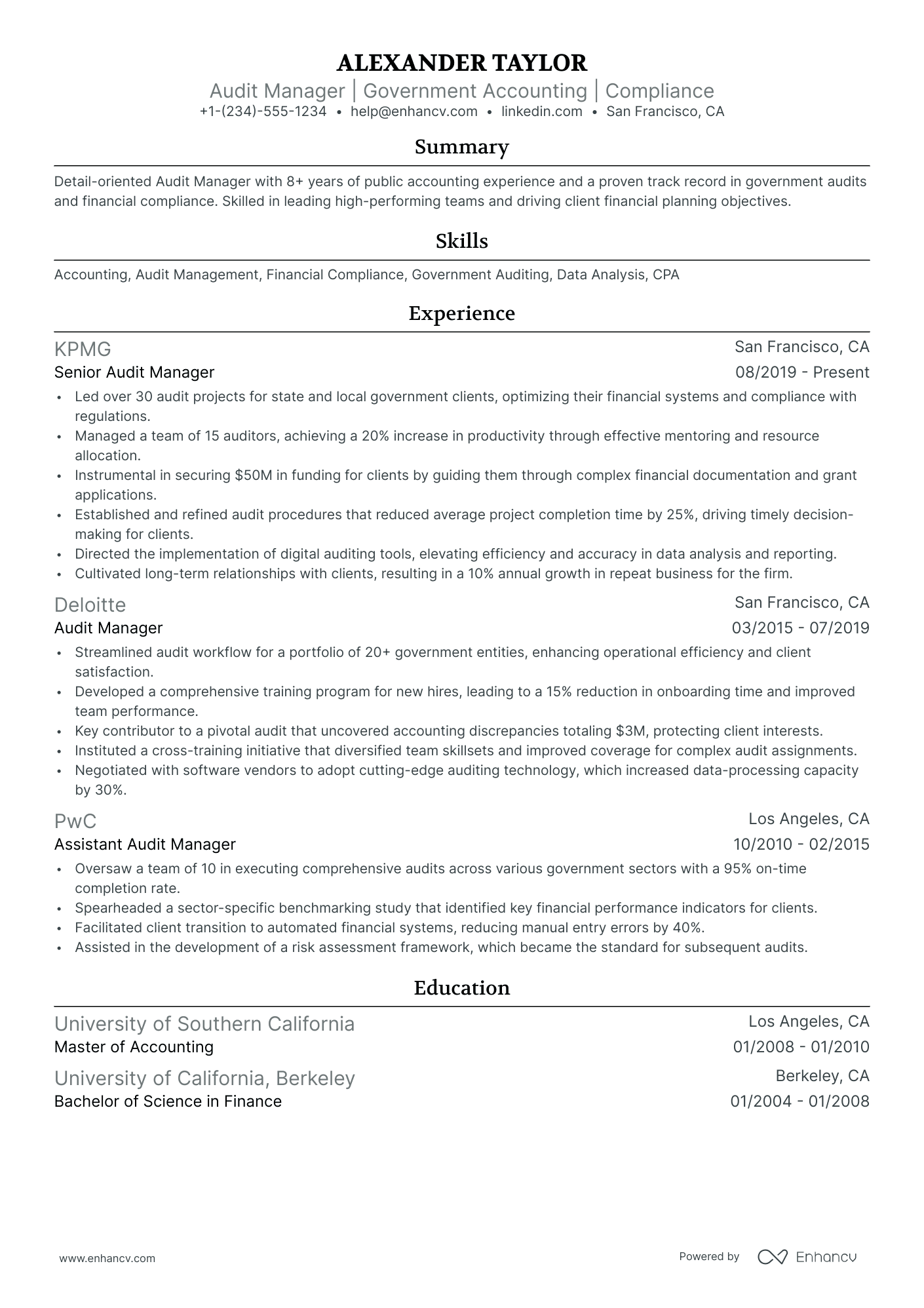
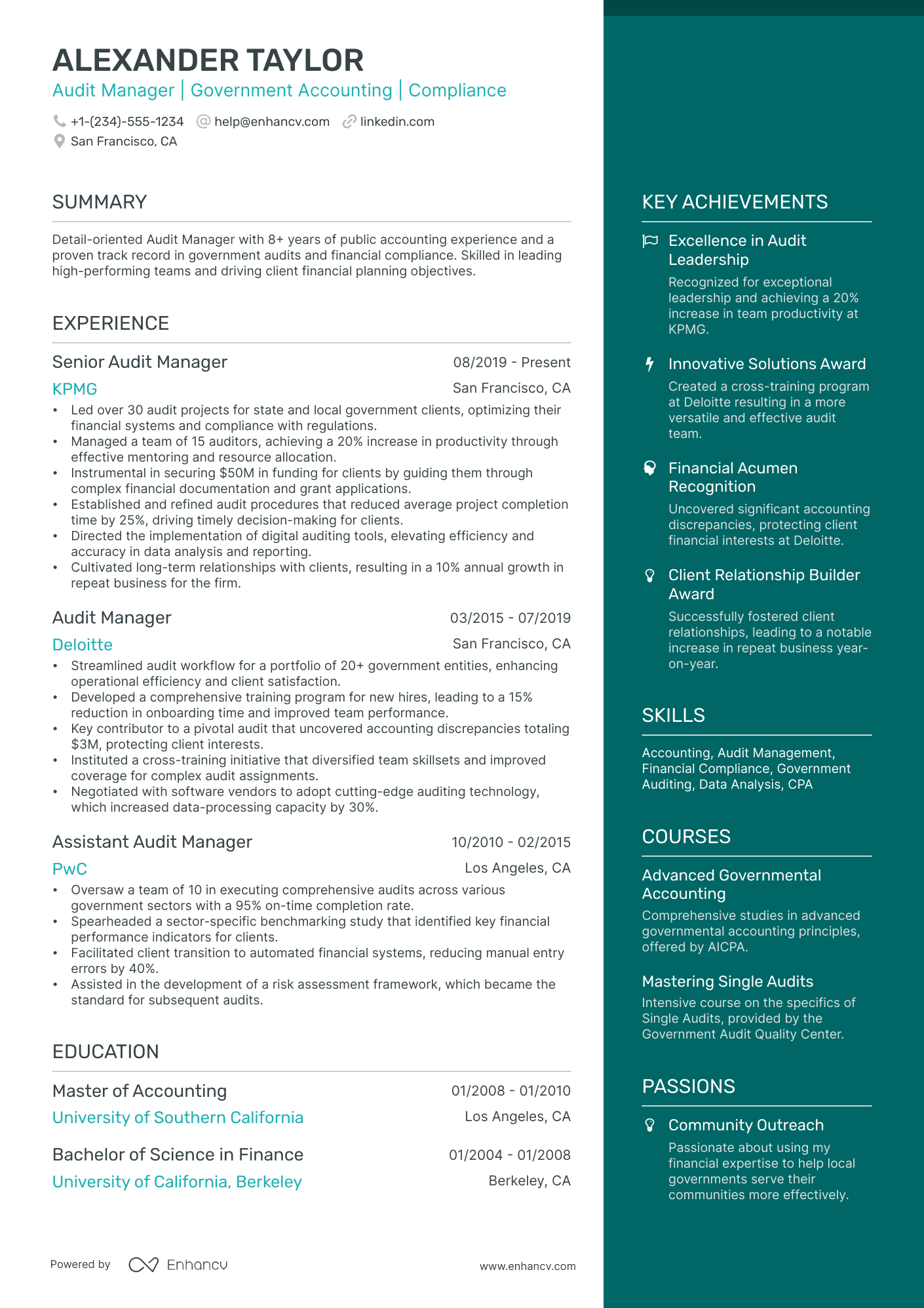
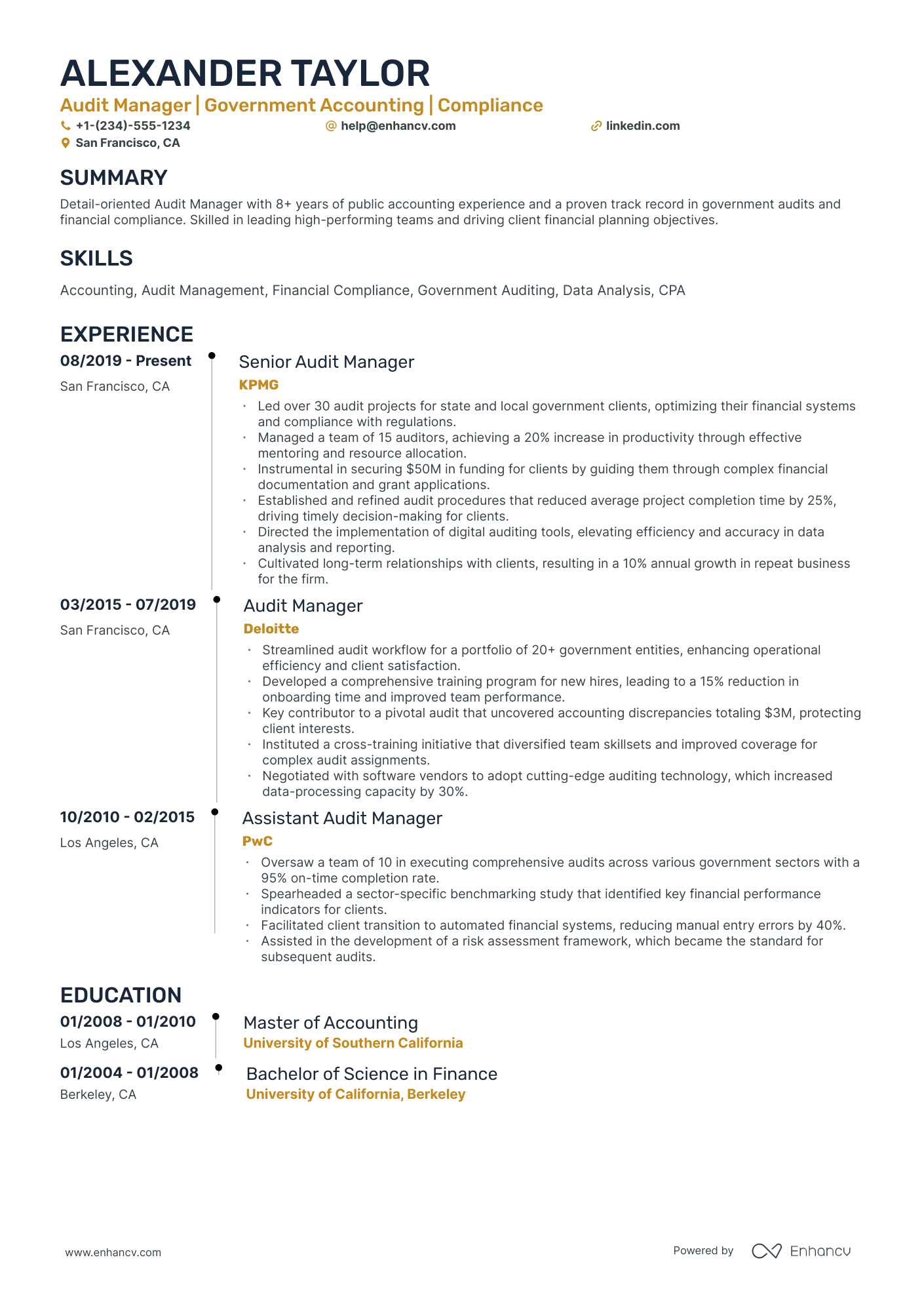
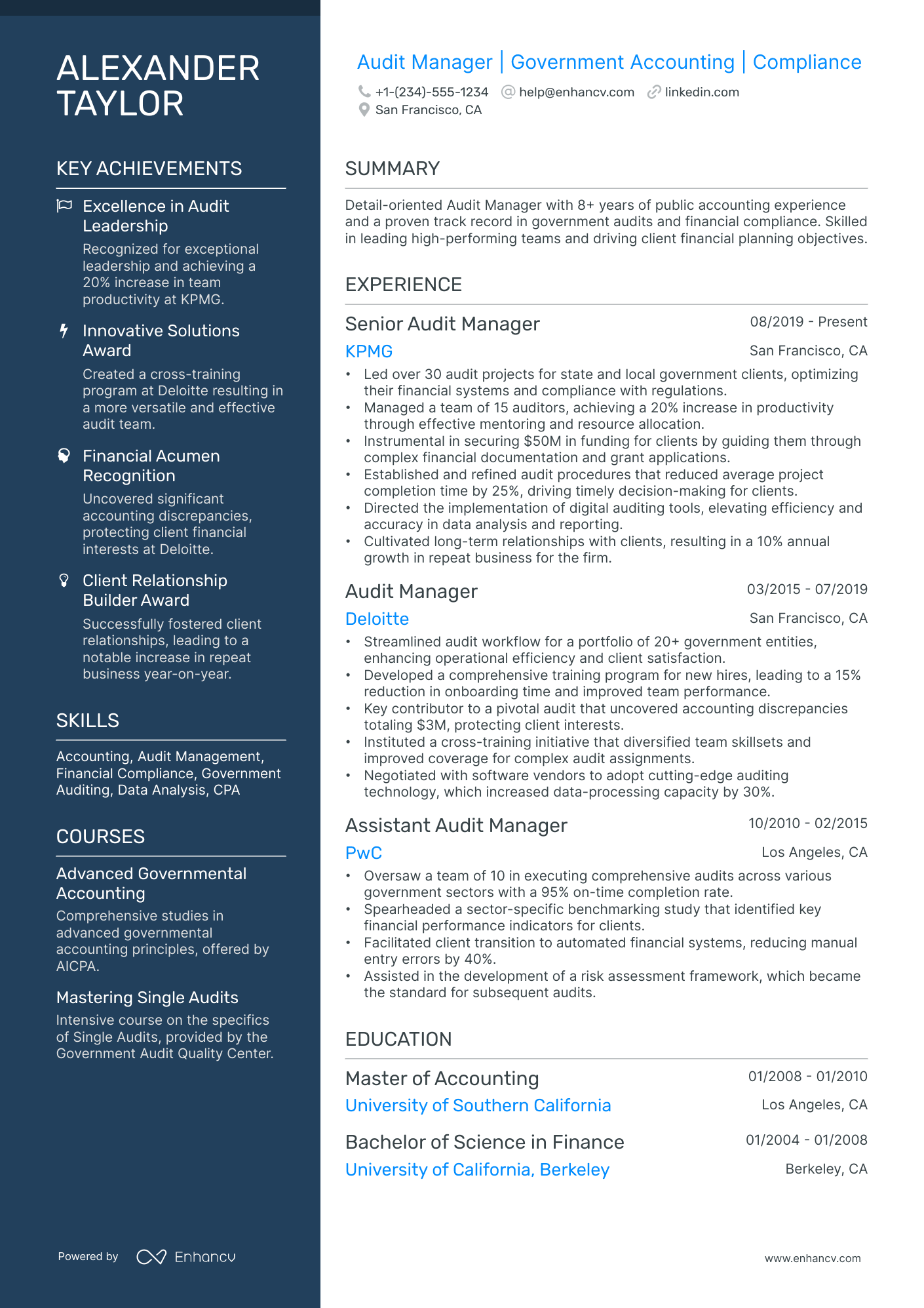
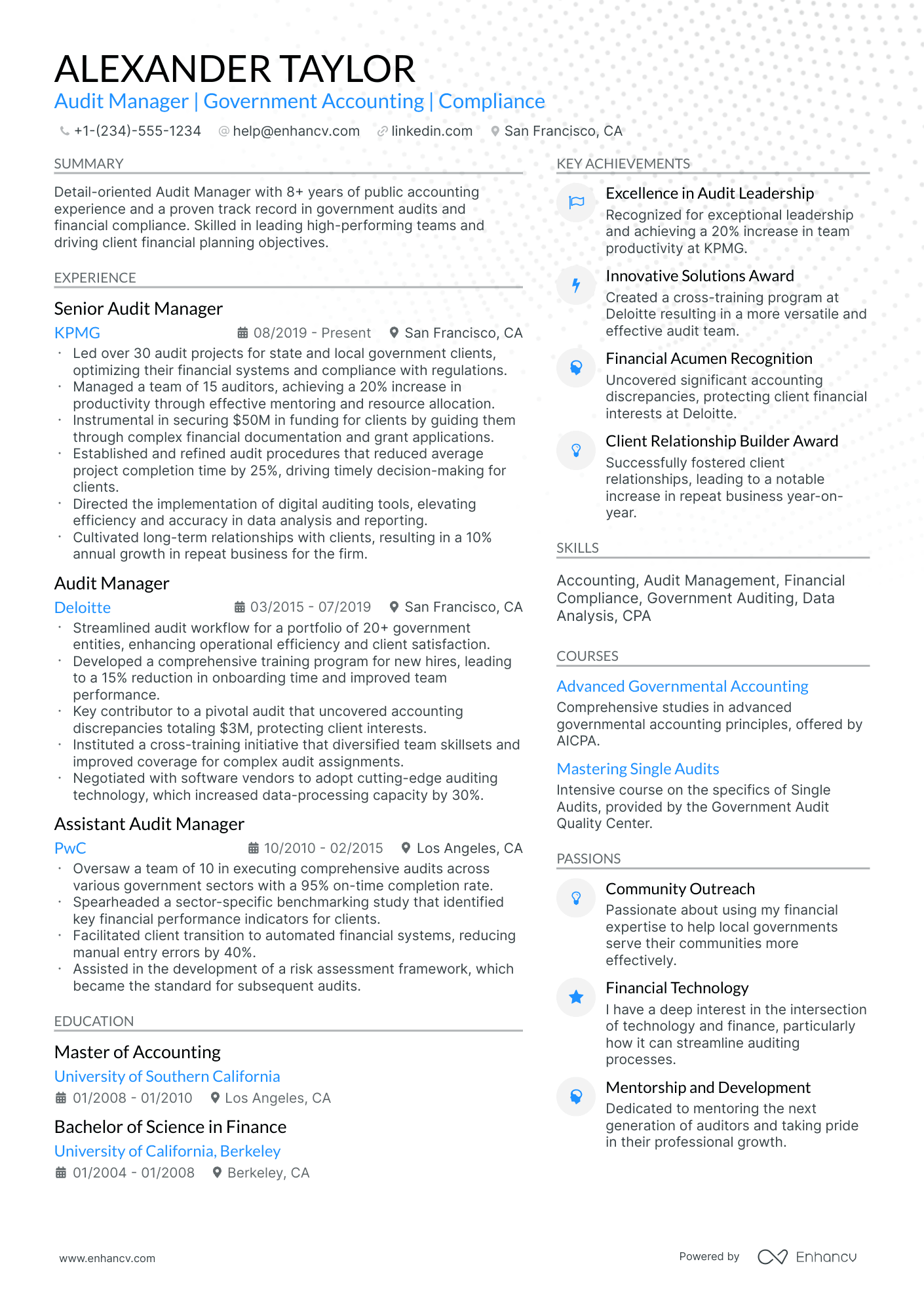
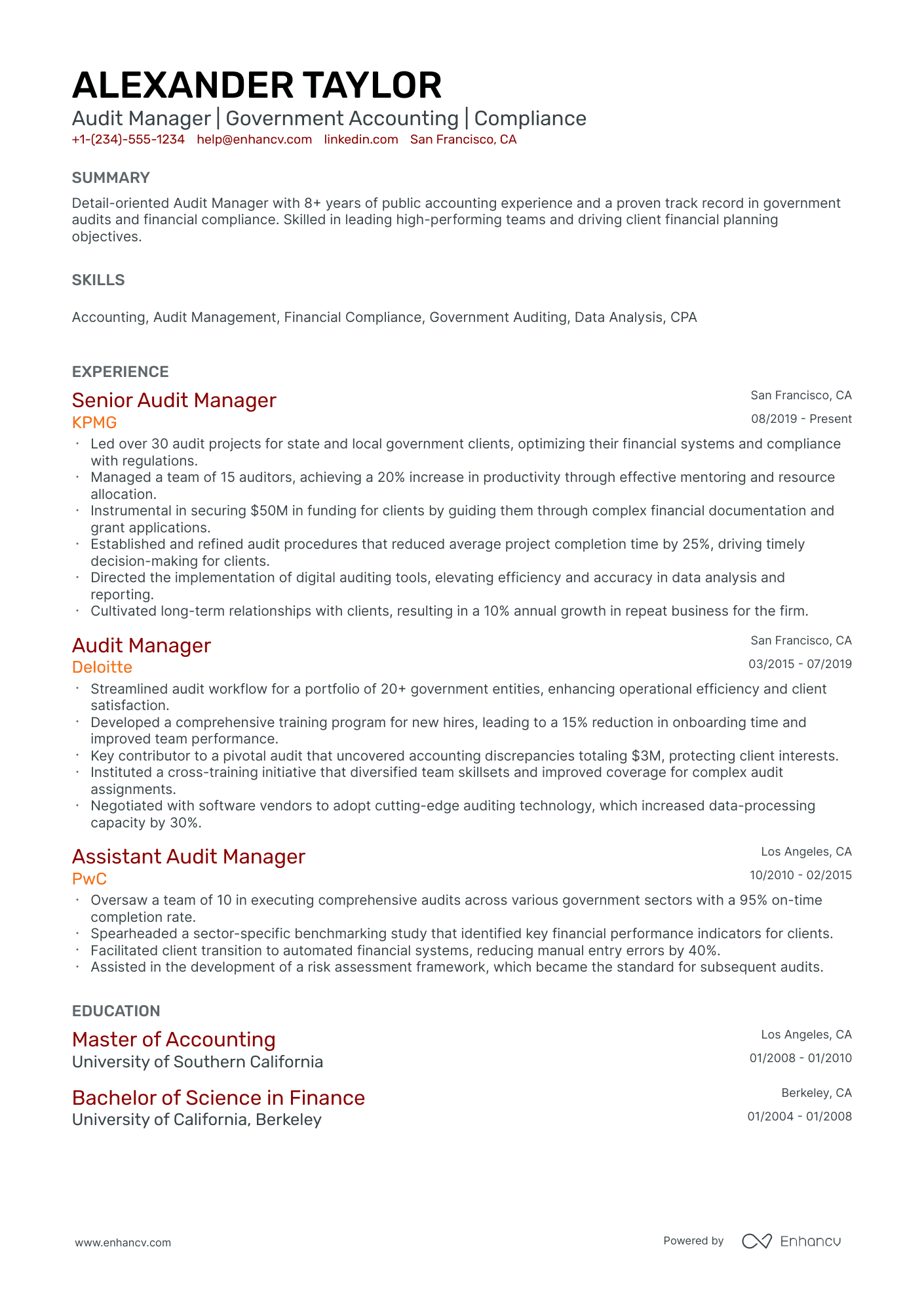
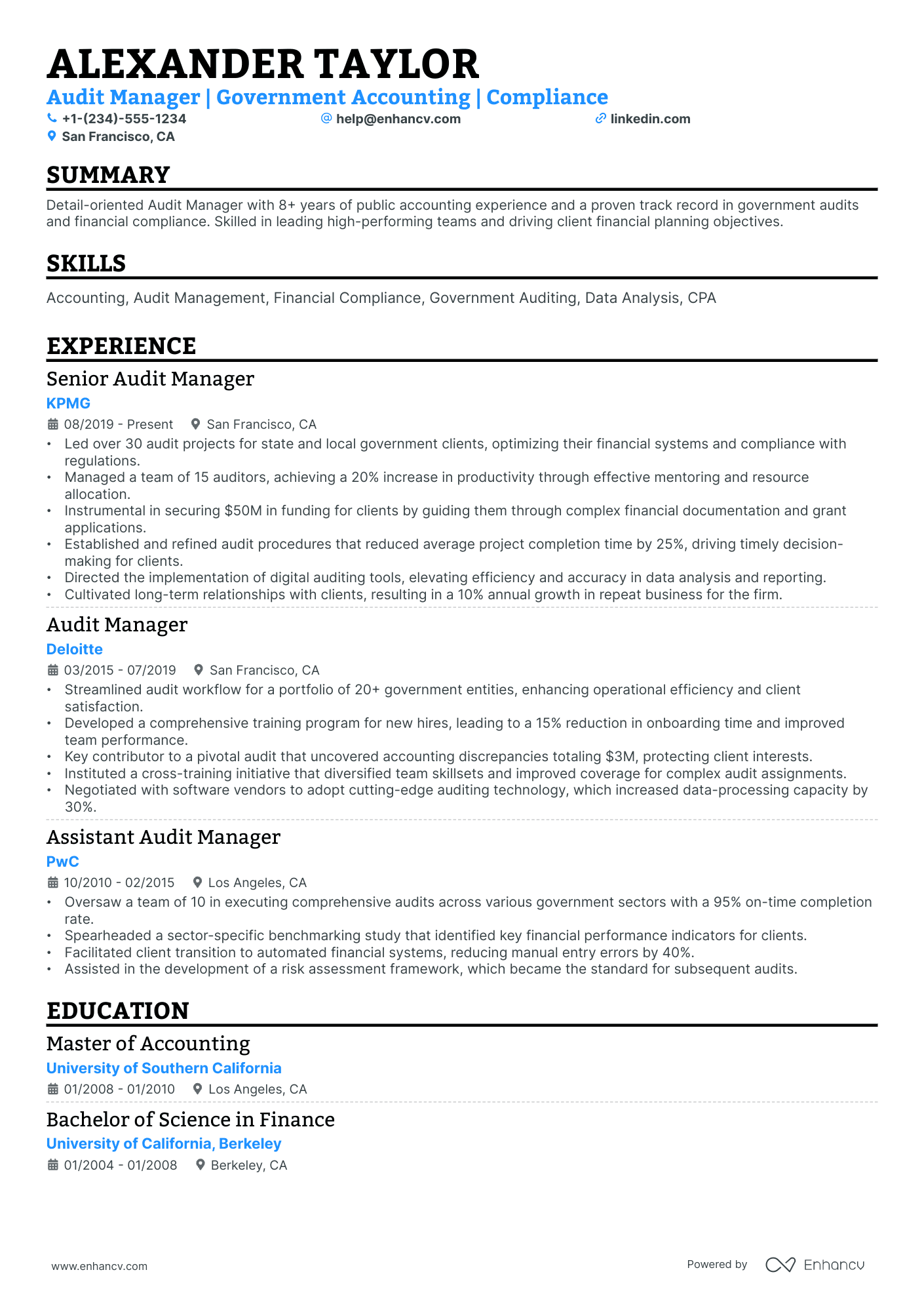
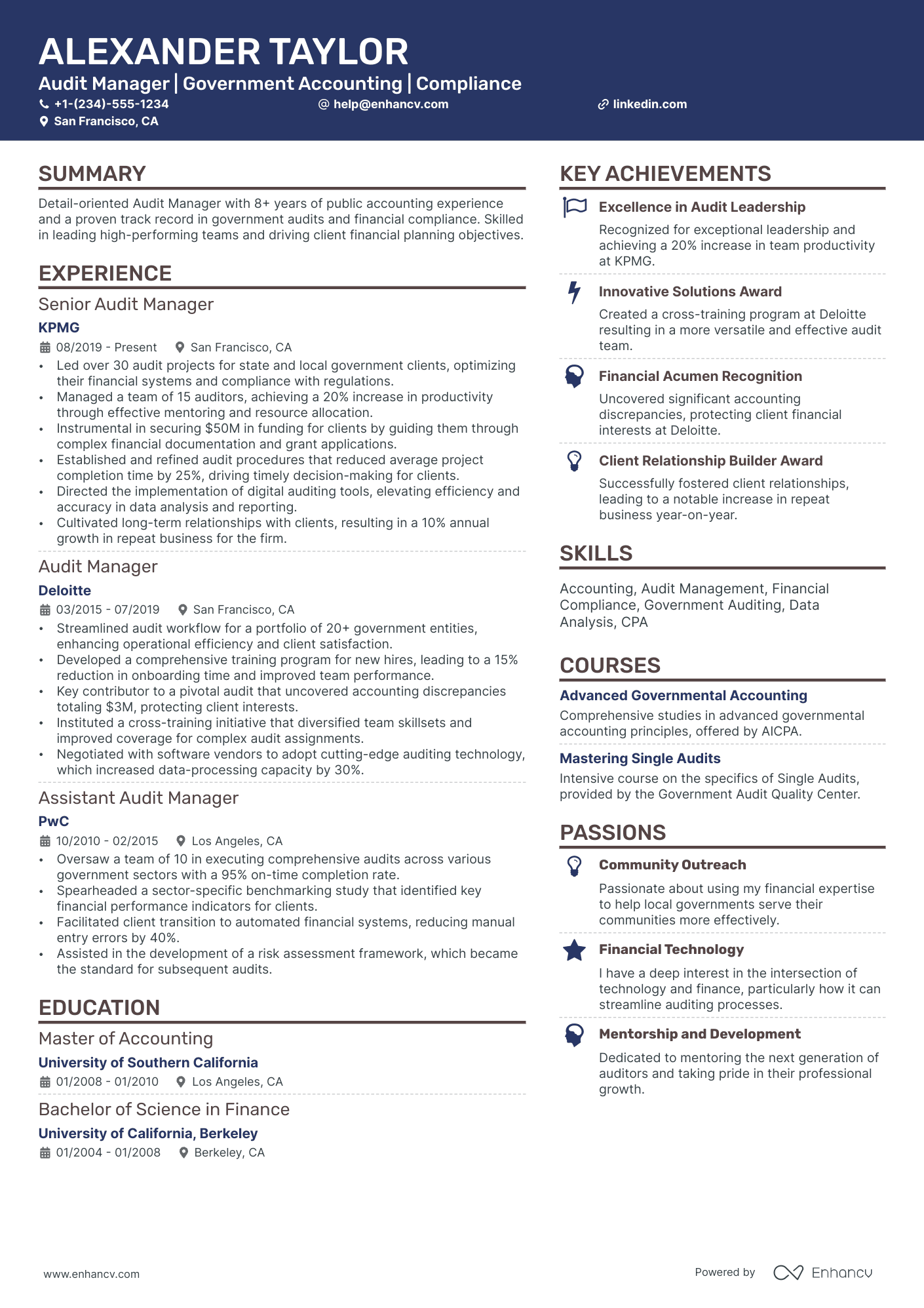
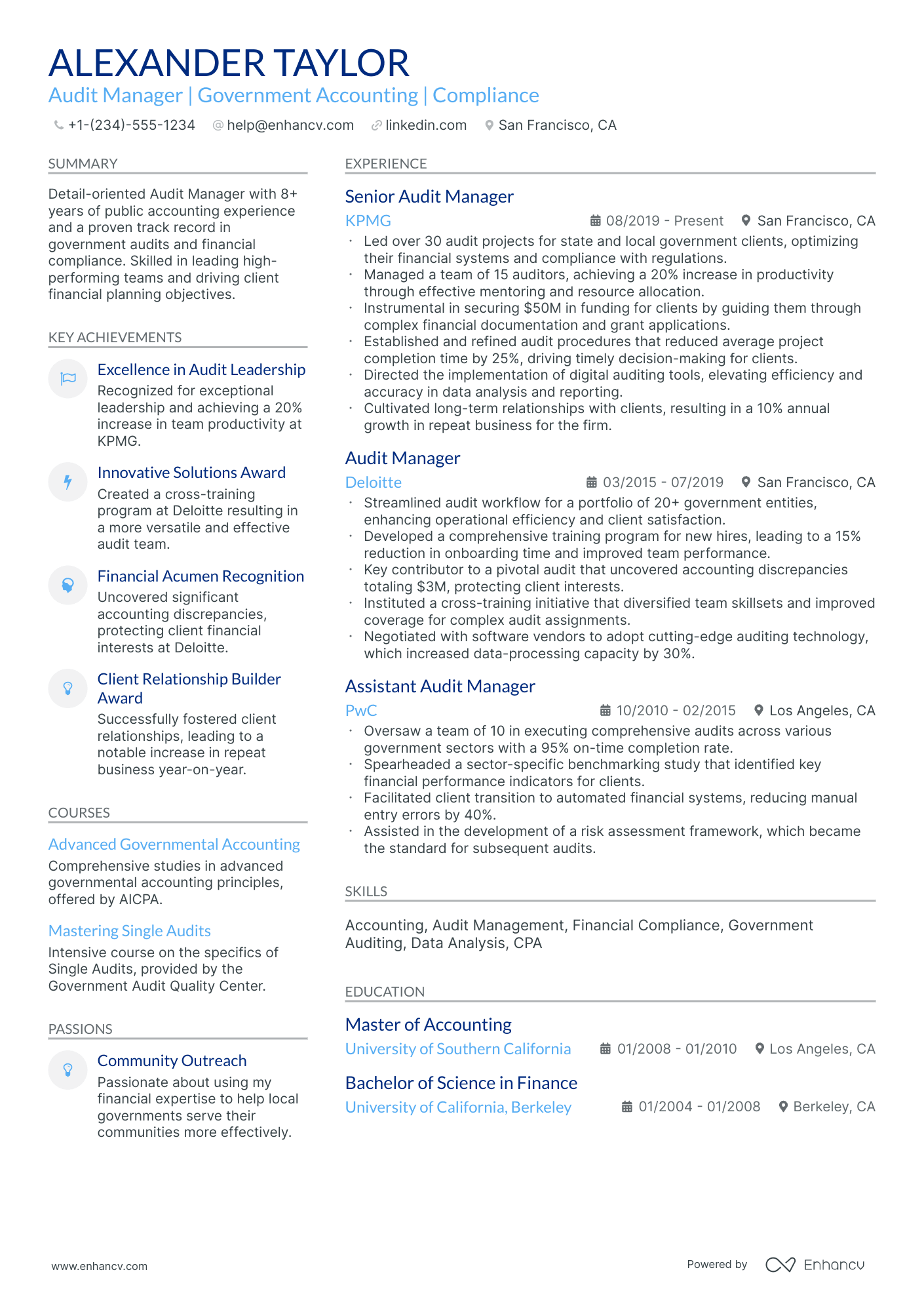
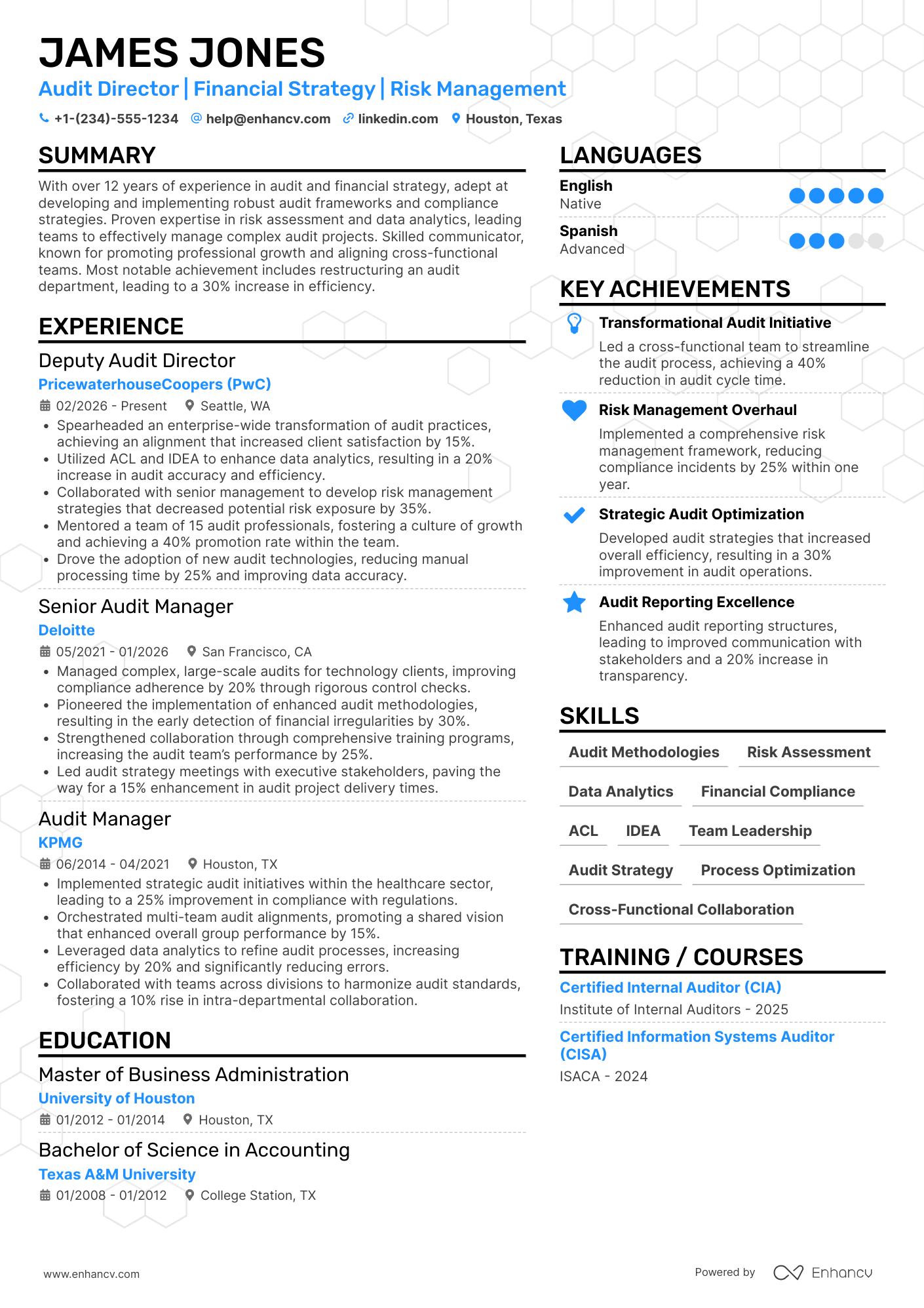
Audit director resume submissions often fail because they read like internal audit job descriptions, not executive evidence of risk reduction and governance impact. That matters when an applicant tracking system filters keywords and recruiters scan fast in a crowded field.
A strong resume shows what changed because of your leadership. Knowing how to make your resume stand out is critical at this level. You should highlight quantified risk exposure reduced, audit plan coverage across entities, on-time report delivery, control deficiencies remediated, and measurable savings from process fixes. Include scope, stakeholders, and outcomes tied to regulatory readiness and board reporting.

Key takeaways
- Use reverse-chronological format to show progressive audit leadership and expanding accountability.
- Quantify every experience bullet with metrics like cycle time, remediation rates, or cost savings.
- Tailor resume language to match each job posting's frameworks, tools, and compliance standards.
- Lead your summary with outcomes, team scope, and strategic ownership—not vague descriptors.
- List certifications like CIA, CPA, or CISA near your education to reinforce credibility fast.
- Demonstrate skills through measurable results in experience bullets, not just a standalone list.
- Use Enhancv to align your audit director resume with role-specific language and quantified achievements.
How to format a audit director resume
Recruiters evaluating audit director candidates prioritize evidence of progressive leadership, oversight of complex audit programs, and direct accountability for risk mitigation and regulatory compliance at the organizational level. Your resume format must surface these signals immediately—burying them under skills lists or non-linear layouts makes it harder for both hiring managers and applicant tracking systems to verify the scope and trajectory of your career.

I have significant experience in this role—which format should I use?
Use a reverse-chronological format—it's the only structure that properly communicates the leadership progression and expanding accountability expected of an audit director. Do:
- Lead each role entry with your scope of ownership: team size, audit portfolio value, number of entities or business units under your oversight, and reporting line (e.g., reporting to the CFO or audit committee).
- Highlight domain expertise in internal audit frameworks, regulatory standards (SOX, GAAP, IFRS, PCAOB), enterprise risk management platforms, and audit management tools such as TeamMate, AuditBoard, or Workiva.
- Quantify business impact in every bullet—tie your actions to measurable outcomes such as cost savings, risk reduction percentages, audit cycle time improvements, or remediation rates.
Why hybrid and functional resumes don't work for senior roles
Hybrid and functional formats fragment your career timeline and bury the progressive leadership trajectory that audit director hiring decisions depend on—recruiters can't assess how your oversight scope, team accountability, and decision-making authority expanded across roles when that context is diluted into disconnected skills sections. Functional formats are especially damaging because they strip away the organizational and regulatory context (audit committee relationships, enterprise-wide risk programs, compliance mandates) that validates a director-level candidate's credibility. Avoid hybrid and functional formats entirely if you have five or more years of progressive audit leadership experience—these structures will raise questions about gaps or stagnation rather than reinforcing your qualifications.
- A functional format may be acceptable only if you're transitioning into an audit director role from a closely related discipline (e.g., moving from a chief compliance officer or risk management director position) and lack a traditional internal audit career path, but even then, every listed skill must be tied to specific projects, governance outcomes, or measurable risk-reduction results.
Once your layout and structure are in place, the next step is deciding which sections to include so every part of your resume serves a clear purpose.
What sections should go on a audit director resume
Recruiters expect to see a clear record of audit leadership, risk management, and measurable improvements in governance and controls. Understanding what to put on a resume at the director level helps you prioritize the right content.
Use this structure for maximum clarity:
- Header
- Summary
- Experience
- Skills
- Projects
- Education
- Certifications
- Optional sections: Awards, Publications, Languages
Strong experience bullets should highlight audit scope, risk and control outcomes, stakeholder influence, and quantified results across the organization.
Is your resume good enough?
Drop your resume here or choose a file. PDF & DOCX only. Max 2MB file size.
Once you’ve organized the key resume components so hiring teams can scan your qualifications quickly, focus next on writing your audit director experience to show the impact behind each role.
How to write your audit director resume experience
The experience section is where you prove you've led audits from planning through final report delivery, using risk-based frameworks and regulatory standards to produce measurable improvements in compliance, controls, and organizational governance. Building a targeted resume ensures hiring managers see demonstrated impact—such as audit programs you built, deficiencies you resolved, or risk exposure you reduced—over descriptive task lists that simply restate job duties.
Each entry should include:
- Job title
- Company and location (or remote)
- Dates of employment (month and year)
Three to five concise bullet points showing what you owned, how you executed, and what outcomes you delivered:
- Ownership scope: the audit functions, compliance programs, internal control environments, risk portfolios, or teams you were directly accountable for as audit director.
- Execution approach: the audit methodologies, risk assessment frameworks, regulatory standards, data analytics platforms, or governance models you applied to plan engagements, evaluate controls, and drive remediation.
- Value improved: the specific changes you achieved in control effectiveness, regulatory compliance posture, audit cycle efficiency, risk mitigation, or finding resolution timelines relevant to the audit director's mandate.
- Collaboration context: how you partnered with executive leadership, audit committees, board members, external auditors, legal counsel, or business unit heads to align audit strategy with enterprise risk priorities.
- Impact delivered: outcomes framed as strengthened governance structures, reduced risk exposure, improved audit coverage, faster remediation rates, or enhanced stakeholder confidence rather than routine audit activities.
Experience bullet formula
A audit director experience example
✅ Right example - modern, quantified, specific.
Audit Director
NorthBridge Financial Services | Charlotte, NC
2021–Present
Mid-market consumer lender operating in a highly regulated environment across five states with centralized finance, compliance, and technology teams.
- Directed a risk-based internal audit plan across SOX (Sarbanes-Oxley Act), operational, and information technology audits, increasing coverage of high-risk processes by 30% while holding on-time report delivery at 98% in TeamMate+.
- Implemented continuous auditing using data analytics in SQL, Power BI, and ACL Analytics, reducing manual testing hours by 35% and accelerating issue identification by an average of fourteen days.
- Led end-to-end SOX program redesign with finance, information technology, and external auditors in Workiva, cutting control testing cycle time by 22% and reducing repeat findings by 40% year over year.
- Partnered with cybersecurity and infrastructure leaders to assess NIST CSF-aligned controls and vulnerability management, improving critical patch compliance from 78% to 95% within two quarters and lowering high-risk audit issues by 28%.
- Presented audit results and remediation roadmaps to the audit committee and executive stakeholders, driving 92% on-time corrective action closure and reducing regulatory exam exceptions by 25% across two annual cycles.
Now that you've seen how a strong experience section comes together, let's walk through how to tailor those details to match a specific audit director job posting.
How to tailor your audit director resume experience
Recruiters evaluate your audit director resume through applicant tracking systems and manual review, scoring how closely your experience matches the posting. Tailoring your resume to the job description by reflecting each bullet to the job description's specific language and priorities increases your chances of advancing past both filters.
Ways to tailor your audit director experience:
- Match audit management software and data analytics tools named in the posting.
- Mirror the exact compliance frameworks or regulatory standards the role requires.
- Reflect the risk assessment methodologies referenced in the job description.
- Align your leadership scope with the team size and structure described.
- Incorporate industry-specific audit experience when the posting names a sector.
- Use the same terminology for internal controls and quality assurance processes.
- Highlight cross-functional collaboration with departments or committees the role references.
- Emphasize the reporting structures and stakeholder engagement models described.
Tailoring means aligning your real accomplishments with the language and priorities of each job posting, not forcing in keywords where they don't belong.
Resume tailoring examples for audit director
| Job description excerpt | Untailored | Tailored |
|---|
Once you’ve aligned your experience with the role’s priorities, quantify your audit director achievements to show the measurable impact of that work.
How to quantify your audit director achievements
Quantifying your achievements shows how your audits improved risk posture, compliance outcomes, and operational efficiency. Focus on audit cycle time, issue closure rates, control effectiveness, coverage scope, cost savings, and reduced regulatory findings.
Quantifying examples for audit director
| Metric | Example |
|---|---|
| Audit cycle time | "Cut average audit cycle time from 10 weeks to seven by standardizing workpapers in TeamMate+ and tightening kickoff-to-fieldwork handoffs across 18 audits." |
| Control effectiveness | "Improved key control pass rate from 86% to 95% by redesigning testing scripts and aligning SOX (Sarbanes-Oxley) controls with COSO across 42 processes." |
| Risk reduction | "Reduced high-risk findings by 30% year over year by shifting to risk-based planning and increasing coverage of third-party and access controls." |
| Issue remediation | "Raised on-time remediation from 62% to 91% by launching a monthly issue-aging dashboard in Power BI and enforcing 30-day action plans with owners." |
| Cost savings | "Saved $420K annually by consolidating co-sourced audit hours 25% and renegotiating vendor rates while maintaining full coverage of the annual audit plan." |
Turn vague job duties into measurable, recruiter-ready resume bullets in seconds with Enhancv's Bullet Point Generator.
With your experience clearly articulated in strong bullet points, the next step is ensuring your audit director resume highlights the right mix of hard and soft skills.
How to list your hard and soft skills on a audit director resume
Your skills section matters for audit directors because recruiters and an ATS (applicant tracking system) scan them to confirm governance, risk, and controls expertise and leadership fit, with most resumes balancing hard skills and soft skills at roughly sixty-forty.
audit director roles require a blend of:
- Product strategy and discovery skills.
- Data, analytics, and experimentation skills.
- Delivery, execution, and go-to-market discipline.
- Soft skills.
Your skills section should be:
- Scannable (bullet-style grouping).
- Relevant to the job post.
- Backed by proof in experience bullets.
- Updated with current tools.
Place your skills section:
- Above experience if you're junior or switching careers.
- Below experience if you're mid/senior with strong achievements.

Hard skills
- Audit planning and scoping
- Risk-based audit methodology
- SOX, ICFR testing
- COSO, COBIT frameworks
- ERM program design
- ITGCs, application controls
- Data analytics: ACL, IDEA, SQL
- GRC platforms: Archer, ServiceNow
- SAP, Oracle ERP controls
- Third-party risk management
- Fraud risk assessments
- Audit reporting and issue tracking
Soft skills
- Executive stakeholder management
- Challenge and escalate with tact
- Influence without direct authority
- Lead cross-functional audit teams
- Translate risk into business impact
- Run effective audit committees
- Negotiate remediation timelines
- Coach and develop auditors
- Drive accountability for closure
- Prioritize audits by risk signals
- Present clear, defensible findings
- Maintain independence under pressure
How to show your audit director skills in context
Skills shouldn't live only in a bulleted list on your resume. Explore resume skills examples to see how audit professionals present their capabilities effectively.
They should be demonstrated in:
- Your summary (high-level professional identity)
- Your experience (proof through outcomes)
Here's how that looks in practice.
Summary example
Audit director with 14 years of experience leading internal audit functions across financial services. Skilled in risk assessment, SOX compliance, and ACL Analytics. Built a continuous auditing framework that reduced finding recurrence by 35%.
- Signals senior-level expertise immediately
- Names specific tools and frameworks
- Quantifies a concrete outcome
- Conveys leadership as a soft skill
Experience example
Audit Director
Crestfield Financial Group | Charlotte, NC
March 2018–Present
- Redesigned the enterprise risk assessment process using TeamMate+, cutting audit cycle time by 22% across eight business units.
- Led a cross-functional team of 12 auditors and compliance analysts to resolve 95% of high-risk findings within 60 days.
- Implemented data analytics procedures in ACL Analytics that identified $2.1M in recoverable overpayments during the 2023 fiscal year.
- Every bullet includes measurable proof
- Skills surface naturally through real outcomes
Once you’ve framed your audit director capabilities through outcomes and relevant examples, the next step is applying that approach to building an audit director resume when you don’t have direct experience.
How do I write a audit director resume with no experience
Even without full-time experience, you can demonstrate readiness through:
- Internal audit internship rotations
- Sarbanes-Oxley controls testing projects
- University audit capstone engagement
- Compliance risk assessment coursework
- Data analytics audits using SQL
- Mock audit committee presentations
- Process walkthroughs and control mapping
- Volunteer nonprofit financial review
If you're building a resume without work experience, focus on:
- Control testing scope and results
- Risk assessment and audit planning
- Evidence-based findings and remediation
- Data analytics and reporting tools
Resume format tip for entry-level audit director
Use a hybrid resume format that leads with skills and projects, then lists experience. It highlights audit director readiness when your work history is limited. Do:
- Lead with an audit director summary.
- Add a "Projects" section first.
- Quantify scope, samples, and impact.
- Name frameworks: COSO, Sarbanes-Oxley.
- List tools: Excel, Power BI.
- Led a Sarbanes-Oxley controls testing project, mapped thirty controls in Excel, tested twenty-five samples, and reduced exceptions by twenty percent through remediation tracking.
Even without direct experience, your educational background can serve as strong evidence of your qualifications—so presenting it effectively on your resume is essential.
How to list your education on a audit director resume
Your education section helps hiring teams confirm you hold the foundational knowledge required for an audit director role. It validates your academic credentials quickly and efficiently.
Include:
- Degree name
- Institution
- Location
- Graduation year
- Relevant coursework (for juniors or entry-level candidates)
- Honors & GPA (if 3.5 or higher)
Omit month and day details from your education dates and list the graduation year only.
Here's a strong education entry tailored for an audit director resume.
Example education entry
Master of Science in Accounting
University of Illinois Urbana-Champaign, Champaign, IL
Graduated 2014
GPA: 3.8/4.0
- Relevant Coursework: Advanced Auditing, Internal Controls, Forensic Accounting, Risk Management, Corporate Governance
- Honors: Beta Alpha Psi Honor Society, Dean's List (all semesters)
How to list your certifications on a audit director resume
Certifications on your resume show an audit director's commitment to learning, proficiency with audit tools and frameworks, and alignment with industry expectations. They also signal credibility when you lead risk-based audits and compliance programs.
Include:
- Certificate name
- Issuing organization
- Year
- Optional: credential ID or URL
- Place certifications below education when your degrees are recent and directly relevant, and your certifications add supporting proof of skills.
- Place certifications above education when they're more recent or more relevant than your degree, or when they match the role's key requirements.
Best certifications for your audit director resume
Certified Internal Auditor (CIA) Certified Public Accountant (CPA) Certified Information Systems Auditor (CISA) Certified Fraud Examiner (CFE) Certification in Risk Management Assurance (CRMA) Certified Compliance and Ethics Professional (CCEP) Certified Management Accountant (CMA)
With your credentials positioned to validate your expertise, you can now write your audit director resume summary to highlight that qualification upfront.
How to write your audit director resume summary
Your resume summary is the first thing a recruiter reads. A strong one immediately signals you have the leadership depth and audit expertise the role demands.
Keep it to three to four lines, with:
- Title and total years of experience in audit leadership.
- Domain focus such as internal audit, regulatory compliance, or financial services.
- Core competencies like risk assessment, SOX compliance, GAAP, or audit management software.
- One or two quantified achievements that reflect scope and business impact.
- Soft skills tied to real outcomes, such as stakeholder communication that improved audit cycle efficiency.

PRO TIP
At the director level, lead with outcomes, team scope, and strategic ownership. Highlight how your decisions reduced risk, improved compliance rates, or optimized audit operations. Avoid vague descriptors like "detail-oriented" or "passionate leader." Replace them with concrete results.
Example summary for a audit director
Audit director with 15 years of experience leading cross-functional teams across financial services. Directed enterprise-wide risk programs, cutting compliance gaps by 34%. Oversaw audit operations spanning $2B in organizational revenue.
Optimize your resume summary and objective for ATS
Drop your resume here or choose a file.
PDF & DOCX only. Max 2MB file size.
Now that your summary captures your leadership and audit expertise, make sure the header presenting your contact details is equally polished and professional.
What to include in a audit director resume header
A resume header is the top section with your key identifiers, and it boosts visibility, credibility, and fast recruiter screening for a audit director.
Essential resume header elements
- Full name
- Tailored job title and headline
- Location
- Phone number
- Professional email
- GitHub link
- Portfolio link
A LinkedIn link helps recruiters verify experience quickly and supports screening.
Do not include a photo on a audit director resume unless the role is explicitly front-facing or appearance-dependent.
Keep your header consistent with your audit director target role and match your title, location, and contact details to the job posting.
Example
Audit director resume header
Jordan M. Taylor
Audit Director | SOX, Risk-Based Audits, and Internal Controls
Chicago, IL
(312) 555-12XX
jordan.taylor@enhancv.com
github.com/jordantaylor
jordantaylor.com
linkedin.com/in/jordantaylor
Once your contact details and role-specific credentials are clearly presented at the top, you can strengthen the rest of the resume with additional sections that support your fit for the audit director role.
Additional sections for audit director resumes
Beyond core qualifications, additional sections help an audit director stand out by showcasing specialized expertise and leadership credibility.
- Professional certifications and licenses
- Industry publications and thought leadership
- Board memberships and advisory roles
- Conference speaking engagements
- Professional affiliations and audit associations
- Languages
- Volunteer and pro bono audit work
Once you've finalized every section of your resume, it's worth preparing a strong cover letter to complement it.
Do audit director resumes need a cover letter
An audit director cover letter isn't required, but it often helps in competitive searches or formal hiring processes. If you're unsure what a cover letter is and how it complements your resume, it makes a difference when your resume needs context, or when the employer expects leadership narrative and stakeholder alignment.
Use a cover letter to add context your resume can't show:
- Explain role and team fit by linking your leadership style to the audit director mandate, reporting line, and key stakeholders.
- Highlight one or two outcomes, such as reducing audit cycle time, improving issue remediation rates, or strengthening controls across high-risk areas.
- Show you understand the business context by referencing the company's products, users, regulatory environment, and risk profile.
- Address career transitions or non-obvious experience by mapping prior work to audit director expectations, including governance, risk, and cross-functional influence.
Drop your resume here or choose a file.
PDF & DOCX only. Max 2MB file size.
Whether you include a cover letter or not, using AI to improve your audit director resume helps you tailor your content faster and more precisely for each role.
Using AI to improve your audit director resume
AI can sharpen your resume's clarity, structure, and overall impact. It helps tighten language and highlight measurable results. But overuse strips authenticity. Once your content feels clear and role-aligned, step away from AI. If you're wondering which AI is best for writing resumes, start with tools that let you maintain control over your content.
Here are 10 practical prompts to strengthen specific sections of your audit director resume:
- Sharpen your summary. "Rewrite my audit director resume summary to emphasize leadership scope, team size, and measurable audit outcomes in under four sentences."
- Quantify experience bullets. "Review my audit director experience bullets and suggest specific metrics, percentages, or dollar figures to replace vague language."
- Align skills section. "Compare my skills section against this audit director job description and identify missing keywords I should add."
- Strengthen action verbs. "Replace weak or repetitive verbs in my audit director experience section with precise, high-impact alternatives."
- Tighten certification details. "Reformat my certifications section for an audit director resume so each entry lists credential name, issuing body, and year earned."
- Clarify project contributions. "Rewrite my audit director project descriptions to clearly state my role, the challenge addressed, and the measurable result."
- Remove redundancy. "Identify and eliminate redundant phrases across all sections of my audit director resume without losing key details."
- Refine education section. "Simplify my education section for an audit director resume, prioritizing relevant degrees, honors, and coursework."
- Improve bullet consistency. "Ensure all experience bullets in my audit director resume follow a consistent structure: action verb, task, and result."
- Tailor for relevance. "Remove or condense any experience on my audit director resume that doesn't directly support leadership, compliance, or risk management qualifications."
Stop using AI once your resume sounds accurate, specific, and aligned with real experience. AI should never invent experience or inflate claims—if it didn't happen, it doesn't belong here.
Conclusion
A strong audit director resume shows measurable outcomes, role-specific skills, and a clear structure. It highlights risk management, internal controls, regulatory compliance, and stakeholder communication with results you can quantify.
Keep sections easy to scan, and align your experience with the audit director role you want now. This approach shows readiness for today’s hiring market and the near-future demands teams face.