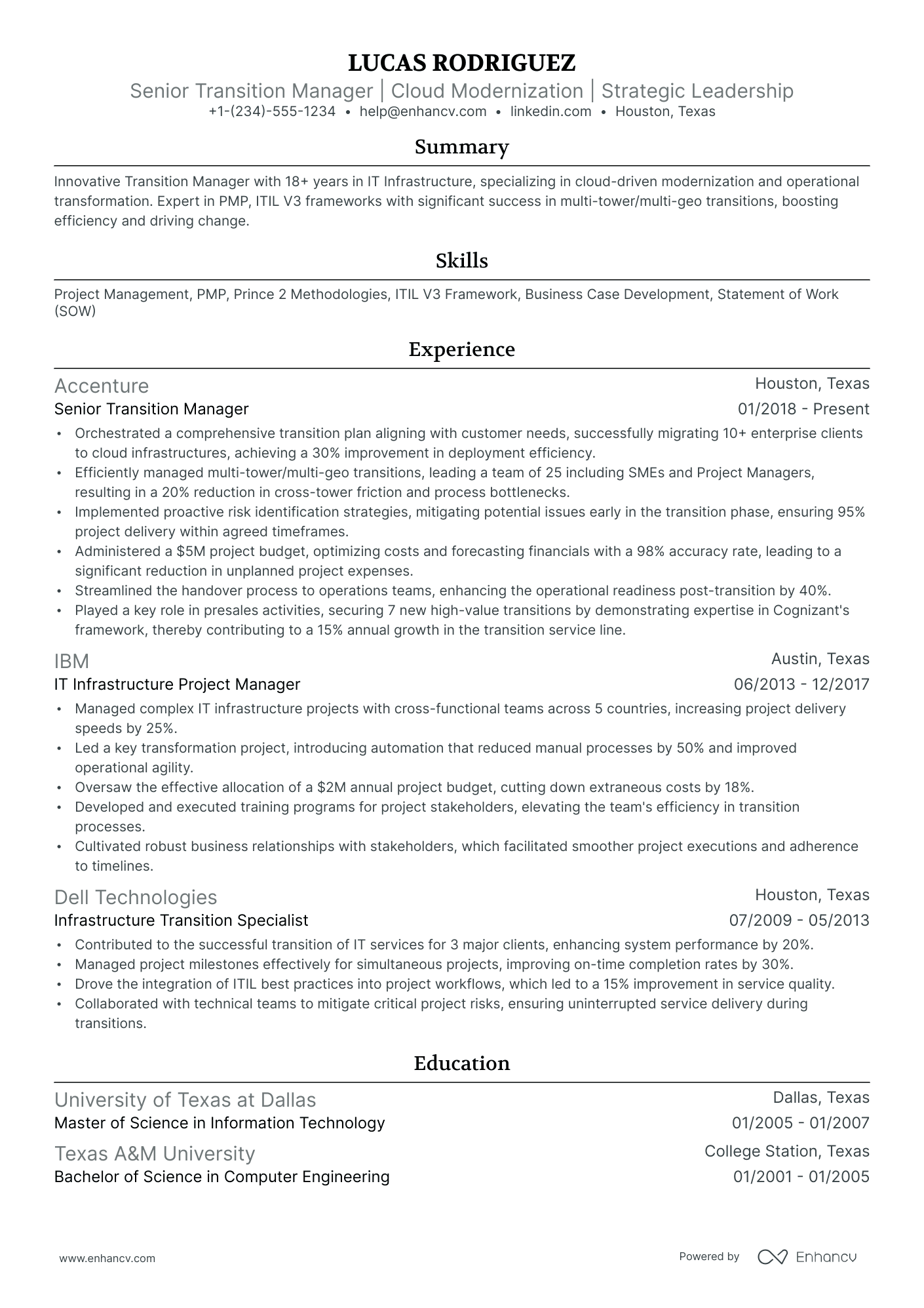
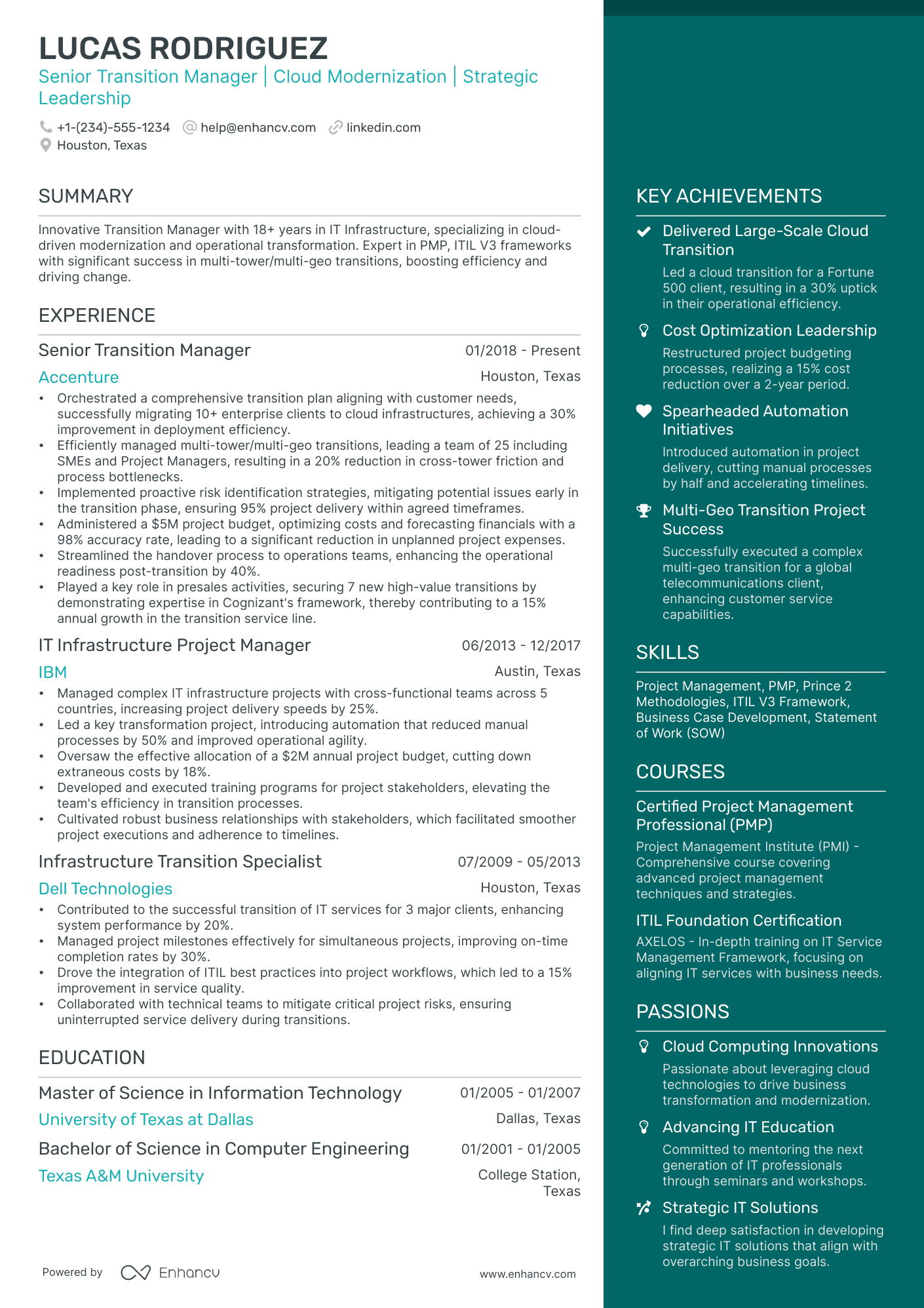
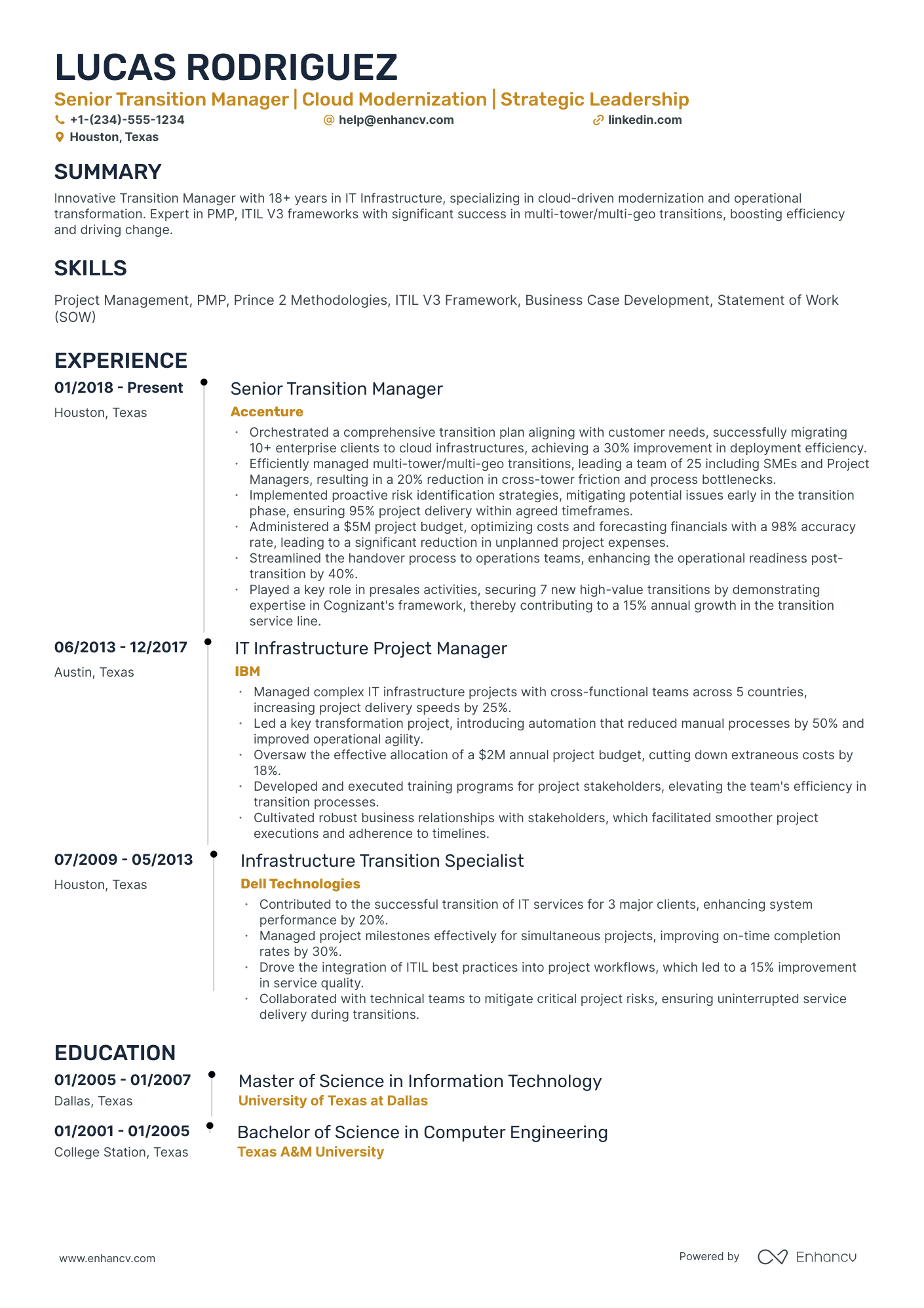
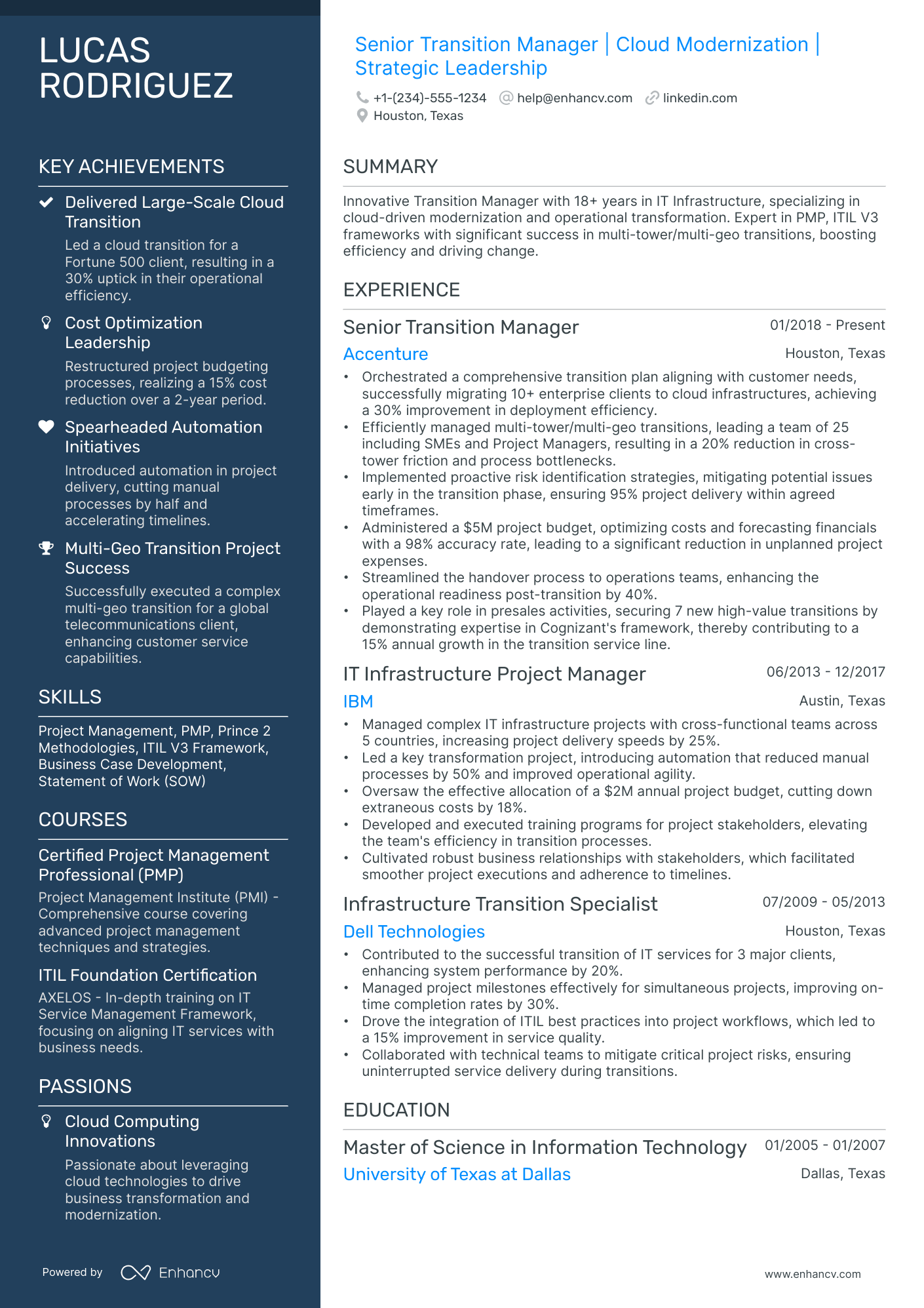
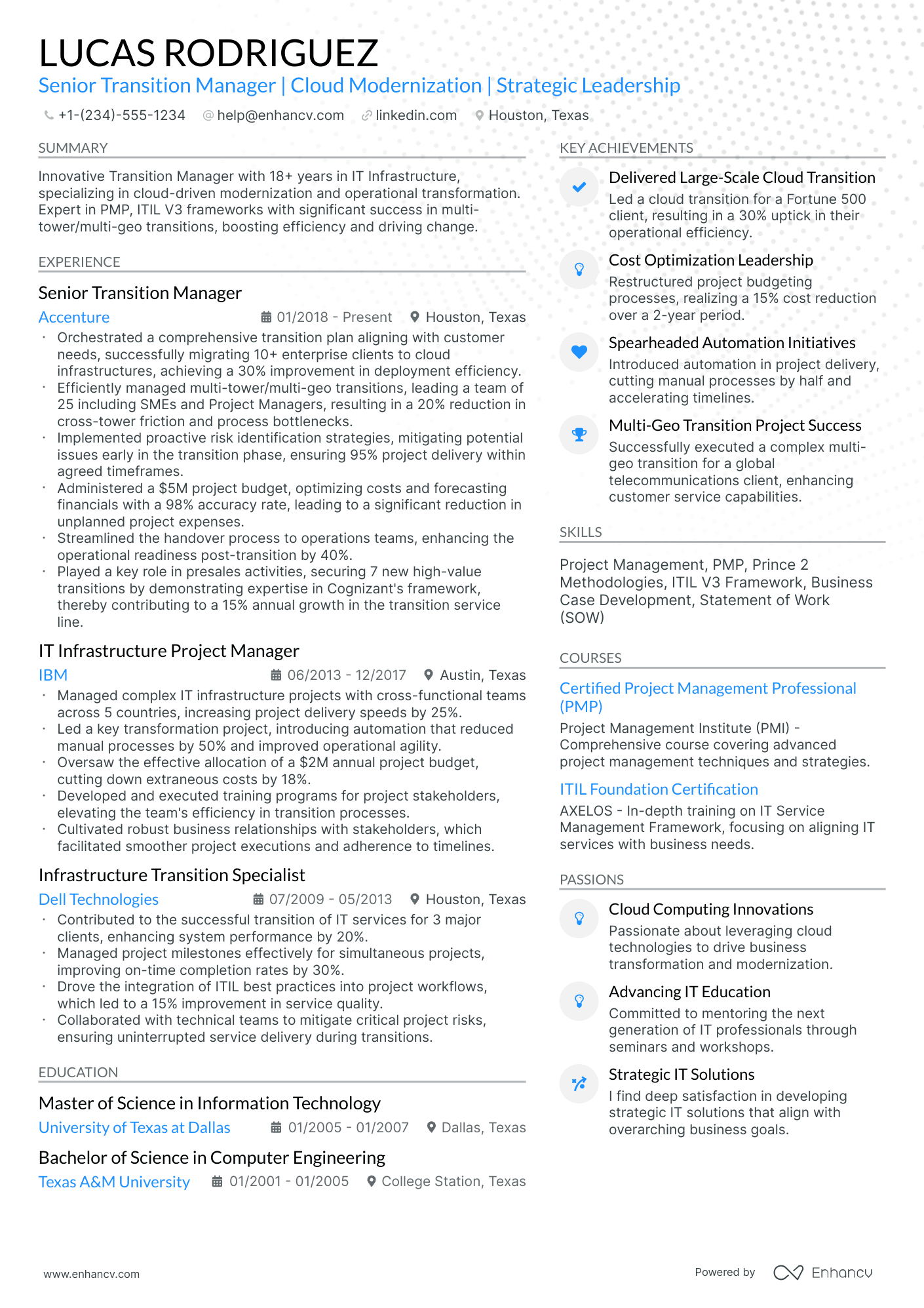
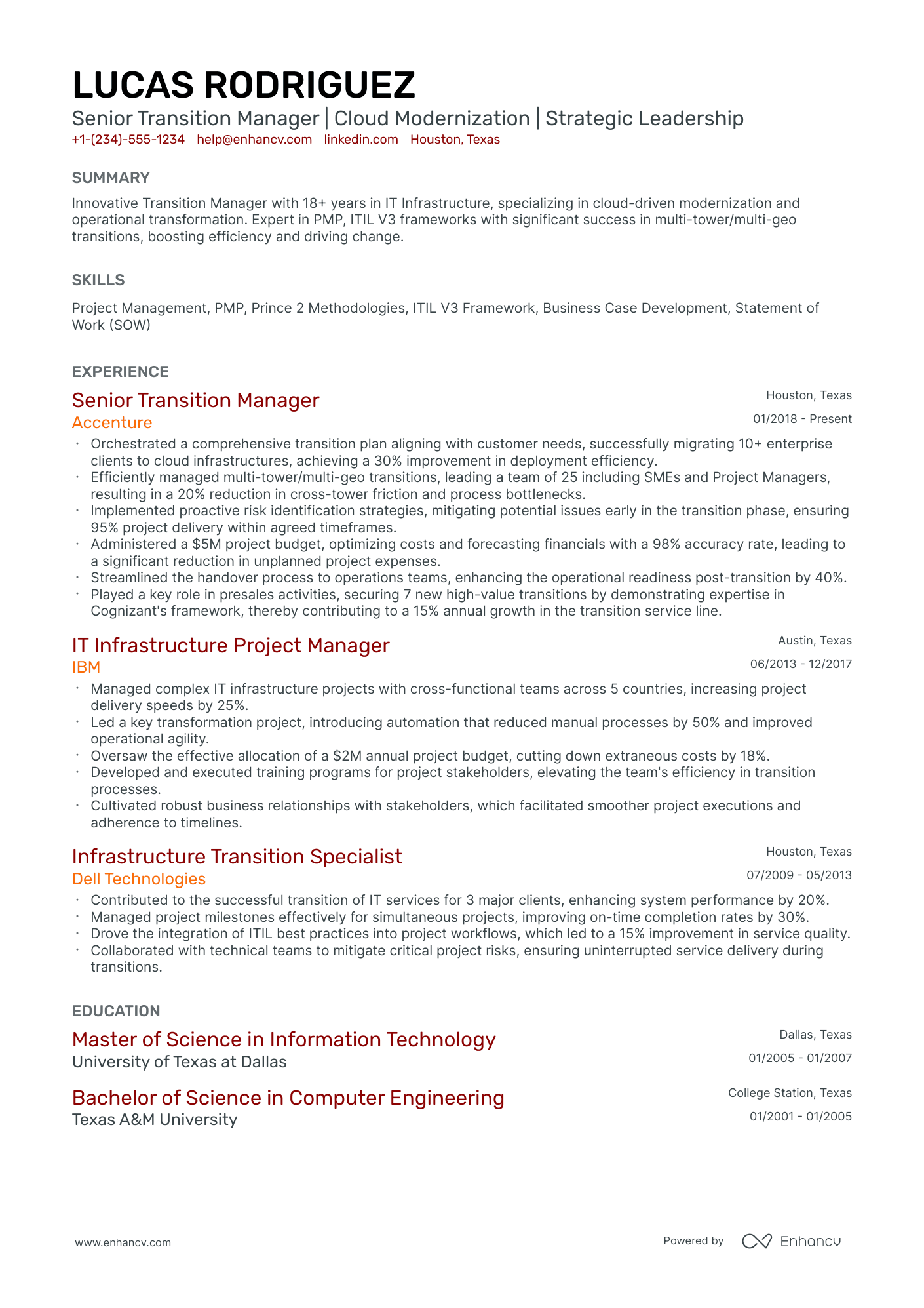
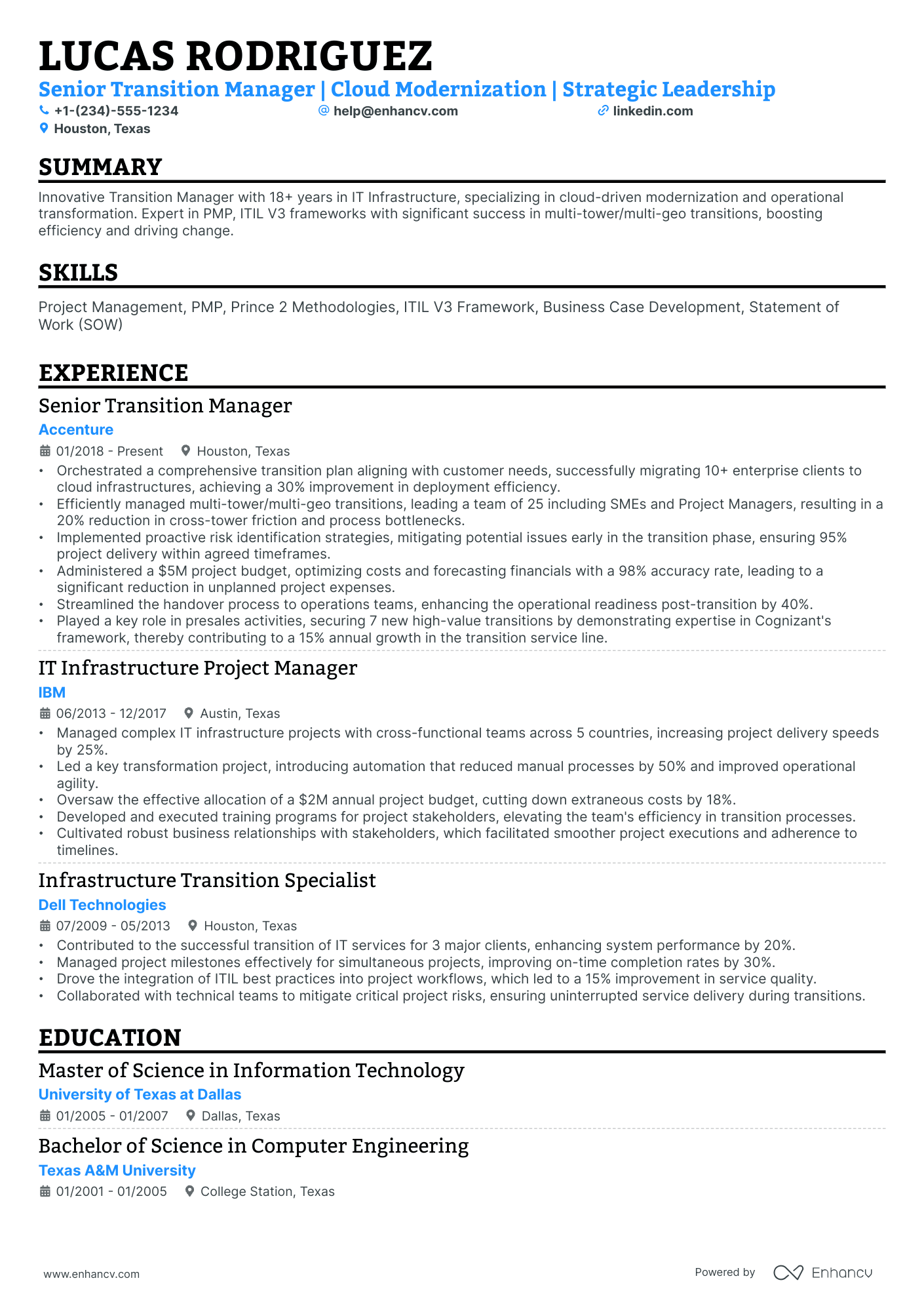
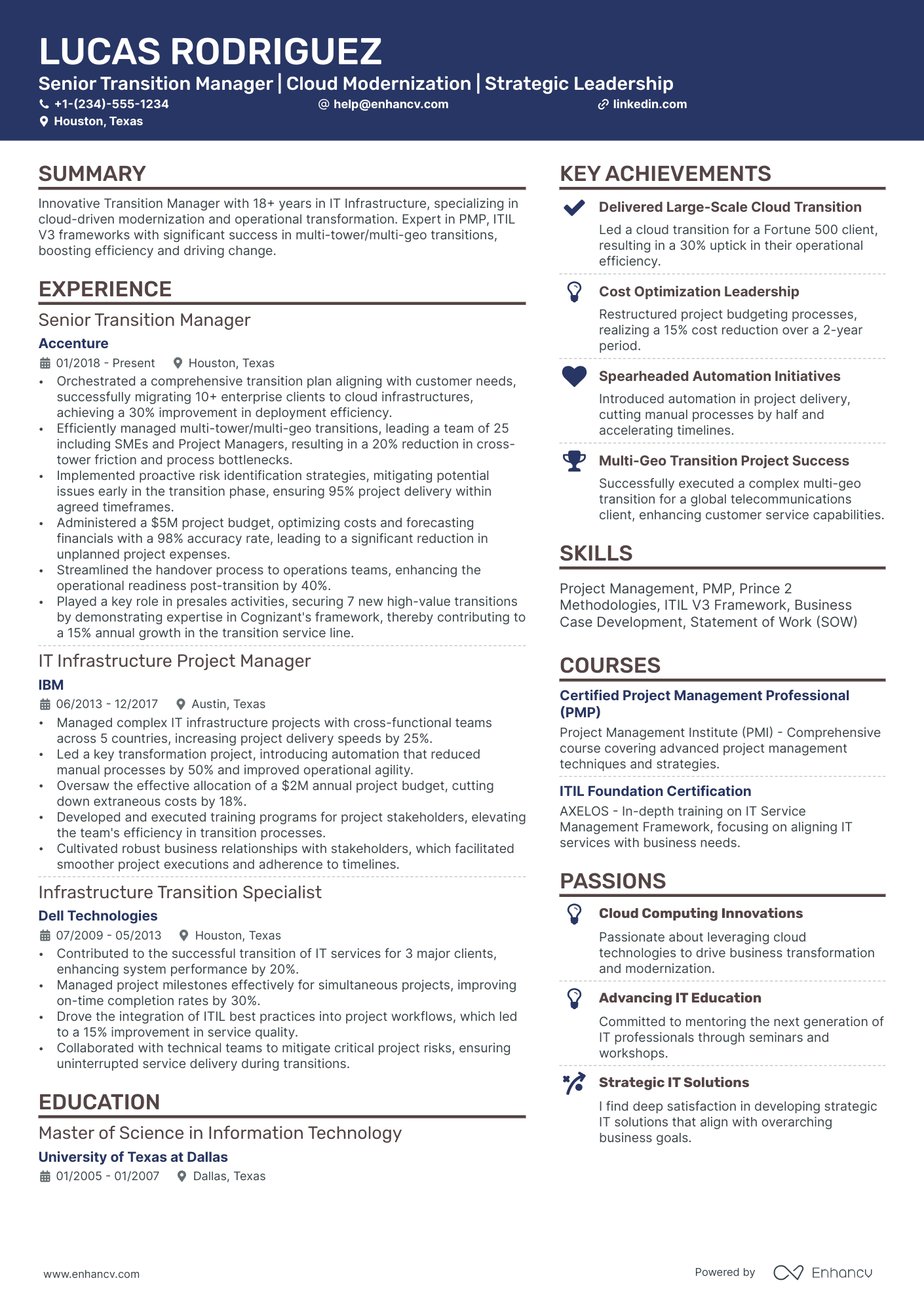
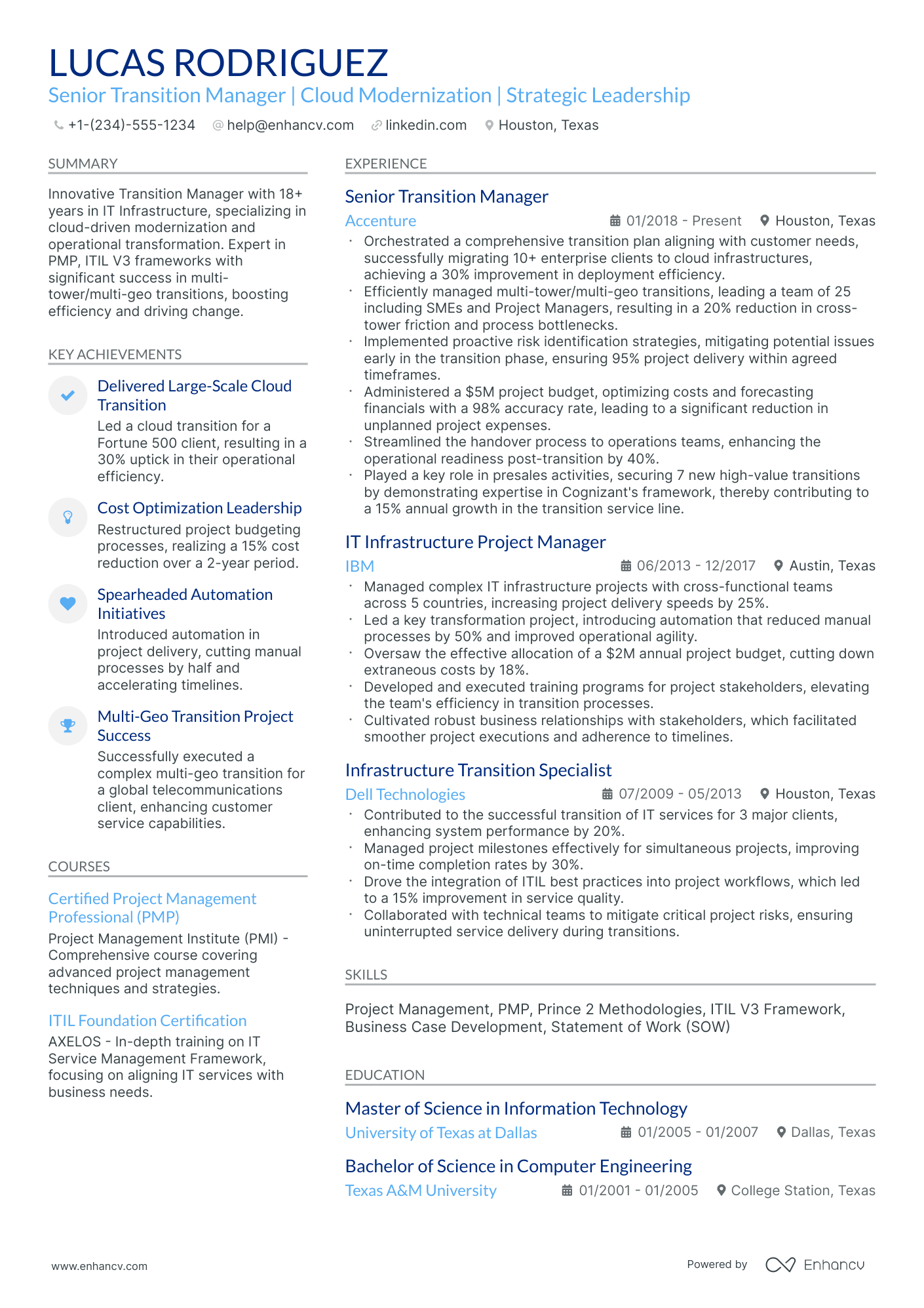
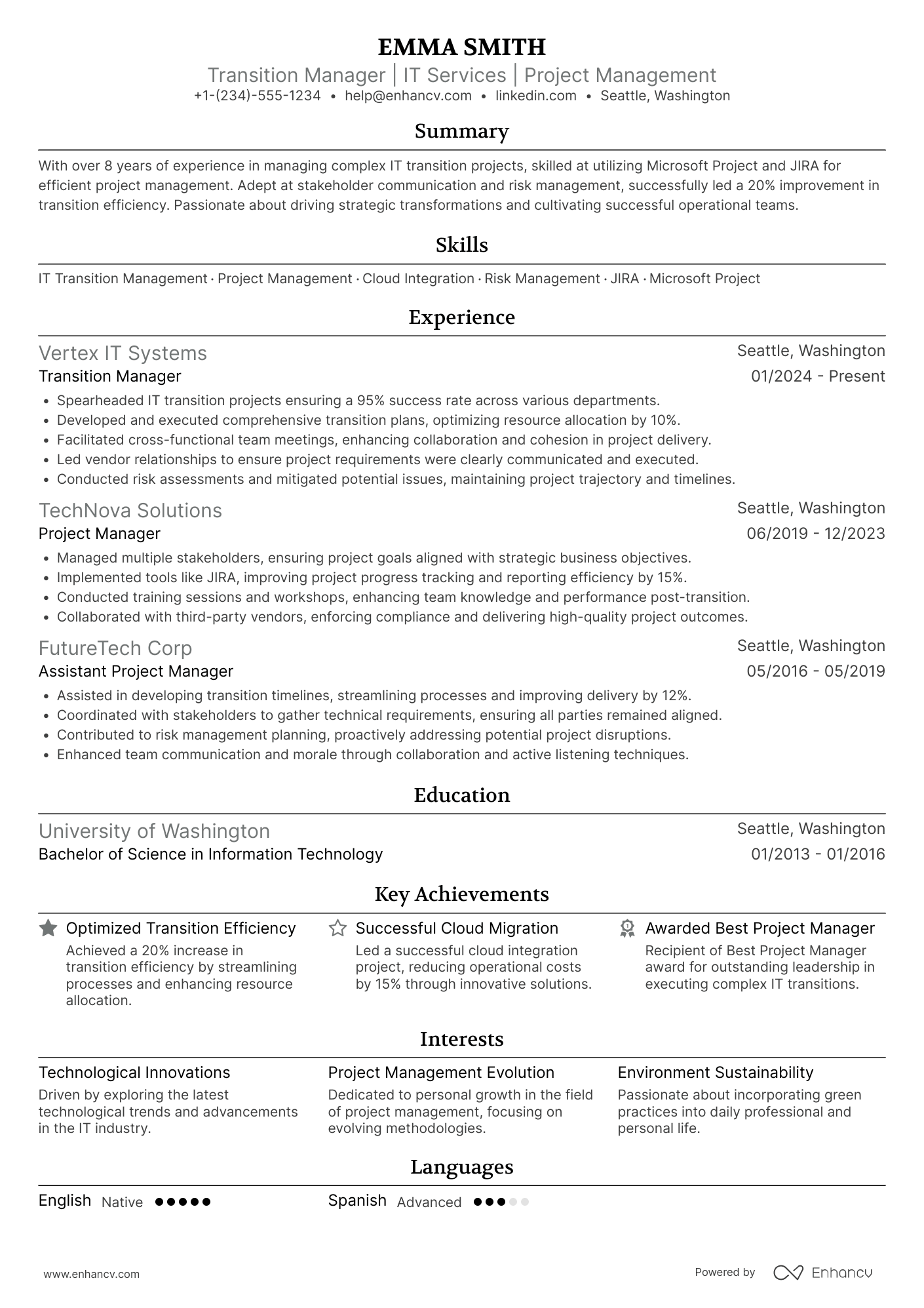
Transition manager resume drafts often fail because they read like project logs, not decision documents, and they bury cross-functional outcomes behind tools and task lists. That hurts in today's hiring flow, where ATS filters and recruiters scan fast amid heavy competition. Understanding how to make your resume stand out is critical in this environment.
A strong resume shows what changed because of your work. You should highlight transition readiness, cutover quality, and business continuity with proof: reduced downtime minutes, on-time go-live rates, defect leakage, adoption lift, cost savings, and scope across sites, vendors, and regions.

Key takeaways
- Quantify transition outcomes like downtime reduction, cutover success rates, and cost savings in every bullet.
- Use reverse-chronological format if experienced; use hybrid format when switching into the role.
- Tailor each resume to the job posting's frameworks, tools, and KPIs—don't force generic keywords.
- Anchor every listed skill to a specific project, deliverable, or measurable result.
- Place certifications above education when they're recent, role-relevant, or explicitly required.
- Write a three- to four-line summary that leads with scope, ownership, and business impact.
- Use Enhancv's tools to sharpen bullet points and align your resume with each posting.
How to format a transition manager resume
Recruiters evaluating transition manager candidates prioritize evidence of structured change delivery, stakeholder management across business units, and measurable outcomes tied to organizational transformation. A clean, well-formatted resume ensures these signals surface quickly during both ATS screening and the initial 6–8 second recruiter scan. Choosing the right resume format is essential to making that first impression count.

I have significant experience in this role—which format should I use?
Use a reverse-chronological format—it's the strongest choice for experienced transition managers. Do:
- Lead each role entry with transition scope and ownership: number of workstreams managed, departments affected, budget accountability, and governance structure.
- Highlight domain-specific expertise including transition methodology frameworks (ITIL, PRINCE2, Agile), service integration tooling, and contract or SLA management.
- Quantify business impact through metrics such as cost savings realized, downtime reduction, on-time delivery rates, and stakeholder satisfaction scores.
I'm junior or switching into this role—what format works best?
A hybrid format works best because it lets you lead with transferable transition management skills while still showing a clear work history. Do:
- Place a skills section near the top that groups relevant competencies—change management, stakeholder communication, process mapping—so recruiters see your fit immediately.
- Include project-based experience such as office relocations, system migrations, or process improvement initiatives, even if they weren't under a formal transition manager title.
- Connect every listed skill or project to a specific action and a measurable result.
Why not use a functional resume?
A functional resume strips away the timeline and context recruiters need to evaluate how you've applied transition management skills in real delivery environments, weakening your candidacy even at the junior level.
- Career changers with no direct transition management experience who need to reframe program coordination, IT service delivery, or operational change work as relevant transition skills.
- Candidates with significant employment gaps who completed transition-related certifications (ITIL, MSP, or Prosci) or managed volunteer or freelance transformation projects during the gap period.
With your format established, the next step is filling it with the right sections to give recruiters exactly the information they're looking for.
What sections should go on a transition manager resume
Recruiters expect to see clear evidence that you can lead complex transitions, align stakeholders, and deliver measurable outcomes on time and within scope. Knowing which resume sections to include ensures you present this evidence in the order hiring teams expect.
Use this structure for maximum clarity:
- Header
- Summary
- Experience
- Skills
- Projects
- Education
- Certifications
- Optional sections: Leadership, Awards, Languages
Strong experience bullets should emphasize transition scope, stakeholder complexity, risk and dependency management, timelines, budgets, and quantified results.
Is your resume good enough?
Drop your resume here or choose a file. PDF & DOCX only. Max 2MB file size.
Once you’ve organized the essential resume components, the next step is to write your transition manager experience section so each role clearly supports those elements.
How to write your transition manager resume experience
The experience section is where you prove you can plan, lead, and deliver organizational transitions—not just describe them. Hiring managers prioritize demonstrated impact over descriptive task lists, so every bullet should reflect shipped work, role-relevant frameworks or tools, and measurable outcomes tied to change delivery. Building a targeted resume ensures each bullet aligns with what the specific employer values most.
Each entry should include:
- Job title
- Company and location (or remote)
- Dates of employment (month and year)
Three to five concise bullet points showing what you owned, how you executed, and what outcomes you delivered:
- Ownership scope: the transitions, workstreams, migration programs, organizational restructures, or stakeholder groups you were directly accountable for as a transition manager.
- Execution approach: the change management frameworks, project governance models, risk assessment tools, communication plans, or readiness methodologies you used to guide decisions and keep transitions on track.
- Value improved: the changes you drove in operational continuity, service stability, employee adoption, process efficiency, timeline adherence, or risk reduction throughout the transition lifecycle.
- Collaboration context: how you coordinated with leadership teams, IT departments, HR partners, external vendors, or affected business units to align priorities and maintain momentum during periods of change.
- Impact delivered: the business outcomes your transitions produced—expressed through results, scale, or strategic impact rather than a list of activities you performed.
Experience bullet formula
A transition manager experience example
✅ Right example - modern, quantified, specific.
Transition Manager
NorthBridge Payments | Remote
2022–Present
Enterprise payments platform supporting 1,200+ merchant clients across retail, healthcare, and hospitality.
- Led twenty-eight client transitions from legacy processors to the new platform using Smartsheet cutover plans, RAID logs, and RACI matrices, achieving a 98% on-time go-live rate and reducing average transition duration from twelve to eight weeks.
- Built a standardized migration playbook in Confluence and Jira, including data mapping, acceptance criteria, and rollback procedures, cutting post-go-live incidents by 35% and improving first-billing accuracy from 96% to 99.5%.
- Partnered with product managers, engineers, and customer success to run weekly change control boards and release readiness reviews, increasing release adoption by 22% and reducing scope churn by 18%.
- Automated stakeholder reporting with Power BI dashboards fed by Salesforce and Jira, saving six hours per week per transition and improving executive visibility into risks, dependencies, and milestone health.
- Negotiated transition timelines and service-level agreements with legal, compliance, and client operations teams, reducing high-severity cutover risks by 40% and avoiding $750K in potential revenue leakage from delayed onboarding.
Now that you've seen how a strong experience section looks in practice, let's break down how to customize yours for each specific job posting.
How to tailor your transition manager resume experience
Recruiters evaluate your transition manager resume through both human review and applicant tracking systems (ATS), so aligning your experience with the job posting is essential. Tailoring your resume to the job description ensures the specific tools, methodologies, and outcomes you highlight match what the hiring team prioritizes.
Ways to tailor your transition manager experience:
- Mirror the transition frameworks or methodologies named in the posting.
- Match ITIL or PRINCE2 terminology the job description uses.
- Reflect specific KPIs or success criteria the employer highlights.
- Include industry or domain experience relevant to the role.
- Emphasize service continuity or risk mitigation if mentioned.
- Highlight stakeholder coordination models referenced in the listing.
- Align your tools and platforms with those the employer specifies.
- Reference compliance or governance standards the posting requires.
Tailoring means aligning your real accomplishments with the language and priorities of each job posting, not forcing keywords where they don't belong.
Resume tailoring examples for transition manager
| Job description excerpt | Untailored | Tailored |
|---|---|---|
| Lead end-to-end IT service transitions using ITIL frameworks, ensuring minimal disruption to business operations during go-live phases | Managed transitions for various projects and helped teams move to new systems. | Led 12 end-to-end IT service transitions following ITIL v4 frameworks, achieving 99.2% uptime during go-live phases across three business units. |
| Coordinate cross-functional stakeholders to develop and execute transition plans for large-scale organizational restructuring initiatives | Worked with different departments on planning and communication during company changes. | Coordinated transition plans across HR, finance, and operations for a 2,000-employee organizational restructuring, delivering all milestones within a six-month timeline. |
| Develop and manage knowledge transfer protocols and readiness assessments to ensure receiving teams are fully operational post-transition | Helped with documentation and training during project handoffs. | Built knowledge transfer protocols and conducted readiness assessments for 8 receiving teams, reducing post-transition support tickets by 34% within the first 90 days. |
Once you’ve aligned your experience with the role’s priorities, quantify your transition manager achievements to show the measurable impact of that work.
How to quantify your transition manager achievements
Quantifying your work proves you moved services smoothly, reduced risk, and hit delivery targets. Using numbers on your resume effectively means focusing on cycle time, cutover success, defect rates, compliance, cost savings, and stakeholder satisfaction across programs, vendors, and teams.
Quantifying examples for transition manager
| Metric | Example |
|---|---|
| Delivery speed | "Cut transition timeline from 14 weeks to 10 by re-sequencing work in Microsoft Project and running weekly RAID reviews across six workstreams." |
| Cutover reliability | "Delivered 12 go-lives with 99.7% cutover success and zero Sev-1 incidents by enforcing runbooks, checkpoints, and rollback criteria in ServiceNow." |
| Quality control | "Reduced post-transition defects from 18 to five per wave by adding UAT exit criteria, defect triage, and daily dashboards in Jira." |
| Risk reduction | "Lowered high-risk items from 22 to six before cutover by tightening RAID logs, owners, and due dates, and escalating blockers within 24 hours." |
| Cost efficiency | "Saved $180,000 annually by consolidating three vendor support contracts and shifting 30% of tickets to an internal tier-one team with updated knowledge articles." |
Turn vague job duties into measurable, recruiter-ready resume bullets in seconds with Enhancv's Bullet Point Generator.
Once you've crafted strong bullet points to showcase your experience, you'll want to ensure your resume also highlights the right hard and soft skills that define your value as a transition manager.
How to list your hard and soft skills on a transition manager resume
Your skills section shows you can plan and execute complex changeovers, and recruiters and an ATS (applicant tracking system) scan this section for role keywords; aim for a balanced mix of hard skills and soft skills that match the job post. transition manager roles require a blend of:
- Product strategy and discovery skills.
- Data, analytics, and experimentation skills.
- Delivery, execution, and go-to-market discipline.
- Soft skills.
Your skills section should be:
- Scannable (bullet-style grouping).
- Relevant to the job post.
- Backed by proof in experience bullets.
- Updated with current tools.
Place your skills section:
- Above experience if you're junior or switching careers.
- Below experience if you're mid/senior with strong achievements.

Hard skills
- Transition planning and runbooks
- Change impact assessment
- Stakeholder mapping and governance
- RAID logs and risk controls
- Cutover and hypercare management
- ServiceNow change management
- Jira, Confluence
- Microsoft Project, Smartsheet
- Process mapping, SIPOC
- SOP development and documentation
- KPI dashboards, Power BI
- UAT coordination and defect triage
Soft skills
- Lead cross-functional alignment
- Drive executive-ready updates
- Negotiate scope and tradeoffs
- Facilitate decision-making forums
- Manage conflict and escalation
- Clarify roles and ownership
- Translate technical to business
- Maintain calm during cutovers
- Hold teams to deadlines
- Prioritize risks and mitigations
- Build adoption with champions
- Close loops with follow-through
How to show your transition manager skills in context
Skills shouldn't live only in a bulleted list on your resume. Explore examples of resume skills shown in context to see how top candidates integrate them naturally.
They should be demonstrated in:
- Your summary (high-level professional identity)
- Your experience (proof through outcomes)
Here's what strong transition manager examples look like in practice.
Summary example
Transition manager with 12 years of experience leading enterprise IT migrations and organizational change initiatives. Skilled in ADKAR, stakeholder mapping, and JIRA-based workflow coordination. Reduced post-transition service disruptions by 34% across global teams.
- Reflects senior-level experience clearly
- Names specific tools and frameworks
- Includes a concrete, measurable outcome
- Signals leadership and collaboration strengths
Experience example
Senior Transition Manager
Capstone Advisory Group | Remote
March 2019–August 2024
- Led a 14-month ERP migration across five business units, completing delivery 3 weeks ahead of schedule using ADKAR methodology.
- Partnered with infrastructure and HR teams to redesign onboarding workflows, cutting new-hire ramp-up time by 27%.
- Built a JIRA-based transition tracker adopted by 40+ stakeholders, improving milestone visibility and reducing status meeting frequency by 50%.
- Every bullet includes measurable proof.
- Skills surface naturally through real outcomes.
Once you’ve demonstrated these capabilities through specific outcomes and examples, the next step is to apply the same approach to building a transition manager resume when you don’t have direct experience.
How do I write a transition manager resume with no experience
Even without full-time experience, you can demonstrate readiness through:
- Internship supporting business transitions
- Change management course capstone project
- PMO support for rollout plan
- Volunteer program handover coordination
- Cross-functional process mapping workshop
- Vendor onboarding and offboarding project
- Incident-to-service transition documentation
- University operations improvement project
If you're in this situation, our guide on writing a resume without work experience offers detailed strategies for showcasing your potential.
Focus on:
- Transition plans with milestones
- Risk, issue, dependency tracking
- Stakeholder communications and reporting
- Handover readiness and acceptance criteria
Resume format tip for entry-level transition manager
Use a hybrid resume format because it highlights transition manager projects and tools while still showing steady education and work history. Do:
- Lead with a project section.
- Name tools: Jira, Confluence, Excel.
- Quantify scope, timelines, and outcomes.
- Show artifacts: plans, RAID logs.
- Match keywords from the job post.
- Built a Jira-based RAID log and Confluence handover checklist for a volunteer program handover, cutting open transition tasks from twenty to eight in four weeks.
Even without direct experience, your education section can demonstrate the foundational knowledge and relevant training that qualifies you for a transition manager role.
How to list your education on a transition manager resume
Your education section helps hiring teams confirm you have the foundational knowledge needed. It validates your understanding of change management, business operations, and organizational strategy relevant to the transition manager role.
Include:
- Degree name
- Institution
- Location
- Graduation year
- Relevant coursework (for juniors or entry-level candidates)
- Honors & GPA (if 3.5 or higher)
Skip month and day details—list the graduation year only.
Here's a strong education entry tailored to a transition manager resume.
Example education entry
Bachelor of Science in Organizational Leadership
Georgetown University, Washington, D.C.
Graduated 2019
GPA: 3.7/4.0
- Relevant Coursework: Change Management Strategies, Business Process Optimization, Stakeholder Communication, and Project Risk Analysis
- Honors: Magna Cum Laude, Dean's List (six consecutive semesters)
How to list your certifications on a transition manager resume
Certifications on a resume show a transition manager's commitment to learning, proficiency with key tools, and alignment with industry standards for change, delivery, and stakeholder management.
Include:
- Certificate name
- Issuing organization
- Year
- Optional: credential ID or URL
- Put certifications below education when your degree is recent and more relevant than older credentials.
- Put certifications above education when they are recent, role-relevant, or required for the transition manager role.
Best certifications for your transition manager resume
- Project Management Professional (PMP)
- PRINCE2 Practitioner
- ITIL 4 Foundation
- Prosci Certified Change Practitioner
- Certified ScrumMaster (CSM)
- Lean Six Sigma Green Belt
- Certified Associate in Project Management (CAPM)
Once you’ve positioned your certifications where they add the most credibility, shift to writing your transition manager resume summary to frame that expertise in a clear, results-focused introduction.
How to write your transition manager resume summary
Your resume summary is the first thing a recruiter reads, so it must immediately signal relevance. A strong summary positions you as the right transition manager by connecting your experience to the employer's needs.
Keep it to three to four lines, with:
- Your title and total years of transition management experience.
- The domain or industry you specialize in, such as IT, mergers, or organizational change.
- Core tools and methodologies like ADKAR, ITIL, or stakeholder mapping frameworks.
- One or two quantified achievements that demonstrate measurable business impact.
- Soft skills tied to real outcomes, such as cross-functional alignment or executive communication.

PRO TIP
At this level, lead with scope, ownership, and business outcomes rather than listing responsibilities. Highlight decisions you drove, teams you led, and transitions you delivered end to end. Avoid vague descriptors like "passionate" or "results-oriented." Replace them with specific metrics and leadership context that prove your value.
Example summary for a transition manager
Senior transition manager with 10+ years leading enterprise IT and M&A transitions across global teams. Delivered 15 large-scale migrations, reducing operational downtime by 35% through structured stakeholder alignment and ITIL-based frameworks.
Optimize your resume summary and objective for ATS
Drop your resume here or choose a file.
PDF & DOCX only. Max 2MB file size.
Now that your summary communicates your value as a transition manager, make sure your header presents your contact details correctly so recruiters can actually reach you.
What to include in a transition manager resume header
A resume header is the top section with your identity and contact details, and it boosts visibility, credibility, and recruiter screening for a transition manager.
Essential resume header elements
- Full name
- Tailored job title and headline
- Location
- Phone number
- Professional email
- GitHub link
- Portfolio link
A LinkedIn link helps recruiters verify experience quickly and supports screening.
Don't include a photo on a transition manager resume unless the role is explicitly front-facing or appearance-dependent.
Match your header title and headline to the job posting's language, and keep every detail consistent across your resume and profiles.
Example
Transition manager resume header
Jordan Taylor
Transition manager | IT Service Transition, Change Management, Stakeholder Communication
Austin, TX
(512) 555-01XX
your.name@enhancv.com
github.com/yourname
yourwebsite.com
linkedin.com/in/yourname
Once your header clearly establishes your role, expertise, and key details at a glance, you can strengthen the rest of your application with additional sections that support and reinforce that information.
Additional sections for transition manager resumes
When your core sections don't fully capture your expertise, additional sections can strengthen your credibility and set you apart from other candidates.
Consider adding these sections to your transition manager resume:
- Languages
- Certifications
- Professional affiliations
- Publications
- Volunteer experience
- Awards and recognitions
- Conference presentations
Once you've rounded out your resume with sections that highlight your full professional profile, it's worth pairing it with a cover letter to add context and personality to your application.
Do transition manager resumes need a cover letter
A cover letter isn't required for a transition manager, but it often helps. If you're unsure where to start, learning what a cover letter is and how it complements your resume can clarify its value. It matters most in competitive searches or when hiring teams expect a clear fit story. It can make a difference when your resume needs context or your impact needs a quick narrative.
Use a cover letter to add clarity and relevance:
- Explain why you fit the role and team: Connect your transition manager approach to their operating model, stakeholders, and decision cadence.
- Highlight one or two outcomes: Name the project, your role, the timeline, and the measurable result you delivered.
- Show you understand the product, users, or business context: Reference a specific workflow, customer segment, risk, or metric the transition manager will own.
- Address career transitions or non-obvious experience: Translate adjacent work into transition manager skills, and explain any gaps or shifts in one sentence.
Drop your resume here or choose a file.
PDF & DOCX only. Max 2MB file size.
Even if you include a cover letter to add context and intent, using AI to improve your transition manager resume helps you sharpen the document itself so it carries that message clearly and consistently.
Using AI to improve your transition manager resume
AI can sharpen your resume's clarity, structure, and overall impact. It helps refine language and highlight measurable results. But overuse risks making your resume sound generic. Once your content feels clear and role-aligned, step away from AI. If you're exploring AI tools for the first time, our guide on ChatGPT resume writing offers practical prompts to get started.
Here are 10 practical prompts you can copy and paste to strengthen specific resume sections:
- Strengthen your summary: "Rewrite my transition manager resume summary to emphasize leadership in organizational change, stakeholder alignment, and measurable business outcomes in under four sentences."
- Quantify experience bullets: "Add specific metrics and measurable results to these transition manager experience bullets without changing the original scope of work described."
- Sharpen skills relevance: "Review my skills section and remove any entries not directly relevant to a transition manager role focused on change execution and process improvement."
- Align with job postings: "Compare my transition manager resume experience section against this job description and identify gaps in keywords, responsibilities, or qualifications."
- Improve action verbs: "Replace weak or repetitive verbs in my transition manager experience bullets with stronger alternatives that convey leadership, execution, and measurable impact."
- Refine project descriptions: "Rewrite my project section entries to clearly show my transition manager role, specific contributions, timeline, and outcomes achieved."
- Tighten education details: "Edit my education section to highlight coursework, honors, or research directly applicable to a transition manager career path."
- Clarify certification value: "Rewrite my certifications section so each entry briefly explains its relevance to transition manager responsibilities like risk mitigation or stakeholder communication."
- Eliminate redundancy: "Identify and remove redundant phrases or overlapping bullet points across all sections of my transition manager resume."
- Improve overall readability: "Simplify complex sentences throughout my transition manager resume so every bullet is concise, specific, and easy to scan quickly."
Stop using AI once your resume sounds accurate, specific, and aligned with real experience. AI should never invent experience or inflate claims—if it didn't happen, it doesn't belong here.
Conclusion
A strong transition manager resume shows measurable outcomes, role-specific skills, and a clear structure. It highlights delivery results, stakeholder alignment, risk control, and change adoption with metrics that hiring teams can verify.
Keep each section easy to scan, with consistent titles and focused bullets. This approach signals you’re ready for today’s hiring market and the near-future demand for reliable transition execution.