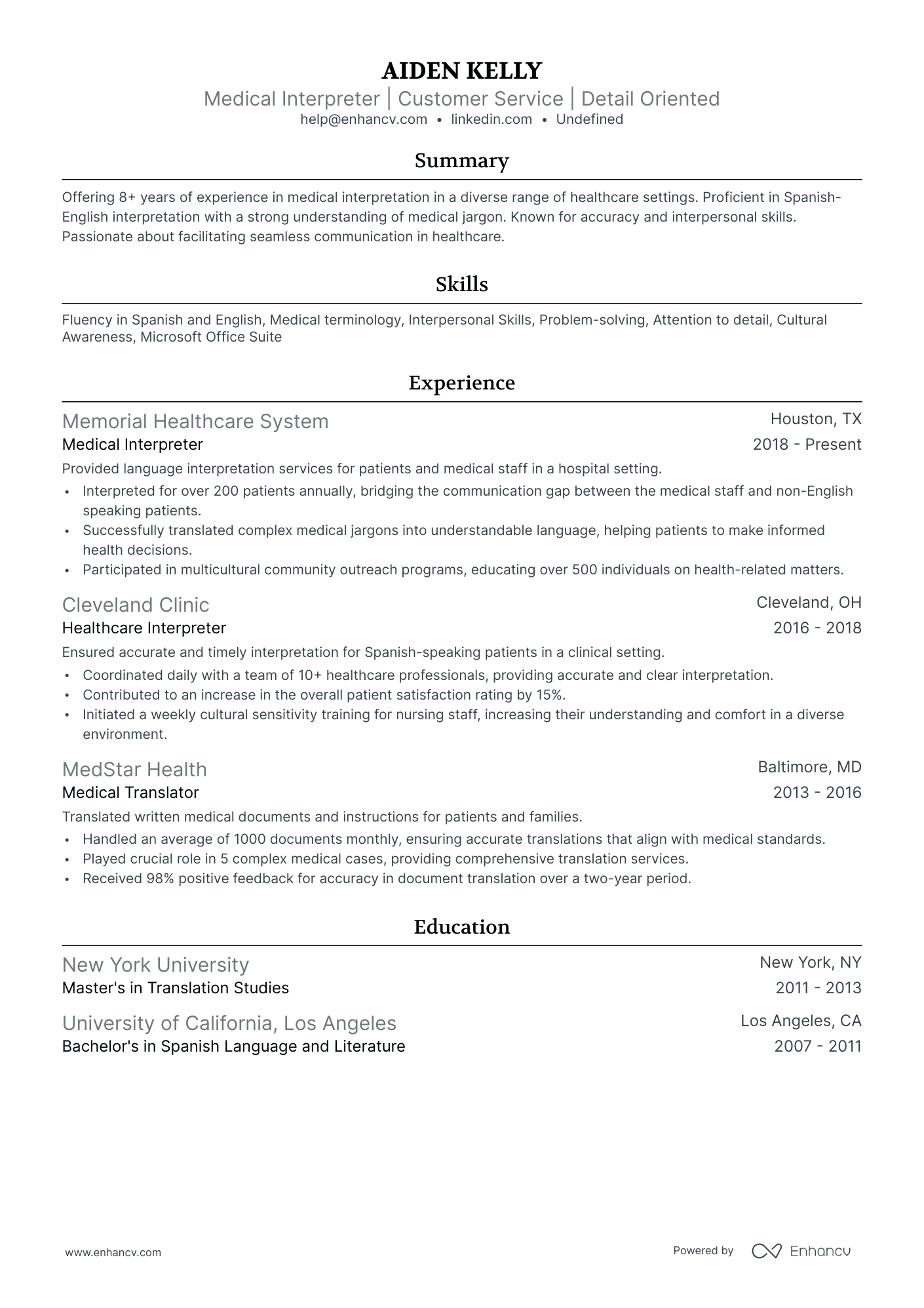
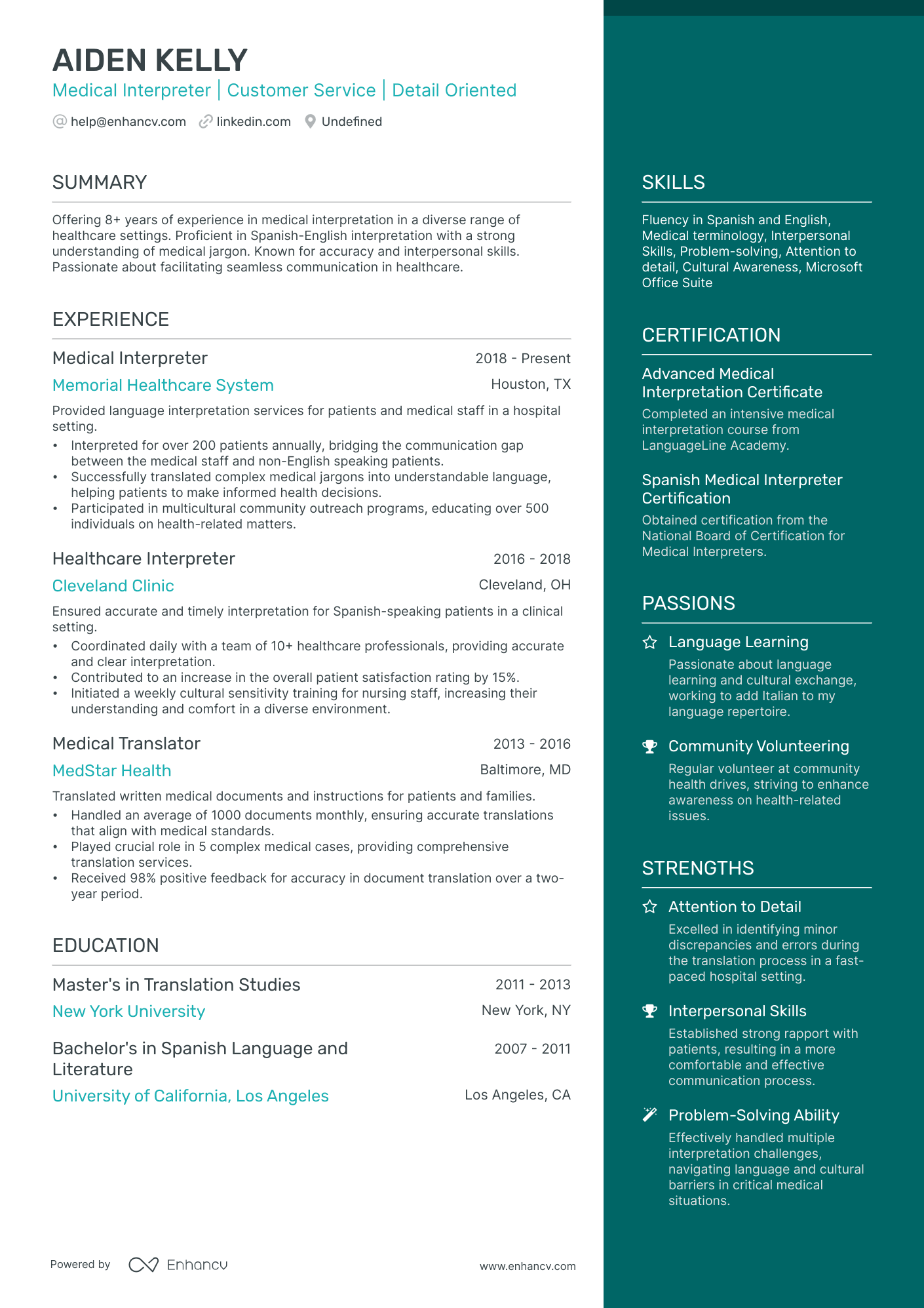
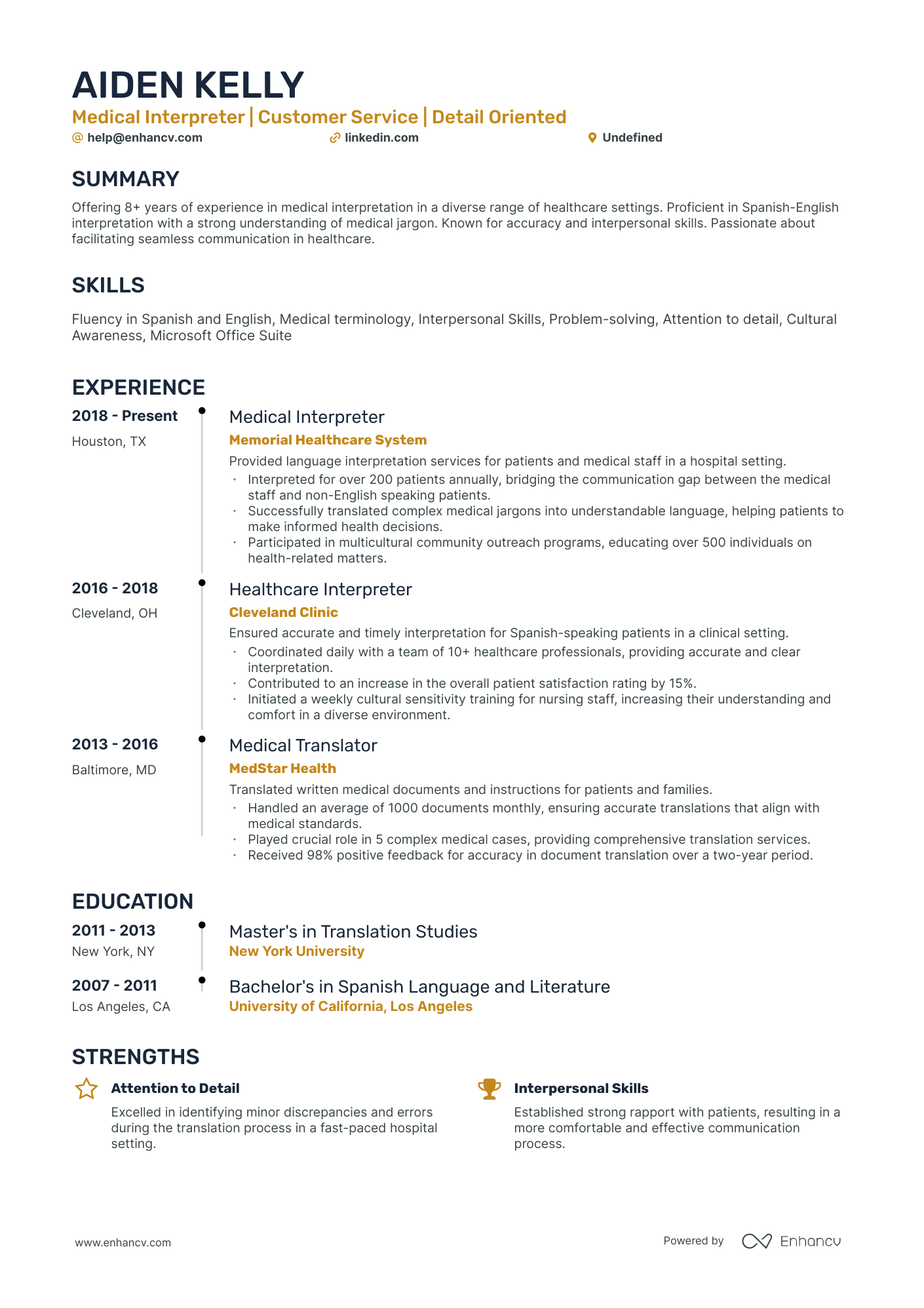
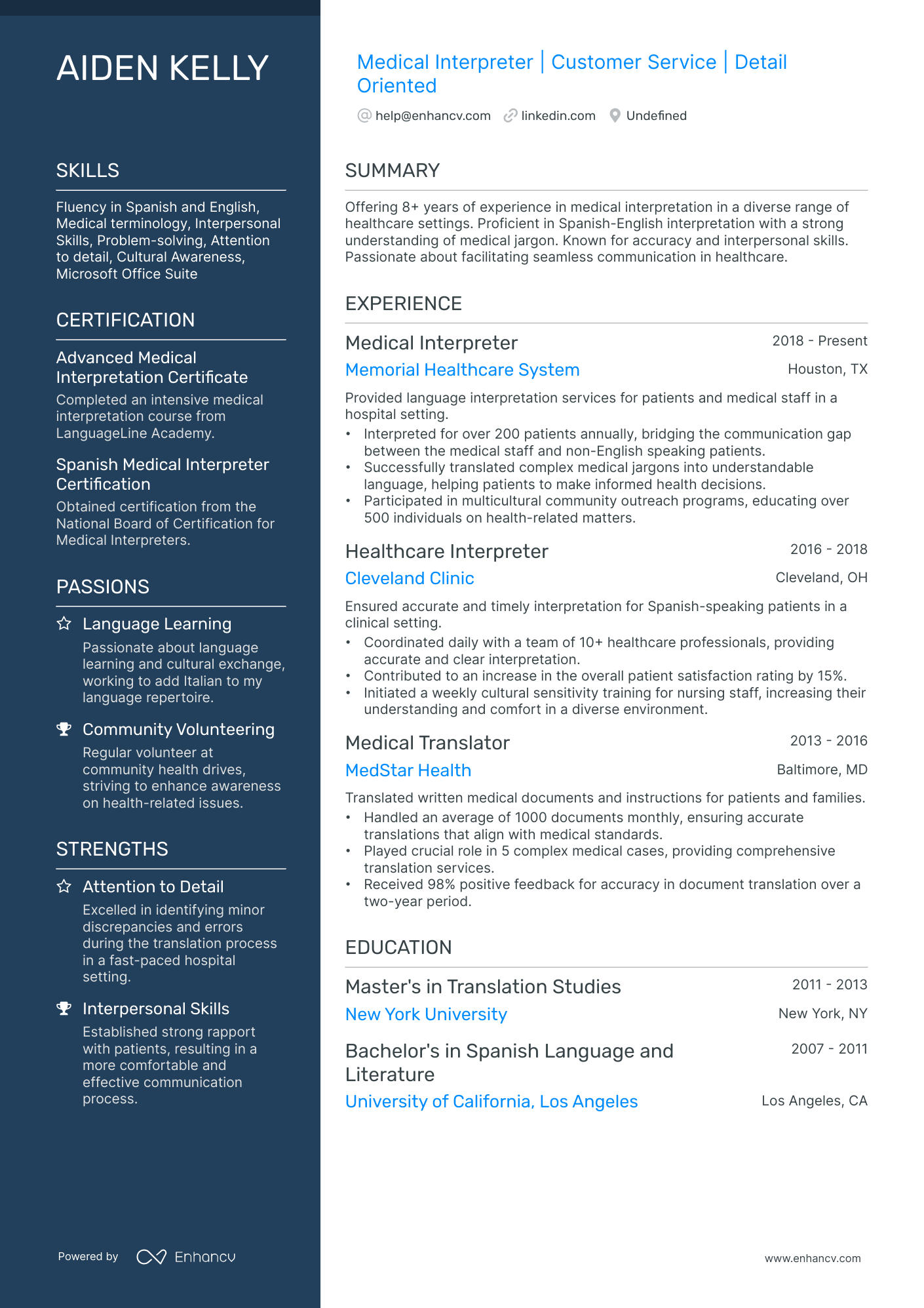
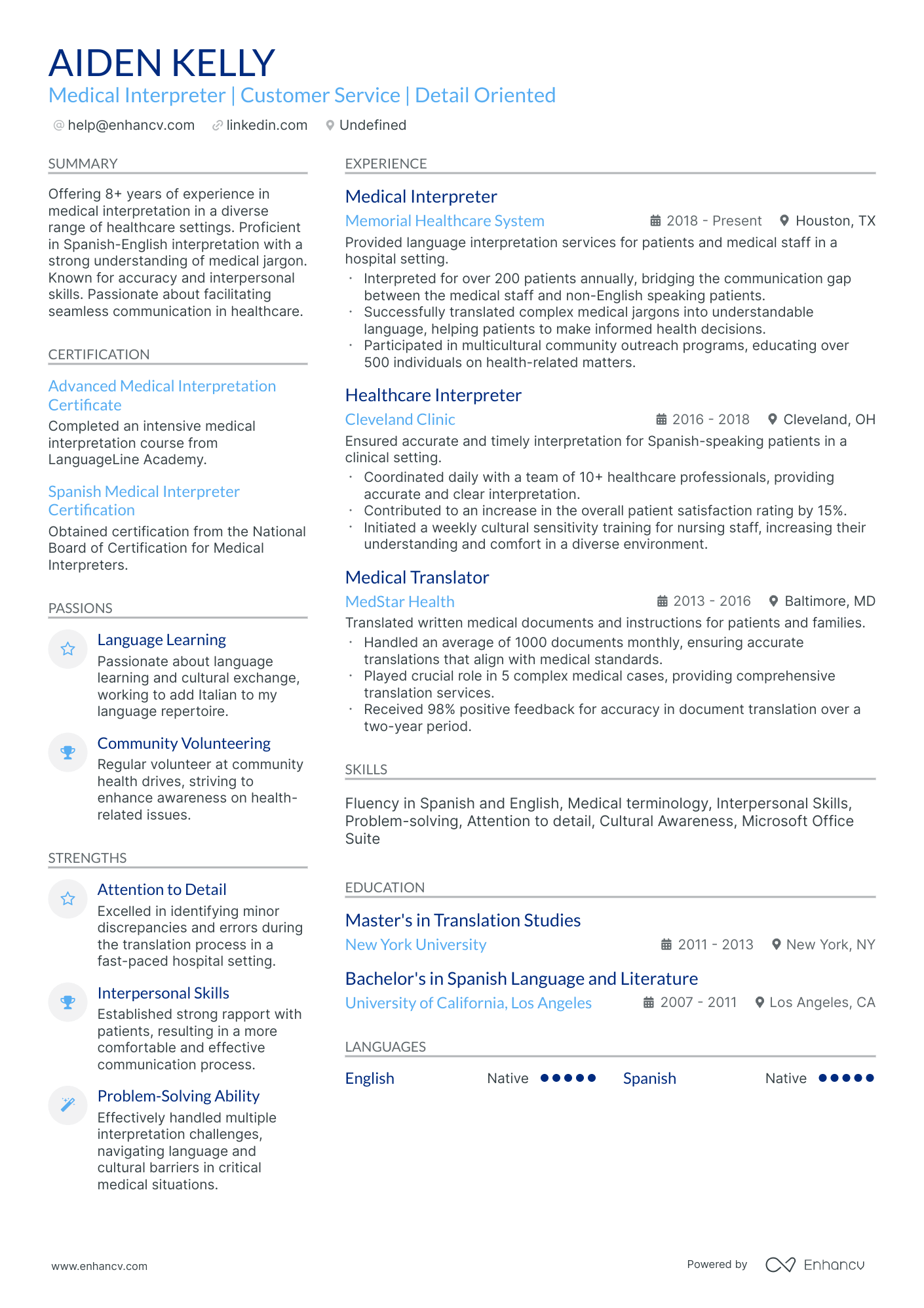
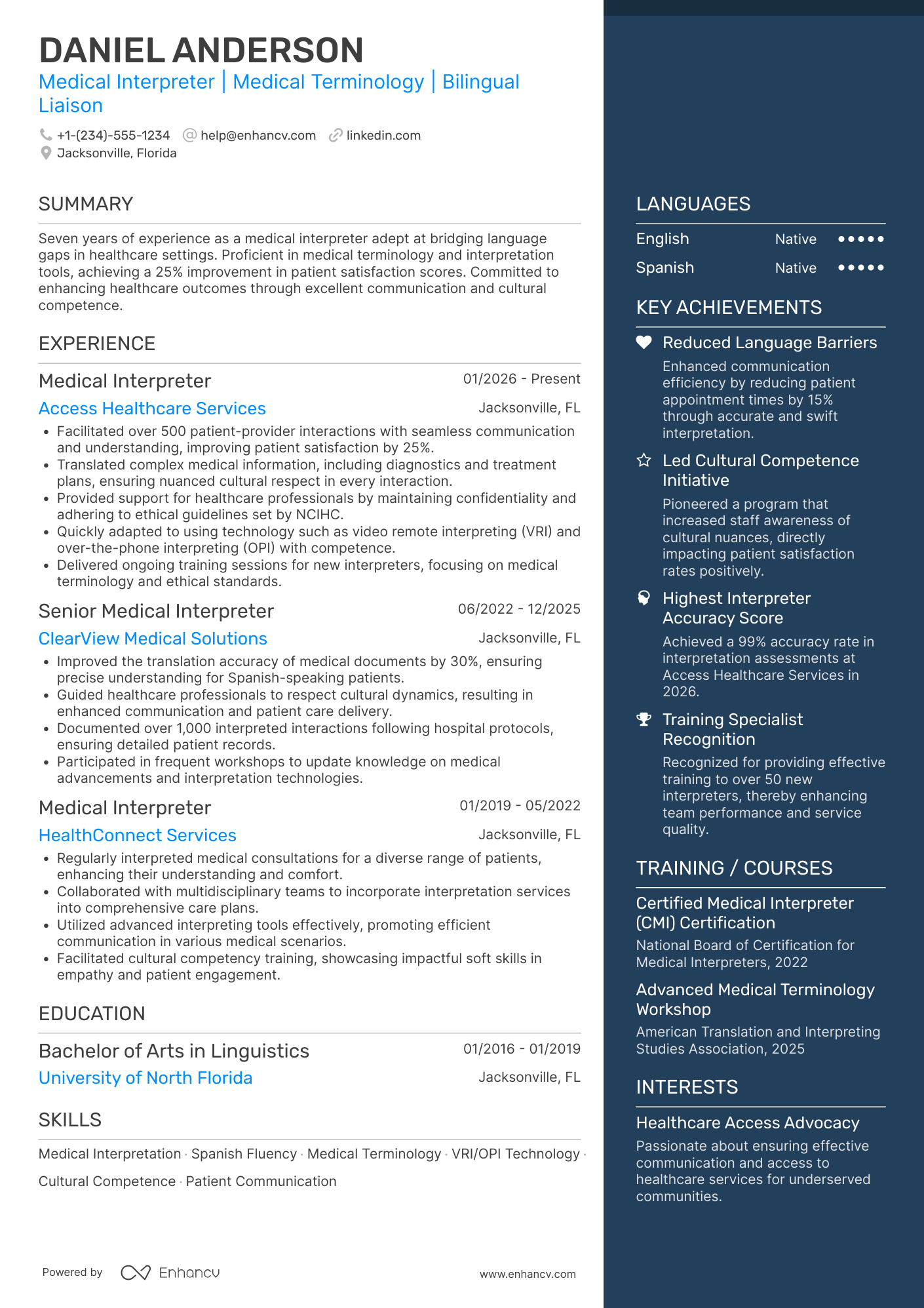
Many medical interpreter resumes fail because they bury language pairs, modality, and specialty context, so recruiters can't verify fit in seconds. A medical interpreter resume also needs clear keywords for applicant tracking system screening in a crowded, fast-moving pipeline.
A strong resume shows outcomes you delivered, not just tools you used. Understanding how to make your resume stand out means you should quantify interpreted encounters per week, on-time coverage across clinics, reduced communication errors, improved patient satisfaction scores, and faster discharge education completion for limited English proficiency patients.

Key takeaways
- Lead with language pairs, interpreting modes, and clinical specialties so recruiters verify fit in seconds.
- Quantify encounter volume, response times, accuracy scores, and patient satisfaction in every experience bullet.
- Tailor each resume to the job posting's exact terminology, tools, and compliance standards.
- Use a reverse-chronological format if experienced and a hybrid format if entering the field.
- Place certifications like CMI or CHI where they're immediately visible to hiring managers and ATS.
- Demonstrate skills through measurable outcomes in your summary and experience, not just a bulleted list.
- Use Enhancv to turn vague duties into specific, recruiter-ready bullets aligned with medical interpreter roles.
Job market snapshot for medical interpreters
We analyzed 53 recent medical interpreter job ads across major US job boards. These numbers help you understand regional hotspots, employer expectations, top companies hiring at a glance.
What level of experience employers are looking for medical interpreters
| Years of Experience | Percentage found in job ads |
|---|---|
| 1–2 years | 30.2% (16) |
| 3–4 years | 3.8% (2) |
| 5–6 years | 3.8% (2) |
| Not specified | 62.3% (33) |
Medical interpreter ads by area of specialization (industry)
| Industry (Area) | Percentage found in job ads |
|---|---|
| Healthcare | 79.2% (42) |
Role overview stats
These tables show the most common responsibilities and employment types for medical interpreter roles. Use them to align your resume with what employers expect and to understand how the role is structured across the market.
Day-to-day activities and top responsibilities for a medical interpreter
| Responsibility | Percentage found in job ads |
|---|---|
| Medical terminology | 66.0% (35) |
| Spanish | 37.7% (20) |
| English | 32.1% (17) |
| Medical interpreting | 26.4% (14) |
| Translation | 26.4% (14) |
| Interpretation | 17.0% (9) |
| Medical interpretation | 13.2% (7) |
| Hipaa | 11.3% (6) |
| Sight translation | 11.3% (6) |
| Epic | 9.4% (5) |
| Document translation | 7.5% (4) |
| Written translation | 7.5% (4) |
How to format a medical interpreter resume
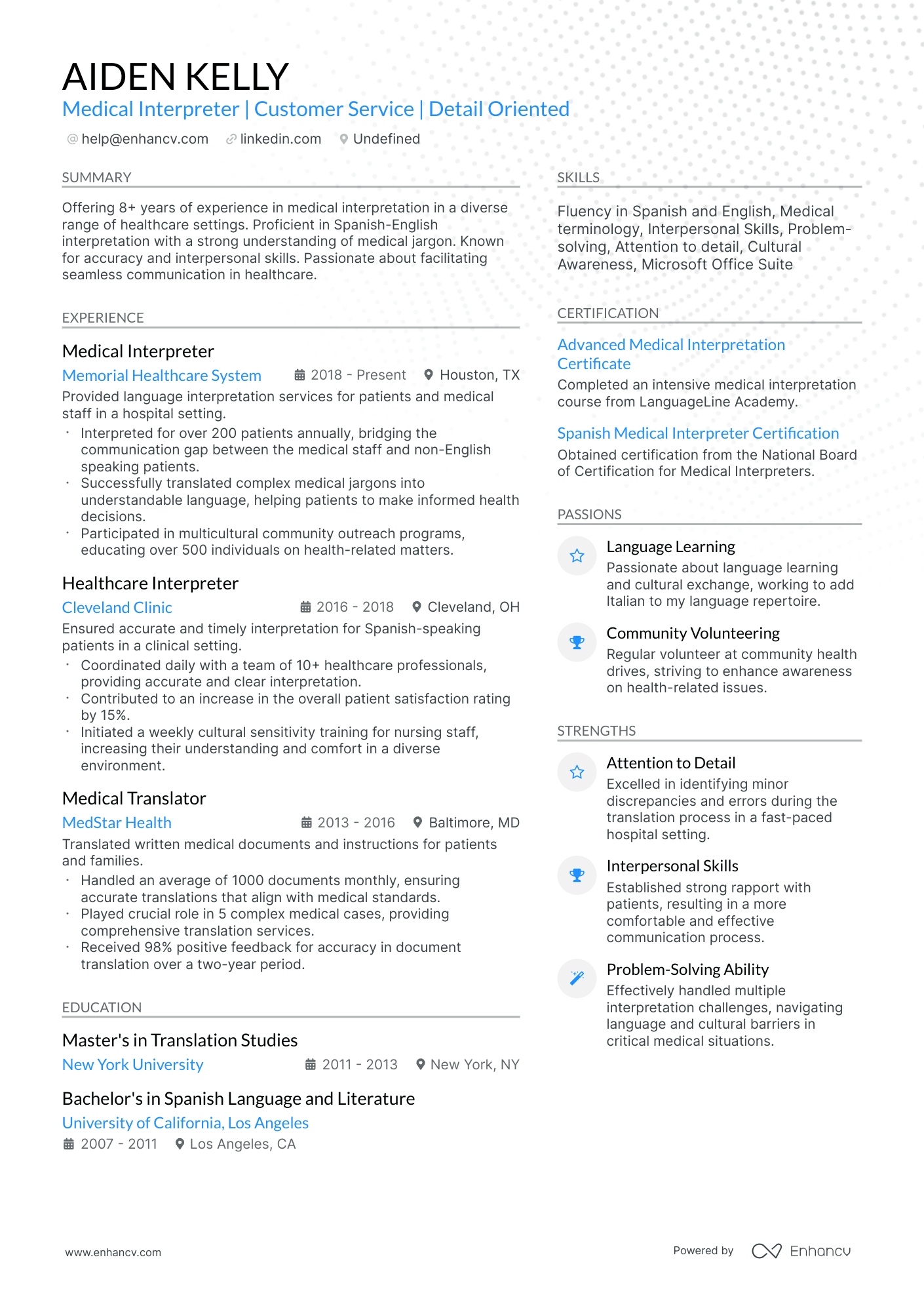
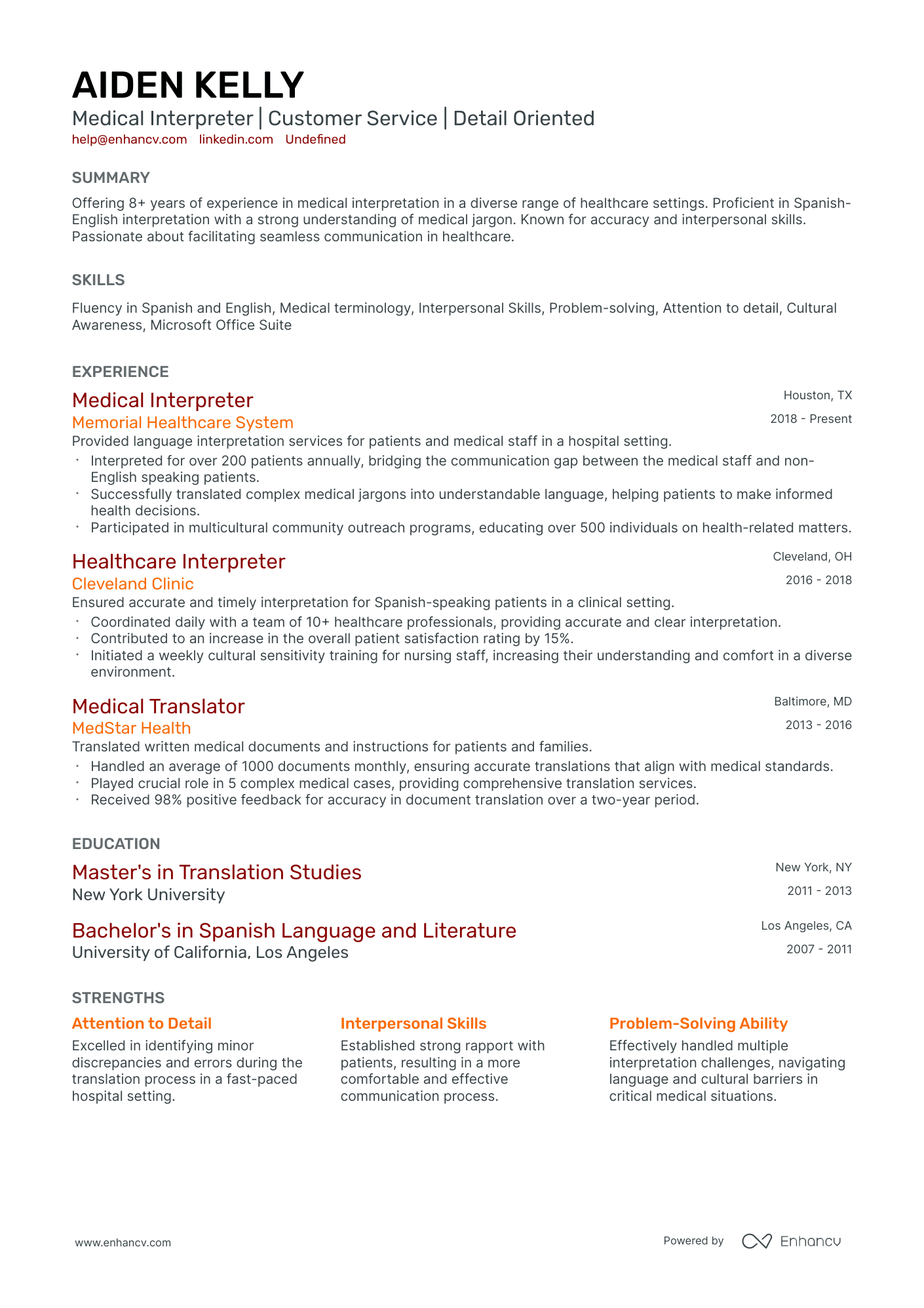
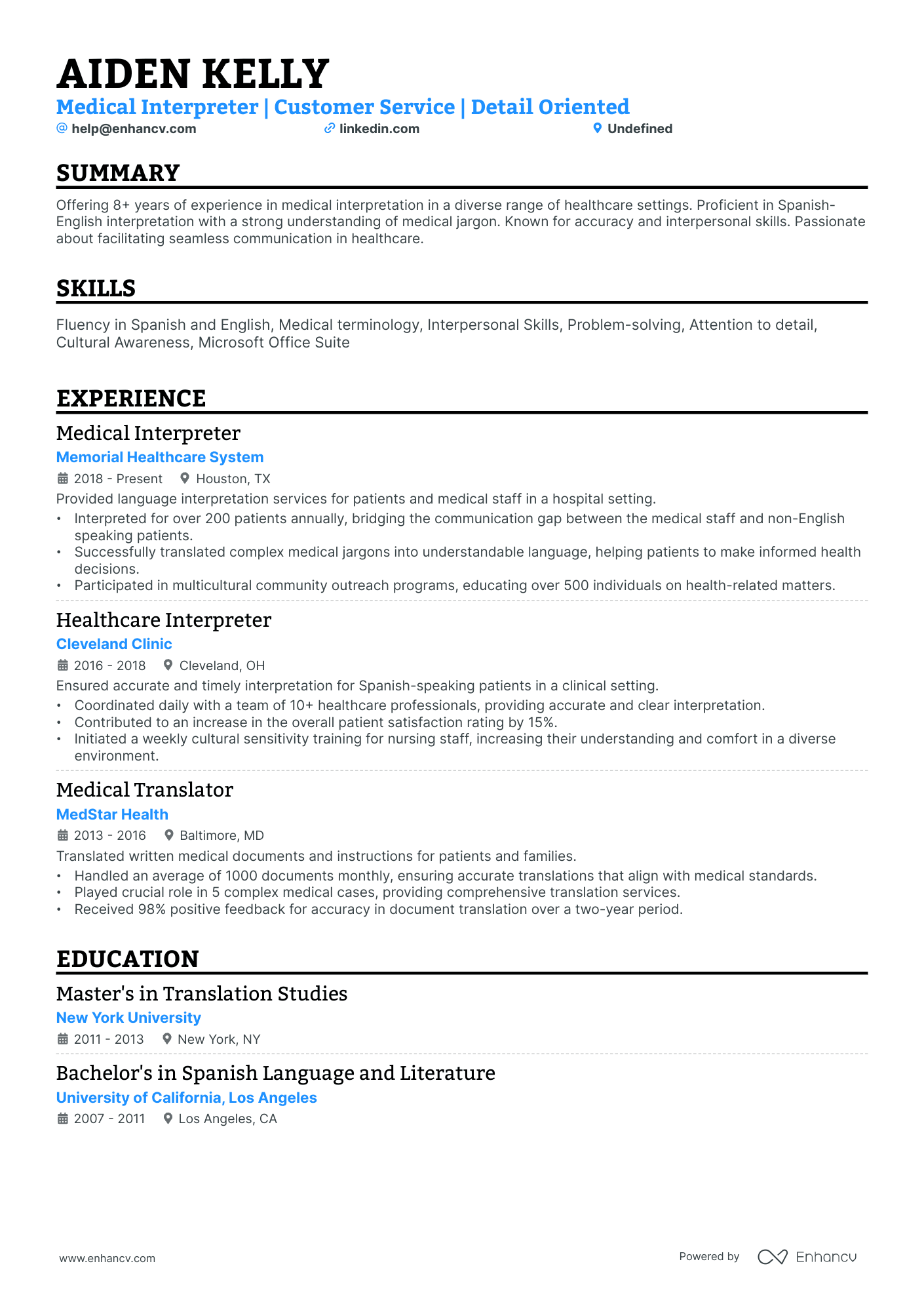
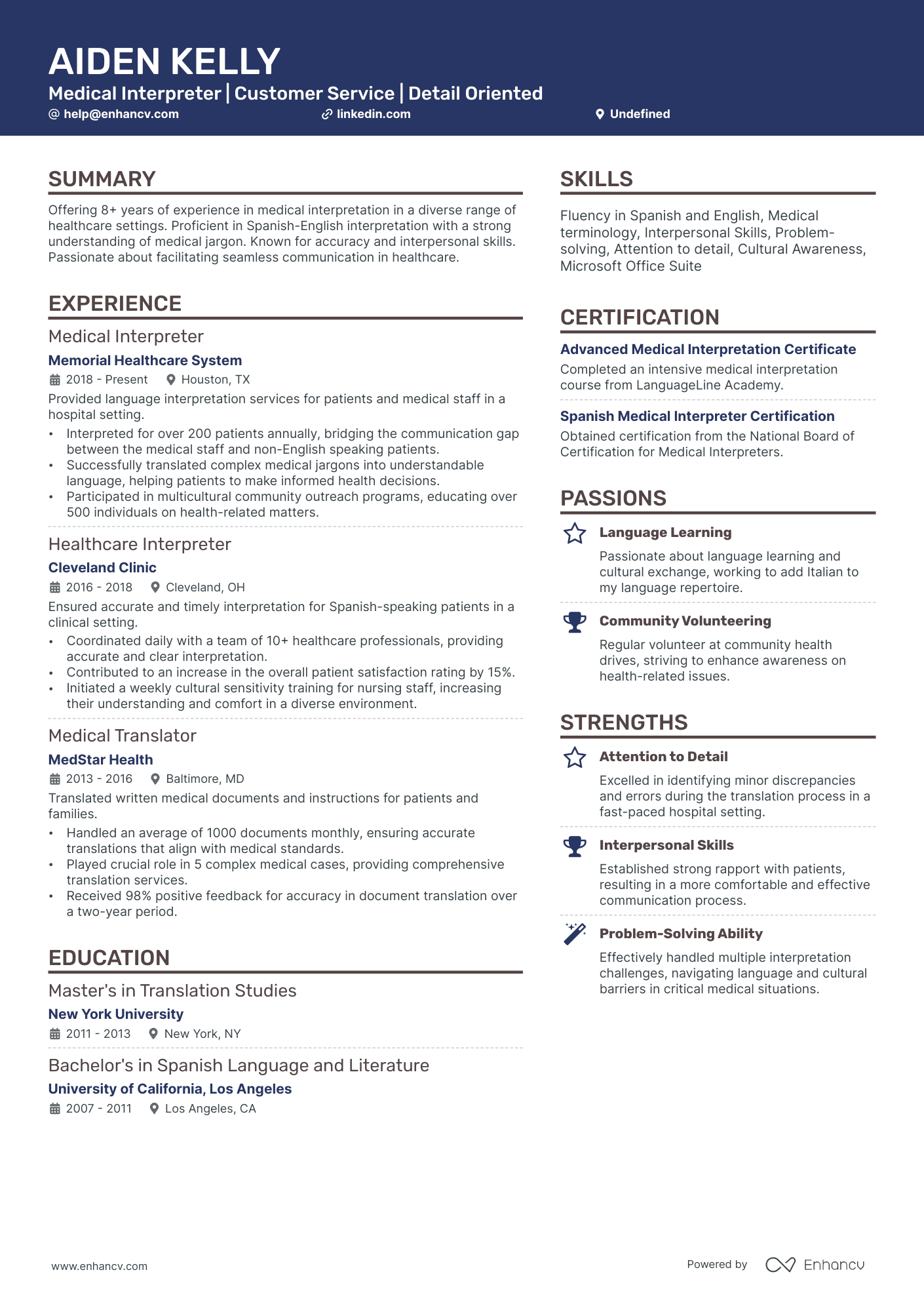
Recruiters reviewing medical interpreter resumes prioritize bilingual fluency, interpreting certifications, familiarity with medical terminology, and demonstrated accuracy in high-stakes clinical settings. A clean, well-structured resume format ensures these signals surface quickly during both human review and applicant tracking system (ATS) scans.

I have significant experience in this role—which format should I use?
Use a reverse-chronological format to highlight your growing interpreting responsibilities and the clinical environments where you've delivered results. Do:
- Lead with your most recent role and emphasize scope: department coverage, patient volume, and specialties you've supported (e.g., oncology, emergency, behavioral health).
- Feature interpreting credentials (CMI, CHI), language pairs, electronic health record (EHR) systems, and compliance frameworks like HIPAA directly in your skills or summary section.
- Quantify outcomes wherever possible—error reduction, patient satisfaction scores, appointment throughput, or interpreter request response times.
I'm junior or switching into this role—what format works best?
A hybrid format works best because it lets you lead with relevant language skills and certifications while still showing any clinical, volunteer, or community interpreting experience in context. Do:
- Place a dedicated skills section near the top highlighting language proficiency levels, medical terminology knowledge, and any interpreting training or certifications in progress.
- Include practicum hours, volunteer interpreting at community clinics, shadowing experience, or bilingual roles in healthcare-adjacent settings to demonstrate transferable exposure.
- Connect each experience entry to a clear outcome: what you interpreted, for whom, and what it accomplished.
Why not use a functional resume?
A functional format strips away the clinical context and continuity that hiring managers need to verify you can perform accurately under real patient-care pressure.
- Career changers with bilingual backgrounds: You have professional-level fluency and interpreting training but no formal medical interpreting roles yet—a functional section can spotlight language skills and certifications while bridging the experience gap.
- Candidates with resume gaps: You stepped away from interpreting but maintained fluency and completed continuing education or recertification during the gap.
Once you've established a clean, readable format, the next step is deciding which sections to include so each one serves a clear purpose on your resume.
What sections should go on a medical interpreter resume
Recruiters expect a medical interpreter resume to show your language coverage, clinical setting experience, and compliance with confidentiality and accuracy standards. Knowing what to put on a resume helps you prioritize the most impactful information for this role.
Use this structure for maximum clarity:
- Header
- Summary
- Experience
- Skills
- Projects
- Education
- Certifications
- Optional sections: Languages, Volunteering, Awards
Strong experience bullets should emphasize interpreted encounter volume, specialties covered, accuracy and adherence to protocols, and measurable outcomes such as reduced communication errors or improved patient satisfaction.
Is your resume good enough?
Drop your resume here or choose a file. PDF & DOCX only. Max 2MB file size.
Now that you’ve organized the key resume components, the next step is to write your medical interpreter experience section so it supports each part with clear, role-specific proof.
How to write your medical interpreter resume experience
The experience section of your medical interpreter resume should demonstrate the interpreting work you've delivered, the tools and methodologies you've relied on, and the measurable outcomes you've produced for patients, providers, and healthcare organizations. Hiring managers prioritize demonstrated impact—accurate communication that improved patient outcomes, reduced errors, or streamlined clinical workflows—over descriptive task lists. Building a targeted resume ensures each bullet speaks directly to the role you're pursuing.
Each entry should include:
- Job title
- Company and location (or remote)
- Dates of employment (month and year)
Three to five concise bullet points showing what you owned, how you executed, and what outcomes you delivered:
- Ownership scope: the interpreting assignments, language pairs, clinical departments, patient populations, or care settings you were directly accountable for as a medical interpreter.
- Execution approach: the interpreting modes, terminology management systems, electronic health record platforms, telehealth tools, or standards of practice you used to deliver accurate, culturally competent communication between patients and providers.
- Value improved: changes to patient comprehension, diagnostic accuracy, appointment efficiency, informed-consent compliance, language-access coverage, or risk reduction that resulted from your interpreting work.
- Collaboration context: how you partnered with physicians, nursing staff, social workers, case managers, compliance teams, or community organizations to facilitate seamless multilingual communication across the care continuum.
- Impact delivered: outcomes expressed through patient satisfaction improvements, reductions in miscommunication incidents, expanded language-access capacity, shortened encounter times, or contributions to regulatory compliance—framed as results rather than activities.
Experience bullet formula
A medical interpreter experience example
✅ Right example - modern, quantified, specific.
Medical Interpreter (Spanish–English)
CityCare Health System | Phoenix, AZ
2021–Present
Multi-site community health system supporting primary care, urgent care, and specialty clinics across the metro area.
- Interpreted Spanish–English for an average of twenty-two encounters per day across primary care, emergency, and behavioral health using video remote interpreting and on-site support, sustaining a 98% patient satisfaction score on post-visit surveys.
- Documented language access services in Epic (electronic health record) and standardized interpreter notes using templated smart phrases, cutting provider follow-up clarification requests by 27%.
- Coordinated with physicians, nurses, and social workers to support informed consent, discharge teaching, and medication reconciliation, reducing teach-back failures from 14% to 9% within six months.
- Triaged and fulfilled urgent interpretation requests through Vocera and Microsoft Teams, improving average response time from nine minutes to five minutes for emergency department calls.
- Flagged and escalated high-risk communication issues using SBAR (Situation, Background, Assessment, Recommendation) and incident reporting workflows, contributing to a 18% reduction in language-related safety events year over year.
Now that you've seen how to structure your experience entries, let's focus on aligning them with the specific requirements of each job posting.
How to tailor your medical interpreter resume experience
Recruiters evaluate medical interpreter resumes through both human review and applicant tracking systems, so tailoring your resume to the job description is essential. Tailoring ensures the specific skills, tools, and qualifications a hiring manager seeks are clearly visible in your experience section.
Ways to tailor your medical interpreter experience:
- Match the interpreting modes listed such as consecutive or simultaneous.
- Mirror the exact language pairs specified in the posting.
- Reference electronic health record systems named in the job description.
- Use the same compliance terminology such as HIPAA or HITECH standards.
- Highlight patient safety protocols or quality assurance processes mentioned.
- Include telehealth or video remote interpreting platforms if referenced.
- Emphasize collaboration with clinical teams or departments specifically named.
- Align your certifications with credentialing bodies the employer requires.
Tailoring means aligning your real accomplishments with what the role demands, not forcing keywords where they don't belong.
Resume tailoring examples for medical interpreter
| Job description excerpt | Untailored | Tailored |
|---|---|---|
| Provide consecutive and simultaneous interpretation in Spanish for patient-provider encounters in oncology and cardiology departments using Linguistica Medical Glossary standards. | Interpreted for Spanish-speaking patients in a hospital setting. | Delivered consecutive and simultaneous Spanish interpretation for 30+ weekly patient-provider encounters across oncology and cardiology units, adhering to Linguistica Medical Glossary terminology standards. |
| Sight-translate discharge instructions, informed consent documents, and medication guides while maintaining HIPAA compliance and documenting all encounters in Epic EHR. | Translated medical documents for patients who needed language assistance. | Sight-translated discharge instructions, informed consent forms, and medication guides for limited-English-proficiency patients, logging each encounter in Epic EHR in full HIPAA compliance. |
| Serve as a cultural broker between Haitian Creole-speaking patients and care teams in the emergency department, de-escalating communication barriers and supporting patient comprehension of treatment plans. | Helped patients understand what doctors told them during appointments. | Acted as a cultural broker for Haitian Creole-speaking patients in a Level I emergency department, de-escalating communication barriers and improving treatment-plan comprehension rates documented through post-encounter patient surveys. |
Once you’ve aligned your experience with the role’s language needs and clinical settings, the next step is to quantify your medical interpreter achievements so employers can see the impact of that fit.
How to quantify your medical interpreter achievements
Quantifying your achievements proves accuracy, speed, and patient safety under pressure. Focus on volume handled, turnaround time, quality scores, compliance outcomes, and risk reduction across clinics, emergency departments, and telehealth platforms.
Quantifying examples for medical interpreter
| Metric | Example |
|---|---|
| Volume handled | "Interpreted for 22–28 patient encounters per shift across emergency, inpatient, and outpatient units, covering Spanish and English with full chart note support." |
| Turnaround time | "Reduced average video remote interpreting connection time from 90 seconds to 35 seconds by standardizing pre-call device checks in Epic and Zoom." |
| Quality accuracy | "Maintained a 98% QA score across 60 monthly call audits, with zero critical meaning errors flagged by the language access quality team." |
| Compliance | "Achieved 100% documentation compliance for interpreter ID and encounter notes across 300+ visits, meeting Joint Commission and HIPAA requirements." |
| Risk reduction | "Prevented three medication-related near-misses in one quarter by escalating high-risk dosage clarifications using SBAR with nurses and pharmacists." |
Turn vague job duties into measurable, recruiter-ready resume bullets in seconds with Enhancv's Bullet Point Generator.
Once you've crafted strong bullet points for your experience section, you'll want to apply that same precision to presenting your hard and soft skills throughout your medical interpreter resume.
How to list your hard and soft skills on a medical interpreter resume
Your skills section shows you can deliver accurate, compliant interpretation in clinical settings, and recruiters and ATS scan this section to confirm language pairs, healthcare workflows, and key tools—aim for a mix weighted toward hard skills with role-specific soft skills.
medical interpreter roles require a blend of:
- Product strategy and discovery skills
- Data, analytics, and experimentation skills
- Delivery, execution, and go-to-market discipline
- Soft skills
Your skills section should be:
- Scannable (bullet-style grouping).
- Relevant to the job post.
- Backed by proof in experience bullets.
- Updated with current tools.
Place your skills section:
- Above experience if you're junior or switching careers.
- Below experience if you're mid/senior with strong achievements.

Hard skills
- Medical terminology, anatomy
- Consecutive interpretation
- Simultaneous interpretation
- Sight translation
- Note-taking for interpreting
- HIPAA compliance
- Informed consent interpreting
- Electronic health records workflows
- Telephonic interpreting platforms
- Video remote interpreting platforms
- Interpreter scheduling systems
- ICD-10, CPT basics
Soft skills
- Maintain neutrality under pressure
- Clarify meaning without leading
- Manage turn-taking and pacing
- Set expectations at session start
- Escalate safety concerns promptly
- Collaborate with clinicians in real time
- De-escalate emotionally charged encounters
- Protect confidentiality in practice
- Adapt register for health literacy
- Handle interruptions and cross-talk
- Recover quickly from errors
- Document issues and follow up
How to show your medical interpreter skills in context
Skills shouldn't live only in a bulleted list on your resume.
They should be demonstrated in:
- Your summary (high-level professional identity)
- Your experience (proof through outcomes)
Here's how that looks in practice. You can also explore resume skills examples for more ideas on presenting your abilities effectively.
Summary example
Bilingual medical interpreter with 10+ years in hospital and oncology settings. Skilled in sight translation, consecutive interpreting, and Epic EHR documentation. Reduced patient complaint rates by 35% through culturally responsive communication across multidisciplinary care teams.
- Signals senior-level experience immediately
- Names role-relevant tools and methods
- Includes a concrete, measurable metric
- Highlights cultural competency as soft skill
Experience example
Senior Medical Interpreter
Advocate Health | Chicago, IL
March 2018–Present
- Interpreted 1,200+ patient encounters annually using consecutive and sight translation methods, maintaining a 98.5% accuracy rating across quality audits.
- Collaborated with physicians, nurses, and social workers to streamline multilingual discharge workflows, cutting average discharge time by 20%.
- Trained 15 junior interpreters on medical terminology and Epic EHR documentation standards, improving team onboarding efficiency by 30%.
- Every bullet contains measurable proof.
- Skills appear naturally through outcomes.
Once you’ve demonstrated your interpreting strengths through specific, real-world examples, the next step is learning how to write a medical interpreter resume with no experience so you can present those same strengths without relying on prior job titles.
How do I write a medical interpreter resume with no experience
Even without full-time experience, you can demonstrate readiness through:
- Medical interpreter certificate coursework
- Supervised clinic shadowing hours
- Medical interpreter practicum simulations
- Volunteer medical interpreter at clinics
- Community health outreach interpreting
- Bilingual patient intake assistance
- Telehealth role-play call recordings
- Terminology glossaries you built
Writing a resume without work experience means focusing on:
- Interpreting accuracy and language pairs
- Medical terminology and anatomy knowledge
- Confidentiality training and compliance
- Documented hours and measurable outcomes
Resume format tip for entry-level medical interpreter
Use a hybrid resume format because it highlights skills and training first, while still showing relevant projects and hours. Do:
- Add a "Languages" section with proficiency levels.
- List training hours, dates, and instructors.
- Include interpreting modes: consecutive, sight translation.
- Name tools used: glossary, call platform.
- Quantify volume: sessions, hours, patients.
- Volunteered as a medical interpreter at a community clinic, completed 30 consecutive interpreting sessions using a bilingual glossary, and reduced provider clarification requests by 20%.
Even without direct experience, your educational background can demonstrate the foundational knowledge and language skills that qualify you for a medical interpreter role.
How to list your education on a medical interpreter resume
Your education section helps hiring teams confirm you have the foundational linguistic, cultural, and medical knowledge a medical interpreter needs. It validates your academic preparation quickly.
Include:
- Degree name
- Institution
- Location
- Graduation year
- Relevant coursework (for juniors or entry-level candidates)
- Honors & GPA (if 3.5 or higher)
Skip month and day details—list the graduation year only.
Here's a strong education entry tailored for a medical interpreter resume.
Example education entry
Bachelor of Arts in Spanish Linguistics
University of Texas at San Antonio, San Antonio, TX
Graduated 2021
GPA: 3.7/4.0
- Relevant Coursework: Medical Terminology, Cross-Cultural Communication, Healthcare Interpreting Practicum, Advanced Spanish Translation
- Honors: Magna Cum Laude, Dean's List (six semesters)
How to list your certifications on a medical interpreter resume
Certifications on your resume show your commitment to learning, your proficiency with interpreting tools and protocols, and your industry relevance as a medical interpreter.
Include:
- Certificate name
- Issuing organization
- Year
- Optional: credential ID or URL
- Place certifications below education when your degree is recent and more relevant than older credentials.
- Place certifications above education when they are recent, role-critical, or required for the medical interpreter roles you target.
Best certifications for your medical interpreter resume
- Certified Medical Interpreter (CMI)
- Certified Healthcare Interpreter (CHI)
- National Board Certification for Medical Interpreters
- Core Certification Healthcare Interpreter (CCHI)
- 40-Hour Medical Interpreter Training Certificate
- HIPAA Privacy and Security Training Certificate
- Basic Life Support (BLS)
Once you’ve placed your credentials where hiring teams can verify them quickly, use your medical interpreter resume summary to highlight those qualifications upfront and set context for the rest of your experience.
How to write your medical interpreter resume summary
Your resume summary is the first thing a recruiter reads. A strong one instantly signals you're qualified to bridge language gaps in clinical settings.
Keep it to three to four lines, with:
- Your title and total years of medical interpreting experience.
- The healthcare settings or specialties you've worked in.
- Core skills like sight translation, consecutive interpreting, or electronic health record systems.
- One or two measurable results, such as patient satisfaction scores or appointment accuracy rates.
- Interpersonal strengths tied to outcomes, like cultural sensitivity that reduced miscommunication incidents.

PRO TIP
At this level, emphasize language pairs, relevant certifications, and concrete contributions from clinical rotations or early roles. Avoid vague phrases like "passionate about helping others" or "strong communicator." Instead, show impact through specific numbers and real scenarios you navigated.
Example summary for a medical interpreter
Bilingual Spanish-English medical interpreter with two years of experience in hospital and urgent care settings. Facilitated over 1,200 patient encounters with a 98% satisfaction rating using consecutive and sight translation techniques.
Optimize your resume summary and objective for ATS
Drop your resume here or choose a file.
PDF & DOCX only. Max 2MB file size.
Now that your summary captures your qualifications at a glance, make sure your header presents the essential contact and professional details recruiters need to reach you.
What to include in a medical interpreter resume header
A resume header lists your key contact and identity details, helping medical interpreter candidates boost visibility, credibility, and pass recruiter screening fast.
Essential resume header elements
- Full name
- Tailored job title and headline
- Location
- Phone number
- Professional email
- GitHub link
- Portfolio link
A LinkedIn link helps recruiters verify your experience quickly and supports screening.
Don't include a photo on a medical interpreter resume unless the role is explicitly front-facing or appearance-dependent.
Match your header title to the job posting and add your language pair and certification to support fast screening.
Example
Medical interpreter resume header
Jordan Rivera
Medical Interpreter (Spanish–English) | CCHI Certified | Hospital and Clinic Experience
Chicago, IL
(312) 555-01XX | your.name@enhancv.com | github.com/yourname | yourwebsite.com | linkedin.com/in/yourname
Once your contact details and key credentials are clearly presented at the top, you can strengthen your application with additional sections that add relevant context and support.
Additional sections for medical interpreter resumes
When your core qualifications match other candidates, well-chosen additional sections can set your medical interpreter resume apart with role-specific credibility.
- Languages and proficiency levels
- Certifications and credentials
- Volunteer experience in healthcare settings
- Professional affiliations and memberships
- Continuing education and specialized training
- Publications or conference presentations
- Hobbies and interests
Once you've strengthened your resume with relevant additional sections, pairing it with a well-crafted cover letter can further set your application apart.
Do medical interpreter resumes need a cover letter
A cover letter isn't required for a medical interpreter, but it often helps. If you're unsure what a cover letter is and how it can support your application, it matters most in competitive roles, hospital systems, and vendor networks with strict hiring expectations. Skip it when the posting says not to include one or when the application limits attachments.
Use a cover letter to add context your resume can't show:
- Explain role and team fit by matching your interpreting settings to the unit's needs, such as emergency department, oncology, or behavioral health.
- Highlight one or two outcomes, such as reducing appointment delays, improving patient comprehension, or supporting discharge education across languages.
- Show you understand the organization's users and context, including patient populations, compliance needs, and workflows across clinicians, registration, and care teams.
- Address a transition or non-obvious experience by linking prior roles to interpreting skills, such as de-escalation, documentation accuracy, or remote platform fluency.
Drop your resume here or choose a file.
PDF & DOCX only. Max 2MB file size.
Even if you decide to skip a cover letter, you can use AI to improve your medical interpreter resume so it communicates your qualifications clearly and consistently.
Using AI to improve your medical interpreter resume
AI can sharpen your resume's clarity, structure, and impact. It helps you find stronger phrasing and tighten wordy bullets. But overuse strips authenticity. Once your content is clear and role-aligned, step away from AI. If you're wondering which AI is best for writing resumes, focus on tools that enhance rather than replace your own voice.
Here are 10 prompts you can copy and paste to strengthen specific sections of your medical interpreter resume:
- Strengthen your summary: "Rewrite my medical interpreter resume summary to highlight language pairs, clinical settings, and years of interpreting experience in under four sentences."
- Quantify experience bullets: "Add measurable outcomes to these medical interpreter experience bullets, such as patient volume, appointment types, or error reduction metrics."
- Tighten wordy descriptions: "Shorten each medical interpreter job description bullet to one concise line without losing clinical context or key responsibilities."
- Align skills strategically: "Compare this medical interpreter job posting to my skills section and suggest missing hard or soft skills I should add."
- Improve action verbs: "Replace weak or repetitive verbs in my medical interpreter experience section with strong, specific action verbs for healthcare settings."
- Refine certifications formatting: "Reorganize my medical interpreter certifications section by relevance, including issuing bodies, dates earned, and credential numbers."
- Clarify education details: "Rewrite my education section to emphasize coursework, training, or degrees directly relevant to working as a medical interpreter."
- Highlight project contributions: "Describe this medical interpreter quality improvement project using specific outcomes, team size, and measurable impact on patient communication."
- Remove filler language: "Identify and remove filler words, redundancies, or vague phrases throughout my entire medical interpreter resume."
- Tailor for specialization: "Adjust my medical interpreter resume bullets to emphasize experience in [specific department], including relevant terminology and procedures."
Stop using AI once your resume sounds accurate, specific, and aligned with real experience. AI should never invent experience or inflate claims—if it didn't happen, it doesn't belong here.
Conclusion
A strong medical interpreter resume proves impact and reliability. It highlights measurable outcomes, such as accuracy rates, patient satisfaction, and reduced appointment delays. It also shows role-specific skills, including medical terminology, sight translation, and cultural mediation.
Keep the structure clear and consistent, with focused summaries, scannable skills, and results-driven experience. This approach matches how employers screen today and supports near-future needs across in-person and remote care.