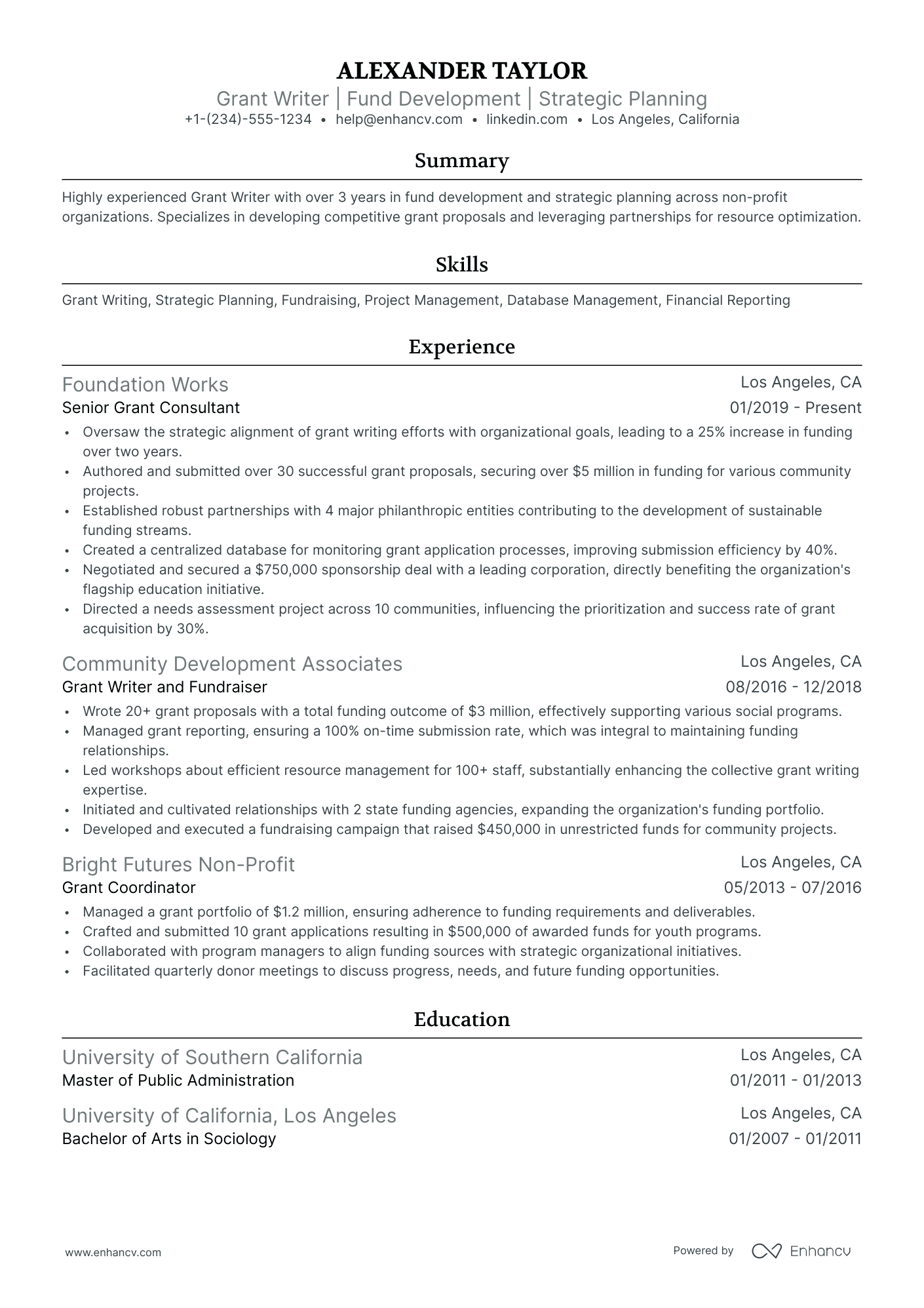
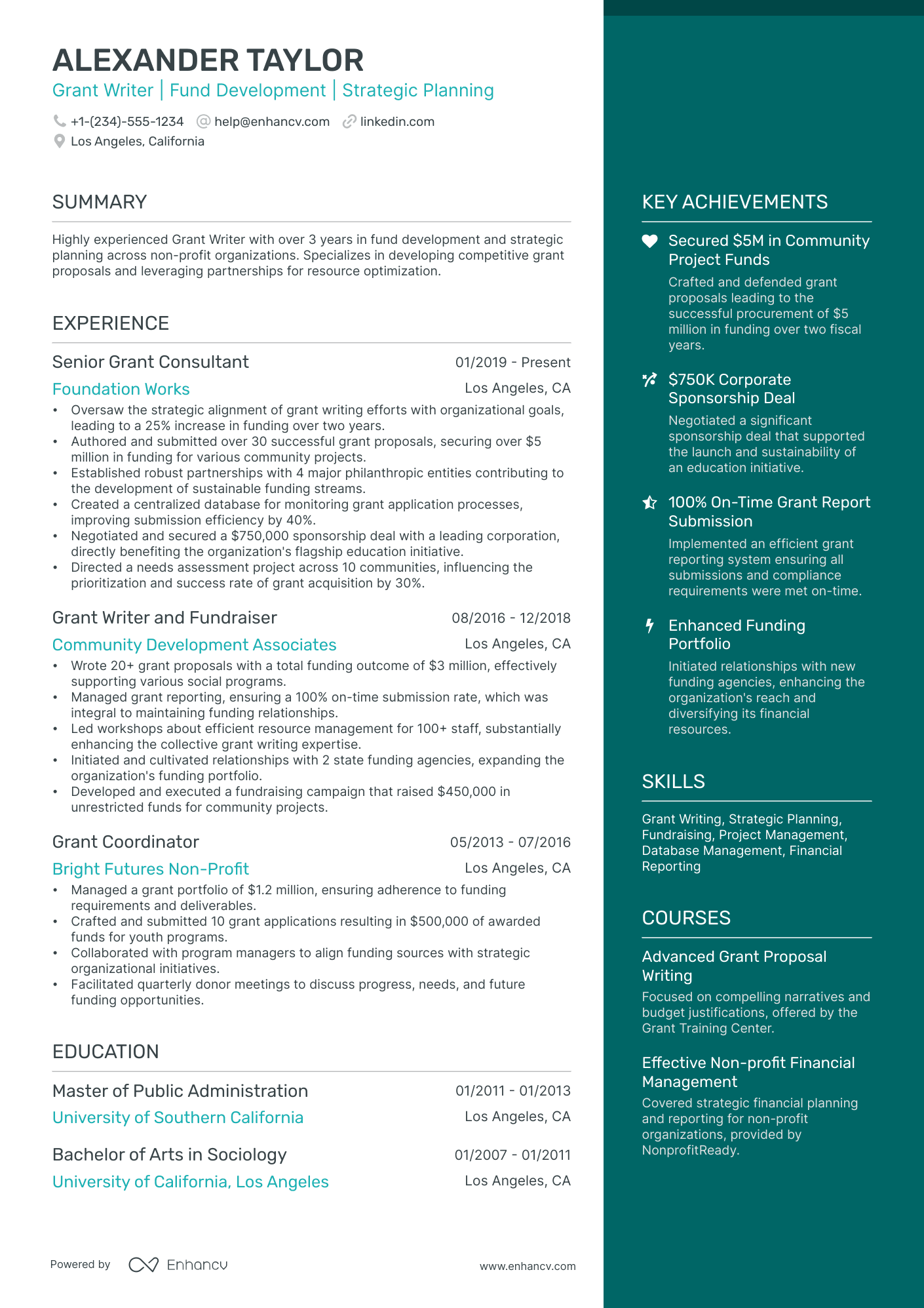
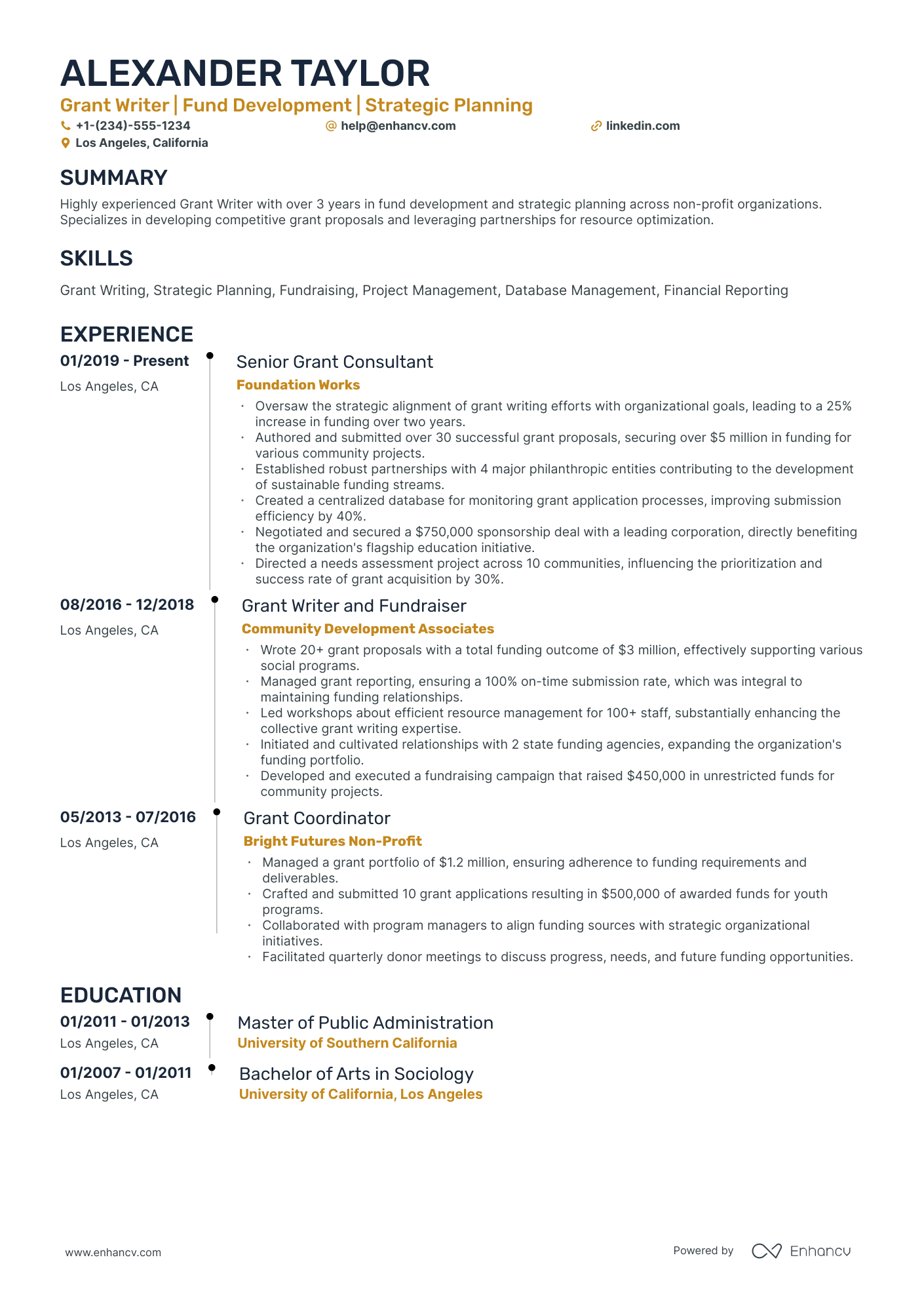
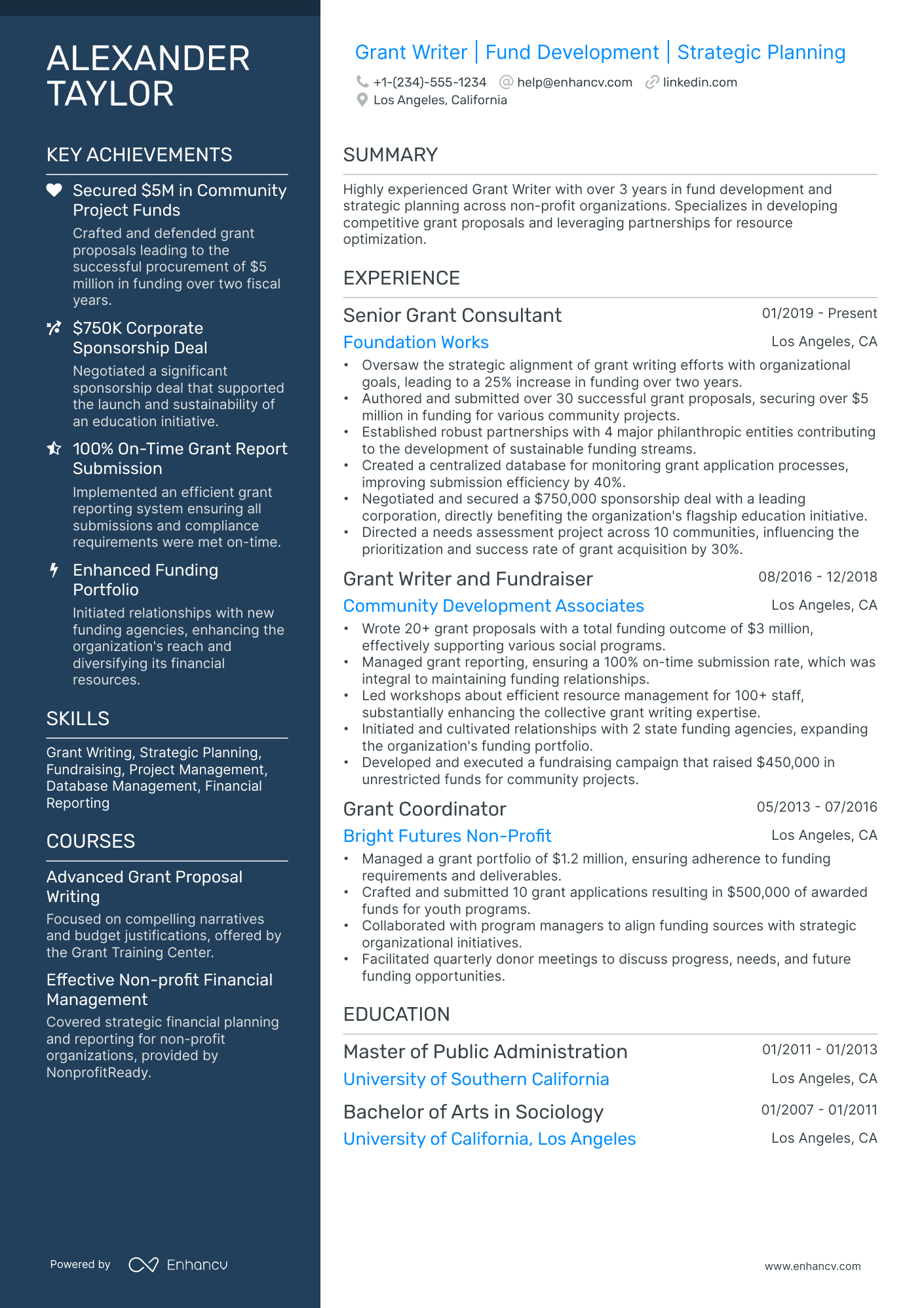
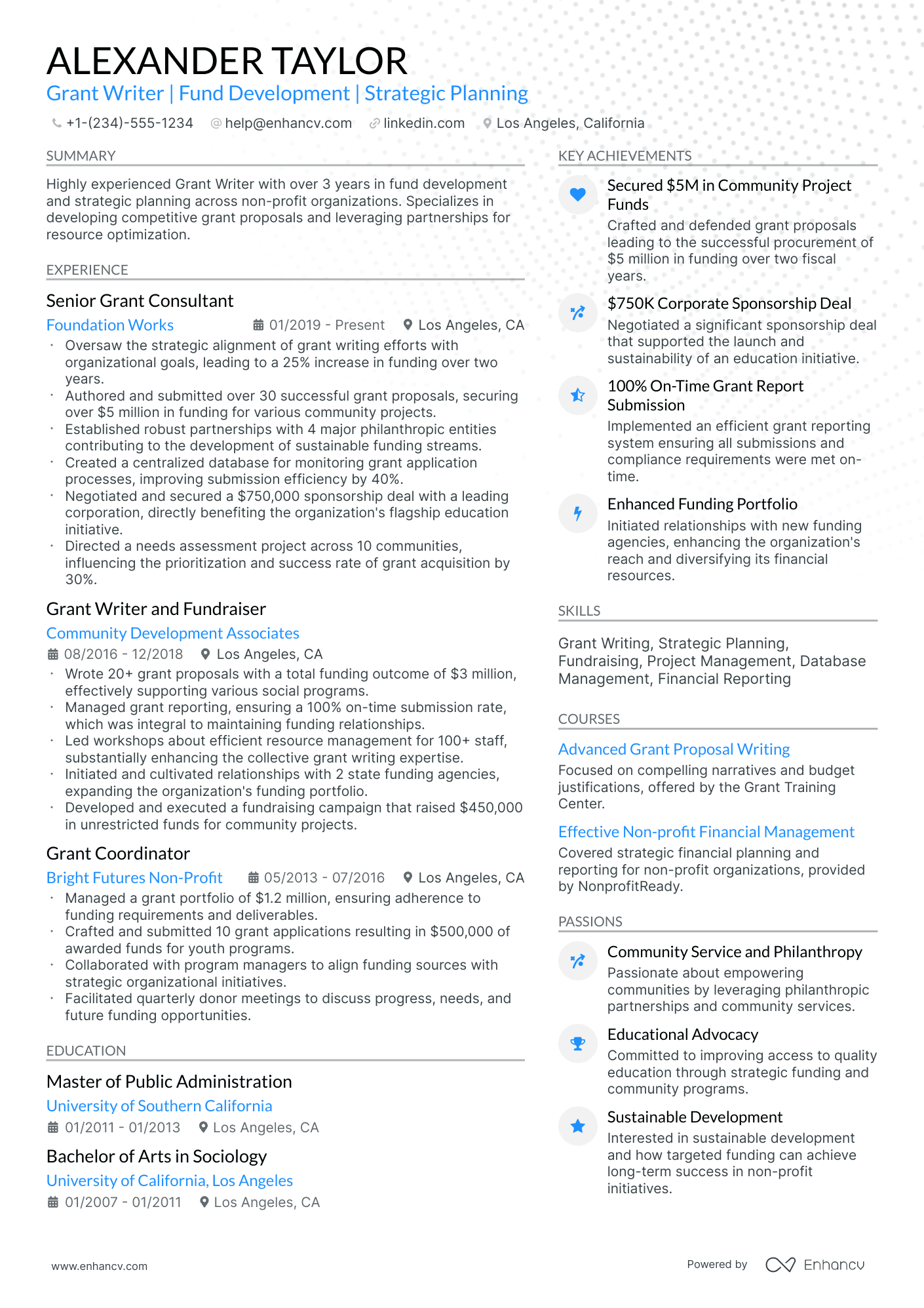
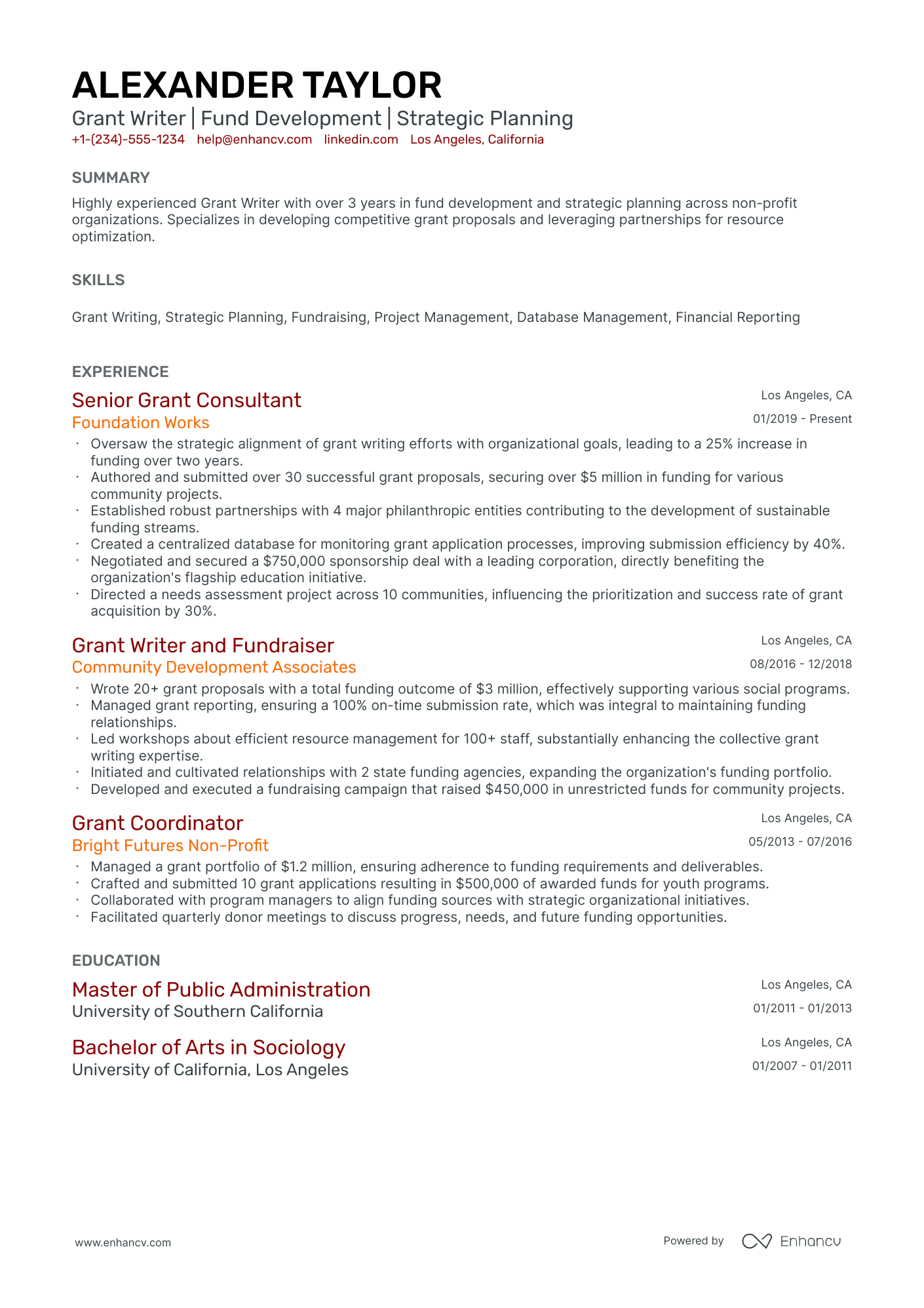
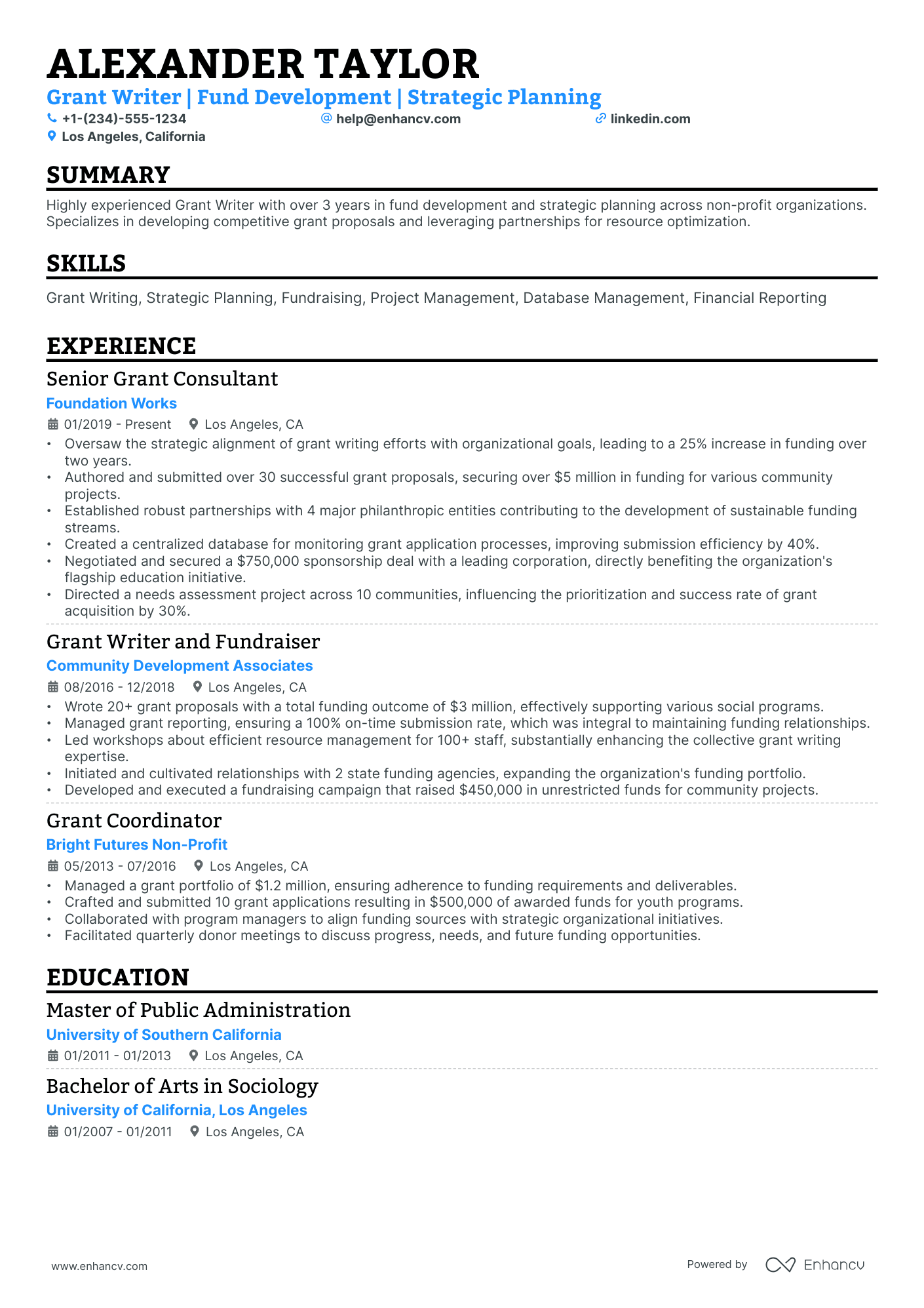
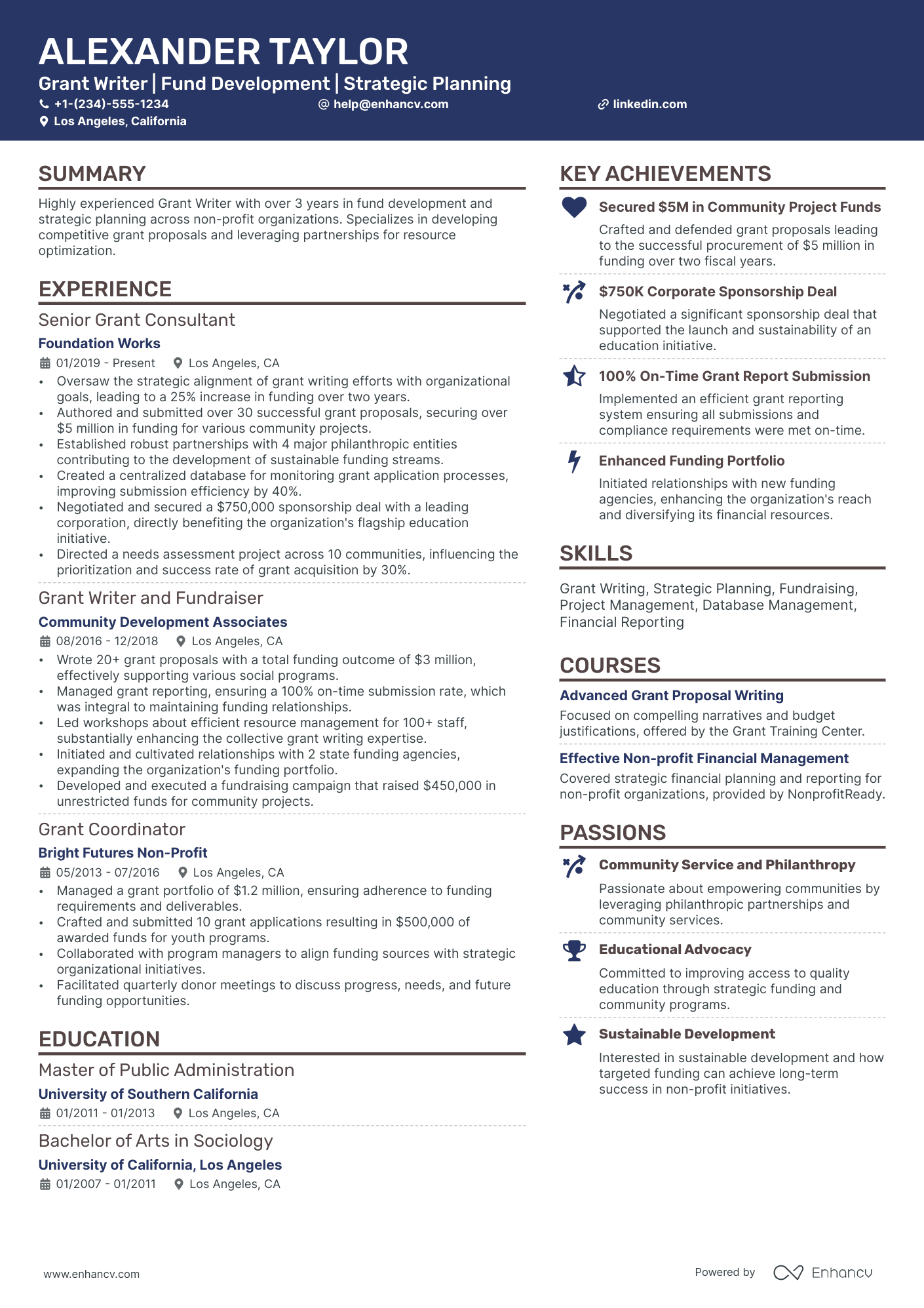
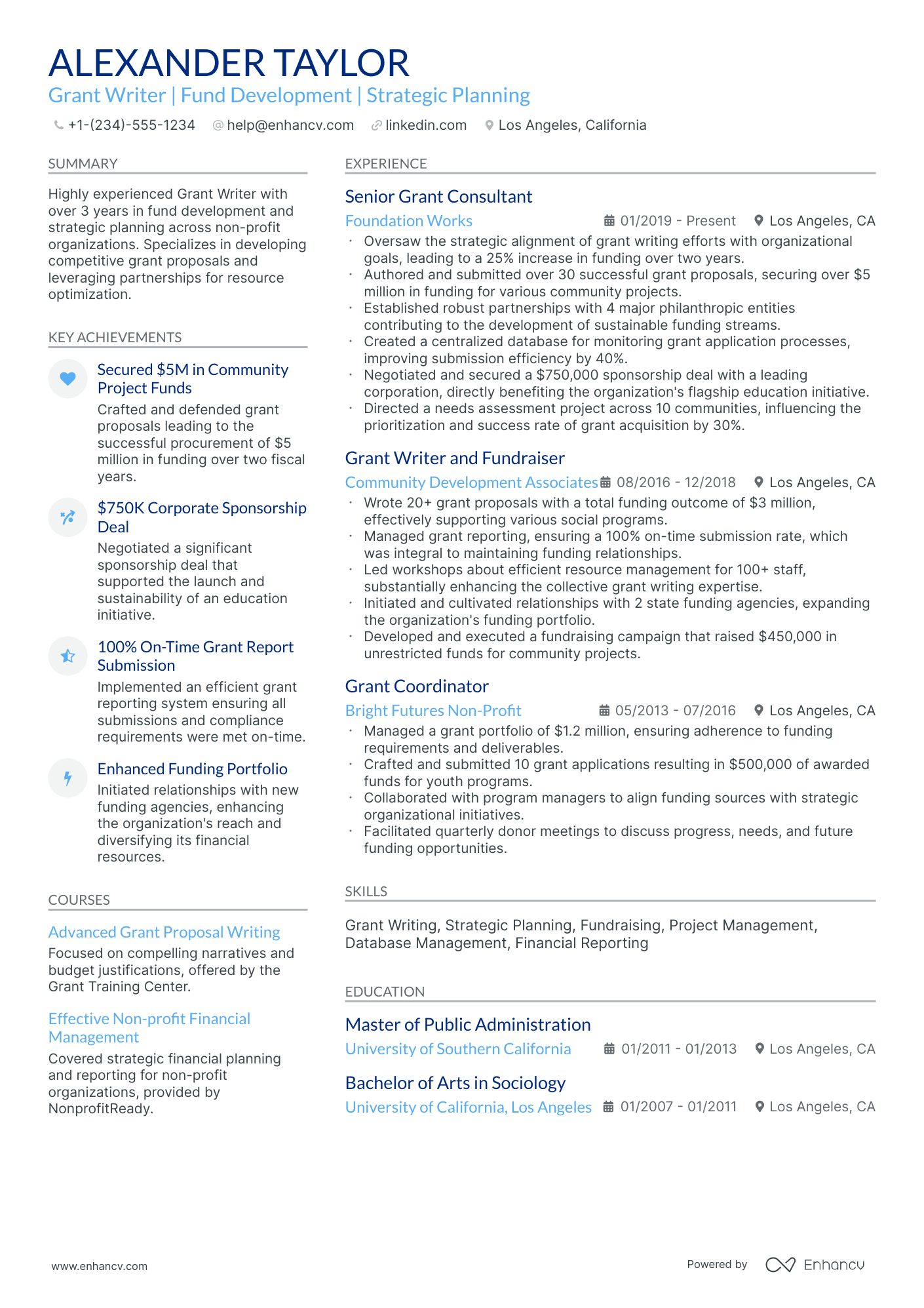
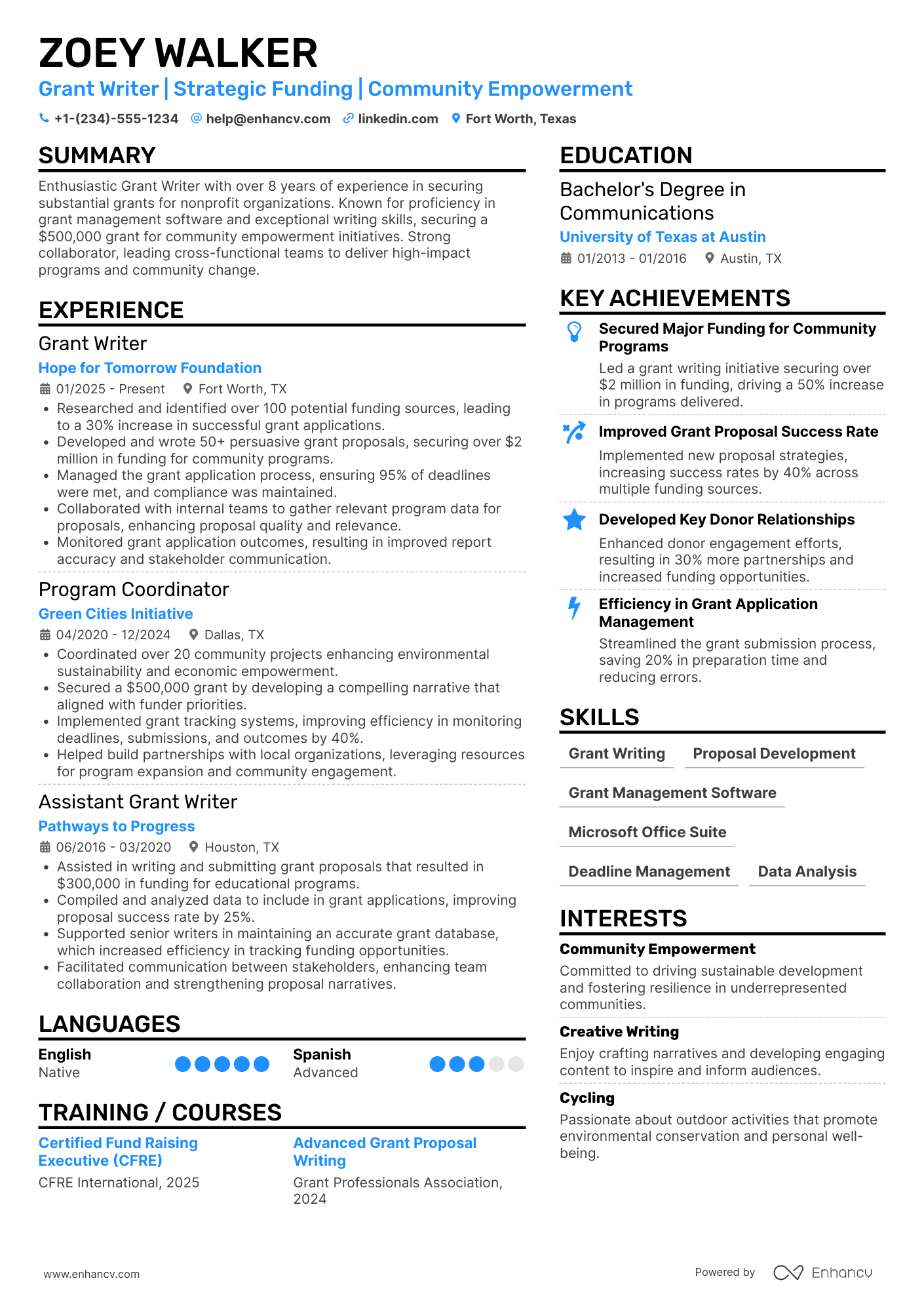
Grant writer resume submissions often fail because they read like task logs, not funding wins. That hides impact in ATS screening and quick recruiter scans, where dozens of applicants compete for limited attention.
A strong resume shows what you secured and what changed because of your work. Knowing how to make your resume stand out starts with highlighting dollars won, win rates, portfolio size, submission volume, on-time delivery, audit-ready compliance, and programs launched or expanded through funded awards.

Key takeaways
- Quantify every bullet with dollars secured, win rates, and submission volume.
- Use reverse-chronological format when you have a funded grant writing track record.
- Tailor each resume to mirror the job posting's tools, funders, and compliance standards.
- Demonstrate skills inside experience bullets, not only in a standalone skills list.
- Lead your summary with years of experience, sectors served, and one measurable win.
- Volunteer proposals, academic projects, and LOIs count as experience for entry-level candidates.
- Use Enhancv to turn vague grant writing duties into measurable, recruiter-ready resume bullets.
How to format a grant writer resume
Recruiters evaluating grant writer resumes prioritize a clear track record of funded proposals, dollar amounts secured, and familiarity with funder guidelines across federal, state, and foundation sources. The right resume format ensures these signals—funding outcomes, compliance expertise, and writing proficiency—are immediately visible rather than buried beneath formatting that obscures your progression.

I have significant experience in this role—which format should I use?
Use a reverse-chronological format to showcase your deepening grant writing expertise and growing portfolio of funded awards over time. Do:
- Lead each role entry with the scope of your grant portfolio, including the types of funders managed (federal, corporate, foundation) and the size of budgets you oversaw.
- Highlight proficiency with role-specific tools and domains such as Grants.gov, SAM.gov, Logic Model development, CFDA research, and compliance frameworks like 2 CFR 200.
- Quantify outcomes with dollar amounts awarded, success rates, and organizational impact tied directly to your proposals.
I'm junior or switching into this role—what format works best?
A hybrid format works best because it lets you lead with transferable writing and research skills while still providing a concise work history that demonstrates professional context. Do:
- Place a dedicated skills section near the top of your resume featuring grant-relevant competencies such as prospect research, proposal writing, budget narratives, and funder relationship management.
- Include academic projects, freelance proposals, volunteer grant work, or nonprofit internships that demonstrate direct experience with funding applications or donor communications.
- Connect every listed skill or project to a concrete action and a measurable or observable result.
Why not use a functional resume?
A functional format strips away the timeline and organizational context that hiring managers need to evaluate how your grant writing skills developed and where your funded outcomes actually occurred, making it harder to verify your claims. A functional format may be acceptable if you're transitioning from a related field (such as technical writing, nonprofit communications, or fundraising coordination) with limited formal grant writing titles—but only if you anchor every listed skill to a specific project, proposal, or measurable funding outcome rather than presenting abilities in the abstract.
Now that you've established a clean, readable layout, it's time to fill it with the right sections that highlight your grant writing qualifications.
What sections should go on a grant writer resume
Recruiters expect a grant writer resume to show you can win funding through strong research, persuasive writing, and compliant submissions. Knowing what to put on a resume helps you prioritize the sections that matter most.
Use this structure for maximum clarity:
- Header
- Summary
- Experience
- Skills
- Projects
- Education
- Certifications
- Optional sections: Awards, Publications, Volunteering
Strong experience bullets should emphasize dollars secured, win rates, submission volume, stakeholder coordination, compliance accuracy, and measurable program outcomes tied to funded grants.
Is your resume good enough?
Drop your resume here or choose a file. PDF & DOCX only. Max 2MB file size.
Once you’ve organized your resume with the right components, focus next on writing your grant writer experience section to show how your work delivers results.
How to write your grant writer resume experience
The experience section is where you prove you can move grant projects from concept to funded reality—showcasing the proposals you've shipped, the research and compliance tools you've used, and the measurable funding outcomes you've secured. Hiring managers prioritize demonstrated impact over descriptive task lists, so every line should connect your work to dollars raised, deadlines met, or organizational capacity strengthened.
Each entry should include:
- Job title
- Company and location (or remote)
- Dates of employment (month and year)
Three to five concise bullet points showing what you owned, how you executed, and what outcomes you delivered:
- Ownership scope: the grant portfolios, funding pipelines, proposal cycles, program areas, or funder relationships you were directly accountable for as a grant writer.
- Execution approach: the prospect research databases, compliance frameworks, budget development methods, or grant management platforms you used to identify opportunities, build narratives, and submit deliverables on time.
- Value improved: changes to award rates, funding diversification, reporting accuracy, proposal turnaround time, or compliance reliability that resulted from your work.
- Collaboration context: how you partnered with program staff, finance teams, executive leadership, government agencies, or foundation officers to align proposals with organizational goals and funder priorities.
- Impact delivered: outcomes expressed through funding secured, grant renewals sustained, capacity expanded, or strategic funding goals advanced—framed as results rather than activities.
Experience bullet formula
A grant writer experience example
✅ Right example - modern, quantified, specific.
Senior Grant Writer
BrightPath Community Health | Remote
2021–Present
Federally qualified health center network serving eighty thousand patients annually across three states, focused on expanding access to primary care and behavioral health.
- Secured $6.8M across twelve awards by leading end-to-end submissions in Instrumentl and Salesforce Nonprofit Cloud, aligning narratives, budgets, and attachments to federal and foundation requirements.
- Increased proposal win rate from twenty-two percent to thirty-four percent by building a reusable content library in SharePoint and maintaining a funder-specific compliance checklist in Smartsheet.
- Cut application cycle time by thirty percent by standardizing templates in Microsoft Word and Adobe Acrobat, implementing version control, and coordinating reviews with finance, clinical leadership, and legal.
- Improved scoring competitiveness by translating program outcomes into logic models and evaluation plans, partnering with data analysts to validate KPIs in Tableau and reduce reporting discrepancies by forty percent.
- Reduced audit and compliance risk by eliminating one hundred percent of late submissions over eighteen months through a milestone calendar, stakeholder sign-offs, and weekly cross-functional standups with program managers and executives.
Now that you've seen how to structure your experience entries, let's focus on aligning them with the specific requirements of each job posting.
How to tailor your grant writer resume experience
Recruiters evaluate your grant writer resume through both applicant tracking systems and human review, so alignment with the job posting matters. Tailoring your resume to the job description ensures your qualifications directly mirror what each organization needs.
Ways to tailor your grant writer experience:
- Match grant management platforms and databases named in the posting.
- Use the exact terminology for funding types the employer specifies.
- Mirror reporting metrics or outcome measures the organization tracks.
- Include sector experience such as nonprofit healthcare or education backgrounds.
- Highlight federal or state compliance standards referenced in the listing.
- Reflect collaborative workflows with program staff or leadership teams.
- Align your proposal development process with their stated methodology.
- Emphasize funder stewardship or relationship management if the role requires it.
Tailoring means aligning your real accomplishments with each job's stated requirements, not forcing disconnected keywords into your experience.
Resume tailoring examples for grant writer
| Job description excerpt | Untailored | Tailored |
|---|---|---|
| Develop and submit federal grant proposals through Grants.gov, with a focus on NIH and NSF funding opportunities for biomedical research programs. | Wrote grant proposals for various organizations and funding sources. | Drafted and submitted 12+ federal grant proposals annually through Grants.gov, securing $3.2M in NIH and NSF funding for biomedical research initiatives. |
| Manage the full grant lifecycle—from prospect research and LOI development to post-award reporting—using Fluxx grant management software. | Handled grant-related tasks including writing and reporting. | Managed the full grant lifecycle for a portfolio of 30+ active awards, from prospect research and LOI development through post-award reporting, using Fluxx to track deadlines and deliverables. |
| Collaborate with program directors to write compelling narratives for state and foundation grants supporting K–12 STEM education initiatives, ensuring alignment with funder priorities. | Worked with team members to prepare grant applications. | Partnered with four program directors to write outcome-driven narratives for state and foundation proposals, aligning K–12 STEM education goals with funder priorities and achieving a 68% award rate. |
Once you’ve aligned your experience with the role’s priorities, the next step is to quantify your grant writer achievements so hiring teams can quickly see the impact behind that fit.
How to quantify your grant writer achievements
Quantifying your achievements proves you drive funding, reduce risk, and speed approvals. Focus on dollars awarded, win rates, submission volume, turnaround time, compliance accuracy, and stakeholder response times across proposals, reports, and audits.
Quantifying examples for grant writer
| Metric | Example |
|---|---|
| Funding secured | "Won $1.2M across eight foundation grants in twelve months by rewriting narratives, aligning outcomes, and managing submissions in Salesforce." |
| Win rate | "Improved proposal win rate from 18% to 31% over two quarters by tightening evaluation criteria mapping and adding a reviewer checklist in Google Docs." |
| Cycle time | "Cut average submission turnaround from twenty-one to fourteen days by building a Smartsheet timeline and standardizing templates for twelve programs." |
| Compliance accuracy | "Reduced compliance errors to zero across fifteen federal submissions by using a requirements matrix and running final checks against Grants.gov forms." |
| Reporting throughput | "Delivered thirty-four quarterly and annual grant reports on time for ten funders, tracking milestones in Asana and reconciling budgets with finance." |
Turn vague job duties into measurable, recruiter-ready resume bullets in seconds with Enhancv's Bullet Point Generator.
Now that your bullet points clearly convey your impact, it's equally important to highlight the specific hard and soft skills that reinforce your qualifications throughout your grant writer resume.
How to list your hard and soft skills on a grant writer resume
A well-organized skills section shows you can research funders, write compliant proposals, and manage deadlines, and recruiters and an ATS (applicant tracking system) scan them to match requirements—most grant writer resumes lean slightly heavier on hard skills than soft skills. grant writer roles require a blend of:
- Product strategy and discovery skills.
- Data, analytics, and experimentation skills.
- Delivery, execution, and go-to-market discipline.
- Soft skills.
Your skills section should be:
- Scannable (bullet-style grouping).
- Relevant to the job post.
- Backed by proof in experience bullets.
- Updated with current tools.
Place your skills section:
- Above experience if you're junior or switching careers.
- Below experience if you're mid/senior with strong achievements.

Hard skills
- Grant proposal writing
- Funder prospect research
- Request for proposal analysis
- Logic models, theory of change
- Program design and outcomes
- Budget narratives and cost breakdowns
- Monitoring and evaluation metrics
- Compliance and reporting, Uniform Guidance
- Grant management systems, Salesforce
- Microsoft Excel, Google Sheets
- Microsoft Word, Google Docs
- Proposal calendars and deadline tracking
Soft skills
- Translate programs into funder language
- Align stakeholders on proposal strategy
- Interview subject matter experts efficiently
- Ask targeted clarifying questions
- Prioritize high-probability opportunities
- Manage multiple deadlines reliably
- Write clearly under tight constraints
- Incorporate feedback without scope creep
- Flag compliance risks early
- Coordinate cross-functional inputs end-to-end
- Maintain version control discipline
- Communicate status and next steps crisply
How to show your grant writer skills in context
Skills shouldn't live only in a dedicated skills list. Explore resume skills examples to see how grant writers weave competencies into real accomplishments.
They should be demonstrated in:
- Your summary (high-level professional identity)
- Your experience (proof through outcomes)
Here's what that looks like in practice.
Summary example
Senior grant writer with 10 years in public health funding. Skilled in federal proposal development, Grants.gov, and budget narrative design. Secured $12M across NIH and CDC cycles through cross-departmental collaboration and data-driven storytelling.
- Reflects senior-level expertise clearly
- Names role-relevant tools and platforms
- Leads with a measurable funding outcome
- Highlights collaboration as a soft skill
Experience example
Senior Grant Writer
Horizon Health Partners | Remote
June 2019–Present
- Wrote 45+ federal and foundation proposals using Grants.gov, securing $8.4M in cumulative funding over four years.
- Partnered with program directors and finance teams to develop compliant budget narratives, reducing revision cycles by 30%.
- Designed a reusable proposal template library in SharePoint, cutting first-draft turnaround time by two weeks across the department.
- Every bullet includes measurable proof.
- Skills appear naturally within achievements.
Once you’ve demonstrated your grant writing strengths through relevant examples and outcomes, the next step is to apply that same approach to building a grant writer resume when you don’t have formal experience.
How do I write a grant writer resume with no experience
Even without full-time experience, you can demonstrate readiness through:
- Nonprofit volunteer grant research.
- Scholarship or fellowship applications.
- University program funding proposals.
- Fundraising campaign impact reports.
- Budget tracking for student groups.
- Grant database prospecting projects.
- Proposal writing for capstones.
- Compliance checklists for programs.
If you're building a resume without work experience, focus on:
- Quantified funding outcomes and targets.
- Grant research sources and methods.
- Proposal sections you owned end-to-end.
- Budgets, timelines, and compliance.
Resume format tip for entry-level grant writer
Use a combination resume format because it highlights grant writer skills and projects first, while still showing relevant roles and volunteering. Do:
- Add a "Grant writer projects" section.
- Name funders, programs, and deadlines.
- Quantify dollars requested and awarded.
- List tools like Instrumentl, Excel.
- Attach writing samples and links.
- Researched ten local foundation prospects in Instrumentl, built an Excel tracker, and drafted a two-page LOI, helping secure a $5,000 award for a student nonprofit.
Even without direct grant writing experience, your education section can demonstrate the foundational knowledge and relevant coursework that qualify you for the role.
How to list your education on a grant writer resume
Your education section helps hiring teams confirm you have the foundational knowledge for grant writing. It validates skills in research, communication, and nonprofit management relevant to the grant writer role.
Include:
- Degree name
- Institution
- Location
- Graduation year
- Relevant coursework (for juniors or entry-level candidates)
- Honors & GPA (if 3.5 or higher)
Skip month and day details—list the graduation year only.
Here's a strong education entry tailored to the grant writer role.
Example education entry
Bachelor of Arts in English and Professional Writing
University of Michigan, Ann Arbor, MI
Graduated 2021
GPA: 3.7/4.0
- Relevant Coursework: Grant Writing & Fundraising Strategy, Nonprofit Administration, Technical Communication, Research Methods
- Honors: Magna Cum Laude, Dean's List (six semesters)
How to list your certifications on a grant writer resume
Certifications on a resume show a grant writer's commitment to learning, proficiency with common tools, and relevance to funder expectations across sectors.
Include:
- Certificate name
- Issuing organization
- Year
- Optional: credential ID or URL
- Place certifications below education when they are older, less relevant, or supplemental to your core grant writer qualifications.
- Place certifications above education when they are recent, highly relevant, or required for the grant writer roles you target.
Best certifications for your grant writer resume
Grant Professionals Certification (GPC) Certified Fund Raising Executive (CFRE) Certificate in Grant Writing Certificate in Nonprofit Management Nonprofit Financial Stewardship Certificate Project Management Professional (PMP) Certified Research Administrator (CRA)
Once you’ve positioned your credentials where hiring teams can find them quickly, shift to your grant writer resume summary to connect those qualifications to the impact you deliver.
How to write your grant writer resume summary
Your resume summary is the first thing a recruiter reads. A strong one instantly signals you have the skills and results that match the grant writer role.
Keep it to three to four lines, with:
- Your title and total years of grant writing experience.
- The sectors you've worked in, such as nonprofit, education, or government.
- Core skills like prospect research, budget development, and proposal writing.
- One or two measurable wins, such as funding secured or success rates.
- Soft skills tied to real outcomes, like stakeholder collaboration that shortened review cycles.

PRO TIP
At a junior or mid-level grant writer role, lead with your strongest relevant skills and tools. Highlight early wins like proposals funded or dollars raised. Avoid vague phrases like "passionate self-starter" or "detail-oriented team player." Recruiters want specifics—name the grant types, funding amounts, and sectors you know best.
Example summary for a grant writer
Grant writer with three years of experience in nonprofit and education sectors. Secured over $1.2 million in federal and foundation funding. Skilled in prospect research, LOI development, and cross-department collaboration.
Optimize your resume summary and objective for ATS
Drop your resume here or choose a file.
PDF & DOCX only. Max 2MB file size.
Now that your summary is ready to showcase your qualifications, make sure the header above it presents your contact details correctly so hiring managers can actually reach you.
What to include in a grant writer resume header
A resume header is the top section with your identity and contact details, and it boosts visibility, credibility, and recruiter screening for a grant writer.
Essential resume header elements
- Full name
- Tailored job title and headline
- Location
- Phone number
- Professional email
- GitHub link
- Portfolio link
A LinkedIn link helps recruiters verify experience quickly and supports faster screening.
Don't include a photo on a grant writer resume unless the role is explicitly front-facing or appearance-dependent.
Match your header job title and headline to the grant writer posting and mirror the same keywords used in the role summary.
Example
Grant writer resume header
Jordan Taylor
Grant writer | Federal and foundation proposals, compliance, and reporting
Chicago, IL
(312) 555-01XX
jordan.taylor@enhancv.com
github.com/jordantaylor
jordantaylor.com
linkedin.com/in/jordantaylor
Once your contact details and key identifiers are clear at the top of your resume, add targeted additional sections to reinforce your qualifications and support your application.
Additional sections for grant writer resumes
When your core qualifications match other applicants, well-chosen additional sections can set your grant writer resume apart with role-specific credibility. For example, listing language skills can be especially valuable if you work with international funders or multilingual communities.
- Languages
- Publications
- Professional affiliations
- Volunteer grant writing
- Awards and honors
- Certifications
- Conference presentations
Once you've rounded out your resume with the right supplementary sections, the next step is pairing it with a strong cover letter to make your application truly complete.
Do grant writer resumes need a cover letter
A cover letter isn't required for a grant writer, but it often helps. If you're wondering what a cover letter is and when it matters, it's most valuable in competitive searches, nonprofit roles with strict hiring expectations, or when your resume needs context.
Use a cover letter to add value in these situations:
- Explain role and team fit by matching your experience to the funder mix, proposal volume, and cross-functional partners.
- Highlight one or two relevant projects or outcomes, such as dollars awarded, win rate, renewal success, or compliance results.
- Show you understand the product, users, or business context by connecting your writing to the mission, programs, and measurable impact.
- Address career transitions or non-obvious experience by translating adjacent work into grant writer skills, like research, budgeting, and stakeholder management.
Drop your resume here or choose a file.
PDF & DOCX only. Max 2MB file size.
Once you’ve decided whether to include a cover letter to add context beyond your resume, the next step is using AI to improve your grant writer resume so it presents your experience more clearly and consistently.
Using AI to improve your grant writer resume
AI can sharpen your resume's clarity, structure, and overall impact. It helps you refine language and highlight measurable results. But overuse strips authenticity fast. Once your content feels clear and role-aligned, step away from AI. If you're curious about which AI is best for writing resumes, start with tools that focus on structure and quantification rather than generating content from scratch.
Here are 10 practical prompts to strengthen specific sections of your grant writer resume:
Strengthen your summary
Quantify experience bullets
Tighten action verbs
Tailor skills section
Clarify project descriptions
Improve education relevance
Refine certification entries
Eliminate filler language
Align with job posting
Boost results statements
Conclusion
A strong grant writer resume proves impact with measurable outcomes, like dollars awarded, win rates, and turnaround time. It highlights role-specific skills, including prospect research, proposal writing, budgeting, compliance, and stakeholder coordination. It stays easy to scan with clear headings and consistent formatting.
Hiring teams want grant writers who deliver results and work well across teams and systems. A focused summary, relevant experience, and targeted skills show you’re ready for today’s market and what comes next. Keep it clear, specific, and confident.