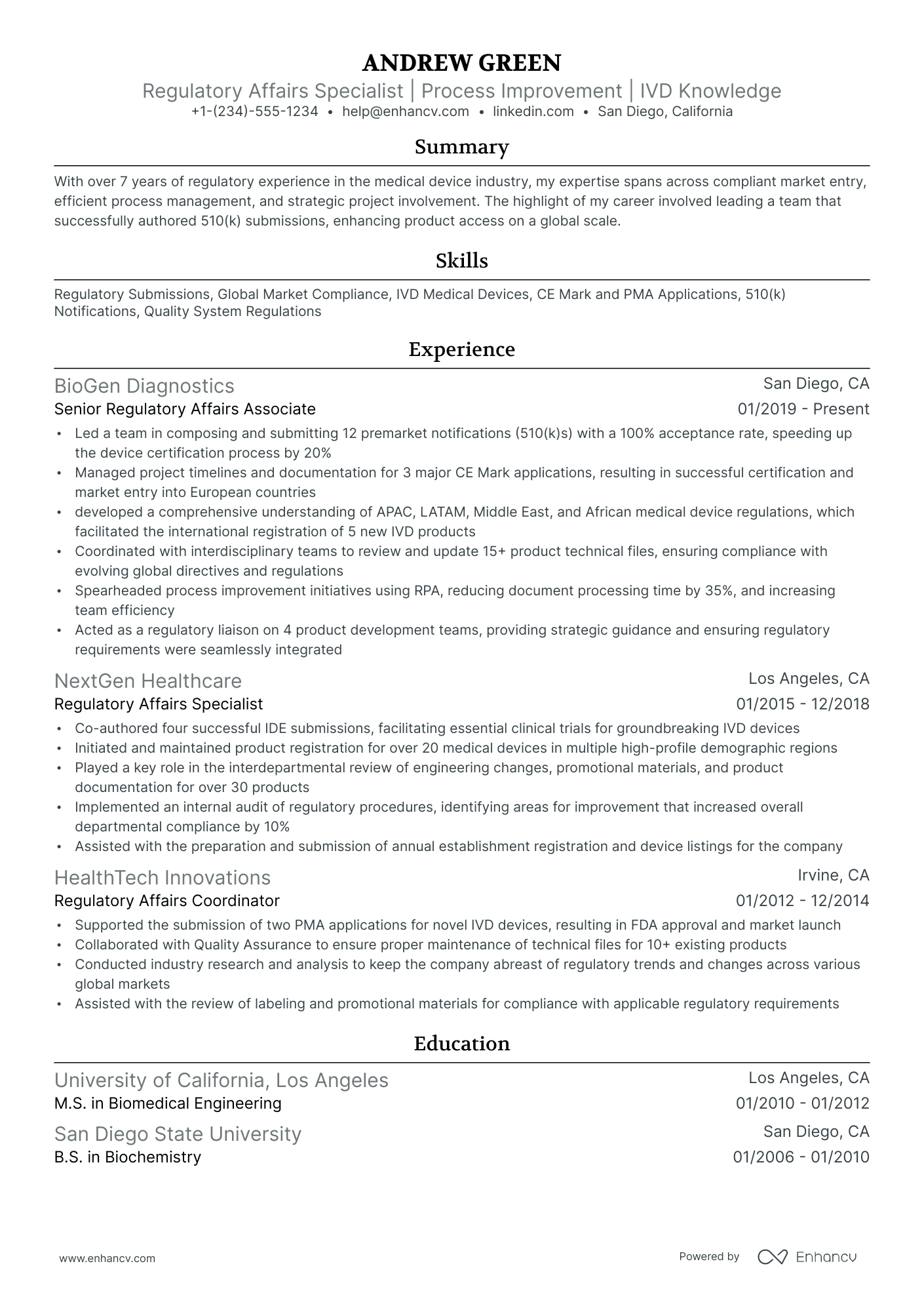
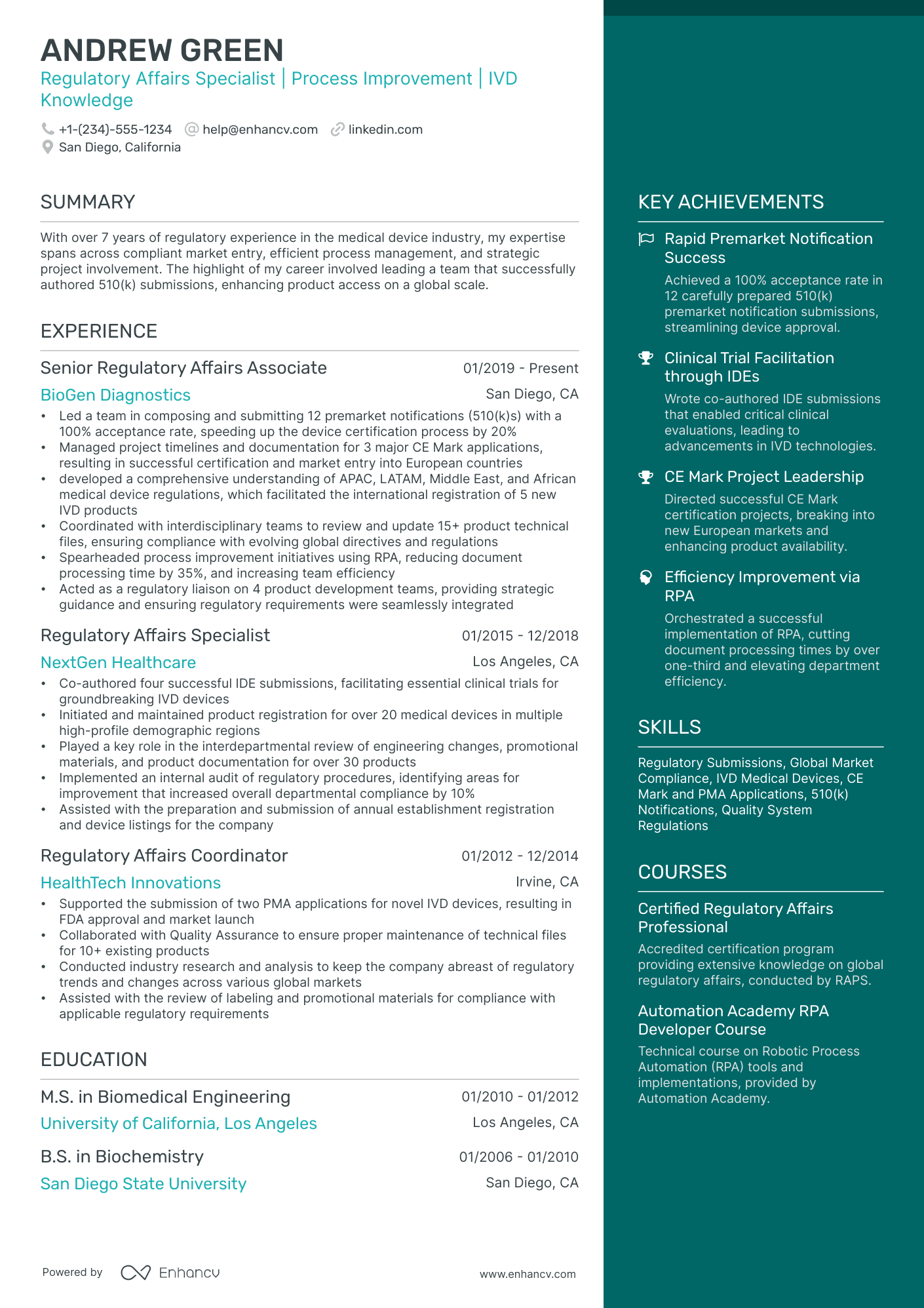
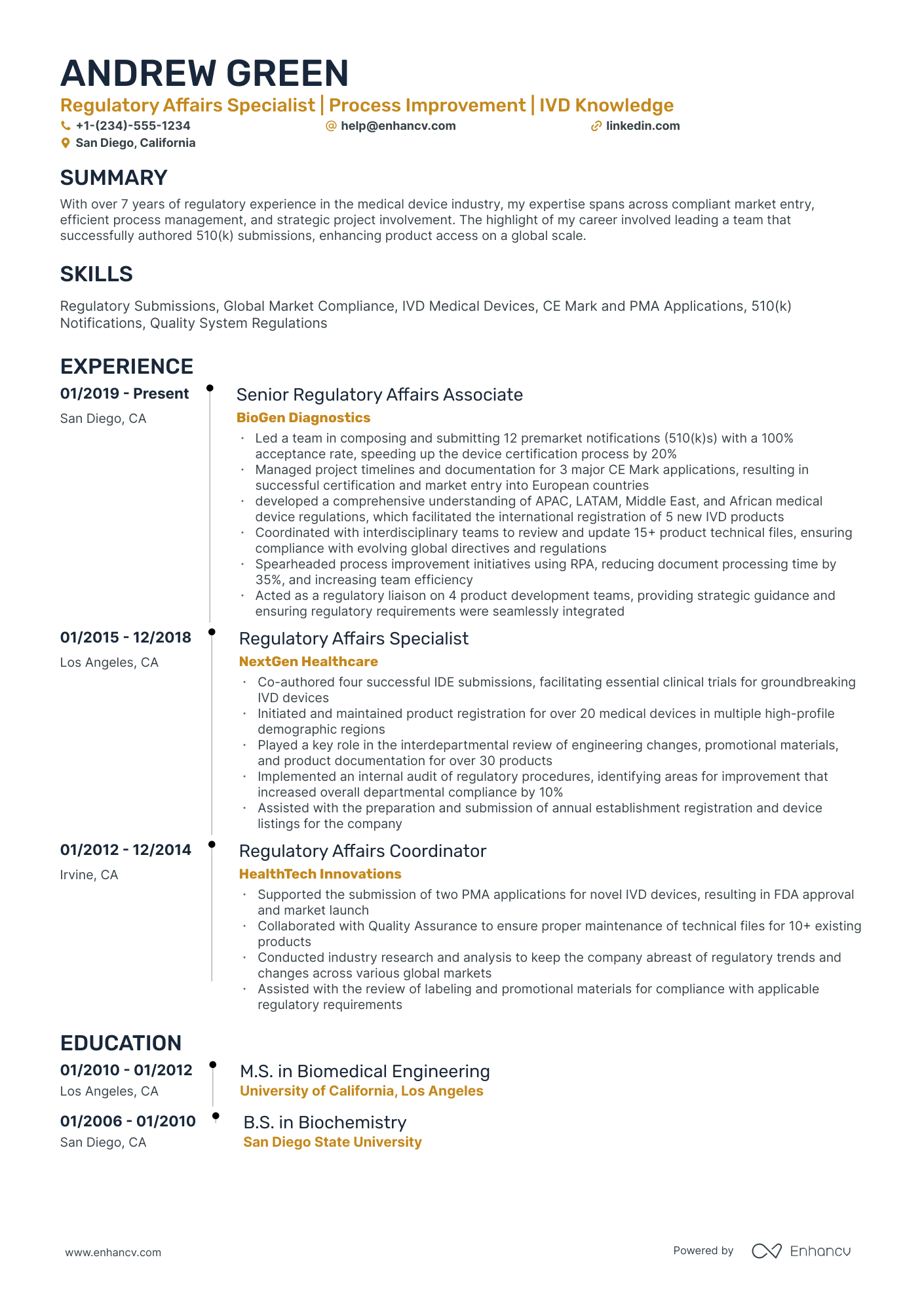
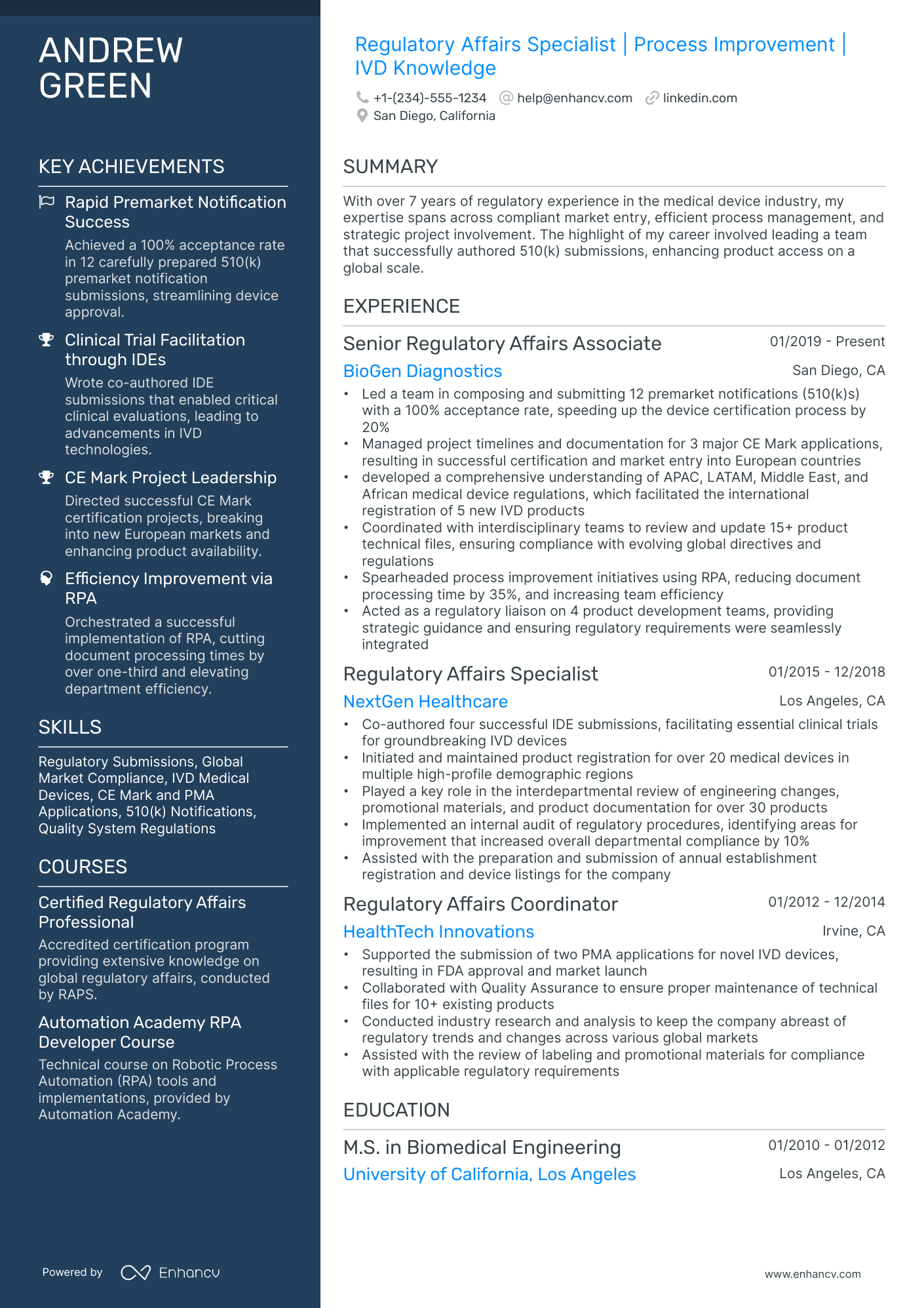
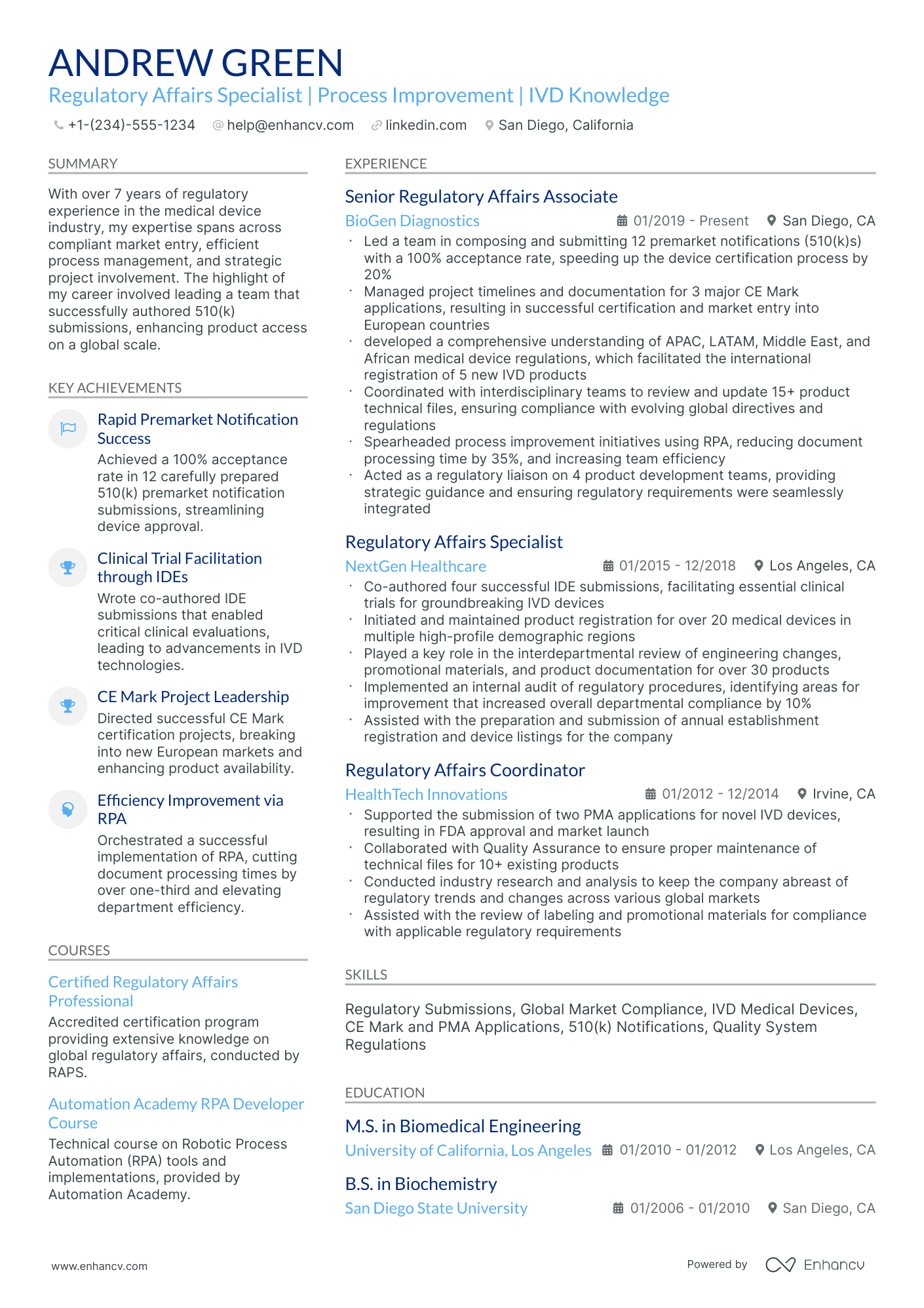
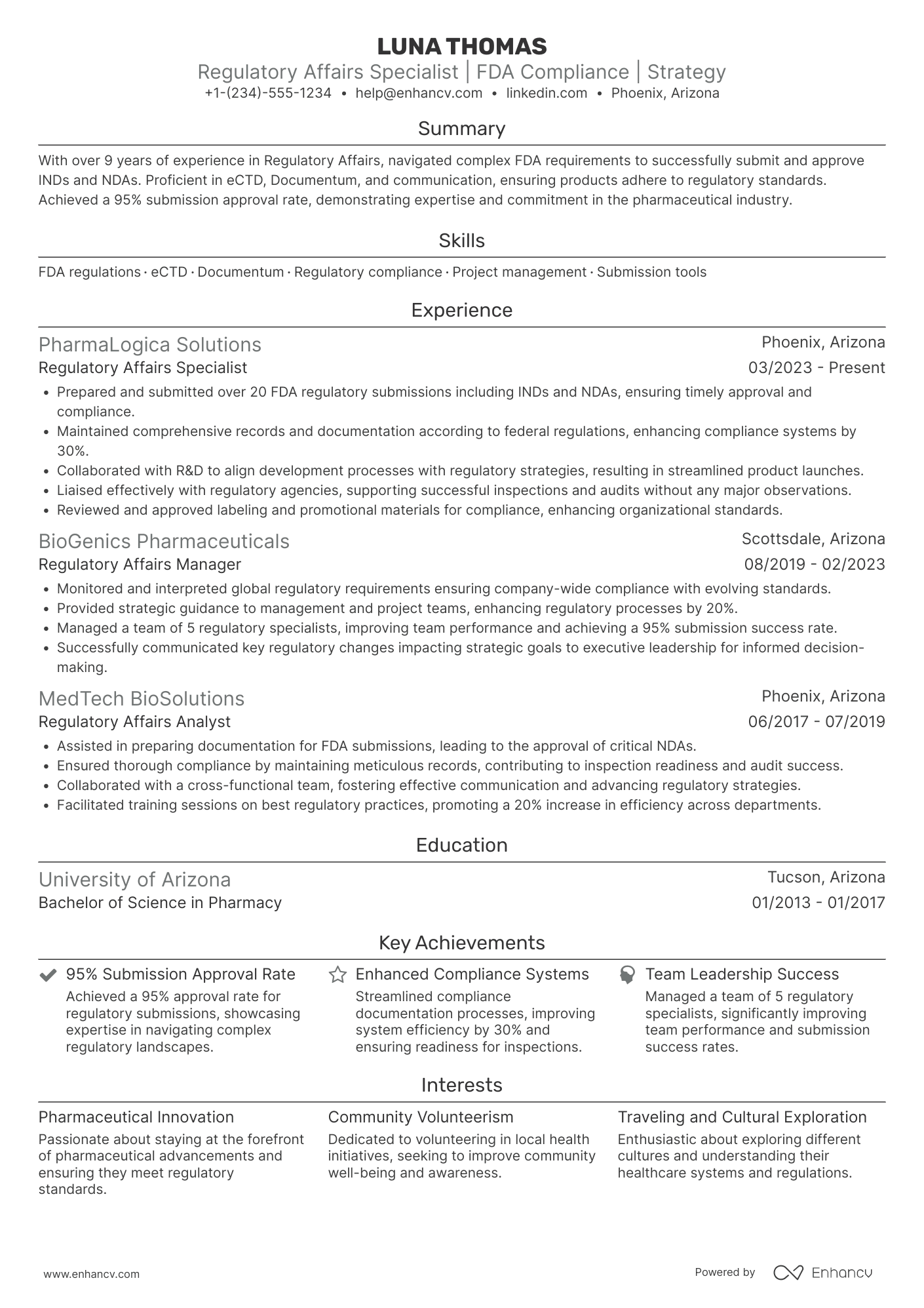
A regulatory affairs resume often lists every guidance document you know but hides the approvals you secured and the timelines you protected. Hiring managers scan fast, and applicant tracking system (ATS) filters match submission types to the posting.
When you write your resume for regulatory roles, lead with outcomes. Show Food and Drug Administration (FDA) clearances won, review cycles shortened, deficiency letters avoided, markets opened, and audits closed without findings.

Key takeaways
- Lead each bullet with an approval, clearance, or compliance result.
- Name the submission types and markets you've handled.
- Use a reverse-chronological format to show growing regulatory scope.
- Mirror the regulations and agencies each posting names.
- Quantify review timelines, approval counts, and audit outcomes.
- Use Enhancv's Bullet Point Generator to turn submission work into measurable bullets.
Job market snapshot for regulatory affairs professionals
We analyzed 566 recent regulatory affairs job ads from major US job boards. Healthcare employers posted 36.9% of them, and manufacturers posted 33.4%. Five to six years of experience is the most common requirement (24.4%). Use these numbers to gauge employer expectations, target the right industries, match your experience level, and find the companies hiring now.
What level of experience employers are looking for in regulatory affairs professionals
| Years of Experience | Percentage found in job ads |
|---|---|
| 1–2 years | 11.0% (62) |
| 3–4 years | 10.2% (58) |
| 5–6 years | 24.4% (138) |
| 7–8 years | 11.1% (63) |
| 10+ years | 18.9% (107) |
| Not specified | 24.4% (138) |
Regulatory affairs ads by area of specialization (industry)
| Industry (Area) | Percentage found in job ads |
|---|---|
| Healthcare | 36.9% (209) |
| Manufacturing | 33.4% (189) |
| Professional services | 9.5% (54) |
| Education | 4.4% (25) |
| Energy | 3.9% (22) |
| Retail & e-commerce | 3.9% (22) |
| Finance & insurance | 2.1% (12) |
| Technology | 1.8% (10) |
Top companies hiring regulatory affairs professionals
| Company | Percentage found in job ads |
|---|---|
| AbbVie | 6.7% (38) |
| Johnson & Johnson | 6.2% (35) |
| Medtronic | 3.9% (22) |
| Regeneron | 3.9% (22) |
| Gilead Sciences | 2.5% (14) |
| Northeastern University | 2.5% (14) |
Role overview stats
These tables show what regulatory affairs professionals do day to day. Ensuring regulatory compliance appears in 90.1% of ads, and preparing submissions appears in 71.2%. Match your bullets to the duties you've owned, and check whether your target roles run on-site, hybrid, or remote.
Day-to-day activities and top responsibilities for a regulatory affairs professional
| Responsibility | Percentage found in job ads |
|---|---|
| Ensure regulatory compliance | 90.1% (510) |
| Advise cross-functional teams | 77.7% (440) |
| Prepare regulatory submissions | 71.2% (403) |
| Interact with health authorities | 69.4% (393) |
| Manage global registrations | 60.4% (342) |
| Develop regulatory strategies | 52.1% (295) |
| Assess product changes | 42.0% (238) |
| Maintain regulatory documentation | 41.9% (237) |
| Review labeling and promotional materials | 40.6% (230) |
| Lead and mentor regulatory staff | 39.4% (223) |
| Support quality and audits | 37.5% (212) |
| Support product development | 35.9% (203) |
Type of employment (remote vs on-site vs hybrid)
| Employment type | Percentage found in job ads |
|---|---|
| On-site | 66.3% (375) |
| Hybrid | 24.2% (137) |
| Remote | 9.5% (54) |
How to format a regulatory affairs resume
Hiring managers in regulatory affairs look first for the submissions you led, the agencies you worked with, and your compliance record. A clear resume format puts those signals where a quick scan finds them.
Resume formatting strategy for regulatory affairs professionals
| Category | Senior & leadership strategy | Entry to mid-level strategy |
|---|---|---|
| Recommended format | Reverse-chronological | Reverse-chronological or hybrid |
| Core dos | Lead each role with the product portfolio, markets, and submission types you owned. Name the agencies you negotiated with, such as FDA or EMA. Tie every bullet to approvals, timelines, or audit results. | Put submission, documentation, and regulatory software skills near the top. Count quality, clinical, or lab work as transitional experience. Link each task to an outcome such as an on-time filing. |
| Example bullet | Led a six-person team through 14 global registrations for a cardiac device line, securing EU MDR certification three months ahead of plan. | eCTD publishing → compiled 9 annual reports and supplements → met every FDA deadline with zero technical rejections. |
| Format to avoid | Hybrid and functional formats strip your submissions of their dates and products. Hiring managers can't see how your regulatory scope grew over time. Avoid any layout that breaks the timeline at this level. | A functional format hides which products and agencies each skill came from. Edge cases: a move from quality assurance or the lab into regulatory affairs, or a return after a career gap. |
A functional resume only fits edge cases, and each skill on it still has to point to a project and a result.
Once the format shows your regulatory growth, the next step is deciding which sections carry the evidence.
What sections should go on a regulatory affairs resume?
Hiring managers expect clear resume sections that show the products you supported, the regulations you know, and the submissions you delivered.
Use this structure for maximum clarity:
- Header
- Summary
- Experience
- Skills
- Education
- Certifications
- Optional sections: Publications, Languages, Professional affiliations
Strong experience bullets should emphasize approvals secured, review timelines met, and the compliance results you protected.
Is your resume good enough?
Drop your resume here or choose a file. PDF & DOCX only. Max 2MB file size.
Experience is the section hiring managers check first, and it needs the most detail on a regulatory resume.
How to write your regulatory affairs resume experience
Your work experience should show the submissions you delivered, the regulations you applied, and tools like Veeva Vault RIM or eCTD publishing software. Hiring managers prioritize demonstrated impact on approvals and compliance over lists of documents you reviewed.
Each entry should include:
- Job title
- Company and location (or remote)
- Dates of employment (month and year)
Three to five concise bullet points showing what you owned, how you executed, and what outcomes you delivered:
- Ownership scope: the products, markets, and submission types you were accountable for in regulatory affairs
- Execution approach: the regulations, guidance documents, and systems such as Veeva Vault RIM you used to plan and file
- Value improved: changes to review timelines, first-pass acceptance, labeling accuracy, or audit readiness
- Collaboration context: how you worked with R&D, quality, clinical, and marketing teams to build compliant submissions
- Impact delivered: approvals, clearances, and market launches stated as timelines, counts, or risk reduced

Experience bullet formula
A regulatory affairs experience example
✅ Right example - modern, quantified, specific.
Regulatory Affairs Specialist
Pellwood Medical | Irvine, CA
2021–Present
Medical device maker selling cardiac and vascular products in 40 countries.
- Prepared and submitted 11 FDA 510(k) premarket notifications with R&D and quality, earning clearance for all 11 with an average review of 112 days.
- Built the EU MDR technical documentation plan for 3 legacy product families, earning CE marking six weeks ahead of the transition deadline.
- Reviewed 240 labeling and promotional pieces a year with marketing and legal, cutting revision cycles from four rounds to two.
- Managed product registrations in 18 markets through Veeva Vault RIM, keeping on-time renewals at 100% for two years.
- Coordinated the regulatory response to an FDA inspection with the quality team, closing 2 observations within 30 days.
That entry sets a clear bar, and tailoring adapts each one to the products and markets a specific employer covers.
How to tailor your regulatory affairs resume experience
Regulatory affairs resumes pass through an ATS first, then a hiring manager checks your submission history line by line. Using the posting's resume keywords where they match your real work aligns your experience with the role.
Ways to tailor your regulatory affairs experience:
- Match the submission types the posting names.
- Use the exact regulations and guidance the role cites.
- Mirror the product classes or therapeutic areas the company sells.
- Highlight the markets and agencies you've worked with.
- Emphasize labeling or promotional review when the posting mentions it.
- Name the regulatory systems and publishing tools the team uses.
- Reflect the cross-functional partners the role works with.
Tailoring puts your real regulatory record in the employer's terms, with no keywords forced in.
Resume tailoring examples for regulatory affairs professionals
| Job description excerpt | Untailored | Tailored |
|---|---|---|
| "Prepare and submit 510(k) and De Novo submissions for Class II medical devices." | Worked on FDA submissions. | Prepared 8 Class II 510(k) submissions and 1 De Novo request, earning clearance on all 9. |
| "Serve as the primary contact with health authorities and lead agency meetings." | Communicated with regulators. | Led 6 FDA pre-submission meetings as primary agency contact for 3 product lines, cutting additional-information requests by 40%. |
| "Review labeling, advertising, and promotional materials for compliance with FDA regulations." | Reviewed marketing materials. | Reviewed 300+ labeling and promotional pieces a year against FDA rules, with no FDA enforcement letters in four years. |
Tailoring shows you fit the role, and numbers show how well your submissions performed.
How to quantify your regulatory affairs achievements
Quantifying your results proves your regulatory work moved products to market safely. For this role, the numbers that matter are approval counts, review timelines, first-pass acceptance, audit findings, and markets opened.
Quantifying examples for regulatory affairs professionals
| Metric | Example |
|---|---|
| Approvals secured | "Secured 14 FDA 510(k) clearances in three years, with an average review time of 105 days." |
| Submission quality | "Raised first-pass eCTD acceptance from 82% to 100% by building a publishing checklist with the documentation team." |
| Speed to market | "Cut time from design freeze to submission by 5 weeks by running regulatory reviews alongside verification testing." |
| Global reach | "Registered a diagnostic product line in 12 new markets in 18 months, opening $9M in annual sales." |
| Audit outcomes | "Led regulatory readiness for 4 notified body audits, closing each with zero major nonconformities." |
Turn submission work and agency interactions into measurable, recruiter-ready bullets with Enhancv's Bullet Point Generator.
Those numbers show what you achieved, and your skills section shows the regulatory knowledge behind it.
How to list your hard and soft skills on a regulatory affairs resume
Hiring managers and ATS filters scan your skills section for regulations and submission expertise, and strong lists pair hard skills like eCTD publishing with soft skills like negotiating with regulators.
Regulatory affairs roles require a blend of:
- Regulatory strategy and submission skills
- Compliance and quality system skills
- Documentation and labeling skills
- Soft skills
Your skills section should be:
- Scannable (bullet-style grouping)
- Relevant to the job post
- Backed by proof in experience bullets
- Updated with current tools
Place your skills section:
- Above experience if you're junior or switching careers
- Below experience if you're mid/senior with strong achievements

Hard skills
- FDA 21 CFR regulations
- 510(k), De Novo, and PMA submissions
- IND and NDA submissions
- EU MDR and IVDR
- eCTD publishing
- Veeva Vault RIM
- ISO 13485
- ICH guidelines
- Labeling and promotional review
- Regulatory intelligence
- Change control assessments
- Post-market surveillance
Soft skills
- Negotiating with health authorities
- Translating regulations for engineers
- Writing clear, defensible documents
- Managing tight filing deadlines
- Influencing launch decisions
- Spotting compliance risk early
- Coordinating cross-functional input
- Staying calm during inspections
- Explaining trade-offs to leadership
- Precision with regulatory detail
How to show your regulatory affairs skills in context
Hiring managers believe resume skills when your work shows them, not only when they sit in a list.
Show them in:
- Your summary (high-level professional identity)
- Your experience (proof through outcomes)
Here's how a regulatory affairs professional can show them in context.
Summary example
Regulatory affairs specialist with six years in medical devices, skilled in 510(k) submissions, EU MDR, and labeling review. Secured 12 FDA clearances and cut average submission prep time by 25% through templated technical files.
- States level and product area
- Names submission types recruiters search
- Backs claims with two metrics
- Shows process improvement skills
Experience example
Regulatory Affairs Specialist
Halden Biologics | Remote
February 2021–Present
- Compiled 6 IND amendments in eCTD format with clinical and CMC teams, meeting every FDA deadline on the first submission.
- Built a regulatory intelligence tracker with quality, flagging 15 guidance changes and avoiding 2 late protocol revisions.
- Negotiated labeling updates with FDA reviewers alongside medical affairs, closing the review 3 weeks before the target action date.
- Each bullet ties skills to results
- Collaboration shows inside real work
Those examples assume years in regulatory roles, and candidates entering the field need another way to show readiness.
How do I write a regulatory affairs resume with no experience?
Even without full-time experience, you can demonstrate readiness through:
- Quality control or assurance roles
- Clinical research coordinator work
- Lab or R&D documentation work
- Regulatory affairs internships
- Graduate regulatory science projects
- Technical writing for medical products
- Compliance or audit support roles
Focus on:
- Documents you wrote or controlled
- Regulations you applied on real work
- Filings or reports finished on time
- Teams you coordinated across functions
Resume format tip for entry-level regulatory affairs professional
Use a hybrid format that leads with regulatory projects and documentation skills, then lists quality, lab, or clinical roles. A resume with no work experience in regulation still earns interviews when every skill points to a document, filing, or audit result. Do:
- Lead with two or three regulatory projects or capstones.
- Name the regulations and guidance documents you applied.
- Quantify documents, deadlines, or audits you supported.
- List regulatory software or document control systems you've used.
- Add a summary aimed at regulatory affairs roles.
- Drafted a mock 510(k) for a glucose monitor in a regulatory science capstone, scoring 96% against FDA's refuse-to-accept checklist.
Projects show applied knowledge, and your education section confirms the scientific training behind it.
How to list your education on a regulatory affairs resume
Your education section shows hiring teams the science and regulatory training behind your submissions, from biology to regulatory law.
Include:
- Degree name
- Institution
- Location
- Graduation year
- Relevant coursework (for juniors or entry-level candidates)
- Honors & GPA (if 3.5 or higher)
Give the graduation year only, and skip months and days.
Here's an education entry for a regulatory affairs professional:
Example education entry
Master of Science in Regulatory Science
University of Southern California, Los Angeles, CA
Graduated: 2019
GPA: 3.7/4.0
- Relevant Coursework: FDA Drug and Device Law, Clinical Trial Design, Quality Systems, Global Regulatory Strategy
- Honors: Graduate Merit Scholarship
Certifications usually follow education, and a recognized regulatory credential shows you've mastered the rules you'll apply every day.
How to list your certifications on a regulatory affairs resume
Listing certifications on a resume shows a regulatory affairs professional keeps learning, knows current submission tools, and follows the industry's changing rules.
Include:
- Certificate name
- Issuing organization
- Year
- Optional: credential ID or URL
- Place certifications below education when they're older or less tied to regulatory work.
- Place certifications above education when they're recent, regulatory-specific, or named in the posting.
Best certifications for your regulatory affairs resume
- Regulatory Affairs Certification (RAC-Drugs), RAPS
- Regulatory Affairs Certification (RAC-Devices), RAPS
- Certified Quality Auditor (CQA), ASQ
- Certified Biomedical Auditor (CBA), ASQ
- ISO 13485 Lead Auditor
- Certified Clinical Research Professional (CCRP), SOCRA
A current credential strengthens your profile, and your summary puts that strength in front of recruiters first.
How to write your regulatory affairs resume summary
Your resume summary tells a hiring manager which products, markets, and submissions you know before they read anything else. Three or four lines should show your level, focus, and best regulatory result.
Keep it to three to four lines, with:
- Your title and years in regulatory affairs.
- The product type you support, such as devices or biologics.
- Core regulations and submission types you know.
- One or two quantified results, such as approvals secured.
- Soft skills tied to outcomes, like smooth agency negotiations.

PRO TIP
At the mid level, lead with your product area, the submissions you own, and one approval or timeline result. Skip claims like "detail-oriented" or "compliance-minded," and let clean audits and on-time filings show those traits.
Example summary for a regulatory affairs professional
Regulatory affairs specialist with five years in pharmaceuticals, covering INDs, NDA supplements, and labeling. Managed 30+ eCTD submissions with zero technical rejections and helped secure approval for 2 new indications.
Optimize your resume summary and objective for ATS
Drop your resume here or choose a file.
PDF & DOCX only. Max 2MB file size.
A strong summary works best under a header that makes you easy to verify and reach.
What to include in a regulatory affairs resume header
A polished resume header gives your name, focus, and contact details, and it's the first sign of the precision regulatory work demands.
Essential resume header elements
- Full name
- Tailored job title and headline
- Location
- Phone number
- Professional email
A LinkedIn link lets hiring managers confirm your employers, product areas, and dates quickly.
Leave the photo off a regulatory affairs resume unless the role is explicitly front-facing or appearance-dependent.
Match the posting's title in your headline, such as regulatory affairs specialist, and name your product area.
Example
Regulatory affairs resume header
Rachel Moreno
Regulatory affairs specialist | Medical devices, 510(k), and EU MDR
San Diego, CA | (858) 555-01XX | rachel.moreno@enhancv.com linkedin.com/in/rachelmoreno
With the essentials covered, a few extra sections can add credibility specific to regulated industries.
Additional sections for regulatory affairs resumes
Extra sections help when they prove reach beyond your job history, such as foreign language skills for global submissions or articles in regulatory journals.
- Languages
- Publications
- Professional affiliations
- Conference presentations
- Regulatory training and workshops
- Volunteer work
Those sections show depth, and a cover letter lets you connect it to one company's products.
Do regulatory affairs resumes need a cover letter?
Many regulatory affairs postings list a cover letter as optional. A focused one helps when you're switching product areas, entering from quality or the lab, or applying to a competitive team.
Knowing what a cover letter should do helps you focus yours on:
- Product fit: Connect your submission experience to the company's product classes and markets.
- One approval: Describe a clearance or approval you drove and the timeline behind it.
- Regulatory awareness: Mention a recent rule change that affects the company's products.
- Career moves: Explain a move from quality, clinical, or lab work in one sentence.
Drop your resume here or choose a file.
PDF & DOCX only. Max 2MB file size.
Your letter adds context, and AI can help sharpen how the resume itself reads.
Using AI to improve your regulatory affairs resume
AI can tighten wording, organize sections, and surface the impact in your regulatory affairs resume. Use AI resume writing prompts on content you've drafted, and stop before the language turns vague or generic.
Try these prompts on specific sections:
- Lead with approvals: "Rewrite my regulatory affairs resume summary to lead with my product area, submission types, and one approval result."
- Quantify submissions: "Review my regulatory affairs experience bullets and suggest where to add approval counts, review timelines, or audit results."
- Name the regulations: "Rewrite my regulatory affairs bullets so each one names the regulation or guidance I applied."
- Fix weak verbs: "Replace weak verbs in my regulatory affairs experience section with precise verbs that show ownership of filings."
- Match the job post: "Compare my regulatory affairs skills section with this job description and list the regulations and tools to add or remove."
- Tailor by product type: "Adjust my regulatory affairs resume for a role in this product area, keeping only claims my experience supports."
- Sharpen project entries: "Edit the projects on my regulatory affairs resume to show the regulatory question, my approach, and the outcome."
- Polish the headline: "Rewrite my regulatory affairs resume headline to name my specialty and product area in under 12 words."
- Connect certifications: "Rewrite my certifications section so each credential ties to a regulatory affairs skill such as submissions or auditing."
- Remove filler: "Scan my regulatory affairs resume for filler, passive voice, and vague phrases, and suggest direct replacements."
Stop using AI once your resume reads accurate, specific, and true to your real filings. AI should never invent experience or inflate claims: if it didn't happen, it doesn't belong on your resume.
Conclusion
A strong regulatory affairs resume proves approvals and compliance with numbers, names the regulations you know, and keeps a clear structure.
Regulated industries will keep needing people who get safe products to market on time. Keep your resume focused on that record, and you'll be ready for your next regulatory role.