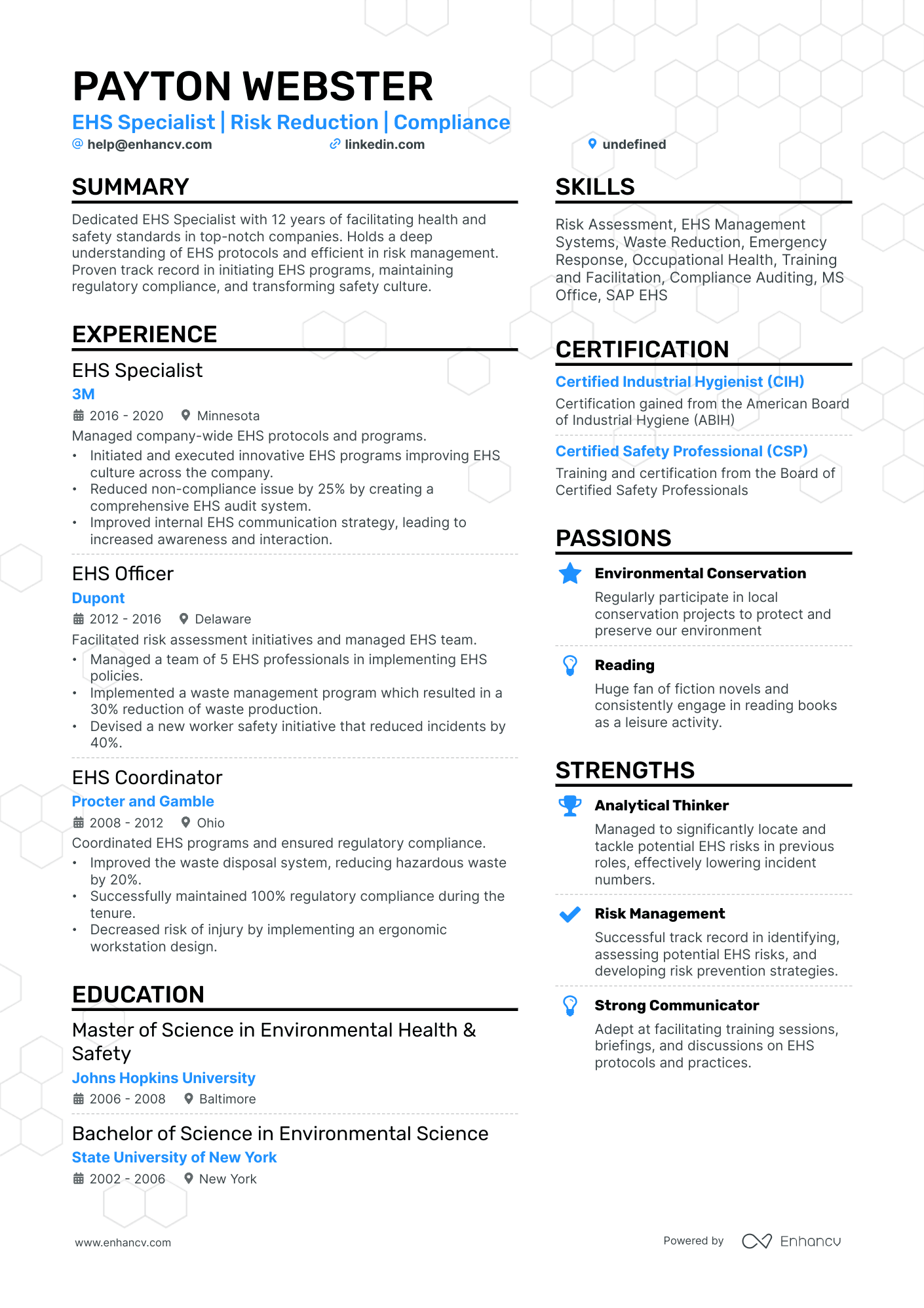
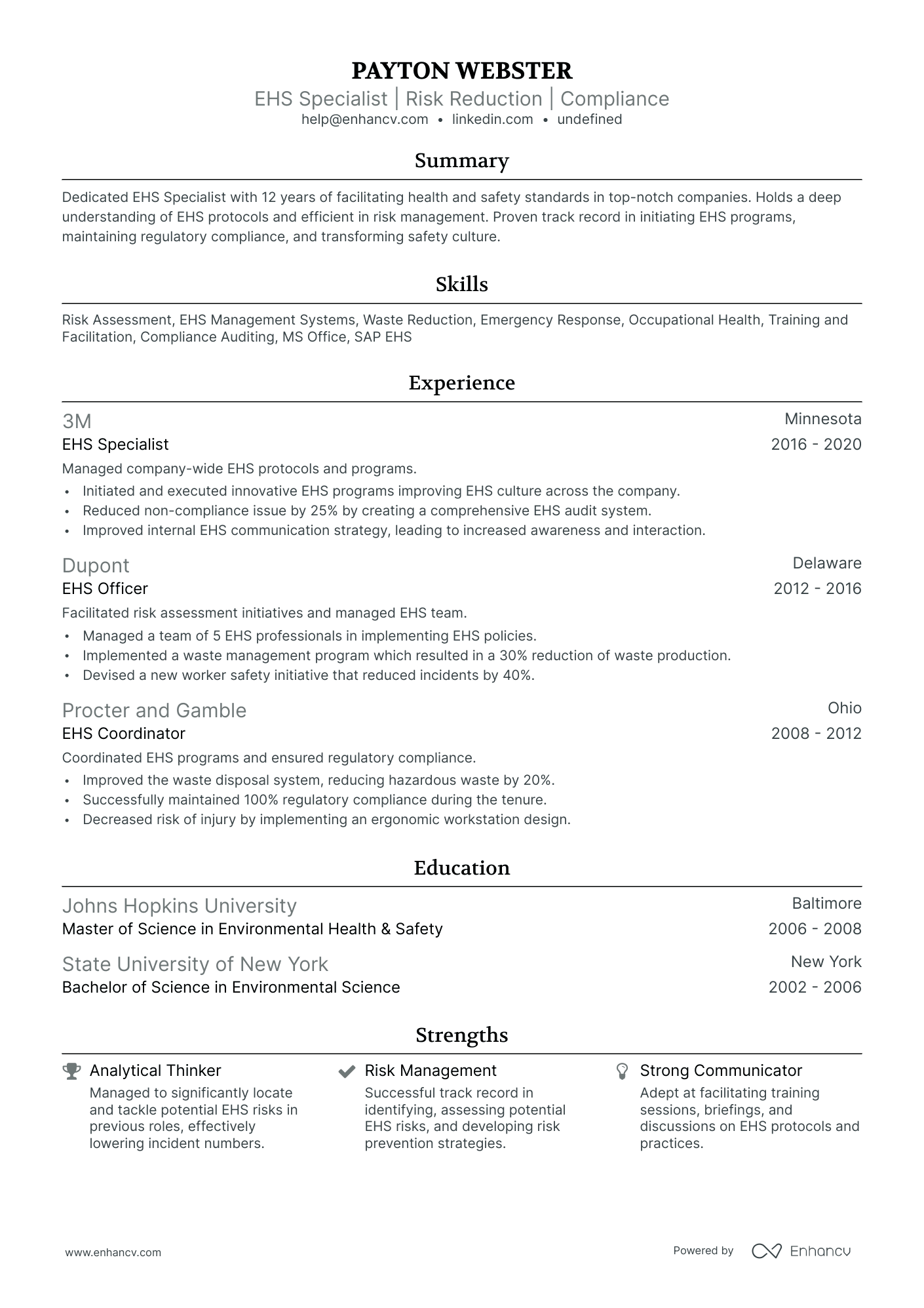
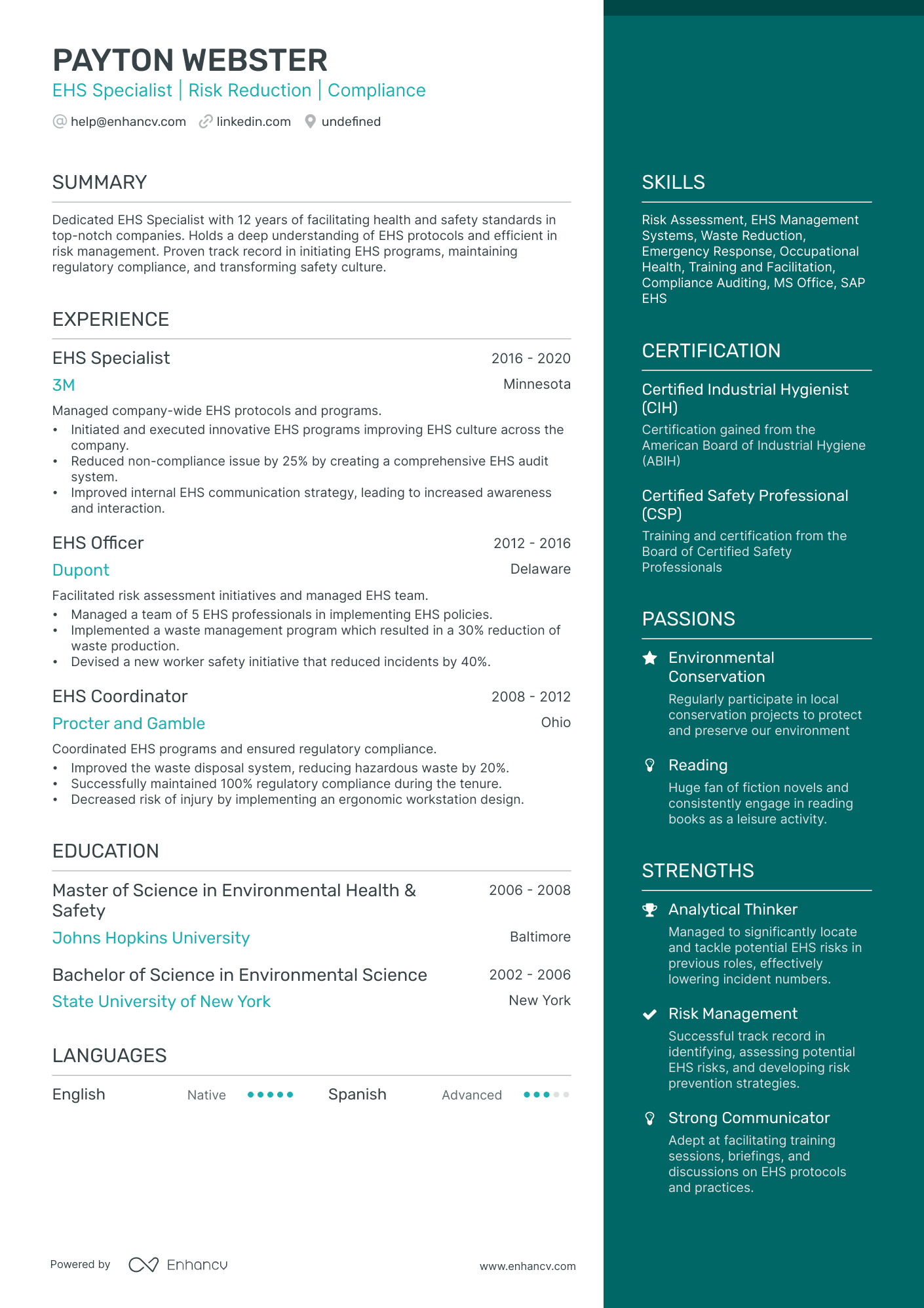
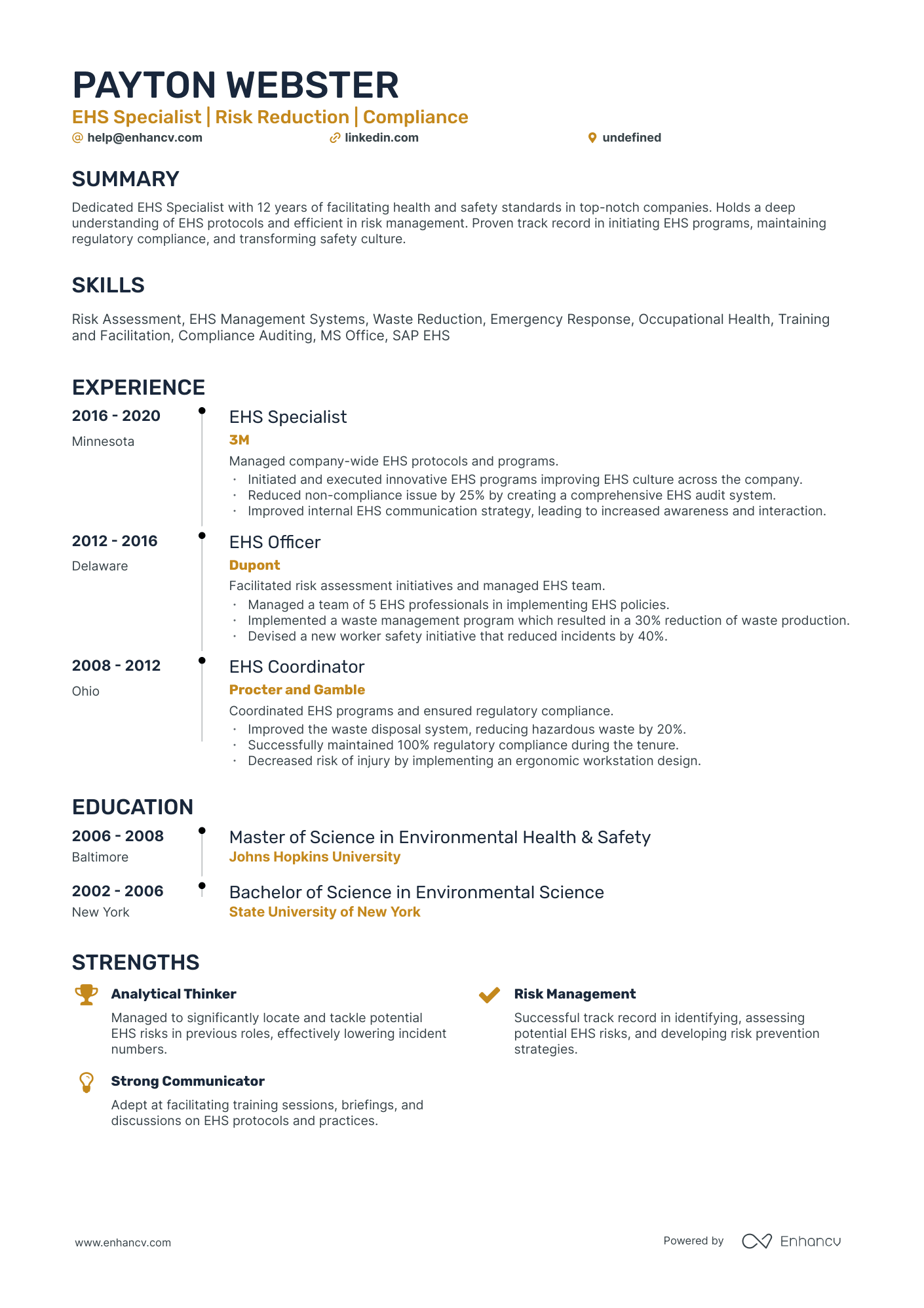
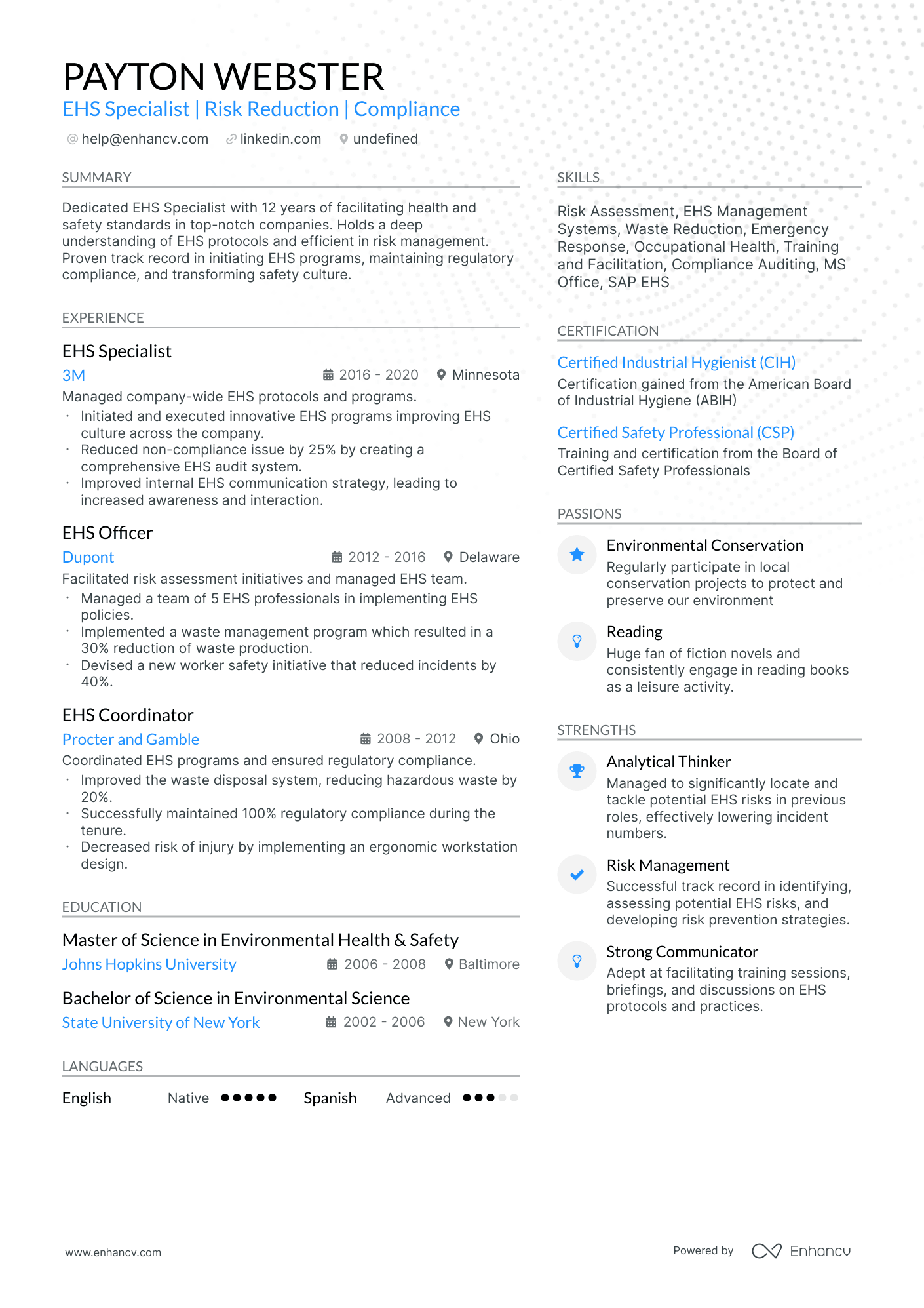
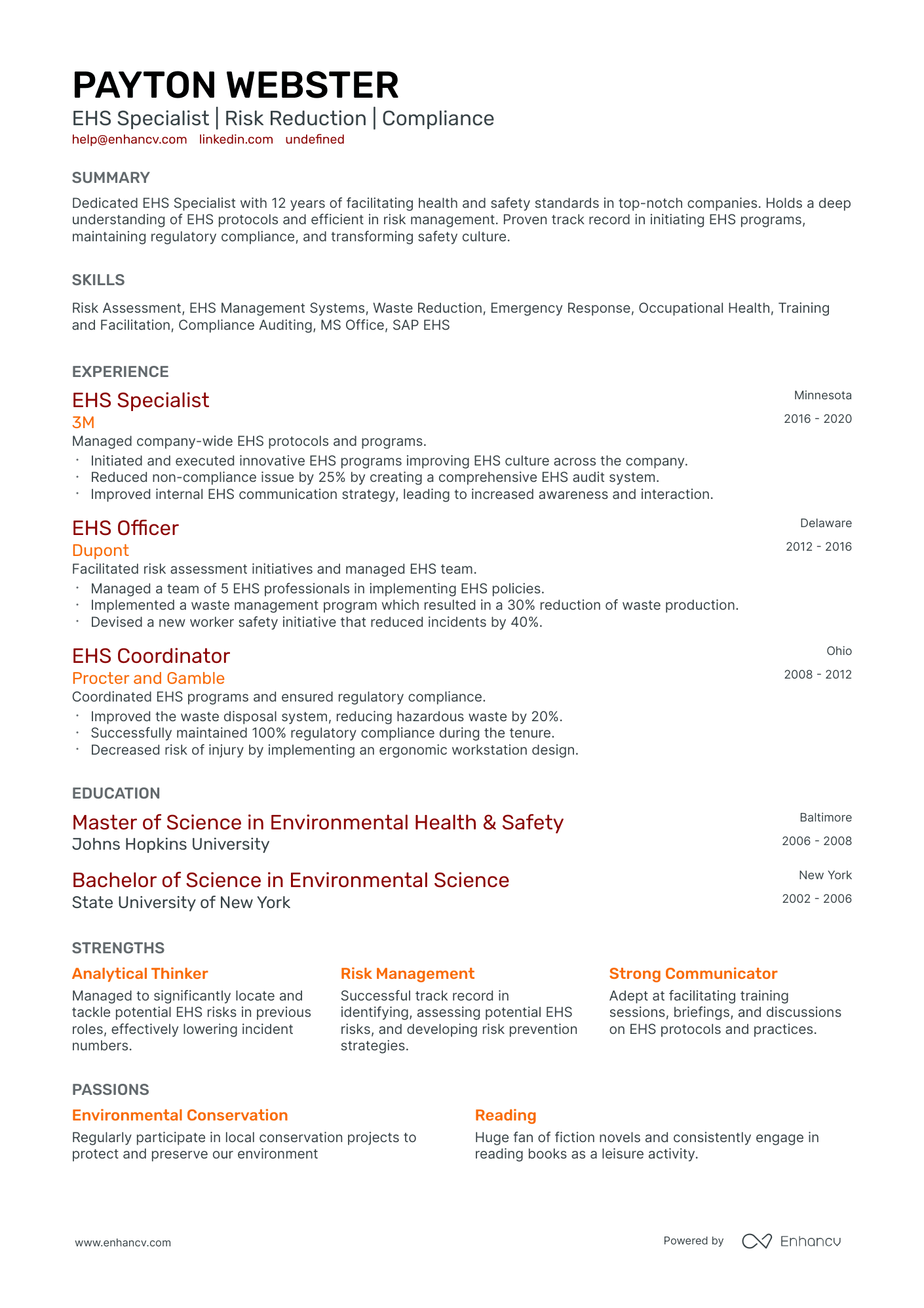
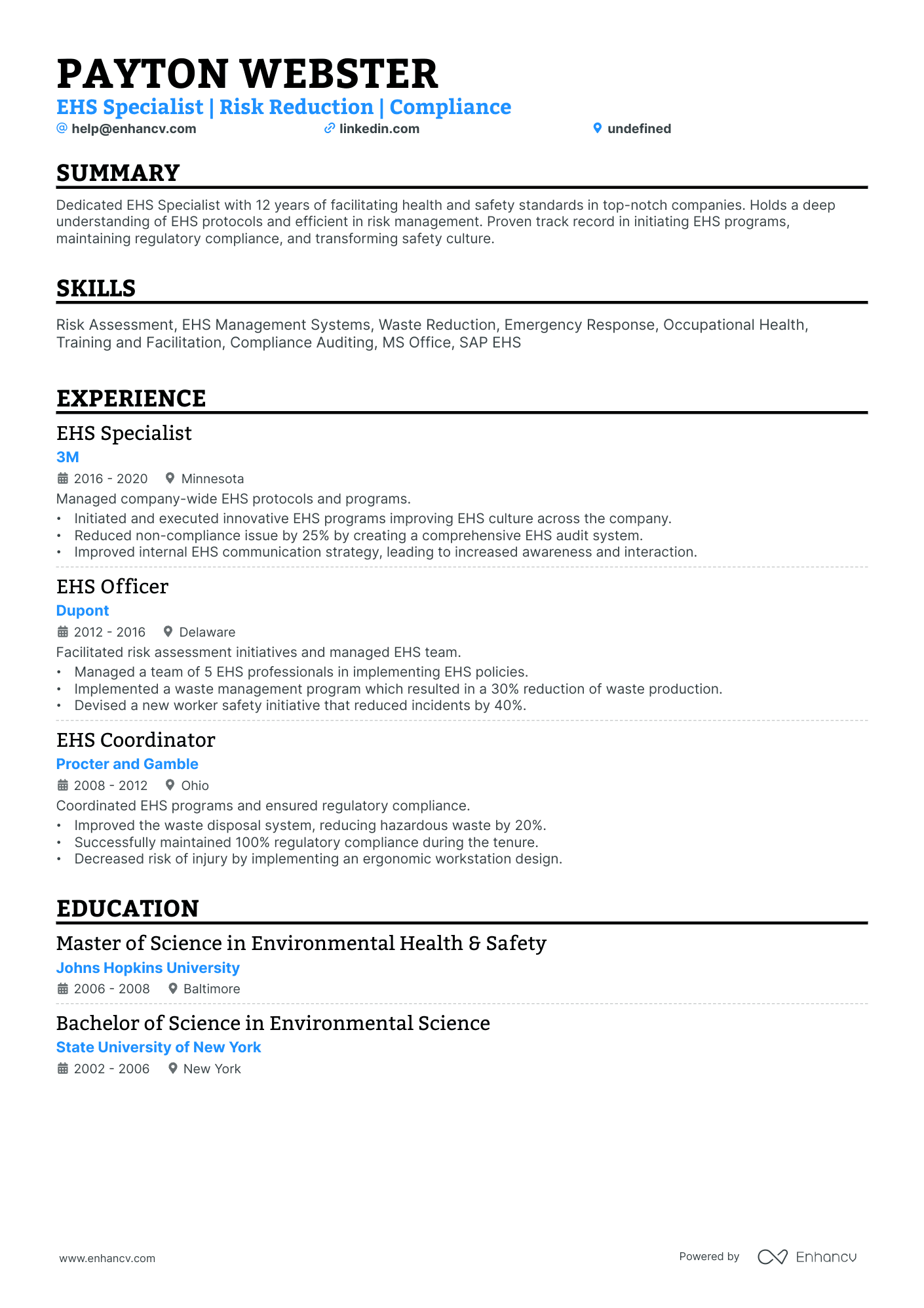
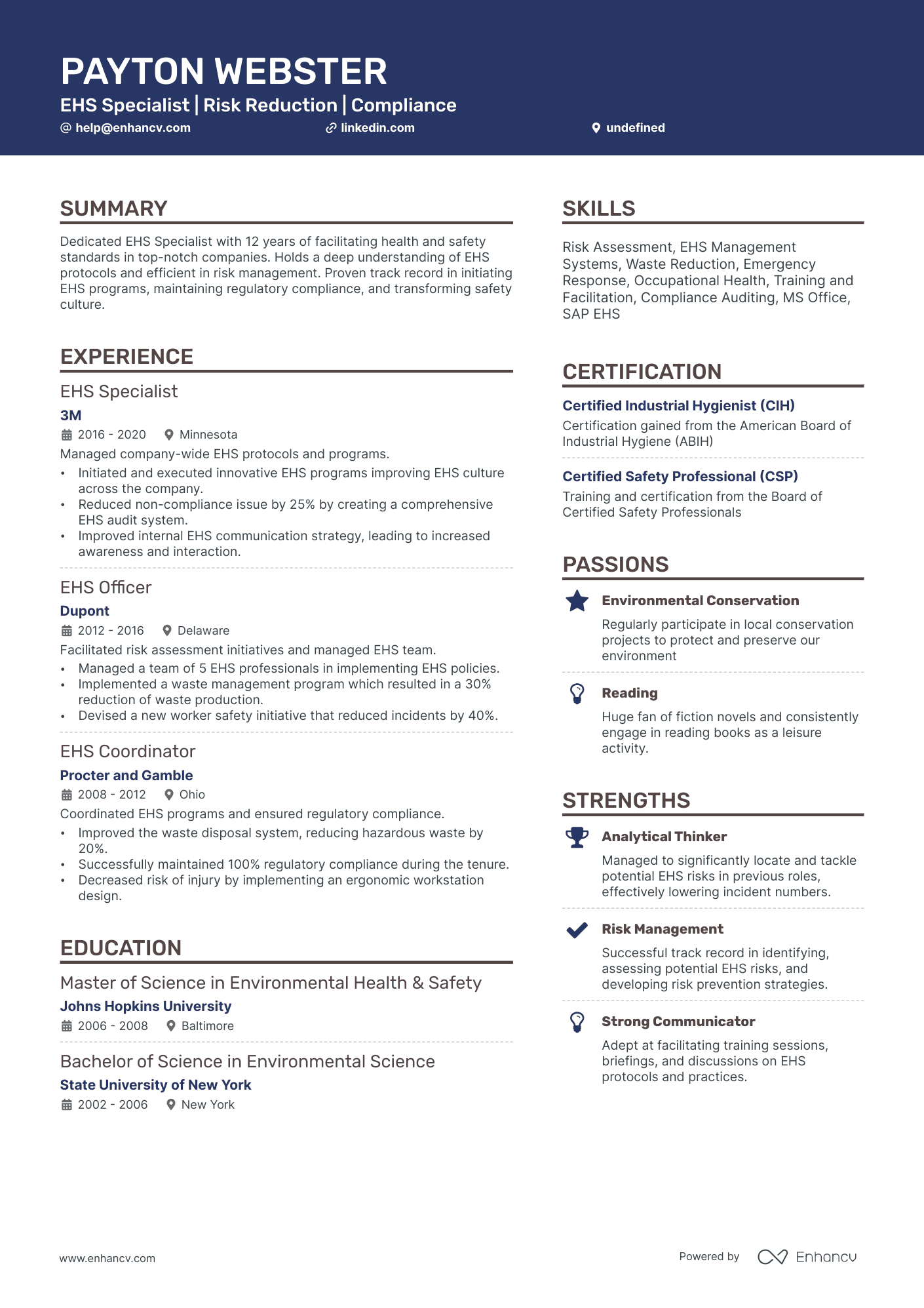
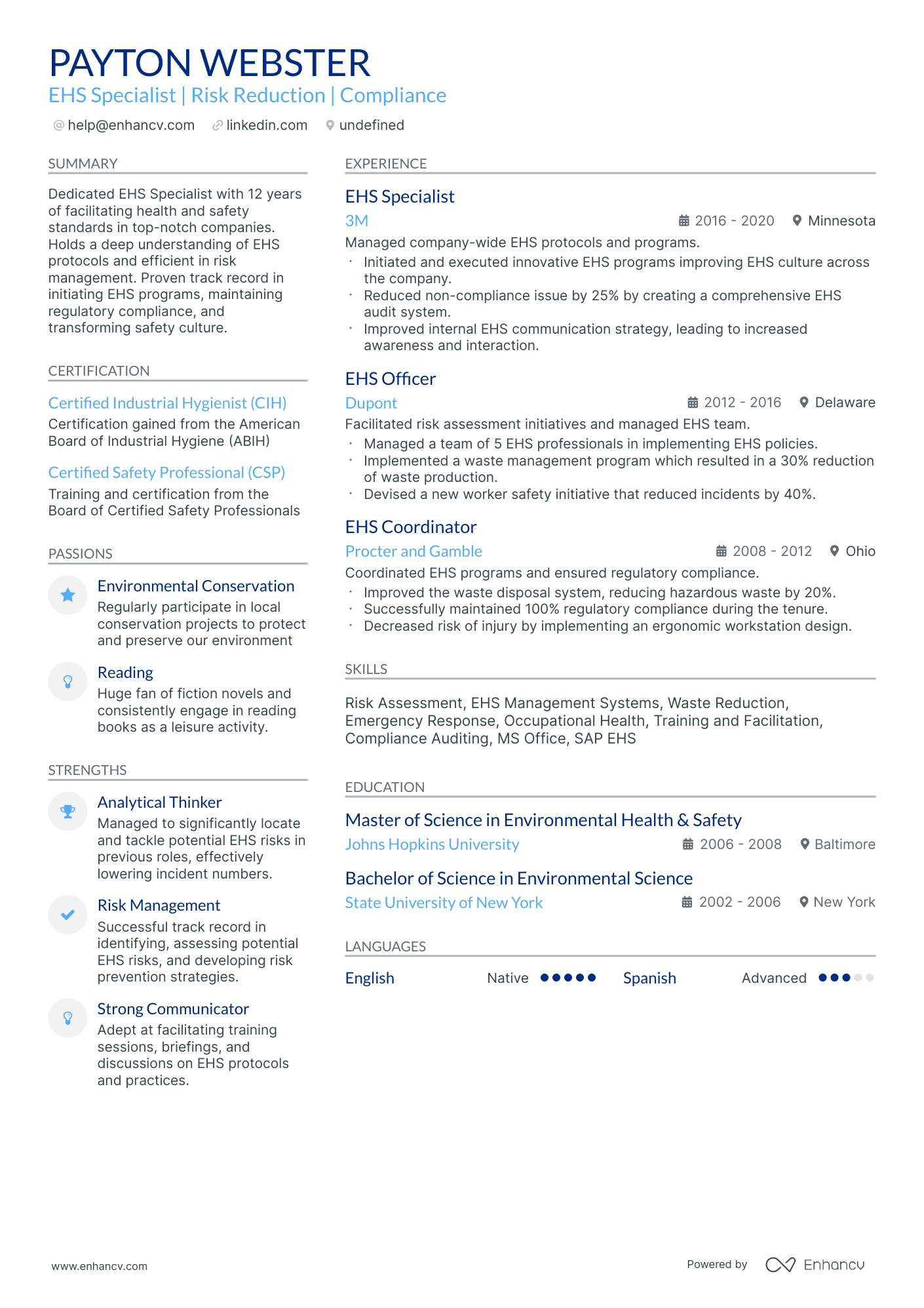
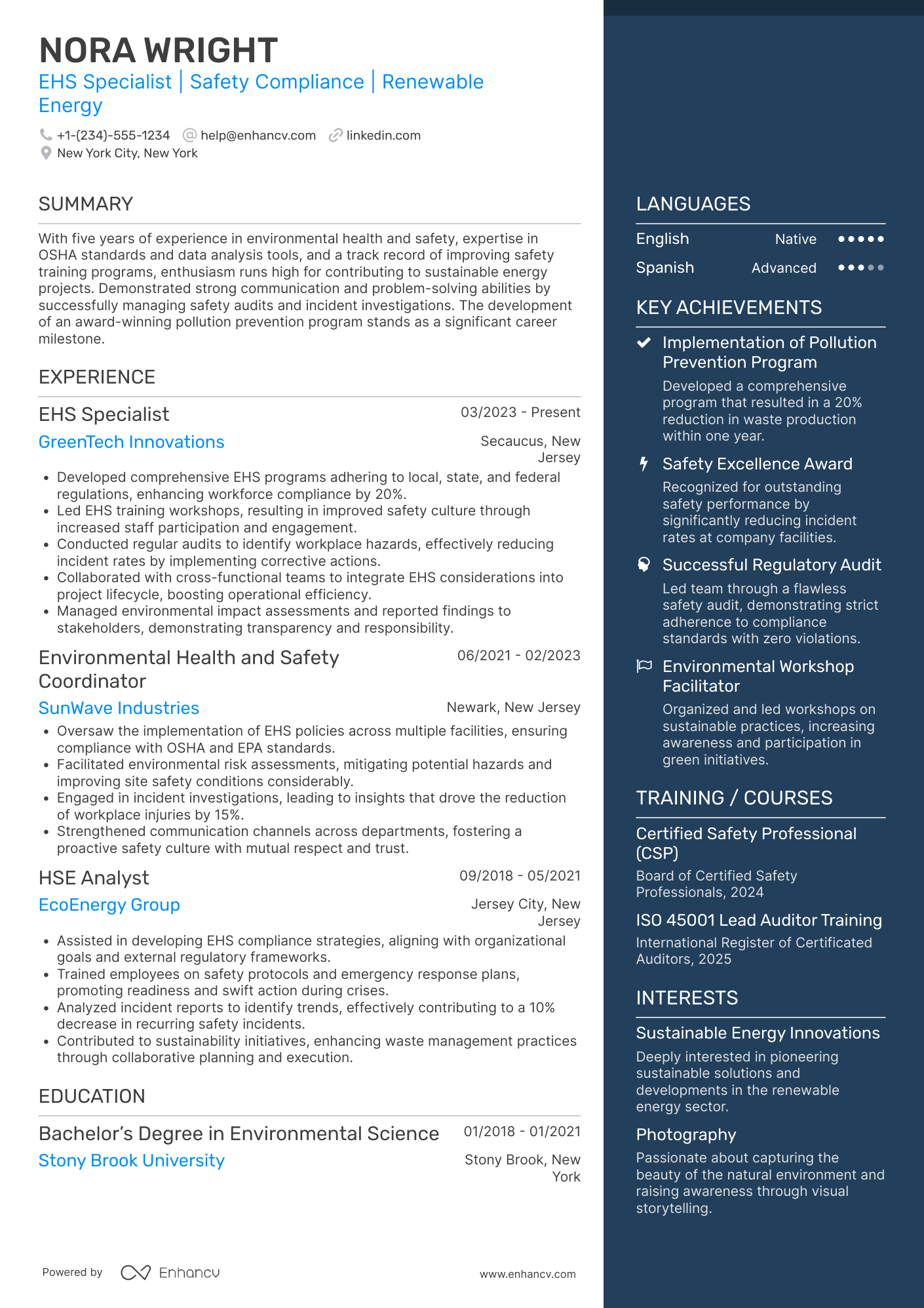
Many EHS specialist resume drafts fail because they list training and inspections without tying them to risk reduction, compliance results, or site impact. That costs you in ATS screening and fast recruiter scans, especially when competition is high.
A strong resume shows what changed because of your work. Knowing how to make your resume stand out starts with highlighting incident rate reductions, audit pass rates, corrective actions closed on time, and multi-site coverage. Include results like fewer recordables, faster permit approvals, and measurable cost avoidance.

Key takeaways
- Tie every resume bullet to measurable outcomes like incident rate reductions, audit scores, or cost avoidance.
- Use a reverse-chronological format if you have sequential EHS experience and growing responsibility.
- Mirror the job posting's exact regulatory language, tools, and KPIs in your experience section.
- List certifications like CSP, ASP, or OSHA 30 near your education to confirm compliance readiness.
- Combine hard skills and soft skills, then back each one with proof in your experience bullets.
- Use AI to tighten language and fill keyword gaps, but stop before it inflates your claims.
- Build your resume faster with Enhancv to keep formatting clean and sections aligned to recruiter expectations.
Job market snapshot for EHS specialists
We analyzed 219 recent EHS specialist job ads across major US job boards. These numbers help you understand employer expectations, skills in demand, salary landscape at a glance.
What level of experience employers are looking for EHS specialists
| Years of Experience | Percentage found in job ads |
|---|---|
| 1–2 years | 46.1% (101) |
| 3–4 years | 14.2% (31) |
| 5–6 years | 16.4% (36) |
| 7–8 years | 0.9% (2) |
| 9–10 years | 1.4% (3) |
| 10+ years | 1.4% (3) |
| Not specified | 21.0% (46) |
EHS specialist ads by area of specialization (industry)
| Industry (Area) | Percentage found in job ads |
|---|---|
| Finance & Banking | 73.1% (160) |
| Healthcare | 22.4% (49) |
Top companies hiring EHS specialists
| Company | Percentage found in job ads |
|---|---|
| Amazon.com, Inc. | 31.5% (69) |
| Tesla | 8.7% (19) |
Role overview stats
These tables show the most common responsibilities and employment types for EHS specialist roles. Use them to align your resume with what employers expect and to understand how the role is structured across the market.
Day-to-day activities and top responsibilities for a EHS specialist
| Responsibility | Percentage found in job ads |
|---|---|
| Osha | 46.6% (102) |
| Microsoft excel | 33.3% (73) |
| Microsoft word | 33.3% (73) |
| First aid | 27.9% (61) |
| Emergency response | 26.5% (58) |
| Cpr | 26.0% (57) |
| Aed | 22.4% (49) |
| Job safety analysis | 22.4% (49) |
| Epa | 21.0% (46) |
| Osha regulations | 20.5% (45) |
| Job hazard analysis | 20.1% (44) |
| Microsoft office | 19.2% (42) |
How to format a EHS specialist resume
Recruiters reviewing EHS specialist resumes prioritize regulatory knowledge, hazard assessment capabilities, and measurable safety improvements such as incident rate reductions or audit results. A clean, well-organized resume format ensures these compliance-driven qualifications and technical competencies surface quickly during both human review and ATS screening.

I have significant experience in this role—which format should I use?
Use a reverse-chronological format to present your EHS career progression and growing scope of responsibility in a clear, linear timeline. Do:
- Lead with your most recent role and emphasize the scope of programs, facilities, or teams you've managed, including multi-site oversight or cross-functional safety committees.
- Highlight role-specific expertise such as OSHA standards, EPA regulations, ISO 14001/45001 implementation, industrial hygiene tools, and incident investigation methodologies.
- Quantify outcomes tied to business impact—reduced recordable injury rates, cost savings from workers' compensation improvements, or successful regulatory audit results.
I'm junior or switching into this role—what format works best?
Use a hybrid format that leads with a focused skills section followed by your work history, allowing you to spotlight EHS-relevant competencies even if your direct experience is limited. Do:
- Place core EHS skills—such as risk assessment, safety auditing, hazard communication, and environmental compliance—near the top of your resume where recruiters and ATS systems scan first.
- Include relevant projects, internships, certifications (OSHA 30-Hour, ASP, or HAZWOPER), or academic research that demonstrates applied safety knowledge.
- Connect each skill or project to a specific action and a measurable or observable result to prove real-world application.
Why not use a functional resume?
A functional format strips away the timeline and context that EHS hiring managers need to verify where, when, and under what regulatory environments you applied your safety expertise, making it harder to assess your qualifications.
- A functional format may be acceptable if you're transitioning from a related field (such as industrial engineering or occupational health nursing) with no direct EHS job titles, or if you're re-entering the workforce after an extended gap—but only if you tie every listed skill to a specific project, certification, or outcome rather than presenting skills in isolation.
Once you've established a clean, readable format, the next step is deciding which sections to include so each one serves a clear purpose on your resume.
What sections should go on a EHS specialist resume
Recruiters expect to see clear evidence you can reduce risk, ensure compliance, and improve safety performance across sites and programs. Knowing what to put on a resume helps you prioritize the right information. Use this structure for maximum clarity:
- Header
- Summary
- Experience
- Skills
- Projects
- Education
- Certifications
- Optional sections: Awards, Leadership, Languages
Strong experience bullets should emphasize measurable safety and compliance outcomes, the scope of facilities and programs you owned, and the results you delivered.
Is your resume good enough?
Drop your resume here or choose a file. PDF & DOCX only. Max 2MB file size.
Once you’ve organized your resume with the right components, the next step is to write your experience section so it supports that structure with relevant, role-specific details.
How to write your EHS specialist resume experience
Your experience section should spotlight the safety programs, compliance initiatives, and risk reduction efforts you've delivered in previous roles. Hiring managers prioritize demonstrated impact—measurable improvements in incident rates, regulatory compliance, and workplace safety culture—over descriptive task lists that simply recount daily duties. Building a targeted resume ensures every bullet point speaks directly to the role you're pursuing.
Each entry should include:
- Job title
- Company and location (or remote)
- Dates of employment (month and year)
Three to five concise bullet points showing what you owned, how you executed, and what outcomes you delivered:
- Ownership scope: the EHS programs, facility safety systems, compliance audits, training curricula, or site operations you were directly accountable for managing and improving.
- Execution approach: the regulatory frameworks, risk assessment methodologies, incident investigation techniques, environmental monitoring tools, or safety management platforms you used to identify hazards, enforce compliance, and drive corrective actions.
- Value improved: the changes you produced in workplace injury rates, environmental compliance posture, audit readiness, hazard elimination timelines, emergency response effectiveness, or overall operational risk exposure.
- Collaboration context: how you partnered with plant managers, operations teams, legal counsel, regulatory agencies, insurance carriers, or contractors to align safety objectives with broader organizational goals.
- Impact delivered: the tangible outcomes your work produced—expressed through reductions in recordable incidents, successful regulatory inspections, improved safety culture benchmarks, or cost savings from proactive hazard mitigation—rather than a list of activities performed.
Experience bullet formula
A EHS specialist experience example
✅ Right example - modern, quantified, specific.
EHS Specialist
Riverton Advanced Materials | Toledo, OH
2022–Present
ISO 9001 and ISO 14001-certified specialty chemicals manufacturer operating a twenty-four-seven, 180-employee plant with batch reactors, bulk storage, and rail loading.
- Led process hazard analyses using hazard and operability studies, layers of protection analysis, and bowtie analysis in PHA-Pro, cutting high-risk scenarios by 32% and reducing process safety incident rate from 0.28 to 0.12 per 200,000 hours.
- Built a digital safety observation and corrective action workflow in Intelex and Power BI, improving closeout within thirty days from 61% to 92% and eliminating 14 hours per week of manual tracking across operations and maintenance.
- Executed industrial hygiene monitoring for volatile organic compounds, noise, and respirable dust using calibrated direct-reading instruments and laboratory sampling, driving engineering controls that lowered overexposures by 45% and reduced hearing conservation enrollments by 18%.
- Partnered with engineering and production to update lockout-tagout and permit-to-work programs, standardizing energy control procedures across 120 assets and cutting recordable incident rate by 22% year over year.
- Coordinated hazardous waste profiling, manifests, and biennial reporting in the Resource Conservation and Recovery Act program, decreasing waste disposal costs by 11% through segregation and vendor optimization while passing three regulatory inspections with zero findings.
Now that you've seen how a strong experience section comes together, let's look at how to adjust yours to match a specific EHS specialist job posting.
How to tailor your EHS specialist resume experience
Recruiters evaluate your EHS specialist resume through applicant tracking systems and manual review, scanning for alignment with specific job requirements. Tailoring your resume to the job description by mirroring the posting's language and priorities increases your chances of passing both screening layers.
Ways to tailor your EHS specialist experience:
- Match safety management software and reporting tools named in the posting.
- Use the exact regulatory standards listed like OSHA or ISO 14001.
- Mirror incident rate or injury reduction KPIs the employer specifies.
- Reflect industry-specific hazards relevant to the posted work environment.
- Highlight compliance audit or inspection experience when the role requires it.
- Emphasize risk assessment methodologies referenced in the job description.
- Include cross-functional safety training coordination if collaboration is mentioned.
- Align your environmental monitoring experience with stated sustainability goals.
Tailoring means framing your real accomplishments in the employer's language, not forcing irrelevant keywords into your experience.
Resume tailoring examples for EHS specialist
| Job description excerpt | Untailored | Tailored |
|---|---|---|
| Conduct root cause analysis for workplace incidents using OSHA recordkeeping standards and maintain compliance with EPA regulations across multiple facility locations. | Helped investigate workplace incidents and ensured regulatory compliance. | Led root cause analyses for 45+ workplace incidents annually using OSHA 300 log recordkeeping standards and maintained EPA compliance across six manufacturing facilities, reducing recordable incident rates by 32% over two years. |
| Develop and deliver EHS training programs, including HAZWOPER, lockout/tagout (LOTO), and confined space entry, for a workforce of 200+ employees in a chemical manufacturing environment. | Provided safety training to employees on various topics. | Designed and delivered HAZWOPER, LOTO, and confined space entry training programs for 220 chemical manufacturing employees, achieving 98% completion rates and zero permit-required confined space violations during annual OSHA audits. |
| Manage industrial hygiene monitoring programs, including air sampling for silica, lead, and noise exposure, and recommend engineering controls to reduce occupational health hazards. | Monitored workplace conditions and suggested improvements to reduce hazards. | Managed industrial hygiene monitoring programs covering silica, lead, and noise exposure across three production lines, analyzing air sampling data to recommend engineering controls that lowered personal exposure levels below OSHA PELs by an average of 40%. |
Once you’ve aligned your experience with the role’s EHS priorities, the next step is to quantify your EHS specialist achievements so employers can quickly see the impact of that work.
How to quantify your EHS specialist achievements
Quantifying your achievements proves you reduced risk, improved compliance, and saved time or money. Focus on incident rates, audit results, corrective action speed, training completion, exposure levels, and cost avoidance tied to safety and environmental controls.
Quantifying examples for EHS specialist
| Metric | Example |
|---|---|
| Incident rate | "Cut recordable incident rate from 2.1 to 0.9 per 200,000 hours in 12 months by updating JHAs, leading weekly GEMBA walks, and closing hazards in SafetyCulture." |
| Audit compliance | "Raised ISO 14001 internal audit score from 82% to 96% by standardizing evidence folders, revising SOPs, and eliminating 14 repeat findings across three sites." |
| Corrective action speed | "Reduced corrective action closure time from 45 to 18 days by rebuilding the CAPA tracker in Excel, setting weekly owner reviews, and escalating overdue actions after seven days." |
| Exposure reduction | "Lowered average noise exposure from 92 dBA to 86 dBA across two production lines using dosimetry, engineering controls, and fit-testing for hearing protection." |
| Cost avoidance | "Avoided $180,000 in potential fines and disposal costs by correcting hazardous waste labeling, training 60 operators, and fixing storage segregation before a state inspection." |
Turn vague job duties into measurable, recruiter-ready resume bullets in seconds with Enhancv's Bullet Point Generator.
Once you've crafted strong bullet points to showcase your accomplishments, the next step is ensuring your resume highlights the right mix of hard and soft skills that EHS specialist roles demand.
How to list your hard and soft skills on a EHS specialist resume
Your skills section shows you can prevent incidents, ensure compliance, and improve site performance—recruiters and applicant tracking systems scan this section for role-specific keywords and fit—so aim for a balanced mix of hard skills and job-relevant soft skills. EHS specialist roles require a blend of:
- Product strategy and discovery skills.
- Data, analytics, and experimentation skills.
- Delivery, execution, and go-to-market discipline.
- Soft skills.
Your skills section should be:
- Scannable (bullet-style grouping).
- Relevant to the job post.
- Backed by proof in experience bullets.
- Updated with current tools.
Place your skills section:
- Above experience if you're junior or switching careers.
- Below experience if you're mid/senior with strong achievements.

Hard skills
- OSHA compliance, recordkeeping
- Incident investigation, root cause analysis
- Job hazard analysis, risk assessment
- Safety audits, inspections
- Environmental compliance, permitting
- Hazardous waste management, RCRA
- Air emissions compliance, Title V
- ISO 14001, ISO 45001
- Industrial hygiene sampling
- Safety management systems
- Emergency response planning
- EHS metrics, dashboards
Soft skills
- Lead toolbox talks and briefings
- Write clear SOPs and policies
- Coach supervisors on safe work
- Influence without formal authority
- Facilitate cross-functional corrective actions
- Escalate high-risk issues fast
- Run effective audit closeouts
- Communicate with regulators professionally
- Prioritize risks under pressure
- Drive consistent follow-through
- Partner with operations and maintenance
- Document decisions and rationale
How to show your EHS specialist skills in context
Skills shouldn't live only in a bulleted list on your resume. Explore resume skills examples to see how top candidates weave competencies throughout their documents.
They should be demonstrated in:
- Your summary (high-level professional identity)
- Your experience (proof through outcomes)
Here's what both look like in practice.
Summary example
Senior EHS specialist with 12 years in chemical manufacturing. Skilled in OSHA compliance, JSA development, and IH monitoring. Led behavior-based safety programs that reduced recordable incidents by 41%. Known for cross-functional collaboration and driving sustainable safety culture improvements.
- Reflects senior-level experience clearly
- Names specific tools and methods
- Leads with a measurable outcome
- Highlights collaboration as a soft skill
Experience example
Senior EHS Specialist
Trident Chemical Solutions | Houston, TX
March 2018–Present
- Implemented a lockout/tagout audit program using Intelex, cutting compliance gaps by 33% across four production facilities.
- Partnered with operations and engineering teams to redesign confined space entry procedures, eliminating two high-risk exposure scenarios.
- Conducted quarterly industrial hygiene sampling and root cause analyses, reducing OSHA recordable incidents by 27% year over year.
- Every bullet includes measurable proof
- Skills appear naturally through real outcomes
Once you’ve tied your safety and compliance strengths to real outcomes, the next step is learning how to write an EHS specialist resume with no experience by translating coursework, projects, and transferable tasks into credible evidence.
How do I write a EHS specialist resume with no experience
Even without full-time experience, you can demonstrate readiness through:
- OSHA 10 or OSHA 30 training
- HAZWOPER coursework or certification
- Safety audits for student labs
- ISO 14001 internal audit project
- Job hazard analysis assignments
- Incident investigation case study
- PPE hazard assessment project
- Environmental sampling field practicum
Writing a resume without work experience means focusing on:
- OSHA and EPA compliance exposure
- Documented audits, inspections, findings
- Job hazard analyses and controls
- Metrics: TRIR, near-miss rates
Resume format tip for entry-level EHS specialist
Use a hybrid resume format. It highlights EHS specialist skills and projects first, while still showing relevant education and work history. Do:
- Put certifications and training near the top.
- Turn coursework into project bullets with results.
- Add tools: Excel, SDS, SPCC basics.
- Quantify outputs: counts, rates, time saved.
- Match keywords to the job posting.
- Completed a PPE hazard assessment for three lab processes, updated SDS binder, and cut noncompliant PPE observations by 40% over four weekly inspections.
Your education section can do much of this heavy lifting, so presenting it effectively is essential.
How to list your education on a EHS specialist resume
Your education section helps hiring teams confirm you have the foundational knowledge needed for the EHS specialist role. It validates your academic background in safety, health, and environmental science.
Include:
- Degree name
- Institution
- Location
- Graduation year
- Relevant coursework (for juniors or entry-level candidates)
- Honors & GPA (if 3.5 or higher)
Skip month and day details—list the graduation year only.
Here's a strong education entry tailored to an EHS specialist resume.
Example education entry
Bachelor of Science in Environmental Health and Safety
University of Central Missouri, Warrensburg, MO
Graduated 2021
GPA: 3.7/4.0
- Relevant Coursework: Industrial Hygiene, Occupational Safety Management, Environmental Regulations, Hazardous Materials Handling, Ergonomics
- Honors: Magna Cum Laude, Dean's List (six consecutive semesters)
How to list your certifications on a EHS specialist resume
Certifications on your resume show your commitment to learning, confirm tool proficiency, and prove industry relevance as an EHS specialist. They also help hiring teams gauge readiness for regulated, high-risk environments.
Include:
- Certificate name
- Issuing organization
- Year
- Optional: credential ID or URL
- List certifications below education when your degree is recent and more relevant than your credentials.
- List certifications above education when they are recent, role-relevant, or required for the EHS specialist role.
Best certifications for your EHS specialist resume
- Certified Safety Professional (CSP)
- Associate Safety Professional (ASP)
- Occupational Health and Safety Technologist (OHST)
- Certified Industrial Hygienist (CIH)
- OSHA 30-Hour General Industry
- HAZWOPER 40-Hour
- ISO 14001 Lead Auditor
Once you’ve positioned your credentials where hiring managers will notice them, shift to writing your EHS specialist resume summary to connect those qualifications to the value you deliver.
How to write your EHS specialist resume summary
Your resume summary is the first thing a recruiter reads. A strong one instantly connects your safety expertise to the employer's needs.
Keep it to three to four lines, with:
- Your title and total years of EHS experience.
- The industries you've worked in, such as manufacturing, construction, or energy.
- Core competencies like OSHA compliance, risk assessment, or incident investigation.
- One or two measurable results, such as injury rate reductions or audit scores.
- Soft skills tied to outcomes, like cross-functional training or stakeholder communication.

PRO TIP
At this level, emphasize hands-on technical skills and early wins that prove your readiness. Highlight certifications, tools you've used, and specific safety programs you've supported. Avoid vague phrases like "passionate about safety" or "hardworking team player." Recruiters want evidence, not enthusiasm.
Example summary for a EHS specialist
EHS specialist with three years of experience in manufacturing compliance and hazard analysis. Conducted facility-wide risk assessments that reduced recordable incidents by 28%. Skilled in OSHA reporting, root cause analysis, and employee safety training programs.
Optimize your resume summary and objective for ATS
Drop your resume here or choose a file.
PDF & DOCX only. Max 2MB file size.
Now that you've crafted a summary that highlights your EHS expertise and value, make sure the header above it presents your contact details correctly so recruiters can actually reach you.
What to include in a EHS specialist resume header
A resume header is the top section with your identity and contact details, and it boosts visibility, credibility, and recruiter screening for a EHS specialist.
Essential resume header elements
- Full name
- Tailored job title and headline
- Location
- Phone number
- Professional email
- GitHub link
- Portfolio link
A LinkedIn link helps recruiters verify experience quickly and supports screening.
Do not include photos on a EHS specialist resume unless the role is explicitly front-facing or appearance-dependent.
Match your header job title to the posting and include a clear EHS specialist headline aligned with the role's focus areas.
Example
EHS specialist resume header
Jordan Taylor
EHS specialist | OSHA compliance, incident investigation, and safety training
Austin, TX
(512) 555-01XX
jordan.taylor@enhancv.com
github.com/jordantaylor
yourwebsite.com
linkedin.com/in/jordantaylor
Once your contact details and role focus are clear at the top, add optional sections to provide more context and strengthen your EHS specialist resume.
Additional sections for EHS specialist resumes
Extra resume sections help you stand out when your core qualifications match other candidates. They showcase unique expertise and build role-specific credibility. For example, listing language skills can demonstrate your ability to communicate safety protocols across multilingual teams.
- Languages
- Certifications and licenses
- Professional affiliations
- Publications and presentations
- Volunteer safety work
- Continuing education and training
Once you've strengthened your resume with relevant additional sections, it's worth pairing it with a well-crafted cover letter to make an even stronger impression.
Do EHS specialist resumes need a cover letter
A cover letter isn't required for an EHS specialist, but it helps in competitive roles or when employers expect one. If you're unsure what a cover letter is or how it complements your resume, it can make a difference when your resume needs context, or when you want to show fit with the site, team, and risk profile.
Use a cover letter to add context your resume can't:
- Explain role and team fit: Connect your experience to the site's hazards, culture, and priorities, such as manufacturing, labs, construction, or logistics.
- Highlight one or two outcomes: Summarize a project with measurable results, such as incident reduction, audit readiness, corrective action closure, or training completion rates.
- Show business context: Reference the company's operations, users, and constraints, and link your EHS specialist work to uptime, quality, compliance, and cost control.
- Address transitions: Clarify a career change, a gap, or non-obvious experience, and explain how it maps to EHS specialist responsibilities.
Drop your resume here or choose a file.
PDF & DOCX only. Max 2MB file size.
Even when you decide to skip a cover letter and let your resume carry the application, AI can help you refine it faster and align it more closely with the role.
Using AI to improve your EHS specialist resume
AI can sharpen your resume's clarity, structure, and impact. It helps tighten language and highlight measurable results. But overuse strips authenticity fast. Once your content is clear and role-aligned, step away from AI entirely. For specific guidance, explore ChatGPT resume writing prompts tailored to safety and compliance roles.
Here are 10 practical prompts to strengthen specific sections of your EHS specialist resume:
Strengthen your summary
Quantify experience bullets
Tailor skills section
Improve action verbs
Refine certification details
Clarify project descriptions
Tighten education section
Remove filler language
Align with job posting
Sharpen regulatory language
Conclusion
A strong EHS specialist resume proves impact with measurable outcomes, like lower incident rates, fewer audit findings, and faster corrective actions. It highlights role-specific skills, including risk assessments, compliance reporting, training, and inspections. It stays easy to scan with clear sections and consistent formatting.
Hiring teams want EHS specialists who deliver results and document work clearly. Your resume should show steady performance, strong communication, and practical problem-solving. With a focused structure and real metrics, you’ll look ready for today’s roles and near-future needs.