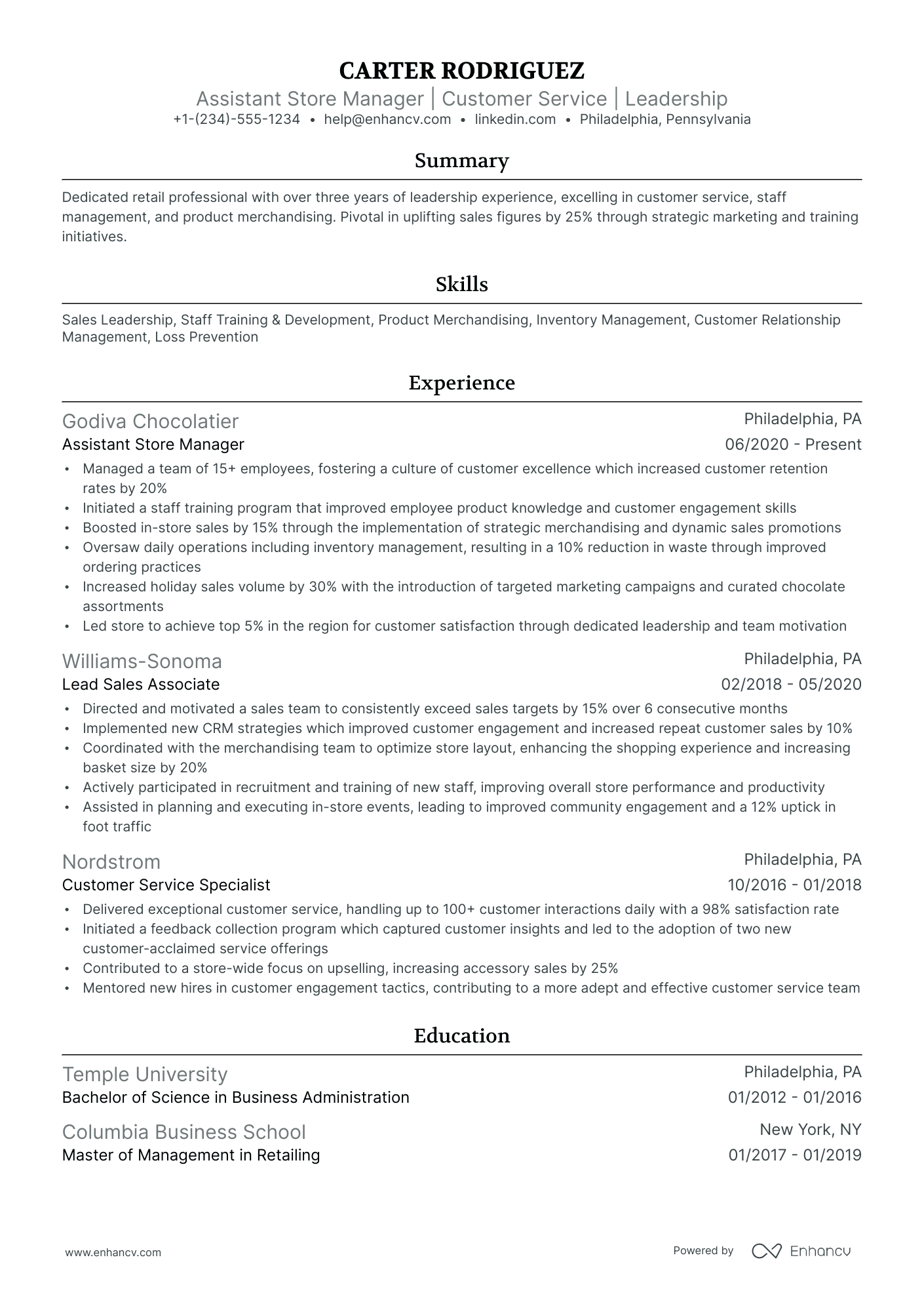
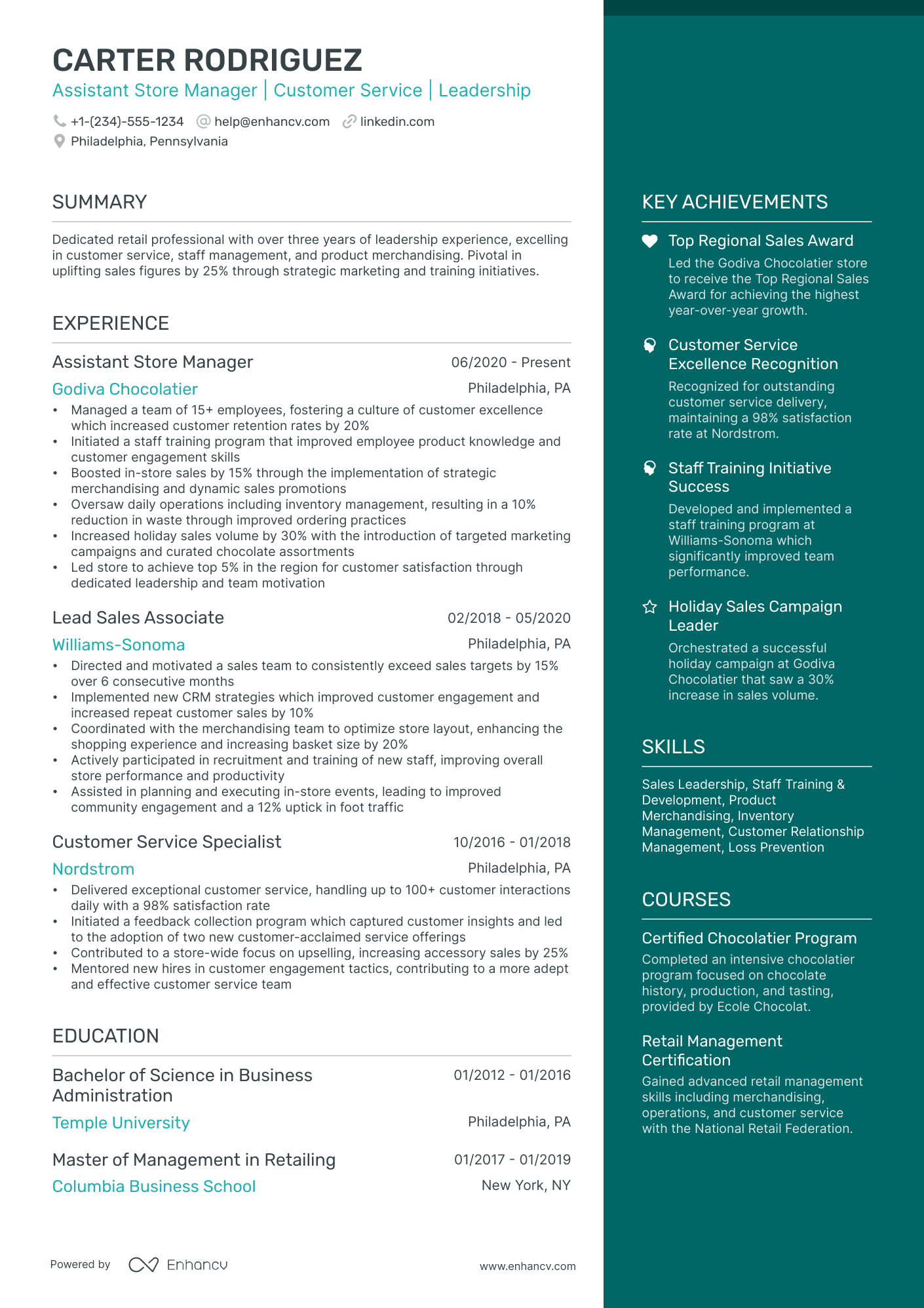
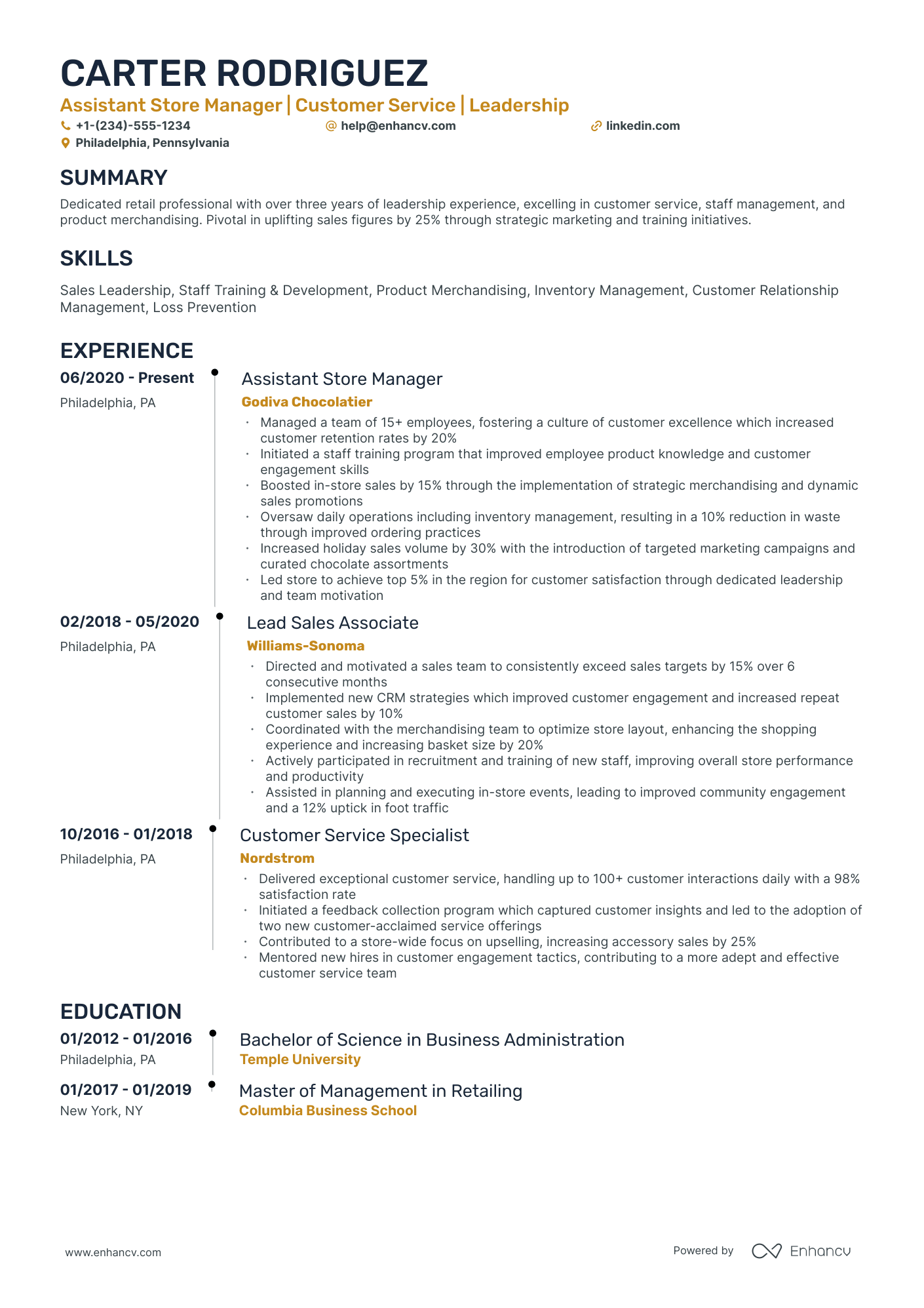
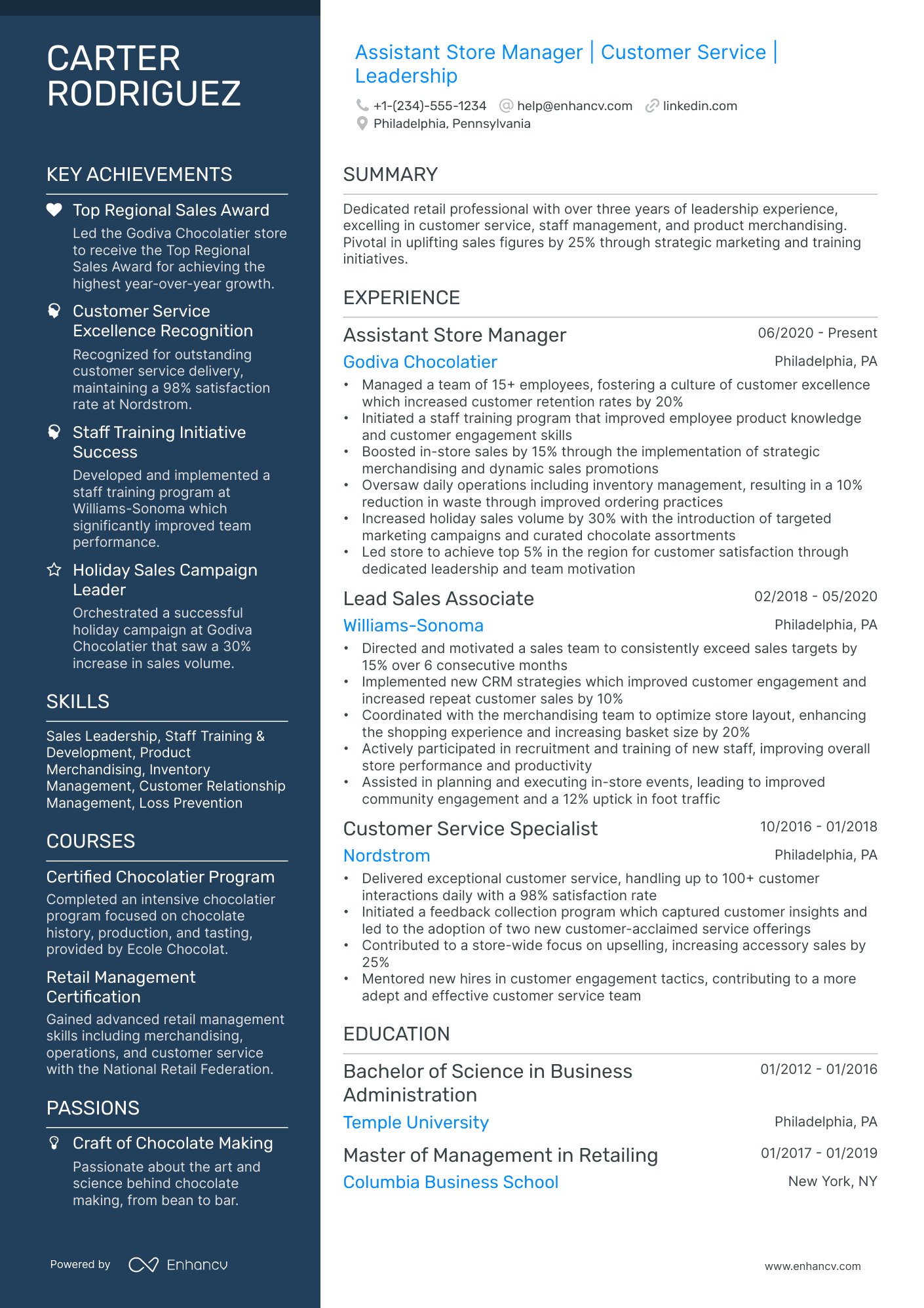
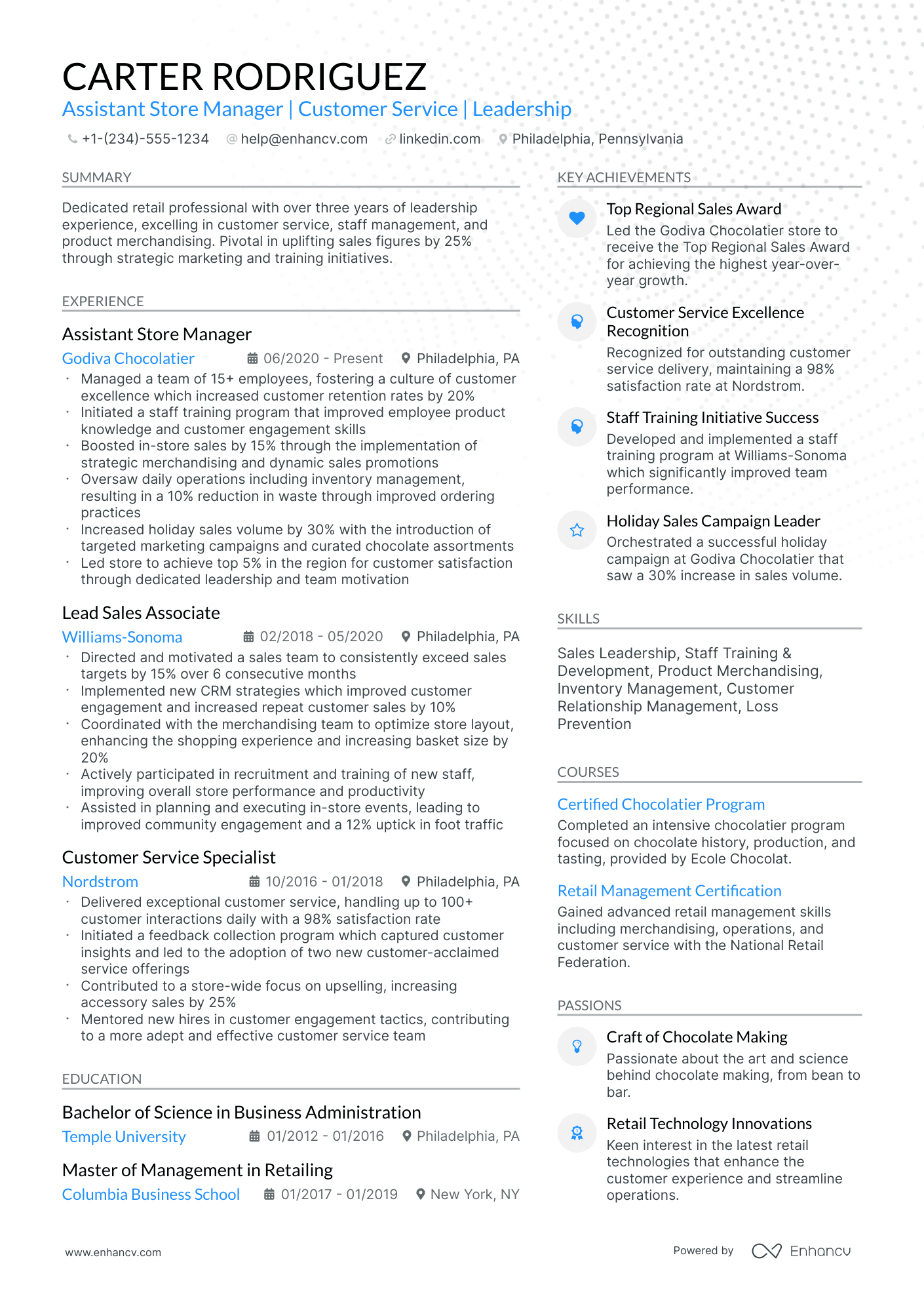
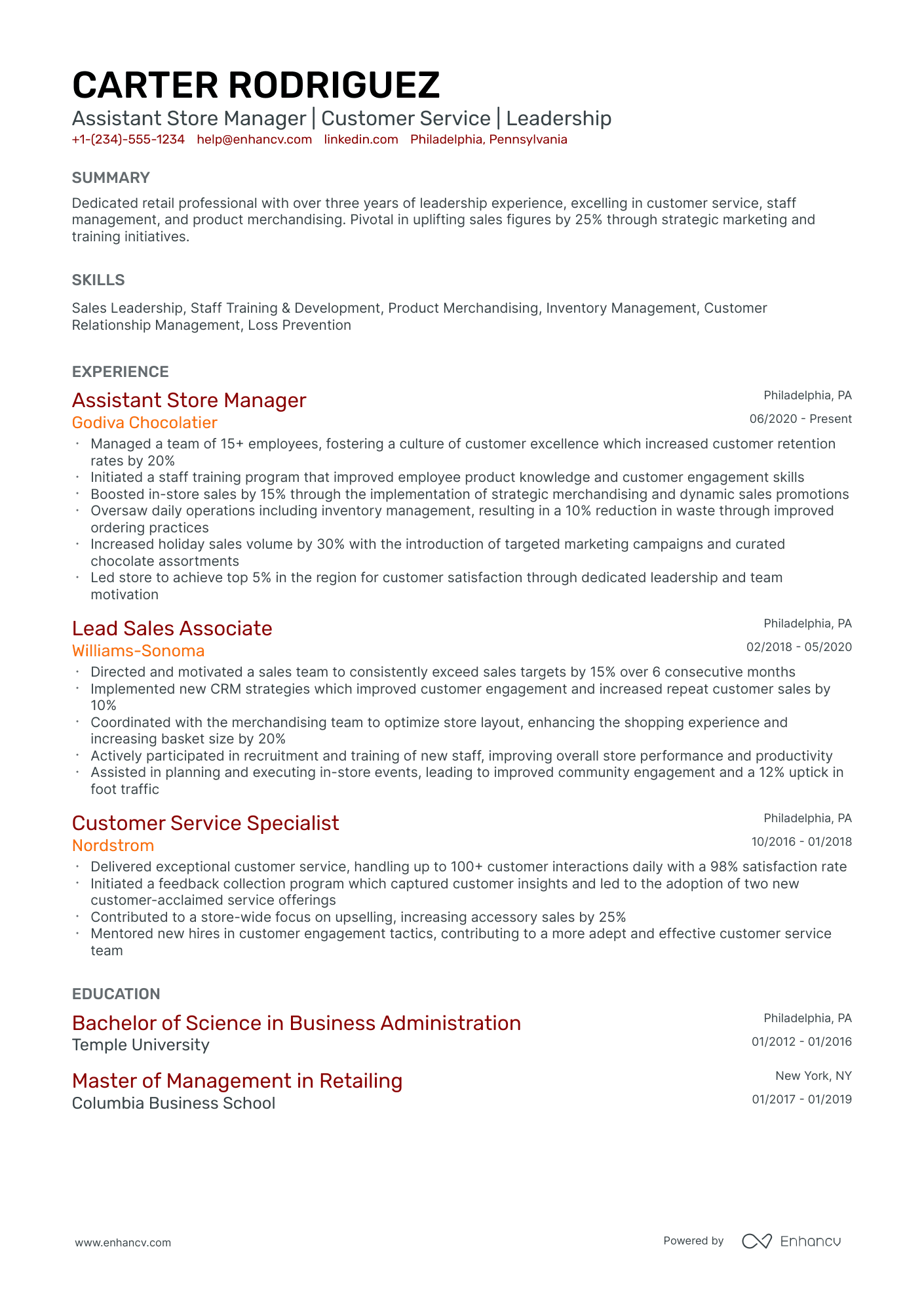
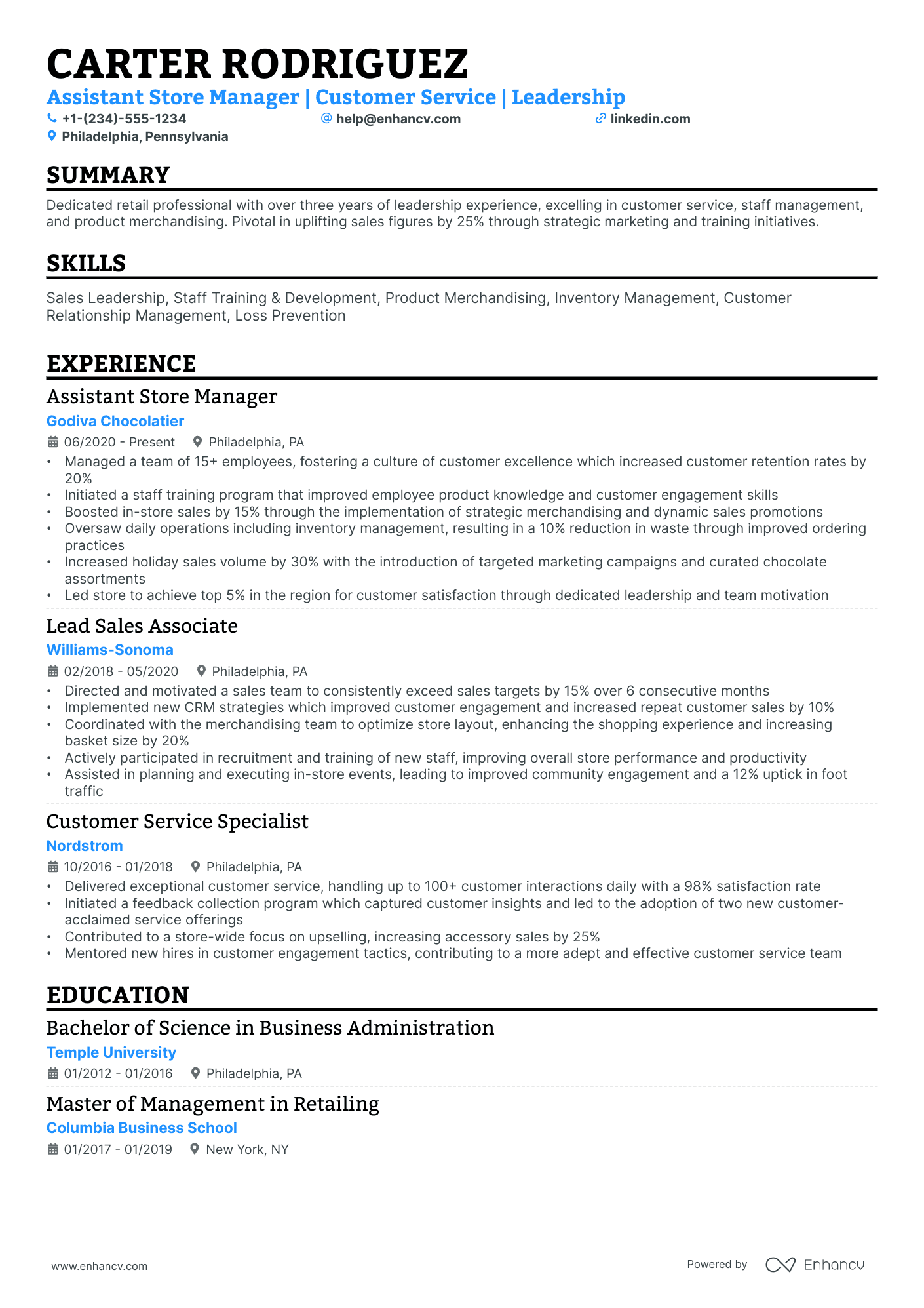
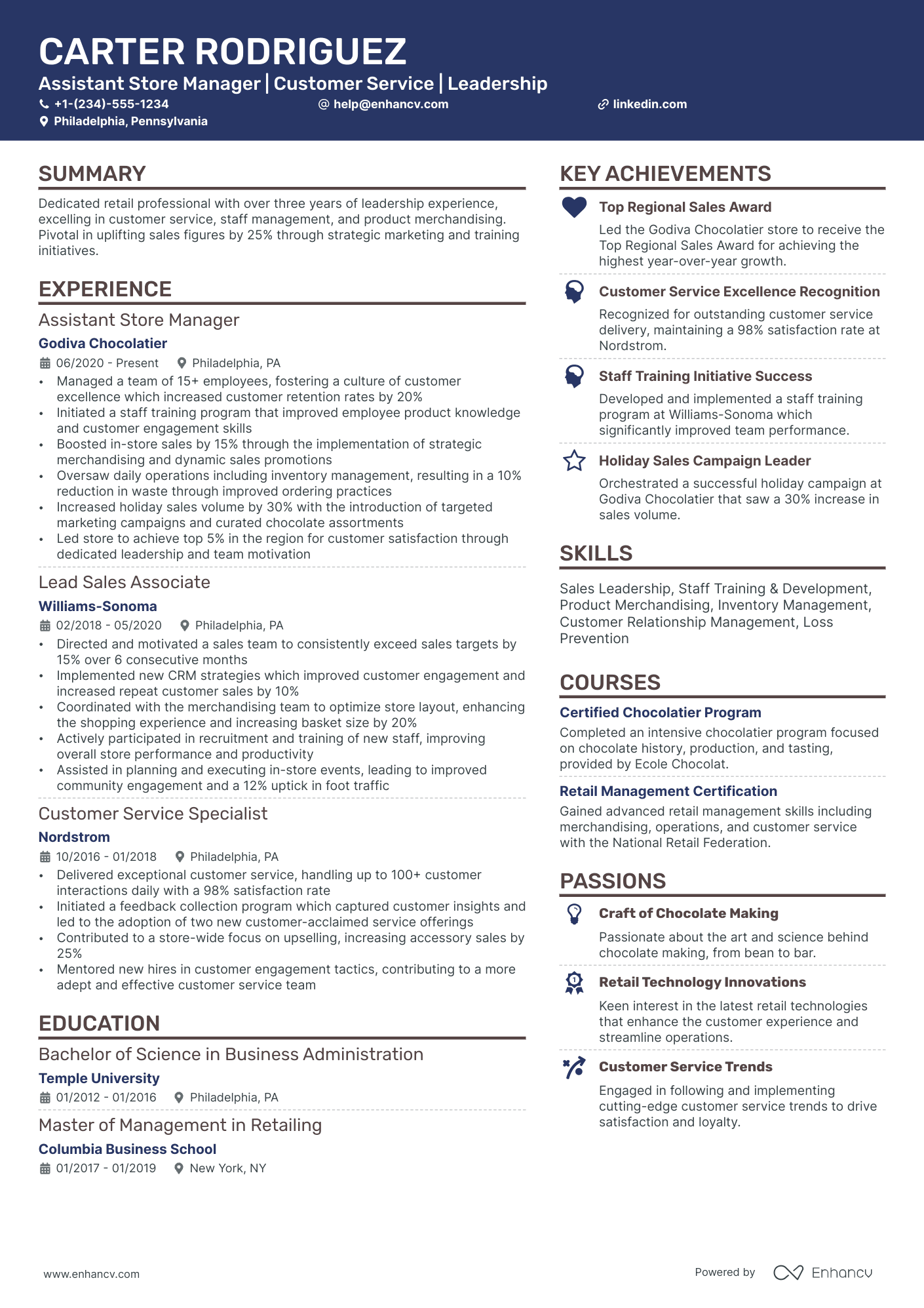
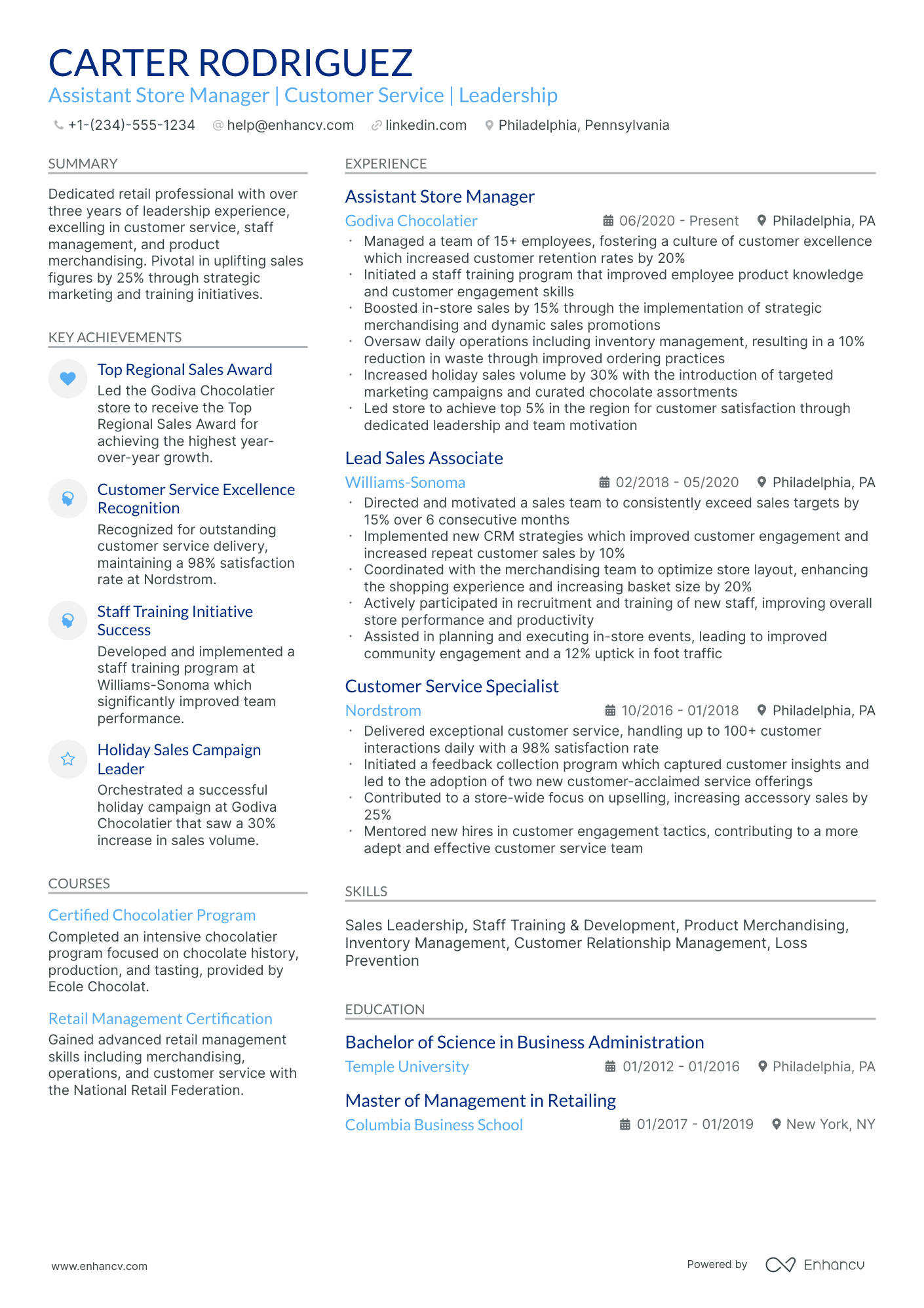
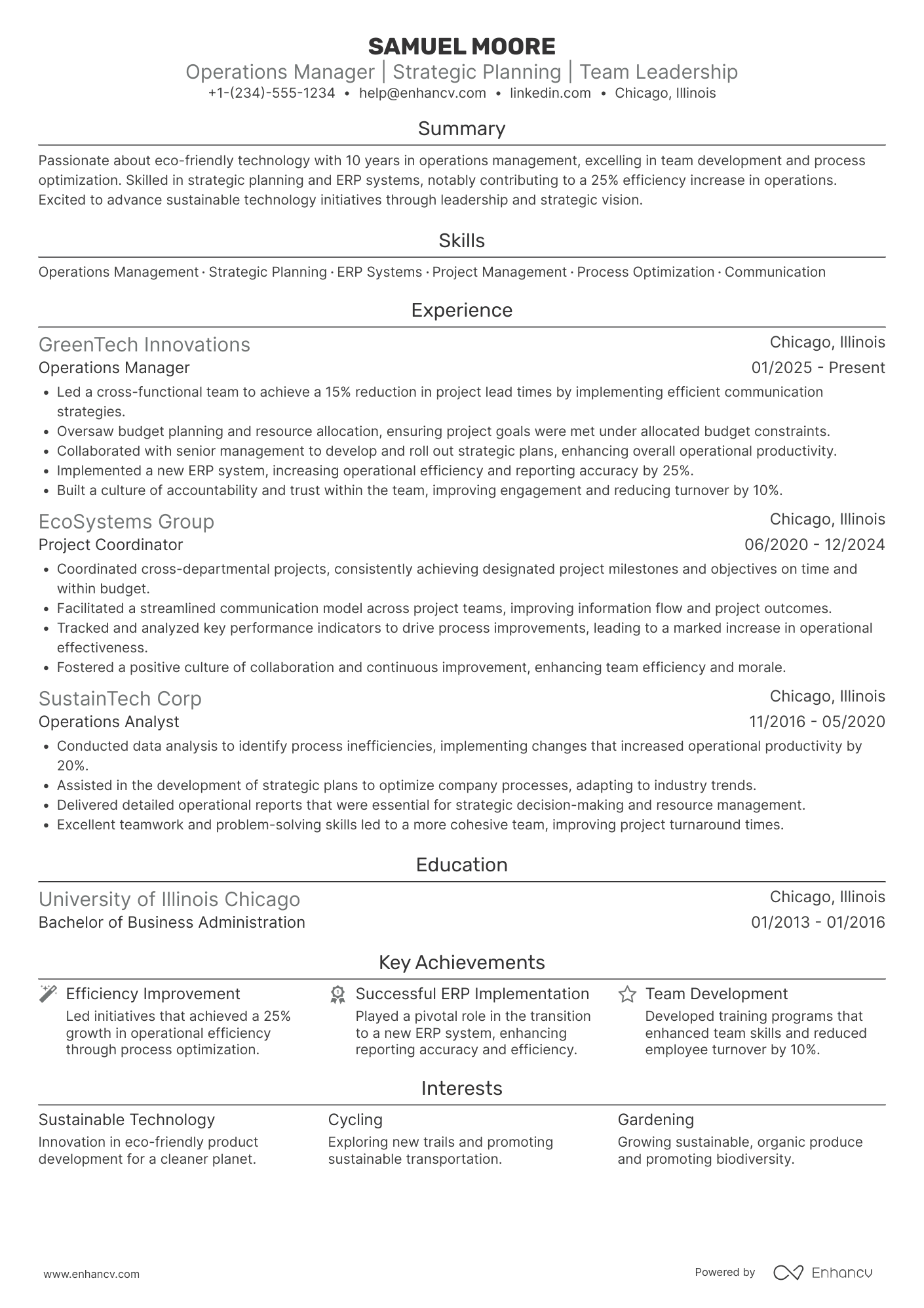
Many deputy manager resumes fail because they read like duty logs, not leadership evidence. In today's deputy manager resume reviews, applicant tracking system filters and rapid recruiter scans reward clear scope, results, and progression.
Once the resume shows the progression, the cover letter has to explain the judgment behind it — our deputy manager cover letter examples show how to frame one shift-level decision in a way a regional manager will recognize.
A strong resume shows how you improved performance, not which tools you used. Knowing how to make your resume stand out means you should highlight budget size managed, teams led across shifts, cycle time reduced, service levels raised, audit scores improved, and delivery milestones met on time.

Key takeaways
- Quantify achievements with metrics like cost savings, team size, and cycle time reductions.
- Use reverse-chronological format if you have progressive deputy management experience.
- Tailor every experience bullet to mirror the job posting's language and priorities.
- Demonstrate skills through measurable outcomes in your experience section, not just a skills list.
- Lead your summary with title, years of experience, and one standout result.
- Place certifications above education when they're recent and directly relevant to the role.
- Use Enhancv's tools to turn vague duty descriptions into sharp, results-driven resume bullets.
How to format a deputy manager resume
Recruiters evaluating deputy manager candidates prioritize operational ownership, team coordination skills, and a clear track record of supporting or stepping into managerial responsibilities. A well-chosen resume format ensures these signals—progression from individual contributor to leadership support, measurable contributions, and cross-functional collaboration—are immediately visible during a quick scan.

I have significant experience in this role—which format should I use?
Use a reverse-chronological format to showcase your growth into deputy management and the increasing scope of your responsibilities. Do:
- Lead with your most recent role and highlight the size of teams, budgets, or operations you directly supported or oversaw.
- Feature role-specific competencies such as staff scheduling, inventory management, KPI tracking, P&L reporting, or vendor coordination.
- Quantify outcomes tied to efficiency gains, revenue targets, cost reductions, or employee retention improvements.
I'm junior or switching into this role—what format works best?
A hybrid format works best because it lets you lead with transferable management skills while still presenting a concise work history. Do:
- Place a skills section near the top of your resume, emphasizing leadership, communication, conflict resolution, and any supervisory or coordination experience.
- Include projects, volunteer leadership, or cross-departmental assignments that demonstrate your readiness to support a manager in day-to-day operations.
- Connect every skill or experience to a concrete action and a measurable or observable result.
Why not use a functional resume?
A functional format strips away the timeline and context recruiters need to evaluate how your responsibilities grew, making it harder to verify hands-on management support experience.
- Career changers with supervisory experience in another industry: A functional format can help bridge the gap if you've led teams or managed operations in a non-retail or non-traditional setting.
- Candidates with resume gaps who held interim leadership roles: If you managed projects or teams during freelance, contract, or volunteer work, a functional layout can spotlight those contributions.
- Limited direct deputy manager experience but strong assistant or team lead background: A skills-forward structure can emphasize coordination and oversight abilities developed in adjacent roles.
With your resume's structure and layout in place, it's time to fill it with the right sections that highlight your qualifications as a deputy manager.
What sections should go on a deputy manager resume
Recruiters expect you to present leadership scope, operational responsibility, and measurable results in a clean, standard resume layout. Understanding which resume sections to include ensures maximum clarity.
Use this structure for maximum clarity:
- Header
- Summary
- Experience
- Skills
- Projects
- Education
- Certifications
- Optional sections: Awards, Leadership, Languages
Your experience bullets should emphasize impact, outcomes, scope of responsibility, and results you delivered across teams, budgets, and key operational metrics.
Is your resume good enough?
Drop your resume here or choose a file. PDF & DOCX only. Max 2MB file size.
Once you’ve organized your resume with the right components in place, the next step is to write your deputy manager experience section so it supports each one with clear, role-relevant detail.
How to write your deputy manager resume experience
The experience section is where you prove you've delivered real results as a deputy manager—not just occupied a role. Hiring managers prioritize demonstrated impact, role-relevant tools and methods, and measurable outcomes over descriptive task lists.
Each entry should include:
- Job title
- Company and location (or remote)
- Dates of employment (month and year)
Three to five concise bullet points showing what you owned, how you executed, and what outcomes you delivered:
- Ownership scope: the departments, operational areas, teams, or daily workflows you were directly accountable for as deputy manager, including the scale of staff, budgets, or facilities under your oversight.
- Execution approach: the management frameworks, reporting tools, scheduling systems, compliance protocols, or decision-making methods you applied to keep operations running and support the general manager's strategic priorities.
- Value improved: the specific gains you drove in operational efficiency, employee retention, customer satisfaction, safety compliance, cost control, or service reliability within your deputy manager responsibilities.
- Collaboration context: how you coordinated with department heads, frontline supervisors, senior leadership, vendors, or external partners to align priorities, resolve conflicts, and maintain seamless operations across functions.
- Impact delivered: the business outcomes your leadership produced—expressed through results tied to revenue growth, reduced turnover, improved audit scores, faster turnaround times, or expanded capacity rather than a list of activities you performed.
Experience bullet formula
A deputy manager experience example
✅ Right example - modern, quantified, specific.
Deputy Manager, Operations
BlueRiver Logistics | Columbus, OH
2022–Present
Regional third-party logistics provider supporting retail and e-commerce fulfillment across three distribution centers.
- Led daily operations for a 120-person team across inbound, outbound, and inventory, improving on-time shipment rate from 92% to 97% by standardizing shift handoffs and enforcing labor plans in UKG.
- Implemented Lean Six Sigma root-cause workflows (DMAIC) and daily Gemba walks, cutting pick errors by 28% and reducing customer chargebacks by $180K annually.
- Partnered with engineering and information technology to deploy a Manhattan Warehouse Management System (WMS) wave optimization update, increasing lines picked per hour by 14% and saving 220 labor hours per month.
- Built KPI dashboards in Power BI using data from the warehouse management system and NetSuite, shortening performance review cycles from weekly to daily and reducing overtime spend by 11%.
- Coordinated with sales, client stakeholders, and transportation carriers to redesign service-level agreements and exception management in ServiceNow, lowering missed pickup incidents by 35% and improving client satisfaction scores by 0.6 points.
Now that you've seen how a strong experience section comes together, let's look at how to adjust yours to match the specific deputy manager role you're targeting.
How to tailor your deputy manager resume experience
Recruiters evaluate your deputy manager resume through both human review and applicant tracking systems (ATS), so tailoring your resume to the job description is essential. Tailoring ensures the specific skills, tools, and responsibilities you highlight match what the hiring team is actively seeking.
Ways to tailor your deputy manager experience:
- Mirror the exact operational processes and standards named in the posting.
- Match leadership frameworks or team supervision models the employer references.
- Include specific software platforms or management systems listed as required.
- Reflect compliance or regulatory requirements mentioned in the job description.
- Align your performance metrics with the KPIs the role prioritizes.
- Highlight relevant industry or domain experience when the posting specifies it.
- Use the same terminology for workflows or reporting structures described.
- Emphasize cross-departmental collaboration if the role references coordination duties.
Tailoring means aligning your real accomplishments with the job's stated requirements, not forcing keywords where they don't naturally belong.
Resume tailoring examples for deputy manager
| Job description excerpt | Untailored | Tailored |
|---|---|---|
| "Oversee daily branch operations, ensure compliance with company SOPs, and manage a team of 15+ staff across front-end and back-end departments." | Helped with daily operations and supervised employees. | Directed daily branch operations for a team of 18 across front-end and back-end departments, enforcing company SOPs and reducing compliance violations by 30% over 12 months. |
| "Support the general manager in budgeting, P&L analysis, and quarterly business reviews using SAP and Excel-based forecasting models." | Assisted management with financial tasks and reporting. | Partnered with the general manager to prepare quarterly business reviews, building Excel-based forecasting models and running P&L analyses in SAP that identified $120K in annual cost savings. |
| "Drive customer satisfaction scores by implementing service recovery protocols and coaching staff through weekly performance check-ins." | Worked on improving customer service and trained team members. | Raised customer satisfaction scores from 78% to 91% by rolling out structured service recovery protocols and leading weekly one-on-one performance check-ins with 12 direct reports. |
Once you’ve aligned your experience with the role’s priorities, the next step is to quantify your deputy manager achievements so hiring teams can see the impact behind those responsibilities.
How to quantify your deputy manager achievements
Quantifying your work proves you drove outcomes, not just activity. Focus on cycle time, accuracy, compliance, cost, risk, customer satisfaction, and volume managed across teams, processes, and service delivery.
Quantifying examples for deputy manager
| Metric | Example |
|---|---|
| Cycle time | "Cut weekly scheduling turnaround from 2 days to 6 hours by standardizing requests in Microsoft Excel and Outlook, supporting 45 staff across three shifts." |
| Accuracy rate | "Reduced invoice and timesheet errors from 3.8% to 1.2% by adding a two-step review in SAP and training eight supervisors." |
| Compliance | "Raised audit pass rate from 86% to 98% by updating checklists, running monthly spot checks, and closing 32 corrective actions in 90 days." |
| Cost savings | "Saved $120,000 annually by renegotiating two vendor contracts and consolidating orders, while maintaining service levels across five locations." |
| Customer satisfaction | "Improved customer satisfaction score from 4.1 to 4.6 out of 5 by tightening escalation workflows and cutting response time from 24 hours to 8 hours." |
Turn vague job duties into measurable, recruiter-ready resume bullets in seconds with Enhancv's Bullet Point Generator.
With strong, action-driven bullet points in place, the next step is making sure your deputy manager resume highlights the right mix of hard and soft skills.
How to list your hard and soft skills on a deputy manager resume
Your skills section shows how you support managers, run operations, and deliver results, and recruiters and an ATS (applicant tracking system) scan this section to confirm fit fast, so aim for a balanced mix of role-specific hard skills and execution-focused soft skills. deputy manager roles require a blend of:
- Product strategy and discovery skills.
- Data, analytics, and experimentation skills.
- Delivery, execution, and go-to-market discipline.
- Soft skills.
Your skills section should be:
- Scannable (bullet-style grouping).
- Relevant to the job post.
- Backed by proof in experience bullets.
- Updated with current tools.
Place your skills section:
- Above experience if you're junior or switching careers.
- Below experience if you're mid/senior with strong achievements.

Hard skills
- KPI dashboards, reporting
- Excel, Google Sheets
- SQL basics, data pulls
- Power BI, Tableau
- Budgeting, cost control
- Forecasting, capacity planning
- Process mapping, SOPs
- Lean, Six Sigma
- Project plans, RAID logs
- Jira, Confluence
- Salesforce, HubSpot
- Vendor management, procurement
Soft skills
- Prioritize work across teams
- Escalate risks early
- Make trade-off decisions
- Align stakeholders on goals
- Run effective weekly cadences
- Delegate and follow through
- Coach and unblock team members
- Deliver clear status updates
- Negotiate timelines and scope
- Resolve conflict with facts
- Hold owners accountable
- Drive continuous improvement
How to show your deputy manager skills in context
Skills shouldn't live only in a bulleted list on your resume. You can explore common resume skills to identify which ones align best with deputy manager expectations.
They should be demonstrated in:
- Your summary (high-level professional identity)
- Your experience (proof through outcomes)
Here's what strong deputy manager examples look like in practice.
Summary example
Deputy manager with 12 years in retail operations, skilled in workforce scheduling, P&L analysis, and Kronos. Led process improvements that cut inventory shrinkage by 18%. Known for mentoring teams and driving consistent store performance.
- Reflects senior-level experience clearly
- Names specific tools and methods
- Includes a measurable cost-saving metric
- Highlights mentoring as a soft skill
Experience example
Deputy Manager
Bridgewell Consumer Group | Denver, CO
March 2019–August 2024
- Redesigned staff onboarding using Workday, reducing new-hire ramp-up time by 30% across three departments.
- Partnered with the regional director to implement quarterly audits, improving compliance scores from 74% to 96%.
- Managed daily operations for a 45-person team using Asana, increasing on-time project delivery by 22%.
- Every bullet contains measurable proof
- Skills appear naturally through real outcomes
Once you’ve demonstrated these capabilities through concrete examples and outcomes, the next step is translating them into a deputy manager resume when you don’t have direct experience.
How do I write a deputy manager resume with no experience
Even without full-time experience, you can demonstrate readiness through:
- Shift lead in retail
- Student organization operations officer
- Event staffing team lead
- Volunteer program coordinator
- Inventory counts and reconciliation
- Scheduling and timekeeping support
- Budget tracking for club events
- Internship supporting operations manager
If you're in this situation, learning how to build a resume without work experience can help you structure these transferable contributions effectively.
Focus on:
- Measurable results and improvements
- Scheduling, staffing, and coverage
- Inventory, budgets, and compliance
- Tools used and proficiency
Resume format tip for entry-level deputy manager
Use a hybrid resume format because it highlights transferable skills and measurable projects before limited work history. Do:
- Add a "Projects" section near top.
- Quantify outcomes with numbers and timeframes.
- List tools like Excel, POS, and scheduling software.
- Mirror deputy manager keywords from postings.
- Include leadership scope: people, budget, volume.
- Led weekly inventory counts and Excel reconciliation for a student-run store, reducing stock variances by 18% over eight weeks through updated cycle-count checks.
Even without direct experience, your education section can demonstrate the foundational knowledge and relevant training that qualifies you for a deputy manager role.
How to list your education on a deputy manager resume
Your education section helps hiring teams confirm you have the foundational knowledge needed for a deputy manager role. It validates your academic background quickly and efficiently.
Include:
- Degree name
- Institution
- Location
- Graduation year
- Relevant coursework (for juniors or entry-level candidates)
- Honors & GPA (if 3.5 or higher)
Skip month and day details—list the graduation year only.
Here's a strong education entry tailored for a deputy manager resume.
Example education entry
Bachelor of Science in Business Administration
University of Georgia, Athens, GA
Graduated 2019
GPA: 3.7/4.0
- Relevant coursework: Operations Management, Organizational Leadership, Financial Analysis, Strategic Planning
- Honors: Magna Cum Laude, Dean's List (six consecutive semesters)
How to list your certifications on a deputy manager resume
Certifications show a deputy manager's commitment to learning, proficiency with tools, and alignment with industry standards. They also validate specialized skills when your work history needs extra proof.
Include:
- Certificate name
- Issuing organization
- Year
- Optional: credential ID or URL
- Place certifications below education when they are older, less relevant, or you want education to lead for early-career deputy manager roles.
- Place certifications above education when they are recent, highly relevant, or required for the deputy manager role you target.
Best certifications for your deputy manager resume
- Project Management Professional (PMP)
- Certified Associate in Project Management (CAPM)
- PRINCE2 Foundation
- Lean Six Sigma Green Belt
- ITIL 4 Foundation
- Certified ScrumMaster (CSM)
- OSHA 30-Hour General Industry
Once you’ve positioned your certifications to reinforce your qualifications, shift to your deputy manager resume summary to highlight those strengths upfront.
How to write your deputy manager resume summary
Your resume summary is the first thing a recruiter reads. A strong one immediately signals you're qualified for the deputy manager role.
Keep it to three to four lines, with:
- Your current title and total years of relevant experience.
- The industry, domain, or business type you've worked in.
- Core skills such as operations management, team coordination, or budgeting.
- One or two measurable achievements that prove your impact.
- Soft skills tied to real outcomes, like conflict resolution that reduced staff turnover.

PRO TIP
As a deputy manager, emphasize hands-on leadership, operational results, and cross-functional coordination. Highlight how you've supported senior leadership and driven team performance. Avoid vague phrases like "passionate leader" or "motivated self-starter." Replace them with specific outcomes and scope.
Example summary for a deputy manager
Deputy manager with six years in retail operations, leading teams of 25+ staff. Streamlined scheduling processes, cutting overtime costs by 18%. Skilled in inventory management, P&L oversight, and staff development.
Optimize your resume summary and objective for ATS
Drop your resume here or choose a file.
PDF & DOCX only. Max 2MB file size.
Now that your summary effectively communicates your leadership value, make sure the header framing it presents your contact details correctly.
What to include in a deputy manager resume header
A resume header is the top section with your identity and contact details, and it boosts visibility, credibility, and recruiter screening for a deputy manager.
Essential resume header elements
- Full name
- Tailored job title and headline
- Location
- Phone number
- Professional email
- GitHub link
- Portfolio link
A LinkedIn link helps recruiters verify your experience quickly and supports faster screening.
Do not include photos on a deputy manager resume unless the role is explicitly front-facing or appearance-dependent.
Keep the header to two lines, match the deputy manager title to the posting, and use consistent formatting so recruiters can scan it fast.
Example
Deputy manager resume header
Jordan Taylor
Deputy Manager | Operations Support and Team Leadership
Chicago, IL
(312) 555-12XX
jordan.taylor@enhancv.com
github.com/jordantaylor yourwebsite.com linkedin.com/in/jordantaylor
Once your contact details and role-specific headline set a clear first impression, add optional sections that reinforce your qualifications and fit for the deputy manager role.
Additional sections for deputy manager resumes
When your core sections don't fully capture your leadership depth, additional sections help you stand out among competing deputy manager candidates. For example, listing language skills can highlight your ability to communicate across diverse teams and customer bases.
- Languages
- Professional affiliations
- Volunteer leadership experience
- Industry certifications
- Awards and recognition
- Community involvement
- Hobbies and interests
Once you've rounded out your resume with the right supplementary sections, it's worth turning your attention to the cover letter—a separate document that can reinforce and contextualize everything your resume presents.
Do deputy manager resumes need a cover letter
A cover letter isn't required for a deputy manager, but it often helps in competitive searches or when hiring managers expect one. If you're unsure where to start, understanding what a cover letter is and how it complements your resume can clarify its value. It can make a difference when your resume needs context, or when the role has high trust and cross-team influence.
Use a cover letter to add details your resume can't show:
- Explain deputy manager fit by connecting your leadership style to the team's needs, operating rhythm, and decision-making expectations.
- Highlight one or two outcomes, such as improving service levels, reducing cycle time, or delivering a project across multiple stakeholders.
- Show you understand the product, users, or business context by naming a key metric, customer segment, or operational constraint you've handled.
- Address a transition or non-obvious experience by clarifying why your background matches deputy manager responsibilities and what you'll prioritize first.
Drop your resume here or choose a file.
PDF & DOCX only. Max 2MB file size.
Even if you decide a cover letter will not add value to your application, AI can help you strengthen your deputy manager resume faster and more precisely in the next section.
Using AI to improve your deputy manager resume
AI can sharpen your resume's clarity, structure, and impact. It helps refine bullet points, tighten language, and highlight results. But overuse strips authenticity fast. Once your content feels clear and role-aligned, step away from AI. If you're wondering which AI is best for writing resumes, the answer depends on your specific needs and how much editing control you want.
Here are 10 practical prompts to strengthen specific sections of your deputy manager resume:
Strengthen your summary
Quantify experience bullets
Tighten action verbs
Align skills strategically
Clarify project contributions
Improve education details
Refine certification entries
Remove redundant phrasing
Tailor for industry fit
Spotlight leadership impact
Conclusion
A strong deputy manager resume highlights measurable outcomes, role-specific skills, and a clear structure. It shows how you improved results, led teams, managed budgets, and solved operational issues with consistent performance.
Keep each section easy to scan, with focused bullets and relevant keywords. This approach shows hiring teams you’re ready for today’s deputy manager roles and near-future expectations.