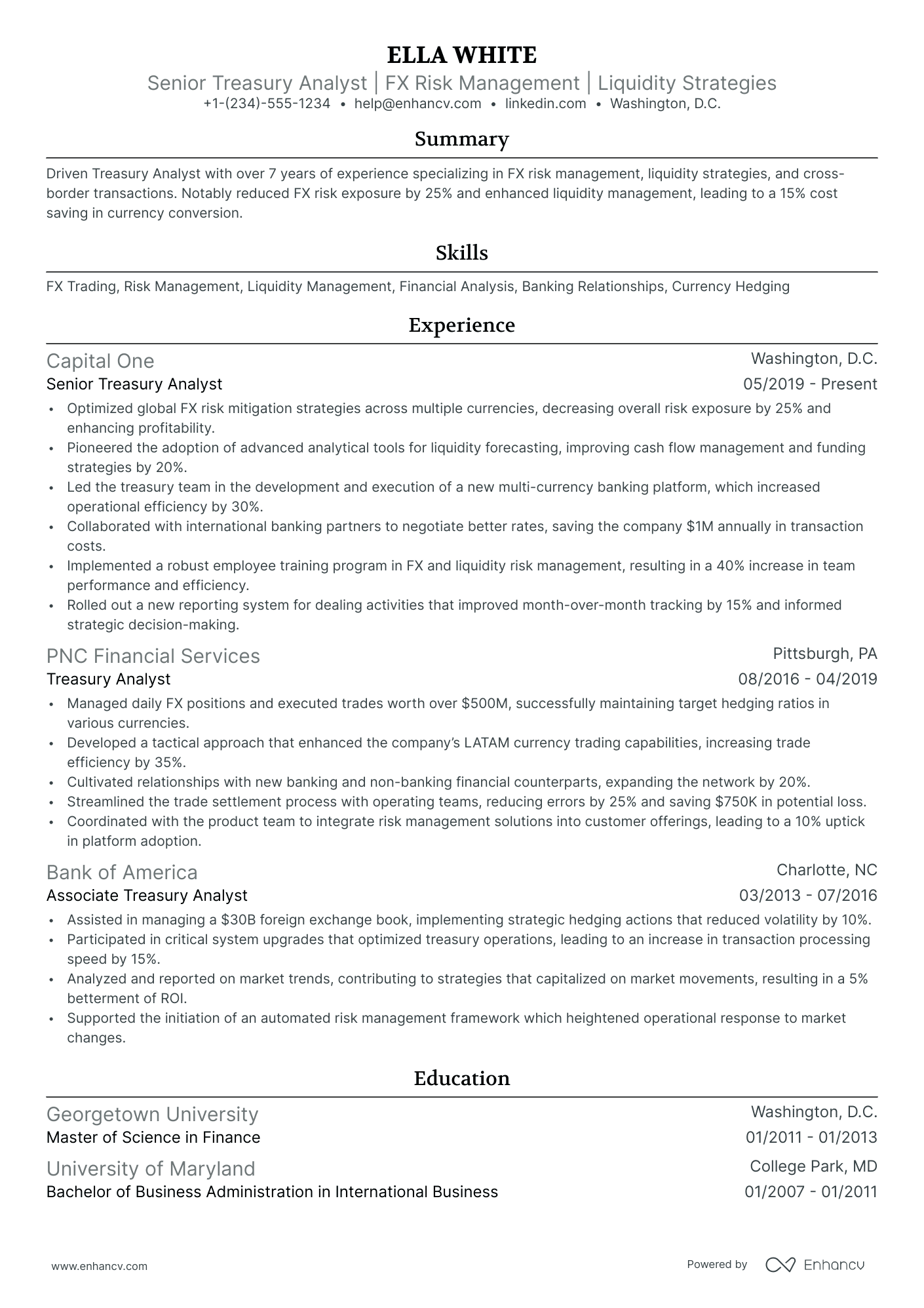
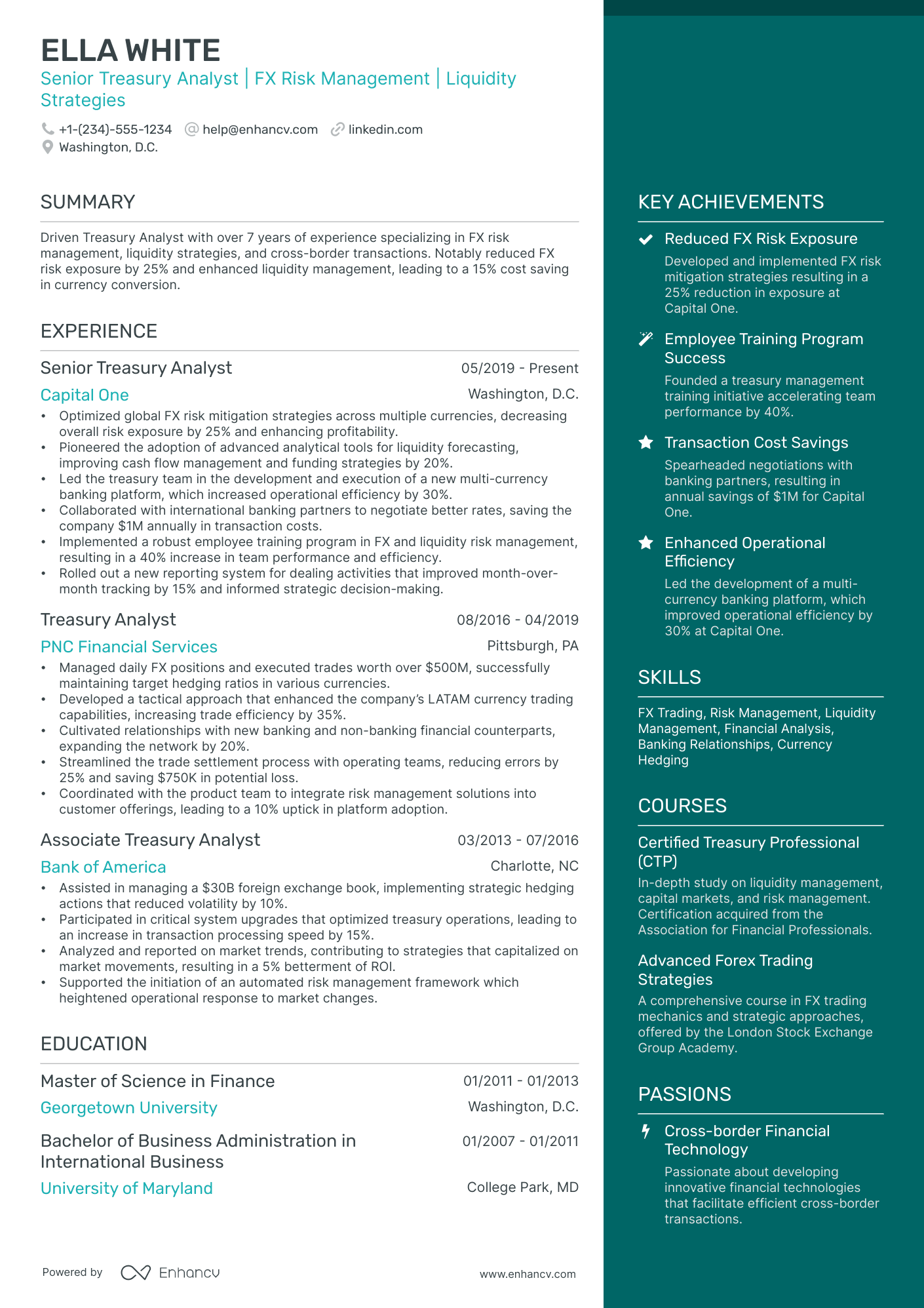
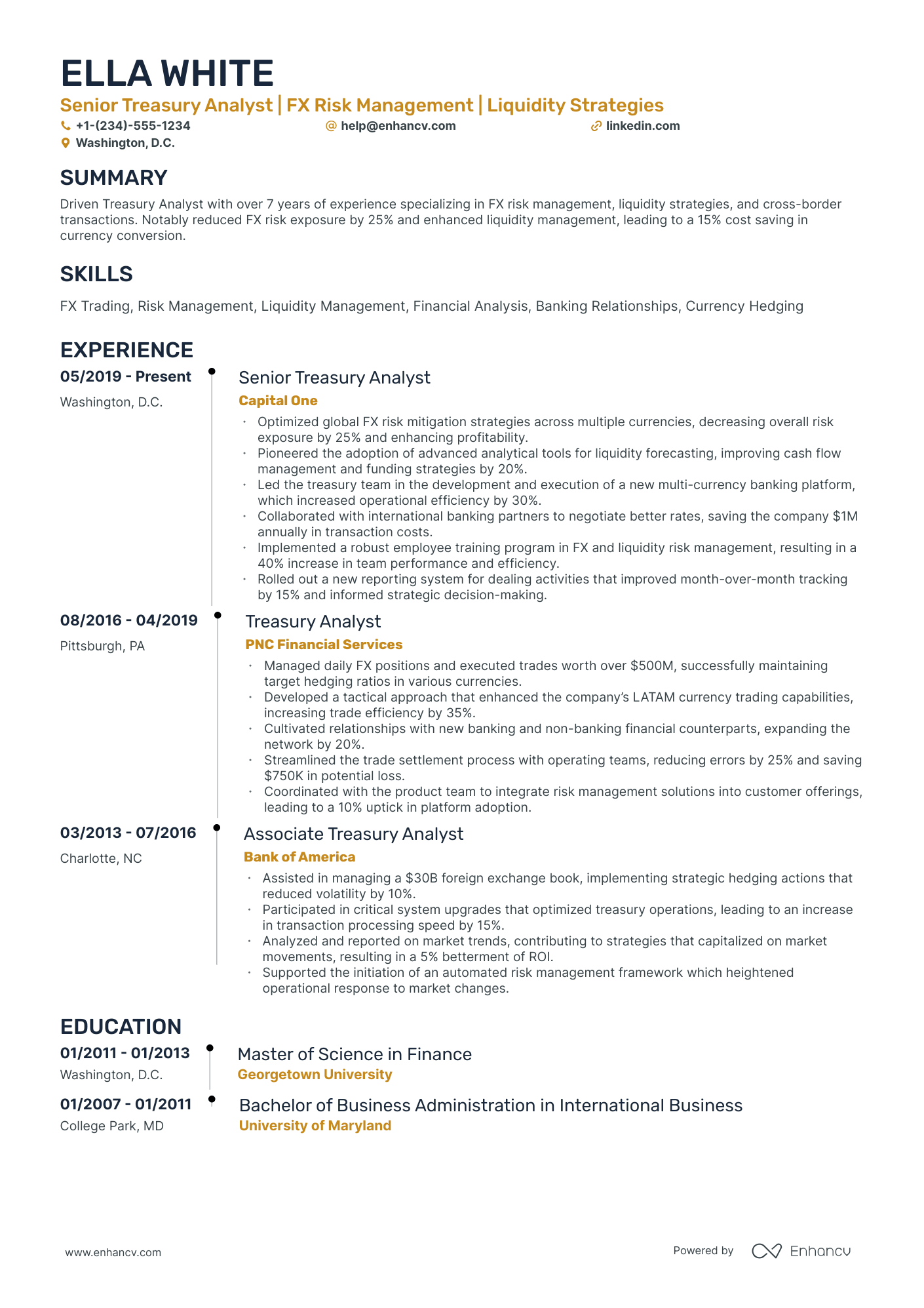
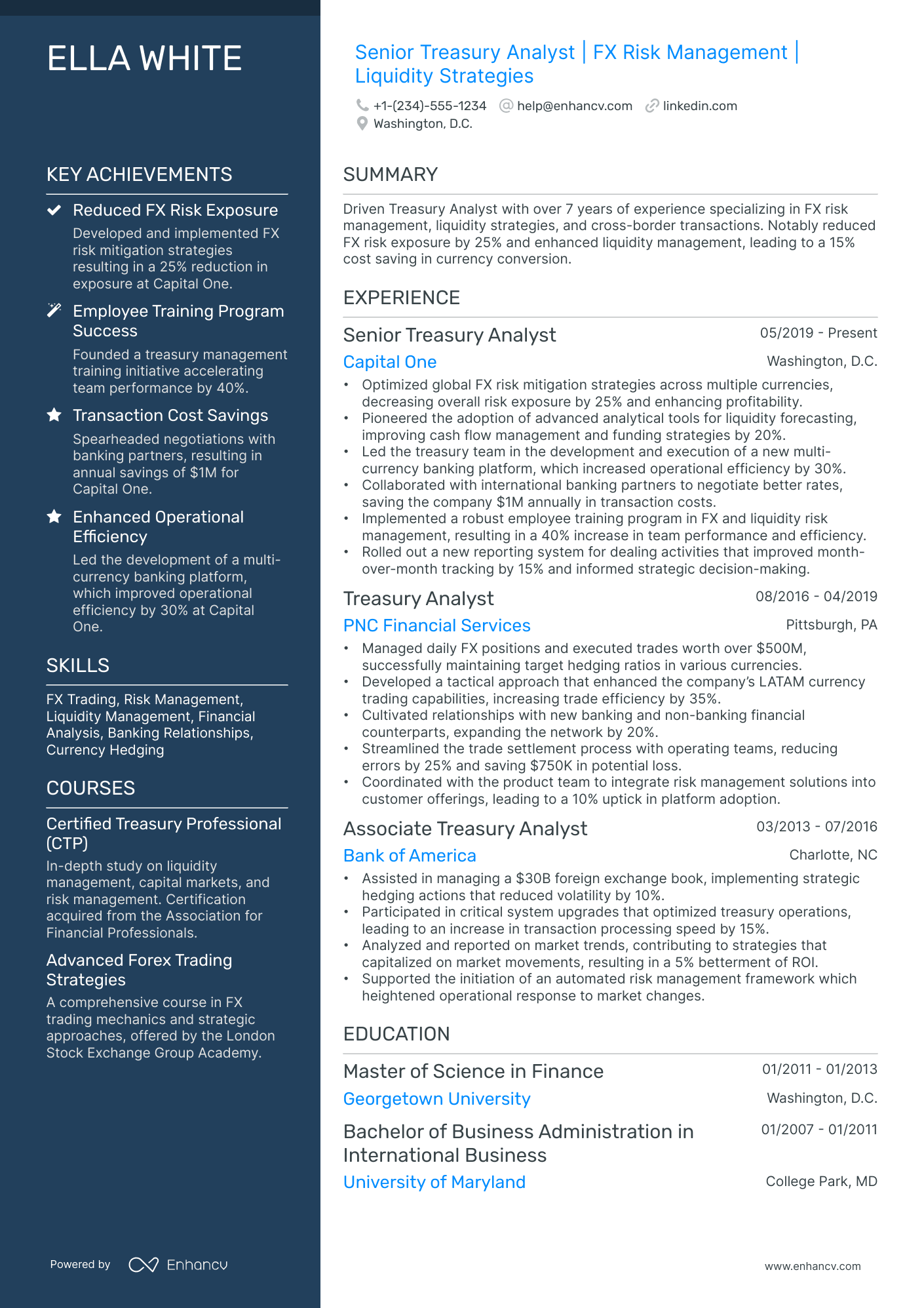
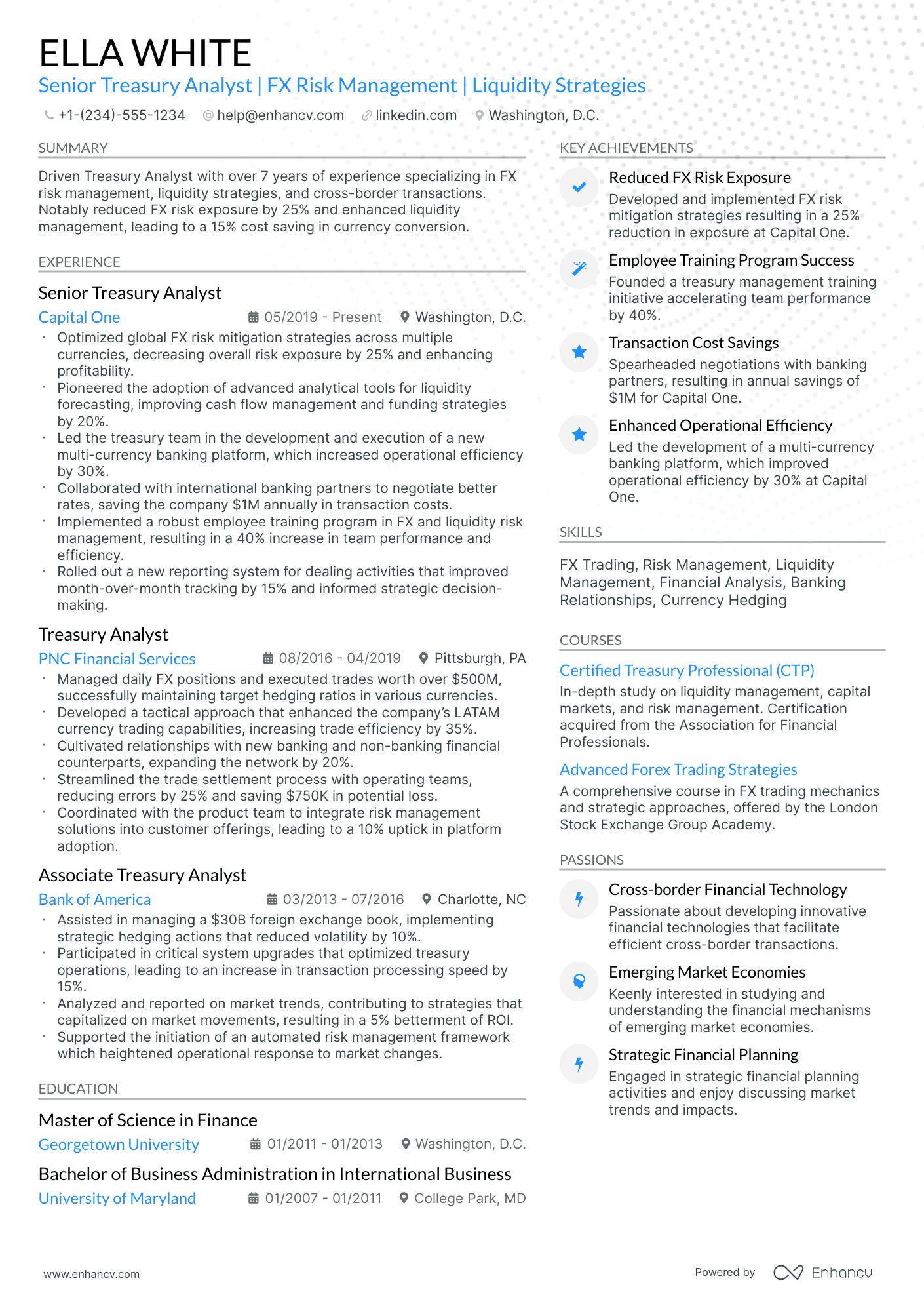
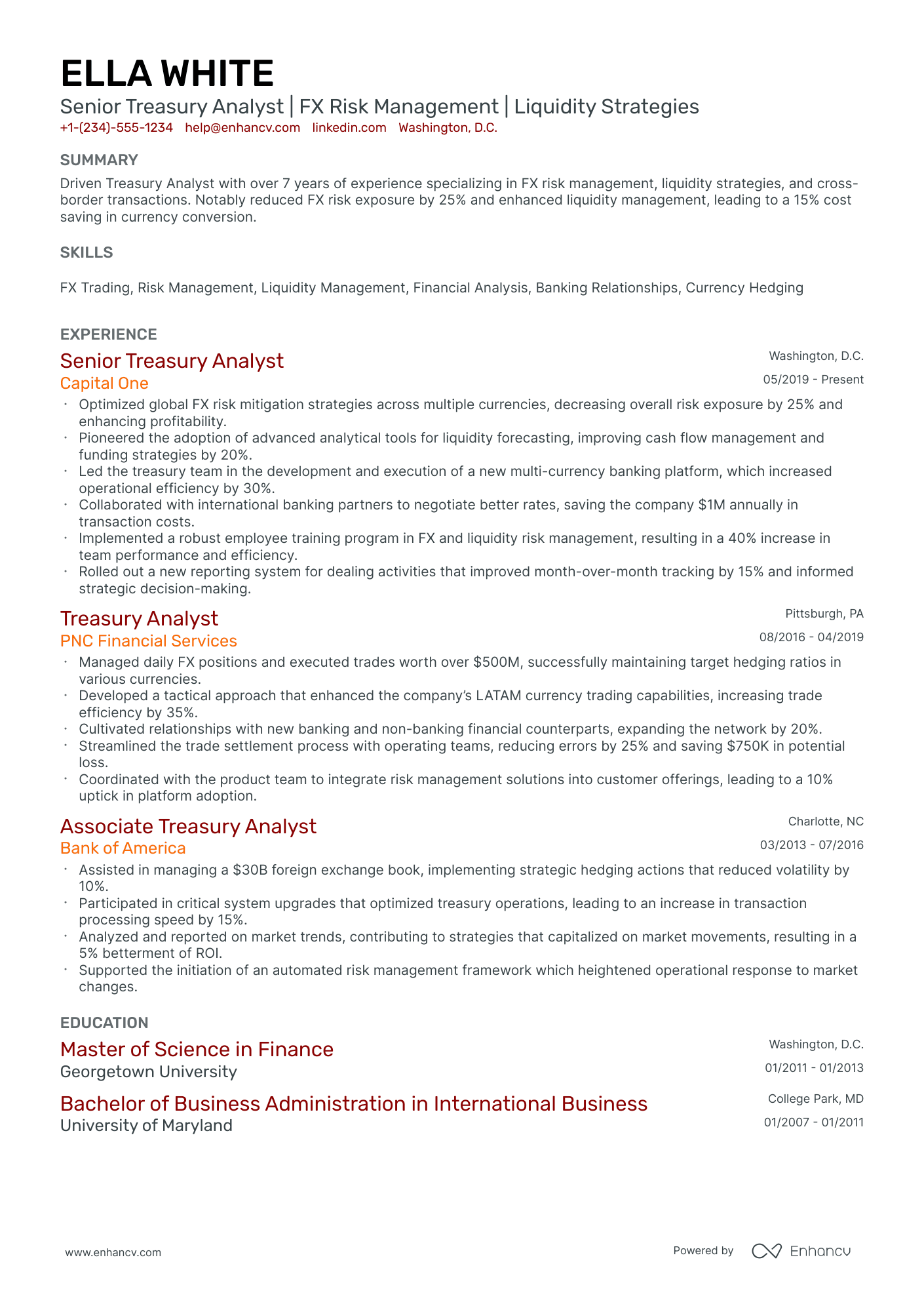
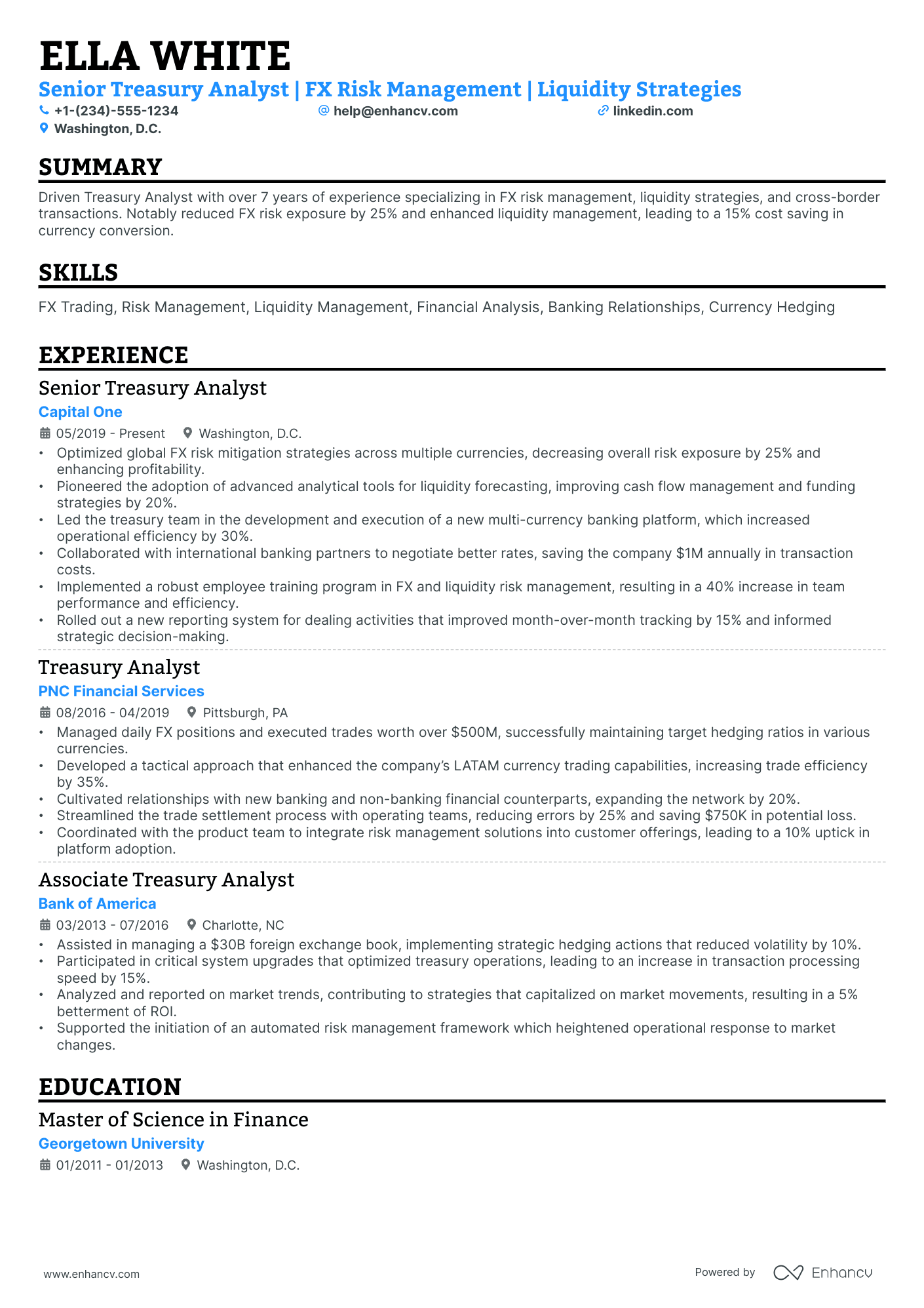
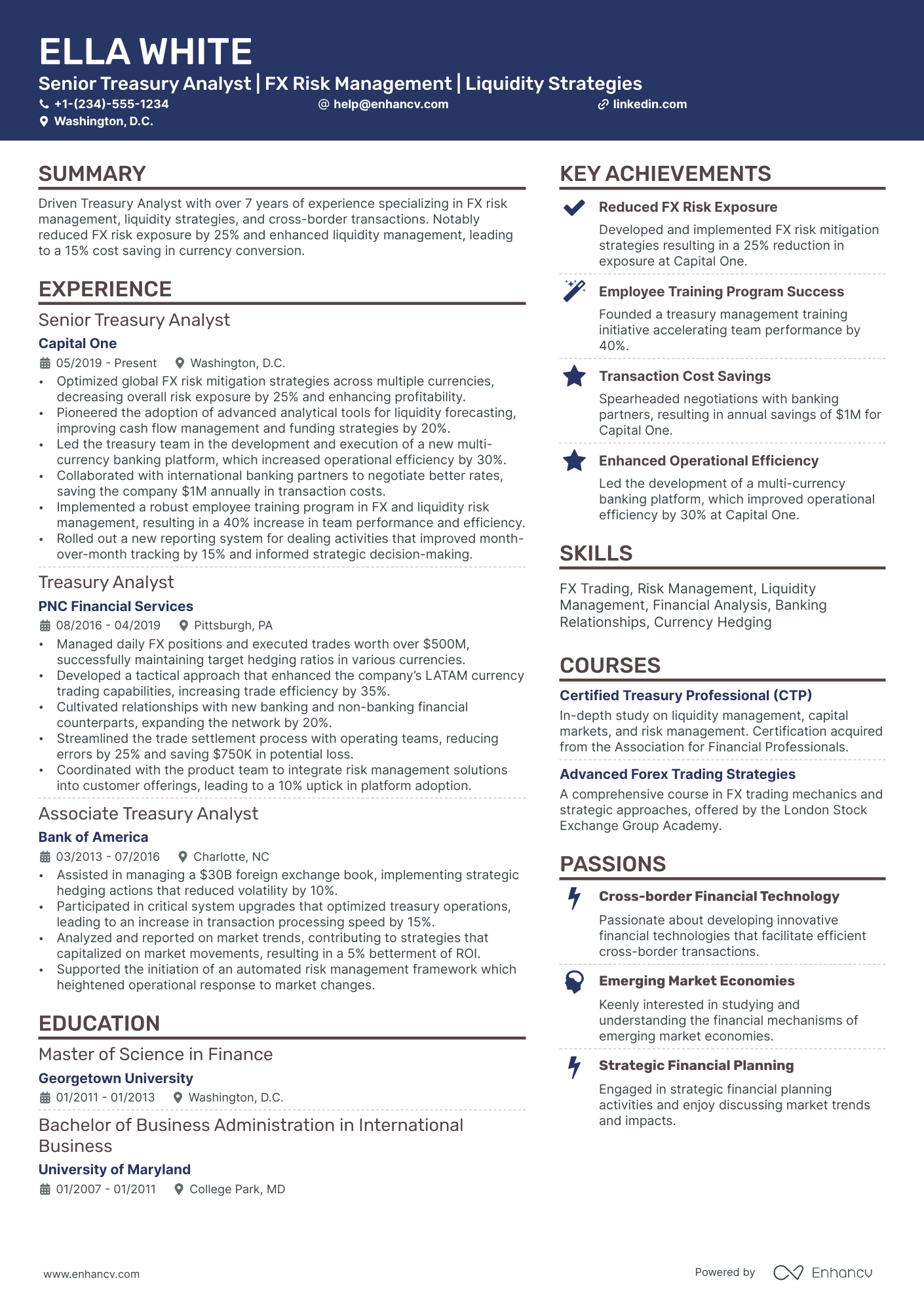
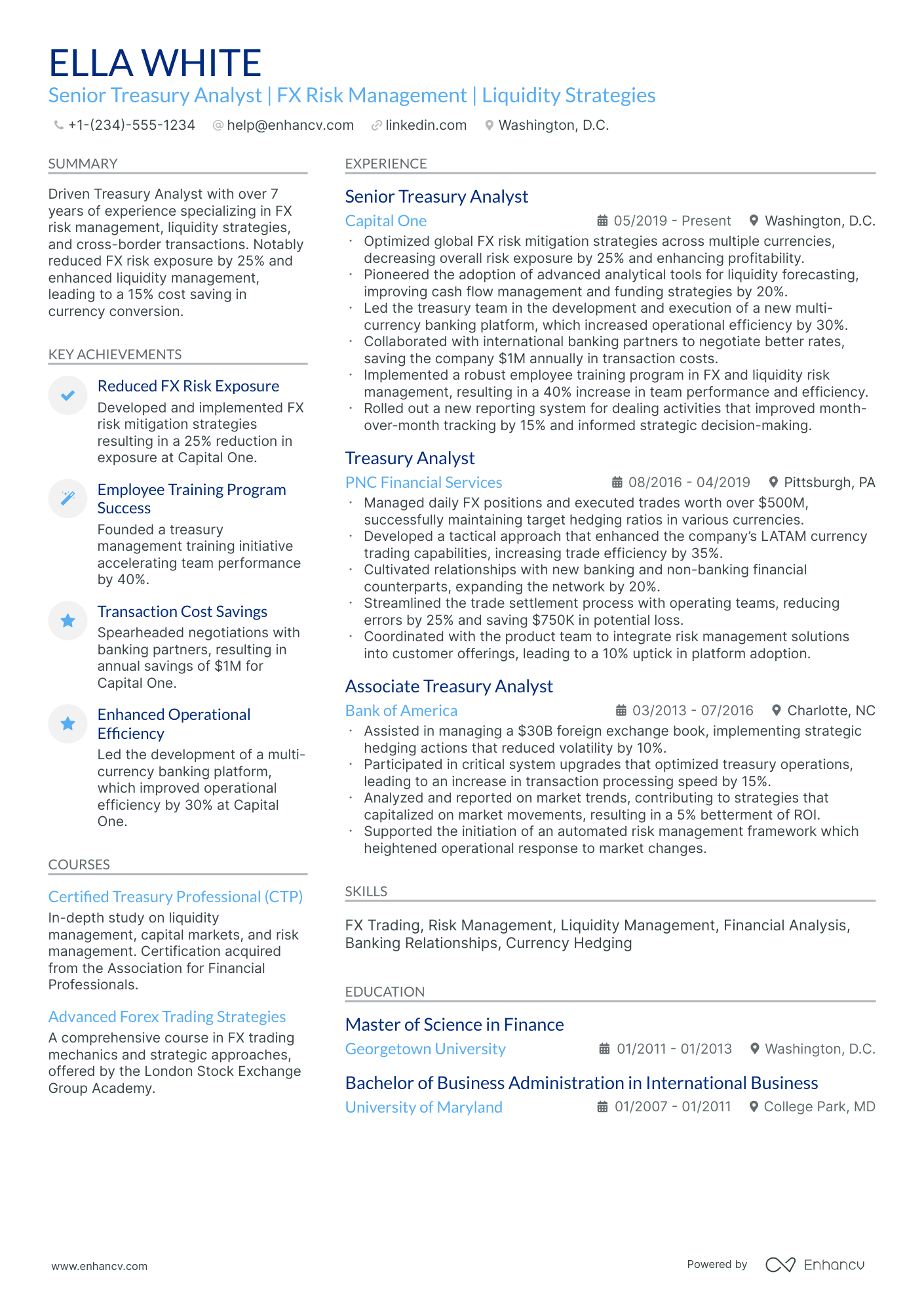
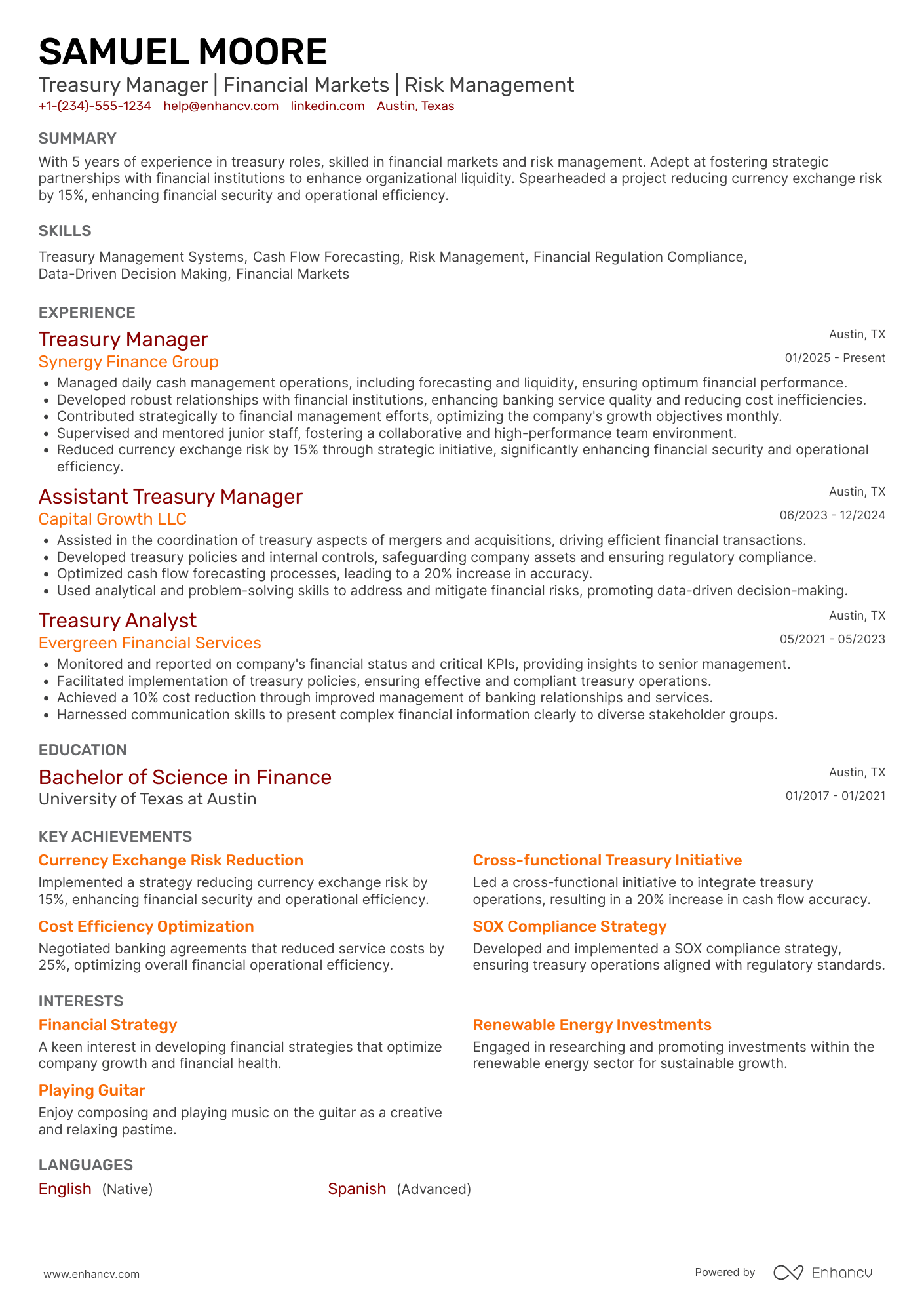
Most treasury manager resume drafts fail because they read like task logs, not decision-ready summaries of liquidity control and risk outcomes. That costs you in applicant tracking system screening, fast recruiter scans, and heavy competition. If you're unsure where to begin, understanding how to write a resume that communicates value is the essential first step.
A strong resume shows what changed because of your decisions. You should quantify cash forecasting accuracy, debt savings, liquidity buffers, and working capital impact. Highlight scope, such as global cash pools, bank relationships, hedging programs, audit-ready controls, and faster close cycles.

Key takeaways
- Quantify treasury outcomes like forecast accuracy, borrowing savings, and idle cash reduction in every bullet.
- Use reverse-chronological format for experienced candidates and hybrid format for career changers.
- Tailor experience bullets to match each job posting's specific systems, KPIs, and terminology.
- Place skills above experience if you're junior, below it if you're mid-level or senior.
- Earn the Certified Treasury Professional credential to stand out from equally qualified candidates.
- Demonstrate skills through measurable results in your experience section, not just a standalone list.
- Use Enhancv to turn routine treasury duties into focused, recruiter-ready resume bullets.
Job market snapshot for treasury managers
We analyzed 513 recent treasury manager job ads across major US job boards. These numbers help you understand top companies hiring, employer expectations, career growth patterns at a glance.
What level of experience employers are looking for treasury managers
| Years of Experience | Percentage found in job ads |
|---|---|
| 1–2 years | 7.0% (36) |
| 3–4 years | 8.6% (44) |
| 5–6 years | 11.1% (57) |
| 7–8 years | 3.5% (18) |
| 9–10 years | 1.2% (6) |
| 10+ years | 1.8% (9) |
| Not specified | 65.3% (335) |
Treasury manager ads by area of specialization (industry)
| Industry (Area) | Percentage found in job ads |
|---|---|
| Finance & Banking | 99.0% (508) |
Top companies hiring treasury managers
| Company | Percentage found in job ads |
|---|---|
| Huntington Bancshares Inc | 16.8% (86) |
| US Bank | 10.3% (53) |
| Cadence Bank | 6.4% (33) |
| Wells Fargo | 5.5% (28) |
| PNC Financial Services Group, Inc. | 4.9% (25) |
| JPMorgan Chase & Co. | 3.7% (19) |
| Old National Bank | 3.3% (17) |
| Seacoast National Bank | 3.1% (16) |
| First Horizon Corp. | 2.9% (15) |
| Business First Bank | 2.3% (12) |
Role overview stats
These tables show the most common responsibilities and employment types for treasury manager roles. Use them to align your resume with what employers expect and to understand how the role is structured across the market.
Day-to-day activities and top responsibilities for a treasury manager
| Responsibility | Percentage found in job ads |
|---|---|
| Treasury management | 35.7% (183) |
| Microsoft office | 16.2% (83) |
| Sales | 16.0% (82) |
| Risk management | 15.8% (81) |
| Negotiation | 15.6% (80) |
| Excel | 13.1% (67) |
| Strategic planning | 10.9% (56) |
| Cash management | 10.7% (55) |
| Powerpoint | 10.5% (54) |
| Customer service | 10.3% (53) |
| Communication | 9.7% (50) |
| Project management | 8.8% (45) |
Type of employment (remote vs on-site vs hybrid)
| Employment type | Percentage found in job ads |
|---|---|
| On-site | 62.4% (320) |
| Hybrid | 35.9% (184) |
| Remote | 1.8% (9) |
How to format a treasury manager resume
Recruiters evaluating treasury manager candidates prioritize cash management expertise, risk mitigation capabilities, and a clear track record of optimizing liquidity and capital structures. A well-chosen resume format ensures these signals—along with progression through increasingly complex treasury functions—are immediately visible to both hiring managers and applicant tracking systems.

I have significant experience in this role—which format should I use?
Use a reverse-chronological format to showcase your deepening accountability across treasury operations, banking relationships, and financial strategy. Do:
- Lead with your most recent role and emphasize scope of ownership—treasury portfolio size, number of entities managed, and reporting structure.
- Highlight domain-specific tools and competencies such as treasury management systems (e.g., Kyriba, SAP TRM), FX hedging instruments, cash forecasting models, and debt covenant management.
- Quantify business impact through measurable outcomes tied to cost savings, yield optimization, or risk reduction.
I'm junior or switching into this role—what format works best?
A hybrid format works best, allowing you to lead with a focused treasury skills section while still presenting your work history in chronological order. Do:
- Place core treasury competencies—cash positioning, bank account management, short-term investment analysis—near the top of the resume so recruiters and applicant tracking systems capture them immediately.
- Include relevant projects or transitional experience such as cash flow forecasting during an internship, FP&A rotations involving liquidity analysis, or CTP (Certified Treasury Professional) coursework.
- Connect every action to a clear result, even at a smaller scale, to demonstrate analytical thinking and financial impact.
Why not use a functional resume?
A functional format strips away the timeline and context that hiring managers need to evaluate how your treasury skills developed and where they were applied, making it harder to verify depth of experience. A functional resume may make sense only in narrow circumstances: if you're transitioning from a related finance role (such as FP&A or corporate banking) with no direct treasury title, if you have a limited work history but hold a CTP or equivalent certification supported by project work, or if you're re-entering the workforce after a significant gap and need to foreground transferable cash management skills.
- Even in these edge cases, tie every listed skill to a specific project, transaction, or outcome—functional formats that present skills in isolation without context are routinely deprioritized by recruiters and frequently parsed poorly by applicant tracking systems.
Once you've established a clean, readable format, the next step is deciding which sections to include so each one serves a clear purpose on your resume.
What sections should go on a treasury manager resume
Recruiters expect a treasury manager resume to show clear ownership of liquidity, funding, risk, and cash optimization across the organization. Knowing what to put on a resume helps you prioritize the sections that matter most for this role.
Use this structure for maximum clarity:
- Header
- Summary
- Experience
- Skills
- Projects
- Education
- Certifications
- Optional sections: Awards, leadership, languages
Your experience bullets should emphasize measurable impact, financial outcomes, scope of responsibility, and results across cash flow, banking relationships, forecasting accuracy, and risk controls.
Is your resume good enough?
Drop your resume here or choose a file. PDF & DOCX only. Max 2MB file size.
Once you’ve organized your resume with the right components, the next step is to write the experience section so it supports that structure with clear, relevant details.
How to write your treasury manager resume experience
Your work experience section should prove you've managed cash positions, optimized liquidity, and delivered measurable financial outcomes—not just list daily responsibilities. Hiring managers prioritize demonstrated impact, so each bullet should connect a treasury function you owned to a tool or method you used and a result the business gained.
Each entry should include:
- Job title
- Company and location (or remote)
- Dates of employment (month and year)
Three to five concise bullet points showing what you owned, how you executed, and what outcomes you delivered:
- Ownership scope: the cash management functions, banking relationships, investment portfolios, debt instruments, or treasury systems you were directly accountable for.
- Execution approach: the treasury management systems, forecasting models, hedging strategies, ERP platforms, or risk frameworks you used to guide decisions and deliver work.
- Value improved: changes to liquidity positioning, borrowing costs, forecast accuracy, counterparty risk exposure, or working capital efficiency that resulted from your actions.
- Collaboration context: how you partnered with finance leadership, banking partners, auditors, tax teams, or business unit controllers to align treasury operations with broader organizational goals.
- Impact delivered: outcomes framed as business results—such as strengthened cash visibility, reduced foreign exchange exposure, or improved covenant compliance—rather than descriptions of routine activity.
Experience bullet formula
A treasury manager experience example
✅ Right example - modern, quantified, specific.
Treasury Manager
BrightWave Manufacturing | Columbus, OH
2021–Present
Multi-site industrial manufacturer with $1.2B annual revenue and global suppliers across North America, Europe, and Asia.
- Optimized daily cash positioning and short-term forecasting in Kyriba and Excel Power Query, improving forecast accuracy from 78% to 93% and reducing idle cash by $18.4M.
- Negotiated and renewed a $250M revolving credit facility and ancillary services with three relationship banks, cutting all-in fees by 22% and improving covenant headroom by 15%.
- Implemented SWIFT connectivity and multi-factor approvals for payments in Kyriba, reducing payment fraud risk and cutting payment release cycle time by 35% in partnership with IT and information security.
- Led a global bank account rationalization program using treasury workstation reporting and ERP (SAP S/4HANA) master data controls, closing 46 accounts and reducing monthly bank fees by $27K.
- Streamlined intercompany funding and FX execution using Bloomberg FXGO and automated journal entries in SAP, lowering FX spread costs by 12% and saving eight hours per week across accounting and FP&A.
Now that you've seen how a strong experience section comes together, let's look at how to adjust yours to match a specific treasury manager job posting.
How to tailor your treasury manager resume experience
Recruiters evaluate your treasury manager resume through both applicant tracking systems and manual review, so tailoring your resume to the job description is essential. Tailoring ensures the skills, tools, and achievements you highlight directly reflect what the employer is looking for.
Ways to tailor your treasury manager experience:
- Match treasury management systems and banking platforms named in the posting.
- Mirror the exact cash forecasting or liquidity management terminology used.
- Reflect specific KPIs like days sales outstanding or working capital targets.
- Highlight industry experience in the sector the employer operates within.
- Emphasize regulatory compliance and audit frameworks referenced in the role.
- Align your debt management or hedging strategies with stated priorities.
- Showcase cross-functional collaboration with accounting or FP&A teams if mentioned.
- Include relevant ERP integrations or payment processing workflows they specify.
Tailoring means aligning your real accomplishments with the employer's stated requirements, not forcing keywords where they don't belong.
Resume tailoring examples for treasury manager
| Job description excerpt | Untailored | Tailored |
|---|---|---|
| Manage daily cash positioning across multiple entities, optimize liquidity using Kyriba, and maintain intercompany lending agreements. | Handled cash management duties and supported finance operations. | Managed daily cash positioning across 12 domestic and international entities using Kyriba, optimizing liquidity buffers by 18% and structuring $150M in intercompany lending agreements. |
| Develop and execute FX hedging strategies to mitigate currency exposure, utilizing Bloomberg Terminal and working closely with counterparty banks. | Assisted with foreign exchange activities and worked with external partners. | Developed and executed FX hedging strategies using Bloomberg Terminal to mitigate $200M in annual currency exposure, negotiating ISDA terms with six counterparty banks to reduce hedging costs by 12%. |
| Lead the transition from manual bank reconciliation processes to an automated treasury management system (TMS), ensuring SOX compliance throughout implementation. | Helped improve treasury processes and contributed to system upgrades. | Led the migration from manual bank reconciliation to an automated TMS for 30+ bank accounts, cutting reconciliation time by 60% while maintaining full SOX compliance across all implementation phases. |
Once you’ve aligned your experience with the role’s priorities, the next step is to quantify your treasury manager achievements so employers can see the business impact.
How to quantify your treasury manager achievements
Quantifying your achievements proves you protected liquidity, reduced risk, and lowered funding costs. Focus on cash visibility, forecast accuracy, working capital, banking fees, debt costs, and compliance outcomes tied to measurable results.
Quantifying examples for treasury manager
| Metric | Example |
|---|---|
| Cash visibility | "Centralized cash positioning across twelve entities in Kyriba, cutting daily cash close from two hours to twenty minutes and improving visibility to 98% of bank balances." |
| Forecast accuracy | "Improved thirteen-week cash forecast accuracy from 78% to 92% by standardizing inputs and automating variance tracking in Excel and Power BI." |
| Funding cost | "Refinanced a $250M revolving credit facility, reducing the interest margin by 35 basis points and saving $875K annually in interest expense." |
| Bank fees | "Renegotiated bank service pricing and rationalized accounts, reducing monthly bank fees by 18% and closing forty-two low-use accounts across five banks." |
| Risk reduction | "Implemented FX hedging for EUR and GBP exposures, cutting quarterly earnings volatility by 22% and maintaining policy compliance at 100% in audit testing." |
Turn vague job duties into measurable, recruiter-ready resume bullets in seconds with Enhancv's Bullet Point Generator.
Once you've crafted strong bullet points to showcase your experience, it's equally important to highlight the specific hard and soft skills that define your expertise as a treasury manager.
How to list your hard and soft skills on a treasury manager resume
Your skills section shows how you manage liquidity, risk, and funding, and recruiters and ATS scan it to confirm core treasury capabilities fast; aim for a balanced mix of hard skills (systems, analytics, controls) and soft skills (partnering, judgment). treasury manager roles require a blend of:
- Product strategy and discovery skills.
- Data, analytics, and experimentation skills.
- Delivery, execution, and go-to-market discipline.
- Soft skills.
Your skills section should be:
- Scannable (bullet-style grouping).
- Relevant to the job post.
- Backed by proof in experience bullets.
- Updated with current tools.
Place your skills section:
- Above experience if you're junior or switching careers.
- Below experience if you're mid/senior with strong achievements.

Hard skills
- Cash forecasting (13-week)
- Liquidity management
- Working capital optimization
- Bank relationship management
- Debt and credit facilities
- Foreign exchange hedging
- Interest rate risk management
- Treasury management systems, Kyriba, FIS Quantum
- Payment rails, SWIFT, ACH, wires
- Bank account management (BAM)
- SOX controls and compliance
- Excel financial modeling, Power BI
Soft skills
- Lead cross-functional cash reviews
- Influence finance and business leaders
- Present funding and risk recommendations
- Negotiate with banks and vendors
- Escalate issues with clear options
- Prioritize liquidity and risk trade-offs
- Drive process standardization
- Maintain tight execution under deadlines
- Communicate complex topics simply
- Own controls and audit readiness
- Resolve payment and banking exceptions
- Align stakeholders on policy changes
How to show your treasury manager skills in context
Skills shouldn't live only in a bulleted list on your resume. Explore resume skills examples to see how treasury competencies can be woven throughout your document.
They should be demonstrated in:
- Your summary (high-level professional identity)
- Your experience (proof through outcomes)
Here's what strong, skills-rich resume entries look like in practice.
Summary example
Treasury manager with 12 years in manufacturing, specializing in cash forecasting, FX hedging, and Kyriba implementation. Reduced borrowing costs by $2.4M annually through optimized debt structures and proactive bank relationship management.
- Signals senior-level expertise immediately
- Names specific platforms and methods
- Leads with a quantified cost saving
- Highlights relationship management soft skills
Experience example
Senior Treasury Manager
Colburn Industrial Group | Chicago, IL
June 2018–Present
- Partnered with FP&A to build a 13-week cash flow model in Kyriba, improving forecast accuracy by 34% across four business units.
- Negotiated revised credit facility terms with a three-bank syndicate, cutting annual interest expense by $1.8M while extending maturity by two years.
- Led a cross-functional team to automate payment workflows via SWIFT integration, reducing manual processing errors by 61% within six months.
- Every bullet contains measurable proof
- Skills surface naturally through outcomes
Once you’ve tied your treasury manager strengths to specific outcomes and responsibilities, the next step is applying that approach to a treasury manager resume with no experience so you can present relevant capabilities without a formal title.
How do I write a treasury manager resume with no experience
Even without full-time experience, you can demonstrate readiness through projects, coursework, and relevant activities. If you're in this situation, our guide on writing a resume without work experience offers a detailed framework to get started. Consider including:
- Treasury-focused internship or co-op
- Cash forecasting class capstone project
- Student-managed investment fund role
- Bank reconciliation volunteer bookkeeping
- Finance case competition cash plan
- ERP cash module course project
- Corporate finance club treasurer role
- Bloomberg Market Concepts certification
Focus on:
- Cash forecasting with clear assumptions
- Liquidity reporting and variance analysis
- Controls, approvals, and audit trails
- Tools: Excel, ERP, Bloomberg
Resume format tip for entry-level treasury manager
Use a skills-based resume format to highlight forecasting, reporting, and controls before limited experience, and to group projects by treasury manager outcomes. Do:
- Put treasury manager skills first.
- Quantify results in every bullet.
- List tools beside each project.
- Show controls and approval steps.
- Add relevant coursework with outcomes.
- Built a thirteen-week cash forecast in Excel using scenario analysis and variance tracking, reducing forecast error from 15% to 6% over eight weeks.
Even without direct experience, your education section can demonstrate the financial knowledge and analytical foundation that qualifies you for a treasury manager role.
How to list your education on a treasury manager resume
Your education section helps hiring teams confirm you have the foundational finance, accounting, or business knowledge a treasury manager needs. It validates your academic background quickly.
Include:
- Degree name
- Institution
- Location
- Graduation year
- Relevant coursework (for juniors or entry-level candidates)
- Honors & GPA (if 3.5 or higher)
Skip month and day details—list the graduation year only.
Here's a strong education entry tailored for a treasury manager resume.
Example education entry
Bachelor of Science in Finance
University of Illinois at Urbana-Champaign, Champaign, IL
Graduated 2018
GPA: 3.7/4.0
- Relevant coursework: Corporate Treasury Management, Financial Risk Analysis, Cash Flow Modeling, and International Banking
- Honors: Dean's List (six semesters), Beta Gamma Sigma Honor Society
How to list your certifications on a treasury manager resume
Certifications on your resume show your commitment to learning, proficiency with treasury tools, and relevance to current industry standards as a treasury manager.
Include:
- Certificate name
- Issuing organization
- Year
- Optional: credential ID or URL
- List certifications below education when they're older, less role-relevant, or when your degree is your strongest, most recent credential.
- List certifications above education when they're recent, highly relevant to treasury manager work, or required for roles you're targeting.
Best certifications for your treasury manager resume
- Certified Treasury Professional (CTP)
- Chartered Financial Analyst (CFA)
- Financial Risk Manager (FRM)
- Certified Public Accountant (CPA)
- Certified Management Accountant (CMA)
- Chartered Global Management Accountant (CGMA)
- Certificate in International Cash Management (CertICM)
Once you’ve positioned your credentials where they’re easy to verify, use your treasury manager resume summary to highlight their relevance and reinforce your fit upfront.
How to write your treasury manager resume summary
Your resume summary is the first thing a recruiter reads, so it must immediately signal your fit for the role. A strong treasury manager summary connects your financial expertise to measurable business results.
Keep it to three to four lines, with:
- Your title and total years of treasury or finance experience.
- Domain focus, such as corporate treasury, cash management, or capital markets.
- Core tools and skills like SAP, Kyriba, FX hedging, or debt management.
- One or two quantified achievements that show financial impact.
- Soft skills tied to real outcomes, such as cross-functional collaboration that improved forecasting accuracy.

PRO TIP
At the mid-level manager tier, emphasize hands-on expertise and operational results over broad leadership claims. Highlight specific treasury functions you've optimized and the dollar impact of your decisions. Avoid vague phrases like "results-driven professional" or "passionate about finance."
Example summary for a treasury manager
Treasury manager with eight years of experience in cash management, FX hedging, and debt portfolio oversight. Reduced borrowing costs by $1.2M annually through refined credit facility negotiations using Kyriba and SAP.
Optimize your resume summary and objective for ATS
Drop your resume here or choose a file.
PDF & DOCX only. Max 2MB file size.
Now that your summary effectively communicates your value, make sure the header framing it presents your professional details correctly.
What to include in a treasury manager resume header
A resume header lists your key identifying and contact details, which boosts visibility, builds credibility, and helps recruiter screening for a treasury manager role.
Essential resume header elements
- Full name
- Tailored job title and headline
- Location
- Phone number
- Professional email
- GitHub link
- Portfolio link
A LinkedIn link helps recruiters verify experience quickly and supports screening.
Don't include a photo on a treasury manager resume unless the role is explicitly front-facing or appearance-dependent.
Match your header title to the posted treasury manager role and align your headline with treasury scope, cash management, and risk oversight.
Example
Treasury manager resume header
Jordan Taylor
Treasury Manager | Cash Forecasting, Liquidity Management, Banking Relationships
Chicago, IL
(312) 555-01XX
jordan.taylor@enhancv.com
github.com/jordantaylor
jordantaylor.com
linkedin.com/in/jordantaylor
Once your contact details and role identifiers are clear and easy to scan, add optional resume sections to strengthen your treasury manager application and provide relevant context.
Additional sections for treasury manager resumes
When your core qualifications match other candidates, additional sections can set you apart and reinforce your treasury manager credibility. For example, listing language skills can be especially valuable if the role involves managing global banking relationships or multi-currency operations.
- Languages
- Professional certifications (CTP, CFA, FRM)
- Industry publications and thought leadership
- Professional affiliations and memberships
- Awards and recognitions
- Conferences and speaking engagements
- Volunteer experience in financial literacy
Once you've rounded out your resume with the right supplementary sections, it's worth pairing it with a strong cover letter to maximize your impact.
Do treasury manager resumes need a cover letter
A cover letter isn't required for a treasury manager, but it often helps in competitive searches or when hiring teams expect one. If you're unfamiliar with the format, learn what a cover letter is and how it complements your resume. It can make a difference when your resume needs context, or when fit and judgment matter as much as credentials.
Use these pointers to decide when to add one and what to say:
- Explain role and team fit by matching your experience to the company's cash management model, banking relationships, and decision cadence.
- Highlight one or two outcomes, such as improving liquidity forecasting accuracy, reducing bank fees, or strengthening controls over payments and signers.
- Show business context by referencing how treasury supports working capital, risk limits, debt covenants, or growth plans across regions and entities.
- Address transitions or non-obvious experience by connecting prior roles to treasury manager priorities, such as audit, FP&A, or systems implementation work.
Drop your resume here or choose a file.
PDF & DOCX only. Max 2MB file size.
Once you’ve decided whether to include a cover letter based on the role and application requirements, the next step is using AI to improve your treasury manager resume so it aligns more precisely with what employers screen for.
Using AI to improve your treasury manager resume
AI can sharpen your resume's clarity, structure, and impact. It helps refine language and highlight measurable results. But overuse strips authenticity. Once your content feels clear and role-aligned, step away from AI. For practical prompt ideas, see our guide on ChatGPT resume writing.
Here are 10 practical prompts to strengthen specific sections of your treasury manager resume:
- Strengthen summary focus: "Rewrite my treasury manager resume summary to emphasize cash management expertise and measurable financial outcomes in under four sentences."
- Quantify experience bullets: "Add specific metrics like dollar amounts or percentages to these treasury manager experience bullets without changing the original meaning."
- Tighten skills section: "Remove vague or generic entries from my treasury manager skills section and suggest precise, industry-relevant replacements."
- Align with job posting: "Compare my treasury manager experience bullets to this job description and flag any gaps in keyword alignment."
- Clarify project contributions: "Rewrite this treasury manager project description to clearly state my role, actions taken, and measurable financial results."
- Improve action verbs: "Replace weak or repetitive verbs in my treasury manager experience section with stronger, more specific alternatives."
- Refine certification details: "Rewrite my treasury manager certifications section to highlight relevance to cash flow forecasting and risk management roles."
- Simplify dense language: "Simplify complex sentences in my treasury manager resume while preserving technical accuracy and professional tone."
- Enhance education relevance: "Rewrite my education section to connect coursework and achievements directly to treasury manager responsibilities."
- Remove redundant content: "Identify and remove any repeated or unnecessary phrases across my entire treasury manager resume."
Stop using AI once your resume sounds accurate, specific, and aligned with real experience. AI should never invent experience or inflate claims—if it didn't happen, it doesn't belong here.
Conclusion
A strong treasury manager resume proves impact with measurable outcomes, like improved liquidity, lower borrowing costs, and tighter cash forecasting accuracy. It highlights role-specific skills, including cash management, risk management, debt and investment oversight, and banking relationships.
Keep the structure clear and consistent so hiring teams can scan fast and trust the details. This approach shows readiness for today’s market and near-future needs, where data-driven results and disciplined execution matter.