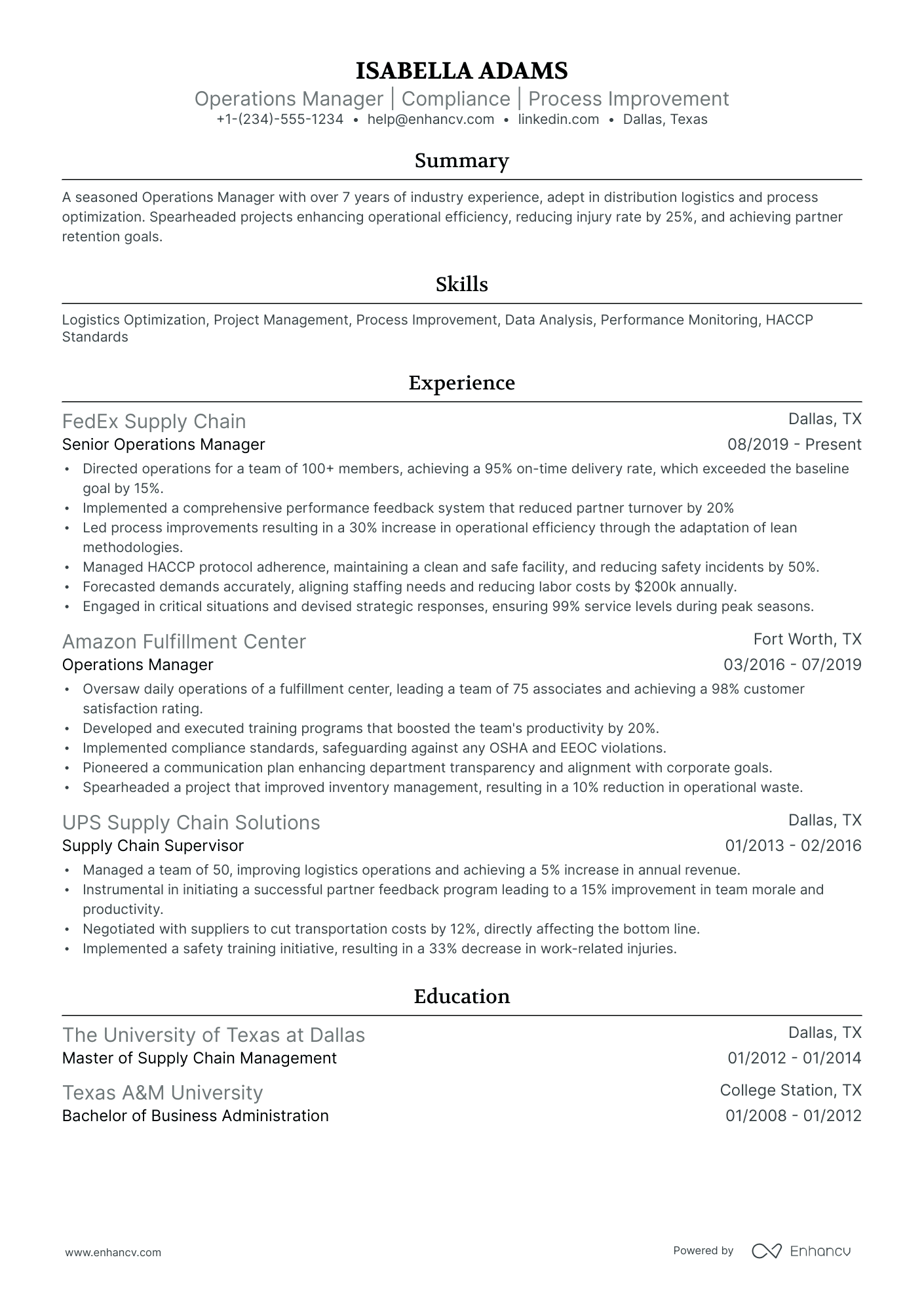
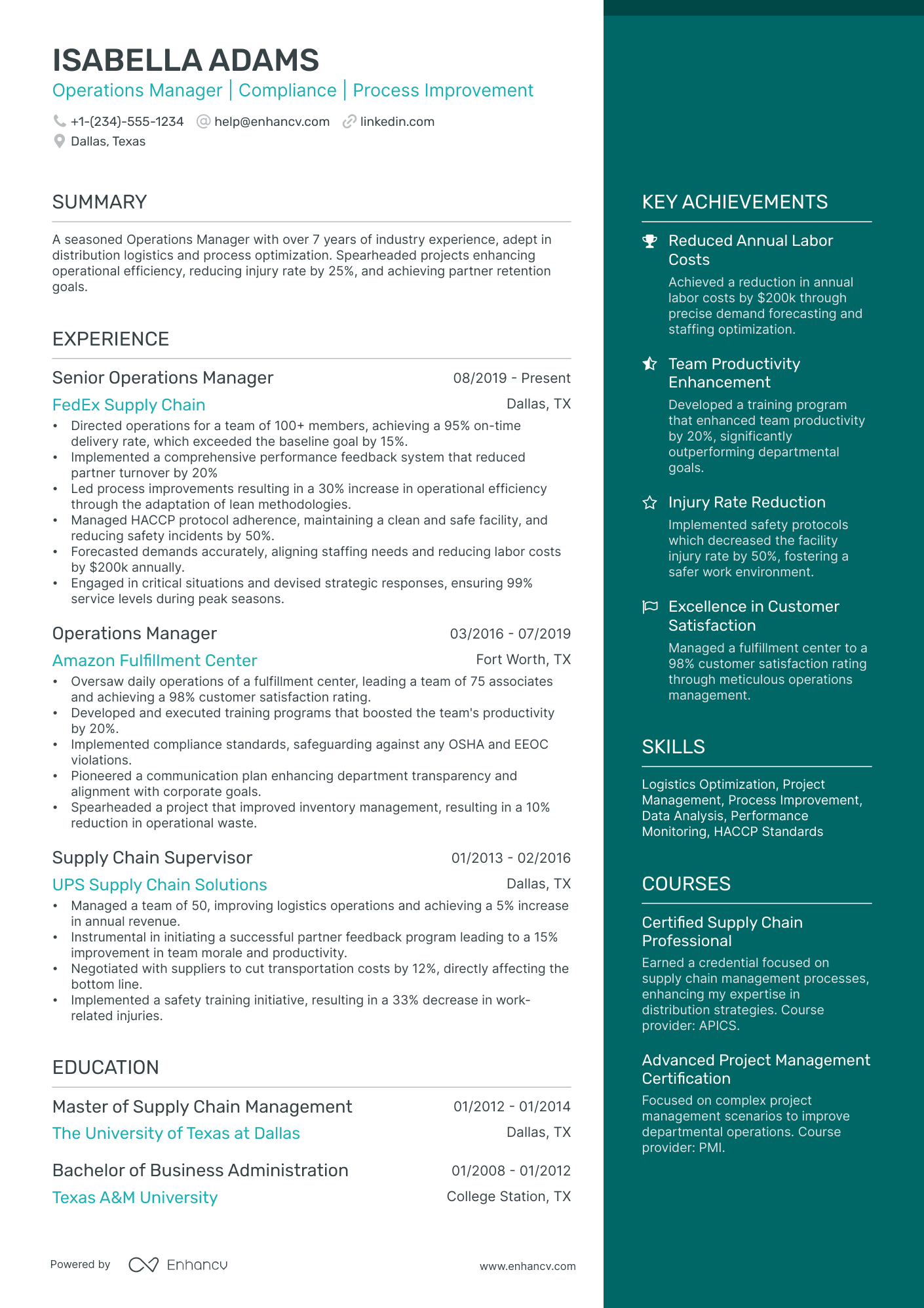
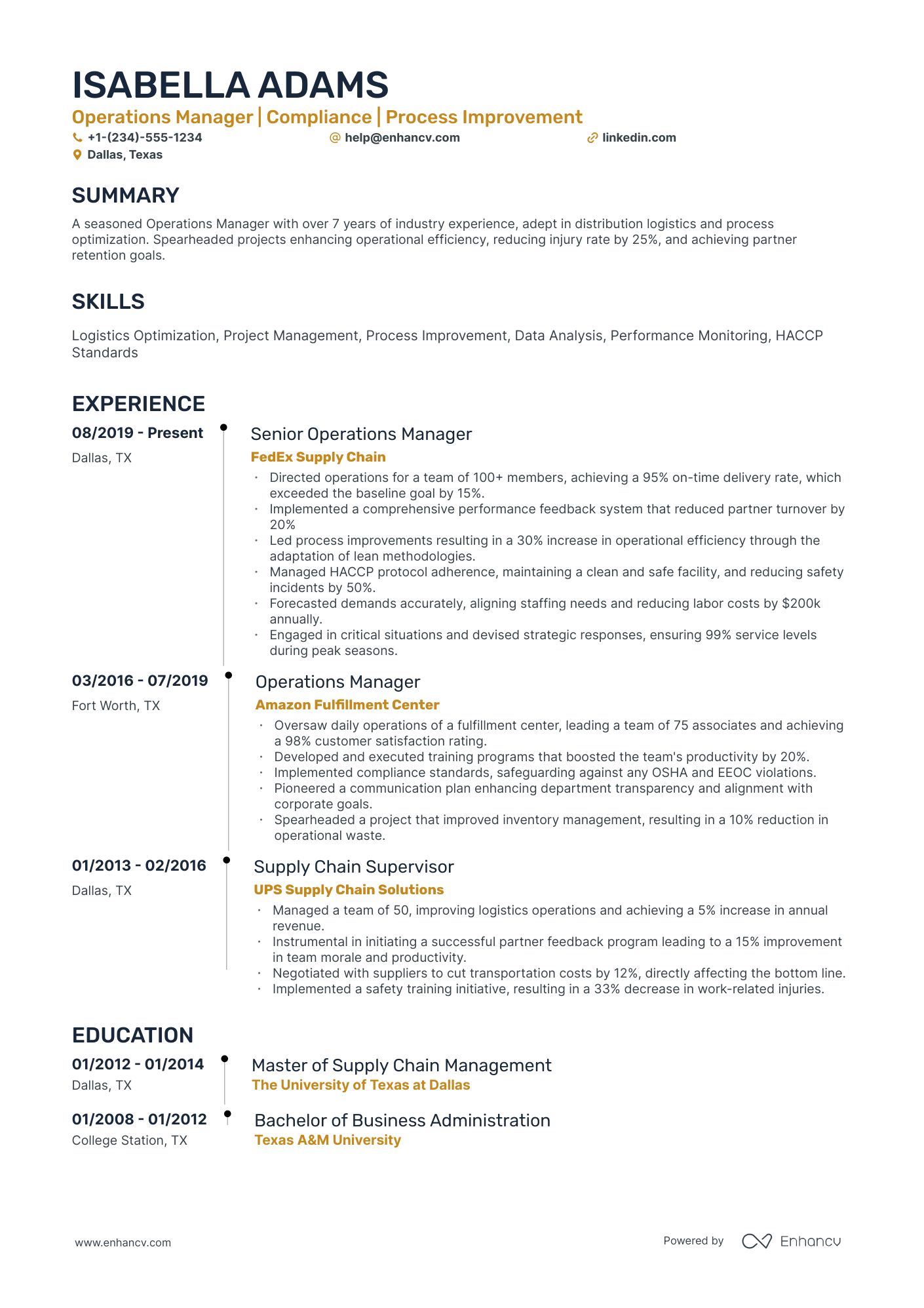
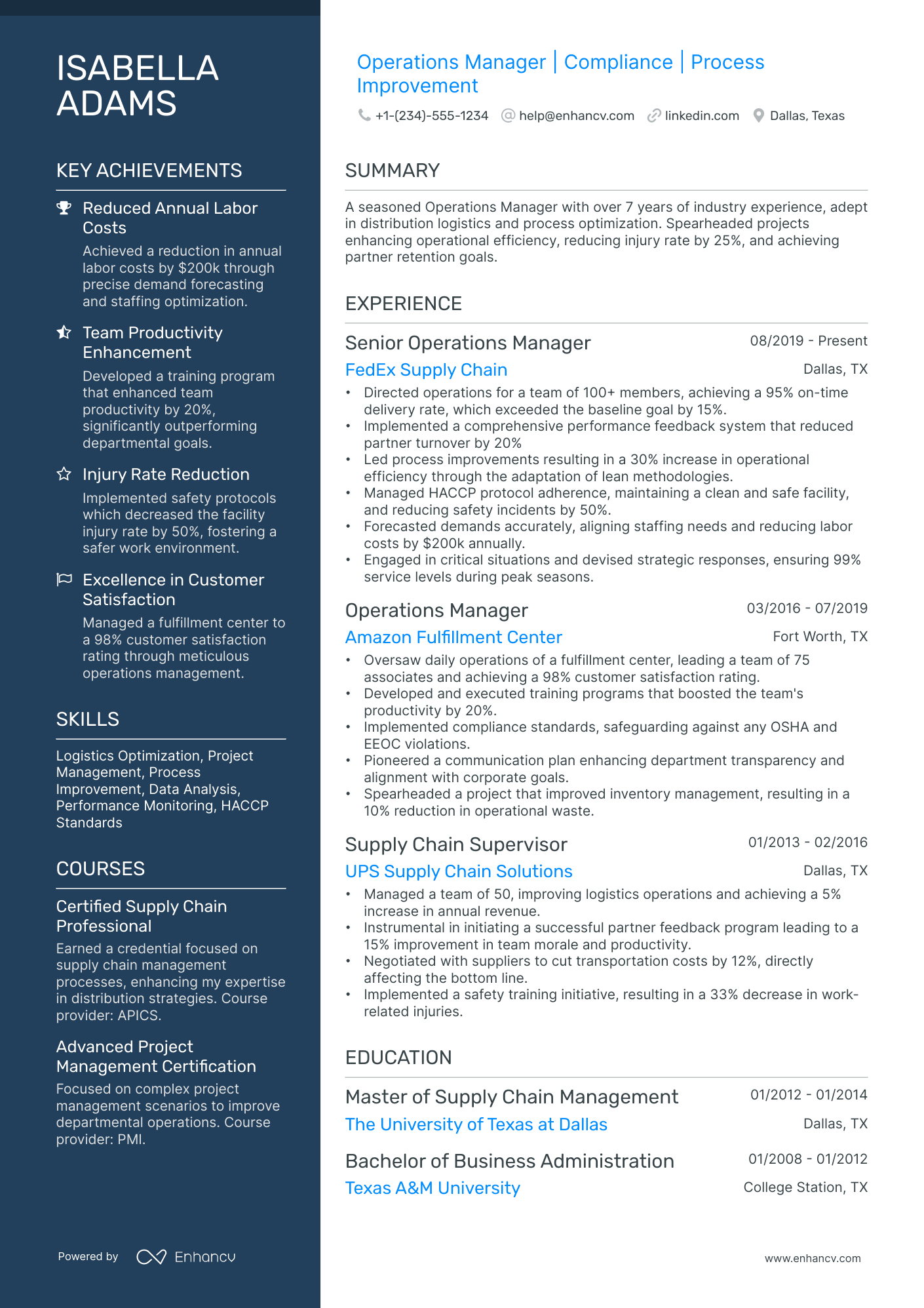
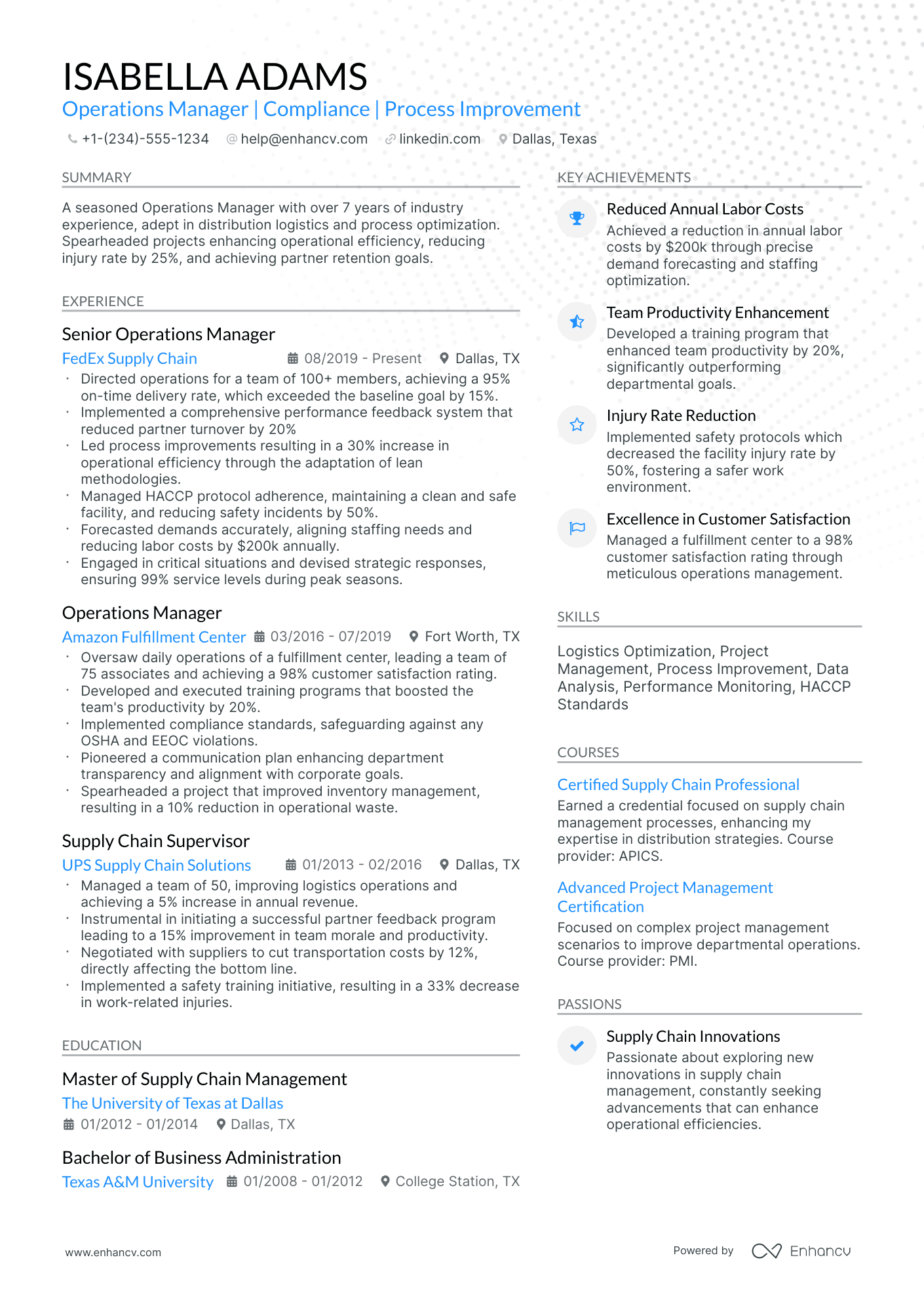
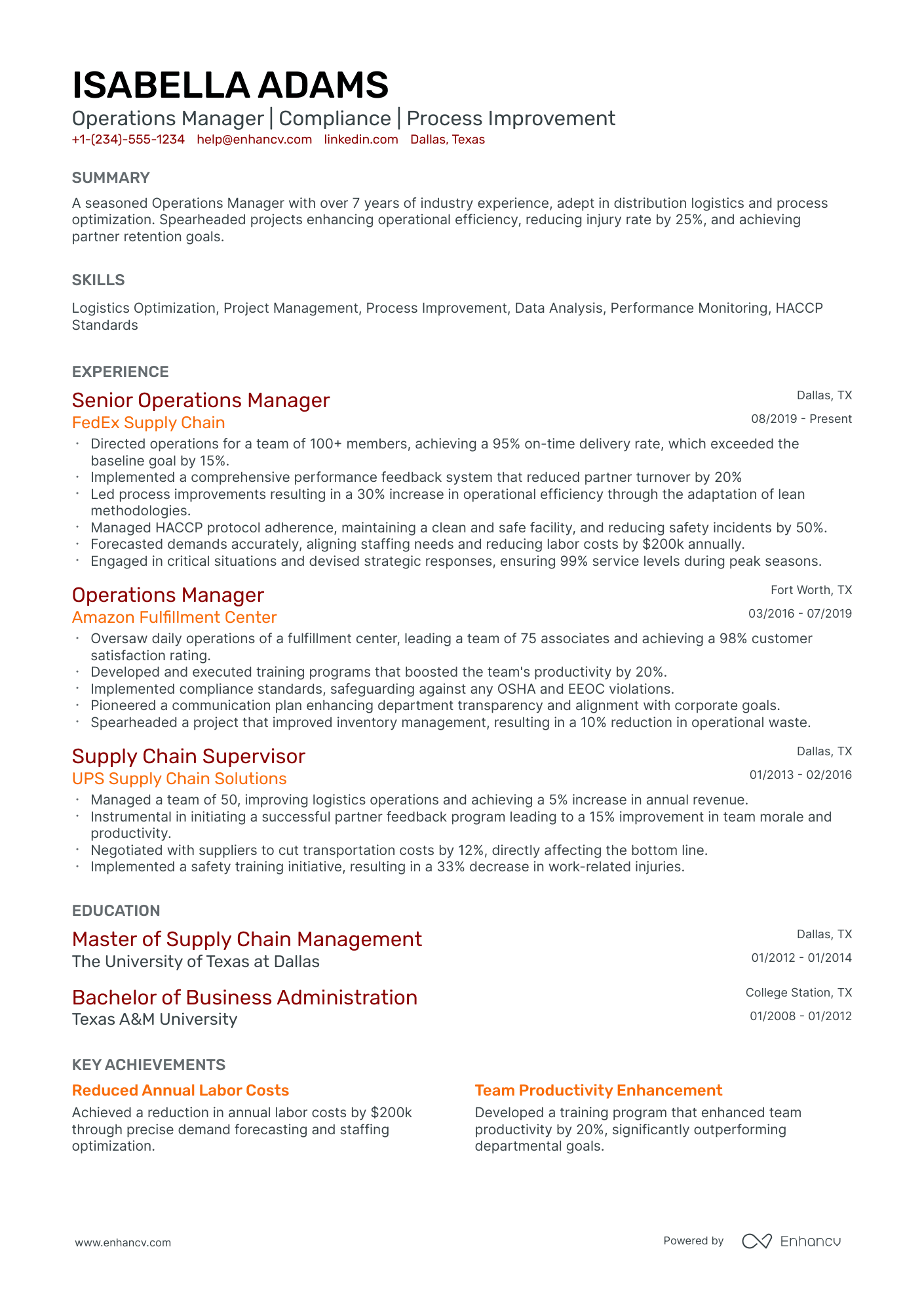
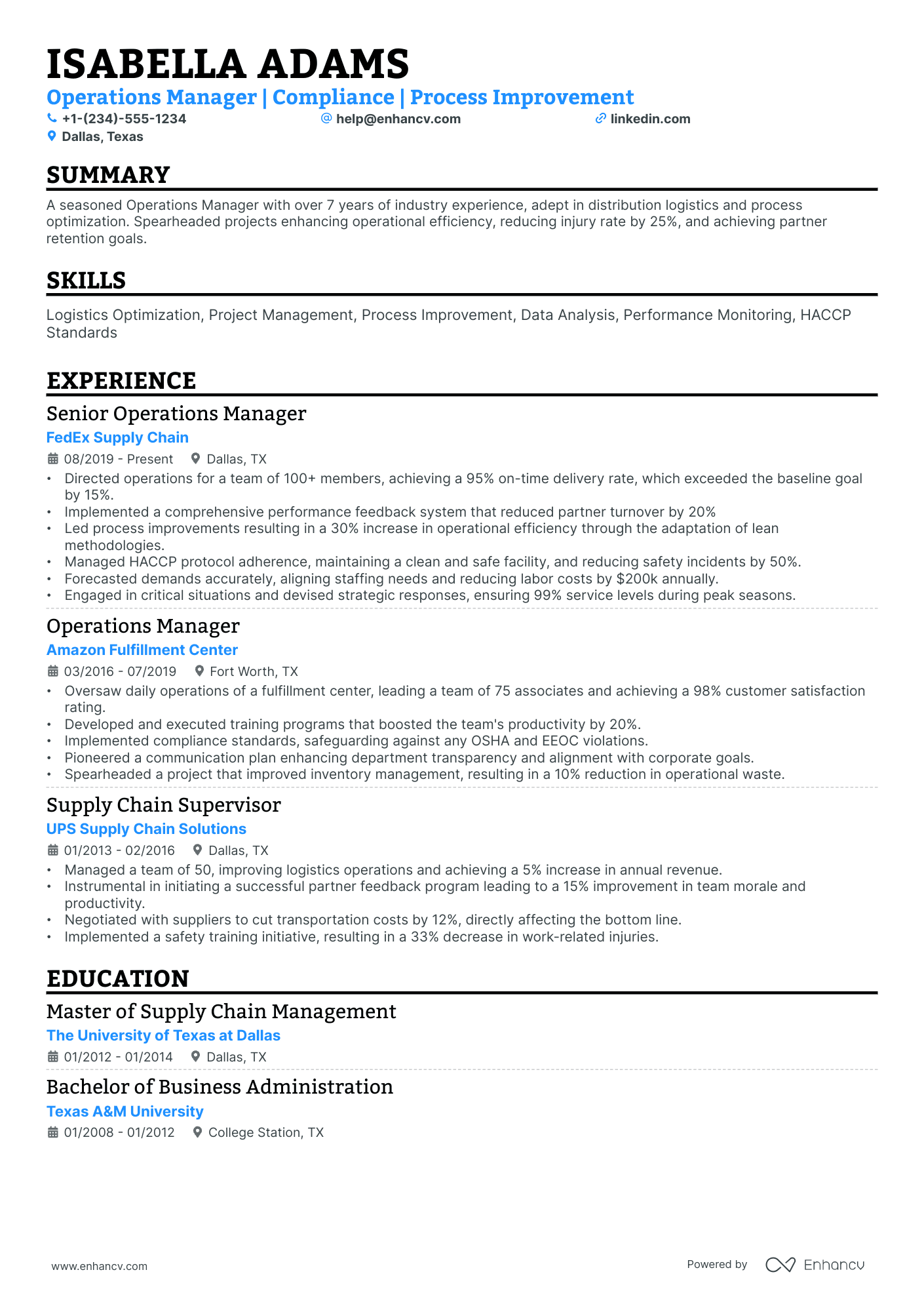
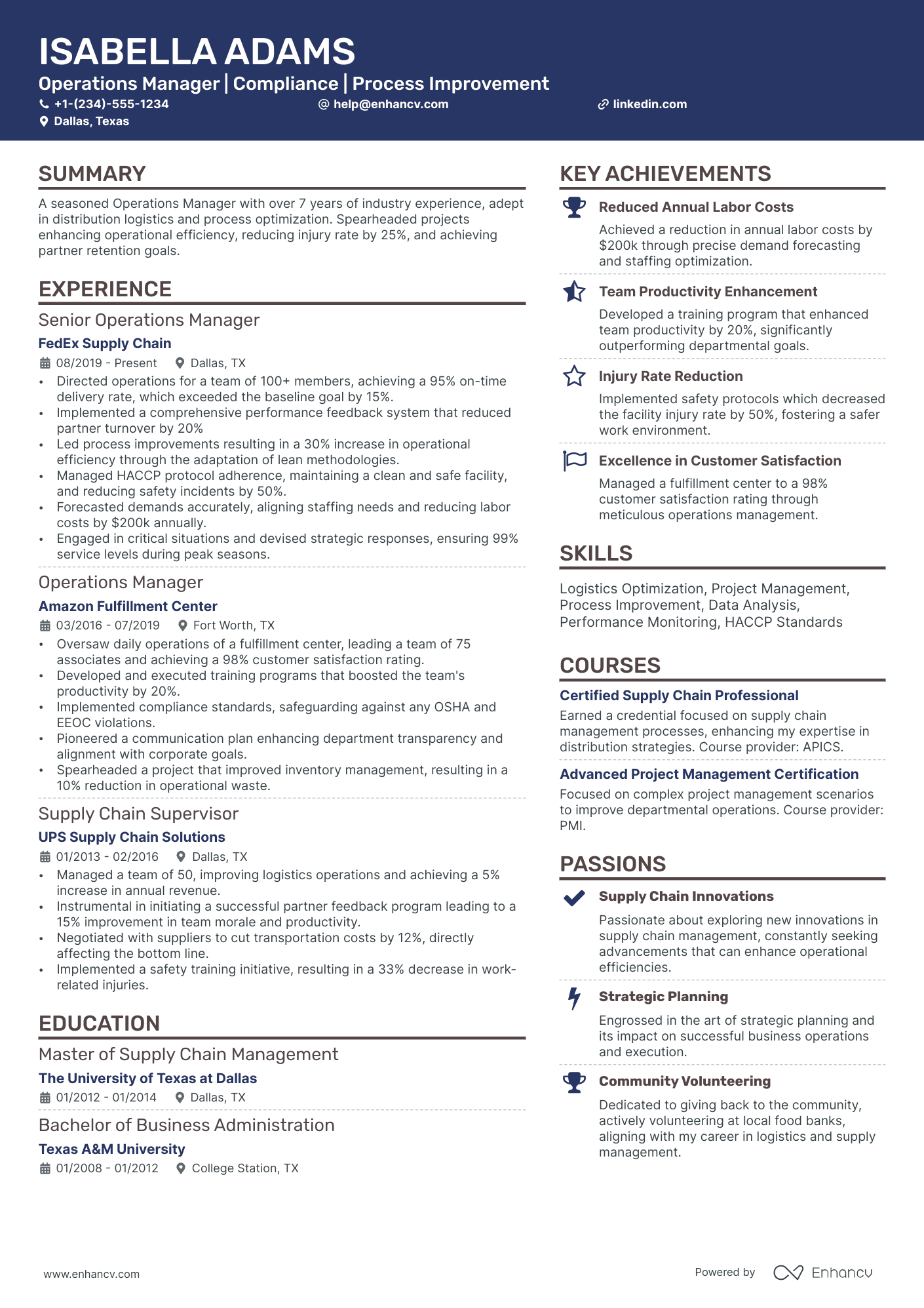
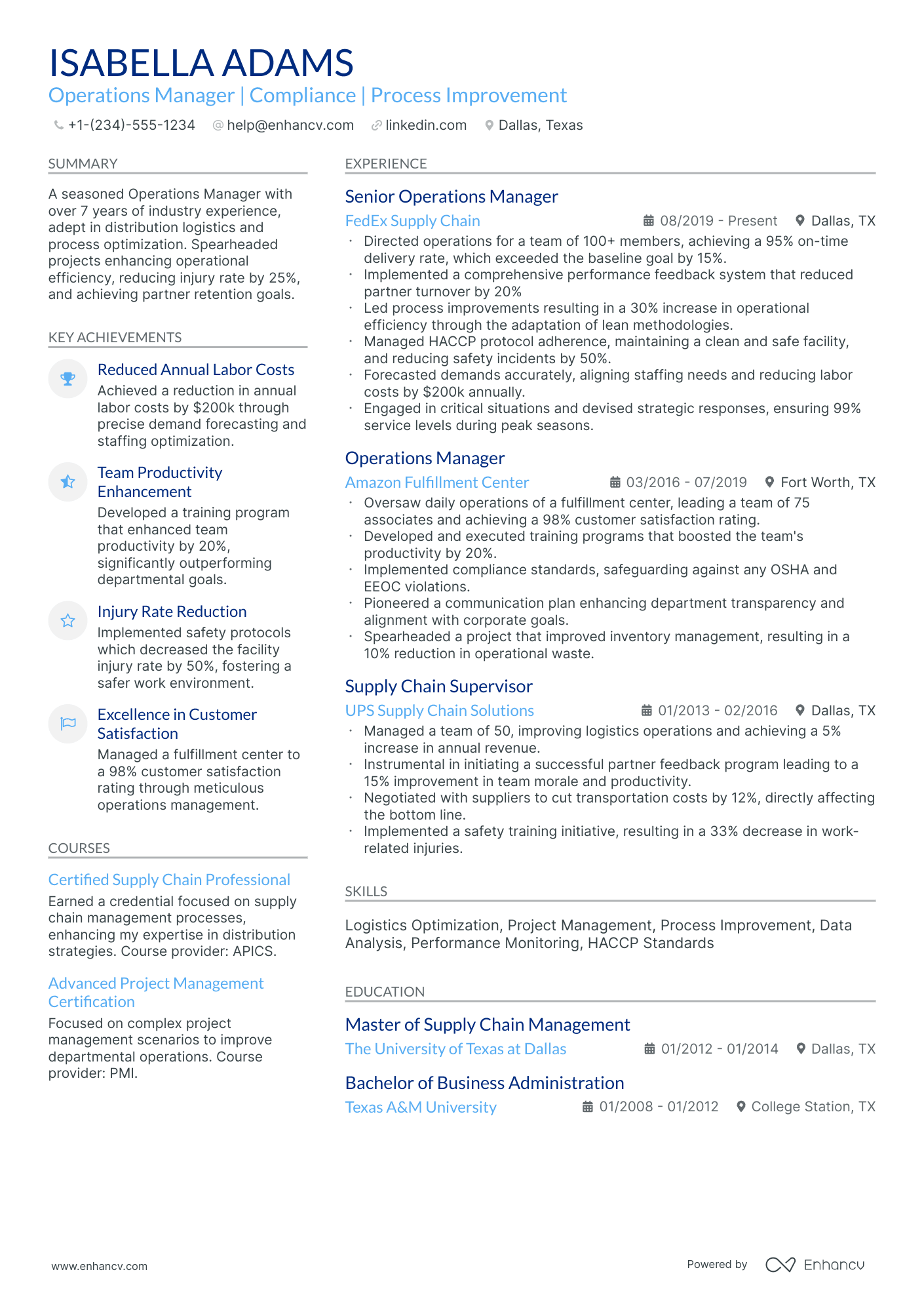
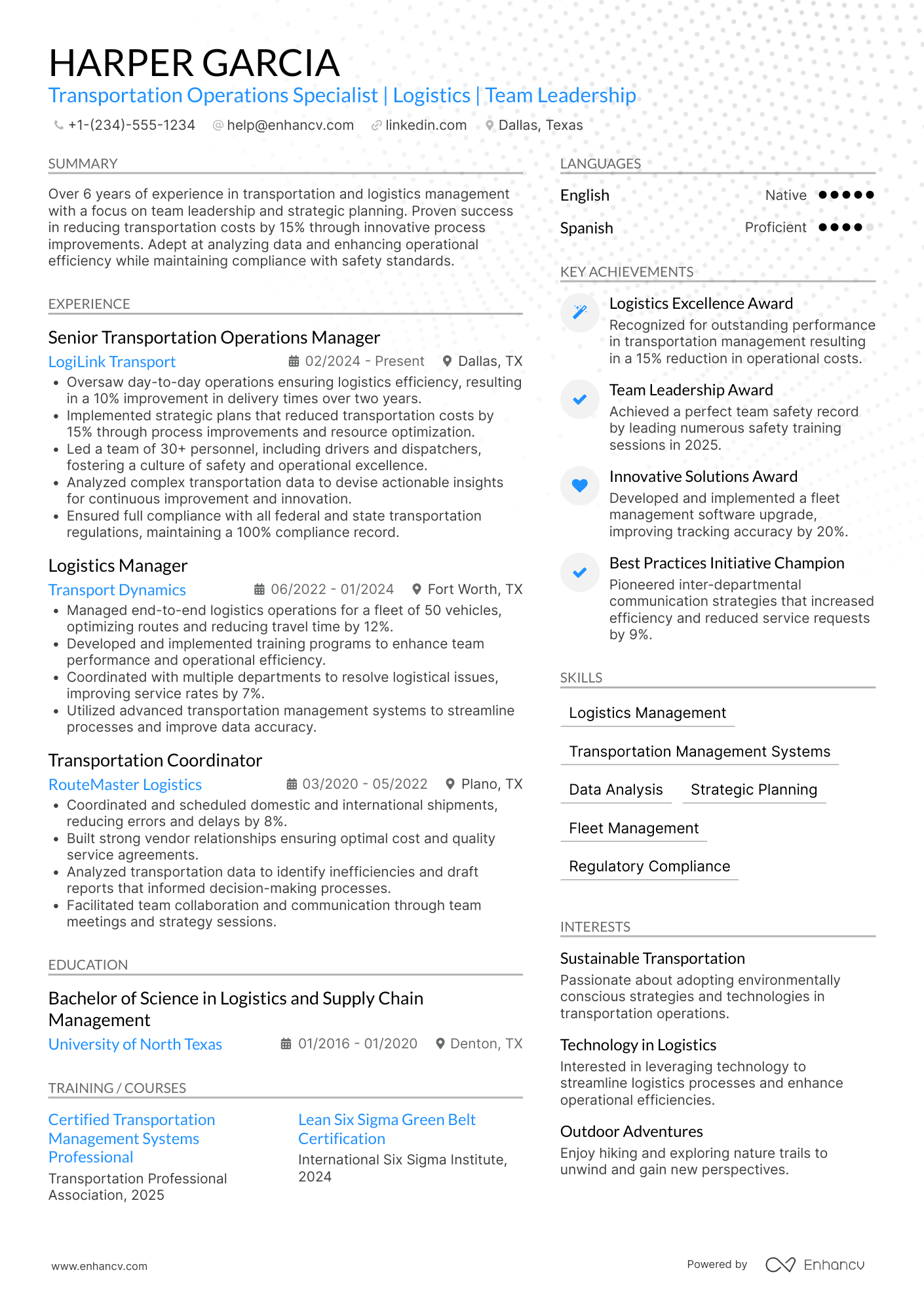
Transportation operations manager resume drafts often fail because they read like task lists and bury measurable impact. That hurts when an ATS (applicant tracking system) filters fast and recruiters scan in seconds amid heavy competition.
A strong resume shows what you improved, not what you used. Knowing how to make your resume stand out means highlighting cost reductions, on-time delivery gains, network coverage, carrier performance, safety incident declines, and service-level improvements across high-volume routes.

Key takeaways
- Quantify on-time delivery, cost per mile, safety incidents, and fleet utilization in every experience bullet.
- Use reverse-chronological format if you have direct transportation operations management experience.
- Tailor resume language to match each job posting's specific tools, KPIs, and compliance terms.
- Lead your summary with years of experience, operational scope, and one or two measurable results.
- Anchor every listed skill to a real outcome in your experience or project sections.
- Use Enhancv to turn vague duty descriptions into measurable, recruiter-ready resume bullets.
- Stop using AI once your resume accurately reflects real experience without inflated claims.
How to format a transportation operations manager resume
Recruiters evaluating transportation operations managers focus on logistics expertise, fleet and route optimization, cost reduction, and the ability to manage teams across multiple sites or regions. A clear, well-structured resume format ensures these operational competencies and career growth are immediately visible to both hiring managers and applicant tracking systems.

I have significant experience in this role—which format should I use?
Use a reverse-chronological format—it's the strongest choice for experienced transportation operations managers because it highlights your progression through increasingly complex logistics environments. Do:
- Lead with your most recent role and clearly define scope: number of drivers managed, fleet size, warehouse locations overseen, and budget accountability.
- Feature role-specific expertise such as TMS platforms (Oracle Transportation Management, SAP TM), DOT compliance, carrier negotiations, and supply chain optimization.
- Quantify operational impact with metrics tied to cost savings, on-time delivery rates, safety improvements, or throughput increases.
I'm junior or switching into this role—what format works best?
A hybrid format works best because it lets you lead with transferable logistics and operations skills while still showing a clear employment timeline. Do:
- Place a skills section near the top highlighting relevant competencies like fleet coordination, inventory management, last-mile delivery, or regulatory compliance.
- Include projects, internships, or cross-functional assignments that demonstrate hands-on transportation or supply chain involvement—even from adjacent roles.
- Connect each action to a measurable result so hiring managers can assess your potential impact.
Why not use a functional resume?
A functional resume obscures your career trajectory, making it difficult for recruiters to verify where and when you applied transportation management skills—context that's essential for assessing operational accountability and growth. A functional format may be worth considering only in narrow circumstances. It can apply if you're transitioning from a related field (such as warehouse management or freight brokerage), have a limited direct work history in transportation operations, or are returning after an extended career gap.
- Edge-case use: If you're pivoting from military logistics or a non-transportation operations role, a functional format can work—but only if every skill is anchored to specific projects, outcomes, or certifications (such as a Six Sigma Green Belt or OSHA compliance initiatives) rather than listed in isolation.
With your format established, the next step is filling it with the right sections to present your qualifications effectively.
What sections should go on a transportation operations manager resume
Recruiters expect to quickly find evidence that you can run safe, compliant, cost-effective transportation operations at scale. Understanding what to put on a resume for this role is critical to making the right impression.
Use this structure for maximum clarity:
- Header
- Summary
- Experience
- Skills
- Projects
- Education
- Certifications
- Optional sections: Awards, Leadership, Languages
Strong experience bullets should emphasize measurable impact—on-time performance, cost per mile, safety and compliance outcomes, fleet utilization, and the scope of routes, facilities, headcount, and budgets you managed.
Is your resume good enough?
Drop your resume here or choose a file. PDF & DOCX only. Max 2MB file size.
With the key resume components in place, the next step is to write your transportation operations manager resume experience section so hiring teams can see how you delivered results in each role.
How to write your transportation operations manager resume experience
The experience section is where you prove you can move freight, manage fleets, and optimize logistics networks—not just describe daily duties. Hiring managers prioritize demonstrated impact over descriptive task lists, so every bullet should connect your decisions to measurable outcomes like cost reductions, on-time delivery improvements, or fleet utilization gains.
Each entry should include:
- Job title
- Company and location (or remote)
- Dates of employment (month and year)
Three to five concise bullet points showing what you owned, how you executed, and what outcomes you delivered:
- Ownership scope: the routes, fleets, distribution centers, carrier relationships, or operational teams you were directly accountable for as a transportation operations manager.
- Execution approach: the transportation management systems, route optimization platforms, load planning tools, compliance frameworks, or data analysis methods you used to drive decisions and deliver work.
- Value improved: the specific changes you made to on-time performance, freight costs, carrier reliability, safety compliance, shipment accuracy, or capacity utilization within your transportation operation.
- Collaboration context: how you coordinated with warehouse teams, procurement, third-party carriers, regulatory agencies, or customer service groups to align transportation activities with broader supply chain goals.
- Impact delivered: the business-level results your work produced, expressed through scale of operations managed, efficiency gains realized, or service-level improvements achieved—rather than a list of activities performed.
Experience bullet formula
A transportation operations manager experience example
✅ Right example - modern, quantified, specific.
Transportation Operations Manager
SwiftLine Logistics | Dallas, TX
2022–Present
Regional transportation provider operating a 24/7 network across Texas and neighboring states, supporting retail and industrial shippers.
- Led daily linehaul and last-mile execution across 120+ drivers and 85 assets using a transportation management system (TMS) (MercuryGate) and Samsara telematics, improving on-time delivery from 92% to 97% in six months.
- Optimized routing and load planning with PC*MILER and Excel Power Query, cutting empty miles by 11% and reducing monthly fuel spend by $145K while maintaining service-level agreements (SLAs).
- Implemented dock-to-dispatch standard work and barcode scanning in the warehouse management system (WMS) (Manhattan), decreasing average dwell time from 78 to 52 minutes and increasing turns per tractor by 9%.
- Built Power BI dashboards integrating TMS, electronic logging device (ELD), and customer order data, enabling weekly performance reviews with sales and customer success teams and reducing accessorial charge disputes by 34%.
- Partnered with safety, HR, and maintenance to launch a driver coaching program using ELD events and camera triggers, lowering preventable incidents by 23% and workers’ compensation costs by 18% year over year.
Now that you've seen what a strong experience section looks like in practice, let's break down how to customize yours for each specific job posting.
How to tailor your transportation operations manager resume experience
Recruiters evaluate your resume through both applicant tracking systems and manual review, so tailoring your resume to the job description is essential. Tailoring ensures the most relevant skills, tools, and accomplishments stand out immediately.
Ways to tailor your transportation operations manager experience:
- Match fleet management software and TMS platforms named in the posting.
- Mirror the exact terminology used for routing or dispatch processes.
- Reflect KPIs like on-time delivery rates or cost-per-mile the employer tracks.
- Highlight DOT compliance and safety regulation experience when specified.
- Emphasize carrier relationship management if the role references vendor coordination.
- Include warehouse or distribution center oversight matching the industry listed.
- Align your experience with referenced lean or continuous improvement frameworks.
- Showcase cross-functional coordination with logistics and supply chain teams mentioned.
The goal is to present your genuine accomplishments using language that directly reflects what the employer is asking for.
Resume tailoring examples for transportation operations manager
| Job description excerpt | Untailored | Tailored |
|---|---|---|
| Oversee daily fleet operations across multiple terminals using GPS tracking and route optimization software to ensure on-time delivery performance above 95% | Managed daily operations and helped improve delivery times. | Directed fleet operations across seven terminals, leveraging Samsara GPS tracking and Route4Me optimization software to sustain a 97.2% on-time delivery rate over 18 months. |
| Develop and manage annual transportation budgets exceeding $10M while identifying cost-reduction opportunities through carrier negotiations and fuel management programs | Responsible for budgeting and reducing costs in the transportation department. | Built and managed a $12.4M annual transportation budget, cutting freight spend by 14% through renegotiated carrier contracts and a diesel fuel hedging program that saved $830K in one fiscal year. |
| Ensure compliance with DOT and FMCSA regulations, lead safety audits, and reduce preventable incident rates across a 200+ vehicle fleet | Ensured the team followed safety rules and passed audits. | Maintained full DOT and FMCSA compliance across a 215-vehicle fleet, led quarterly safety audits, and implemented a driver coaching program that reduced preventable incidents by 31% year over year. |
Once your experience aligns with the role’s priorities, the next step is to quantify your transportation operations manager achievements to show the impact of that work.
How to quantify your transportation operations manager achievements
Quantifying your achievements proves you improved service, cost, and safety—not just stayed busy. Focus on on-time delivery, cost per mile, fleet utilization, safety incidents, and compliance outcomes tied to lanes, loads, drivers, and carriers.
Quantifying examples for transportation operations manager
| Metric | Example |
|---|---|
| On-time delivery | "Raised on-time delivery from 91% to 97% in six months across 120 daily loads by tightening appointment scheduling and exception management in the transportation management system." |
| Cost per mile | "Cut linehaul cost per mile 8% ($0.14 per mile) on three core lanes by rebidding carriers, enforcing accessorial controls, and optimizing tendering rules." |
| Fleet utilization | "Improved tractor utilization from 68% to 78% by redesigning dispatch waves and reducing empty miles 12% using route optimization and backhaul matching." |
| Safety incidents | "Reduced preventable incidents 22% year over year by launching driver coaching, telematics scorecards, and weekly safety standups for seventy-five drivers." |
| Compliance accuracy | "Achieved 99.6% hours-of-service audit accuracy and zero critical findings by standardizing electronic logging device reviews and closing logs within twenty-four hours." |
Turn vague job duties into measurable, recruiter-ready resume bullets in seconds with Enhancv's Bullet Point Generator.
With strong, results-driven bullet points in place, the next step is ensuring your skills section highlights the right mix of hard and soft skills that transportation operations managers need.
How to list your hard and soft skills on a transportation operations manager resume
Your skills section shows you can run safe, on-time, cost-efficient transportation networks, and recruiters and an ATS (applicant tracking system) scan this section to match you to route, fleet, compliance, and service needs—aim for a mostly hard-skill mix with targeted soft skills. Transportation operations manager roles require a blend of:
- Product strategy and discovery skills.
- Data, analytics, and experimentation skills.
- Delivery, execution, and go-to-market discipline.
- Soft skills.
Your skills section should be:
- Scannable (bullet-style grouping).
- Relevant to the job post.
- Backed by proof in experience bullets.
- Updated with current tools.
Place your skills section:
- Above experience if you're junior or switching careers.
- Below experience if you're mid/senior with strong achievements.

Hard skills
Including the right hard skills is critical for passing ATS filters and demonstrating technical competence:
- Transportation management systems (TMS)
- Route optimization, load planning
- Fleet maintenance planning, CMMS
- DOT, FMCSA compliance
- Hours of Service, ELD platforms
- Dispatch operations, driver scheduling
- Freight audit, billing, claims
- Carrier procurement, contract management
- KPI dashboards, Excel, Power BI
- Cost modeling, budget forecasting
- Incident reporting, safety audits
- SOPs, process standardization
Soft skills
Pairing technical expertise with the right soft skills shows you can lead teams and manage complex operations:
- Prioritize dispatch trade-offs fast
- Lead cross-shift operations handoffs
- Hold carriers and drivers accountable
- Communicate delays with clear options
- Escalate risks early and directly
- Align stakeholders on service levels
- Coach supervisors through change
- Negotiate win-win vendor outcomes
- Run tight daily standups
- Make data-backed decisions under pressure
- Resolve customer issues to closure
- Build follow-through across teams
How to show your transportation operations manager skills in context
Skills shouldn't live only in a bulleted list on your resume. Explore how other professionals present their resume skills for inspiration on contextual placement.
They should be demonstrated in:
- Your summary (high-level professional identity)
- Your experience (proof through outcomes)
Here's what strong, context-rich examples look like in practice.
Summary example
Transportation operations manager with 12 years optimizing multimodal freight networks using TMS platforms and lean methodology. Led cross-functional teams to cut delivery cycle times by 22% while reducing carrier spend across three regional distribution centers.
- Reflects senior-level career depth
- Names specific tools and methods
- Leads with a measurable outcome
- Signals leadership and collaboration
Experience example
Transportation Operations Manager
Bridgeport Logistics Group | Memphis, TN
March 2019–Present
- Implemented Oracle TMS to automate load planning, reducing empty miles by 18% and saving $1.4M annually in carrier costs.
- Partnered with warehouse and procurement teams to redesign inbound scheduling, improving dock utilization by 27% across two facilities.
- Developed real-time KPI dashboards using Power BI, enabling leadership to act on on-time delivery trends and cut late shipments by 15%.
- Every bullet includes measurable proof
- Skills surface naturally through outcomes
Once you’ve tied your logistics and coordination strengths to real outcomes and responsibilities, the next step is to apply that same approach to building a transportation operations manager resume when you don’t have direct experience.
How do I write a transportation operations manager resume with no experience
Even without full-time experience, you can demonstrate readiness through transferable work. Writing a resume without work experience is entirely possible when you focus on relevant projects and skills:
- Dispatch or routing class projects
- Internship in logistics operations
- Volunteer fleet scheduling for nonprofits
- Campus shuttle or event transport
- Warehouse shipping and receiving support
- Customer service in delivery settings
- Safety training and compliance coursework
- Data analysis dashboards for routes
Focus on:
- Routing efficiency metrics and methods
- Safety, compliance, and documentation
- Dispatch tools and tracking systems
- Cost control and vendor coordination
Resume format tip for entry-level transportation operations manager
Use a combination resume format because it highlights relevant skills and projects while keeping limited work history credible and scannable. Do:
- Lead with a summary naming transportation operations manager targets.
- Add a Projects section with routing, dispatch, and safety work.
- Quantify results with time, cost, or on-time rates.
- List tools like Excel, TMS, and GPS platforms.
- Mirror the job description keywords in bullets.
- Built an Excel-based dispatch tracker for a campus shuttle project, cutting late pickups by 18% over four weeks using route timing analysis.
When you're building your resume without direct experience, your education section becomes one of the strongest tools for demonstrating relevant knowledge and qualifications.
How to list your education on a transportation operations manager resume
Your education section helps hiring teams confirm you have the foundational knowledge needed for a transportation operations manager role. It validates your academic background quickly.
Include:
- Degree name
- Institution
- Location
- Graduation year
- Relevant coursework (for juniors or entry-level candidates)
- Honors & GPA (if 3.5 or higher)
Skip month and day details—list the graduation year only.
Here's a strong education entry tailored for a transportation operations manager resume.
Example education entry
Bachelor of Science in Supply Chain Management
University of Tennessee, Knoxville, TN
Graduated 2018
GPA: 3.7/4.0
- Relevant coursework: Logistics Systems Design, Fleet Management, Transportation Law, and Operations Research
- Honors: Magna Cum Laude, Dean's List (six consecutive semesters)
How to list your certifications on a transportation operations manager resume
Certifications on your resume show a transportation operations manager's commitment to learning, proficiency with key tools, and relevance to current logistics and safety standards.
Include:
- Certificate name
- Issuing organization
- Year
- Optional: credential ID or URL
- Place certifications below education when your degree is recent and certifications are older or only loosely related to transportation operations manager work.
- Place certifications above education when they're recent, role-relevant, or required for the job, especially if your education is older.
Best certifications for your transportation operations manager resume
- Certified in Transportation and Logistics (CTL)
- Certified Supply Chain Professional (CSCP)
- Certified Professional in Supply Management (CPSM)
- Lean Six Sigma Green Belt
- OSHA 30-Hour General Industry
- Transportation Management System (TMS) Certification
- Certified Safety Professional (CSP)
Once you’ve positioned your credentials to validate your expertise, shift to writing your transportation operations manager resume summary to highlight that value upfront.
How to write your transportation operations manager resume summary
Your resume summary is the first thing a recruiter reads. A sharp, specific opening sets the tone and decides whether they keep scrolling or reach for the phone.
Keep it to three to four lines, with:
- Your title and total years in transportation operations management.
- The domain you specialize in, such as freight, logistics, or fleet management.
- Core tools and skills like TMS platforms, route optimization, or DOT compliance.
- One or two quantified achievements, such as cost reductions or on-time delivery gains.
- Soft skills tied to real outcomes, like cross-functional coordination that reduced delays.

PRO TIP
At this mid-level role, lead with operational results and process improvements you've owned. Highlight team leadership and measurable efficiency gains. Avoid vague phrases like "passionate leader" or "results-driven professional." Recruiters want specifics—show the scope of what you managed and the outcomes you delivered.
Example summary for a transportation operations manager
Transportation operations manager with eight years overseeing regional freight networks. Reduced distribution costs by 18% through route optimization. Led a 35-person team using SAP TMS to improve on-time delivery rates to 96%.
Optimize your resume summary and objective for ATS
Drop your resume here or choose a file.
PDF & DOCX only. Max 2MB file size.
Now that your summary captures your professional value, make sure your resume header presents your contact details clearly so hiring managers can easily reach you.
What to include in a transportation operations manager resume header
A well-crafted resume header lists your key contact and professional links, boosting visibility, credibility, and recruiter screening for a transportation operations manager role.
Essential resume header elements
- Full name
- Tailored job title and headline
- Location
- Phone number
- Professional email
- GitHub link
- Portfolio link
A LinkedIn link helps recruiters verify experience quickly and supports screening.
Don't include a photo on a transportation operations manager resume unless the role is explicitly front-facing or appearance-dependent.
Match your header title to the job posting and keep every detail consistent across your resume, LinkedIn, and application profiles.
Example
Transportation operations manager resume header
Jordan Mitchell
Transportation Operations Manager | Linehaul & Last-Mile Performance, Carrier Relations
Dallas, TX
(214) 555-01XX
jordan.mitchell@enhancv.com
github.com/jordanmitchell
jordanmitchell.com
linkedin.com/in/jordanmitchell
Once your contact details and professional identifiers are set at the top, add optional sections to strengthen your transportation operations manager resume with relevant supporting information.
Additional sections for transportation operations manager resumes
Adding extra sections helps you stand out when your core qualifications match other candidates. They build role-specific credibility and highlight unique strengths.
- Languages
- Certifications and licenses
- Industry affiliations and memberships
- Awards and recognitions
- Volunteer experience in logistics or community transportation
- Publications or conference presentations
- Technology proficiencies
Once you've strengthened your resume with relevant additional sections, pairing it with a well-crafted cover letter can further set your application apart.
Do transportation operations manager resumes need a cover letter
A cover letter isn't required for a transportation operations manager, but it helps in competitive searches or when hiring managers expect context. If you're unsure what a cover letter is and how it complements your resume, it's worth learning before you apply. It can make a difference when your resume needs a clear story or when the role spans multiple sites, modes, or teams.
Use a cover letter to add details your resume can't:
- Explain role and team fit: connect your operating model experience to their network, shift structure, safety standards, and cross-functional partners.
- Highlight one or two outcomes: cite a project that improved on-time performance, reduced cost per mile, raised trailer utilization, or cut dwell time.
- Show business and user understanding: reference their customers, service-level agreements, carriers, and constraints like capacity, seasonality, and compliance.
- Address career transitions or non-obvious experience: link adjacent roles to transportation operations manager work with clear, comparable metrics and scope.
Drop your resume here or choose a file.
PDF & DOCX only. Max 2MB file size.
Even if you decide to include a cover letter to add context, using AI to improve your transportation operations manager resume helps you sharpen the resume itself and align it with the role faster.
Using AI to improve your transportation operations manager resume
AI can sharpen your resume's clarity, structure, and impact. It helps you refine language and highlight measurable results. But overuse strips authenticity. Once your content feels clear and role-aligned, step away from AI. If you're exploring options, learn which AI is best for writing resumes before committing to a tool.
Here are 10 practical prompts to strengthen specific sections of your transportation operations manager resume:
Strengthen your summary
Quantify experience bullets
Tighten skills section
Improve action verbs
Align with job posting
Refine project descriptions
Clarify education relevance
Highlight certifications properly
Remove filler language
Check consistency throughout
Conclusion
A strong transportation operations manager resume proves results with numbers and stays easy to scan. Highlight on-time performance, cost savings, safety metrics, and service levels. Pair outcomes with role-specific skills like route planning, fleet utilization, carrier management, and compliance.
Keep the structure clear with a focused summary, targeted experience, and relevant skills. Show how you lead teams, solve disruptions, and improve processes. This approach signals readiness for today’s hiring needs and near-future demands.