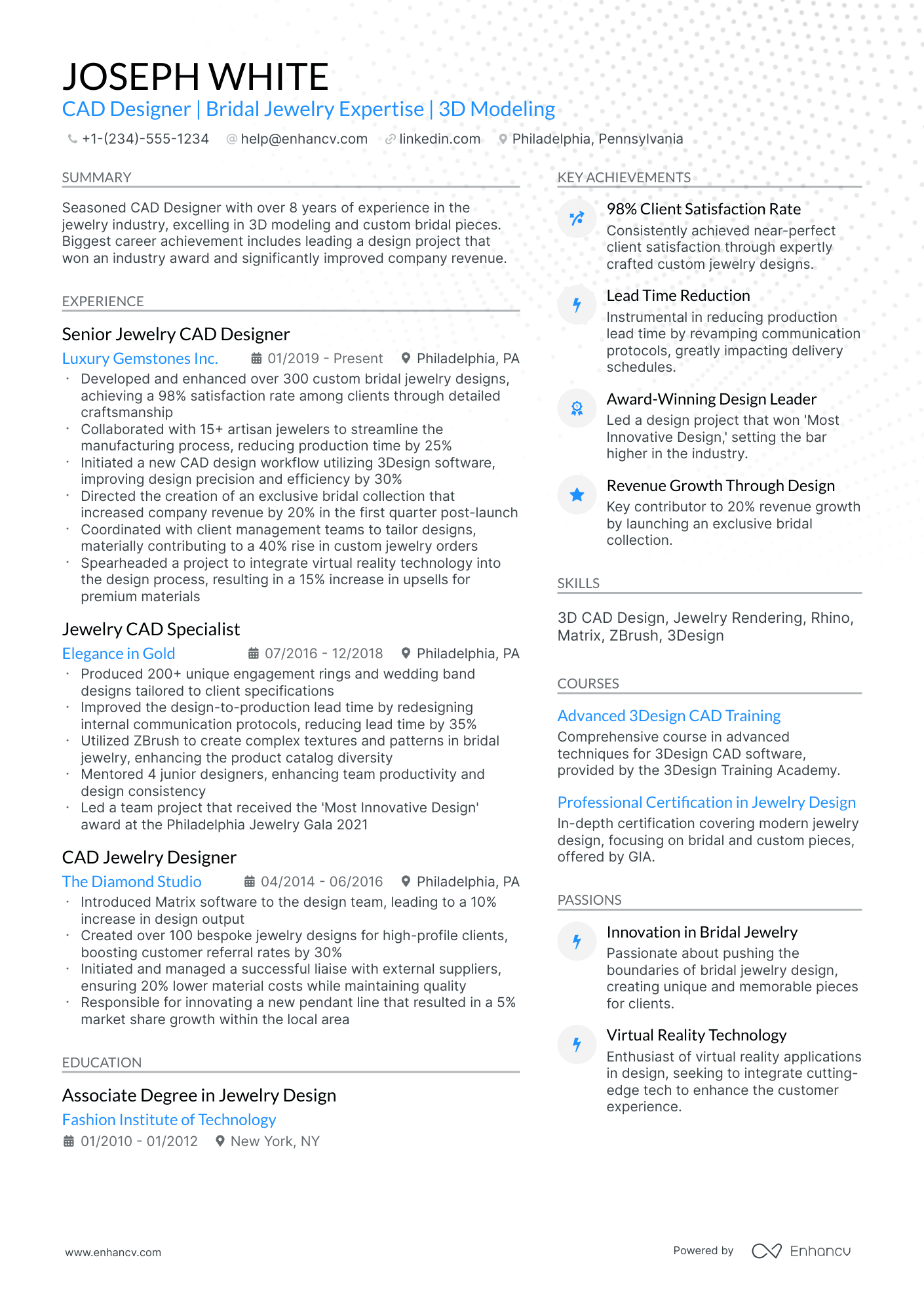
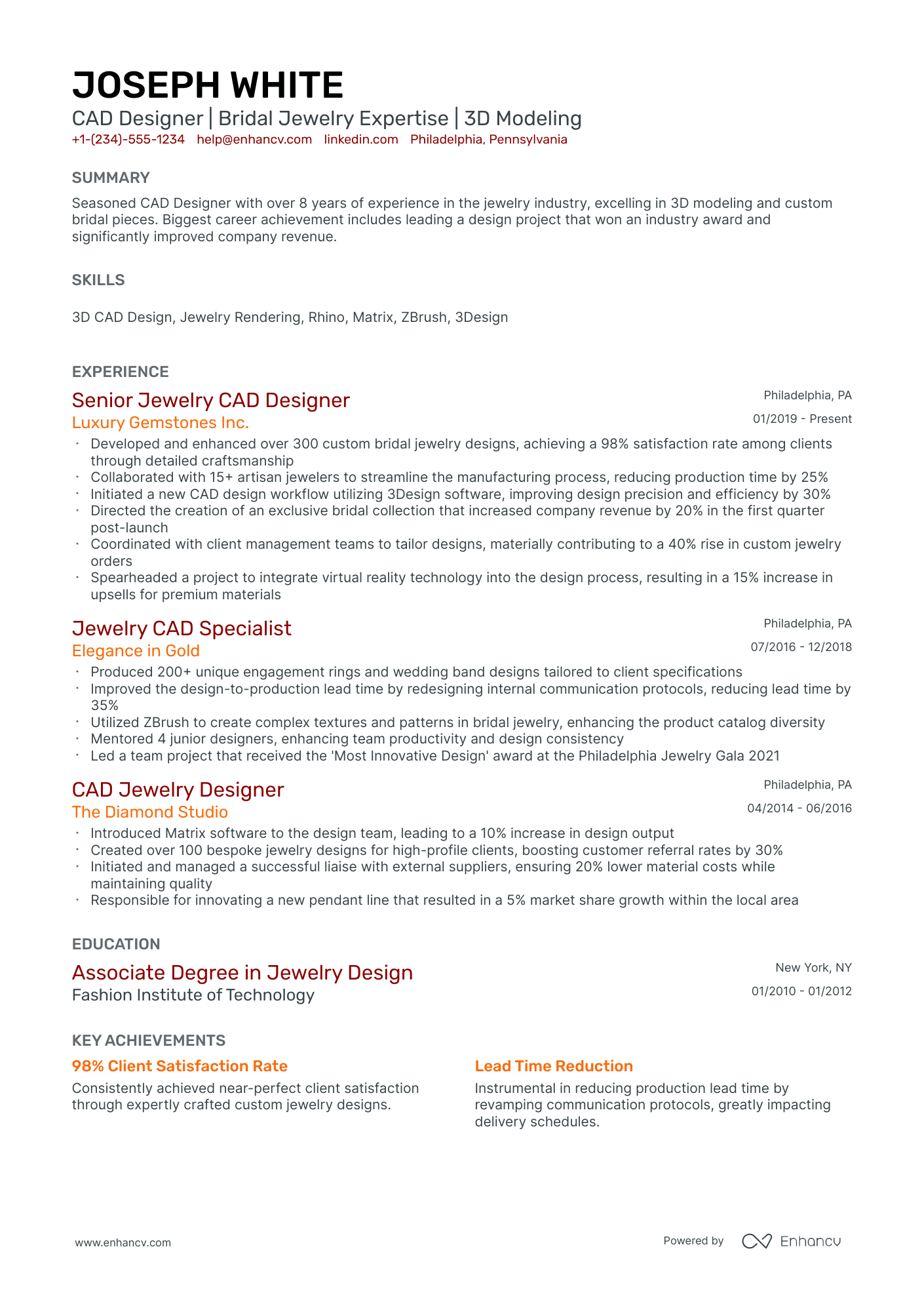
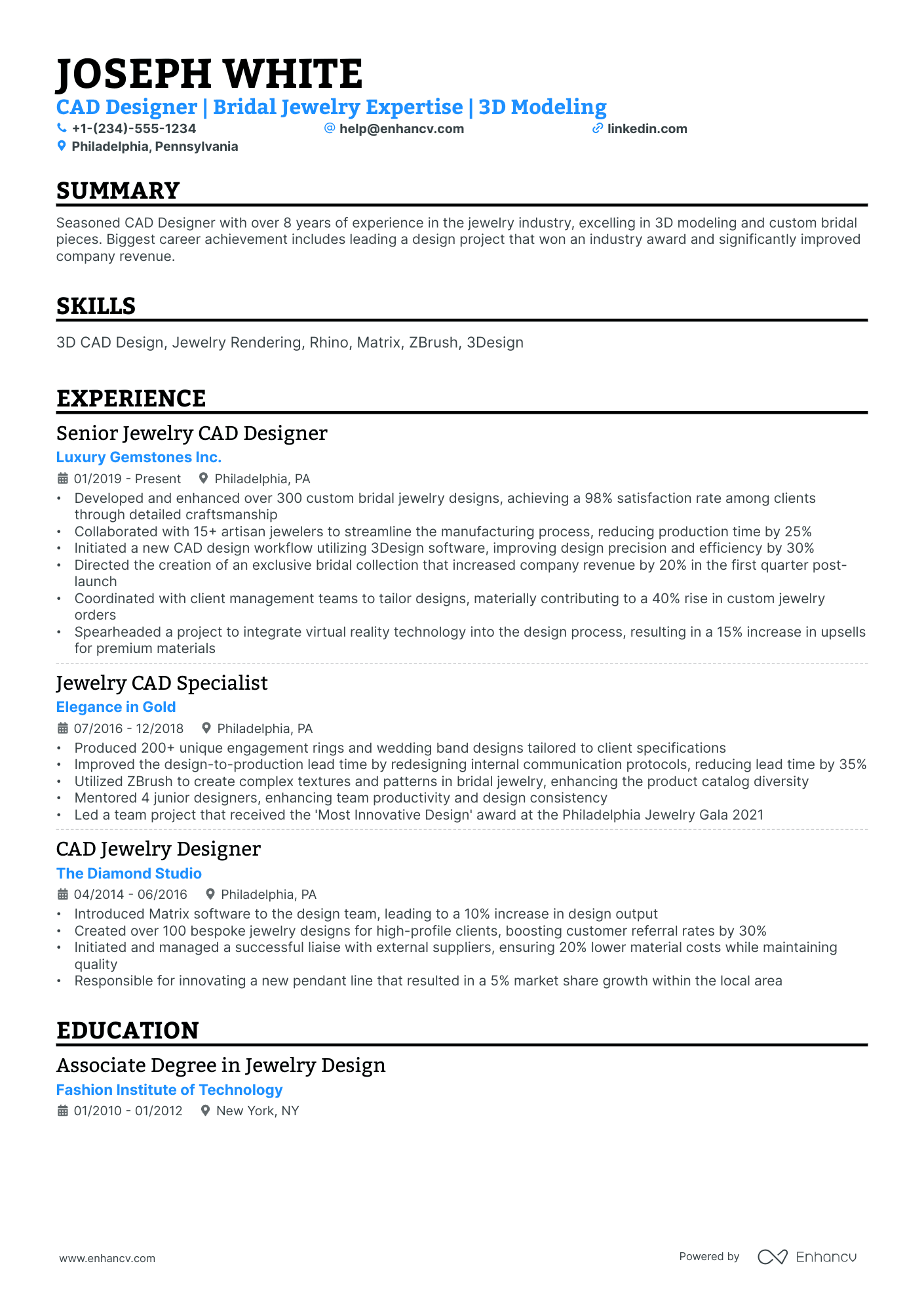
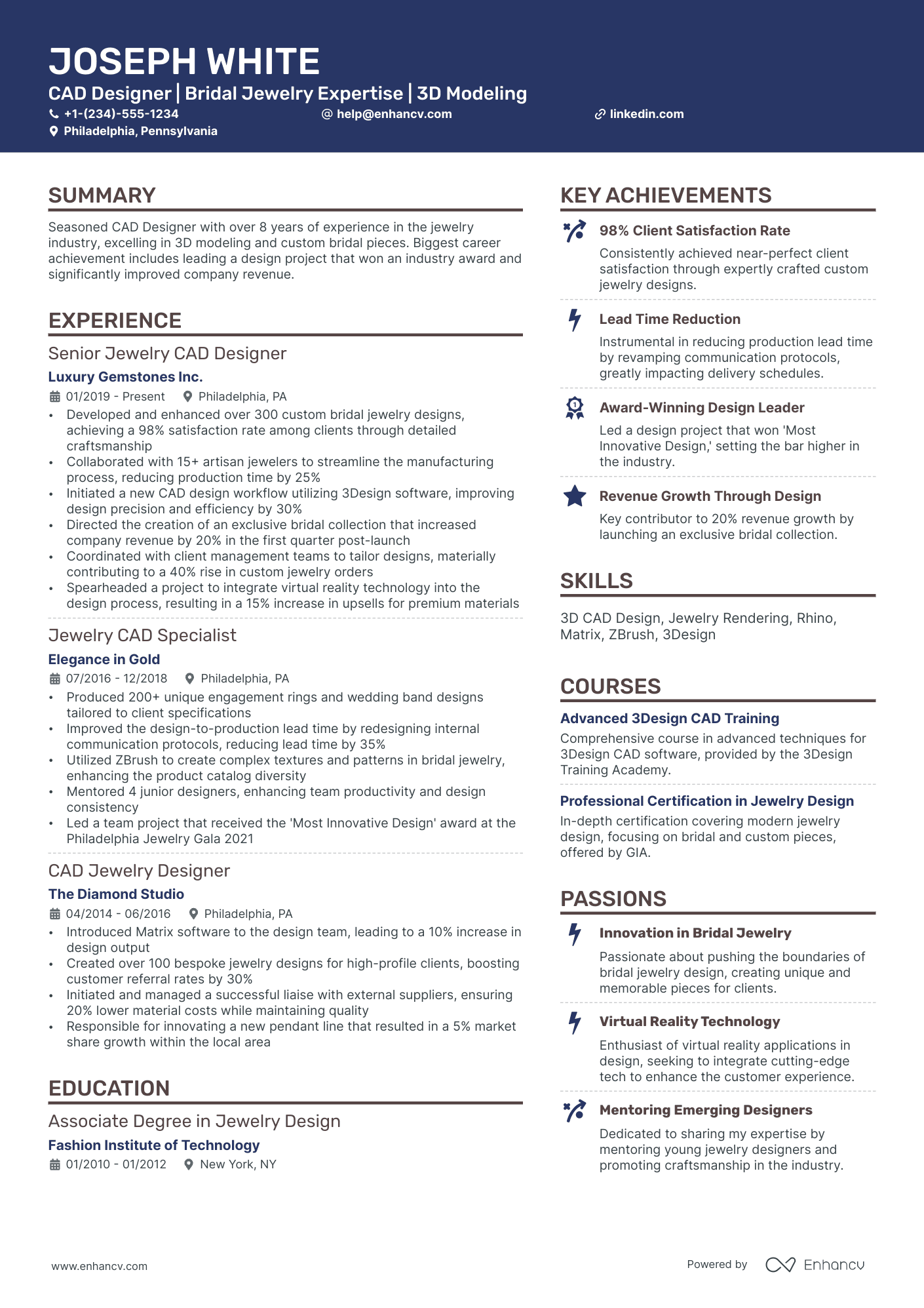
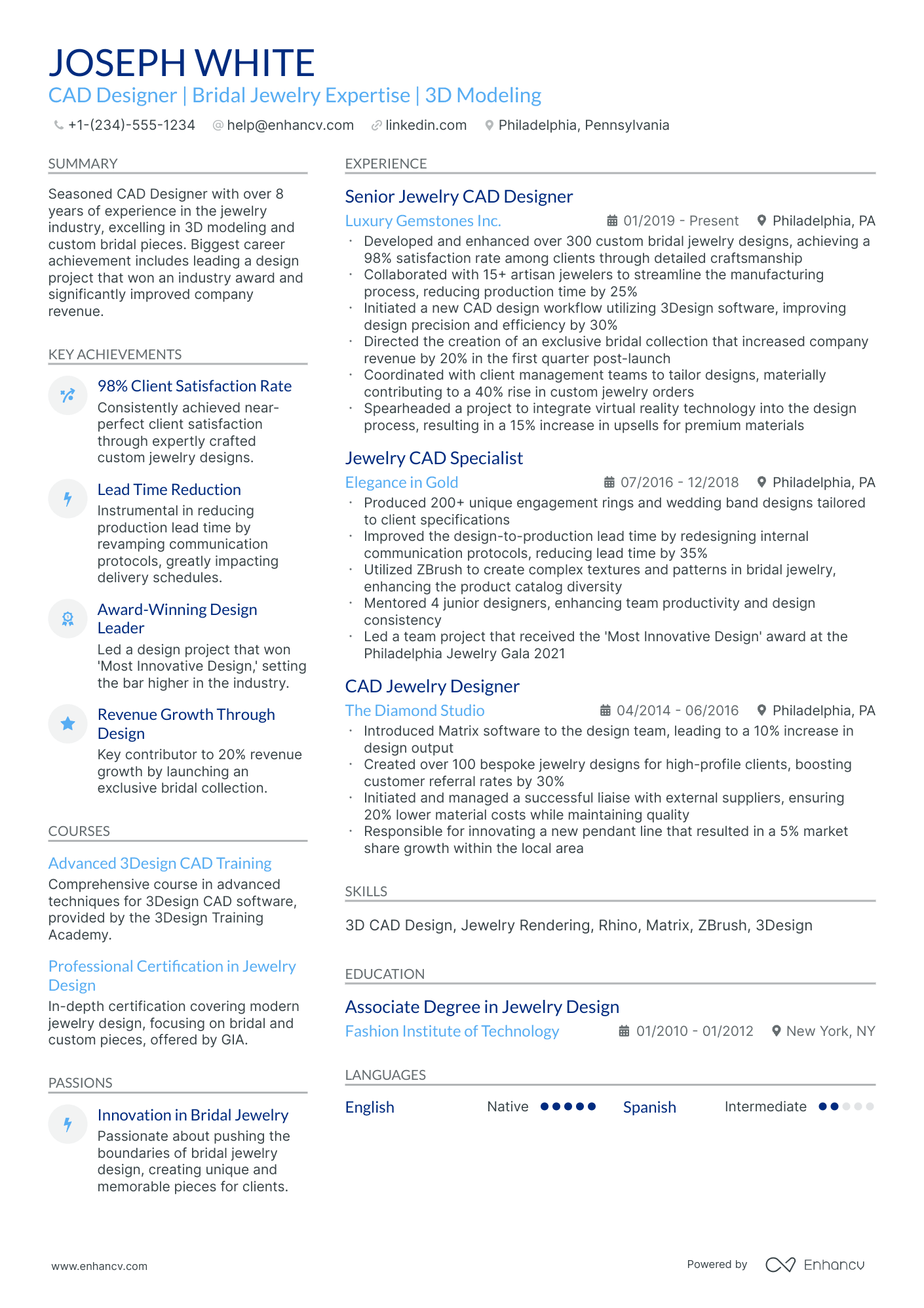
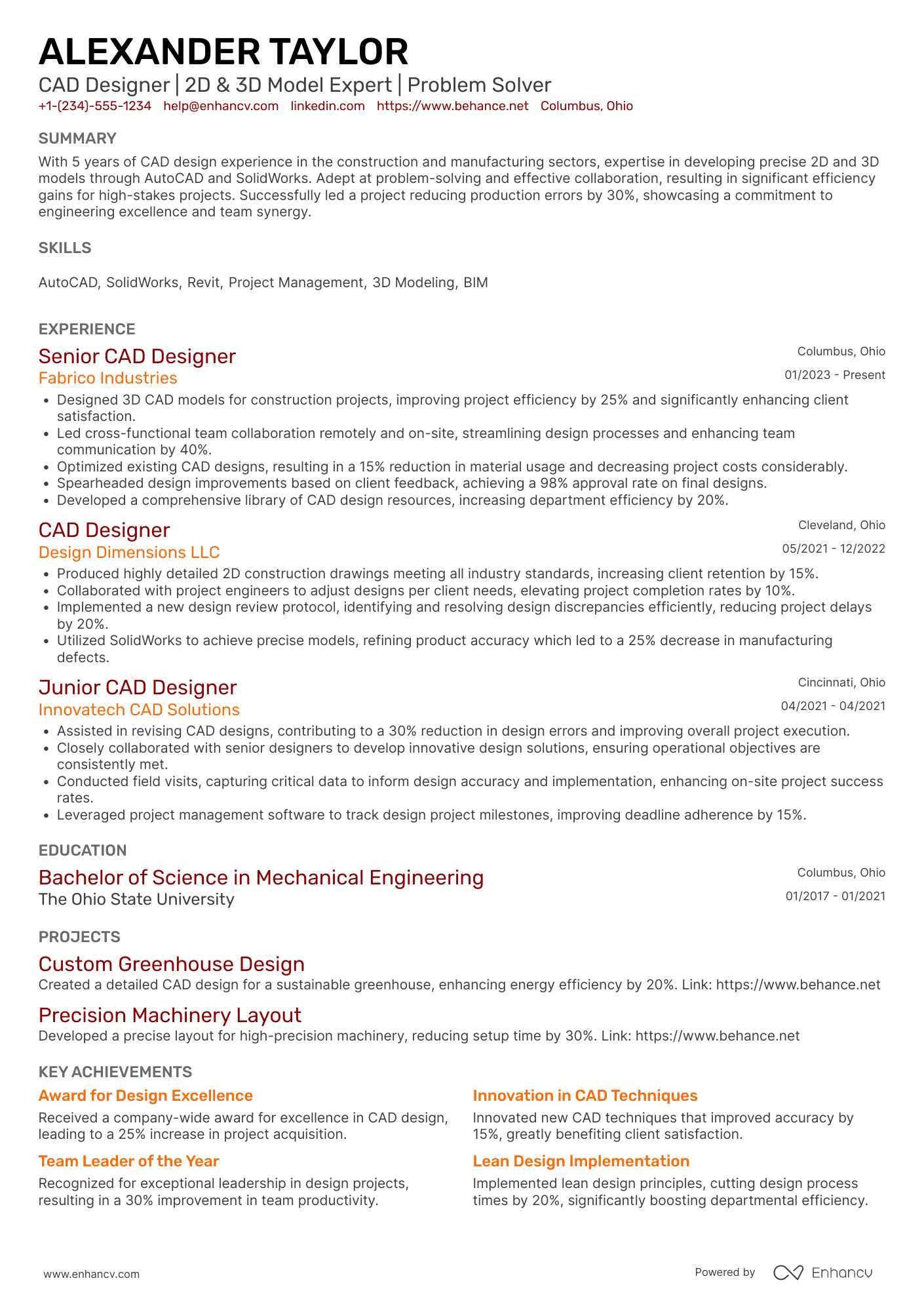
Many CAD designer resume submissions fail because they read like tool inventories and task logs, so recruiters can't spot impact in a ten-second scan. In ATS screening, missing role keywords and unclear project context can bury qualified candidates fast.
A strong resume shows what changed because of your work, not just what you used. Knowing how to write a resume that highlights delivered drawings for a defined scope, reduced rework rates, improved tolerances, accelerated release cycles, supported successful fabrication, and prevented field issues through accurate documentation is what separates top candidates from the rest.

Key takeaways
- Quantify design impact with metrics like rework reduction, cycle time, and cost savings.
- Tailor every experience bullet to mirror the job posting's tools and terminology.
- Use reverse-chronological format for experienced designers and hybrid format for career changers.
- List hard and soft skills in a roughly seventy-thirty balance, backed by experience proof.
- Tie each skill to a specific project, tool, and measurable outcome on your resume.
- Place certifications above or below education based on their relevance to the target role.
- Use Enhancv to turn vague task descriptions into measurable, recruiter-ready resume bullets.
Job market snapshot for CAD designers
We analyzed 144 recent CAD designer job ads across major US job boards. These numbers help you understand employer expectations, career growth patterns, industry demand at a glance.
What level of experience employers are looking for CAD designers
| Years of Experience | Percentage found in job ads |
|---|---|
| 1–2 years | 7.6% (11) |
| 3–4 years | 10.4% (15) |
| 5–6 years | 14.6% (21) |
| 7–8 years | 3.5% (5) |
| 9–10 years | 4.2% (6) |
| 10+ years | 5.6% (8) |
| Not specified | 58.3% (84) |
CAD designer ads by area of specialization (industry)
| Industry (Area) | Percentage found in job ads |
|---|---|
| Finance & Banking | 58.3% (84) |
| Manufacturing | 17.4% (25) |
| Healthcare | 10.4% (15) |
Top companies hiring CAD designers
| Company | Percentage found in job ads |
|---|---|
| Actalent | 13.2% (19) |
Role overview stats
These tables show the most common responsibilities and employment types for CAD designer roles. Use them to align your resume with what employers expect and to understand how the role is structured across the market.
Day-to-day activities and top responsibilities for a CAD designer
| Responsibility | Percentage found in job ads |
|---|---|
| Autocad | 52.1% (75) |
| Cad | 49.3% (71) |
| Solidworks | 27.1% (39) |
| Revit | 23.6% (34) |
| Microsoft office | 18.1% (26) |
| 3d modeling | 12.5% (18) |
| Drafting | 12.5% (18) |
| Bim | 9.7% (14) |
| Autocad civil 3d | 8.3% (12) |
| Autodesk inventor | 8.3% (12) |
| Ms office | 8.3% (12) |
| Civil 3d | 7.6% (11) |
Type of employment (remote vs on-site vs hybrid)
| Employment type | Percentage found in job ads |
|---|---|
| On-site | 72.9% (105) |
| Hybrid | 18.8% (27) |
| Remote | 8.3% (12) |
How to format a CAD designer resume
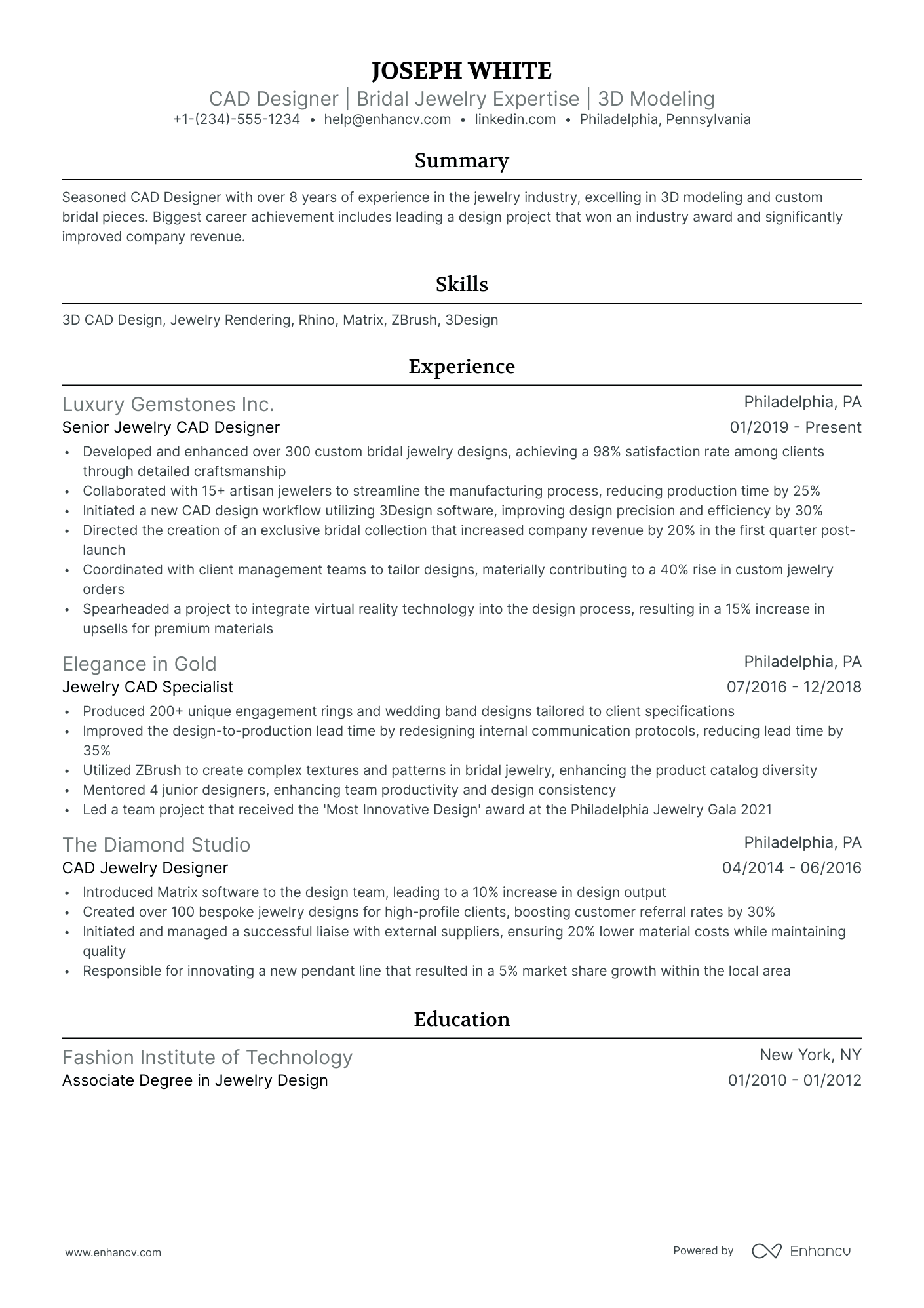
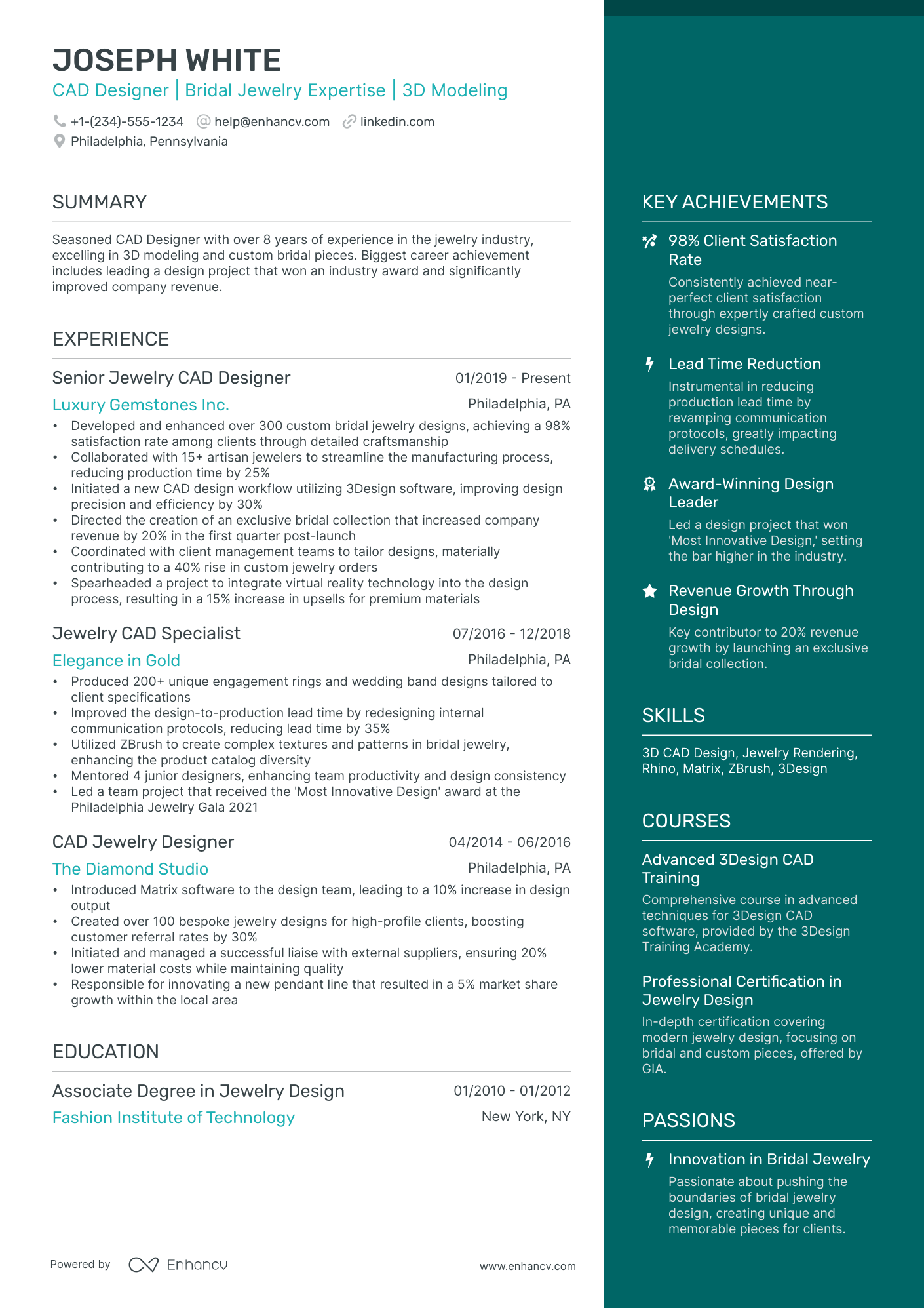
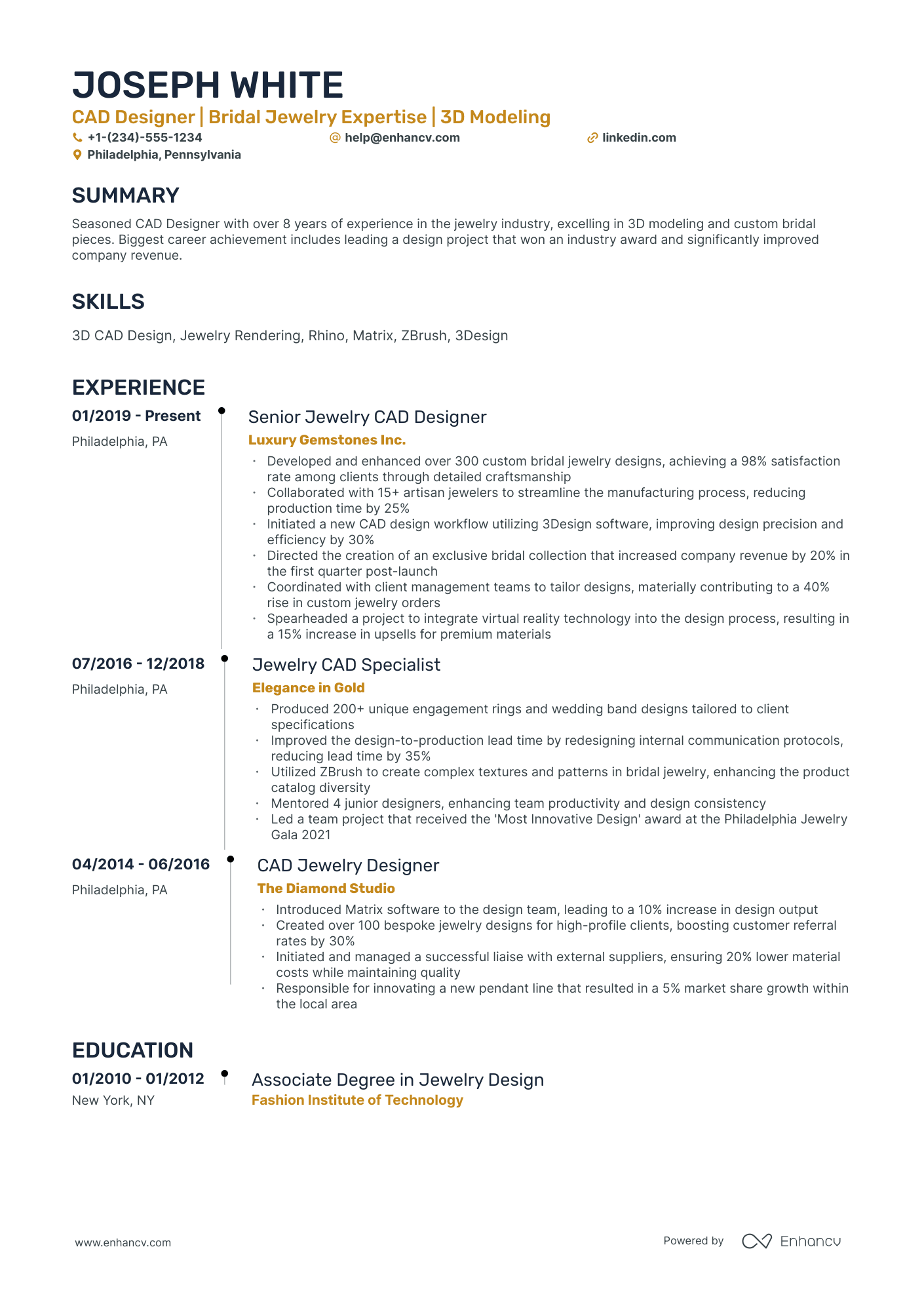
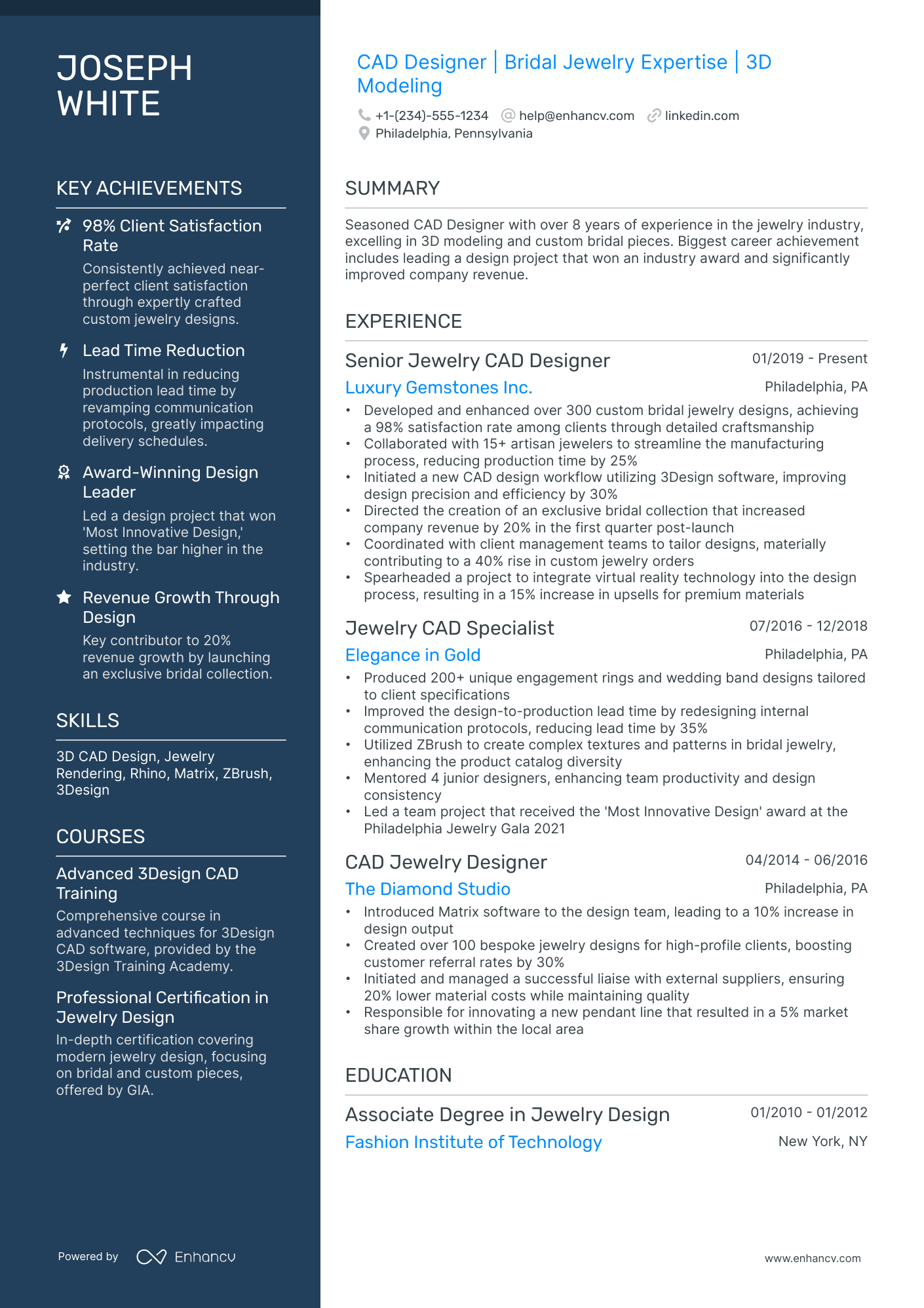
Recruiters reviewing CAD designer resumes prioritize technical software proficiency, project complexity, and the ability to translate design intent into production-ready deliverables. A clean, well-structured resume format ensures these signals surface quickly during both automated parsing and the initial human scan. Paying attention to your resume layout is equally important for making a strong first impression.

I have significant experience in this role—which format should I use?
Use a reverse-chronological format to present your deepest and most relevant CAD experience first. Do:
- Lead with your most recent positions, emphasizing the scope of projects you owned—assembly complexity, team size, and cross-functional coordination.
- Highlight proficiency in role-specific tools such as AutoCAD, SolidWorks, CATIA, Revit, or Inventor, along with domain expertise in areas like mechanical design, architecture, or manufacturing.
- Quantify outcomes tied to efficiency, cost, or quality improvements your designs delivered.
- "Redesigned a 200+ component hydraulic assembly in SolidWorks, reducing material waste by 14% and cutting prototype iteration cycles from five rounds to two, saving $38K annually."
I'm junior or switching into this role—what format works best?
A hybrid format works best because it lets you lead with relevant CAD skills and software competencies while still showing a concise work history. Do:
- Place a dedicated skills section near the top, listing CAD platforms, file formats (DWG, STEP, IGES), and any relevant certifications like Certified SolidWorks Associate (CSWA).
- Include academic projects, freelance work, or internships where you produced technical drawings, 3D models, or contributed to design reviews.
- Connect each listed skill or project to a concrete action and a measurable or observable result.
- SolidWorks surface modeling → created parametric enclosure designs for a senior capstone project → reduced 3D printing material usage by 20% across three prototype iterations.
Why not use a functional resume?
A functional format strips away the project context and timeline that hiring managers rely on to assess a CAD designer's hands-on experience with real deliverables, making it harder to verify your technical depth.
- A functional format may be acceptable if you're transitioning from a related field (such as drafting, architecture, or manufacturing engineering), have limited formal CAD work history, or are re-entering the workforce after a gap—but only if every listed skill is tied directly to a specific project, tool, and outcome rather than presented as an abstract capability.
Once your layout and structure are set, the next step is filling each section with the right content to showcase your qualifications.
What sections should go on a CAD designer resume
Recruiters expect to see clear evidence that you can produce accurate CAD deliverables, follow standards, and support projects from concept through release. Understanding what to put on a resume helps you prioritize the right content for each section.
Use this structure for maximum clarity:
- Header
- Summary
- Experience
- Skills
- Projects
- Education
- Certifications
- Optional sections: Awards, Publications, Languages
In your experience bullets, emphasize measurable outcomes, drawing and model accuracy, standards compliance, revision control, and the scope of parts, assemblies, and projects you supported.
Is your resume good enough?
Drop your resume here or choose a file. PDF & DOCX only. Max 2MB file size.
Once you’ve laid out the key resume components in a clear structure, focus next on writing your CAD designer resume experience section to show how your work supports those details.
How to write your CAD designer resume experience
Your work experience section should highlight shipped designs, delivered projects, and the specific tools or methods you used to produce them. Hiring managers prioritize demonstrated impact—measurable improvements to design quality, production timelines, or manufacturing outcomes—over descriptive task lists.
Each entry should include:
- Job title
- Company and location (or remote)
- Dates of employment (month and year)
Three to five concise bullet points showing what you owned, how you executed, and what outcomes you delivered:
- Ownership scope: the assemblies, components, product lines, or design systems you were directly accountable for as a CAD designer.
- Execution approach: the CAD platforms, modeling techniques, simulation tools, or drafting standards you applied to develop and validate designs.
- Value improved: the changes you drove in dimensional accuracy, design cycle time, material efficiency, manufacturability, or error reduction across your projects.
- Collaboration context: how you coordinated with mechanical engineers, manufacturing teams, project managers, or external vendors to align designs with production and performance requirements.
- Impact delivered: the tangible results your work produced, expressed through project scale, production readiness, cost outcomes, or quality benchmarks rather than routine activities.
Experience bullet formula
A CAD designer experience example
✅ Right example - modern, quantified, specific.
CAD Designer
Kestrel Industrial Systems | Milwaukee, WI
2022–Present
Designed sheet metal enclosures and machine assemblies for high-mix industrial automation equipment serving food and beverage manufacturers.
- Modeled and detailed over 180 custom sheet metal and machined parts in SolidWorks, applying geometric dimensioning and tolerancing and design-for-manufacturability standards to cut fabrication rework by 28%.
- Built parametric templates and design tables for enclosure families, reducing quote-to-release time from five days to three days and increasing on-time engineering releases by 19%.
- Produced manufacturing-ready drawings and bills of materials in SolidWorks PDM (product data management), improving revision control and lowering engineering change order cycle time by 22% in partnership with mechanical engineers and manufacturing.
- Ran interference checks and tolerance stack-ups across multi-part assemblies, preventing eight fit-up issues per quarter and reducing first-article inspection failures by 15%.
- Coordinated with electrical engineers, project managers, and suppliers to route cable paths, place cutouts, and validate bend allowances, accelerating prototype builds by 12% and avoiding $45,000 in scrap annually.
Now that you've seen how a strong experience section comes together, let's look at how to adjust yours to match the specific job you're targeting.
How to tailor your CAD designer resume experience
Recruiters evaluate your CAD designer resume through both manual review and applicant tracking systems. Tailoring your resume to the job description helps you clear both filters.
Ways to tailor your CAD designer experience:
- Match the exact CAD software versions listed in the job posting.
- Mirror the file formats and data exchange standards they specify.
- Use their terminology for drafting conventions or design methodologies.
- Reflect the industry focus such as architecture or manufacturing.
- Highlight tolerance analysis or GD&T skills when the role requires them.
- Emphasize collaboration with engineering or production teams if referenced.
- Include BIM or PLM workflow experience when the posting names them.
- Align your revision control practices with their documentation standards.
Tailoring means connecting your real accomplishments to the role's stated requirements, not forcing keywords where they don't belong.
Resume tailoring examples for CAD designer
| Job description excerpt | Untailored | Tailored |
|---|---|---|
| "Create detailed 3D models and 2D production drawings in SolidWorks for injection-molded plastic enclosures, ensuring designs meet DFM guidelines." | Created 3D models and drawings for various projects using CAD software. | Developed 50+ detailed 3D models and 2D production drawings in SolidWorks for injection-molded plastic enclosures, collaborating with tooling vendors to ensure all designs met DFM guidelines and reduced mold revision cycles by 30%. |
| "Collaborate with structural engineers to produce AutoCAD Civil 3D drawings for commercial site grading, utility layouts, and stormwater management plans." | Worked with engineers and made drawings for construction projects. | Produced AutoCAD Civil 3D drawings for 12 commercial site developments, detailing grading plans, underground utility layouts, and stormwater management systems in close coordination with structural engineering teams. |
| "Design precision sheet metal components and weldments in Autodesk Inventor, generate flat patterns, and maintain revision-controlled drawing packages per ASME Y14.5 GD&T standards." | Designed metal parts and kept drawings organized for manufacturing. | Designed precision sheet metal components and weldments in Autodesk Inventor, generated flat patterns with accurate bend allowances, and maintained revision-controlled drawing packages for 200+ parts fully dimensioned per ASME Y14.5 GD&T standards. |
Once you’ve aligned your experience with the role’s requirements, quantify your CAD designer achievements to show the measurable impact of that work.
How to quantify your CAD designer achievements
Quantifying your achievements proves your designs improved speed, accuracy, cost, and delivery. Track revision cycles, error rates, drawing throughput, material savings, and on-time releases across tools like AutoCAD, SolidWorks, and Revit.
Quantifying examples for CAD designer
| Metric | Example |
|---|---|
| Cycle time | "Cut drawing turnaround from five days to two by standardizing templates and automating title blocks in AutoCAD across thirty recurring parts." |
| Quality defects | "Reduced engineering change orders by 28% by tightening GD&T callouts and running interference checks in SolidWorks before release." |
| Material cost | "Lowered sheet metal material spend by $18K per quarter by nesting parts and optimizing bend allowances for six high-volume assemblies." |
| Delivery speed | "Improved on-time drawing releases from 82% to 96% by batching reviews and using a shared Revit model for weekly coordination." |
| Risk reduction | "Prevented two field rework incidents by resolving twelve clash issues in Navisworks and issuing updated shop drawings before fabrication." |
Turn vague job duties into measurable, recruiter-ready resume bullets in seconds with Enhancv's Bullet Point Generator.
Once you've crafted strong bullet points for your experience section, you'll want to apply that same precision to presenting your hard and soft skills throughout your CAD designer resume.
How to list your hard and soft skills on a CAD designer resume
Your skills section shows hiring teams and an ATS (applicant tracking system) that you can produce accurate, manufacturable drawings, collaborate across engineering and production, and work in the right tools—so list hard skills and soft skills in a roughly seventy-thirty balance. CAD designer roles require a blend of:
- Product strategy and discovery skills.
- Data, analytics, and experimentation skills.
- Delivery, execution, and go-to-market discipline.
- Soft skills.
Your skills section should be:
- Scannable (bullet-style grouping).
- Relevant to the job post.
- Backed by proof in experience bullets.
- Updated with current tools.
Place your skills section:
- Above experience if you're junior or switching careers.
- Below experience if you're mid/senior with strong achievements.

Hard skills
- AutoCAD, DraftSight
- SolidWorks, PDM
- Autodesk Inventor
- Fusion 360
- Revit, BIM modeling
- GD&T (ASME Y14.5)
- ANSI, ISO drafting standards
- 2D detailing, 3D modeling
- Sheet metal design
- Weldment and assembly drawings
- Tolerance stack-up analysis
- Revision control, ECO workflows
Soft skills
- Clarify requirements with engineers
- Turn markups into clean revisions
- Communicate constraints and tradeoffs
- Coordinate handoffs to manufacturing
- Document assumptions and decisions
- Prioritize accuracy under deadlines
- Run design reviews and incorporate feedback
- Flag risks early and propose options
- Manage versioning across stakeholders
- Ask targeted questions to unblock work
- Collaborate across mechanical and electrical teams
- Maintain consistent drawing standards
How to show your CAD designer skills in context
Skills shouldn't live only in a bulleted list on your resume. Browse examples of resume skills to see how other professionals present theirs effectively.
They should be demonstrated in:
- Your summary (high-level professional identity)
- Your experience (proof through outcomes)
Here's what that looks like in practice.
Summary example
Senior CAD designer with 10+ years in aerospace structural design. Skilled in CATIA V5, GD&T, and cross-functional collaboration. Reduced design revision cycles by 30% through standardized parametric modeling workflows that improved team-wide efficiency.
- Reflects senior-level expertise clearly
- Names industry-relevant tools directly
- Includes a measurable productivity gain
- Highlights collaboration as a strength
Experience example
Senior CAD Designer
Meridian Aerospace Solutions | Wichita, KS
March 2018–Present
- Modeled 200+ aircraft bracket assemblies in CATIA V5, cutting average design cycle time by 25%.
- Partnered with stress engineers to validate load-bearing components, reducing prototype rejection rates by 18%.
- Implemented GD&T standards across the drafting team, decreasing manufacturing interpretation errors by 40%.
- Every bullet contains measurable proof.
- Skills appear through real accomplishments.
Once you’ve demonstrated your CAD design abilities through relevant examples and outcomes, the next step is applying that approach to a CAD designer resume with no experience so you can highlight what you can do without relying on past job titles.
How do I write a CAD designer resume with no experience
Even without full-time experience, you can demonstrate readiness through:
- CAD coursework with graded deliverables
- Portfolio of modeled assemblies
- Capstone design project drawings
- Internship or co-op CAD tasks
- Freelance drafting for local clients
- Maker projects with fabrication prints
- Certification exam practice projects
- Design competition submissions
If you're building a resume without work experience, focus on:
- Industry-standard CAD tool proficiency
- GD&T application on drawings
- Drawing standards and revision control
- Portfolio links with outcomes
Resume format tip for entry-level CAD designer
Use a combination resume format because it highlights CAD designer skills and projects first, while still showing education and any related work. Do:
- Put your CAD designer portfolio link near the top.
- List CAD tools and versions you used.
- Describe projects with specs, tolerances, and standards.
- Add measurable results like time saved.
- Include drawing sets, assemblies, and revisions.
- Modeled a twelve-part gearbox assembly in SolidWorks, created a ten-sheet drawing set with GD&T, and reduced drawing errors by 30% after peer review.
Even without professional experience, your education section can demonstrate the technical foundation and relevant coursework that make you a strong candidate—here's how to present it effectively.
How to list your education on a CAD designer resume
Your education section helps hiring teams confirm you have the foundational technical knowledge a CAD designer needs. It validates your training in design principles, engineering concepts, and software proficiency.
Include:
- Degree name
- Institution
- Location
- Graduation year
- Relevant coursework (for juniors or entry-level candidates)
- Honors & GPA (if 3.5 or higher)
Skip month and day details—list the graduation year only.
Here's a strong education entry tailored for a CAD designer resume:
Example education entry
Bachelor of Science in Mechanical Engineering Technology
Rochester Institute of Technology, Rochester, NY
Graduated 2021
GPA: 3.7/4.0
- Relevant Coursework: 3D Solid Modeling, Engineering Graphics, Geometric Dimensioning & Tolerancing, Manufacturing Processes
- Honors: Dean's List (six semesters), Magna Cum Laude
How to list your certifications on a CAD designer resume
Certifications on your resume show your commitment to learning, confirm tool proficiency, and signal industry relevance as a CAD designer. They help employers trust your skills, especially when projects and roles vary.
Include:
- Certificate name
- Issuing organization
- Year
- Optional: credential ID or URL
- Place certifications below education when your degree is recent and closely matches the CAD designer role.
- Place certifications above education when they are recent, highly relevant, or required for the CAD designer job.
Best certifications for your CAD designer resume
- Autodesk Certified Professional: AutoCAD for Design and Drafting
- Autodesk Certified Professional: Revit for Architectural Design
- Autodesk Certified Professional: Fusion 360 for Design
- SOLIDWORKS Certified Professional (CSWP)
- Certified SOLIDWORKS Associate (CSWA)
- Certified Professional in GD&T (ASME GDTP)
- Autodesk Certified User: AutoCAD
Once you’ve positioned your credentials where hiring teams can spot them quickly, move to your CAD designer resume summary to connect those qualifications to the role’s requirements at a glance.
How to write your CAD designer resume summary
Your resume summary is the first thing a recruiter reads. A strong one instantly signals you have the skills and design experience to be worth a closer look.
Keep it to three to four lines, with:
- Your title and total years of CAD design experience.
- The industry or product type you've worked in, such as consumer electronics or industrial equipment.
- Core tools you use daily, like SolidWorks, AutoCAD, or CATIA.
- One or two measurable results, such as reduced revision cycles or faster design turnaround.
- Practical soft skills tied to outcomes, like cross-functional collaboration that shortened project timelines.

PRO TIP
At the junior level, focus on the specific CAD tools you've mastered and any early project contributions. Highlight relevant coursework or internship work that led to tangible results. Avoid vague phrases like "passionate designer" or "eager learner." Replace them with concrete skills and real accomplishments, even small ones.
Example summary for a CAD designer
Detail-oriented CAD designer with two years of experience creating mechanical part models in SolidWorks for consumer electronics. Reduced design revision cycles by 20% through standardized parametric templates and close collaboration with manufacturing engineers.
Optimize your resume summary and objective for ATS
Drop your resume here or choose a file.
PDF & DOCX only. Max 2MB file size.
Now that your summary is crafted to showcase your strongest qualifications, make sure the header above it presents your contact details clearly so recruiters can actually reach you.
What to include in a CAD designer resume header
A resume header lists your key contact and professional details, helping CAD designer candidates boost visibility, build credibility, and pass recruiter screening fast.
Essential resume header elements
- Full name
- Tailored job title and headline
- Location
- Phone number
- Professional email
- GitHub link
- Portfolio link
A LinkedIn link helps recruiters verify your experience fast and supports screening with consistent dates, titles, and project context.
Do not include a photo on a CAD designer resume unless the role is explicitly front-facing or appearance-dependent.
Match your headline to the job posting and keep links short, working, and relevant to CAD designer work.
Example
CAD designer resume header
Jordan Taylor
CAD Designer | Mechanical Drafting and 3D Modeling
Austin, TX
(512) 555-01XX
jordan.taylor@enhancv.com
github.com/jordantaylor
jordantaylordesigns.com
linkedin.com/in/jordantaylor
Once your contact details, role, and key credentials are in place at the top of your resume, add targeted additional sections to highlight relevant strengths that don’t fit in the main experience and skills areas.
Additional sections for CAD designer resumes
When your core sections look similar to other applicants, well-chosen additional sections can highlight specialized skills and build role-specific credibility. For example, listing language skills can set you apart when applying to companies with international teams or global projects.
- Languages
- Certifications and licenses
- Professional affiliations
- Publications and technical papers
- Hobbies and interests
- Continuing education and workshops
- Awards and design competitions
Once you've strengthened your resume with relevant additional sections, pairing it with a well-crafted cover letter can further set your application apart.
Do CAD designer resumes need a cover letter
A cover letter isn't required for every CAD designer role. If you're unsure what a cover letter is and when it adds value, it helps most in competitive openings, smaller teams, and roles with strict hiring expectations. It can make a difference when your resume needs context or you want to show clear fit.
Use a cover letter to add value in these cases:
- Explain role and team fit: Match your CAD designer strengths to the team's workflows, tools, and handoff points.
- Highlight one or two relevant projects or outcomes: Name the project, your contribution, and the measurable result, such as fewer revisions or faster release.
- Show understanding of the product, users, or business context: Reference the user needs, constraints, and tradeoffs you design for.
- Address career transitions or non-obvious experience: Connect past work to CAD designer requirements, and explain gaps, industry changes, or a shift in focus.
Drop your resume here or choose a file.
PDF & DOCX only. Max 2MB file size.
Even when you include a cover letter to add context beyond your CAD designer resume, AI tools can help you strengthen the resume itself by improving clarity, relevance, and alignment with the role.
Using AI to improve your CAD designer resume
AI can sharpen your resume's clarity, structure, and impact. It helps tighten language and highlight measurable results. But overuse strips authenticity fast. Once your content reads clearly and fits the role, step away from AI entirely. If you're curious about which AI is best for writing resumes, start with tools that focus on structure and keyword alignment rather than generating content from scratch.
Here are 10 practical prompts you can copy and paste to strengthen specific sections of your CAD designer resume:
- Sharpen your summary: "Rewrite my CAD designer resume summary to emphasize technical expertise and measurable project outcomes in under four sentences."
- Quantify experience bullets: "Add specific metrics to these CAD designer experience bullets, focusing on project timelines, error reduction, or output volume."
- Align skills strategically: "Reorganize my CAD designer skills section to prioritize the most relevant software and technical competencies for this job posting."
- Strengthen project descriptions: "Rewrite my CAD designer project descriptions to clearly state my role, tools used, and the measurable result delivered."
- Tighten action verbs: "Replace weak or passive verbs in my CAD designer experience section with strong, specific action verbs."
- Remove redundancy: "Identify and remove any repetitive phrasing across my CAD designer resume without losing important details."
- Tailor to job posting: "Compare my CAD designer resume against this job description and suggest changes to improve keyword alignment."
- Clarify certifications: "Reformat my CAD designer certifications section so each entry clearly states the credential, issuing body, and date earned."
- Improve education relevance: "Highlight coursework and achievements in my CAD designer education section that directly support this target role."
- Fix inconsistent formatting: "Review my CAD designer resume for inconsistent tense, punctuation, or formatting and suggest corrections."
Stop using AI once your resume sounds accurate, specific, and aligned with real experience. AI should never invent experience or inflate claims—if it didn't happen, it doesn't belong here.
Conclusion
A strong CAD designer resume shows measurable outcomes, role-specific skills, and a clear structure. It highlights drawings delivered, revisions reduced, and standards met, backed by tools, drafting accuracy, and collaboration with engineers and production teams.
Keep it scannable and consistent so hiring teams can confirm fit fast. When your impact, technical strengths, and organization are clear, you show readiness for today’s roles and near-future expectations.