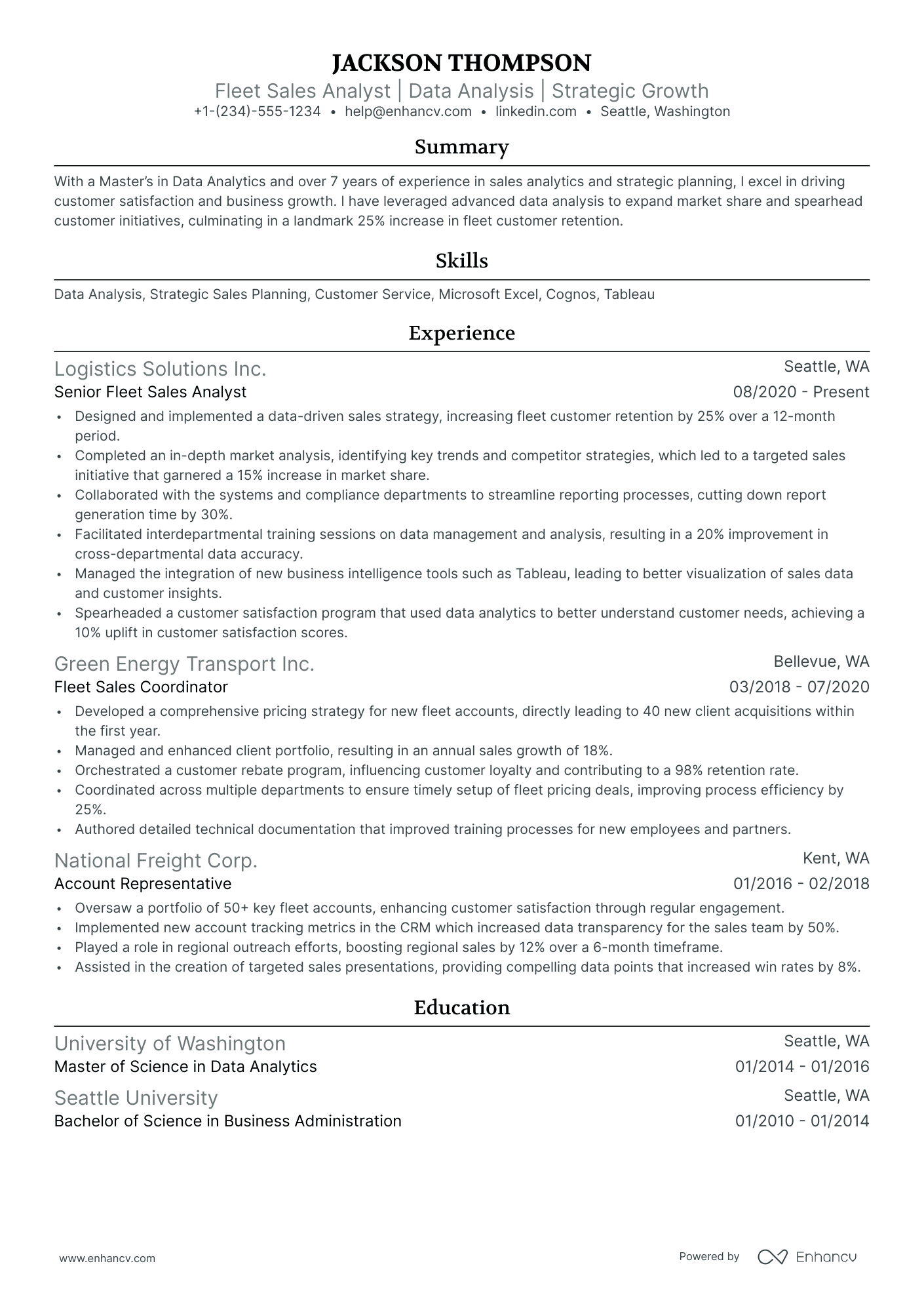
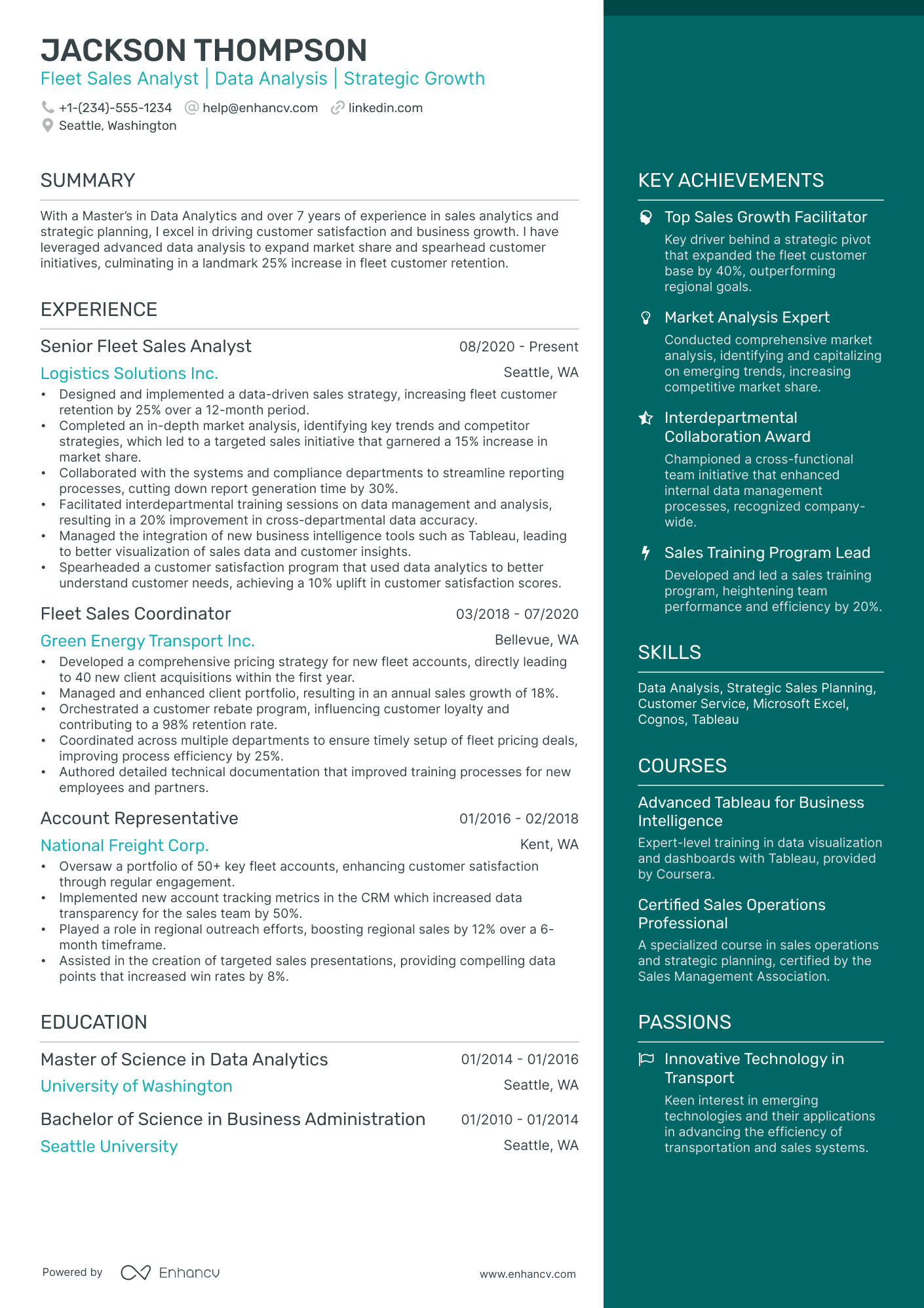
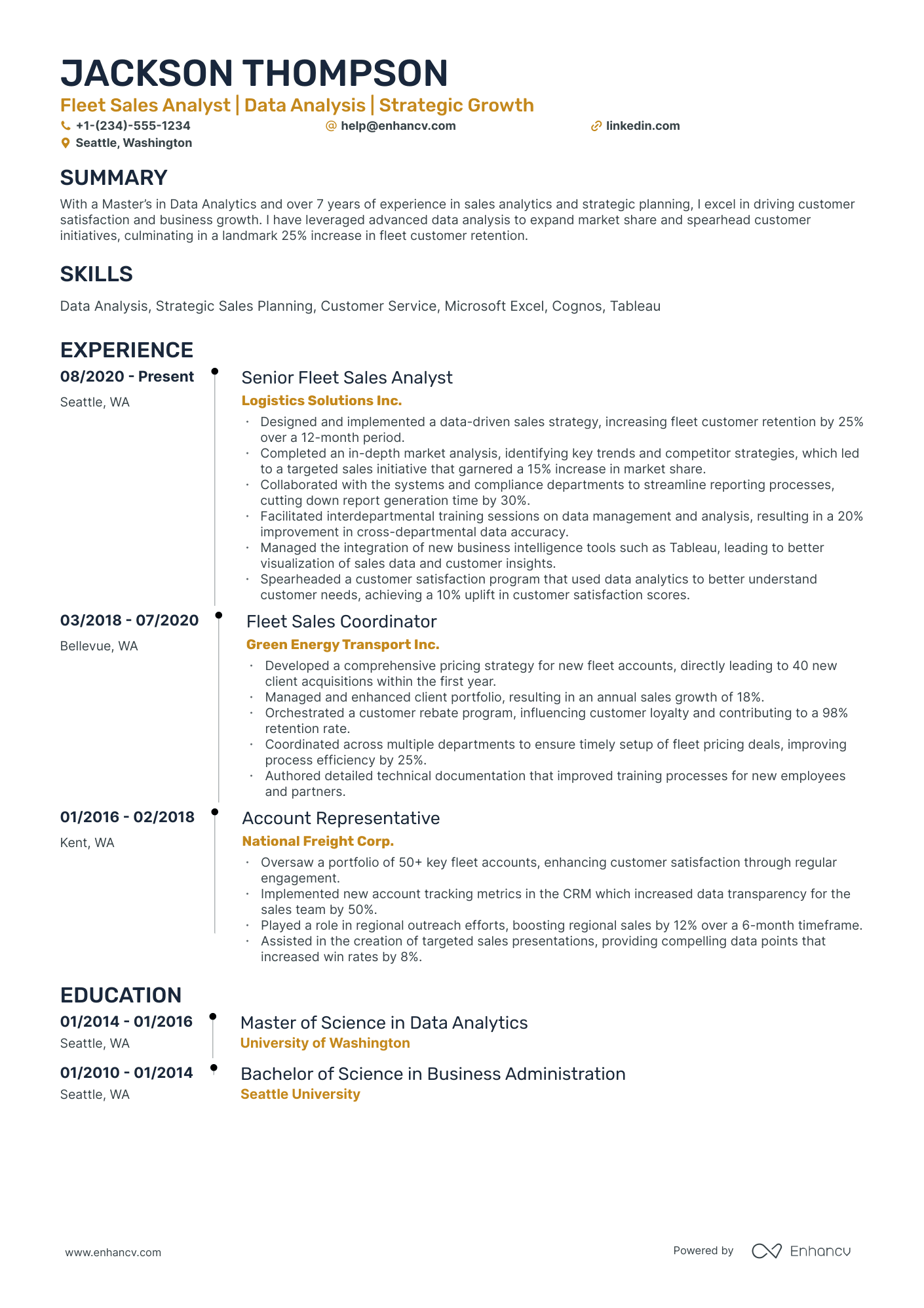
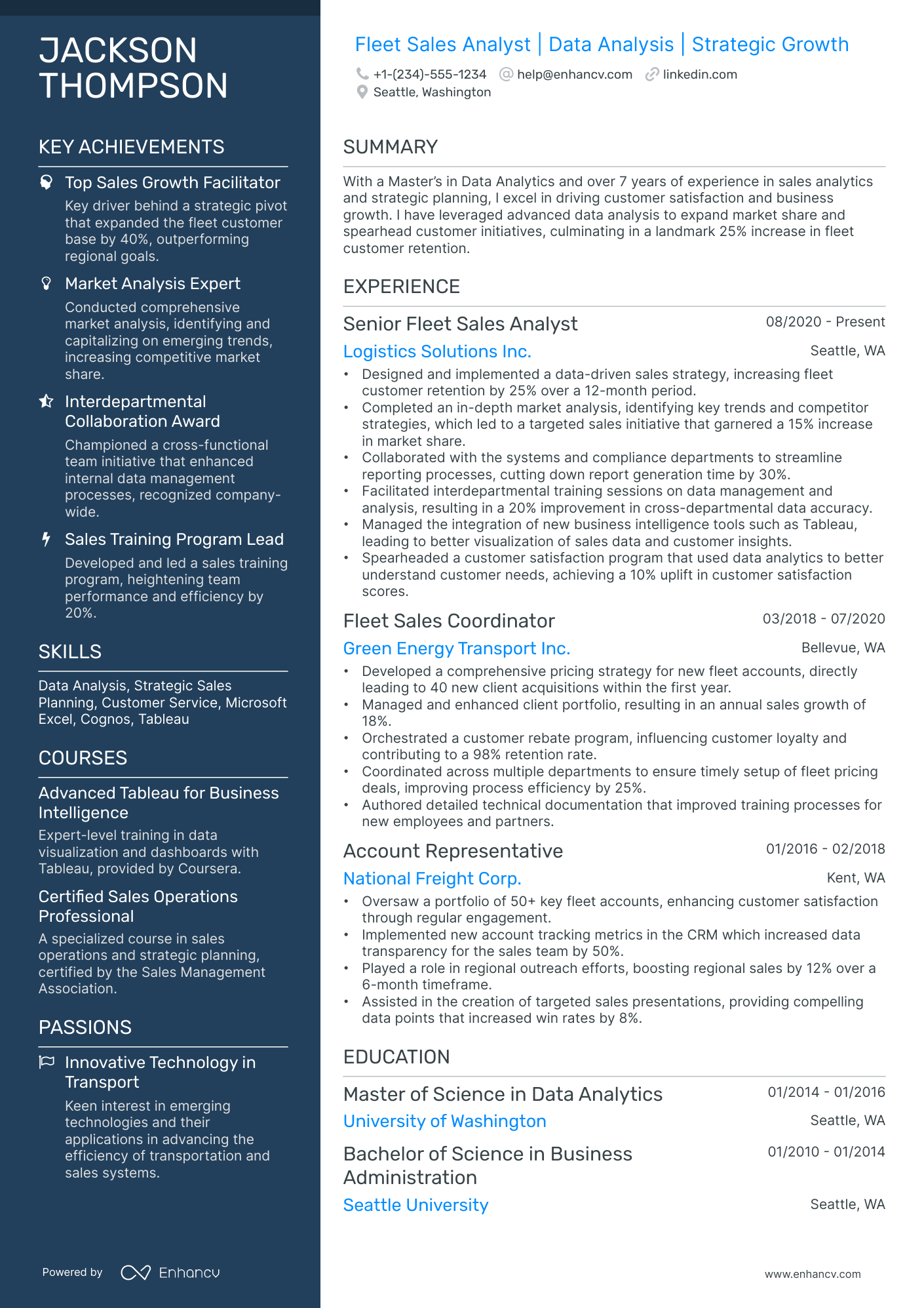
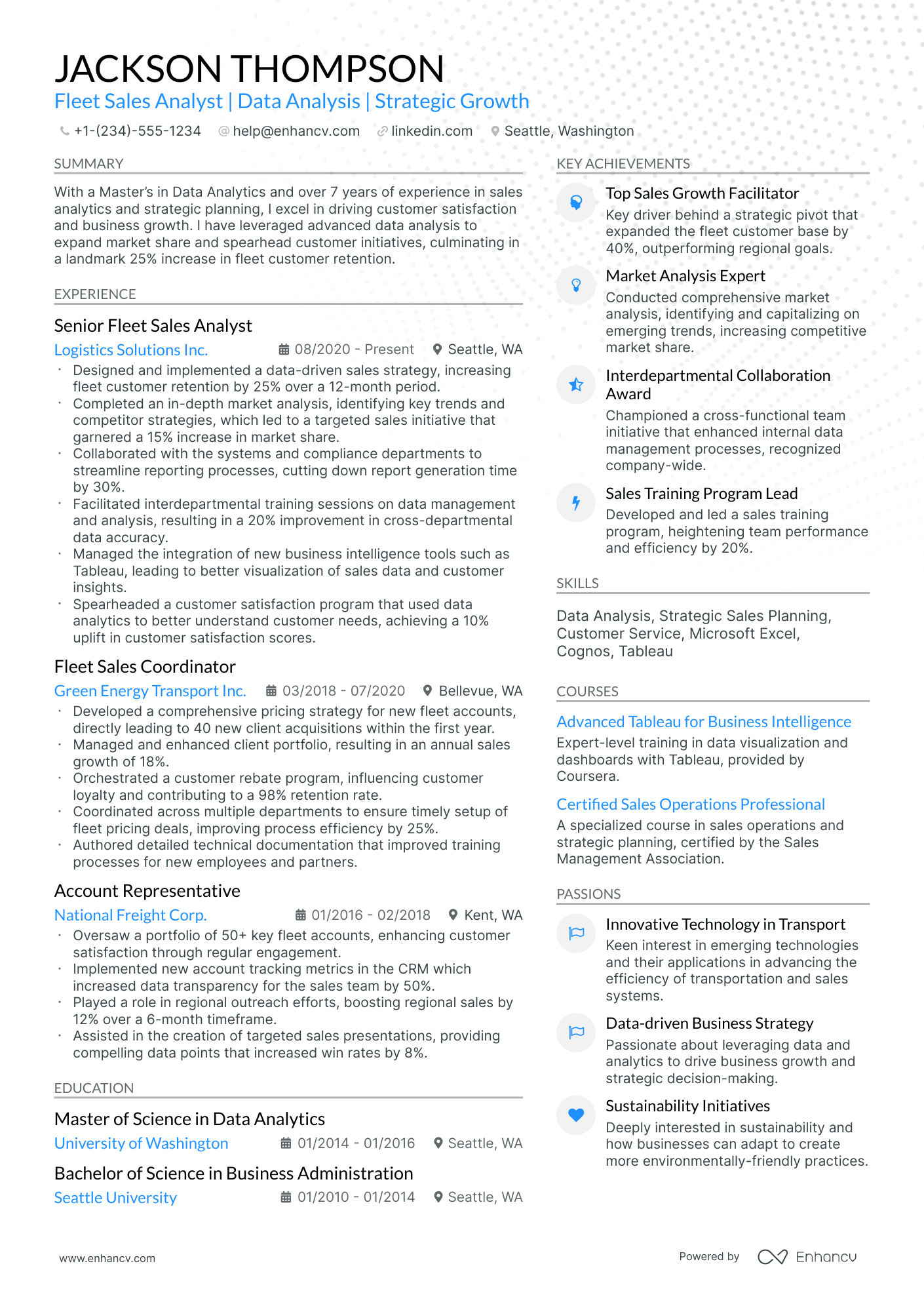
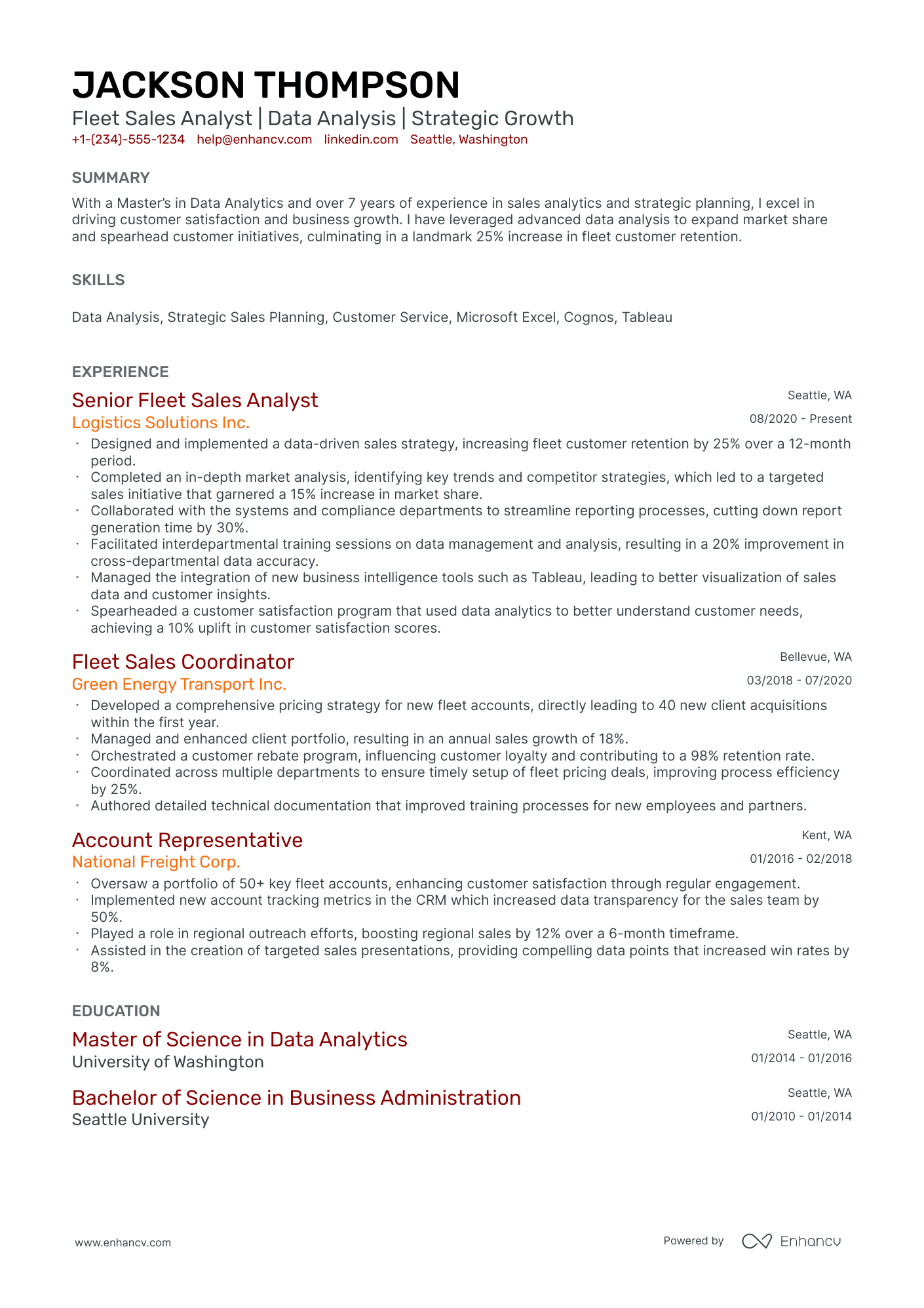
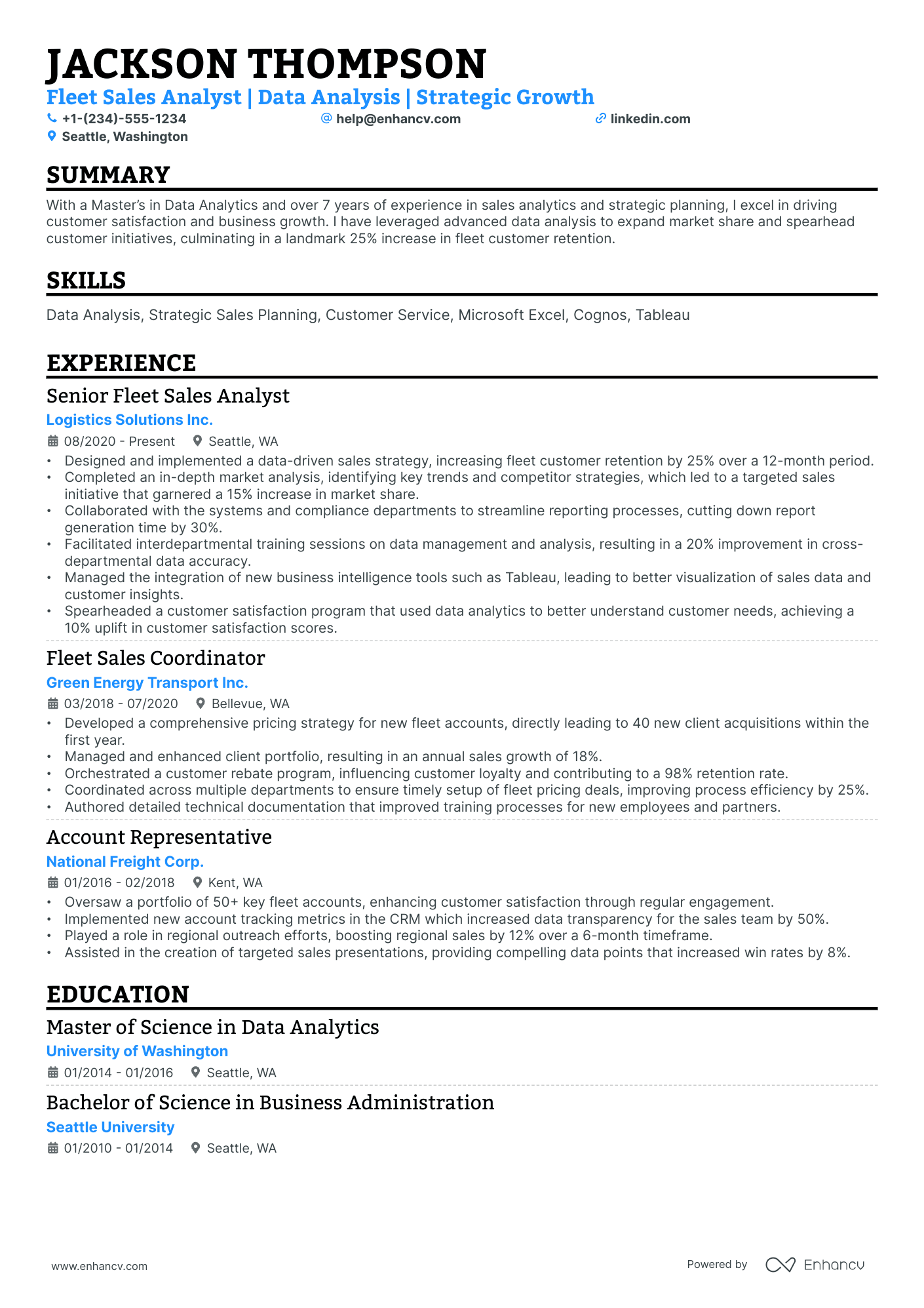
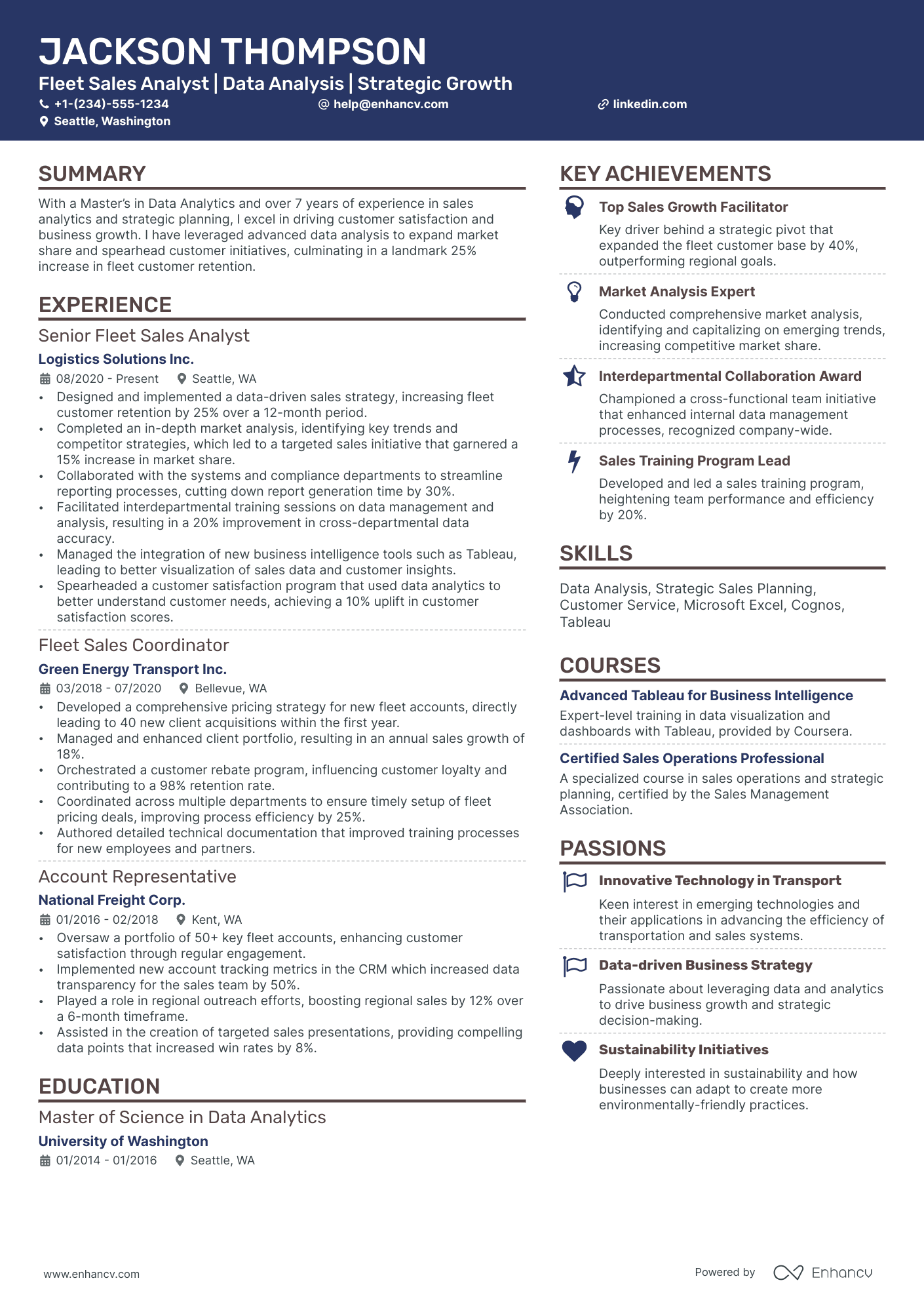
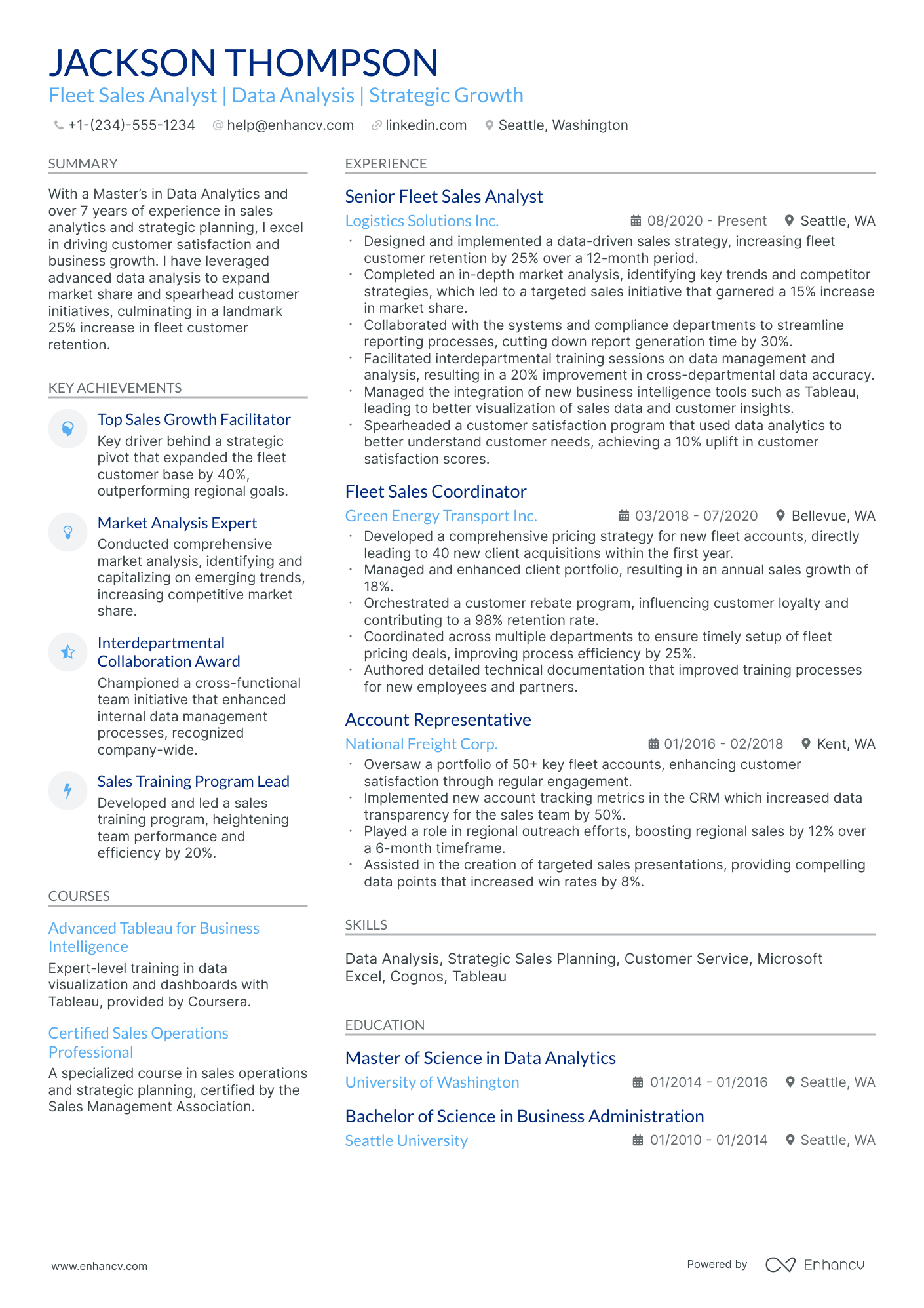
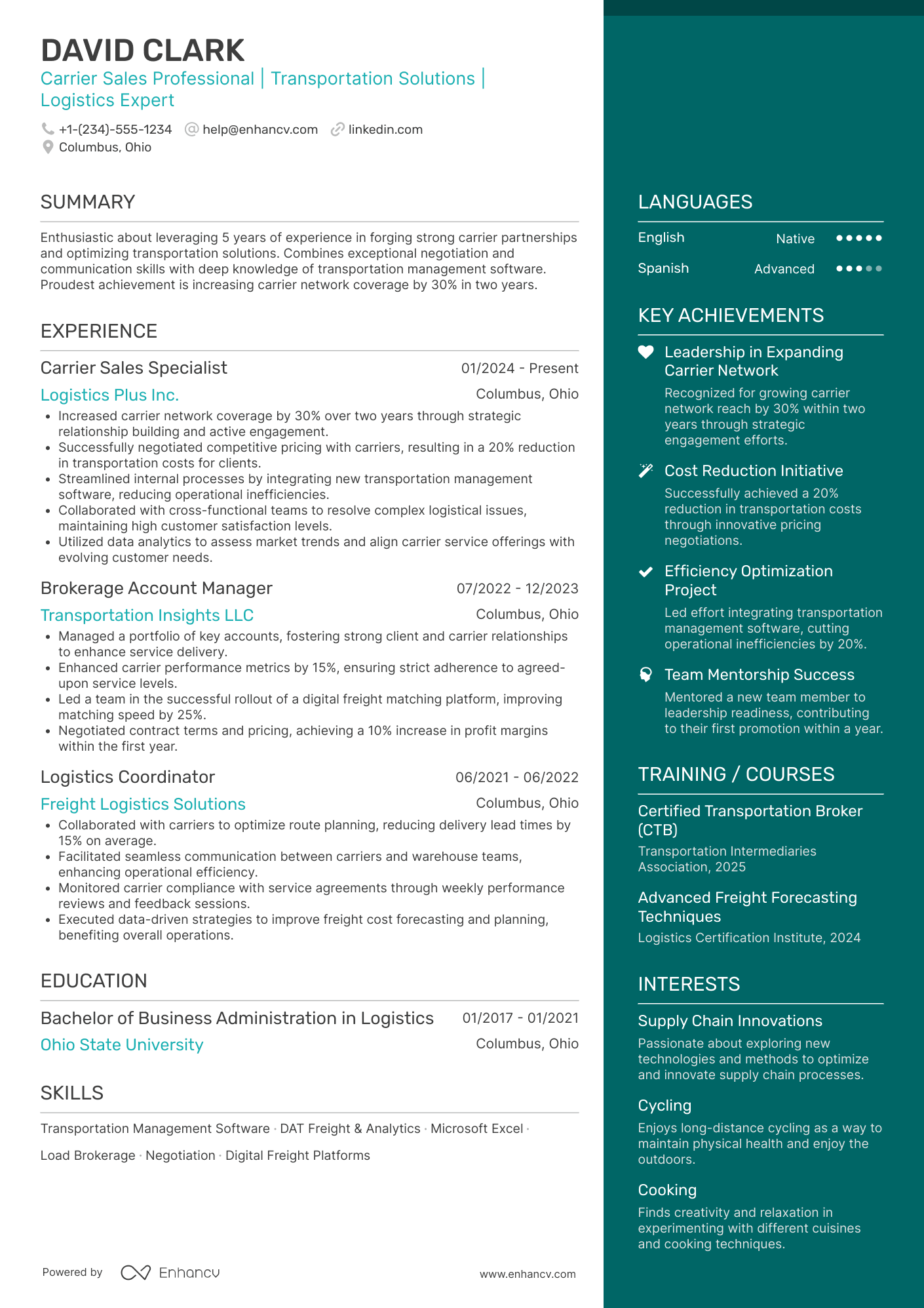
Many carrier sales resumes fail because they list loads, lanes, and tools but don't show margin, win rates, or service outcomes. This carrier sales resume guide fixes that gap so your resume passes ATS filters and earns attention in fast recruiter scans.
You should lead with outcomes that prove you can grow revenue and protect service. Show gross margin dollars, tender acceptance, on-time pickup and delivery, claim rate reductions, and book-of-business size. Quantify new shipper wins, carrier coverage, and cost savings per lane. If you're unsure where to begin, learning how to write a resume with the right foundation will help you structure every section effectively.

Key takeaways
- Quantify margin, revenue, and service metrics instead of listing daily carrier sales duties.
- Use reverse-chronological format if you have direct carrier sales experience to showcase.
- Mirror the job posting's tools, freight modes, and KPIs in your experience bullets.
- Lead each bullet with ownership scope, execution method, and measurable business outcome.
- Place skills above experience when switching careers, below it when mid-level or senior.
- Add certifications like Certified Transportation Broker directly after your education section.
- Use Enhancv's Bullet Point Generator to turn vague duties into recruiter-ready, quantified bullets.
How to format a strong carrier sales resume
Recruiters evaluating carrier sales resumes prioritize revenue generation, relationship management with carriers and shippers, and the ability to negotiate competitive rates that drive margin growth. A clean, well-structured format ensures these signals—quota attainment, book of business growth, and lane pricing expertise—surface immediately during both ATS parsing and the initial human scan. Choosing the right resume format is the first step toward making those signals visible.

I have significant experience in this role—which format should I use?
Use a reverse-chronological format—it's the strongest choice for experienced carrier sales professionals because it puts your track record of revenue growth and carrier network expansion front and center. Do:
- Lead each role entry with scope indicators: number of carriers managed, freight volume overseen, lanes covered, and team or territory size.
- Highlight proficiency with role-specific tools and domains such as TMS platforms (e.g., McLeod, TMW), DAT/Truckstop load boards, rate negotiation, and capacity planning.
- Quantify business impact in every bullet using revenue figures, margin improvements, carrier retention rates, or cost savings.
I'm junior or switching into this role—what format works best?
A hybrid format works best because it lets you lead with transferable skills—negotiation, relationship building, logistics knowledge—before reinforcing them with your work history. Do:
- Place a skills section near the top featuring competencies directly relevant to carrier sales: cold calling, rate negotiation, load board management, CRM proficiency, and freight market analysis.
- Include projects, internships, or transitional experience such as dispatch coordination, customer service in supply chain, or inside sales roles that demonstrate logistics exposure.
- Connect every action to a clear outcome so recruiters can see your potential impact, even without deep carrier sales tenure.
Why not use a functional resume?
A functional resume strips away the timeline and context recruiters need to evaluate how your carrier sales capabilities developed, making it harder to verify where and when you built relevant experience.
- A functional format may be acceptable if you're transitioning from a related logistics or sales role with no direct carrier sales history, or if you're re-entering the workforce after a gap—but only if every listed skill is tied to a specific project, transaction, or measurable outcome rather than presented as a standalone claim.
Once your layout and structure are set, the next step is filling each section with the right content to showcase your carrier sales expertise.
What sections should go on a strong carrier sales resume
Recruiters expect a carrier sales resume to show a clear track record of moving freight by building carrier relationships, improving coverage, and protecting margin. Understanding the essential resume sections ensures you don't miss anything hiring managers look for.
Use this structure for maximum clarity:
- Header
- Summary
- Experience
- Skills
- Projects
- Education
- Certifications
- Optional sections: Awards, Leadership, Languages
Strong experience bullets should emphasize measurable impact—carrier coverage, on-time performance, cost savings, margin improvement, and load volume managed.
Is your resume good enough?
Drop your resume here or choose a file. PDF & DOCX only. Max 2MB file size.
Now that you’ve included the key parts employers expect, the next step is to write your carrier sales resume experience so those details clearly show your impact and fit.
How to write your strong carrier sales resume experience
The experience section of your carrier sales resume proves you've driven revenue, built lasting shipper and carrier relationships, and managed freight operations using role-relevant tools like transportation management systems, load boards, and CRM platforms. Hiring managers prioritize demonstrated impact—closed lanes, retained accounts, and margin growth—over descriptive task lists that simply outline daily duties. Building a targeted resume that aligns each bullet with the role's priorities makes your experience section far more compelling.
Each entry should include:
- Job title
- Company and location (or remote)
- Dates of employment (month and year)
Three to five concise bullet points showing what you owned, how you executed, and what outcomes you delivered:
- Ownership scope: the carrier accounts, freight lanes, geographic territories, or book of business you were directly accountable for managing and growing within your carrier sales role.
- Execution approach: the load boards, transportation management systems, rate negotiation strategies, or prospecting methods you used to source capacity, price loads, and close deals.
- Value improved: changes to carrier retention, lane coverage, margin performance, load acceptance rates, or service reliability that resulted from your carrier sales efforts.
- Collaboration context: how you coordinated with operations teams, shippers, dispatch, compliance, or account managers to resolve issues, align on capacity needs, and maintain service commitments.
- Impact delivered: outcomes tied to revenue growth, network expansion, cost reduction, or customer satisfaction that reflect the business value of your carrier sales contributions rather than routine activity.
Experience bullet formula
A strong carrier sales experience example
✅ Right example - modern, quantified, specific.
Carrier Sales Manager
BluePeak Logistics | Chicago, IL
2022–Present
Third-party logistics provider supporting time-sensitive truckload and less-than-truckload freight for mid-market manufacturers across the Midwest.
- Negotiated and secured one hundred twenty-five high-performing carriers across dry van, reefer, and flatbed, increasing primary tender acceptance from seventy-one percent to eighty-six percent while maintaining on-time pickup above ninety-seven percent.
- Implemented DAT One, Truckstop, and Parade for lane-level pricing and capacity forecasting, improving quote-to-cover time by thirty-five percent and lifting gross margin by one point two percentage points across top fifty lanes.
- Built and automated carrier scorecards in Salesforce and Microsoft Excel using claims rate, late pickup, and tracking compliance, reducing service failures by twenty-two percent and cutting claims dollars by eighteen percent year over year.
- Partnered with operations, customer success, and shipper procurement to run weekly lane reviews and quarterly business reviews, expanding contractual capacity on ten core lanes and driving four hundred eighty thousand dollars in annualized gross profit.
- Launched EDI (electronic data interchange) and API (application programming interface) onboarding playbooks with carriers and tracking vendors, raising real-time visibility coverage from sixty percent to ninety-two percent and reducing check-call workload by eight hours per week per rep.
Now that you've seen what an effective carrier sales experience section looks like, let's break down how to tailor each element to match the specific role you're targeting.
How to tailor your strong carrier sales resume experience
Recruiters evaluate your resume through applicant tracking systems and manual review, scanning for alignment with the specific role. Tailoring your resume to the job description increases your chances of passing both screening layers.
Ways to tailor your strong carrier sales experience:
- Match carrier management platforms and TMS tools listed in the posting.
- Mirror the exact freight modes and service types they reference.
- Align your lane development results with their stated coverage priorities.
- Use their terminology for rate negotiation and capacity procurement processes.
- Highlight carrier compliance and onboarding standards they specifically mention.
- Reflect their KPIs for on-time delivery and tender acceptance performance.
- Emphasize cross-functional collaboration with operations or dispatch teams referenced.
- Include relevant industry verticals such as refrigerated or flatbed if specified.
Tailoring means aligning your real accomplishments with the language and priorities in the job description, not forcing irrelevant keywords into your experience.
Resume tailoring examples for strong carrier sales
| Job description excerpt | Untailored | Tailored |
|---|---|---|
| Develop and manage relationships with carrier partners to drive freight volume growth across dedicated and OTR lanes | Managed carrier relationships and helped grow the business. | Built and maintained a portfolio of 45+ carrier partners across dedicated and OTR lanes, increasing freight volume by 32% year over year through strategic lane matching and consistent capacity planning. |
| Negotiate competitive rates using DAT and Truckstop load boards while maintaining target margins of 12–15% on all booked loads | Negotiated rates with carriers to keep costs low. | Leveraged DAT and Truckstop load boards to negotiate spot and contract rates with carriers, consistently maintaining margins between 13–16% across 200+ monthly booked loads. |
| Onboard new carriers by verifying authority, insurance, and safety scores through RMIS and carrier vetting protocols | Helped onboard new carriers and ensured they met company standards. | Onboarded 20+ new carriers per quarter using RMIS for authority verification, insurance compliance, and CSA safety score evaluation, reducing onboarding cycle time by 40%. |
Once you’ve aligned your experience with the role’s priorities, quantify your strong carrier sales achievements to prove the impact of that work.
How to quantify your strong carrier sales achievements
Quantifying your achievements in carrier sales proves you drive revenue, protect margin, and move freight faster. Focus on booked loads, gross margin, quote-to-book time, tender acceptance, service failures, and customer retention across your book of business.
Quantifying examples for strong carrier sales
| Metric | Example |
|---|---|
| Revenue growth | "Grew monthly gross margin from $42K to $71K in six months by expanding carrier mix in DAT and Truckstop and renegotiating rate confirmations." |
| Cycle time | "Cut quote-to-book time from 18 minutes to seven minutes by using templated lanes, saved carrier profiles, and scripted calls in Salesforce." |
| Retention | "Improved shipper retention from 78% to 90% across twenty-five accounts by adding weekly lane reviews and proactive capacity updates during peak weeks." |
| Compliance | "Reduced rate confirmation errors from 3.2% to 0.8% by standardizing accessorial checks and auditing paperwork before dispatch in the transportation management system." |
| Service quality | "Increased on-time pickup from 92% to 97% on 120+ monthly loads by tightening carrier scorecards and removing low-performing carriers after two late pickups." |
Turn vague job duties into measurable, recruiter-ready resume bullets in seconds with Enhancv's Bullet Point Generator.
With your bullet points sharpened to highlight measurable achievements, the next step is ensuring your skills section presents the right mix of hard and soft skills that hiring managers expect on a carrier sales resume.
How to list your hard and soft skills on a strong carrier sales resume
A well-crafted skills section shows you can source capacity, negotiate rates, and protect margin, and recruiters and an ATS (applicant tracking system) scan this section to confirm role fit fast—aim for a heavier hard-skill mix with targeted soft skills.
strong carrier sales roles require a blend of:
- Product strategy and discovery skills.
- Data, analytics, and experimentation skills.
- Delivery, execution, and go-to-market discipline.
- Soft skills.
Your skills section should be:
- Scannable (bullet-style grouping).
- Relevant to the job post.
- Backed by proof in experience bullets.
- Updated with current tools.
Place your skills section:
- Above experience if you're junior or switching careers.
- Below experience if you're mid/senior with strong achievements.

Hard skills
Listing relevant hard skills demonstrates your technical ability to manage carrier operations and freight logistics:
- Carrier sourcing and onboarding
- RFP and bid management
- Lane pricing and rate benchmarking
- Contract negotiation and renewals
- Spot quoting and coverage planning
- Load tendering, EDI workflows
- Transportation management systems: MercuryGate, McLeod, TMW, Oracle
- Customer relationship management: Salesforce, HubSpot
- DAT, Truckstop, Loadlink
- Carrier scorecards and KPIs
- Accessorials, detention, and claims handling
- Compliance: FMCSA, insurance, W-9
Soft skills
Pairing those technical abilities with the right soft skills shows recruiters you can collaborate, lead, and solve problems under pressure:
- Negotiate to protect margin
- Run structured carrier calls
- Communicate constraints and tradeoffs
- Prioritize coverage under pressure
- Escalate risks early and clearly
- Align with operations and customer teams
- Document decisions and next steps
- Hold carriers accountable to service
- Resolve service failures fast
- Manage a high-volume pipeline
- Make data-backed decisions
- Own outcomes end to end
How to show your strong carrier sales skills in context
Skills shouldn't live only in a skills list.
They should be demonstrated in:
- Your summary (high-level professional identity)
- Your experience (proof through outcomes)
Here's how that looks in practice. You can also explore curated resume skills examples to find the right phrasing for your role.
Summary example
Carrier sales professional with eight years in domestic freight brokerage. Skilled in TMS platforms, lane pricing, and capacity sourcing. Built a reliable carrier network of 200+ partners, boosting on-time delivery rates by 18% through proactive relationship management.
- Reflects senior-level experience clearly
- Names role-relevant tools and methods
- Includes a specific measurable outcome
- Highlights relationship-building soft skills
Experience example
Senior Carrier Sales Representative
Echo Global Logistics | Chicago, IL
March 2019–January 2024
- Negotiated spot and contract rates using DAT and Trucker Tools, reducing average cost per load by 12% across 15 key lanes.
- Collaborated with operations and account management teams to resolve service failures, improving carrier scorecard ratings by 22%.
- Expanded carrier base by 35% through targeted outreach and onboarding, ensuring consistent capacity during peak seasonal demand.
- Every bullet contains measurable proof.
- Skills appear naturally through outcomes.
Once you’ve tied your carrier sales strengths to real outcomes and situations, the next step is to apply that same approach to writing a carrier sales resume when you don’t have direct experience.
How do I write a strong carrier sales resume with no experience
Even without full-time experience, you can demonstrate readiness through:
- Logistics, supply chain, or sales coursework
- Freight brokerage or logistics internship
- Campus sales or fundraising role
- Customer service with KPI tracking
- CRM pipeline class project
- Negotiation role-plays with metrics
- Market research on carrier lanes
- Excel rate analysis mini-project
If you're in this situation, our guide on writing a resume without work experience walks you through how to position these alternatives effectively.
Focus on:
- Quantified results and clear metrics
- Strong carrier sales process steps
- Tools: CRM, Excel, TMS
- Industry knowledge: lanes, rates, compliance
Resume format tip for entry-level strong carrier sales
Use a hybrid resume format because it spotlights relevant projects and skills while keeping limited work history credible and easy to scan. Do:
- Lead with a summary of strong carrier sales fit.
- Add a projects section with metrics.
- List tools: CRM, Excel, TMS.
- Quantify calls, emails, and conversion rates.
- Tailor keywords to each job post.
- Built a strong carrier sales CRM pipeline in HubSpot, logged 120 outreach touches, and improved reply rate from eight percent to fourteen percent in four weeks.
Even without hands-on experience, your education section can demonstrate relevant knowledge and transferable skills that strengthen your candidacy—so formatting it effectively matters.
How to list your education on a strong carrier sales resume
Your education section helps hiring teams confirm you have foundational knowledge in logistics, supply chain management, or business—all critical areas for strong carrier sales success.
Include:
- Degree name
- Institution
- Location
- Graduation year
- Relevant coursework (for juniors or entry-level candidates)
- Honors & GPA (if 3.5 or higher)
Skip month and day details—list the graduation year only for a cleaner, more professional look.
Here's a realistic education entry tailored to strong carrier sales:
Example education entry
Bachelor of Science in Supply Chain Management
University of Tennessee, Knoxville, TN
Graduated 2021
GPA: 3.7/4.0
- Relevant Coursework: Transportation Economics, Freight Logistics, Negotiation Strategies, Carrier Relationship Management
- Honors: Dean's List (six consecutive semesters), Supply Chain Excellence Award recipient
How to list your certifications on a strong carrier sales resume
Certifications on your resume show your commitment to learning, your proficiency with key tools, and your industry relevance for strong carrier sales roles.
Include:
- Certificate name
- Issuing organization
- Year
- Optional: credential ID or URL
- Place certifications below education when your degree is recent and more relevant than your credentials.
- Place certifications above education when they are recent, highly relevant to strong carrier sales, or required by the role.
Best certifications for your strong carrier sales resume
- Certified Transportation Broker (CTB)
- Transportation Intermediaries Association (TIA) Certified Sales Professional
- APICS Certified in Logistics, Transportation and Distribution (CLTD)
- Lean Six Sigma Yellow Belt
- HubSpot Sales Software Certification
- Salesforce Certified Associate
- Google Analytics Certification
Once you’ve positioned your credentials where recruiters can quickly spot their value, shift to crafting a carrier sales resume summary that ties those qualifications to your impact in the role.
How to write your strong carrier sales resume summary
Your resume summary is the first thing a recruiter reads when reviewing your carrier sales application. A sharp, specific opening sets you apart and earns a closer look at the rest of your resume.
Keep it to three to four lines, with:
- Your title and total years of experience in carrier sales or logistics.
- The domain you specialize in, such as telecommunications, freight, or insurance.
- Core skills like contract negotiation, CRM platforms, or rate analysis.
- One or two measurable wins, such as revenue growth or new accounts closed.
- Soft skills tied to outcomes, like relationship building that improved client retention.

PRO TIP
At a junior or mid-level carrier sales role, lead with relevant skills, tools, and early results. Highlight specific sales metrics and industry knowledge. Avoid vague phrases like "passionate go-getter" or "motivated self-starter." Recruiters want proof of what you've done, not personality descriptors.
Example summary for a strong carrier sales
Carrier sales representative with three years of experience in freight logistics. Grew assigned lane volume by 34% year over year using DAT and Salesforce. Skilled in rate negotiation and building lasting carrier relationships.
Optimize your resume summary and objective for ATS
Drop your resume here or choose a file.
PDF & DOCX only. Max 2MB file size.
Now that your summary captures your value as a carrier sales professional, make sure your header presents the essential contact and identification details recruiters need to reach you.
What to include in a strong carrier sales resume header
A resume header is the top section with your identity and contact details, and it drives visibility, credibility, and recruiter screening for strong carrier sales roles.
Essential resume header elements
- Full name
- Tailored job title and headline
- Location
- Phone number
- Professional email
- GitHub link
- Portfolio link
A LinkedIn link helps recruiters confirm your timeline, titles, and recommendations fast, which supports screening.
Don't include a photo on a strong carrier sales resume unless the role is explicitly front-facing or appearance-dependent.
Keep the header on one to two lines, use a job-matched title, and make every link clickable and easy to scan.
Example
Strong carrier sales resume header
Jordan Lee
Carrier Sales Representative | Strong carrier sales—capacity sourcing, lane pricing, and broker support
Chicago, IL
(312) 555-01XX
jordan.lee@enhancv.com
github.com/jordanlee
yourwebsite.com
linkedin.com/in/jordanlee
Once your contact details and positioning are clear at the top, you can strengthen the rest of the document with additional sections that support your carrier sales experience.
Additional sections for strong carrier sales resumes
When your core experience aligns with competitors, additional sections can set you apart by showcasing unique strengths relevant to carrier sales. For example, listing language skills can highlight your ability to communicate with carriers and shippers across diverse markets.
- Languages
- Industry certifications
- Professional affiliations and memberships
- Awards and sales achievements
- Volunteer experience in logistics or trade organizations
- Publications or speaking engagements
- Hobbies and interests
Once you've strengthened your resume with relevant additional sections, the next step is pairing it with a well-crafted cover letter to maximize your impact.
Do strong carrier sales resumes need a cover letter
A cover letter isn't required for a strong carrier sales resume, but it helps in competitive roles or strict hiring processes. It can make a difference when the team expects context, or when your resume needs a clear narrative. If you're unsure where to start, understanding what a cover letter is and how it complements your resume will help you decide when to include one.
Use a cover letter to add detail your resume can't show:
- Explain role and team fit by connecting your sales motion to their carrier segment, deal cycle, and stakeholders.
- Highlight one or two outcomes, such as carrier wins, pipeline growth, or renewal lift, and name your exact contribution.
- Show product and business understanding by referencing their users, pricing model, integrations, or go-to-market approach.
- Address transitions or non-obvious experience by mapping transferable skills to strong carrier sales responsibilities and targets.
Drop your resume here or choose a file.
PDF & DOCX only. Max 2MB file size.
Even when you decide a separate letter won’t add value, you can still strengthen your application by using AI to improve your strong carrier sales resume.
Using AI to improve your strong carrier sales resume
AI can sharpen clarity, tighten structure, and boost measurable impact across your resume. It's useful for refining language and aligning content with role expectations. But overuse dulls authenticity. Once your resume reads clearly and fits the role, step away from AI. If you're wondering which AI is best for writing resumes, choosing the right tool matters as much as knowing when to stop using it.
Here are 10 practical prompts to strengthen specific sections of your strong carrier sales resume:
- Sharpen your summary. "Rewrite my resume summary to highlight my strongest carrier sales achievements in two concise sentences."
- Quantify experience bullets. "Add specific metrics like revenue figures or client counts to each of my strong carrier sales experience bullets."
- Align skills section. "Review my skills section and remove anything not directly relevant to a strong carrier sales position."
- Strengthen action verbs. "Replace weak or passive verbs in my strong carrier sales experience bullets with direct, results-driven alternatives."
- Tighten project descriptions. "Condense my project descriptions to focus on outcomes directly tied to strong carrier sales performance."
- Improve certification relevance. "Reorder my certifications section to prioritize credentials most valued in strong carrier sales roles."
- Refine education details. "Edit my education section to emphasize coursework or honors relevant to a strong carrier sales career."
- Remove redundant phrasing. "Identify and cut repeated or filler language across all sections of my strong carrier sales resume."
- Target job descriptions. "Compare my strong carrier sales resume against this job posting and flag missing keywords or qualifications."
- Clarify career progression. "Restructure my experience section to clearly show upward growth within strong carrier sales roles."
Stop using AI once your resume sounds accurate, specific, and aligned with real experience. AI should never invent experience or inflate claims—if it didn't happen, it doesn't belong here.
Conclusion
A strong carrier sales resume proves impact with measurable outcomes. It highlights margin growth, on-time pickup and delivery, cost savings, and coverage speed. It shows role-specific skills like rate negotiation, lane planning, and carrier onboarding, in a clear structure.
Keep it focused, scannable, and easy to verify. A strong carrier sales resume signals readiness for today’s and near-future hiring market. It shows you can protect service, manage volatility, and deliver results under pressure.