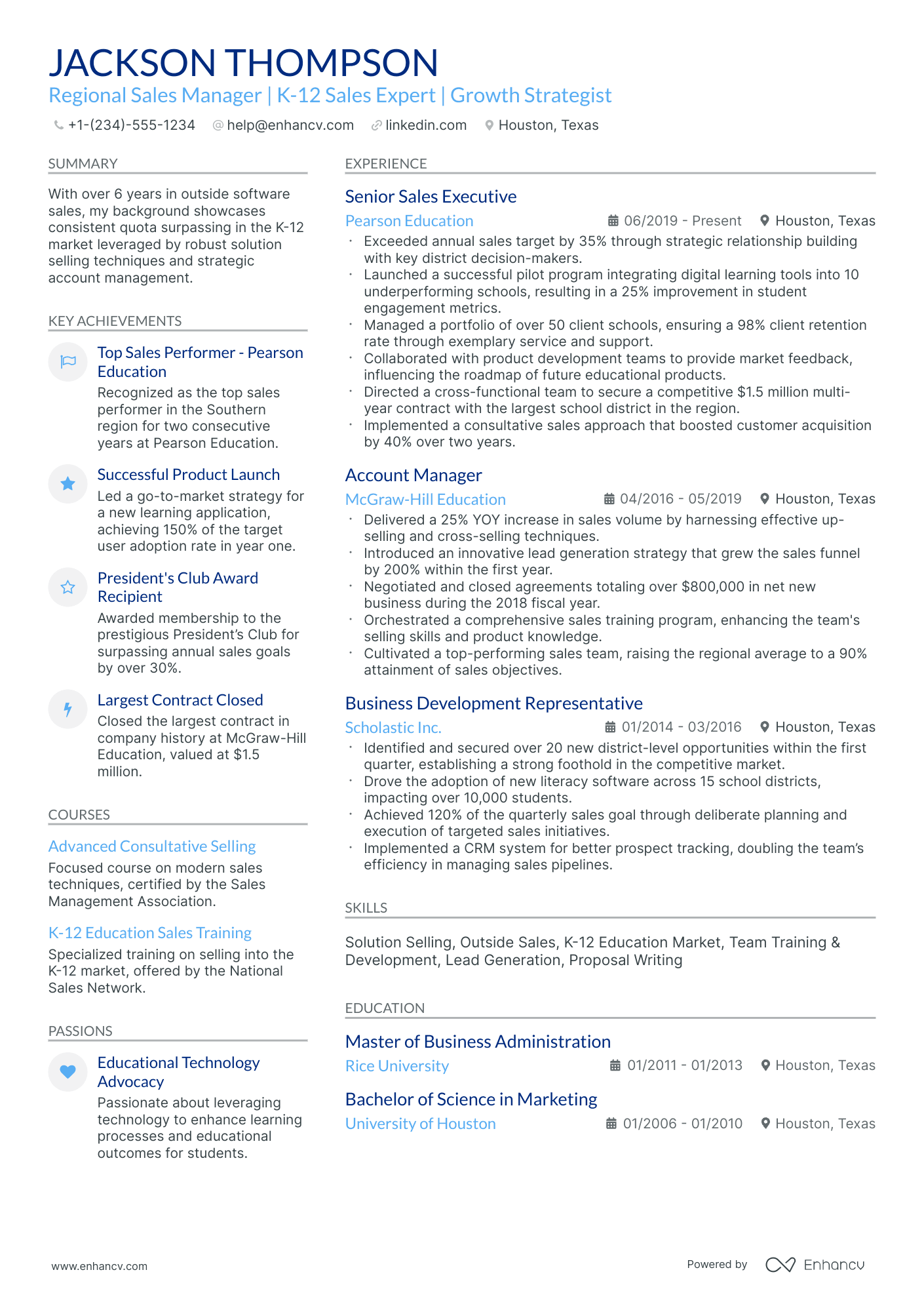
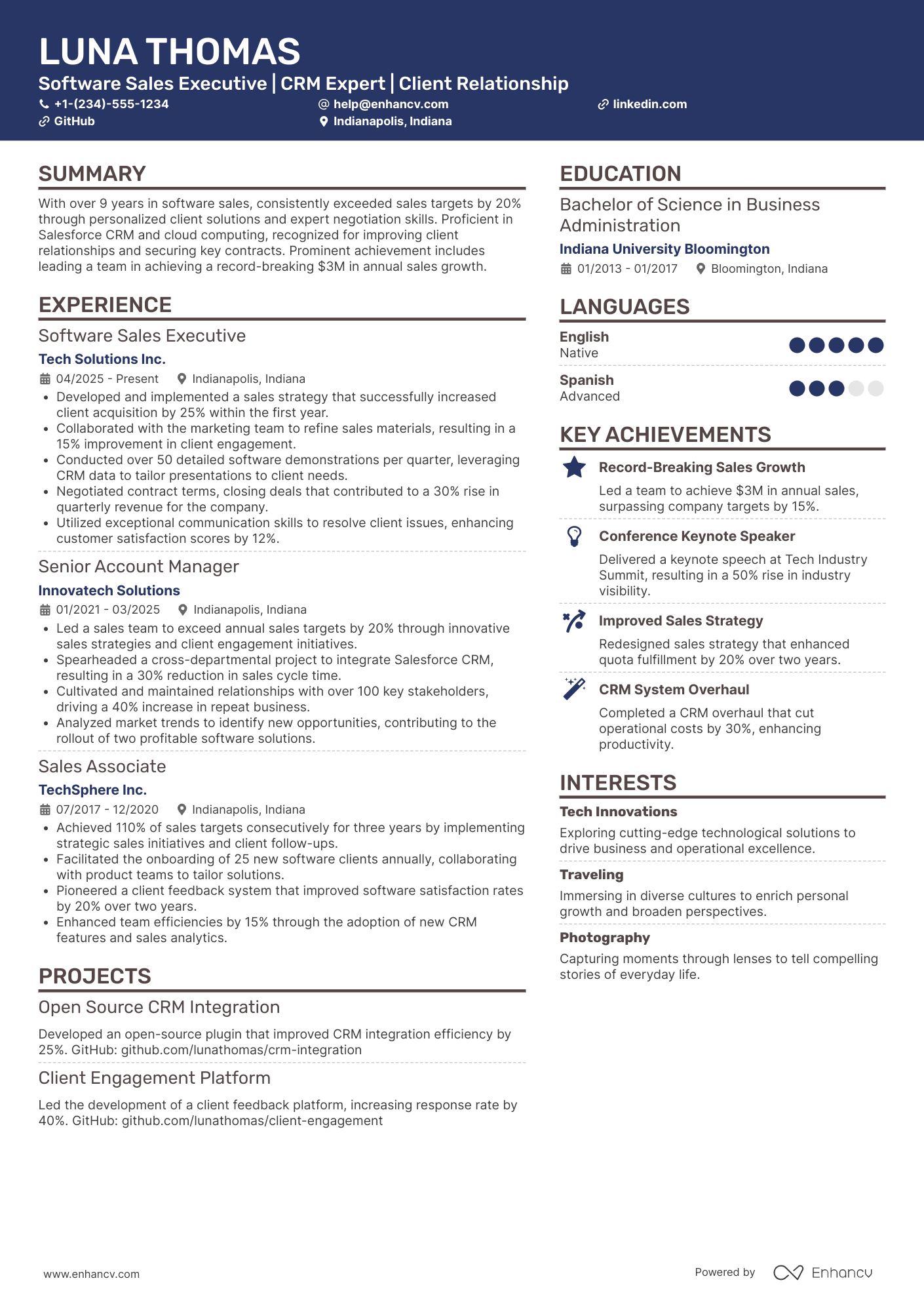
Many software sales resume submissions fail because they read like product catalogs, not revenue stories. That blurs your impact in ATS screening, rapid recruiter scans, and a crowded market.
A strong resume shows outcomes and scope, not tools or task lists. Knowing how to make your resume stand out means you should highlight quota attainment, pipeline created, deal size, win rate, sales cycle reduction, renewals, expansion revenue, and customer retention impact. Include territory coverage, strategic accounts, and measurable forecast accuracy.

Key takeaways
- Quantify every experience bullet with revenue, quota attainment, win rate, or sales cycle data.
- Use reverse-chronological format if you have proven software sales results to showcase.
- Tailor each resume to mirror the job posting's tools, methodologies, and revenue KPIs.
- Lead with a three- to four-line summary that names your domain, tools, and top metrics.
- Demonstrate skills through measurable outcomes in your experience, not just a skills list.
- Place certifications above or below education based on which better proves role readiness.
- Use Enhancv to turn vague job duties into concise, metric-driven resume bullets faster.
Job market snapshot for software sales
We analyzed 104 recent software sales job ads across major US job boards. These numbers help you understand salary landscape, employer expectations, industry demand at a glance.
What level of experience employers are looking for software sales
| Years of Experience | Percentage found in job ads |
|---|---|
| 1–2 years | 1.0% (1) |
| 3–4 years | 2.9% (3) |
| 5–6 years | 45.2% (47) |
| 7–8 years | 2.9% (3) |
| 9–10 years | 3.8% (4) |
| 10+ years | 3.8% (4) |
| Not specified | 44.2% (46) |
Software sales ads by area of specialization (industry)
| Industry (Area) | Percentage found in job ads |
|---|---|
| Finance & Banking | 69.2% (72) |
| Healthcare | 19.2% (20) |
Top companies hiring software sales
| Company | Percentage found in job ads |
|---|---|
| Accenture | 41.3% (43) |
| Motorola Solutions | 11.5% (12) |
Role overview stats
These tables show the most common responsibilities and employment types for software sales roles. Use them to align your resume with what employers expect and to understand how the role is structured across the market.
Day-to-day activities and top responsibilities for a software sales
| Responsibility | Percentage found in job ads |
|---|---|
| Saas | 51.0% (53) |
| Marketing | 42.3% (44) |
| Advertising | 41.3% (43) |
| Cloud hosting | 41.3% (43) |
| Marketing measurement | 41.3% (43) |
| Media | 41.3% (43) |
| Professional services | 41.3% (43) |
| Telecommunications | 41.3% (43) |
| Crm | 18.3% (19) |
| Microsoft office | 11.5% (12) |
| Sales | 7.7% (8) |
| Ai | 4.8% (5) |
Type of employment (remote vs on-site vs hybrid)
| Employment type | Percentage found in job ads |
|---|---|
| On-site | 67.3% (70) |
| Hybrid | 21.2% (22) |
| Remote | 11.5% (12) |
How to format a software sales resume
Recruiters evaluating software sales candidates prioritize quota attainment, deal size, sales cycle expertise, and familiarity with CRM and sales engagement platforms. Choosing the right resume format ensures these revenue-driving signals surface immediately rather than getting buried beneath generic skills lists or unclear job histories.

I have significant experience in this role—which format should I use?
Use a reverse-chronological format to put your strongest, most recent sales performance front and center. Do:
- Lead each role entry with your scope of ownership—territory size, account segment, team size, or revenue responsibility.
- Highlight proficiency with role-specific tools and domains such as Salesforce, HubSpot, Gong, MEDDIC/MEDDPICC methodology, and SaaS pipeline management.
- Quantify outcomes tied directly to business impact, including quota attainment percentages, ARR growth, average contract value, and win rates.
I'm junior or switching into this role—what format works best?
A hybrid format works best because it lets you lead with transferable sales skills while still showing a clear work timeline. Do:
- Place a focused skills section near the top that highlights competencies like prospecting, demo delivery, objection handling, and CRM fluency.
- Include projects, internships, or transitional experience that demonstrate customer-facing work—such as SDR/BDR rotations, SaaS product demos, or B2B outreach campaigns.
- Connect every action to a measurable result so hiring managers can see your potential impact.
Why not use a functional resume?
A functional resume strips away the timeline context that hiring managers need to evaluate your sales growth, ramp speed, and consistency—making it harder to trust your numbers.
- Career changers with no direct software sales experience who need to foreground adjacent skills like account management, technical consulting, or customer success.
- Recent graduates or bootcamp completers with limited professional history but relevant coursework, certifications (e.g., Salesforce Administrator, SaaS Sales Foundations), or capstone projects involving pipeline modeling or go-to-market strategy.
- A functional format may be acceptable if you're bridging a significant resume gap or pivoting from a non-sales career, but only if every listed skill is anchored to a specific project, certification, or measurable outcome rather than presented as a standalone claim.
Now that your resume's structure and layout are in place, it's time to fill each part with the right content—starting with knowing exactly which sections to include.
What sections should go on a software sales resume
Recruiters expect a software sales resume to quickly show your ability to hit quota, grow pipeline, and close revenue. Understanding which resume sections to include ensures nothing critical gets left out.
Use this structure for maximum clarity:
- Header
- Summary
- Experience
- Skills
- Projects
- Education
- Certifications
- Optional sections: Awards, Leadership, Languages
Strong experience bullets should emphasize quota attainment, revenue closed, pipeline created, deal size, sales cycle length, territory scope, and measurable outcomes.
Is your resume good enough?
Drop your resume here or choose a file. PDF & DOCX only. Max 2MB file size.
Now that you’ve mapped out the key resume components employers expect, the next step is learning how to write your software sales resume experience so each role supports those sections with clear, results-focused detail.
How to write your software sales resume experience
The experience section is where you prove you can close deals, grow accounts, and drive revenue using the platforms and sales methodologies your target employer values. Hiring managers prioritize demonstrated impact—quota attainment, pipeline growth, and retained accounts—over descriptive task lists that simply recount daily activities.
Each entry should include:
- Job title
- Company and location (or remote)
- Dates of employment (month and year)
Three to five concise bullet points showing what you owned, how you executed, and what outcomes you delivered:
- Ownership scope: the territories, named accounts, product lines, or revenue segments you were directly responsible for, including whether you managed full-cycle sales, net-new business, expansions, or renewals.
- Execution approach: the sales methodologies, CRM platforms, prospecting tools, demo environments, and forecasting frameworks you used to qualify opportunities, advance pipeline stages, and close deals.
- Value improved: changes to win rates, deal velocity, average contract value, customer retention, or forecast accuracy that resulted from how you refined your approach to selling software solutions.
- Collaboration context: how you partnered with solutions engineers, customer success managers, product teams, marketing, or channel partners to build compelling business cases and navigate complex buying committees.
- Impact delivered: outcomes expressed through revenue generated, quota performance, pipeline created, accounts expanded, or market share gained rather than a summary of calls made or demos scheduled.
Experience bullet formula
A software sales experience example
✅ Right example - modern, quantified, specific.
Senior Account Executive, SaaS
NimbleGrid | Austin, TX (Remote)
2022–Present
B2B workflow automation platform serving mid-market operations teams across North America.
- Closed $2.8M in annual recurring revenue across twenty-one net-new logos by running MEDDICC-driven discovery, building mutual action plans, and executing multi-threaded outreach in Salesforce.
- Increased win rate from 24% to 33% by tightening qualification in Gong, standardizing call scorecards, and partnering with product managers and sales engineers to align demos to use cases.
- Reduced average sales cycle from seventy-two to fifty-six days by implementing a Champion Enablement kit in Notion, automating follow-ups with Outreach, and coordinating security reviews with customer IT.
- Expanded existing accounts by $740K in annual recurring revenue through QBR cadence, usage-based expansion plays in Gainsight, and joint roadmap sessions with customer stakeholders and engineering.
- Improved forecast accuracy from 68% to 86% by enforcing stage exit criteria, cleaning pipeline hygiene, and running weekly deal reviews with sales leadership and RevOps.
Now that you've seen how a strong experience section comes together, let's look at how to adjust yours to match the specific role you're targeting.
How to tailor your software sales resume experience
Recruiters evaluate your software sales resume through both applicant tracking systems and manual review. Tailoring your resume to the job description ensures your qualifications connect directly with what hiring managers prioritize.
Ways to tailor your software sales experience:
- Match CRM platforms and sales tools named in the job description.
- Mirror the exact terminology used for sales methodologies or frameworks.
- Reflect quota structures and revenue KPIs the posting emphasizes.
- Include experience with the specific software vertical or industry mentioned.
- Highlight referenced deal cycles such as enterprise or mid-market sales.
- Align your language with stated collaboration models like cross-functional selling.
- Emphasize solution selling or consultative approaches if the role requires them.
- Feature relevant technical knowledge tied to the product stack described.
Tailoring means aligning your real accomplishments with each role's stated requirements, not forcing disconnected keywords into your experience.
Resume tailoring examples for software sales
| Job description excerpt | Untailored | Tailored |
|---|---|---|
| "Drive new business through outbound prospecting using Salesforce CRM and sales engagement platforms like Outreach.io to exceed quarterly ARR targets." | Responsible for finding new clients and growing revenue. | Generated $1.8M in new ARR by building an outbound pipeline of 120+ accounts in Salesforce, using Outreach.io sequences that achieved a 34% open rate and 12% meeting conversion rate. |
| "Manage the full sales cycle for mid-market SaaS deals, partnering with solutions engineers to deliver technical demos and navigate multi-stakeholder procurement." | Handled sales from start to finish and gave product demonstrations. | Closed 27 mid-market SaaS deals averaging $65K ACV over 12 months, collaborating with solutions engineers to deliver tailored technical demos for procurement committees of five to eight stakeholders. |
| "Expand existing accounts by identifying upsell and cross-sell opportunities within the installed base, driving net revenue retention above 120%." | Worked with current customers to sell additional products and services. | Grew net revenue retention to 128% across a portfolio of 45 accounts by mapping product usage data to upsell opportunities, closing $740K in cross-sell revenue from add-on modules and premium tier upgrades. |
Once you’ve aligned your experience with the role’s priorities, quantify your software sales achievements to prove impact with measurable results.
How to quantify your software sales achievements
Quantifying your achievements shows the business impact behind your deals, not just activity. Focus on revenue, sales cycle speed, win rate, retention, pipeline coverage, and risk reduction across your accounts and territories.
Quantifying examples for software sales
| Metric | Example |
|---|---|
| Revenue growth | "Closed $1.8M in annual recurring revenue across nine mid-market accounts by running MEDDICC in Salesforce and tightening mutual action plans." |
| Sales cycle time | "Cut average sales cycle from 62 to 45 days by standardizing discovery in Gong and aligning legal, security, and procurement steps." |
| Win rate | "Raised win rate from 24% to 33% in two quarters by improving demo-to-proof-of-concept handoffs with solutions engineering and adding tailored success criteria." |
| Retention | "Improved renewal rate from 88% to 94% across a $3.2M book by launching quarterly business reviews and tracking adoption milestones in Gainsight." |
| Risk reduction | "Reduced late-stage deal slippage by 30% by adding security questionnaire templates and a red-flag checklist for procurement and data processing terms." |
Turn vague job duties into measurable, recruiter-ready resume bullets in seconds with Enhancv's Bullet Point Generator.
Once your bullet points clearly convey your impact, it's equally important to highlight the specific hard and soft skills that reinforce your qualifications throughout your software sales resume.
How to list your hard and soft skills on a software sales resume
Your skills section shows you can run discovery, manage a pipeline, and close revenue—recruiters and an ATS (applicant tracking system) scan this section to match keywords to the job post, so aim for a mix of role-specific hard skills and execution-focused soft skills. software sales roles require a blend of:
- Product strategy and discovery skills.
- Data, analytics, and experimentation skills.
- Delivery, execution, and go-to-market discipline.
- Soft skills.
Your skills section should be:
- Scannable (bullet-style grouping).
- Relevant to the job post.
- Backed by proof in experience bullets.
- Updated with current tools.
Place your skills section:
- Above experience if you're junior or switching careers.
- Below experience if you're mid/senior with strong achievements.

Hard skills
- Customer discovery, MEDDICC
- Consultative selling, SPIN
- Pipeline management, forecasting
- Salesforce, HubSpot CRM
- Outreach, Salesloft sequences
- Gong conversation intelligence
- LinkedIn Sales Navigator
- Deal desk, pricing strategy
- Contracting, procurement workflows
- Competitive analysis, battlecards
- Sales enablement, playbooks
- Sales metrics, cohort analysis
Soft skills
- Run structured discovery calls
- Ask incisive follow-up questions
- Align stakeholders to next steps
- Communicate value in plain language
- Handle objections with evidence
- Negotiate trade-offs and timelines
- Collaborate with solutions engineers
- Coordinate with marketing on campaigns
- Escalate risks early and clearly
- Prioritize pipeline by impact
- Follow up with disciplined cadence
- Maintain clean, consistent handoffs
How to show your software sales skills in context
Skills shouldn't live only in a dedicated skills list. Browse examples of resume skills to see how top candidates present theirs effectively.
They should be demonstrated in:
- Your summary (high-level professional identity)
- Your experience (proof through outcomes)
Here's what that looks like in practice.
Summary example
Senior software sales executive with 10+ years in B2B SaaS, skilled in Salesforce, MEDDIC, and consultative selling. Built and led a 12-person team that exceeded annual quota by 34%, generating $18M in recurring revenue.
- Signals senior-level depth immediately
- Names specific tools and methodologies
- Leads with a measurable revenue outcome
- Highlights leadership as a soft skill
Experience example
Senior Account Executive
Vantage Cloud Solutions | Remote
March 2020–January 2025
- Closed $12.4M in annual recurring revenue by running a full-cycle MEDDIC sales process across enterprise accounts.
- Partnered with solutions engineers and marketing to build tailored demos, shortening the average sales cycle by 22%.
- Managed a 60-account portfolio in Salesforce and Gong, maintaining a 93% forecast accuracy over eight consecutive quarters.
- Every bullet contains measurable proof.
- Skills surface naturally through real outcomes.
Once you’ve demonstrated your software sales strengths through specific, results-focused examples, the next step is applying that approach to building a software sales resume when you don’t have direct experience.
How do I write a software sales resume with no experience
Even without full-time experience, you can demonstrate readiness through:
- CRM pipeline tracking for leads
- Cold email and call outreach
- Campus org sponsorship sales
- Retail upsell and renewals
- Freelance client acquisition projects
- Sales shadowing and call notes
- Demo scripts and role-plays
If you're building a resume without work experience, focus on:
- Quota-style targets and results
- CRM hygiene and pipeline stages
- Outreach volume and reply rates
- Product knowledge and positioning
Resume format tip for entry-level software sales
Use a combination resume format. It highlights skills and results first, while still showing relevant experience substitutes and tools. Do:
- Put software sales skills under "Skills."
- Add tools: Salesforce, HubSpot, LinkedIn Sales Navigator.
- Quantify outreach: dials, emails, replies.
- Write bullets with action and results.
- Include a "Projects" section.
- Built a HubSpot pipeline for fifty leads, ran three-step cold email sequences, and booked six demo meetings in four weeks.
Even without direct experience, your educational background can serve as a strong foundation for your software sales resume—here's how to present it effectively.
How to list your education on a software sales resume
Your education section helps hiring teams confirm you have foundational knowledge in business, technology, or communication—areas directly relevant to software sales success.
Include:
- Degree name
- Institution
- Location
- Graduation year
- Relevant coursework (for juniors or entry-level candidates)
- Honors & GPA (if 3.5 or higher)
Skip month and day details—list the graduation year only.
Here's a strong education entry tailored to software sales:
Example education entry
Bachelor of Science in Business Administration
University of Texas at Austin, Austin, TX
Graduated 2021
GPA: 3.7/4.0
- Relevant Coursework: SaaS Business Models, Sales Management, Consumer Behavior, Data-Driven Marketing
- Honors: Dean's List, Magna Cum Laude
How to list your certifications on a software sales resume
Certifications show your commitment to learning, your proficiency with sales tools, and your relevance in software sales industries and markets. They help hiring teams trust your skills when your experience is still growing.
Include:
- Certificate name
- Issuing organization
- Year
- Optional: credential ID or URL
- Place certifications below education when your degree is recent and your certifications add support, not differentiation.
- Place certifications above education when they are recent, role-relevant, and stronger proof of software sales readiness than your schooling.
Best certifications for your software sales resume
- Salesforce Certified Sales Cloud Consultant
- HubSpot Sales Software Certification
- MEDDIC Certification
- Certified Inside Sales Professional (CISP)
- AWS Certified Cloud Practitioner
- Google Cloud Digital Leader
- Pragmatic Institute Certified (Foundations)
Once you’ve positioned your credentials where they add the most value, you can write your software sales resume summary to reinforce those qualifications upfront.
How to write your software sales resume summary
Your resume summary is the first thing a recruiter reads. A strong one instantly signals you're qualified for a software sales role.
Keep it to three to four lines, with:
- Your title and total years of experience in software sales.
- The domain, industry, or product type you know best.
- Core tools and skills such as Salesforce, HubSpot, or solution selling.
- One or two quantified wins like revenue closed or quota attainment.
- Soft skills tied to real outcomes, such as negotiation that shortened deal cycles.

PRO TIP
At the entry level, lead with relevant skills, tools, and any early wins that prove you can contribute. Avoid vague descriptors like "motivated self-starter" or "passionate about sales." Recruiters want evidence, not enthusiasm.
Example summary for a software sales
Software sales representative with two years of experience selling B2B SaaS solutions. Skilled in Salesforce, cold outreach, and demo delivery. Exceeded quarterly quota by 15% across three consecutive cycles.
Optimize your resume summary and objective for ATS
Drop your resume here or choose a file.
PDF & DOCX only. Max 2MB file size.
Now that your summary is ready to hook the reader, make sure the header above it presents your contact details correctly so recruiters can actually reach you.
What to include in a software sales resume header
A resume header lists your key contact and professional details, helping software sales recruiters spot you fast, trust your profile, and screen you efficiently.
Essential resume header elements
- Full name
- Tailored job title and headline
- Location
- Phone number
- Professional email
- GitHub link
- Portfolio link
A LinkedIn link helps recruiters verify experience quickly and supports screening.
Don't include a photo on a software sales resume unless the role is explicitly front-facing or appearance-dependent.
Match your header title and headline to the software sales job posting, and keep every link current, professional, and easy to scan.
Software sales resume header
Jordan Taylor
Software Sales Account Executive | SaaS pipeline growth and enterprise prospecting
Austin, TX
(512) 555-01XX
jordan.taylor@enhancv.com
github.com/jordantaylor
jordantaylor.com
linkedin.com/in/jordantaylor
Once your header quickly identifies who you are and how to reach you, you can strengthen the rest of your resume with additional sections that support your software sales experience.
Additional sections for software sales resumes
When your core experience doesn't fully capture your competitive edge, additional sections help differentiate you from other software sales candidates. For example, listing language skills can set you apart when selling into multilingual or international markets.
- Languages
- Certifications and licenses
- Awards and sales achievements
- Industry conferences and speaking engagements
- Professional affiliations and memberships
- Volunteer experience
- Publications
Once you've rounded out your resume with the right supplementary sections, it's worth turning your attention to the cover letter that'll accompany it.
Do software sales resumes need a cover letter
Software sales resumes don't require a cover letter, but it helps in competitive roles or when hiring teams expect one. If you're unsure where to start, understanding what a cover letter is and how it complements your resume can make a real difference when your application needs context or when you want to show product knowledge.
Use a cover letter to add value in these cases:
- Explain role or team fit by linking your sales motion experience to their segment, deal size, and collaboration model.
- Highlight one or two relevant projects or outcomes, and name the metric, timeframe, and your specific contribution.
- Show understanding of the product, users, or business context by referencing a use case, buying committee, and common objections.
- Address career transitions or non-obvious experience by mapping transferable skills to software sales tasks and quotas.
Drop your resume here or choose a file.
PDF & DOCX only. Max 2MB file size.
Once you’ve decided whether to include a cover letter, the next step is using AI to improve your software sales resume so it communicates your value more clearly and consistently.
Using AI to improve your software sales resume
AI can sharpen your resume's clarity, structure, and overall impact. It helps tighten language and highlight measurable results. But overuse strips authenticity fast. If you're wondering which AI is best for writing resumes, start with tools that focus on structure and metrics rather than generating content from scratch. Once your content is clear and role-aligned, step away from AI.
Here are 10 practical prompts you can copy and paste to strengthen specific sections of your software sales resume:
- Strengthen your summary: "Rewrite my resume summary to highlight my software sales experience, key metrics, and unique value in under four sentences."
- Quantify achievements: "Add specific revenue numbers, percentages, or deal sizes to each of my software sales experience bullets."
- Tighten bullet points: "Shorten each software sales experience bullet to one concise line starting with a strong action verb."
- Align skills strategically: "Reorganize my skills section to prioritize the most in-demand technical and interpersonal skills for software sales roles."
- Improve project descriptions: "Rewrite my project descriptions to show direct contributions and measurable outcomes in a software sales context."
- Refine education details: "Edit my education section to emphasize coursework, honors, or activities most relevant to a software sales career."
- Spotlight certifications: "Reorder and describe my certifications to show their direct relevance to software sales performance and credibility."
- Remove filler language: "Identify and remove vague or redundant phrases across my entire software sales resume."
- Target a job description: "Compare my software sales resume against this job posting and suggest specific edits to improve alignment."
- Boost action verbs: "Replace weak or repeated verbs in my software sales experience section with stronger, more precise alternatives."
Stop using AI once your resume sounds accurate, specific, and aligned with real experience. AI should never invent experience or inflate claims—if it didn't happen, it doesn't belong here.
Conclusion
A strong software sales resume proves impact with measurable outcomes, highlights role-specific skills, and follows a clear structure that’s easy to scan. Keep every bullet focused on what you sold, how you sold it, and the results you delivered.
This approach shows you’re ready for today’s hiring market and the near-future one. A clean layout and strong metrics help hiring teams trust your performance and move faster.