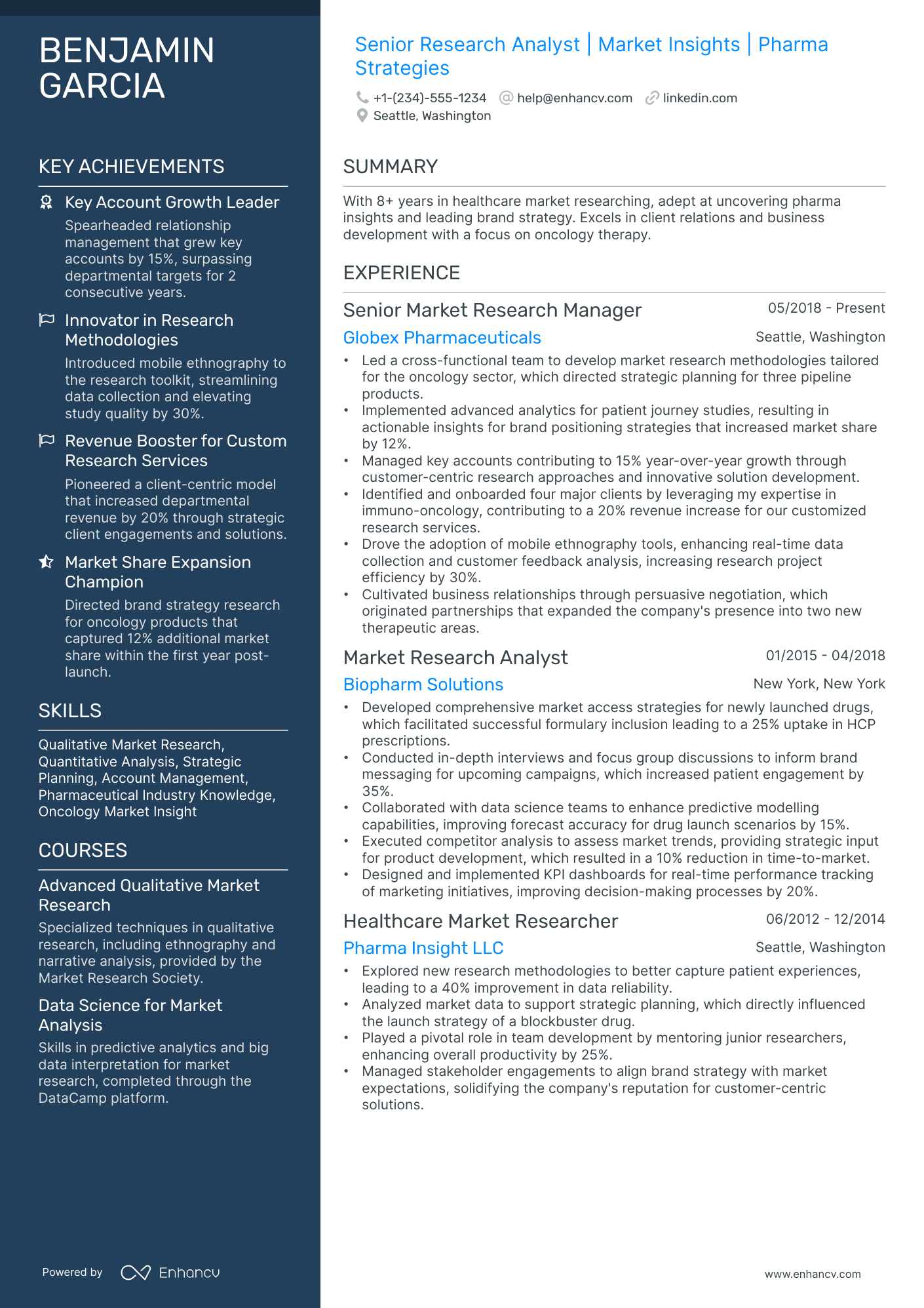
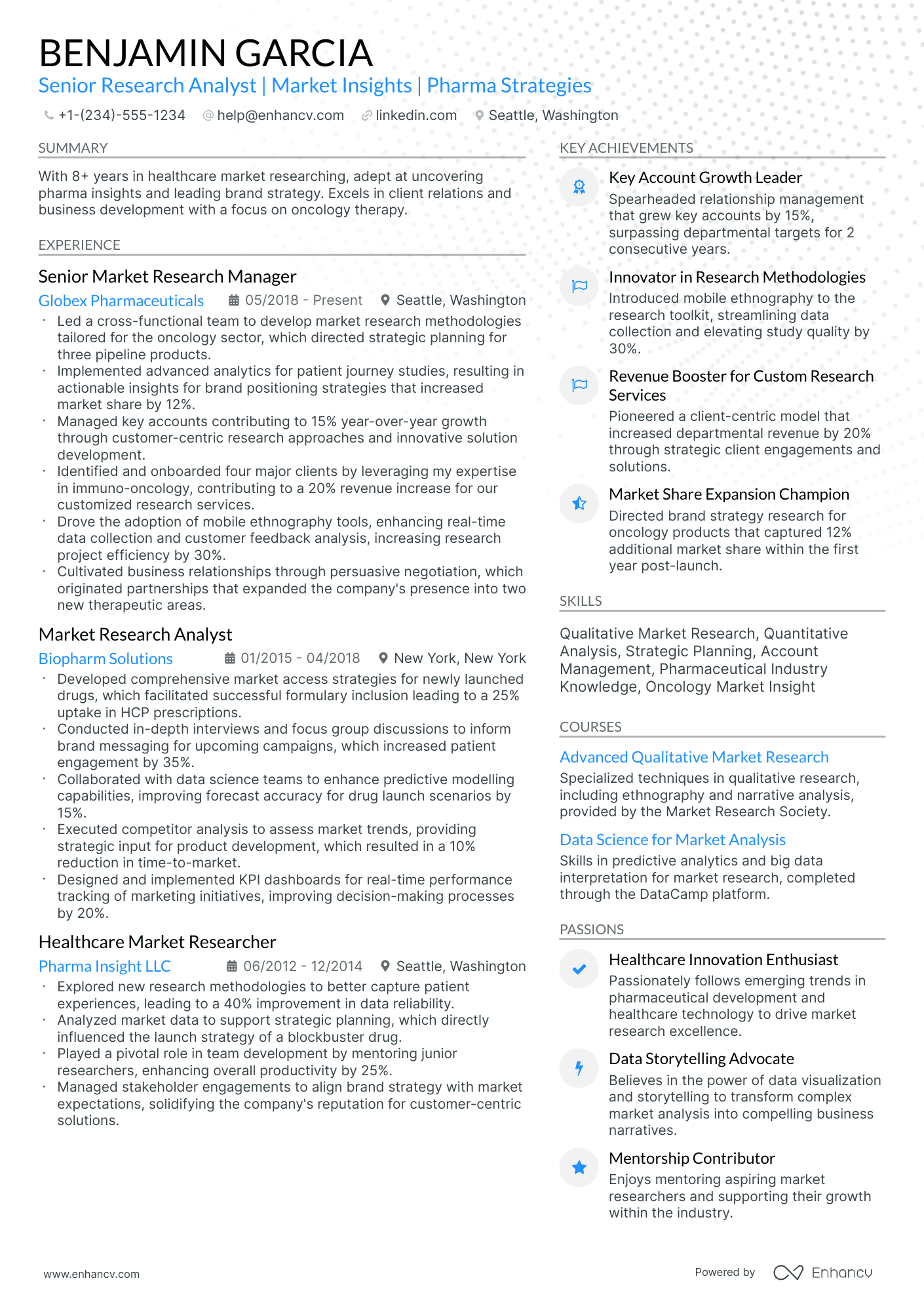
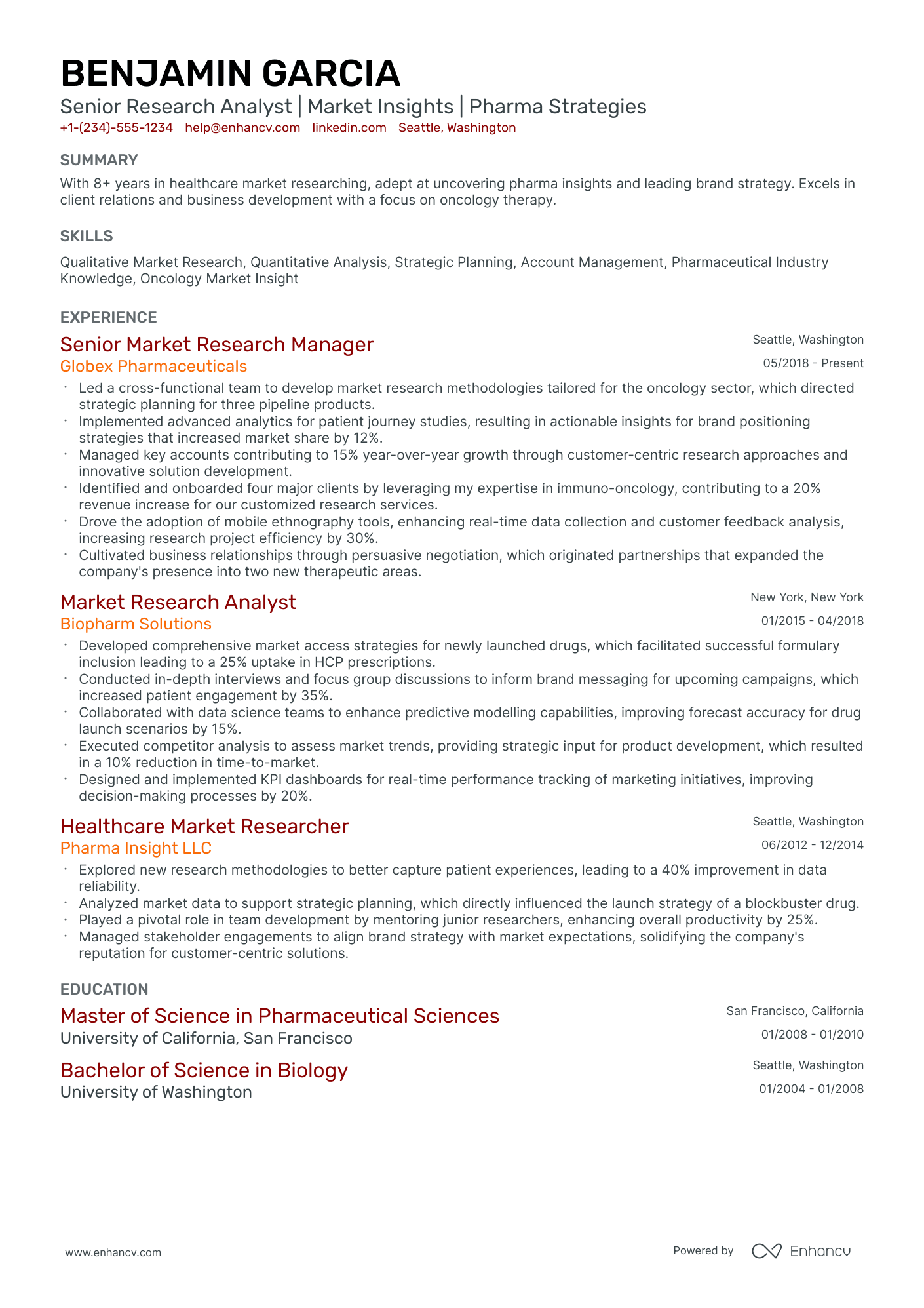
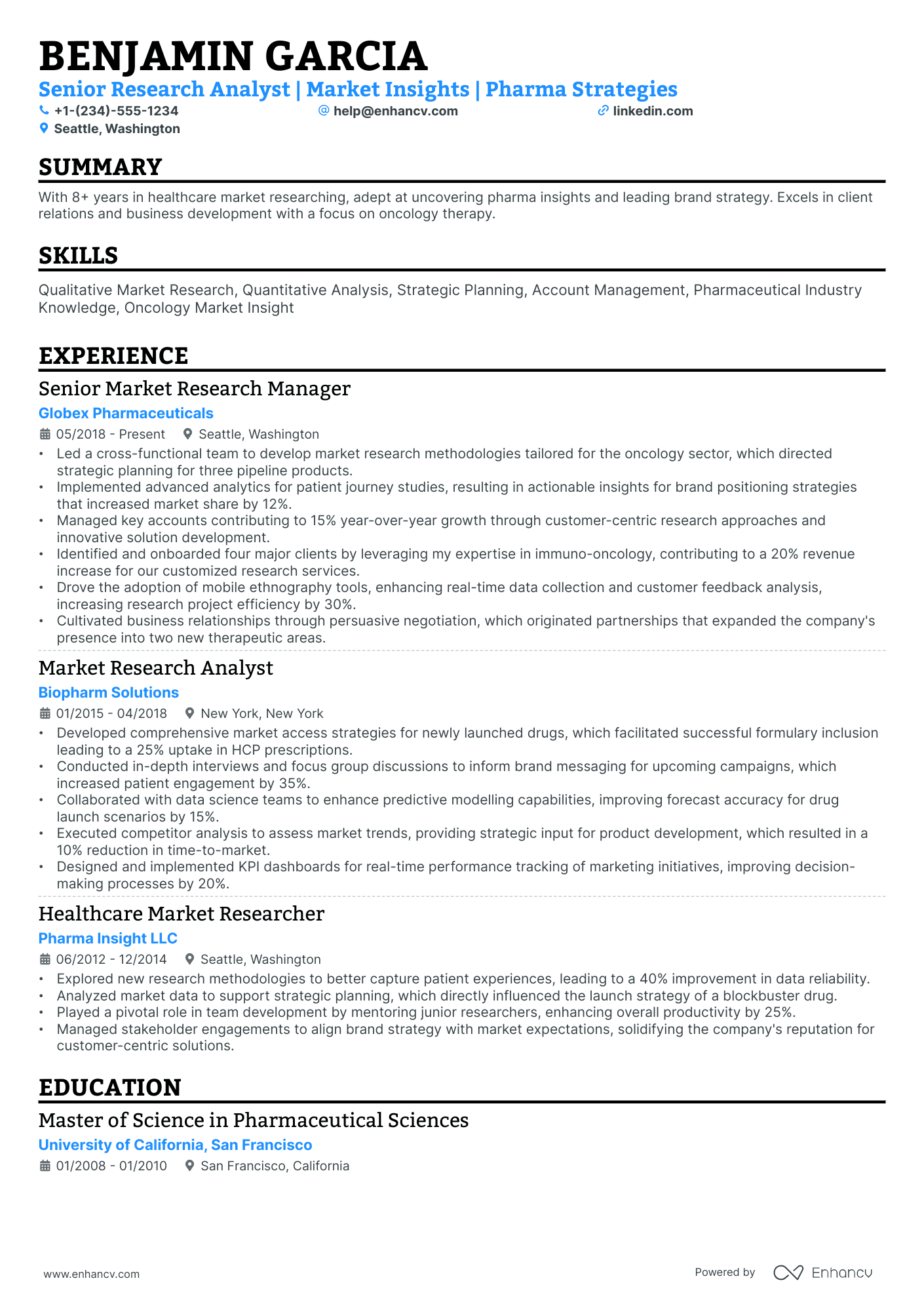
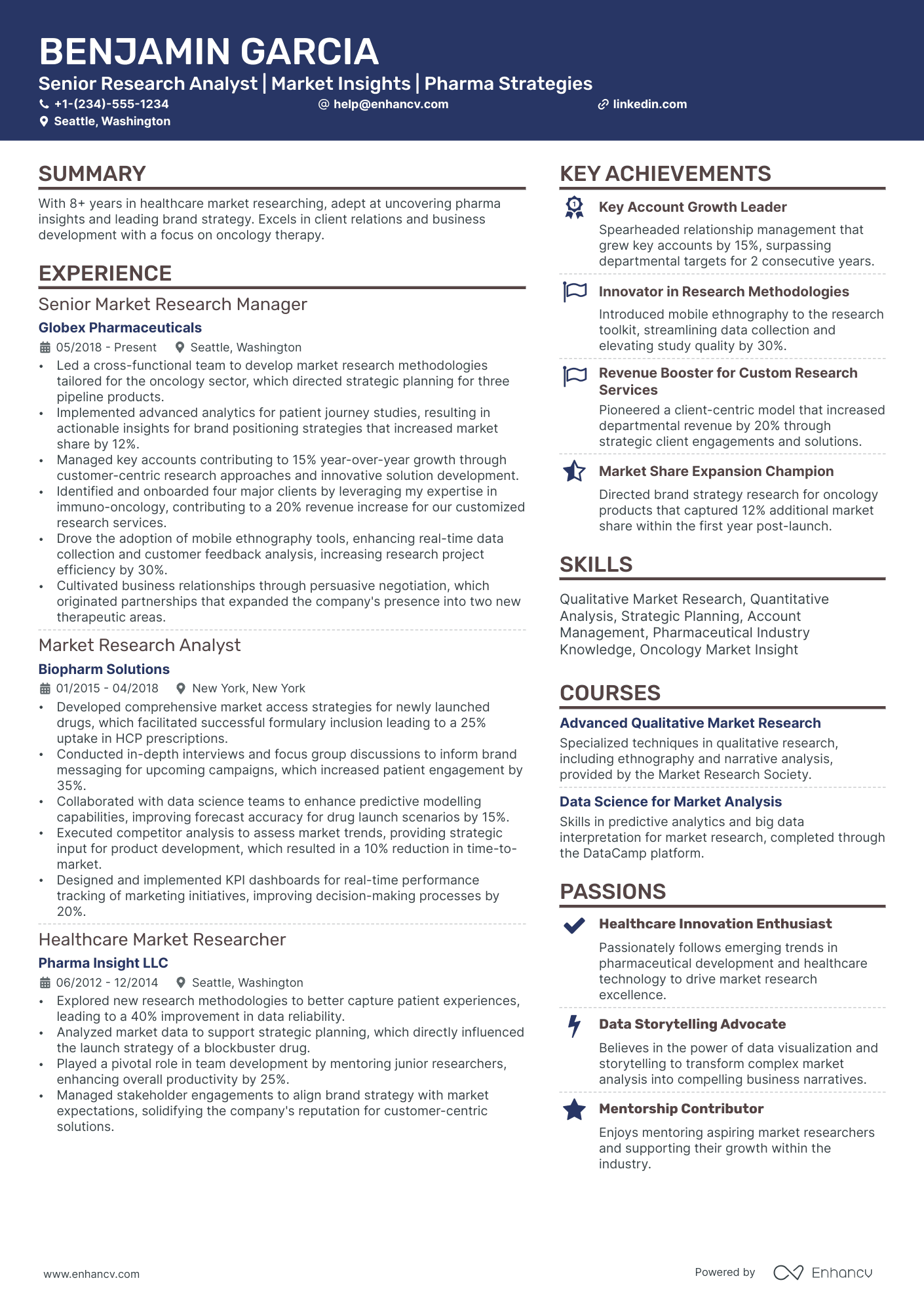
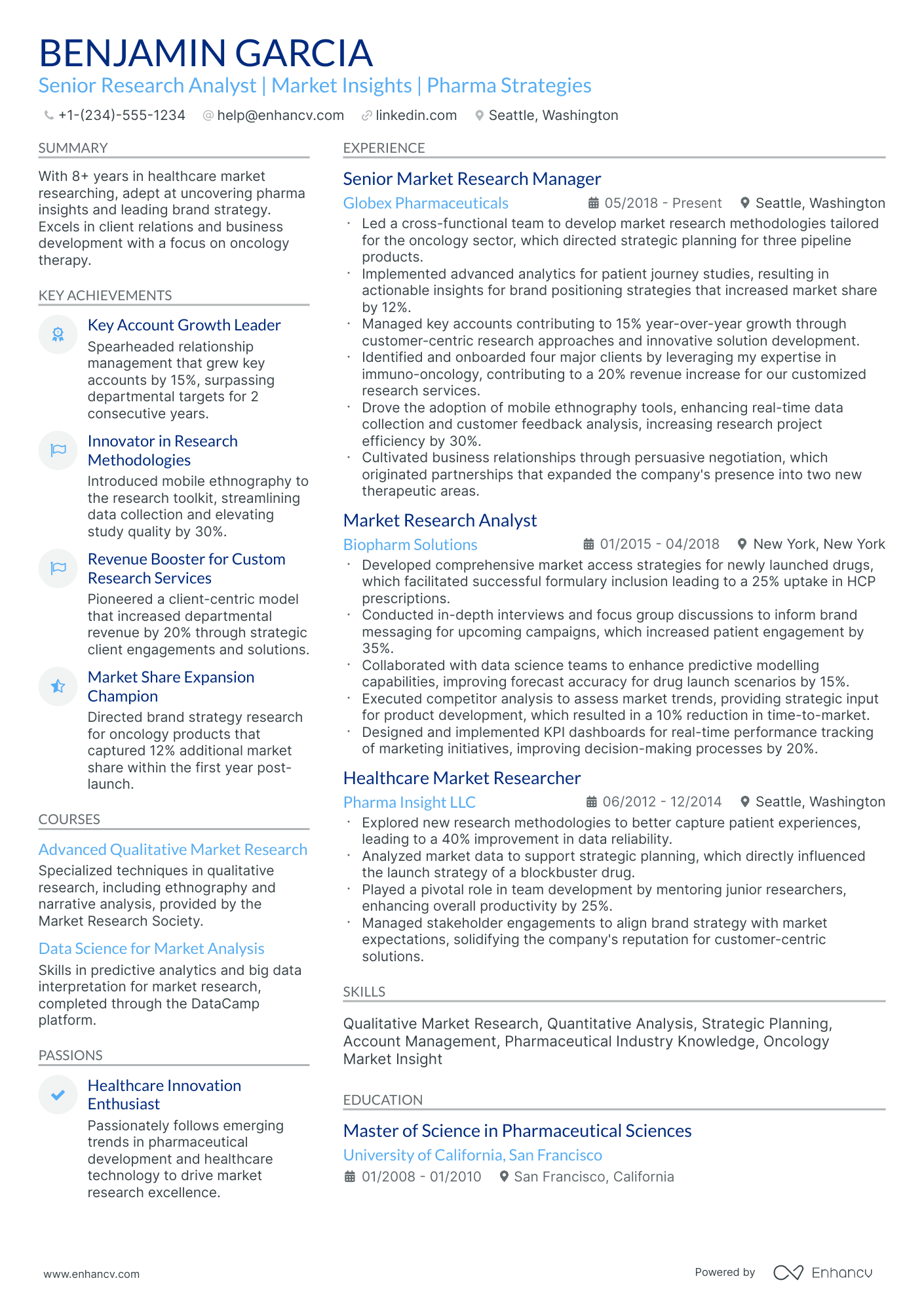
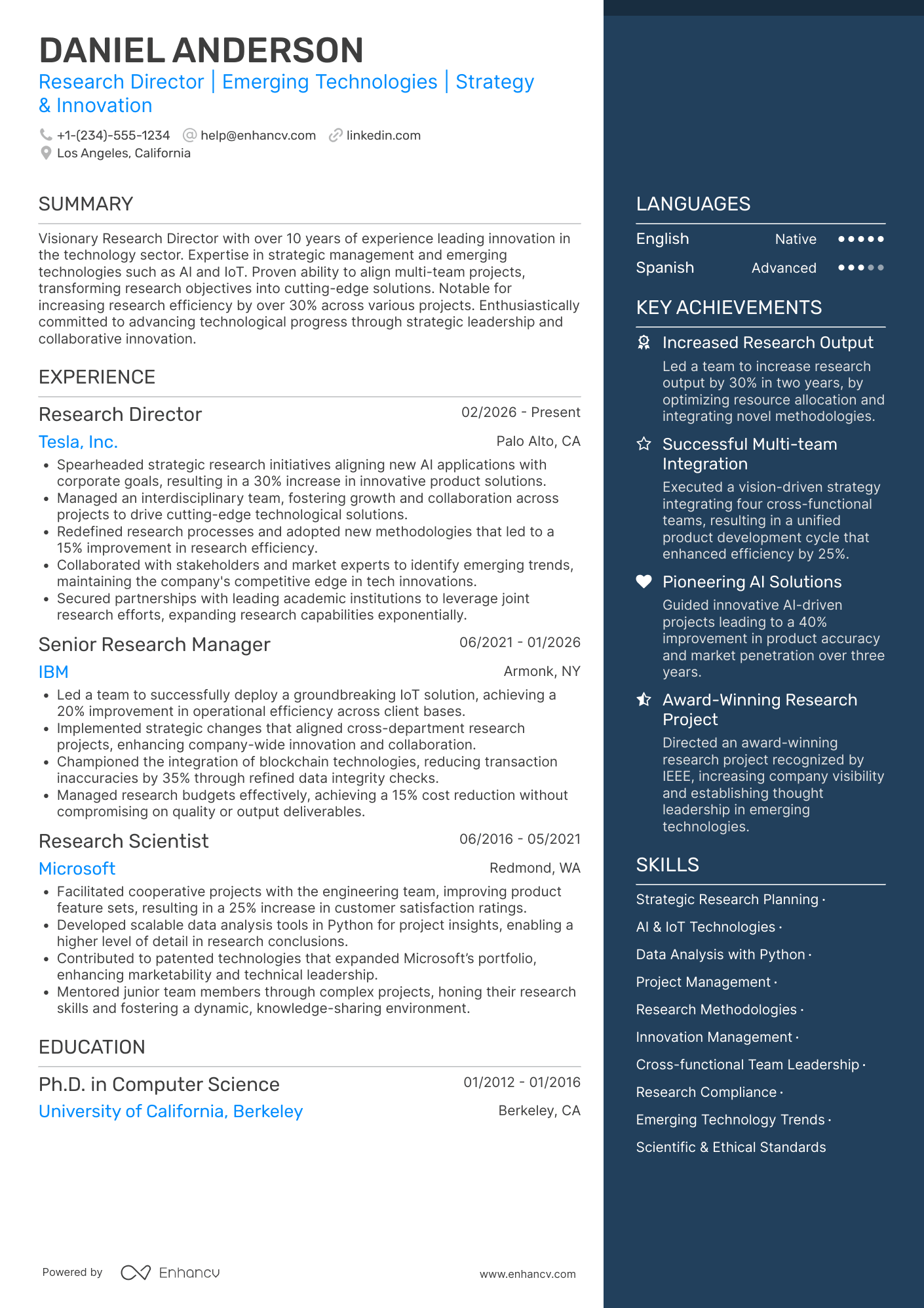
Many research director resumes fail because they read like project logs, not leadership narratives. This research director resume must prove strategic influence fast, since ATS filters and recruiters scan in seconds in a crowded market.
A strong resume shows outcomes and decision impact, not tools or task lists. Understanding how to make your resume stand out starts with highlighting funding won, portfolio size, time-to-insight improvements, on-time delivery rates, publication or patent impact, and measurable business results tied to research.

Key takeaways
- Use reverse-chronological format to showcase progressive research leadership and career trajectory.
- Anchor every experience bullet to a measurable outcome, not a task description.
- Tailor resume language to mirror each job posting's terminology, methods, and priorities.
- Quantify achievements using metrics like funding secured, cycle time reduced, or adoption rates improved.
- Demonstrate skills in context through your summary and experience, not just a standalone list.
- Pair your resume with a cover letter when fit, influence, or career transitions need explanation.
- Use Enhancv's tools to sharpen bullet points and align your resume with role-specific expectations.
Job market snapshot for research directors
We analyzed 51 recent research director job ads across major US job boards. These numbers help you understand regional hotspots, industry demand, career growth patterns at a glance.
What level of experience employers are looking for research directors
| Years of Experience | Percentage found in job ads |
|---|---|
| 1–2 years | 9.8% (5) |
| 3–4 years | 5.9% (3) |
| 5–6 years | 2.0% (1) |
| 7–8 years | 2.0% (1) |
| 9–10 years | 3.9% (2) |
| 10+ years | 3.9% (2) |
| Not specified | 76.5% (39) |
Research director ads by area of specialization (industry)
| Industry (Area) | Percentage found in job ads |
|---|---|
| Retail & E-commerce | 51.0% (26) |
| Healthcare | 21.6% (11) |
Top companies hiring research directors
| Company | Percentage found in job ads |
|---|---|
| Savills plc | 51.0% (26) |
| Sanofi | 19.6% (10) |
Role overview stats
These tables show the most common responsibilities and employment types for research director roles. Use them to align your resume with what employers expect and to understand how the role is structured across the market.
Day-to-day activities and top responsibilities for a research director
| Responsibility | Percentage found in job ads |
|---|---|
| Data visualization | 54.9% (28) |
| Costar | 52.9% (27) |
| Ai tools | 51.0% (26) |
| Automation | 51.0% (26) |
| Internet research | 51.0% (26) |
| Microsoft office | 51.0% (26) |
| Analytics | 41.2% (21) |
| Clinical pharmacology | 11.8% (6) |
| Analytical software | 9.8% (5) |
| Clinical research | 9.8% (5) |
| Clinical development | 7.8% (4) |
| Presentation software | 7.8% (4) |
How to format a research director resume
Recruiters evaluating research director candidates prioritize evidence of strategic leadership, portfolio-level research oversight, and measurable organizational impact. A well-chosen resume format ensures these signals are immediately visible rather than buried beneath skills lists or non-linear sections that obscure your career trajectory.

I have significant experience in this role—which format should I use?
Use a reverse-chronological format—it's the strongest choice for a research director resume. Do:
- Lead each role entry with your scope and ownership: team size, budget authority, number of concurrent research programs, and reporting structure.
- Highlight domain expertise and tools relevant to research leadership, such as research methodology design, IRB oversight, grant management platforms, statistical software suites, and cross-functional stakeholder engagement.
- Anchor every accomplishment to measurable outcomes or business impact, including revenue influence, publication output, funding secured, or time-to-insight improvements.
Why hybrid and functional resumes don't work for senior roles
Hybrid and functional formats fragment your leadership narrative by pulling skills and competencies out of the roles where you demonstrated them, which obscures career progression and dilutes the accountability context that hiring committees expect from a research director. These formats make it difficult for reviewers to assess decision ownership, the scale of teams and budgets you managed, or how your strategic impact grew over time. Avoid hybrid and functional formats entirely if you have a consistent track record of progressive research leadership—they will raise more questions than they answer.
- Edge-case exception: A functional format may be acceptable only if you're transitioning into research leadership from a parallel discipline (such as moving from a chief scientist role in industry to an academic research director position), you have a significant career gap, or your experience spans highly fragmented contract engagements—but even then, every listed skill must be tied directly to specific projects and quantified outcomes.
Now that you've established a clean, readable layout, it's time to fill it with the right sections that highlight your qualifications as a research director.
What sections should go on a research director resume
Recruiters expect to see clear evidence that you lead research strategy, deliver measurable outcomes, and influence executive decisions. Knowing what to put on a resume at the director level is critical for making every section count.
Use this structure for maximum clarity:
- Header
- Summary
- Experience
- Skills
- Projects
- Education
- Certifications
- Optional sections: Publications, Awards, Leadership
Your experience bullets should emphasize research impact, business outcomes, scope of ownership, stakeholder influence, and measurable results.
Is your resume good enough?
Drop your resume here or choose a file. PDF & DOCX only. Max 2MB file size.
Once you’ve organized your resume with the right core components, the next step is to write your research director experience in a way that fits that structure and supports your qualifications.
How to write your research director resume experience
The experience section is where you prove you've led research initiatives from concept through delivery—showcasing the methodologies you've deployed, the teams you've built, and the measurable outcomes your work produced. Hiring managers reviewing research director candidates prioritize demonstrated impact over descriptive task lists, so every bullet should connect your leadership to a tangible result. Writing a targeted resume ensures each entry speaks directly to what the hiring team values most.
Each entry should include:
- Job title
- Company and location (or remote)
- Dates of employment (month and year)
Three to five concise bullet points showing what you owned, how you executed, and what outcomes you delivered:
- Ownership scope: the research programs, portfolios, laboratories, teams, or strategic agendas you were directly accountable for as a research director.
- Execution approach: the research methodologies, analytical frameworks, data platforms, or investigative techniques you used to guide decisions and advance discoveries or insights.
- Value improved: changes to research quality, knowledge output, innovation pipeline speed, funding success rates, data reliability, or organizational risk that your leadership drove.
- Collaboration context: how you partnered with executive leadership, product teams, funding bodies, academic institutions, regulatory agencies, or cross-functional stakeholders to align research priorities with broader goals.
- Impact delivered: outcomes framed through published findings, secured grants, adopted recommendations, expanded research capacity, or strategic influence on organizational direction—expressed as results rather than activities.
Experience bullet formula
A research director experience example
✅ Right example - modern, quantified, specific.
Research Director, Customer Insights
Aurora HealthTech | Remote
2021–Present
Series C digital health platform serving 4M+ patients and 15K+ clinicians across the US.
- Led a mixed-methods research program across eight product pods using Qualtrics, UserTesting, Dovetail, and Jira, cutting discovery-to-decision time by 35% and improving on-time roadmap delivery by 18%.
- Built and governed an enterprise research repository in Dovetail with standardized taxonomy, templates, and consent workflows, increasing study reuse by 42% and reducing duplicate research spend by $280K annually.
- Partnered with product managers, designers, and data scientists to triangulate Amplitude event data, Snowflake queries, and diary study findings, driving a navigation redesign that lifted task completion by 14% and reduced support tickets by 11%.
- Directed a longitudinal clinician panel (n=600) and quarterly brand tracker using Qualtrics and Tableau, improving Net Promoter Score by nine points and informing a pricing change that increased annual recurring revenue by 6%.
- Established research quality and compliance controls—Institutional Review Board vendor process, Health Insurance Portability and Accountability Act-safe recruitment, and redaction standards—reducing privacy incidents to zero and accelerating legal approvals by 25%.
Now that you've seen how a strong experience section comes together, let's look at how to adjust yours to match the specific role you're targeting.
How to tailor your research director resume experience
Recruiters evaluate research director resumes through both human review and applicant tracking systems, so tailoring your resume to the job description increases your chances of advancing. Tailoring means reshaping how you present your work to reflect the employer's stated priorities.
Ways to tailor your research director experience:
- Match specific research methodologies or analytical frameworks named in the posting.
- Mirror the exact terminology used for grant funding or proposal processes.
- Reflect domain expertise in the industry or scientific discipline specified.
- Highlight experience with research tools or data platforms the role requires.
- Emphasize team leadership structures or cross-functional collaboration models referenced.
- Align your outcomes with the KPIs or success criteria they describe.
- Include regulatory compliance or institutional review standards when mentioned.
- Showcase publication or dissemination channels relevant to their research goals.
Tailoring is about framing your real accomplishments to match what the employer values, not forcing keywords where they don't belong.
Resume tailoring examples for research director
| Job description excerpt | Untailored | Tailored |
|---|---|---|
| "Lead a team of 15+ scientists in designing and executing multi-phase clinical research programs across oncology therapeutic areas, ensuring compliance with FDA regulatory standards." | Managed a research team and oversaw various scientific projects. | Directed a cross-functional team of 18 scientists through three concurrent Phase II–III oncology clinical trials, maintaining full FDA regulatory compliance and advancing two compounds to NDA submission. |
| "Develop and manage an annual R&D budget of $10M+, allocating resources across translational research, biomarker discovery, and computational biology initiatives." | Responsible for department budgeting and resource planning. | Managed a $12M annual R&D budget, strategically allocating funding across translational research, biomarker discovery, and computational biology—reducing cost overruns by 14% while accelerating two pipeline programs by six months. |
| "Build partnerships with academic institutions and CROs to expand the organization's real-world evidence (RWE) capabilities using electronic health record (EHR) data and advanced statistical modeling." | Collaborated with external partners on data-driven research efforts. | Established research partnerships with four academic medical centers and two CROs, integrating EHR datasets from 1.2M patient records into real-world evidence studies using Cox regression and propensity score matching to support post-market label expansion. |
Once you’ve aligned your experience with the role’s priorities, the next step is to quantify your research director achievements so hiring teams can see the scope and impact of your work.
How to quantify your research director achievements
Quantifying your achievements proves your research changed decisions, reduced risk, or improved outcomes. Focus on cycle time, study quality, adoption of insights, budget efficiency, and business impact tied to launches, retention, or revenue.
Quantifying examples for research director
| Metric | Example |
|---|---|
| Cycle time | "Cut end-to-end study cycle time from 6 weeks to 4 weeks by standardizing scripts in Dovetail and automating recruitment via User Interviews." |
| Research quality | "Raised insight validation rate from 62% to 81% by adding a two-stage synthesis review and triangulating surveys, interviews, and product analytics." |
| Adoption | "Increased product teams acting on research recommendations from 45% to 70% by launching a quarterly insights roadmap and tracking follow-through in Jira." |
| Budget efficiency | "Reduced annual research spend by 18% ($140K) by consolidating vendors, renegotiating panel rates, and shifting three studies to in-house moderation." |
| Risk reduction | "Prevented two high-risk releases by flagging accessibility failures, cutting reported severity-one issues post-launch by 35% across three product areas." |
Turn vague job tasks into measurable, recruiter-ready resume bullets in seconds with Enhancv's Bullet Point Generator.
Once you've crafted strong bullet points that highlight your achievements, the next step is ensuring your resume also effectively showcases the specific hard and soft skills that research director roles demand.
How to list your hard and soft skills on a research director resume
Your skills section matters because it shows how you lead research strategy and execution, and recruiters and ATS scan this section for role keywords and tool fit, so aim for a balanced mix of hard skills and soft skills.
research director roles require a blend of:
- Product strategy and discovery skills.
- Data, analytics, and experimentation skills.
- Delivery, execution, and go-to-market discipline.
- Soft skills.
Your skills section should be:
- Scannable (bullet-style grouping).
- Relevant to the job post.
- Backed by proof in experience bullets.
- Updated with current tools.
Place your skills section:
- Above experience if you're junior or switching careers.
- Below experience if you're mid/senior with strong achievements.

Hard skills
- Research strategy and roadmap
- Mixed-methods research design
- Quantitative survey research
- Qualitative interviews, field studies
- Usability testing and benchmarking
- Experimental design, A/B testing
- Statistical analysis, regression
- SQL, BigQuery, Snowflake
- Tableau, Looker, Power BI
- Dovetail, UserTesting, Qualtrics
- Segmentation and persona development
- GDPR and research compliance
Soft skills
- Align stakeholders on priorities
- Turn insights into decisions
- Influence without direct authority
- Lead cross-functional workshops
- Executive-ready storytelling
- Challenge assumptions with evidence
- Set clear research standards
- Coach and develop researchers
- Manage up and across teams
- Drive focus under ambiguity
- Negotiate scope and timelines
- Build trust with partners
How to show your research director skills in context
Skills shouldn't live only in a bulleted list on your resume. Explore resume skills examples to see how top candidates weave competencies into their narratives.
They should be demonstrated in:
- Your summary (high-level professional identity)
- Your experience (proof through outcomes)
Here's what this looks like in practice.
Summary example
Research director with 15 years in clinical pharmacology, leading cross-functional teams through FDA-regulated trials using SAS, SPSS, and adaptive designs. Reduced average trial cycle time by 22% while maintaining full regulatory compliance.
- Signals senior-level expertise immediately
- Names specific tools and methods
- Quantifies a concrete operational outcome
- Highlights leadership as a soft skill
Experience example
Research Director
Astellion Therapeutics | Boston, MA
March 2018–Present
- Directed a 40-person interdisciplinary team across three Phase III oncology trials, cutting enrollment timelines by 30% using predictive analytics in SAS.
- Partnered with biostatistics, regulatory affairs, and external CROs to redesign data collection protocols, reducing query rates by 45%.
- Implemented mixed-methods research frameworks in SPSS and NVivo, producing findings that secured $12M in continued grant funding.
- Every bullet includes measurable proof
- Skills surface naturally through real outcomes
Once you’ve grounded your research director strengths in concrete outcomes and scope, the next step is learning how to write a research director resume with no experience so you can present that evidence without relying on prior job titles.
How do I write a research director resume with no experience
Even without full-time experience, you can demonstrate readiness through transferable projects and academic work. Our guide on writing a resume without work experience covers strategies that apply directly to aspiring research directors.
- Graduate thesis with applied research.
- Independent market research portfolio projects.
- Research assistantship leading multi-study workflows.
- Published papers or conference posters.
- Consulting practicum for real clients.
- Institutional review board-approved human research.
- Grant writing and funded proposals.
- Cross-functional capstone with stakeholders.
Focus on:
- End-to-end study leadership evidence.
- Methods rigor and governance compliance.
- Measurable impact on decisions.
- Tools: SQL, R, Tableau.
Resume format tip for entry-level research director
Use a combination resume format. It highlights research outcomes and methods first, while still showing relevant roles, projects, and education. Do:
- Lead with a "Research leadership projects" section.
- Use action verbs and metrics per bullet.
- List methods: surveys, experiments, qualitative coding.
- Name tools used: SQL, R, Tableau.
- Add governance: institutional review board, consent.
- Led an institutional review board-approved survey study in Qualtrics, analyzed in R and SQL, and delivered a Tableau dashboard that cut reporting time 30%.
Even without direct experience, your academic background can serve as a strong foundation for your candidacy, making how you present your education a critical next step.
How to list your education on a research director resume
Your education section helps hiring teams confirm you hold the academic credentials expected of a research director. It validates expertise in methodology, analysis, and domain-specific knowledge.
Include:
- Degree name
- Institution
- Location
- Graduation year
- Relevant coursework (for juniors or entry-level candidates)
- Honors & GPA (if 3.5 or higher)
List your graduation year only. Avoid adding specific months or days to keep the format clean.
Here's a strong education entry tailored for a research director resume.
Example education entry
Ph.D. in Applied Statistics
Columbia University, New York, NY
Graduated 2016
GPA: 3.8/4.0
- Relevant coursework: Advanced Multivariate Analysis, Experimental Design, Quantitative Research Methods, Bayesian Inference
- Honors: Recipient of the Dean's Award for Distinguished Doctoral Research
How to list your certifications on a research director resume
Certifications show a research director's commitment to continuous learning, proficiency with modern tools, and alignment with industry standards that shape credible, data-driven research leadership.
Include:
- Certificate name
- Issuing organization
- Year
- Optional: credential ID or URL
- Place certifications below education when your education is recent and your certifications provide supporting skills rather than core qualifications.
- Place certifications above education when they are recent, highly relevant to your research director role, or required for the industry you target.
Best certifications for your research director resume
Project Management Professional (PMP) Certified Market Research Professional (CMRP) Professional Researcher Certification (PRC) Lean Six Sigma Black Belt Certified Analytics Professional (CAP) Tableau Desktop Specialist Google Data Analytics Professional Certificate
Once you’ve positioned your certifications to reinforce your qualifications, shift to your research director resume summary to tie those credentials to your value in a clear, high-impact opening.
How to write your research director resume summary
Your resume summary is the first thing a recruiter reads. A strong one instantly signals you have the leadership depth and strategic vision a research director role demands.
Keep it to three to four lines, with:
- Your title and total years of research leadership experience.
- The domain, industry, or product area you specialize in.
- Core methodologies, platforms, or technical competencies you bring.
- One or two quantified achievements that reflect organizational impact.
- Soft skills tied to real outcomes, such as cross-functional alignment or stakeholder influence.

PRO TIP
At the director level, lead with outcomes, scope, and strategic ownership. Highlight how your decisions shaped research agendas, secured funding, or drove measurable business results. Avoid generic descriptors like "passionate" or "motivated self-starter." Recruiters want evidence of influence, not enthusiasm.
Example summary for a research director
Research director with 12+ years leading mixed-methods teams across healthcare and consumer technology. Directed a 15-person research organization, delivering insights that reduced product development cycles by 30% and informed a $40M portfolio strategy.
Optimize your resume summary and objective for ATS
Drop your resume here or choose a file.
PDF & DOCX only. Max 2MB file size.
Now that your summary captures the strategic value you bring, make sure the header framing it presents your contact details and professional identity with equal precision.
What to include in a research director resume header
A well-structured resume header lists your key identity and contact details, helping a research director stand out in recruiter screening through clear visibility and credibility.
Essential resume header elements
- Full name
- Tailored job title and headline
- Location
- Phone number
- Professional email
- GitHub link
- Portfolio link
A LinkedIn link helps recruiters verify experience quickly and supports screening with consistent titles, dates, and scope.
Do not include photos on a research director resume unless the role is explicitly front-facing or appearance-dependent.
Match your header keywords to the research director job description and keep formatting consistent so applicant tracking systems parse details correctly.
Example
Research director resume header
Morgan Lee
Research Director | Mixed-Methods Research, Strategy, and Team Leadership
Boston, MA
(617) 555-01XX
morgan.lee@enhancv.com
github.com/morganlee
morganlee.com
linkedin.com/in/morganlee
Once your header clearly identifies you and your role at a glance, add targeted additional sections to reinforce key qualifications and support the details in your resume.
Additional sections for research director resumes
When your core qualifications align closely with other candidates, well-chosen additional sections can establish deeper credibility and set you apart.
- Publications and peer-reviewed research
- Conference presentations and keynote speaking
- Editorial board memberships
- Research grants and funded projects
- Professional affiliations and scientific societies
- Languages
- Patents and intellectual property
Once you've rounded out your resume with relevant additional sections, it's worth ensuring you pair it with a strong cover letter to maximize your application's impact.
Do research director resumes need a cover letter
A cover letter isn't required for a research director, but it often helps in competitive searches or when hiring teams expect one. If you're unfamiliar with the format, learn what a cover letter is and how it complements your resume. It can make a difference when your resume needs context, or when fit and influence matter as much as methods.
Use a cover letter to add detail your resume can't show:
- Explain role and team fit: Connect your leadership style to the org's research maturity, cross-functional partners, and decision-making cadence.
- Highlight one or two relevant projects or outcomes: Name the problem, your approach, and the measurable impact on product direction, revenue, or risk.
- Show understanding of the product, users, or business context: Reference the company's users, market, and constraints, and how research director work supports them.
- Address career transitions or non-obvious experience: Clarify why your background fits a research director role, and map past scope to the new expectations.
Drop your resume here or choose a file.
PDF & DOCX only. Max 2MB file size.
After you decide whether a cover letter adds value to your application, using AI to improve your research director resume helps you sharpen the document recruiters and hiring managers review first.
Using AI to improve your research director resume
AI can sharpen your resume's clarity, structure, and impact. It helps tighten language and highlight measurable results. But overuse strips authenticity. Once your content feels clear and role-aligned, step away from AI. For specific prompt ideas, explore our guide on ChatGPT resume writing prompts.
Here are 10 practical prompts to strengthen specific sections of your research director resume:
Strengthen your summary
Quantify experience bullets
Tighten action verbs
Align skills strategically
Clarify project impact
Refine education details
Improve certification relevance
Remove filler language
Tailor to job posting
Sharpen leadership framing
Conclusion
A strong research director resume highlights measurable outcomes, role-specific skills, and a clear structure. It shows impact through metrics like funded dollars, publications, timelines, cost savings, and team performance. It stays easy to scan, with focused sections and consistent formatting.
This approach signals readiness for today’s hiring market and near-future expectations. It proves you can set strategy, lead cross-functional teams, manage budgets, and deliver reliable results. Keep every line relevant, and let your outcomes speak first.