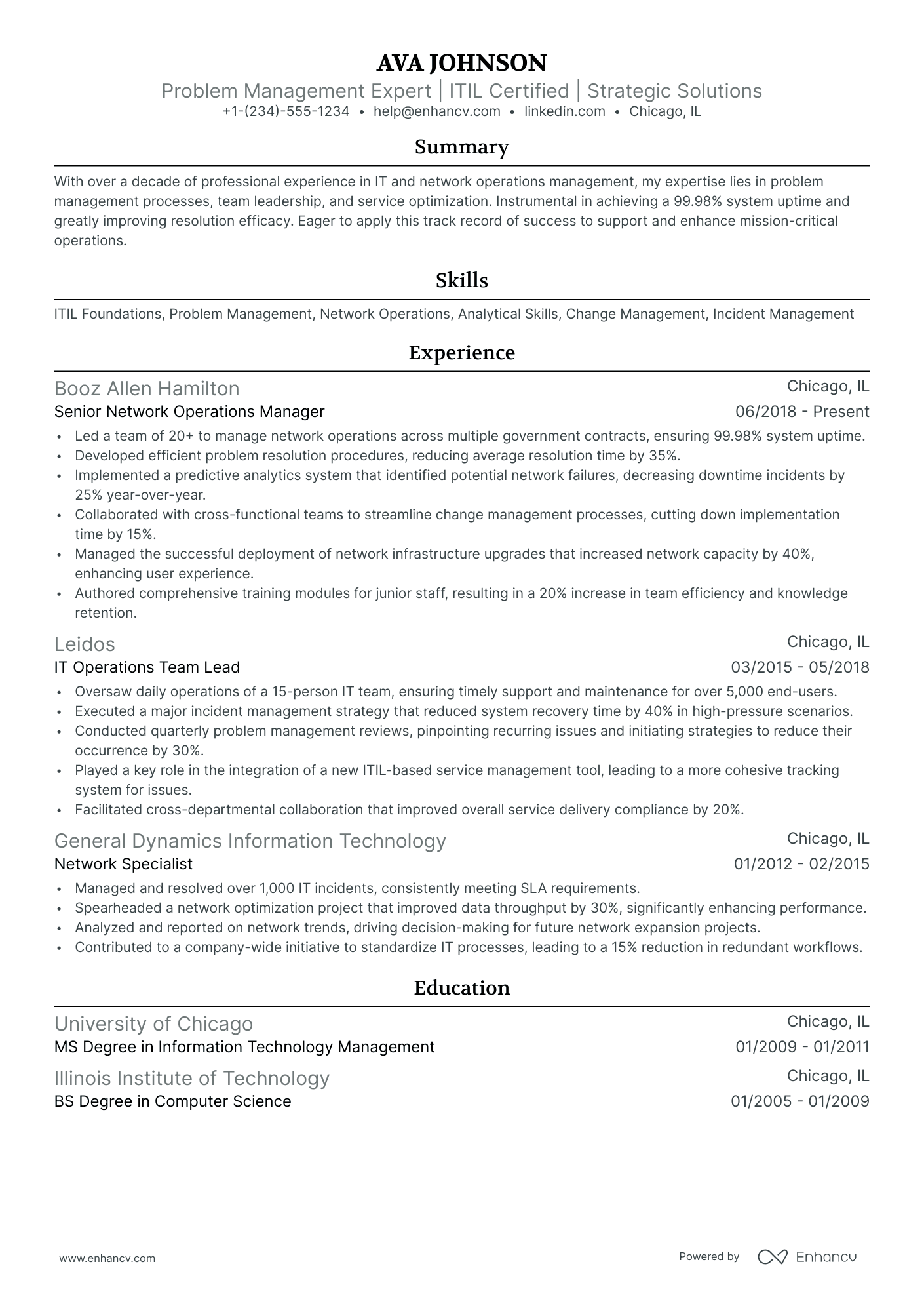
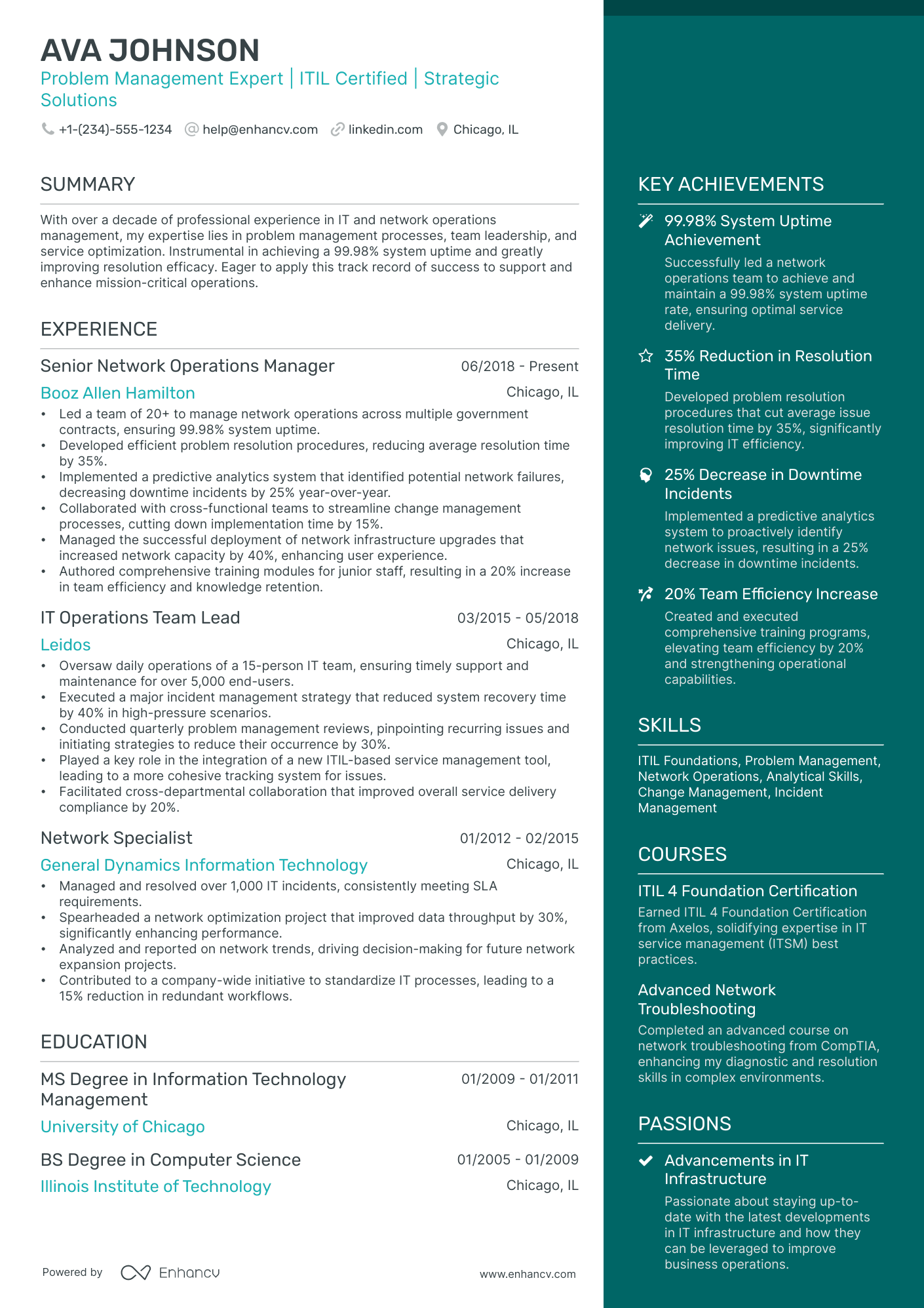
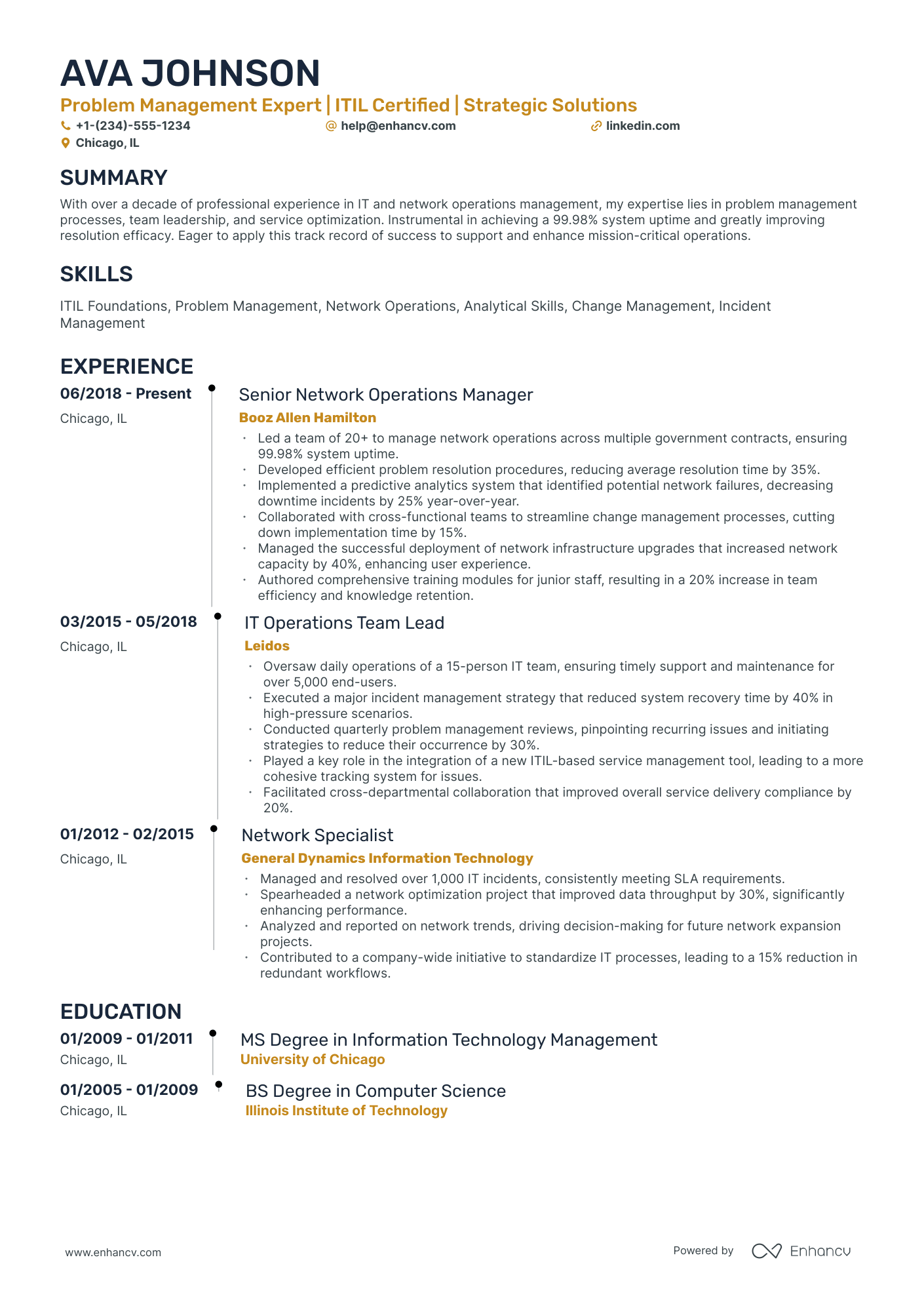
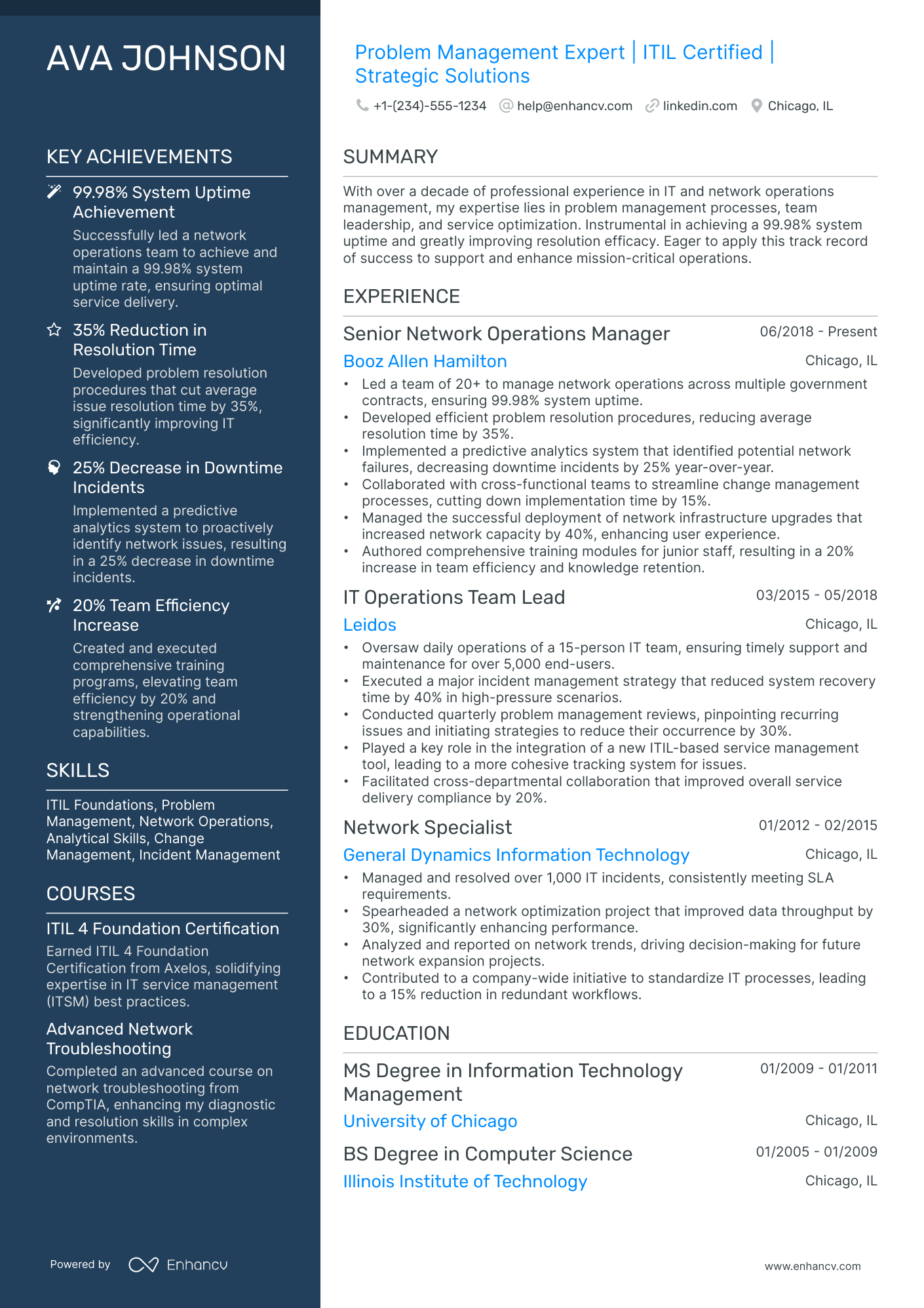
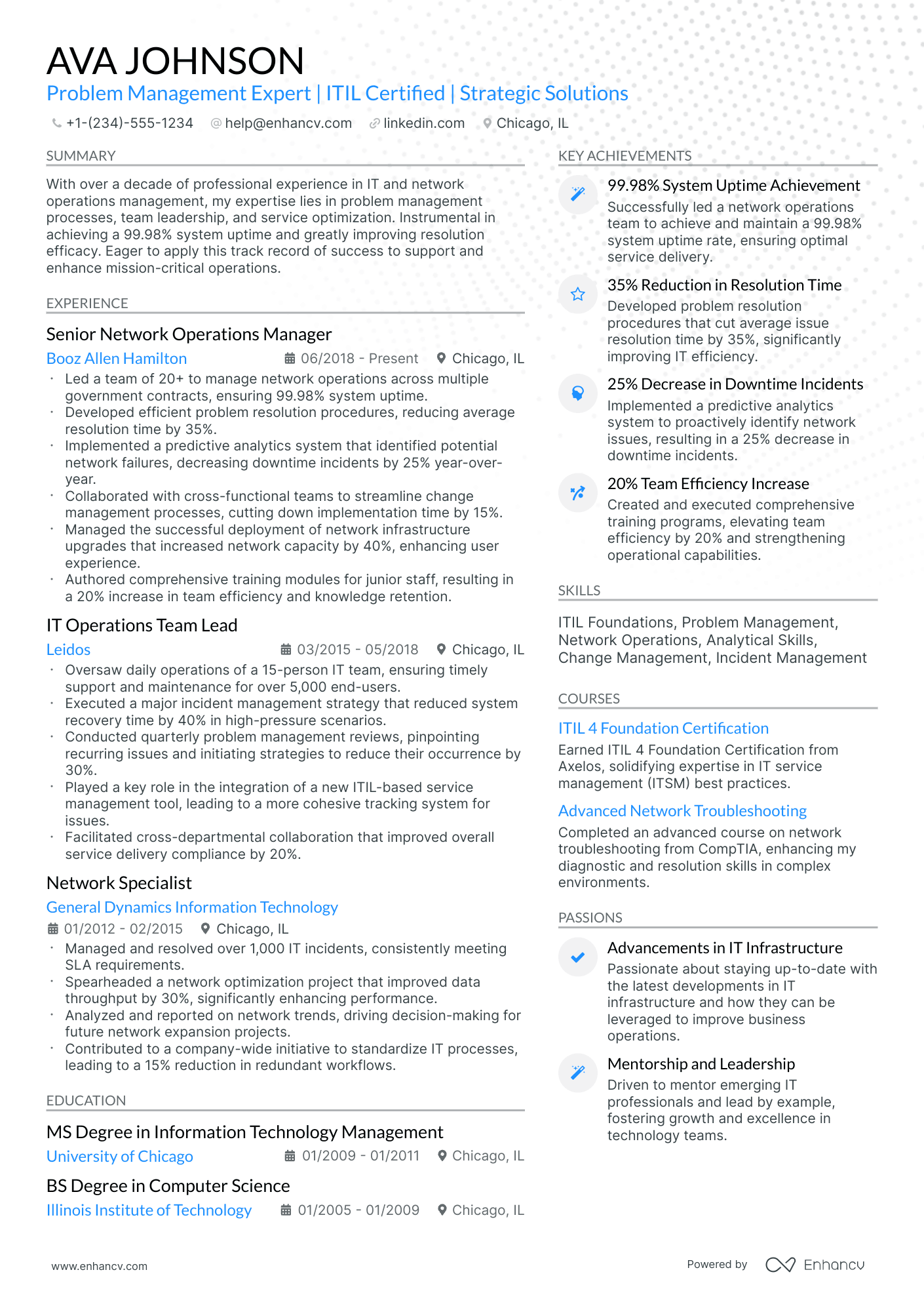
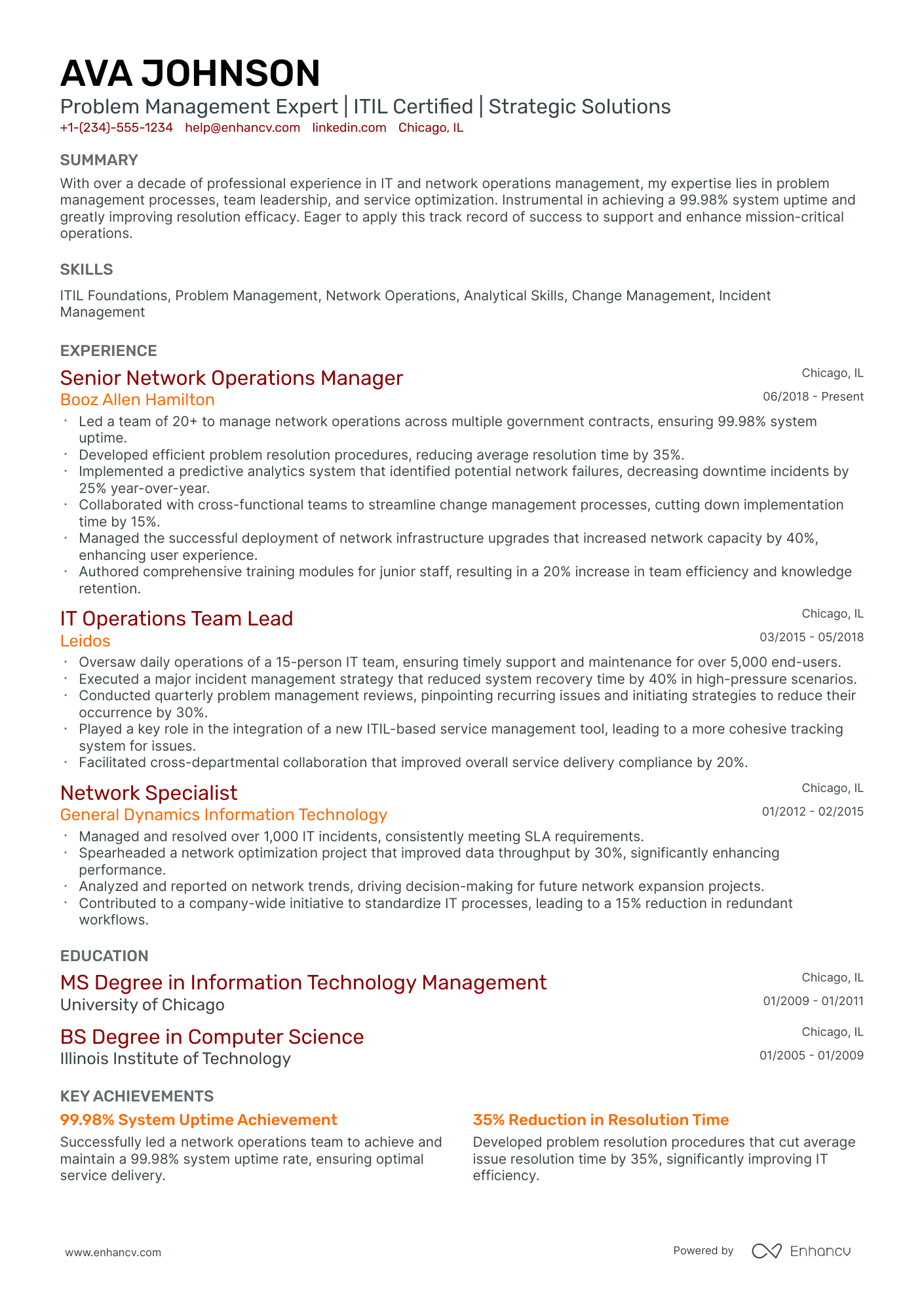
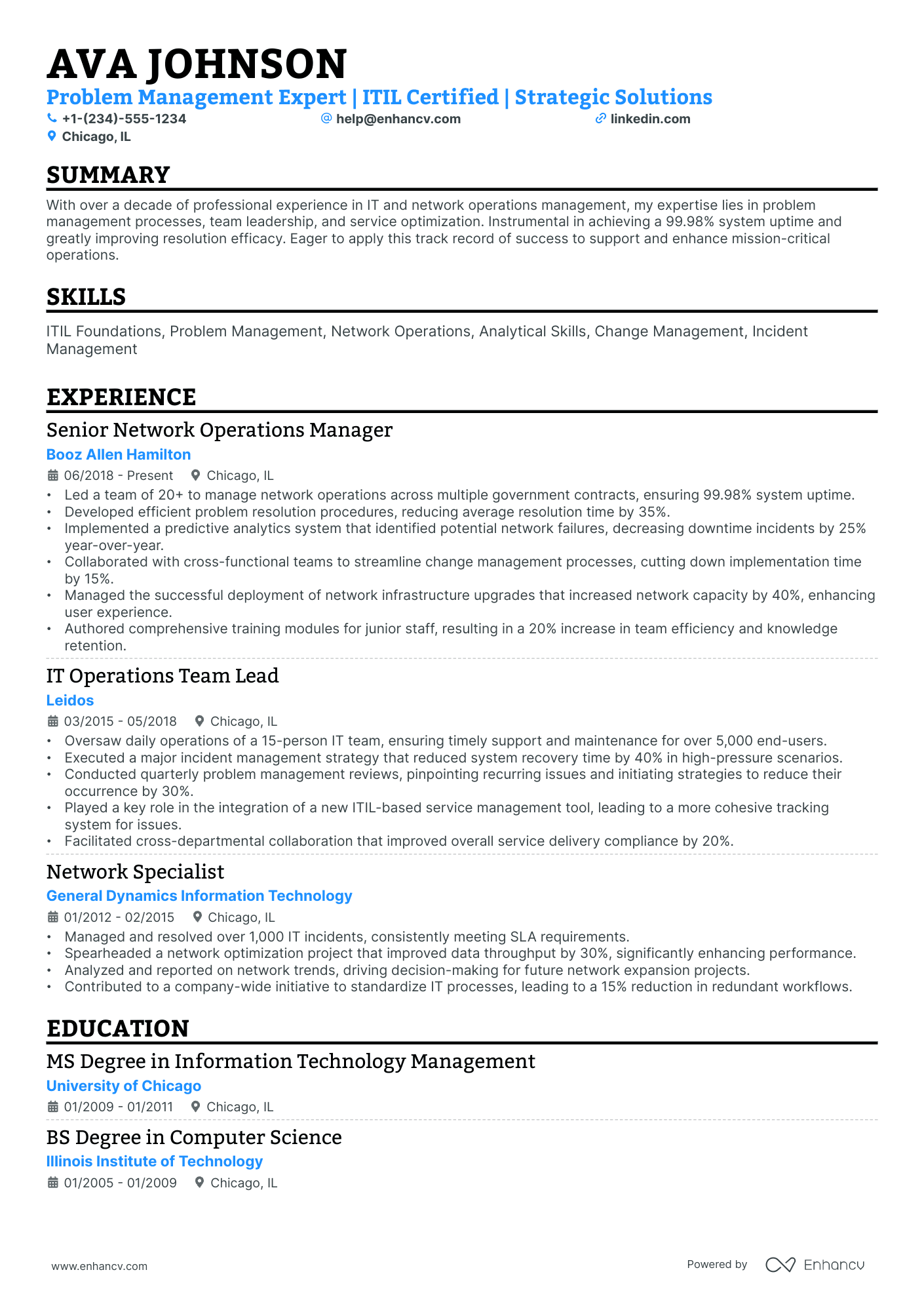
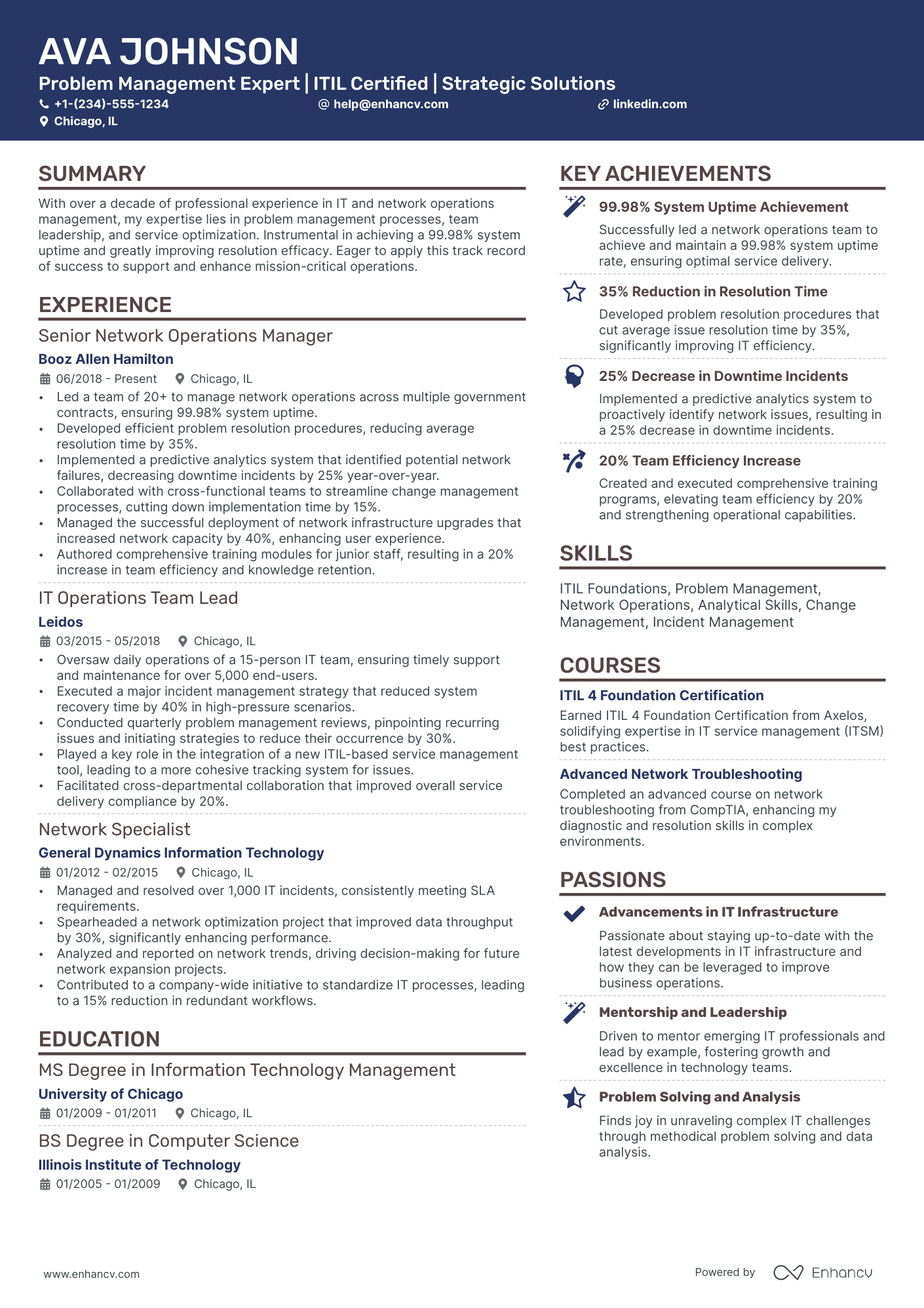
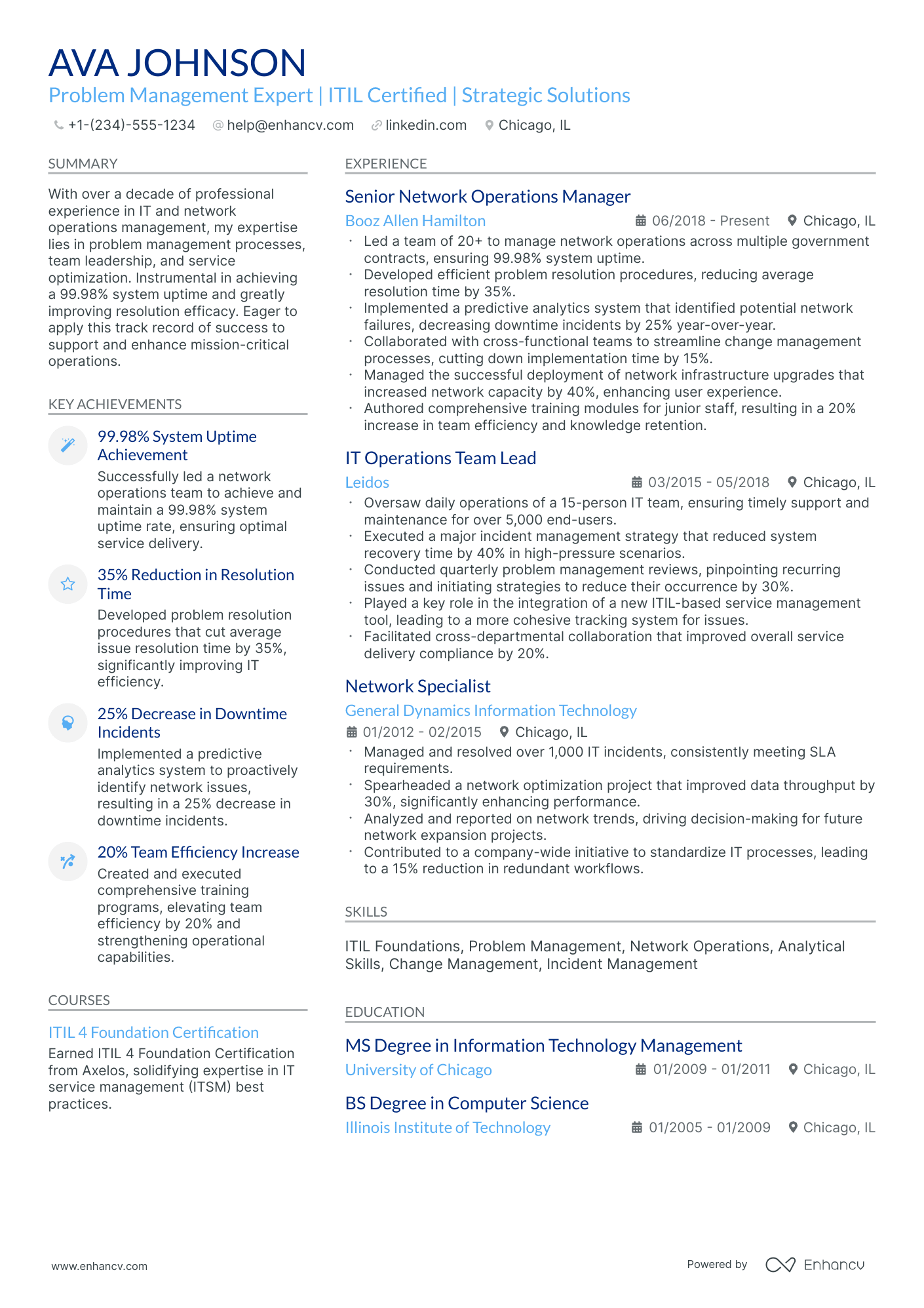
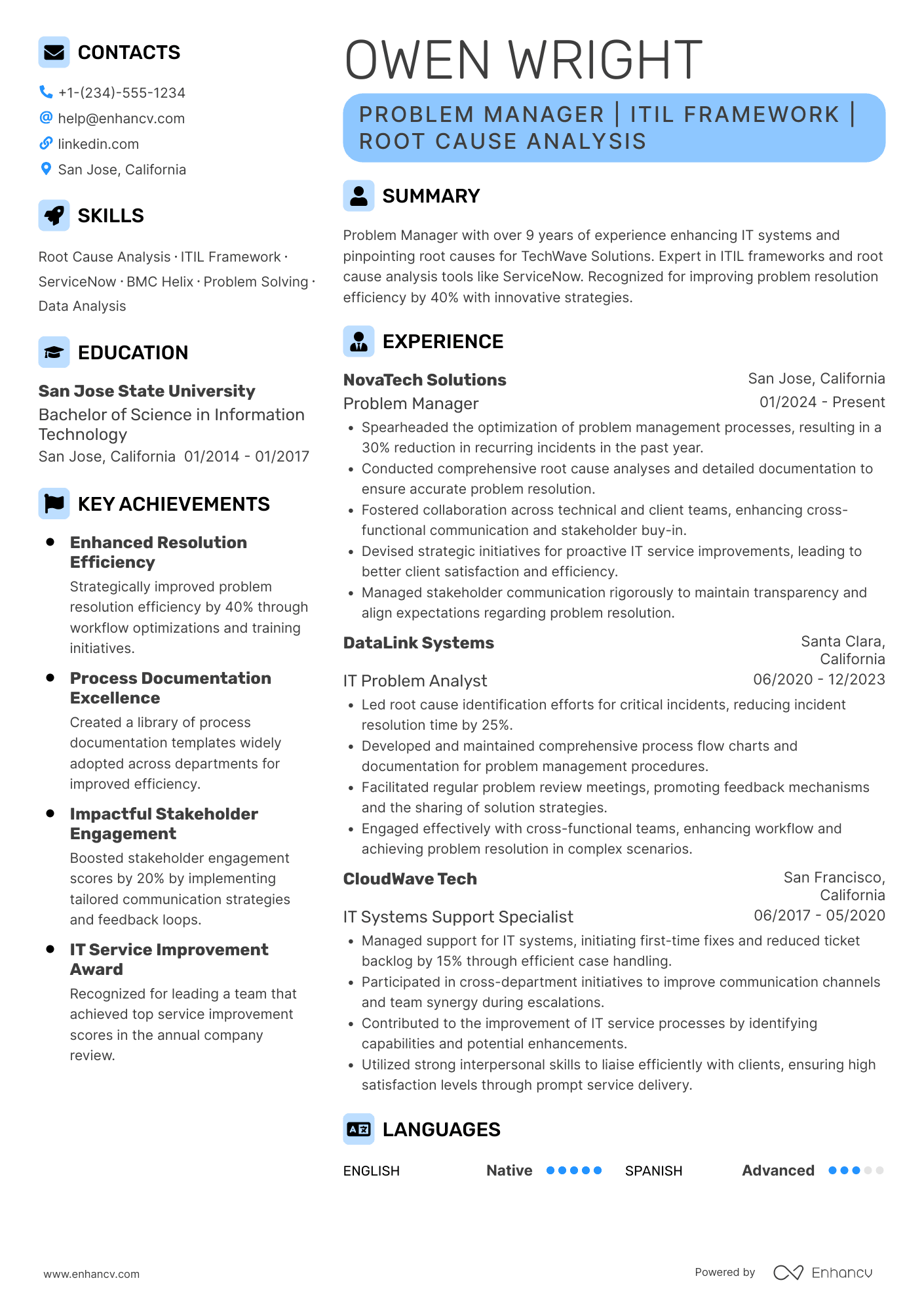
Many problem manager resume drafts fail because they describe problem logs and meetings, not how you prevented recurrence or reduced impact. That gets filtered by ATS keywords and lost in rapid recruiter scans in a crowded market.
A strong resume shows what changed because of your work. Knowing how to make your resume stand out means you should highlight reduced incident volume, faster mean time to resolution, higher service availability, fewer repeat defects, on-time delivery across teams, and measurable cost or customer-impact reductions.

Key takeaways
- Use a reverse-chronological format to show progressive problem management ownership and accountability.
- Quantify every experience bullet with metrics like incident reduction, resolution time, and cost savings.
- Tailor your resume to each job posting by mirroring its tools, frameworks, and KPIs.
- Demonstrate skills through outcome-driven experience bullets, not standalone keyword lists.
- Anchor entry-level resumes in measurable projects, certifications, and root cause analysis coursework.
- Use AI to sharpen language and structure, but stop before it inflates or invents experience.
- Build your problem manager resume faster with Enhancv to ensure clear formatting and recruiter-ready content.
How to format a problem manager resume
Recruiters evaluating problem manager resumes prioritize evidence of incident lifecycle ownership, root cause analysis leadership, and measurable improvements to service availability and operational stability. A reverse-chronological format surfaces these signals immediately by showing a clear trajectory of growing accountability across ITIL-aligned environments.

I have significant experience in this role—which format should I use?
Use a reverse-chronological format—it's the strongest way to demonstrate progressive ownership of problem management processes and their business outcomes. Do:
- Lead with your most senior scope first, including team size, number of services or environments managed, and cross-functional stakeholder relationships.
- Highlight domain-specific expertise such as ITIL problem management practices, root cause analysis frameworks (Kepner-Tregoe, 5 Whys, Ishikawa), and tools like ServiceNow, Jira Service Management, or Splunk.
- Quantify outcomes tied to incident reduction, mean time to resolution improvements, and cost savings from proactive problem elimination.
Why hybrid and functional resumes don't work for senior roles
Hybrid and functional formats fragment your career timeline, obscuring the progression from reactive incident handling to strategic problem prevention leadership that hiring managers need to see. They dilute evidence of decision ownership, accountability for service improvements, and the expanding scope of cross-team influence that defines senior problem management roles. Choosing the right resume layout is essential to presenting this progression clearly. Avoid these formats entirely if you have three or more years of dedicated problem management experience with demonstrable leadership responsibilities.
- Edge-case exception: A functional format may be acceptable only if you're transitioning into problem management from a closely related discipline (such as incident management or service delivery) and lack formal problem manager titles—but even then, every skill listed must be anchored to specific projects, root cause investigations, or measurable service improvement outcomes.
Once you've established a clean, readable format, the next step is deciding which sections to include and how to organize them for maximum impact.
What sections should go on a problem manager resume
Recruiters expect a problem manager resume to show how you identify recurring issues, drive root-cause fixes, and prevent repeat incidents across teams. Understanding what to put on a resume ensures you include the right information from the start.
Use this structure for maximum clarity:
- Header
- Summary
- Experience
- Skills
- Projects
- Education
- Certifications
- Optional sections: Awards, Leadership, Languages
Strong experience bullets should emphasize measurable impact, incident reduction, cross-functional scope, root-cause outcomes, and sustained results over time.
Is your resume good enough?
Drop your resume here or choose a file. PDF & DOCX only. Max 2MB file size.
Once you’ve organized your resume with the right structure and supporting sections, the next step is to write your problem manager resume experience in a way that fits that framework and highlights your impact.
How to write your problem manager resume experience
The experience section is where you prove you've delivered measurable results—not just managed tickets. Hiring managers reviewing problem manager resumes prioritize demonstrated impact through root cause elimination, service improvement, and cross-functional coordination over descriptive task lists that restate job descriptions.
Each entry should include:
- Job title
- Company and location (or remote)
- Dates of employment (month and year)
Three to five concise bullet points showing what you owned, how you executed, and what outcomes you delivered:
- Ownership scope: the services, infrastructure components, incident categories, or operational domains you were directly accountable for as a problem manager, including the breadth of systems, environments, or business units under your remit.
- Execution approach: the ITIL practices, root cause analysis frameworks, trend analysis tools, or service management platforms you used to investigate recurring incidents, identify underlying causes, and drive permanent fixes.
- Value improved: the changes you produced in incident recurrence rates, mean time to resolution, service availability, operational stability, or risk posture that directly tied back to your problem management activities.
- Collaboration context: how you partnered with incident managers, change managers, engineering teams, service owners, vendors, or senior leadership to validate root causes, implement corrective actions, and embed preventive measures across the organization.
- Impact delivered: the business-level outcomes your problem management work produced, expressed through reduced disruption, improved service continuity, lower support burden, or stronger compliance posture rather than a summary of meetings held or reports filed.
Experience bullet formula
A problem manager experience example
✅ Right example - modern, quantified, specific.
Problem Manager
Apex FinTech | Austin, TX
2022–Present
B2B fintech platform processing ten million+ daily transactions for broker-dealers and digital wealth apps.
- Established ITIL-aligned Problem Management using ServiceNow IT Service Management (human resources) (ITSM) workflows, Jira integration, and a Known Error Database, cutting repeat incidents by 32% and improving mean time to restore by 18% in six months.
- Led cross-functional root cause analyses using the “five whys,” fishbone diagrams, and blameless postmortems with engineering, site reliability engineering, product managers, and customer support, reducing high-severity incident volume from twenty-two to fourteen per quarter.
- Built a problem backlog and risk-based prioritization model in Jira using failure mode and effects analysis (FMEA), driving remediation of forty-eight systemic defects and lowering payment reconciliation errors by 41%.
- Implemented trend detection and alert correlation using Datadog, Splunk, and ServiceNow Event Management, identifying three recurring latency drivers and cutting false-positive alerts by 27%.
- Partnered with security and compliance to embed problem reviews into change enablement and quarterly risk reporting, reducing audit findings tied to recurring incidents by 60% and improving change success rate by nine percentage points.
Now that you've seen how a strong experience section comes together, let's look at how to adjust yours based on the specific job you're targeting.
How to tailor your problem manager resume experience
Recruiters evaluate your problem manager resume through both applicant tracking systems and manual review, so alignment with the job posting is critical. Tailoring your resume to the job description ensures the most relevant skills, tools, and outcomes surface immediately.
Ways to tailor your problem manager experience:
- Match ITSM platforms and monitoring tools named in the job description.
- Mirror the exact ITIL process terminology the posting uses.
- Reflect specific KPIs or success criteria the employer highlights.
- Include industry or domain experience when the role requires it.
- Emphasize root cause analysis methods referenced in the listing.
- Highlight cross-functional collaboration models the job description outlines.
- Align your compliance or service reliability focus with stated priorities.
- Incorporate escalation frameworks or workflow structures the employer values.
Tailoring means aligning your real accomplishments with what the employer asks for, not forcing keywords where they don't belong.
Resume tailoring examples for problem manager
| Job description excerpt | Untailored | Tailored |
|---|---|---|
| Lead root cause analysis using ITIL frameworks, coordinate with infrastructure and application teams, and reduce recurring incidents by 30% within 12 months. | Performed root cause analysis and worked with teams to resolve issues. | Led ITIL-aligned root cause analysis across infrastructure and application teams, reducing recurring incidents by 34% within 10 months through structured problem records and known error documentation. |
| Manage the problem management lifecycle in ServiceNow, maintain the Known Error Database (KEDB), and present trend reports to IT leadership monthly. | Tracked problems and created reports for management review. | Managed the end-to-end problem management lifecycle in ServiceNow, maintained a KEDB of 200+ entries, and delivered monthly trend analysis reports to IT leadership that drove prioritization of three critical infrastructure upgrades. |
| Conduct proactive problem identification using incident trend data, collaborate with change management to implement permanent fixes, and support major incident reviews for a 24/7 financial services environment. | Identified problems and helped implement fixes to improve service quality. | Analyzed incident trend data across a 24/7 financial services environment to proactively identify systemic problems, partnering with change management to implement permanent fixes that cut major incident recurrence by 40% over two quarters. |
Once you’ve aligned your experience with the role’s priorities, the next step is to quantify your problem manager achievements so hiring managers can quickly see the impact behind those choices.
How to quantify your problem manager achievements
Quantifying your work proves you reduced customer impact and improved service outcomes. Focus on incident volume, time to restore service, recurrence, root cause completion, risk reduction, cost savings, and on-time delivery.
Quantifying examples for problem manager
| Metric | Example |
|---|---|
| Time to restore | "Cut mean time to restore service from 95 to 52 minutes by tightening incident triage, using ServiceNow workflows, and clarifying on-call handoffs across three teams." |
| Recurrence rate | "Reduced repeat incidents for top five problems by 38% quarter over quarter by enforcing root cause standards and tracking fixes in Jira through release." |
| Root cause quality | "Raised on-time root cause analyses from 62% to 91% by introducing a five-why template, peer reviews, and a seven-day service level agreement." |
| Risk reduction | "Lowered high-severity incident risk by 30% by prioritizing ten known errors, coordinating patch windows, and validating controls with security and compliance." |
| Cost savings | "Saved $240,000 annually by eliminating noisy alerts and automating enrichment in Splunk, reducing escalations by 22% and after-hours pages by 15%." |
Turn vague job duties into measurable, recruiter-ready resume bullets in seconds with Enhancv's Bullet Point Generator.
Once you've crafted strong bullet points that highlight your achievements, the next step is ensuring your resume also showcases the right combination of hard and soft skills employers expect from a problem manager.
How to list your hard and soft skills on a problem manager resume
Your skills section matters for problem manager roles because recruiters and an ATS (applicant tracking system) scan them to confirm role fit fast, and the strongest resumes balance role-specific hard skills with execution-focused soft skills that show how you drive outcomes.
problem manager roles require a blend of:
- Product strategy and discovery skills.
- Data, analytics, and experimentation skills.
- Delivery, execution, and go-to-market discipline.
- Soft skills.
Your skills section should be:
- Scannable (bullet-style grouping).
- Relevant to the job post.
- Backed by proof in experience bullets.
- Updated with current tools.
Place your skills section:
- Above experience if you're junior or switching careers.
- Below experience if you're mid/senior with strong achievements.

Hard skills
- Problem framing, root cause analysis
- Customer journey mapping
- User research synthesis
- Jobs-to-be-Done framework
- PRDs, user stories, acceptance criteria
- Roadmapping and prioritization
- OKRs, KPI definition
- A/B testing and experiment design
- SQL, Excel, dashboards
- Amplitude, Mixpanel, Google Analytics
- Jira, Confluence
- Go-to-market planning
Soft skills
- Structured problem solving
- Clear tradeoff communication
- Stakeholder alignment
- Cross-functional facilitation
- Decision-making under ambiguity
- Prioritization discipline
- Ownership and follow-through
- Escalation management
- Executive-ready storytelling
- Customer empathy in decisions
- Conflict resolution
- Outcome-focused execution
How to show your problem manager skills in context
Skills shouldn't live only in a bulleted list on your resume. Browse examples of resume skills to see how top candidates present theirs.
They should be demonstrated in:
- Your summary (high-level professional identity)
- Your experience (proof through outcomes)
Here's what that looks like in practice.
Summary example
Senior problem manager with 10 years in financial services, skilled in root cause analysis, ITIL frameworks, and ServiceNow. Led cross-functional improvement initiatives that reduced recurring major incidents by 45%, strengthening service reliability across global infrastructure.
- Signals senior-level expertise immediately
- Names specific tools and frameworks
- Leads with a strong metric
- Highlights cross-functional collaboration
Experience example
Senior Problem Manager
Bridgepoint Financial Technologies | Remote
March 2019–Present
- Conducted root cause analyses using Kepner-Tregoe methods in ServiceNow, eliminating 12 recurring P1 incidents within 18 months.
- Partnered with infrastructure and application teams to build a known-error database, cutting mean time to resolution by 30%.
- Presented quarterly trend reports to IT leadership, driving prioritization of fixes that reduced incident volume by 22% year over year.
- Every bullet includes measurable proof.
- Skills surface naturally through outcomes.
Once you’ve tied your problem manager strengths to real outcomes, the next step is to apply that same approach to writing a problem manager resume with no experience.
How do I write a problem manager resume with no experience
Even without full-time experience, you can demonstrate readiness through:
- IT service desk incident triage
- Root cause analysis class projects
- Process improvement volunteer work
- Customer support escalation handling
- Bug triage for open-source
- Internship issue tracking ownership
- Campus operations problem log
If you're just starting out, our guide on writing a resume without work experience can help you structure your application effectively.
Focus on:
- Quantified resolution and prevention metrics
- Root cause analysis with evidence
- Clear problem statements and scope
- Tools: Jira, ServiceNow, Excel
Resume format tip for entry-level problem manager
Use a skills-based resume format because it highlights problem management methods, tools, and measurable projects when your work history is limited. Do:
- Lead with a summary of methods, tools.
- Add a projects section with metrics.
- Use action verbs and numbers.
- Name tools used for tracking.
- Tie each bullet to outcomes.
- Led campus operations problem log in Jira, ran root cause analysis on five recurring outages, and reduced repeat incidents by 30% over eight weeks.
Even without direct experience, your educational background can demonstrate the analytical and technical foundation employers seek in a problem manager.
How to list your education on a problem manager resume
Your education section helps hiring teams confirm you have the foundational knowledge needed for a problem manager role. It validates your analytical training and technical background quickly.
Include:
- Degree name
- Institution
- Location
- Graduation year
- Relevant coursework (for juniors or entry-level candidates)
- Honors & GPA (if 3.5 or higher)
Avoid listing specific months or days for graduation. Use the year only to keep things clean.
Here's a strong education entry tailored to a problem manager resume.
Example education entry
Bachelor of Science in Information Technology
University of Illinois at Chicago, Chicago, IL
Graduated 2019
GPA: 3.7/4.0
- Relevant Coursework: IT Service Management, Root Cause Analysis, Systems Architecture, Data Analytics
- Honors: Dean's List, Summa Cum Laude
How to list your certifications on a problem manager resume
Certifications on your resume show your commitment to learning, prove tool proficiency, and signal industry relevance for a problem manager. They also help validate skills when your experience spans multiple teams, systems, or workflows.
Include:
- Certificate name
- Issuing organization
- Year
- Optional: credential ID or URL
- Place certifications below education when your degree is recent and more relevant than older or general certifications.
- Place certifications above education when they are recent, role-specific, and closely match the problem manager tools or methods in the job posting.
Best certifications for your problem manager resume
- ITIL 4 Foundation
- Certified Problem Manager (CPM)
- ServiceNow Certified Implementation Specialist (CIS)
- HDI Problem Management Professional
- Lean Six Sigma Green Belt
- Project Management Professional (PMP)
- Certified ScrumMaster (CSM)
Once you’ve placed your credentials where recruiters can spot them, focus next on your product manager resume summary to frame those qualifications in a clear, role-aligned snapshot.
How to write your problem manager resume summary
Your resume summary is the first thing a recruiter reads. A strong one immediately signals you're qualified for the problem manager role.
Keep it to three to four lines, with:
- Your title and total years of experience in problem or incident management.
- The domain you've worked in, such as ITSM, cloud infrastructure, or financial services.
- Core tools and frameworks like ServiceNow, ITIL, Jira, or root cause analysis methodologies.
- One or two measurable achievements, such as reduced recurring incidents by a specific percentage.
- Soft skills tied to real outcomes, like cross-team collaboration that shortened resolution cycles.

PRO TIP
At this level, focus on demonstrating hands-on skill with ITSM tools and early, measurable contributions. Highlight specific frameworks you've applied and problems you've helped resolve. Avoid vague phrases like "passionate team player" or "motivated self-starter." Recruiters want evidence, not enthusiasm.
Example summary for a problem manager
Problem manager with three years of ITIL-aligned experience in SaaS environments. Reduced recurring incidents by 34% using ServiceNow and structured root cause analysis across cross-functional teams.
Optimize your resume summary and objective for ATS
Drop your resume here or choose a file.
PDF & DOCX only. Max 2MB file size.
Now that your summary captures the value you bring, make sure your resume header presents the essential contact and professional details recruiters need to reach you.
What to include in a problem manager resume header
A resume header is the top section with your key identifiers, and it boosts visibility, credibility, and recruiter screening for a problem manager role.
Essential resume header elements
- Full name
- Tailored job title and headline
- Location
- Phone number
- Professional email
- GitHub link
- Portfolio link
A LinkedIn link helps recruiters verify experience quickly and supports fast screening.
Don't include a photo on a problem manager resume unless the role is explicitly front-facing or appearance-dependent.
Match your header title to the job posting and keep links short, working, and consistent across every profile.
Example
Problem manager resume header
Jordan Lee
Problem manager | Root cause analysis, incident response, and cross-functional delivery
Austin, TX
(512) 555-01XX
your.name@enhancv.com
github.com/yourname
yourwebsite.com
linkedin.com/in/yourname
Once your header clearly identifies you and your role, you can strengthen the rest of your resume with additional sections that add relevant context and credibility.
Additional sections for problem manager resumes
When your core qualifications align closely with other candidates, well-chosen additional sections can set your problem manager resume apart. For example, listing language skills can demonstrate your ability to collaborate across global teams and support multi-region incident coordination.
- Languages
- Certifications and training
- Publications and case studies
- Professional affiliations
- Hobbies and interests
- Volunteer experience
- Conference presentations
With your resume's additional sections reinforcing your qualifications, pairing it with a tailored cover letter can further strengthen your application.
Do problem manager resumes need a cover letter
A cover letter isn't required for a problem manager, but it helps in competitive searches or when hiring teams expect one. If you're unsure where to start, understanding what a cover letter is and how it complements your resume can clarify when one adds value. It can make a difference when your resume needs context, or when the role demands tight cross-functional fit.
Use a cover letter to add value in these situations:
- Explain role and team fit by linking your approach to incident management, root cause analysis, and cross-team coordination.
- Highlight one or two outcomes, such as reduced repeat incidents, faster time to resolution, or improved post-incident follow-through.
- Show you understand the product, users, and business context by referencing reliability goals, customer impact, and operational constraints.
- Address career transitions or non-obvious experience by mapping your past work to problem manager responsibilities and decision-making.
Drop your resume here or choose a file.
PDF & DOCX only. Max 2MB file size.
Even when you decide a cover letter won’t add value to your application, using AI to improve your program manager resume helps you strengthen the document hiring teams will review first.
Using AI to improve your problem manager resume
AI can sharpen your resume's clarity, structure, and impact. It helps refine language and highlight measurable results. But overuse strips away authenticity. Once your content feels clear and aligned with the problem manager role, step back. If you're wondering which AI is best for writing resumes, the answer depends on the level of control and customization you need.
Here are 10 practical prompts you can copy and paste to strengthen specific sections:
- Sharpen your summary: "Rewrite my problem manager resume summary to emphasize root cause analysis leadership and measurable service improvements in under four sentences."
- Quantify experience bullets: "Add specific metrics to these problem manager experience bullets, focusing on incident reduction percentages and resolution time improvements."
- Align skills section: "Review my skills section and recommend which entries best match a senior problem manager job description focused on ITIL frameworks."
- Strengthen action verbs: "Replace weak verbs in my problem manager experience bullets with strong, specific action verbs that convey ownership and results."
- Trim redundant language: "Remove filler words and redundant phrases from my problem manager resume while keeping all factual content intact."
- Tailor project descriptions: "Rewrite my project descriptions to highlight cross-functional coordination and root cause elimination outcomes relevant to a problem manager role."
- Improve certification relevance: "Reorder and rephrase my certifications section to prioritize credentials most valued for a problem manager position."
- Refine education entries: "Suggest how to present my education section to support a problem manager career path, emphasizing relevant coursework or research."
- Tighten bullet structure: "Restructure my problem manager experience bullets into consistent 'Action + Context + Result' format with parallel construction."
- Eliminate generic phrasing: "Identify and replace any generic or cliché phrases in my problem manager resume with specific, role-relevant language."
Stop using AI once your resume sounds accurate, specific, and aligned with real experience. AI should never invent experience or inflate claims—if it didn't happen, it doesn't belong here.
Conclusion
A strong problem manager resume proves impact with measurable outcomes. It highlights role-specific skills, including root cause analysis, prioritization, stakeholder communication, and incident coordination. It uses a clear structure, with a focused summary, scannable experience, and targeted skills.
This approach shows you’re ready for today’s hiring market and the near-future demands of the role. Hiring teams can quickly see what you solved, how you worked, and what results you delivered.