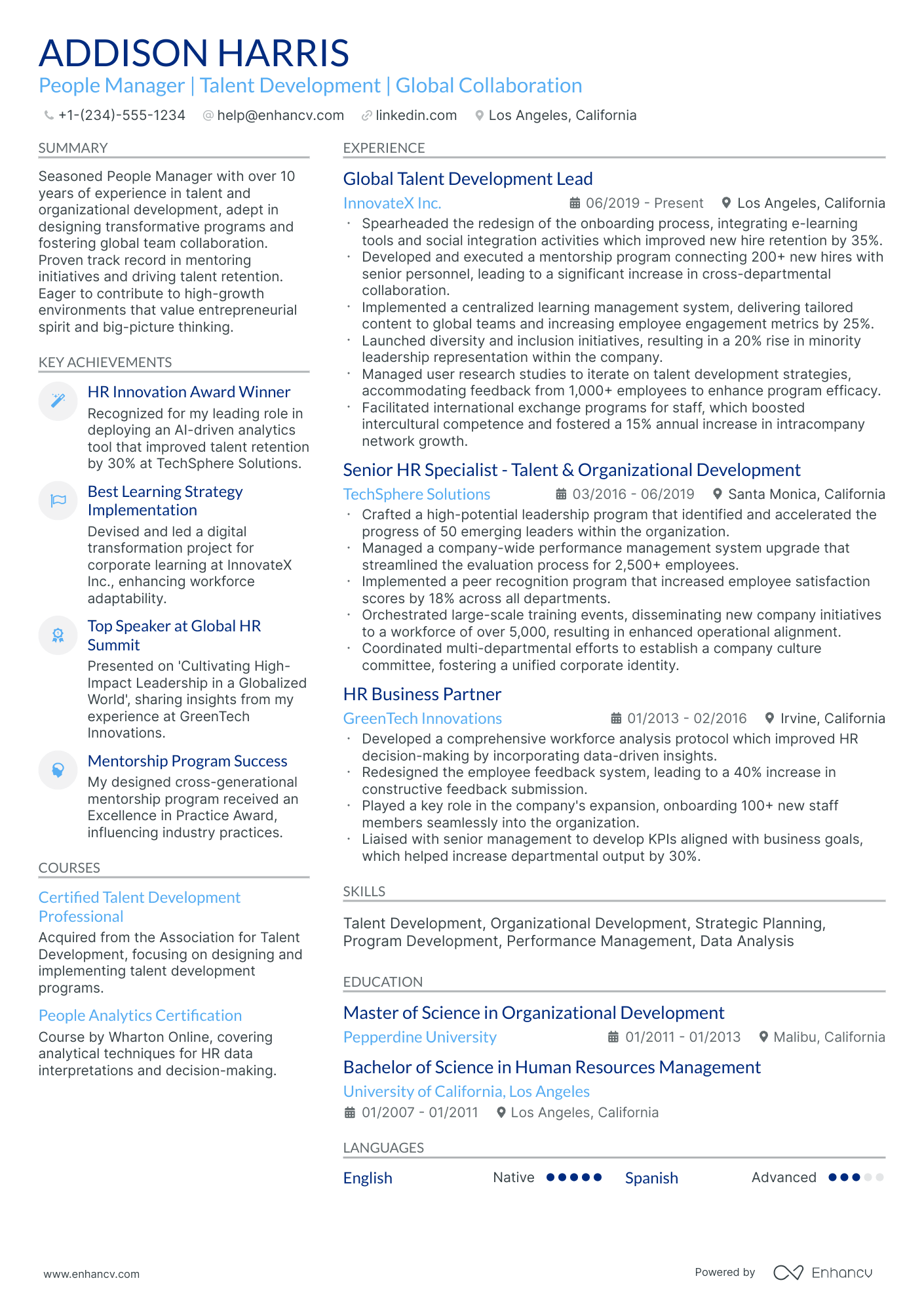
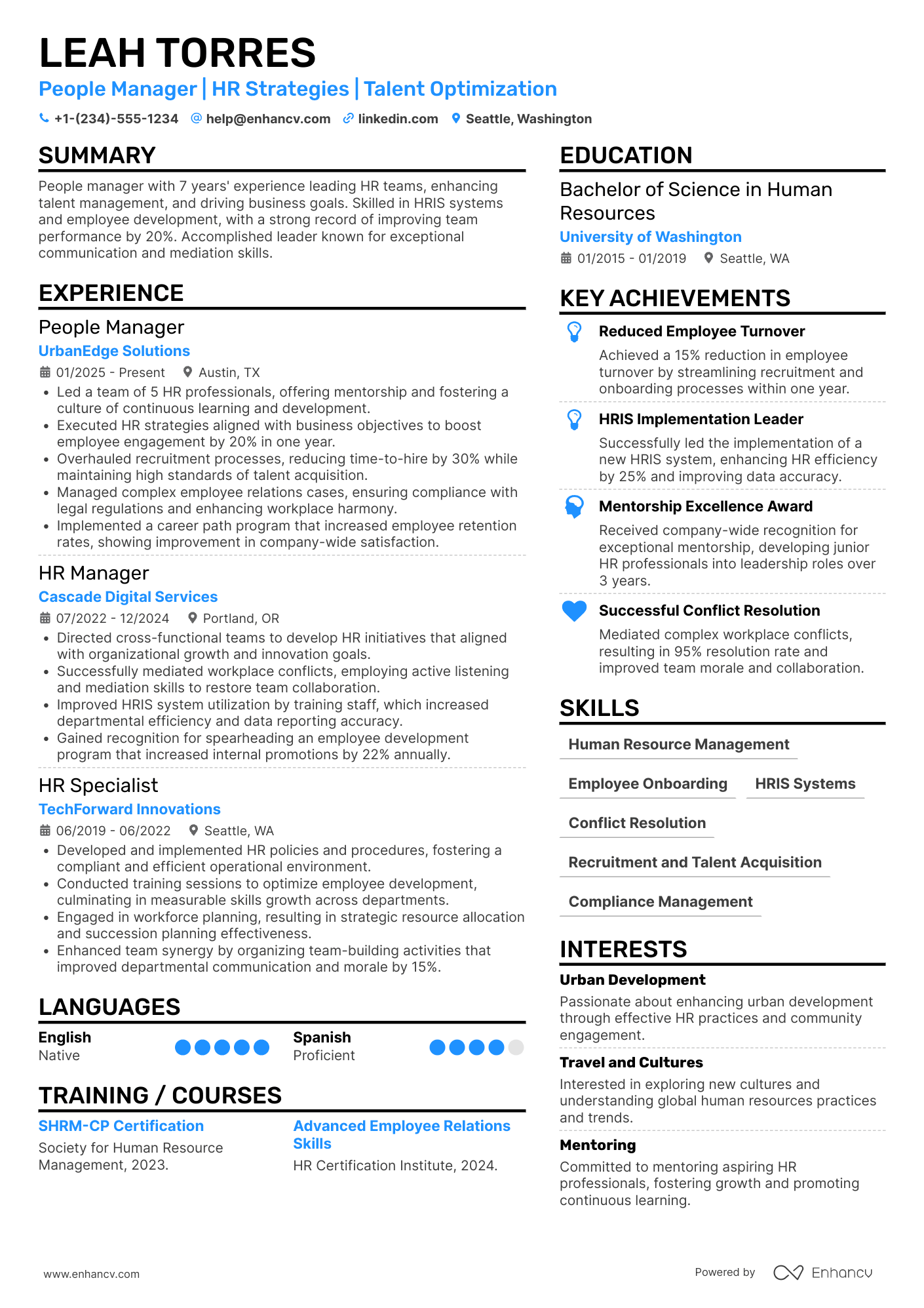
Many people manager resume drafts fail because they bury leadership impact under task lists and team buzzwords. That's costly when applicant tracking system filters and fast recruiter scans decide who advances in a crowded field.
A strong resume shows what you changed, not what you touched. Learning how to make your resume stand out starts with highlighting retention gains, engagement scores, headcount and budget scope, delivery speed, defect reduction, customer satisfaction, and revenue or cost impact. Quantify promotions, hiring velocity, and cross-functional alignment outcomes.

Key takeaways
- Lead every experience bullet with measurable outcomes, not daily responsibilities or task lists.
- Use a reverse-chronological format to show growing leadership scope and team size.
- Tailor resume language to match each job posting's frameworks, tools, and metrics.
- Quantify retention gains, delivery speed, cost savings, and engagement scores wherever possible.
- Demonstrate skills through summary and experience results, not just a standalone skills list.
- Build your resume in Enhancv to keep formatting clean and sections aligned with recruiter expectations.
- Use AI to sharpen clarity and structure, but stop before it inflates or invents experience.
How to format a people manager resume
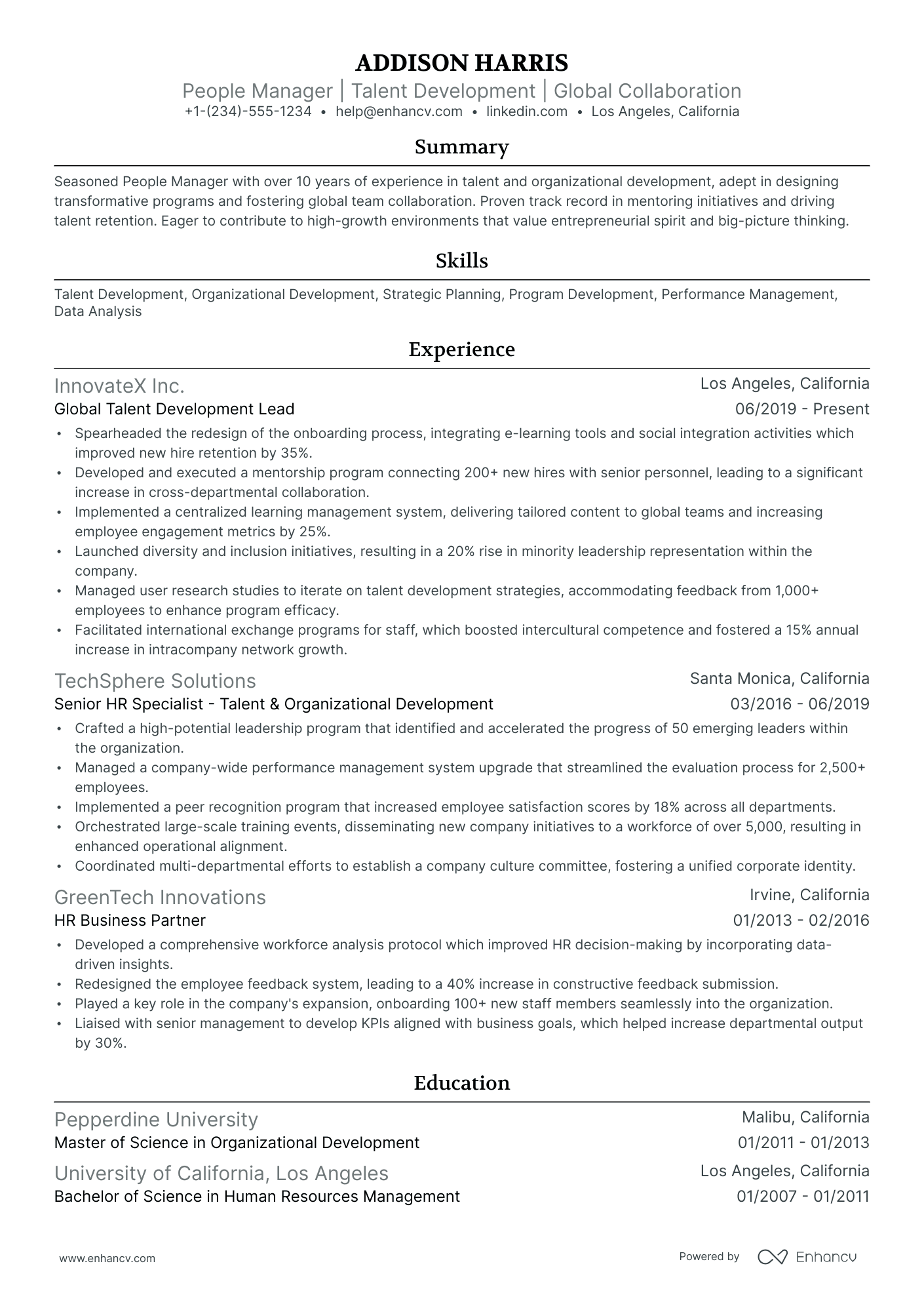
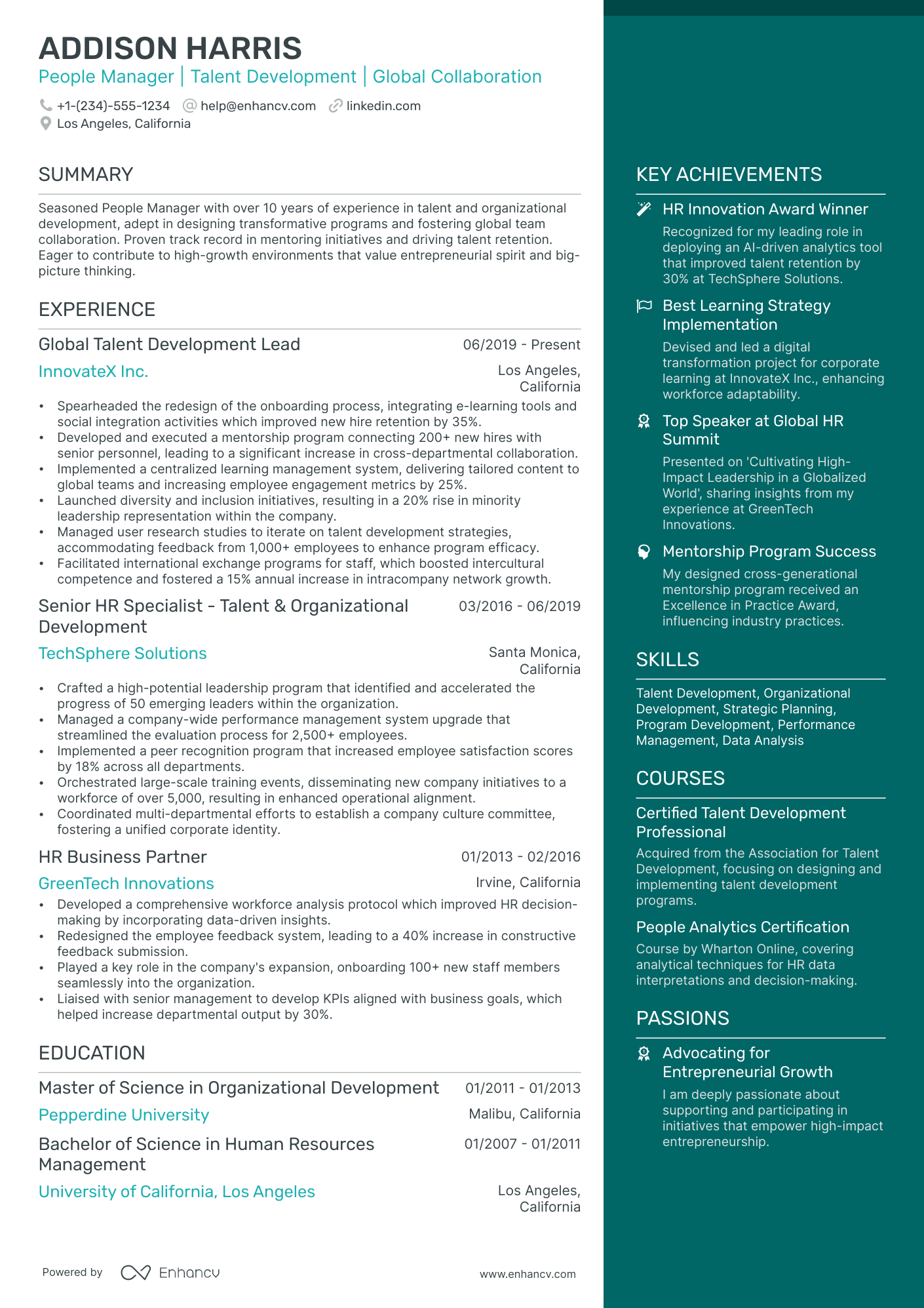
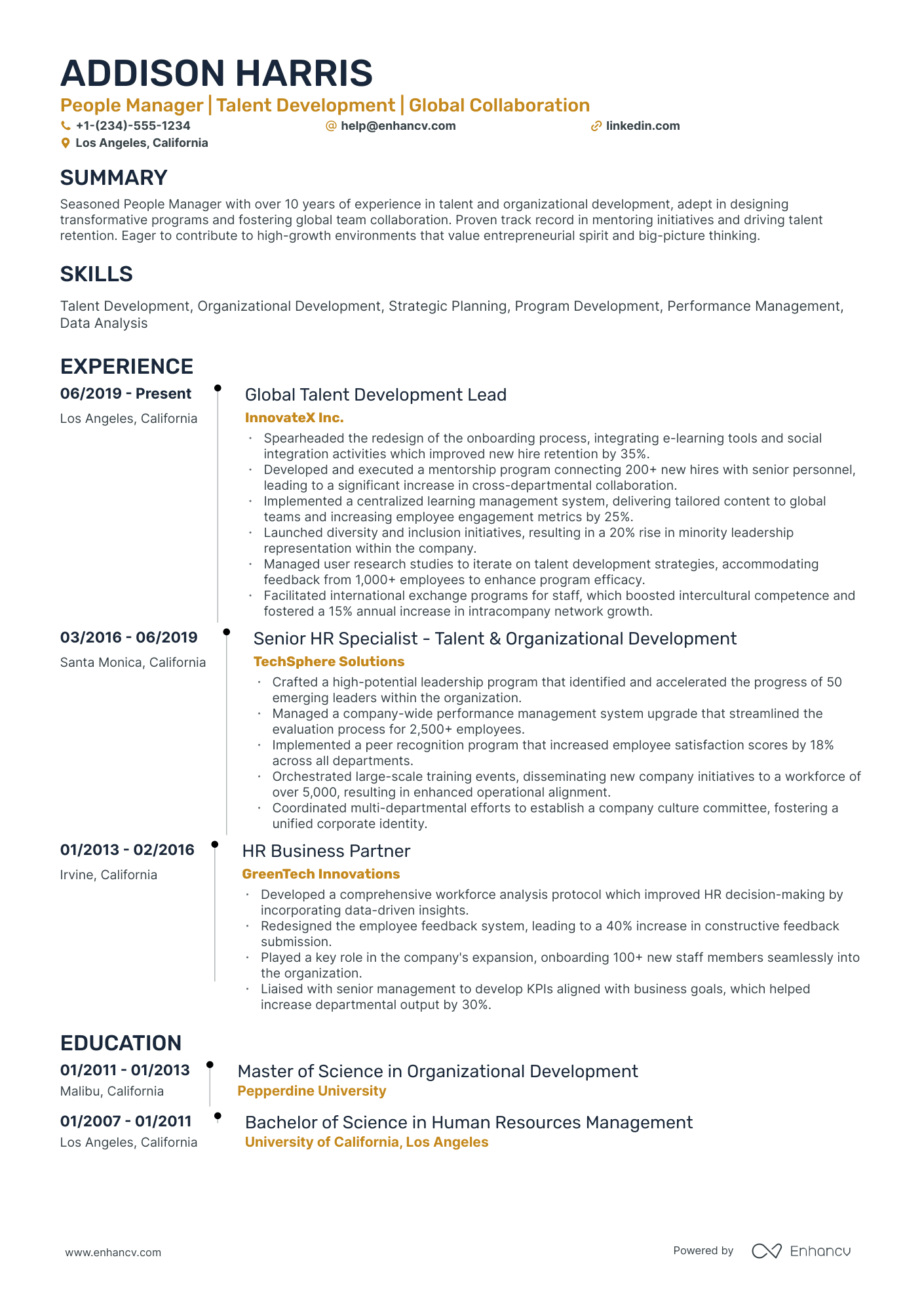
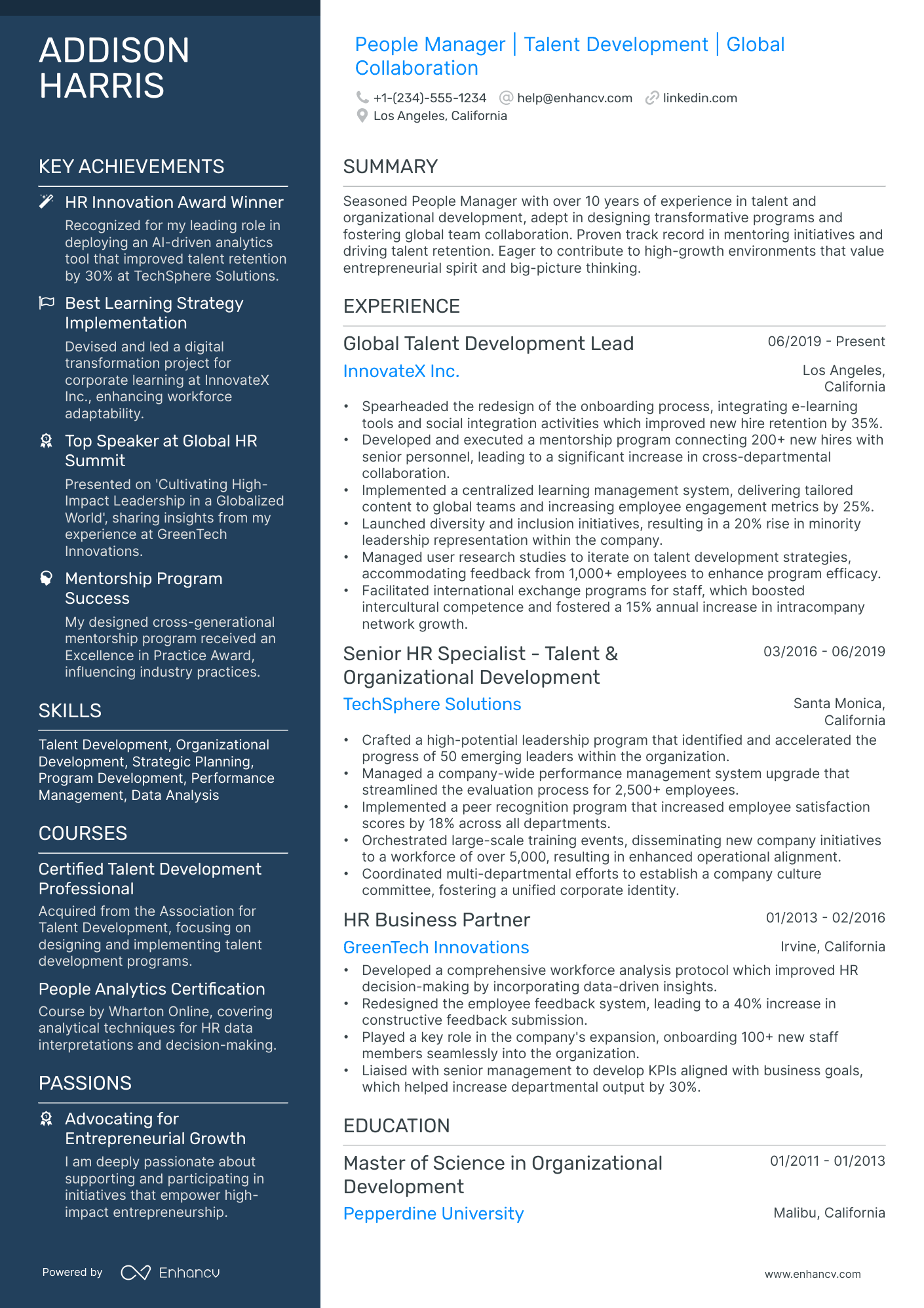
Recruiters evaluating people manager candidates prioritize evidence of team leadership, cross-functional collaboration, and measurable impact on team performance and business outcomes. A well-chosen resume format ensures these signals—headcount managed, retention improvements, coaching initiatives, and operational results—are immediately visible rather than buried beneath skills lists or unclear structure.

I have significant experience as a people manager—which format should I use?
Use a reverse-chronological format to showcase your progression through increasing leadership responsibility and team scope. Do:
- Lead each role entry with scope and ownership details: team size, departments managed, reporting structure, and budget authority.
- Highlight domain-specific competencies such as performance management frameworks, workforce planning tools, employee engagement platforms, and conflict resolution methodologies.
- Quantify outcomes tied to business impact—retention rates, productivity gains, employee satisfaction scores, and cost savings from talent strategy decisions.
I'm junior or switching into a people management role—what format works best?
A hybrid format works best, letting you lead with transferable leadership skills while still showing a clear work history. Do:
- Place a focused skills section near the top highlighting competencies like team coordination, mentorship, stakeholder communication, and performance feedback.
- Feature projects or transitional experience—such as leading cross-functional initiatives, mentoring junior staff, or running training programs—that demonstrate people management readiness.
- Connect every action to an outcome so recruiters can see the impact of your leadership behaviors, even in non-managerial titles.
Why not use a functional resume?
A functional format strips away the timeline and context that recruiters need to evaluate your leadership trajectory, making it harder to verify team size, role duration, and growth into people management responsibilities. A functional resume may be acceptable if you're transitioning from an individual contributor role with no formal management titles, but only if you tie every listed skill directly to specific projects, team outcomes, or mentorship results that demonstrate people management capability.
Once your layout and formatting choices are in place, the next step is deciding which sections to include so each one reinforces your management qualifications.
What sections should go on a people manager resume
Recruiters expect a people manager resume to quickly show leadership scope, team outcomes, and business impact. Knowing which resume sections to include ensures maximum clarity.
Use this structure for maximum clarity:
- Header
- Summary
- Experience
- Skills
- Projects
- Education
- Certifications
- Optional sections: Awards, Volunteering, Languages
Your experience bullets should emphasize measurable impact, outcomes delivered, team size and scope, cross-functional influence, and results tied to business goals.
Is your resume good enough?
Drop your resume here or choose a file. PDF & DOCX only. Max 2MB file size.
With your resume structure in place, the next step is to write your people manager resume experience section so it supports each part with clear, relevant proof.
How to write your people manager resume experience
The experience section is where you prove you can lead teams, develop talent, and deliver organizational results—not just describe your daily responsibilities. Hiring managers prioritize demonstrated impact, including the frameworks you applied, the initiatives you shipped, and the measurable outcomes your leadership produced.
Each entry should include:
- Job title
- Company and location (or remote)
- Dates of employment (month and year)
Three to five concise bullet points showing what you owned, how you executed, and what outcomes you delivered:
- Ownership scope: the teams, departments, programs, or workforce segments you were directly accountable for as a people manager.
- Execution approach: the leadership frameworks, performance management systems, coaching methodologies, or talent development tools you used to guide decisions and drive team effectiveness.
- Value improved: changes to employee engagement, retention, team productivity, succession readiness, or organizational health that resulted from your management approach.
- Collaboration context: how you partnered with HR, senior leadership, cross-functional peers, or external partners to align people strategy with broader business objectives.
- Impact delivered: outcomes expressed through retention gains, team growth, culture improvements, or business results your people leadership directly enabled—framed as results rather than activities.
Experience bullet formula
A people manager experience example
✅ Right example - modern, quantified, specific.
Engineering Manager, Platform
BrightLedger | Remote
2021–Present
Led a multi-tenant SaaS platform team supporting financial workflows for over 1,200 mid-market customers.
- Scaled and coached a team of ten engineers (seven direct reports) using weekly one-on-ones, growth plans, and a competency matrix in Lattice, improving engagement scores from 3.6 to 4.4 and reducing regrettable attrition from 12% to 4%.
- Implemented quarterly planning and delivery rituals (OKRs, roadmap reviews, and Jira dashboards) with product managers and designers, increasing on-time delivery from 62% to 88% and cutting average cycle time by 23%.
- Established an incident management program with PagerDuty, Datadog, and blameless postmortems, reducing Sev-1 incidents by 31% and improving mean time to recovery from 78 minutes to 42 minutes.
- Partnered with security, compliance, and legal to operationalize access reviews and audit-ready change controls (SOC 2), closing fourteen high-risk findings and lowering audit remediation time by 40%.
- Standardized hiring and onboarding with structured interviews, scorecards, and a thirty-sixty-ninety plan, improving offer acceptance from 71% to 83% and ramp time to independent ownership from twelve weeks to eight weeks.
Now that you've seen how a strong experience section comes together, let's look at how to adjust yours based on the specific role you're targeting.
How to tailor your people manager resume experience
Recruiters evaluate your people manager resume through both human review and applicant tracking systems (ATS), so tailoring your resume to the job description is essential. Aligning your language and accomplishments with the specific role ensures you pass automated filters and hold a hiring manager's attention.
Ways to tailor your people manager experience:
- Match leadership frameworks or management methodologies named in the posting.
- Mirror the exact performance metrics or KPIs the employer prioritizes.
- Reference the same HR platforms or workforce tools listed in requirements.
- Highlight relevant industry or domain experience when the role specifies it.
- Emphasize compliance or regulatory oversight if the job description mentions it.
- Use the employer's terminology for team structures or operating models.
- Showcase collaboration workflows or cross-functional processes they reference.
- Include employee engagement or retention strategies tied to stated goals.
Tailoring means aligning your real accomplishments with the language and priorities of each job posting, not forcing keywords where they don't belong.
Resume tailoring examples for people manager
| Job description excerpt | Untailored | Tailored |
|---|---|---|
| Lead a team of 8–12 direct reports across product and engineering, driving quarterly OKR planning and execution using Lattice for performance tracking | Managed a team and helped set goals each quarter. | Led 10 direct reports across product and engineering, facilitating quarterly OKR planning and tracking progress through Lattice to achieve 93% goal completion. |
| Coach and develop mid-level managers through structured 1:1s, career pathing, and succession planning in a hybrid environment | Provided mentorship and supported employee development. | Coached five mid-level managers through structured weekly 1:1s, built individualized career paths, and established succession plans that promoted three internal candidates within 18 months—all in a hybrid setting. |
| Partner with HR business partners to reduce attrition on a 60-person distributed team by improving engagement scores measured through Culture Amp | Worked with HR to improve team retention and morale. | Partnered with HR business partners to design and execute engagement initiatives for a 60-person distributed team, raising Culture Amp engagement scores by 15 points and reducing annual attrition from 22% to 14%. |
Once you’ve aligned your experience with the role’s priorities, quantify your achievements to show the impact of that work with clear, measurable results.
How to quantify your people manager achievements
Quantifying your impact shows how your team improved results, not just activity. Focus on delivery speed, quality, reliability, cost, retention, and risk reduction across the scope you led.
Quantifying examples for people manager
| Metric | Example |
|---|---|
| Delivery speed | "Cut sprint cycle time from 14 to 10 days by enforcing WIP limits in Jira and improving backlog refinement across an eight-engineer team." |
| Quality | "Reduced production defects by 32% by adding code review checklists, increasing unit test coverage from 58% to 76%, and tracking escapes in Datadog." |
| Reliability | "Improved service availability from 99.3% to 99.9% by implementing on-call runbooks, error budgets, and incident retrospectives for four critical services." |
| Cost efficiency | "Lowered cloud spend by $180K annually by rightsizing workloads and setting AWS budgets and alerts, without increasing p95 latency above 250 milliseconds." |
| Team retention | "Improved twelve-month retention from 78% to 92% by launching career ladders, monthly one-on-ones, and a mentorship program for a twelve-person org." |
Turn vague job duties into measurable, recruiter-ready resume bullets in seconds with Enhancv's Bullet Point Generator.
Once you've crafted strong bullet points that showcase your achievements, the next step is ensuring your resume highlights the right mix of hard and soft skills employers expect from a people manager.
How to list your hard and soft skills on a people manager resume
Your skills section shows how you lead teams and deliver outcomes, and recruiters and an ATS (applicant tracking system) scan this section to confirm fit fast—aim for a balanced mix of role-specific hard skills and execution-focused soft skills. people manager roles require a blend of:
- Product strategy and discovery skills.
- Data, analytics, and experimentation skills.
- Delivery, execution, and go-to-market discipline.
- Soft skills.
Your skills section should be:
- Scannable (bullet-style grouping).
- Relevant to the job post.
- Backed by proof in experience bullets.
- Updated with current tools.
Place your skills section:
- Above experience if you're junior or switching careers.
- Below experience if you're mid/senior with strong achievements.

Hard skills
- OKRs, KPIs, scorecards
- Hiring, interviewing, onboarding
- Performance reviews, calibration
- Workforce planning, headcount modeling
- Compensation bands, leveling frameworks
- Agile delivery, Scrum, Kanban
- Roadmapping, prioritization frameworks
- Stakeholder management, RACI
- Experiment design, A/B testing
- SQL, Excel, dashboards
- Jira, Confluence, Asana
- Workday, Greenhouse, Lattice
Soft skills
- Coach and develop direct reports
- Set clear priorities and expectations
- Run effective one-on-ones
- Deliver candid feedback
- Resolve conflict quickly
- Influence without authority
- Align cross-functional stakeholders
- Make timely trade-offs
- Delegate and unblock execution
- Communicate decisions and context
- Lead change with accountability
- Build psychological safety norms
How to show your people manager skills in context
Skills shouldn't live only in a dedicated skills list. Browse resume skills examples to see how top candidates weave competencies into every section.
They should be demonstrated in:
- Your summary (high-level professional identity)
- Your experience (proof through outcomes)
Here's what that looks like in practice.
Summary example
People manager with 12 years in SaaS operations, skilled in workforce planning, coaching, and Workday analytics. Built a 45-person cross-functional team, cutting attrition by 30% through structured career-pathing and continuous feedback loops.
- Reflects senior-level experience clearly
- Names role-relevant tools and methods
- Includes a measurable retention outcome
- Highlights coaching as a soft skill
Experience example
Senior People Manager
Bridgevine Solutions | Remote
March 2019–Present
- Redesigned onboarding workflows in Lattice, reducing new-hire ramp time by 25% across three distributed teams.
- Partnered with HR and product leadership to launch quarterly talent reviews, improving internal promotion rates by 18%.
- Introduced weekly one-on-one coaching frameworks that lifted employee engagement scores from 72% to 89% within one year.
- Every bullet contains measurable proof.
- Skills surface naturally through outcomes.
Once you’ve demonstrated your leadership strengths through specific examples and outcomes, the next step is learning how to write a people manager resume with no experience so you can translate those examples into a clear, credible story for employers.
How do I write a people manager resume with no experience
Even without full-time experience, you can demonstrate readiness through leadership activities and transferable roles. If you're building a resume without work experience, focus on situations where you guided, coordinated, or developed others:
- Team lead in student clubs
- Shift lead in retail
- Volunteer coordinator for events
- Project lead in group coursework
- Onboarding buddy for new hires
- Training facilitator for peers
- Cross-functional project coordinator
- Mentoring junior teammates
Focus on:
- Team size, scope, and outcomes
- Hiring, onboarding, and training work
- Scheduling, coverage, and productivity
- Process improvements with measurable results
Resume format tip for entry-level people manager
Use a combination resume format because it highlights leadership projects and transferable experience while keeping a clear work history. Do:
- Add a "Leadership Projects" section.
- Quantify team size, hours, and results.
- Include tools like Excel, Asana.
- Use action verbs and outcomes.
- Match keywords from the job post.
- Coordinated a ten-volunteer event team in Asana, built shift schedules in Excel, and cut no-show rates by 25% across four weekends.
Even without direct management titles, your education section can highlight leadership-relevant coursework, certifications, and academic achievements that strengthen your candidacy.
How to list your education on a people manager resume
Your education section helps hiring teams confirm you have the foundational knowledge needed for the people manager role. It validates leadership training, business acumen, and organizational behavior expertise.
Include:
- Degree name
- Institution
- Location
- Graduation year
- Relevant coursework (for juniors or entry-level candidates)
- Honors & GPA (if 3.5 or higher)
Skip month and day details—list the graduation year only.
Here's a strong education entry tailored for a people manager resume.
Example education entry
Bachelor of Science in Organizational Leadership
University of Michigan, Ann Arbor, MI
Graduated 2018
GPA: 3.7/4.0
- Relevant Coursework: Team Dynamics, Conflict Resolution, Workforce Planning, Employment Law
- Honors: Magna Cum Laude, Dean's List (six semesters)
How to list your certifications on a people manager resume
Certifications on your resume show your commitment to continuous learning, prove tool proficiency, and signal industry relevance as a people manager. They also help validate leadership practices, compliance knowledge, and modern workforce skills.
Include:
- Certificate name
- Issuing organization
- Year
- Optional: credential ID or URL
- List certifications below education when your degree is recent, directly relevant, or your certifications are older than three years.
- List certifications above education when they are recent, role-relevant, or required for the job, especially if your degree is older.
Best certifications for your people manager resume
- SHRM Certified Professional (SHRM-CP)
- SHRM Senior Certified Professional (SHRM-SCP)
- HRCI Professional in Human Resources (PHR)
- HRCI Senior Professional in Human Resources (SPHR)
- Project Management Professional (PMP)
- Certified ScrumMaster (CSM)
- Prosci Certified Change Practitioner
Once your credentials are placed where recruiters can spot them and verified with the right details, shift to your people manager resume summary to highlight the leadership impact those qualifications support.
How to write your people manager resume summary
Your resume summary is the first thing a recruiter reads, so it needs to earn attention fast. A strong opening frames you as a qualified people manager before the rest of your resume does the heavy lifting.
Keep it to three to four lines, with:
- Your title and total years of people management experience.
- The domain, industry, or product area where you've led teams.
- Core skills like coaching, performance management, workforce planning, or conflict resolution.
- One or two quantified achievements such as retention improvements or team growth metrics.
- Soft skills tied to real outcomes, like cross-functional collaboration that shortened project timelines.

PRO TIP
At the people manager level, lead with team size, direct reports, and measurable improvements you drove. Highlight retention rates, engagement scores, or productivity gains. Avoid vague phrases like "passionate leader" or "people person." Every claim should connect to a result.
Example summary for a people manager
People manager with six years of experience leading teams of up to 15 in SaaS operations. Improved employee retention by 28% through structured coaching and quarterly development plans.
Optimize your resume summary and objective for ATS
Drop your resume here or choose a file.
PDF & DOCX only. Max 2MB file size.
Now that your summary captures your leadership value at a glance, make sure your header provides the essential contact details recruiters need to actually reach you.
What to include in a people manager resume header
A resume header is the top section with your key identifiers, and it boosts visibility, credibility, and recruiter screening for a people manager role.
Essential resume header elements
- Full name
- Tailored job title and headline
- Location
- Phone number
- Professional email
- GitHub link
- Portfolio link
A LinkedIn link helps recruiters verify experience quickly and supports screening.
Do not include a photo on a people manager resume unless the role is explicitly front-facing or appearance-dependent.
Match your header title to the exact job posting language and keep every link and detail current and consistent.
People manager resume header
Jordan Taylor
People Manager | Team Leadership and Performance Coaching
Austin, TX
(512) 555-12XX
jordan.taylor@enhancv.com
github.com/jordantaylor
jordantaylor.com
linkedin.com/in/jordantaylor
Once your header clearly identifies who you are, where you’re based, and how to reach you, you can strengthen the resume with additional sections that add relevant context and support your fit for people manager roles.
Additional sections for people manager resumes
Beyond core sections, additional resume entries can set you apart by showcasing leadership depth, cultural fit, or specialized credibility relevant to managing teams. For example, listing language skills on your resume can highlight your ability to lead diverse or global teams.
- Languages
- Professional affiliations and memberships
- Leadership training and certifications
- Volunteer experience and community leadership
- Publications and speaking engagements
- Awards and recognition
- Hobbies and interests
Once you've rounded out your resume with the right supplementary sections, it's worth turning your attention to the cover letter—a separate document that can reinforce and contextualize everything your resume presents.
Do people manager resumes need a cover letter
A cover letter isn't required for a people manager, but it helps in competitive roles or when hiring expectations include leadership context. If you're unsure where to start, understanding what a cover letter is and how it complements your resume can make a real difference when your resume alone can't show fit, scope, or decision-making.
Use a cover letter to add context your resume can't:
- Explain role and team fit: Align your leadership style with the team's size, maturity, and goals.
- Highlight one or two outcomes: Choose a project that shows how you improved delivery, quality, retention, or cross-functional alignment.
- Show product and business understanding: Reference the users, key metrics, and tradeoffs you've managed with product, design, and stakeholders.
- Address transitions or non-obvious experience: Connect adjacent roles, industry changes, or gaps to people manager responsibilities and impact.
Drop your resume here or choose a file.
PDF & DOCX only. Max 2MB file size.
Even if you include a cover letter to add context and show fit, you can use AI to improve your people manager resume by sharpening your impact and aligning it with the role.
Using AI to improve your people manager resume
AI can sharpen your resume's clarity, structure, and impact. It helps refine language and highlight results. But overuse strips authenticity fast. Once your content feels clear and role-aligned, step away from AI entirely. If you're wondering which AI is best for writing resumes, focus on tools that enhance structure without inflating your experience.
Here are 10 practical prompts to strengthen specific sections of your people manager resume:
- Strengthen your summary. "Rewrite my resume summary to highlight my experience as a people manager, focusing on leadership scope, team size, and measurable outcomes."
- Quantify experience bullets. "Add specific metrics to these people manager experience bullets, emphasizing team growth, retention rates, and performance improvements."
- Align skills to the role. "Review this job description and reorder my skills section to prioritize what's most relevant for a people manager position."
- Sharpen action verbs. "Replace weak or generic verbs in my people manager experience section with strong, leadership-focused action verbs."
- Trim redundant phrasing. "Remove filler words and redundant phrases from my people manager resume while keeping the original meaning intact."
- Refine project descriptions. "Rewrite my project section to clearly show how I led cross-functional teams as a people manager and delivered measurable results."
- Improve education relevance. "Tailor my education section to emphasize coursework, training, or research directly relevant to a people manager career path."
- Highlight certifications strategically. "Reorganize my certifications section so the most impactful credentials for a people manager role appear first."
- Tighten bullet consistency. "Make all experience bullets consistent in tense, structure, and length across my people manager resume."
- Remove vague claims. "Identify and rewrite any vague or unsupported claims in my people manager resume, replacing them with specific, evidence-based statements."
Stop using AI once your resume sounds accurate, specific, and aligned with real experience. AI should never invent experience or inflate claims—if it didn't happen, it doesn't belong here.
Conclusion
A strong people manager resume shows measurable outcomes, role-specific skills, and a clear structure. It connects leadership to results, such as retention gains, faster delivery, and stronger performance. It stays easy to scan, with focused sections and consistent formatting.
Hiring teams want people managers who can lead through change and deliver steady results. A resume that highlights impact, core skills, and clear priorities shows you’re ready for today’s market and what comes next.