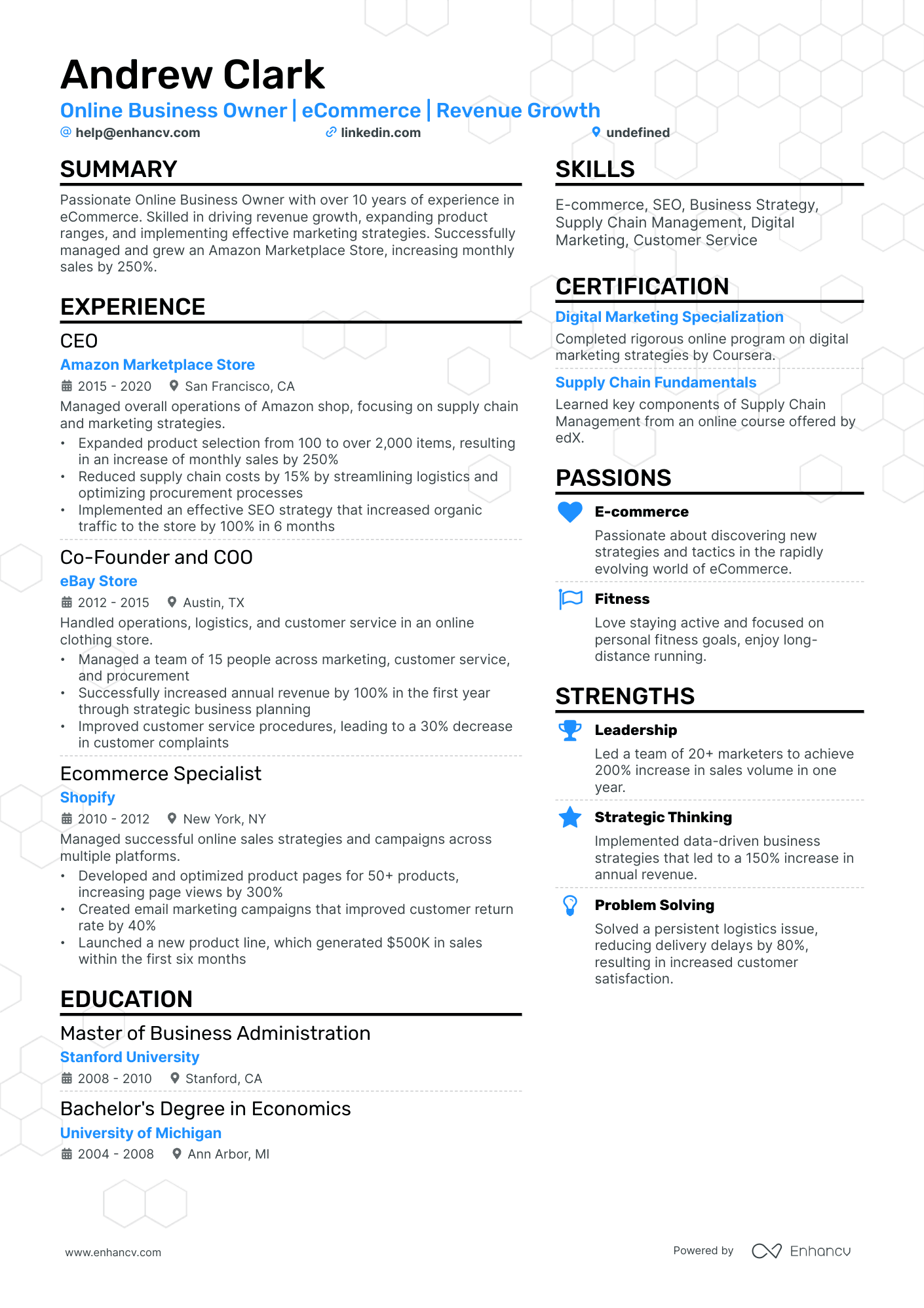
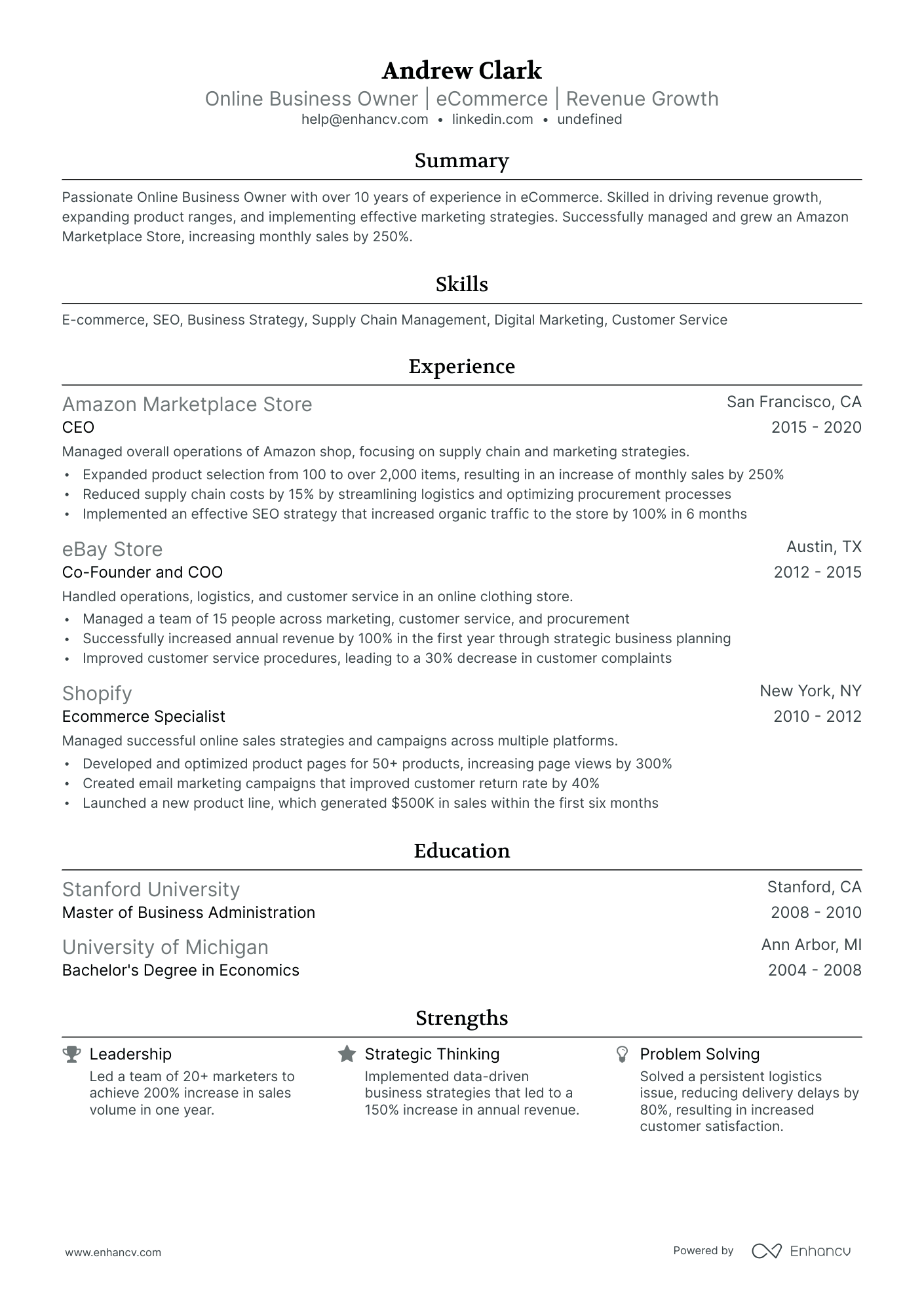
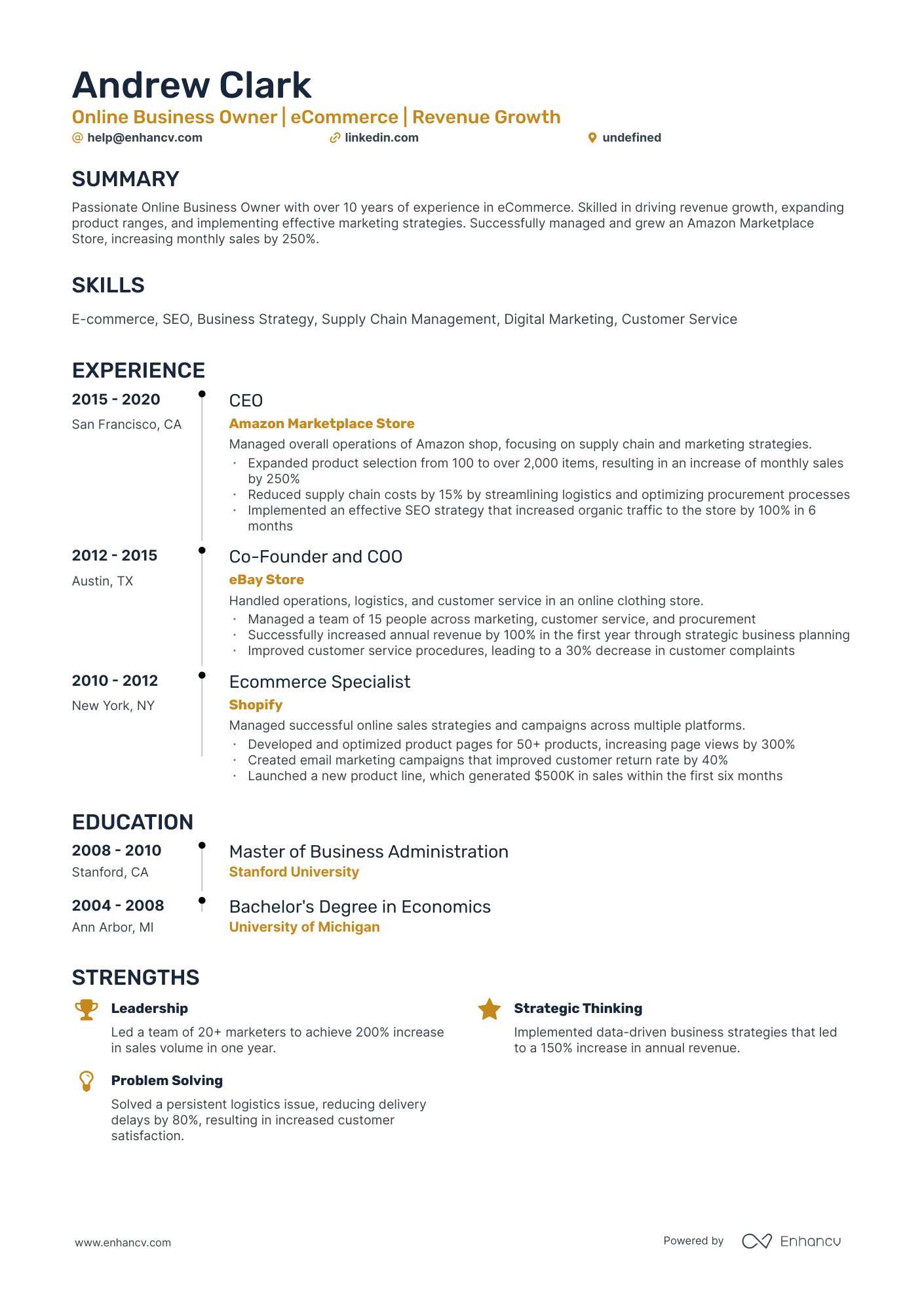
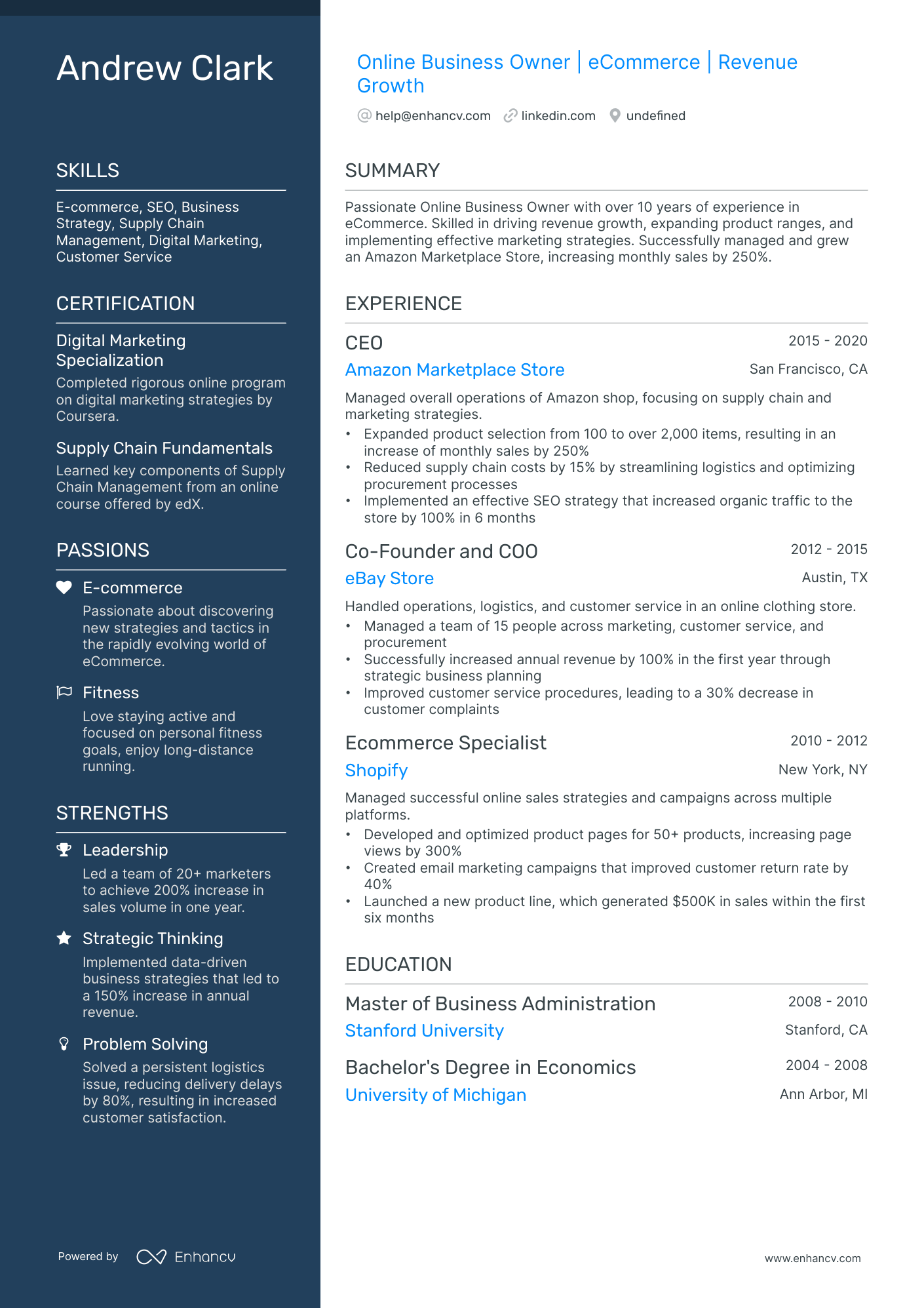
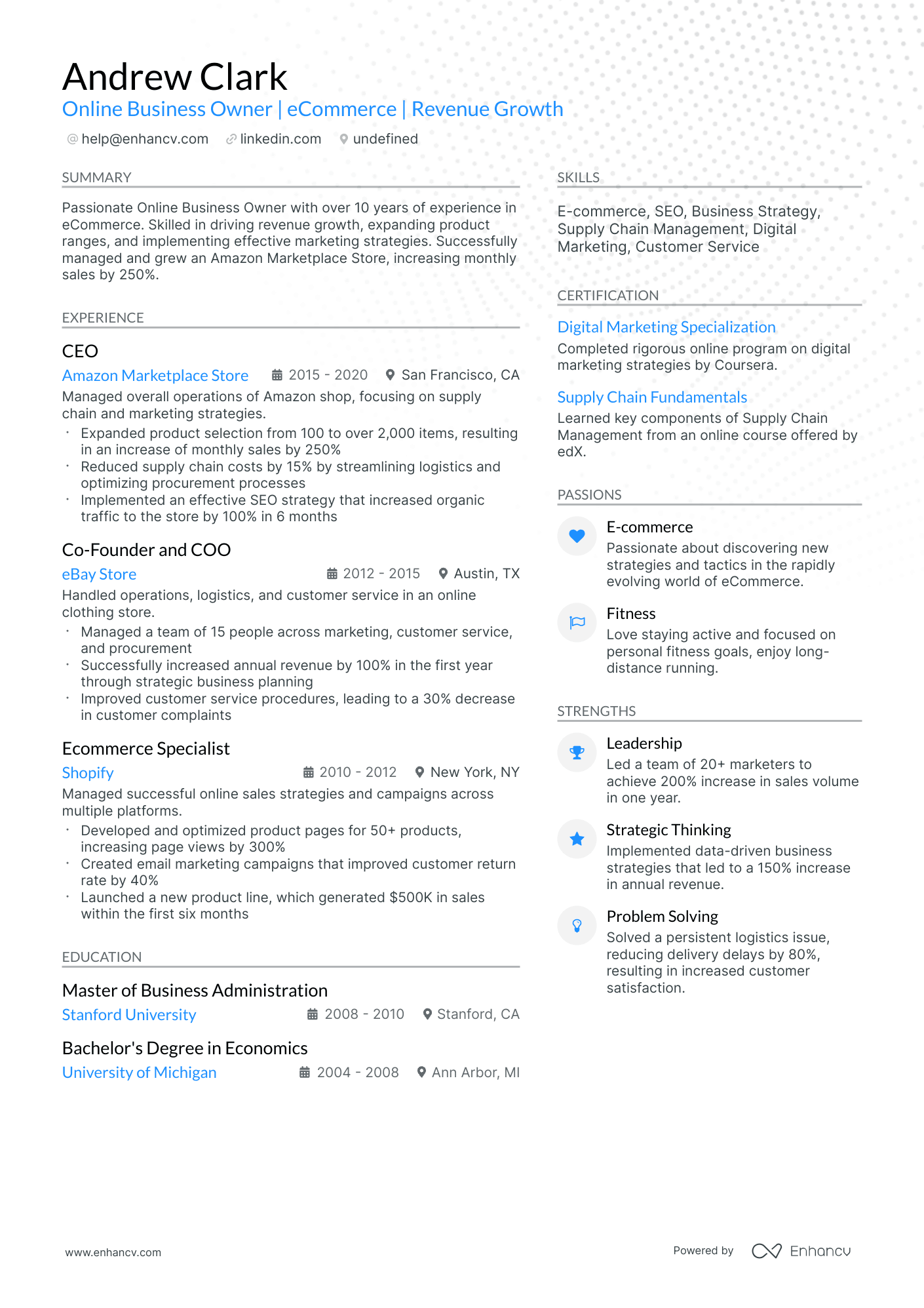
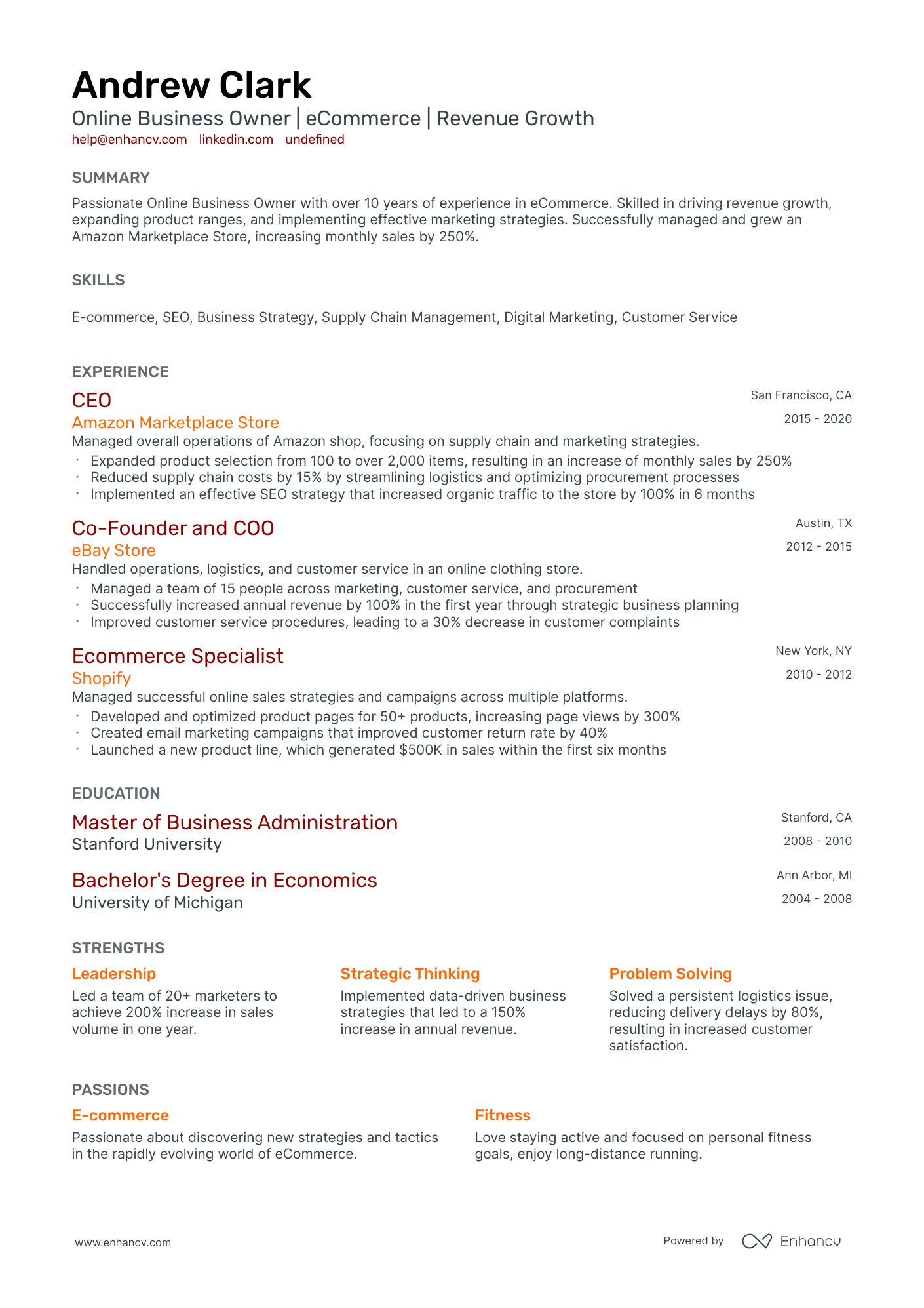
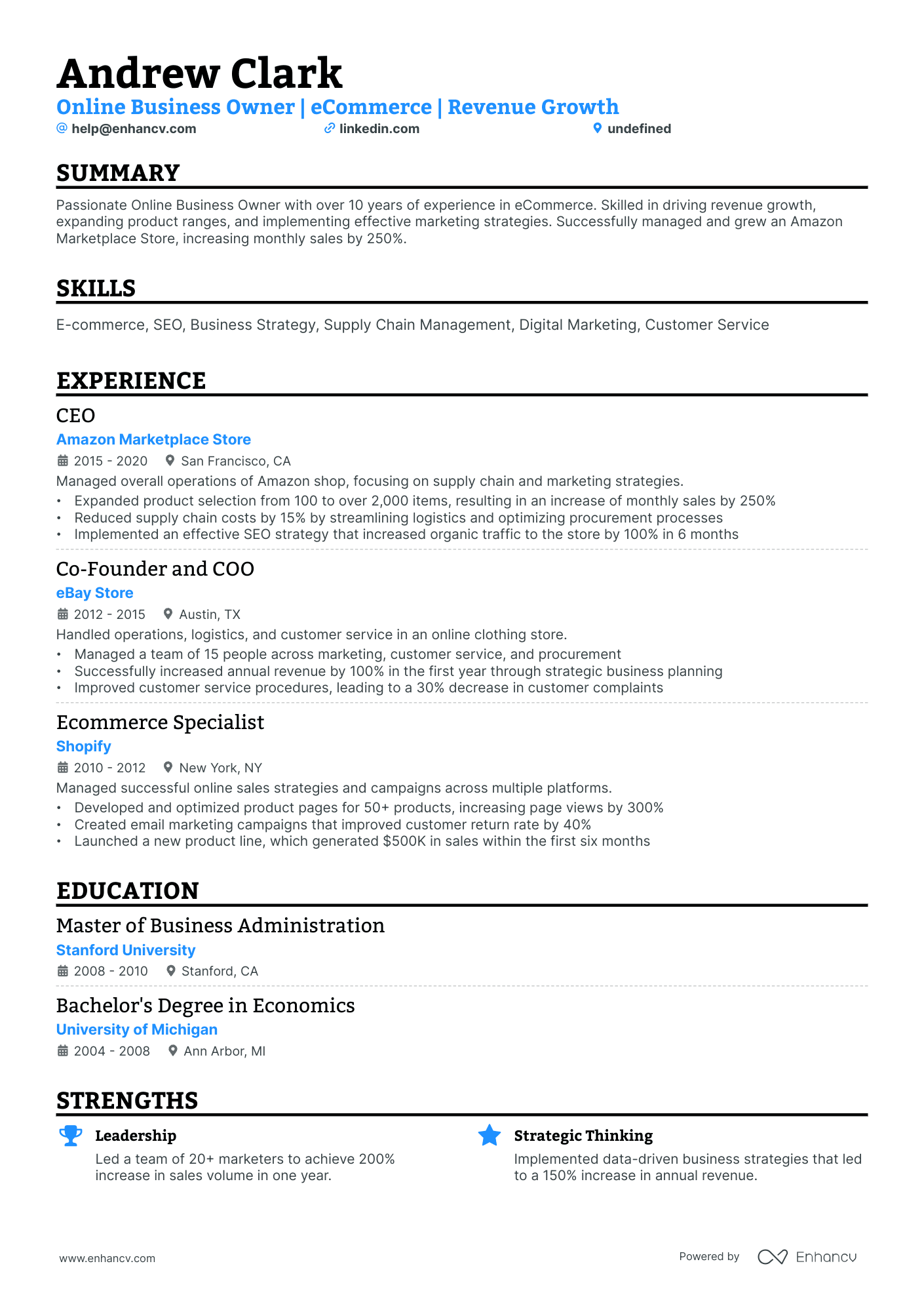
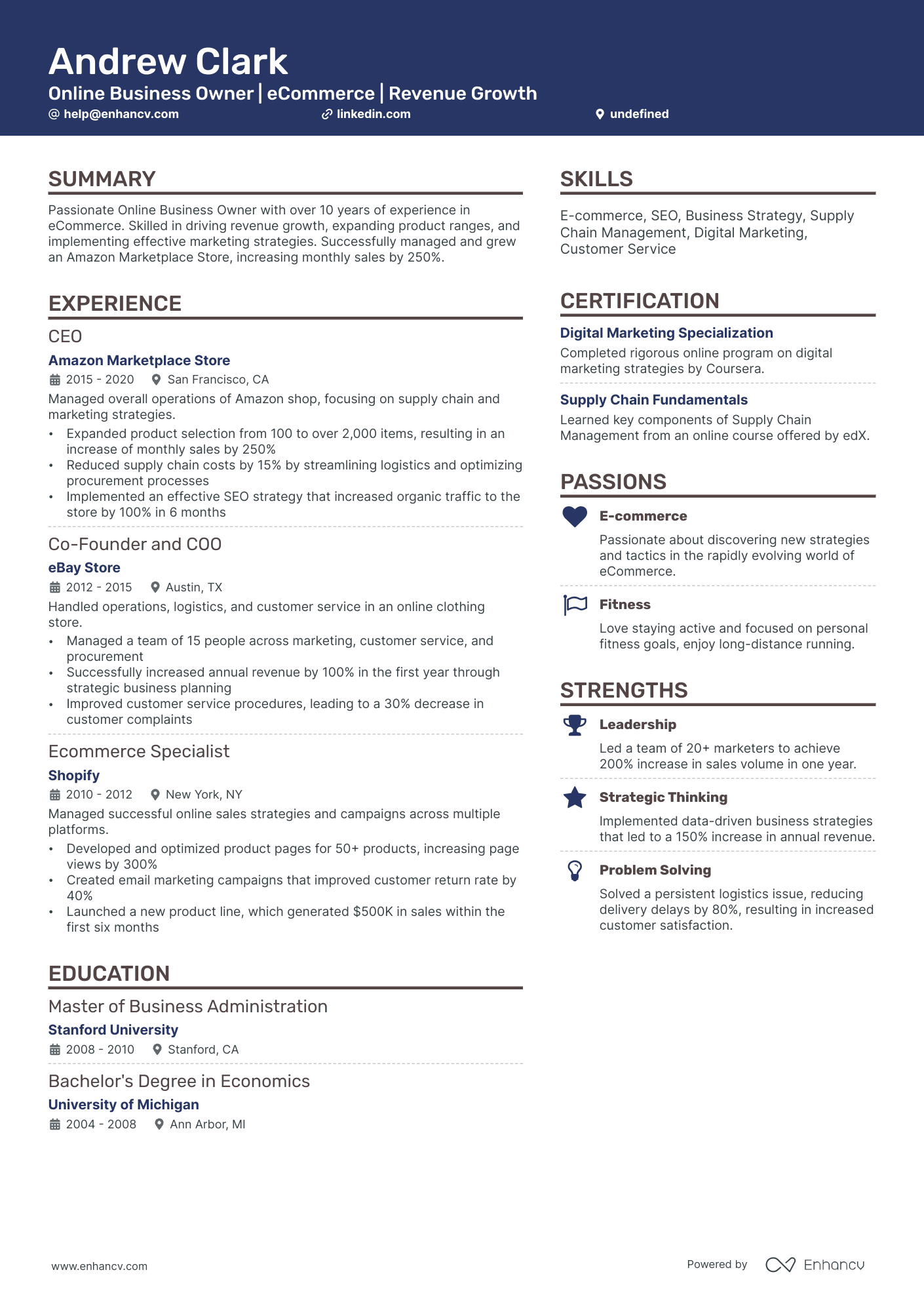
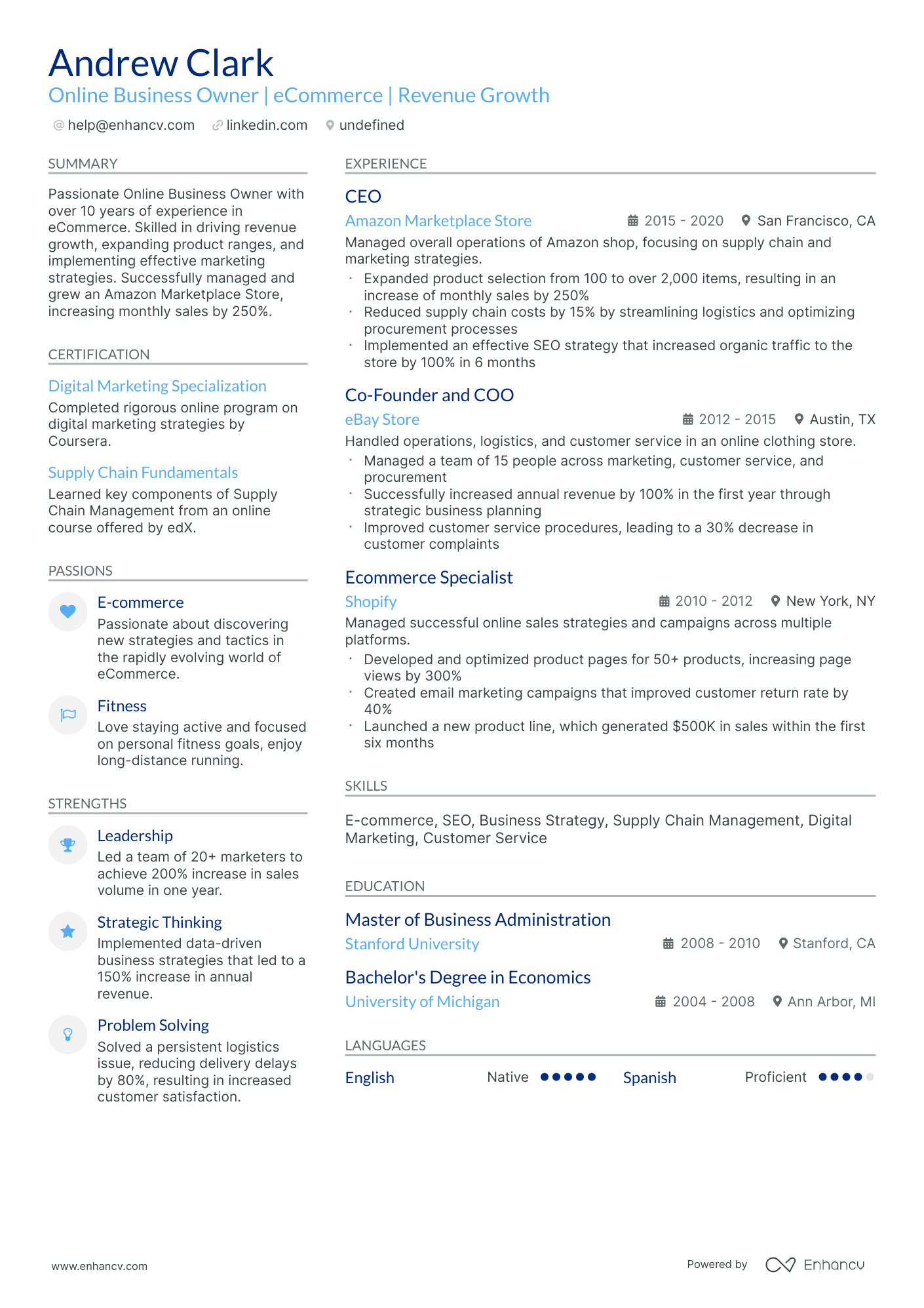
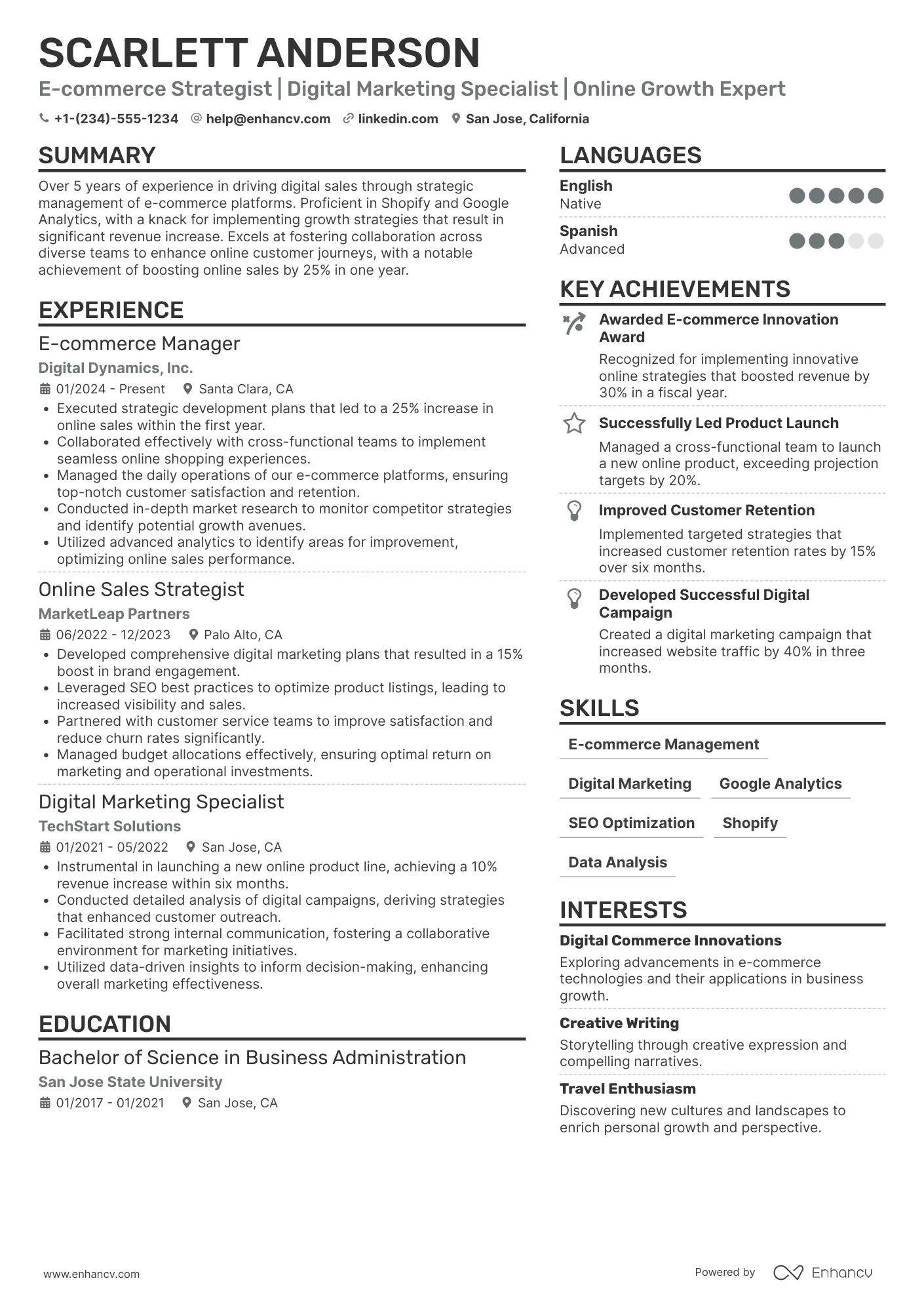
Many online business owner resume drafts fail because they read like storefront descriptions, not decision-ready evidence. That mismatch gets filtered by ATS rules and lost in rapid recruiter scans amid intense competition. If you're unsure where to begin, learning how to write a resume that communicates value is the essential first step.
A strong resume shows outcomes you drove and the scale you managed. You should highlight revenue growth, conversion lift, customer acquisition cost reduction, fulfillment speed, repeat purchase rate, profit margin gains, and successful launches across channels.

Key takeaways
- Quantify every achievement with revenue, conversion, retention, or cost metrics recruiters can verify.
- Choose reverse-chronological format for seasoned owners and hybrid format for career switchers.
- Tailor experience bullets to mirror the exact tools, platforms, and KPIs in each job posting.
- Demonstrate skills through outcome-driven experience bullets, not just a standalone skills list.
- Frame entrepreneurial results in corporate-friendly language that highlights team size, revenue, and processes built.
- Use Enhancv's Bullet Point Generator to turn daily tasks into measurable, recruiter-ready resume lines.
- Stop using AI once your resume accurately reflects real experience—never inflate or invent claims.
How to format a online business owner resume
Recruiters evaluating an online business owner resume want to see revenue generation, operational scope, digital marketing proficiency, and the ability to build and scale a business from the ground up. Because this role spans strategy, execution, and financial accountability, your resume format needs to surface measurable business outcomes and the breadth of your ownership experience immediately.

I have significant experience in this role—which format should I use?
Use a reverse-chronological format to present your business ventures and any prior roles in clear, dated order that demonstrates growth and sustained results. Do:
- Lead each entry with the scope of your ownership—revenue range, team size, market reach, and platforms managed.
- Highlight domain-specific skills such as e-commerce platform management (Shopify, WooCommerce), SEO, paid advertising, supply chain logistics, and CRM tools.
- Quantify business impact with concrete metrics tied to profitability, customer acquisition, and operational efficiency.
I'm junior or switching into this role—what format works best?
A hybrid format works best because it lets you lead with transferable skills and digital competencies while still grounding them in a chronological work or project history. Do:
- Place a skills section near the top that highlights e-commerce platforms, digital marketing channels, analytics tools, and financial management capabilities.
- Include freelance projects, side businesses, or relevant coursework that demonstrate hands-on experience with online business operations.
- Connect every skill or project to a specific action and a measurable result so recruiters see practical application.
Why not use a functional resume?
A functional format strips away the timeline of your experience, making it difficult for recruiters to verify how, where, and when you developed your business acumen—context that matters heavily for a role built on self-directed execution and accountability.
- A functional format may be acceptable if you're pivoting from a traditional employment background into online business ownership for the first time, have significant resume gaps, or lack formal work history—but only if every skill listed is tied to a specific project, freelance engagement, or measurable outcome rather than presented in isolation.
Once you've locked in the right format, the next step is deciding which sections to include so each one works together to present a complete picture of your experience.
What sections should go on a online business owner resume
Recruiters expect you to present a clear record of ownership, execution, and measurable business results. Knowing what to put on a resume ensures you include the sections that matter most for this role.
Use this structure for maximum clarity:
- Header
- Summary
- Experience
- Skills
- Projects
- Education
- Certifications
- Optional sections: Awards, Publications, Languages
Strong experience bullets should emphasize revenue and profit impact, growth outcomes, operational scope, and quantified results across channels and timeframes.
Is your resume good enough?
Drop your resume here or choose a file. PDF & DOCX only. Max 2MB file size.
Now that you’ve organized the key resume components, the next step is writing your online business owner experience so each entry supports the structure and highlights your impact.
How to write your online business owner resume experience
Your work experience section proves you can build, run, and grow a digital business—not just describe one. Hiring managers and potential partners prioritize demonstrated impact over descriptive task lists, so every bullet should highlight shipped work, role-relevant tools or platforms, and measurable outcomes that reflect your ability to drive revenue and scale operations.
Each entry should include:
- Job title
- Company and location (or remote)
- Dates of employment (month and year)
Three to five concise bullet points showing what you owned, how you executed, and what outcomes you delivered:
- Ownership scope: the online stores, digital product lines, revenue streams, vendor relationships, or remote teams you were directly accountable for as a business owner.
- Execution approach: the ecommerce platforms, marketing automation tools, analytics dashboards, fulfillment systems, or growth frameworks you used to make strategic decisions and deliver results.
- Value improved: changes to conversion rates, customer retention, operational efficiency, site performance, supply chain reliability, or financial risk that strengthened your online business.
- Collaboration context: how you coordinated with freelancers, agencies, suppliers, developers, or platform support teams to execute campaigns, product launches, or operational improvements.
- Impact delivered: outcomes expressed through business growth, market expansion, profitability, or customer reach rather than a simple list of daily activities.
Experience bullet formula
A online business owner experience example
✅ Right example - modern, quantified, specific.
Online Business Owner
Northwind Supply Co. | Remote
2021–Present
Direct-to-consumer home organization brand selling on Shopify and Amazon, serving 25,000+ customers annually.
- Launched and optimized a Shopify storefront using Klaviyo, GA4, and Hotjar, increasing conversion rate from 2.1% to 3.0% and adding $180,000 in annual revenue.
- Built a paid acquisition engine across Meta Ads and Google Ads with UTM governance and weekly cohort reporting, reducing customer acquisition cost by 22% while scaling monthly spend from $6,000 to $18,000.
- Implemented inventory forecasting and reorder points in Google Sheets integrated with ShipStation and Amazon Seller Central, cutting stockouts by 35% and improving on-time shipment rate to 98%.
- Led a product refresh with a contract designer and packaging vendor using Figma and Airtable to manage approvals, improving review rating from 4.3 to 4.6 and decreasing return rate by 14%.
- Automated customer support workflows in Gorgias with macros and order lookups, saving eight hours per week and improving first-response time from twelve hours to two hours.
Now that you've seen how a strong experience section comes together, let's break down the specific strategies you can use to tailor each detail to the job you're targeting.
How to tailor your online business owner resume experience
Recruiters evaluate your resume through both applicant tracking systems and manual review, so alignment with the job posting is critical. Tailoring your resume to the job description ensures your most relevant accomplishments surface quickly for each specific role.
Ways to tailor your online business owner experience:
- Match e-commerce platforms and digital tools named in the job description.
- Mirror the exact terminology used for revenue growth or scaling strategies.
- Highlight experience with the specific marketing channels the role requires.
- Reflect KPIs like customer acquisition cost or lifetime value when referenced.
- Include industry or niche expertise that aligns with the company's market.
- Emphasize data privacy compliance or security practices if the role mentions them.
- Reference cross-functional collaboration models described in the posting.
- Align your workflow language with project management frameworks they use.
Tailoring means connecting your real accomplishments to what the employer values—not forcing keywords where they don't belong.
Resume tailoring examples for online business owner
| Job description excerpt | Untailored | Tailored |
|---|---|---|
| "Manage and scale a Shopify-based DTC brand, including email marketing through Klaviyo and paid social campaigns across Meta and Google Ads." | Managed an online store and ran digital marketing campaigns. | Scaled a Shopify DTC storefront to $1.2M in annual revenue, building Klaviyo email flows that drove 34% of total sales and managing $15K/month in Meta and Google Ads spend at a 4.2x ROAS. |
| "Oversee daily operations including inventory management, vendor negotiations, and fulfillment logistics through Amazon FBA and a third-party 3PL provider." | Handled business operations and worked with suppliers. | Coordinated inventory across Amazon FBA and a 3PL warehouse, negotiating vendor contracts that reduced product costs by 18% while maintaining a 98.5% on-time fulfillment rate across 3,000+ monthly orders. |
| "Build and optimize conversion funnels using ClickFunnels, A/B test landing pages, and grow organic traffic through SEO content strategy targeting high-intent buyer keywords." | Created website content and worked on improving sales. | Designed and A/B tested ClickFunnels sales funnels that increased checkout conversion by 27%, while executing an SEO content strategy targeting high-intent buyer keywords that grew organic traffic from 8K to 42K monthly sessions in 10 months. |
Once you’ve aligned your experience with the role’s priorities, quantify your online business owner achievements to prove the impact behind those choices.
How to quantify your online business owner achievements
Quantifying your achievements shows how your decisions moved the business forward, not just what you did. Focus on revenue, conversion rate, retention, customer satisfaction, and efficiency so hiring managers can see your impact fast.
Quantifying examples for online business owner
| Metric | Example |
|---|---|
| Revenue growth | "Grew monthly revenue from $12,000 to $19,500 in six months by optimizing Shopify bundles and running Klaviyo email flows." |
| Conversion rate | "Increased site conversion from 1.8% to 2.6% by A/B testing product pages in Google Optimize and improving checkout UX." |
| Retention | "Raised ninety-day repeat purchase rate from 22% to 31% by launching a loyalty program and post-purchase sequences in Klaviyo." |
| Customer satisfaction | "Improved customer satisfaction score from 4.2 to 4.7 out of five by adding self-serve order tracking and reducing support backlog." |
| Cost efficiency | "Cut shipping cost per order by 14% by renegotiating carrier rates and switching to a three-pl warehouse for faster zone coverage." |
Turn your everyday tasks into measurable, recruiter-ready resume bullets in seconds with Enhancv's Bullet Point Generator.
Once you've crafted strong bullet points to showcase your experience, the next step is strategically presenting the hard and soft skills that reinforce your qualifications as an online business owner.
How to list your hard and soft skills on a online business owner resume
Your skills section shows how you grow revenue and run operations, and recruiters and applicant tracking systems (ATS) scan them to match your fit fast; aim for a balanced mix of hard skills (tools and methods) and soft skills (execution behaviors). online business owner roles require a blend of:
- Product strategy and discovery skills.
- Data, analytics, and experimentation skills.
- Delivery, execution, and go-to-market discipline.
- Soft skills.
Your skills section should be:
- Scannable (bullet-style grouping).
- Relevant to the job post.
- Backed by proof in experience bullets.
- Updated with current tools.
Place your skills section:
- Above experience if you're junior or switching careers.
- Below experience if you're mid/senior with strong achievements.

Hard skills
- Shopify, WooCommerce
- Amazon Seller Central
- Google Analytics 4, Looker Studio
- Google Tag Manager
- Search engine optimization
- Google Ads, Meta Ads Manager
- Klaviyo, Mailchimp
- Conversion rate optimization
- A/B testing, landing pages
- Pricing and margin analysis
- Inventory forecasting, demand planning
- Customer relationship management (HubSpot)
Soft skills
- Prioritize revenue-impact work
- Make data-backed decisions
- Write clear customer messaging
- Negotiate with vendors and partners
- Lead contractors and freelancers
- Align stakeholders on goals
- Diagnose issues fast
- Execute week-over-week improvements
- Manage tradeoffs under constraints
- Communicate performance updates clearly
- Handle customer escalations calmly
- Own outcomes end-to-end
How to show your online business owner skills in context
Skills shouldn't live only in a dedicated skills list. Explore resume skills examples to see how top candidates weave competencies throughout their resumes.
They should be demonstrated in:
- Your summary (high-level professional identity)
- Your experience (proof through outcomes)
Here's what that looks like in practice.
Summary example
Senior e-commerce entrepreneur with 12 years scaling DTC brands using Shopify, Google Analytics, and paid media strategy. Built a sustainable home goods store from zero to $2.4M annual revenue while leading a remote team of nine.
- Signals senior-level expertise immediately
- Names role-relevant platforms and tools
- Includes a concrete revenue metric
- Highlights remote leadership as soft skill
Experience example
Founder & CEO
BrightLeaf Home Goods | Remote
March 2017–January 2024
- Grew monthly revenue from $8K to $198K within three years by optimizing Shopify storefront conversion rates and refining Facebook Ads targeting strategy.
- Collaborated with a five-person content team to launch an SEO-driven blog, increasing organic traffic by 140% over 18 months.
- Reduced customer acquisition cost by 34% using Klaviyo email automation and A/B-tested landing pages built in Unbounce.
- Every bullet contains measurable proof.
- Skills appear naturally through outcomes.
Once you’ve tied your capabilities to real outcomes and responsibilities, the next step is to apply that same approach to writing an online business owner resume with no experience.
How do I write a online business owner resume with no experience
Even without full-time experience, you can demonstrate readiness through transferable projects and side ventures. Our guide on writing a resume without work experience walks you through the full approach. Start by showcasing:
- Etsy or Shopify store setup
- Product listings and copywriting tests
- Social media ad campaigns run
- Email marketing flows built
- Customer support tickets resolved
- Basic bookkeeping and invoicing
- Supplier sourcing and negotiations
- Website analytics and conversion tracking
Focus on:
- Revenue, profit, and order metrics
- Acquisition channels and conversion rates
- Tools used: Shopify, Google Analytics
- Repeatable processes and documentation
Resume format tip for entry-level online business owner
Use a combination resume format because it highlights skills and projects first, while still showing any work history, even if limited. Do:
- Add a Projects section above Work.
- Quantify results: orders, revenue, conversion.
- Name tools used in each bullet.
- Show end-to-end ownership: launch to support.
- Include a link to your store.
- Launched a Shopify store, wrote ten product listings, and tracked Google Analytics weekly, increasing conversion rate from 0.8% to 1.6% in six weeks.
Once you've framed your transferable skills and relevant projects to compensate for a lack of formal experience, presenting your education strategically can further strengthen your candidacy.
How to list your education on a online business owner resume
Your education section helps hiring teams confirm you have foundational knowledge in business, marketing, or technology relevant to the online business owner role.
Include:
- Degree name
- Institution
- Location
- Graduation year
- Relevant coursework (for juniors or entry-level candidates)
- Honors & GPA (if 3.5 or higher)
Skip month and day details—list the graduation year only.
Here's a strong education entry tailored for an online business owner resume.
Example education entry
Bachelor of Science in Business Administration
University of Georgia, Athens, GA
Graduated 2019
GPA: 3.7/4.0
- Relevant coursework: E-Commerce Strategy, Digital Marketing, Consumer Behavior, Financial Management, and Data Analytics
- Honors: Magna Cum Laude, Dean's List (six consecutive semesters)
How to list your certifications on a online business owner resume
Certifications on a resume show an online business owner's commitment to learning, hands-on tool proficiency, and industry relevance across marketing, ecommerce, analytics, and operations.
Include:
- Certificate name
- Issuing organization
- Year
- Optional: credential ID or URL
- Place certifications below education when they're older, less relevant, or you want your degree to lead your qualifications.
- Place certifications above education when they're recent, highly relevant, or you lack formal education tied to your online business owner work.
Best certifications for your online business owner resume
- Google Analytics Certification
- Google Ads Search Certification
- Meta Certified Digital Marketing Associate
- HubSpot Content Marketing Certification
- HubSpot Inbound Marketing Certification
- Shopify Partner Academy Certifications
- Amazon Advertising Sponsored Ads Certification
Once you’ve placed your certifications where they’re easy to verify, focus on your online business owner resume summary to connect those credentials to your overall value at a glance.
How to write your online business owner resume summary
Your resume summary is the first thing a recruiter reads. A strong one instantly connects your entrepreneurial experience to the role you're targeting.
Keep it to three to four lines, with:
- Your title and total years of relevant business ownership experience.
- The industry, niche, or product type you operated in.
- Core skills like e-commerce platforms, digital marketing, or supply chain management.
- One or two measurable wins, such as revenue growth or customer acquisition numbers.
- Soft skills tied to real outcomes, like negotiation that closed vendor contracts or leadership that retained a remote team.

PRO TIP
As a business owner, focus on translating entrepreneurial results into corporate-friendly language. Highlight revenue you generated, teams you managed, and processes you built. Avoid vague claims like "passionate self-starter" or "visionary entrepreneur." Recruiters want proof, not personality descriptors.
Example summary for a online business owner
Online business owner with six years of experience scaling a direct-to-consumer brand to $1.2M in annual revenue. Skilled in Shopify, paid media strategy, and vendor negotiations. Built and managed a 12-person remote team.
Optimize your resume summary and objective for ATS
Drop your resume here or choose a file.
PDF & DOCX only. Max 2MB file size.
Now that your summary captures your value as an online business owner, make sure your header presents the essential contact and branding details that let hiring managers reach you.
What to include in a online business owner resume header
What to include in a online business owner resume header
A resume header is the top section with your key identifiers, and it boosts visibility, credibility, and recruiter screening for a online business owner.
Essential resume header elements
- Full name
- Tailored job title and headline
- Location
- Phone number
- Professional email
- GitHub link
- Portfolio link
Including a LinkedIn link helps recruiters verify experience quickly and supports screening.
Do not include photos on a online business owner resume unless the role is explicitly front-facing or appearance-dependent.
Match your job title and headline to the posting, and keep your links consistent with the same name across profiles.
Online business owner resume header
Jordan Lee
Online business owner | E-commerce operations, paid ads, and conversion-focused growth
Austin, TX
(512) 555-01XX
your.name@enhancv.com
github.com/yourname
yourwebsite.com
linkedin.com/in/yourname
Once your header clearly identifies who you are and how to reach you, add targeted additional sections to reinforce key qualifications that don’t fit in the main resume content.
Additional sections for online business owner resumes
When your core experience doesn't tell the full story, additional sections help highlight unique strengths that set you apart as an online business owner. For example, listing language skills on your resume can demonstrate your ability to serve international customers and operate across multilingual markets.
- Languages
- Certifications and licenses
- Publications and thought leadership
- Speaking engagements and webinars
- Professional affiliations and communities
- Notable projects and product launches
- Awards and recognitions
Once you've strengthened your resume with relevant additional sections, pairing it with a well-crafted cover letter can further set your application apart.
Do online business owner resumes need a cover letter
A cover letter isn't required for an online business owner, but it helps in competitive roles or when hiring managers expect one. If you're unsure where to start, understanding what a cover letter is and how it complements your resume can clarify when it's worth writing one. It can make a difference when your resume needs context, or when you need to show fit fast.
Use a cover letter to add context your resume can't:
- Explain role and team fit by linking your operating style to the company's stage, pace, and cross-functional needs.
- Highlight one or two relevant projects or outcomes, and connect each to revenue, retention, conversion, or cost control.
- Show you understand the product, users, and business context by naming a key audience, channel, and metric you'd prioritize.
- Address career transitions or non-obvious experience by explaining the bridge skills, scope, and results that transfer directly.
Drop your resume here or choose a file.
PDF & DOCX only. Max 2MB file size.
Even if you decide to include a cover letter to add context beyond your resume, AI can help you strengthen the resume itself by improving clarity, relevance, and impact.
Using AI to improve your online business owner resume
AI can sharpen your resume's clarity, structure, and impact. It helps refine language and highlight measurable results. But overuse dulls authenticity. Once your content is clear and role-aligned, step away from AI. If you're wondering which AI is best for writing resumes, the key is choosing tools that enhance your real experience rather than fabricate it.
Here are 10 practical prompts to strengthen specific sections of your online business owner resume:
- Sharpen your summary: "Rewrite my resume summary to highlight my top three achievements as an online business owner in two concise sentences."
- Quantify revenue results: "Add specific revenue metrics to my experience bullets that reflect my role as an online business owner scaling digital sales."
- Strengthen action verbs: "Replace weak verbs in my online business owner experience section with strong, results-driven action verbs."
- Refine skills section: "Identify the most relevant hard and soft skills for an online business owner resume and remove outdated ones."
- Tighten project descriptions: "Condense my project descriptions to one sentence each, emphasizing outcomes I delivered as an online business owner."
- Align with job posting: "Compare my online business owner resume bullets against this job description and flag any gaps in keyword alignment."
- Improve education relevance: "Rewrite my education section to emphasize coursework and training directly applicable to my online business owner career."
- Clarify certification value: "Explain how each certification listed supports my credibility as an online business owner in one brief phrase."
- Eliminate filler language: "Remove vague or redundant phrasing from my online business owner resume without changing the original meaning."
- Highlight growth metrics: "Rewrite my experience bullets to emphasize customer growth, retention rates, and profit margins as an online business owner."
Stop using AI once your resume sounds accurate, specific, and aligned with real experience. AI should never invent experience or inflate claims—if it didn't happen, it doesn't belong here.
Conclusion
A strong online business owner resume proves results. It highlights measurable outcomes, role-specific skills, and a clear structure that makes your impact easy to scan.
Keep the focus on what you built, improved, and delivered. With clean formatting and strong metrics, your online business owner resume shows you’re ready for today’s hiring market and what comes next.