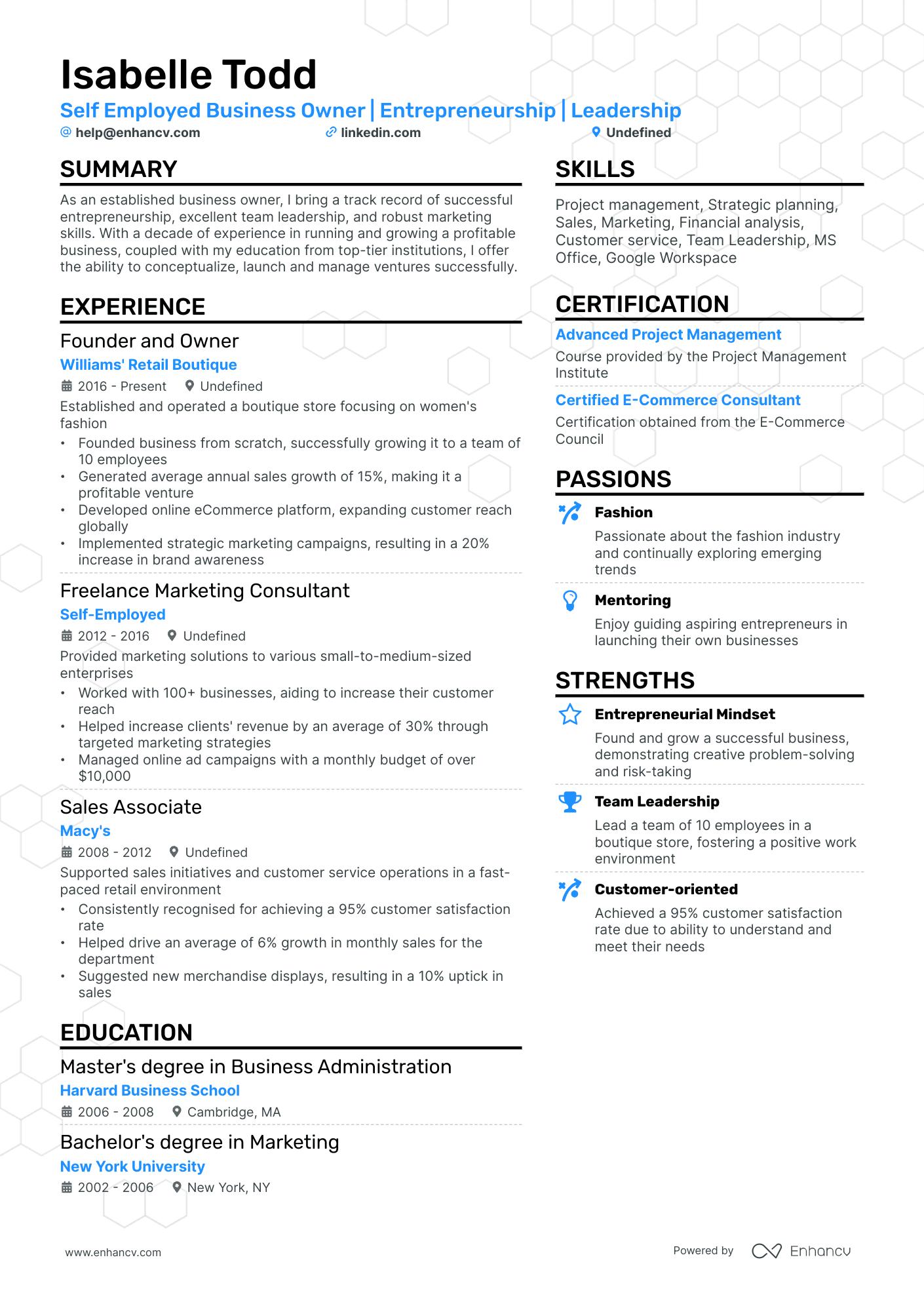
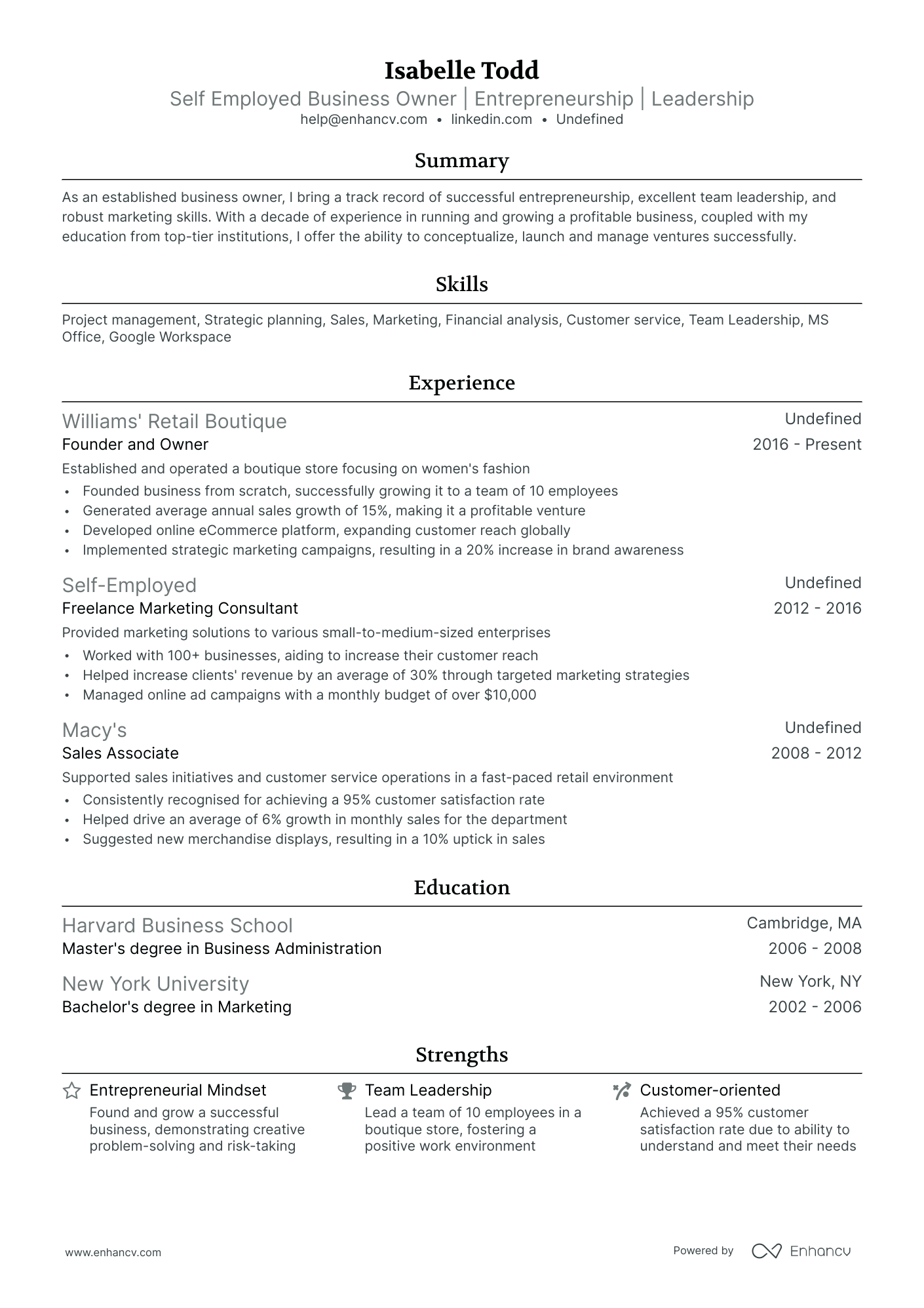
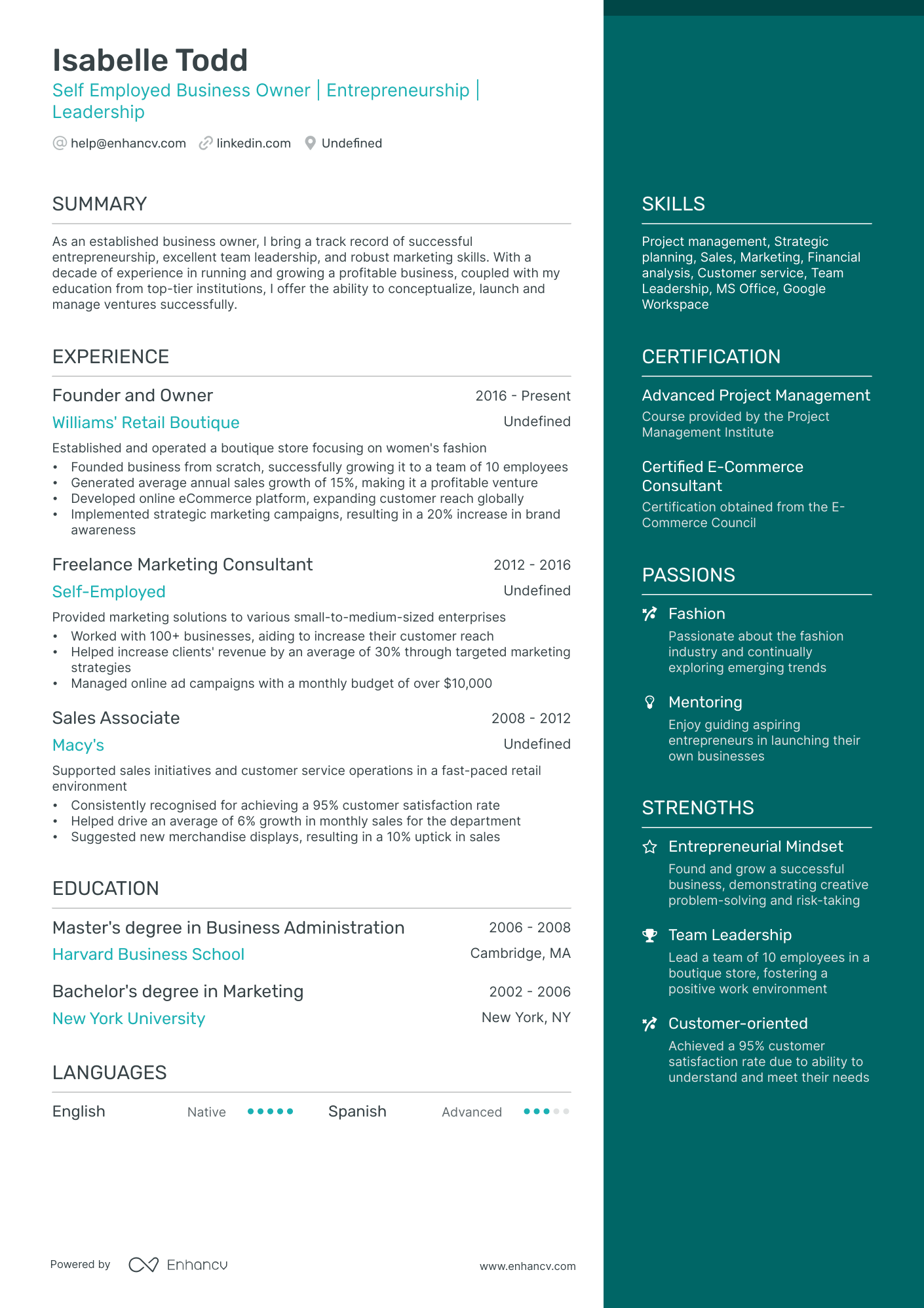
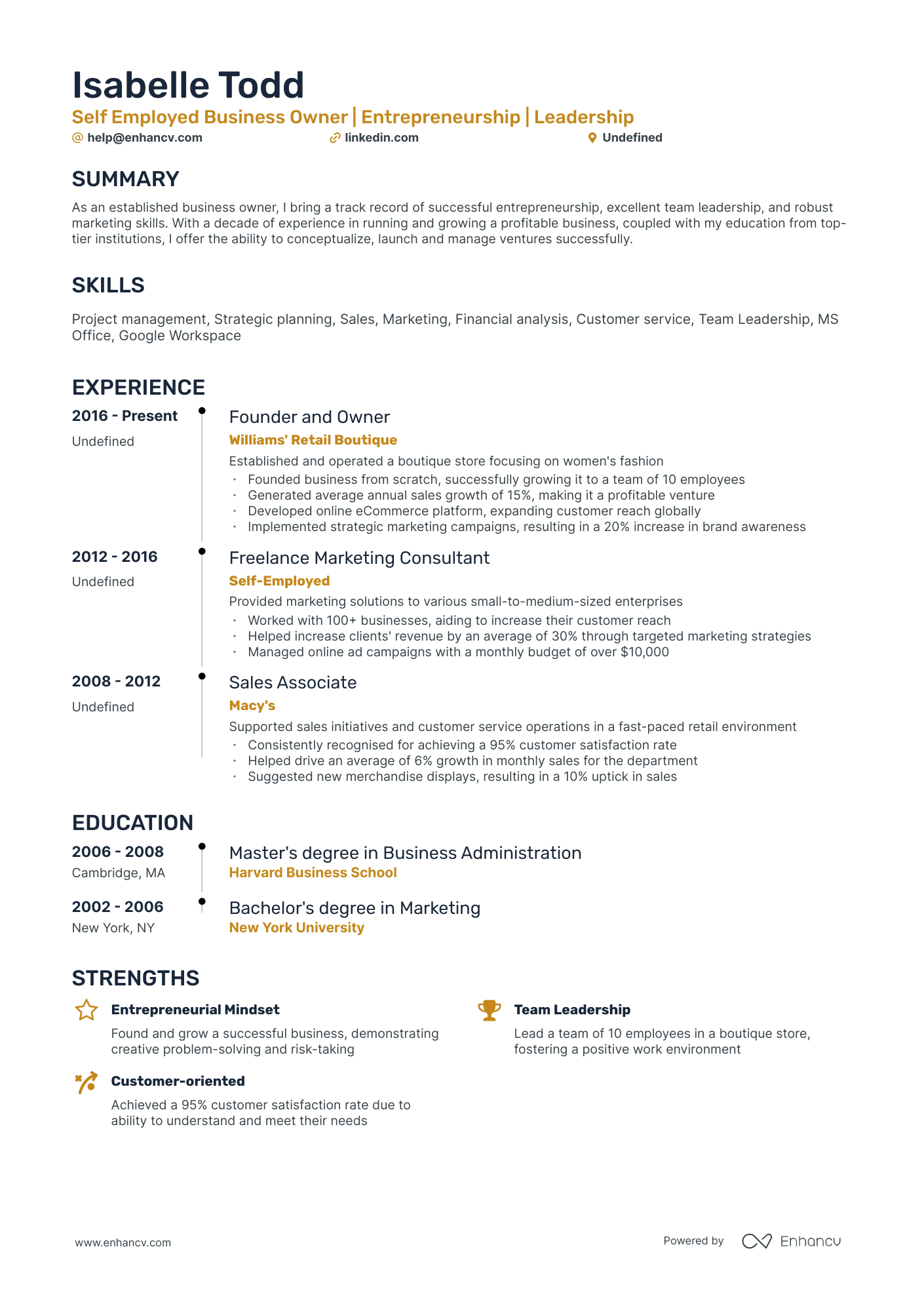
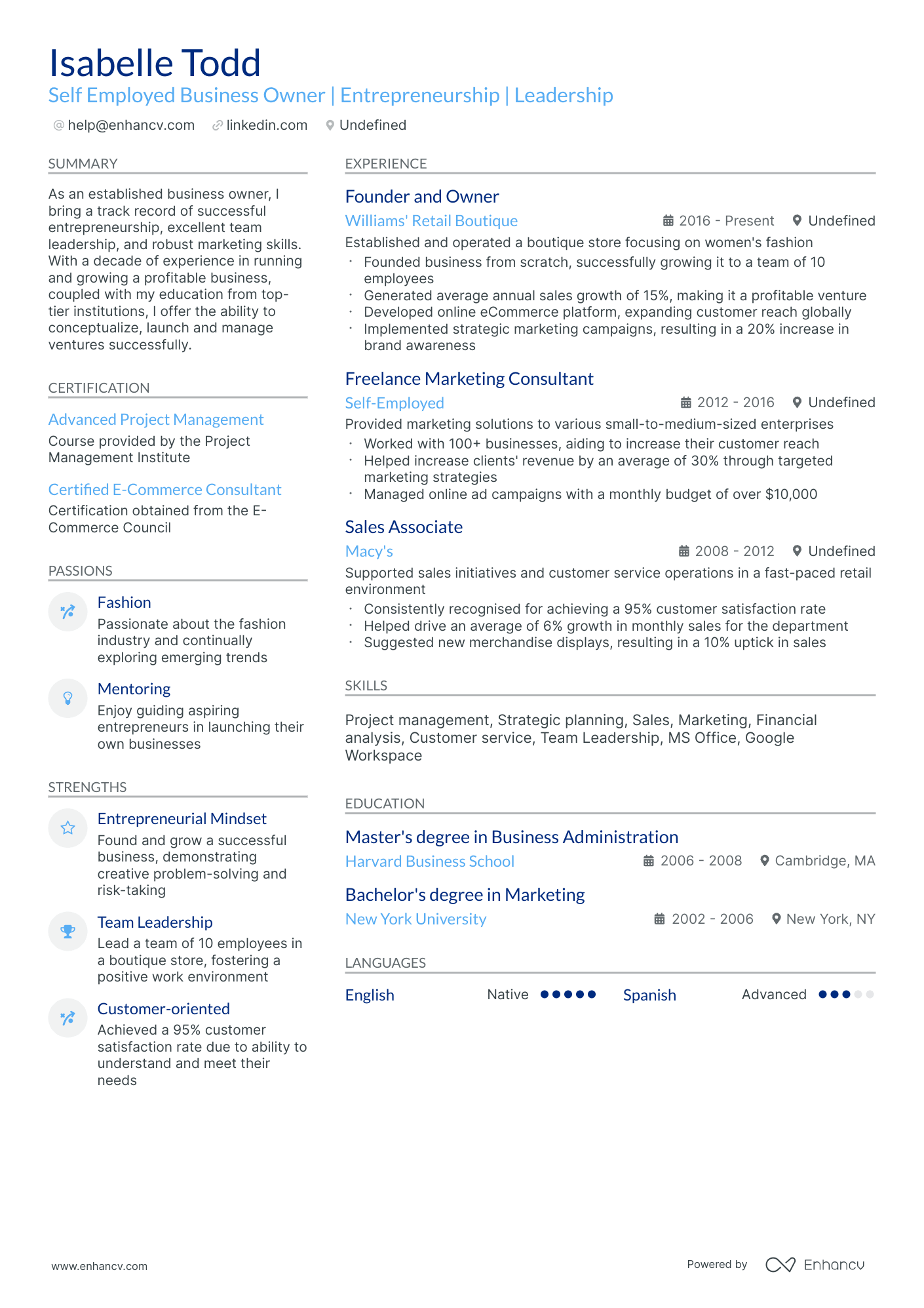
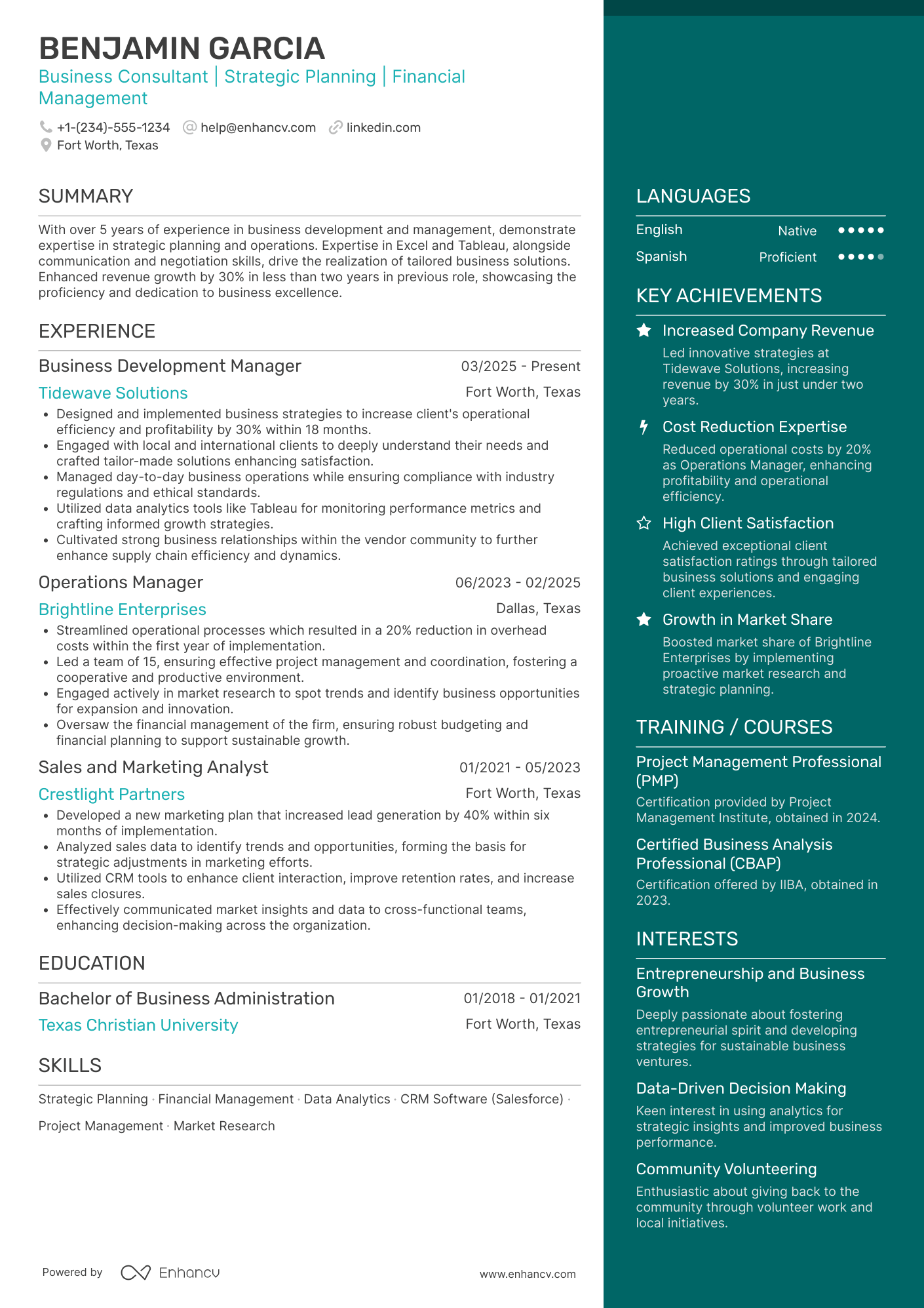
A self-employed business owner resume often lists every task you handled without showing the business you built. Hiring managers scan fast, and applicant tracking system (ATS) filters look for job-ready skills a long task list buries.
When you're writing your resume after running your own business, lead with results an employer can picture. Show revenue growth, client retention, profit margins, projects delivered, and the people you hired or managed.

Key takeaways
- Present your business as a job with a clear title and dates.
- Lead each bullet with revenue, client, or cost results you achieved.
- Use a hybrid format if you're moving into a different field.
- Translate owner tasks into the skills the posting asks for.
- Quantify clients served, revenue growth, and profit margins.
- Use Enhancv's Bullet Point Generator to turn daily tasks into measurable bullets.
How to format a self-employed business owner resume
Hiring managers reviewing self-employed business owners look first for results, the scope of what you ran, and skills that transfer to their team. A clear resume format presents your business like any other role, with a title, dates, and outcomes.
Resume formatting strategy for self-employed business owners
| Category | Senior & leadership strategy | Entry to mid-level strategy |
|---|---|---|
| Recommended format | Reverse-chronological | Reverse-chronological or hybrid |
| Core dos | Lead each role with the business you ran: revenue, clients, and staff. Name the functions you owned, such as sales, operations, and finance. Tie every bullet to growth, profit, or client results. | Put the skills the target job needs near the top. Count client projects and freelance work as transitional experience. Link each action to a result such as revenue or repeat clients. |
| Example bullet | Led a 9-person landscaping business to $1.4M in annual revenue, growing commercial contracts 60% in three years. | QuickBooks bookkeeping → cut overdue invoices from 30% to 8% → improved monthly cash flow by $6K. |
| Format to avoid | Hybrid and functional formats hide how long you ran the business and when results happened. Hiring managers lose the timeline that proves your staying power. Treat any non-chronological layout as a risk when your business is your main experience. | A functional format hides where and when you used each skill. Edge cases: a switch into a new industry after self-employment, or a return after a long break. |
Use a functional resume layout only in edge cases, and back every skill on it with a client project and a result.
With the format settled, the sections you choose decide how clearly your business reads as real experience.
What sections should go on a self-employed business owner resume?
Recruiters expect a self-employed business owner resume to present the business like a job, and choosing what to include on a resume starts there.
Use this structure for maximum clarity:
- Header
- Summary
- Experience
- Skills
- Projects
- Education
- Certifications
- Optional sections: Licenses, Awards, Volunteer work
Strong experience bullets should emphasize revenue and client results, the functions you ran, and the size of the business you built.
Is your resume good enough?
Drop your resume here or choose a file. PDF & DOCX only. Max 2MB file size.
Experience is where your business becomes proof, and it needs the most care on this resume.
How to write your self-employed business owner resume experience
Your work experience section should list the business as a job and show what you delivered with tools like QuickBooks, Shopify, or a CRM. Hiring managers prioritize demonstrated impact on revenue, clients, and costs over a list of every task you handled.
Each entry should include:
- Job title
- Company and location (or remote)
- Dates of employment (month and year)
Three to five concise bullet points showing what you owned, how you executed, and what outcomes you delivered:
- Ownership scope: the business, services, clients, and staff you were accountable for as a self-employed business owner
- Execution approach: the tools, systems, and methods you used to sell, deliver, and run operations
- Value improved: changes to revenue, profit margins, client retention, or turnaround time
- Collaboration context: how you worked with clients, vendors, contractors, and partners
- Impact delivered: results stated as revenue growth, repeat business, savings, or projects completed

Experience bullet formula
A self-employed business owner experience example
✅ Right example - modern, quantified, specific.
Founder and Owner
Tidewell Home Services | Raleigh, NC
2017–Present
Residential repair and renovation business serving 400+ homeowners a year.
- Grew annual revenue from $180K to $760K in six years by adding kitchen and bath remodeling services.
- Hired and managed a team of 7 technicians and 2 subcontractor crews, keeping 92% of jobs on schedule.
- Built a client follow-up system in Jobber, raising repeat and referral business to 55% of revenue.
- Negotiated supplier pricing with 4 distributors, cutting material costs by 12% across 300 projects a year.
- Managed bookkeeping and taxes in QuickBooks with an outside accountant, keeping net margins above 18%.
That entry shows the standard, and tailoring connects your business experience to what each employer needs.
How to tailor your self-employed business owner resume experience
Recruiters screen self-employed business owner resumes in an ATS, then a hiring manager looks for skills that fit the open role. Tailoring your resume to each job turns your owner experience into the employer's language.
Ways to tailor your self-employed business owner experience:
- Match the software and tools the posting names.
- Use the employer's terms for the skills you practiced.
- Mirror the customers or markets the company serves.
- Highlight the functions the role covers such as sales or operations.
- Name the team size you managed when the job supervises staff.
- Emphasize compliance or licensing work when the posting requires it.
- Reflect the results the employer measures such as revenue or service quality.
Tailoring presents your real business results in the employer's terms without forcing in keywords.
Resume tailoring examples for self-employed business owners
| Job description excerpt | Untailored | Tailored |
|---|---|---|
| "Manage client relationships and grow revenue within an assigned territory." | Ran my own business and handled clients. | Managed 120 client accounts as owner of a home services business, growing annual revenue 3x in five years. |
| "Oversee daily operations, scheduling, and vendor relationships." | Took care of operations. | Ran scheduling for 9 staff and 4 vendors in Jobber, completing 300+ projects a year with 92% on time. |
| "Prepare budgets, track expenses, and report on financial performance." | Did the bookkeeping. | Built annual budgets and monthly profit reports in QuickBooks, keeping net margins above 18% for five straight years. |
Tailored bullets connect your business to the role, and numbers show how well you ran it.
How to quantify your self-employed business owner achievements
Adding numbers to your resume proves the business worked and gives hiring managers results they can compare. For this role, the numbers that matter are revenue, profit, clients, costs, and projects completed.
Quantifying examples for self-employed business owners
| Metric | Example |
|---|---|
| Revenue growth | "Grew annual revenue from $95K to $310K in four years by adding a subscription service line." |
| Client retention | "Kept 85% of clients for three or more years through quarterly check-ins and service guarantees." |
| Profit margin | "Raised net margin from 9% to 17% by renegotiating supplier terms and dropping 2 low-profit services." |
| Cost savings | "Cut software and overhead costs by $14K a year by consolidating 6 tools into one platform." |
| Project volume | "Completed 240 client projects a year with a 4.9-star average across 180 online reviews." |
Turn the work of running your own business into measurable, recruiter-ready bullets with Enhancv's Bullet Point Generator.
Those numbers prove you can deliver, and your skills section shows which of your abilities transfer to the new role.
How to list your hard and soft skills on a self-employed business owner resume
Recruiters and ATS filters scan your resume skills section for skills that match the job, and owners do best when they pair hard skills like bookkeeping with soft skills like client communication.
Self-employed business owner roles require a blend of:
- Business operations and management skills
- Sales, marketing, and client skills
- Finance and bookkeeping skills
- Soft skills
Your skills section should be:
- Scannable (bullet-style grouping)
- Relevant to the job post
- Backed by proof in experience bullets
- Updated with current tools
Place your skills section:
- Above experience if you're junior or switching careers
- Below experience if you're mid/senior with strong achievements

Hard skills
- Business operations management
- Bookkeeping in QuickBooks or Xero
- Budgeting and cash flow management
- Pricing and quoting
- Sales and client acquisition
- Digital marketing and social media
- CRM tools such as HubSpot
- Vendor and supplier negotiation
- Scheduling and project management
- Hiring and supervising staff
- Contracts and invoicing
- Tax and licensing compliance
Soft skills
- Making decisions without a manager
- Owning results end to end
- Clear client communication
- Negotiating with suppliers
- Handling complaints calmly
- Managing time across many roles
- Adapting quickly to change
- Building long-term client trust
- Solving problems with limited resources
- Leading small teams by example
How to show your self-employed business owner skills in context
The transferable skills employers want carry more weight when your summary and bullets prove them, not only when they sit in a list.
Show them in:
- Your summary (high-level professional identity)
- Your experience (proof through outcomes)
Here's how a self-employed business owner can show skills in context.
Summary example
Self-employed business owner with six years running a bookkeeping and payroll firm for 60 small businesses. Grew revenue 140% through referrals while keeping client retention above 90%, using QuickBooks, Gusto, and HubSpot.
- States experience and business type
- Names tools employers recognize
- Proves growth with clear metrics
- Shows client relationship strength
Experience example
Owner
Marlowe Bookkeeping Services | Remote
June 2020–Present
- Onboarded 45 small-business clients through referral partnerships with 3 local accountants, growing revenue 140% in four years.
- Moved all clients to QuickBooks Online and Gusto, cutting monthly close time from 12 days to 5.
- Trained and supervised 2 part-time bookkeepers, keeping client error rates under 1% across 2,000 monthly transactions.
- Each bullet shows a measured result
- Skills appear inside real client work
Those examples come from established owners, and people whose business is new or small need a different way to show readiness.
How do I write a self-employed business owner resume with no experience?
Even without full-time experience, you can demonstrate readiness through:
- Side business or freelance gigs
- Online store or marketplace sales
- Client projects for friends or family
- Small business courses or incubators
- Family business work
- Volunteer event or fundraiser management
- Part-time sales or service jobs
Focus on:
- Revenue or sales you generated
- Clients you served and kept
- Tools you used to run things
- Problems you solved independently
Resume format tip for entry-level self-employed business owner
A hybrid format works best: lead with skills and client projects, then list the business and any part-time jobs. A resume without formal work experience still wins interviews when each project shows a result. Do:
- Give your business a clear title and dates.
- Quantify sales, clients, or orders for each project.
- List the tools you used, like Shopify or QuickBooks.
- Add a summary that names the job you want.
- Include a link to your business website.
- Launched an Etsy shop selling custom candles, reaching 1,100 orders and $28K in sales in the first 18 months.
Business projects show initiative, and your education section adds the formal training behind your skills.
How to list your education on a self-employed business owner resume
Your education section helps hiring teams confirm the business, trade, or technical training behind the company you ran.
Include:
- Degree name
- Institution
- Location
- Graduation year
- Relevant coursework (for juniors or entry-level candidates)
- Honors & GPA (if 3.5 or higher)
Include just the graduation year, with no months or days.
Here's an education entry for a self-employed business owner:
Example education entry
Associate of Applied Science in Business Administration
Wake Technical Community College, Raleigh, NC
Graduated: 2014
GPA: 3.6/4.0
- Relevant Coursework: Small Business Management, Principles of Accounting, Marketing, Business Law
- Honors: Phi Theta Kappa Honor Society
Certifications usually follow education, and a few credentials show you know the tools and rules behind running a business.
How to list your certifications on a self-employed business owner resume
Adding certifications to a resume shows a self-employed business owner keeps learning, knows key business tools, and meets the standards of their field.
Include:
- Certificate name
- Issuing organization
- Year
- Optional: credential ID or URL
- Place certifications below education when they're older or less tied to the job you want.
- Place certifications above education when they're current, required, or named in the posting.
Best certifications for your self-employed business owner resume
- QuickBooks Certified User
- QuickBooks Online ProAdvisor Certification
- Google Digital Marketing & E-commerce Professional Certificate
- HubSpot Inbound Marketing Certification
- Certified Associate in Project Management (CAPM)
Certifications back up your skills, and your summary tells a hiring manager why your business experience fits their team.
How to write your self-employed business owner resume summary
A short resume profile helps a hiring manager see your business as relevant experience in seconds. Those first lines connect what you ran to the job you want.
Keep it to three to four lines, with:
- Your title, such as owner or founder, and years in business.
- The industry or services your business provides.
- Core tools and skills, like QuickBooks or client acquisition.
- One or two quantified results, such as revenue or client retention.
- Soft skills tied to outcomes, like keeping clients for years.

PRO TIP
Present your business at the level of a manager, with team size, revenue, and one growth result up front. Skip phrases like "jack of all trades" or "self-starter," and let the results you built show your range.
Example summary for a self-employed business owner
Self-employed business owner with seven years running a residential cleaning company. Manages 12 staff and 150 recurring clients, growing revenue to $520K a year while holding client retention at 88%.
Optimize your resume summary and objective for ATS
Drop your resume here or choose a file.
PDF & DOCX only. Max 2MB file size.
A clear summary works best under a header with your target title and contact details.
What to include in a self-employed business owner resume header
Your resume header holds your name, target title, and contact details, and it's where a hiring manager first sees you as a candidate.
Essential resume header elements
- Full name
- Tailored job title and headline
- Location
- Phone number
- Professional email
- Portfolio link
A LinkedIn link lets recruiters confirm your business, dates, and client work quickly.
Leave the photo off a self-employed business owner resume unless the role is explicitly front-facing or appearance-dependent.
Use a target title that matches the job, such as operations manager, and add "business owner" to your headline.
Example
Self-employed business owner resume header
Andre Delgado
Operations manager and business owner | Small business growth, client service, and team leadership
Tampa, FL | (813) 555-01XX | andre.delgado@enhancv.com andredelgado.com linkedin.com/in/andredelgado
With the essentials in place, a few extra sections can show the full range of your business work.
Additional sections for self-employed business owner resumes
Additional sections help when they add credibility, such as professional licenses, industry awards, or volunteer work on a resume that shows community ties.
- Licenses and permits
- Awards and recognition
- Client projects
- Professional associations
- Volunteer work
- Languages
Those sections add context, and a cover letter explains why you're moving from your own business to a new role.
Do self-employed business owner resumes need a cover letter?
Cover letters are often optional, and they still help self-employed business owners more than most applicants. A short letter explains why you're joining a team and how your business skills fit the role.
Let the cover letter handle:
- Your transition: Explain in one sentence why you're moving from ownership to employment.
- Role fit: Connect the business skills you used daily to the job's main duties.
- One result: Describe a growth or client win with the number behind it.
- Team readiness: Show you're ready to work within a team and its processes.
Drop your resume here or choose a file.
PDF & DOCX only. Max 2MB file size.
Once your letter explains the move, AI can help you polish the resume itself.
Using AI to improve your self-employed business owner resume
AI can tighten wording, organize sections, and turn owner tasks into clear results on your self-employed business owner resume. Use resume prompts for AI on drafts you've written, and stop when the language starts sounding generic.
Use these prompts on one section at a time:
- Frame the business: "Rewrite my self-employed business owner resume summary to present my business as relevant experience for this job."
- Quantify your results: "Review my self-employed business owner experience bullets and suggest where to add revenue, client, cost, or project numbers."
- Translate owner tasks: "Rewrite my self-employed business owner bullets in the language of this job description, keeping every claim accurate."
- Strengthen verbs: "Replace weak verbs in my self-employed business owner experience section with precise verbs that show ownership and results."
- Match the posting: "Compare my self-employed business owner skills section with this job description and list the skills to add or remove."
- Explain the move: "Write one sentence for my self-employed business owner resume summary that explains why I'm joining a team now."
- Tighten project entries: "Edit the client projects on my self-employed business owner resume to show the problem, my work, and the result."
- Polish the headline: "Rewrite my self-employed business owner resume headline to name my target role and strongest skill in under 12 words."
- Connect certifications: "Rewrite my certifications section so each credential ties to a self-employed business owner skill such as bookkeeping."
- Remove filler: "Scan my self-employed business owner resume for filler, passive voice, and vague phrases, and suggest direct replacements."
Stop using AI once your resume sounds accurate, specific, and true to the business you built. AI should never invent experience or inflate claims: if it didn't happen, it doesn't belong on your resume.
Conclusion
A strong self-employed business owner resume presents your business like a job, proves results with numbers, and shows skills that transfer to the role.
Employers value people who've run a business and owned the outcome. Keep your resume focused on those results, and you'll be ready for the role you want next.