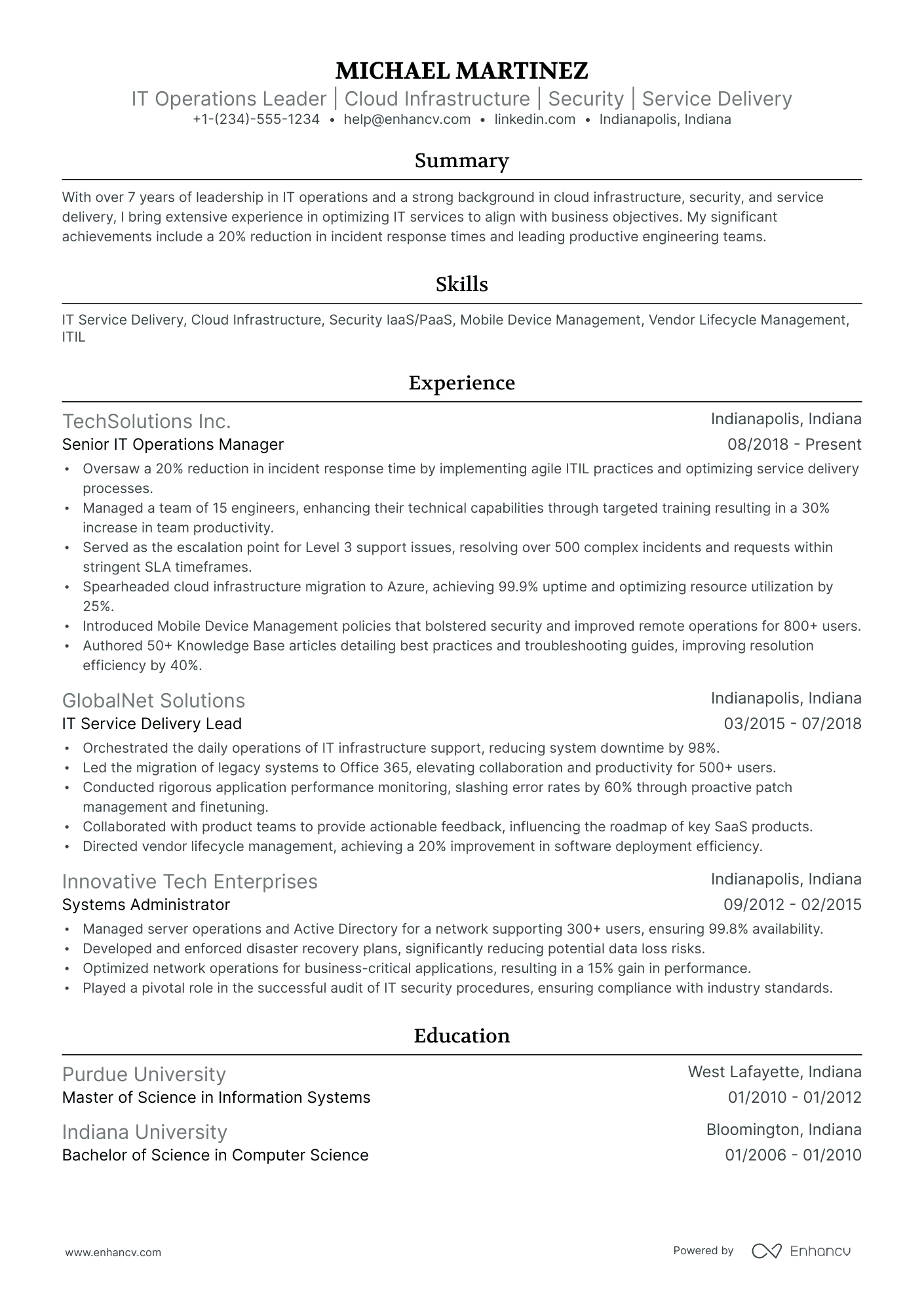
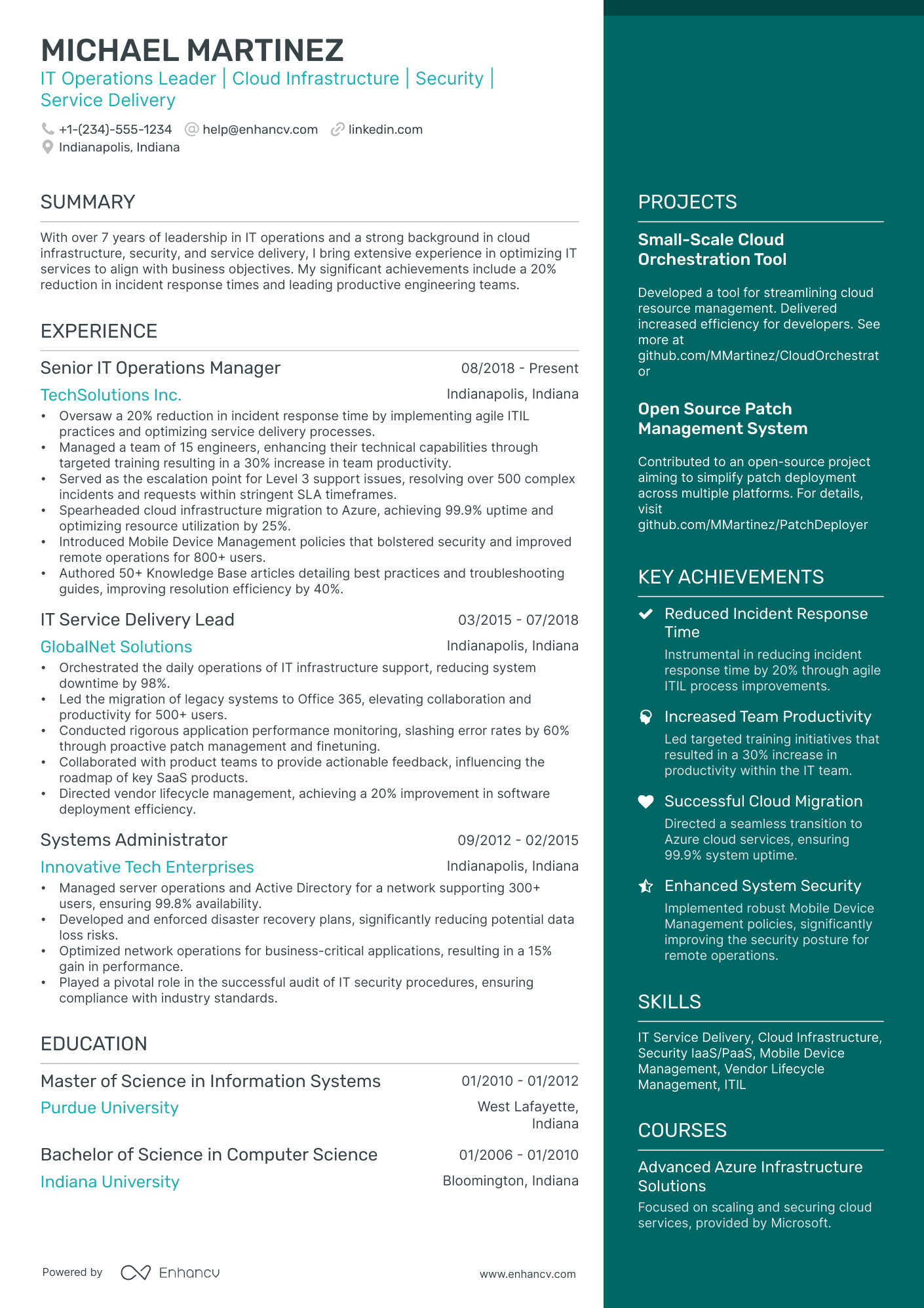
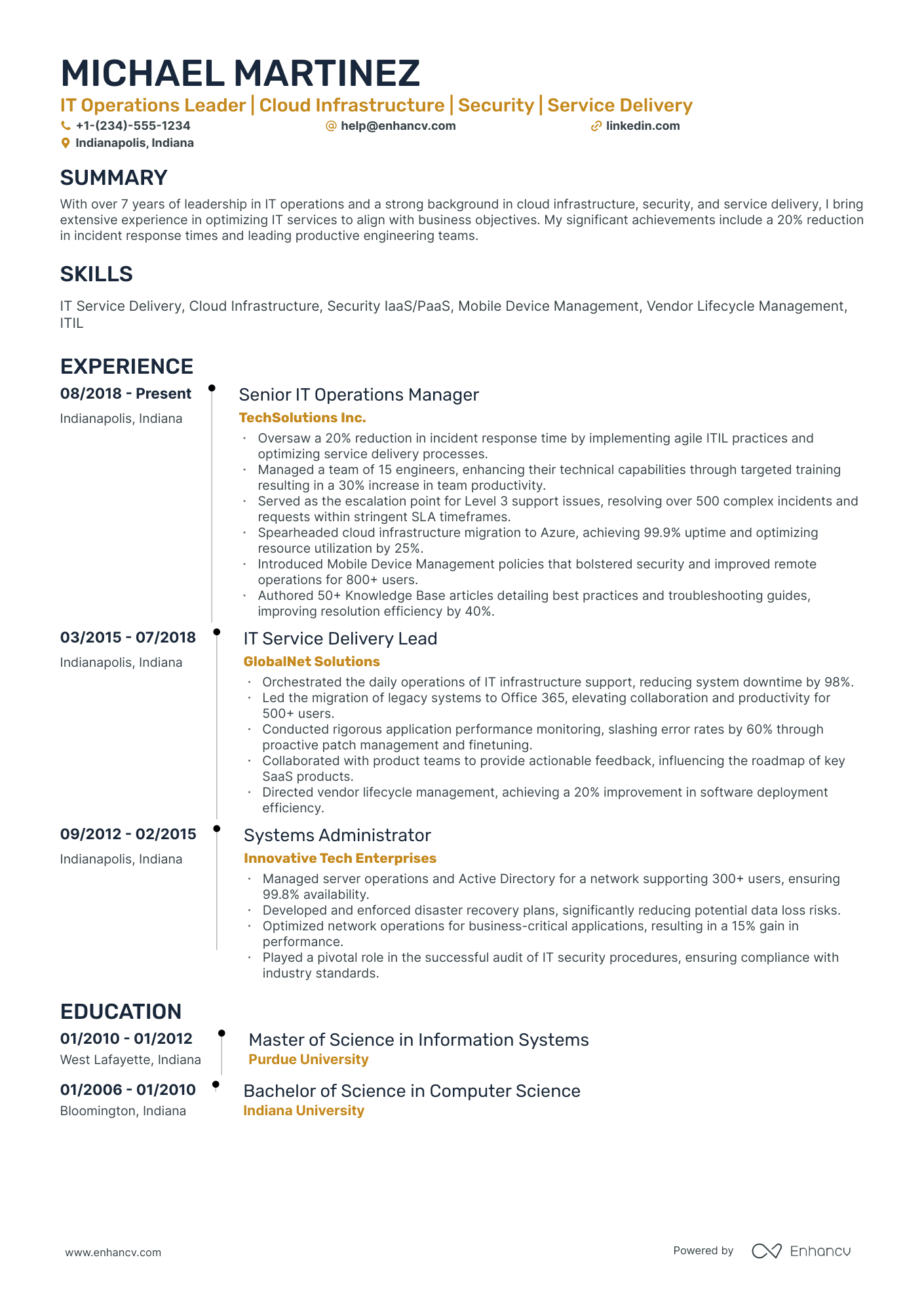
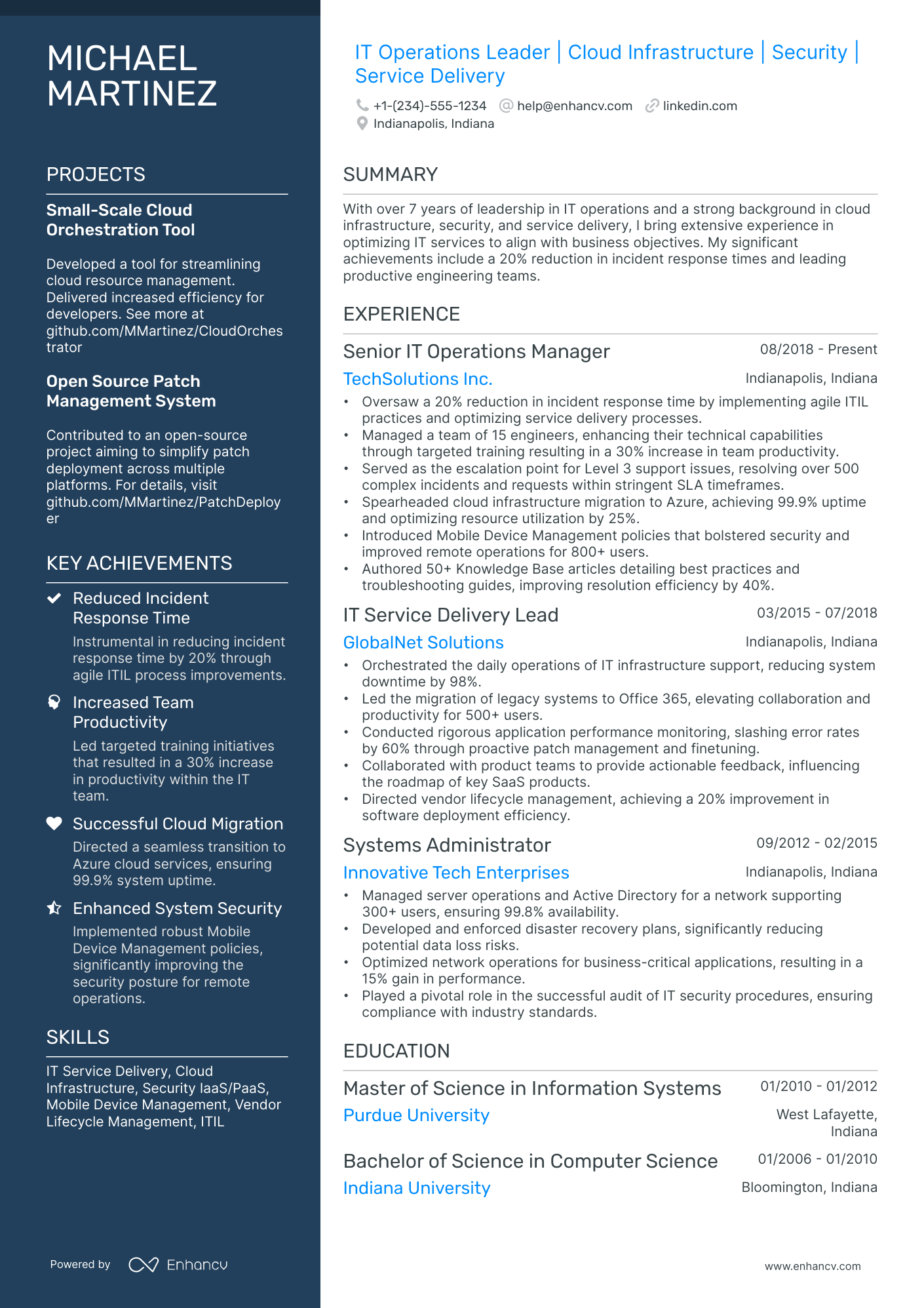
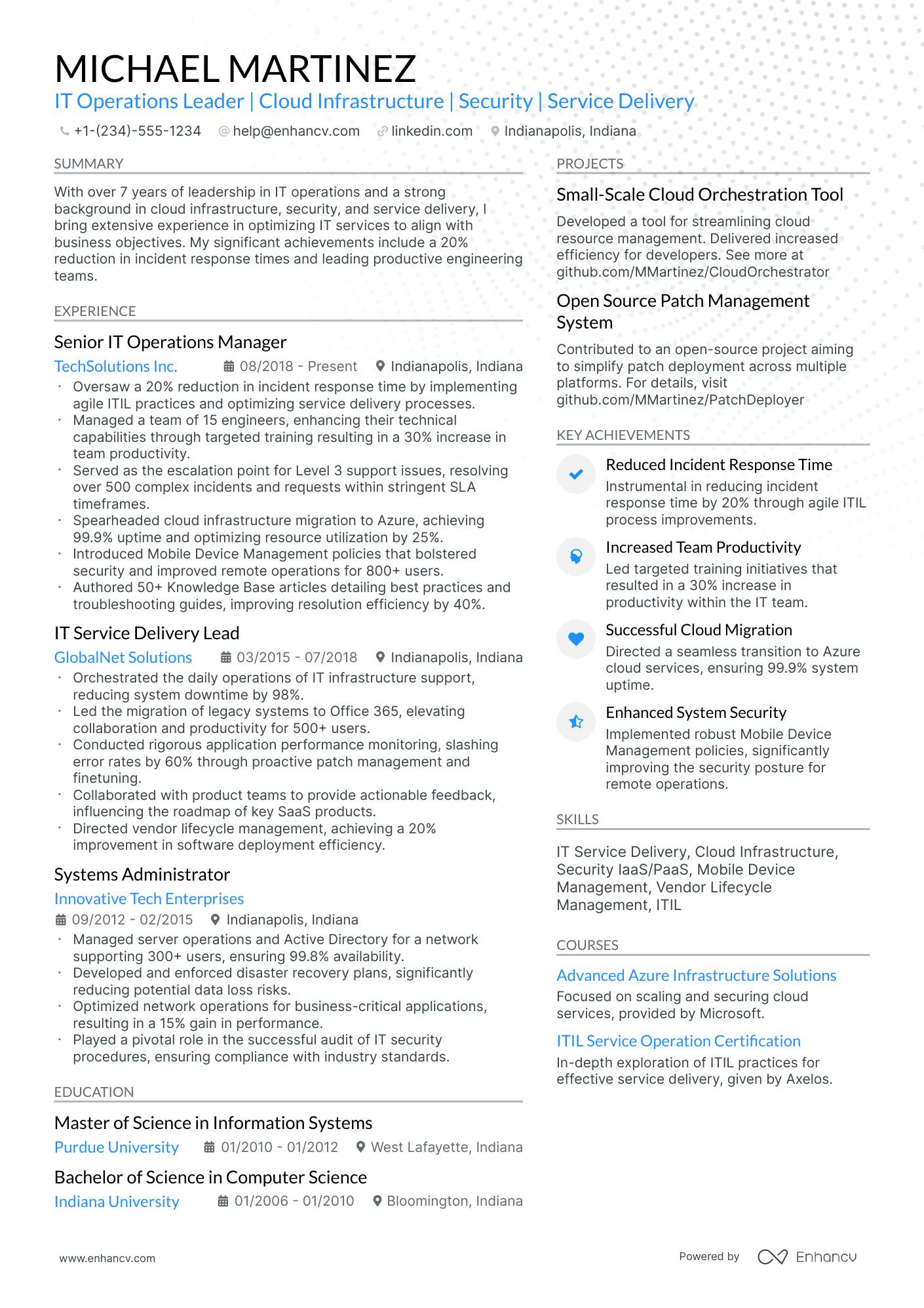
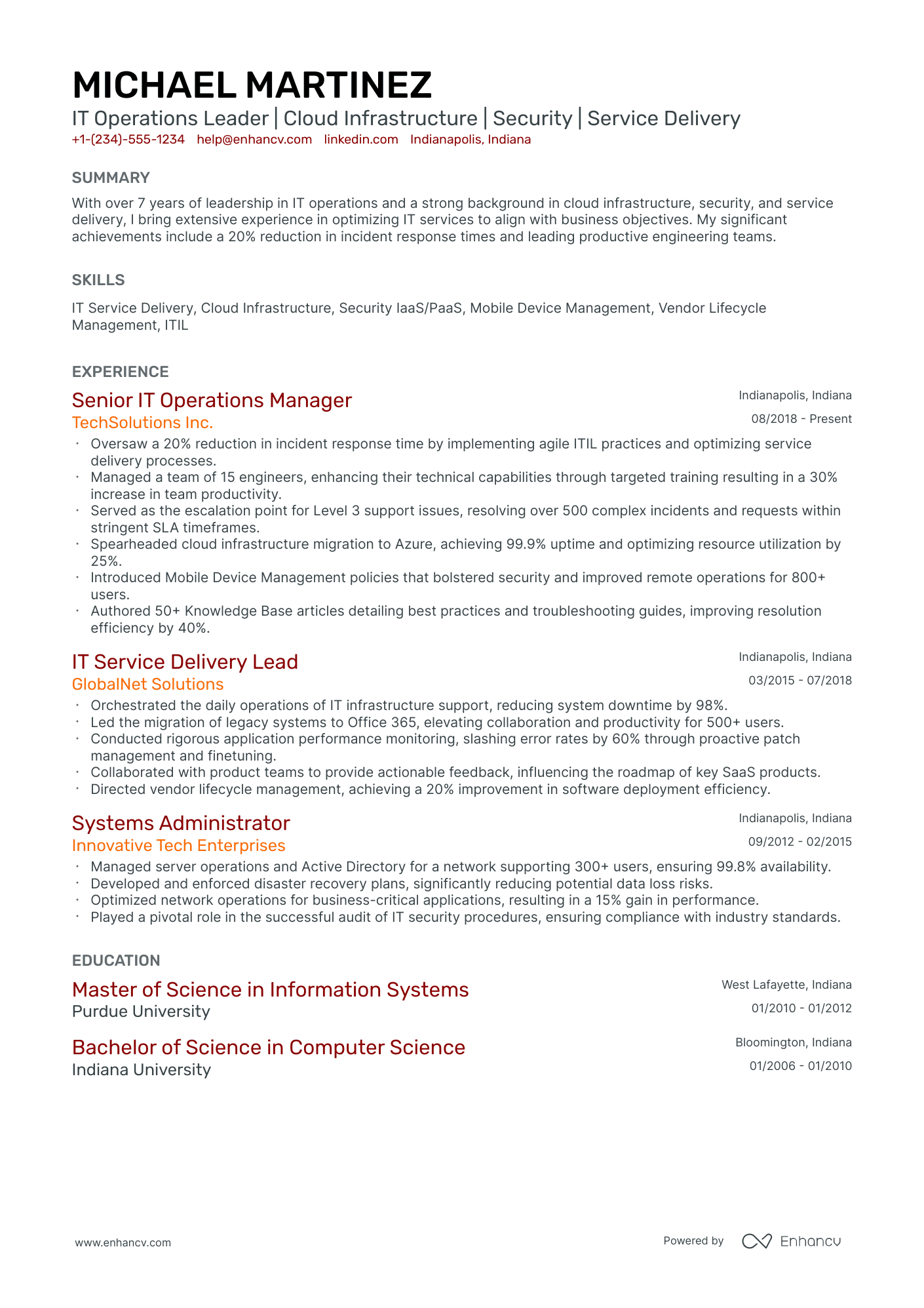
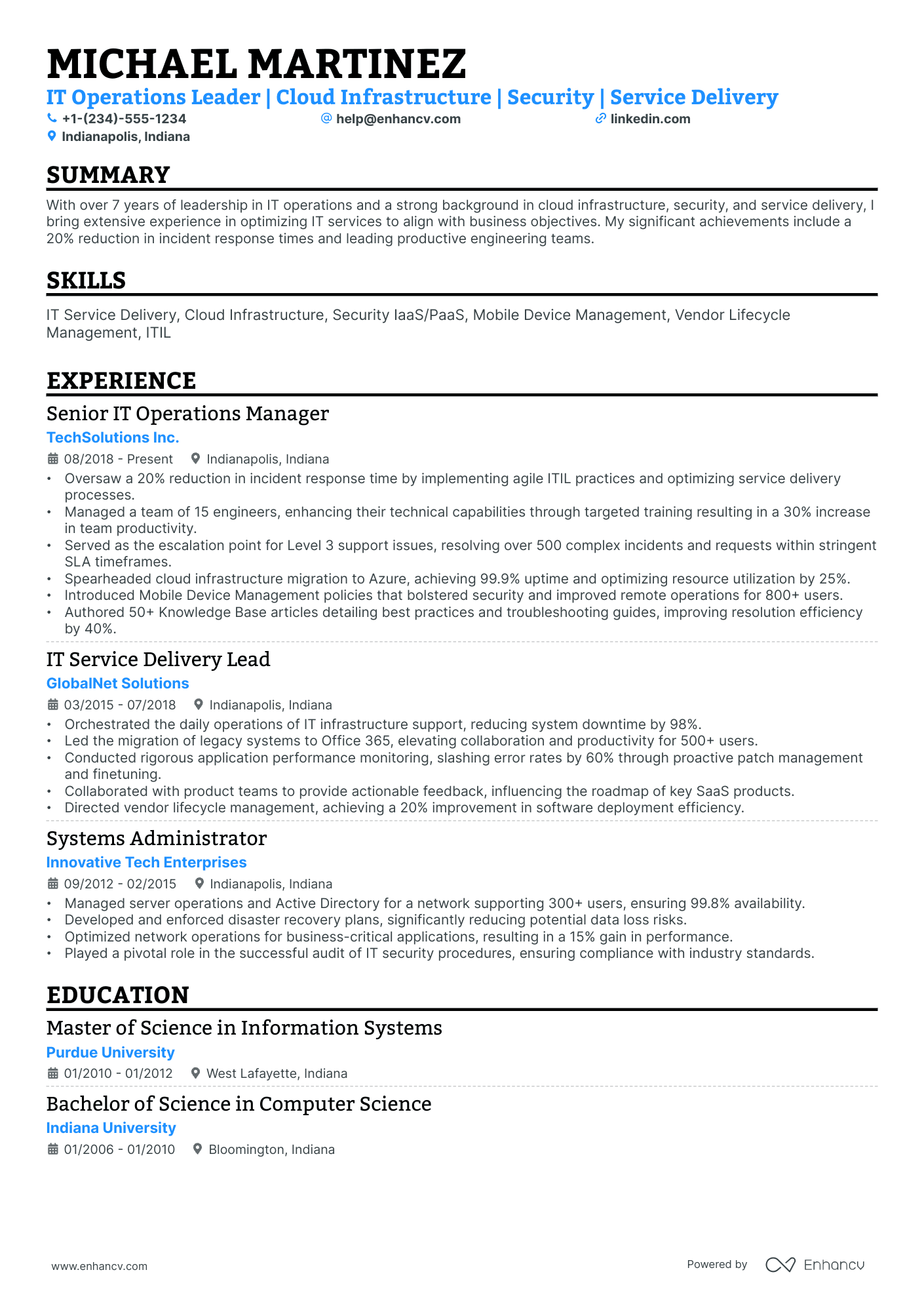
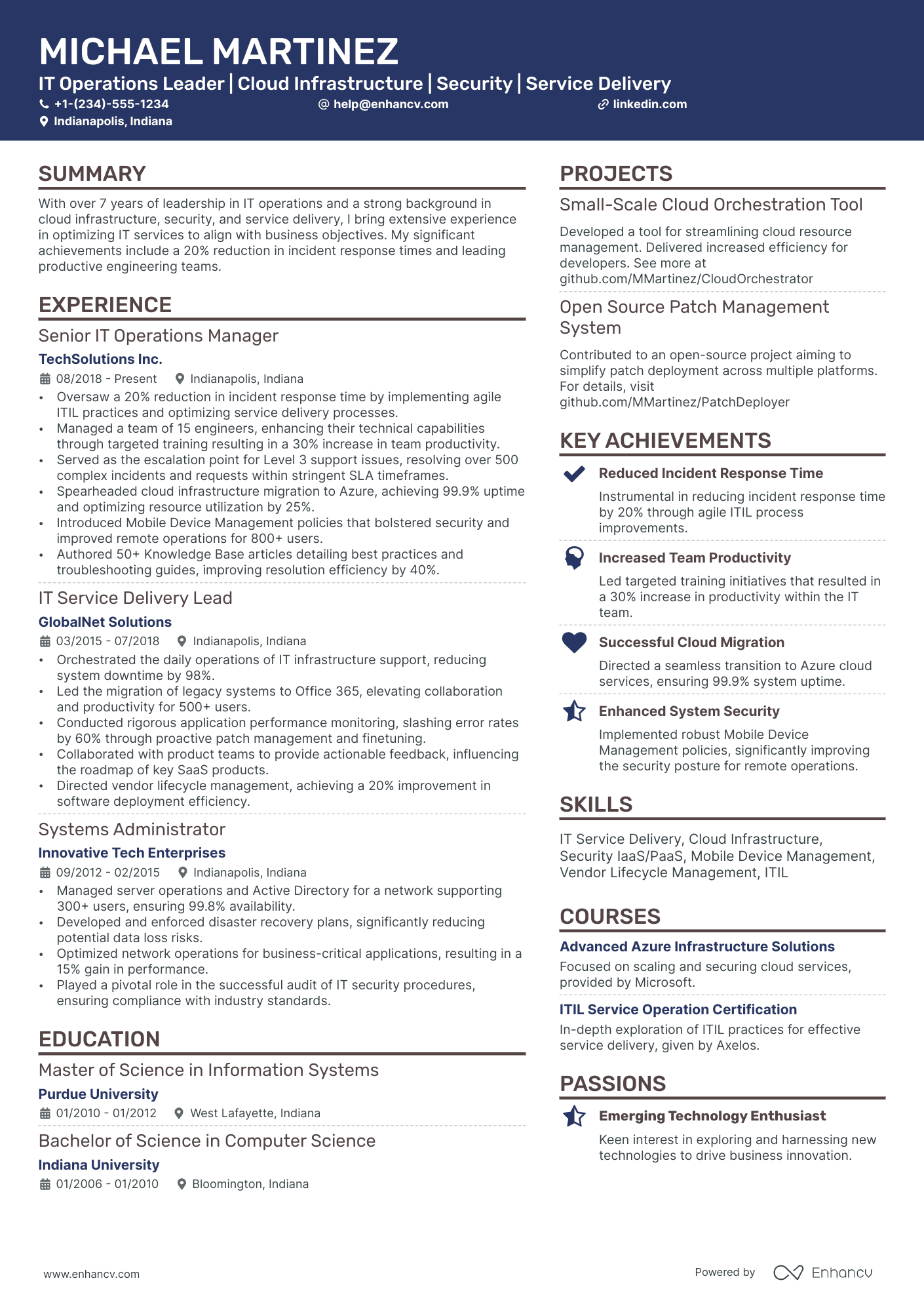
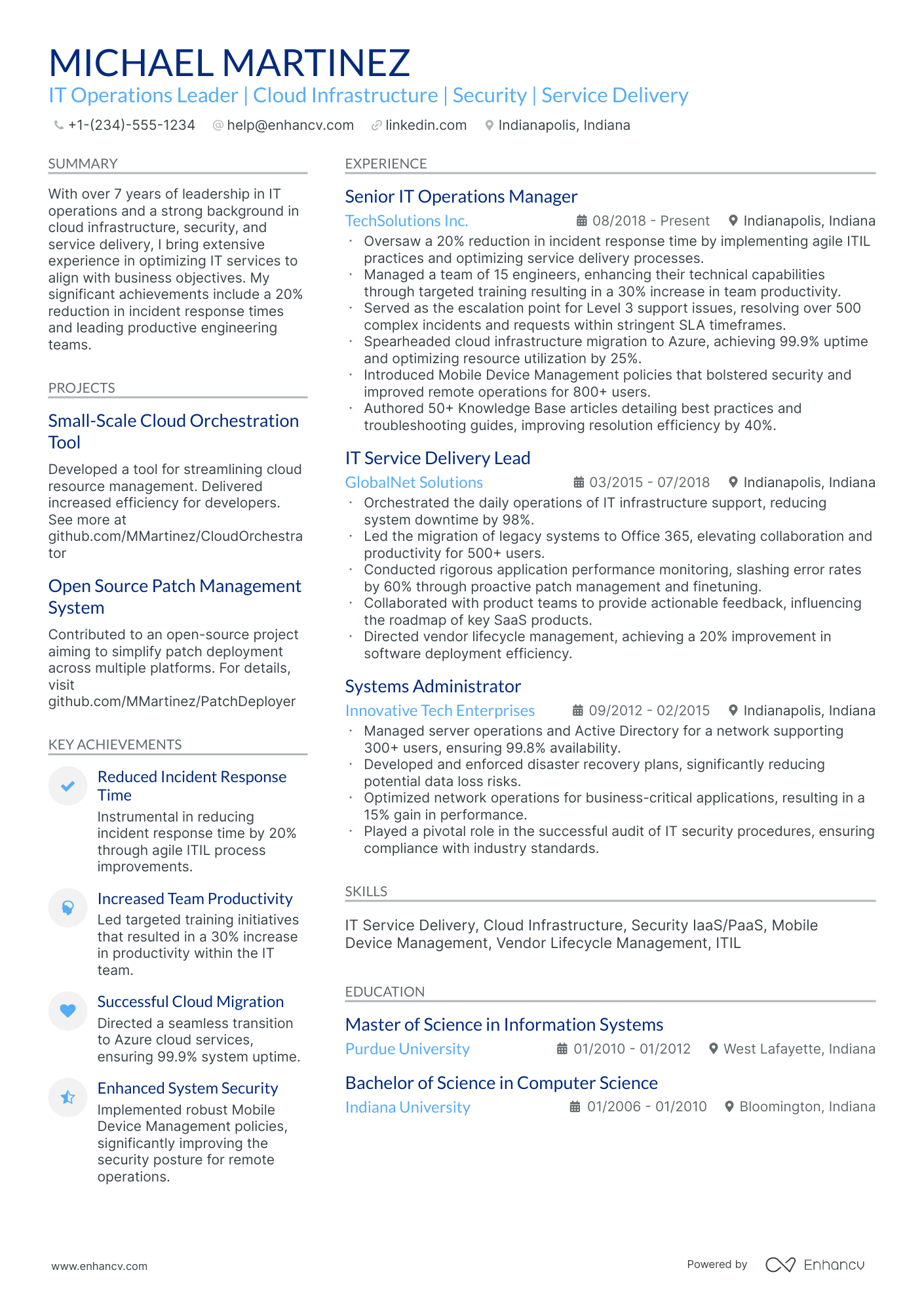
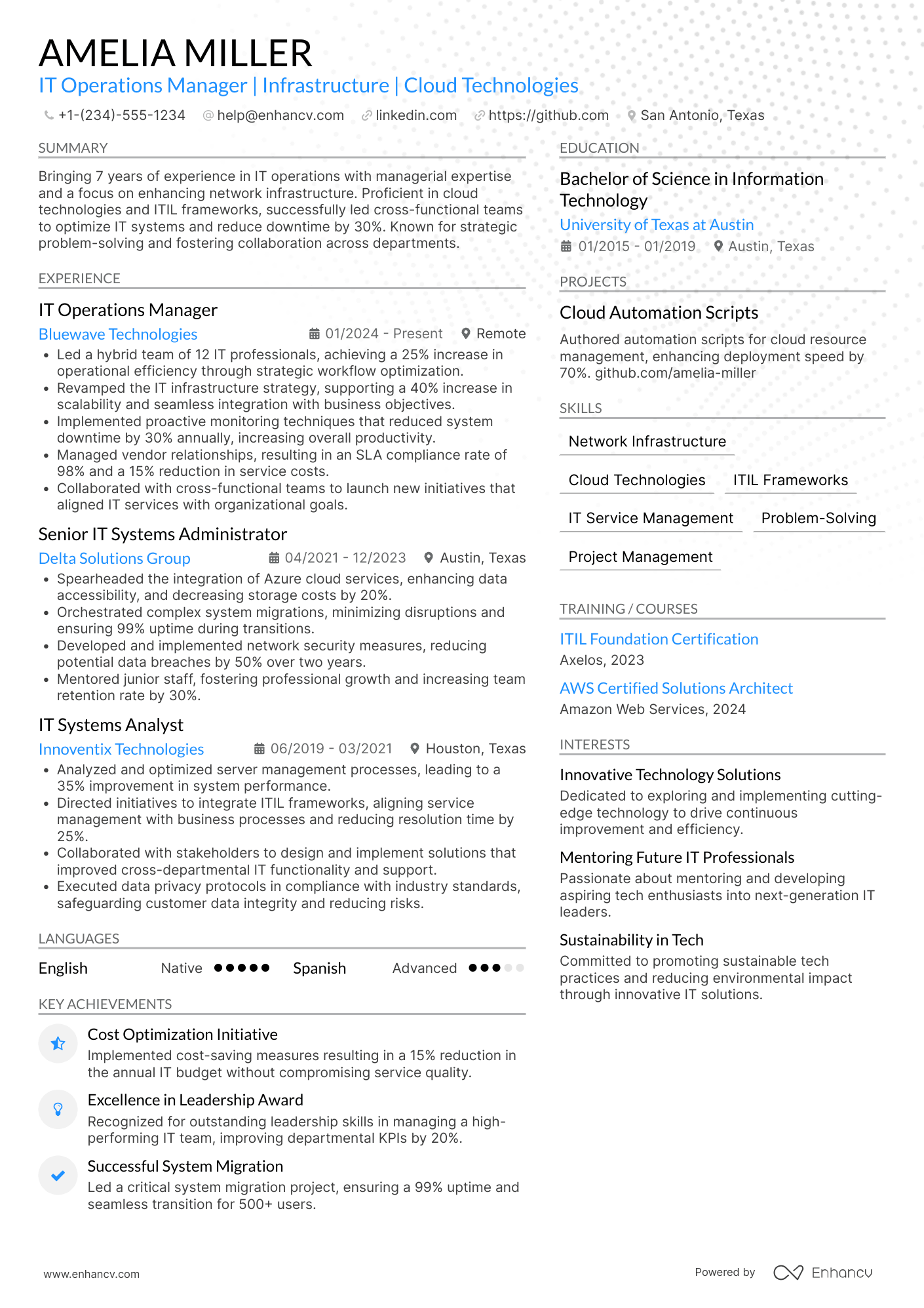
Most IT operations manager resume drafts fail because they read like tool inventories and task lists, not proof of service reliability and business impact. That buries your value in applicant tracking system screening, quick recruiter scans, and crowded shortlists.
A strong resume shows outcomes you delivered and the scale you operated. Knowing how to make your resume stand out means you should highlight uptime gains, incident volume reductions, faster recovery times, cost savings, audit readiness, and improved user satisfaction across sites or thousands of endpoints.

Key takeaways
- Quantify uptime, incident response times, and cost savings instead of listing tools and tasks.
- Use reverse-chronological format for experienced candidates and hybrid format for career switchers.
- Tailor every experience bullet to mirror the job description's language and priorities.
- Place certifications above education when they're recent and directly relevant to the role.
- Tie each skill to a measurable outcome in your summary or experience section.
- Enhancv's Bullet Point Generator helps turn routine responsibilities into recruiter-ready, metrics-driven bullets.
- Stop using AI once your resume accurately reflects real experience without inflated claims.
Job market snapshot for IT operations managers
We analyzed 5,772 recent IT operations manager job ads across major US job boards. These numbers help you understand experience requirements, regional hotspots, salary landscape at a glance.
What level of experience employers are looking for IT operations managers
| Years of Experience | Percentage found in job ads |
|---|---|
| 1–2 years | 6.1% (351) |
| 3–4 years | 11.7% (674) |
| 5–6 years | 9.7% (559) |
| 7–8 years | 4.5% (261) |
| 9–10 years | 2.3% (134) |
| 10+ years | 4.6% (268) |
| Not specified | 63.1% (3643) |
IT operations manager ads by area of specialization (industry)
| Industry (Area) | Percentage found in job ads |
|---|---|
| Finance & Banking | 57.3% (3308) |
| Healthcare | 28.3% (1634) |
| Education | 5.1% (296) |
| Retail & E-commerce | 2.7% (154) |
| Manufacturing | 2.5% (143) |
| Government | 1.5% (88) |
| Energy | 0.6% (32) |
| Real Estate & Construction | 0.6% (32) |
| Media & Entertainment | 0.5% (29) |
| Travel & Hospitality | 0.3% (18) |
Top companies hiring IT operations managers
| Company | Percentage found in job ads |
|---|---|
| Walgreens | 6.8% (394) |
| CVS Health | 6.3% (364) |
| Amazon.com, Inc. | 3.0% (173) |
| Sodexo S A | 2.0% (116) |
| Deloitte | 1.9% (107) |
| Ryder System Inc. | 1.9% (107) |
| Marriott International | 1.4% (79) |
| DaVita Inc. | 1.3% (75) |
| PetSmart | 1.3% (75) |
| First Watch Restaurants | 1.2% (70) |
Role overview stats
These tables show the most common responsibilities and employment types for IT operations manager roles. Use them to align your resume with what employers expect and to understand how the role is structured across the market.
Day-to-day activities and top responsibilities for a IT operations manager
| Responsibility | Percentage found in job ads |
|---|---|
| Microsoft office | 10.0% (579) |
| Excel | 10.0% (578) |
| Project management | 9.5% (546) |
| Customer service | 7.6% (439) |
| Inventory management | 6.5% (373) |
| Leadership | 6.0% (349) |
| Analytical skills | 6.0% (347) |
| Powerpoint | 5.6% (325) |
| Performance management | 5.5% (316) |
| Pharmacy systems | 5.0% (291) |
| Data analysis | 4.9% (280) |
| Communication | 4.8% (275) |
Type of employment (remote vs on-site vs hybrid)
| Employment type | Percentage found in job ads |
|---|---|
| On-site | 87.4% (5043) |
| Hybrid | 8.5% (490) |
| Remote | 4.1% (239) |
How to format a IT operations manager resume
Recruiters evaluating IT operations manager candidates prioritize infrastructure oversight experience, incident management capabilities, and the ability to maintain system uptime at scale. A clean, well-structured resume format ensures these signals—along with relevant tools, certifications, and operational metrics—surface quickly during both automated screening and manual review. Paying attention to your resume layout also helps recruiters parse your qualifications faster.

I have significant experience in this role—which format should I use?
Use a reverse-chronological format. It places your most recent and relevant IT operations leadership front and center, giving recruiters an immediate view of your career trajectory and expanding scope. Do:
- Lead each role entry with your operational scope: team size, infrastructure scale (servers, endpoints, cloud environments), and budget ownership.
- Highlight proficiency in role-specific platforms and frameworks such as ITIL, ServiceNow, Nagios, Splunk, AWS, Azure, Terraform, and CI/CD pipelines.
- Quantify business impact through uptime percentages, incident resolution times, cost reductions, and SLA compliance rates.
I'm junior or switching into this role—what format works best?
A hybrid format works best because it lets you lead with a targeted skills section while still providing enough chronological context to show growth and accountability. Do:
- Place a skills section near the top that groups competencies by domain: monitoring and alerting, cloud infrastructure, automation, and vendor management.
- Include project-based experience—such as migration initiatives, disaster recovery drills, or system rollouts—even if they occurred outside a formal IT operations manager title.
- Connect every action to a measurable result so recruiters can assess your operational impact, regardless of title.
Why not use a functional resume?
A functional format strips away the timeline and context recruiters need to evaluate how your IT operations skills were applied, in what environment, and at what scale—making it harder to assess readiness for this role.
- Edge-case exception: A functional format may be acceptable if you're transitioning from a related field (such as systems administration or network engineering) with limited direct IT operations management titles, or if you're re-entering the workforce after a gap—but only if every listed skill is tied to a specific project, environment, or measurable outcome rather than presented in isolation.
With your format established, the next step is filling it with the right sections to present your qualifications effectively.
What sections should go on a IT operations manager resume
Recruiters expect a clear snapshot of how you keep infrastructure reliable, secure, and cost-effective while leading operational improvements. Understanding what to put on a resume for this role is critical to making the right impression.
Use this structure for maximum clarity:
- Header
- Summary
- Experience
- Skills
- Projects
- Education
- Certifications
- Optional sections: Awards, Open-source work, Languages
Strong experience bullets should emphasize measurable uptime and reliability gains, incident and change management outcomes, cost and performance improvements, scope of systems supported, and cross-functional leadership results.
Is your resume good enough?
Drop your resume here or choose a file. PDF & DOCX only. Max 2MB file size.
Once you’ve organized your resume with the right structure, the next step is to write your IT operations manager resume experience section so it supports each part with relevant, role-specific impact.
How to write your IT operations manager resume experience
Your experience section should showcase infrastructure projects you've delivered, the platforms and methodologies you've used, and the measurable improvements you've driven in uptime, efficiency, and system reliability. Hiring managers prioritize demonstrated impact over descriptive task lists—they want proof that you've owned critical environments and delivered tangible results.
Each entry should include:
- Job title
- Company and location (or remote)
- Dates of employment (month and year)
Three to five concise bullet points showing what you owned, how you executed, and what outcomes you delivered:
- Ownership scope: the infrastructure environments, production systems, service platforms, or operations teams you were directly accountable for as an IT operations manager.
- Execution approach: the monitoring tools, ITIL frameworks, automation technologies, incident management processes, or capacity planning methods you used to maintain and optimize IT operations.
- Value improved: changes to system uptime, mean time to resolution, deployment frequency, operational cost efficiency, disaster recovery readiness, or security posture that resulted from your leadership.
- Collaboration context: how you partnered with engineering, security, DevOps, vendor teams, or executive stakeholders to align infrastructure decisions with broader business objectives.
- Impact delivered: outcomes expressed through service-level improvements, reduced downtime, infrastructure cost savings, or scaled capacity rather than routine administrative tasks.
Experience bullet formula
A IT operations manager experience example
✅ Right example - modern, quantified, specific.
IT Operations Manager
NorthBridge Health Systems | Remote
2022–Present
Multi-site healthcare network supporting 4,500 employees across 12 clinics with a hybrid cloud environment.
- Led a ServiceNow IT service management rollout (Incident, Problem, Change, Configuration Management Database), cutting mean time to resolve by 34% and reducing Sev-1 incidents by 18% through tighter change controls and root cause analysis.
- Implemented Microsoft Intune and Azure Active Directory (Microsoft Entra ID) conditional access for 2,800 endpoints, increasing device compliance from 72% to 96% and reducing phishing-related account takeovers by 41% in partnership with security and HR.
- Standardized monitoring and alerting with Datadog, Microsoft Sentinel, and PagerDuty, lowering alert noise by 28% and improving uptime from 99.82% to 99.95% across electronic health record integrations and core network services.
- Managed vendor performance and contracts for managed network and telecom providers, renegotiating service-level agreements and reducing annual spend by $210K while improving circuit failover recovery time from fifteen minutes to four minutes.
- Built a weekly operations review with engineering, product managers, and clinical stakeholders, prioritizing a three-month reliability backlog that cut recurring incidents by 22% and improved customer satisfaction score from 4.1 to 4.6.
Now that you've seen what a strong experience entry looks like in practice, let's break down how to adapt yours to match the specific job you're targeting.
How to tailor your IT operations manager resume experience
Recruiters evaluate your resume through applicant tracking systems and manual review, scoring candidates on how closely their experience matches the posting. Tailoring your resume to the job description gives you a measurable advantage in both screenings.
Ways to tailor your IT operations manager experience:
- Match infrastructure tools and platforms named in the job description.
- Mirror the exact terminology used for ITIL or ITSM frameworks.
- Reflect uptime or SLA metrics the posting prioritizes.
- Highlight compliance standards like SOC 2 or ISO 27001 if listed.
- Include relevant industry experience such as healthcare or financial services.
- Align your incident management process language with the posting.
- Emphasize disaster recovery or business continuity work when referenced.
- Reference cross-functional collaboration models the role describes.
Tailoring means aligning your real accomplishments with what the employer asks for, not forcing keywords where they don't belong.
Resume tailoring examples for IT operations manager
| Job description excerpt | Untailored | Tailored |
|---|---|---|
| Manage enterprise ITIL-based service delivery across a 24/7 hybrid cloud environment (AWS, Azure), ensuring 99.9% uptime SLAs for business-critical applications. | Managed IT services and ensured systems were running smoothly for the organization. | Directed ITIL-aligned service delivery across AWS and Azure hybrid cloud infrastructure, maintaining 99.95% uptime against 99.9% SLA targets for 12 business-critical applications serving 4,000+ end users. |
| Lead incident and problem management processes using ServiceNow, driving root cause analysis and reducing mean time to resolution (MTTR) for P1/P2 incidents. | Handled IT incidents and worked with teams to fix technical problems quickly. | Led P1/P2 incident and problem management workflows in ServiceNow, conducting root cause analysis that reduced MTTR from 4.2 hours to 1.8 hours over 12 months—a 57% improvement across 300+ annual escalations. |
| Oversee IT infrastructure operations including network, storage, and virtualization (VMware), while managing vendor relationships and a $3.5M annual operations budget. | Responsible for infrastructure and worked with vendors to keep costs under control. | Managed network, SAN storage, and VMware virtualization environments spanning two data centers, negotiating vendor contracts that cut annual infrastructure spend by 14% within a $3.5M operations budget. |
Once you’ve aligned your experience with the role’s priorities, quantify your IT operations manager achievements to show the measurable impact of that work.
How to quantify your IT operations manager achievements
Quantifying your achievements proves you didn't just keep systems running—you improved outcomes. Focus on uptime, incident speed, change success, cost efficiency, and security risk reduction across servers, networks, cloud, and end-user services.
Quantifying examples for IT operations manager
| Metric | Example |
|---|---|
| Availability | "Raised core service uptime from 99.5% to 99.95% by tuning monitoring in Datadog and standardizing on-call runbooks across 20 production systems." |
| Incident response | "Cut mean time to resolution from 90 to 35 minutes by implementing PagerDuty escalation rules and a tiered triage process for a 12-person on-call rotation." |
| Change quality | "Reduced change failure rate from 14% to 6% by enforcing ITIL change controls and adding automated smoke tests in Jenkins for weekly releases." |
| Cost efficiency | "Lowered monthly cloud spend by $48,000 by right-sizing Amazon Web Services instances and setting budget alerts for eight business units." |
| Security risk | "Decreased critical vulnerabilities older than 30 days by 72% by tightening patch SLAs and automating scans with Tenable across 1,200 endpoints." |
Turn your everyday tasks into measurable, recruiter-ready resume bullets in seconds with Enhancv's Bullet Point Generator.
With strong bullet points in place, the next step is ensuring your skills section effectively showcases the technical and interpersonal abilities that define a well-rounded IT operations manager.
How to list your hard and soft skills on a IT operations manager resume
Your skills section shows you can keep systems reliable and secure, and recruiters and an ATS (applicant tracking system) scan this section to confirm role-fit fast, so aim for a mix of mostly hard skills with targeted soft skills. IT operations manager roles require a blend of:
- Product strategy and discovery skills.
- Data, analytics, and experimentation skills.
- Delivery, execution, and go-to-market discipline.
- Soft skills.
Your skills section should be:
- Scannable (bullet-style grouping).
- Relevant to the job post.
- Backed by proof in experience bullets.
- Updated with current tools.
Place your skills section:
- Above experience if you're junior or switching careers.
- Below experience if you're mid/senior with strong achievements.

Hard skills
- ITIL service management
- Incident, problem, change management
- ServiceNow, Jira Service Management
- SLA, SLO, KPI reporting
- Linux, Windows Server administration
- Active Directory, Group Policy
- Network troubleshooting, TCP/IP, DNS
- Cloud ops: AWS, Azure
- Monitoring: Datadog, Splunk, Prometheus
- Endpoint management: Intune, SCCM
- Backup, disaster recovery planning
- Vulnerability management, patching
Soft skills
- Lead incident communications
- Drive cross-team prioritization
- Make risk-based decisions
- Own service reliability outcomes
- Translate tech for executives
- Set clear operating cadences
- Escalate fast, escalate smart
- Coach and develop operators
- Negotiate realistic SLAs
- Align stakeholders on tradeoffs
- Run blameless postmortems
- Improve processes through feedback
How to show your IT operations manager skills in context
Skills shouldn't live only in a dedicated skills list. Browse resume skills examples to see how top candidates weave competencies throughout their resumes.
They should be demonstrated in:
- Your summary (high-level professional identity)
- Your experience (proof through outcomes)
Here's what strong, context-rich examples look like in practice.
Summary example
IT operations manager with 12 years in healthcare infrastructure, skilled in ITIL, VMware, and Azure. Led a 15-member team that achieved 99.98% uptime while cutting incident response time by 40% through automated monitoring workflows.
- Reflects senior-level experience clearly
- Names industry-relevant tools and frameworks
- Quantifies uptime and efficiency gains
- Signals leadership and team collaboration
Experience example
IT Operations Manager
Brevian Health Systems | Chicago, IL
March 2019–Present
- Directed migration of 200+ servers to Azure, partnering with security and DevOps teams to reduce infrastructure costs by 32% within one year.
- Implemented Datadog monitoring and PagerDuty alerting, cutting mean time to resolution from 45 minutes to 12 minutes across all production environments.
- Established ITIL-aligned change management processes with cross-functional stakeholders, decreasing unplanned outages by 58% over 18 months.
- Every bullet includes measurable proof
- Skills surface naturally through real outcomes
Once you’ve tied your IT operations manager capabilities to real outcomes, the next step is to apply that same approach when building an IT operations manager resume with no experience.
How do I write a IT operations manager resume with no experience
Even without full-time experience, you can demonstrate readiness through:
- IT lab uptime monitoring projects
- Service desk ticket triage volunteering
- Home lab Active Directory setup
- Internship incident response participation
- Campus network troubleshooting role
- Vendor support case coordination
- ITIL process improvement coursework
- Cloud cost optimization practice
If you're building a resume without work experience, focus on:
- Reliable uptime and incident metrics
- Ticketing and escalation workflows
- Monitoring, patching, and backups
- Documented procedures and compliance
Resume format tip for entry-level IT operations manager
Use a combination resume format because it highlights IT operations manager skills and projects first, while still showing steady experience history. Do:
- Lead with a skills summary tied to tools.
- Add two to three projects with metrics.
- List ticketing, monitoring, and patch tools.
- Quantify uptime, response time, and volume.
- Include documentation, runbooks, and audits.
- Built a home lab Active Directory environment with Microsoft Active Directory, PowerShell, and Windows Server; reduced account provisioning time by 60% using scripted onboarding.
Even without direct experience, your education section can demonstrate the foundational knowledge and technical training that qualifies you for an IT operations manager role.
How to list your education on a IT operations manager resume
Your education section helps hiring teams confirm you have the foundational knowledge needed for IT operations manager roles. It validates technical training, analytical skills, and leadership readiness.
Include:
- Degree name
- Institution
- Location
- Graduation year
- Relevant coursework (for juniors or entry-level candidates)
- Honors & GPA (if 3.5 or higher)
Skip month and day details—list the graduation year only.
Here's a strong education entry tailored to the IT operations manager role.
Example education entry
Bachelor of Science in Information Technology Management
George Mason University, Fairfax, VA
Graduated 2018
GPA: 3.7/4.0
- Relevant coursework: Network Administration, IT Service Management, Systems Architecture, Database Management, and Cybersecurity Fundamentals
- Honors: Magna Cum Laude, Dean's List (six semesters)
How to list your certifications on a IT operations manager resume
Certifications on your resume show an IT operations manager's commitment to learning, hands-on tool proficiency, and current industry knowledge. They also signal readiness to manage infrastructure, service delivery, and risk in fast-changing environments. Include:
- Certificate name
- Issuing organization
- Year
- Optional: credential ID or URL
- Place certifications below education when they're older, less relevant, or you have a strong degree that aligns with IT operations manager work.
- Place certifications above education when they're recent, highly relevant, or required for the IT operations manager roles you target.
Best certifications for your IT operations manager resume
- ITIL 4 Foundation
- Project Management Professional (PMP)
- Certified Information Systems Security Professional (CISSP)
- AWS Certified SysOps Administrator—Associate
- Microsoft Certified: Azure Administrator Associate
- Cisco Certified Network Associate (CCNA)
- Certified Information Systems Auditor (CISA)
Once you’ve positioned your credentials where hiring managers can spot them quickly, shift to your IT operations manager resume summary to reinforce those qualifications upfront and frame your fit for the role.
How to write your IT operations manager resume summary
Your resume summary is the first thing a recruiter reads. A strong one instantly signals you're qualified for the IT operations manager role.
Keep it to three to four lines, with:
- Your title and total years of experience in IT operations.
- The domain or industry you've worked in, such as SaaS, healthcare, or finance.
- Core tools and technologies like ITIL, ServiceNow, AWS, or VMware.
- One or two quantified achievements that show operational impact.
- Soft skills tied to real outcomes, such as cross-functional collaboration or vendor negotiation.

PRO TIP
At this level, lead with measurable results and the scope of your responsibilities. Highlight team size, budget ownership, and infrastructure scale. Avoid vague phrases like "passionate leader" or "results-driven professional." Recruiters want proof, not personality branding.
Example summary for a IT operations manager
IT operations manager with eight years of experience leading 15-person teams across SaaS environments. Reduced system downtime by 37% through ITIL-driven process improvements and AWS migration. Skilled in vendor management and cross-departmental coordination.
Optimize your resume summary and objective for ATS
Drop your resume here or choose a file.
PDF & DOCX only. Max 2MB file size.
Now that your summary effectively communicates your value, make sure your header presents the essential contact and professional details recruiters need to reach you.
What to include in a IT operations manager resume header
A resume header is the contact and identity block at the top of your resume, and it boosts visibility, credibility, and recruiter screening for a IT operations manager.
Essential resume header elements
- Full name
- Tailored job title and headline
- Location
- Phone number
- Professional email
- GitHub link
- Portfolio link
A LinkedIn link helps recruiters verify your experience quickly and supports faster screening.
Don't include a photo on a IT operations manager resume unless the role is explicitly front-facing or appearance-dependent.
Match your header title and headline to the job posting and keep formatting consistent so recruiters can scan it in seconds.
IT operations manager resume header
Jordan Ramirez
IT operations manager — Infrastructure, Incident Response, and Service Delivery
Austin, TX
(512) 555-01XX
jordan.ramirez@enhancv.com
github.com/jordanramirez
jordanramirez.com
linkedin.com/in/jordanramirez
Once your contact details and role identifiers are clear and accurate, add the following additional sections to round out your IT operations manager resume.
Additional sections for IT operations manager resumes
When your core qualifications match other candidates, additional sections help you stand out with role-specific credibility and depth. For example, listing language skills can be especially valuable if you support global infrastructure or work with international teams.
- Languages
- Certifications and professional development
- Industry conferences and speaking engagements
- Publications and technical blog contributions
- Volunteer IT leadership and mentorship
- Professional associations and memberships
- Awards and recognitions
Once you've strengthened your resume with relevant additional sections, pairing it with a well-crafted cover letter can further set your application apart.
Do IT operations manager resumes need a cover letter
An IT operations manager resume rarely requires a cover letter, but it often helps in competitive searches or formal hiring processes. Understanding what a cover letter is and when to use one can make a difference when you need to clarify fit, context, or impact beyond metrics.
Use a cover letter to add details your IT operations manager resume can't cover:
- Explain role or team fit by linking your operating model to the company's environment, such as on-call practices, compliance needs, or service-level targets.
- Highlight one or two relevant projects or outcomes, including incident reduction, uptime improvements, cost controls, or faster change delivery.
- Show understanding of the product, users, or business context by connecting reliability work to customer experience, revenue risk, or internal productivity.
- Address career transitions or non-obvious experience by mapping transferable skills from adjacent roles to IT operations manager responsibilities.
Drop your resume here or choose a file.
PDF & DOCX only. Max 2MB file size.
Even if you choose to submit a cover letter to add context, AI can help you strengthen your IT operations manager resume by sharpening your impact and tailoring it to the role.
Using AI to improve your IT operations manager resume
AI can sharpen your resume's clarity, structure, and impact. It helps tighten language and highlight measurable results. But overuse strips authenticity. Once your content feels clear and role-aligned, step away from AI. If you're curious about which AI is best for writing resumes, choose tools that prioritize accuracy over generic phrasing.
Here are 10 practical prompts to strengthen specific sections of your IT operations manager resume:
Sharpen your summary
Quantify experience bullets
Align skills section
Strengthen action verbs
Tailor to job posting
Clarify project contributions
Tighten certification details
Remove redundant phrasing
Improve education relevance
Fix inconsistent formatting
Conclusion
A strong IT operations manager resume ties daily work to measurable outcomes, like uptime gains, faster incident response, and lower costs. It highlights role-specific skills, including service management, change control, vendor oversight, and team leadership.
Keep the structure clear with targeted sections, consistent formatting, and easy-to-scan bullets. This approach shows you can run stable operations today and adapt to the near-future hiring market.