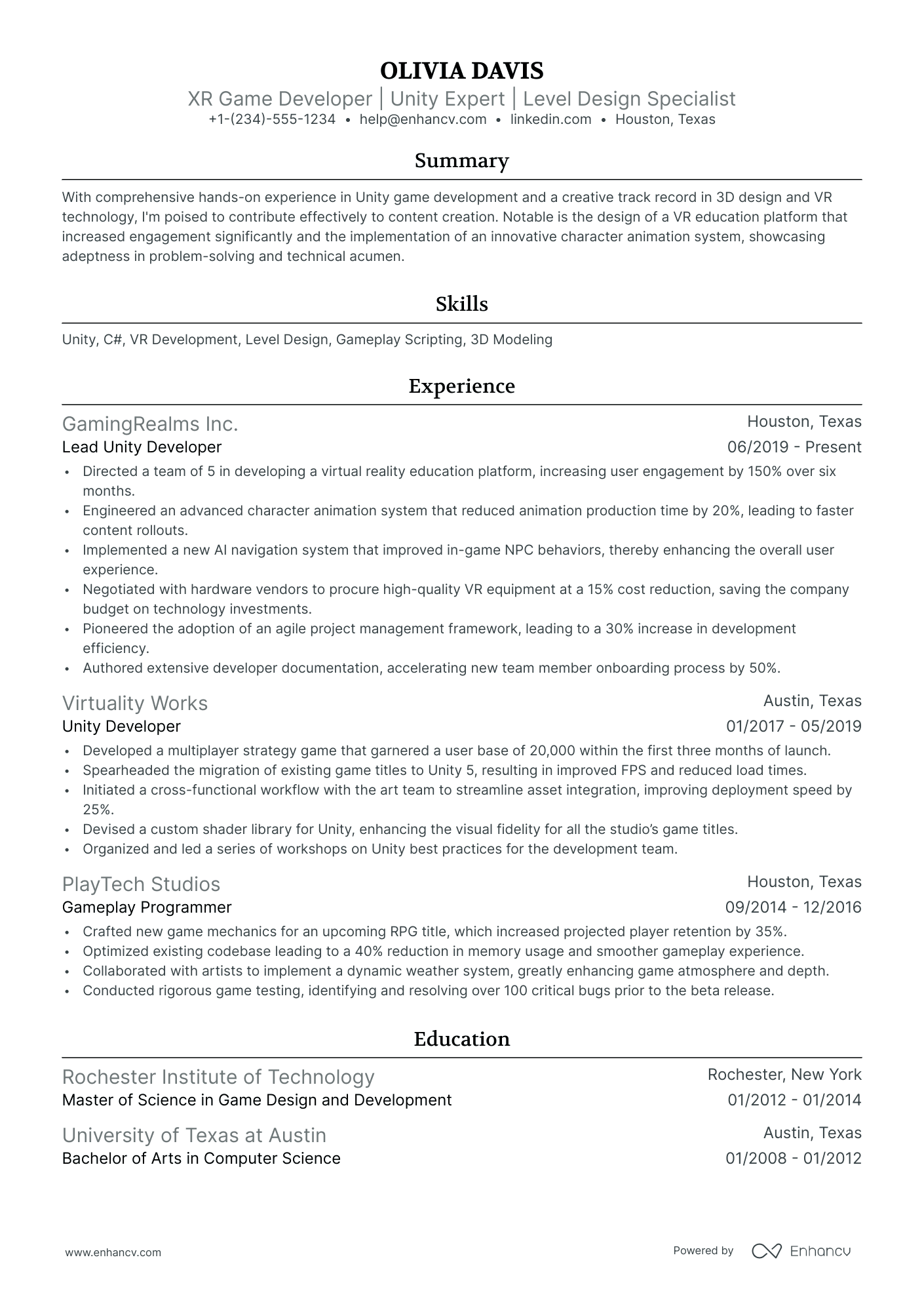

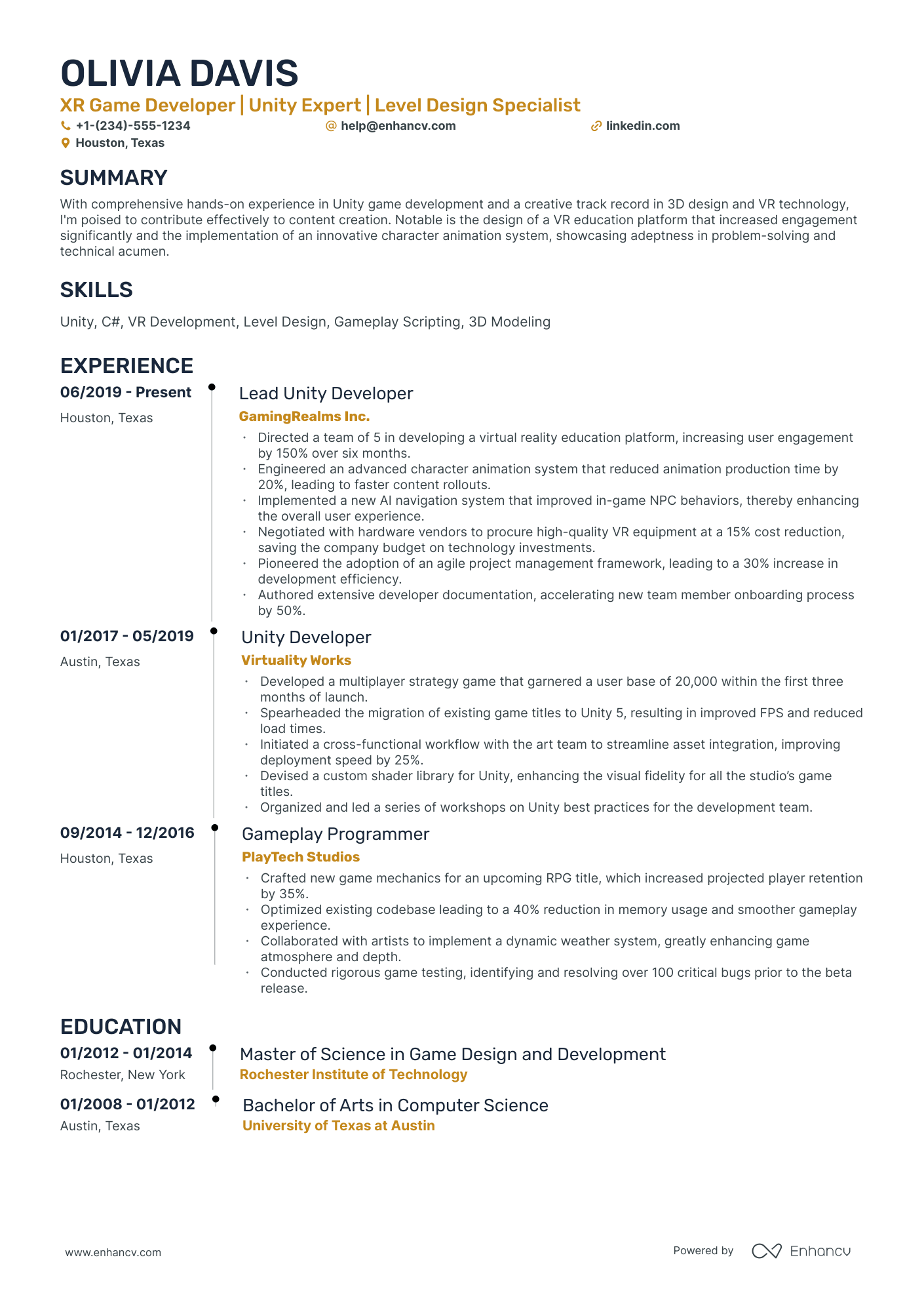
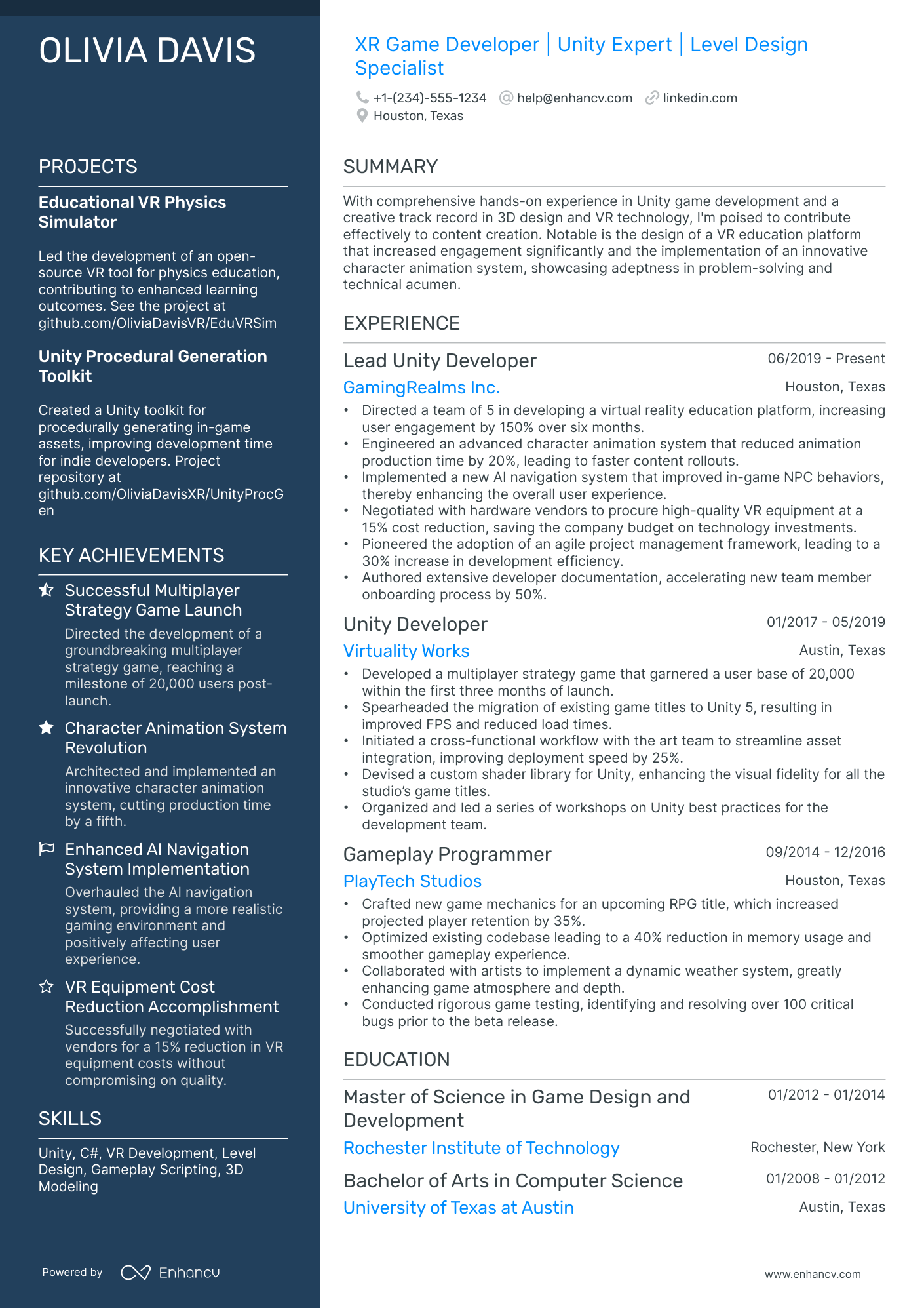
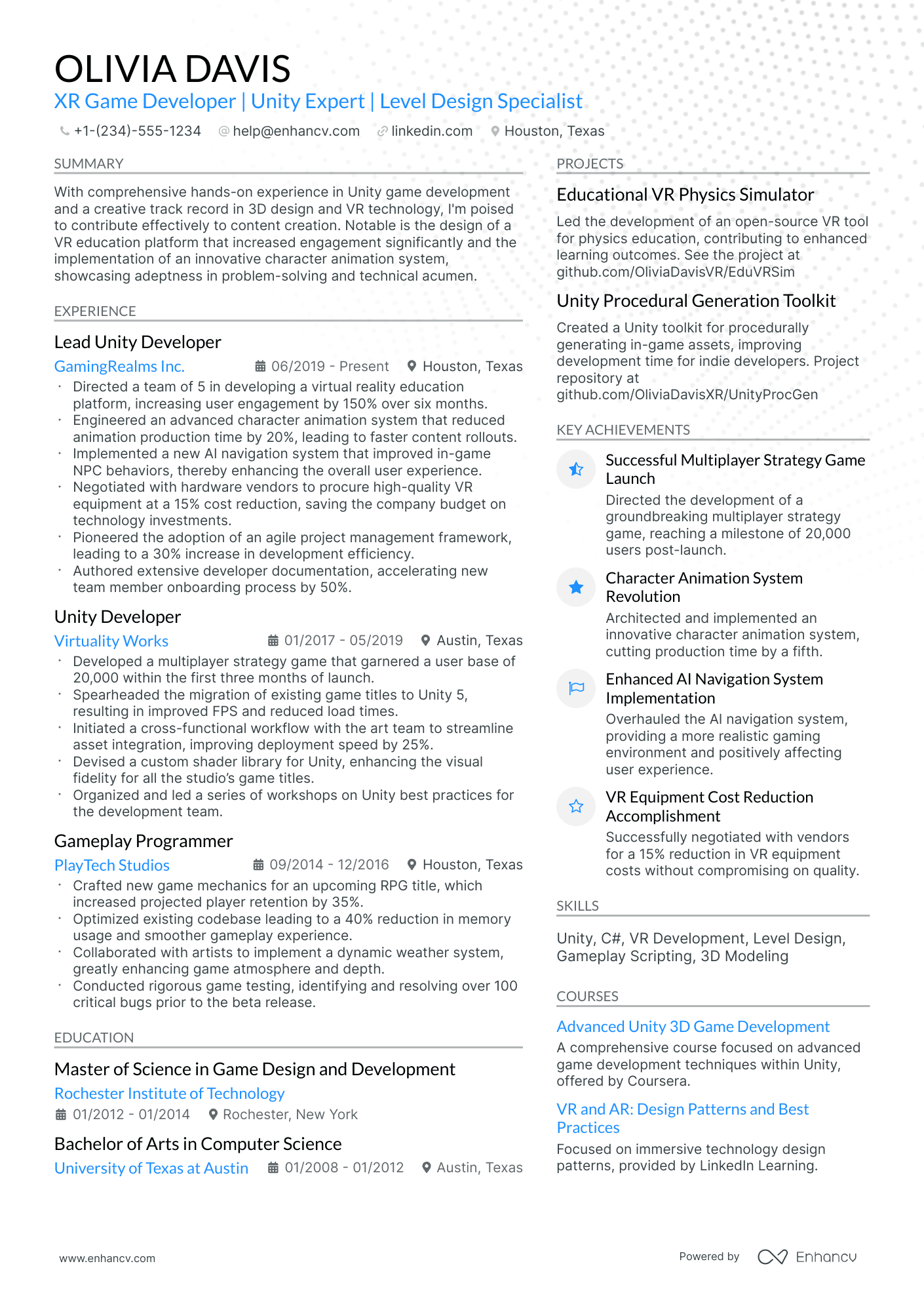

A game developer resume often lists engines and languages but never shows what you shipped or how it ran on real hardware. Recruiters skim in seconds, and applicant tracking system (ATS) filters check for the engines a posting names.
A resume that stands out to a studio leads with shipped work and its results. Show stable frame rates, shorter load times, fewer crashes, finished features, and the player numbers your games reached.

Key takeaways
- Lead each bullet with a shipped feature and its measured result.
- Link a portfolio of playable builds and a GitHub with real code.
- Use reverse-chronological order, or hybrid when game jams are your main proof.
- Name the engines, languages, and platforms each studio's posting lists.
- Quantify frame rate, load time, crash rate, and player reach.
- Use Enhancv's Bullet Point Generator to turn task lists into measurable bullets.
How to format a game developer resume
Studios hiring game developers look first for shipped titles, the systems you built, and proof your code ran well on target hardware. A clean resume layout puts those credits where a quick scan finds them.
Resume formatting strategy for game developers
| Category | Senior & leadership strategy | Entry to mid-level strategy |
|---|---|---|
| Recommended format | Reverse-chronological | Reverse-chronological or hybrid |
| Core dos | Lead each role with the titles you shipped and the systems you owned. Name the engines, platforms, and team sizes involved. Tie every bullet to performance, stability, or player results. | Put engines and languages near the top. Count game jams, mods, and student projects as transitional experience. Link each feature you built to a result such as frame rate or playtime. |
| Example bullet | Led a 6-person gameplay team that shipped a co-op action title on PC and consoles, holding 60 fps on all target platforms. | Unity and C# → rebuilt enemy AI pathfinding for a student project → cut CPU frame time by 35%. |
| Format to avoid | Hybrid and functional formats separate your shipped titles from the studios and years behind them. Leads lose the timeline of what you built and when. Treat any non-chronological layout as a risk at this level. | A functional format hides where you built each skill. Edge cases: a move into games from general software work, or a portfolio built mostly from game jams. |
A functional resume suits edge cases only, and each skill on it must point to a project and a result.
Once the format puts your credits in order, the next choice is which sections back them up.
What sections should go on a game developer resume?
Studios expect a game developer resume to follow a simple resume outline that leads to shipped work, code samples, and the engines you know.
Use this structure for maximum clarity:
- Header
- Summary
- Experience
- Skills
- Projects
- Education
- Certifications
- Optional sections: Game jams, Awards, Open-source contributions
Strong experience bullets should emphasize shipped features, performance and stability gains, and the player results your work produced.
Is your resume good enough?
Drop your resume here or choose a file. PDF & DOCX only. Max 2MB file size.
Experience and projects carry the most weight in that list, and they need the clearest proof.
How to write your game developer resume experience
Your work experience should show the features you shipped, the engines and tools you used, such as Unity, Unreal Engine, or Perforce, and what improved. Hiring leads prioritize demonstrated impact on performance, stability, and player experience over task lists.
Each entry should include:
- Job title
- Company and location (or remote)
- Dates of employment (month and year)
Three to five concise bullet points showing what you owned, how you executed, and what outcomes you delivered:
- Ownership scope: the game systems, features, or platforms you were accountable for as a game developer
- Execution approach: the engines, languages, and tools such as Unity, Unreal Engine, or Perforce you used to build and ship
- Value improved: changes to frame rate, memory use, load times, stability, or player experience
- Collaboration context: how you worked with designers, artists, QA testers, and producers to hit milestones
- Impact delivered: shipped results stated as performance, crash rates, release dates met, or player reach

Experience bullet formula
A game developer experience example
✅ Right example - modern, quantified, specific.
Game Developer
Lanternfall Studios | Austin, TX
2021–Present
Independent studio of 40 people building co-op action games for PC and consoles.
- Built a networked ability system in Unreal Engine 5 and C++ with 3 designers, supporting 4-player co-op across PC and consoles.
- Profiled and optimized rendering and gameplay code, raising average frame rate from 42 to 60 fps on base consoles.
- Cut level load times from 28 to 11 seconds by moving asset streaming to async loading with the tools team.
- Partnered with QA to triage 600+ crash reports, lowering the crash rate from 2.1% to 0.3% of sessions before launch.
- Shipped 4 post-launch content updates on schedule, helping lift 30-day player retention from 18% to 26%.
That entry shows the bar, and tailoring adjusts each one to the studio and genre you're applying to.
How to tailor your game developer resume experience
Studios screen game developer resumes in an ATS, then a lead engineer reviews your code and credits. Mirroring the posting's keywords on your resume ties your real work to the engine, genre, and platforms they need.
Ways to tailor your game developer experience:
- Match the engine and language the studio builds with.
- Use the posting's terms for systems such as gameplay or networking.
- Mirror the platforms the team ships on.
- Highlight genre experience when the studio works in it.
- Emphasize performance work when the posting mentions optimization.
- Name the version control and build tools the team uses.
- Reflect the team size and pipeline the role describes.
Tailoring matches your real credits to the studio's needs without padding bullets with keywords.
Resume tailoring examples for game developers
| Job description excerpt | Untailored | Tailored |
|---|---|---|
| "Build and maintain gameplay systems in Unity using C# for a mobile live-service title." | Worked on gameplay features. | Built 12 gameplay systems in Unity and C# for a live mobile title with 2M monthly players, cutting feature bugs by 30%. |
| "Optimize CPU, GPU, and memory performance to hit frame-rate targets on consoles." | Improved game performance. | Profiled CPU and GPU hotspots with Unreal Insights, raising console frame rates from 45 to 60 fps and trimming memory use by 400MB. |
| "Collaborate with designers and artists to prototype and iterate on new features." | Helped the team with new features. | Prototyped 8 combat features with designers and artists in two-week sprints, and 5 shipped in the final game. |
Matching the studio's needs gets your resume read, and numbers show how well your work performed.
How to quantify your game developer achievements
Numbers in your resume prove your code made the game better. For this role, the strongest metrics cover frame rate, load times, crash rates, build times, and player retention.
Quantifying examples for game developers
| Metric | Example |
|---|---|
| Frame rate | "Raised average frame rate from 48 to 60 fps on handheld hardware by batching draw calls and pooling objects in Unity." |
| Load time | "Cut open-world load times from 35 to 12 seconds by streaming assets asynchronously in Unreal Engine." |
| Stability | "Reduced the crash rate from 1.8% to 0.2% of sessions by fixing memory leaks found in 400 crash reports." |
| Build pipeline | "Shortened nightly build times from 3 hours to 50 minutes by parallelizing asset cooking on the build farm." |
| Player retention | "Shipped a daily challenge system that lifted 7-day retention from 21% to 29% across 500K players." |
Turn feature work and bug fixes into measurable, recruiter-ready resume bullets with Enhancv's Bullet Point Generator.
Those numbers prove what your code delivered, and your skills section shows the tools that made it possible.
How to list your hard and soft skills on a game developer resume
Studios and ATS filters scan your skills section for the engines and languages you ship with, and strong lists pair hard skills like C++ with soft skills like clear design feedback.
Game developer roles require a blend of:
- Game engine and programming skills
- Performance and optimization skills
- Tools, pipelines, and version control skills
- Soft skills
Your skills section should be:
- Scannable (bullet-style grouping)
- Relevant to the job post
- Backed by proof in experience bullets
- Updated with current tools
Place your skills section:
- Above experience if you're junior or switching careers
- Below experience if you're mid/senior with strong achievements

Hard skills
- C++, C#
- Unity
- Unreal Engine, Blueprints
- Gameplay programming
- Multiplayer networking
- Profiling and optimization
- Shaders: HLSL
- Physics and animation systems
- Perforce, Git
- Console and mobile platform SDKs
- Debugging and crash analysis
- Python tools scripting
Soft skills
- Giving and taking design feedback
- Scoping features to fit milestones
- Clear bug reports and handoffs
- Collaborating with artists and designers
- Staying focused near release deadlines
- Owning features from prototype to launch
- Explaining technical limits to non-engineers
- Mentoring junior developers
- Adapting to changing design goals
- Playtesting with a player's eye
How to show your game developer skills in context
Studios trust the skills on your resume when your shipped work proves them, beyond a list of engines.
Show them in:
- Your summary (high-level professional identity)
- Your experience (proof through outcomes)
Here's how a game developer can show them in context.
Summary example
Game developer with five years building gameplay and networking systems in Unreal Engine and C++. Shipped two co-op titles on PC and consoles and cut crash rates by 80% before launch through profiling and memory fixes.
- States experience level and focus
- Names engine and language
- Proves impact with a metric
- Shows shipped, finished work
Experience example
Game Developer
Copperwake Games | Remote
June 2022–Present
- Built a crafting system in Unity and C# with 2 designers, raising average session length from 14 to 19 minutes.
- Optimized mobile rendering with the art team, holding 60 fps on mid-range Android devices and cutting battery drain by 25%.
- Wrote automated playtests in Python with QA, catching 140 regressions before release across 6 updates.
- Every bullet shows a measured result
- Skills appear inside shipped work
Those examples come from shipped careers, and newcomers to game development need a different way to show readiness.
How do I write a game developer resume with no experience?
Even without full-time experience, you can demonstrate readiness through:
- Game jam entries
- Student or capstone game projects
- Mods for existing games
- Published indie or mobile games
- Open-source engine contributions
- QA tester roles at studios
- Personal prototypes on itch.io
Focus on:
- Finished, playable projects
- Code reviewers can read
- Performance or stability results
- Teamwork on shared builds
Resume format tip for entry-level game developer
Use a hybrid format that opens with playable projects and engine skills, then lists any related roles. A resume without work experience still earns interviews when each project links to a build or code. Do:
- Lead with two or three finished, playable projects.
- Link each project to a build, video, or repository.
- Quantify results such as frame rate or player count.
- Name the engine and language behind every project.
- Add a summary aimed at game development roles.
- Built a 2D platformer in Unity for a 48-hour game jam, placing 4th of 120 entries and reaching 5,000 downloads.
Projects show what you can build, and your education section shows the computer science behind it.
How to list your education on a game developer resume
Your education section helps studios confirm your grounding in programming, math, and graphics for game development.
Include:
- Degree name
- Institution
- Location
- Graduation year
- Relevant coursework (for juniors or entry-level candidates)
- Honors & GPA (if 3.5 or higher)
List the graduation year only, and skip months and days.
Here's an education entry for a game developer:
Example education entry
Bachelor of Science in Computer Science
University of Utah, Salt Lake City, UT
Graduated: 2020
GPA: 3.6/4.0
- Relevant Coursework: Computer Graphics, Game Engine Architecture, Data Structures, Linear Algebra
- Honors: Dean's List (five semesters)
Certifications usually follow education, and engine credentials show studios you can work in their tools from day one.
How to list your certifications on a game developer resume
Certifications on a resume show a game developer keeps learning, knows current engine tools, and follows how the industry builds games.
Include:
- Certificate name
- Issuing organization
- Year
- Optional: credential ID or URL
- Place certifications below education when they're older or less tied to the engines a studio uses.
- Place certifications above education when they're recent, engine-specific, or named in the posting.
Best certifications for your game developer resume
- Unity Certified User: Programmer
- Unity Certified Associate: Game Developer
- Unity Certified Professional: Programmer
- AWS Certified Developer – Associate
- Professional Scrum Developer (PSD)
Credentials add weight after education, and your summary decides whether a studio reads far enough to see them.
How to write your game developer resume summary
A short resume profile tells a studio what kind of game developer you are and what you've shipped. Those lines frame every credit and project below them.
Keep it to three to four lines, with:
- Your title and years in game development.
- The genres or platforms you build for, such as console action games.
- Core engines and languages, like Unreal Engine and C++.
- One or two quantified results, such as frame rate or retention.
- Soft skills tied to outcomes, like features shipped with designers.

PRO TIP
At the mid level, lead with the titles or features you shipped and one performance or player result. Skip phrases like "passionate gamer" or "lifelong love of games," and let your shipped work show your commitment.
Example summary for a game developer
Game developer with four years building gameplay systems in Unity and C# for mobile and PC. Shipped three titles with 3M+ combined downloads and raised average frame rate by 25% on low-end devices.
Optimize your resume summary and objective for ATS
Drop your resume here or choose a file.
PDF & DOCX only. Max 2MB file size.
With your summary written, the header above it should make your work easy to find.
What to include in a game developer resume header
A strong resume header gives studios your name, focus, and links to code and playable work, the first proof a lead checks.
Essential resume header elements
- Full name
- Tailored job title and headline
- Location
- Phone number
- Professional email
- GitHub link
- Portfolio link
A LinkedIn link helps recruiters confirm your studios, titles, and shipped credits quickly.
Leave the photo off a game developer resume unless the role is explicitly front-facing or appearance-dependent.
Use the posting's title, such as gameplay programmer, and name your main engine in the headline.
Example
Game developer resume header
Tyler Nguyen
Game developer | Gameplay systems, Unreal Engine 5, and C++
Seattle, WA | (206) 555-01XX | tyler.nguyen@enhancv.com github.com/tylernguyen tylernguyen.dev linkedin.com/in/tylernguyen
Once the core sections are in place, a few extras can show depth beyond your job titles.
Additional sections for game developer resumes
Extra sections help when they prove skills a studio can't see in your job history, and a portfolio of playable work does that best.
- Portfolio
- Game jams
- Shipped titles
- Awards and festival selections
- Open-source contributions
- Languages
Those sections round out your profile, and a cover letter explains why you want this studio's games.
Do game developer resumes need a cover letter?
Many game developer postings treat a cover letter as optional. A short one helps when a studio asks for it, when you're moving into games, or when you know its titles well.
A short cover letter works best when it covers:
- Studio fit: Connect your skills to the genres and platforms the studio ships on.
- One shipped feature: Describe a system you built and the result it produced.
- Player understanding: Show you know the studio's games and the players they serve.
- Career moves: Explain a move from general software or QA into game development.
Drop your resume here or choose a file.
PDF & DOCX only. Max 2MB file size.
Once your letter and resume line up, AI can help you tighten the resume itself.
Using AI to improve your game developer resume
AI can tighten wording, improve structure, and surface the shipped results in your game developer resume. Use AI resume writing prompts on drafts you've written, and stop when the wording starts to sound generic.
Paste these prompts into the section you're editing:
- Sharpen your summary: "Rewrite my game developer resume summary to lead with the titles I shipped, my main engine, and one performance result."
- Quantify shipped work: "Review my game developer experience bullets and suggest where to add frame rate, load time, crash rate, or player numbers."
- Show system ownership: "Rewrite my game developer bullets so each one names the system I owned and the team I built it with."
- Fix weak verbs: "Replace weak verbs in my game developer experience section with precise verbs that show what I built, optimized, or shipped."
- Match the studio's stack: "Compare my game developer skills section with this job description and list the engines, languages, and tools to add or remove."
- Tailor to a genre: "Adjust my game developer resume for a studio that makes this genre, keeping only claims my experience supports."
- Strengthen project entries: "Edit the projects on my game developer resume to show the goal, my role, the engine, and the measured result."
- Polish the headline: "Rewrite my game developer resume headline to name my specialty and main engine in under 12 words."
- Connect certifications: "Rewrite my certifications section so each credential ties to a game developer skill such as Unity programming."
- Remove filler: "Scan my game developer resume for filler, passive voice, and vague phrases, and suggest direct replacements."
Stop using AI once your resume reads accurate, specific, and true to the work you shipped. AI should never invent experience or inflate claims: if it didn't happen, it doesn't belong on your resume.
Conclusion
A strong game developer resume shows the features you shipped, proves performance with numbers, and links to code a lead can check.
Studios will keep hiring developers who ship stable, well-performing games. Keep your resume focused on that record, and you'll be ready for the next studio you want to join.