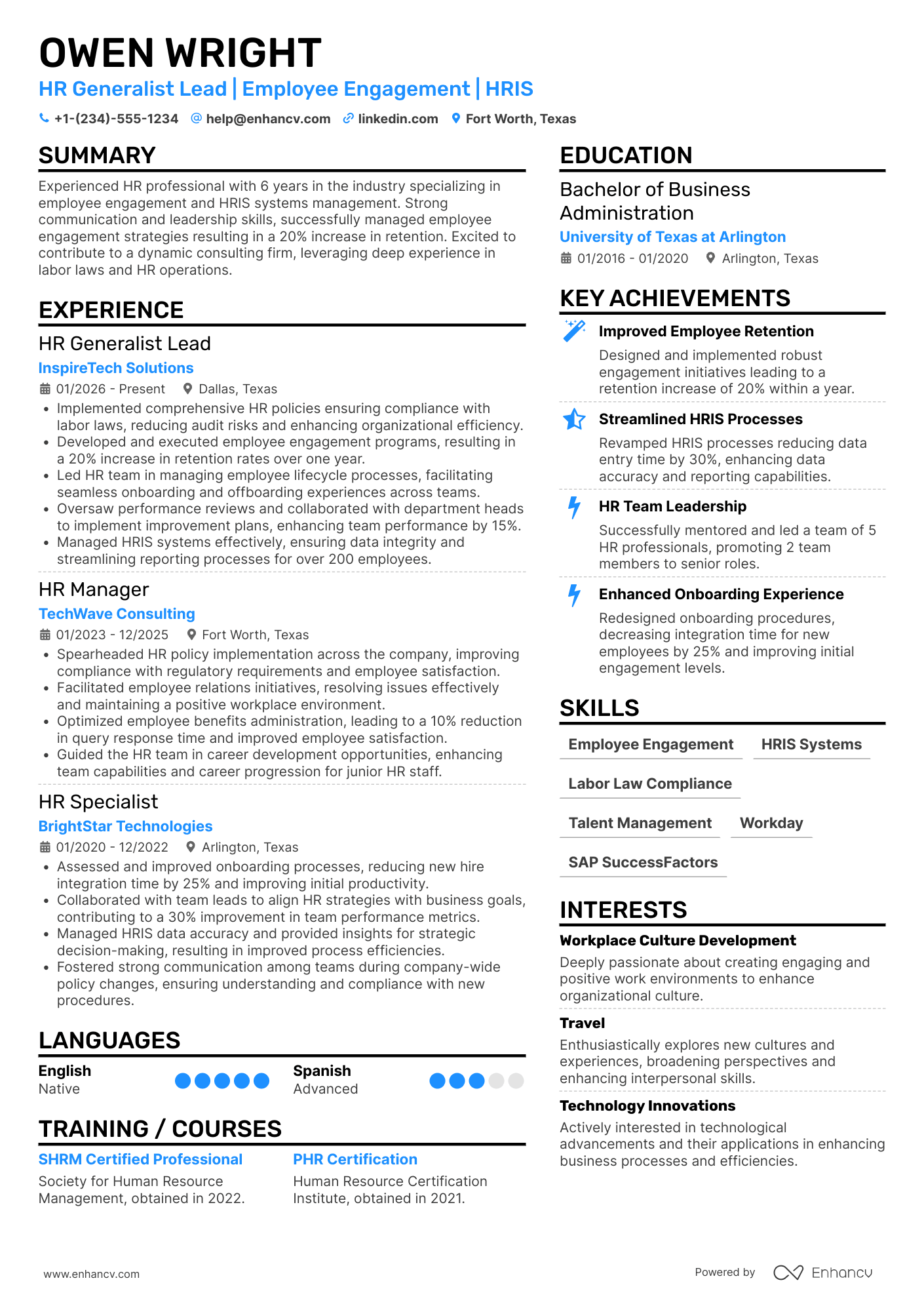
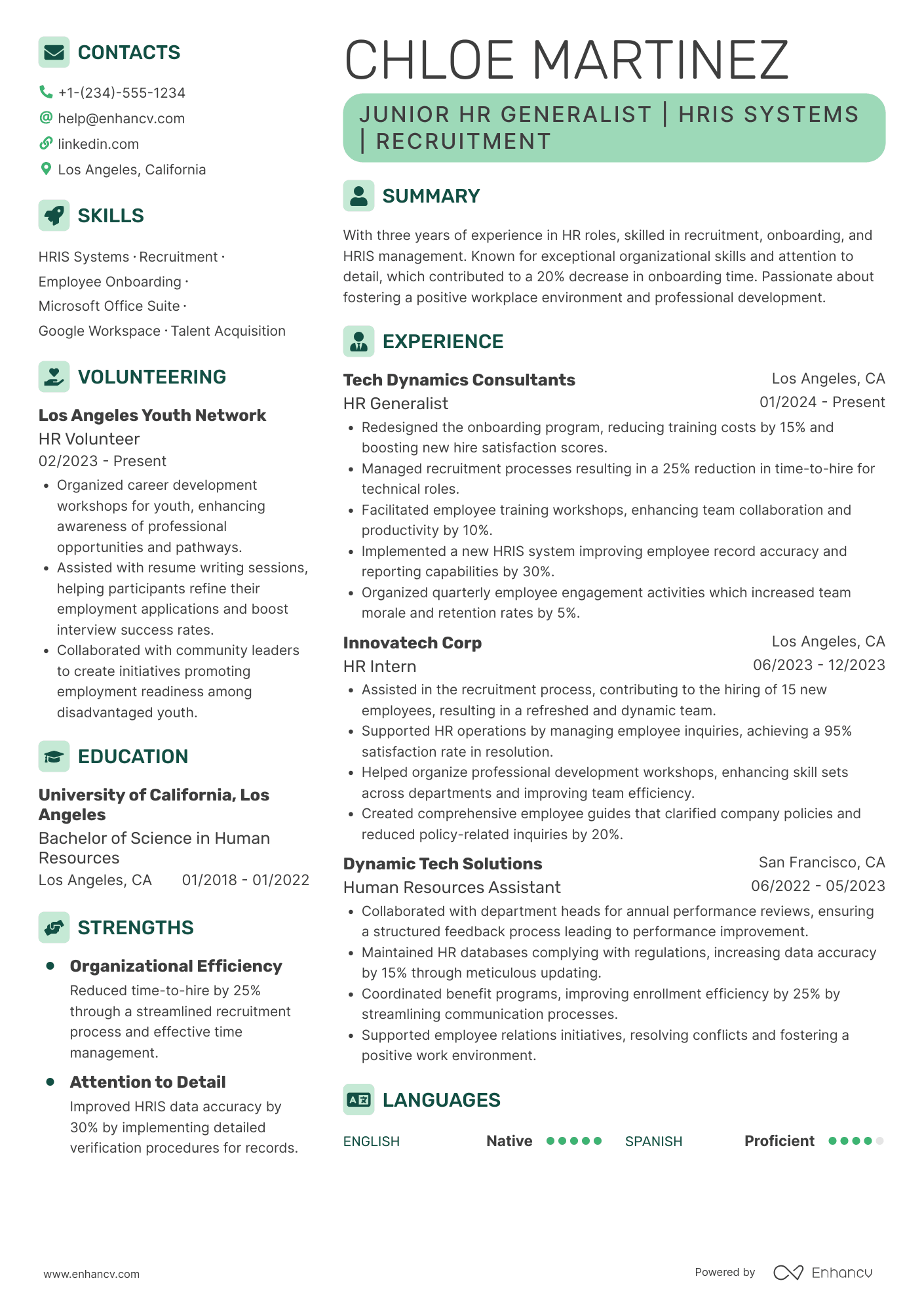
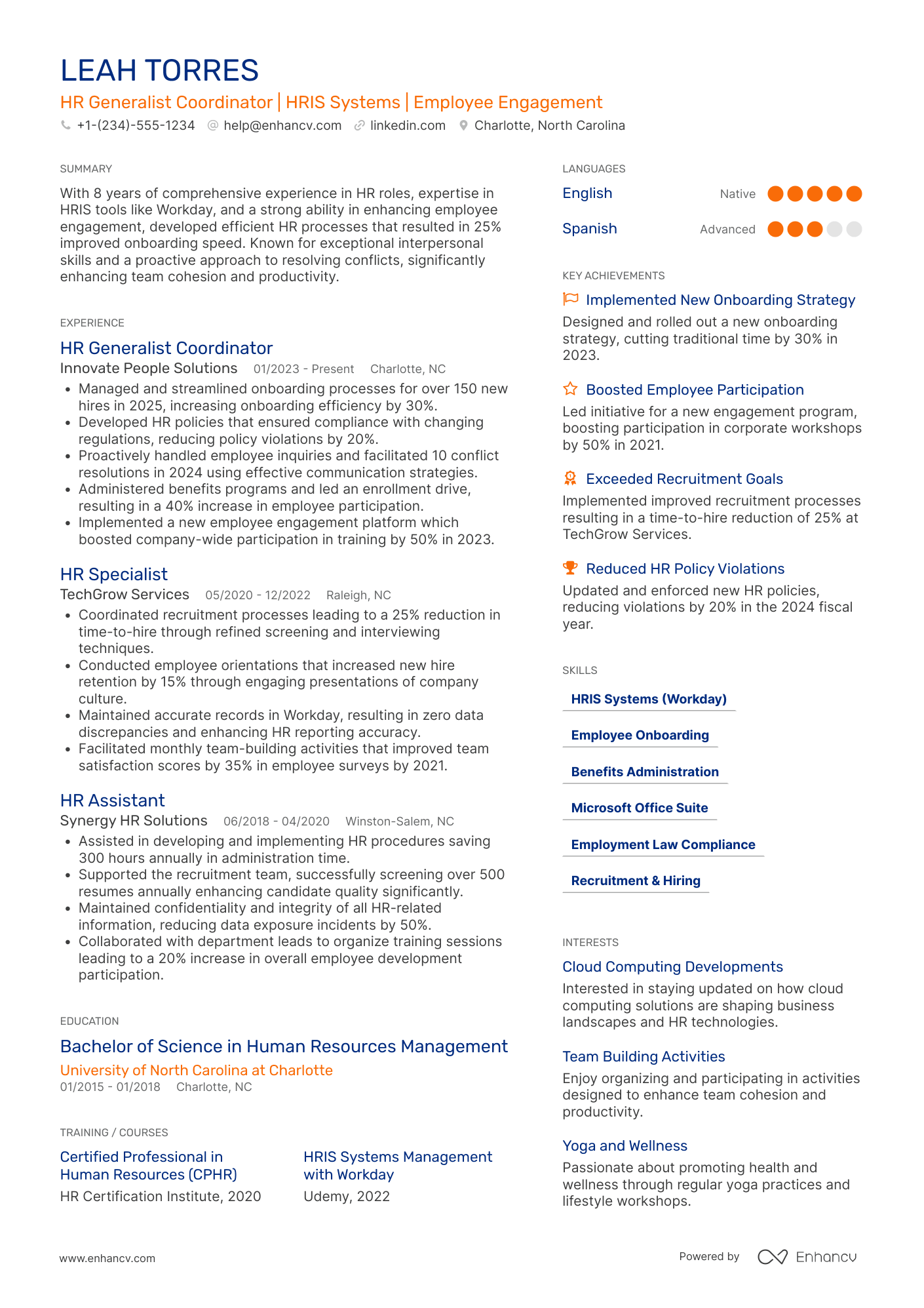
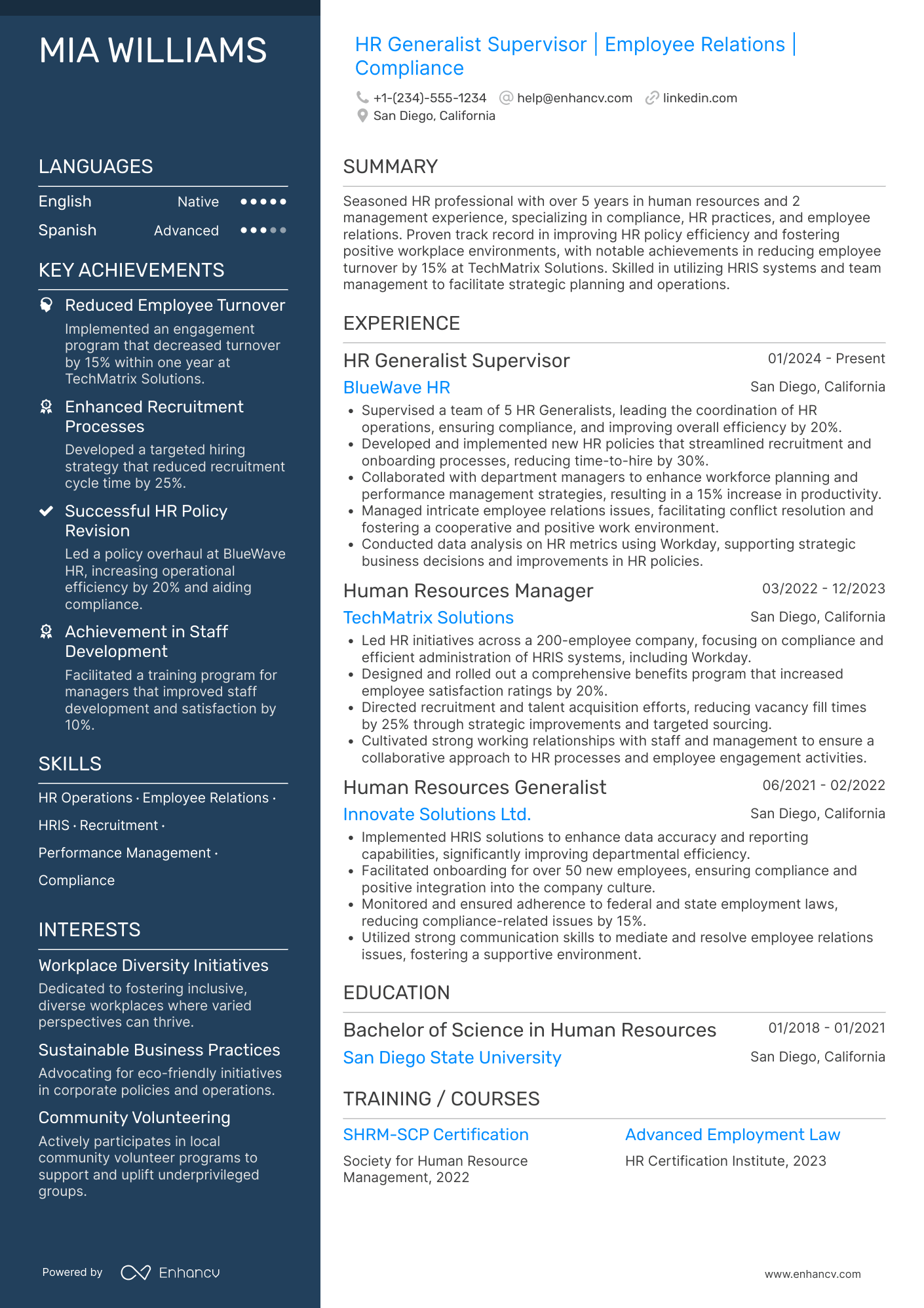
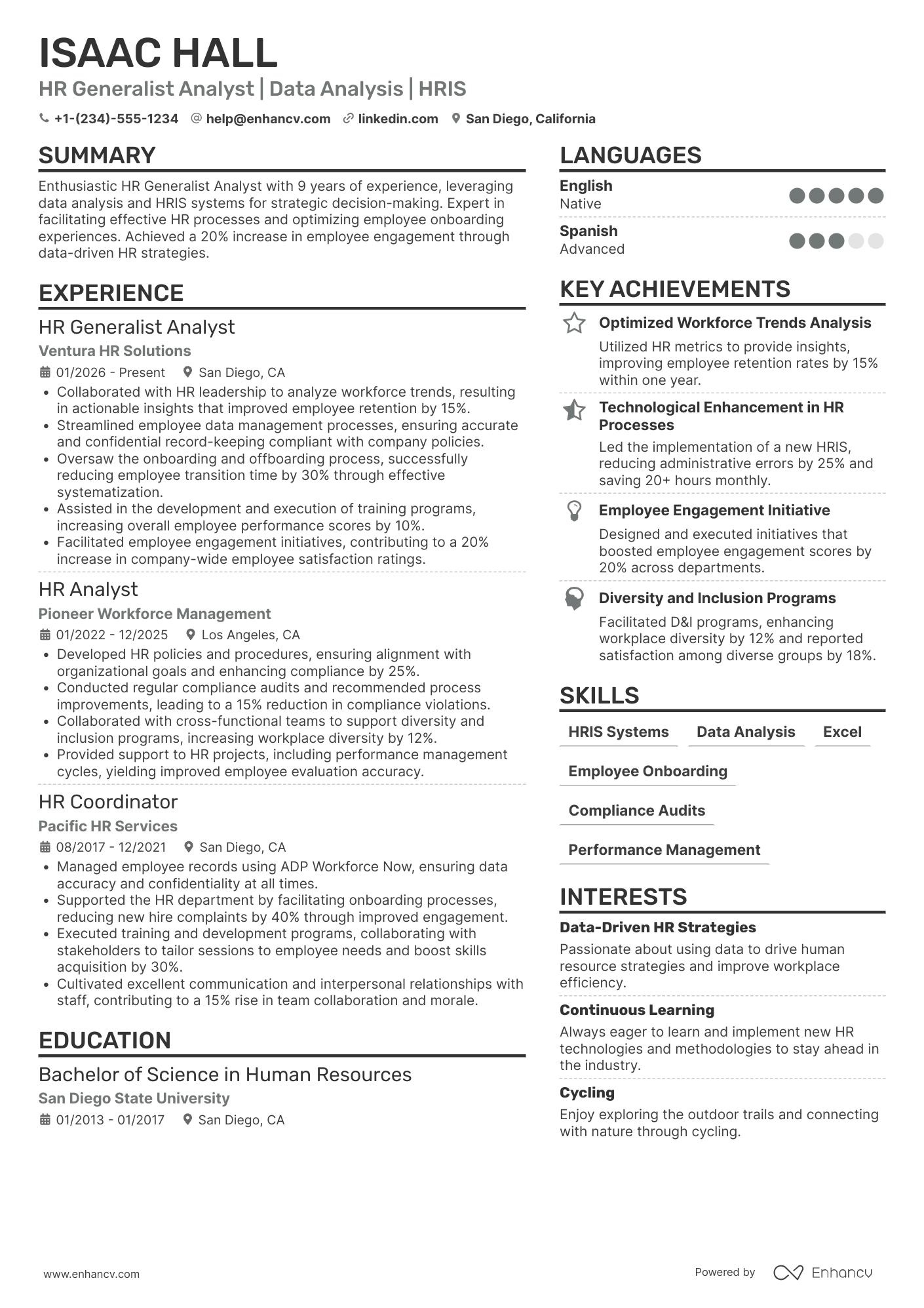
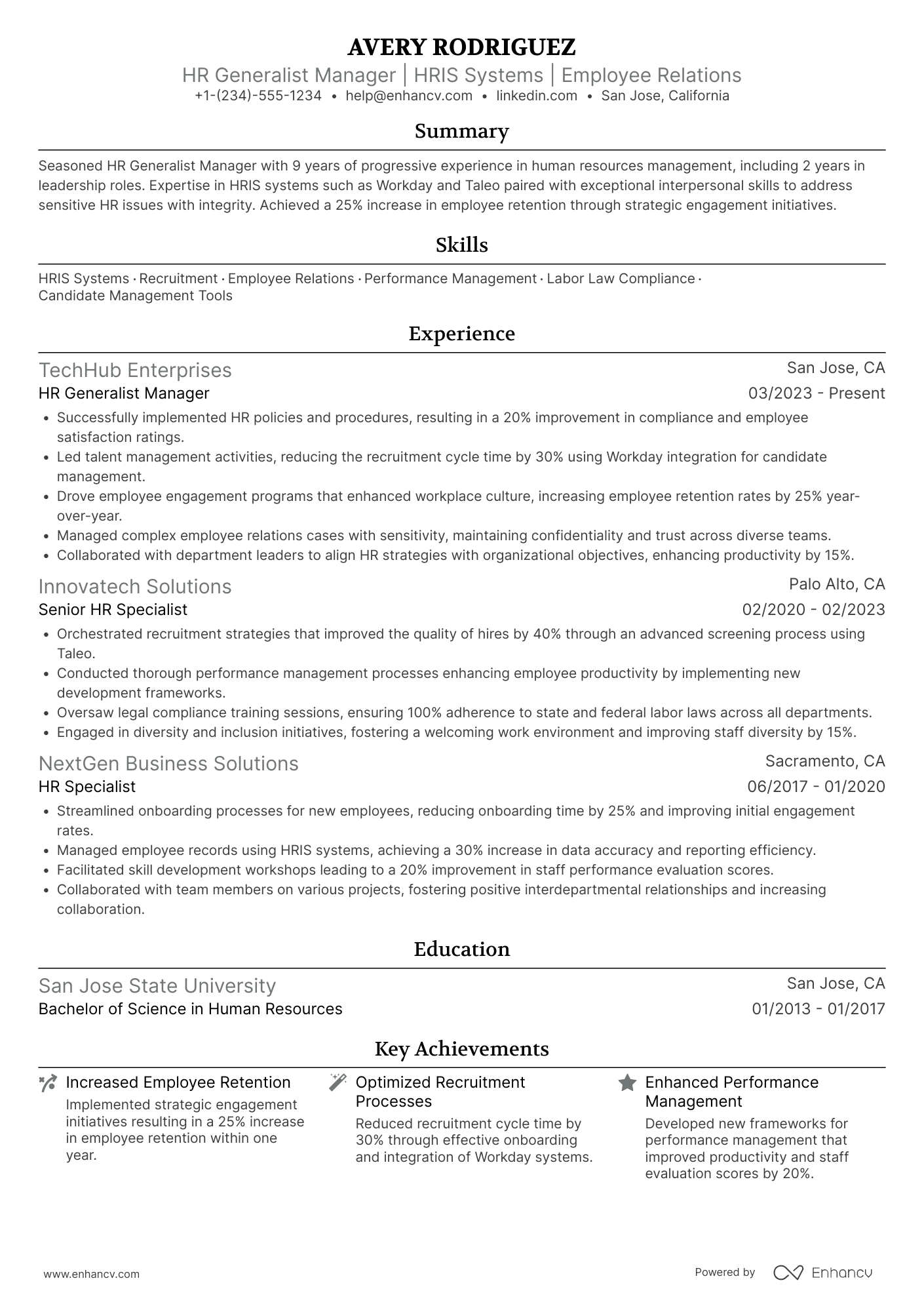
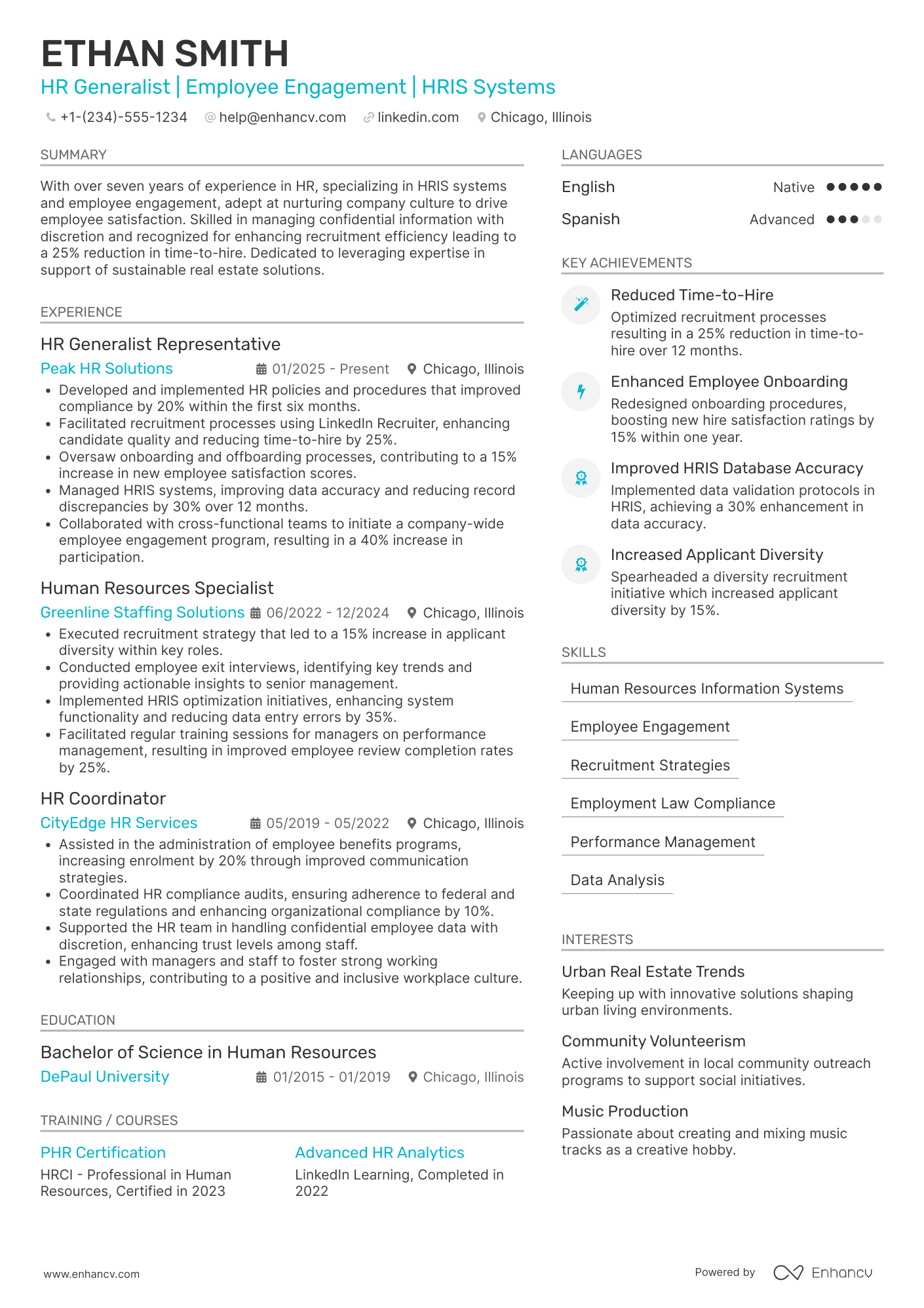
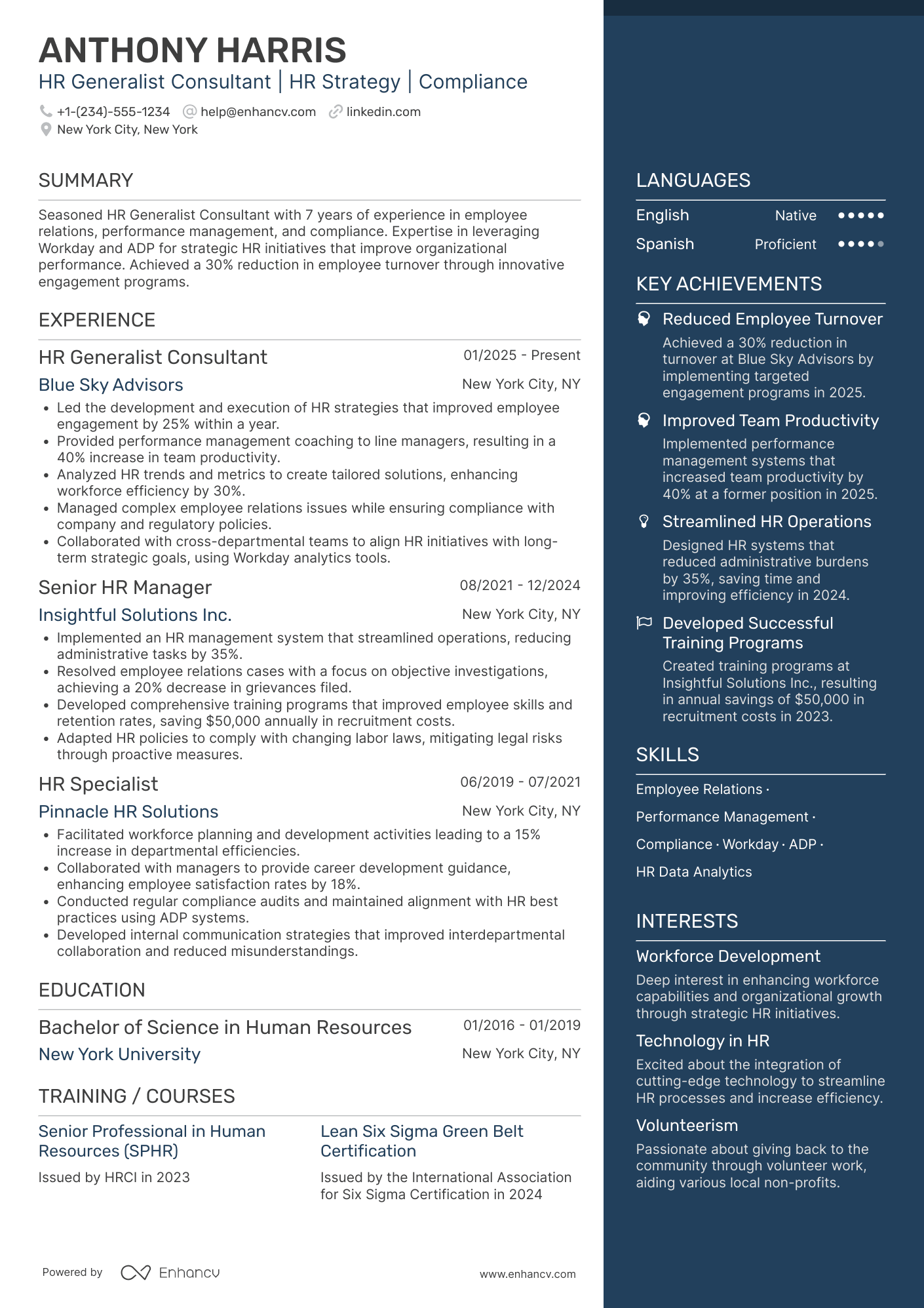
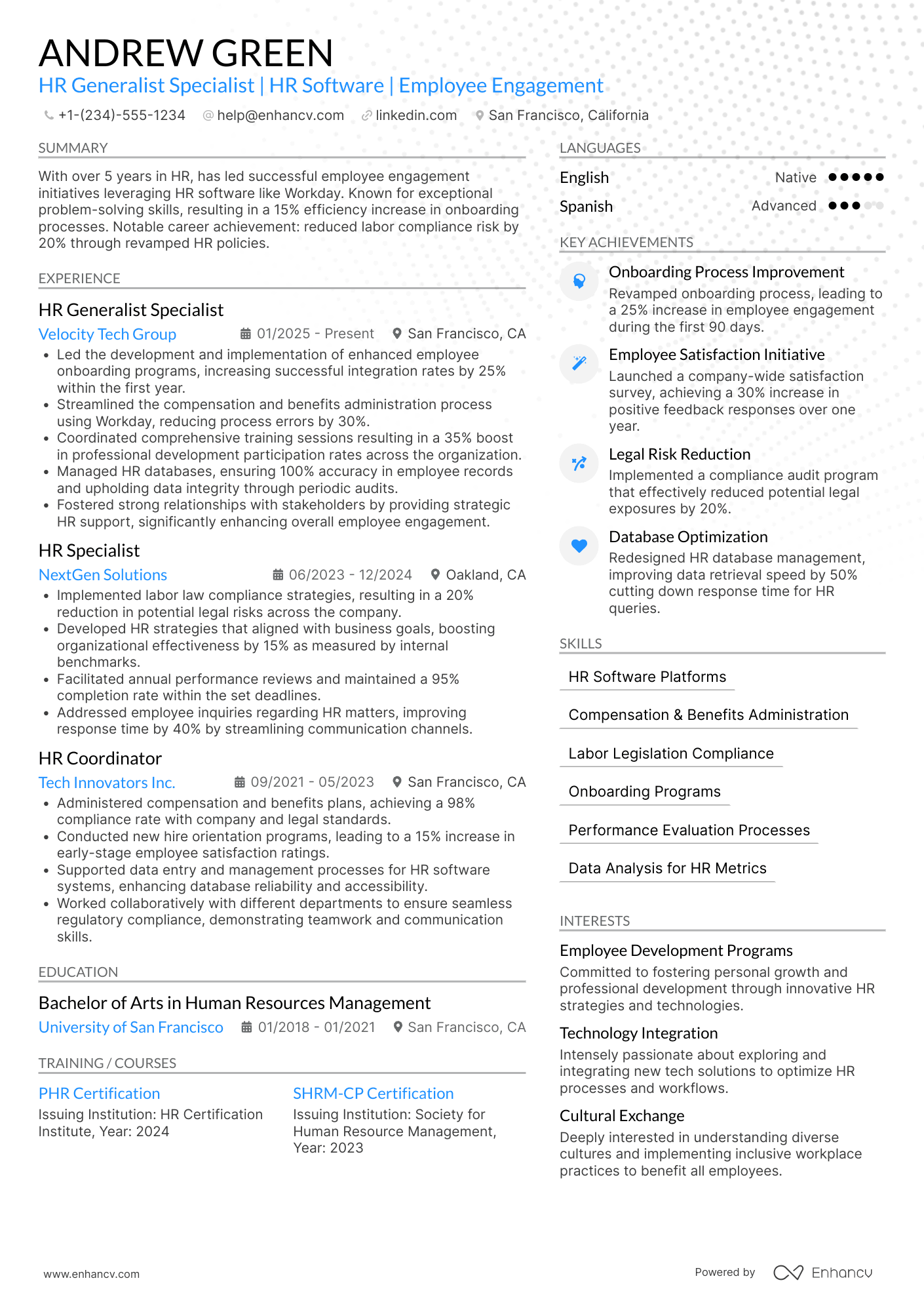
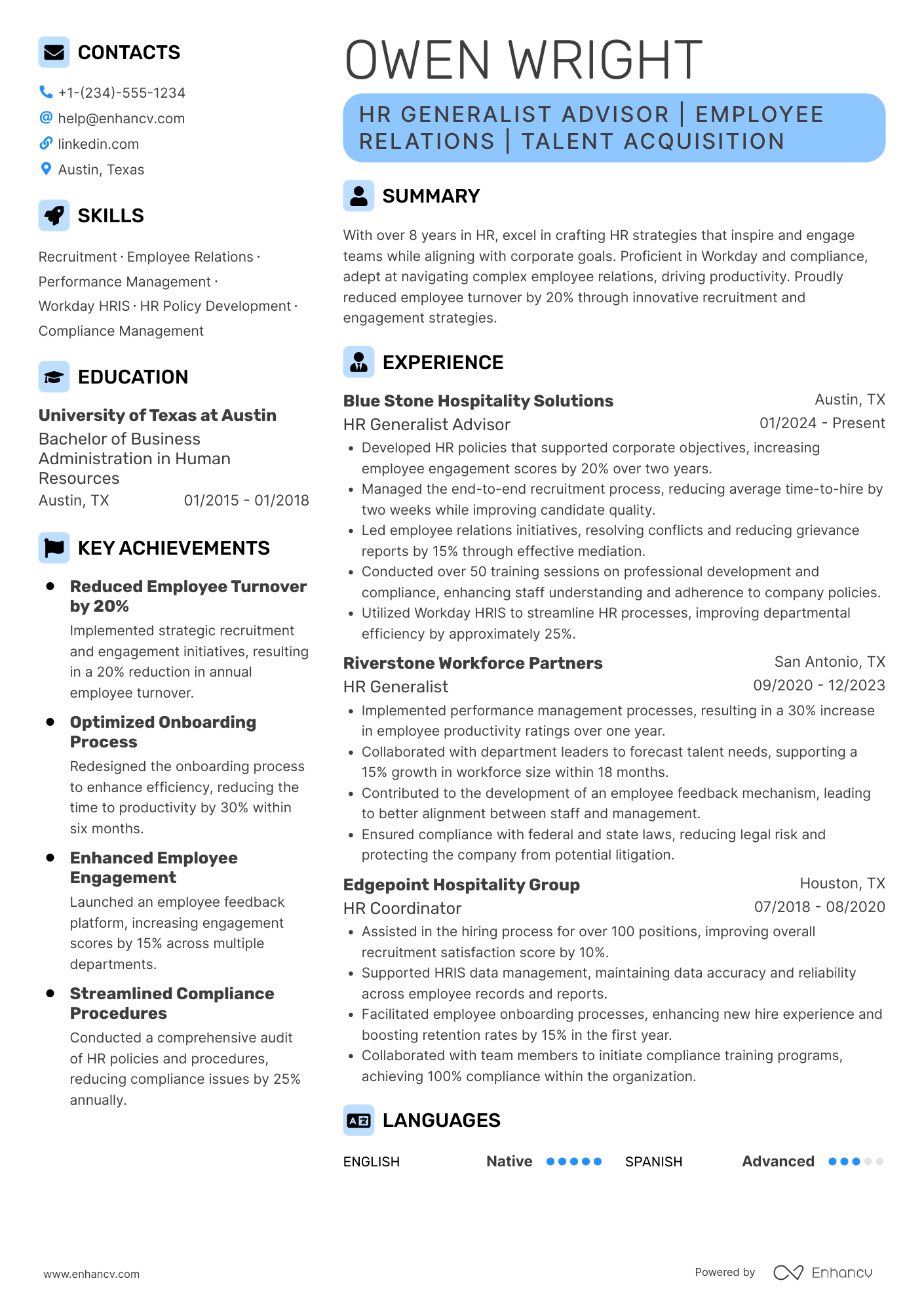
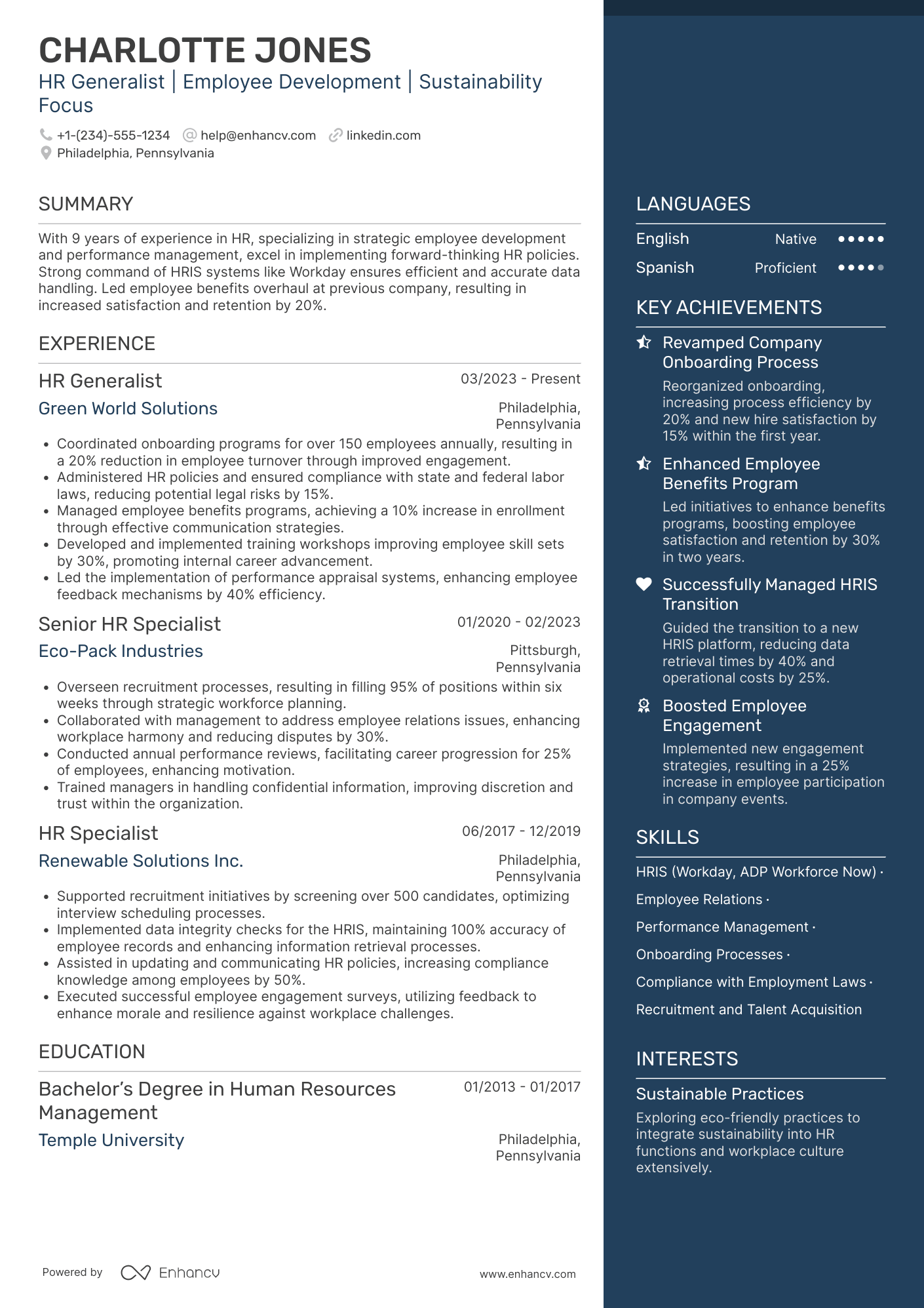
Most HR generalist resume drafts fail because they read like task lists and bury impact behind generic HR terms. That hurts when an applicant tracking system filters by keywords and recruiters scan fast in a crowded market.
A strong resume shows what changed because of your work. If you're unsure where to begin, learning how to write a resume that highlights impact is essential. You should highlight measurable outcomes like reduced time-to-fill, improved retention, audit-ready compliance, faster onboarding, higher employee satisfaction, fewer payroll errors, and smoother investigations across multiple sites.

Key takeaways
- Quantify HR outcomes like retention, time-to-fill, and payroll accuracy instead of listing daily tasks.
- Use reverse-chronological format for experienced candidates and hybrid format for career changers.
- Tailor every experience bullet to mirror the job posting's tools, systems, and compliance language.
- Place skills above experience on junior resumes and below experience on senior ones.
- Pair each listed skill with a measurable result in your experience or summary section.
- Add certifications like SHRM-CP or PHR directly after education to signal job-ready expertise.
- Use Enhancv to turn vague job duties into specific, recruiter-ready resume bullets faster.
Job market snapshot for HR generalists
We analyzed 406 recent HR generalist job ads across major US job boards. These numbers help you understand role specialization trends, industry demand, skills in demand at a glance.
What level of experience employers are looking for HR generalists
| Years of Experience | Percentage found in job ads |
|---|---|
| 1–2 years | 13.1% (53) |
| 3–4 years | 20.4% (83) |
| 5–6 years | 7.6% (31) |
| 7–8 years | 0.5% (2) |
| 10+ years | 1.2% (5) |
| Not specified | 55.9% (227) |
HR generalist ads by area of specialization (industry)
| Industry (Area) | Percentage found in job ads |
|---|---|
| Finance & Banking | 42.9% (174) |
| Healthcare | 27.3% (111) |
| Education | 12.1% (49) |
| Government | 6.2% (25) |
| Manufacturing | 4.4% (18) |
| Retail & E-commerce | 4.2% (17) |
Top companies hiring HR generalists
| Company | Percentage found in job ads |
|---|---|
| FirstService Corporation | 3.7% (15) |
Role overview stats
These tables show the most common responsibilities and employment types for HR generalist roles. Use them to align your resume with what employers expect and to understand how the role is structured across the market.
Day-to-day activities and top responsibilities for a HR generalist
| Responsibility | Percentage found in job ads |
|---|---|
| Hris | 39.4% (160) |
| Microsoft office | 25.6% (104) |
| Excel | 20.0% (81) |
| Employee relations | 19.7% (80) |
| Payroll | 11.3% (46) |
| Word | 10.8% (44) |
| Performance management | 10.6% (43) |
| Workday | 10.6% (43) |
| Powerpoint | 10.1% (41) |
| Fmla | 9.9% (40) |
| Compliance | 8.6% (35) |
| Outlook | 8.4% (34) |
Type of employment (remote vs on-site vs hybrid)
| Employment type | Percentage found in job ads |
|---|---|
| On-site | 82.3% (334) |
| Hybrid | 14.8% (60) |
| Remote | 3.0% (12) |
How to format a HR generalist resume
Recruiters evaluating HR generalist resumes prioritize breadth of HR functional knowledge, compliance awareness, employee relations experience, and the ability to manage multiple HR processes simultaneously. A clean, well-structured format ensures these signals surface quickly during both automated screening and manual review, especially since HR generalists are expected to demonstrate organizational skills through every professional touchpoint—including the resume itself. Choosing the right resume format is the first step toward making a strong impression.

I have significant experience in this role—which format should I use?
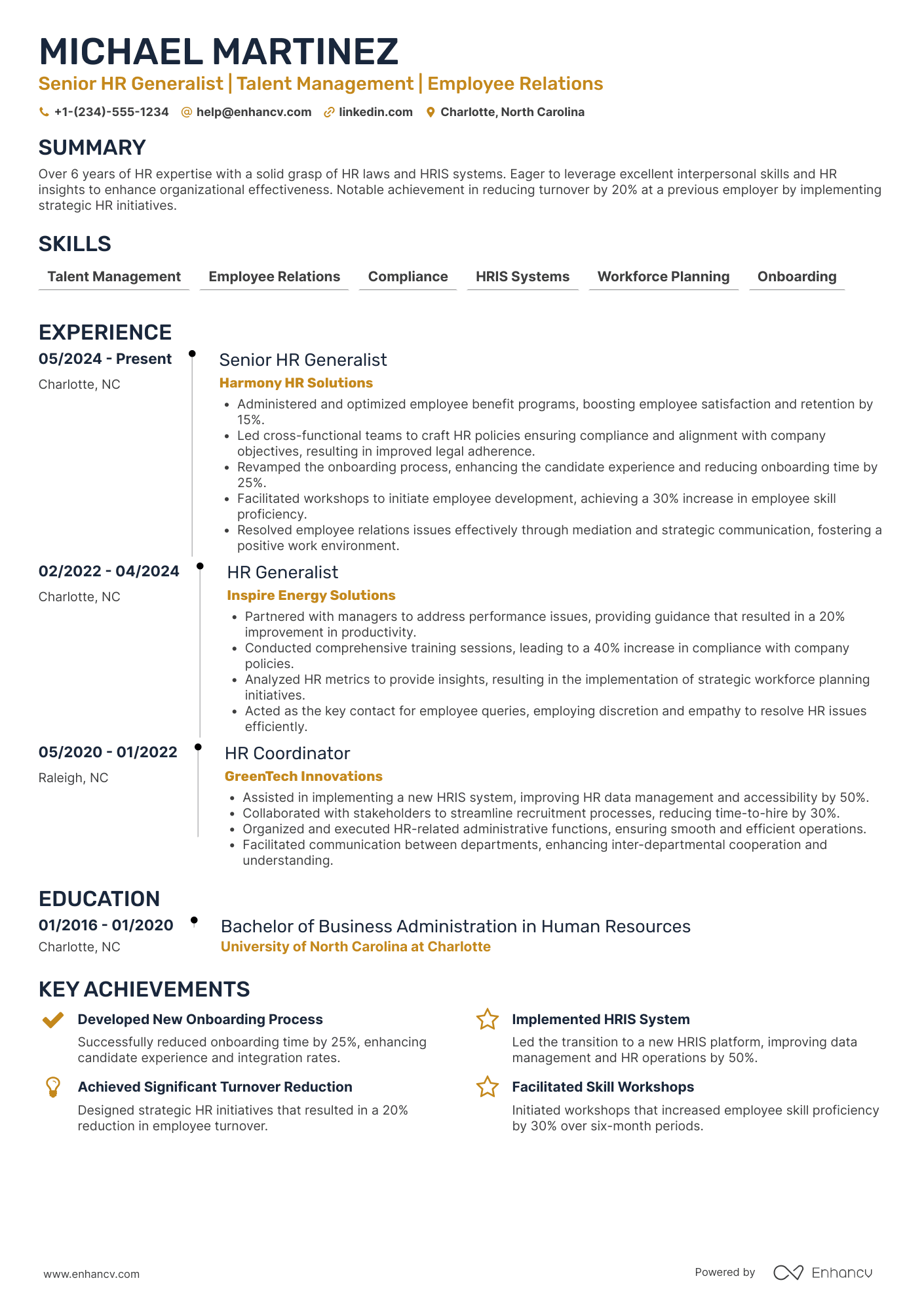
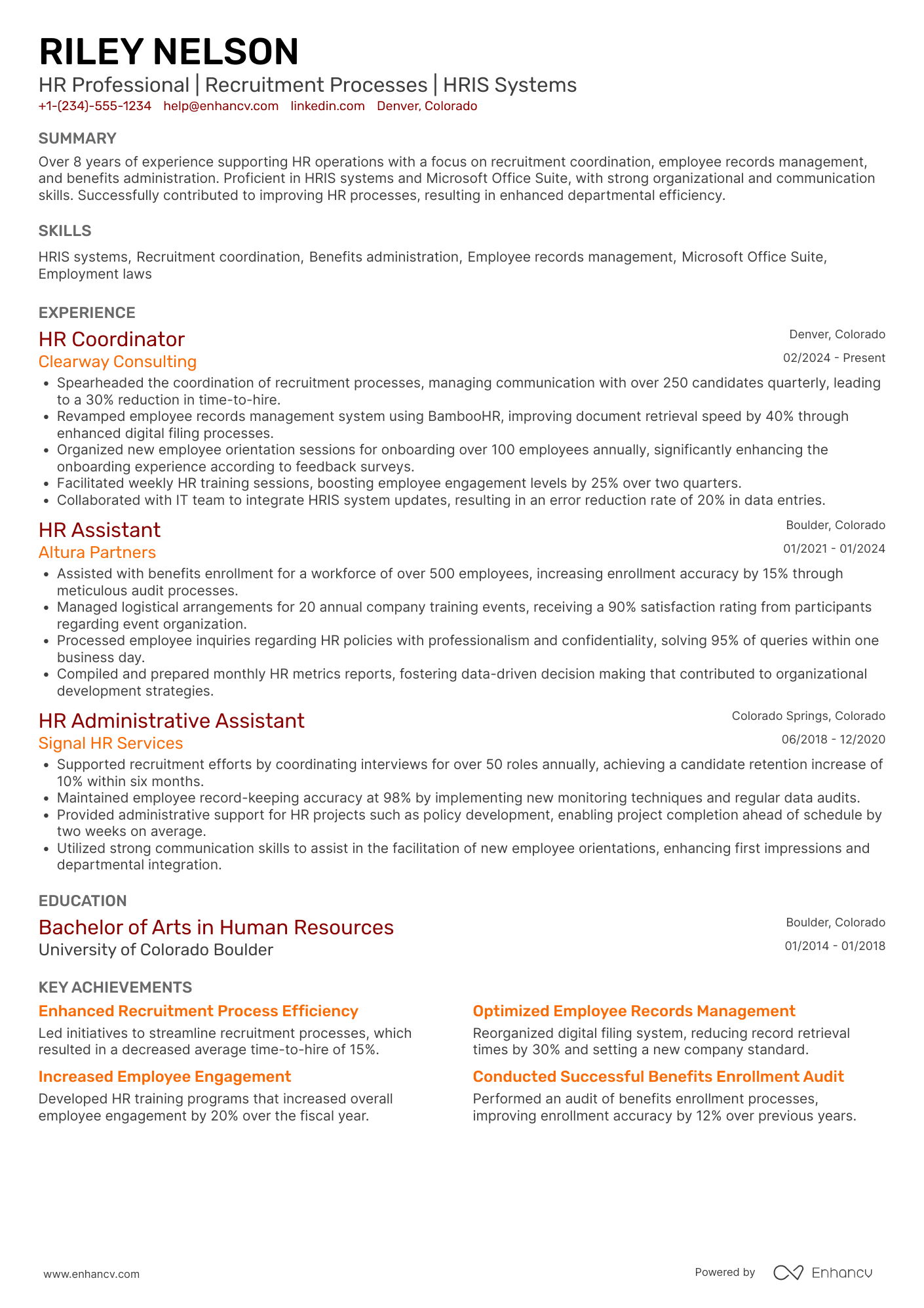
Use a reverse-chronological format to showcase your progressive HR generalist experience and the expanding scope of your responsibilities. Do:
- Lead each role entry with the breadth of your HR ownership—number of employees supported, departments served, and policy areas managed.
- Highlight proficiency in role-specific systems and domains such as HRIS platforms (Workday, BambooHR, ADP), benefits administration, leave management, and employment law compliance.
- Quantify outcomes tied to retention, process efficiency, cost savings, or employee satisfaction improvements.
I'm junior or switching into this role—what format works best?
A hybrid format works best, allowing you to lead with a focused skills section while still grounding your experience in a concise work history. Do:
- Place a skills section near the top that groups core HR competencies—recruitment coordination, payroll processing, employee recordkeeping, and HRIS data entry—so recruiters and applicant tracking systems catch them immediately.
- Include internships, HR-adjacent projects, volunteer committee work, or relevant coursework (such as an HR management certificate or SHRM-CP preparation) to demonstrate foundational exposure.
- Connect every skill to a specific action and a measurable or observable result, even at a small scale.
Why not use a functional resume?
A functional format strips away the timeline and context that hiring managers rely on to verify where, when, and how you applied your HR skills, making it harder to assess your readiness for a role that demands day-to-day accountability across multiple HR functions. A functional format might be acceptable if you're making a career change into HR from an adjacent field (such as office management or recruiting coordination), have a limited formal work history, or are re-entering the workforce after a gap—but only if every listed skill is tied to a specific project, initiative, or outcome rather than presented as an unsupported claim.
Once you've established a clean, readable format, the next step is deciding which sections to include so each one earns its place on the page.
What sections should go on a HR generalist resume
Recruiters expect to quickly find your HR generalist scope, core competencies across the employee lifecycle, and measurable results. Knowing which resume sections to include ensures nothing critical gets overlooked.
Use this structure for maximum clarity:
- Header
- Summary
- Experience
- Skills
- Projects
- Education
- Certifications
- Optional sections: Awards, Volunteering, Languages
Strong experience bullets should emphasize business impact, outcomes, scope, and results across hiring, employee relations, compliance, benefits, and human resources operations.
Is your resume good enough?
Drop your resume here or choose a file. PDF & DOCX only. Max 2MB file size.
Now that you’ve organized your resume with the right core components, the next step is learning how to write your HR generalist resume experience so each role supports your qualifications.
How to write your HR generalist resume experience
Your experience section should prove you've delivered meaningful HR outcomes—not just handled day-to-day responsibilities. Hiring managers reviewing HR generalist resumes prioritize demonstrated impact through role-relevant tools, programs you've shipped or implemented, and measurable results over descriptive task lists. Building a targeted resume that speaks directly to each employer's priorities is key.
Each entry should include:
- Job title
- Company and location (or remote)
- Dates of employment (month and year)
Three to five concise bullet points showing what you owned, how you executed, and what outcomes you delivered:
- Ownership scope: the HR functions, employee populations, policy areas, or talent programs you were directly accountable for as an HR generalist.
- Execution approach: the HRIS platforms, compliance frameworks, recruitment methodologies, or employee relations strategies you used to make decisions and deliver work.
- Value improved: changes to retention, time-to-fill, employee engagement, compliance accuracy, onboarding efficiency, or organizational risk that resulted from your efforts.
- Collaboration context: how you partnered with department leaders, legal counsel, benefits vendors, or executive stakeholders to align HR initiatives with broader business goals.
- Impact delivered: outcomes expressed through workforce improvements, program scale, cost efficiencies, or cultural shifts rather than routine activity descriptions.
Experience bullet formula
A HR generalist experience example
✅ Right example - modern, quantified, specific.
HR Generalist
Northbridge Health | Austin, TX
2022–Present
Multi-site healthcare services provider supporting eight clinics and a 420-employee workforce in a regulated environment.
- Streamlined onboarding in BambooHR and DocuSign by standardizing templates, I-9 workflows, and task automation, cutting time-to-productivity from twelve days to eight days and reducing first-week ticket volume by 28%.
- Partnered with legal, finance, and clinic leadership to update employee handbook policies and compliance training in Litmos, improving course completion from 74% to 96% and reducing policy-related incidents by 18%.
- Led biweekly HR data audits across BambooHR, ADP Workforce Now, and benefit carrier feeds, resolving 210+ discrepancies and lowering payroll corrections by 35% while improving payroll close time by one day.
- Supported managers on performance management using a calibrated review rubric and documented coaching plans, increasing on-time review completion from 81% to 97% and reducing regrettable turnover by 10%.
- Managed employee relations investigations with standardized intake forms and case tracking in Jira Service Management, shortening average resolution time from nine days to six days and reducing repeat issues by 22%.
Now that you've seen how a strong experience section comes together, let's look at how to adjust yours to match the specific HR generalist role you're targeting.
How to tailor your HR generalist resume experience
Recruiters evaluate your HR generalist resume through applicant tracking systems and manual review, scoring relevance against the job posting. Tailoring your resume to the job description increases your chances of advancing.
Ways to tailor your HR generalist experience:
- Match the HRIS platforms and payroll systems named in the posting.
- Mirror the exact compliance standards or labor regulations referenced.
- Use the same terminology for onboarding or offboarding processes described.
- Highlight employee relations or conflict resolution if the role prioritizes them.
- Reflect the performance management frameworks or review cycles mentioned.
- Emphasize benefits administration experience when the listing calls for it.
- Include industry-specific workforce knowledge that aligns with the employer.
- Align your collaboration language with cross-functional or departmental models referenced.
Tailoring means aligning your real accomplishments with each job's stated requirements, not forcing disconnected keywords into your experience bullets.
Resume tailoring examples for HR generalist
| Job description excerpt | Untailored | Tailored |
|---|---|---|
| Administer employee benefits programs, including open enrollment, FMLA leave tracking, and COBRA compliance using Workday. | Helped with employee benefits and answered HR questions. | Administered benefits programs for 350+ employees in Workday, managing open enrollment cycles, FMLA leave tracking, and COBRA compliance with zero audit findings over two years. |
| Partner with hiring managers to lead full-cycle recruiting, conduct structured interviews, and maintain requisition data in Greenhouse ATS. | Assisted with recruiting and hiring new employees. | Led full-cycle recruiting for 40+ annual requisitions across five departments, conducting structured interviews and maintaining accurate requisition pipelines in Greenhouse ATS to reduce average time-to-fill by 12 days. |
| Support employee relations by conducting workplace investigations, documenting findings, and ensuring adherence to federal and state employment laws, including Title VII and ADA. | Handled employee issues and helped resolve workplace conflicts. | Conducted 25+ workplace investigations annually, documenting findings and recommended actions in compliance with Title VII, ADA, and state employment laws, resulting in consistent resolution of cases before escalation to external agencies. |
Once you’ve aligned your experience with the role’s priorities, the next step is to quantify your HR generalist achievements so hiring managers can see the impact behind those responsibilities.
How to quantify your HR generalist achievements
Quantifying your achievements proves business impact beyond "people support." Focus on cycle time, accuracy, compliance risk reduction, retention, and volume handled—especially across hiring, onboarding, employee relations, and human resources information system workflows.
Quantifying examples for HR generalist
| Metric | Example |
|---|---|
| Hiring cycle time | "Cut average time-to-fill from 52 to 38 days by streamlining intake forms and using Greenhouse scorecards across 18 requisitions." |
| Onboarding throughput | "Onboarded 96 new hires in one quarter with a 98% on-time completion rate using BambooHR checklists and manager reminders." |
| Payroll accuracy | "Reduced payroll corrections from 3.1% to 0.8% by auditing timecards weekly and standardizing approval steps in ADP Workforce Now." |
| Compliance risk | "Closed 14 I-9 audit issues and achieved 100% completion within 72 hours by implementing E-Verify tracking and monthly self-audits." |
| Retention impact | "Improved ninety-day new-hire retention from 86% to 92% by adding stay interviews and manager coaching for eight high-turnover teams." |
Turn vague job duties into measurable, recruiter-ready resume bullets in seconds with Enhancv's Bullet Point Generator.
Once you've crafted strong bullet points for your experience section, you'll want to apply that same precision to presenting your hard and soft skills.
How to list your hard and soft skills on a HR generalist resume
Your skills section shows recruiters and an ATS (applicant tracking system) that you can run core HR operations, stay compliant, and support employees—aim for a balance of role-specific hard skills and execution-focused soft skills. HR generalist roles require a blend of:
- Product strategy and discovery skills: Workforce planning, employee needs analysis, policy improvement.
- Data, analytics, and experimentation skills: HR metrics reporting, survey analysis, process testing.
- Delivery, execution, and go-to-market discipline: Onboarding rollout, benefits administration, change enablement.
- Soft skills: Stakeholder communication, conflict resolution, sound judgment.
Your skills section should be:
- Scannable (bullet-style grouping).
- Relevant to the job post.
- Backed by proof in experience bullets.
- Updated with current tools.
Place your skills section:
- Above experience if you're junior or switching careers.
- Below experience if you're mid/senior with strong achievements.

Hard skills
- Human resources information systems (HRIS)
- Workday, ADP Workforce Now, UKG
- Applicant tracking systems
- Recruiting coordination, scheduling
- Onboarding, offboarding workflows
- Benefits administration, open enrollment
- Leave of absence administration, FMLA
- Employee relations investigations
- Performance management cycles
- Compensation benchmarking, salary bands
- Policy drafting, handbook updates
- HR compliance: FLSA, EEOC, I-9, E-Verify
Soft skills
- Handle sensitive information discreetly
- Build trust with employees and managers
- De-escalate conflict and resolve issues
- Coach managers through documentation
- Communicate policy changes clearly
- Align stakeholders on next steps
- Prioritize competing HR requests
- Make consistent, fair decisions
- Follow through on deadlines and details
- Document decisions and action items
- Partner cross-functionally with payroll and finance
- Improve processes without disrupting operations
How to show your HR generalist skills in context
Skills shouldn't live only in a bulleted list on your resume. Explore resume skills examples to see how top candidates weave competencies throughout their documents.
They should be demonstrated in:
- Your summary (high-level professional identity)
- Your experience (proof through outcomes)
Here's what strong, skills-rich resume content looks like in practice.
Summary example
HR generalist with 10+ years in healthcare, skilled in employee relations, HRIS administration, and benefits coordination. Redesigned onboarding using BambooHR, cutting new-hire ramp-up time by 30%. Known for bridging leadership and staff through transparent communication.
- Reflects senior-level depth immediately
- Names specific tools and platforms
- Leads with a measurable outcome
- Highlights communication as a soft skill
Experience example
Senior HR Generalist
Lakeview Regional Medical Group | Remote
March 2019–Present
- Partnered with department heads to restructure performance reviews in Workday, improving completion rates by 42% across 12 teams.
- Led a cross-functional benefits audit using ADP Workforce Now, identifying $85K in annual savings while maintaining employee satisfaction scores.
- Collaborated with legal counsel to update compliance training modules, reducing policy violations by 27% within one fiscal year.
- Every bullet includes measurable proof.
- Skills surface naturally through real outcomes.
Once you’ve demonstrated your HR generalist strengths through specific, results-focused examples, the next step is applying the same approach to build an HR generalist resume with no experience.
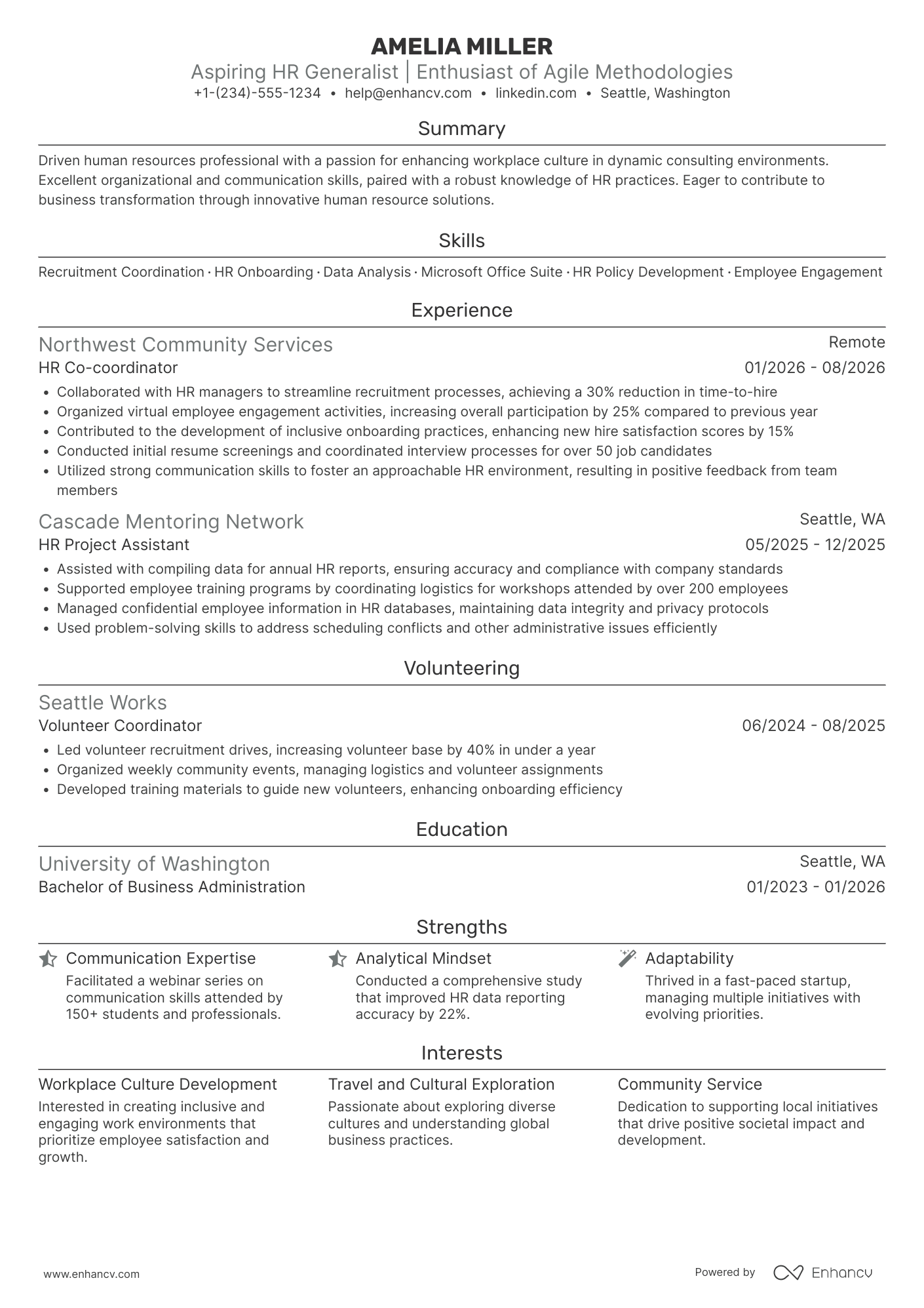
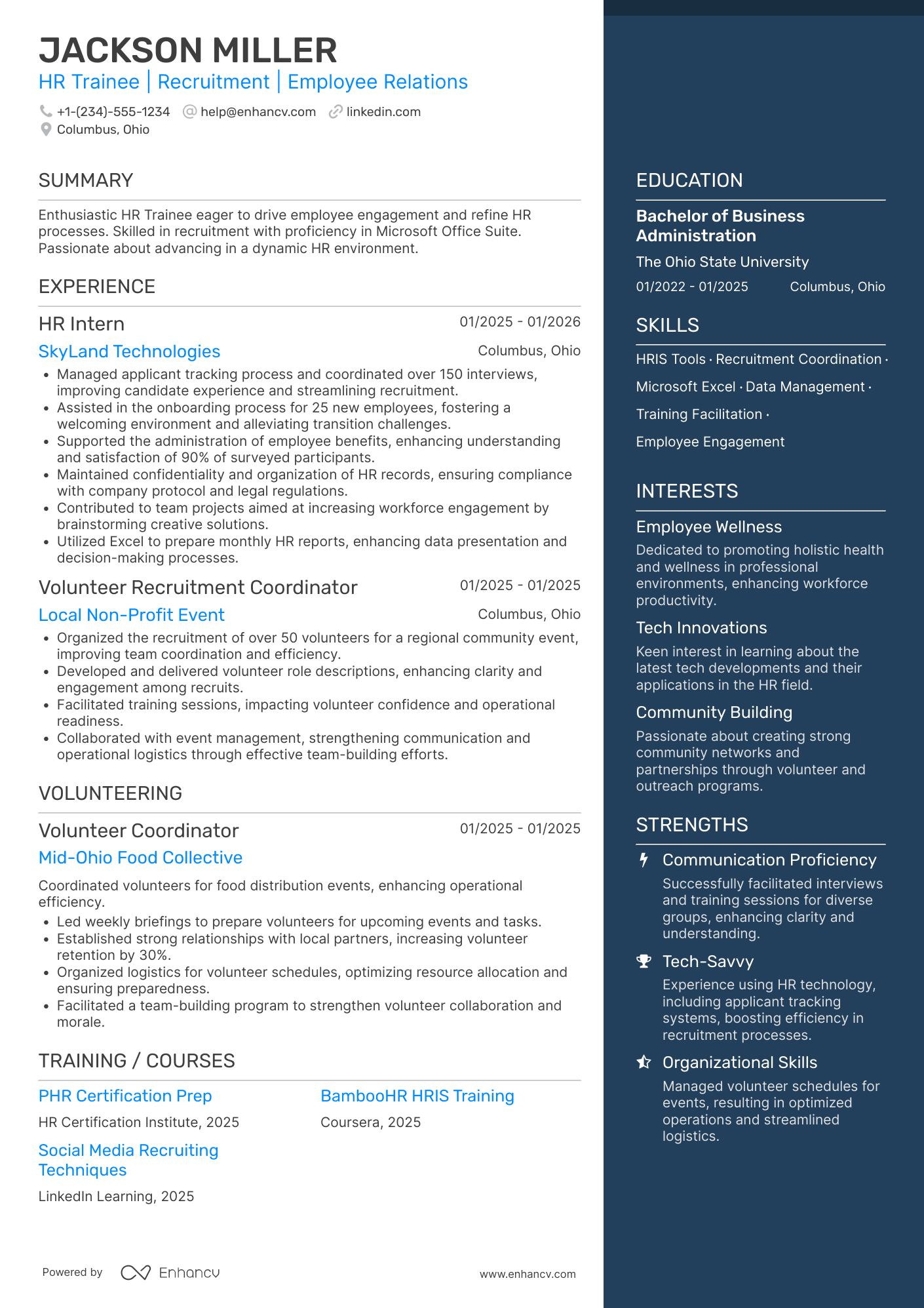
How do I write a HR generalist resume with no experience
Even without full-time experience, you can demonstrate readiness through:
- HR internship or co-op rotation
- Campus HR or recruiting club
- Volunteer onboarding and scheduling support
- HRIS (human resources information system) coursework
- Mock employee relations casework
- Recruiting projects with applicant tracking systems
- Payroll and benefits simulations
If you're starting from scratch, this guide on writing a resume without work experience offers strategies tailored to entry-level candidates.
Focus on:
- HRIS data accuracy and reporting
- Recruiting pipeline metrics and tracking
- Compliance documentation and audit readiness
- Employee lifecycle process knowledge
Resume format tip for entry-level HR generalist
Use a hybrid resume format. It highlights HR generalist skills and projects first, while keeping education and any work history easy to scan. Do:
- Lead with an HR generalist summary.
- Add a "Projects" section near top.
- Mirror keywords from job postings.
- Quantify results with counts and rates.
- List tools like Workday and Excel.
- Built a recruiting tracker in Excel and an applicant tracking system sandbox, cutting duplicate entries by 30% and improving candidate status accuracy across fifty records.
Your education section becomes especially critical when you don't have direct experience, so presenting it strategically can strengthen your candidacy.
How to list your education on a HR generalist resume
Your education section helps hiring teams confirm you have the foundational knowledge needed for the HR generalist role. It quickly validates your academic background in human resources or related fields.
Include:
- Degree name
- Institution
- Location
- Graduation year
- Relevant coursework (for juniors or entry-level candidates)
- Honors & GPA (if 3.5 or higher)
Skip month and day details—list the graduation year only.
Here's a strong education entry tailored to the HR generalist role.
Example education entry
Bachelor of Science in Human Resource Management
University of Georgia, Athens, GA
Graduated 2021
GPA: 3.7/4.0
- Relevant Coursework: Employment Law, Compensation & Benefits, Organizational Behavior, Talent Acquisition Strategies
- Honors: Magna Cum Laude, Dean's List (six semesters)
How to list your certifications on a HR generalist resume
Certifications on your resume show your commitment to learning, your proficiency with HR tools and practices, and your industry relevance as a HR generalist.
Include:
- Certificate name
- Issuing organization
- Year
- Optional: credential ID or URL
- Place certifications below education when your degree is recent and your certifications are older or less relevant to your current HR generalist focus.
- Place certifications above education when they are recent, highly relevant, or required for the HR generalist roles you target.
Best certifications for your HR generalist resume
- SHRM Certified Professional (SHRM-CP)
- Professional in Human Resources (PHR)
- Certified Professional in Talent Development (CPTD)
- Certified Compensation Professional (CCP)
- Certified Employee Benefits Specialist (CEBS)
- HRCI Senior Professional in Human Resources (SPHR)
- Society for Human Resource Management Specialty Credential
Once you’ve positioned your credentials where recruiters can spot them quickly, you’re ready to write your HR generalist resume summary to frame those qualifications in a clear, results-focused snapshot.
How to write your HR generalist resume summary
Your resume summary is the first thing a recruiter reads. A strong one immediately signals you're qualified for an HR generalist role.
Keep it to three to four lines, with:
- Your title and total years of HR experience.
- The industry or company type where you've worked.
- Core skills like employee relations, benefits administration, or HRIS platforms.
- One or two measurable achievements, such as turnover reduction or time-to-fill improvements.
- Soft skills tied to real outcomes, like conflict resolution that lowered formal grievances.

PRO TIP
At this level, lead with practical skills, relevant tools, and early wins that prove you can execute. Highlight HRIS proficiency, onboarding coordination, or compliance support. Avoid vague phrases like "passionate team player" or "motivated self-starter." Recruiters want evidence, not enthusiasm.
Example summary for a HR generalist
HR generalist with two years of experience supporting employee relations and benefits administration. Reduced onboarding time by 20% using BambooHR. Skilled in compliance tracking, HRIS management, and resolving workplace conflicts.
Optimize your resume summary and objective for ATS
Drop your resume here or choose a file.
PDF & DOCX only. Max 2MB file size.
Now that your summary is ready to showcase your HR expertise, make sure the header above it presents your contact details clearly so recruiters can reach you without any hassle.
What to include in a HR generalist resume header
A resume header is the contact and identity block at the top that boosts visibility, builds credibility, and speeds recruiter screening for a HR generalist.
Essential resume header elements
- Full name
- Tailored job title and headline
- Location
- Phone number
- Professional email
- GitHub link
- Portfolio link
A LinkedIn link helps recruiters verify your experience quickly and supports screening.
Don't include a photo on a HR generalist resume unless the role is explicitly front-facing or appearance-dependent.
Keep your header on one to two lines, match it to the job posting, and use consistent formatting so recruiters can scan it fast.
HR generalist resume header
Jordan Taylor
HR Generalist | Employee Relations, Recruiting, and HR Operations
Austin, TX
(512) 555-01XX
jordan.taylor@enhancv.com
github.com/jordantaylor yourwebsite.com linkedin.com/in/jordantaylor
Once your contact details and role identifiers are set at the top, add the following optional sections to round out your HR generalist resume with relevant supporting information.
Additional sections for HR generalist resumes
When your core sections don't fully capture your expertise, additional sections help you stand out and reinforce your HR generalist credibility. For example, listing language skills can be especially valuable if you support a multilingual workforce.
- Languages
- Certifications (SHRM-CP, PHR, HRCI)
- Professional affiliations
- Volunteer experience
- Awards and recognitions
- Publications
- Continuing education and training
Once you've rounded out your resume with the right supplementary sections, the next step is pairing it with a strong cover letter to make your application complete.
Do HR generalist resumes need a cover letter
A cover letter isn't required for an HR generalist, but it helps in competitive roles or when hiring teams expect one. If you're unsure where to start, understanding what a cover letter is and how it complements your resume can clarify when to include one. It can make a difference when your resume needs context, or when you want to show clear fit fast.
Use a cover letter when it adds information your resume can't:
- Explain role or team fit: Connect your HR generalist scope to their needs, such as employee relations, benefits, or performance management.
- Highlight one or two relevant projects or outcomes: Pick results like improved time-to-fill, reduced turnover, or cleaner HR processes, and name your role.
- Show understanding of the product, users, or business context: Reference their workforce profile, growth stage, or compliance environment, and tie it to your HR generalist experience.
- Address career transitions or non-obvious experience: Clarify shifts in industry, gaps, or lateral moves, and map transferable HR generalist skills to the role.
Drop your resume here or choose a file.
PDF & DOCX only. Max 2MB file size.
Whether you include a cover letter depends on the role and employer expectations, and AI can help you strengthen your HR generalist resume accordingly.
Using AI to improve your HR generalist resume
AI can sharpen your resume's clarity, structure, and impact. It helps refine language and highlight measurable results. But overuse strips authenticity fast. Once your content feels clear and role-aligned, step away from AI. For practical prompts and techniques, check out this guide on ChatGPT resume writing.
Here are 10 practical prompts to strengthen specific sections of your HR generalist resume:
Strengthen your summary
Quantify experience bullets
Align skills with job posts
Tighten bullet phrasing
Improve project descriptions
Refine education details
Highlight relevant certifications
Remove redundant language
Tailor for ATS compatibility
Focus on career progression
Conclusion
A strong HR generalist resume highlights measurable outcomes, role-specific skills, and a clear structure. It shows impact in hiring, employee relations, compliance, and HR operations with numbers, timelines, and results.
Keep every section easy to scan, and connect your experience to today’s hiring priorities. This approach signals you’re ready to support changing policies, evolving workforce needs, and the near-future HR generalist market.