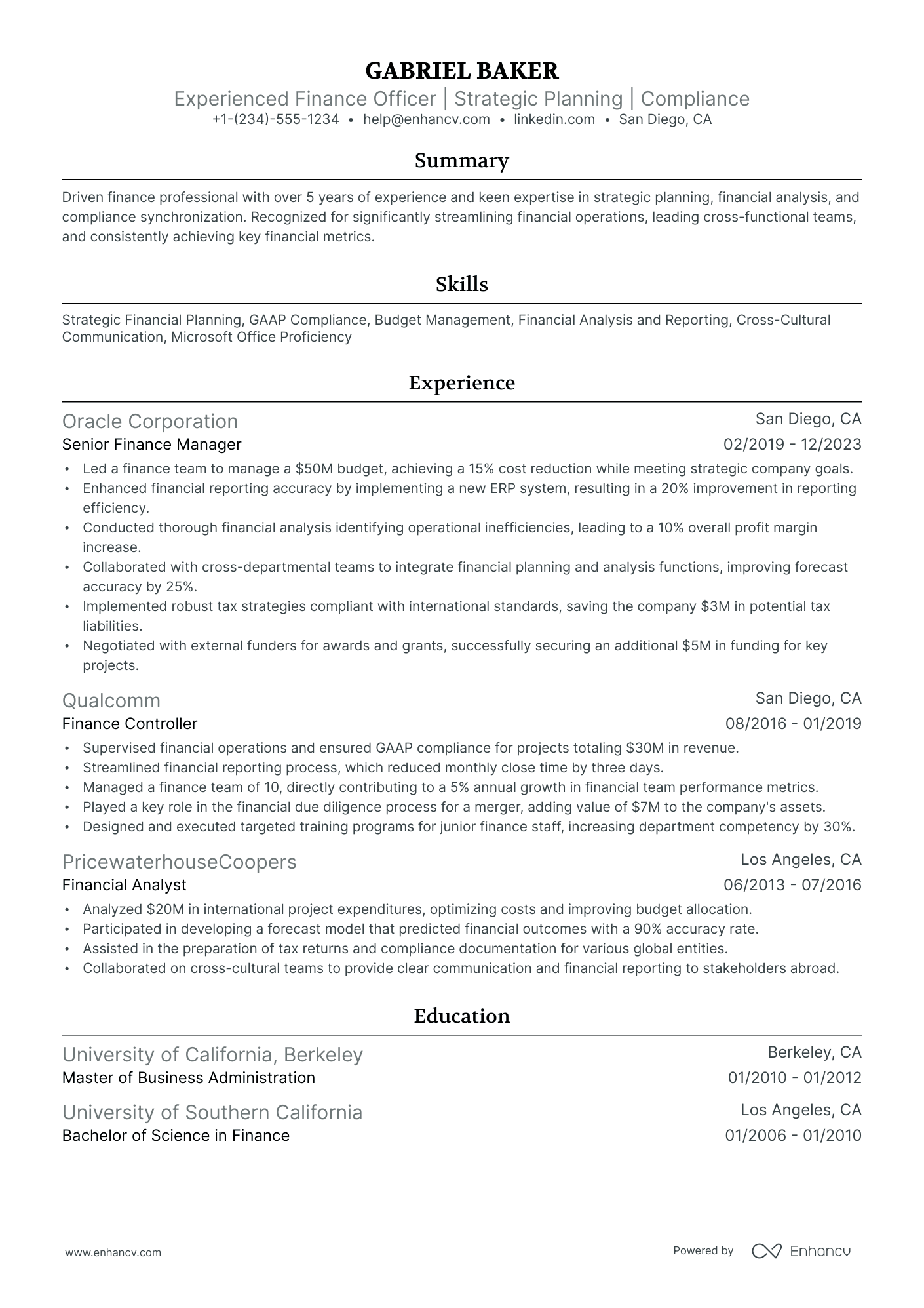
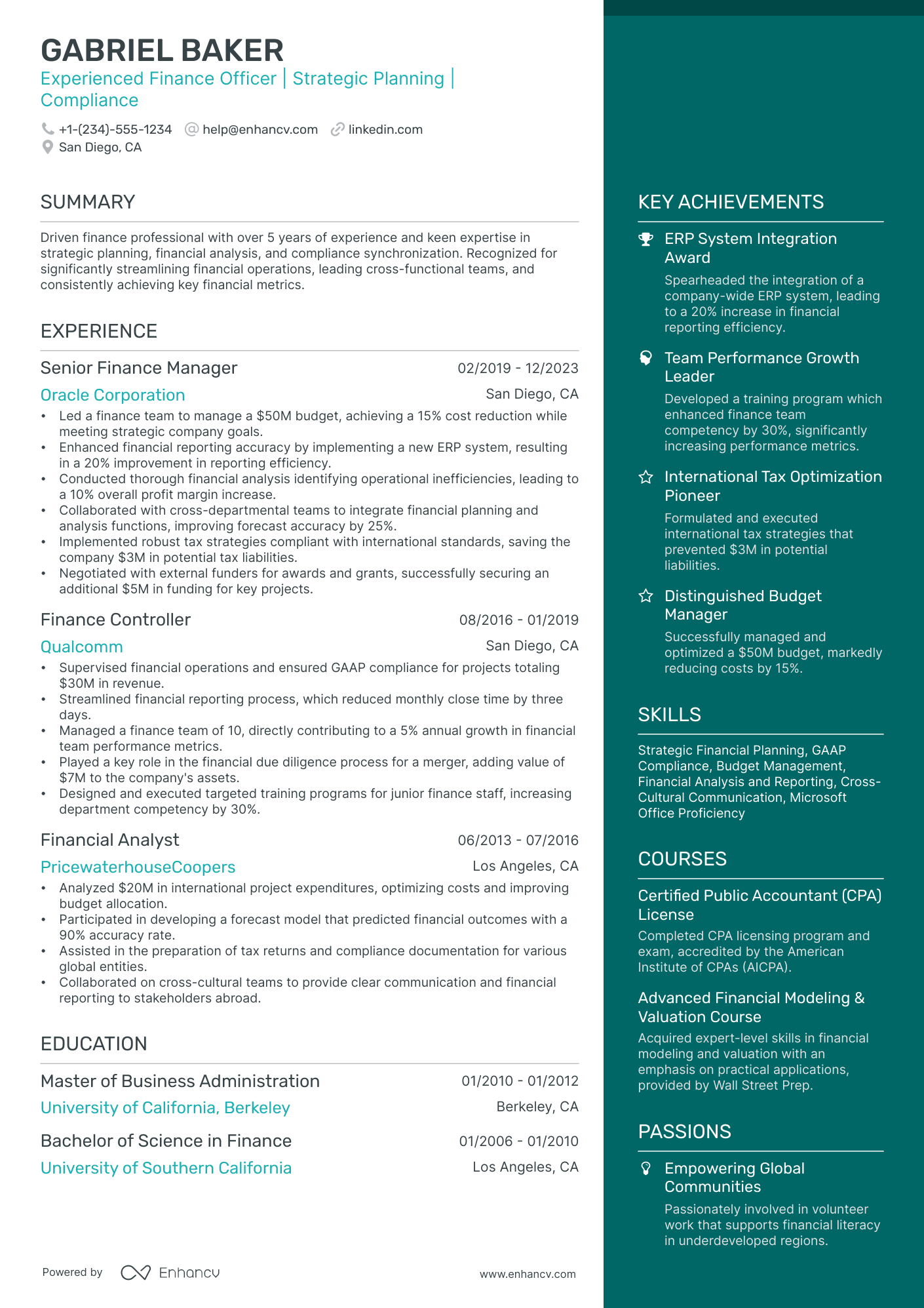
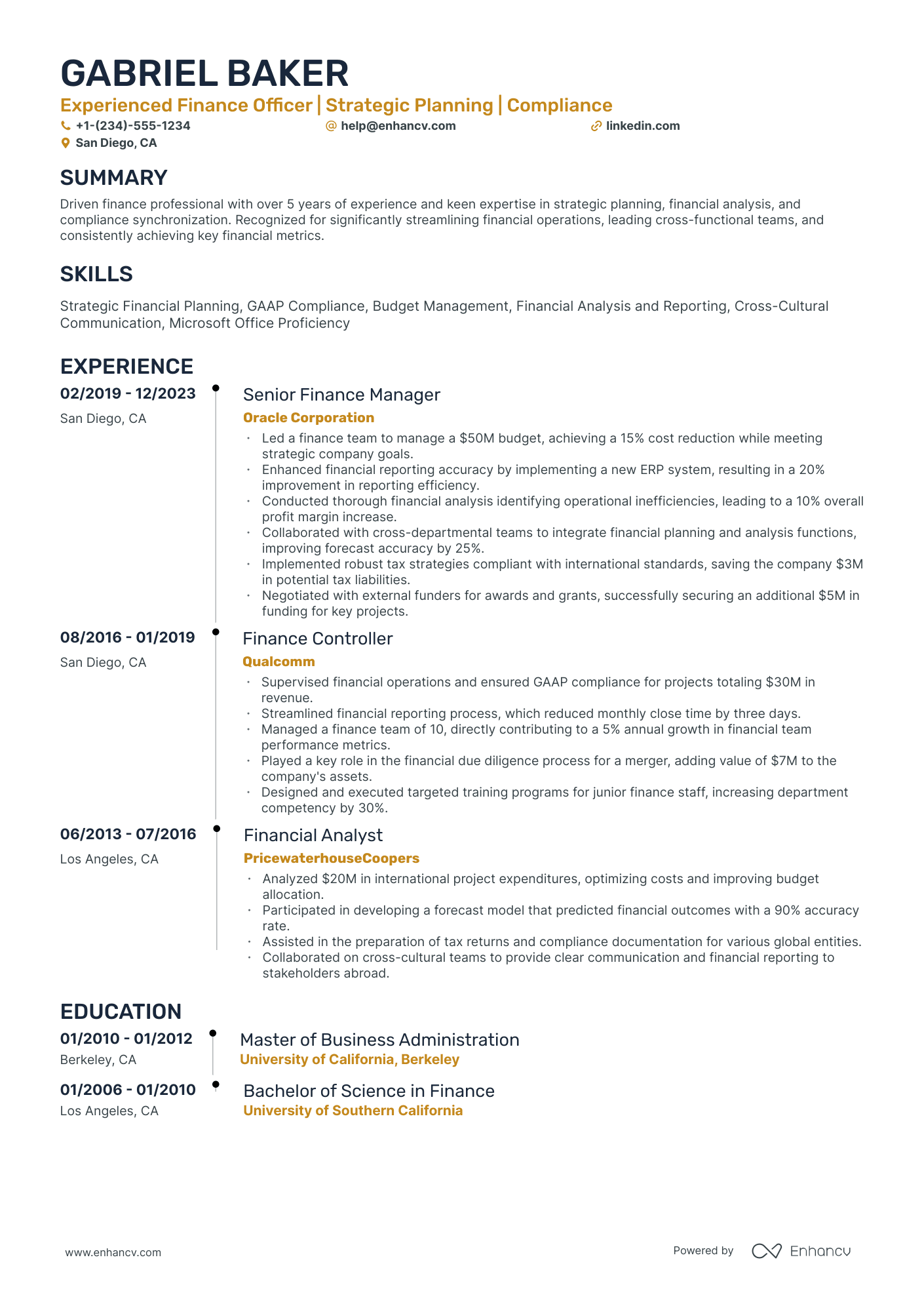
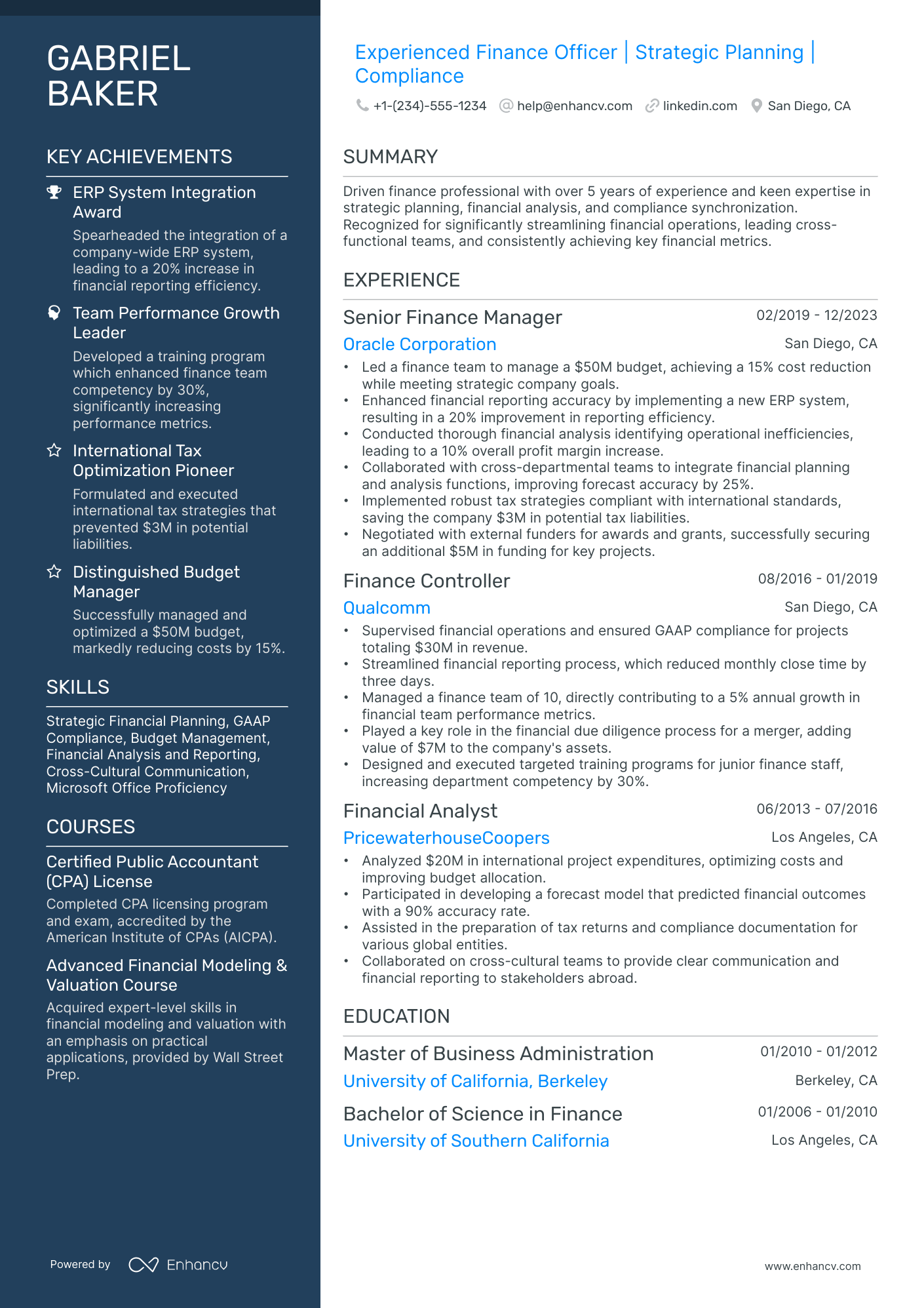
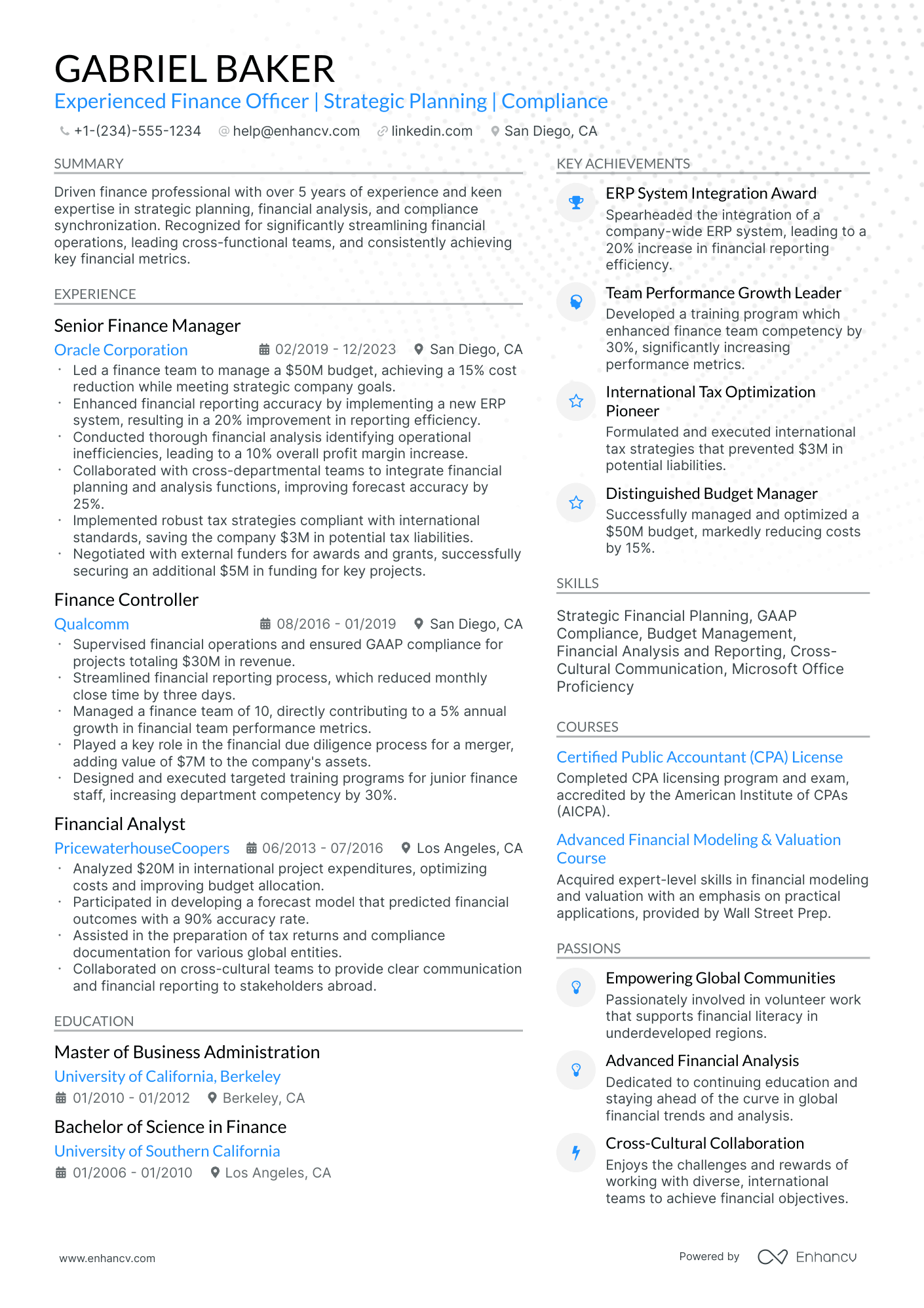
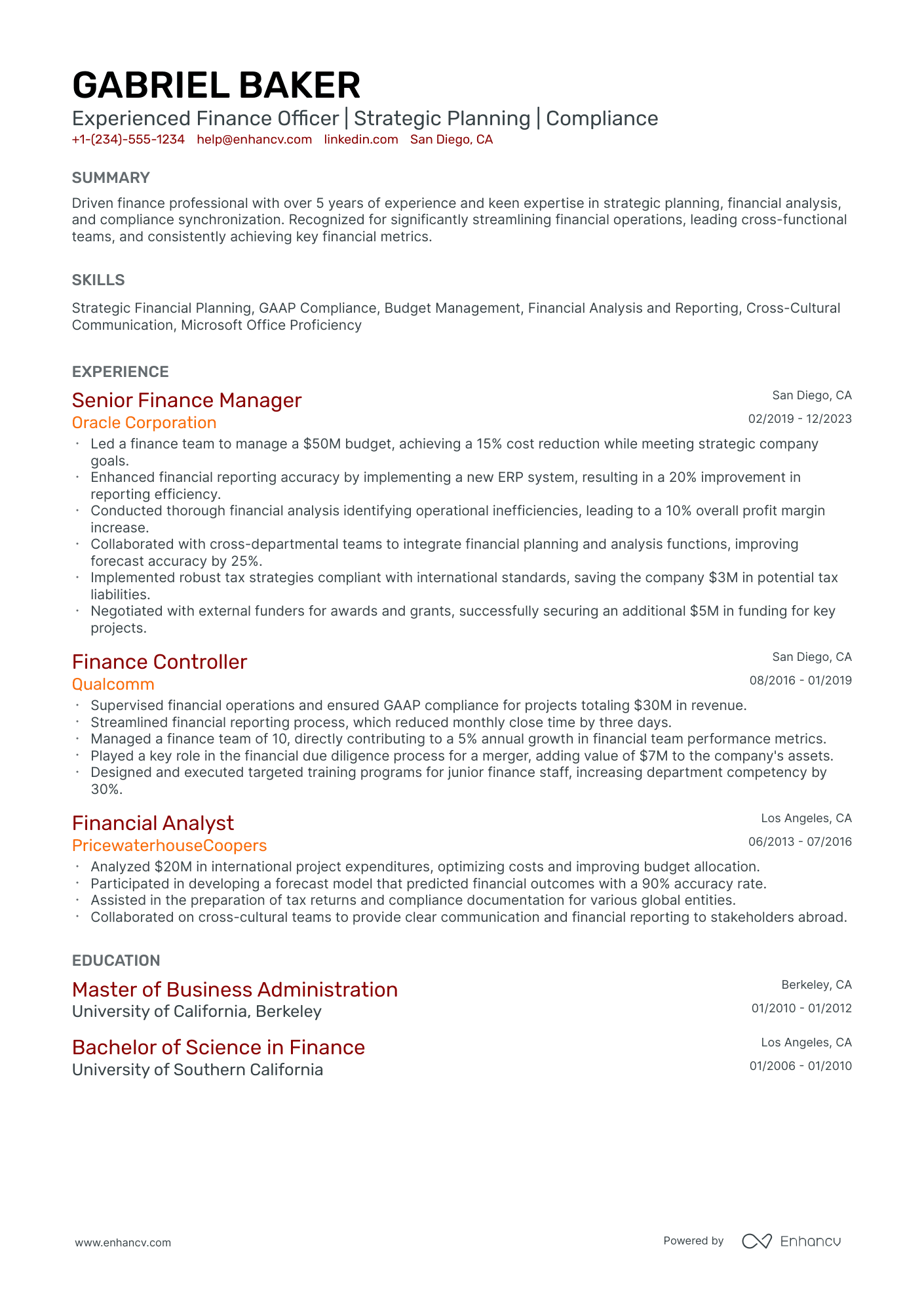
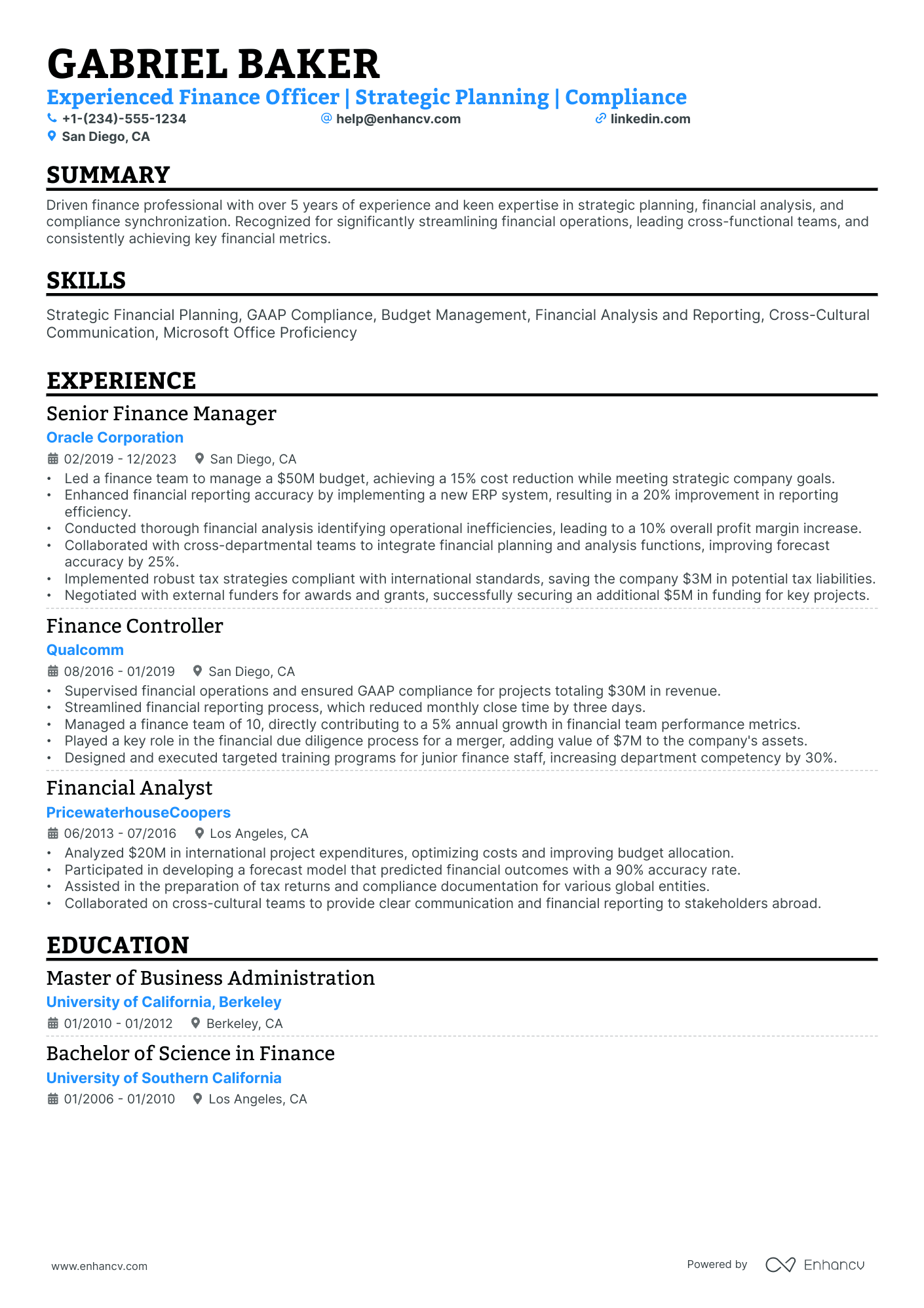
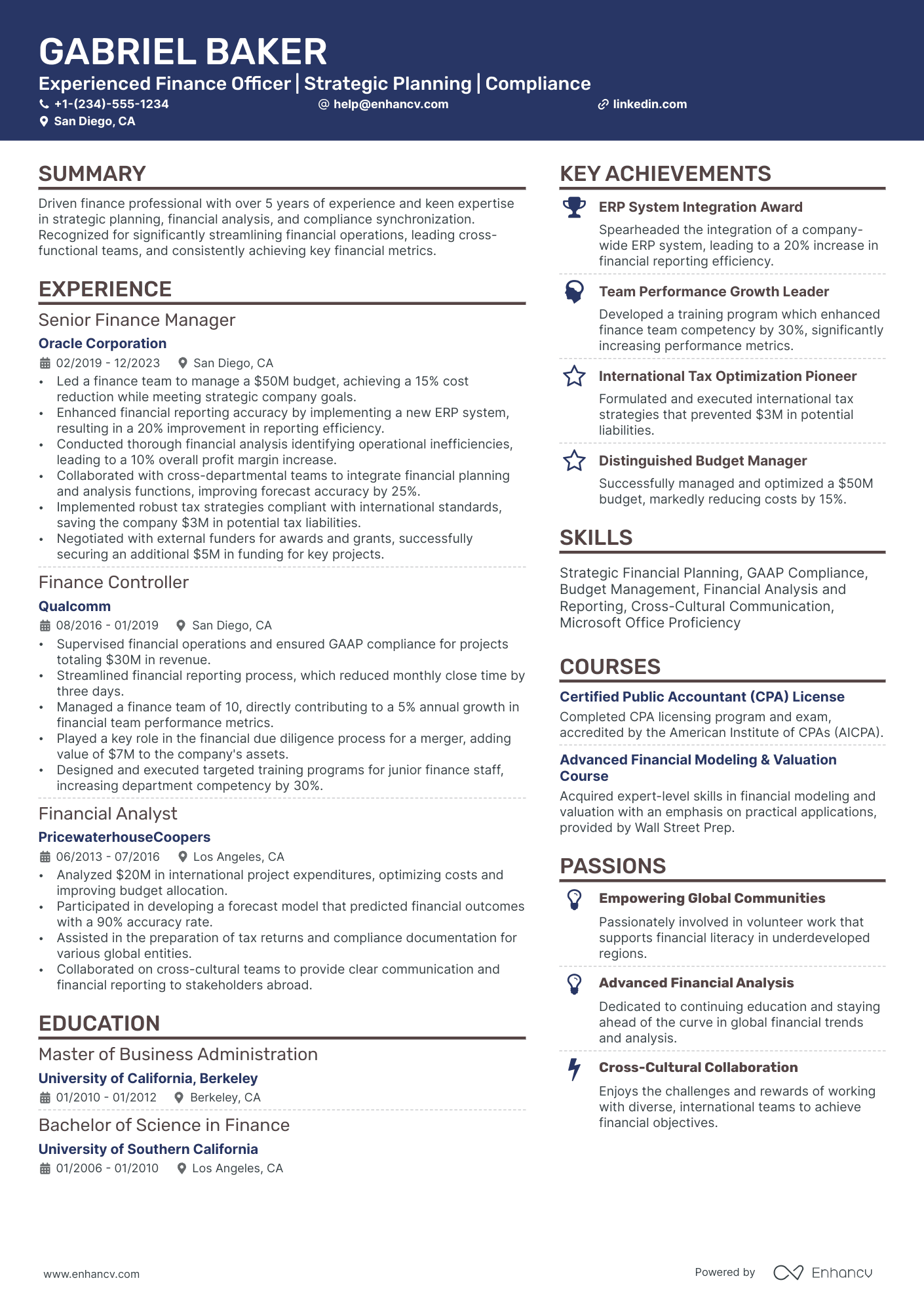
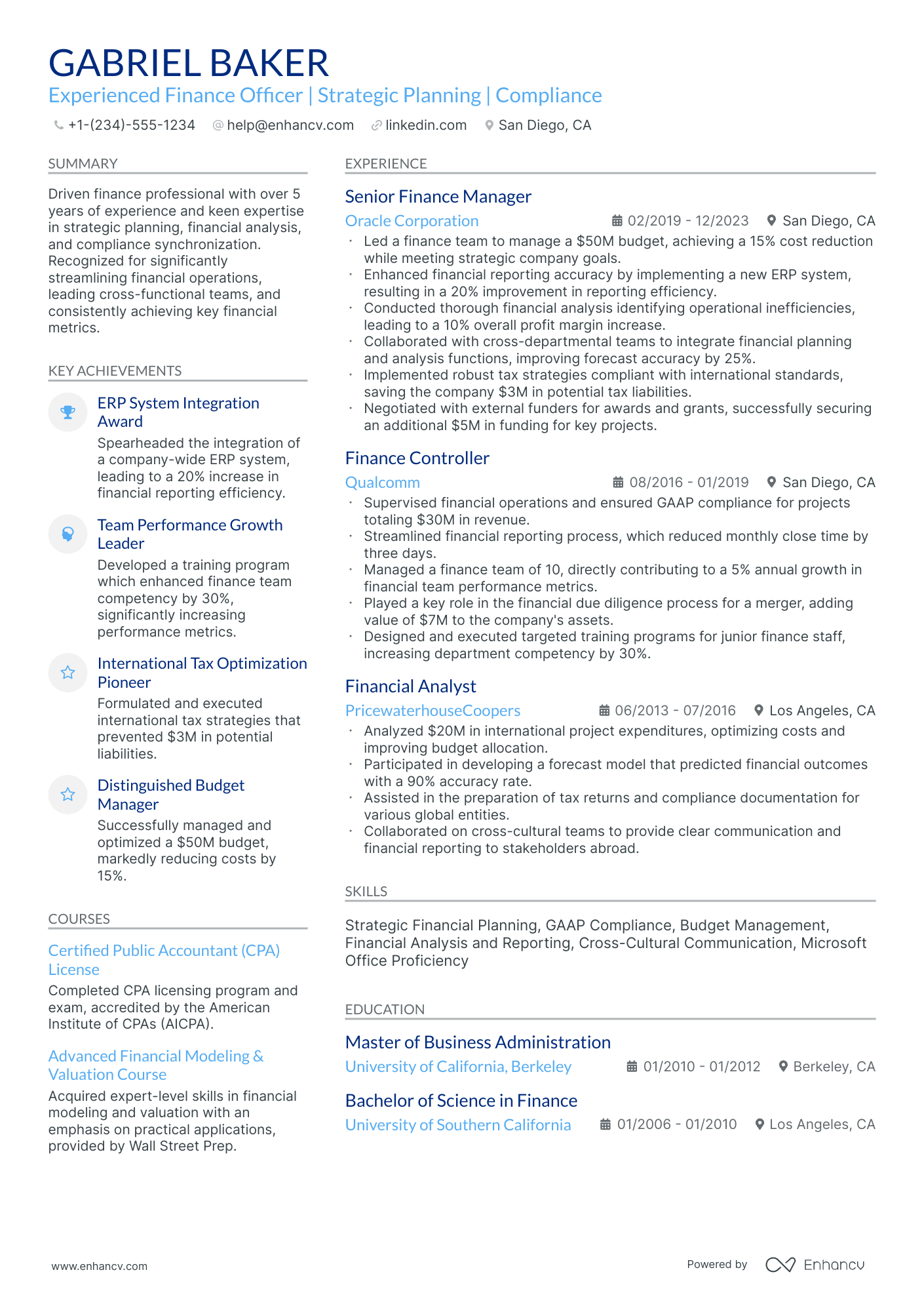
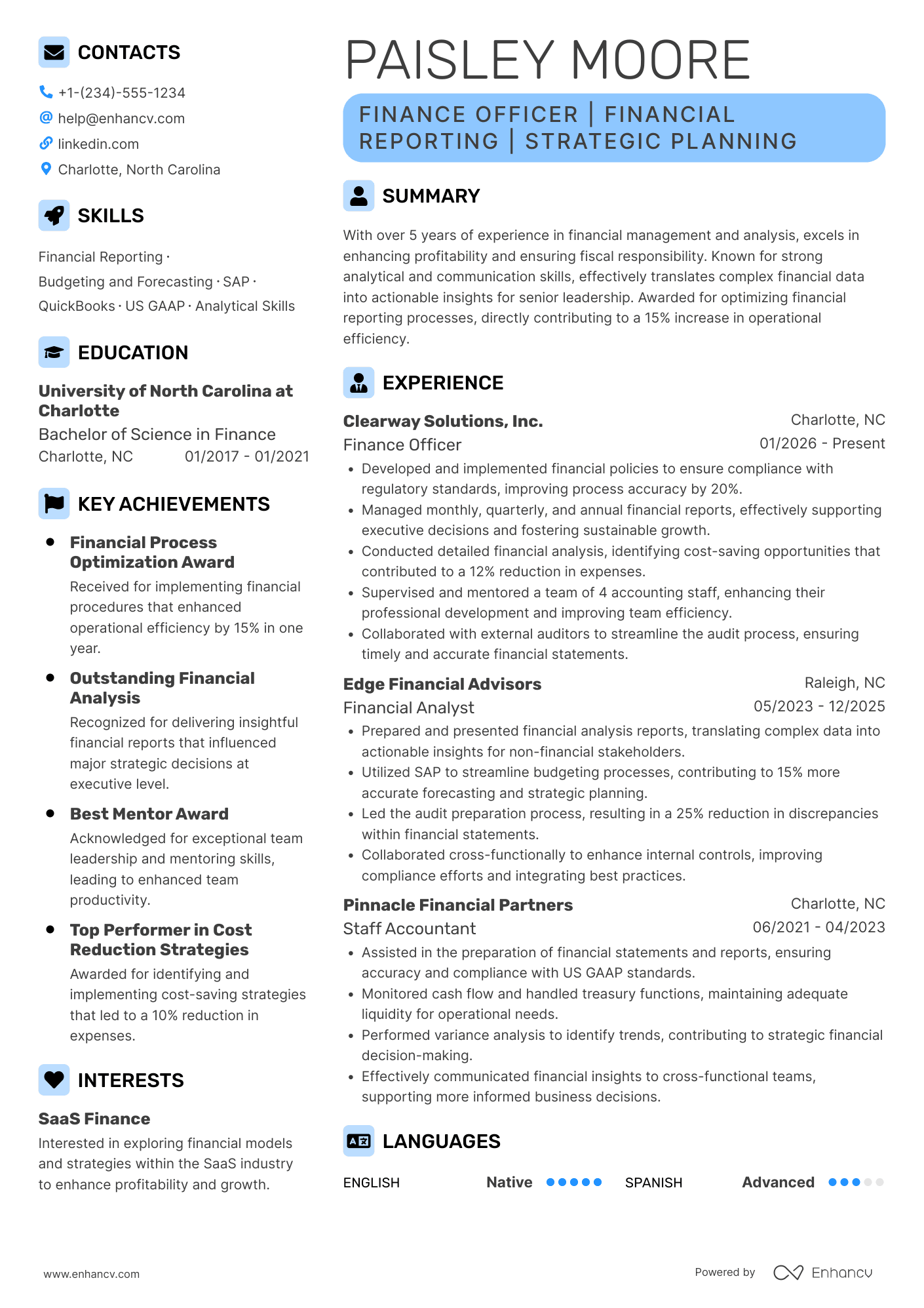
Many finance officer resumes fail because they list duties and systems but omit decision-ready results. In today's high-competition funnel, your finance officer resume must pass ATS screening and earn attention in a fast recruiter scan. Understanding how to make your resume stand out is critical when competing against other qualified finance professionals.
Once the resume earns the scan, the cover letter is where the controller or finance director looks for judgment — our finance officer cover letter examples show how to land one close-cycle or audit-fix story in a way that reads as evidence, not narrative.
A strong resume shows how you improved financial performance and reduced risk. You should lead with outcomes like budget size managed, close cycle time reduced, forecast accuracy improved, audit findings eliminated, cash flow strengthened, and savings delivered.

Key takeaways
- Lead every experience bullet with measurable outcomes like cost savings, forecast accuracy, or close-cycle time.
- Use reverse-chronological format for senior roles and hybrid format for career changers or juniors.
- Mirror the exact software, compliance standards, and KPIs from each job posting you target.
- Pair every listed skill with proof in your summary or experience bullets.
- Place certifications like CPA, CFA, or CMA where they add the most strategic weight.
- Keep your summary to four lines featuring your title, domain, top skills, and a quantified win.
- Use Enhancv to turn vague duties into sharp, recruiter-ready bullets backed by real numbers.
How to format a finance officer resume
Recruiters evaluating finance officer candidates prioritize analytical proficiency, regulatory knowledge, and a clear track record of financial stewardship. A clean, well-structured resume format ensures these signals surface quickly during both human review and applicant tracking system (ATS) screening.

I have significant experience in this role—which format should I use?
Use a reverse-chronological format to present your deepest and most relevant finance experience first. Do:
- Lead each role entry with your scope of ownership—budget size, team oversight, reporting lines, and compliance responsibilities.
- Highlight domain-specific expertise such as financial modeling, GAAP/IFRS compliance, ERP systems (SAP, Oracle Financials), and audit coordination.
- Quantify outcomes tied to cost savings, revenue impact, risk reduction, or process efficiency gains.
I'm junior or switching into this role—what format works best?
A hybrid format works best, letting you lead with core finance skills while supporting them with relevant experience or projects. Do:
- Place a focused skills section near the top featuring financial analysis, bookkeeping, reconciliation, or relevant certifications (CPA, CFA Level I).
- Include academic projects, internships, or volunteer treasurer roles that demonstrate applied financial knowledge.
- Connect every listed skill or experience to a specific action and a measurable or observable result.
Why not use a functional resume?
A functional format strips away the timeline and context recruiters need to verify your financial competencies, making it harder to assess where and how you applied your skills. Functional formats should be avoided unless you have no other way to present relevant qualifications.
- A functional resume may be acceptable if you're transitioning from an adjacent field (accounting, banking, auditing) with no direct finance officer title, have significant resume gaps, or lack formal work history—but every skill listed must still be tied to a specific project, course, or outcome.
Once you've established a clean, readable layout, the next step is deciding which sections to include so every part of your resume serves a clear purpose.
What sections should go on a finance officer resume
Recruiters expect a finance officer resume to show clear ownership of financial operations, controls, reporting, and measurable business results. Knowing what to put on a resume ensures every section works toward proving your qualifications.
Use this structure for maximum clarity:
- Header
- Summary
- Experience
- Skills
- Projects
- Education
- Certifications
- Optional sections: Awards, Leadership, Languages
Strong experience bullets should emphasize measurable impact, outcomes, scope of responsibility, and results across budgeting, forecasting, compliance, and financial reporting.
Is your resume good enough?
Drop your resume here or choose a file. PDF & DOCX only. Max 2MB file size.
Once you’ve organized the key resume components, focus next on writing your finance officer resume experience to show how you delivered results in each area.
How to write your finance officer resume experience
Your work experience section proves you can manage financial operations, apply regulatory frameworks, and deliver measurable results that protect and grow an organization's fiscal health. Hiring managers prioritize demonstrated impact—budgets you controlled, compliance standards you upheld, reporting processes you improved—over descriptive task lists that only outline daily duties.
Each entry should include:
- Job title
- Company and location (or remote)
- Dates of employment (month and year)
Three to five concise bullet points showing what you owned, how you executed, and what outcomes you delivered:
- Ownership scope: the financial functions, budgets, accounts, reporting systems, or teams you were directly accountable for as a finance officer.
- Execution approach: the accounting standards, ERP platforms, forecasting models, audit procedures, or analytical methods you used to inform decisions and deliver work.
- Value improved: changes to financial accuracy, cash flow efficiency, cost control, regulatory compliance, risk exposure, or reporting timeliness tied to your finance officer responsibilities.
- Collaboration context: how you partnered with leadership, auditors, department heads, tax advisors, or banking institutions to align financial strategy with organizational goals.
- Impact delivered: outcomes framed through fiscal results, cost savings, revenue protection, audit findings, or operational scale rather than routine activity.
Experience bullet formula
A finance officer experience example
✅ Right example - modern, quantified, specific.
Finance Officer
Northbridge Community Health | Columbus, OH
2021–Present
Nonprofit healthcare network operating five clinics with a $38M annual budget and multiple grant-funded programs.
- Led annual budgeting and rolling forecasts in Workday Adaptive Planning for eight departments; improved forecast accuracy from 86% to 95% and reduced budget cycle time by 25% through standardized templates and driver-based models.
- Implemented month-end close controls in NetSuite and BlackLine, partnering with accounting and clinic operations; cut close from nine to six business days and reduced reconciling items by 40%.
- Built executive dashboards in Power BI using SQL-based data models; automated variance reporting and saved 12 hours per month while improving board reporting timeliness by two days.
- Strengthened cash management by redesigning weekly liquidity forecasts and payment runs; improved days cash on hand from 41 to 52 and reduced late vendor payments by 60% without increasing working capital.
- Coordinated annual audit and single audit readiness with external auditors and program leaders; resolved zero material weaknesses and reduced audit adjustments by 70% through tighter documentation and approval workflows.
Now that you've seen how a strong experience section comes together, let's look at how to adjust those details to match the specific finance officer role you're targeting.
How to tailor your finance officer resume experience
Recruiters evaluate your finance officer resume through both applicant tracking systems and manual review, so tailoring your resume to the job description is essential. Tailoring ensures the specific skills, tools, and responsibilities you highlight match what the employer is actively seeking.
Ways to tailor your finance officer experience:
- Mirror the exact financial software and ERP systems listed in the posting.
- Match terminology for budgeting forecasting or financial reporting processes mentioned.
- Reflect specific compliance standards or regulatory frameworks the role requires.
- Highlight audit preparation experience when the job description references it.
- Include relevant industry experience such as government nonprofit or corporate finance.
- Align your KPIs with the performance metrics the employer prioritizes.
- Emphasize cross-departmental collaboration if the posting references stakeholder partnerships.
- Reference grant management or fund accounting when the role specifies them.
Tailoring means aligning your actual accomplishments with what the job posting prioritizes, not forcing keywords where they don't genuinely belong.
Resume tailoring examples for finance officer
| Job description excerpt | Untailored | Tailored |
|---|---|---|
| Prepare monthly, quarterly, and annual financial reports in compliance with GAAP standards using Oracle Financials. | Prepared financial reports and assisted with accounting tasks. | Prepared monthly, quarterly, and annual financial reports fully compliant with GAAP standards, using Oracle Financials to consolidate data across four business units. |
| Manage budgeting and forecasting processes for departmental operating budgets totaling $12M+, coordinating with cross-functional stakeholders. | Helped with budgets and worked with different teams on financial planning. | Led annual budgeting and rolling forecast cycles for $14M in departmental operating budgets, coordinating inputs from 10 cross-functional stakeholders to reduce budget variances by 18%. |
| Conduct internal audits and ensure compliance with federal and state financial regulations, including OMB Circular A-133. | Performed audits and made sure the company followed financial rules. | Conducted quarterly internal audits across three divisions, ensuring full compliance with federal, state, and OMB Circular A-133 requirements—resulting in zero findings over two consecutive audit cycles. |
Once you’ve aligned your experience with the finance officer role, the next step is to quantify your achievements so hiring managers can quickly see your impact.
How to quantify your finance officer achievements
Quantifying your achievements shows how you protect cash, reduce risk, and improve decision-making. Focus on accuracy, close speed, cost savings, compliance outcomes, and forecast performance—numbers that finance leaders and auditors trust.
Quantifying examples for finance officer
| Metric | Example |
|---|---|
| Close cycle time | "Cut month-end close from nine to five business days by standardizing reconciliations and automating journal uploads in Oracle NetSuite." |
| Forecast accuracy | "Improved quarterly cash forecast accuracy from 82% to 94% using a 13-week model in Excel and variance reviews with department heads." |
| Compliance | "Led annual audit with zero material findings and reduced audit PBC requests by 30% by organizing evidence in SharePoint and tightening controls." |
| Cost savings | "Reduced banking and merchant fees by $180,000 annually by renegotiating contracts and consolidating accounts across three subsidiaries." |
| Risk reduction | "Lowered overdue receivables over 60 days from 14% to 8% by enforcing credit limits and launching weekly aging reviews with sales." |
Turn vague job duties into measurable, recruiter-ready resume bullets in seconds with Enhancv's Bullet Point Generator.
With strong bullet points in place, the next step is ensuring your skills section presents the right mix of hard and soft skills that finance hiring managers look for.
How to list your hard and soft skills on a finance officer resume
Your skills section shows you can manage budgets, reporting, controls, and compliance; recruiters and an ATS (applicant tracking system) scan this section for role-matched keywords and proficiency, and strong resumes balance hard skills with job-specific soft skills.
finance officer roles require a blend of:
- Product strategy and discovery skills.
- Data, analytics, and experimentation skills.
- Delivery, execution, and go-to-market discipline.
- Soft skills.
Your skills section should be:
- Scannable (bullet-style grouping).
- Relevant to the job post.
- Backed by proof in experience bullets.
- Updated with current tools.
Place your skills section:
- Above experience if you're junior or switching careers.
- Below experience if you're mid/senior with strong achievements.

Hard skills
- Financial planning and analysis
- Budgeting and forecasting
- Variance analysis
- Cash flow forecasting
- General ledger accounting
- Financial statement preparation
- Month-end close
- GAAP, IFRS compliance
- Internal controls, SOX compliance
- Audit coordination
- ERP systems: SAP, Oracle, NetSuite
- Excel: Power Query, PivotTables
Soft skills
- Translate financials for executives
- Partner with department leaders
- Challenge assumptions with data
- Own deadlines and close cadence
- Prioritize competing requests
- Present concise recommendations
- Negotiate budgets and tradeoffs
- Maintain audit-ready documentation
- Escalate risks early and clearly
- Align stakeholders on decisions
- Drive process improvements
- Protect confidentiality and ethics
How to show your finance officer skills in context
Skills shouldn't live only in a bulleted list on your resume. Explore common resume skills to ensure you're not overlooking competencies that recruiters expect.
They should be demonstrated in:
- Your summary (high-level professional identity)
- Your experience (proof through outcomes)
Here's how that looks in practice.
Summary example
Finance officer with 12 years in healthcare revenue management. Skilled in SAP, cash flow forecasting, and regulatory compliance. Streamlined month-end close by 35%, saving 60+ staff hours quarterly. Known for cross-departmental collaboration and strategic budget leadership.
- Reflects senior-level expertise clearly
- Names specific tools like SAP
- Quantifies impact with real metrics
- Highlights leadership and collaboration
Experience example
Senior Finance Officer
Meridian Health Partners | Denver, CO
March 2018–Present
- Redesigned the annual budgeting process using Adaptive Insights, reducing forecast variance by 22% across four fiscal cycles.
- Partnered with operations and compliance teams to automate accounts payable workflows, cutting processing time by 40%.
- Led quarterly financial audits and variance analyses in SAP, identifying $1.3M in recoverable costs over two years.
- Every bullet includes measurable proof
- Skills surface naturally through real outcomes
Once you’ve tied your finance officer strengths to measurable outcomes and real responsibilities, the next step is applying that same approach to a finance officer resume when you don’t have formal experience.
How do I write a finance officer resume with no experience
Even without full-time experience, you can demonstrate readiness through the strategies outlined in our guide on building a resume without work experience:
- Student finance club treasurer role
- Budgeting for campus organizations
- Accounts payable volunteer support
- Bookkeeping for family business
- Finance internship class practicum
- Case competitions with financial models
- Personal portfolio tracking and reports
- Tax preparation volunteer assistance
Focus on:
- Budgeting, forecasting, and variance analysis
- Reconciliations, journal entries, and controls
- Reporting with Excel and dashboards
- Compliance exposure and audit-ready documentation
Resume format tip for entry-level finance officer
Use a combination resume format because it highlights finance officer skills and projects first, while still showing education and limited experience clearly. Do:
- Lead with a skills summary tied to tools.
- Add two to four finance projects.
- Quantify results with dollars and percentages.
- List coursework that matches finance officer tasks.
- Include relevant tools: Excel, QuickBooks, Power BI.
- Built a monthly budget and variance report in Excel and Power BI for a campus organization, cutting overspend by 12% in one semester.
Even without traditional work experience, your education section can serve as the foundation of your finance officer resume—here's how to present it effectively.
How to list your education on a finance officer resume
Your education section helps hiring teams confirm you hold the foundational knowledge a finance officer needs. It validates your academic background in accounting, economics, or related disciplines quickly.
Include:
- Degree name
- Institution
- Location
- Graduation year
- Relevant coursework (for juniors or entry-level candidates)
- Honors & GPA (if 3.5 or higher)
Skip month and day details—list the graduation year only.
Here's a strong education entry tailored to the finance officer role.
Example education entry
Bachelor of Science in Finance
University of Illinois at Urbana-Champaign, Champaign, IL
Graduated 2021
GPA: 3.7/4.0
- Relevant Coursework: Corporate Finance, Financial Statement Analysis, Managerial Accounting, Risk Management
- Honors: Dean's List (six consecutive semesters), Beta Gamma Sigma Honor Society
How to list your certifications on a finance officer resume
Certifications on a resume show a finance officer's commitment to ongoing learning, proficiency with financial tools and standards, and relevance to regulated, data-driven finance environments.
Include:
- Certificate name
- Issuing organization
- Year
- Optional: credential ID or URL
- Place certifications below education when your degree is recent and your certifications add supporting value.
- Place certifications above education when they are highly relevant and recent, or when your education is older.
Best certifications for your finance officer resume
Certified Public Accountant (CPA) Chartered Financial Analyst (CFA) Certified Management Accountant (CMA) Certified Internal Auditor (CIA) Certified Treasury Professional (CTP) Certified Fraud Examiner (CFE) Financial Risk Manager (FRM)
Once you’ve included your credentials where they add the most value, use your finance officer resume summary to highlight them in context and reinforce your fit at a glance.
How to write your finance officer resume summary
Your resume summary is the first thing a recruiter reads. A strong one instantly signals you're qualified and worth interviewing for a finance officer role.
Keep it to three to four lines, with:
- Your title and total years of experience in finance or accounting.
- The domain you specialize in, such as corporate finance, public sector, or nonprofit.
- Core skills like budgeting, forecasting, financial reporting, or regulatory compliance.
- One or two measurable achievements, such as cost savings or audit outcomes.
- Soft skills tied to real results, like cross-department collaboration that improved reporting accuracy.

PRO TIP
At this level, focus on clarity and relevance over breadth. Highlight specific finance skills, tools you've used, and early wins that show impact. Avoid vague phrases like "passionate team player" or "results-driven professional." Let your numbers speak instead.
Example summary for a finance officer
Finance officer with three years of experience in corporate budgeting and forecasting. Reduced quarterly close time by 20% using SAP. Skilled in variance analysis, compliance reporting, and cross-team coordination.
Optimize your resume summary and objective for ATS
Drop your resume here or choose a file.
PDF & DOCX only. Max 2MB file size.
Now that your summary communicates your value as a finance officer, make sure your header presents the essential contact and professional details recruiters need to reach you.
What to include in a finance officer resume header
Your resume header lists your key contact and professional details so recruiters can find you fast, trust your profile, and screen you accurately.
Essential resume header elements
- Full name
- Tailored job title and headline
- Location
- Phone number
- Professional email
- GitHub link
- Portfolio link
A LinkedIn link helps recruiters confirm your roles, dates, and credentials quickly, which speeds up screening.
Don't include a photo on a finance officer resume unless the role is explicitly front-facing or appearance-dependent.
Keep the header to two lines, match your job title to the posting, and use links that open to complete, up-to-date profiles.
Finance officer resume header
Jordan Taylor
Finance officer | Budgeting, financial reporting, and compliance
Chicago, IL
(312) 555-01XX
jordan.taylor@enhancv.com
github.com/jordantaylor
jordantaylor.com
linkedin.com/in/jordantaylor
With your key identifying details and contact information set at the top, the next step is to add additional sections that strengthen your finance officer resume and support the role.
Additional sections for finance officer resumes
When your core qualifications match other candidates, additional sections can set you apart by showcasing role-specific credibility and well-roundedness. For example, listing language skills on your resume can be a differentiator when applying to multinational organizations or roles with cross-border financial responsibilities.
- Languages
- Professional affiliations (e.g., AICPA, IMA, CFA Institute)
- Publications and financial research
- Continuing education and professional development
- Volunteer experience in financial literacy or nonprofit boards
- Awards and recognitions in finance or accounting
Once you've strengthened your resume with well-chosen additional sections, the next step is pairing it with a cover letter that adds even more context to your candidacy.
Do finance officer resumes need a cover letter
A cover letter isn't required for a finance officer, but it helps in competitive searches or when hiring managers expect one. If you're unsure where to start, learning what a cover letter is and how it complements your resume can clarify when one is worth writing. It can make a difference when your resume needs context, or when the role demands close partnership across teams.
Use your cover letter to add context your resume can't:
- Explain role and team fit: Connect your finance officer experience to the company's structure, reporting lines, and cross-functional partners.
- Highlight one or two projects or outcomes: Quantify impact, such as improving cash flow forecasting accuracy or shortening the close process.
- Show understanding of the product, users, or business context: Tie your financial decisions to pricing, retention, unit economics, or customer segments.
- Address career transitions or non-obvious experience: Clarify industry changes, gaps, or lateral moves, and link them to finance officer responsibilities.
Drop your resume here or choose a file.
PDF & DOCX only. Max 2MB file size.
Once you’ve decided how a cover letter fits into your application strategy, you can use AI to improve your finance officer resume and strengthen the rest of your submission.
Using AI to improve your finance officer resume
AI can sharpen your resume's clarity, structure, and impact. It helps tighten language and highlight measurable results. But overuse dulls authenticity. Once your content feels clear and role-aligned, step away from AI. If you're exploring tools, our guide on which AI is best for writing resumes can help you choose the right one for your needs.
Here are 10 prompts you can copy and paste to strengthen specific sections of your finance officer resume:
- Strengthen summary — "Rewrite my finance officer resume summary to emphasize leadership in budgeting, forecasting, and financial compliance in under four sentences."
- Quantify achievements — "Add measurable results to these finance officer experience bullets using dollar amounts, percentages, or timeframes wherever possible."
- Tighten bullet points — "Shorten each finance officer experience bullet to one concise line that leads with a strong action verb."
- Align with job posting — "Compare my finance officer resume experience section to this job description and suggest wording changes to improve alignment."
- Improve skills section — "Reorganize my finance officer skills section into technical, analytical, and leadership categories relevant to corporate finance roles."
- Refine project descriptions — "Rewrite my finance officer project entries to clearly state the problem, my specific role, and the financial outcome."
- Clarify certifications — "Format my finance officer certifications section so each entry includes the credential name, issuing body, and year earned."
- Enhance education details — "Revise my finance officer education section to highlight coursework, honors, or research directly related to financial analysis."
- Remove filler language — "Identify and remove vague or redundant phrases from my finance officer resume without losing any meaningful detail."
- Check consistency — "Review my entire finance officer resume for inconsistent formatting, tense shifts, and mismatched date formats across all sections."
Stop using AI once your resume sounds accurate, specific, and aligned with real experience. AI should never invent experience or inflate claims—if it didn't happen, it doesn't belong here.
Conclusion
A strong finance officer resume highlights measurable outcomes, role-specific skills, and a clear structure. Lead with impact, such as improved cash flow, reduced costs, or stronger controls. Use clean headings, consistent formatting, and focused bullets that make results easy to scan.
This approach shows you’re ready for today’s hiring market and the near-future one. It proves you can manage reporting, budgeting, compliance, and stakeholder needs with accuracy and speed. Keep it direct, evidence-based, and easy to review.