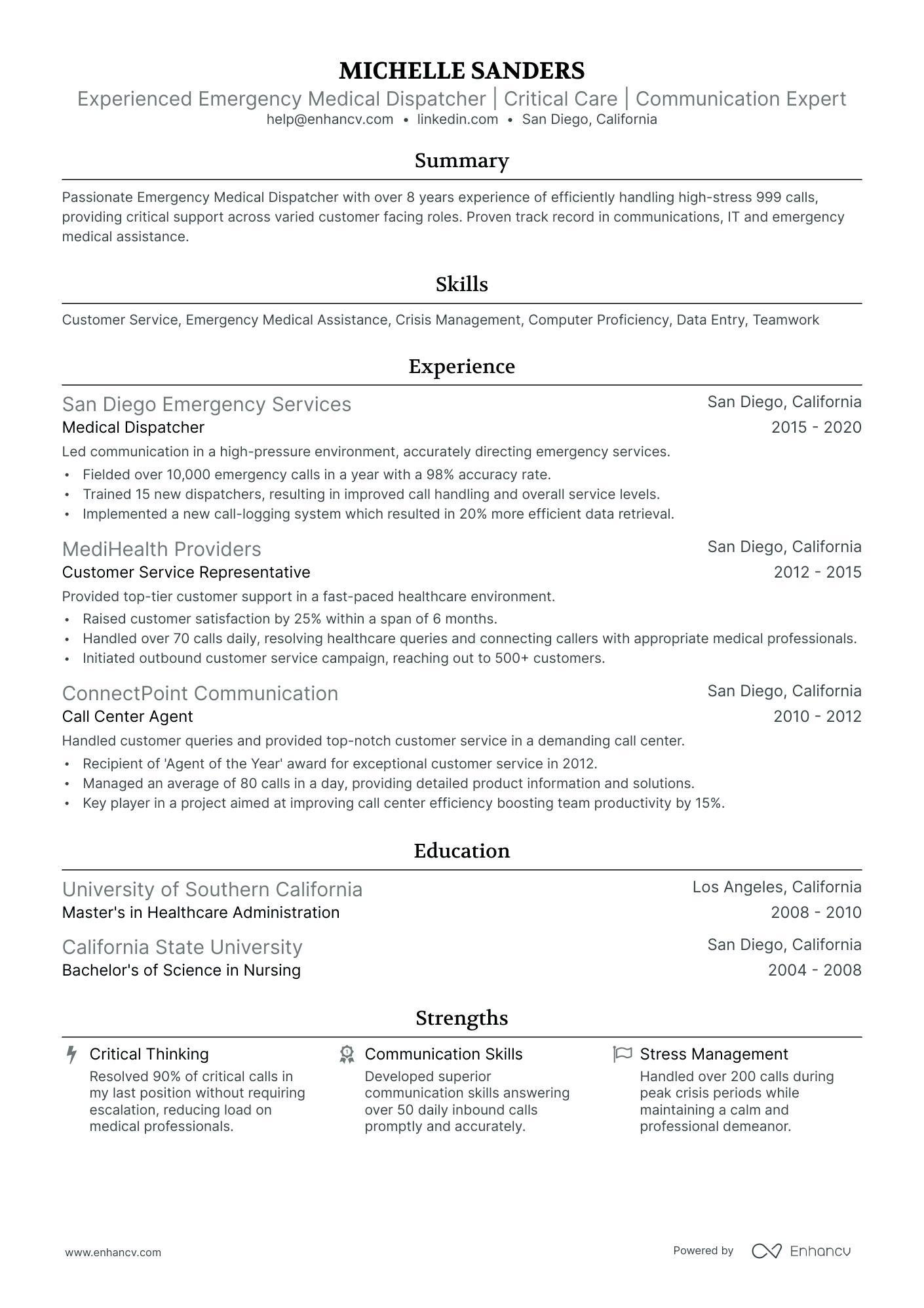
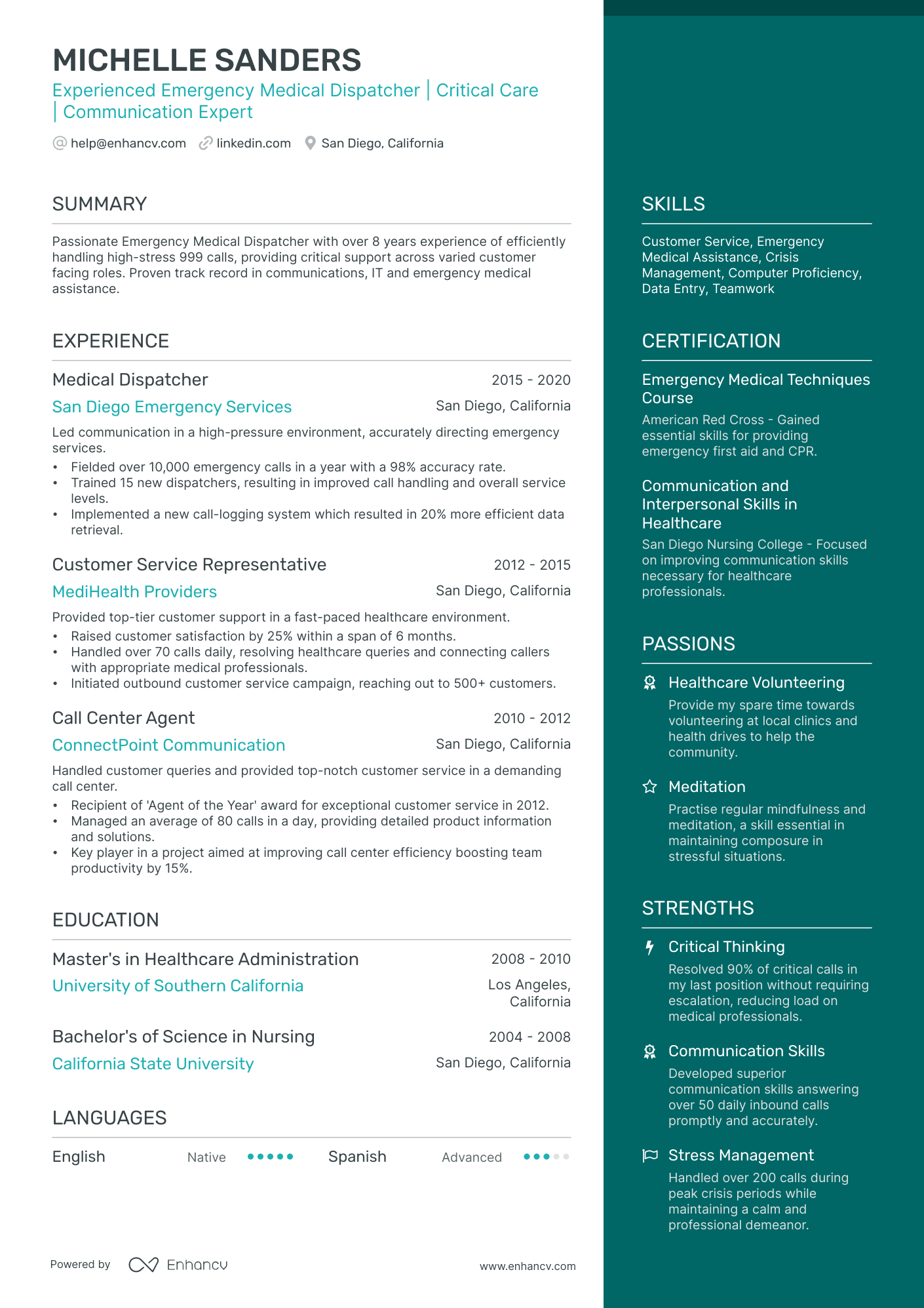
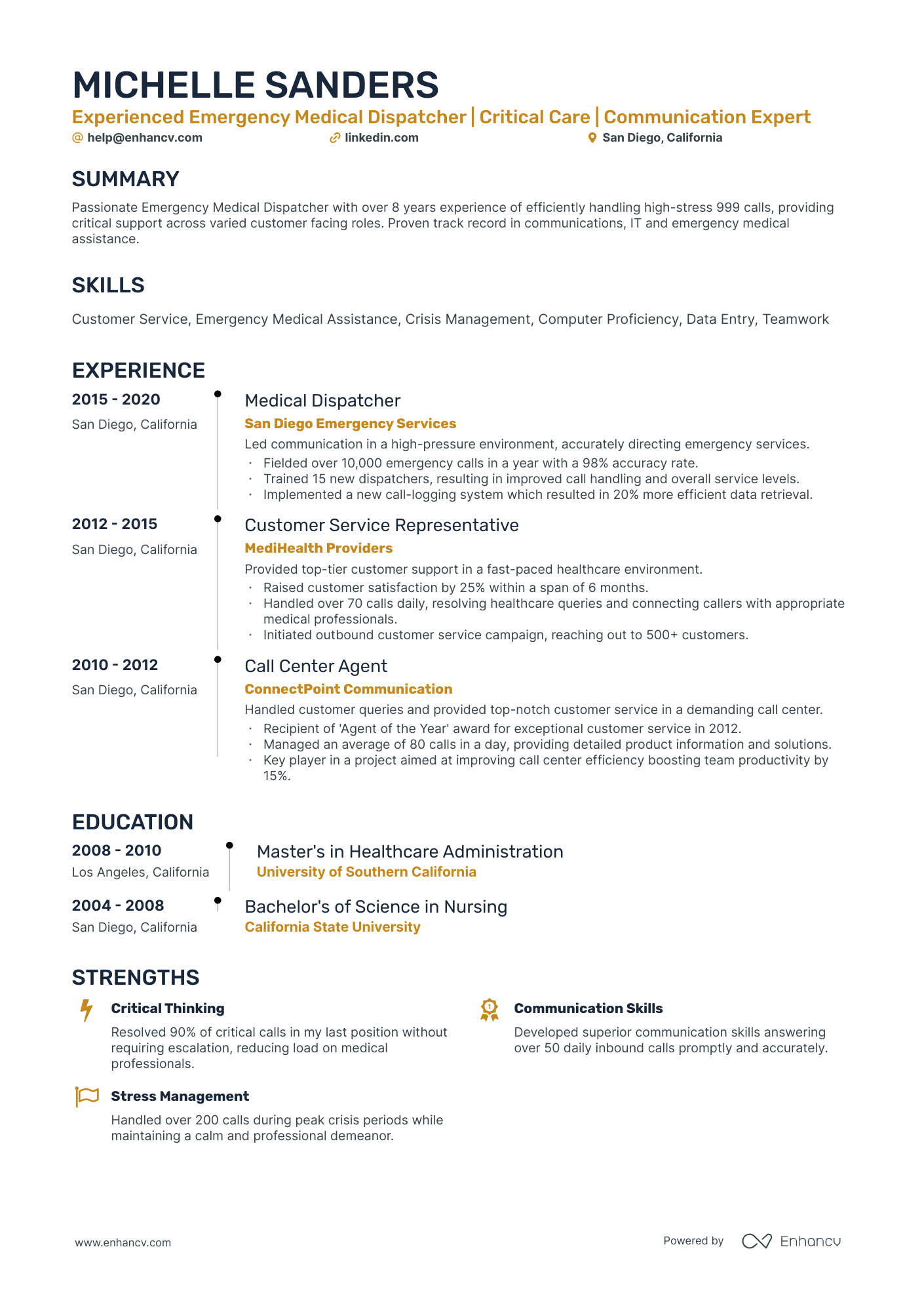
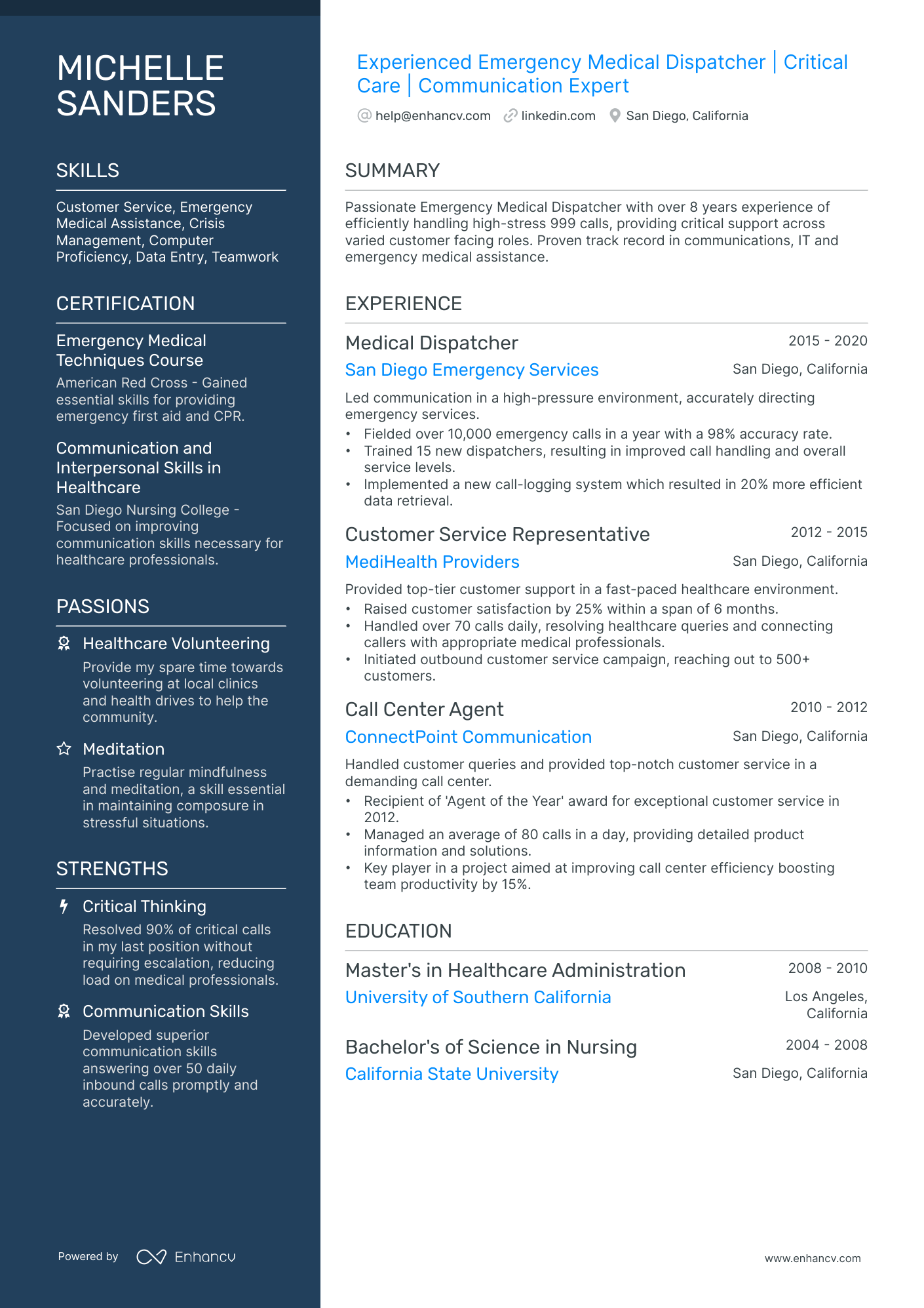
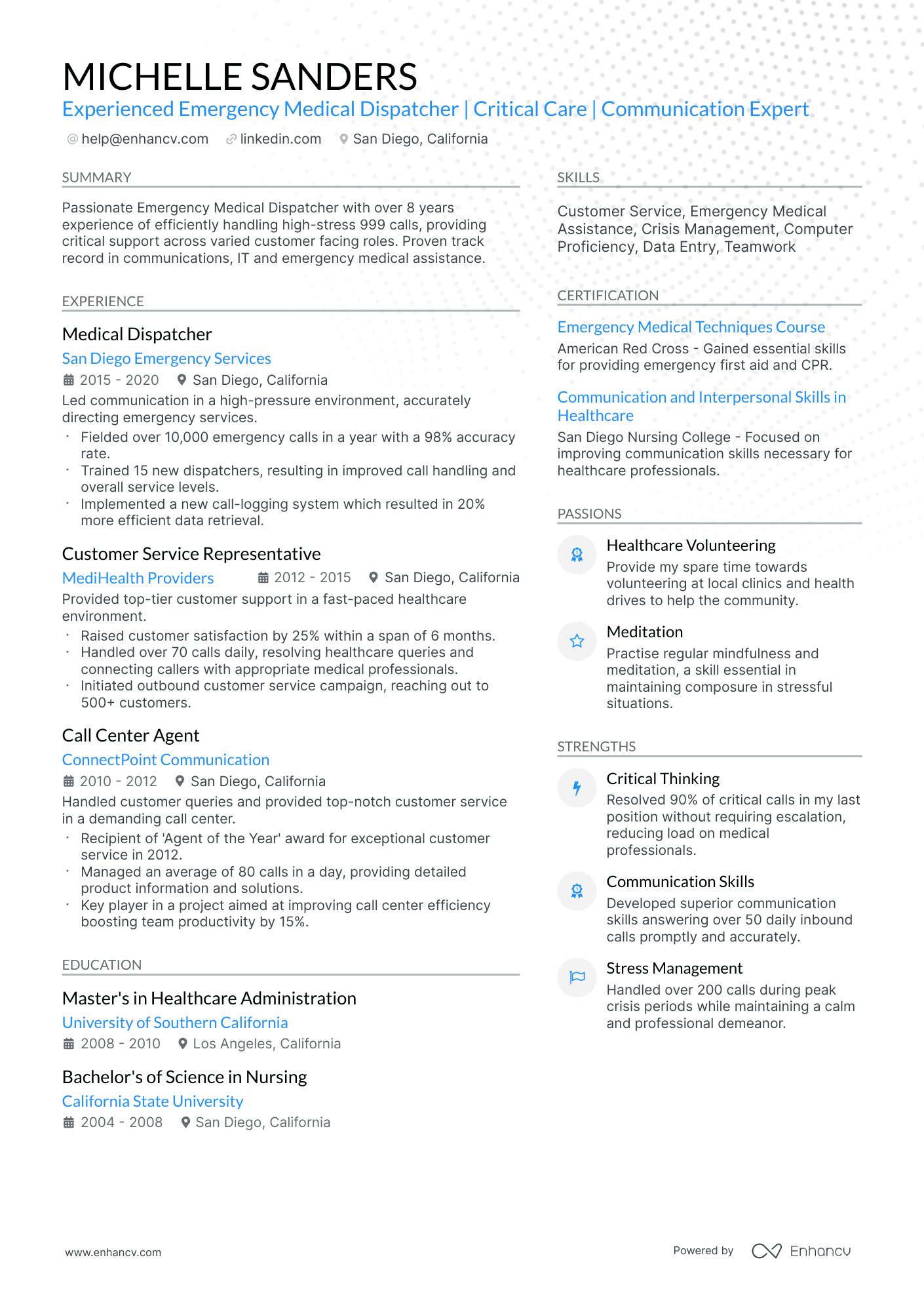
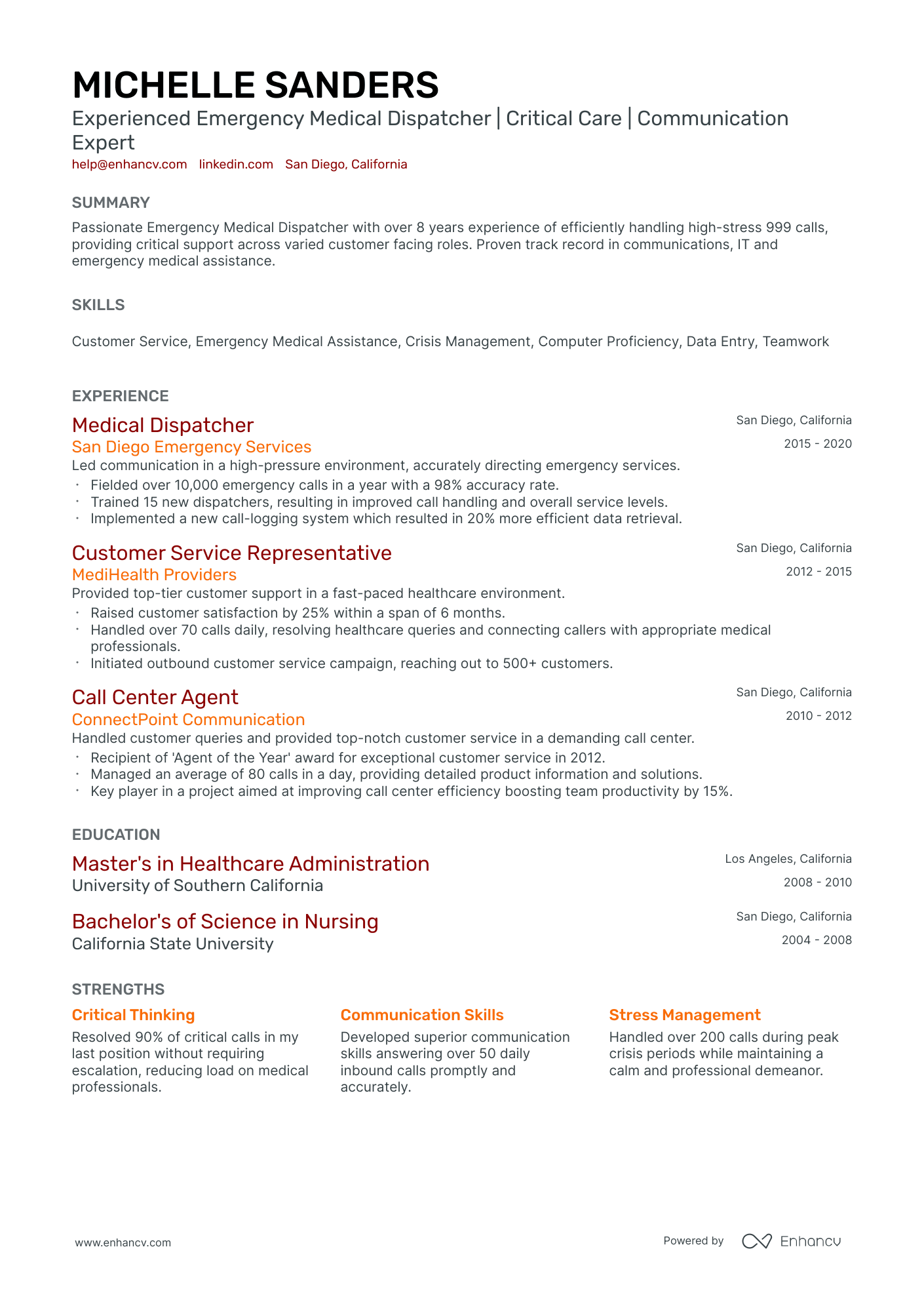
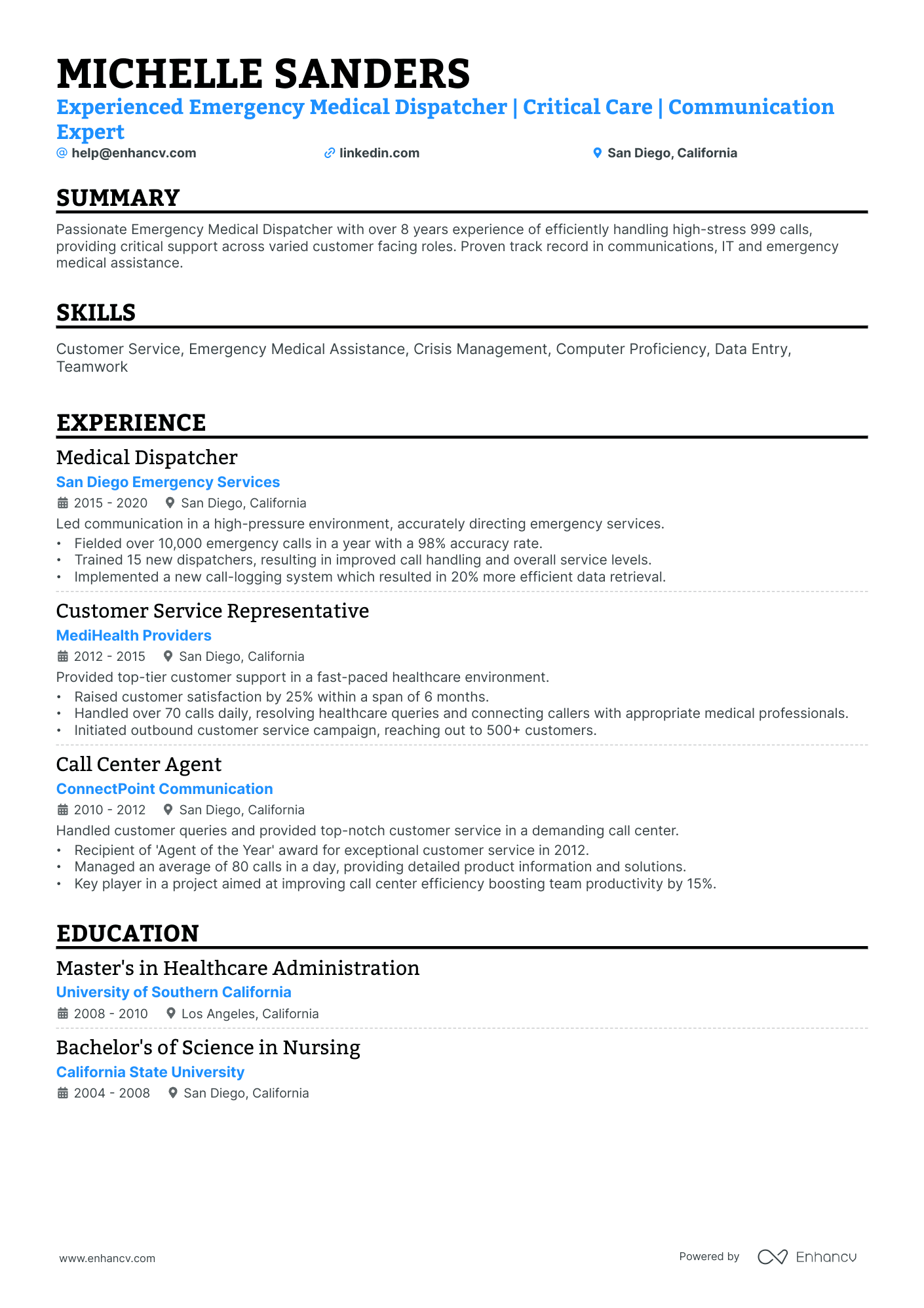
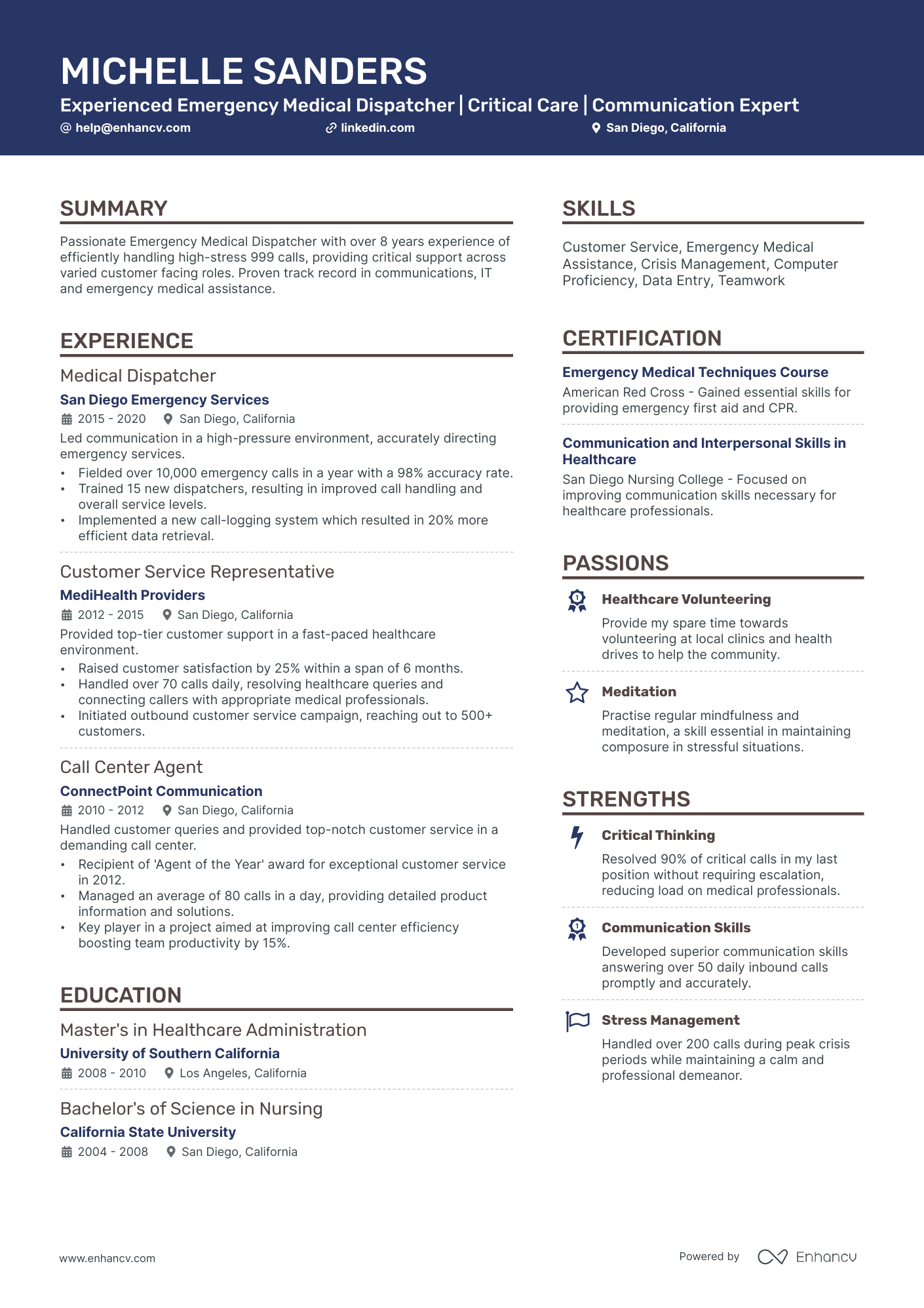
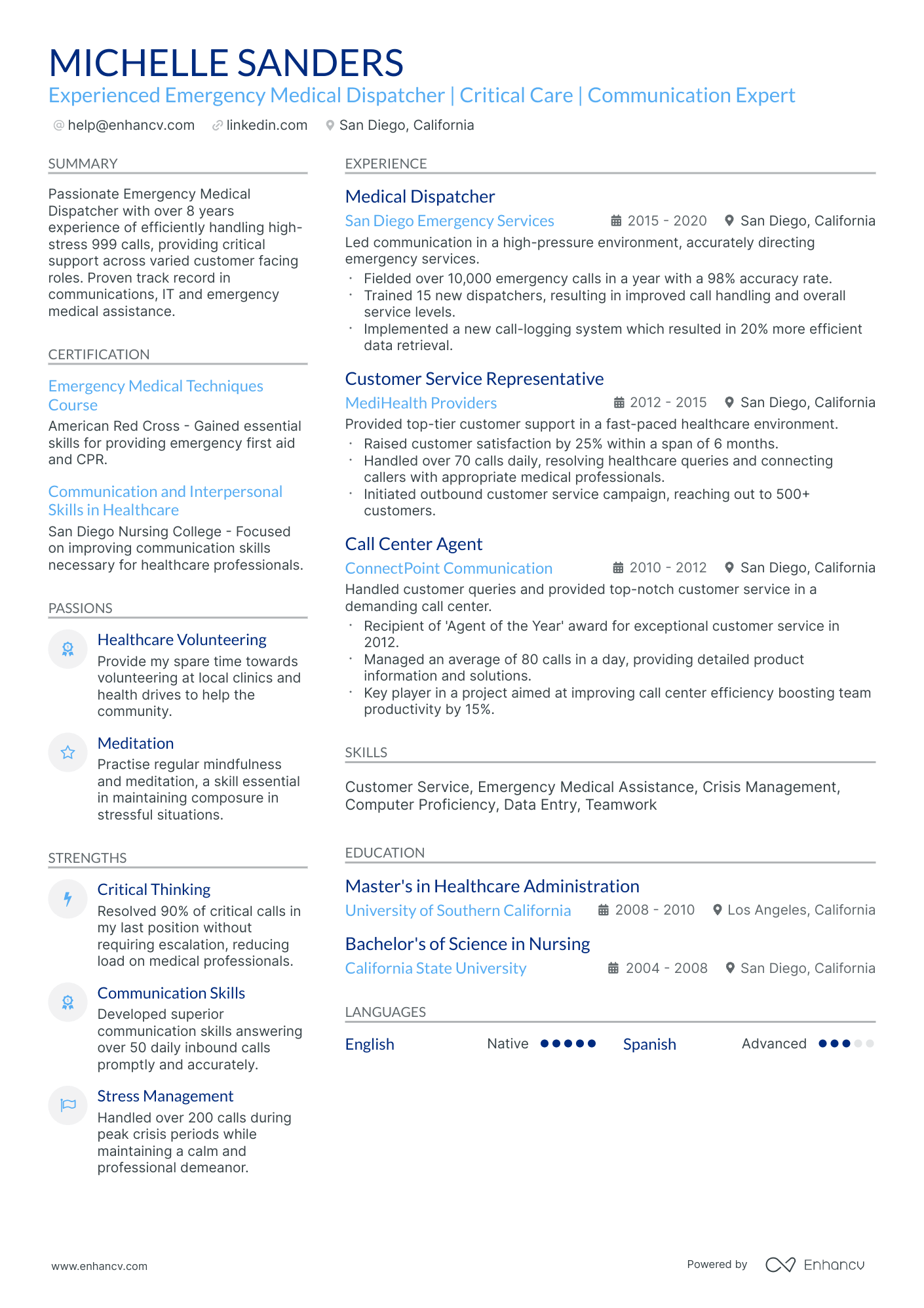
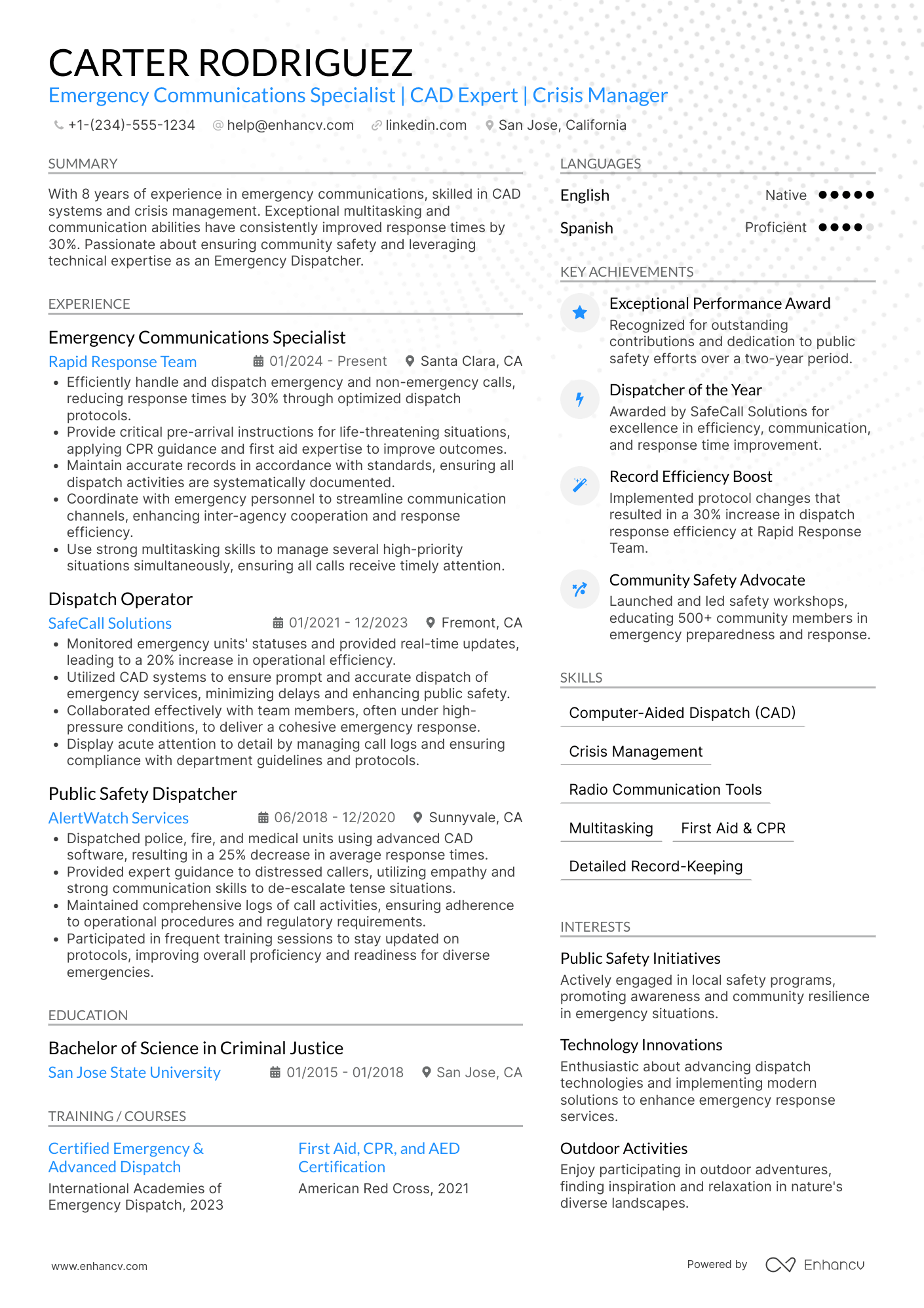
Many emergency dispatcher resume drafts fail because they read like shift logs, not evidence of performance. That buries key qualifications during ATS screening and fast recruiter scans, especially when agencies compare dozens of applicants.
A strong resume shows outcomes you drove, not tools you touched. Knowing how to make your resume stand out starts with highlighting reduced call processing time, higher protocol compliance, accurate location verification, improved transfer success, fewer escalations, and calm handling of high-volume incidents.

Key takeaways
- Quantify call volume, response times, and accuracy rates in every experience bullet.
- Use reverse-chronological format if you have dispatching experience; use hybrid if switching careers.
- Tailor resume language to match each job posting's specific systems, protocols, and KPIs.
- Demonstrate skills through measurable outcomes in your summary and experience, not just a skills list.
- Place certifications like EMD, CPR, and NIMS prominently—they signal job-ready credibility to hiring managers.
- Replace vague duty descriptions with ownership, execution method, and delivered results in each bullet.
- Use Enhancv's tools to tighten bullet points and align your resume with dispatcher role requirements.
How to format a emergency dispatcher resume
Recruiters evaluating emergency dispatcher resumes prioritize clear evidence of call-handling speed, protocol adherence, multitasking under pressure, and familiarity with CAD (computer-aided dispatch) systems. A well-chosen resume format ensures these signals surface quickly, both for human reviewers scanning in seconds and for applicant tracking systems parsing your content.

I have significant experience in this role—which format should I use?
Use a reverse-chronological format to lead with your most recent and relevant dispatching experience. Do:
- Highlight the scope and ownership of your dispatch operations, including call volume, team coordination, and shift leadership responsibilities.
- Feature role-specific tools and domains prominently—CAD software, emergency medical dispatch (EMD) certification, NCIC database access, and multi-line phone systems.
- Quantify outcomes tied to response efficiency, accuracy, and public safety impact.
I'm junior or switching into this role—what format works best?
A hybrid format works best because it lets you lead with transferable skills while still showing a concise work history. Do:
- Place a skills section near the top that highlights relevant abilities such as active listening, geographic knowledge, stress tolerance, and familiarity with radio communication protocols.
- Include projects, volunteer work, or transitional experience—such as crisis hotline work, customer service in high-volume environments, or emergency response training—that demonstrates dispatcher-adjacent competencies.
- Connect every listed action to a clear outcome so recruiters can see your potential impact, not just your duties.
Why not use a functional resume?
A functional format strips away the timeline and context recruiters need to evaluate how you performed under real operational pressure, making it harder to verify your reliability and growth in high-stakes environments. Functional resumes can be acceptable in one narrow scenario:
- If you're entering emergency dispatch with no prior dispatch experience and have a significant resume gap, a functional format can work—but only if every skill listed is tied to a specific project, certification, or measurable outcome rather than presented as a standalone claim.
Once you've established a clean, readable format, the next step is determining which sections to include so each one serves a clear purpose on your resume.
What sections should go on a emergency dispatcher resume
Recruiters expect a clean, role-focused resume that proves you can manage high-volume calls, follow protocols, and support fast, accurate emergency response. Understanding what to put on a resume for this field is essential.
Use this structure for maximum clarity:
- Header
- Summary
- Experience
- Skills
- Projects
- Education
- Certifications
- Optional sections: Awards, Volunteering, Languages
Strong experience bullets should emphasize measurable call volume, response outcomes, protocol compliance, accuracy under pressure, coordination scope, and clear results.
Is your resume good enough?
Drop your resume here or choose a file. PDF & DOCX only. Max 2MB file size.
Once you’ve organized your resume with the right components, the next step is to write your emergency dispatcher resume experience so each entry supports that structure with relevant, job-focused details.
How to write your emergency dispatcher resume experience
Your work experience section should demonstrate the real-world impact you've delivered as an emergency dispatcher—highlighting the call-handling systems, dispatch protocols, and communication tools you've used to protect lives and coordinate rapid response. Hiring managers prioritize demonstrated impact over descriptive task lists, so focus on outcomes like improved response times, call resolution accuracy, and resource coordination efficiency.
Each entry should include:
- Job title
- Company and location (or remote)
- Dates of employment (month and year)
Three to five concise bullet points showing what you owned, how you executed, and what outcomes you delivered:
- Ownership scope: the dispatch operations, call queues, geographic coverage areas, emergency communication systems, or shift teams you were directly accountable for managing during critical incidents.
- Execution approach: the computer-aided dispatch software, radio communication platforms, emergency medical dispatch protocols, call-prioritization frameworks, or multi-agency coordination methods you relied on to triage situations and deploy resources.
- Value improved: changes to emergency response times, call-processing speed, dispatch accuracy, situational awareness, resource allocation efficiency, or risk reduction that resulted from your decisions under pressure.
- Collaboration context: how you coordinated with law enforcement officers, fire departments, EMS personnel, field supervisors, fellow dispatchers, or public safety leadership to ensure seamless emergency response across agencies.
- Impact delivered: outcomes expressed through measurable improvements in public safety response, caller survival rates, operational throughput, error reduction, or community service reliability rather than routine task descriptions.
Experience bullet formula
A emergency dispatcher experience example
✅ Right example - modern, quantified, specific.
Emergency Dispatcher
City of Mesa Public Safety Communications | Mesa, AZ
2021–Present
High-volume 911 and non-emergency communications center supporting police, fire, and emergency medical services across a city of 500K+ residents.
- Triaged 911 calls using ProQA and Emergency Medical Dispatch protocols, cutting call processing time by 18% while maintaining a 98% QA compliance score across 1,200+ calls per month.
- Dispatched police, fire, and emergency medical services via Computer-Aided Dispatch (CAD) and Automatic Vehicle Location (AVL), improving unit selection accuracy by 22% and reducing average response time by 46 seconds.
- Coordinated multi-agency incidents using Incident Command System (ICS) workflows, shared talkgroups, and mutual-aid channels, supporting 30+ large-scale events with zero missed notifications.
- Verified caller locations with RapidSOS, Phase II wireless data, and mapping tools, reducing location-related delays by 27% and increasing successful callback contact rate to 94%.
- Partnered with field supervisors, records staff, and information technology to refine CAD disposition codes and radio procedures, decreasing re-dispatches by 15% and improving shift handoff clarity by 20%.
Now that you've seen how a strong experience section looks in practice, let's break down how to customize yours for the specific dispatcher role you're targeting.
How to tailor your emergency dispatcher resume experience
Recruiters evaluate your emergency dispatcher resume through both applicant tracking systems and manual review. Tailoring your resume to the job description by mirroring the language and priorities in the job posting helps you pass both layers of screening.
Ways to tailor your emergency dispatcher experience:
- Match the specific CAD software and dispatch systems named in the posting.
- Mirror the exact radio communication protocols the agency references.
- Use the same terminology for emergency response prioritization methods listed.
- Highlight multi-agency coordination experience when the role requires interoperability.
- Emphasize compliance with NENA or APCO standards if the posting mentions them.
- Include call volume and response time metrics that reflect their KPIs.
- Reference EMD certification or CPR instruction if listed as preferred qualifications.
- Align your experience with the specific shift structure or staffing model described.
Tailoring means aligning your real accomplishments with what the role demands, not forcing disconnected keywords into your experience bullets.
Resume tailoring examples for emergency dispatcher
| Job description excerpt | Untailored | Tailored |
|---|---|---|
| Operate CAD (Computer-Aided Dispatch) system to prioritize and dispatch police, fire, and EMS units according to established protocols | Used computer systems to handle incoming calls and send out responders as needed. | Operated CAD system to prioritize and dispatch police, fire, and EMS units for a center handling 450+ daily calls, following established dispatch protocols to maintain response-time compliance above 95%. |
| Gather critical information from callers using Emergency Medical Dispatch (EMD) ProQA software and provide pre-arrival instructions per MPDS guidelines | Assisted callers during emergencies by asking questions and giving basic instructions until help arrived. | Utilized ProQA software to gather critical caller information and delivered pre-arrival instructions per MPDS guidelines, supporting positive patient outcomes across 12,000+ EMD calls annually. |
| Monitor multiple radio frequencies simultaneously, coordinate multi-agency responses during large-scale incidents, and maintain accurate logs in the RMS (Records Management System) | Communicated with different teams on the radio and kept records of what happened during shifts. | Monitored six simultaneous radio frequencies to coordinate multi-agency responses during large-scale incidents, maintaining real-time logs in the RMS with a 99.7% documentation accuracy rate. |
Once you’ve aligned your experience with the role’s priorities, the next step is to quantify your emergency dispatcher achievements so hiring managers can see the impact of your work.
How to quantify your emergency dispatcher achievements
Quantifying your achievements shows how your calls improved response, accuracy, and safety. Track call volume, answer speed, dispatch time, protocol compliance, and high-priority outcomes across shifts and agencies.
Quantifying examples for emergency dispatcher
| Metric | Example |
|---|---|
| Call volume | "Handled 120 to 160 calls per twelve-hour shift, triaging police, fire, and emergency medical services requests using Computer Aided Dispatch (CAD)." |
| Answer speed | "Cut average call answer time from twelve seconds to seven seconds by optimizing call queue practices during peak hours." |
| Dispatch time | "Reduced time from call receipt to unit dispatch by 18% by using CAD hotkeys and pre-plans for frequent locations." |
| Protocol accuracy | "Maintained 99.2% protocol compliance across 250 audited calls by following Emergency Medical Dispatch (EMD) scripts and documenting critical details." |
| High-risk outcomes | "Improved CPR instruction delivery on cardiac arrest calls, raising bystander CPR initiation from 38% to 52% over six months." |
Turn vague job duties into measurable, recruiter-ready resume bullets in seconds with Enhancv's Bullet Point Generator.
With strong bullet points in place, the next step is ensuring your emergency dispatcher resume highlights the right mix of hard and soft skills.
How to list your hard and soft skills on a emergency dispatcher resume
Your skills section shows you can triage calls, use dispatch systems, and coordinate responders under pressure, and recruiters and ATS scan this section for role keywords; aim for a balanced mix of hard skills and job-specific soft skills.
emergency dispatcher roles require a blend of:
- Product strategy and discovery skills.
- Data, analytics, and experimentation skills.
- Delivery, execution, and go-to-market discipline.
- Soft skills.
Your skills section should be:
- Scannable (bullet-style grouping).
- Relevant to the job post.
- Backed by proof in experience bullets.
- Updated with current tools.
Place your skills section:
- Above experience if you're junior or switching careers.
- Below experience if you're mid/senior with strong achievements.

Hard skills
- Computer-aided dispatch (CAD)
- Enhanced 911 (E911) call handling
- Emergency medical dispatch protocols
- Police, fire, EMS dispatching
- Priority call triage, pre-arrival instructions
- Radio console operations, multi-channel monitoring
- National Crime Information Center queries
- Automatic vehicle location, unit status tracking
- Incident logging, timestamp accuracy
- GIS mapping, address validation
- Teletypewriter, text-to-911 workflows
- Quality assurance, call review scoring
Soft skills
- Rapid situational assessment
- Clear, directive call control
- Calm de-escalation under stress
- Concise radio communication
- Active listening for key details
- Split-second decision-making
- High-stakes prioritization
- Cross-agency coordination
- Policy-compliant judgment
- Shift handoff accountability
- Focused multitasking
- Error-checking before dispatch
How to show your emergency dispatcher skills in context
Skills shouldn't live only in a bulleted list on your resume. Browse resume skills examples to see how dispatchers present their abilities effectively.
They should be demonstrated in:
- Your summary (high-level professional identity)
- Your experience (proof through outcomes)
Here's what this looks like in practice.
Summary example
Senior emergency dispatcher with 12 years in metropolitan 911 operations. Skilled in CAD systems, EMD protocols, and crisis de-escalation. Reduced average call processing time by 18% while maintaining 99.6% dispatch accuracy across a 40-person team.
- Specifies senior-level experience clearly
- Names industry tools and protocols
- Highlights a measurable efficiency gain
- Demonstrates calm leadership under pressure
Experience example
Senior Emergency Dispatcher
Tri-County Regional Communications Center | Columbus, OH
March 2017–Present
- Processed 150+ daily 911 calls using Hexagon CAD, cutting average dispatch time by 22% over three years through refined triage workflows.
- Collaborated with fire, EMS, and law enforcement supervisors to redesign mutual-aid protocols, reducing inter-agency response gaps by 14%.
- Trained and mentored eight new dispatchers on ProQA EMD cardsets, achieving a 96% first-attempt certification pass rate across two hiring cohorts.
- Every bullet includes measurable proof
- Skills appear naturally within achievements
Once you’ve demonstrated how your strengths translate into real dispatch scenarios, the next step is to apply that same approach to building an emergency dispatcher resume with no experience.
How do I write a emergency dispatcher resume with no experience
Even without full-time experience, you can demonstrate readiness through dispatch-adjacent activities. Our guide on writing a resume without work experience covers this approach in detail. Here are ways to build your candidacy:
- 911 call-taking training simulations
- Public safety telecommunicator coursework
- Ride-along with dispatch center
- Campus security communications volunteer work
- Red Cross emergency response volunteering
- Incident report writing for security
- Radio communications in volunteer roles
- Crisis hotline call documentation practice
Focus on:
- Accurate call documentation and coding
- Clear radio protocol and terminology
- High-volume, time-stamped call logs
- Compliance with privacy procedures
Resume format tip for entry-level emergency dispatcher
Use a combination resume format to highlight dispatch-relevant skills and training first, then list experience substitutes and work history. It helps when your most relevant work is training, volunteering, or projects. Do:
- Put certifications and training at the top.
- List dispatch tools you used, by name.
- Write bullets with metrics and timestamps.
- Describe scenarios, actions, and outcomes.
- Add relevant coursework with outcomes.
- Completed 40 911 call-taking simulations using Computer-Aided Dispatch and scripted protocols, achieving 98% correct incident coding and address verification accuracy.
Even without direct experience, your educational background can strengthen your candidacy—here's how to present it effectively on your resume.
How to list your education on a emergency dispatcher resume
Your education section helps hiring teams confirm you have the foundational knowledge needed for an emergency dispatcher role. It validates relevant training in communication, crisis response, and public safety.
Include:
- Degree name
- Institution
- Location
- Graduation year
- Relevant coursework (for juniors or entry-level candidates)
- Honors & GPA (if 3.5 or higher)
Skip month and day details—list the graduation year only.
Here's a strong education entry tailored for an emergency dispatcher resume.
Example education entry
Bachelor of Science in Criminal Justice
Ohio State University, Columbus, OH
Graduated 2021
GPA: 3.7/4.0
- Relevant Coursework: Emergency Communication Systems, Crisis Intervention, Public Safety Administration, Introduction to Geographic Information Systems
- Honors: Magna Cum Laude, Dean's List (six semesters)
How to list your certifications on a emergency dispatcher resume
Certifications show your commitment to learning, proficiency with emergency response tools, and alignment with public safety standards for an emergency dispatcher.
Include:
- Certificate name
- Issuing organization
- Year
- Optional: credential ID or URL
- List certifications below education when they're older, less relevant, or you want education to lead your qualifications.
- List certifications above education when they're recent, directly tied to emergency dispatcher work, or required for the roles you target.
Best certifications for your emergency dispatcher resume
- Emergency Medical Dispatcher (EMD)
- Emergency Fire Dispatcher (EFD)
- Emergency Police Dispatcher (EPD)
- Cardiopulmonary Resuscitation (CPR) and Automated External Defibrillator (AED)
- National Incident Management System (NIMS): ICS-100 and ICS-200
- Telecommunications Device for the Deaf (TDD) and Teletypewriter (TTY) Training
- Association of Public-Safety Communications Officials (APCO) Public Safety Telecommunicator I (PST1)
Once you’ve documented your credentials in a clear, easy-to-scan format, focus on your emergency dispatcher resume summary to tie those qualifications to your strongest value at a glance.
How to write your emergency dispatcher resume summary
Your resume summary is the first thing a recruiter reads, so it needs to earn attention fast. A strong opening signals you're qualified, composed under pressure, and ready to handle high-stakes calls.
Keep it to three to four lines, with:
- Your title and total years of dispatching experience.
- The type of agency or environment, such as 911 centers or municipal public safety.
- Core tools like CAD systems, radio consoles, or emergency notification platforms.
- One or two measurable achievements, such as call volume handled or response time improvements.
- Soft skills tied to real outcomes, like calm decision-making that reduced escalation rates.

PRO TIP
At this level, focus on relevant skills, certifications, and early wins that prove you can perform under pressure. Highlight specific tools you've used and concrete results from your training or first role. Avoid vague phrases like "passionate team player" or "hardworking self-starter."
Example summary for a emergency dispatcher
Detail-oriented emergency dispatcher with two years of experience in a high-volume 911 center. Proficient in CAD and multi-line phone systems, averaging 120+ calls per shift with a 98% accuracy rate on dispatch protocols.
Optimize your resume summary and objective for ATS
Drop your resume here or choose a file.
PDF & DOCX only. Max 2MB file size.
Now that your summary captures your strongest qualifications at a glance, make sure your header presents your contact details clearly so recruiters can reach you without any friction.
What to include in a emergency dispatcher resume header
A resume header lists your key identity and contact details, helping an emergency dispatcher stand out in searches, build credibility, and pass recruiter screening.
Essential resume header elements
- Full name
- Tailored job title and headline
- Location
- Phone number
- Professional email
- GitHub link
- Portfolio link
A LinkedIn link helps recruiters verify your experience quickly and supports screening.
Do not include photos on a emergency dispatcher resume unless the role is explicitly front-facing or appearance-dependent.
Use a title that matches the posting and add a headline that reflects your emergency dispatcher scope, such as police, fire, or medical dispatch.
Emergency dispatcher resume header
Jordan Taylor
Emergency Dispatcher | Police, Fire, and Medical Call Triage
Phoenix, AZ
(602) 555-01XX
jordan.taylor@enhancv.com
github.com/yourname
yourwebsite.com
linkedin.com/in/yourname
Once your contact details and key identifiers are set at the top, add relevant optional sections to strengthen your emergency dispatcher resume and support the information already presented.
Additional sections for emergency dispatcher resumes
When your core qualifications match other applicants, well-chosen additional sections can set your emergency dispatcher resume apart with proof of specialized credibility.
- Languages
- Certifications (CPR, EMD, NIMS/ICS)
- Volunteer experience in public safety or crisis response
- Professional affiliations (NENA, APCO)
- Awards and commendations
- Continuing education and training
- Community involvement
Once you've strengthened your resume with targeted additional sections, pairing it with a well-crafted cover letter can further set your application apart.
Do emergency dispatcher resumes need a cover letter
A cover letter isn't required for an emergency dispatcher, but it helps in competitive postings or agencies that expect one. It can make a difference when your resume needs context, or when you need to show fit with a specific team.
Use a cover letter to add details your resume can't show:
- Explain role and team fit by naming the agency's call types, shift model, and protocols you've used, such as medical priority dispatch or incident command support.
- Highlight one or two outcomes, such as reduced call processing time, improved location accuracy, or fewer documentation errors, and state what you changed to get results.
- Show understanding of users and context by referencing callers in crisis, officer safety, and service level goals like response times and quality assurance standards.
- Address transitions or non-obvious experience by connecting related work, such as healthcare, security, or customer support, to emergency dispatcher tasks and stress tolerance.
Drop your resume here or choose a file.
PDF & DOCX only. Max 2MB file size.
Even if you decide a cover letter won’t add value for the role, you can still use AI to strengthen your emergency dispatcher resume faster and more consistently.
Using AI to improve your emergency dispatcher resume
AI can sharpen your resume's clarity, structure, and impact. It helps tighten language and highlight relevant experience. But overuse strips authenticity. Once your content sounds clear and role-aligned, step away from AI. If you're wondering which AI is best for writing resumes, the answer depends on what you need most—language polish, formatting, or content suggestions.
Here are 10 practical prompts to strengthen specific sections of your emergency dispatcher resume:
- Strengthen your summary: "Rewrite my emergency dispatcher resume summary to highlight years of experience, call volume handled, and core dispatching competencies in three concise sentences."
- Quantify experience bullets: "Add measurable outcomes to these emergency dispatcher experience bullets, focusing on response times, call volumes, and accuracy rates."
- Improve action verbs: "Replace weak verbs in my emergency dispatcher experience section with strong, specific action verbs relevant to public safety communications."
- Tailor skills section: "Review this skills list and remove items irrelevant to an emergency dispatcher role. Suggest missing technical and soft skills."
- Align with job posting: "Compare my emergency dispatcher resume experience bullets against this job description. Identify gaps and suggest targeted revisions."
- Refine certifications section: "Reorganize my emergency dispatcher certifications section by relevance. Prioritize CPR, EMD, and NCIC credentials appropriately."
- Tighten education details: "Trim my education section to emphasize coursework and training directly applicable to an emergency dispatcher position."
- Clarify technical proficiencies: "Rewrite my emergency dispatcher technical skills to specify exact CAD systems, radio equipment, and software platforms I've used."
- Eliminate redundancy: "Identify and remove repetitive phrasing across my emergency dispatcher resume. Keep each bullet unique and concise."
- Polish final draft: "Proofread my emergency dispatcher resume for grammar, consistency, and formatting. Flag any vague claims that need specific evidence."
Stop using AI once your resume sounds accurate, specific, and aligned with real experience. AI should never invent experience or inflate claims—if it didn't happen, it doesn't belong here.
Conclusion
A strong emergency dispatcher resume shows measurable outcomes, role-specific skills, and a clear structure. It highlights call handling volume, response times, accuracy, and quality results. It also reflects calm communication, prioritization, documentation, and teamwork under pressure.
Keep your emergency dispatcher resume easy to scan and consistent. Use clear headings, tight bullet points, and relevant keywords. This approach shows you’re ready for today’s hiring market and the near-future demands of the role.