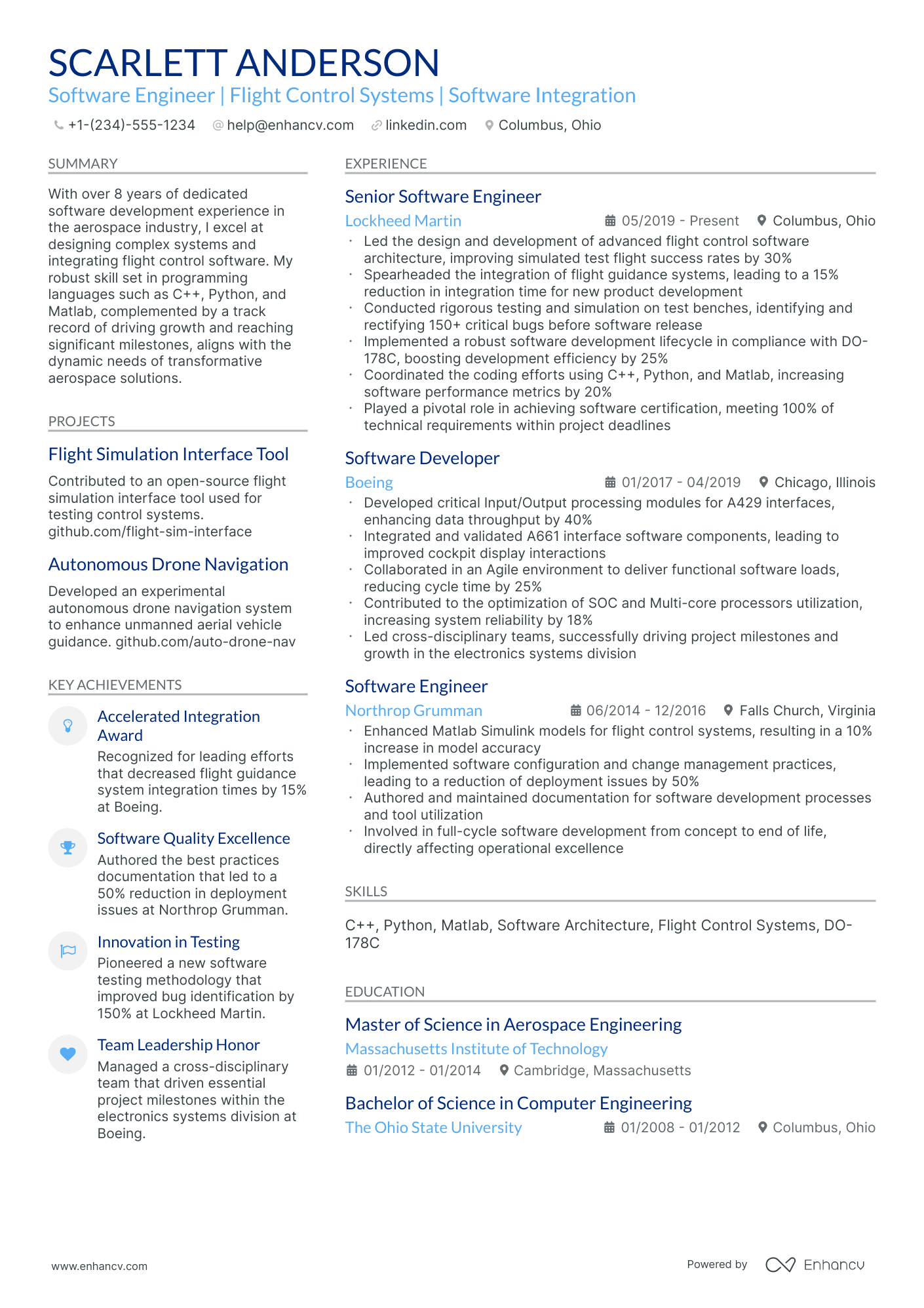
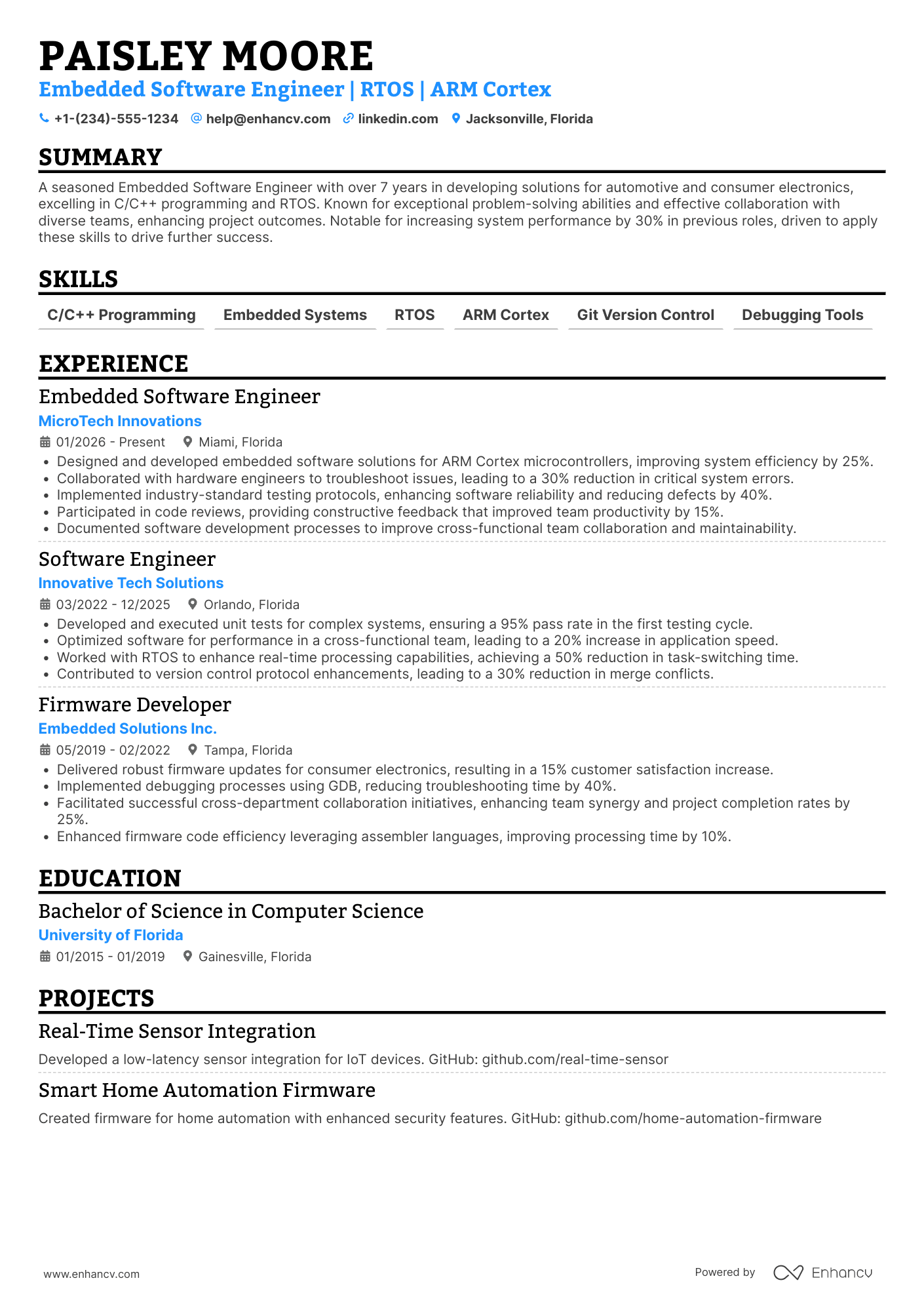
Many embedded software engineer resume submissions fail because they read like firmware task logs, not evidence of shipped, reliable systems. That hurts during embedded software engineer resume screening, where applicant tracking systems filter keywords and recruiters scan fast. Knowing how to make your resume stand out is critical in a field where technical depth alone won't get you past the first screen.
A strong resume shows outcomes: you reduced boot time by 35 percent, cut power draw by 18 percent, shipped a safety-critical feature on schedule, and improved test coverage to 85 percent. It highlights defect escapes, latency, field reliability, and customer impact.

Key takeaways
- Quantify firmware outcomes like latency, power draw, defect rates, and delivery speed in every bullet.
- Use reverse-chronological format if you're experienced and hybrid format if you're junior.
- Mirror exact microcontrollers, RTOS platforms, and protocols from each job posting you target.
- Anchor every listed skill to a specific project, platform, and measurable result.
- Lead your summary with your title, domain expertise, core tools, and one standout achievement.
- Build your resume with Enhancv to structure embedded credentials for ATS parsing and recruiter clarity.
- Stop using AI once your resume accurately reflects real experience—never invent or inflate claims.
Job market snapshot for embedded software engineers
We analyzed 475 recent embedded software engineer job ads across major US job boards. These numbers help you understand top companies hiring, industry demand, employment type trends at a glance.
What level of experience employers are looking for embedded software engineers
| Years of Experience | Percentage found in job ads |
|---|---|
| 1–2 years | 10.3% (49) |
| 3–4 years | 10.1% (48) |
| 5–6 years | 15.4% (73) |
| 7–8 years | 8.4% (40) |
| 9–10 years | 5.7% (27) |
| 10+ years | 8.4% (40) |
| Not specified | 46.1% (219) |
Embedded software engineer ads by area of specialization (industry)
| Industry (Area) | Percentage found in job ads |
|---|---|
| Finance & Banking | 56.4% (268) |
| Healthcare | 20.8% (99) |
| Manufacturing | 7.6% (36) |
| Education | 4.4% (21) |
| Government | 4.2% (20) |
| Real Estate & Construction | 2.5% (12) |
Top companies hiring embedded software engineers
| Company | Percentage found in job ads |
|---|---|
| Blue Origin | 12.2% (58) |
| Actalent | 11.4% (54) |
| General Dynamics | 8.0% (38) |
| ViaSat Inc. | 4.0% (19) |
| Northrop Grumman | 3.6% (17) |
| RTX Corporation | 2.7% (13) |
| Tesla | 2.7% (13) |
| Qualcomm | 2.3% (11) |
| Apple Inc. | 2.1% (10) |
| Boeing | 2.1% (10) |
Role overview stats
These tables show the most common responsibilities and employment types for embedded software engineer roles. Use them to align your resume with what employers expect and to understand how the role is structured across the market.
Day-to-day activities and top responsibilities for a embedded software engineer
| Responsibility | Percentage found in job ads |
|---|---|
| C++ | 77.5% (368) |
| C | 69.9% (332) |
| Linux | 44.8% (213) |
| Python | 44.4% (211) |
| Rtos | 30.3% (144) |
| Embedded software | 28.8% (137) |
| Agile | 26.1% (124) |
| Git | 21.3% (101) |
| I2c | 20.6% (98) |
| Spi | 20.6% (98) |
| Ci/cd | 18.3% (87) |
| Rust | 17.7% (84) |
Type of employment (remote vs on-site vs hybrid)
| Employment type | Percentage found in job ads |
|---|---|
| On-site | 88.4% (420) |
| Hybrid | 9.7% (46) |
| Remote | 1.9% (9) |
How to format a embedded software engineer resume
Recruiters evaluating embedded software engineers prioritize hands-on firmware and hardware-software integration experience, proficiency with specific microcontroller families and RTOS platforms, and evidence of delivering reliable, resource-constrained systems. A clean reverse-chronological or hybrid format ensures these technical signals and project outcomes surface quickly during both ATS parsing and manual review. Choosing the right resume format is especially important for embedded roles where both technical depth and clarity matter.

I have significant experience in this role—which format should I use?
Use a reverse-chronological format to present your deepest embedded systems work first, giving recruiters immediate visibility into your current technical scope and project complexity. Do:
- Lead each role entry with your ownership scope—board bring-up responsibility, peripheral driver development, or full product firmware lifecycle management.
- List specific tools and domains early: target MCU families (STM32, NXP, TI MSP430), RTOS platforms (FreeRTOS, Zephyr, VxWorks), communication protocols (SPI, I2C, UART, CAN), and debugging tools (JTAG, logic analyzers, oscilloscopes).
- Quantify outcomes tied to system performance, reliability, or development efficiency.
I'm junior or switching into this role—what format works best?
Use a hybrid format that places a focused technical skills section above your experience, ensuring embedded-relevant competencies are visible even if your work history is short or transitional. Do:
- Position core embedded skills—C/C++ for bare-metal development, register-level peripheral configuration, RTOS task management—in a dedicated section above your experience entries.
- Highlight academic projects, personal hardware builds, or open-source firmware contributions that demonstrate real embedded development work, even outside formal employment.
- Connect every listed skill to an action and a measurable or observable result so recruiters can assess applied competence, not just familiarity.
Why not use a functional resume?
A functional format strips away the project timelines and employer context that embedded software hiring managers rely on to verify you've shipped real firmware, worked under hardware constraints, and debugged systems in production environments. Avoid functional formats entirely unless you have no other way to present relevant experience. Even then, every listed skill must be anchored to a specific project, platform, or measurable outcome—standalone skill lists without applied context are routinely filtered out by both ATS systems and technical reviewers.
- A functional format may be acceptable if you're transitioning from a related field (such as electrical engineering or general software development into embedded work), have a gap in employment history, or lack formal embedded job titles—but only if you tie each skill directly to a hands-on project with a defined platform, toolchain, and outcome.
With your format established, the next step is filling it with the right sections to give recruiters exactly what they're looking for.
What sections should go on a embedded software engineer resume
Recruiters expect you to present embedded systems experience that proves you can ship reliable firmware on real hardware. Understanding which resume sections to include ensures you don't miss anything critical.
Use this structure for maximum clarity:
- Header
- Summary
- Experience
- Skills
- Projects
- Education
- Certifications
- Optional sections: Open-source work, publications, awards
Strong experience bullets should emphasize measurable impact, shipped outcomes, hardware scope, performance or reliability gains, and clear results tied to the product.
Is your resume good enough?
Drop your resume here or choose a file. PDF & DOCX only. Max 2MB file size.
Once you’ve organized the key resume components, the next step is to write your embedded software engineer resume experience so it supports each section with clear, relevant proof.
How to write your embedded software engineer resume experience
Your experience section should highlight firmware and embedded systems work you've shipped or delivered, the role-relevant tools and methods you used, and the measurable outcomes tied to each project. Hiring managers prioritize demonstrated impact—real results from real products—over descriptive task lists that only outline daily responsibilities.
Each entry should include:
- Job title
- Company and location (or remote)
- Dates of employment (month and year)
Three to five concise bullet points showing what you owned, how you executed, and what outcomes you delivered:
- Ownership scope: the embedded platforms, hardware targets, firmware modules, product lines, or peripheral subsystems you were directly accountable for as an embedded software engineer.
- Execution approach: the toolchains, real-time operating systems, communication protocols, debugging instruments, or development methodologies you applied to architect solutions and deliver production-ready embedded software.
- Value improved: the changes you drove in system performance, power consumption, boot time, memory footprint, code reliability, or defect rates across the embedded products you touched.
- Collaboration context: how you partnered with hardware engineers, PCB designers, systems architects, QA teams, or external silicon vendors to align firmware deliverables with broader product goals.
- Impact delivered: the tangible outcomes your embedded software work produced, expressed through product-level results, deployment scale, or direct business impact rather than a summary of tasks performed.
Experience bullet formula
A embedded software engineer experience example
✅ Right example - modern, quantified, specific.
Embedded Software Engineer
AeroLink Systems | Austin, TX
2022–Present
Developed safety-critical firmware for industrial wireless sensor gateways deployed across five thousand plus customer sites.
- Architected and shipped C and C plus plus firmware on ARM Cortex-M with FreeRTOS, cutting end-to-end sensor-to-cloud latency by thirty-eight percent and improving uptime from 99.3 percent to 99.9 percent.
- Implemented secure boot, over-the-air updates, and X.509 certificate provisioning using mbed TLS and a hardware security module, reducing field security incidents by seventy percent and passing third-party penetration testing with zero critical findings.
- Optimized SPI and I2C driver stack with direct memory access and interrupt coalescing, lowering CPU utilization by twenty-six percent and extending battery life by nineteen percent on remote nodes.
- Built hardware-in-the-loop test benches and automated regression in GitHub Actions with PyTest and Unity, raising unit and integration coverage from forty-five percent to eighty-one percent and cutting release validation time by fifty-two percent.
- Partnered with hardware engineers and product managers to root-cause intermittent brownout resets using logic analyzers and oscilloscope traces, reducing return merchandise authorizations by twenty-two percent and saving $180,000 annually in warranty costs.
Now that you've seen how a strong experience section comes together, let's look at how to adjust yours based on the specific job posting you're targeting.
How to tailor your embedded software engineer resume experience
Recruiters evaluate your embedded software engineer resume through applicant tracking systems and manual review. Tailoring your resume to the job description ensures your qualifications surface during both screening stages.
Ways to tailor your embedded software engineer experience:
- Match specific microcontrollers and processors listed in the job description.
- Mirror the exact RTOS platforms the employer names in requirements.
- Use the same terminology for firmware development lifecycle stages referenced.
- Highlight compliance with industry standards like MISRA or IEC 62304.
- Reflect debugging and testing methodologies the posting emphasizes by name.
- Include relevant domain experience such as automotive or medical devices.
- Emphasize real-time performance optimization if the role prioritizes reliability.
- Align collaboration references with hardware or cross-functional team structures described.
Tailoring means connecting your genuine accomplishments to the language and priorities of each specific job posting, not forcing unrelated keywords into your experience.
Resume tailoring examples for embedded software engineer
| Job description excerpt | Untailored | Tailored |
|---|---|---|
| "Develop and debug firmware for ARM Cortex-M microcontrollers using C/C++ in an RTOS environment, with a focus on low-power design for battery-operated IoT devices." | Wrote embedded software for various hardware platforms using common programming languages. | Developed and optimized firmware in C/C++ for ARM Cortex-M4 microcontrollers running FreeRTOS, reducing power consumption by 35% across three battery-operated IoT sensor product lines. |
| "Design and implement device drivers for SPI, I2C, and UART peripherals on custom PCBs, collaborating with hardware engineers to bring up new board designs from prototype to production." | Worked on driver development and collaborated with cross-functional teams on hardware projects. | Wrote and validated device drivers for SPI, I2C, and UART peripherals on four custom PCB revisions, leading board bring-up efforts from prototype through production release alongside a six-person hardware engineering team. |
| "Perform static analysis, unit testing, and code reviews to ensure compliance with MISRA C standards for safety-critical automotive embedded systems (ISO 26262)." | Tested code and participated in code reviews to improve software quality across projects. | Enforced MISRA C compliance through static analysis using Polyspace and PC-lint, authored 200+ unit tests in Unity, and led weekly code reviews for an ISO 26262 ASIL-B automotive body control module, achieving zero critical defects over two release cycles. |
Once your experience aligns with the role’s requirements, quantify your embedded software engineer achievements to show the measurable impact of that work.
How to quantify your embedded software engineer achievements
Quantifying your achievements shows how your firmware changes improved real devices, not just code. Focus on latency, memory, power, defect rates, uptime, security findings, and delivery speed across shipped builds and hardware revisions.
Quantifying examples for embedded software engineer
| Metric | Example |
|---|---|
| Latency | "Cut interrupt handling latency from 120 µs to 45 µs by optimizing ISR paths and using ARM Cortex-M DWT cycle counters." |
| Power draw | "Reduced average current from 18 mA to 11 mA by adding tickless FreeRTOS idle, peripheral gating, and BLE advertising tuning." |
| Defect rate | "Lowered field crash rate from 2.1% to 0.4% by fixing stack overflows with MPU guards and adding fuzz tests for UART parsing." |
| Flash footprint | "Shrank firmware image from 612 KB to 498 KB using link-time optimization, dead-code removal, and protobuf message pruning." |
| Delivery speed | "Shortened release cycle from four weeks to two by automating CI builds with CMake, unit tests, and hardware-in-the-loop smoke tests." |
Turn your everyday tasks into measurable, recruiter-ready resume bullets in seconds with Enhancv's Bullet Point Generator.
Once you've crafted strong bullet points to showcase your experience, the next step is ensuring your resume also highlights the right hard and soft skills employers expect from an embedded software engineer.
How to list your hard and soft skills on a embedded software engineer resume
Your skills section shows you can build reliable firmware and ship on real hardware—recruiters and an ATS (applicant tracking system) scan this section for keyword match and fit, so aim for a balanced mix of hard skills and job-specific soft skills. embedded software engineer roles require a blend of:
- Product strategy and discovery skills.
- Data, analytics, and experimentation skills.
- Delivery, execution, and go-to-market discipline.
- Soft skills.
Your skills section should be:
- Scannable (bullet-style grouping).
- Relevant to the job post.
- Backed by proof in experience bullets.
- Updated with current tools.
Place your skills section:
- Above experience if you're junior or switching careers.
- Below experience if you're mid/senior with strong achievements.

Hard skills
- C, C++
- Embedded Linux, Yocto
- FreeRTOS, Zephyr RTOS
- Bare-metal firmware
- Device drivers, BSP bring-up
- ARM Cortex-M, Cortex-A
- I2C, SPI, UART, CAN
- TCP/IP, BLE, MQTT
- JTAG, SWD, GDB
- Git, CI/CD pipelines
- Unit testing, hardware-in-the-loop
- MISRA C, static analysis
Soft skills
- Translate requirements into interfaces
- Write clear design documentation
- Debug systematically under pressure
- Communicate trade-offs and risks
- Collaborate with hardware and test teams
- Own issues through root-cause and fix
- Prioritize reliability and safety impacts
- Review code with actionable feedback
- Plan milestones and unblock delivery
- Align stakeholders on scope changes
How to show your embedded software engineer skills in context
Skills shouldn't live only in a bulleted list on your resume. Explore curated examples of resume skills to see how top candidates present their technical abilities effectively.
They should be demonstrated in:
- Your summary (high-level professional identity)
- Your experience (proof through outcomes)
Here's how that looks in practice.
Summary example
Senior embedded software engineer with 10 years designing firmware for automotive safety systems. Proficient in C, RTOS, and JTAG debugging. Led a driver optimization initiative that reduced boot times by 35%, collaborating cross-functionally with hardware and QA teams.
- Signals senior-level depth immediately
- Names role-critical tools and platforms
- Quantifies a meaningful outcome
- Highlights cross-functional collaboration
Experience example
Senior Embedded Software Engineer
Vericore Systems | Detroit, MI
March 2019–Present
- Redesigned CAN bus communication firmware in C, cutting message latency by 28% across 12 vehicle ECU modules.
- Partnered with hardware engineers to integrate RTOS-based diagnostics, reducing field failure rates by 40% within one year.
- Developed automated unit testing frameworks using Python and JTAG tools, improving code coverage from 62% to 91%.
- Every bullet contains measurable proof
- Skills appear naturally within accomplishments
Once you’ve demonstrated your embedded software engineering skills through concrete examples, the next step is to apply that same approach to writing an embedded software engineer resume with no experience.
How do I write a embedded software engineer resume with no experience
Even without full-time experience, you can demonstrate readiness through projects and academics. Our guide on writing a resume without work experience covers this in detail. Consider showcasing:
- Capstone embedded systems course project
- Personal firmware project on microcontroller
- Open-source driver or library contributions
- Hardware-in-the-loop test bench build
- Internship or co-op in firmware
- Robotics club firmware and bring-up
- Senior design board bring-up work
- Lab assistant for embedded courses
Focus on:
- Bare-metal C on microcontrollers
- Device drivers and peripheral interfaces
- Debugging with JTAG and logic analyzer
- Measurable results and test evidence
Resume format tip for entry-level embedded software engineer
Use a hybrid format that leads with skills and projects, then lists education and experience. It highlights proof of embedded software engineer work when job history is limited. Do:
- Put projects above work history.
- List microcontrollers, buses, and tools.
- Show test methods and coverage metrics.
- Link to code and schematics.
- Quantify latency, memory, and power.
- Built bare-metal C firmware on STM32 using SPI and UART drivers, debugged with J-Link and logic analyzer, reducing sensor read latency by 35%.
Once you've structured your resume around transferable skills and relevant projects, presenting your education effectively becomes your strongest asset for demonstrating technical foundations to employers.
How to list your education on a embedded software engineer resume
Your education section helps hiring teams confirm you have the foundational knowledge needed. It validates your technical training in areas critical to the embedded software engineer role.
Include:
- Degree name
- Institution
- Location
- Graduation year
- Relevant coursework (for juniors or entry-level candidates)
- Honors & GPA (if 3.5 or higher)
Skip month and day details—list the graduation year only.
Here's a strong education entry tailored for an embedded software engineer resume.
Example education entry
Bachelor of Science in Electrical and Computer Engineering
University of Michigan, Ann Arbor, MI
Graduated 2021
GPA: 3.7/4.0
- Relevant coursework: Embedded Systems Design, Real-Time Operating Systems, Microprocessor Architecture, Digital Signal Processing
- Honors: Magna Cum Laude, Dean's List (six semesters)
How to list your certifications on a embedded software engineer resume
Certifications show an embedded software engineer's commitment to learning, proficiency with key tools, and alignment with industry standards and safety expectations.
Include:
- Certificate name
- Issuing organization
- Year
- Optional: credential ID or URL
- Place certifications below education when they're older, less relevant, or secondary to your degree and core embedded software engineer experience.
- Place certifications above education when they're recent, highly relevant, or required for the embedded software engineer roles you target.
Best certifications for your embedded software engineer resume
- ARM Accredited Engineer (AAE)
- Certified LabVIEW Developer (CLD)
- Certified Kubernetes Application Developer (CKAD)
- ISTQB Certified Tester Foundation Level (CTFL)
- IEEE Wireless Communication Professional (WCP)
- CompTIA Security+
Once you’ve positioned your credentials where recruiters can spot them quickly, focus on your embedded software engineer resume summary to tie those qualifications to the role you’re targeting.
How to write your embedded software engineer resume summary
Your resume summary is the first thing a recruiter reads. A strong one instantly signals you have the right skills and experience for an embedded software engineer role.
Keep it to three to four lines, with:
- Your title and relevant years of hands-on embedded development experience.
- The domain or industry you've worked in, such as automotive, IoT, or medical devices.
- Core tools and technologies like C, C++, RTOS, JTAG, or ARM Cortex processors.
- One or two measurable achievements that show your technical impact.
- Soft skills tied to real outcomes, such as cross-functional collaboration that shortened a release cycle.

PRO TIP
At this level, focus on clarity and relevance above all else. Highlight specific tools, languages, and platforms you've used. Pair each skill with an early contribution or result. Avoid vague descriptors like "passionate" or "hard-working." Those waste space and tell recruiters nothing concrete about what you can deliver.
Example summary for a embedded software engineer
Embedded software engineer with two years of experience developing firmware in C for IoT sensor devices. Reduced boot time by 30% through optimized driver initialization. Skilled in FreeRTOS, ARM Cortex-M, and JTAG debugging.
Optimize your resume summary and objective for ATS
Drop your resume here or choose a file.
PDF & DOCX only. Max 2MB file size.
Now that your summary captures your embedded expertise at a glance, make sure your header provides the essential contact details recruiters need to actually reach you.
What to include in a embedded software engineer resume header
A resume header is the top section with your identity and contact details, and it boosts visibility, credibility, and recruiter screening for a embedded software engineer.
Essential resume header elements
- Full name
- Tailored job title and headline
- Location
- Phone number
- Professional email
- GitHub link
- Portfolio link
A LinkedIn link helps recruiters verify experience quickly and supports screening.
Do not include photos on a embedded software engineer resume unless the role is explicitly front-facing or appearance-dependent.
Match your header job title and headline to the posting and include firmware keywords that align with the role.
Embedded software engineer resume header
Jordan Lee
Embedded Software Engineer | C/C++ | RTOS | ARM Cortex-M | I2C, SPI, UART
Austin, TX
(512) 555-01XX
jordan.lee@enhancv.com
github.com/jordanlee
yourwebsite.com
linkedin.com/in/jordanlee
Once your contact details and role-specific identifiers are clear at the top, add relevant supporting sections to strengthen the rest of your embedded software engineer resume.
Additional sections for embedded software engineer resumes
When your core sections don't fully capture your expertise, additional sections help distinguish you from other embedded software engineer candidates.
- Languages
- Publications and technical papers
- Open-source contributions and personal embedded projects
- Professional certifications (e.g., Embedded Linux, ARM architecture)
- Conference presentations and speaking engagements
- Professional memberships (e.g., IEEE, ACM)
- Patents
Once you've strengthened your resume with relevant additional sections, the next step is pairing it with a cover letter to give hiring managers a fuller picture of your qualifications.
Do embedded software engineer resumes need a cover letter
A cover letter isn't required for an embedded software engineer, but it helps in competitive roles or teams with strict hiring expectations. If you're unsure what a cover letter is or when to use one, it can make a difference when your resume needs context, or when you want to show clear fit fast.
Use these tips to decide when to include one and what to say:
- Explain role or team fit by linking your experience to their hardware stack, real-time constraints, and development workflow.
- Highlight one or two relevant projects or outcomes, including measurable results like latency reduction, power savings, or improved reliability.
- Show understanding of the product, users, or business context, such as safety requirements, regulatory needs, or field failure risks.
- Address career transitions or non-obvious experience by explaining how your skills transfer to embedded software engineer work and why the shift makes sense.
Drop your resume here or choose a file.
PDF & DOCX only. Max 2MB file size.
Once you’ve decided how to position your application beyond the resume alone, you can use AI to strengthen your embedded software engineer resume by quickly refining its clarity, structure, and role-specific focus.
Using AI to improve your embedded software engineer resume
AI can sharpen your resume's clarity, structure, and impact. It helps refine language and highlight measurable results. But overuse strips authenticity. Once your content is clear and role-aligned, step away from AI. If you're wondering which AI is best for writing resumes, the answer depends on your specific needs and how much editing control you want.
Here are 10 practical prompts to strengthen specific sections of your embedded software engineer resume:
Strengthen your summary
Quantify experience bullets
Align skills to job posts
Tighten project descriptions
Improve action verbs
Refine education details
Highlight certifications clearly
Remove filler language
Tailor for ATS parsing
Clarify technical scope
Conclusion
A strong embedded software engineer resume shows measurable outcomes, role-specific skills, and a clear structure. It highlights impact with numbers, names core tools, and explains your work in concise, scannable sections.
Keep your embedded software engineer resume focused on results, reliability, and collaboration. This approach matches today’s hiring expectations and stays relevant as teams prioritize performance, safety, and maintainable code.