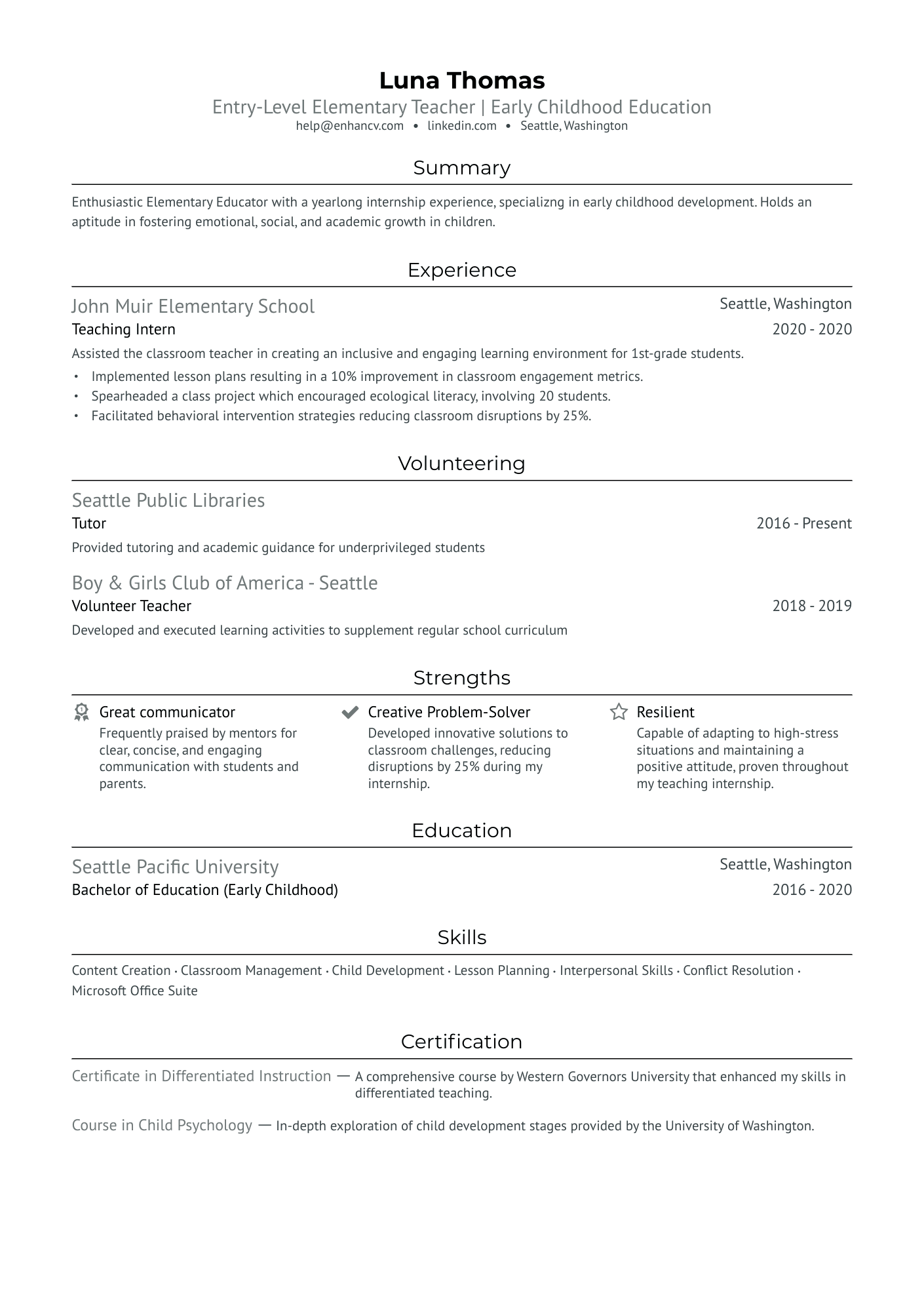
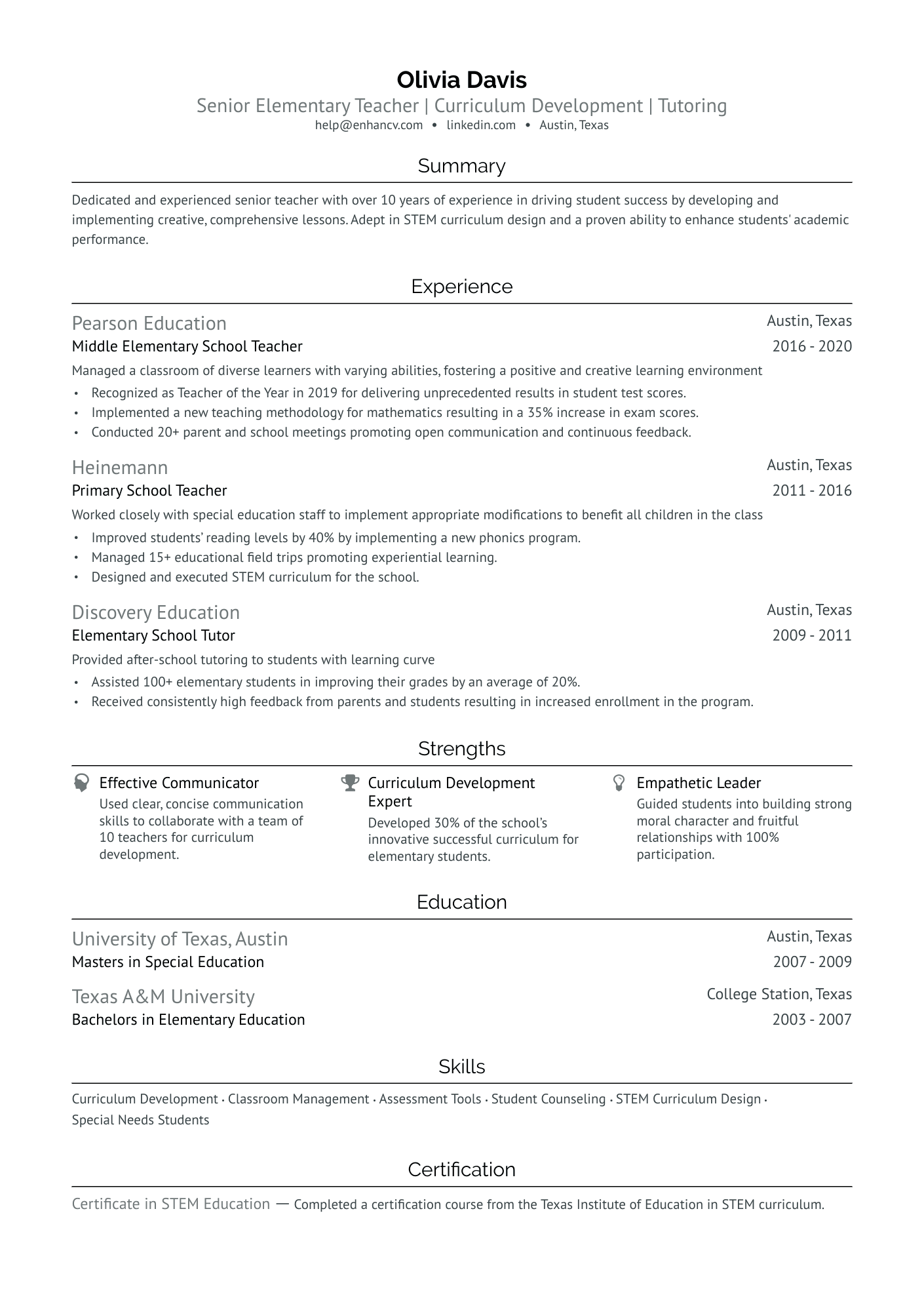
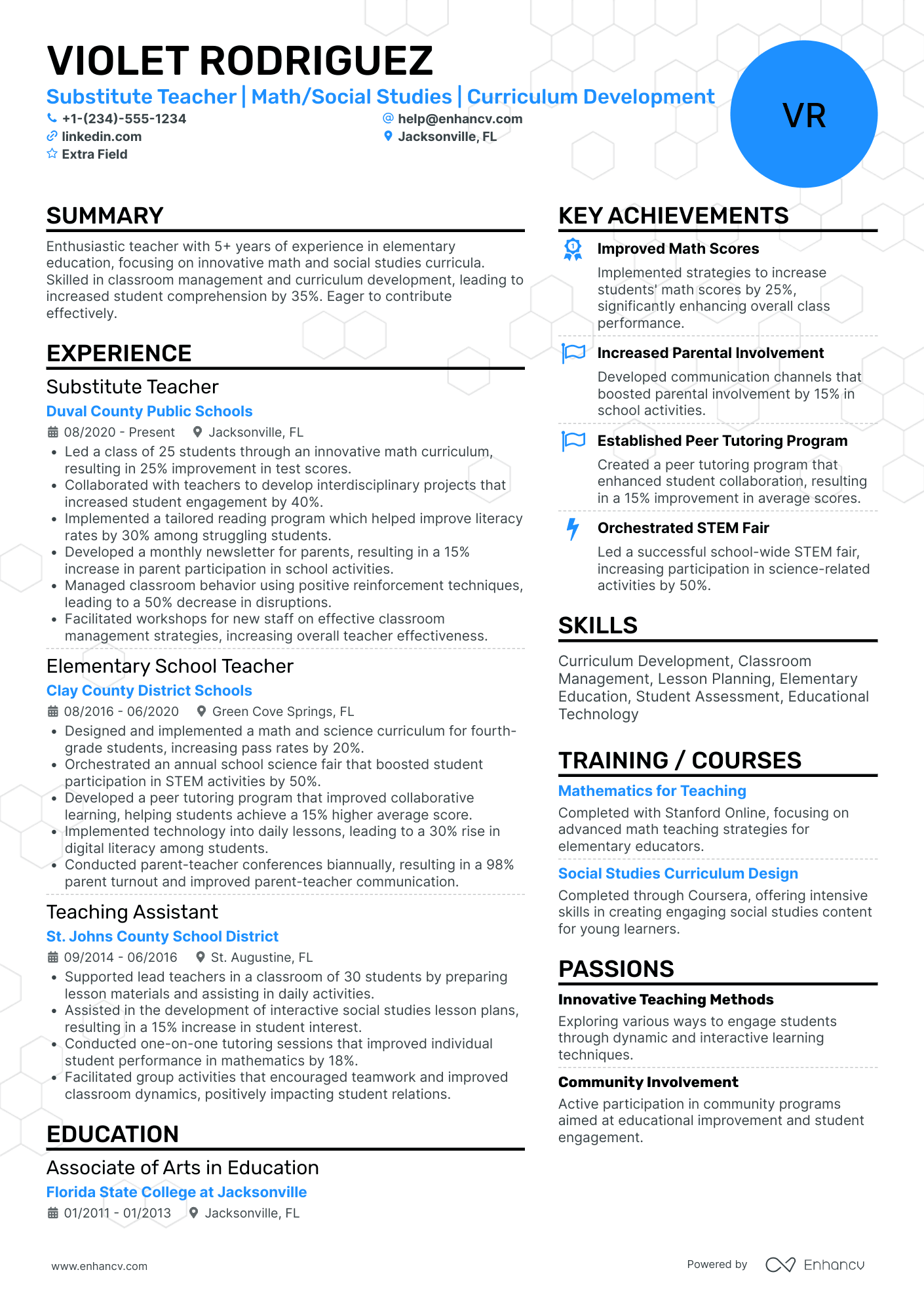
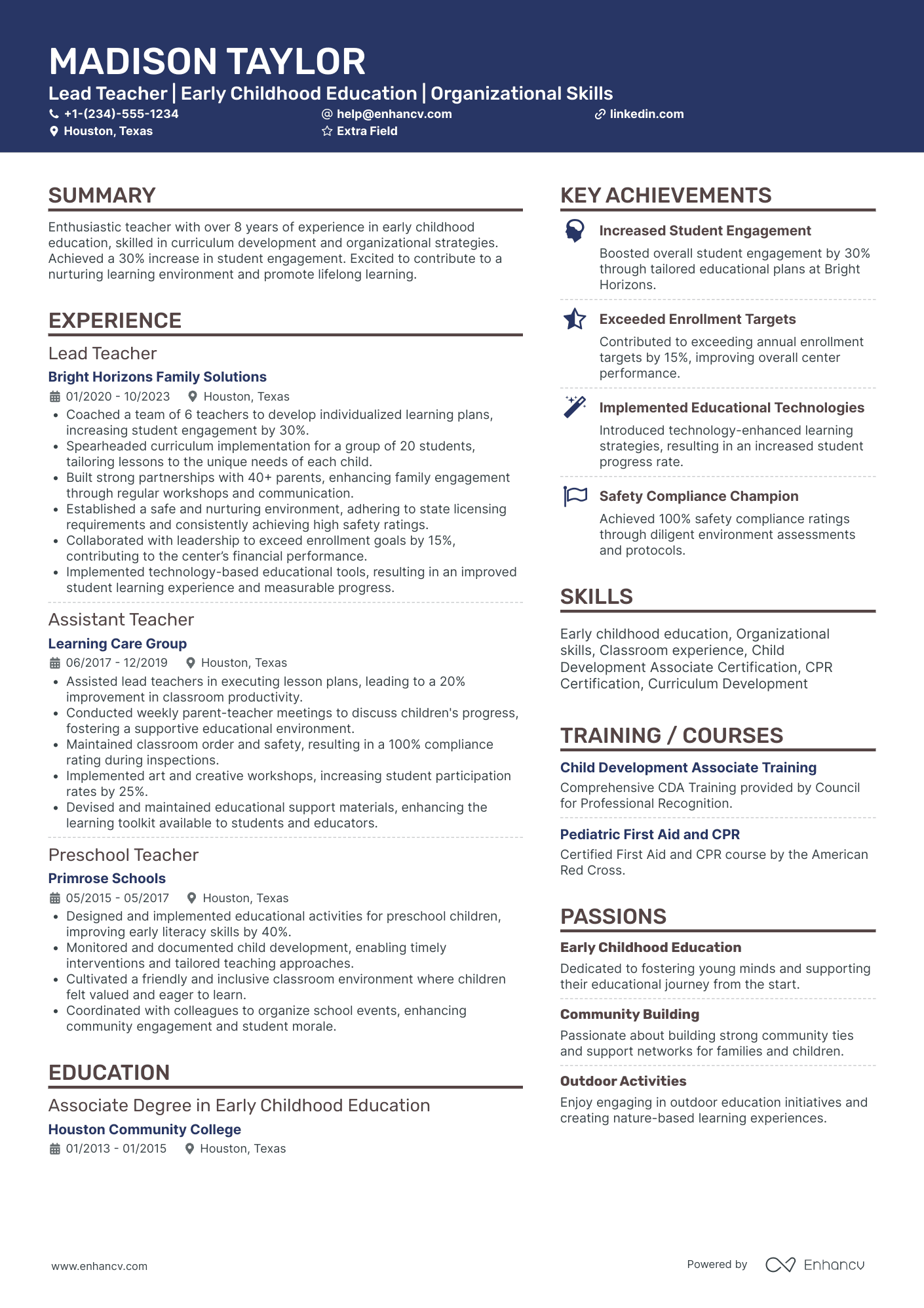
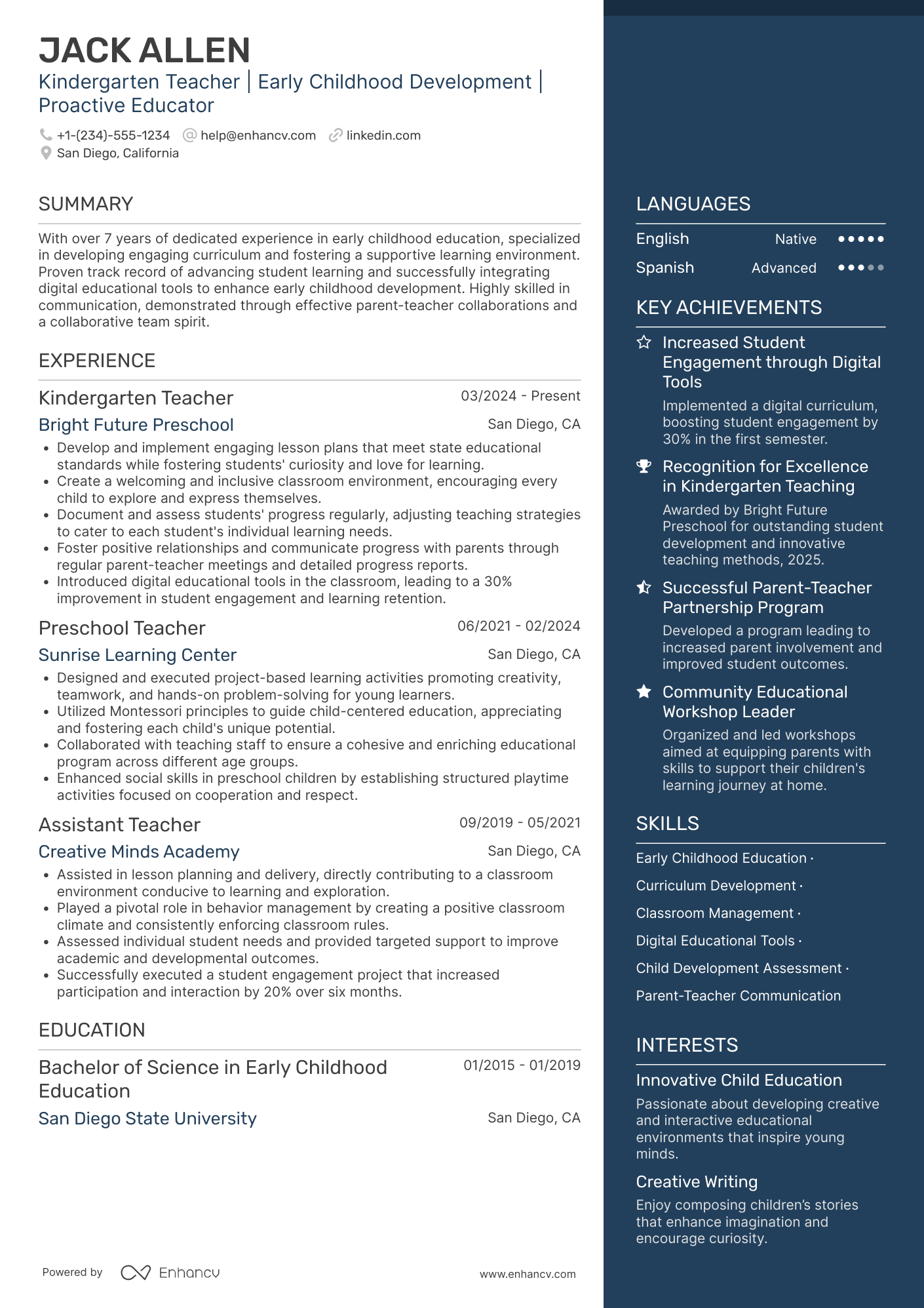
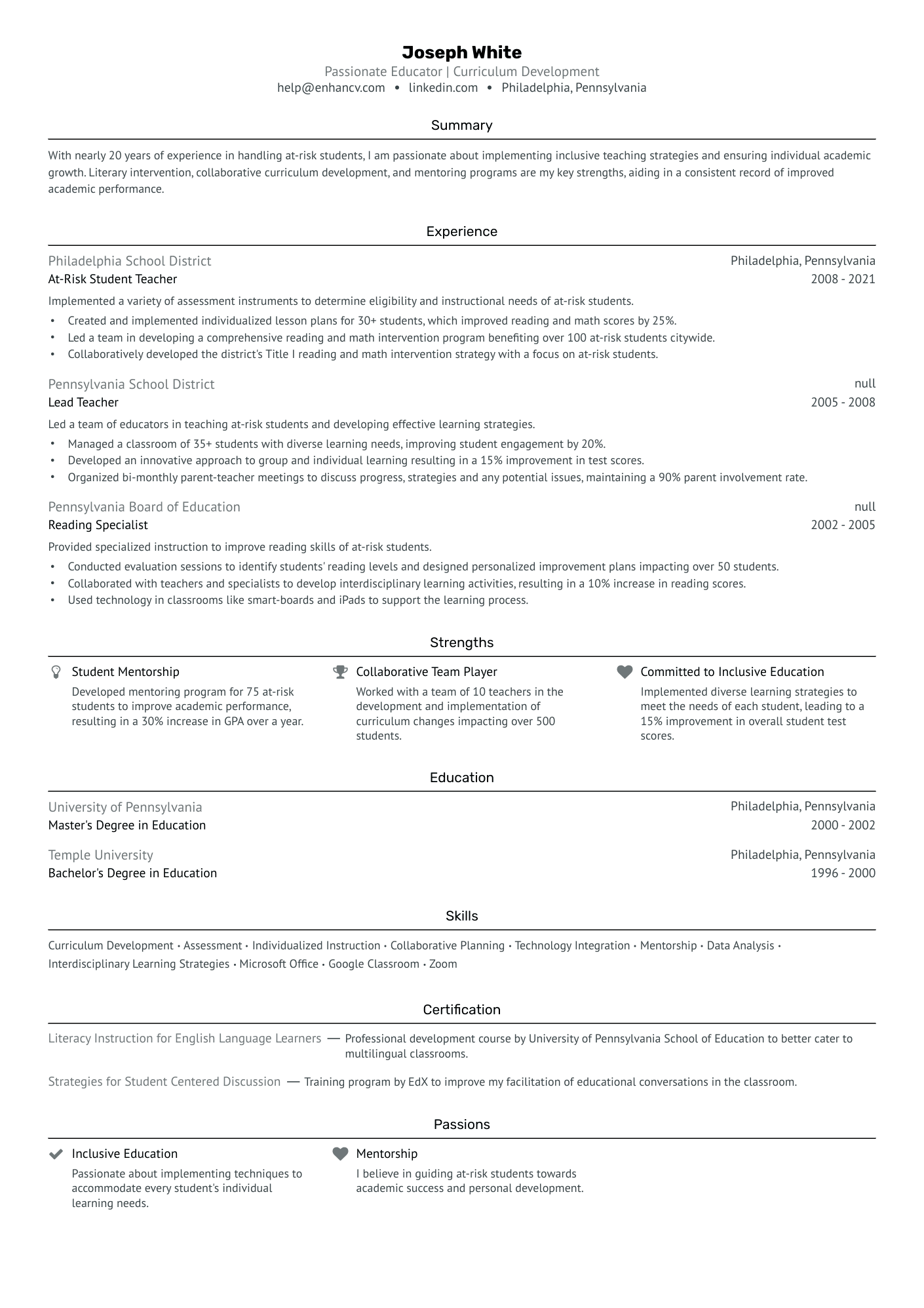
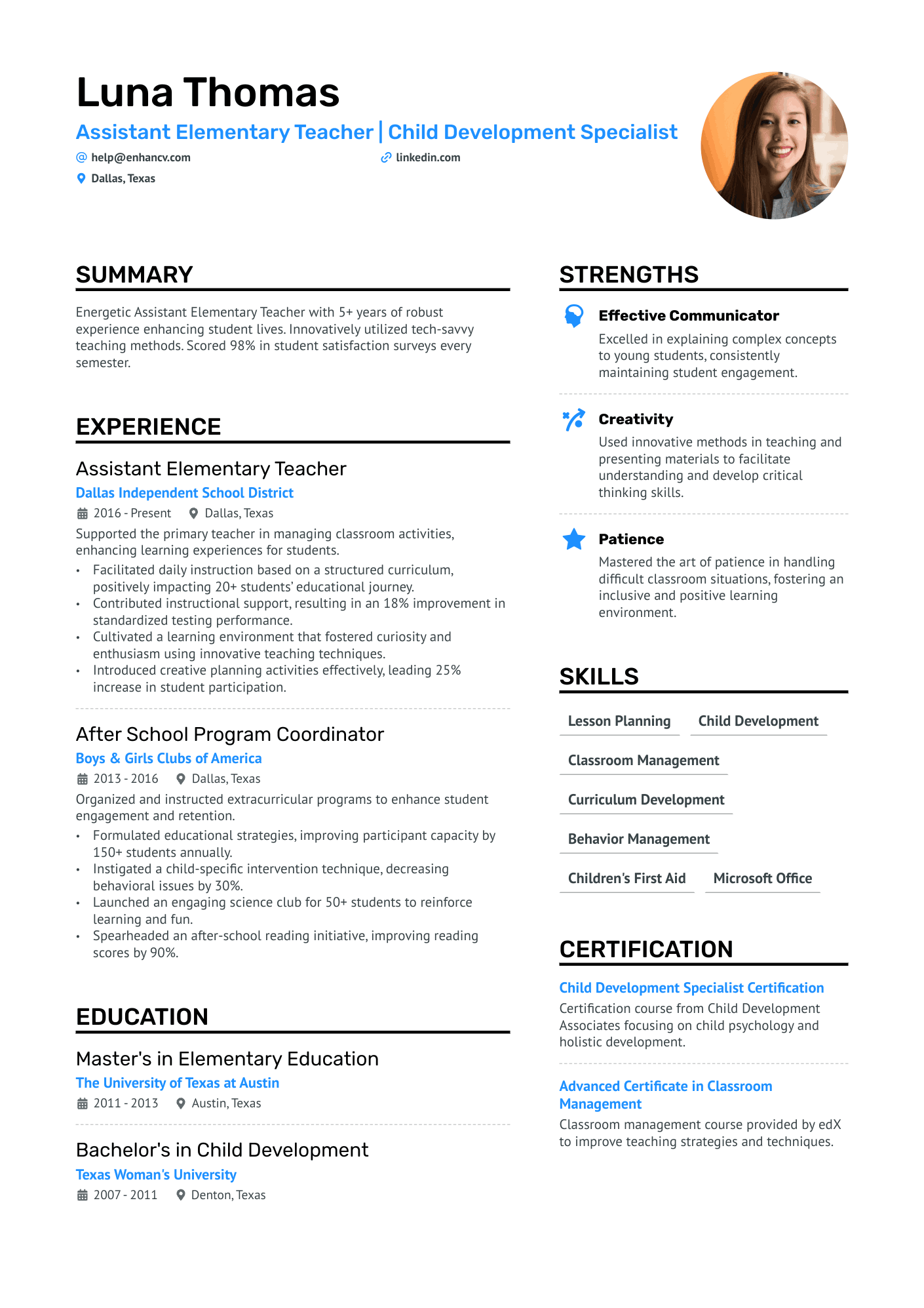
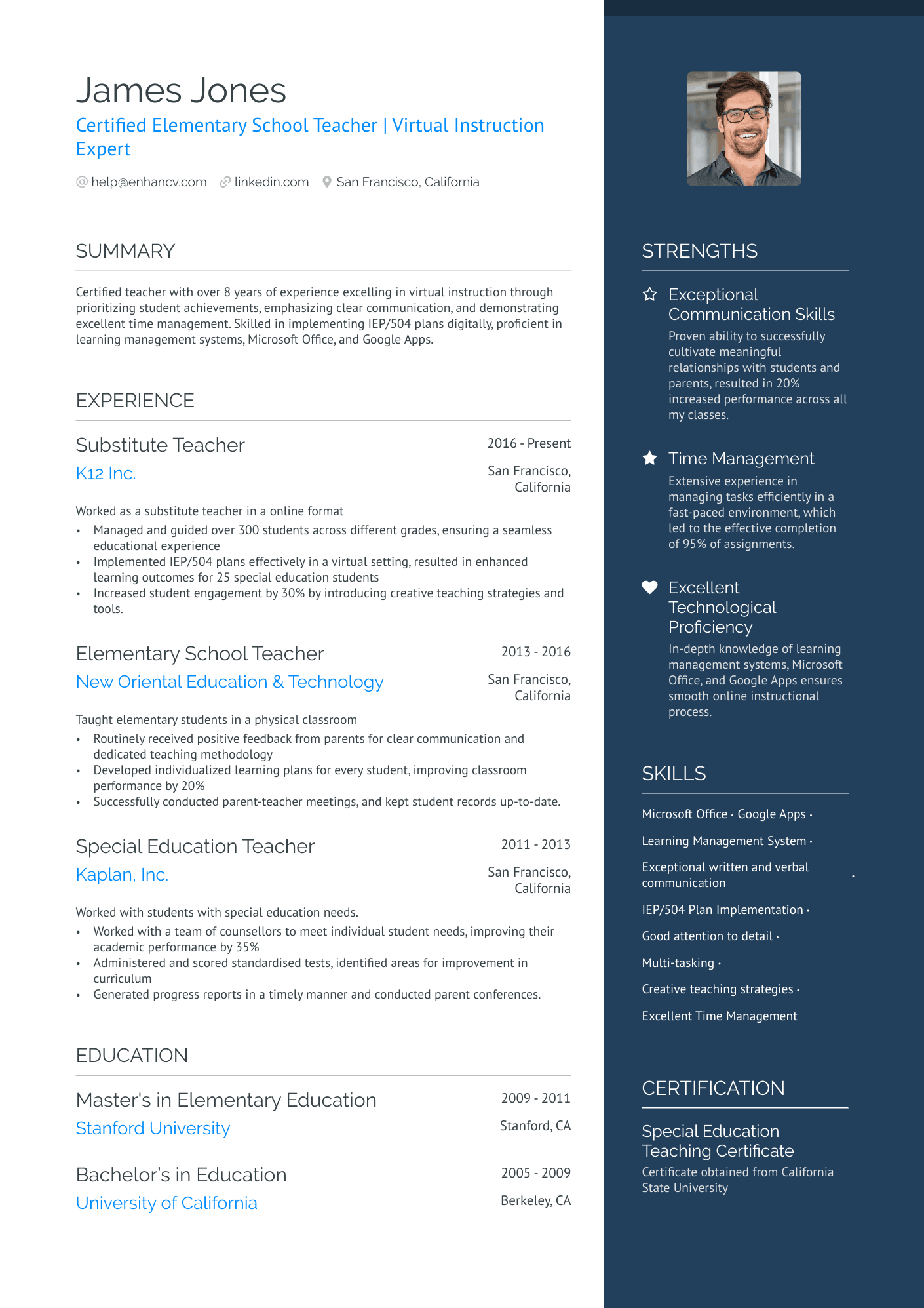
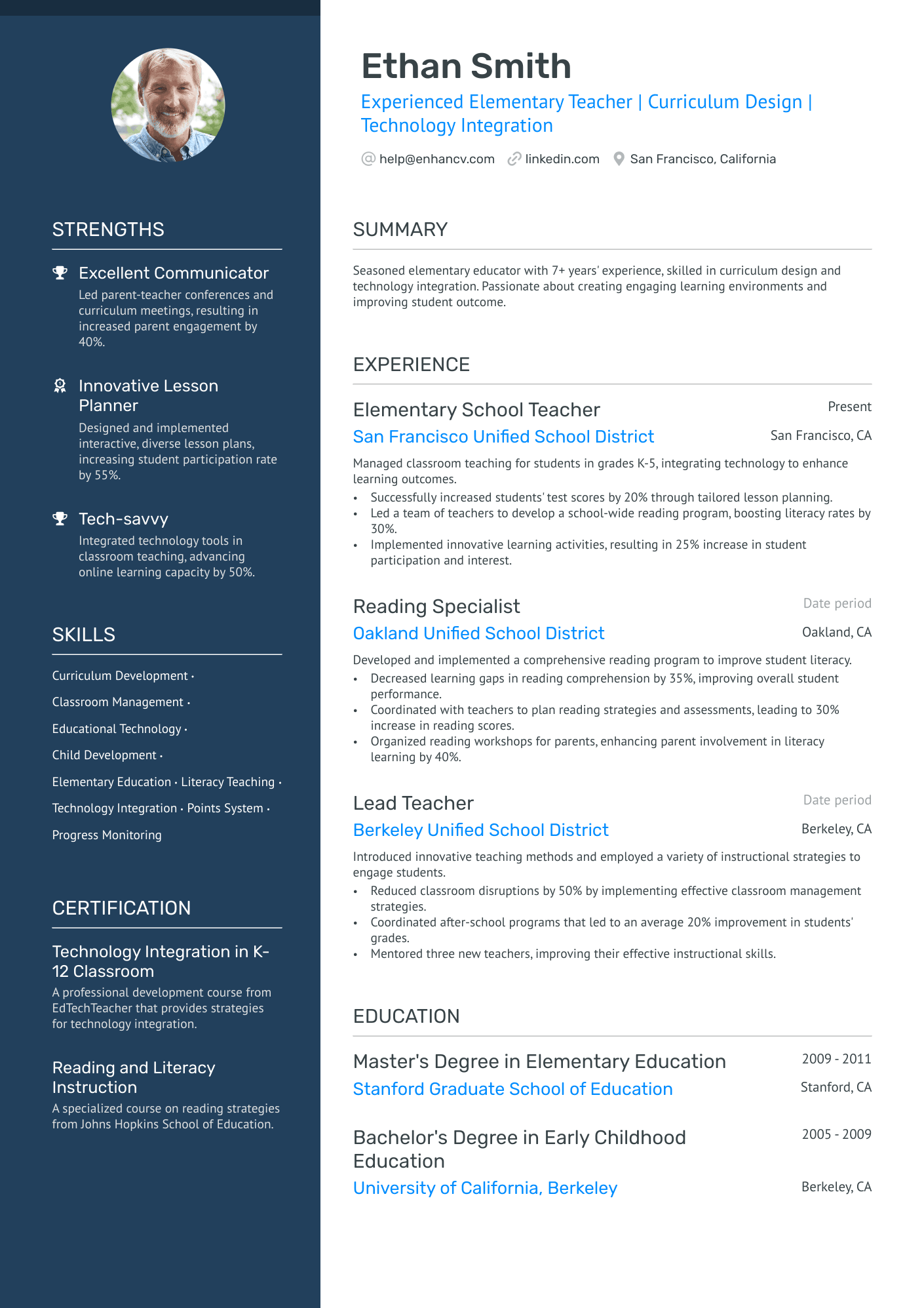
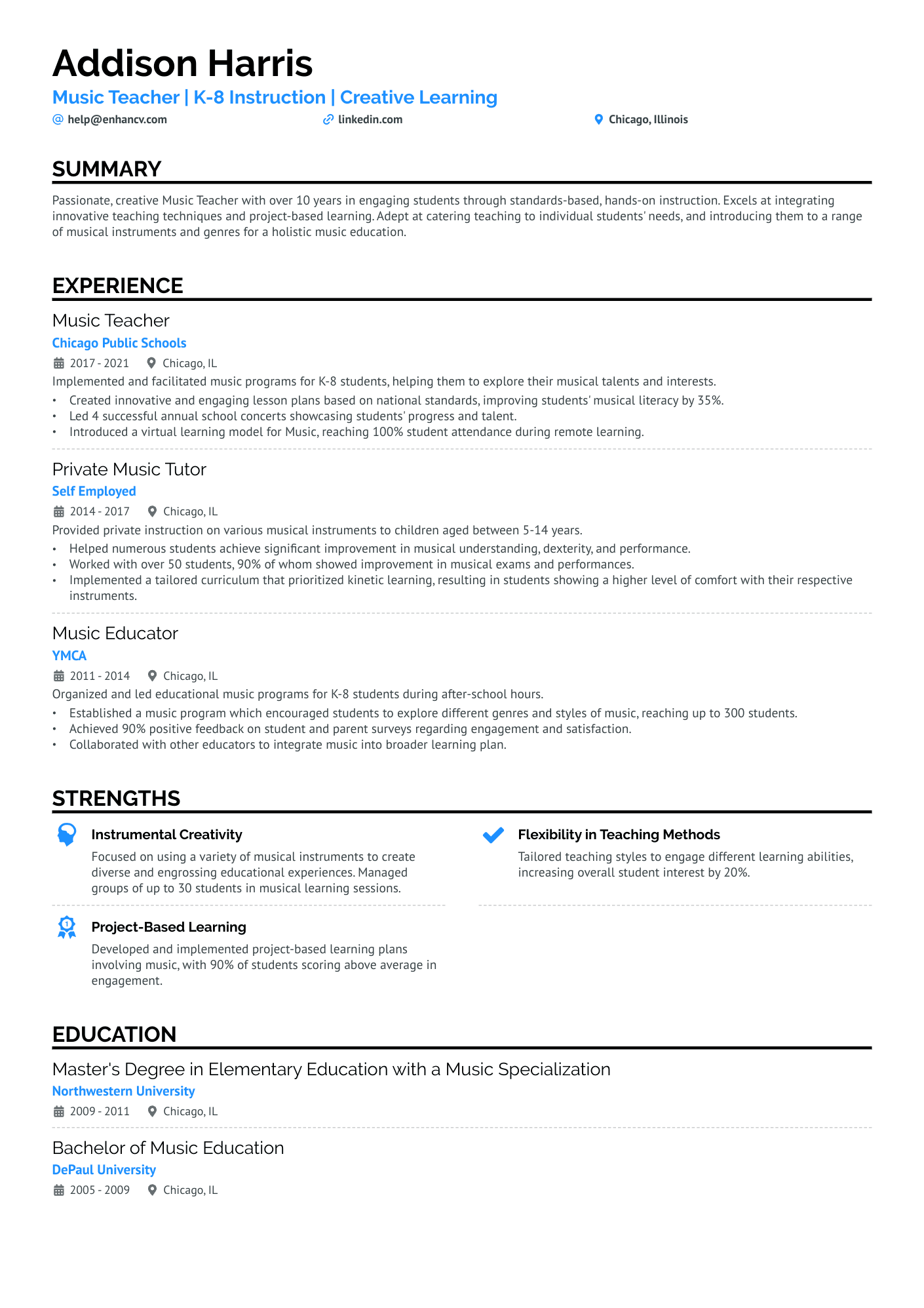
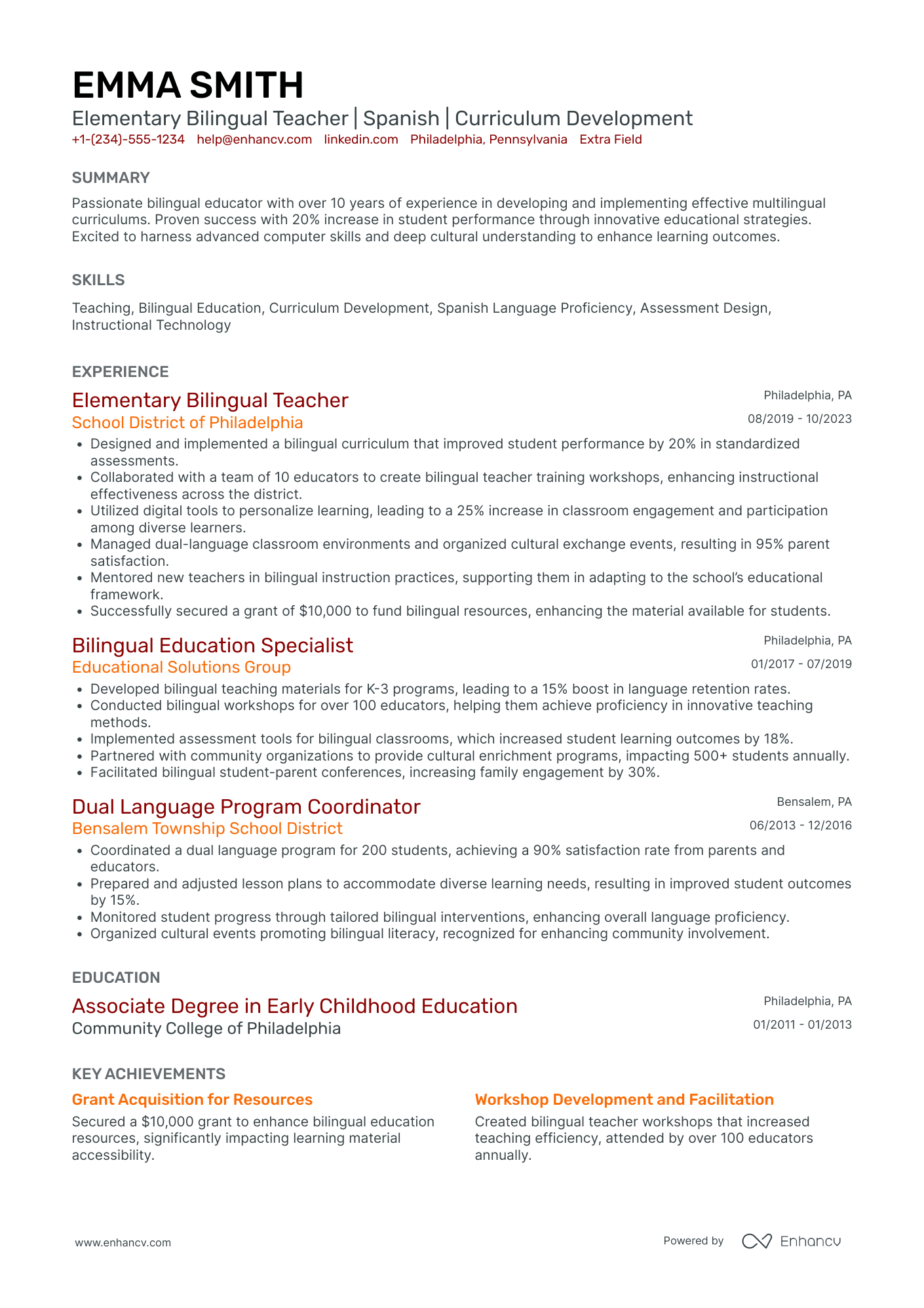
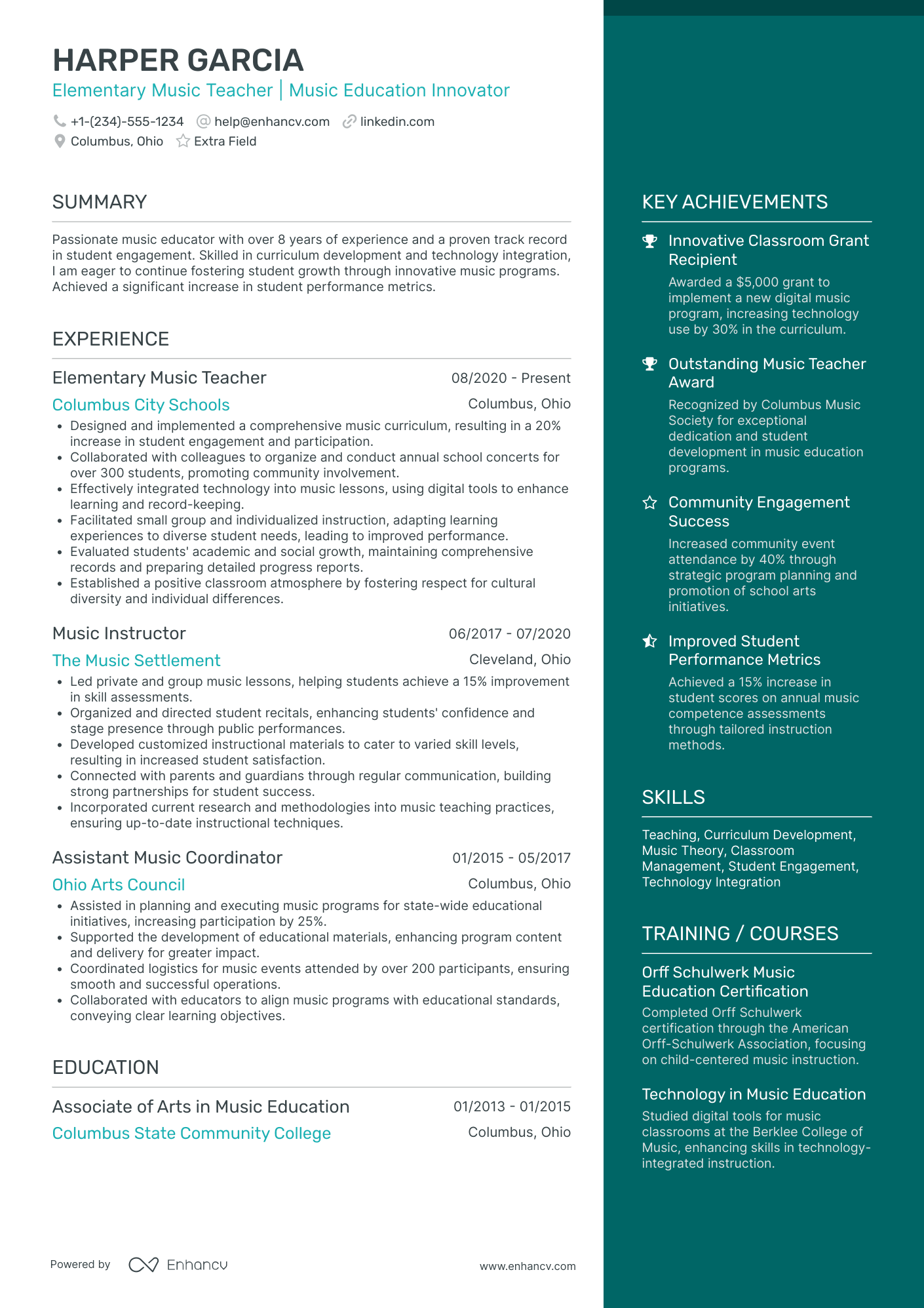
Landing your dream classroom in 2026 requires more than just a valid credential. While there are still thousands of annual openings due to turnover, the U.S. Bureau of Labor Statistics projects an overall 2% decline in employment for elementary teachers through 2033.
In a shrinking job market, modern hiring committees need specialists who can deal with persistent literacy plateaus, implement multi-tiered systems of support (MTSS), and manage the rising complexities of student dysregulation.
The trap most elementary teachers fall into is writing a resume that echoes a district handbook—listing "grading" and "supervision" instead of the specialized pedagogy that genuinely keeps a classroom afloat.
To stand out, you must move beyond listing classroom management and start proving how you’ve really moved the needle on student growth.

Key takeaways
- Prioritize the hybrid format. Use a layout that front-loads your state certifications and modern pedagogical skills to satisfy legal and technical checks in under six seconds.
- Pivot from listing daily chores like grading to proving impact through quantifiable student growth metrics and behavioral leadership outcomes.
- Ensure your highest-value skills appear in both your dedicated skills section and within your experience bullets to provide immediate proof of competency.
- Align your resume narrative with the specific school philosophy—whether it’s a trauma-informed Title I environment or a tech-heavy STEM academy.
- Use Enhancv’s AI Resume Builder and tailored prompts to turn basic responsibilities into achievement-focused statements that resonate with hiring committees.
To ensure your classroom wins are immediately scannable, you need to choose a structural framework that mirrors the organization and clarity you bring to your lesson plans.
How to choose the best elementary teacher resume format
In a field where organization is a top-three job requirement, your resume's layout is your first unofficial performance task. For elementary school teachers, the combination (hybrid) format is the gold standard.
Here’s why it works:
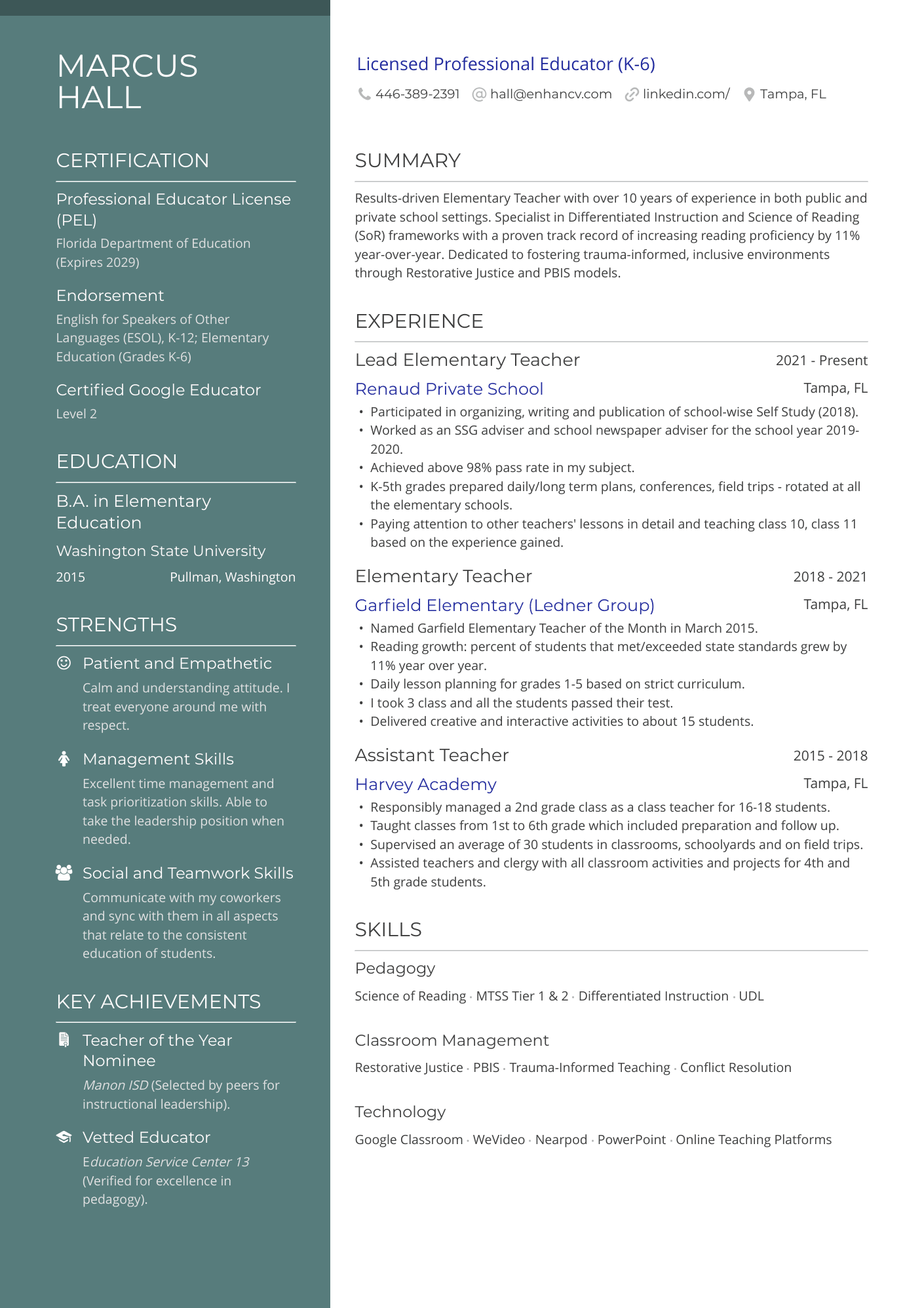
- It allows you to place your state certifications and specialized endorsements (like ESL or SPED) at the very top, satisfying the legal clearance check instantly.
- Before diving into your work history, you can feature a dedicated section for modern pedagogical must-haves like Science of Reading (SoR) or restorative justice frameworks.
- It retains a strict reverse-chronological experience section to show your career progression and tenure—a key indicator of reliability for school districts.
The ideal elementary teacher section order
- Header: Name, specific license, contact information.
- Professional Summary: Three to four lines of your "teaching brand" and top metric.
- Certifications & Licenses: Clear, bold list of state-issued and upskilling credentials.
- Key Skills: Categorized into Pedagogy, Tech, and Classroom Management.
- Professional Experience: Your reverse-chronological history (student teaching goes here if you’re new).
- Education: University name, degree, and GPA (if above 3.5).

PRO TIP
This format works because it passes the 6-second scan. The hiring manager sees you’re licensed (Certifications), they see you know the modern frameworks (Skills), and then they see the proof of your work (Experience).
Is your teaching resume ready for today’s job market?
Don't leave your application to chance. Use Enhancv’s Resume Checker to see how your experience stacks up against current district standards. Our tool scans for the specific keywords and impact-driven metrics that principals are hunting for.
Is your resume good enough?
Drop your resume here or choose a file. PDF & DOCX only. Max 2MB file size.
How to write your elementary teacher resume experience
Some teaching resumes fail because they list the responsibilities of the job rather than the results of the work.
To capture a hiring panel’s attention, you need to use the C-A-R method: Context, Action, and Result (similar to the STAR approach to job interview questions).
In three to six bullet points, your experience section must show:
- Quantifiable literacy and math wins: Use data from universal screeners like DIBELS, i-Ready, or MAP Growth.
- Behavioral leadership: Don’t just say “classroom management.” Mention specific frameworks like PBIS, restorative justice, or SEL (Social-Emotional Learning) and how they reduced disruptions.
- Inclusion and differentiation: Explicitly state your experience with IEPs, 504 plans, and neurodivergent learners. In 2026, every classroom is an inclusive classroom.
- Collaborative impact: Highlighting your work with Grade Level Teams, Professional Learning Communities (PLCs), or parent-teacher organizations shows you’re a true culture builder.
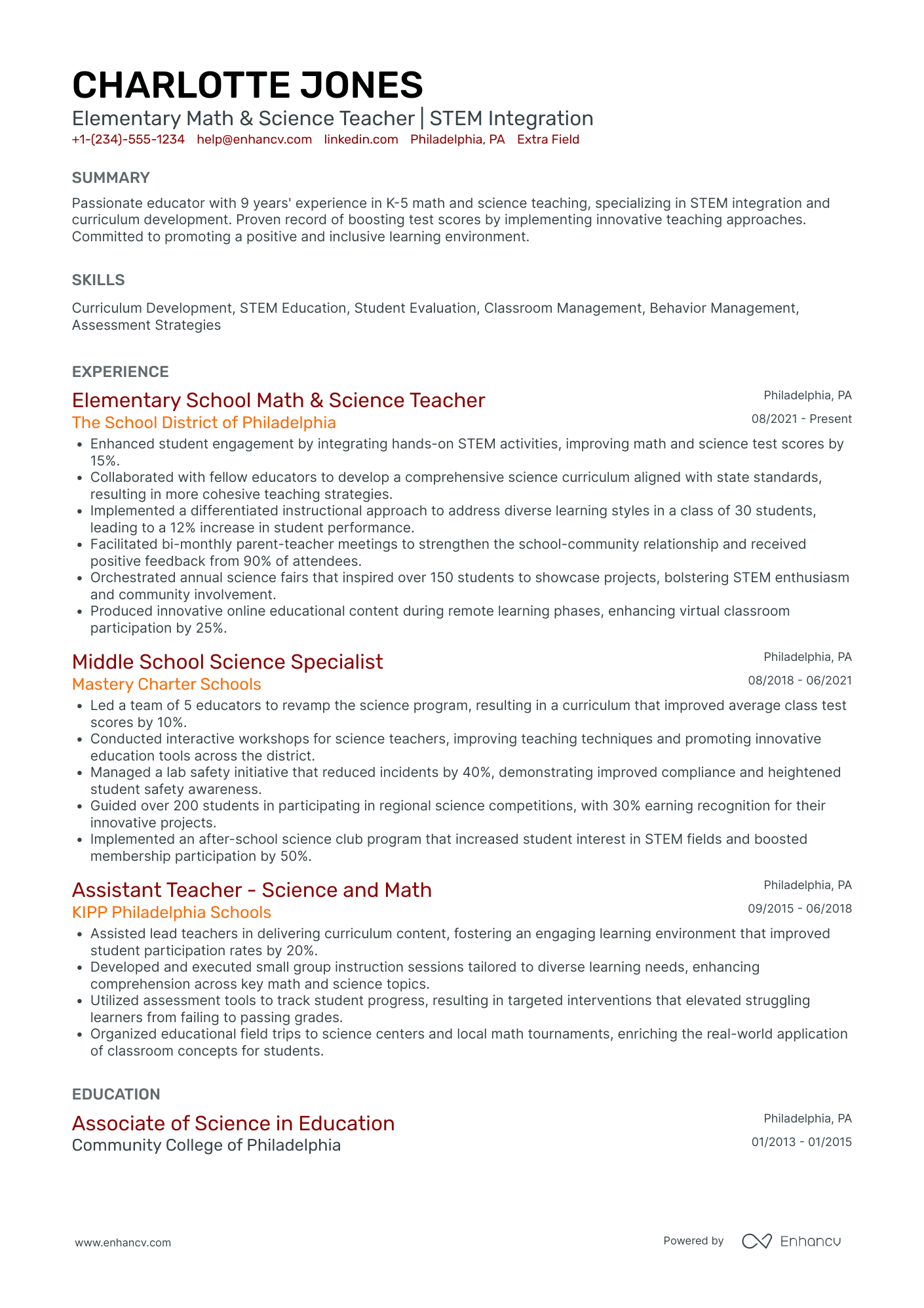
Below is an example of an elementary school teacher’s experience:
Good example of an elementary teacher experience section
Lead 2nd Grade Teacher
Lincoln Elementary, Chicago Public Schools
Aug 2021 – Present
- Elevated literacy proficiency by 22% within one academic year by transitioning to a Science of Reading (SoR) framework and utilizing Heggerty Phonemic Awareness for daily interventions.
- Directly managed a 28-student inclusive classroom, successfully implementing 15+ IEP and 504 accommodations in collaboration with the SPED department to ensure 100% compliance.
- Pioneered a “Restorative Justice” circle model that decreased classroom-level behavioral referrals by 45%, fostering a trauma-informed environment for a high-needs student population.
- Led the Grade-Level Professional Learning Community (PLC) to deconstruct Common Core standards and map out a cross-curricular STEAM unit featured in the District’s Showcase.
PRO TIP
Using numbers on your teaching resume is important for proving your impact in the classroom. However, you may not always be able to access district-wide standardized test scores.
In this case, pivot to classroom growth metrics. Did you increase the number of students meeting their weekly reading goals? Did you reduce transition times between subjects by five minutes?
Even soft wins have hard numbers—calculate the percentage of your class that reached mastery on a specific unit. In education, time saved on transitions is time earned for instruction.
How to tailor your resume experience as an elementary teacher
Tailoring your resume is critical because a 3rd Grade Teacher role can look vastly different depending on the school. A Title I school may prioritize behavioral intervention and trauma-informed care, while a private STEM academy will hunt for project-based learning and advanced tech integration.
The same school-by-school tailoring logic applies to your application letter—see our elementary teacher cover letter examples for openings that mirror a Title I or STEM posting line for line.
Principals scan your resume for a cultural and pedagogical match. If the job description emphasizes foundational literacy and you only talk about creative arts, your application will be buried.
To effectively translate your teaching experience and pass the first check, follow these steps:
- Analyze the job description (JD): Pinpoint the school’s specific philosophy. Are they a Responsive Classroom school? Do they use Common Core or a specific state standard?
- Identify key frameworks: Look for specific keywords like MTSS, PBIS, Science of Reading, or Orton-Gillingham listed under “Requirements.”
- Adapt your bullet points: Rewrite your experience to mirror their language. Don't just say “taught small groups.” Say “Led Tier 2 reading interventions for at-risk learners.”
- Leverage AI tailoring tools: Enhancv’s One-Click Tailoring Tool automatically aligns your experience with the school's specific needs. Paste the job description, then refine the output by injecting your personal student growth data.
PRO TIP
AI can help structure your resume, and it's even considered a mark of professional efficiency. Educators already leverage AI to plan lessons, so applying it to your career strategy is the next logical step.
However, watch out for the “AI glaze”—those overly formal, robotic phrases that lack the warmth hiring committees expect from a teacher.
Rely on these tools to surface the right keywords, but ruthlessly edit the final copy to ensure your unique classroom voice shines through.
Below are a few examples of untailored vs. tailored resume bullet points. See how the last column closely follows the job requirement and makes a perfect case of action verbs and quantified achievements.
Resume tailoring examples for elementary school teachers
| Job description excerpt | Untailored bullet | Tailored bullet |
|---|---|---|
| "Requires experience with data-driven literacy instruction and Science of Reading (SoR) frameworks." | Taught reading and phonics to a 1st-grade class using various books. | Boosted decoding accuracy by 30% by implementing an SoR-aligned phonics curriculum and tracking progress via DIBELS 8th Edition. |
| "Seeking a candidate with strong classroom management and experience in Restorative Practices." | Handled discipline issues in the classroom and made sure students followed rules. | Reduced exclusionary discipline by 50% by facilitating daily Restorative Circles and implementing a "peace corner" for self-regulation. |
| "Expertise in integrating 1:1 technology to enhance student engagement." | Used iPads and computers in the classroom for student assignments. | Orchestrated a 1:1 Chromebook environment, utilizing Seesaw and Nearpod to increase student engagement and participation rates by 40%. |
As we mentioned earlier, putting a number on your teaching achievements isn’t always possible—especially when dealing with the heart of education. However, when you dig into your daily routines, you’ll find that almost every successful classroom outcome has a measurable trail.
When trying to quantify your experience, think of the following tactics:
- Growth percentages: Instead of listing test scores, focus on the leap. (e.g., "Guided 85% of students to meet or exceed their individualized growth targets on i-Ready assessments.")
- Time-saving wins: Did you streamline a process? (e.g., "Reduced transition times by 50% through the implementation of visual schedules, reclaiming 20 minutes of instructional time daily.")
- Scale and scope: Give the reader a sense of the volume you handled. (e.g., "Managed a diverse inclusive classroom of 28 students, including 6 with IEPs and 4 English Language Learners.")
- Resource creation: If you built something, count it. (e.g., "Developed a library of 50+ digital science resources that were adopted and used by the entire 4th-grade team.")
- Behavioral frequency: Show the reduction of negative outcomes. (e.g., "Decreased behavioral 'clip-downs' by 60% after introducing a social-emotional learning (SEL) curriculum focused on self-regulation.")
- Parental engagement: Quantify your community reach. (e.g., "Achieved 100% parent attendance at fall conferences by offering flexible digital check-ins and multilingual outreach.")
PRO TIP
When you're struggling to find the right words to describe those daily classroom victories, remember that you don't have to start with a blank page.
To help you transform your teaching history into a high-impact narrative, you can leverage Enhancv’s AI Bullet Point Generator, which is designed to help you turn basic responsibilities into the kind of achievement-focused statements that catch a principal's eye.
How to list skills on your elementary teacher resume
In 2026, communication and organizationare expected baselines for teachers. To pass both the applicant tracking system (ATS) and the employers’ scan, you need a skills section that categorizes your expertise into pedagogical frameworks, classroom management, and EdTech stack.
This allows a hiring manager to see at a glance if you have the specific skill set needed for the vacancy.
Here’s a list of the most wanted hard skills for your elementary teacher resume:

Pedagogical expertise
These are your teaching methodologies. If a school is a "Science of Reading" district and you don't have that keyword, you’re at a disadvantage.
- Literacy: Science of Reading (SoR), Orton-Gillingham, LETRS, Balanced Literacy, Phonics-Based Instruction.
- Mathematics: Singapore Math, Eureka Math, CGI (Cognitively Guided Instruction), Math Workshop.
- Instructional Design: Differentiated Instruction, Universal Design for Learning (UDL), Project-Based Learning (PBL), Inquiry-Based Learning.
Classroom management and culture
Principals care about your ability to keep a classroom safe and productive. Use the specific names of the systems you've been trained in.
- Behavioral systems: PBIS (Positive Behavioral Interventions and Supports), MTSS (Tier 1 & 2), Restorative Justice/Circles.
- Social-emotional learning (SEL): Responsive Classroom, Second Step, Trauma-Informed Pedagogy, Zones of Regulation.
- Compliance: IEP/504 Implementation, Data-Driven Goal Setting, Functional Behavioral Assessments (FBA).
Educational technology
Don't just say "proficient in technology." List the specific platforms you use to deliver instruction and communicate with families.
To pass both the ATS and a principal's deep dive, your top skills (like Science of Reading or MTSS) should appear in two places:
- The summary or skills section: This acts as an immediate visual hook for the reader. It signals that you have the right vocabulary for the role.
- The experience section bullets: This provides the context. It shows how you used that skill to achieve a result.
Experience bullet example
- Utilized Science of Reading (SoR) principles to design a daily phonics block, resulting in a 25% increase in student blending fluency.
With soft skills, you’ll want to use a similar approach.
If you simply put them in a bulleted skills section, they act as filler that distracts from your technical expertise.
The rule of thumb:
- Don't put generic soft skills, like hardworking, in your skills list.
- Do weave them into your experience entries through action.
Better ways to list soft skills on an elementary teacher's resume
Instead of “patience,” write:
“Maintained a calm, productive environment during high-intensity behavioral de-escalations.”
Instead of “collaboration,” write:
“Co-planned weekly STEAM units with a cross-functional team of 4 grade-level peers.”
Note that if a soft skill is a specific job requirement (e.g., “Must be bilingual” or “Experience in parent mediation”), you can list it under a “Communication & Language” subheading in your skills section.
Otherwise, let your impact bullets prove your expertise and character.
How to list your education and certifications on your elementary teacher resume
For teachers in the U.S., the education and certifications sections aren’t interchangeable. Your education is your academic foundation (your degree), but your certification is your legal license to work.
In a field as regulated as teaching, if a hiring manager can’t find your license status in the first six seconds, they may move on to the next candidate—regardless of your experience.
So, should you list them together or separately?
The most effective way to format this depends on how many extras you have.
You have two professional options:
- Education & Certifications: Use this if you’re a recent graduate or have a single state license. It keeps the top of your resume tight and focuses on your baseline eligibility.
- Separate sections: Use this if you have a degree plus multiple high-value endorsements (like ESL or special education) or upskilling credentials (like Orton-Gillingham or Google Educator). This allows your legal license to stand out as a primary heading.
If you’re a new teacher, place your education section at the very top of your resume, immediately following your summary.
Why? Without years of full-time classroom data, your academic pedigree and clinical hours are your social proof. Listing your degree and GPA (if 3.5+) up front signals that you’ve mastered the latest pedagogical theories and met the rigorous state standards for entry into the profession.
How to list certificates and licenses
In a certifications section, list the full, official name of your license as it appears on state records. Include the state and the expiration date (or "Expected" date).
Like so:
- Professional Educator License (PEL) – Illinois State Board of Education (Expires 2028)
- Endorsement: English as a Second Language (ESL), K-12
- Endorsement: Self-Contained General Education, Age 0 through Grade 9
The education section should also be clean and straightforward. At a minimum, each entry should include your degree type, major, university name, and graduation year. Only include your GPA if it’s 3.5 or higher. If you’re a veteran teacher, you can omit the GPA and graduation date entirely to save space and avoid age bias.
Here’s how this can look on a resume:
How to list education
M.Ed. in Curriculum and Instruction
University of Illinois at Chicago
2020
B.A. in Elementary Education
Northwestern University (GPA: 3.8)
2018
While your license and degrees prove you’re qualified, your summary is what proves you’re effective.
How to write your elementary teacher resume summary
The most common mistake teachers make is writing a vague summary filled with clichés like "passionate about kids" or "lifelong learner."
A high-impact summary needs three main ingredients:
- Years of experience/niche
- A couple of your top skills
- A quantifiable achievement
Here’s a simple formula you can adapt to your needs:
[Adjective/Seniority] [Specific Job Title] with [Number] years of experience in [Environment]. Specialist in [Key Methodology/Tool] with a proven track record of [Specific Achievement/Metric].
Example summary for an experienced teacher
Results-driven 4th Grade Teacher with 8+ years of experience in high-growth Title I districts. Expert in implementing Science of Reading (SoR) frameworks and MTSS Tier 2 interventions to close literacy gaps. Successfully increased class-wide reading proficiency by 22% in a single academic year while reducing behavioral referrals by 40% through Restorative Justice practices.
Example summary for a career changer
Adaptable educator with 5 years of experience in corporate training and a newly minted K-6 Multiple Subject Teaching Credential. Specialized in Differentiated Instruction and Google Classroom integration. Leveraged professional background in project management to orchestrate a 6-week student teaching 'solo takeover' for 28 students, achieving 100% mastery on district math benchmarks.
Summary vs. objective: Which should you use?
In the modern job market, the resume objective (“Seeking a position at ABC School…”) is largely obsolete because it focuses on what you want. The professional summary focuses on what you can do for the school.
- Use a summary if you have any classroom experience (including student teaching). It allows you to lead with your value.
- Use an objective if you’re a true entry-level candidate with zero classroom exposure (e.g., applying for your very first subbing or aide role). Even then, try to pivot it toward how your skills will benefit the students.
Crafting a summary that perfectly balances your teaching philosophy with high-priority keywords can feel like a daunting creative task. If you’re struggling to weave terms like "restorative justice" or “Orton-Gillingham” into a punchy narrative, Enhancv’s Summary Generator can do the heavy lifting for you.
It instantly aligns your unique classroom experience with the specific pedagogical language school districts are looking for.
Get a resume summary that proves your classroom leadership and student growth
Drop your resume here or choose a file.
PDF & DOCX only. Max 2MB file size.
Once your summary and experience are strategically aligned, you might still find yourself staring at a blank page, wondering how to articulate the messy, complex reality of a school day into a polished bullet point. Transforming "de-escalated a playground conflict" or "taught a phonics lesson" into professional, high-impact language is a specialized skill in itself.
To help you bridge that gap, you can use targeted AI prompts to refine your narrative. These prompts address the most common writer's block moments teachers face when trying to quantify their impact or explain specialized roles.
10 Targeted AI prompts for elementary teachers
Here are 10 highly relevant topics and specific prompts you can copy-paste into ChatGPT, Claude, or Gemini to fix your resume and stand out to school districts.
1. Turning generic duties into strong achievements
Your bullets often sound like a job description (e.g., "Taught math," "Attended meetings"). You need to turn these tasks into academic or behavioral wins.
Prompt:
Rewrite these three generic teaching bullet points to make them sound like achievements. Use strong action verbs and emphasize student growth, data-driven results, or classroom efficiency. Here are the bullets: [Insert Bullets]
2. Translating student teaching into professional experience
You’re a new graduate with no lead teacher history, and you feel like an amateur. To fix this, you must elevate your clinical residency to professional status.
Prompt:
I’m a new graduate teacher. Please turn my 12-week student teaching residency into professional resume entries. Include the grade level, district type, and specific responsibilities like my "solo takeover" weeks. Make the instructional and management tasks sound as rigorous as a full-time lead teacher role.
3. Highlighting science of reading (SoR) expertise
You’ve been teaching literacy for years, but your resume doesn't reflect the current shift toward evidence-based phonics
Prompt:
I have experience teaching literacy. Please rewrite my experience bullets to emphasize my knowledge of Science of Reading (SoR) principles. Include keywords like phonemic awareness, decodable texts, and orthographic mapping to show I am current with modern literacy standards.
4. Quantifying impact without exact test data
Don’t have access to state-wide standardized test scores or hard metrics? You can still estimate your impact based on classroom-level growth.
Prompt:
I need to add numbers to my teacher resume, but I don't have exact state test data. Ask me 5 questions about my classroom routines, reading groups, and student progress that will help me estimate credible metrics (like percentage of growth or time saved) to include in my bullets.
5. Highlighting informal leadership in the building
You want a Grade Level Lead or Instructional Coach role, but you’ve never held the official title. Now’s the time to underscore your informal leadership.
Prompt:
I’ve been a classroom teacher for 6 years, but often lead my grade-level team meetings and mentor new hires. Help me write a bullet point that highlights my experience with curriculum mapping, data analysis for the PLC, and peer mentoring to prove I’m ready for a leadership position.
6. Explaining a career break or gap year
Did you take time off for family, or are you returning to the classroom after years in a different field? Frame the gap as a period of growth, not a lapse in skill.
Prompt:
I have a 4-year employment gap in my teaching career due to [caregiving/personal reasons]. Please write a brief, professional one-line explanation for my resume that frames this positively and pivots back to my specialized skills and eagerness to return to the classroom.
7. Tailoring for Title I vs. private/suburban schools
A resume for a high-needs Title I school needs to scream "classroom management," while a private school might want "project based learning.”
Prompt:
I am a teacher moving from a [Suburban/Private] setting to a [Title I/High-Needs] school. Rewrite my summary and experience to prioritize skills like Trauma-Informed Care, MTSS Tier 2 interventions, and de-escalation strategies over extracurricular or enrichment-heavy tasks.
8. Optimizing for special education (inclusion) expertise
You teach general education, but your classroom is 30% inclusion. You need to prove you can handle the paperwork and the differentiation.
Prompt:
Review my experience section. Add specific keywords related to IEP implementation, 504 accommodations, and Universal Design for Learning (UDL) to prove I am an expert at managing a diverse, inclusive 2026 classroom.
9. Showcasing EdTech beyond basic use
Every teacher uses a laptop. To stand out, you need to show how technology actually improved student participation or assessment.
Prompt:
I use tools like Seesaw, Google Classroom, and Nearpod. Help me write a bullet point that shows how I integrated these tools to increase student engagement or provide real-time data feedback, rather than just using technology.
10. Avoiding a wall of text with older experience
Your resume is too long because you’ve listed every grade and school since 2008. You need to condense the history to make room for your modern skills.
Prompt:
My resume is three pages long. Please condense my teaching roles from 10+ years ago into a brief Early Career section. Summarize the roles into 2 sentences that show my longevity and tenure without wasting space on outdated curriculum names.
While these prompts are powerful, you can skip the manual copy-pasting by using Enhancv’s AI Resume Builder. It integrates these teacher-specific tailoring and writing capabilities directly into the editor, allowing you to polish your bullets or quantify your student growth metrics without ever switching tabs.
Frequently asked questions about elementary school teacher resumes and job applications
Here are answers to the most common questions about building a professional teacher resume and navigating the current education job market.
How long should an elementary teacher’s resume be?
For most teachers, one page is enough, especially if you have under ten years of experience. Principals and hiring committees often scan hundreds of applications per opening, and brevity shows you can communicate your value efficiently.
However, if you’re a veteran educator, possess extensive specialized certifications (like National Board Certification), or have a CV-style academic background (PhD/EdD), a two-page resume is perfectly acceptable to capture your full impact.
What are the best formatting rules for a teacher resume?
Keep it clean, professional, and highly readable:
- Fonts: Use standard sans-serif fonts like Arial, Montserrat, or Rubik at 10–12 pt.
- Margins: Set margins between 0.5 and 1 inch to maintain plenty of white space.
- Color: Stick to professional accents like navy, forest green, or slate grey, or keep it classic black and white.
- File type: Save your resume as a PDF to preserve your layout, unless the district’s portal specifically requests a Word document.
- Naming:Name your fileclearly (e.g., JaneDoeElementaryTeacher_Resume.pdf).
Do I really need a cover letter for teaching jobs?
While not always mandatory, a cover letter is crucial if you’re a new graduate, a career changer, or looking to switch grade levels (e.g., moving from 5th grade to Kindergarten). It allows you to explain your pedagogical philosophy and your "why" behind the application, which bullet points alone can’t always convey.
Drop your resume here or choose a file.
PDF & DOCX only. Max 2MB file size.
Where should I place my teaching license number?
Your license type (e.g., PEL, Standard K-6) should be in your header next to your name. Your full license details (state, license number, and expiration date) belong in a dedicated Licensure & Certifications section near the top of the resume, ensuring employers can instantly verify your legal status.
Example: Professional teacher resume header
SARAH M. JENKINS, M.Ed.
Licensed Professional Educator (K-6)
Chicago, IL | 555-0123 | s.jenkins.edu@email.com linkedin.com
Where are the biggest teacher shortages in the U.S.?
According to the Learning Policy Institute (2025), there is a national shortage of over 411,500 teachers. Elementary education is one of the deepest shortage areas. Districts are highly motivated to hire fully certified candidates to avoid the $20k+ cost of teacher turnover.
In conclusion
You clearly have the pedagogy and the heart for the classroom—now you have the strategy to prove it on paper. By shifting the focus from your daily to-do list to the actual growth of your students and by tailoring your keywords for modern hiring processes, you’ll build a profile that stands out in any district's inbox.
Think of your resume as the ultimate lesson plan for your career. Use the checklists and prompts we’ve covered to give your final draft that extra polish. After all, your resume isn’t just a record of where you’ve been—it’s the roadmap for where you’re going next.