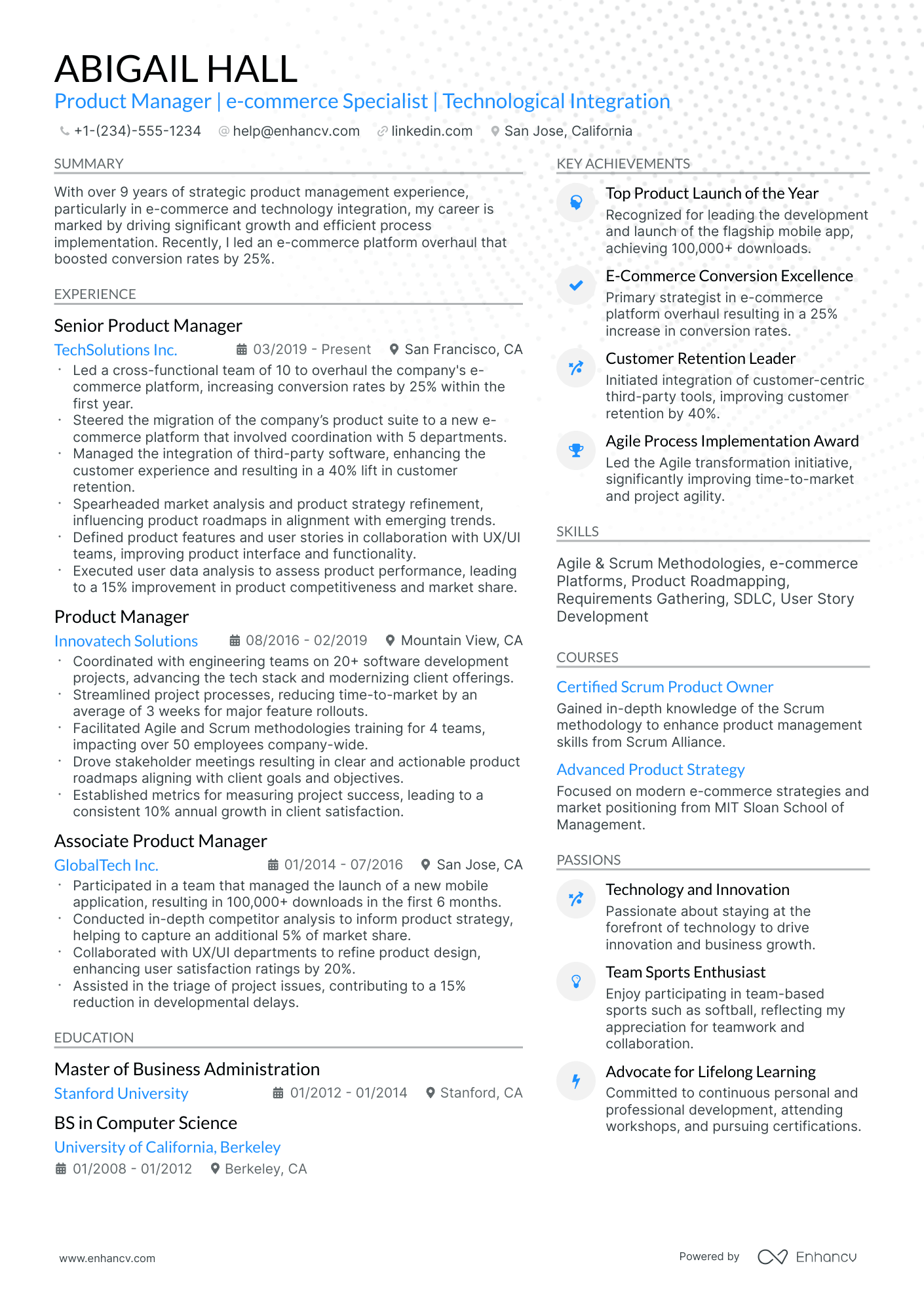
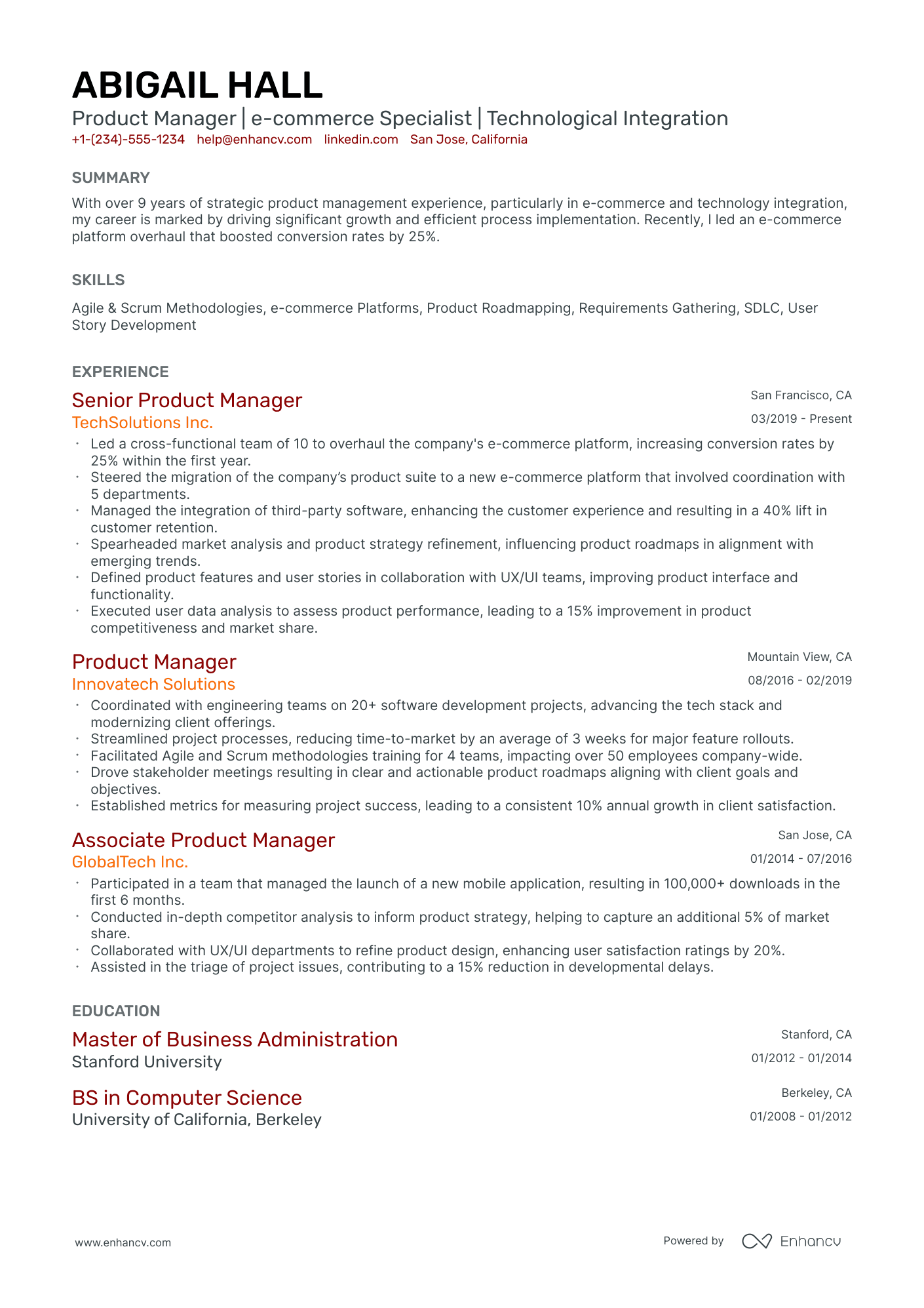
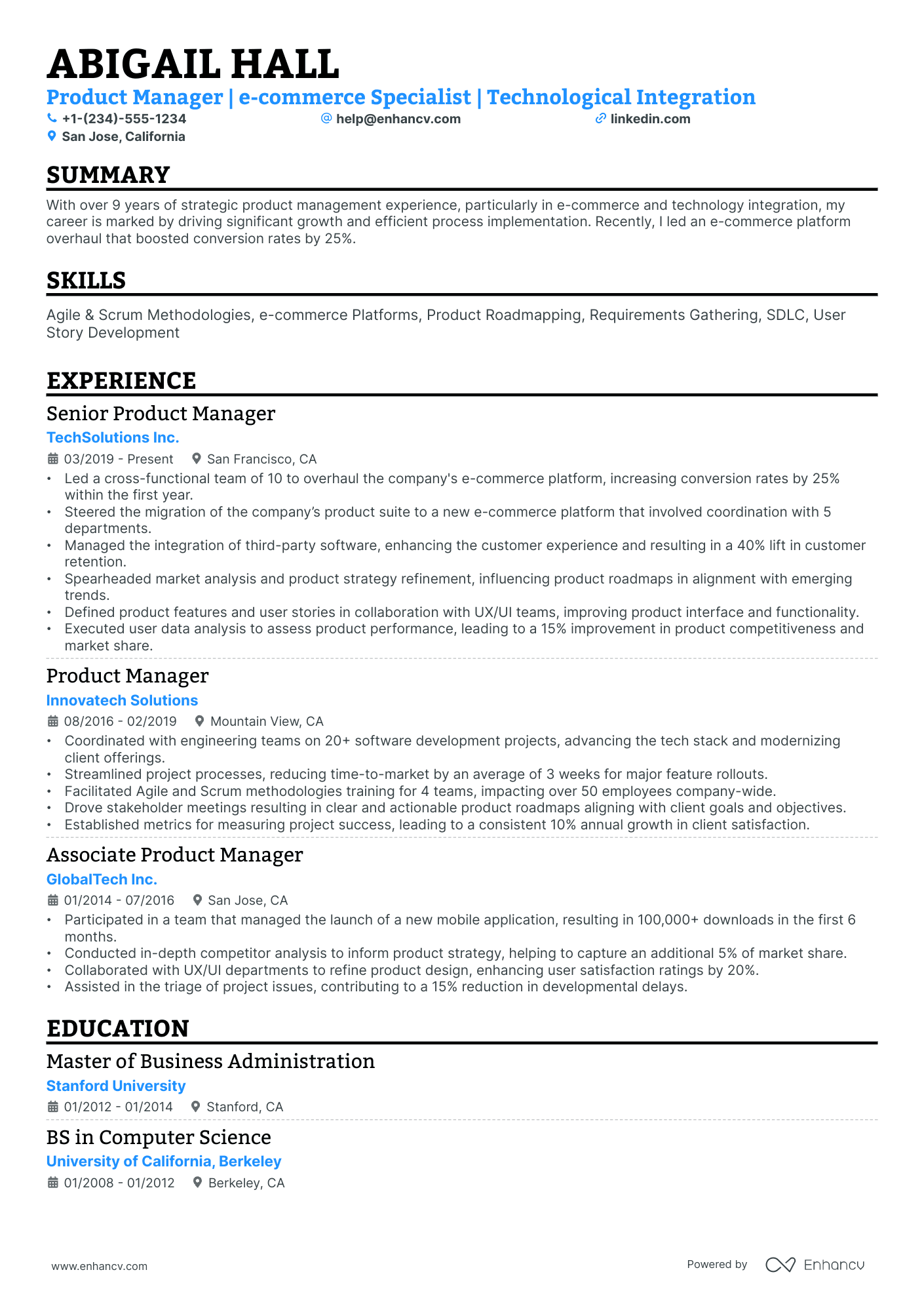
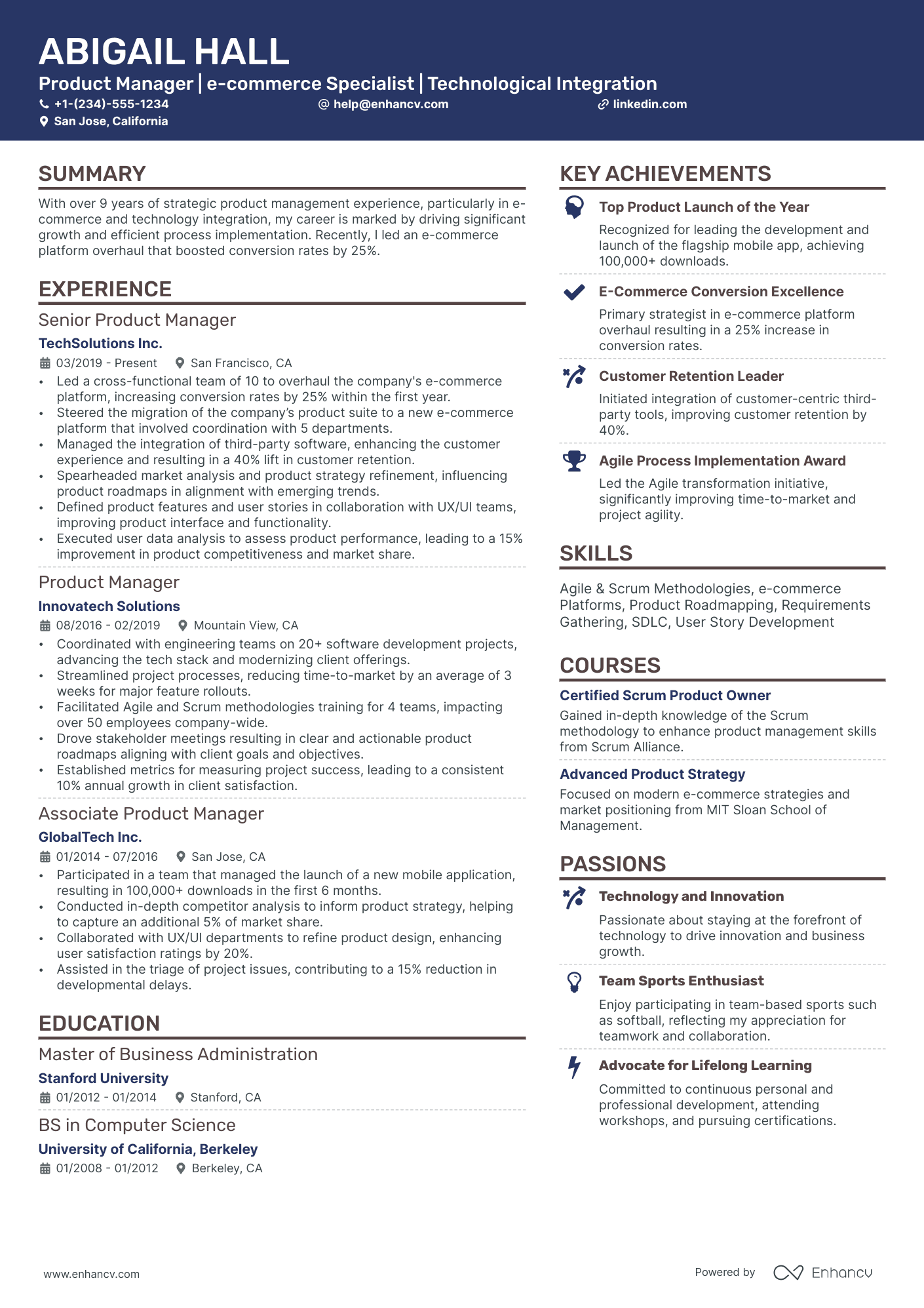
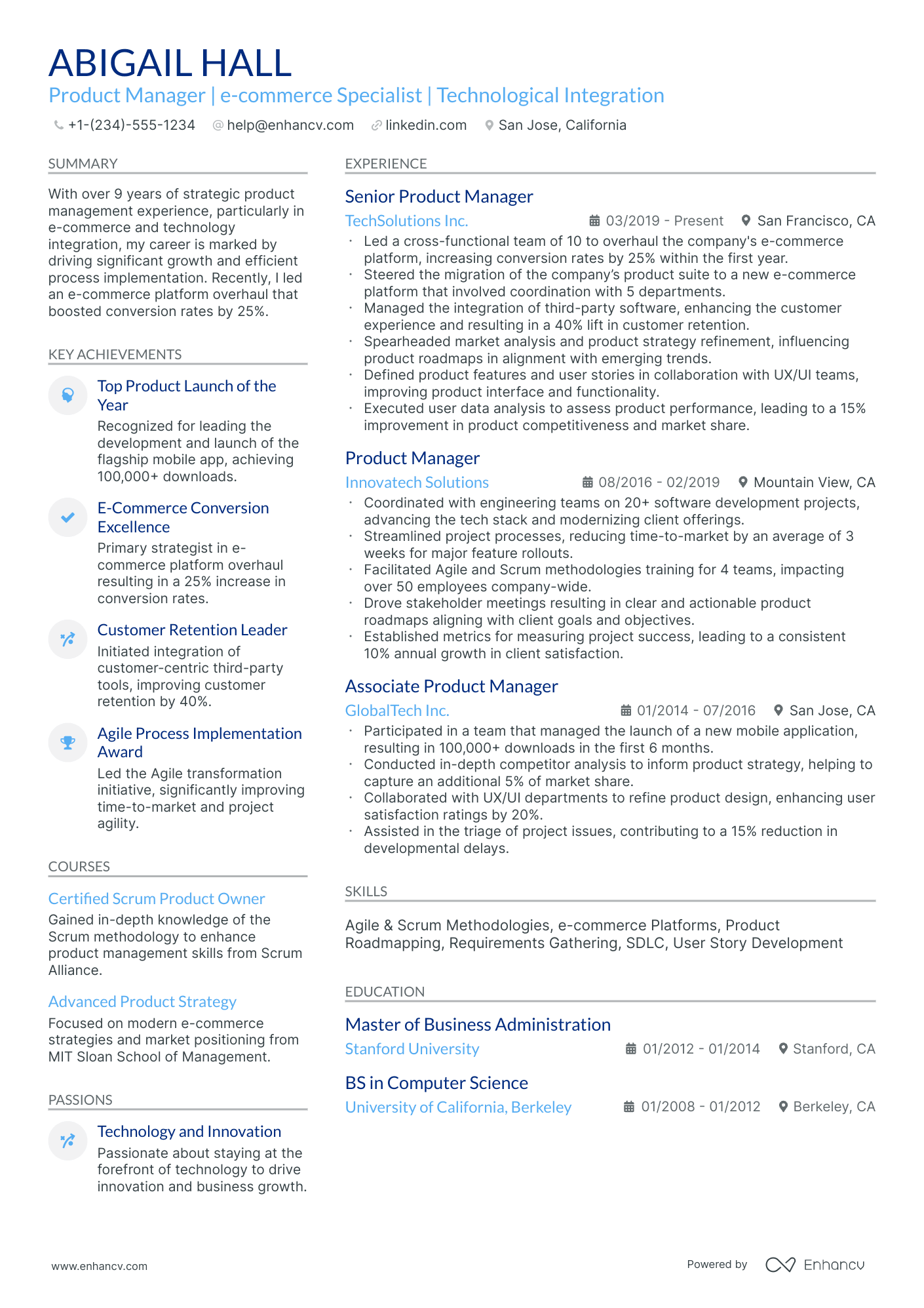
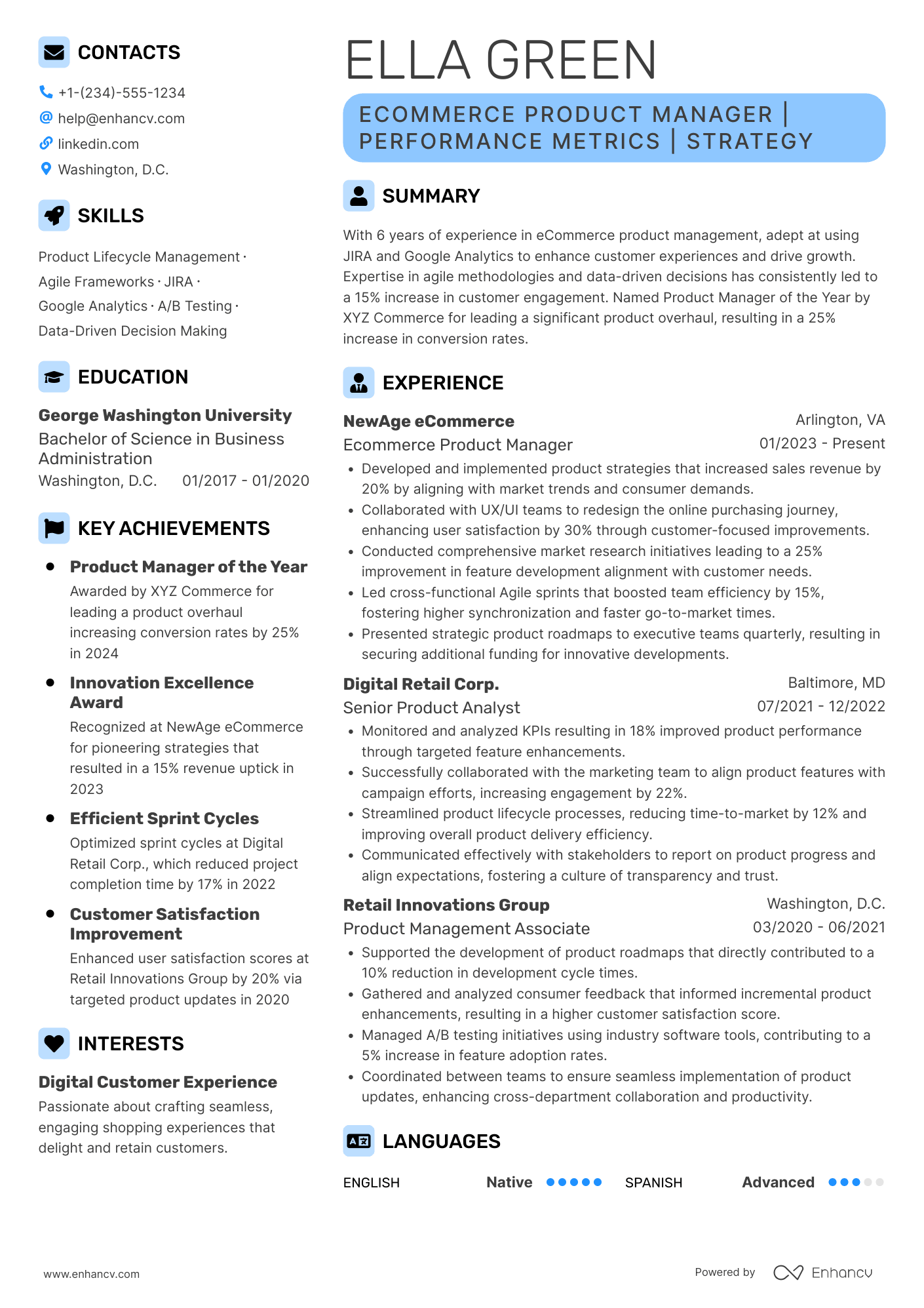
Most eCommerce product manager resume drafts fail because they read like task lists and bury measurable impact. That hurts when an ATS filters keywords and recruiters scan in seconds amid intense competition. If you're unsure where to begin, understanding how to write a resume that highlights outcomes over duties is the first step.
A strong resume shows outcomes and decision quality, not tools. You should highlight revenue lift, conversion gains, retention improvements, reduced checkout drop-off, faster release cycles, fewer defects, and successful launches across markets and platforms.

Key takeaways
- Quantify every achievement with metrics like revenue lift, conversion gains, or retention improvements.
- Use reverse-chronological format if experienced and hybrid format if junior or switching careers.
- Mirror the job posting's exact tools, KPIs, and terminology in your experience bullets.
- Lead each bullet with what you owned, how you executed, and what outcome you delivered.
- Place skills above experience when junior, below experience when your track record speaks louder.
- Anchor every listed skill to a specific project, experiment, or measurable business result.
- Use Enhancv to turn vague duties into focused, metrics-driven resume bullets faster.
How to format a eCommerce product manager resume
Recruiters hiring for eCommerce product manager roles prioritize evidence of product ownership, cross-functional collaboration, and data-driven decision-making that ties directly to revenue or user growth. A clear, well-structured resume format ensures these signals surface quickly during both ATS parsing and the initial recruiter scan.

I have significant experience in this role—which format should I use?
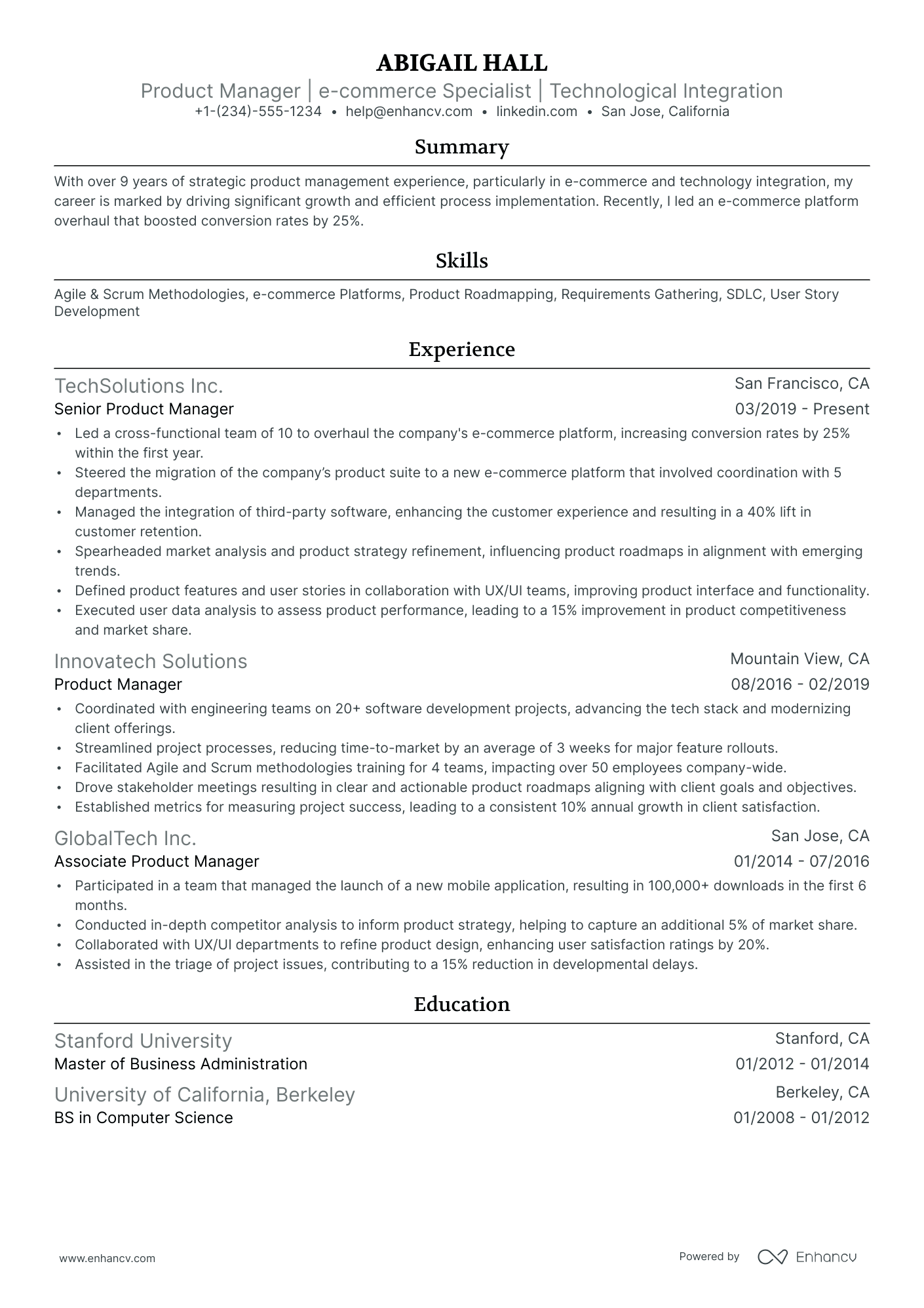
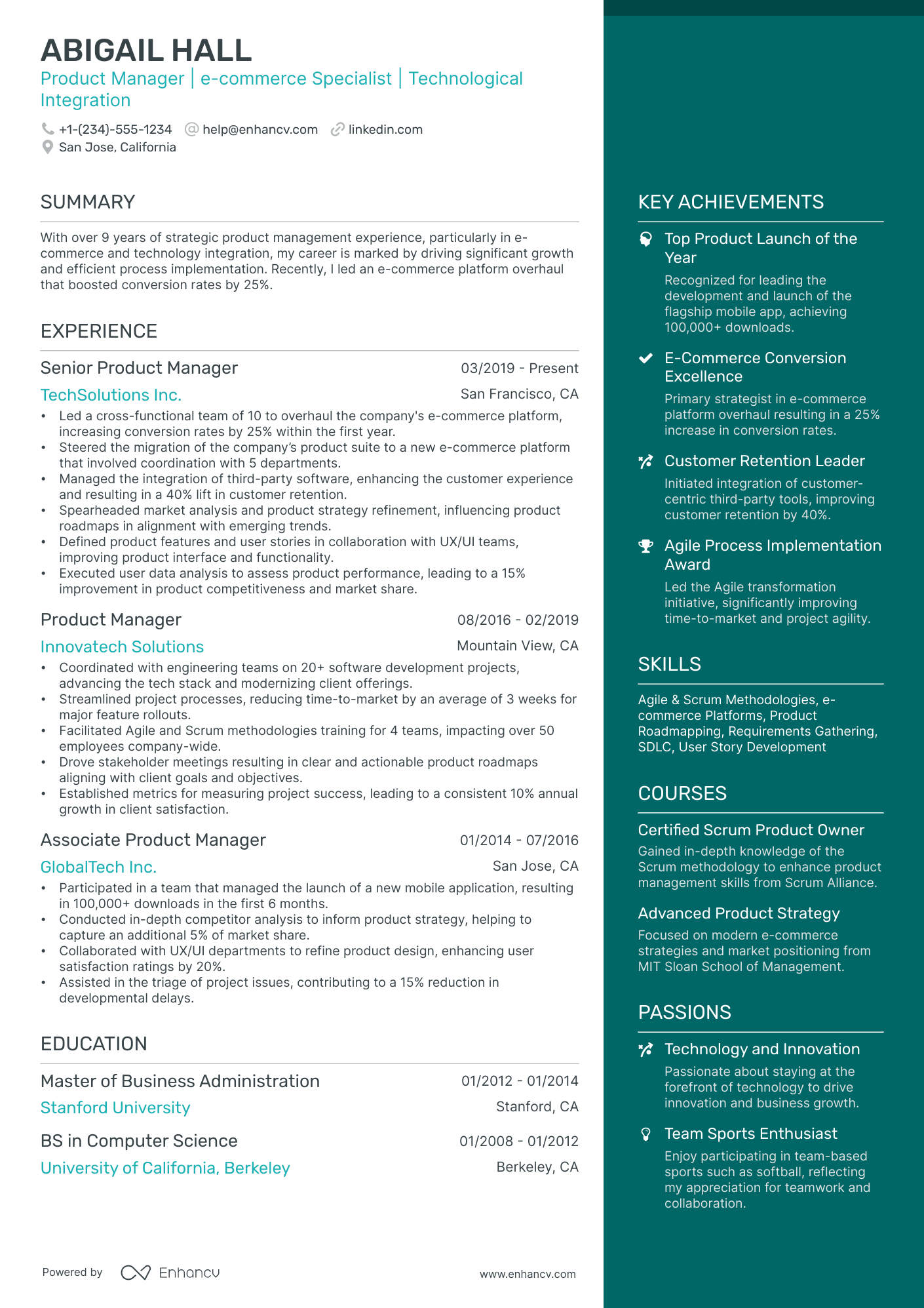
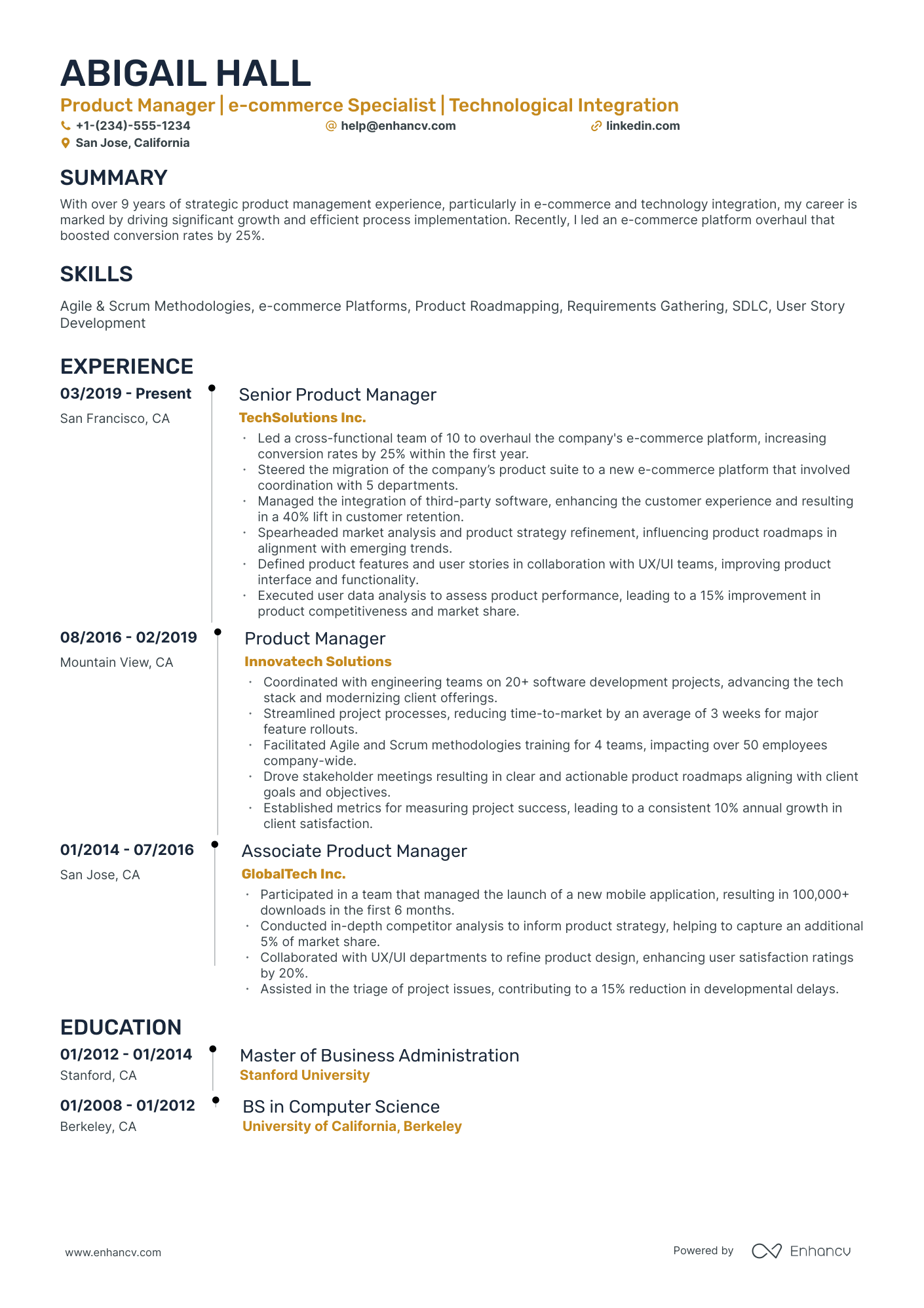
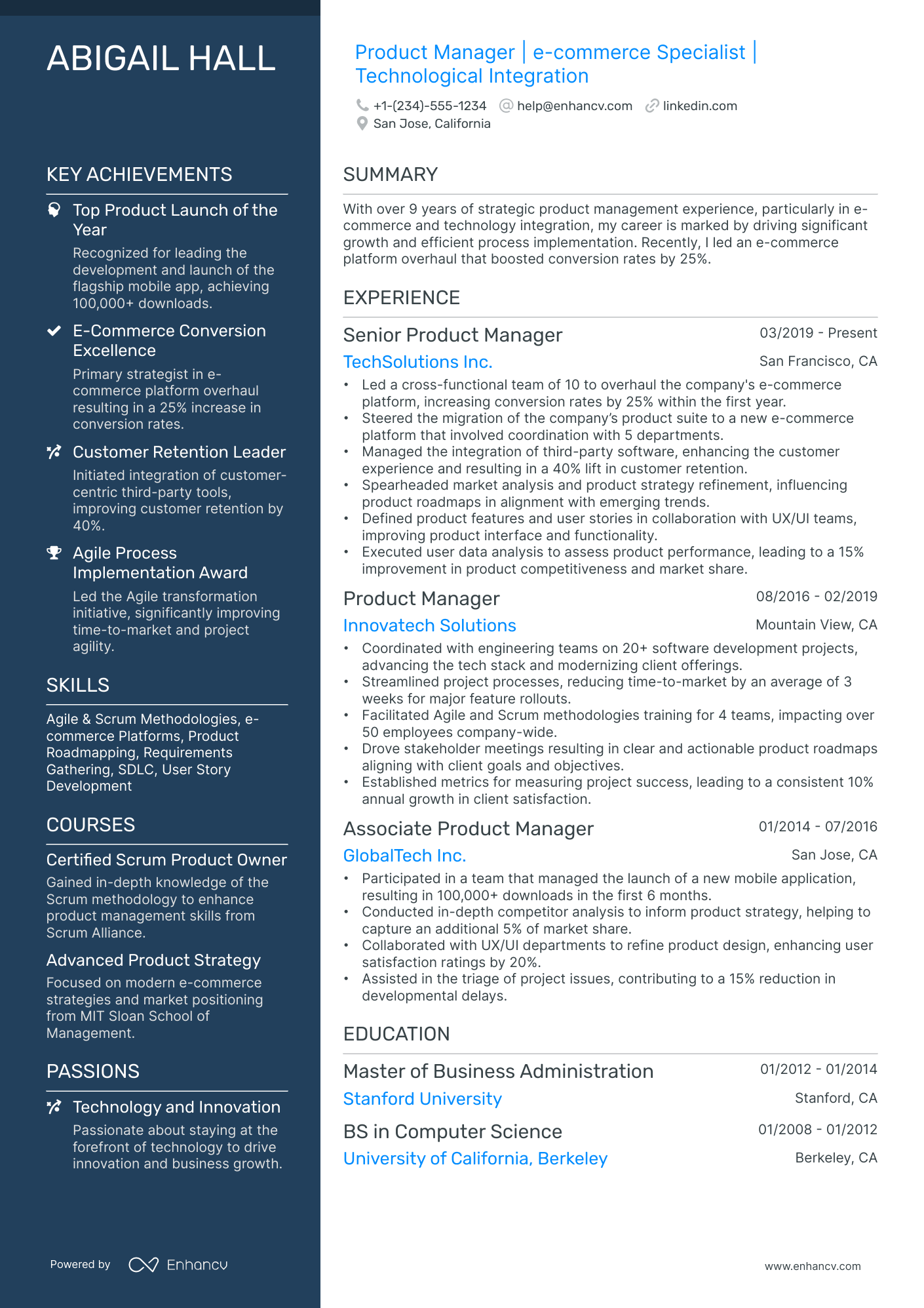
Use a reverse-chronological format to showcase your progression across product cycles, increasing scope, and measurable business outcomes. Do:
- Lead each role entry with the scope of your ownership—product lines managed, team size, revenue responsibility, and cross-functional stakeholders you partnered with.
- Highlight eCommerce-specific tools and domains such as A/B testing platforms, analytics suites (Google Analytics, Amplitude), product roadmapping tools (Jira, Productboard), and familiarity with conversion funnel optimization, marketplace dynamics, or subscription models.
- Quantify outcomes in terms of business impact—revenue growth, conversion rate improvements, customer acquisition cost reduction, or time-to-market acceleration.
I'm junior or switching into this role—what format works best?
Use a hybrid format that leads with a focused skills section and follows with concise work or project experience in reverse-chronological order. Do:
- Place your strongest eCommerce and product skills—such as user research, roadmap prioritization, funnel analysis, or SQL—at the top so recruiters and ATS systems catch them immediately.
- Include product-adjacent projects, side ventures, or transitional experience like managing a Shopify store, running growth experiments, or leading a feature launch during a bootcamp or internship.
- Connect every listed action to a clear outcome, even if the scale is modest—what you did, what changed, and how you measured it.
Why not use a functional resume?
A functional format strips away the timeline and context that recruiters need to assess how your product skills were applied in real working environments, making it harder to verify growth, accountability, or collaboration. Avoid a functional format unless you have no other way to present your qualifications coherently—such as when you're making a career change from a non-product discipline, have limited formal work history, or need to address a significant resume gap. Even in these cases, tie every listed skill to a specific project, experiment, or measurable outcome so recruiters can evaluate practical application rather than just self-reported abilities.
- A functional format may be acceptable if you're pivoting from a related eCommerce role (such as merchandising or digital marketing) and need to foreground transferable product skills, but always anchor each skill to a concrete project and its outcome.
Once your resume's layout and structure are in place, the next step is filling it with the right sections to showcase your eCommerce product management expertise.
What sections should go on a eCommerce product manager resume
Recruiters expect a clear snapshot of how you drive eCommerce product growth, conversion, and customer experience across the funnel. Knowing which resume sections to include ensures you present your qualifications in the order hiring managers expect. Use this structure for maximum clarity:
- Header
- Summary
- Experience
- Skills
- Projects
- Education
- Certifications
- Optional sections: Awards, Publications, Languages
Your strongest experience bullets should highlight measurable impact, business outcomes, and scope—conversion lift, revenue growth, retention gains, and cross-functional ownership.
Is your resume good enough?
Drop your resume here or choose a file. PDF & DOCX only. Max 2MB file size.
Now that you’ve organized the key resume components, the next step is to write your eCommerce product manager resume experience section so your impact is clear and easy to evaluate.
How to write your eCommerce product manager resume experience
Your experience section is where you prove you've shipped real products—features, storefronts, checkout flows, or platform improvements—using the tools, data, and methods eCommerce teams rely on daily. Hiring managers prioritize demonstrated impact over descriptive task lists, so every bullet should connect what you owned to the measurable outcome it produced.
Each entry should include:
- Job title
- Company and location (or remote)
- Dates of employment (month and year)
Three to five concise bullet points showing what you owned, how you executed, and what outcomes you delivered:
- Ownership scope: the specific products, platform verticals, marketplace features, or customer-facing experiences you were directly accountable for, including the segments or markets they served.
- Execution approach: the analytics platforms, A/B testing frameworks, experimentation methodologies, roadmapping tools, or prioritization models you used to inform decisions and drive product delivery.
- Value improved: the changes you made to conversion performance, site reliability, page speed, fulfillment efficiency, cart experience, or customer retention that advanced core eCommerce objectives.
- Collaboration context: how you partnered with engineering, UX, merchandising, marketing, data science, or third-party vendors to align on requirements, resolve dependencies, and launch on schedule.
- Impact delivered: the business outcomes your work produced—expressed through revenue influence, customer growth, operational scale, or marketplace expansion rather than a summary of daily activities.
Experience bullet formula
A eCommerce product manager experience example
✅ Right example - modern, quantified, specific.
eCommerce Product Manager
BrightCart | Austin, TX
2022–Present
High-growth direct-to-consumer marketplace processing over one million monthly sessions across web and mobile.
- Led a checkout redesign using Figma, Amplitude, and Optimizely A/B tests, increasing conversion by 9.4% and reducing cart abandonment by 6.1% in eight weeks.
- Prioritized a three-month roadmap in Jira using RICE scoring and customer research, shipping twelve releases that lifted average order value by 7.8% and added $2.3M in annualized revenue.
- Partnered with engineering to improve Core Web Vitals using Google Lighthouse, New Relic, and Cloudflare, cutting median page load time from 3.1 seconds to 1.9 seconds and improving organic sessions by 11%.
- Launched personalized product recommendations with Segment and a machine learning service, increasing revenue per session by 5.6% and improving repeat purchase rate by 3.2%.
- Implemented fraud and chargeback controls with Stripe Radar and internal rules, reducing chargebacks by 18% while holding approval rates within one percentage point.
Now that you've seen how a strong experience section comes together, let's look at how to adjust yours to match the specific eCommerce product manager role you're targeting.
How to tailor your eCommerce product manager resume experience
Recruiters evaluate your eCommerce product manager resume through both human review and applicant tracking systems. Tailoring your resume to the job description ensures your qualifications register with both.
Ways to tailor your eCommerce product manager experience:
- Match the eCommerce platforms and tools named in the job description.
- Mirror the exact conversion or revenue KPIs the posting highlights.
- Use the same terminology for product development methodologies listed.
- Highlight A/B testing or experimentation frameworks the role requires.
- Include marketplace or direct-to-consumer experience when the posting specifies.
- Reference checkout optimization or funnel analysis if the role mentions them.
- Emphasize cross-functional collaboration models described in the job listing.
- Align your analytics stack references with the tools they specify.
Tailoring means framing your real achievements in the language of the job posting, not inserting keywords where they don't belong.
Resume tailoring examples for eCommerce product manager
| Job description excerpt | Untailored | Tailored |
|---|---|---|
| "Own the end-to-end product roadmap for our Shopify Plus storefront, driving conversion rate optimization across the purchase funnel." | Managed product roadmap and worked on improving website performance. | Owned the end-to-end product roadmap for a Shopify Plus storefront serving 1.2M monthly visitors, launching A/B-tested checkout redesigns that lifted conversion rates by 18% across the purchase funnel. |
| "Partner with data engineering to define tracking requirements in Amplitude and translate customer behavior insights into prioritized feature backlogs." | Collaborated with cross-functional teams to analyze data and prioritize features. | Partnered with data engineering to implement Amplitude event tracking across 40+ customer touchpoints, translating behavioral cohort analysis into a prioritized feature backlog that reduced cart abandonment by 12%. |
| "Lead integration of third-party marketplace channels (Amazon, Walmart) and manage catalog syndication using Feedonomics or similar PIM tools." | Helped expand the company's presence on different sales channels. | Led integration of Amazon and Walmart marketplace channels using Feedonomics for catalog syndication of 8,000+ SKUs, growing third-party channel revenue by 35% within the first two quarters post-launch. |
Once you’ve aligned your experience with the role’s priorities, the next step is to quantify your eCommerce product manager achievements to show the impact of that work.
How to quantify your eCommerce product manager achievements
Quantifying your achievements proves business impact and execution strength. Focus on revenue lift, conversion changes, margin, page speed, defect rates, delivery cadence, and customer retention across key funnels and launches.
Quantifying examples for eCommerce product manager
| Metric | Example |
|---|---|
| Conversion rate | "Improved checkout conversion from 3.1% to 3.6% by shipping Apple Pay and address autocomplete, validated through Optimizely A/B tests across 1.2M monthly sessions." |
| Revenue growth | "Grew subscription add-on revenue by $420K per quarter by launching bundles and in-cart upsells, using Amplitude cohorts and weekly pricing experiments." |
| Page performance | "Cut product detail page median load time from 3.4s to 2.1s by prioritizing image optimization and caching, tracked in Datadog and Core Web Vitals." |
| Delivery speed | "Reduced average idea-to-launch cycle time from nine to six weeks by tightening PRD templates, aligning sprint goals, and increasing on-time releases from 68% to 90%." |
| Defect reduction | "Lowered checkout-related incidents by 35% by adding automated regression tests and a feature-flag rollout plan, decreasing rollback frequency from four to one per month." |
Turn vague job duties into measurable, recruiter-ready resume bullets in seconds with Enhancv's Bullet Point Generator.
Once you've crafted strong bullet points to showcase your accomplishments, the next step is ensuring your resume highlights the right mix of hard and soft skills that eCommerce hiring managers are looking for.
How to list your hard and soft skills on a eCommerce product manager resume
Your skills section shows you can drive online revenue and customer experience, and recruiters and ATS scan this section to confirm you match the job's requirements, so aim for a balanced mix of hard skills and role-specific soft skills. eCommerce product manager roles require a blend of:
- Product strategy and discovery skills.
- Data, analytics, and experimentation skills.
- Delivery, execution, and go-to-market discipline.
- Soft skills.
Your skills section should be:
- Scannable (bullet-style grouping).
- Relevant to the job post.
- Backed by proof in experience bullets.
- Updated with current tools.
Place your skills section:
- Above experience if you're junior or switching careers.
- Below experience if you're mid/senior with strong achievements.

Hard skills
- Product discovery, customer interviews
- Roadmapping, prioritization, RICE
- eCommerce funnel optimization
- Conversion rate optimization
- A/B testing, multivariate testing
- Web analytics: Google Analytics 4
- Event tracking: Segment, Google Tag Manager
- SQL, cohort analysis
- Product analytics: Amplitude, Mixpanel
- Search and merchandising: Algolia
- Payments, checkout optimization
- Agile delivery: Jira, Confluence
Soft skills
- Aligning stakeholders on tradeoffs
- Writing crisp product requirements
- Leading cross-functional execution
- Turning data into decisions
- Managing scope and prioritization
- Communicating with executives
- Handling ambiguity with ownership
- Influencing without authority
- Partnering with design and engineering
- Negotiating timelines and dependencies
- Driving go-to-market alignment
- Escalating risks early and clearly
How to show your eCommerce product manager skills in context
Skills shouldn't live only in a dedicated skills list. Explore resume skills examples to see how top candidates weave competencies throughout their resumes.
They should be demonstrated in:
- Your summary (high-level professional identity)
- Your experience (proof through outcomes)
Here's what that looks like in practice.
Summary example
Senior eCommerce product manager with 10 years driving digital growth for DTC brands. Skilled in A/B testing, Amplitude, and cross-functional roadmap planning. Increased average order value 28% through data-informed personalization strategies.
- Reflects senior-level experience clearly
- Names specific tools and methods
- Leads with a measurable outcome
- Signals cross-functional collaboration skills
Experience example
Senior Product Manager, eCommerce
Carvana | Remote
March 2020–August 2024
- Partnered with engineering and UX to redesign the checkout flow using Optimizely, reducing cart abandonment by 19% within two quarters.
- Defined and prioritized a 12-month product roadmap in Jira, launching three features that lifted customer retention by 14%.
- Collaborated with marketing and data science to build personalized recommendation modules in Amplitude, growing average order value by 22%.
- Every bullet includes measurable proof
- Skills surface naturally through real outcomes
Once you’ve tied your product management strengths to real outcomes and examples, the next step is applying that approach to an eCommerce product manager resume when you don’t have direct experience.
How do I write a eCommerce product manager resume with no experience
Even without full-time experience, you can demonstrate readiness through projects and transferable work. For a deeper guide, see how to build a resume without work experience that still impresses hiring managers.
- Shopify store build and launch
- Ecommerce analytics dashboard case study
- Product requirements document for feature
- A/B test on product page
- Customer interviews and insight report
- Competitor teardown with roadmap
- Internship supporting ecommerce product manager
- Freelance backlog and sprint planning
Focus on:
- Metrics-driven product decisions and outcomes
- Clear product requirements and acceptance criteria
- Ecommerce platform and analytics tool use
- Prioritization rationale tied to revenue
Resume format tip for entry-level eCommerce product manager
Use a hybrid resume format, so you can lead with projects and skills while still showing a clear timeline of related work. Do:
- Lead with a "Projects" section.
- Write bullets with tools and metrics.
- Include product requirements documents and experiments.
- Name ecommerce product manager methods used.
- Add a "Tools" line near top.
- Built and launched a Shopify store, set up GA4 and Hotjar, ran two product page A/B tests, and increased add-to-cart rate by 12% in four weeks.
Even without direct experience, your education section can serve as a powerful foundation for demonstrating relevant knowledge and qualifications.
How to list your education on a eCommerce product manager resume
Your education section helps hiring teams confirm you have the foundational knowledge needed for the eCommerce product manager role. It signals relevant analytical, technical, and business skills.
Include:
- Degree name
- Institution
- Location
- Graduation year
- Relevant coursework (for juniors or entry-level candidates)
- Honors & GPA (if 3.5 or higher)
Skip month and day details—list only the graduation year.
Here's a strong education entry tailored for an eCommerce product manager resume:
Example education entry
Bachelor of Science in Business Information Systems
University of Michigan, Ann Arbor, MI
Graduated: 2019
GPA: 3.7/4.0
- Relevant Coursework: Digital Commerce Strategy, Data Analytics, User Experience Design, Consumer Behavior, Agile Project Management
- Honors: Magna Cum Laude, Dean's List (six semesters)
How to list your certifications on a eCommerce product manager resume
Certifications on your resume show your commitment to learning, prove tool proficiency, and signal industry relevance for an eCommerce product manager across analytics, experimentation, and platform ecosystems.
Include:
- Certificate name
- Issuing organization
- Year
- Optional: credential ID or URL
- Place certifications below education when they're older, broadly relevant, or less tied to your current eCommerce product manager focus.
- Place certifications above education when they're recent, highly relevant, or required for the eCommerce product manager roles you target.
Best certifications for your eCommerce product manager resume
- Certified Scrum Product Owner (CSPO)
- Professional Scrum Product Owner I (PSPO I)
- Google Analytics Certification
- Google Ads Search Certification
- Optimizely Experimentation Certification
- Salesforce Certified Administrator
- Adobe Certified Professional: Adobe Experience Manager Sites
Once you’ve positioned your credentials to reinforce your fit, shift to your eCommerce product manager resume summary to tie those qualifications to the value you deliver upfront.
How to write your eCommerce product manager resume summary
Your resume summary is the first thing a recruiter reads. A strong one immediately signals you're qualified for the eCommerce product manager role.
Keep it to three to four lines, with:
- Your title and total years of product management experience.
- The eCommerce domain, platform type, or industry you specialize in.
- Core tools and skills like A/B testing, SQL, Jira, or conversion optimization.
- One or two measurable achievements, such as revenue growth or improved conversion rates.
- Soft skills tied to real outcomes, like cross-functional collaboration that shortened launch cycles.

PRO TIP
At a mid-level role, lead with relevant eCommerce experience and specific tools you've used daily. Highlight concrete results from product launches or optimization efforts. Avoid vague phrases like "passionate problem-solver" or "results-driven professional." Recruiters want proof, not personality descriptors.
Example summary for a eCommerce product manager
eCommerce product manager with four years of experience optimizing D2C checkout flows. Increased conversion rates by 18% through A/B testing and cross-functional collaboration with engineering and design teams.
Optimize your resume summary and objective for ATS
Drop your resume here or choose a file.
PDF & DOCX only. Max 2MB file size.
Before your summary can make an impact, recruiters need to find your contact details easily, which is why a well-structured header is the foundation of your resume.
What to include in a eCommerce product manager resume header
A resume header is the top section with your identity and contact details, and it boosts visibility, credibility, and recruiter screening for a eCommerce product manager.
Essential resume header elements
- Full name
- Tailored job title and headline
- Location
- Phone number
- Professional email
- GitHub link
- Portfolio link
A LinkedIn link helps recruiters verify titles, dates, and scope fast, which supports quick screening decisions.
Don't include a photo on a eCommerce product manager resume unless the role is explicitly front-facing or appearance-dependent.
Match your headline and links to the job posting's focus, such as checkout optimization, retention, or marketplace growth, and keep formatting consistent.
Example
ECommerce product manager resume header
Jordan Lee
eCommerce product manager | Checkout optimization and conversion testing
Austin, TX
(512) 555-01XX
your.name@enhancv.com
github.com/yourname
yourwebsite.com
linkedin.com/in/yourname
Once your contact details and role focus are clear at the top, add relevant additional sections to strengthen your eCommerce product manager resume and support the information recruiters see first.
Additional sections for eCommerce product manager resumes
Adding extra sections strengthens your resume when they highlight specialized expertise or unique qualifications relevant to the eCommerce product manager role.
- Languages
- Certifications (e.g., Google Analytics, Pragmatic Institute, Scrum)
- Publications or speaking engagements
- Industry awards or recognitions
- Volunteer experience in tech or digital commerce
- Professional affiliations (e.g., Product Development and Management Association)
- Hobbies and interests tied to digital trends or consumer behavior
Once you've rounded out your resume with additional sections, it's worth ensuring you pair it with an equally strong cover letter.
Do eCommerce product manager resumes need a cover letter
Most eCommerce product manager roles don't require a cover letter, but it helps in competitive searches or when hiring teams expect one. If you're wondering what a cover letter is and when it matters, it can make a difference when your resume needs context or when you want to show clear fit.
Use a cover letter to add detail your resume can't:
- Explain role or team fit: Connect your strengths to the company's product stage, team structure, and how you partner with design, engineering, and marketing.
- Highlight one or two relevant projects or outcomes: Pick results tied to conversion rate, average order value, retention, or checkout performance, and name your specific decisions.
- Show understanding of the product, users, or business context: Reference the customer journey, key segments, and tradeoffs across pricing, merchandising, fulfillment, and returns.
- Address career transitions or non-obvious experience: Clarify why your background maps to eCommerce product manager work, and translate past metrics into eCommerce outcomes.
Drop your resume here or choose a file.
PDF & DOCX only. Max 2MB file size.
Whether you include a cover letter depends on the role and hiring context, so the next step is using AI to improve your eCommerce product manager resume and strengthen what hiring teams see first.
Using AI to improve your eCommerce product manager resume
AI can sharpen your resume's clarity, structure, and impact. It helps tighten language and highlight measurable results. But overuse risks making your resume sound generic. To learn more about ChatGPT resume writing prompts and how to use them effectively, explore practical examples before diving in. Once your content is clear and role-aligned, step away from AI.
Here are 10 practical prompts to strengthen specific sections of your resume:
Strengthen your summary
Quantify experience bullets
Align skills section
Tighten action verbs
Refine project descriptions
Tailor to job posting
Improve education relevance
Highlight certifications strategically
Remove redundant language
Clarify career progression
Conclusion
A strong eCommerce product manager resume shows measurable outcomes, role-specific skills, and a clear structure. It connects your work to revenue, conversion rate, retention, and order value. It highlights product strategy, experimentation, analytics, and cross-functional delivery.
Keep it scannable and consistent, with focused summaries and impact-first bullets. Show how you prioritize roadmaps, improve customer journeys, and make decisions with data. This clarity signals readiness for today’s hiring market and near-future expectations.