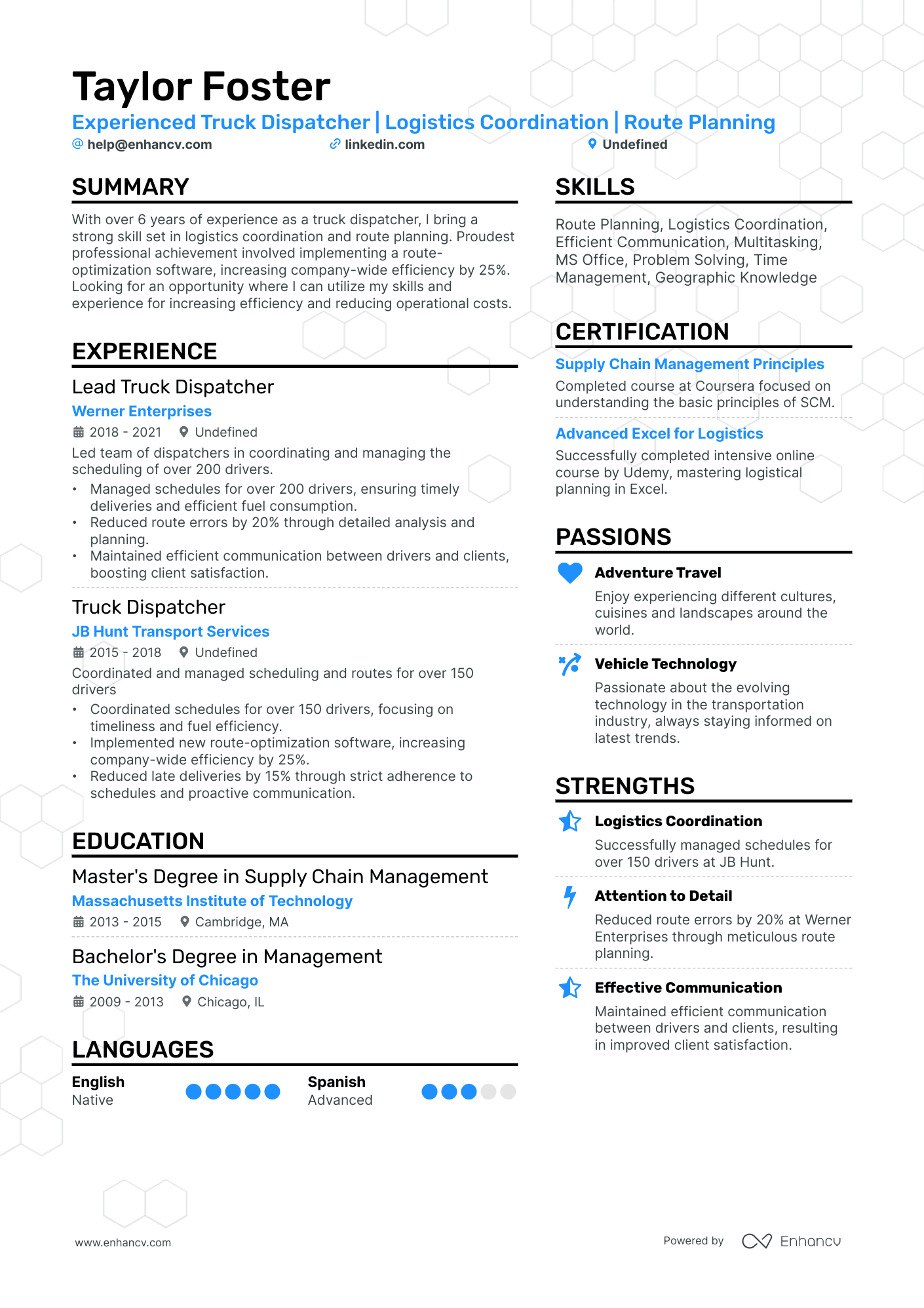
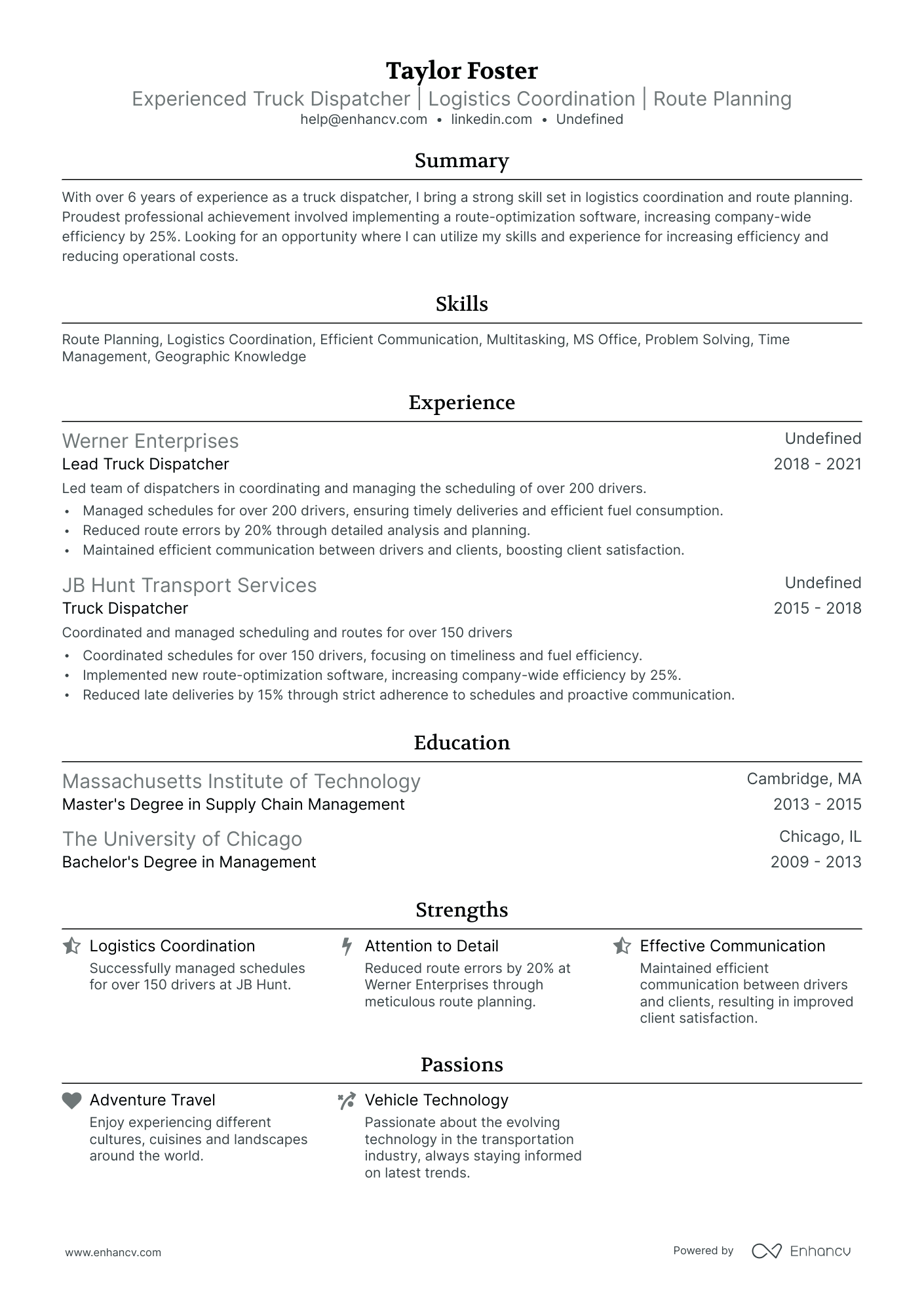
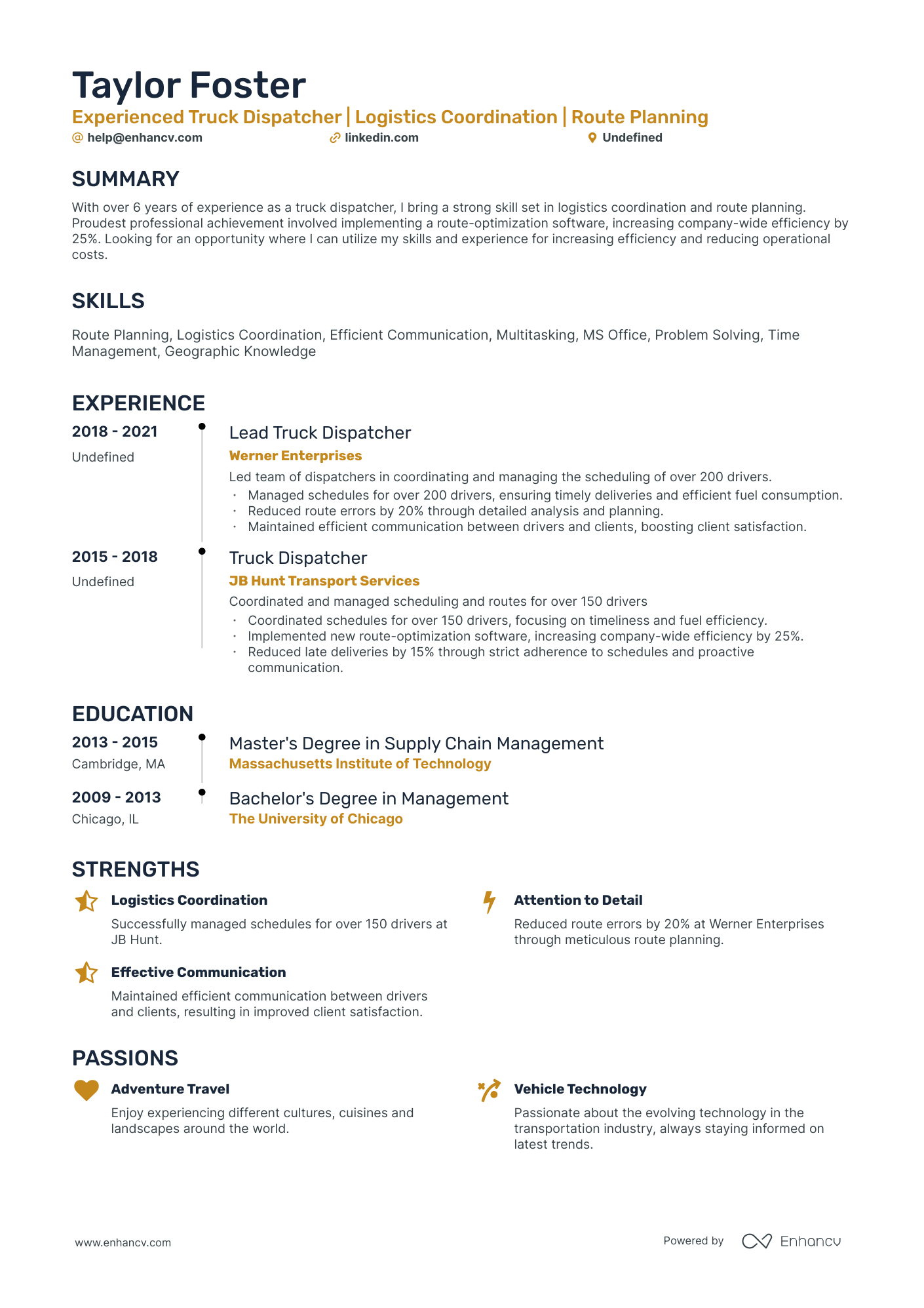
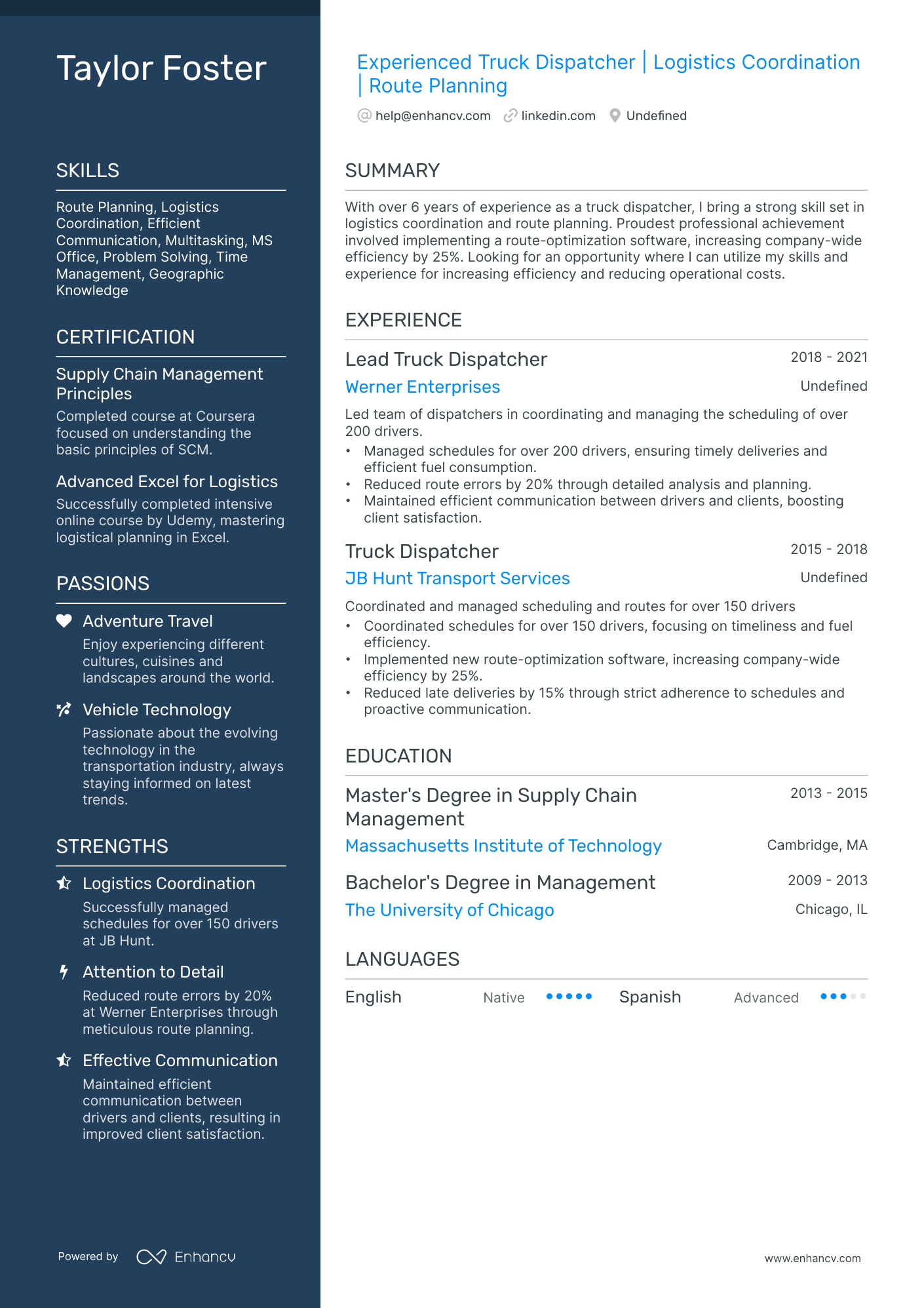
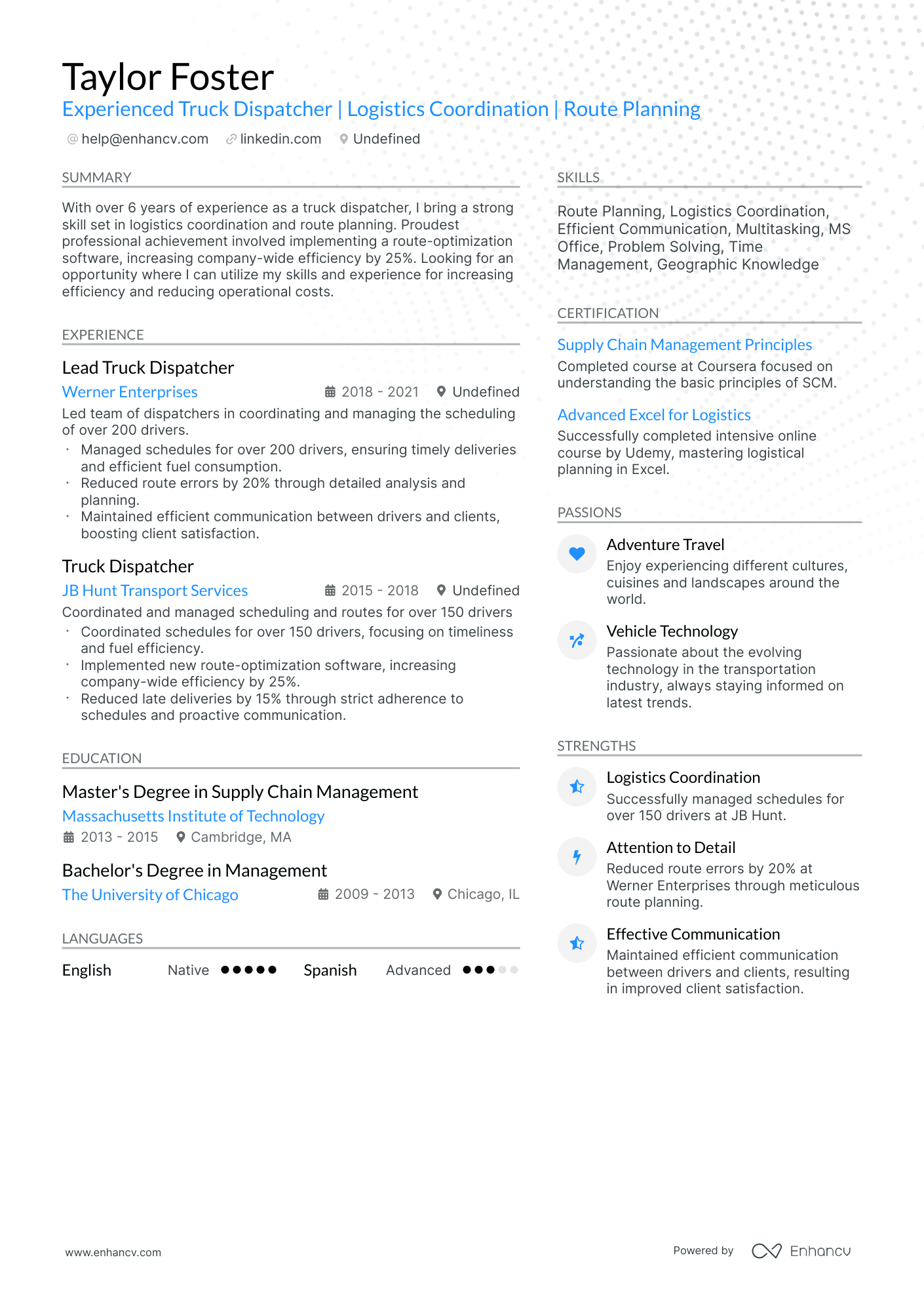
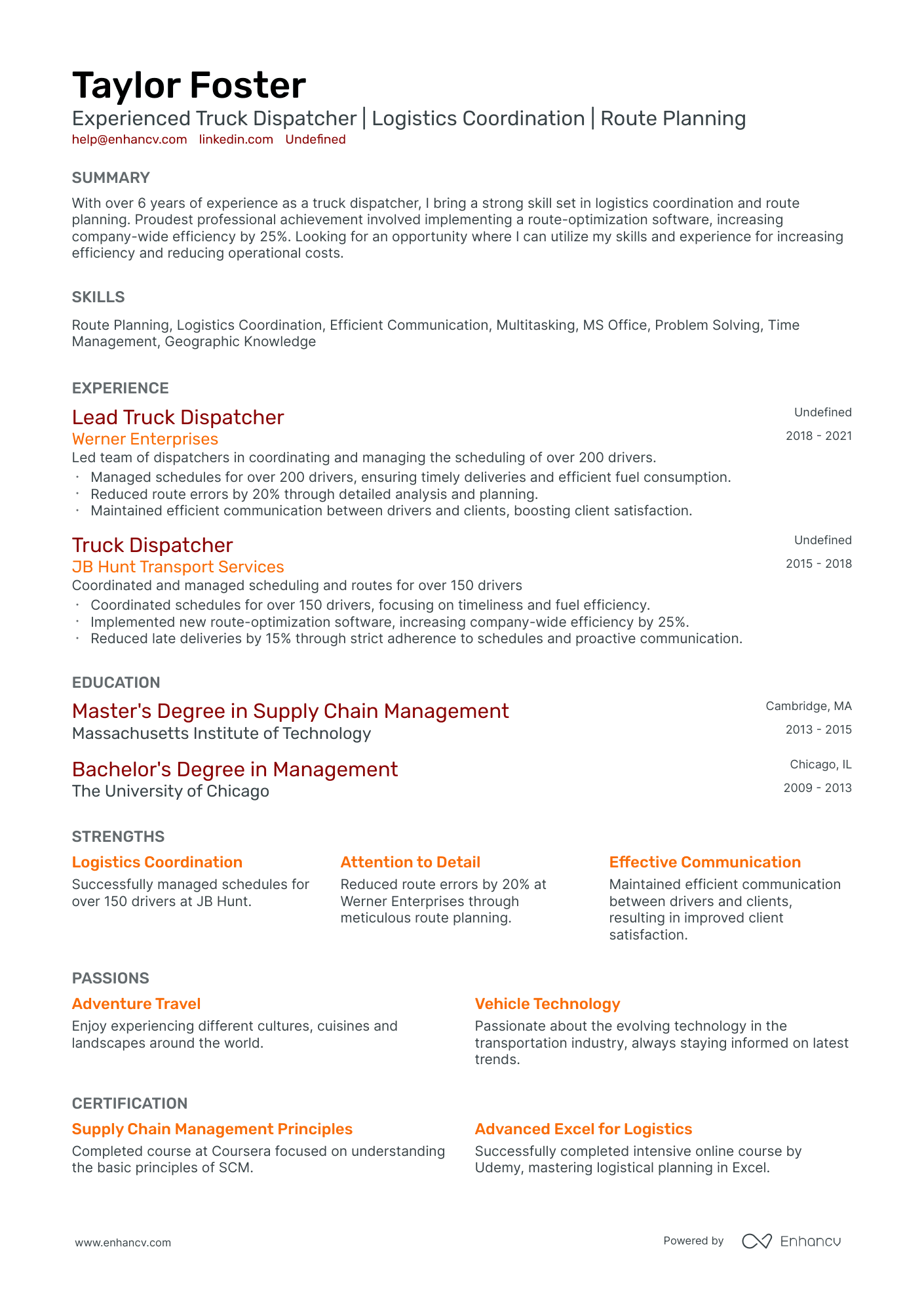
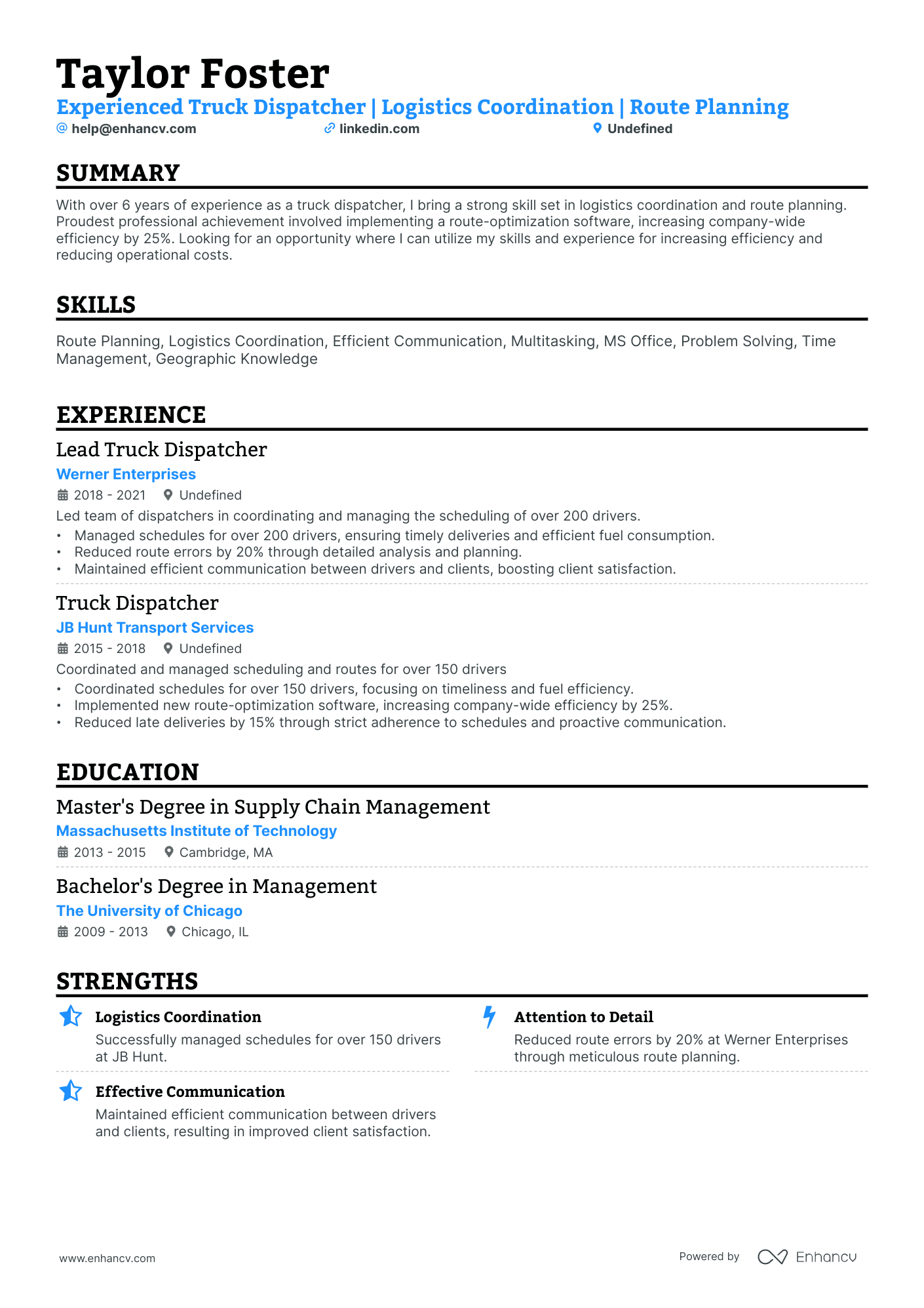
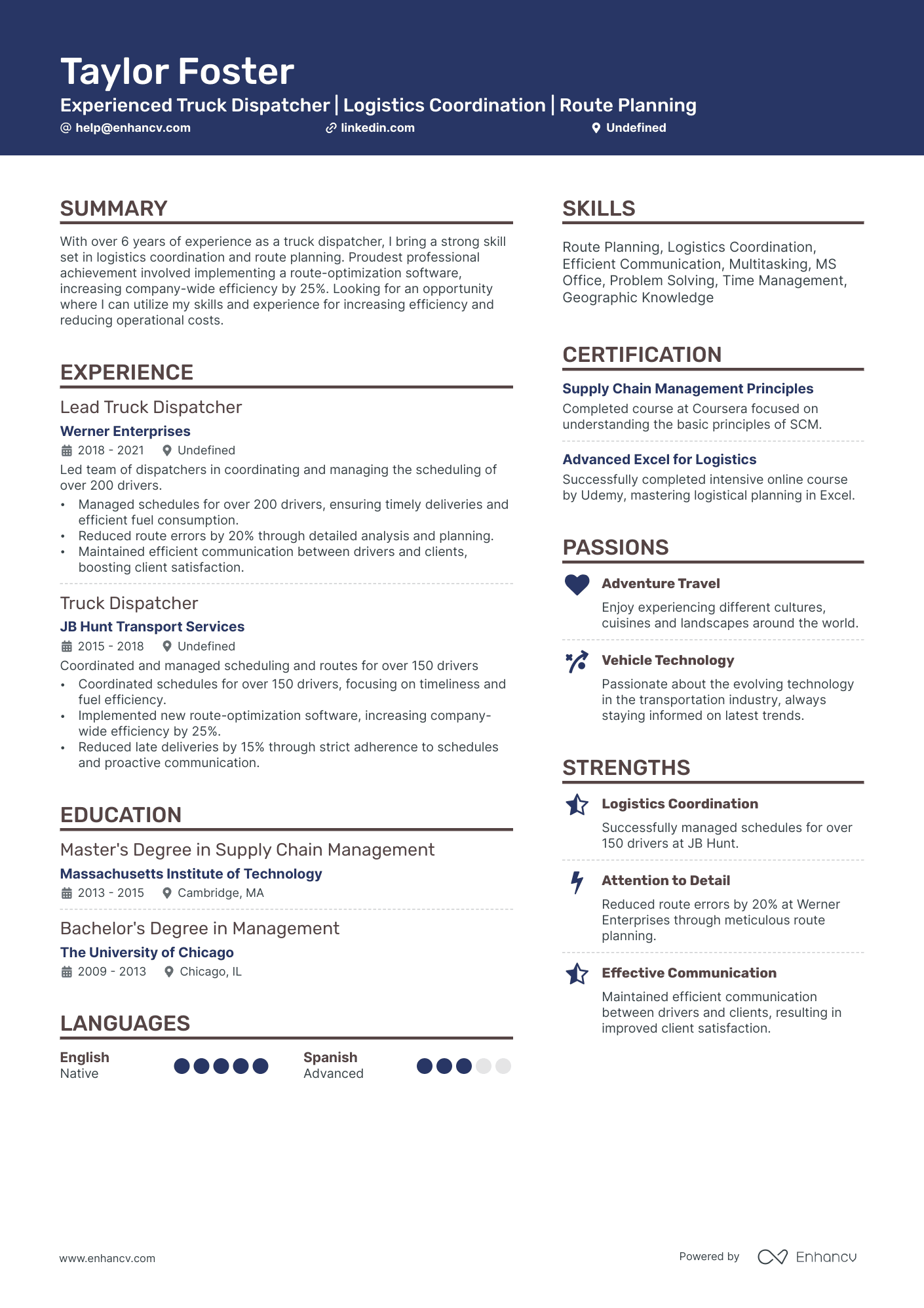
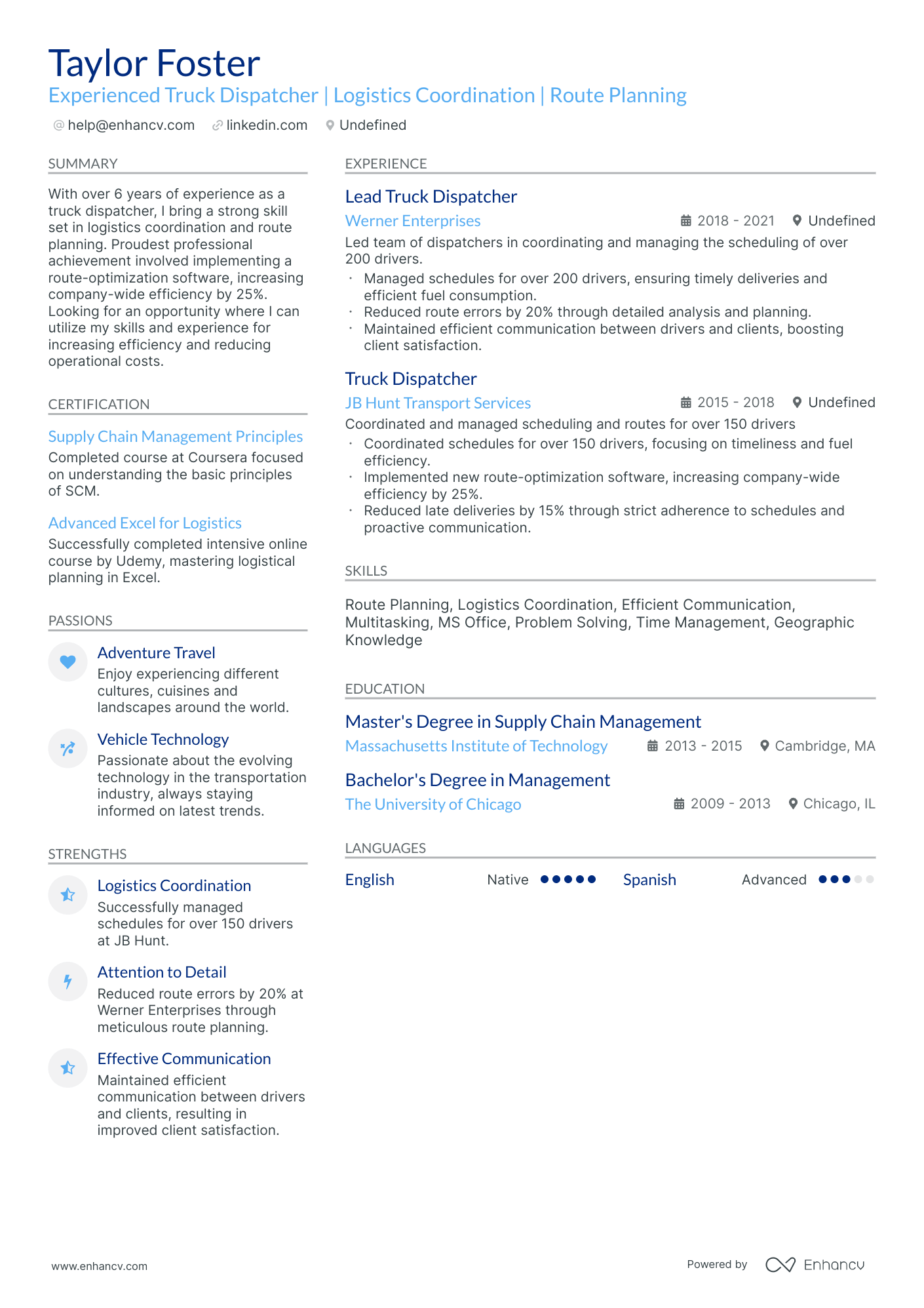
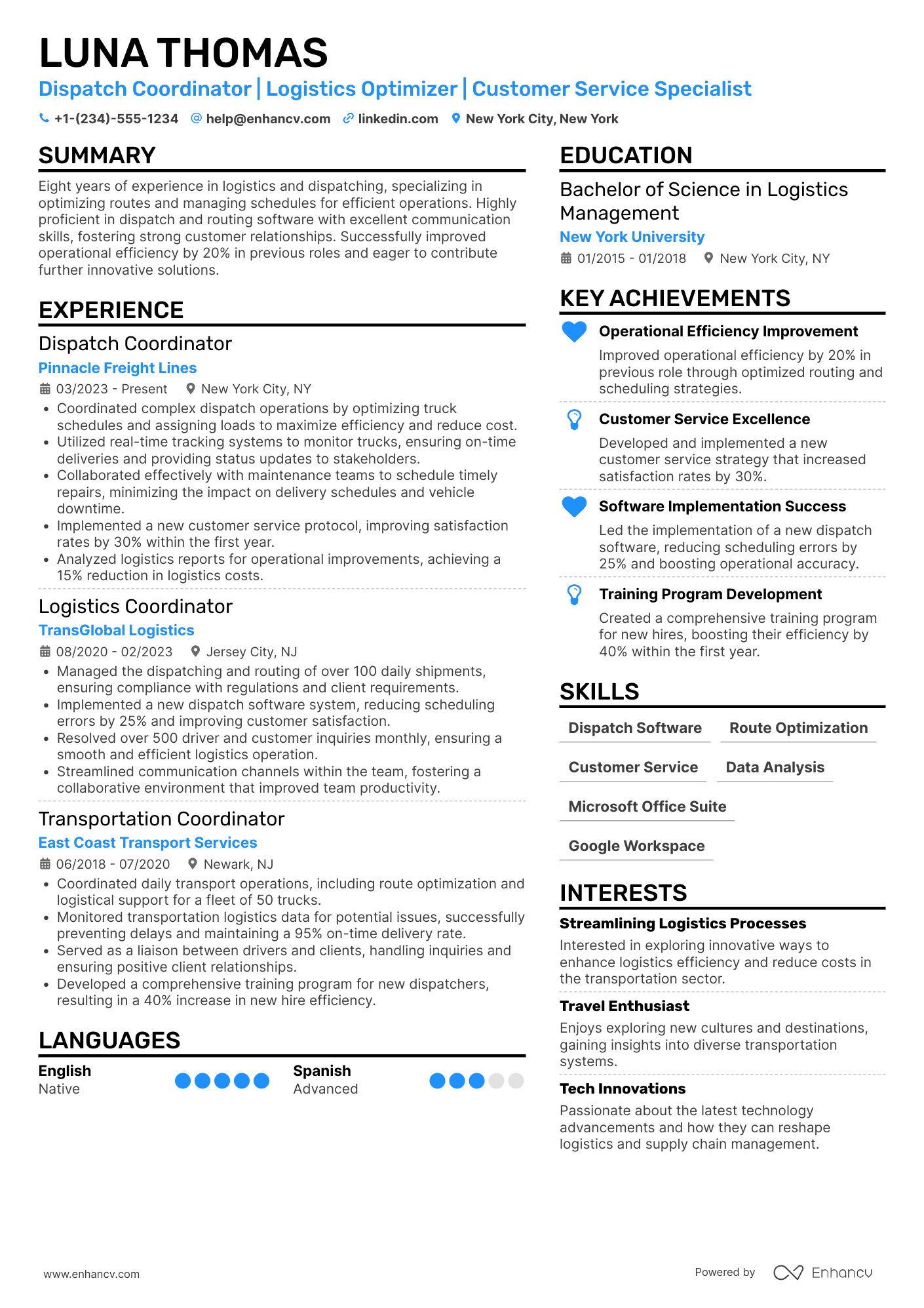
Many truck dispatcher resume submissions fail because they read like task lists and bury measurable dispatch impact. That gets filtered by an ATS (applicant tracking system) and missed in fast recruiter scans, especially when competition is high.
A strong resume shows what you improved, not just what you used. Knowing how to make your resume stand out means highlighting on-time delivery gains, lower deadhead miles, fewer service failures, higher driver utilization, larger fleet coverage, and tighter cost per mile through smarter routing.

Key takeaways
- Quantify dispatch impact with metrics like on-time rates, deadhead miles, and cost savings.
- Use reverse-chronological format if you have direct truck dispatcher experience.
- Tailor every resume to match the job posting's software, lanes, and compliance terms.
- Lead each experience bullet with a result, not a routine task description.
- Place skills above experience only if you're junior or changing careers.
- Pair your resume with a cover letter when context or career transitions need explaining.
- Build your truck dispatcher resume faster with Enhancv to align structure and keywords precisely.
How to format a truck dispatcher resume
Recruiters hiring truck dispatchers prioritize logistics coordination skills, familiarity with dispatch software and routing tools, and a track record of keeping shipments on schedule while controlling costs. A clean, well-structured resume format ensures these signals surface quickly during both human review and applicant tracking system (ATS) scans.

I have significant experience in this role—which format should I use?
Use a reverse-chronological format to lead with your most recent and relevant dispatch experience. Do:
- Highlight the scope of your dispatch operations, including fleet size, number of daily loads, and regional or national coverage you managed.
- List role-specific tools and systems—such as TMS (transportation management system) platforms, GPS tracking software, ELD compliance tools, and load board proficiency—within each position.
- Quantify outcomes tied to efficiency, cost savings, on-time delivery rates, or driver retention improvements.
I'm junior or switching into this role—what format works best?
A hybrid format works best because it lets you lead with transferable logistics and communication skills while still showing a clear work history. Do:
- Place a skills section near the top featuring dispatch-relevant competencies like route optimization, freight matching, DOT/HOS regulations knowledge, and customer communication.
- Include projects, internships, or transitional experience—such as fleet coordination, warehouse logistics, or freight brokerage support—that demonstrate operational decision-making.
- Connect every listed skill or experience to a concrete action and a measurable or observable result.
Why not use a functional resume?
A functional format strips away the timeline and context recruiters need to evaluate how your dispatch skills were applied in real operational settings, making it harder to verify your hands-on experience.
- Career changers with no logistics background: If your only relevant experience comes from self-directed coursework or certifications (such as a dispatch training program), a functional format can organize skills before a thin work history.
- Significant employment gaps: If you're returning to the workforce after an extended absence but have prior transportation or logistics experience to reference.
- A functional format is acceptable only when you have no direct or adjacent dispatch experience to list chronologically—and even then, every skill you feature should be tied to a specific project, certification exercise, or measurable outcome rather than listed in isolation.
With your format established, the next step is filling it with the right sections to showcase your qualifications effectively.
What sections should go on a truck dispatcher resume
Recruiters expect a truck dispatcher resume to quickly show your dispatch performance, safety and compliance awareness, and ability to keep loads moving on time. Understanding which resume sections to include ensures your qualifications are presented clearly.
Use this structure for maximum clarity:
- Header
- Summary
- Experience
- Skills
- Projects
- Education
- Certifications
- Optional sections: Awards, Leadership, Languages
Strong experience bullets should emphasize measurable outcomes like on-time pickup and delivery rates, reduced empty miles, improved driver utilization, fewer service failures, and the size and complexity of the fleet, lanes, and load volume you managed.
Is your resume good enough?
Drop your resume here or choose a file. PDF & DOCX only. Max 2MB file size.
Once you’ve set up the right resume structure, the next step is writing your truck dispatcher experience so each role clearly supports those sections with relevant details.
How to write your truck dispatcher resume experience
The work experience section is where you prove you can keep freight moving on time, coordinate drivers effectively, and use dispatch tools to optimize routes and loads. Hiring managers prioritize demonstrated impact—shipments delivered, costs reduced, on-time rates improved—over generic task lists that describe daily responsibilities without showing results.
Each entry should include:
- Job title
- Company and location (or remote)
- Dates of employment (month and year)
Three to five concise bullet points showing what you owned, how you executed, and what outcomes you delivered:
- Ownership scope: the fleet size, lanes, territories, carrier relationships, or driver teams you were directly accountable for managing on a daily or weekly basis.
- Execution approach: the transportation management systems, GPS tracking platforms, load boards, routing software, or communication methods you relied on to assign loads, adjust schedules, and resolve disruptions.
- Value improved: the changes you drove in on-time delivery rates, fuel efficiency, empty-mile reduction, load optimization, driver retention, or compliance with Department of Transportation regulations.
- Collaboration context: how you coordinated with drivers, brokers, shippers, receivers, warehouse teams, safety managers, or maintenance departments to keep operations running without interruption.
- Impact delivered: the outcomes you produced expressed through fleet performance gains, cost savings, service-level improvements, capacity increases, or customer satisfaction results rather than a summary of dispatching activities.
Experience bullet formula
A truck dispatcher experience example
✅ Right example - modern, quantified, specific.
Truck Dispatcher
BlueLine Freight Logistics | Dallas, TX
2022–Present
Regional dry van carrier operating a seventy-five truck fleet across Texas and the Southwest with strict on-time delivery requirements.
- Optimized daily routes and multi-stop plans in McLeod LoadMaster and PC Miler, cutting empty miles by 9% and improving on-time pickup performance from 92% to 97%.
- Coordinated real-time load coverage using DAT One and Truckstop, reducing tender rejections by 18% and protecting $1.2M in quarterly contract revenue.
- Monitored ELD (electronic logging device) hours-of-service compliance in Samsara and proactively re-powered at-risk loads, lowering late deliveries by 22% and preventing compliance violations.
- Resolved exceptions across TMS (transportation management system), customer portals, and driver mobile workflows—detention, lumper, breakdowns—reducing average issue-to-resolution time from ninety minutes to forty-five minutes.
- Partnered with operations, safety, and key shipper contacts to standardize appointment and check-call cadence in Salesforce and email templates, cutting “where’s my load” calls by 30% and raising shipper satisfaction scores by 0.6 points.
Now that you've seen how a strong experience section comes together, let's look at how to adjust yours to match the specific job you're applying for.
How to tailor your truck dispatcher resume experience
Recruiters evaluate truck dispatcher resumes through both human review and applicant tracking systems (ATS), so tailoring your resume to the job description is essential. Aligning your listed responsibilities and achievements with the specific role increases your chances of passing both screening layers.
Ways to tailor your truck dispatcher experience:
- Match dispatch software and TMS platforms named in the posting.
- Mirror the exact freight or shipping terminology the employer uses.
- Highlight on-time delivery rates or load optimization KPIs referenced.
- Include experience with DOT compliance standards when specified.
- Emphasize route planning methods or load board tools they mention.
- Reference fleet size or driver count relevant to the operation.
- Showcase real-time tracking or communication workflows they describe.
- Align your experience with regional or OTR lanes they prioritize.
Tailoring means aligning your real accomplishments with what the job posting asks for, not forcing keywords where they don't belong.
Resume tailoring examples for truck dispatcher
| Job description excerpt | Untailored | Tailored |
|---|---|---|
| "Coordinate daily routes for 50+ drivers using TMW Suite and ensure on-time delivery rates exceed 95%." | Managed driver schedules and helped with deliveries. | Coordinated daily routes for 50+ OTR drivers in TMW Suite, maintaining a 97% on-time delivery rate across regional and long-haul freight lanes. |
| "Monitor real-time GPS tracking, communicate delays to customers, and adjust loads to minimize deadhead miles." | Tracked trucks and communicated with customers about shipments. | Monitored real-time GPS positions across a 30-truck fleet, proactively notified customers of ETAs during delays, and rerouted loads to cut deadhead miles by 18%. |
| "Ensure DOT/FMCSA compliance, manage HOS logs in Samsara, and coordinate with maintenance on pre-trip inspection failures." | Made sure drivers followed regulations and handled some compliance tasks. | Enforced DOT and FMCSA compliance for 40 drivers by auditing HOS logs daily in Samsara and coordinating same-day maintenance responses to pre-trip inspection failures, reducing out-of-service violations by 25%. |
Once you’ve aligned your experience with the role’s priorities, quantify your truck dispatcher achievements to show the measurable impact of that work.
How to quantify your truck dispatcher achievements
Quantifying your achievements proves you kept freight moving, costs down, and drivers productive. Focus on on-time delivery, load volume, deadhead miles, detention, compliance, and customer satisfaction using data from your transportation management system and carrier scorecards.
Quantifying examples for truck dispatcher
| Metric | Example |
|---|---|
| On-time delivery | "Improved on-time pickup rate from 92% to 97% across 45 weekly loads by tightening appointment confirmations in McLeod Software and proactive check-calls." |
| Cost reduction | "Cut deadhead miles by 14% over three months by optimizing backhauls and reloads using DAT load board and Google Maps routing." |
| Throughput | "Dispatched an average of 28 loads per day for 18 drivers while maintaining accurate status updates every two hours in the transportation management system." |
| Compliance | "Reduced hours-of-service violations to zero for six straight months by auditing electronic logging device logs daily and reworking routes before drivers hit limits." |
| Customer satisfaction | "Raised shipper scorecard rating from 4.1 to 4.6 out of five by reducing late arrival incidents from nine to three per month and sending proactive delay alerts." |
Turn vague job duties into measurable, recruiter-ready resume bullets in seconds with Enhancv's Bullet Point Generator.
Once you've crafted strong bullet points for your experience section, you'll want to apply that same precision to presenting your hard and soft skills throughout your truck dispatcher resume.
How to list your hard and soft skills on a truck dispatcher resume
Your skills section shows you can keep freight moving safely and on time, and recruiters and an ATS (applicant tracking system) scan this section for dispatch keywords and fit—aim for a hard skill-heavy mix supported by role-specific soft skills. truck dispatcher roles require a blend of:
- Product strategy and discovery skills.
- Data, analytics, and experimentation skills.
- Delivery, execution, and go-to-market discipline.
- Soft skills.
Your skills section should be:
- Scannable (bullet-style grouping).
- Relevant to the job post.
- Backed by proof in experience bullets.
- Updated with current tools.
Place your skills section:
- Above experience if you're junior or switching careers.
- Below experience if you're mid/senior with strong achievements.

Hard skills
- Transportation management systems
- Dispatch software, load boards
- Hours of Service compliance
- Electronic logging device systems
- Route planning and optimization
- Load tendering and tracking
- Appointment scheduling and dock coordination
- Detention, layover, accessorial billing
- Proof of delivery processing
- Carrier setup and compliance checks
- Fuel surcharge and rate confirmation review
- Microsoft Excel, Google Sheets
Soft skills
- Prioritize loads under pressure
- Communicate clear ETAs and updates
- De-escalate driver and customer issues
- Coordinate across drivers, brokers, shippers
- Make fast, safety-first decisions
- Negotiate workable pickup and delivery windows
- Follow through on exceptions to closure
- Document incidents with precision
- Maintain calm during disruptions
- Hold partners accountable to commitments
- Spot risks before they escalate
- Adapt plans in real time
How to show your truck dispatcher skills in context
Skills shouldn't live only in a bullet list on your resume. Explore resume skills examples to see how dispatchers present their competencies effectively.
They should be demonstrated in:
- Your summary (high-level professional identity)
- Your experience (proof through outcomes)
Here's what that looks like in practice.
Summary example
Senior truck dispatcher with 10+ years in LTL and FTL freight operations. Skilled in TMS platforms, route optimization, and carrier negotiations. Reduced empty miles by 18% across a 200-truck fleet while maintaining 97% on-time delivery.
- Establishes senior-level credibility immediately
- Names specific tools and methods
- Leads with a measurable cost-saving metric
- Highlights communication through carrier negotiations
Experience example
Senior Truck Dispatcher
Ridgeline Freight Solutions | Denver, CO
March 2019–Present
- Coordinated daily routing for 150+ drivers using McLeod TMS, cutting average transit time by 12% over two years.
- Collaborated with warehouse managers and carriers to consolidate shipments, reducing deadhead miles by 15% annually.
- Trained four junior dispatchers on load-planning protocols, improving team scheduling accuracy to 98.5%.
- Every bullet includes a measurable outcome.
- Skills appear naturally within real achievements.
Once you’ve demonstrated your dispatching strengths through specific, results-focused examples, the next step is applying that approach when you write a truck dispatcher resume with no experience.
How do I write a truck dispatcher resume with no experience
Even without full-time experience, you can demonstrate readiness through:
- Route planning for deliveries
- Scheduling drivers for volunteer shifts
- Coordinating pickups with vendors
- Tracking loads in spreadsheets
- Customer updates via phone scripts
- Dispatch simulations using GPS apps
- Safety logs and compliance checklists
- Radio etiquette and call sheets
If you're building a resume without work experience, focus on:
- Accurate scheduling and route decisions
- Load tracking and status reporting
- Clear driver and customer updates
- Compliance documentation and recordkeeping
Resume format tip for entry-level truck dispatcher
Use a combination resume format because it highlights dispatcher-relevant skills first while still showing projects, training, and related experience. Do:
- Lead with a dispatcher skills summary.
- List tools: Excel, Google Sheets, GPS apps.
- Add projects with metrics and scope.
- Quantify volume: calls, loads, routes.
- Match keywords from dispatcher job posts.
- Built a Google Sheets load tracker with GPS ETA updates for ten mock shipments, cutting status update time by 30% during dispatch simulations.
Even without direct experience, your educational background can strengthen your candidacy—here's how to present it effectively on your resume.
How to list your education on a truck dispatcher resume
Your education section helps hiring teams confirm you have foundational knowledge in logistics, transportation, or business operations relevant to the truck dispatcher role.
Include:
- Degree name
- Institution
- Location
- Graduation year
- Relevant coursework (for juniors or entry-level candidates)
- Honors & GPA (if 3.5 or higher)
Skip month and day details—list the graduation year only.
Here's a strong education entry tailored for a truck dispatcher resume:
Example education entry
Bachelor of Science in Logistics and Supply Chain Management
University of Memphis, Memphis, TN
Graduated 2021
GPA: 3.7/4.0
- Relevant Coursework: Transportation Management, Fleet Operations, Route Optimization, Supply Chain Analytics
- Honors: Dean's List (six consecutive semesters), Magna Cum Laude
How to list your certifications on a truck dispatcher resume
Certifications on a resume show a truck dispatcher's commitment to learning, proficiency with dispatch tools, and understanding of transportation rules and workflows.
Include:
- Certificate name
- Issuing organization
- Year
- Optional: credential ID or URL
- Put certifications below education when your education is recent and your certifications are older or less relevant to a truck dispatcher role.
- Put certifications above education when they are recent and directly relevant to truck dispatcher duties, compliance, safety, or dispatch software.
Best certifications for your truck dispatcher resume
- Certified Transportation Broker (CTB)
- Transportation and Logistics Management (TLM) Certificate
- Certified in Logistics, Transportation and Distribution (CLTD)
- OSHA 10-Hour General Industry
- DOT Hazardous Materials Awareness Training Certificate
- IATA Dangerous Goods Regulations (DGR) Training Certificate
- Lean Six Sigma Yellow Belt
With your credentials clearly positioned to support your qualifications, you can now write your truck dispatcher resume summary to highlight those strengths upfront.
How to write your truck dispatcher resume summary
Your resume summary is the first thing a recruiter reads. A strong one immediately signals you have the logistics skills and dispatch experience they need.
Keep it to three to four lines, with:
- Your title and total years of dispatch or logistics experience.
- Industry focus, such as freight, LTL, FTL, or dedicated fleet operations.
- Core tools like TMS platforms, GPS tracking software, or load boards.
- One or two measurable wins, such as on-time delivery rates or cost reductions.
- Communication or problem-solving skills tied to real operational results.

PRO TIP
At this level, emphasize hands-on dispatch skills, software proficiency, and early contributions to fleet efficiency. Avoid vague phrases like "hard worker" or "passionate about logistics." Recruiters want specific tools, measurable results, and clear relevance to daily dispatch operations.
Example summary for a truck dispatcher
Truck dispatcher with three years of experience coordinating FTL shipments using Samsara and DAT. Improved on-time delivery rates by 14% while managing 30+ daily driver routes across the Midwest.
Optimize your resume summary and objective for ATS
Drop your resume here or choose a file.
PDF & DOCX only. Max 2MB file size.
Now that your summary is ready to showcase your dispatch expertise, make sure the header above it presents your contact details correctly so recruiters can actually reach you.
What to include in a truck dispatcher resume header
A resume header lists your key contact details and role focus, helping recruiters spot you fast, trust your information, and screen you accurately.
Essential resume header elements
- Full name
- Tailored job title and headline
- Location
- Phone number
- Professional email
- GitHub link
- Portfolio link
A LinkedIn link helps recruiters confirm your work history quickly and supports fast screening.
Don't include a photo on a truck dispatcher resume unless the role is explicitly front-facing or appearance-dependent.
Match your header title to the exact truck dispatcher job posting and include your preferred shift or freight type in the headline.
Truck dispatcher resume header
Jordan Taylor
Truck Dispatcher | Dry Van and Reefer | Nights and Weekends
Dallas, TX
(214) 555-01XX
jordan.taylor@enhancv.com github.com/jordantaylor yourwebsite.com linkedin.com/in/jordantaylor
Once your contact details and key identifiers are set at the top, you can strengthen the rest of your application by adding relevant additional sections for truck dispatcher resumes.
Additional sections for truck dispatcher resumes
Extra resume sections help you stand out when your core qualifications match other candidates—especially by showcasing role-specific knowledge or personal strengths. For example, listing language skills on your resume can be a strong differentiator when coordinating with diverse driver teams or cross-border freight operations.
- Languages
- Certifications and licenses
- Industry memberships and associations
- Technology proficiencies
- Hobbies and interests
- Volunteer experience
- Awards and recognitions
Once you've strengthened your resume with relevant extra sections, pairing it with a well-crafted cover letter can further set your application apart.
Do truck dispatcher resumes need a cover letter
A cover letter isn't required for a truck dispatcher, but it helps in competitive roles or when hiring teams expect one. If you're unsure what a cover letter is or when to use one, it can make a difference when your resume doesn't show fit, context, or a clear reason for your move.
Use a cover letter to add details your truck dispatcher resume can't:
- Explain role or team fit by matching your dispatch style to their freight type, lanes, hours, and communication expectations.
- Highlight one or two relevant projects or outcomes, like improving on-time pickup rates, reducing deadhead miles, or speeding up driver check-ins.
- Show understanding of the product, users, or business context, such as how their transportation management system supports drivers, customers, and billing.
- Address career transitions or non-obvious experience by connecting prior work to dispatch skills, including prioritization, conflict resolution, and time-sensitive decisions.
Drop your resume here or choose a file.
PDF & DOCX only. Max 2MB file size.
Even if you choose to skip a cover letter and rely on your resume to carry your application, using AI to improve your truck dispatcher resume helps you strengthen that document and tailor it faster.
Using AI to improve your truck dispatcher resume
AI can sharpen your resume's clarity, structure, and overall impact. It helps tighten language and highlight measurable results. But overuse strips away authenticity. Once your content feels clear and role-aligned, step away from AI. If you're exploring options, learn which AI is best for writing resumes before committing to a single tool.
Here are 10 practical prompts to strengthen specific sections of your truck dispatcher resume:
- Strengthen your summary. "Rewrite my truck dispatcher resume summary to highlight route optimization skills and measurable efficiency gains in two concise sentences."
- Quantify experience bullets. "Add specific metrics to these truck dispatcher experience bullets, focusing on on-time delivery rates, fleet size, and cost reductions."
- Tighten action verbs. "Replace weak verbs in my truck dispatcher experience section with strong, industry-specific action verbs that show leadership and logistics coordination."
- Align skills strategically. "Compare my truck dispatcher skills section against this job description and suggest missing keywords related to dispatching software and compliance."
- Refine certification details. "Rewrite my truck dispatcher certifications section to emphasize relevance to DOT compliance, hazmat routing, and fleet safety regulations."
- Improve education relevance. "Tailor my education section to highlight coursework and training directly applicable to a truck dispatcher role in freight logistics."
- Clarify project contributions. "Rewrite this truck dispatcher project description to clearly show my role, the problem solved, and the measurable outcome achieved."
- Eliminate filler language. "Remove vague or redundant phrases from my truck dispatcher resume without losing key details about responsibilities and achievements."
- Target a specific role. "Adjust my truck dispatcher experience bullets to match the requirements in this posting for a regional freight dispatch coordinator."
- Improve overall readability. "Restructure my truck dispatcher resume so each bullet leads with a result, uses concise phrasing, and stays under 20 words."
Stop using AI once your resume sounds accurate, specific, and aligned with real experience. AI should never invent experience or inflate claims—if it didn't happen, it doesn't belong here.
Conclusion
A strong truck dispatcher resume proves results and keeps details easy to scan. Use measurable outcomes like on-time delivery rates, reduced deadhead miles, faster load coverage, and fewer service failures. Highlight role-specific skills, including routing, carrier and driver coordination, and issue resolution.
Keep the structure clear with a focused summary, impact-driven experience, and a clean skills section. When hiring stays competitive and tools keep evolving, a well-organized truck dispatcher resume shows you can deliver steady performance now.