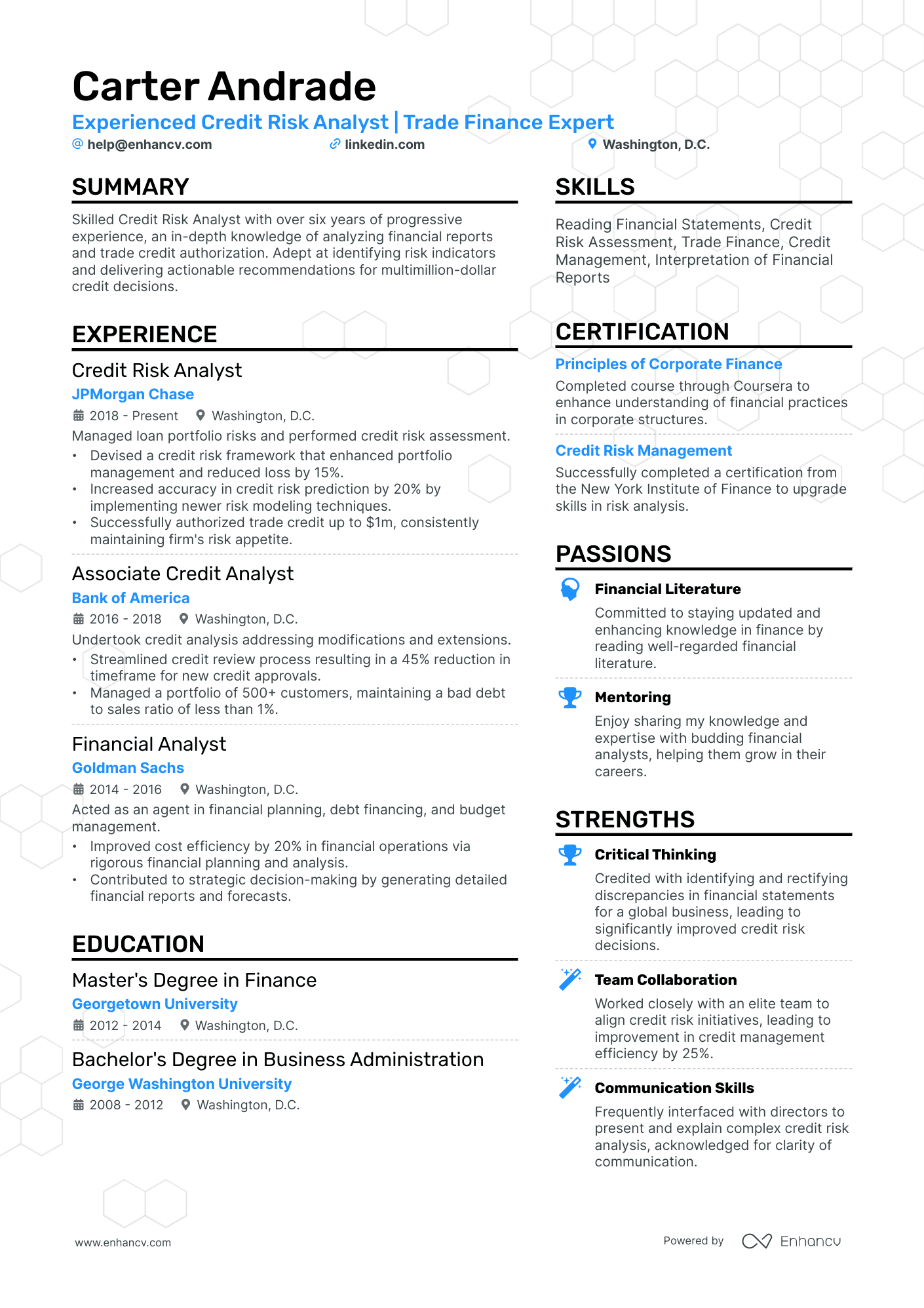
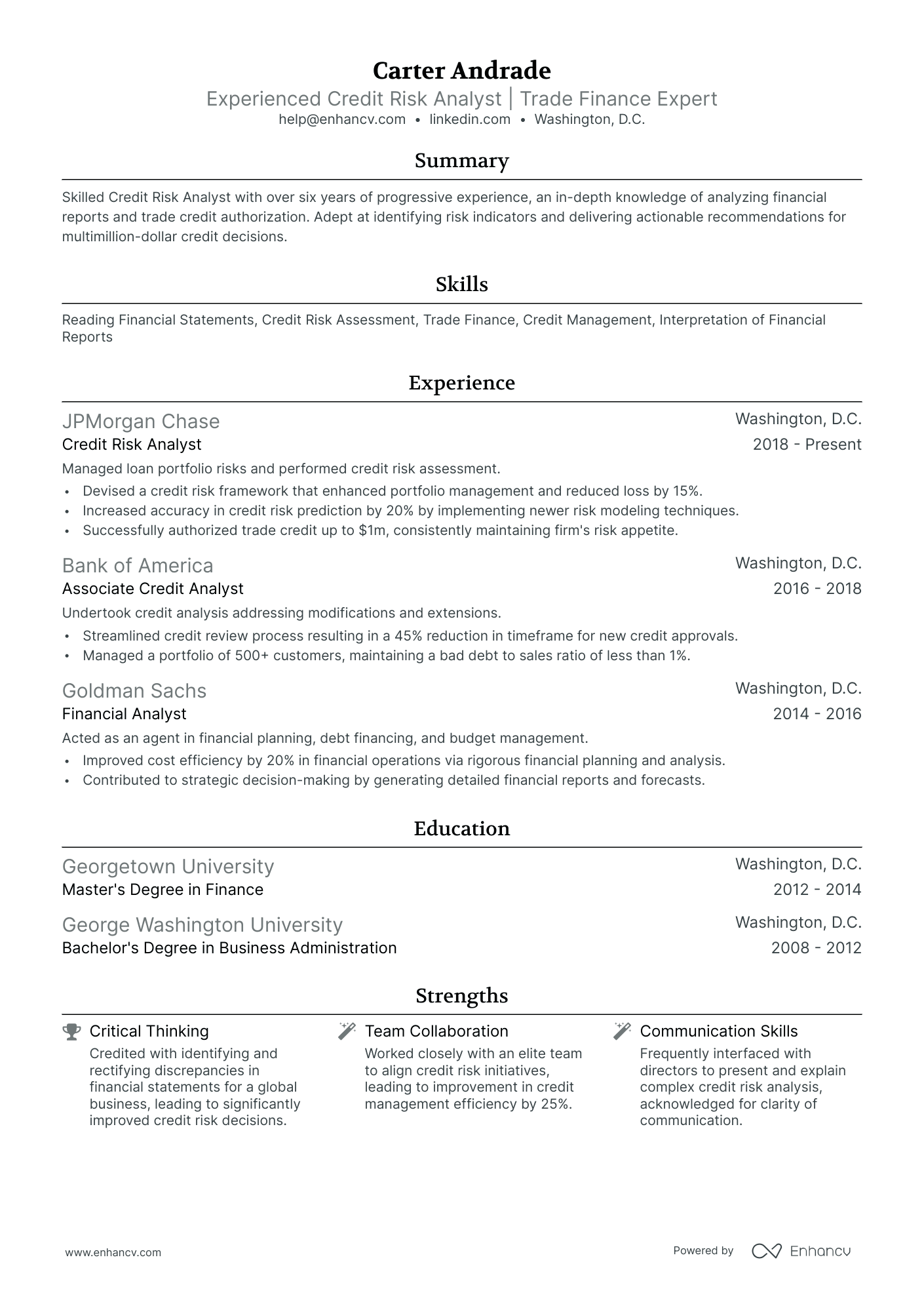
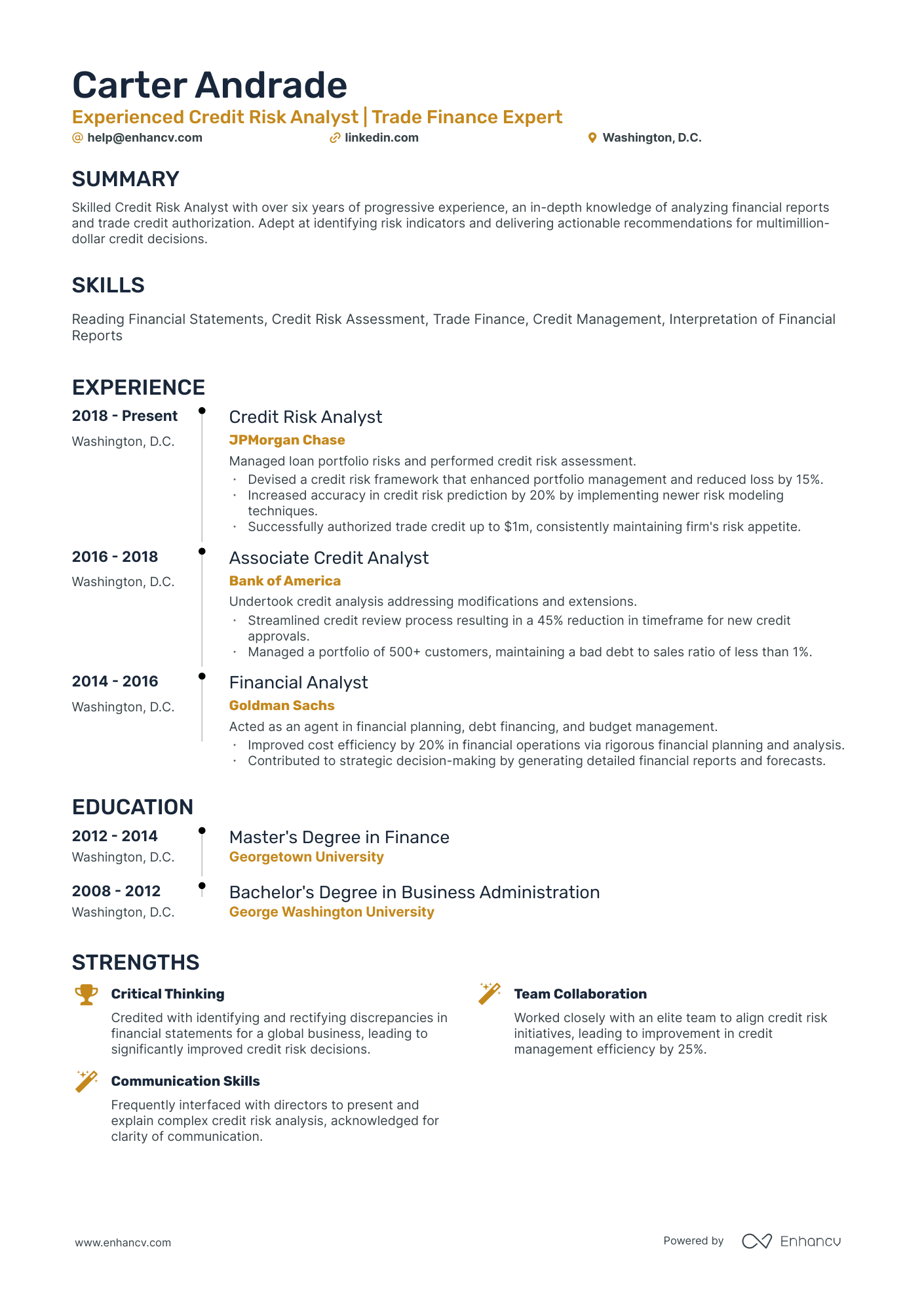
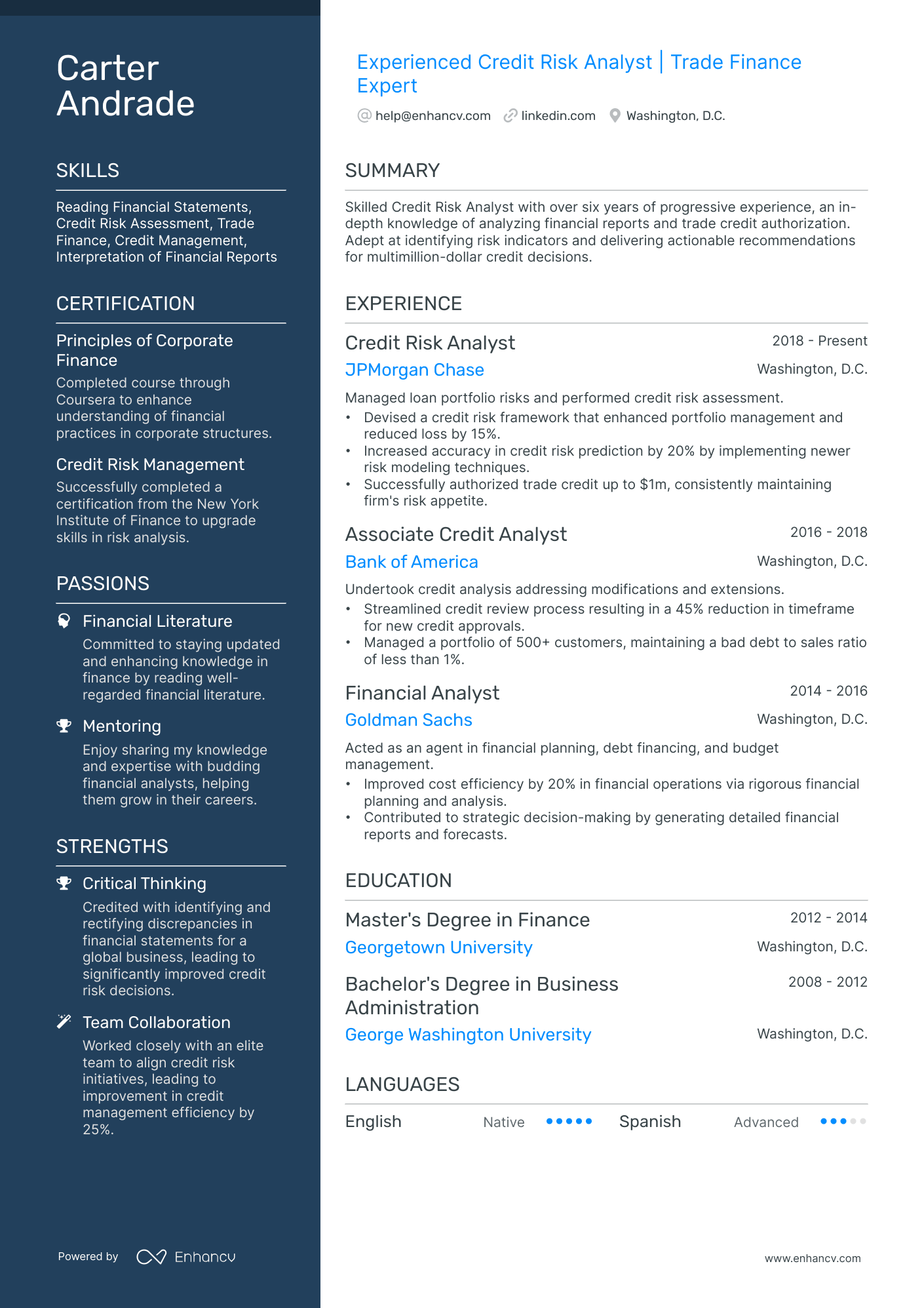
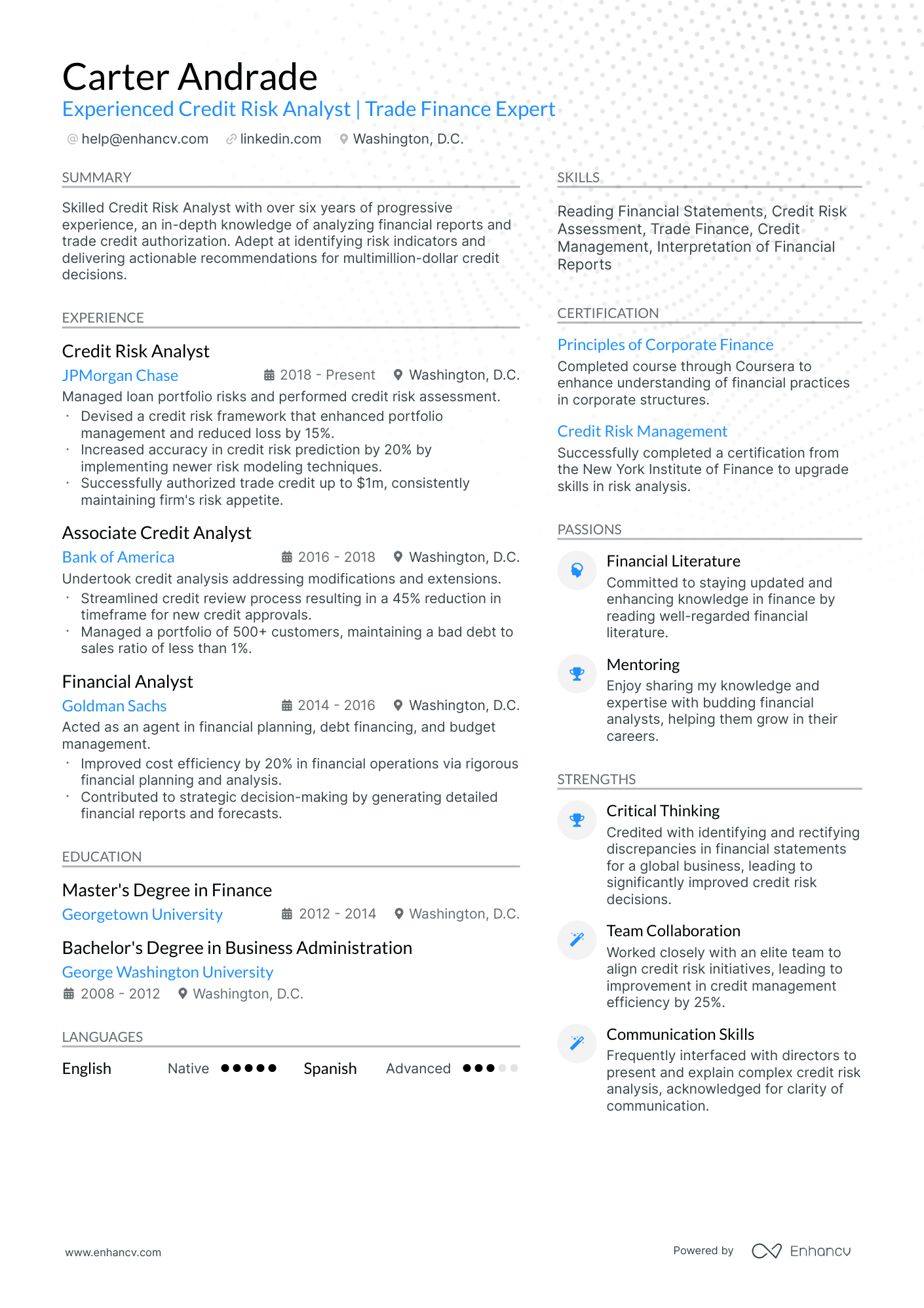
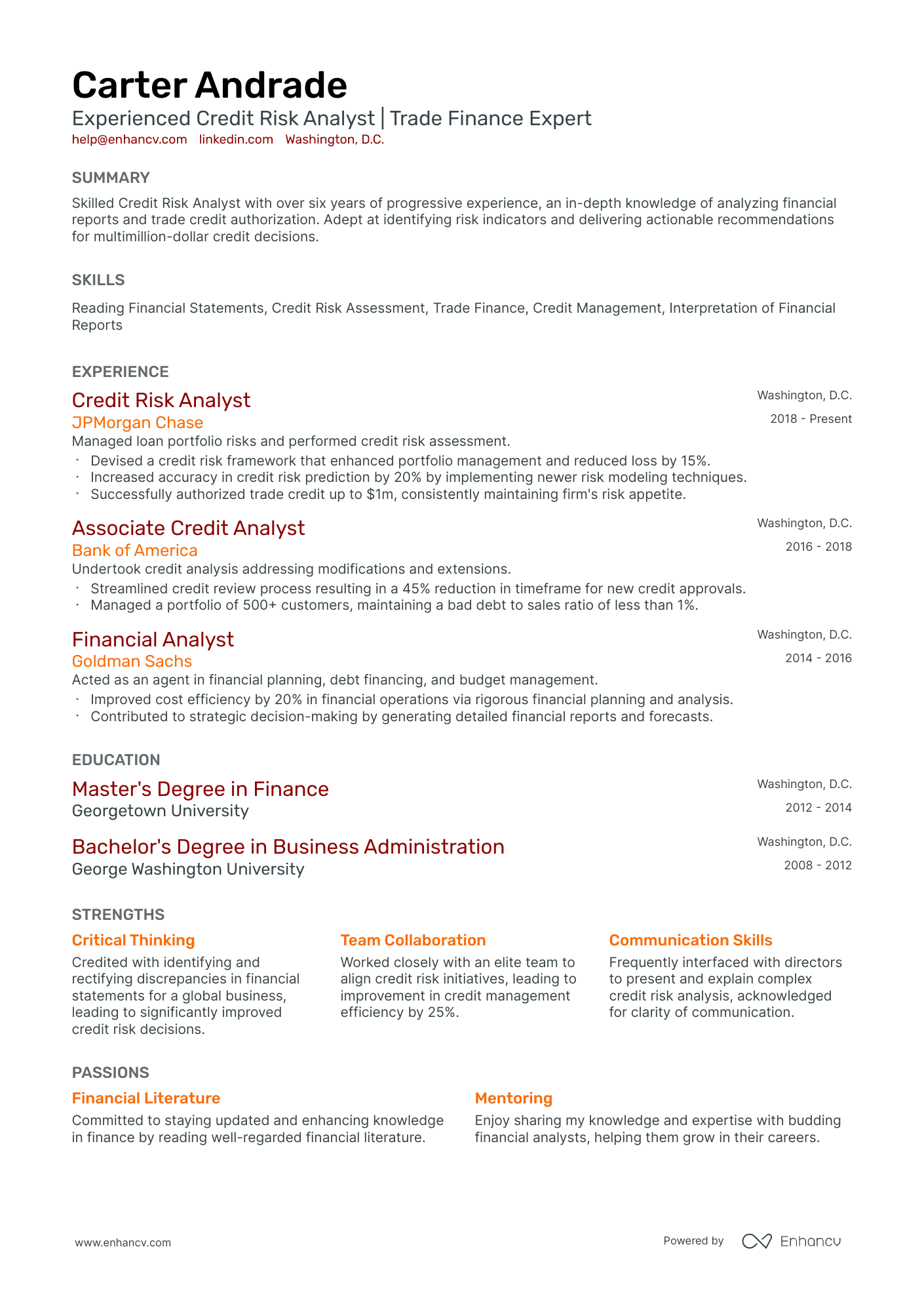
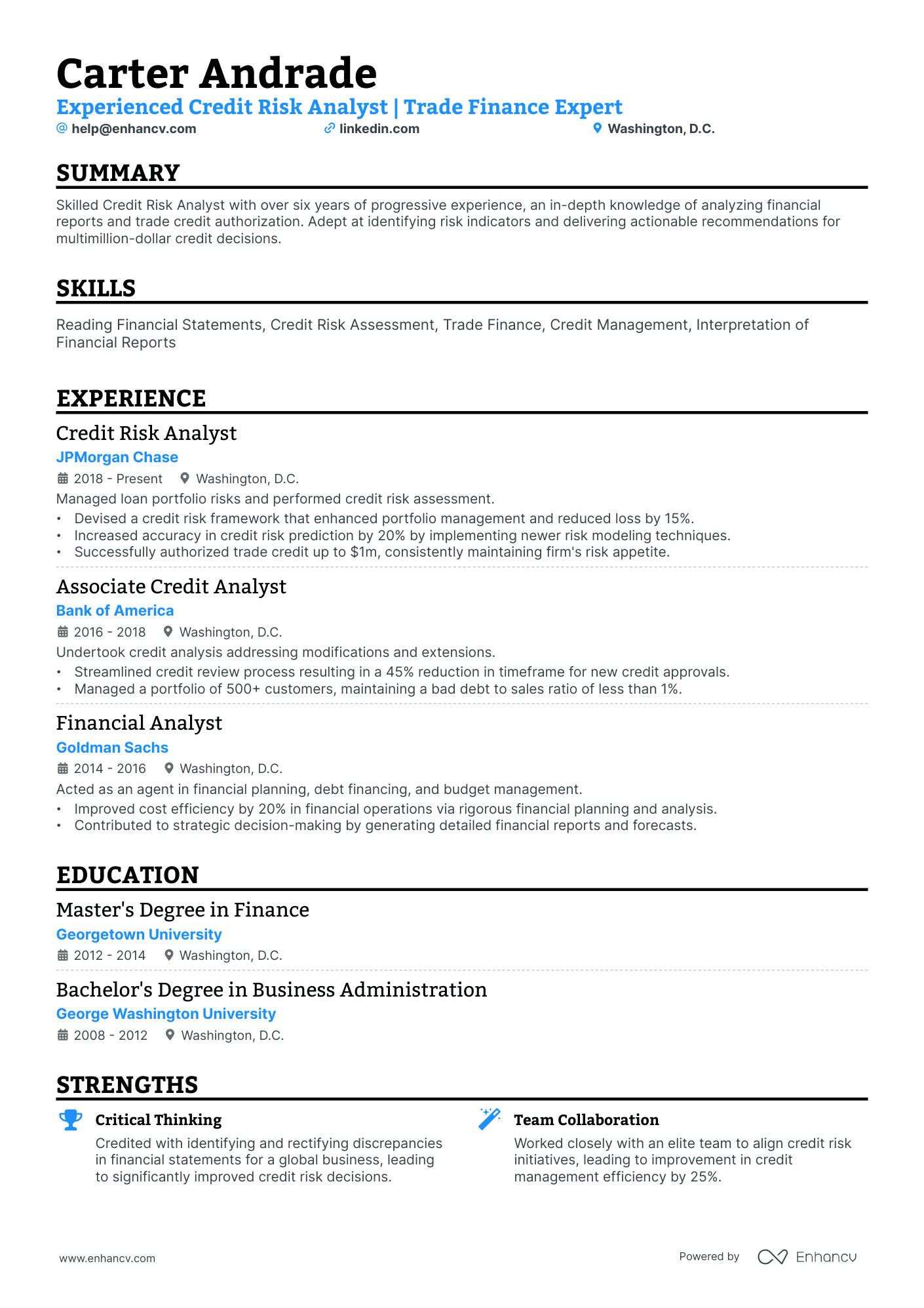
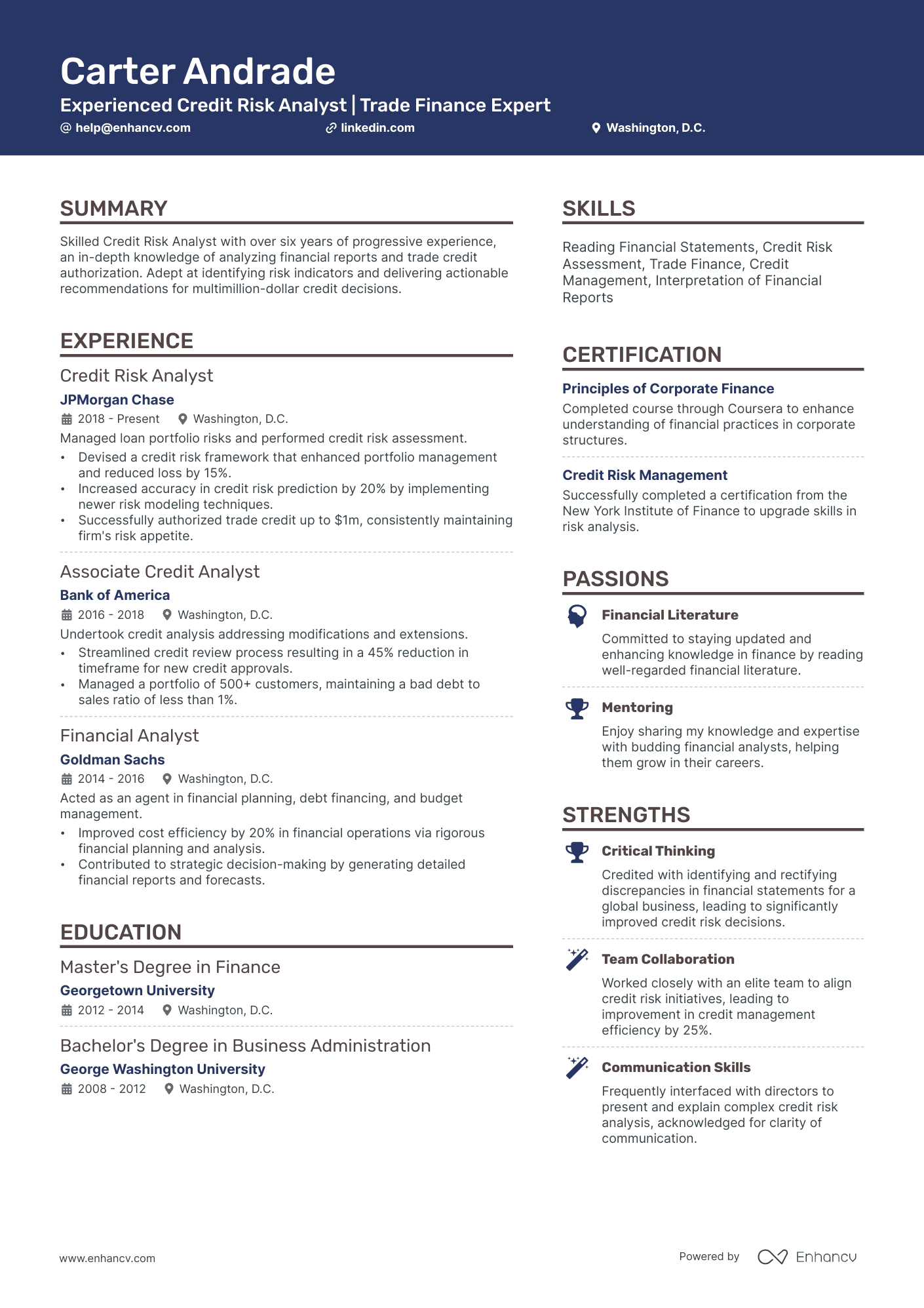
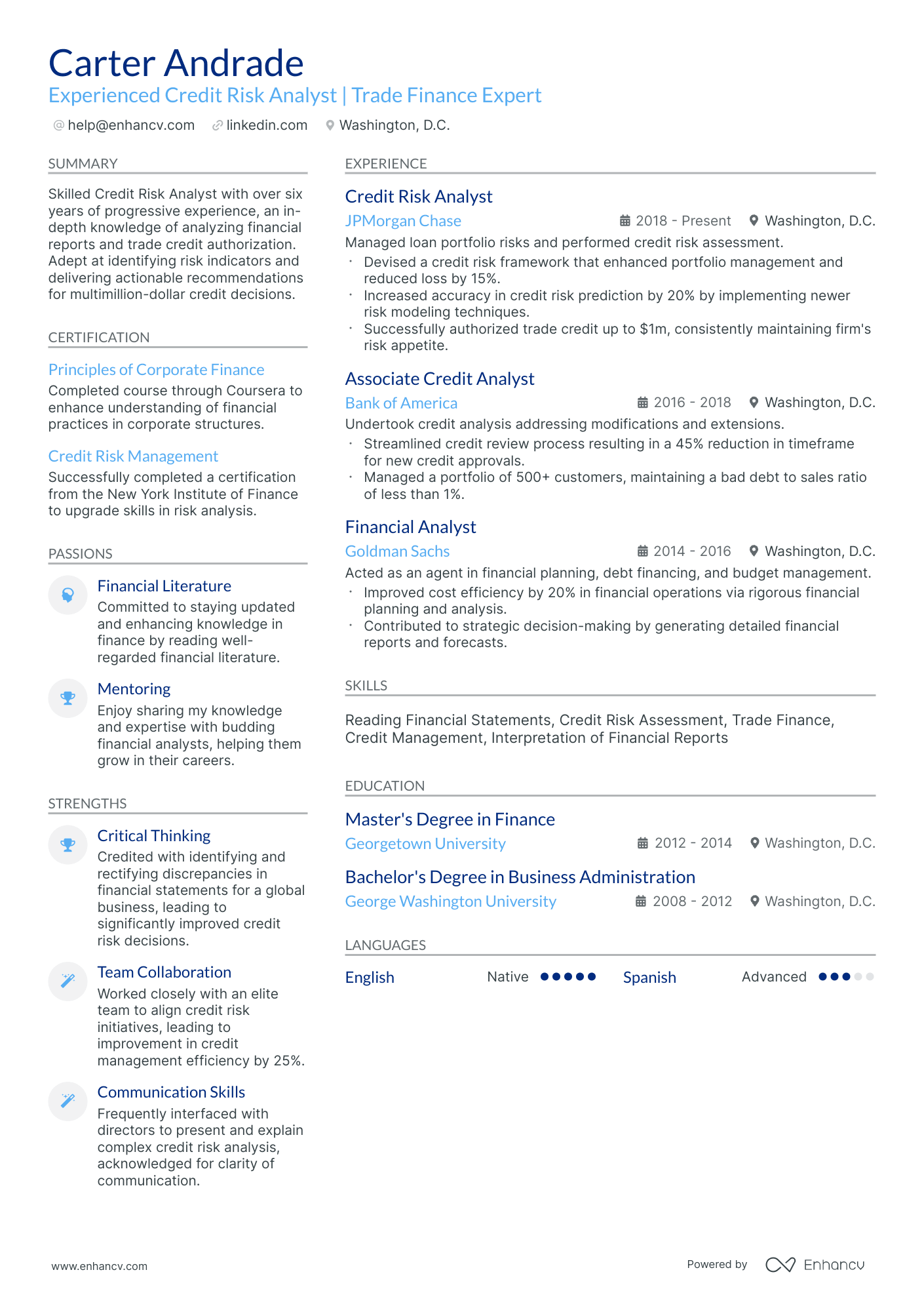
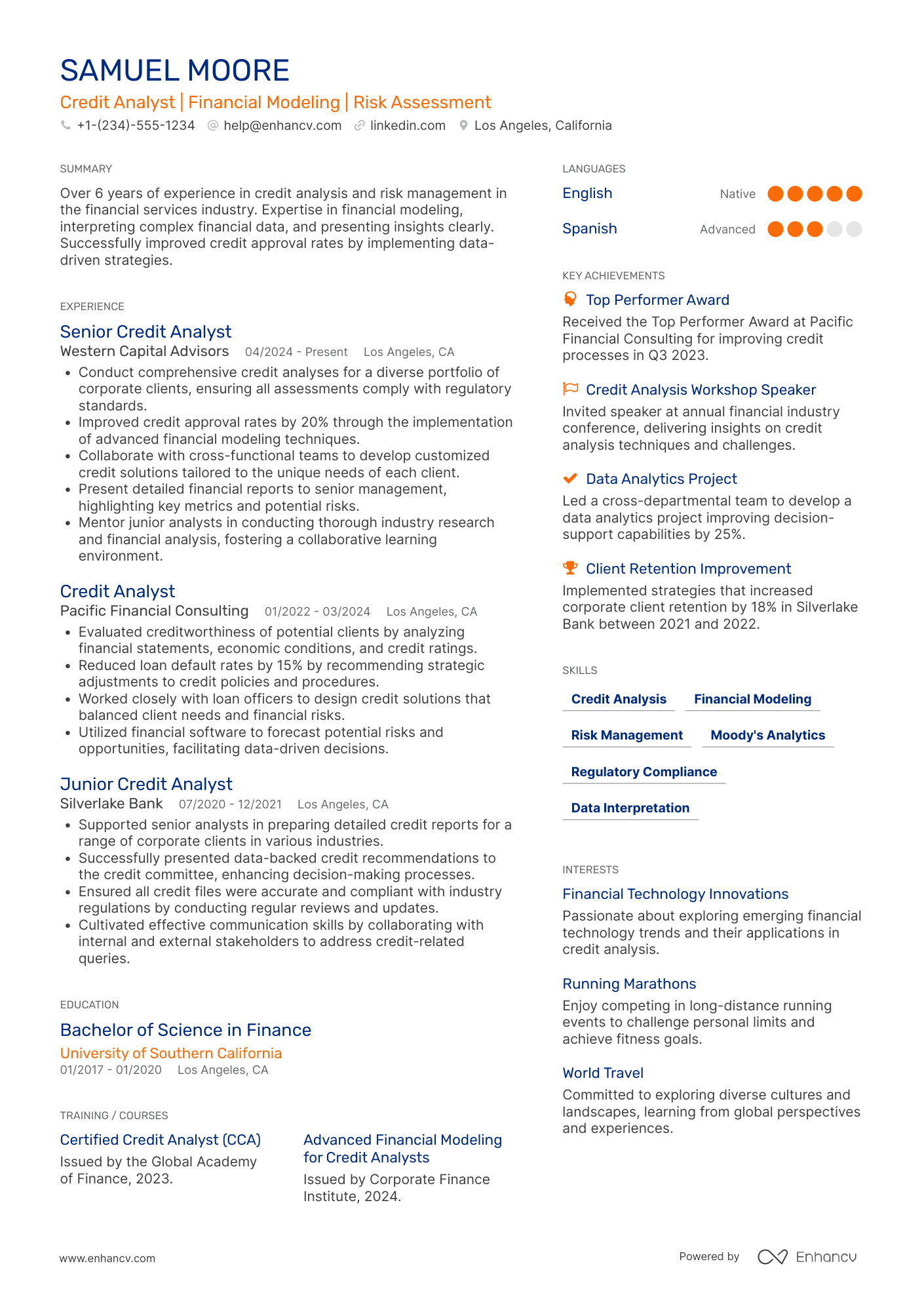
Many credit analyst resume submissions fail because they list duties and tools but don't show risk judgment, credit decisions, or portfolio impact. That hurts in ATS screening and fast recruiter scans, where strong evidence must surface quickly.
A strong resume shows what you improved and how you measured it. Highlight default-rate changes, exposure managed, approval turnaround reduced, covenant breaches prevented, and audit findings closed. Show deal size, portfolio scope, accuracy rates, and stakeholder outcomes. If you're unsure where to begin, learning how to write a resume with measurable impact is the essential first step.

Key takeaways
- Quantify credit outcomes like default-rate reductions, portfolio size, and approval turnaround instead of listing duties.
- Use reverse-chronological format for experienced analysts and hybrid format for career changers.
- Tailor resume language to match each job posting's tools, frameworks, and risk terminology.
- Anchor every listed skill to a measurable outcome in your experience or projects section.
- Place certifications like the CFA or FRM near education to signal validated expertise quickly.
- Write a three- to four-line summary featuring your specialty, core tools, and strongest metric.
- Use Enhancv to turn vague bullet points into measurable, role-aligned resume statements faster.
Job market snapshot for credit analysts
We analyzed 450 recent credit analyst job ads across major US job boards. These numbers help you understand salary landscape, employment type trends, career growth patterns at a glance.
What level of experience employers are looking for credit analysts
| Years of Experience | Percentage found in job ads |
|---|---|
| 1–2 years | 12.9% (58) |
| 3–4 years | 11.1% (50) |
| 5–6 years | 9.3% (42) |
| 7–8 years | 1.6% (7) |
| 9–10 years | 1.8% (8) |
| 10+ years | 2.7% (12) |
| Not specified | 61.6% (277) |
Credit analyst ads by area of specialization (industry)
| Industry (Area) | Percentage found in job ads |
|---|---|
| Finance & Banking | 98.4% (443) |
Top companies hiring credit analysts
| Company | Percentage found in job ads |
|---|---|
| US Bank | 8.4% (38) |
| WesBanco | 4.7% (21) |
| Standard Chartered | 4.4% (20) |
| Fifth Third Bank | 4.2% (19) |
| Austin Bank | 3.8% (17) |
| First Interstate BancSystem, Inc. | 3.6% (16) |
| Zions Bancorporation | 2.4% (11) |
| Barings Corp. | 2.2% (10) |
Role overview stats
These tables show the most common responsibilities and employment types for credit analyst roles. Use them to align your resume with what employers expect and to understand how the role is structured across the market.
Day-to-day activities and top responsibilities for a credit analyst
| Responsibility | Percentage found in job ads |
|---|---|
| Credit analysis | 36.9% (166) |
| Excel | 28.7% (129) |
| Financial analysis | 27.3% (123) |
| Microsoft office | 24.0% (108) |
| Financial modeling | 15.6% (70) |
| Financial statement analysis | 15.3% (69) |
| Financial statements | 13.1% (59) |
| Microsoft excel | 13.1% (59) |
| Microsoft word | 13.1% (59) |
| Risk analysis | 12.4% (56) |
| Word | 10.9% (49) |
| Accounting | 9.1% (41) |
Type of employment (remote vs on-site vs hybrid)
| Employment type | Percentage found in job ads |
|---|---|
| On-site | 82.2% (370) |
| Hybrid | 15.6% (70) |
| Remote | 2.2% (10) |
How to format a credit analyst resume
Recruiters evaluating credit analyst resumes prioritize analytical rigor, financial modeling proficiency, and the ability to assess risk across portfolios. A clean, well-structured resume format ensures these signals surface quickly during both human review and ATS parsing.

I have significant experience in this role—which format should I use?
Use a reverse-chronological format to showcase your deepening expertise in credit risk assessment, underwriting, and portfolio analysis. Do:
- Lead each role entry with the scope of your responsibilities—portfolio size, credit limits managed, or number of accounts reviewed.
- Highlight proficiency in role-specific tools and domains such as Moody's Analytics, Bloomberg Terminal, S&P Capital IQ, financial statement analysis, and credit scoring models.
- Quantify outcomes tied to risk mitigation, approval accuracy, loss reduction, or process improvements.
I'm junior or switching into this role—what format works best?
Use a hybrid format to lead with relevant analytical skills while supporting them with internship, academic, or transitional experience. Do:
- Place a skills section near the top featuring credit analysis fundamentals, financial modeling, ratio analysis, and relevant software (Excel, SQL, SAS).
- Include coursework, capstone projects, case competitions, or internship work that involved financial data interpretation or risk evaluation.
- Connect every listed skill or project to a specific action and a measurable or observable result.
Why not use a functional resume?
A functional format strips away the timeline context that hiring managers need to verify how your credit analysis skills developed through real-world application, making it harder to assess your readiness for the role.
- A functional format may be acceptable if you're transitioning from a related field (such as accounting or banking) and lack direct credit analyst titles, but only if every listed skill is anchored to a specific project, case study, or measurable outcome.
With your format establishing a clean, scannable structure, the next step is filling it with the right sections to present your qualifications effectively.
What sections should go on a credit analyst resume
Recruiters expect a credit analyst resume that clearly shows your credit risk expertise, underwriting judgment, and measurable results. Knowing what to put on a resume for this role helps you prioritize the sections that matter most.
Use this structure for maximum clarity:
- Header
- Summary
- Experience
- Skills
- Projects
- Education
- Certifications
- Optional sections: Awards, Leadership, Languages
Strong experience bullets should emphasize portfolio impact, risk outcomes, deal size, exposure, approval rates, and the business results of your recommendations.
Is your resume good enough?
Drop your resume here or choose a file. PDF & DOCX only. Max 2MB file size.
Once you’ve organized your resume with the right structure, focus next on writing your credit analyst experience section to show how you’ve applied those elements in your work history.
How to write your credit analyst resume experience
Your experience section proves you can assess creditworthiness, manage risk, and deliver sound recommendations that protect a lender's portfolio. Hiring managers prioritize demonstrated impact—approved credit facilities, refined scoring models, reduced default rates—over descriptive task lists that only recount daily duties. Building a targeted resume that reflects each employer's priorities makes this section far more effective.
Each entry should include:
- Job title
- Company and location (or remote)
- Dates of employment (month and year)
Three to five concise bullet points showing what you owned, how you executed, and what outcomes you delivered:
- Ownership scope: the credit portfolios, borrower segments, risk rating systems, or underwriting pipelines you were directly accountable for.
- Execution approach: the financial modeling techniques, credit scoring platforms, ratio analysis frameworks, or regulatory guidelines you applied to evaluate borrower risk and structure lending decisions.
- Value improved: the changes you drove in default rates, approval turnaround times, portfolio quality, loss reserves, or compliance accuracy that strengthened the organization's credit posture.
- Collaboration context: how you partnered with relationship managers, loan officers, risk committees, legal teams, or external auditors to align credit decisions with broader business and regulatory objectives.
- Impact delivered: the outcomes your work produced—expressed through portfolio performance, risk reduction, process efficiency, or revenue protection—rather than a summary of tasks you performed.
Experience bullet formula
A credit analyst experience example
✅ Right example - modern, quantified, specific.
Senior Credit Analyst
Riverbend Commercial Bank | Charlotte, NC
2022–Present
Regional commercial bank supporting middle-market and small business lending across the Southeast.
- Underwrote and presented one hundred twenty commercial credit requests per year across commercial real estate, commercial and industrial, and small business portfolios using Moody’s Analytics RiskAnalyst, spreading software, and Excel models, sustaining a 98% approval quality score on post-close reviews.
- Built a probability of default and loss given default scorecard in Python and Excel Power Query, integrating bureau, financial statement, and payment data to cut average decision time from five days to three days and reduce manual data prep by 40%.
- Recalibrated debt service coverage ratio and leverage covenant frameworks with relationship managers and credit officers, lowering policy exceptions by 22% and improving early risk identification, measured by a 15% increase in watchlist captures before delinquency.
- Led quarterly portfolio monitoring for a $650M commercial and industrial book in Tableau and SQL, flagging concentration and migration trends that drove a $1.8M reduction in criticized exposure through repricing, collateral updates, and proactive client outreach.
- Partnered with loan operations, legal, and treasury to standardize collateral and guarantor documentation in the loan origination system, cutting post-approval condition clearing time by 30% and improving audit findings from four to zero in the latest internal review.
Now that you've seen how to structure a strong experience entry, let's focus on adjusting those details to match the specific role you're targeting.
How to tailor your credit analyst resume experience
Recruiters evaluate your credit analyst resume through both applicant tracking systems and manual review, so tailoring your resume to the job description is essential. Tailoring ensures the specific skills, tools, and responsibilities they're looking for appear clearly in your work history.
Ways to tailor your credit analyst experience:
- Match credit risk software and financial modeling tools listed in the posting.
- Mirror the exact terminology used for underwriting standards or credit policies.
- Reflect portfolio size or loan volume metrics the employer prioritizes.
- Highlight industry experience in the specific sector the role serves.
- Emphasize regulatory compliance frameworks referenced in the job description.
- Align your experience with their stated risk assessment methodologies.
- Include cross-functional collaboration with sales or relationship management teams mentioned.
- Reference credit scoring models or rating systems the employer uses.
Tailoring means presenting your real accomplishments in language that directly reflects what the employer has asked for, not forcing keywords where they don't belong.
Resume tailoring examples for credit analyst
| Job description excerpt | Untailored | Tailored |
|---|---|---|
| Perform detailed financial statement analysis and cash flow modeling to assess borrower creditworthiness for commercial lending portfolios up to $50M. | Reviewed financial documents and helped assess client risk. | Conducted financial statement analysis and built cash flow models to evaluate creditworthiness for a $45M commercial lending portfolio, reducing default rates by 12% over two years. |
| Utilize Moody's RiskAnalyst and internal scoring frameworks to assign and monitor credit risk ratings across a portfolio of middle-market clients. | Used software tools to track and rate client accounts. | Assigned and monitored credit risk ratings for 120+ middle-market clients using Moody's RiskAnalyst and internal scoring frameworks, flagging 15 rating downgrades before quarterly reviews. |
| Prepare detailed credit memos and present lending recommendations to the senior credit committee, ensuring compliance with OCC regulatory guidelines. | Wrote reports and presented findings to leadership on a regular basis. | Prepared credit memos with full risk assessments and presented lending recommendations to a six-member senior credit committee, maintaining 100% compliance with OCC regulatory guidelines across 80+ annual reviews. |
Once you’ve aligned your experience with the role’s priorities, quantify your credit analyst achievements to prove the impact of that work with clear results.
How to quantify your credit analyst achievements
Quantifying your achievements proves you reduce risk and speed sound credit decisions. Focus on cycle time, accuracy, portfolio performance, policy compliance, and loss avoidance—plus the volume and dollar exposure you manage.
Quantifying examples for credit analyst
| Metric | Example |
|---|---|
| Cycle time | "Cut credit review turnaround from four days to two by standardizing checklists in Excel and Salesforce, supporting 30+ decisions per week." |
| Accuracy | "Reduced rating errors from 3.2% to 1.1% by adding validation rules and peer reviews, preventing rework on 120+ monthly assessments." |
| Risk reduction | "Lowered delinquency rate from 2.4% to 1.7% across a $45M portfolio by tightening covenants and flagging early-warning signals." |
| Compliance | "Achieved 98% policy adherence in quarterly audits by documenting exceptions and updating underwriting memos, cutting audit findings from nine to two." |
| Volume handled | "Processed 1,150 credit applications in six months while maintaining service-level agreements, covering exposures up to $2M per account." |
Turn vague job duties into measurable, recruiter-ready resume bullets in seconds with Enhancv's Bullet Point Generator.
With strong bullet points in place, the next step is making sure your skills section clearly highlights the hard and soft skills that credit analyst hiring managers are looking for.
How to list your hard and soft skills on a credit analyst resume
Your skills section shows how you assess risk and support lending decisions, and recruiters and an ATS (applicant tracking system) scan this section to match you to the job, so aim for a heavier mix of hard skills with a focused set of role-specific soft skills. credit analyst roles require a blend of:
- Product strategy and discovery skills.
- Data, analytics, and experimentation skills.
- Delivery, execution, and go-to-market discipline.
- Soft skills.
Your skills section should be:
- Scannable (bullet-style grouping).
- Relevant to the job post.
- Backed by proof in experience bullets.
- Updated with current tools.
Place your skills section:
- Above experience if you're junior or switching careers.
- Below experience if you're mid/senior with strong achievements.

Hard skills
- Financial statement analysis
- Credit risk assessment
- Cash flow modeling
- Debt service coverage ratio analysis
- Loan underwriting, credit memos
- Covenant analysis and monitoring
- Industry and peer benchmarking
- Portfolio monitoring and reporting
- Microsoft Excel, Power Query
- SQL querying
- Bloomberg Terminal
- Moody's Analytics (CreditLens)
Soft skills
- Write clear credit narratives
- Challenge assumptions with evidence
- Prioritize risk drivers under deadlines
- Partner with relationship managers
- Align with credit policy and exceptions
- Ask targeted borrower questions
- Communicate risk to non-finance teams
- Escalate issues early and clearly
- Manage multiple deals simultaneously
- Maintain strong documentation discipline
- Negotiate terms with stakeholders
- Own decisions and follow through
How to show your credit analyst skills in context
Skills shouldn't live only in a bulleted list on your resume. Explore common resume skills by role to see how top candidates present theirs.
They should be demonstrated in:
- Your summary (high-level professional identity)
- Your experience (proof through outcomes)
Here's what strong, skill-rich entries look like in practice.
Summary example
Senior credit analyst with 10 years in commercial lending. Skilled in financial modeling, Moody's RiskAnalyst, and portfolio stress testing. Reduced annual charge-offs by 18% through enhanced underwriting frameworks and cross-departmental risk collaboration.
- Reflects senior-level expertise immediately
- Names industry-specific tools directly
- Quantifies a meaningful financial outcome
- Signals collaboration as a soft skill
Experience example
Senior Credit Analyst
Meridian Capital Group | Remote
March 2019–Present
- Built automated credit scoring models in Moody's RiskAnalyst, cutting portfolio review time by 30% across 1,200 accounts.
- Partnered with relationship managers to restructure $45M in distressed loans, reducing default rates by 12% year over year.
- Led quarterly stress-testing initiatives using Monte Carlo simulations, improving forecast accuracy by 22% for senior leadership reporting.
- Every bullet includes measurable proof
- Skills surface naturally through achievements
Once you’ve demonstrated your credit analyst capabilities through relevant examples and outcomes, the next step is applying that approach to a credit analyst resume when you don’t have direct experience.
How do I write a credit analyst resume with no experience
Even without full-time experience, you can demonstrate readiness through the strategies outlined in our guide on writing a resume without work experience. Consider showcasing:
- Credit risk case study projects.
- Finance coursework with modeling.
- Internship in lending operations.
- Bank teller cash reconciliation.
- Underwriting shadowing or job simulations.
- Credit bureau report analyses.
- Excel financial statement spreads.
- Student investment fund research.
Focus on:
- Financial statement analysis results.
- Credit memo writing samples.
- Excel models with assumptions.
- Risk metrics and data sources.
Resume format tip for entry-level credit analyst
Use a combination resume format because it highlights credit analyst skills and projects first, while still showing work history, even if unrelated. Do:
- Put a "Projects" section above experience.
- Quantify results with clear metrics.
- List tools: Excel, SQL, Power BI.
- Add coursework tied to credit analyst work.
- Include one credit memo writing sample.
- Built an Excel credit risk model for eight public retailers using Altman Z-score and leverage ratios, flagging two high-risk firms and improving ranking accuracy by 20%.
Even without direct experience, your education section can serve as the foundation of your credit analyst resume—here's how to present it effectively.
How to list your education on a credit analyst resume
Your education section helps hiring teams confirm you have the foundational knowledge needed for credit analysis. It validates your training in finance, accounting, and risk assessment.
Include:
- Degree name
- Institution
- Location
- Graduation year
- Relevant coursework (for juniors or entry-level candidates)
- Honors & GPA (if 3.5 or higher)
Avoid listing specific months or days. Use the graduation year only for a cleaner look.
Here's a strong education entry tailored to a credit analyst resume.
Example education entry
Bachelor of Science in Finance
Georgetown University, Washington, D.C.
Graduated 2022
GPA: 3.7/4.0
- Relevant Coursework: Financial Statement Analysis, Corporate Credit Risk, Accounting for Decision-Making, Fixed Income Securities
- Honors: Dean's List (six semesters), Beta Gamma Sigma Honor Society
How to list your certifications on a credit analyst resume
Certifications on a resume show a credit analyst's commitment to learning, proficiency with finance tools, and alignment with current industry standards. They also signal credibility when you review borrowers, assess risk, and communicate recommendations.
Include:
- Certificate name
- Issuing organization
- Year
- Optional: credential ID or URL
- Place certifications below education when your degree is recent and more relevant than older or general certifications.
- Place certifications above education when they are recent, highly relevant, or required for the credit analyst roles you target.
Best certifications for your credit analyst resume
Chartered Financial Analyst (CFA) Financial Risk Manager (FRM) Chartered Alternative Investment Analyst (CAIA) Certified Public Accountant (CPA) Certified Credit Executive (CCE) Certified Financial Services Auditor (CFSA) Commercial Banking and Credit Analyst (CBCA)
Once you’ve positioned your credentials where hiring managers will notice them, shift to writing your credit analyst resume summary to highlight their value upfront.
How to write your credit analyst resume summary
Your resume summary is the first thing a recruiter reads. A sharp, specific opening instantly signals you're qualified for a credit analyst role.
Keep it to three to four lines, with:
- Your title and years of relevant credit analysis experience.
- The domain you specialize in, such as commercial lending, consumer credit, or corporate finance.
- Core tools and skills like financial modeling, Moody's RiskAnalyst, Excel, or SQL.
- One or two measurable achievements, such as portfolio size managed or default rate reductions.
- Soft skills tied to real outcomes, like communicating risk recommendations that shaped lending decisions.

PRO TIP
At the junior level, focus on relevant coursework, internships, technical tools, and early wins. Show you can analyze data and communicate findings clearly. Avoid vague phrases like "passionate self-starter" or "eager to learn." Replace them with specific skills and concrete contributions.
Example summary for a credit analyst
Credit analyst with two years of experience in commercial lending. Skilled in financial modeling, Moody's RiskAnalyst, and Excel. Reduced underwriting turnaround time by 18% through streamlined credit memo workflows.
Optimize your resume summary and objective for ATS
Drop your resume here or choose a file.
PDF & DOCX only. Max 2MB file size.
Now that your summary effectively communicates your value, make sure the header above it presents your contact details correctly so recruiters can easily reach you.
What to include in a credit analyst resume header
A well-crafted resume header lists your key contact details and role focus, helping a credit analyst stand out in recruiter screening through visibility and credibility.
Essential resume header elements
- Full name
- Tailored job title and headline
- Location
- Phone number
- Professional email
- GitHub link
- Portfolio link
A LinkedIn link helps recruiters verify your experience quickly and supports screening.
Do not include photos on a credit analyst resume unless the role is explicitly front-facing or appearance-dependent.
Use a tailored credit analyst title and keep contact links consistent across platforms to reduce verification time and prevent screening errors.
Credit analyst resume header
Jordan Lee
Credit Analyst | Commercial Lending & Risk Assessment
Chicago, IL
(312) 555-01XX
jordan.lee@enhancv.com
github.com/jordanlee
jordanlee.com
linkedin.com/in/jordanlee
Once your contact details and role identifiers are set, add relevant additional sections to strengthen your credit analyst resume and support the header information.
Additional sections for credit analyst resumes
When your core qualifications match other applicants, well-chosen additional sections can set your credit analyst resume apart with relevant depth. For example, listing language skills can be a strong differentiator if you work with international borrowers or cross-border portfolios.
- Languages
- Certifications
- Industry publications
- Professional affiliations
- Volunteer experience in financial literacy
- Technical proficiencies
- Awards and honors
With your resume's additional sections reinforcing your qualifications, pairing it with a tailored cover letter can further distinguish your application.
Do credit analyst resumes need a cover letter
A cover letter isn't required for a credit analyst, but it helps in competitive roles or teams that expect one. It can make a difference when your resume needs context, or when you want to show clear fit. If you're unfamiliar with the format, start by understanding what a cover letter is and how it complements your resume.
Use a cover letter when it adds specific, job-relevant clarity:
- Explain role or team fit: Tie your industry exposure, risk approach, and stakeholder style to the group's portfolio and decision process.
- Highlight one or two relevant projects or outcomes: Quantify impact, such as reduced delinquency, improved approval rates, or faster turnaround through better analysis.
- Show understanding of the product, users, or business context: Connect credit decisions to customer segments, underwriting policy, and revenue and loss tradeoffs.
- Address career transitions or non-obvious experience: Translate adjacent work into credit analyst skills, including financial statement analysis, covenant review, and monitoring.
Drop your resume here or choose a file.
PDF & DOCX only. Max 2MB file size.
Even when you skip a cover letter and let your resume carry the application, using AI to improve your credit analyst resume helps you sharpen and tailor it faster.
Using AI to improve your credit analyst resume
AI can sharpen your resume's clarity, structure, and impact. It helps tighten language and highlight measurable results. But overuse strips authenticity. Once your content is clear and role-aligned, step away from AI. For practical prompt ideas, see our guide on ChatGPT resume writing.
Here are 10 prompts to strengthen specific sections of your credit analyst resume:
Sharpen your summary
Quantify experience bullets
Align skills section
Strengthen action verbs
Tighten project descriptions
Improve education relevance
Refine certification entries
Remove redundant phrasing
Tailor to job posting
Check consistency throughout
Conclusion
A strong credit analyst resume proves impact with measurable outcomes. Use clear metrics like loss reduction, approval accuracy, portfolio performance, and turnaround time. Highlight role-specific skills, including financial statement analysis, risk rating, cash flow modeling, and covenant monitoring.
Keep the structure clean and easy to scan. Lead with the strongest results, then align skills and experience to the role. This approach shows you’re ready for today’s credit analyst hiring market and near-future expectations.