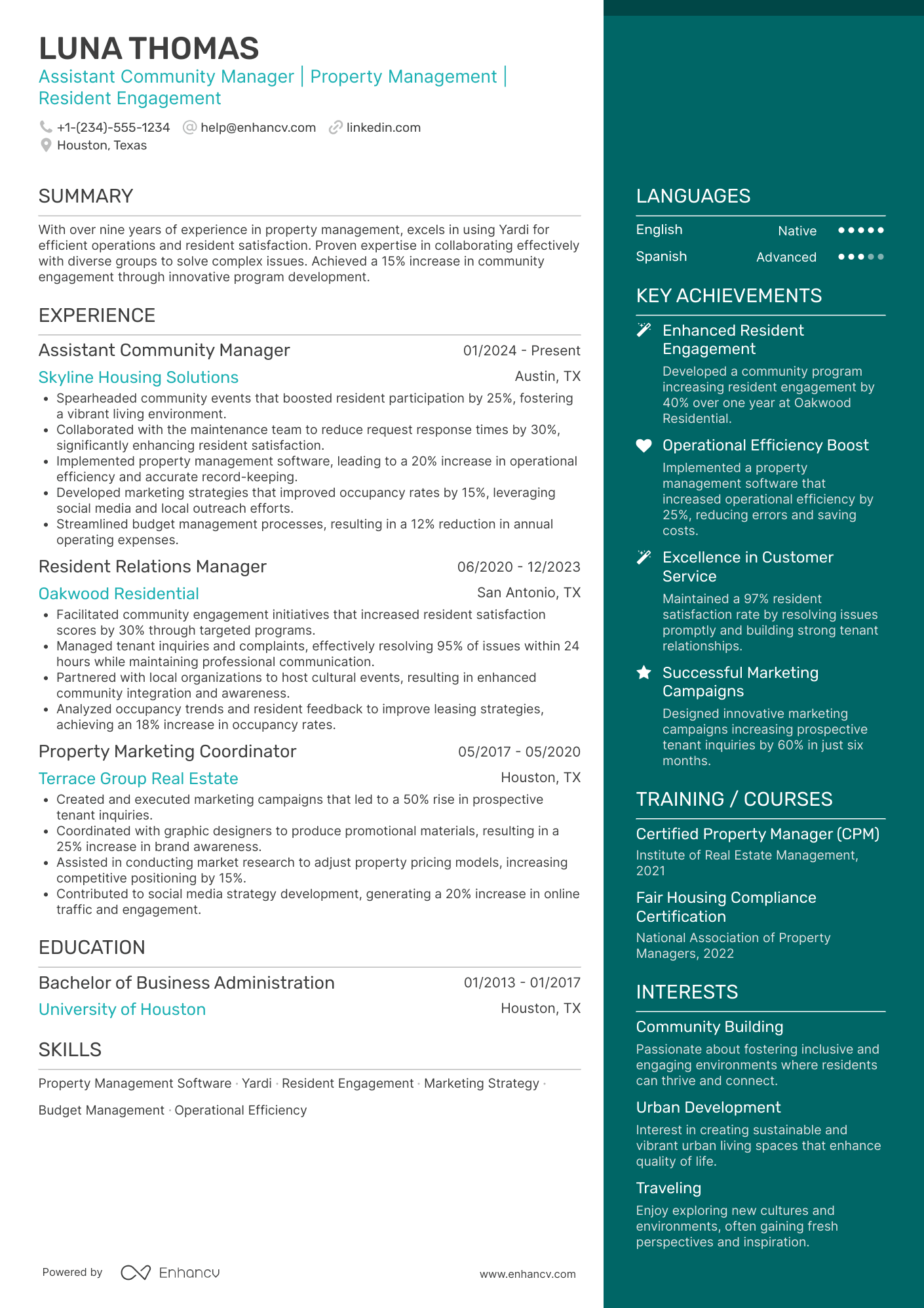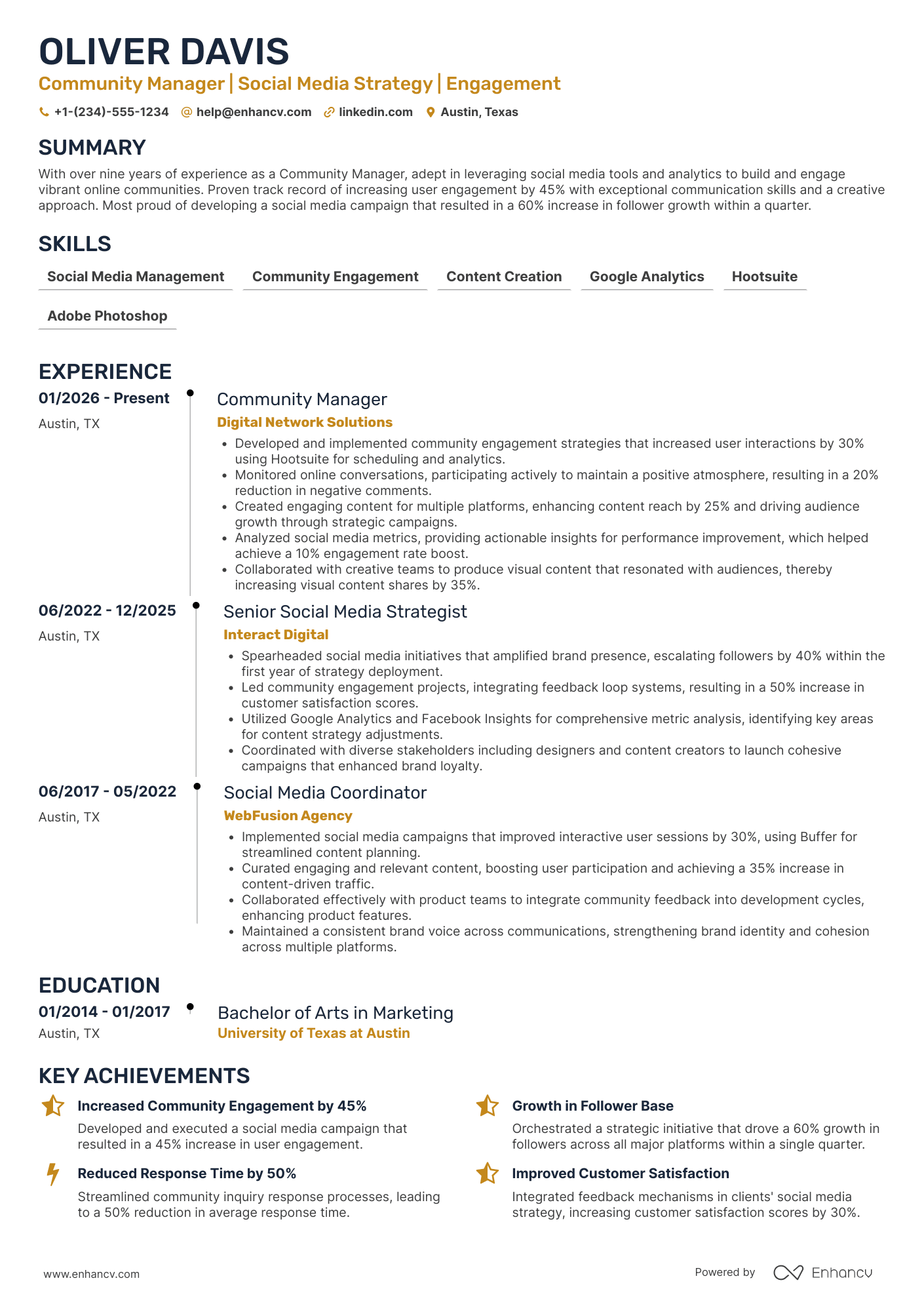
Many community manager resumes fail because they describe daily tasks instead of proving impact across programs, members, and the business. In a community manager resume, that gets buried in ATS screening and lost in fast recruiter scans.
A strong resume shows what changed because of your work. You should quantify member growth, retention, and engagement lifts, highlight response-time improvements, show event attendance and conversion impact, and tie moderation quality to fewer escalations and higher satisfaction. Understanding how to make your resume stand out starts with leading with measurable results rather than routine responsibilities.

Key takeaways
- Quantify community growth, retention, and engagement outcomes instead of listing daily tasks.
- Use reverse-chronological format for experienced roles and hybrid format for career changers.
- Tailor every experience bullet to match the platforms, metrics, and language in the job posting.
- Demonstrate skills through measurable results in your summary and experience, not just a skills list.
- Showcase volunteer moderation, personal projects, or freelance work when formal experience is limited.
- Use AI tools like Enhancv to tighten language and add metrics, but stop before it overwrites authenticity.
- Pair your resume with a cover letter when you need to explain transitions or highlight specific projects.
Job market snapshot for community managers
We analyzed 1,449 recent community manager job ads across major US job boards. These numbers help you understand role specialization trends, regional hotspots, skills in demand at a glance.
What level of experience employers are looking for community managers
| Years of Experience | Percentage found in job ads |
|---|---|
| 1–2 years | 13.4% (194) |
| 3–4 years | 9.0% (130) |
| 5–6 years | 5.7% (83) |
| 7–8 years | 3.9% (56) |
| 9–10 years | 1.5% (22) |
| 10+ years | 2.8% (40) |
| Not specified | 64.9% (940) |
Community manager ads by area of specialization (industry)
| Industry (Area) | Percentage found in job ads |
|---|---|
| Finance & Banking | 52.8% (765) |
| Education | 26.7% (387) |
| Healthcare | 9.2% (134) |
| Real Estate & Construction | 7.8% (113) |
| Government | 1.2% (18) |
| Retail & E-commerce | 0.8% (11) |
| Media & Entertainment | 0.7% (10) |
Top companies hiring community managers
| Company | Percentage found in job ads |
|---|---|
| Education Realty Trust Inc. | 21.0% (304) |
| RPM Living | 8.8% (127) |
| Walgreens | 3.9% (57) |
| FirstService Corporation | 3.5% (50) |
| RHP Properties | 2.1% (30) |
| Cardinal Group Companies | 1.9% (28) |
| The Michaels Organization | 1.8% (26) |
| BH Management | 1.7% (24) |
| Google LLC | 1.5% (22) |
| Ledic Management Group | 1.5% (22) |
Role overview stats
These tables show the most common responsibilities and employment types for community manager roles. Use them to align your resume with what employers expect and to understand how the role is structured across the market.
Day-to-day activities and top responsibilities for a community manager
| Responsibility | Percentage found in job ads |
|---|---|
| Yardi | 15.7% (227) |
| Property management software | 13.3% (192) |
| Microsoft office | 11.9% (173) |
| Excel | 11.8% (171) |
| Accounting | 9.9% (144) |
| Financial reporting | 9.5% (137) |
| Bookkeeping | 8.7% (126) |
| Outlook | 8.2% (119) |
| Project management | 8.0% (116) |
| Word | 7.7% (112) |
| Microsoft office suite | 7.5% (108) |
| Yardi/onesite | 7.1% (103) |
Type of employment (remote vs on-site vs hybrid)
| Employment type | Percentage found in job ads |
|---|---|
| On-site | 89.0% (1290) |
| Hybrid | 7.9% (115) |
| Remote | 3.0% (44) |
How to format a community manager resume
Recruiters evaluating community manager resumes prioritize evidence of audience growth, engagement strategy, and cross-functional collaboration with marketing, product, and support teams. A clean, well-structured format ensures these signals surface quickly during both human review and applicant tracking system (ATS) scans. Choosing the right resume format is the first step toward making your qualifications easy to find.

I have significant experience in this role—which format should I use?
Use a reverse-chronological format to showcase your progression in community strategy, platform ownership, and stakeholder collaboration. Do:
- Lead with your most recent role and clearly define the scope of communities you managed, including platform count, audience size, and team oversight.
- Highlight proficiency in role-specific tools and domains such as community platforms (Discourse, Khoros, Bevy), social listening software, CRM systems, content management, and moderation frameworks.
- Quantify outcomes tied to engagement, retention, brand advocacy, or revenue influence.
- "Grew a branded online community from 12,000 to 85,000 active members in 18 months by launching a tiered ambassador program, increasing user-generated content volume by 140% and reducing support ticket volume by 22%."
I'm junior or switching into this role—what format works best?
A hybrid format works best, allowing you to lead with relevant community and communication skills while still providing a concise work history. Do:
- Place a dedicated skills section near the top of your resume featuring community engagement, content moderation, social media management, and analytics tools.
- Include volunteer moderation, freelance social media work, campus organization leadership, or personal community-building projects as transitional experience.
- Connect every action to a clear outcome so recruiters see your ability to drive engagement, not just participate in it.
- Social media management → developed and executed a 90-day content calendar for a nonprofit's Facebook group → increased weekly active participation by 35%.
Why not use a functional resume?
A functional format strips away the timeline and context recruiters need to evaluate how your community management skills developed and were applied in real settings, making it harder to assess your readiness for the role. A functional format may make sense in a narrow set of circumstances:
- You're transitioning from a related field (customer support, social media marketing, or content creation) and need to foreground transferable skills.
- You have a gap in employment but maintained community involvement through volunteer moderation, open-source project management, or freelance work.
- A functional format is acceptable only when you're making a career change, have limited formal community management employment, or are addressing a significant resume gap—and only if each skill listed is anchored to a concrete project or result.
Once your format establishes a clean, readable structure, the next step is filling it with the right sections to showcase your qualifications effectively.
What sections should go on a community manager resume
Recruiters expect a community manager resume to show you can grow and engage a community while driving measurable business outcomes. Knowing what to put on a resume helps you prioritize the sections that matter most.
Use this structure for maximum clarity:
- Header
- Summary
- Experience
- Skills
- Projects
- Education
- Certifications
- Optional sections: Awards, Volunteering, Languages
Strong experience bullets should emphasize impact, outcomes, scope, and results, including growth, engagement, retention, and cross-functional influence.
Is your resume good enough?
Drop your resume here or choose a file. PDF & DOCX only. Max 2MB file size.
Once you’ve organized your resume with the right core components, the next step is to write your community manager experience in a way that clearly supports and strengthens each section.
How to write your community manager resume experience
The experience section is where you prove you've built, grown, and sustained real communities—not just managed social accounts. Hiring managers prioritize demonstrated impact through engagement strategies, platform management, and measurable community growth over descriptive task lists.
Each entry should include:
- Job title
- Company and location (or remote)
- Dates of employment (month and year)
Three to five concise bullet points showing what you owned, how you executed, and what outcomes you delivered:
- Ownership scope: the communities, platforms, channels, programs, or member segments you were directly accountable for as a community manager.
- Execution approach: the engagement tools, moderation frameworks, content strategies, analytics platforms, or feedback loops you used to nurture communities and inform decisions.
- Value improved: changes to member engagement, retention, sentiment, response time, content quality, or brand trust that resulted from your community management work.
- Collaboration context: how you partnered with marketing, product, support, developer relations, or external advocates to align community efforts with broader organizational goals.
- Impact delivered: outcomes expressed through community growth, activation rates, user-generated content volume, reduced churn, or strengthened brand loyalty rather than routine activity.
Experience bullet formula
A community manager experience example
✅ Right example - modern, quantified, specific.
Community Manager
NimbusNote | Remote
2022–Present
B2B productivity software company supporting a 75,000-member customer community across North America and Europe.
- Launched and scaled a Discourse community with Salesforce Service Cloud integration, lifting monthly active members by 38% and reducing support ticket volume by 14% in six months.
- Built a content and events calendar in Notion and Airtable, delivering weekly webinars in Zoom and streamlining speaker ops—cutting planning time by 30% while increasing average attendance by 22%.
- Implemented community health reporting in Looker Studio using UTM tracking and cohort analysis, improving activation from first post to second session by 17% and raising weekly retention by nine points.
- Partnered with product managers and designers to run monthly feedback sprints via Typeform, Miro, and Jira, generating 120+ validated insights and influencing eight shipped features tied to a 10% increase in Net Promoter Score.
- Established moderation workflows and escalation playbooks in Zendesk and Slack, improving first response time from twelve hours to four hours and reducing policy violations by 26% quarter over quarter.
Now that you've seen what a strong experience section looks like in practice, let's break down how to tailor each element to match the specific community manager role you're targeting.
How to tailor your community manager resume experience
Recruiters evaluate your community manager resume through both applicant tracking systems and manual review, so alignment with the job posting matters. Tailoring your resume to the job description ensures your most relevant skills and accomplishments surface first.
Ways to tailor your community manager experience:
- Match the specific platforms and community tools named in the posting.
- Mirror the engagement metrics or KPIs the employer prioritizes.
- Use the exact terminology the job description applies to workflows.
- Highlight moderation frameworks or guidelines referenced in the listing.
- Include relevant industry or domain experience when the role requires it.
- Emphasize brand voice development if the posting calls for it.
- Reflect collaboration structures like cross-functional or agency partnerships mentioned.
- Incorporate content strategy methods the employer specifically names.
Tailoring means aligning your real accomplishments with what the role demands, not forcing keywords where they don't belong.
Resume tailoring examples for community manager
| Job description excerpt | Untailored | Tailored |
|---|---|---|
| "Manage and grow our Discord and Slack communities, driving a 20% increase in monthly active members through engagement campaigns and event programming." | Helped manage online communities and worked on growing membership. | Grew Discord and Slack communities by 24% in monthly active members over six months by launching weekly AMAs, themed discussion events, and targeted re-engagement campaigns. |
| "Monitor community sentiment using Sprout Social and produce monthly reports with actionable insights for the product and marketing teams." | Tracked community feedback and reported findings to leadership. | Used Sprout Social to track community sentiment across four channels, delivering monthly reports with actionable recommendations that informed two product roadmap adjustments and a revised messaging strategy. |
| "Develop and enforce community guidelines, resolve member conflicts, and collaborate with the trust and safety team to reduce policy violations by 15%." | Maintained community standards and handled member issues as they came up. | Co-authored updated community guidelines with the trust and safety team, mediated 50+ member conflicts per quarter, and implemented a moderation workflow that reduced policy violations by 18%. |
Once you’ve aligned your experience with the role’s priorities, quantify your community manager achievements to prove the impact behind those choices.
How to quantify your community manager achievements
Numbers prove your community work drives retention, satisfaction, and revenue, not just activity. Focus on engagement quality, response speed, member retention, support deflection, and conversion from community programs. Learning how to effectively use numbers on your resume transforms vague duties into compelling proof of impact.
Quantifying examples for community manager
| Metric | Example |
|---|---|
| Member retention | "Improved ninety-day member retention from 58% to 71% by launching a welcome journey in Gainsight and a weekly onboarding webinar." |
| Response time | "Cut median first-response time from twelve hours to two hours using Zendesk macros, office hours, and an on-call rotation." |
| Support deflection | "Deflected 420 monthly support tickets by publishing thirty-two help articles and routing questions to a Discourse knowledge base." |
| Program conversion | "Generated $86,000 in influenced pipeline by running three product webinars and tracking conversions in HubSpot and Salesforce." |
| Satisfaction score | "Raised community CSAT from 4.1 to 4.6 by adding moderation guidelines, escalating bugs weekly, and closing the loop in Slack." |
Turn vague job duties into measurable, recruiter-ready resume bullets in seconds with Enhancv's Bullet Point Generator.
Once you've crafted strong bullet points to showcase your experience, the next step is ensuring your resume also highlights the specific hard and soft skills that hiring managers look for in a community manager.
How to list your hard and soft skills on a community manager resume
Your skills section shows you can grow, engage, and retain a community—recruiters scan them fast, and an ATS (applicant tracking system) uses them to match keywords—so aim for a balanced mix of role-specific hard skills and execution-focused soft skills. community manager roles require a blend of:
- Product strategy and discovery skills.
- Data, analytics, and experimentation skills.
- Delivery, execution, and go-to-market discipline.
- Soft skills.
Your skills section should be:
- Scannable (bullet-style grouping).
- Relevant to the job post.
- Backed by proof in experience bullets.
- Updated with current tools.
Place your skills section:
- Above experience if you're junior or switching careers.
- Below experience if you're mid/senior with strong achievements.

Hard skills
- Community platform administration
- Discord, Slack, Circle, Discourse
- Khoros, Zendesk, Intercom
- Content calendar management
- Editorial writing and copyediting
- Member segmentation and tagging
- Event programming and operations
- Webinar tools, livestream platforms
- Social media publishing tools
- Survey design and analysis
- SQL basics, dashboards, reporting
- A/B testing and experimentation
Soft skills
- Stakeholder alignment and updates
- Cross-functional collaboration
- Member-first decision-making
- De-escalation and conflict resolution
- Clear, concise writing
- Active listening and probing
- Facilitation and group moderation
- Prioritization under constraints
- Ownership and follow-through
- Feedback synthesis into actions
- Judgment on escalation paths
- Consistent execution cadence
How to show your community manager skills in context
Skills shouldn't live only in a dedicated skills list. Browse resume skills examples to see how top candidates weave abilities into their experience and summary.
They should be demonstrated in:
- Your summary (high-level professional identity)
- Your experience (proof through outcomes)
Here's what that looks like in practice.
Summary example
Senior community manager with eight years of experience building engaged SaaS communities. Skilled in Discourse, sentiment analysis, and cross-functional storytelling. Grew a developer community from 4,000 to 28,000 members while maintaining a 92% satisfaction score.
- Reflects senior-level depth immediately
- Names role-relevant platforms and methods
- Leads with a measurable growth metric
- Signals empathy through satisfaction focus
Experience example
Senior Community Manager
Basethread | Remote
June 2020–March 2025
- Partnered with product and support teams to launch a feedback loop program using Discourse, reducing churn-related complaints by 34%.
- Designed a brand ambassador initiative that recruited 120 advocates, increasing user-generated content output by 58% year over year.
- Built and maintained a community moderation framework with Notion and Slack, improving average response time from 14 hours to three hours.
- Every bullet includes measurable proof.
- Skills surface naturally through real outcomes.
Once you’ve demonstrated your community management abilities through specific examples and outcomes, the next step is applying that approach to building a community manager resume when you don’t have formal experience.
How do I write a community manager resume with no experience
Even without full-time experience, you can demonstrate readiness through volunteer work and personal projects. Our guide on writing a resume without work experience covers additional strategies for showcasing your potential. Consider activities like:
- Moderating Discord or Slack communities
- Managing Facebook Groups or subreddits
- Running event check-ins and follow-ups
- Writing newsletter or blog updates
- Building a content calendar in Notion
- Tracking engagement in Google Sheets
- Supporting customers via help desk
Focus on:
- Clear metrics: growth, retention, response
- Tools used: Slack, Discord, Zendesk
- Content systems: calendars, templates, workflows
- Cross-team updates with documented notes
Resume format tip for entry-level community manager
Use a hybrid resume format because it highlights community manager projects and tools while still showing work history, even when unrelated. Do:
- Put a "Projects" section near top.
- Add metrics to every project bullet.
- List tools next to each project.
- Include links to public communities.
- Tailor keywords to each job post.
- Moderated a 300-member Discord community, set up roles and AutoMod, and tracked weekly engagement in Google Sheets, increasing active members by 18% in eight weeks.
Even without direct experience, your educational background can strengthen your community manager resume—here's how to present it effectively.
How to list your education on a community manager resume
Your education section helps hiring teams confirm you have foundational knowledge in communications, marketing, or related fields. It validates your readiness for the community manager role.
Include:
- Degree name
- Institution
- Location
- Graduation year
- Relevant coursework (for juniors or entry-level candidates)
- Honors & GPA (if 3.5 or higher)
Skip month and day details—list the graduation year only.
Here's a strong education entry tailored to the community manager role.
Example education entry
Bachelor of Arts in Communications
University of Oregon, Eugene, OR
Graduated 2021
GPA: 3.7/4.0
- Relevant Coursework: Digital Media Strategy, Public Relations, Social Media Analytics, Crisis Communication
- Honors: Magna Cum Laude, Dean's List (six consecutive semesters)
How to list your certifications on a community manager resume
Certifications on a resume show a community manager's commitment to learning, proven tool proficiency, and up-to-date industry relevance, especially in fast-changing social and customer channels.
Include:
- Certificate name
- Issuing organization
- Year
- Optional: credential ID or URL
- Place certifications below education when they're older, less relevant to the community manager role, or you have stronger recent education to highlight.
- Place certifications above education when they're recent, highly relevant to community manager work, or they validate key tools you list in skills.
Best certifications for your community manager resume
- Meta Certified Digital Marketing Associate
- Hootsuite Social Marketing Certification
- HubSpot Social Media Certification
- HubSpot Content Marketing Certification
- Google Analytics Certification
- Google Digital Garage: Fundamentals of Digital Marketing
- Salesforce Certified Administrator
Once you’ve positioned your credentials where recruiters can spot them, use that same relevance to shape your community manager resume summary.
How to write your community manager resume summary
Your resume summary is the first thing a recruiter reads. A strong one instantly signals you're the right fit for the community manager role.
Keep it to three to four lines, with:
- Your title and years of experience in community management.
- The domain or industry you've worked in, such as SaaS, gaming, or e-commerce.
- Core tools and skills like Discourse, Sprout Social, or content moderation frameworks.
- One or two quantified achievements, such as engagement growth or retention rates.
- Soft skills tied to real outcomes, like conflict resolution that reduced churn.

PRO TIP
At this level, focus on relevant skills, specific tools, and early measurable impact. Show recruiters you understand community dynamics and can contribute from day one. Avoid vague phrases like "passionate team player" or "self-starter eager to learn."
Example summary for a community manager
Community manager with two years of experience in SaaS, skilled in Discourse and Zendesk. Grew active forum membership by 35% and reduced average response time to under four hours through structured engagement workflows.
Optimize your resume summary and objective for ATS
Drop your resume here or choose a file.
PDF & DOCX only. Max 2MB file size.
Now that your summary captures your professional value, make sure the header above it presents your contact details correctly so recruiters can actually reach you.
What to include in a community manager resume header
Your resume header is the top section with your identity and contact details, and it drives visibility, credibility, and fast recruiter screening for a community manager.
Essential resume header elements
- Full name
- Tailored job title and headline
- Location
- Phone number
- Professional email
- GitHub link
- Portfolio link
Including a LinkedIn link lets recruiters confirm roles, dates, and recommendations fast, which supports screening.
Don't include photos on a community manager resume unless the role is explicitly front-facing or appearance-dependent.
Use a clear job title and headline that match the posting, and keep links short, current, and easy to scan.
Community manager resume header
Jordan Rivera
Community manager | Customer community and social engagement
Austin, TX
(512) 555-12XX
jordan.rivera@enhancv.com
github.com/jordanrivera
jordanrivera.com
linkedin.com/in/jordanrivera
Once your contact details and role-specific identifiers are in place at the top, the next step is to add supporting sections that reinforce your fit for the community manager role.
Additional sections for community manager resumes
When your core sections don't fully capture your qualifications, additional sections help you stand out with role-specific credibility and depth. For example, listing language skills can be especially valuable if the role involves managing global or multilingual communities.
- Languages
- Volunteer experience
- Publications and thought leadership
- Professional memberships and community affiliations
- Speaking engagements and panels
- Certifications
- Awards and recognition
Once you've strengthened your resume with these supplementary sections, the next step is pairing it with a cover letter that adds even more context to your candidacy.
Do community manager resumes need a cover letter
A cover letter isn't required for a community manager, but it often helps. It makes the biggest difference in competitive roles or when hiring managers expect a clear narrative beyond metrics. If you're unsure where to start, learn what a cover letter is and when it adds the most value.
Use a cover letter when you need to add context that a resume can't:
- Explain role or team fit by naming the community model, channels, and cross-functional partners you've worked with, and how that matches the role.
- Highlight one or two relevant projects or outcomes, such as retention improvements, reduced support tickets, or successful launches, and state your specific contribution.
- Show understanding of the product, users, or business context by referencing the target audience, key use cases, and what community should drive.
- Address career transitions or non-obvious experience by connecting past work to community manager responsibilities, and clarifying how you built the needed skills.
Drop your resume here or choose a file.
PDF & DOCX only. Max 2MB file size.
Whether you include a cover letter or not, the next step is strengthening your resume itself—using AI to improve your community manager resume helps you do that faster and more consistently.
Using AI to improve your community manager resume
AI can sharpen your resume's clarity, structure, and impact. It helps tighten language and highlight results. But overuse strips authenticity. Once your content feels clear and aligned with the role, step away from AI. For specific guidance, explore these ChatGPT resume writing prompts tailored to common resume challenges.
Here are 10 practical prompts you can copy and paste to strengthen specific sections of your community manager resume:
- Strengthen your summary: "Rewrite my community manager resume summary to highlight engagement expertise, platform knowledge, and measurable community growth in three sentences or fewer."
- Quantify experience bullets: "Add specific metrics to these community manager experience bullets, focusing on engagement rates, member growth, and response times."
- Tighten verbose bullets: "Shorten each of these community manager experience bullet points to one concise line without losing key achievements or context."
- Align skills section: "Compare this community manager job description to my skills section and suggest missing relevant skills I should add."
- Improve action verbs: "Replace weak or repeated verbs in my community manager experience section with stronger, more specific action verbs."
- Refine project descriptions: "Rewrite this community manager project description to emphasize my direct contributions, tools used, and outcomes achieved."
- Tailor to posting: "Adjust my community manager resume summary and experience bullets to better match this specific job posting's requirements."
- Highlight certifications: "Reformat my community manager certifications section to emphasize platform-specific credentials and their relevance to engagement strategy."
- Clarify education entries: "Rewrite my education section to highlight coursework and projects directly relevant to a community manager role."
- Remove filler language: "Identify and remove vague or filler phrases across my entire community manager resume, keeping only specific and meaningful content."
Stop using AI once your resume sounds accurate, specific, and aligned with real experience. AI should never invent experience or inflate claims—if it didn't happen, it doesn't belong here.
Conclusion
A strong community manager resume shows measurable outcomes, role-specific skills, and a clear structure. Lead with impact, support it with metrics, and highlight community growth, engagement, retention, and support efficiency.
Keep each section easy to scan and focused on results. This approach signals readiness for today’s hiring market and near-future needs, and it helps recruiters match you to the role quickly.
Community Manager resume examples
By Experience