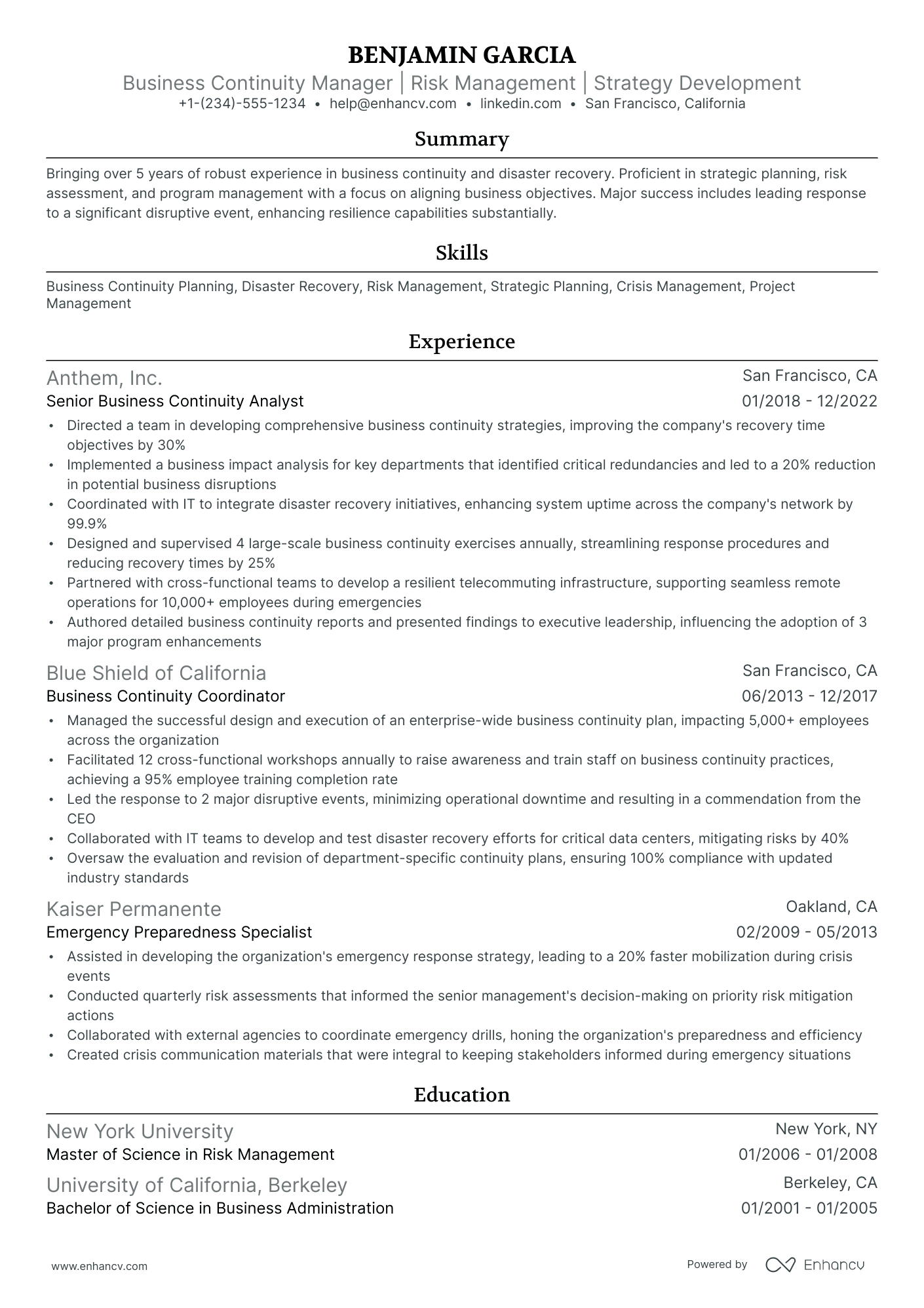
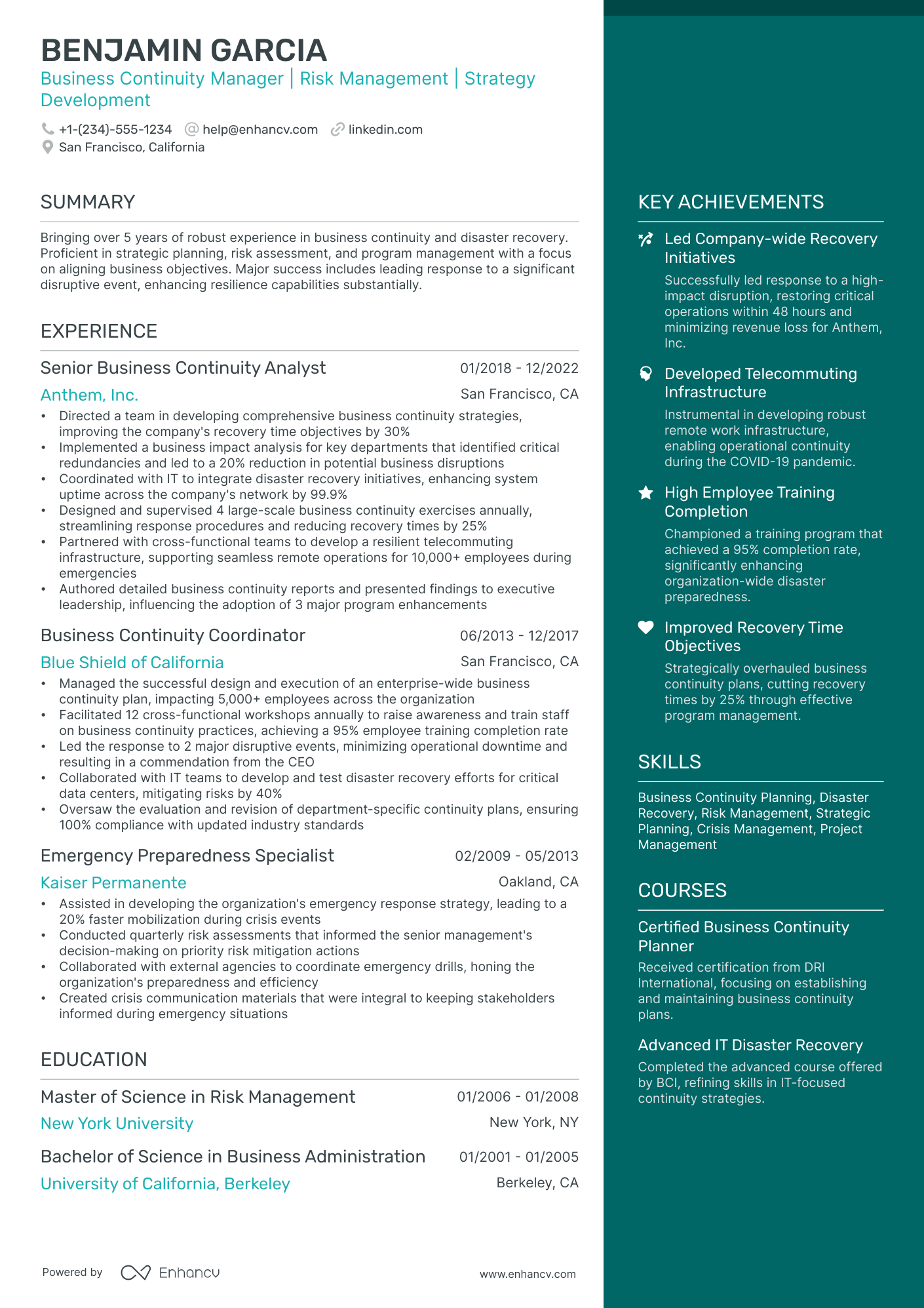
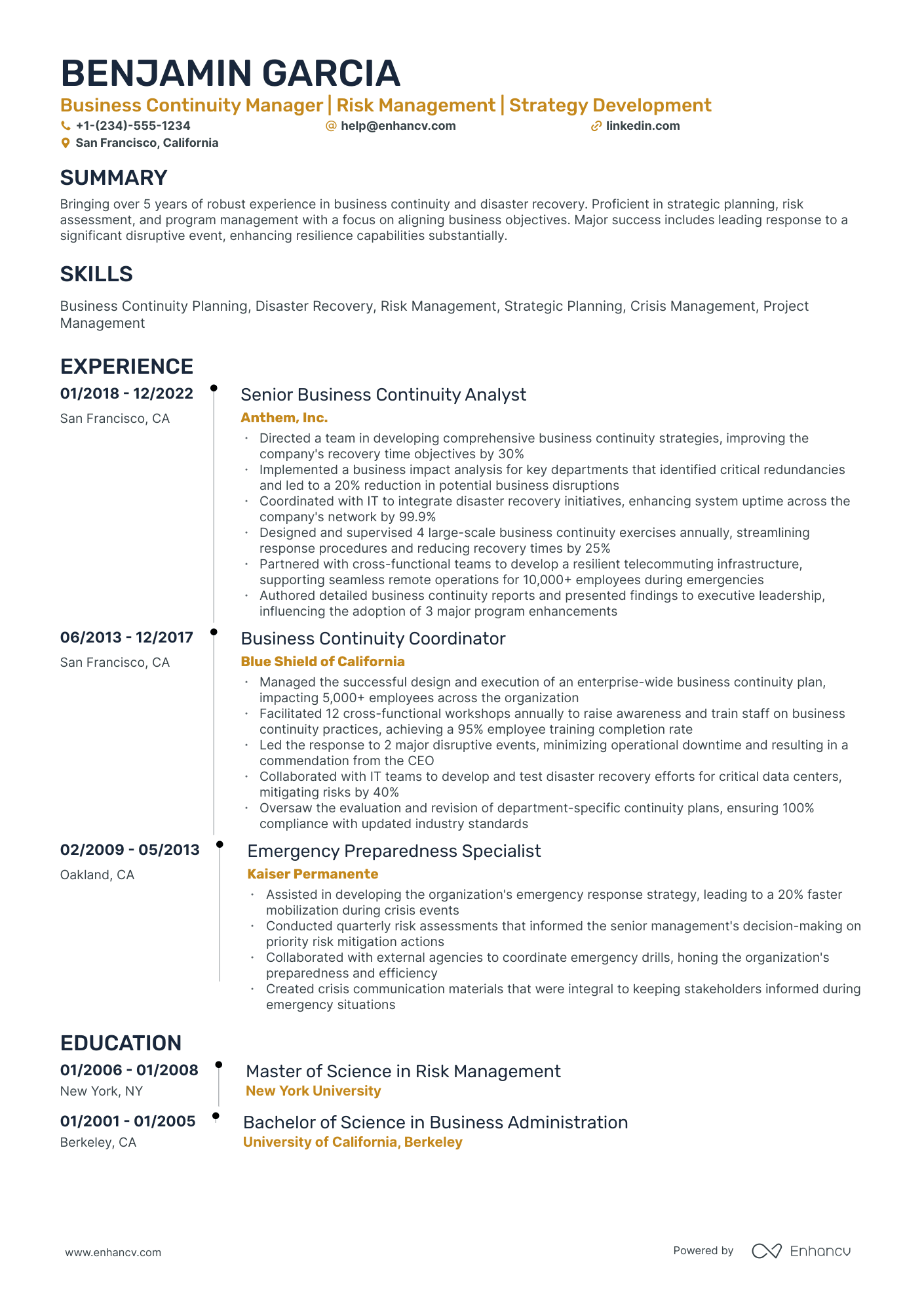
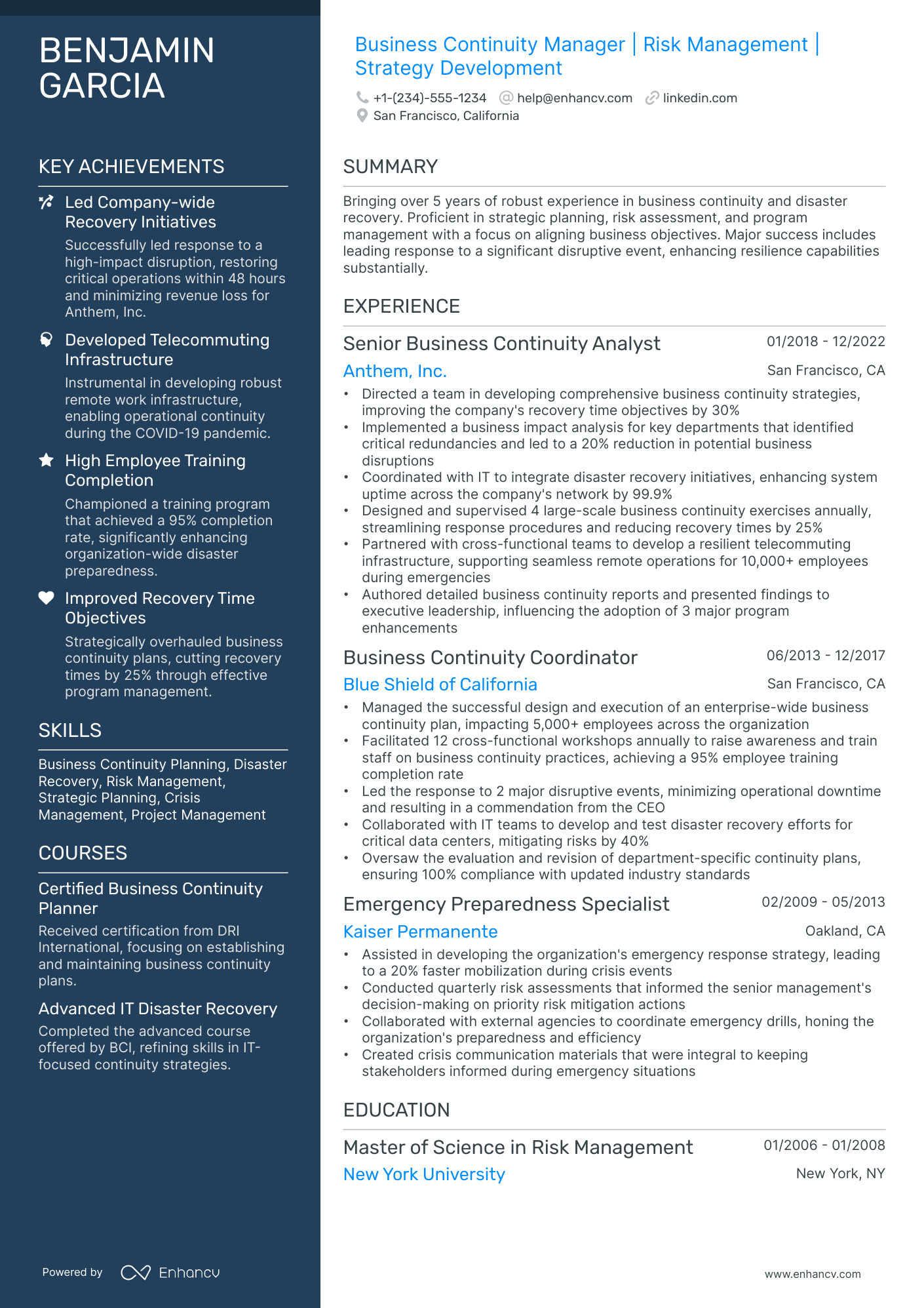
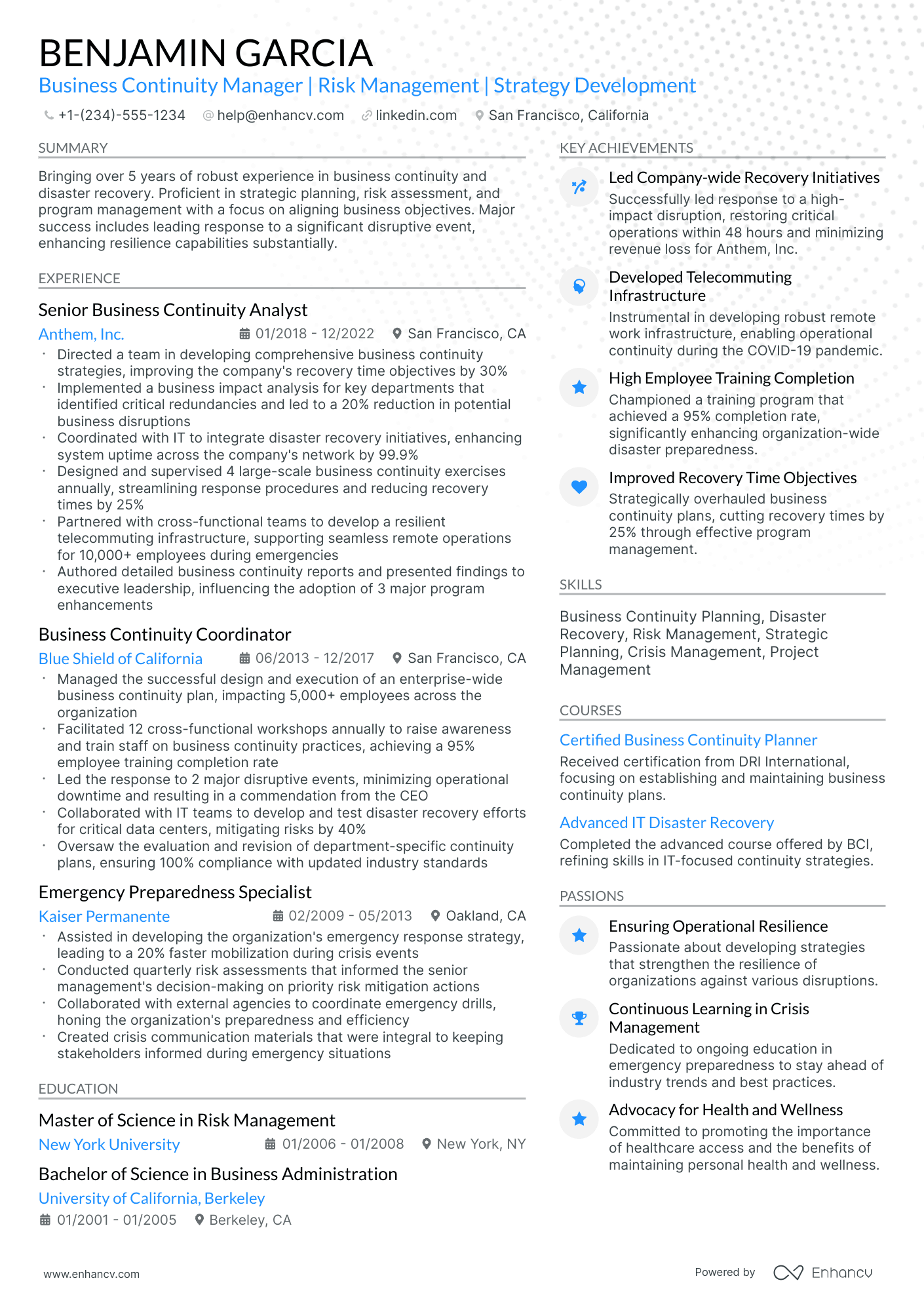
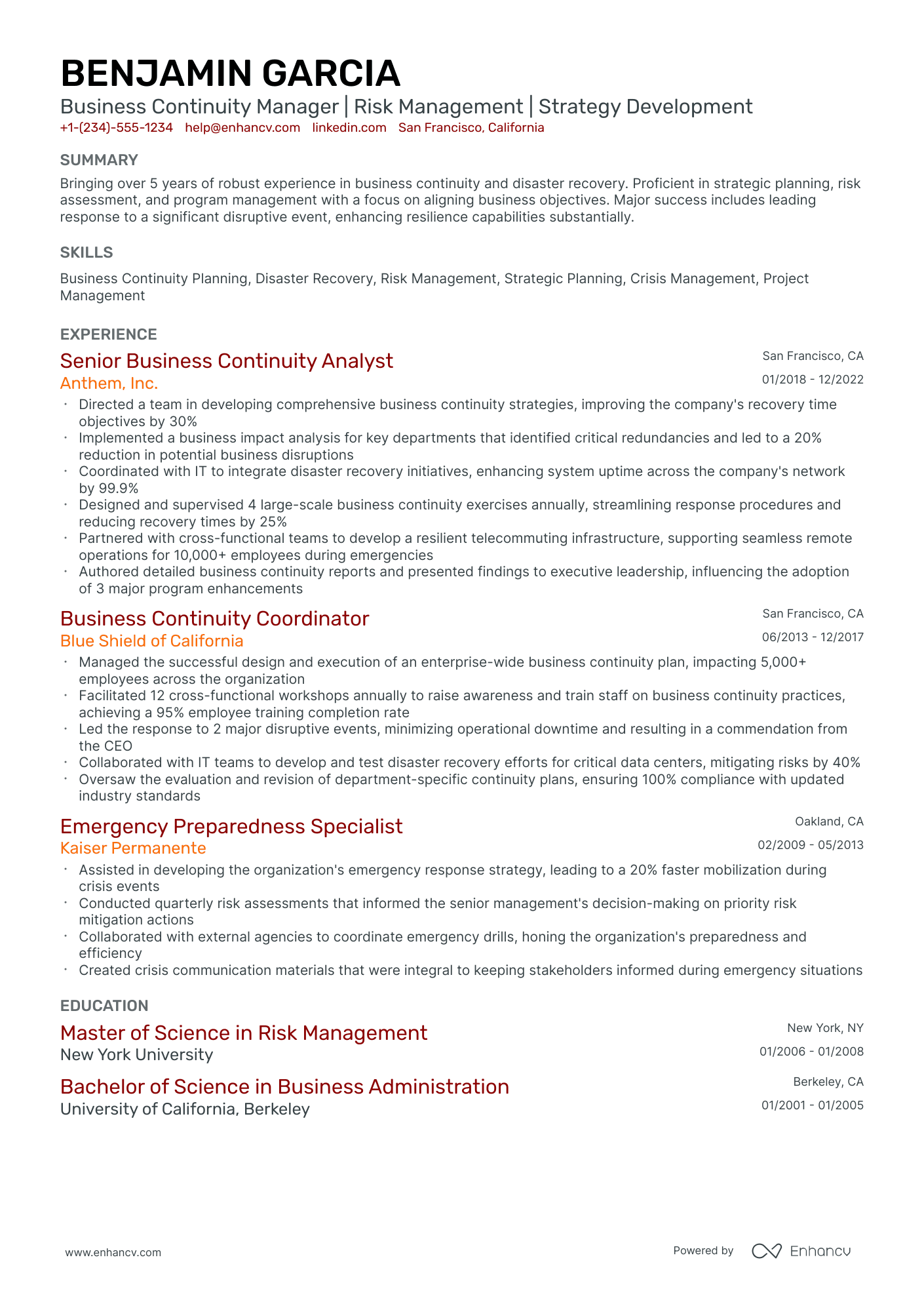
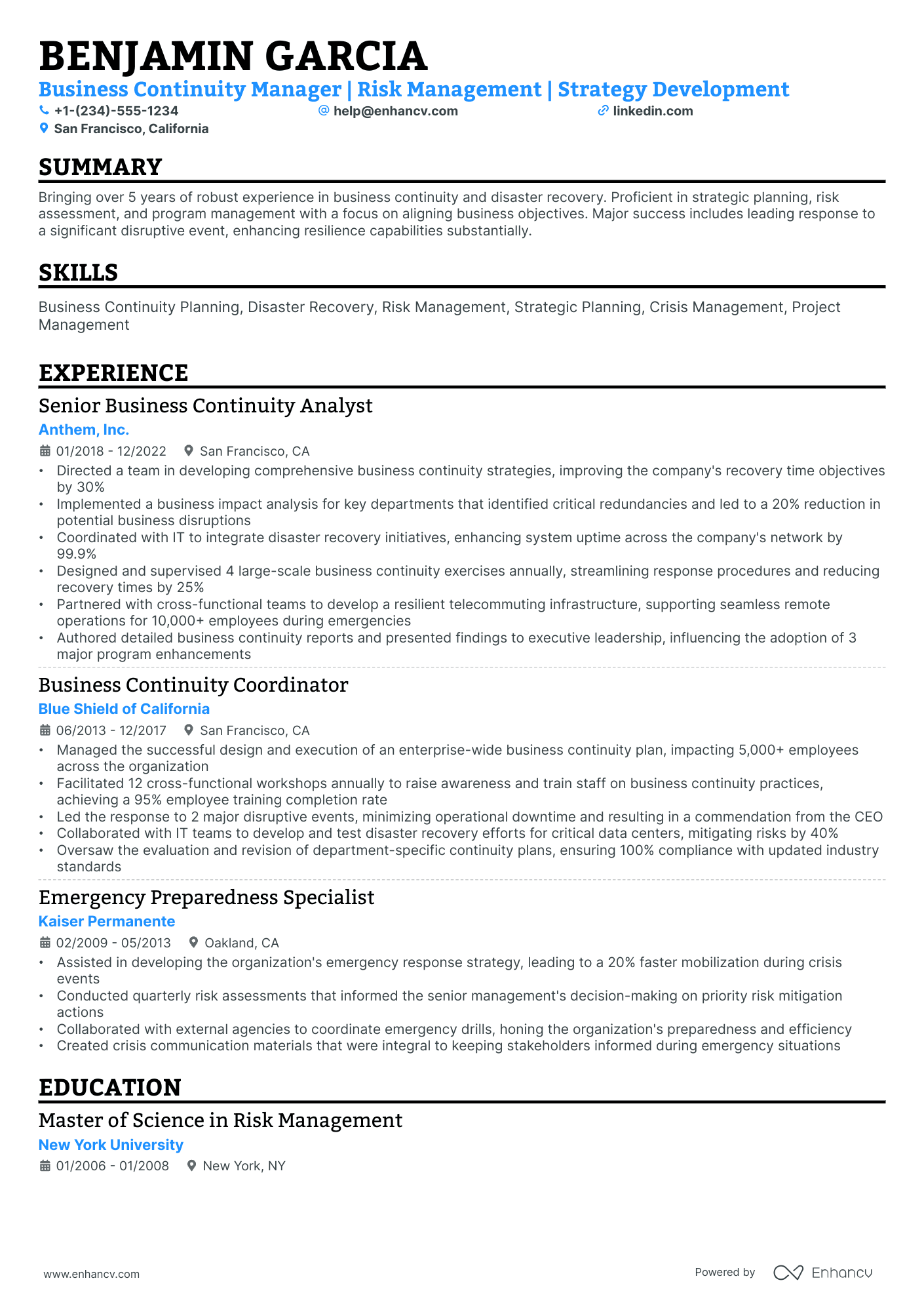
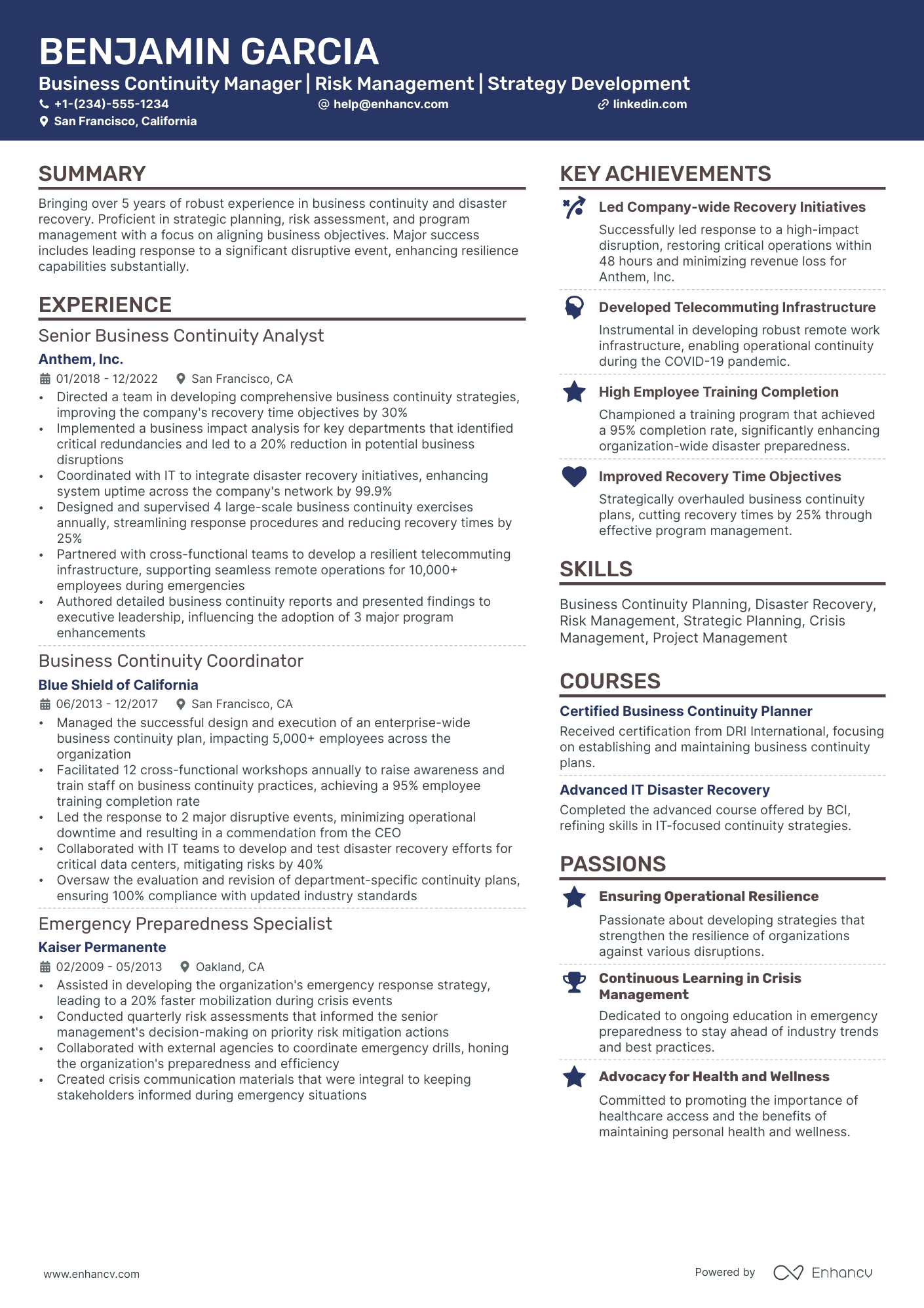
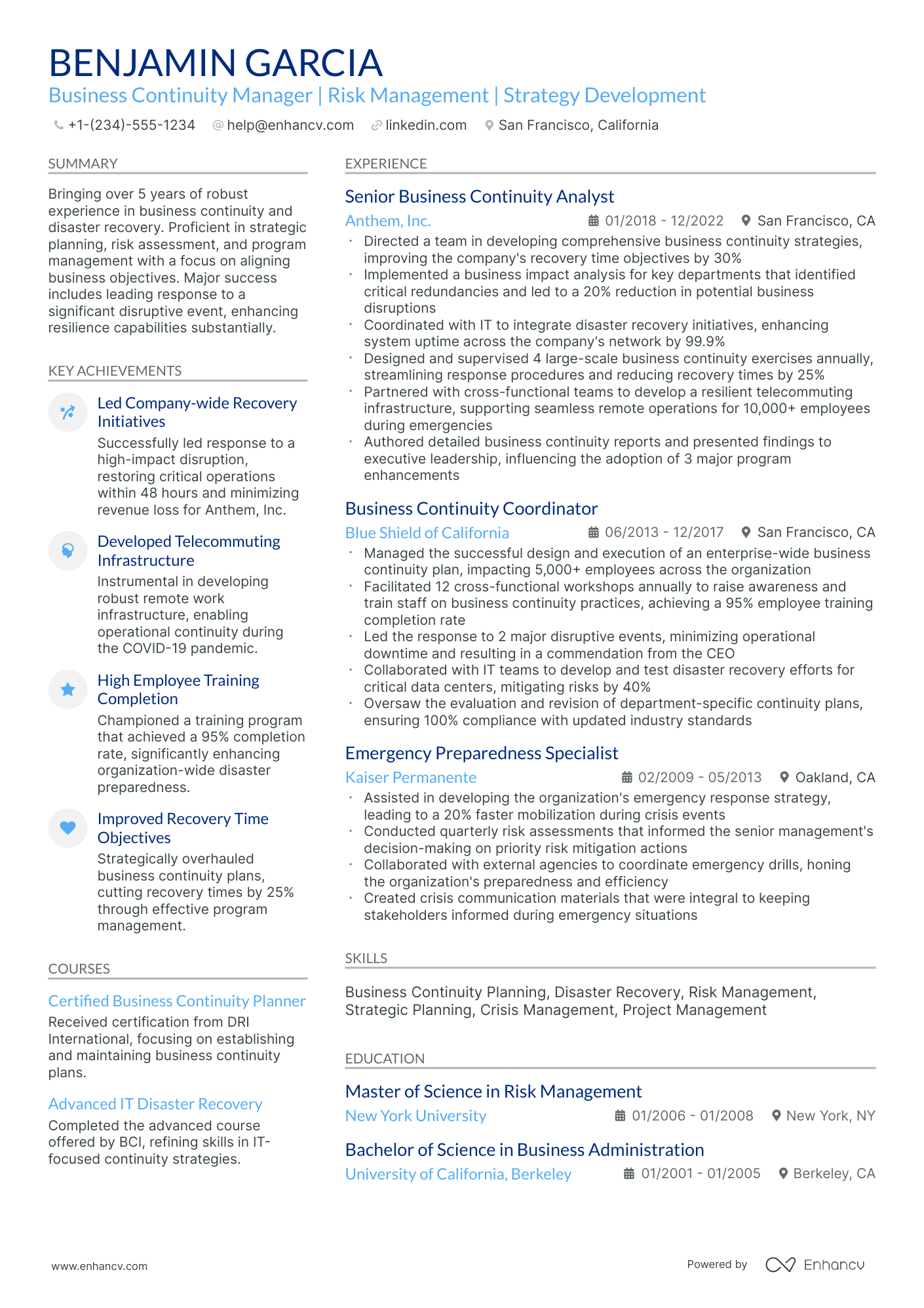
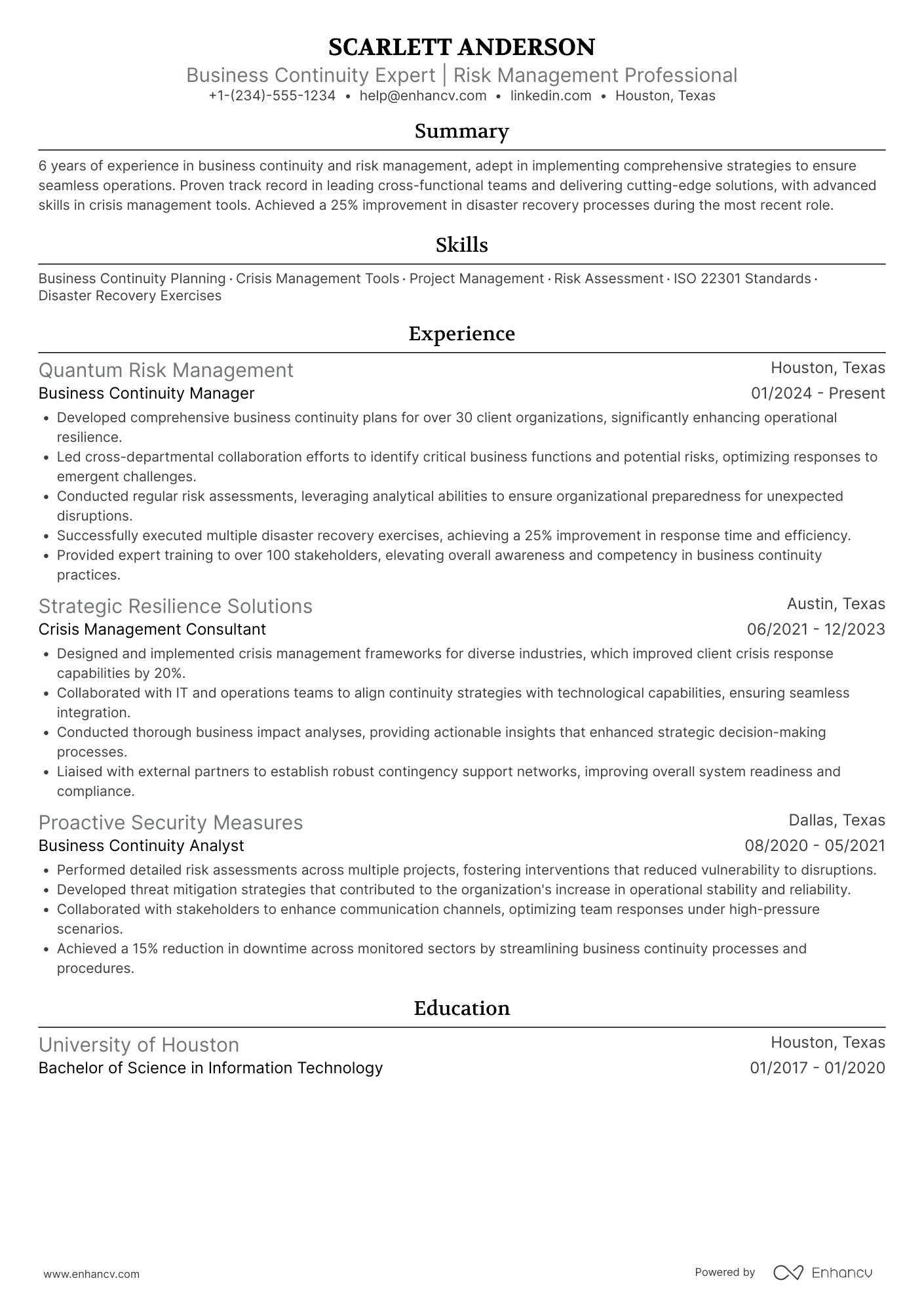
Business continuity manager resume guides often miss the mark because they read like policy manuals. That buries your impact, so an applicant tracking system can't match keywords and recruiters skip past your value in seconds.
A strong resume shows how you protect operations and revenue. Knowing how to make your resume stand out means highlighting measurable reductions in recovery time, tested plans delivered on schedule, audit findings closed, critical systems covered, incident response outcomes, and cross-functional adoption across sites.

Key takeaways
- Use a reverse-chronological format to show clear progression through increasingly complex continuity programs.
- Quantify recovery time, audit results, cost avoidance, and exercise outcomes in every experience bullet.
- Tailor your resume to each job posting by mirroring its exact frameworks, tools, and terminology.
- Anchor every listed skill to a specific project, plan activation, or measurable outcome.
- Place certifications like CBCP or ISO 22301 Lead Implementer where they'll reinforce your strongest qualifications.
- Write a three-to-four-line summary highlighting leadership scope and one or two quantified achievements.
- Use Enhancv to turn routine job duties into measurable, recruiter-ready resume bullets quickly.
How to format a business continuity manager resume
Recruiters evaluating business continuity manager candidates prioritize evidence of enterprise-wide risk mitigation, disaster recovery leadership, and cross-functional coordination that protected organizational operations during disruptions. A reverse-chronological format ensures these signals—program ownership, escalating scope, and measurable resilience outcomes—are immediately visible to both hiring managers and applicant tracking systems. Choosing the right resume layout further strengthens readability and visual hierarchy.

I have significant experience in this role—which format should I use?
Use a reverse-chronological format to showcase your progression through increasingly complex business continuity programs and leadership responsibilities. Do:
- Lead with your most senior role first, emphasizing the scope of continuity programs you owned—number of sites, business units, or employees covered under your plans.
- Highlight domain expertise in business impact analysis (BIA), crisis management frameworks, ISO 22301 compliance, and recovery tools such as Fusion Risk Management, Archer, or ServiceNow BCM.
- Quantify outcomes that demonstrate organizational resilience improvements, cost avoidance, or recovery time reductions tied directly to your decisions.
Why hybrid and functional resumes don't work for senior roles
Hybrid and functional formats fragment your career timeline and obscure the progression from tactical continuity planning into strategic program leadership, making it difficult for reviewers to assess how your accountability and decision-making authority expanded over time. These formats also dilute the impact of enterprise-scale achievements by decoupling results from the specific roles and organizational contexts where you delivered them. Avoid hybrid and functional formats entirely if you have five or more years of dedicated business continuity experience with clear upward movement in scope, team size, or organizational influence.
- Edge-case exception: A functional format may be acceptable only if you're transitioning into business continuity management from a related discipline such as IT disaster recovery, enterprise risk, or emergency management—and only if every listed skill is anchored to a specific project, plan activation, or measurable outcome rather than presented as a standalone competency.
With your layout and structure in place, the next step is deciding which sections to include so each one works together to present a complete picture of your qualifications.
What sections should go on a business continuity manager resume
Recruiters expect a business continuity manager resume to show clear ownership of resilience planning, incident response, and measurable risk reduction. Understanding what to put on a resume ensures you include the right details for this specialized role.
Use this structure for maximum clarity:
- Header
- Summary
- Experience
- Skills
- Projects
- Education
- Certifications
- Optional sections: Awards, Publications, Volunteering
Strong experience bullets should emphasize quantified impact, business scope, recovery time and recovery point improvements, audit results, and outcomes from exercises and real incidents.
Is your resume good enough?
Drop your resume here or choose a file. PDF & DOCX only. Max 2MB file size.
With your resume’s structure in place, the next step is to write your business continuity manager resume experience section so you can fill those sections with role-specific impact.
How to write your business continuity manager resume experience
Your work experience section should prove you've built, tested, and maintained continuity programs that keep organizations operational during disruptions. Hiring managers prioritize demonstrated impact—recovery outcomes achieved, frameworks implemented, and risks mitigated—over descriptive task lists that simply recount daily responsibilities.
Each entry should include:
- Job title
- Company and location (or remote)
- Dates of employment (month and year)
Three to five concise bullet points showing what you owned, how you executed, and what outcomes you delivered:
- Ownership scope: the continuity programs, recovery plans, risk registers, critical business functions, or organizational units you were directly accountable for as a business continuity manager.
- Execution approach: the frameworks, standards, risk assessment methodologies, business impact analysis tools, or crisis management platforms you used to design strategies and drive recovery readiness.
- Value improved: the changes you brought to organizational resilience, recovery time objectives, plan reliability, regulatory compliance posture, or operational risk exposure through your continuity management work.
- Collaboration context: how you partnered with IT disaster recovery teams, executive leadership, compliance officers, facility managers, third-party vendors, or regulatory bodies to align continuity strategies across the organization.
- Impact delivered: the tangible outcomes your work produced, expressed through recovery capability improvements, audit results, downtime reductions, compliance milestones, or enterprise-wide adoption of continuity practices rather than routine activity descriptions.
Experience bullet formula
A business continuity manager experience example
✅ Right example - modern, quantified, specific.
Business Continuity Manager
NorthBridge Payments | Austin, TX
2021–Present
Fintech payments platform processing eight million transactions per day across North America.
- Led enterprise Business Impact Analysis (BIA) and recovery strategy refresh across six business units using Fusion Risk Management, reducing critical process Recovery Time Objective (RTO) by 35% and aligning Recovery Point Objective (RPO) targets to sub-one-hour for tier-one services.
- Built and maintained ISO 22301-aligned business continuity program, closing twenty-two audit findings and improving internal control pass rate from 84% to 98% in partnership with HR, legal, and information security.
- Orchestrated quarterly disaster recovery and cyber recovery exercises for AWS, Kubernetes, and PostgreSQL workloads using runbooks in Confluence and Jira, cutting failover time from ninety minutes to twenty-eight minutes and achieving a 100% success rate across four consecutive tests.
- Implemented crisis management and mass notification workflows in Everbridge, integrating with ServiceNow incident management to reduce stakeholder notification time by 70% and standardize executive updates within fifteen minutes of severity-one events.
- Negotiated continuity requirements with eight critical vendors, adding service level agreements, resilience testing clauses, and evidence collection, which reduced third-party concentration risk score by 30% and prevented two high-risk renewals from auto-approving.
Now that you've seen what a strong experience section looks like in practice, let's break down how to customize yours for each specific job posting.
How to tailor your business continuity manager resume experience
Recruiters evaluate your business continuity manager resume through both human review and applicant tracking systems. Tailoring your resume to the job description increases your chances of passing both screenings.
Ways to tailor your business continuity manager experience:
- Mirror the exact business continuity standards or frameworks listed in the posting.
- Match disaster recovery tools or platforms the employer specifically names.
- Reference the same risk assessment methodologies outlined in the job description.
- Highlight business impact analysis experience when the role requires it.
- Include industry-specific continuity planning relevant to the employer's sector.
- Align your recovery time objectives with the KPIs the posting prioritizes.
- Emphasize regulatory compliance areas the job description explicitly mentions.
- Use the same terminology for crisis communication workflows they describe.
Tailoring means aligning your real accomplishments with what the role demands, not forcing keywords where they don't belong.
Resume tailoring examples for business continuity manager
| Job description excerpt | Untailored | Tailored |
|---|---|---|
| "Develop and maintain business impact analyses (BIA) and risk assessments across all critical business units to ensure organizational resilience." | Helped with risk management and business planning activities. | Conducted business impact analyses and risk assessments across 12 critical business units, identifying recovery priorities that reduced potential downtime exposure by 40%. |
| "Lead the design, execution, and evaluation of annual BC/DR tabletop exercises and full-scale simulations using Fusion Risk Management platform." | Participated in disaster recovery testing and helped coordinate exercises. | Led design and execution of eight annual BC/DR tabletop exercises and full-scale simulations through Fusion Risk Management, achieving 95% stakeholder participation and resolving 30+ plan gaps. |
| "Coordinate crisis communication protocols and cross-functional incident response aligned with ISO 22301 standards." | Worked on communication plans and helped teams respond to incidents. | Developed ISO 22301-aligned crisis communication protocols and coordinated cross-functional incident response across five departments, cutting average escalation time from 45 minutes to 12 minutes. |
Once you’ve aligned your experience with the role’s priorities, quantify those achievements to show the measurable impact behind each example.
How to quantify your business continuity manager achievements
Quantifying your achievements proves your plans reduced downtime and risk, not just produced documents. Focus on recovery time objectives, recovery point objectives, audit outcomes, incident impact, and cost avoided across critical systems and vendors.
Quantifying examples for business continuity manager
| Metric | Example |
|---|---|
| Recovery time | "Cut payment platform recovery time objective from eight hours to two hours by redesigning runbooks and automating failover checks in ServiceNow." |
| Data loss | "Improved recovery point objective from four hours to fifteen minutes for Tier one databases by coordinating replication testing with infrastructure and vendors." |
| Exercise cadence | "Led twelve tabletop exercises and two full failover tests across five sites, raising on-time corrective action closure from 62% to 93%." |
| Compliance | "Achieved zero major findings across two ISO 22301 surveillance audits by updating business impact analyses and evidence in Archer." |
| Cost avoidance | "Avoided $1.2M in outage losses by prioritizing thirty critical applications and aligning incident response playbooks with IT and customer support." |
Turn vague job duties into measurable, recruiter-ready resume bullets in seconds with Enhancv's Bullet Point Generator.
Once you've crafted strong, achievement-driven bullet points, the next step is ensuring your resume also highlights the right mix of hard and soft skills that business continuity manager roles demand.
How to list your hard and soft skills on a business continuity manager resume
Your skills section shows you can protect critical services during disruptions, and recruiters and an ATS (applicant tracking system) scan this section to confirm fit fast—aim for a hard-skill-heavy mix supported by role-specific soft skills. business continuity manager roles require a blend of:
- Product strategy and discovery skills.
- Data, analytics, and experimentation skills.
- Delivery, execution, and go-to-market discipline.
- Soft skills.
Your skills section should be:
- Scannable (bullet-style grouping).
- Relevant to the job post.
- Backed by proof in experience bullets.
- Updated with current tools.
Place your skills section:
- Above experience if you're junior or switching careers.
- Below experience if you're mid/senior with strong achievements.

Hard skills
- Business impact analysis
- Risk assessments and controls
- Business continuity plans
- Disaster recovery planning
- Incident command system
- Crisis communications plans
- Tabletop exercises, simulations
- ISO 22301, NIST
- ITIL service continuity
- Third-party risk management
- RTO/RPO definition
- GRC tools: ServiceNow, Archer
Soft skills
- Lead cross-functional incident response
- Make time-critical decisions
- Escalate risks with clarity
- Align stakeholders on priorities
- Facilitate executive briefings
- Drive plan adoption and compliance
- Coordinate vendors under pressure
- Negotiate recovery tradeoffs
- Document actions and outcomes
- Run post-incident retrospectives
- Maintain calm, direct communication
- Hold owners accountable to deadlines
How to show your business continuity manager skills in context
Skills shouldn't live only in a dedicated skills list. Explore resume skills examples to see how continuity professionals weave competencies throughout their resumes.
They should be demonstrated in:
- Your summary (high-level professional identity)
- Your experience (proof through outcomes)
Here's what that looks like in practice.
Summary example
Senior business continuity manager with 12 years in financial services. Skilled in BIA, ISO 22301, and crisis communications. Led enterprise recovery program redesign that cut RTO by 40% across 15 critical functions.
- Reflects senior-level expertise clearly
- Names industry-standard frameworks and tools
- Quantifies recovery time improvement
- Signals leadership and communication ability
Experience example
Business Continuity Manager
Ridgeline Federal Credit Union | Charlotte, NC
March 2019–Present
- Designed and executed 22 business impact analyses using Fusion Framework, reducing recovery gaps by 35% across four business divisions.
- Partnered with IT, compliance, and operations teams to implement ISO 22301-aligned continuity plans covering 90% of critical services.
- Led quarterly tabletop exercises for 120+ staff, improving incident response readiness scores by 28% year over year.
- Every bullet includes measurable proof
- Skills surface naturally through real outcomes
Once you’ve tied your business continuity manager abilities to real outcomes and situations, the next step is to apply the same approach to building a business continuity manager resume with no experience by highlighting transferable work and measurable results.
How do I write a business continuity manager resume with no experience
Even without full-time experience, you can demonstrate readiness through transferable projects and relevant training. If you're building a resume without work experience, focus on these activities:
- University continuity planning capstone project
- Internship supporting risk assessments
- Volunteer emergency response coordination role
- ISO 22301 training and exercises
- Tabletop exercise design and facilitation
- Disaster recovery plan documentation practice
- Business impact analysis case study work
- Crisis communications plan draft portfolio
Focus on:
- Business impact analysis and priorities
- Incident response plans and runbooks
- ISO 22301-aligned documentation samples
- Exercise results with measurable improvements
Resume format tip for entry-level business continuity manager
Use a hybrid resume format because it highlights projects and skills while still showing internships, coursework, and volunteer work in a clear timeline. Do:
- Add a "Projects" section near the top.
- Quantify outcomes from exercises and analyses.
- List tools like ServiceNow and Jira.
- Include ISO 22301, business impact analysis, and tabletop exercises.
- Attach work samples as portfolio links.
- Built a business impact analysis in Excel and mapped recovery time objectives for five processes, reducing tabletop exercise recovery gaps by 30% through updated runbooks.
Once you've positioned your transferable skills and relevant knowledge to offset limited professional experience, the next step is ensuring your education section reinforces your qualifications for the role.
How to list your education on a business continuity manager resume
Your education section helps hiring teams confirm you hold the foundational knowledge needed for a business continuity manager role. It validates your academic background quickly and effectively.
Include:
- Degree name
- Institution
- Location
- Graduation year
- Relevant coursework (for juniors or entry-level candidates)
- Honors & GPA (if 3.5 or higher)
Skip month and day details—list the graduation year only.
Here's a strong education entry tailored to the business continuity manager role.
Example education entry
Bachelor of Science in Emergency Management
Georgetown University, Washington, D.C.
Graduated 2019
GPA: 3.7/4.0
- Relevant coursework: Crisis Communication, Disaster Recovery Planning, Risk Analysis, and Organizational Resilience
- Graduated magna cum laude
How to list your certifications on a business continuity manager resume
Certifications on your resume show your commitment to learning, proficiency with continuity tools, and relevance to business continuity standards and regulations in a business continuity manager role. Include:
- Certificate name
- Issuing organization
- Year
- Optional: credential ID or URL
- Place certifications below education when your degree is recent and your certifications are older or less relevant to business continuity manager work.
- Place certifications above education when they are recent, highly relevant, or required, and they strengthen your business continuity manager qualifications immediately.
Best certifications for your business continuity manager resume
Certified Business Continuity Professional (CBCP) Associate Business Continuity Professional (ABCP) Certified Information Systems Security Professional (CISSP) Certified Information Security Manager (CISM) Certified in Risk and Information Systems Control (CRISC) ITIL 4 Foundation ISO 22301 Lead Implementer
Once you’ve positioned your credentials where hiring teams can quickly verify them, shift to writing your business continuity manager resume summary to connect those qualifications to your value in a clear opening statement.
How to write your business continuity manager resume summary
Your resume summary is the first thing a recruiter reads, so it must instantly communicate your value. A strong opening positions you as a qualified business continuity manager before the rest of your resume is even scanned.
Keep it to three to four lines, with:
- Your title and total years of experience in business continuity or related fields.
- Domain expertise such as disaster recovery, risk management, or crisis response.
- Core frameworks and tools like ISO 22301, business impact analysis, or crisis management platforms.
- One or two quantified achievements that demonstrate measurable organizational impact.
- Soft skills tied to real outcomes, such as cross-functional coordination or executive communication.

PRO TIP
At this level, lead with outcomes and strategic ownership rather than listing responsibilities. Highlight how you've shaped continuity programs, reduced organizational risk, or influenced executive decisions. Avoid generic phrases like "results-driven professional" or "passionate leader." Instead, show scope—team size, budget, number of sites covered, or recovery time improvements. Recruiters want proof of impact, not motivation.
Example summary for a business continuity manager
Business continuity manager with eight years leading enterprise resilience programs across 30+ global sites. Reduced recovery time objectives by 40% through ISO 22301 implementation and cross-departmental tabletop exercises.
Optimize your resume summary and objective for ATS
Drop your resume here or choose a file.
PDF & DOCX only. Max 2MB file size.
Now that your summary captures your expertise and value, make sure your header presents the essential contact and professional details recruiters need to reach you.
What to include in a business continuity manager resume header
Your resume header lists your key identity and contact details, and it boosts visibility, credibility, and recruiter screening for a business continuity manager role.
Essential resume header elements
- Full name
- Tailored job title and headline
- Location
- Phone number
- Professional email
- GitHub link
- Portfolio link
A LinkedIn link helps recruiters verify experience quickly and supports screening.
Do not include photos on a business continuity manager resume unless the role is explicitly front-facing or appearance-dependent.
Match your header title and headline to the job posting and include only links that reflect continuity planning, risk work, or technical documentation.
Example
Business continuity manager resume header
Jordan Lee
Business continuity manager | Business continuity planning, crisis response, and disaster recovery
Austin, TX
(512) 555-01XX
your.name@enhancv.com
github.com/yourname
yourwebsite.com
linkedin.com/in/yourname
Once your contact details and role are clearly presented at the top, add relevant optional sections to strengthen your business continuity manager resume and provide supporting context.
Additional sections for business continuity manager resumes
When your core qualifications closely match other candidates, additional sections can set you apart by showcasing role-specific credibility and expertise. For example, listing language skills can demonstrate your ability to coordinate continuity efforts across global teams and multilingual stakeholders.
- Languages
- Industry certifications and professional development
- Publications and white papers
- Conference presentations and speaking engagements
- Professional associations and memberships
- Volunteer disaster response and crisis management experience
Once you've strengthened your resume with relevant additional sections, it's worth pairing it with a cover letter to further set your application apart.
Do business continuity manager resumes need a cover letter
A cover letter isn't required for a business continuity manager, but it often helps in competitive searches or organizations with strict hiring expectations. If you're unsure what a cover letter is and how it complements your resume, it's worth learning before you apply. It can make a difference when your resume needs context, or when multiple candidates meet the same baseline requirements.
Use a cover letter to add targeted context:
- Explain role and team fit: Connect your experience to the org's operating model, risk profile, and stakeholders, including IT, security, and operations.
- Highlight one or two relevant projects or outcomes: Name a recovery time objective improvement, audit result, exercise outcome, or incident response lesson learned.
- Show understanding of the product, users, or business context: Reference critical services, customer impact, regulatory exposure, and the cost of downtime.
- Address career transitions or non-obvious experience: Translate adjacent work, such as compliance or program management, into business continuity manager responsibilities and outcomes.
Drop your resume here or choose a file.
PDF & DOCX only. Max 2MB file size.
Once you’ve decided how a cover letter fits into your application strategy, the next step is using AI to improve your business continuity manager resume so it better matches the role’s requirements.
Using AI to improve your business continuity manager resume
AI can sharpen your resume's clarity, structure, and impact. It helps tighten language and highlight results. But overuse dulls authenticity. Once your content is clear and role-aligned, step away from AI. If you're wondering which AI is best for writing resumes, start with tools designed specifically for resume optimization.
Here are 10 practical prompts to strengthen specific sections of your business continuity manager resume:
Strengthen your summary
Quantify experience bullets
Tighten action verbs
Align with job posting
Refine technical skills
Clarify project descriptions
Improve certification framing
Remove filler language
Enhance education relevance
Tailor for ATS readability
Conclusion
A strong business continuity manager resume shows measurable outcomes, role-specific skills, and a clear structure. It highlights recovery time objectives, risk assessments, incident response, testing results, and stakeholder coordination with specific numbers.
Keep sections scannable and focused on impact, with crisp bullets and consistent formatting. This approach fits today’s hiring market and supports near-future needs across hybrid operations, third-party risk, and regulatory expectations.