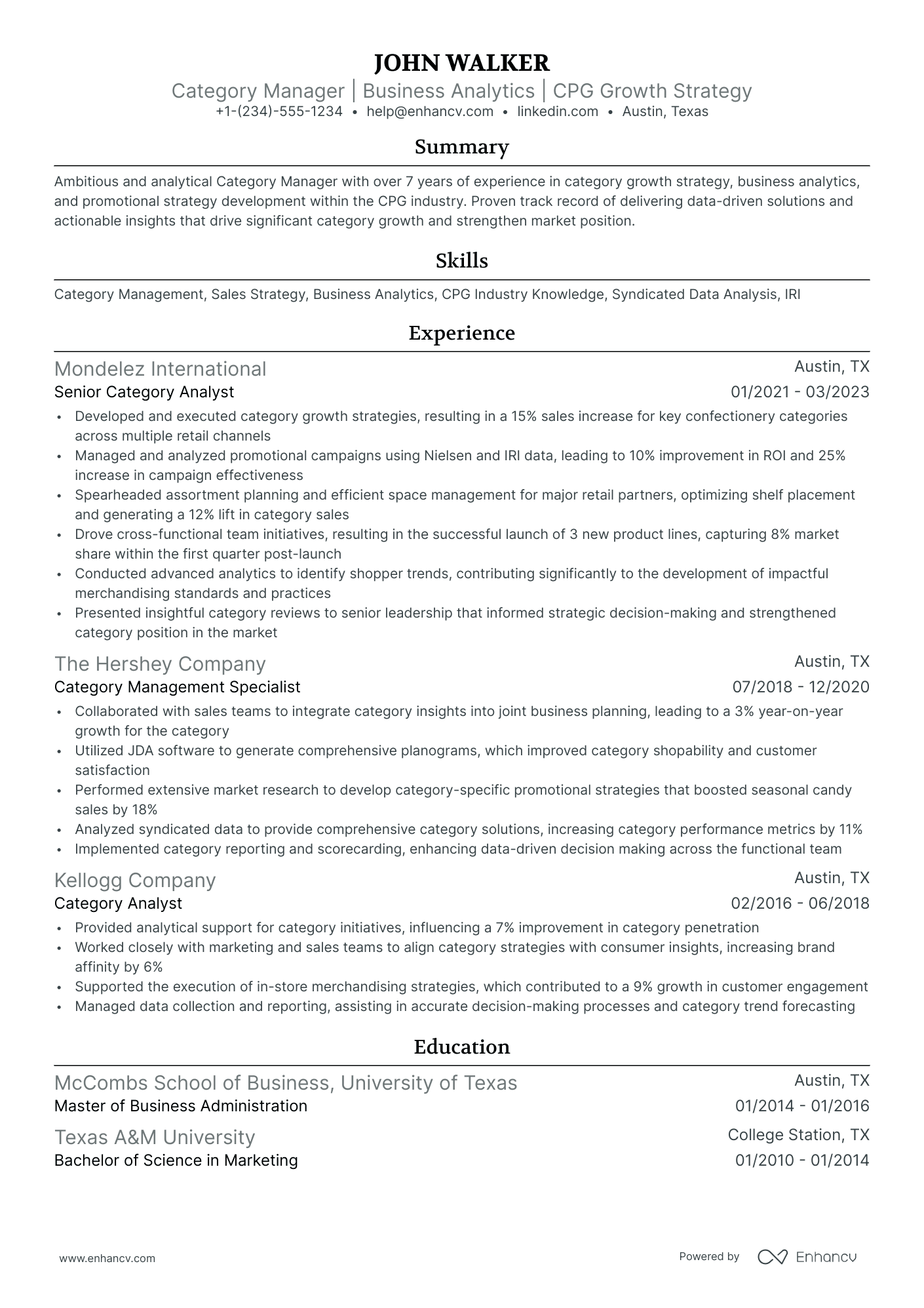
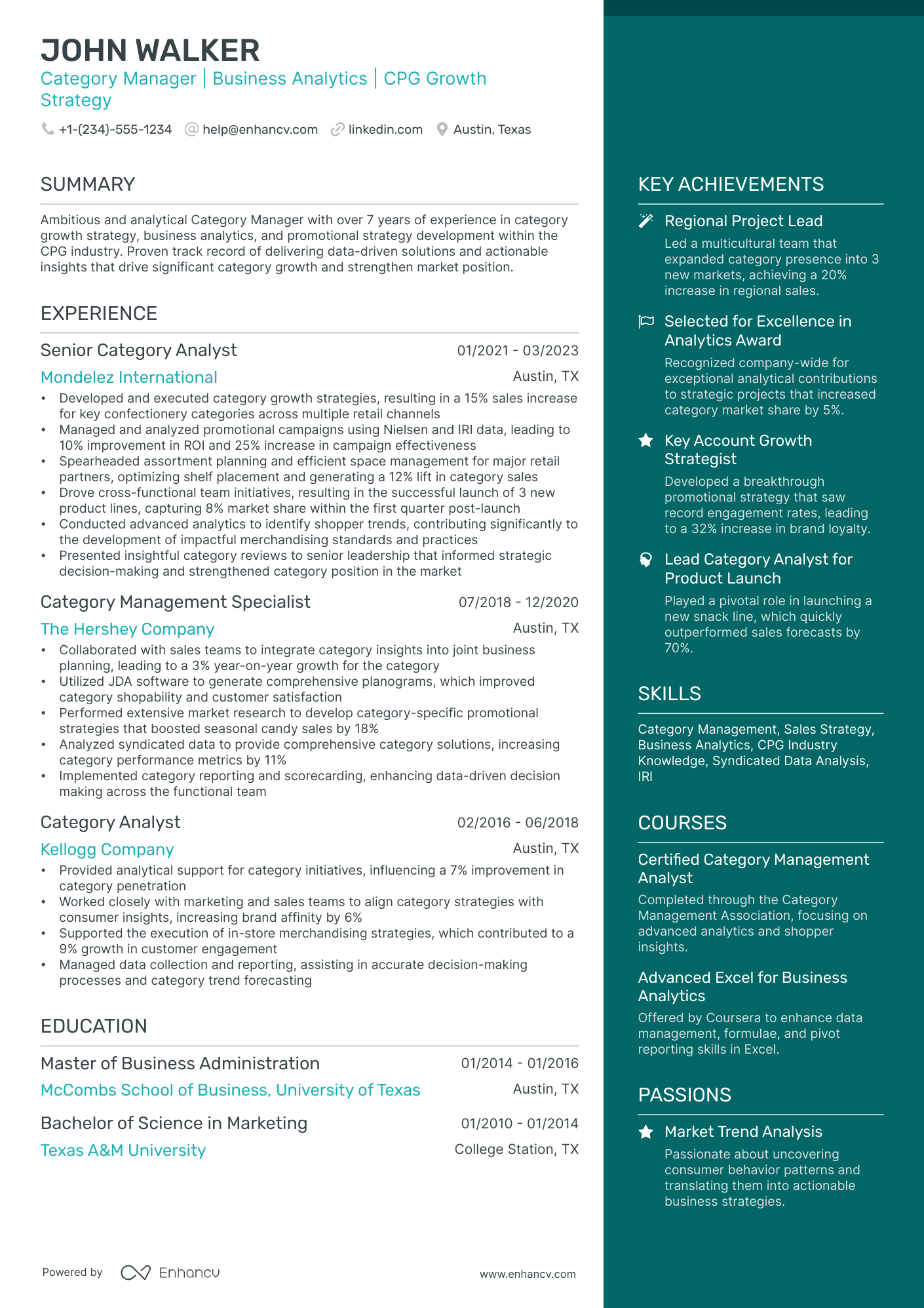
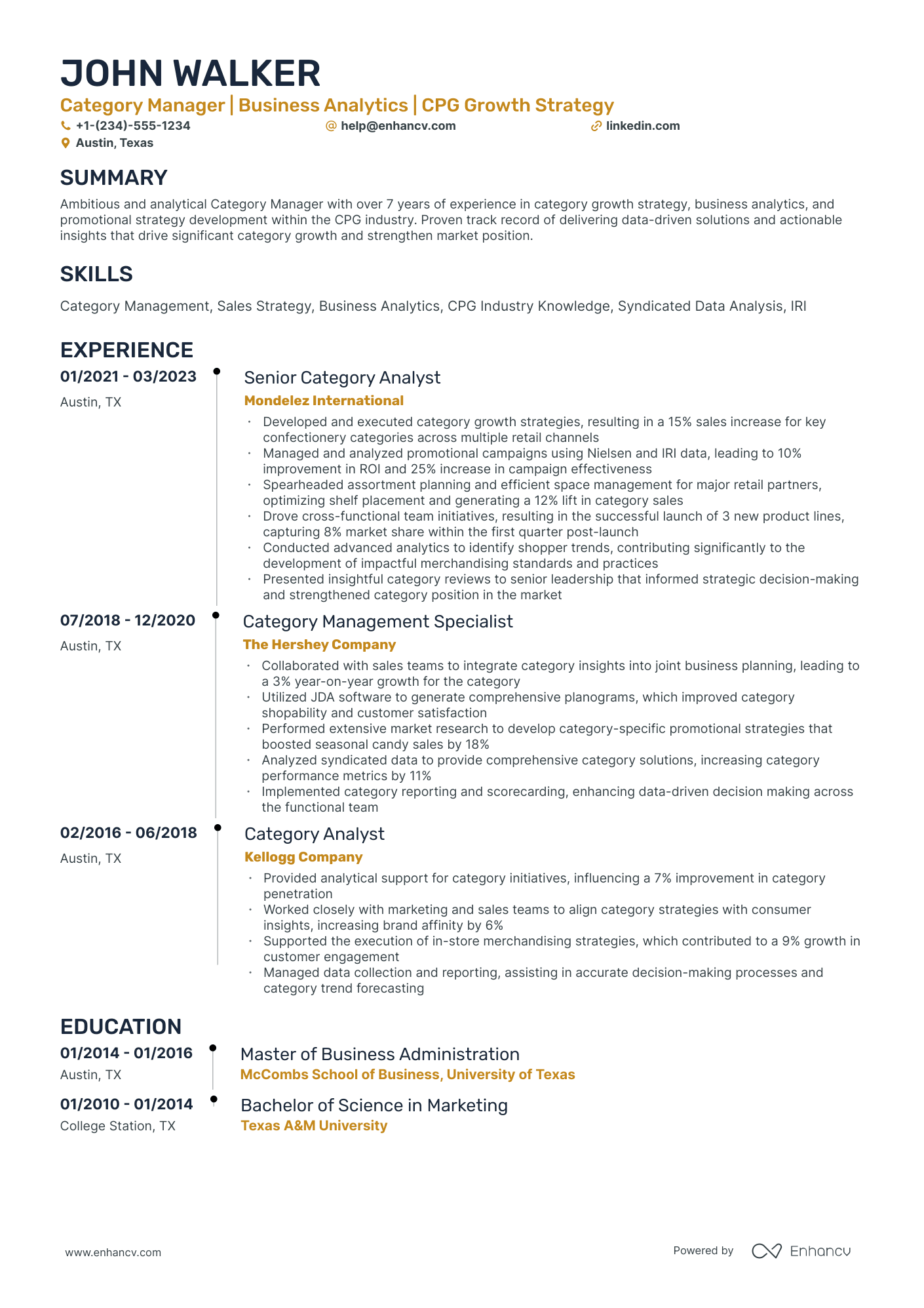
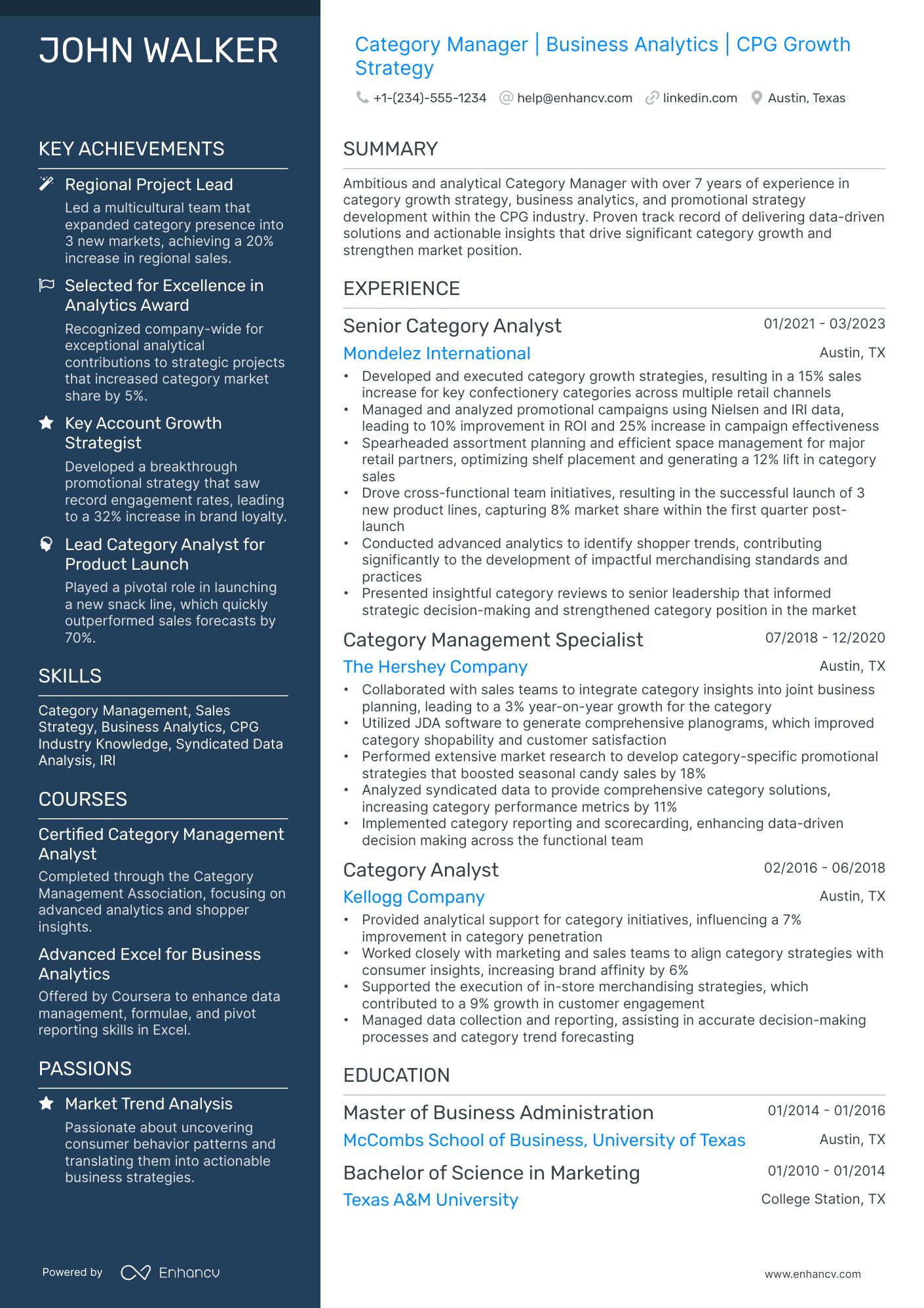
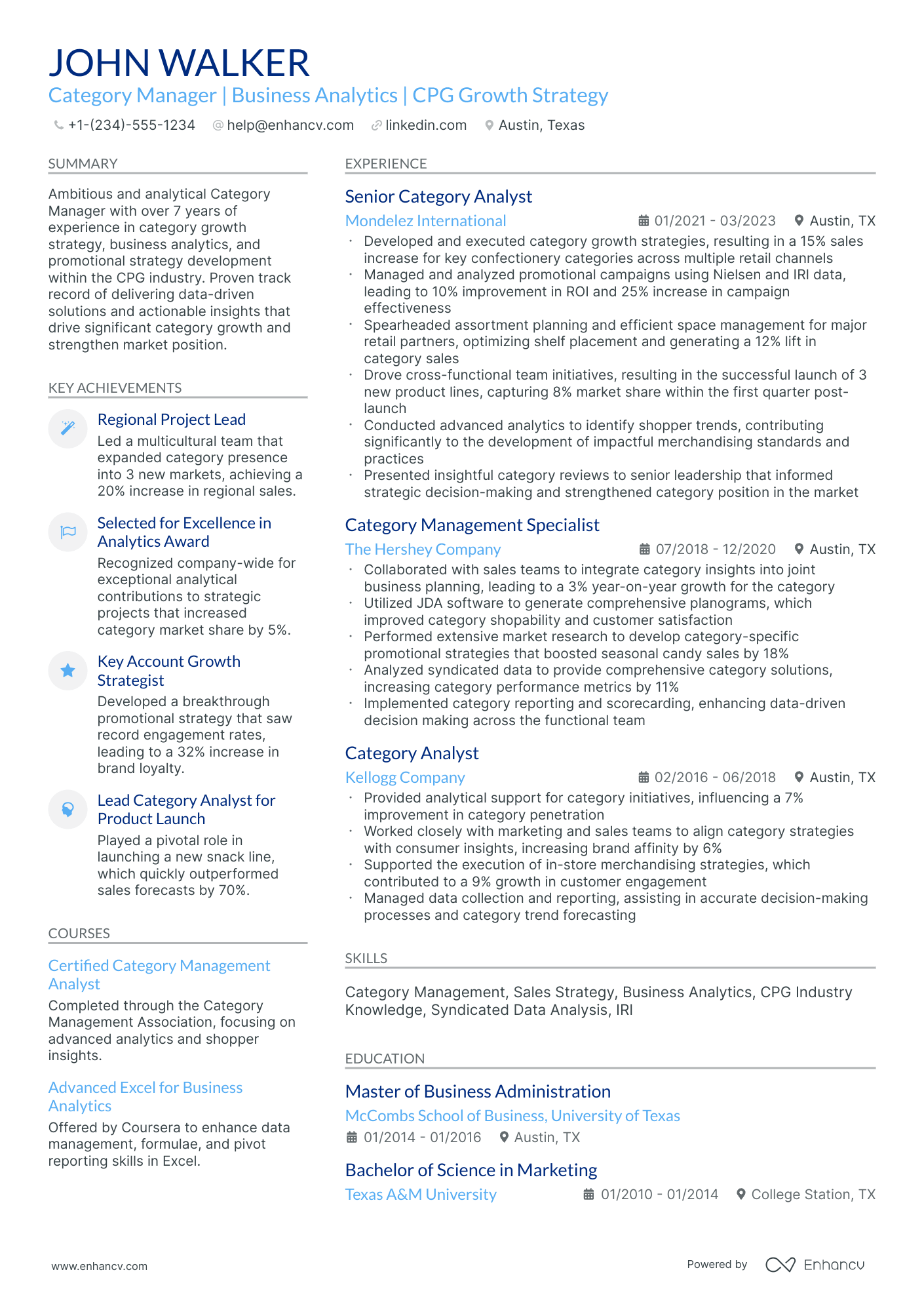

Many category manager resume drafts describe supplier meetings and reports but leave out the savings and margin those efforts produced. Recruiters scan quickly, and applicant tracking system (ATS) filters look for sourcing and negotiation results.
A resume that stands out from other candidates leads with category results. Show the savings you negotiated, margin gains, supplier performance, sales growth in your categories, and the contracts you rebuilt.

Key takeaways
- Lead each bullet with savings, margin, or category sales results.
- Use reverse-chronological order to show growing category scope and spend.
- Name the categories, spend levels, and suppliers you managed.
- Mirror each posting's terms for sourcing, RFPs, and category strategy.
- Quantify negotiations with dollar savings and contract terms.
- Use Enhancv's Bullet Point Generator to turn sourcing work into measurable bullets.
Job market snapshot for category managers
We analyzed 900 recent category manager job ads from major US job boards. Manufacturing companies posted 26.4% of them, and retail and e-commerce employers posted 21.3%. Among ads that state a number, five to six years is the most common requirement (21.7%). Use the data to understand what employers expect, pick the industries worth targeting, size up the level, and see who's hiring.
What level of experience employers are looking for in category managers
| Years of Experience | Percentage found in job ads |
|---|---|
| 1–2 years | 5.7% (51) |
| 3–4 years | 13.6% (122) |
| 5–6 years | 21.7% (195) |
| 7–8 years | 16.6% (149) |
| 10+ years | 10.2% (92) |
| Not specified | 32.3% (291) |
Category manager ads by area of specialization (industry)
| Industry (Area) | Percentage found in job ads |
|---|---|
| Manufacturing | 26.4% (238) |
| Retail & e-commerce | 21.3% (192) |
| Healthcare | 11.3% (102) |
| Professional services | 8.4% (76) |
| Media & entertainment | 8.1% (73) |
| Technology | 5.6% (50) |
| Energy | 5.4% (49) |
| Finance & insurance | 3.4% (31) |
| Travel & hospitality | 3.1% (28) |
| Real estate & construction | 1.9% (17) |
Top companies hiring category managers
| Company | Percentage found in job ads |
|---|---|
| TikTok | 6.7% (60) |
| Amazon | 3.2% (29) |
| Vizient | 2.4% (22) |
| Lockheed Martin Corporation | 2.3% (21) |
| Eaton Corporation | 2.1% (19) |
| Sazerac Company | 1.9% (17) |
| Circle K Stores | 1.6% (14) |
| Kroger | 1.2% (11) |
| Motorola Solutions | 1.1% (10) |
| 1.1% (10) |
Role overview stats
The tables below show what category managers handle most often and where they work. Negotiating contracts and pricing appears in 80.8% of ads, and developing and executing category strategies appears in 71.6%. Lead with the duties you've owned, and note that 75.7% of roles are on-site.
Day-to-day activities and top responsibilities for a category manager
| Responsibility | Percentage found in job ads |
|---|---|
| Negotiate contracts and pricing | 80.8% (727) |
| Partner with business stakeholders | 73.7% (663) |
| Develop and execute category strategies | 71.6% (644) |
| Lead sourcing and RFP processes | 59.8% (538) |
| Manage supplier relationships and performance | 54.7% (492) |
| Analyze spend and market trends | 50.3% (453) |
| Track category KPIs and reviews | 46.3% (417) |
| Ensure procurement compliance | 41.6% (374) |
| Drive cost savings | 39.9% (359) |
| Drive supplier innovation | 37.9% (341) |
| Forecast demand and manage inventory | 34.2% (308) |
| Plan assortment and product mix | 27.0% (243) |
Type of employment (remote vs on-site vs hybrid)
| Employment type | Percentage found in job ads |
|---|---|
| On-site | 75.7% (681) |
| Hybrid | 18.2% (164) |
| Remote | 6.1% (55) |
| Remote or hybrid negotiable | 0.6% (5) |
How to format a category manager resume
Recruiters hiring category managers look first for the spend you managed and the savings or margin you delivered. The right format for your resume keeps those results visible at the top of each role.
Resume formatting strategy for category managers
| Category | Senior & leadership strategy | Entry to mid-level strategy |
|---|---|---|
| Recommended format | Reverse-chronological | Reverse-chronological or hybrid |
| Core dos | Lead each role with the categories and annual spend you owned. Name your major suppliers, markets, or retail channels. Tie every bullet to savings, margin, or category sales. | Put sourcing, negotiation, and analysis skills near the top. Count buyer, procurement analyst, or merchandising work as transitional experience. Link each action to savings or sales results. |
| Example bullet | Led a $180M indirect spend portfolio with 4 buyers, delivering $14M in savings over two years. | Spend analysis in Excel → consolidated 9 packaging suppliers into 3 → cut unit costs by 12%. |
| Format to avoid | Hybrid and functional formats separate your savings from the categories and years that produced them. Hiring managers lose the progression from buyer to category owner. Recruiters question a missing timeline at this level. | A functional format hides where you managed each supplier. Edge cases: a move from finance, supply chain, or sales into category management, or a return after a career gap. |
A functional resume fits only edge cases, and every skill on it should connect to a supplier project and a result.
Once the format shows your growth, the sections you choose decide how fast a recruiter finds your results.
What sections should go on a category manager resume?
Recruiters expect a category manager resume to have clear resume sections that show your categories, spend, suppliers, and results.
Use this structure for maximum clarity:
- Header
- Summary
- Experience
- Skills
- Education
- Certifications
- Optional sections: Languages, Awards, Professional associations
Strong experience bullets should emphasize the savings you negotiated, margin and sales growth, and the supplier results you improved.
Is your resume good enough?
Drop your resume here or choose a file. PDF & DOCX only. Max 2MB file size.
Experience is the section recruiters read most closely, and it needs the strongest numbers.
How to write your category manager resume experience
Your work experience section should show the categories you owned, the sourcing and negotiation methods you used, and tools like SAP Ariba or Coupa. Hiring managers prioritize demonstrated impact on cost, margin, and supplier performance over a list of meetings and reports.
Each entry should include:
- Job title
- Company and location (or remote)
- Dates of employment (month and year)
Three to five concise bullet points showing what you owned, how you executed, and what outcomes you delivered:
- Ownership scope: the categories, annual spend, suppliers, and business units you were accountable for as a category manager
- Execution approach: the sourcing strategies, negotiation methods, and tools such as SAP Ariba, Coupa, or Excel you used to make decisions
- Value improved: changes to cost, margin, supplier quality, delivery reliability, or assortment performance
- Collaboration context: how you worked with finance, operations, legal, and business stakeholders on category plans
- Impact delivered: results stated as savings, margin gains, sales growth, or risk reduced

Experience bullet formula
A category manager experience example
✅ Right example - modern, quantified, specific.
Category Manager
Ashgrove Foods Group | Milwaukee, WI
2021–Present
Regional food manufacturer with $900M in sales and 6 production plants.
- Managed $65M in packaging and ingredient spend across 22 suppliers, delivering $5.8M in savings over two years.
- Ran 14 RFPs in Coupa with operations and quality teams, consolidating suppliers from 22 to 13 without service disruptions.
- Negotiated index-based pricing with 3 key suppliers, cutting cost volatility by 40% during commodity swings.
- Built supplier scorecards with plant managers, raising on-time delivery from 87% to 96%.
- Partnered with R&D and marketing on a packaging redesign that lowered unit costs by 9% and met sustainability targets.
A strong example sets the target, and tailoring adapts your entries to the categories a specific employer manages.
How to tailor your category manager resume experience
Recruiters screen category manager resumes with an ATS and then by eye. Tailoring your resume to each job lines up your real experience with the spend and categories in the posting.
Ways to tailor your category manager experience:
- Match the categories and spend levels the posting names.
- Use the employer's sourcing and procurement terms.
- Mirror the procurement tools the role lists.
- Highlight retail or manufacturing experience that fits the company.
- Emphasize supplier risk work when the posting stresses resilience.
- Name the stakeholders you'd partner with on category plans.
- Reflect the savings or margin targets the job describes.
Tailoring connects your real results to the job's requirements without forcing keywords where they don't belong.
Resume tailoring examples for category managers
| Job description excerpt | Untailored | Tailored |
|---|---|---|
| "Develop and execute category strategies that deliver cost savings and supplier innovation." | Created category plans. | Built 3-year strategies for 4 categories with $48M in spend, delivering $3.9M in savings and 2 supplier-led product improvements. |
| "Lead sourcing events and RFPs, and negotiate contracts and pricing with suppliers." | Ran sourcing events and negotiated contracts. | Led 11 RFPs and negotiated 3-year contracts with 8 suppliers, cutting unit prices by an average of 7%. |
| "Analyze spend and market trends to identify savings opportunities." | Analyzed spend data. | Analyzed $120M in spend in Power BI, finding $6M in savings from tail-spend consolidation and contract compliance. |
Matching the posting earns a closer look, and numbers show what your category work was worth.
How to quantify your category manager achievements
Adding numbers to your resume proves the value of every negotiation and sourcing decision. For this role, the numbers that matter are savings, margin, the spend you manage, supplier performance, and category sales.
Quantifying examples for category managers
| Metric | Example |
|---|---|
| Cost savings | "Delivered $4.2M in annual savings across $60M of indirect spend by consolidating 30 suppliers into 12." |
| Gross margin | "Raised category gross margin from 31% to 35% by renegotiating terms and cutting slow-moving items." |
| Category sales | "Grew snack category sales by 18% in one year by reworking the assortment with store operations." |
| Supplier performance | "Improved supplier on-time delivery from 84% to 97% by launching quarterly business reviews and scorecards." |
| Inventory | "Cut category inventory by $2.1M while holding in-stock rates at 98% through better demand forecasts." |
Turn supplier negotiations and sourcing projects into measurable, recruiter-ready bullets with Enhancv's Bullet Point Generator.
Those numbers show your results, and your skills section shows the expertise that produced them.
How to list your hard and soft skills on a category manager resume
Recruiters and ATS filters check your skills section for sourcing and analysis expertise, and strong lists pair hard skills like spend analysis with soft skills like stakeholder influence.
Category manager roles require a blend of:
- Strategic sourcing and negotiation skills
- Spend and market analysis skills
- Supplier and contract management skills
- Soft skills
Your skills section should be:
- Scannable (bullet-style grouping)
- Relevant to the job post
- Backed by proof in experience bullets
- Updated with current tools
Place your skills section:
- Above experience if you're junior or switching careers
- Below experience if you're mid/senior with strong achievements

Hard skills
- Strategic sourcing
- Contract and price negotiation
- Spend analysis
- RFP and RFQ management
- Supplier relationship management
- SAP Ariba, Coupa
- Excel, Power BI
- Total cost of ownership modeling
- Category strategy planning
- Demand forecasting
- Assortment planning
- Supplier risk assessment
Soft skills
- Stakeholder influence
- Persuasive negotiating
- Building supplier partnerships
- Making data-backed decisions
- Managing competing priorities
- Clear executive updates
- Holding suppliers to commitments
- Resolving disputes calmly
- Cross-functional teamwork
- Commercial judgment
How to show your category manager skills in context
The skills recruiters look for count more when your summary and experience prove them, beyond a list.
Show them in:
- Your summary (high-level professional identity)
- Your experience (proof through outcomes)
Here's how a category manager can show them in context.
Summary example
Category manager with seven years in food manufacturing, managing $70M in packaging and ingredient spend. Delivered $6M in savings over two years through strategic sourcing and supplier negotiation in SAP Ariba.
- States level and industry
- Shows spend under management
- Names tools and methods
- Proves impact with savings
Experience example
Category Manager
Bellhaven Home Retail | Atlanta, GA
June 2020–Present
- Reworked the kitchen and bath assortment with store operations, growing category sales by 14% in one year.
- Negotiated co-op funding with 10 vendors alongside marketing, adding $2.3M to the promotions budget.
- Built a weekly Power BI margin report with finance, catching pricing errors that recovered $410K.
- Each result shows a real number
- Skills appear inside real work
Those examples come from experienced category managers, and candidates breaking into the role need a different approach.
How do I write a category manager resume with no experience?
Even without full-time experience, you can demonstrate readiness through:
- Buyer or assistant buyer roles
- Procurement analyst work
- Merchandising or planning internships
- Supply chain coordination roles
- Pricing or spend analysis projects
- Sales roles with supplier contact
- Supply chain coursework projects
Focus on:
- Savings or margin you influenced
- Supplier work you handled directly
- Analysis that shaped a decision
- Tools you used on real data
Resume format tip for entry-level category manager
Start with a hybrid format that leads with sourcing and analysis skills, then lists buying, planning, or analyst roles. A good resume without work experience ties every skill to a measurable result, and yours should too. Do:
- Lead with two or three sourcing or pricing projects.
- Quantify savings, margin, or inventory results.
- List Excel, Power BI, and any procurement tools.
- Add a summary aimed at category management.
- Show any supplier negotiation you handled.
- Analyzed office supply spend as a procurement intern, recommending 2 supplier consolidations that saved $85K a year.
Analysis projects show readiness, and your education section shows the business training behind them.
How to list your education on a category manager resume
Your education section shows hiring teams the business, supply chain, or finance foundation behind your category decisions.
Include:
- Degree name
- Institution
- Location
- Graduation year
- Relevant coursework (for juniors or entry-level candidates)
- Honors & GPA (if 3.5 or higher)
Include just the graduation year, with no month or day.
Here's an education entry for a category manager:
Example education entry
Bachelor of Science in Supply Chain Management
Michigan State University, East Lansing, MI
Graduated: 2016
GPA: 3.6/4.0
- Relevant Coursework: Strategic Sourcing, Negotiation, Supply Chain Analytics, Operations Management
- Honors: Dean's List (six semesters)
Certifications usually follow education, and procurement credentials show you know the standards buyers and suppliers use.
How to list your certifications on a category manager resume
Relevant certifications for your resume show a category manager keeps learning, knows sourcing tools, and understands the supply markets behind each category.
Include:
- Certificate name
- Issuing organization
- Year
- Optional: credential ID or URL
- Place certifications below education when they're older or less tied to category work.
- Place certifications above education when they're recent, procurement-specific, or named in the posting.
Best certifications for your category manager resume
- Certified Professional in Supply Management (CPSM)
- ASCM Certified Supply Chain Professional (CSCP)
- CIPS Level 4 Diploma in Procurement and Supply
- Certified Professional in Supplier Diversity (CPSD)
- Certified Six Sigma Green Belt (CSSGB)
Credentials show you know the field, and your summary shows recruiters what you've done with that knowledge.
How to write your category manager resume summary
Your resume profile tells a recruiter which categories you manage and what you've saved before they read a bullet. On a category manager resume, those lines frame every result that follows.
Keep it to three to four lines, with:
- Your title and years in category management or procurement.
- The categories or industry you manage, such as food packaging.
- Core methods and tools, like strategic sourcing or SAP Ariba.
- One or two quantified results, such as savings or margin gains.
- Soft skills tied to outcomes, like supplier partnerships that cut costs.

PRO TIP
At the mid level, lead with your categories, annual spend, and one savings or margin result. Skip phrases like "strong negotiator" or "detail-oriented buyer," and let your numbers prove both.
Example summary for a category manager
Category manager with six years in retail, managing $85M across home and seasonal categories. Grew category sales by 12% and raised gross margin by 3 points through supplier negotiations and assortment changes.
Optimize your resume summary and objective for ATS
Drop your resume here or choose a file.
PDF & DOCX only. Max 2MB file size.
A focused summary needs a header that makes you simple to reach.
What to include in a category manager resume header
The header of your resume holds your name, title, and contact details, and it's the first thing recruiters check before they read your results.
Essential resume header elements
- Full name
- Tailored job title and headline
- Location
- Phone number
- Professional email
A LinkedIn link lets recruiters check your categories, employers, and dates quickly.
Leave the photo off a category manager resume unless the role is explicitly front-facing or appearance-dependent.
Use the posting's title, such as indirect procurement category manager, and name your categories in the headline.
Example
Category manager resume header
Olivia Harper
Category manager | Strategic sourcing, packaging, and supplier negotiation
St. Louis, MO | (314) 555-01XX | olivia.harper@enhancv.com linkedin.com/in/oliviaharper
With the main sections complete, a few extras can strengthen your case.
Additional sections for category manager resumes
Extra sections help when they add proof that matters in sourcing, such as the languages you speak with global suppliers.
- Languages
- Awards and recognition
- Professional associations
- Supplier diversity initiatives
- Sustainability projects
- Volunteer work
Those sections round out your profile, and a cover letter explains how your experience fits one employer's categories.
Do category manager resumes need a cover letter?
Many category manager postings make a cover letter optional. A short one helps when you're switching between retail and procurement, changing industries, or applying for a high-spend category.
Let your cover letter add:
- Category fit: Connect your experience to the categories and suppliers this company manages.
- One savings story: Describe a negotiation or sourcing project and the money it saved.
- Market knowledge: Show you understand the supply markets, customers, or price trends involved.
- Career moves: Explain a switch between retail and procurement in one clear sentence.
Drop your resume here or choose a file.
PDF & DOCX only. Max 2MB file size.
Once your letter makes the case, AI can help tighten the resume behind it.
Using AI to improve your category manager resume
AI can tighten wording, organize sections, and highlight the savings in your category manager resume. Treat AI resume writing prompts as an editing aid for your own drafts, since heavy use makes a resume sound generic.
Try these prompts one section at a time:
- Lead with savings: "Rewrite my category manager resume summary to lead with my categories, annual spend, and one savings or margin result."
- Quantify negotiations: "Review my category manager experience bullets and suggest where to add savings, margin, price, or contract term numbers."
- Show supplier impact: "Rewrite my category manager bullets about suppliers so each one shows a cost, quality, or delivery result."
- Fix weak verbs: "Replace weak verbs in my category manager experience section with precise verbs that show sourcing ownership."
- Match the job post: "Compare my category manager skills section with this job description and list the skills and tools to add or remove."
- Tailor to an industry: "Adjust my category manager resume for this industry, keeping only claims my experience supports."
- Tighten sourcing projects: "Edit the sourcing projects on my category manager resume to show the spend, my approach, and the savings."
- Polish the headline: "Rewrite my category manager resume headline to name my categories and industry in under 12 words."
- Connect certifications: "Rewrite my certifications section so each credential ties to a category manager skill such as strategic sourcing."
- Remove filler: "Scan my category manager resume for filler, passive voice, and vague phrases, and suggest direct replacements."
Stop using AI once your resume sounds accurate, specific, and matched to your real experience. AI should never invent experience or inflate claims: if it didn't happen, it doesn't belong on your resume.
Conclusion
A strong category manager resume proves savings and margin with numbers, names the categories and suppliers you managed, and follows a clear structure.
Employers will keep needing category managers who control costs and grow margin. Keep your resume focused on those results, and you'll be ready for your next role.