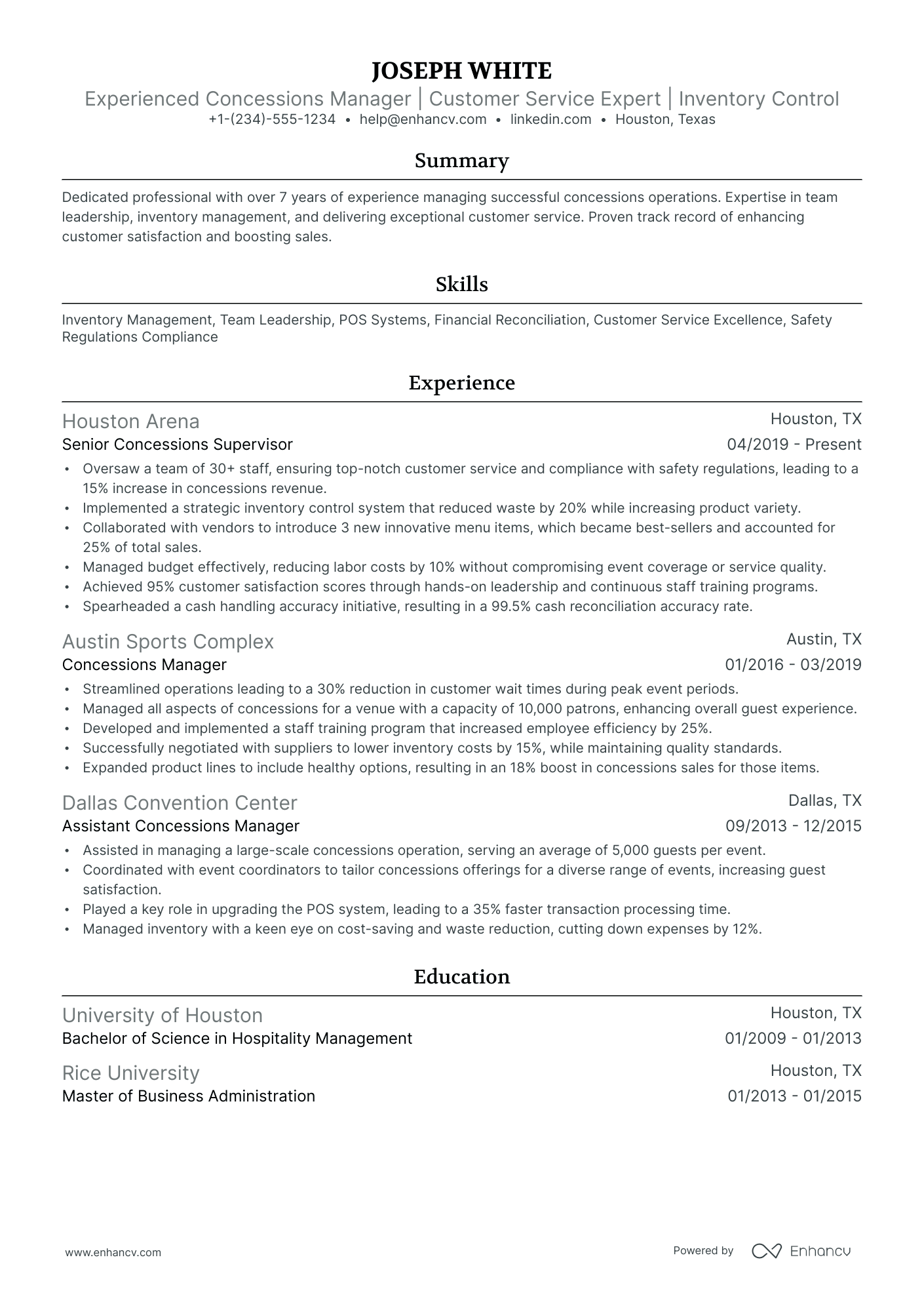
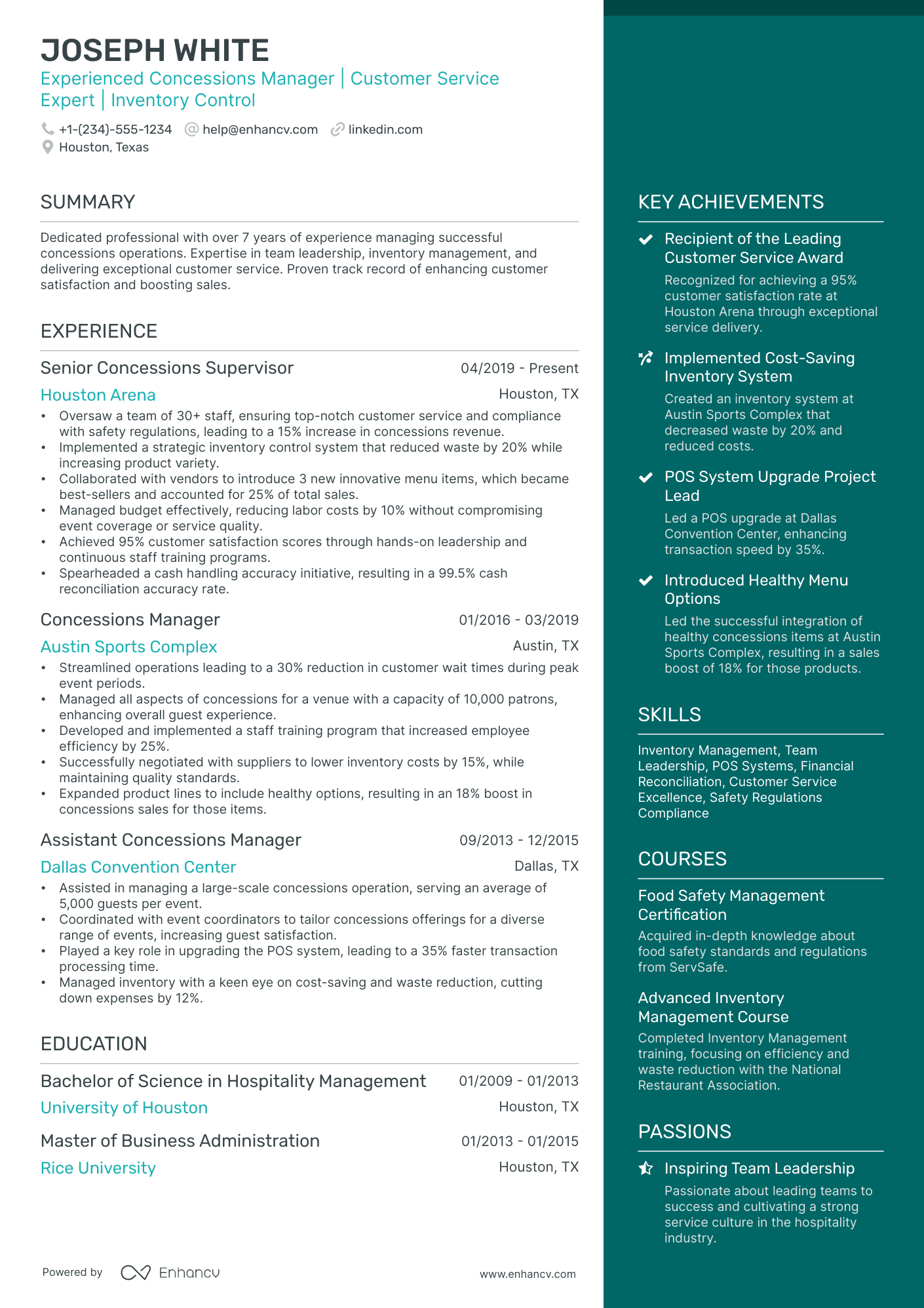
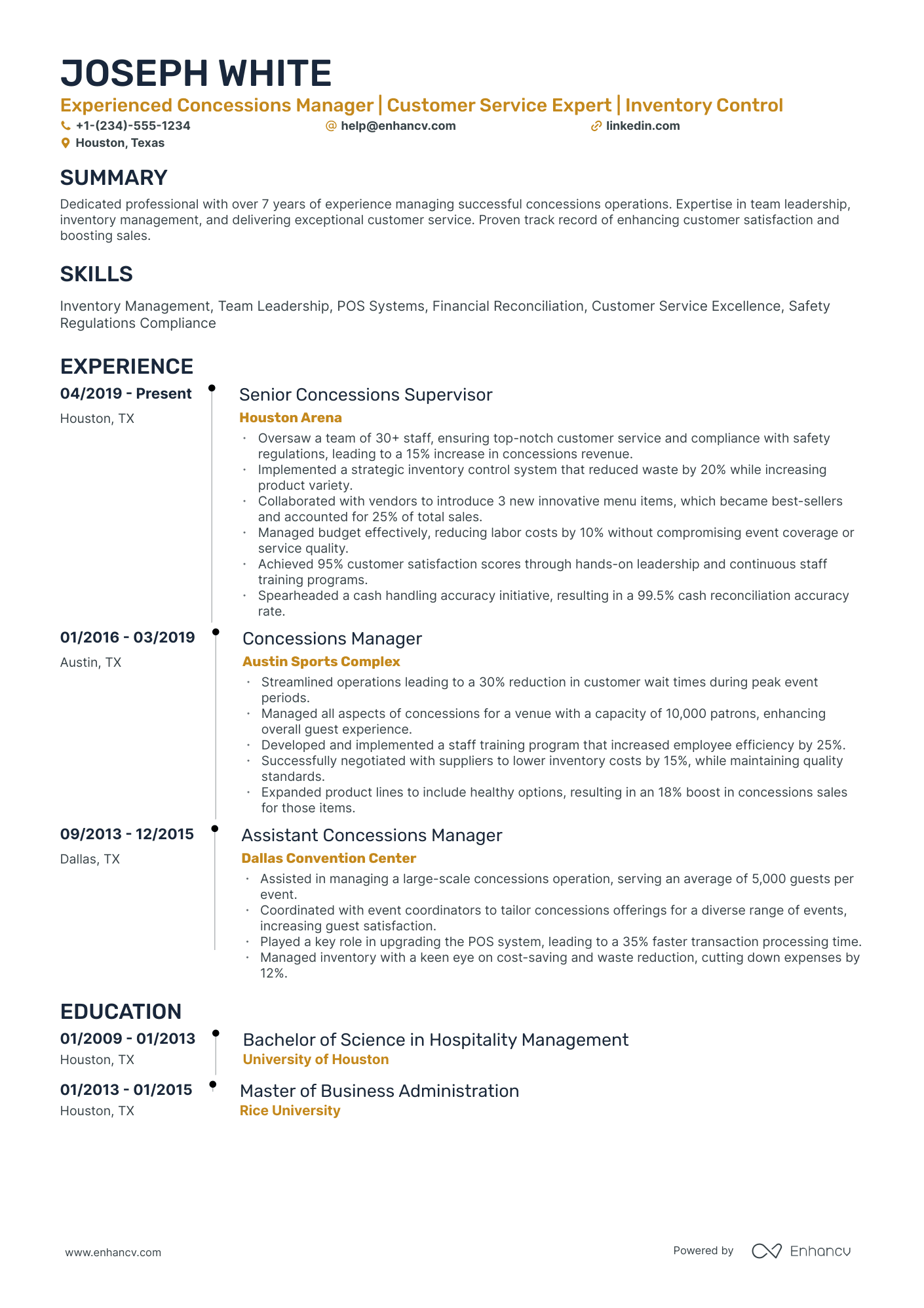
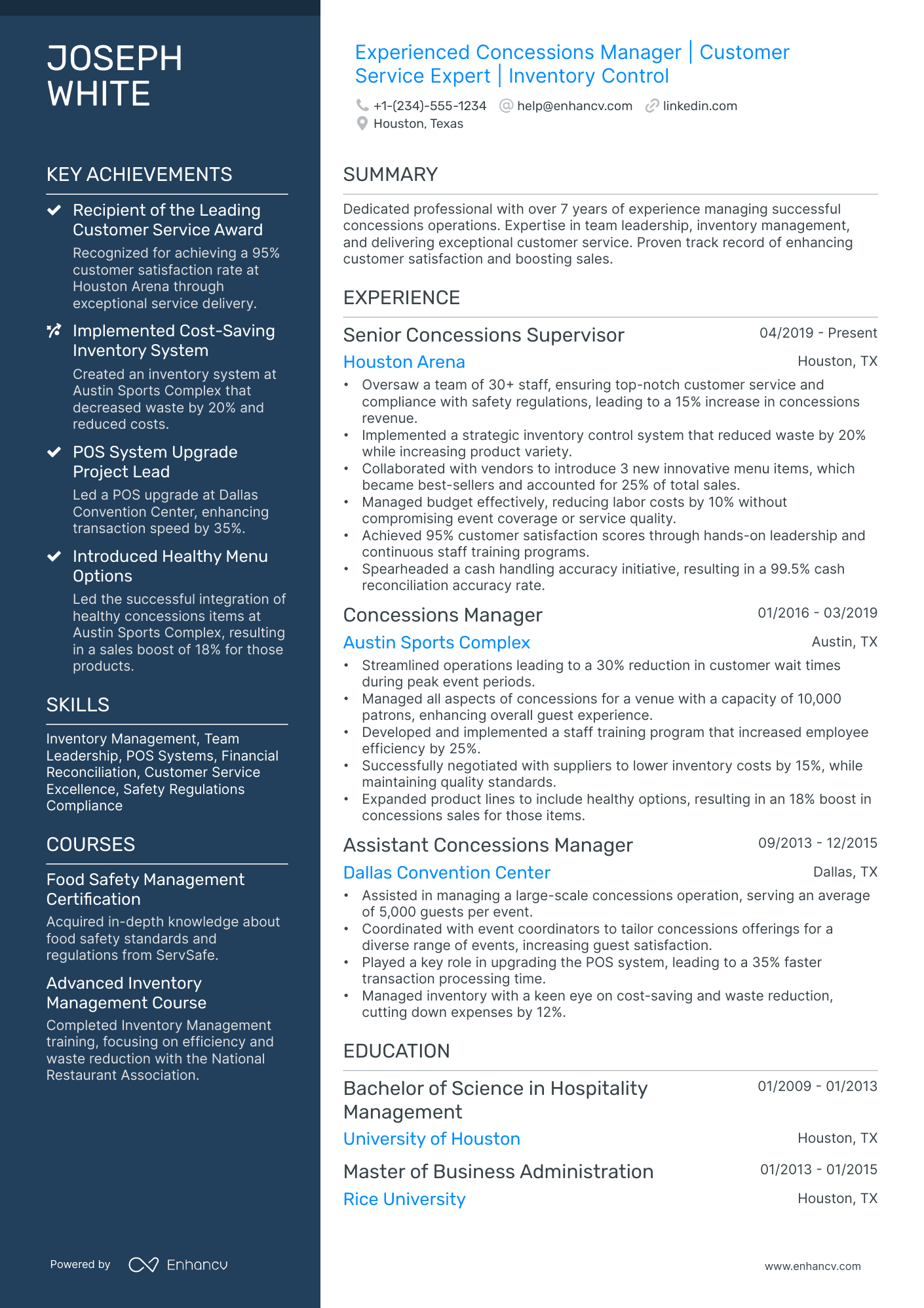
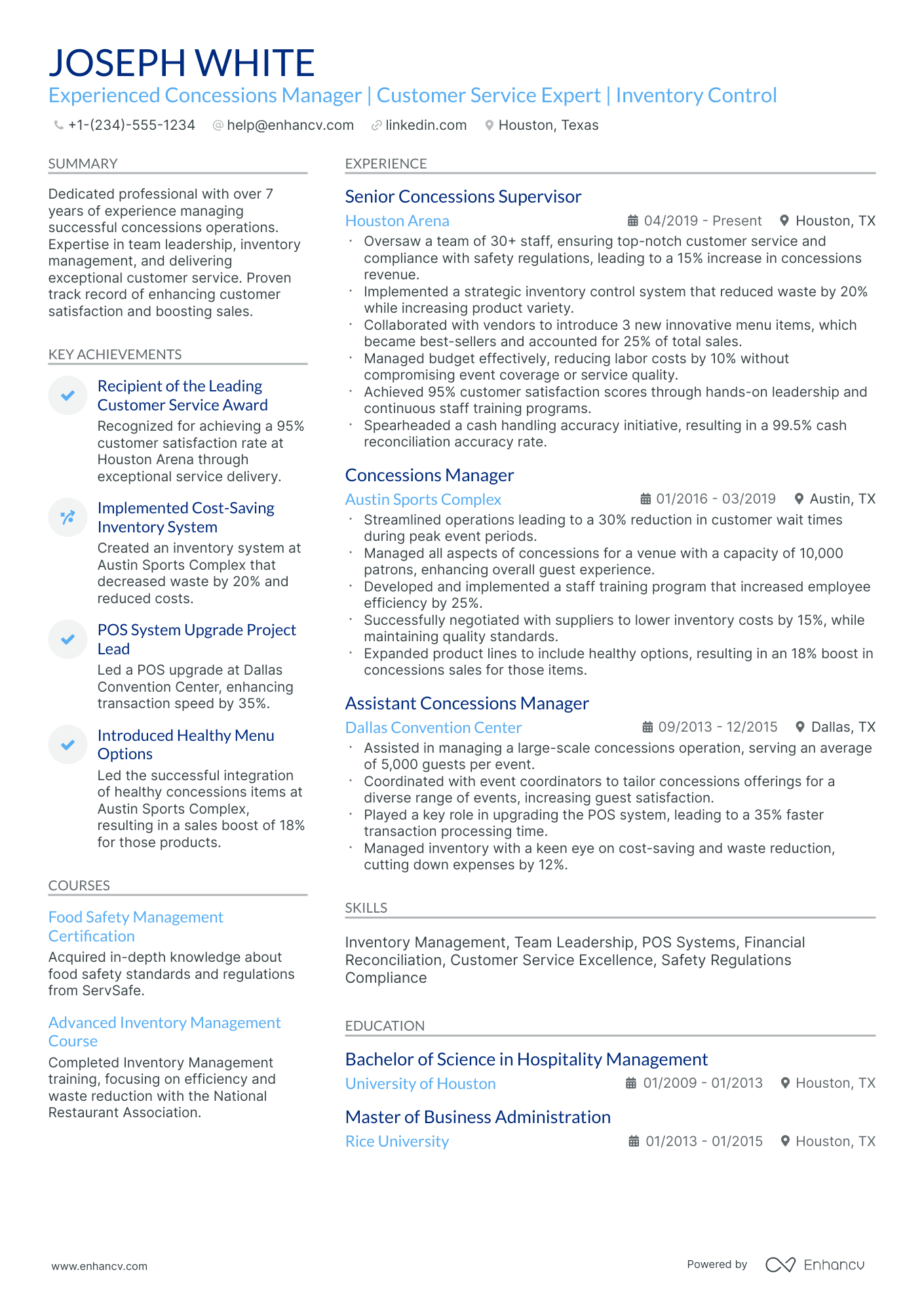
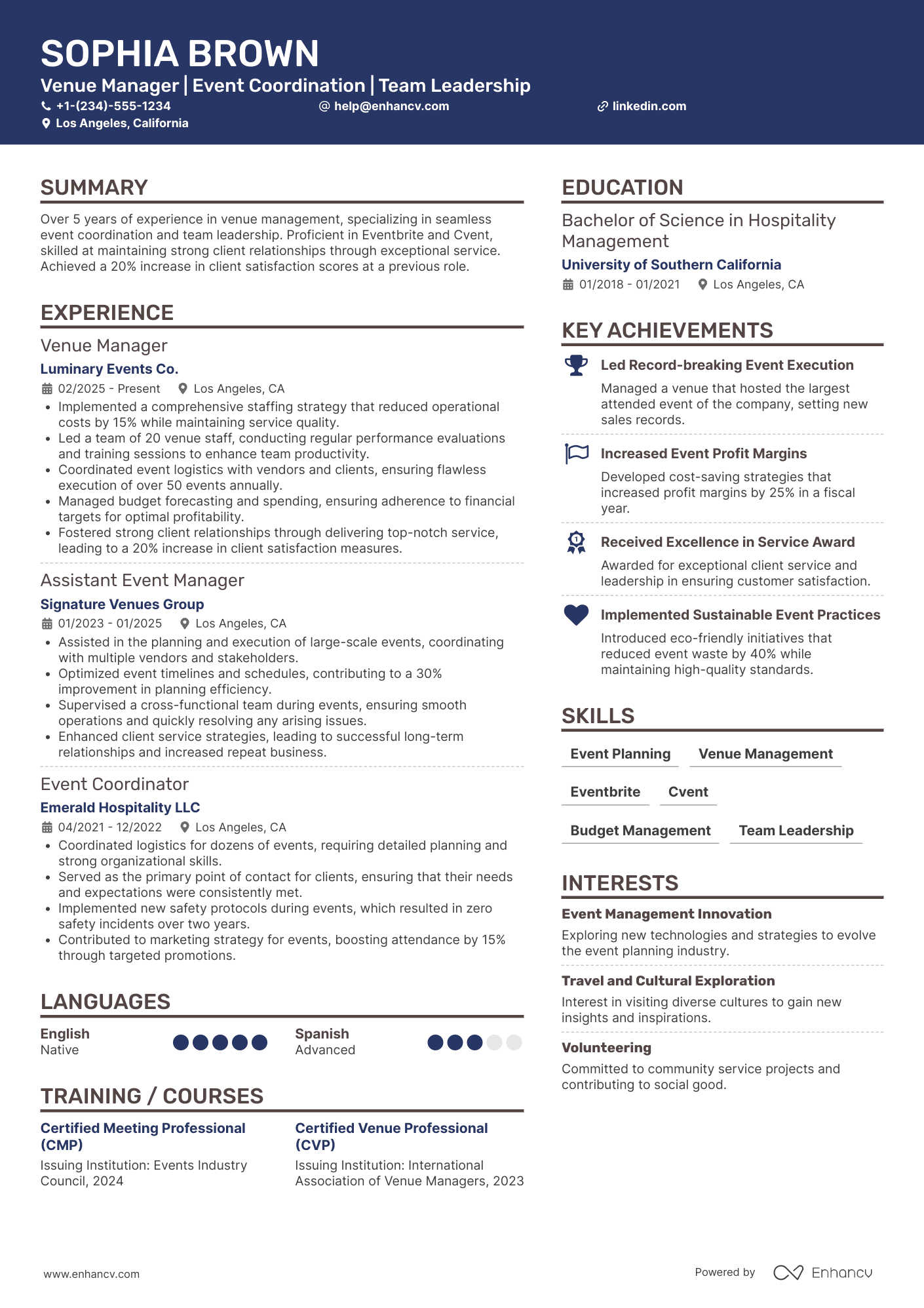
Most venue manager resume drafts fail because they bury operational impact under task lists and vendor tools. That hurts when an ATS filters fast and recruiters scan in seconds. Competition is tight, so unclear scope and results get skipped.
A strong resume shows what you improved and how you ran the room. Knowing how to make your resume stand out starts with highlighting revenue growth, attendance increases, budget savings, sell-through rates, on-time load-ins, incident reductions, and stronger guest satisfaction scores. Quantify venue capacity, event volume, and team size.

Key takeaways
- Quantify venue capacity, event volume, team size, and revenue impact in every experience bullet.
- Use reverse-chronological format if you have direct venue management experience.
- Tailor each resume to the job posting's exact tools, compliance standards, and KPIs.
- Demonstrate skills through measurable outcomes in your summary and experience sections, not just a list.
- Place certifications like CMP, OSHA, or ServSafe where they'll reinforce your operational credibility fastest.
- Use AI to sharpen language and add metrics, but stop before your resume sounds generic.
- Enhancv's Bullet Point Generator helps turn vague duties into specific, results-driven resume bullets.
How to format a venue manager resume
Recruiters hiring for venue manager roles prioritize operational expertise, event coordination skills, and measurable results tied to revenue, guest satisfaction, or efficiency improvements. A clean, well-structured resume format ensures these signals surface quickly during the six-to-ten-second initial scan and passes through applicant tracking systems without formatting errors.

I have significant experience in this role—which format should I use?
Use a reverse-chronological format to lead with your strongest and most recent venue management experience. Do:
- Highlight the scope and ownership of each role, including venue capacity, team size, budget authority, and number of events managed annually.
- Feature role-specific tools and domains such as event management software (Ungerboeck, Tripleseat, VenueOps), vendor negotiations, licensing compliance, and health and safety oversight.
- Quantify outcomes tied to business impact—revenue growth, cost reductions, occupancy rates, or client retention improvements.
I'm junior or switching into this role—what format works best?
Use a hybrid format that leads with a focused skills section and follows with a concise work history to show how you've applied those skills in practice. Do:
- Place core venue management competencies—event coordination, budget tracking, vendor relations, customer service—near the top of the resume so recruiters and ATS systems catch them immediately.
- Include internships, volunteer event work, hospitality roles, or project-based experience that demonstrates transferable venue operations knowledge.
- Connect every action to a clear outcome so hiring managers can see the value you delivered, even in adjacent roles.
Why not use a functional resume?
A functional format strips away the timeline and context that venue manager hiring managers rely on to evaluate your hands-on operational experience, making it harder to verify where and how you developed your skills.
- Career changers from hospitality, entertainment, or facility management who have directly transferable skills but no venue manager job title on their resume.
- Candidates with resume gaps who maintained relevant certifications or completed event management coursework during time away from work.
- Recent graduates with internship or volunteer event coordination experience but limited formal employment history.
Once your resume's format establishes a clean, readable structure, the next step is filling it with the right sections to showcase your qualifications effectively.
What sections should go on a venue manager resume
Recruiters expect a venue manager resume to clearly show your ability to run safe, profitable events while leading teams and coordinating vendors. Understanding which resume sections to include helps you organize this information effectively.
Use this structure for maximum clarity:
- Header
- Summary
- Experience
- Skills
- Projects
- Education
- Certifications
- Optional sections: Awards, Leadership, Languages
Strong experience bullets should emphasize measurable outcomes, event volume and scale, budget and revenue impact, safety and compliance results, and operational improvements.
Is your resume good enough?
Drop your resume here or choose a file. PDF & DOCX only. Max 2MB file size.
Now that you’ve outlined the key resume components, the next step is to write your venue manager experience section so those details translate into clear, role-relevant impact.
How to write your venue manager resume experience
The experience section is where you prove you can deliver results—not just describe responsibilities. Hiring managers scanning venue manager resumes prioritize demonstrated impact, role-relevant tools and methods, and measurable outcomes over generic task lists. Building a targeted resume ensures each entry speaks directly to what the employer needs.
Each entry should include:
- Job title
- Company and location (or remote)
- Dates of employment (month and year)
Three to five concise bullet points showing what you owned, how you executed, and what outcomes you delivered:
- Ownership scope: the venues, event spaces, operational budgets, vendor relationships, or on-site teams you were directly accountable for as a venue manager.
- Execution approach: the booking platforms, scheduling systems, safety protocols, inventory management tools, or event coordination frameworks you used to plan and deliver venue operations.
- Value improved: changes to guest satisfaction, operational efficiency, event turnaround time, compliance standards, venue uptime, or risk mitigation tied to your venue management decisions.
- Collaboration context: how you coordinated with event planners, catering teams, facilities staff, municipal authorities, security contractors, or corporate clients to execute seamless venue operations.
- Impact delivered: outcomes expressed through revenue growth, capacity utilization, client retention, cost savings, or operational scale rather than a list of daily activities.
Experience bullet formula
A venue manager experience example
✅ Right example - modern, quantified, specific.
Venue Manager
Riverfront Live | Nashville, TN
2021–Present
One thousand eight hundred-capacity live music venue hosting two hundred plus ticketed events annually across national tours, corporate rentals, and community programming.
- Led event operations across two hundred twenty-four shows and forty-six private rentals per year using Momentus and Social Tables, improving load-in to doors time by 18% and cutting show-day incidents by 32%.
- Negotiated and managed vendor and labor contracts in NetSuite and When I Work, reducing staffing costs by 11% while maintaining a 98% on-time call compliance rate.
- Implemented crowd management and safety protocols aligned to NFPA 101 and local fire code, partnering with security leadership and city inspectors to reduce ejections by 21% and achieve zero recordable safety violations.
- Optimized ticketing, entry, and cashless workflows with Ticketmaster Archtics and Square, increasing per-capita spend from $18.40 to $20.10 and reducing average entry queue time from fourteen minutes to nine minutes.
- Built weekly performance reporting in Google Looker Studio from POS, ticketing, and incident logs, aligning with promoters and finance stakeholders to improve settlement accuracy to 99.5% and cut closeout time by two hours per event.
Now that you've seen how a strong experience section looks in practice, let's break down how to customize yours for each specific job posting.
How to tailor your venue manager resume experience
Recruiters evaluate your venue manager resume through applicant tracking systems and manual review, so tailoring your resume to the job description increases your chances of advancing. Tailoring means connecting what you've done to what the employer explicitly asks for.
Ways to tailor your venue manager experience:
- Match event management platforms or booking systems named in the posting.
- Mirror the exact terminology used for safety and compliance standards.
- Reflect occupancy or guest satisfaction KPIs the employer prioritizes.
- Highlight experience in the specific venue type such as arena or theater.
- Emphasize vendor coordination or contractor management workflows they reference.
- Include ADA accessibility or fire code compliance if the role requires it.
- Reference staffing models or shift scheduling frameworks outlined in the listing.
- Align your budgeting language with their financial oversight expectations.
Tailoring means framing your real accomplishments to directly address what the employer needs��not forcing disconnected keywords into your experience section.
Resume tailoring examples for venue manager
| Job description excerpt | Untailored | Tailored |
|---|---|---|
| "Oversee all aspects of event execution, including vendor coordination, AV setup, and day-of logistics for a 5,000-capacity indoor arena." | Managed events and handled various tasks related to venue operations. | Directed end-to-end event execution for a 5,000-capacity indoor arena, coordinating vendor schedules, AV setup, and day-of logistics for 120+ events annually. |
| "Manage facility maintenance budgets, negotiate service contracts, and ensure compliance with local fire and safety codes using FMX work order software." | Responsible for budgets and making sure the building was safe and up to code. | Managed a $450K annual facility maintenance budget, negotiated service contracts saving 18% year over year, and tracked fire and safety code compliance through FMX work order software. |
| "Lead a team of 30+ part-time event staff, including hiring, scheduling via WhenIWork, and conducting post-event performance reviews." | Supervised staff and helped with scheduling and other team-related duties. | Hired, trained, and scheduled 35 part-time event staff using WhenIWork, then conducted post-event performance reviews that reduced turnover by 22% over two seasons. |
Once you’ve aligned your experience with the venue’s needs, quantify your venue manager achievements to show the measurable impact behind those choices.
How to quantify your venue manager achievements
Numbers show how you ran smoother events, protected guests, and grew revenue. Focus on attendance, ticket and bar sales, turnaround time, labor and vendor costs, safety incidents, and guest satisfaction scores. Learning how to use numbers on your resume effectively transforms generic duties into compelling proof of impact.
Quantifying examples for venue manager
| Metric | Example |
|---|---|
| Revenue growth | "Increased per-event revenue 18% ($42K to $49.5K) by adding VIP bundles and optimizing bar pricing in Square POS." |
| Cost control | "Cut labor costs 12% per show by rebuilding schedules in When I Work and reducing overtime hours from 95 to 62 monthly." |
| Turnaround time | "Reduced load-in to doors-open time from 4 hours to 2.8 hours by standardizing stage plots and crew checklists." |
| Safety compliance | "Achieved 14 consecutive months with zero recordable incidents by enforcing OSHA checklists and running quarterly evacuation drills." |
| Guest satisfaction | "Raised post-event CSAT from 4.2 to 4.6 out of 5 across 1,200 surveys by improving queue flow and retraining ushers." |
Turn vague job duties into measurable, recruiter-ready resume bullets in seconds with Enhancv's Bullet Point Generator.
With strong, action-driven bullet points in place, the next step is making sure your hard and soft skills are strategically listed throughout your venue manager resume.
How to list your hard and soft skills on a venue manager resume
Your skills section shows you can run safe, profitable events, and recruiters and an ATS (applicant tracking system) scan this section to match you to venue needs—aim for a hard-skill-heavy mix supported by role-specific soft skills. venue manager roles require a blend of:
- Product strategy and discovery skills.
- Data, analytics, and experimentation skills.
- Delivery, execution, and go-to-market discipline.
- Soft skills.
Your skills section should be:
- Scannable (bullet-style grouping).
- Relevant to the job post.
- Backed by proof in experience bullets.
- Updated with current tools.
Place your skills section:
- Above experience if you're junior or switching careers.
- Below experience if you're mid/senior with strong achievements.

Hard skills
- Event operations planning
- Venue scheduling and booking
- Budgeting and cost control
- Contract negotiation and vendor management
- Point of sale systems, ticketing platforms
- Event management software, CRM systems
- Floor plans, seating charts, crowd flow
- Staffing plans and labor scheduling
- Safety compliance and risk assessments
- Emergency action plans, incident reporting
- Audio visual, staging, load-in logistics
- Post-event reporting and KPI tracking
Soft skills
- Lead cross-functional event teams
- Align promoters, vendors, and staff
- De-escalate guest and staff conflicts
- Make real-time operational decisions
- Communicate clearly under pressure
- Set priorities across overlapping events
- Hold teams accountable to standards
- Negotiate win-win outcomes
- Manage stakeholder expectations
- Escalate issues with context and options
- Run tight pre-shift briefings
- Improve processes after post-mortems
How to show your venue manager skills in context
Skills shouldn't live only in a bulleted list on your resume. Explore resume skills examples to see how top candidates weave competencies throughout their documents.
They should be demonstrated in:
- Your summary (high-level professional identity)
- Your experience (proof through outcomes)
Here's what strong skill integration looks like in practice.
Summary example
Venue manager with 12 years of experience overseeing high-capacity concert and event spaces. Skilled in CAD floor planning, vendor negotiations, and crowd-flow optimization. Boosted annual client retention by 34% through streamlined booking workflows and proactive stakeholder communication.
- Reflects senior-level experience clearly
- Names role-specific tools and methods
- Includes a concrete, measurable outcome
- Highlights communication as a soft skill
Experience example
Senior Venue Manager
Ridgeline Event Group | Denver, CO
March 2018–August 2024
- Managed 200+ events annually using Ungerboeck venue management software, increasing scheduling accuracy by 27% and reducing double-bookings to zero.
- Collaborated with catering, AV, and security teams to redesign load-in procedures, cutting setup time by 35% across all large-format productions.
- Negotiated vendor contracts worth $1.2M yearly, saving 18% on average through competitive bidding and long-term partnership agreements.
- Every bullet includes measurable proof
- Skills surface naturally through real outcomes
Once you’ve positioned your venue management strengths through specific responsibilities and results, the next step is applying that same approach to a venue manager resume when you don’t have direct experience.
How do I write a venue manager resume with no experience
Even without full-time experience, you can demonstrate readiness through:
- Student event operations leadership
- Volunteer front-of-house supervision
- Campus venue booking coordination
- Ticketing system support shifts
- Vendor load-in and strike coordination
- Safety walkthroughs and incident logs
- Budget tracking for event expenses
- Staff scheduling for small events
If you're entering the field without a traditional background, our guide on writing a resume without work experience offers strategies to showcase your transferable skills effectively.
Focus on:
- Event operations scope and scale
- Scheduling, budgets, and reporting
- Safety compliance and incident tracking
- Venue manager tools used
Resume format tip for entry-level venue manager
Use a combination resume format to highlight relevant projects and tools before work history. It shows venue manager readiness through evidence, not job titles. Do:
- Put a "Relevant Projects" section first.
- List tools like Eventbrite and Google Sheets.
- Quantify attendance, revenue, or issues resolved.
- Mirror venue manager keywords from postings.
- Add a short operations-focused summary.
- Coordinated campus venue booking coordination in Google Sheets and Eventbrite for six events, tracking holds and ticket counts, reducing double-bookings to zero.
Even without direct experience, your educational background can strengthen your venue manager resume—here's how to present it effectively.
How to list your education on a venue manager resume
Your education section helps hiring teams confirm you have foundational knowledge in hospitality, business, or event management. It validates your readiness for venue manager responsibilities.
Include:
- Degree name
- Institution
- Location
- Graduation year
- Relevant coursework (for juniors or entry-level candidates)
- Honors & GPA (if 3.5 or higher)
Skip month and day details—list the graduation year only.
Here's a strong education entry tailored to a venue manager resume:
Example education entry
Bachelor of Science in Hospitality Management
University of Central Florida, Orlando, FL
Graduated 2021
GPA: 3.7/4.0
- Relevant Coursework: Event Operations, Facility Planning, Food & Beverage Management, Risk Assessment in Live Venues
- Honors: Magna Cum Laude, Dean's List (six semesters)
How to list your certifications on a venue manager resume
Certifications on a resume show a venue manager's commitment to learning, proficiency with key tools, and alignment with industry standards employers expect.
Include:
- Certificate name
- Issuing organization
- Year
- Optional: credential ID or URL
- Place certifications below education when your degree is recent and your certifications are older or only loosely related to venue manager work.
- Place certifications above education when they are recent, highly relevant, or required for the venue manager roles you target.
Best certifications for your venue manager resume
- Certified Meeting Professional (CMP)
- Certified Venue Professional (CVP)
- Certified Special Events Professional (CSEP)
- ServSafe Food Protection Manager Certification
- TIPS Alcohol Training Certification
- OSHA 10-Hour General Industry
- First Aid/CPR/AED Certification
Once you’ve positioned your credentials where hiring managers will see them, shift to your venue manager resume summary to connect those qualifications to the value you deliver.
How to write your venue manager resume summary
Your resume summary is the first thing a recruiter reads, so it needs to earn their attention fast. A strong opening frames your venue management experience and sets the tone for everything that follows.
Keep it to three to four lines, with:
- Your title and total years of experience in venue or event operations.
- The type of venues, industries, or events you've managed.
- Core skills like budgeting, scheduling, vendor coordination, or safety compliance.
- One or two measurable achievements, such as revenue growth or cost savings.
- Soft skills tied to real outcomes, like team leadership that reduced staff turnover.

PRO TIP
At this level, focus on practical skills, relevant tools, and early wins that show you can manage day-to-day operations. Avoid vague phrases like "passionate go-getter" or "results-driven professional." Recruiters want specifics—name the venue types, team sizes, and measurable contributions you've made.
Example summary for a venue manager
Venue manager with four years of experience overseeing concert and conference spaces. Skilled in vendor negotiations, budgeting, and staff scheduling. Cut operational costs by 18% while improving guest satisfaction scores across three locations.
Optimize your resume summary and objective for ATS
Drop your resume here or choose a file.
PDF & DOCX only. Max 2MB file size.
Now that your summary is ready to showcase your qualifications, make sure the header above it presents your contact details correctly so hiring managers can actually reach you.
What to include in a venue manager resume header
A resume header is the top section with your key details, and it boosts visibility, credibility, and recruiter screening for a venue manager role.
Essential resume header elements
- Full name
- Tailored job title and headline
- Location
- Phone number
- Professional email
- GitHub link
- Portfolio link
A LinkedIn link helps recruiters verify experience fast and supports screening.
Don't include a photo on a venue manager resume unless the role is explicitly front-facing or appearance-dependent.
Match your header title to the job posting and keep every detail consistent across your resume and online profiles.
Example
Venue manager resume header
Jordan Ramirez
Venue Manager | Live Events Operations, Staffing, and Vendor Coordination
Austin, TX
(512) 555-01XX
jordan.ramirez@enhancv.com
github.com/jordanramirez
jordanramirez.com
linkedin.com/in/jordanramirez
Once your contact details and role identifiers are clear at the top, add targeted additional sections to reinforce your qualifications with relevant supporting information.
Additional sections for venue manager resumes
When your core qualifications match other candidates, well-chosen additional sections can set your venue manager resume apart with role-specific credibility. For example, listing language skills on your resume can be a strong differentiator when managing diverse teams or international events.
- Languages
- Certifications and licenses
- Industry awards and recognitions
- Professional affiliations and memberships
- Volunteer experience in event coordination
- Hobbies and interests
Once you've strengthened your resume with relevant extra sections, the next step is pairing it with a cover letter that adds even more context to your application.
Do venue manager resumes need a cover letter
A cover letter isn't required for a venue manager, but it often helps in competitive searches or when hiring teams expect one. If you're unsure where to start, understanding what a cover letter is and how it complements your resume can help you decide. It can make a difference when your resume needs context or when you want to show strong fit fast.
Use a cover letter to add value in these situations:
- Explain role and team fit: Match your leadership style to the venue manager's priorities, like safety, guest experience, and vendor coordination.
- Highlight one or two outcomes: Share a specific project, such as improving event load-in time or reducing incident reports, and quantify the result.
- Show business understanding: Reference the venue's event mix, audience, and revenue model, and connect your decisions to those realities.
- Address transitions or non-obvious experience: Clarify a move from hospitality, operations, or production, and translate skills into venue manager responsibilities.
Drop your resume here or choose a file.
PDF & DOCX only. Max 2MB file size.
Even when you decide a cover letter won’t add value to your application, using AI to improve your venue manager resume helps you strengthen the document hiring teams review first.
Using AI to improve your venue manager resume
AI can sharpen your resume's clarity, structure, and impact. It helps refine language and highlight measurable results. However, overusing it risks sounding generic. Stop tweaking once your content feels authentic and aligned with the venue manager role. If you're wondering which AI is best for writing resumes, the key is choosing tools that enhance your real experience rather than replace it.
Here are 10 practical prompts to strengthen specific sections of your venue manager resume:
Strengthen your summary
Quantify experience bullets
Tighten action verbs
Align skills section
Refine project descriptions
Improve education relevance
Clarify certification value
Remove filler language
Target a specific posting
Check consistent formatting
Conclusion
A strong venue manager resume highlights measurable outcomes, role-specific skills, and a clear structure. Use metrics to show results in revenue, attendance, costs, safety, and team performance. Keep sections consistent, and make your experience easy to scan.
Today’s hiring market rewards venue manager candidates who prove impact and execution. When your resume connects responsibilities to results, it shows readiness for current expectations and near-future needs. With a focused summary and clean formatting, you’ll stand out fast.