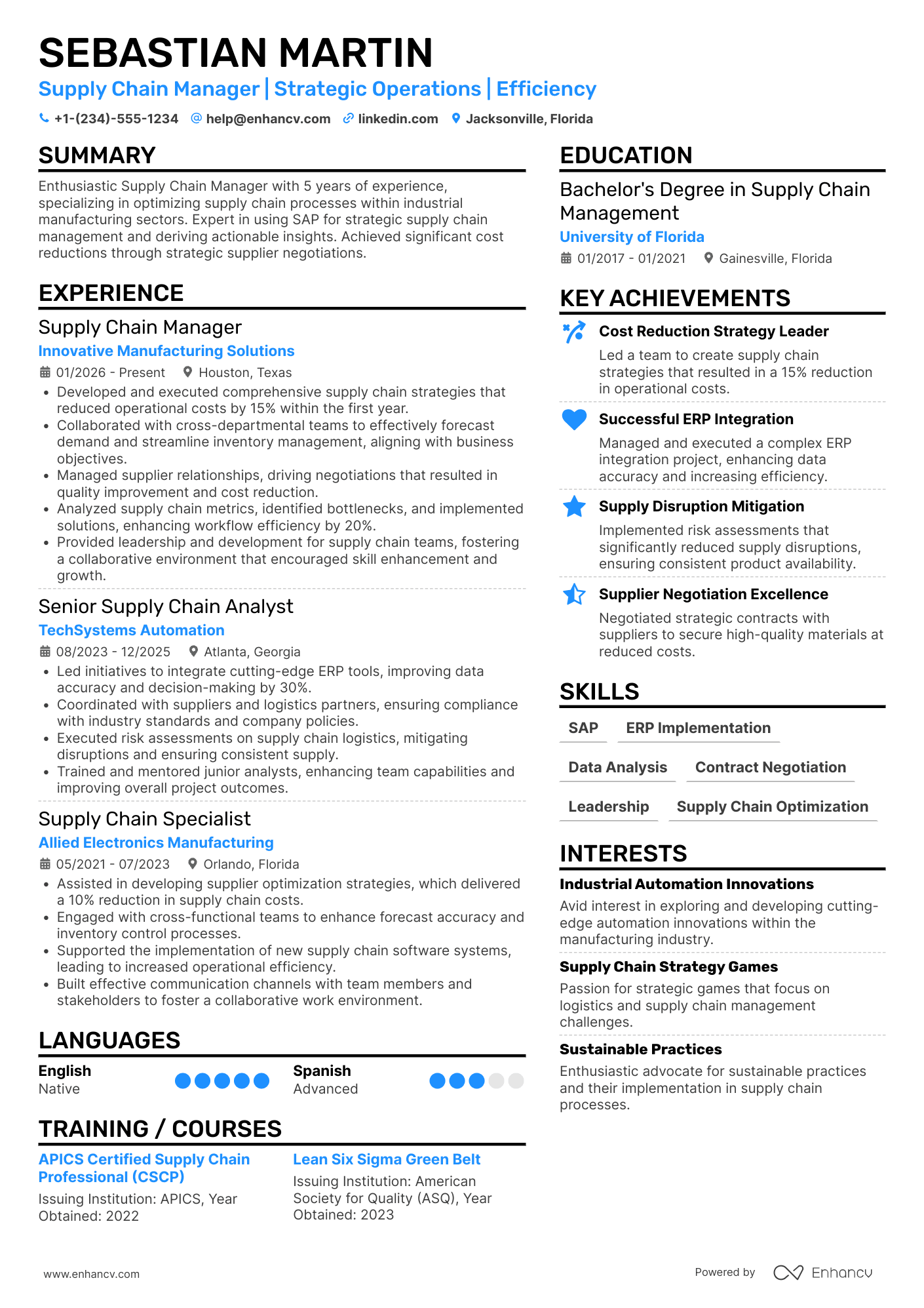

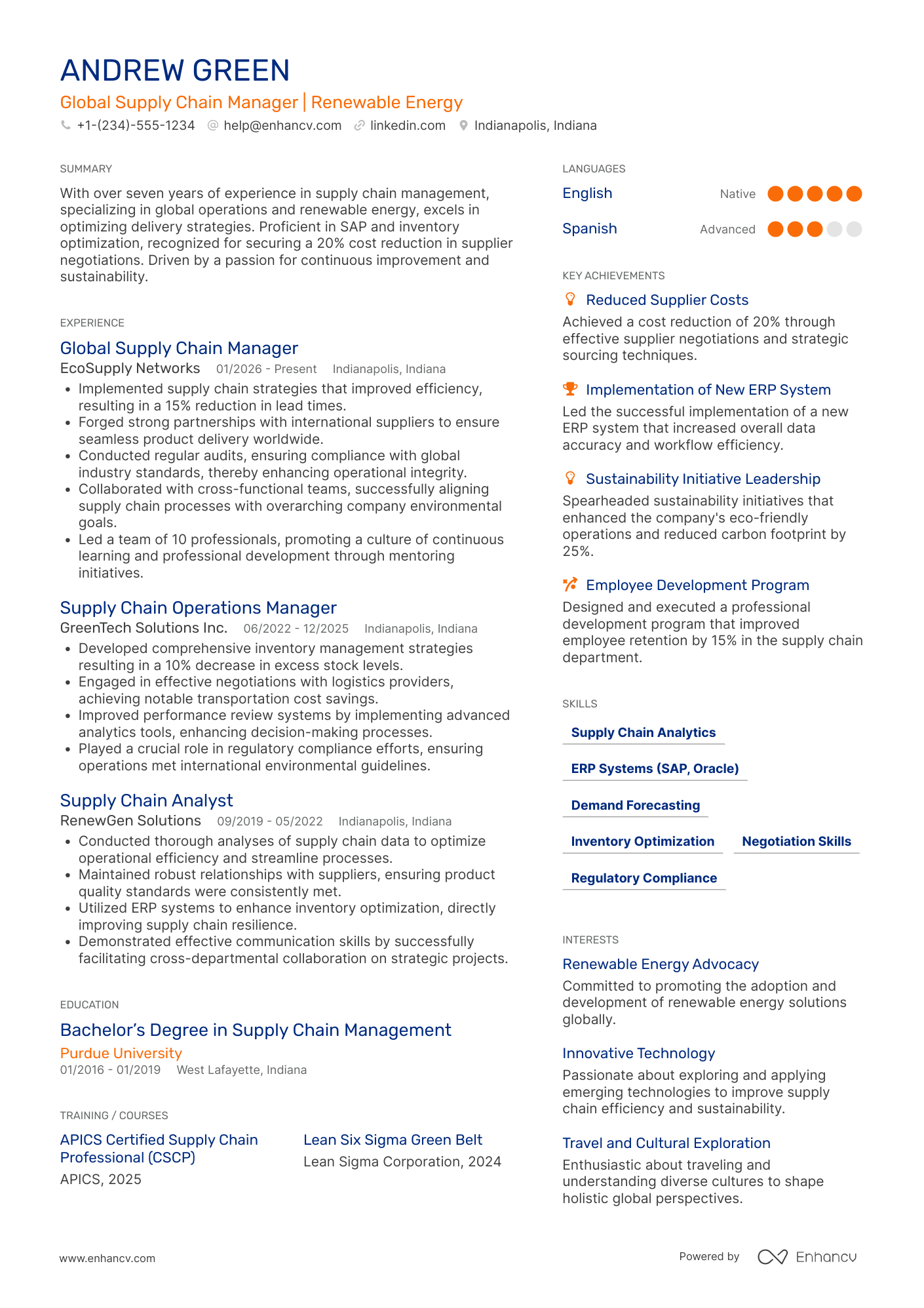
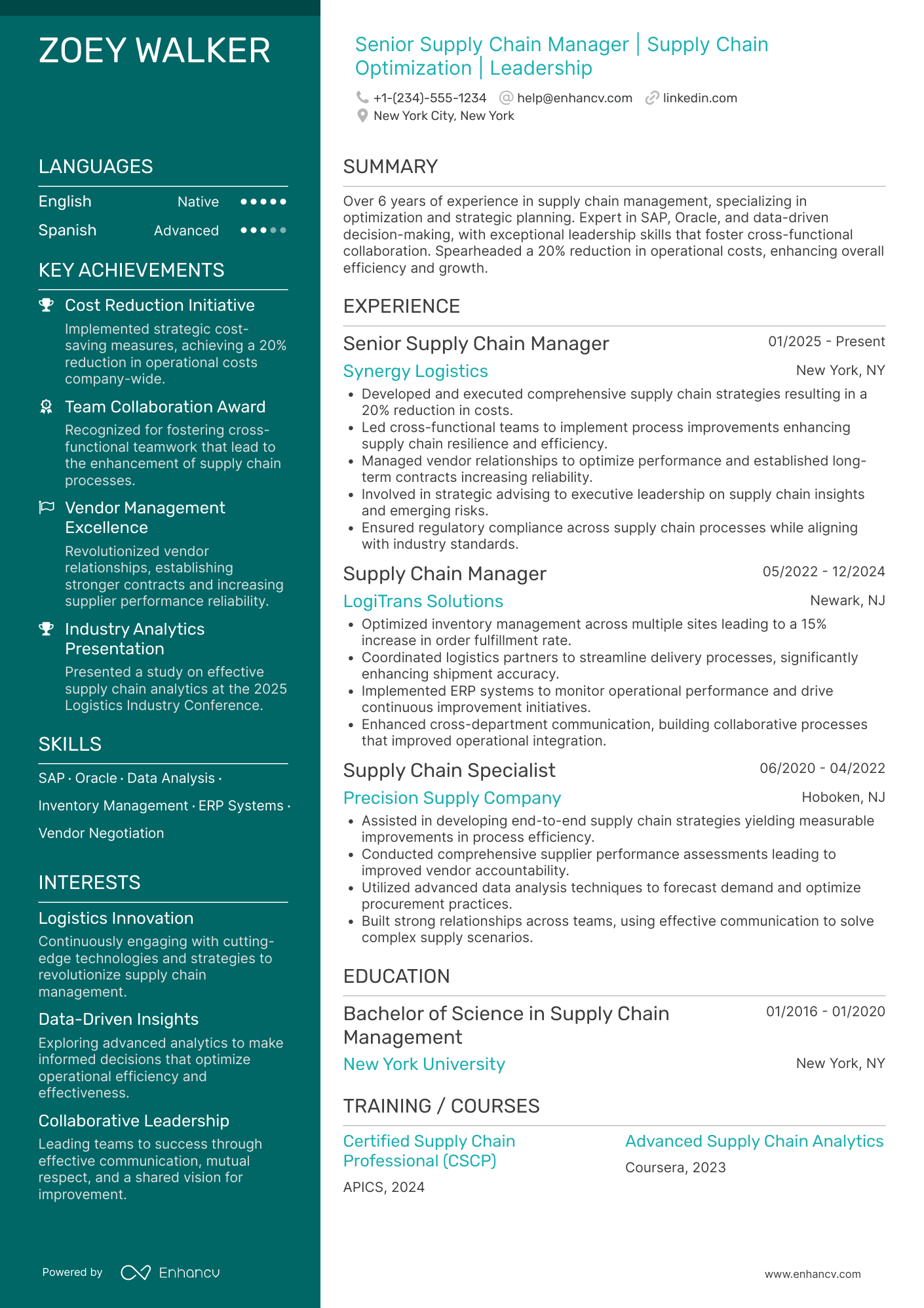
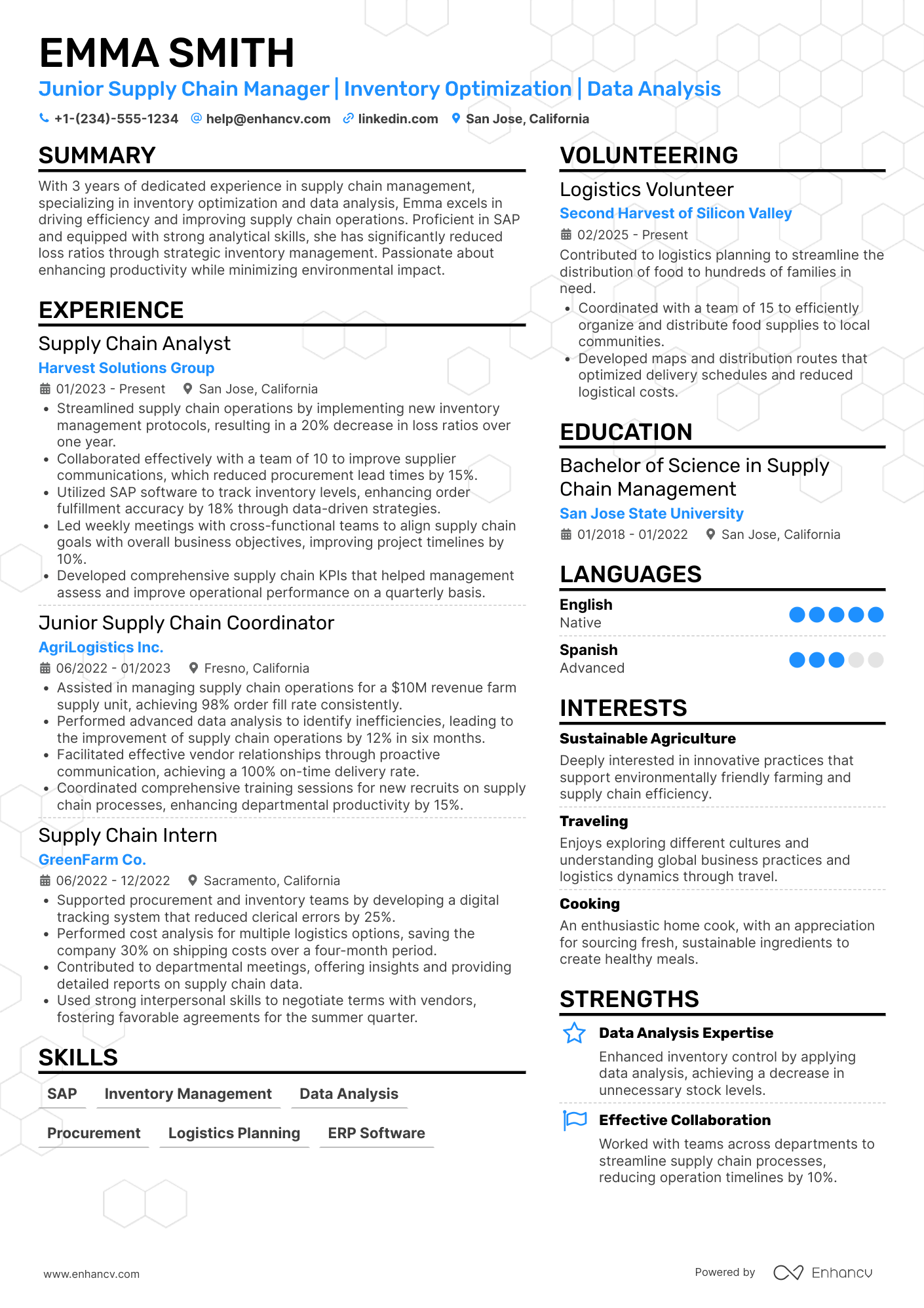
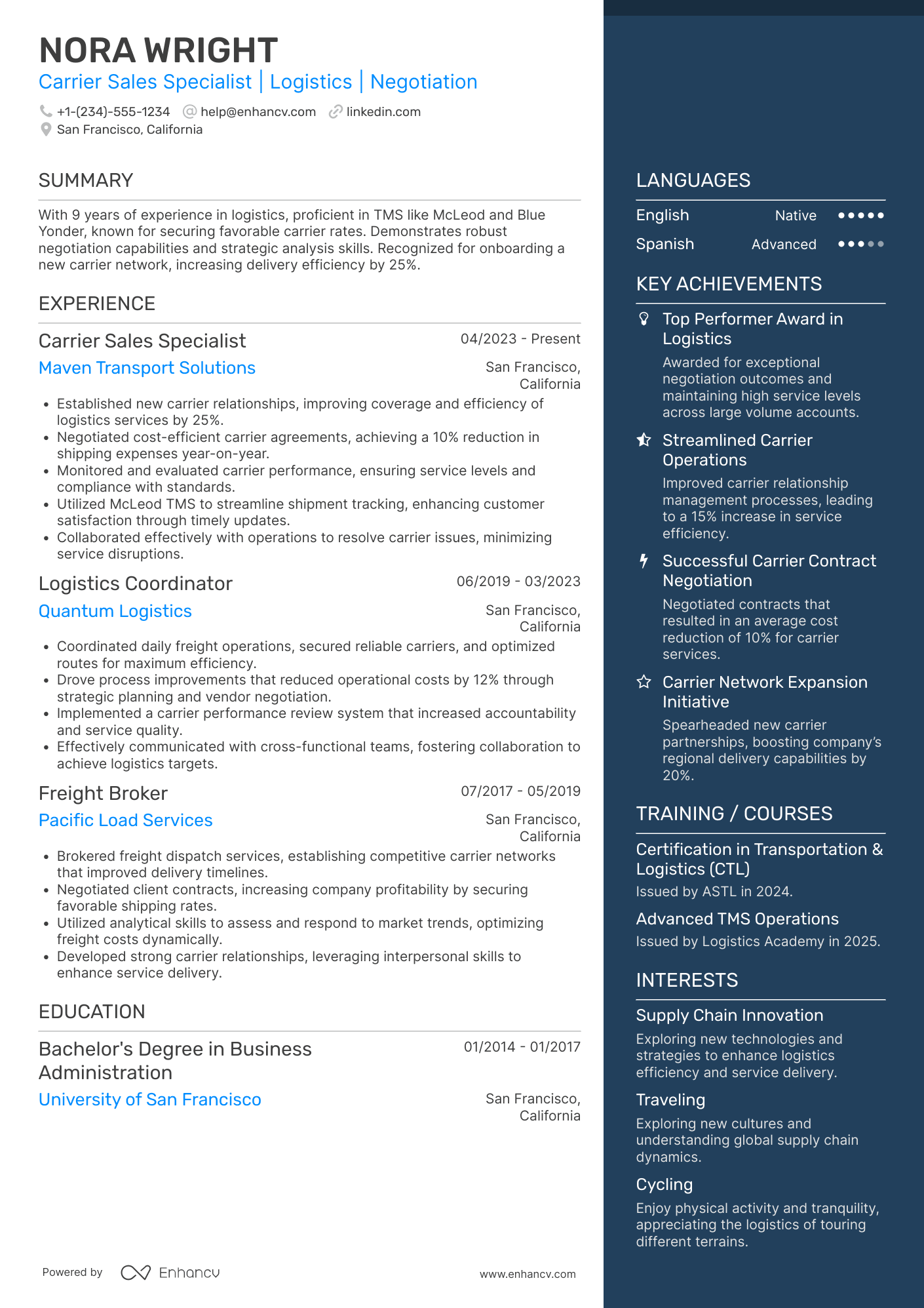
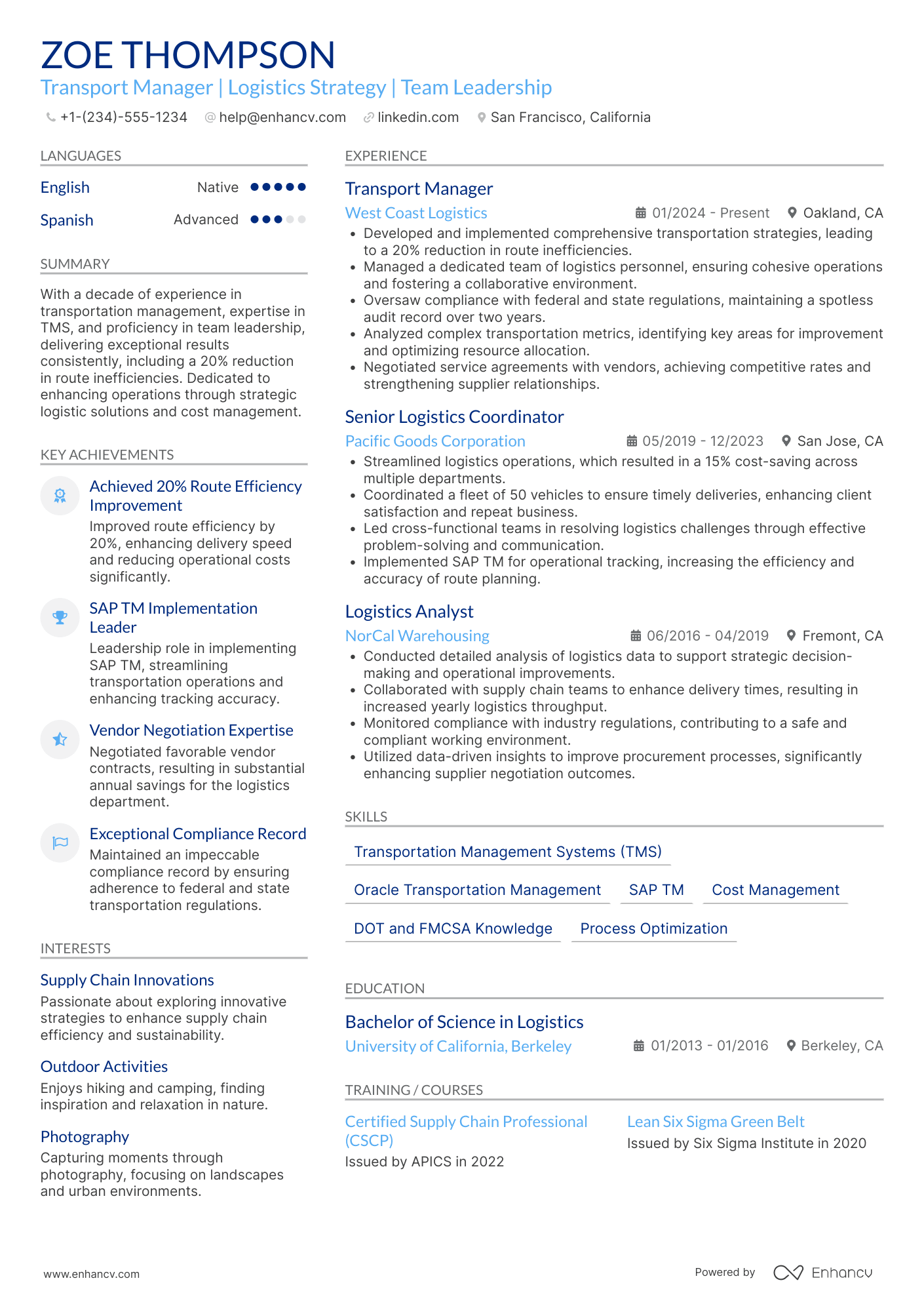
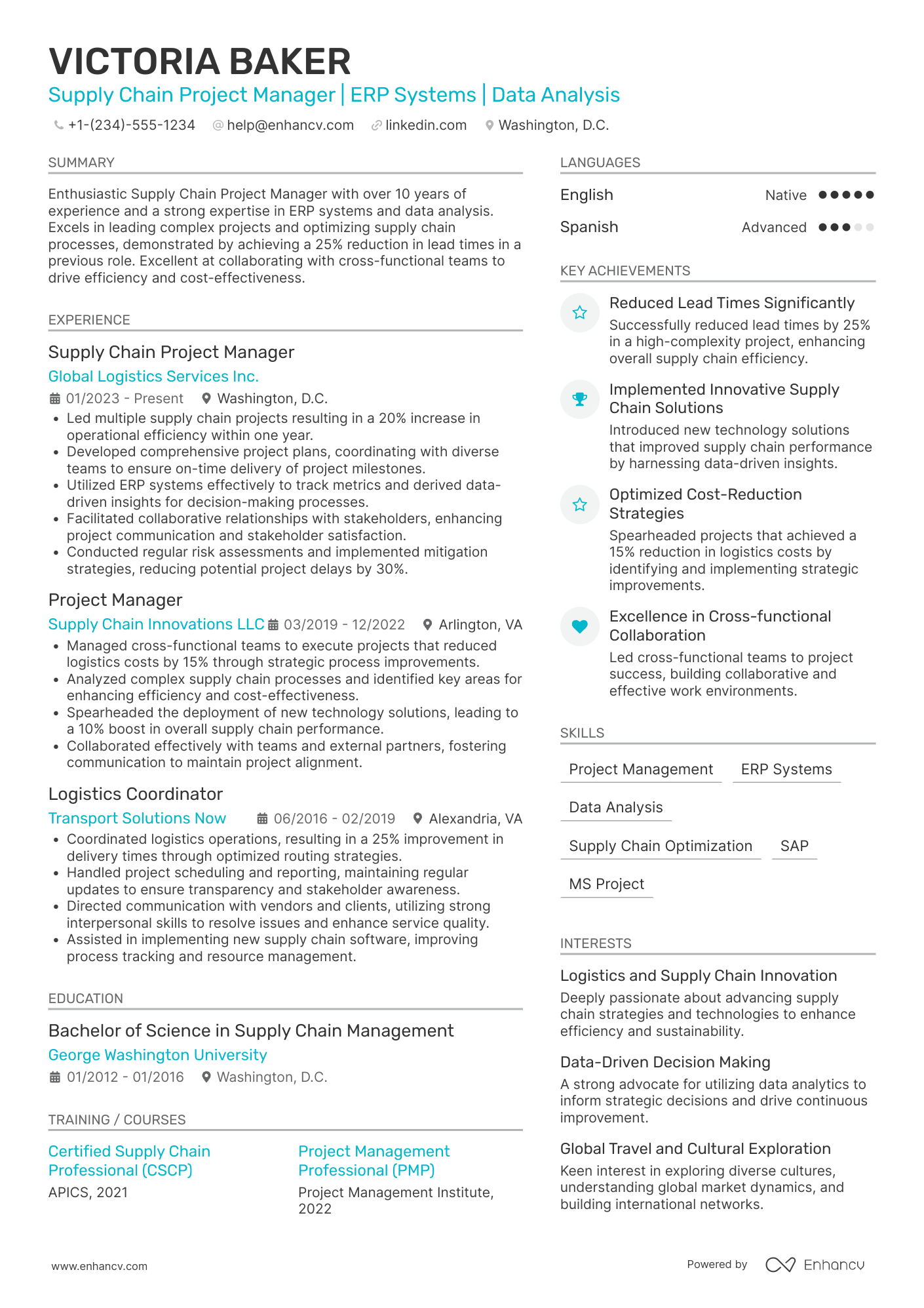
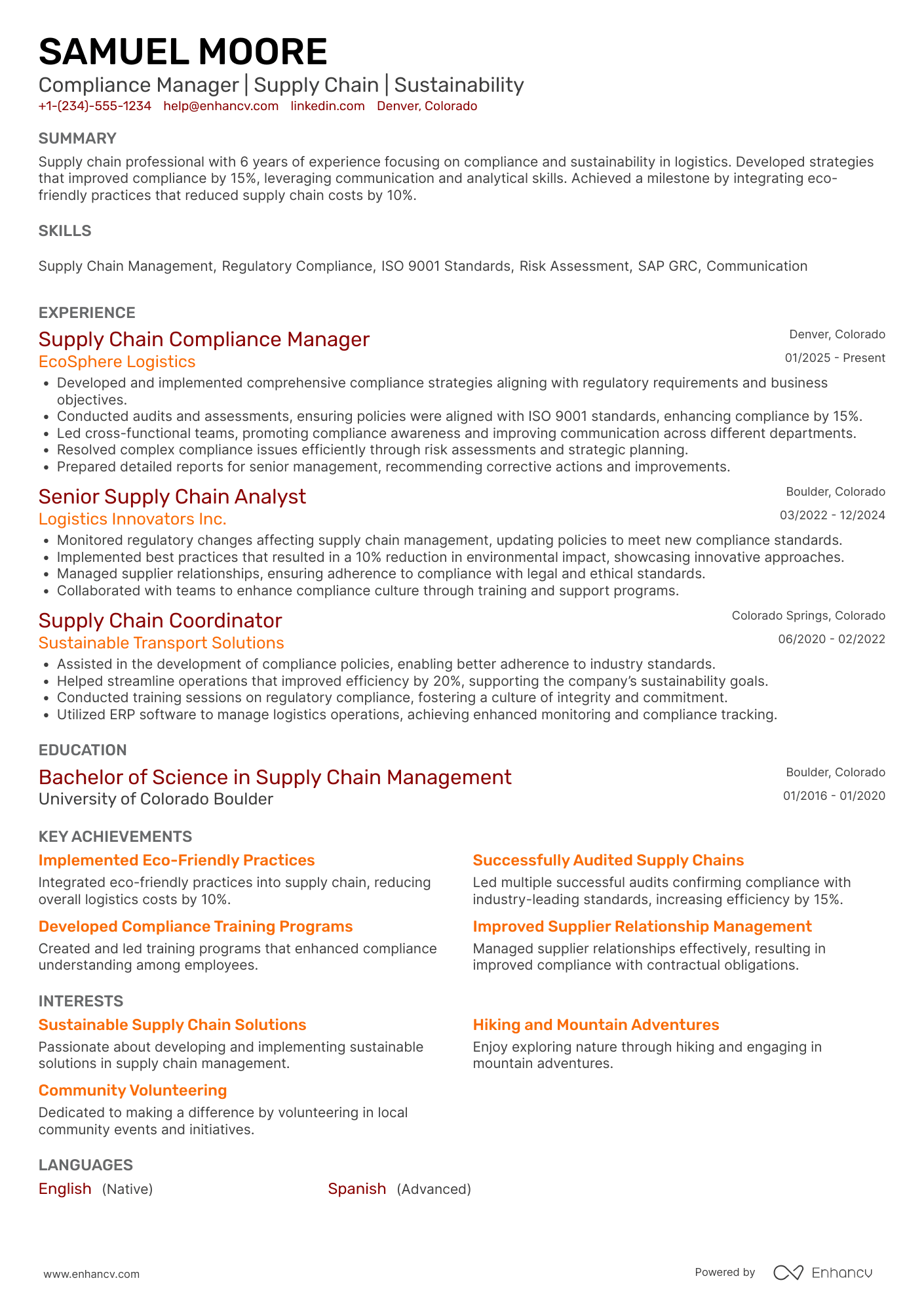
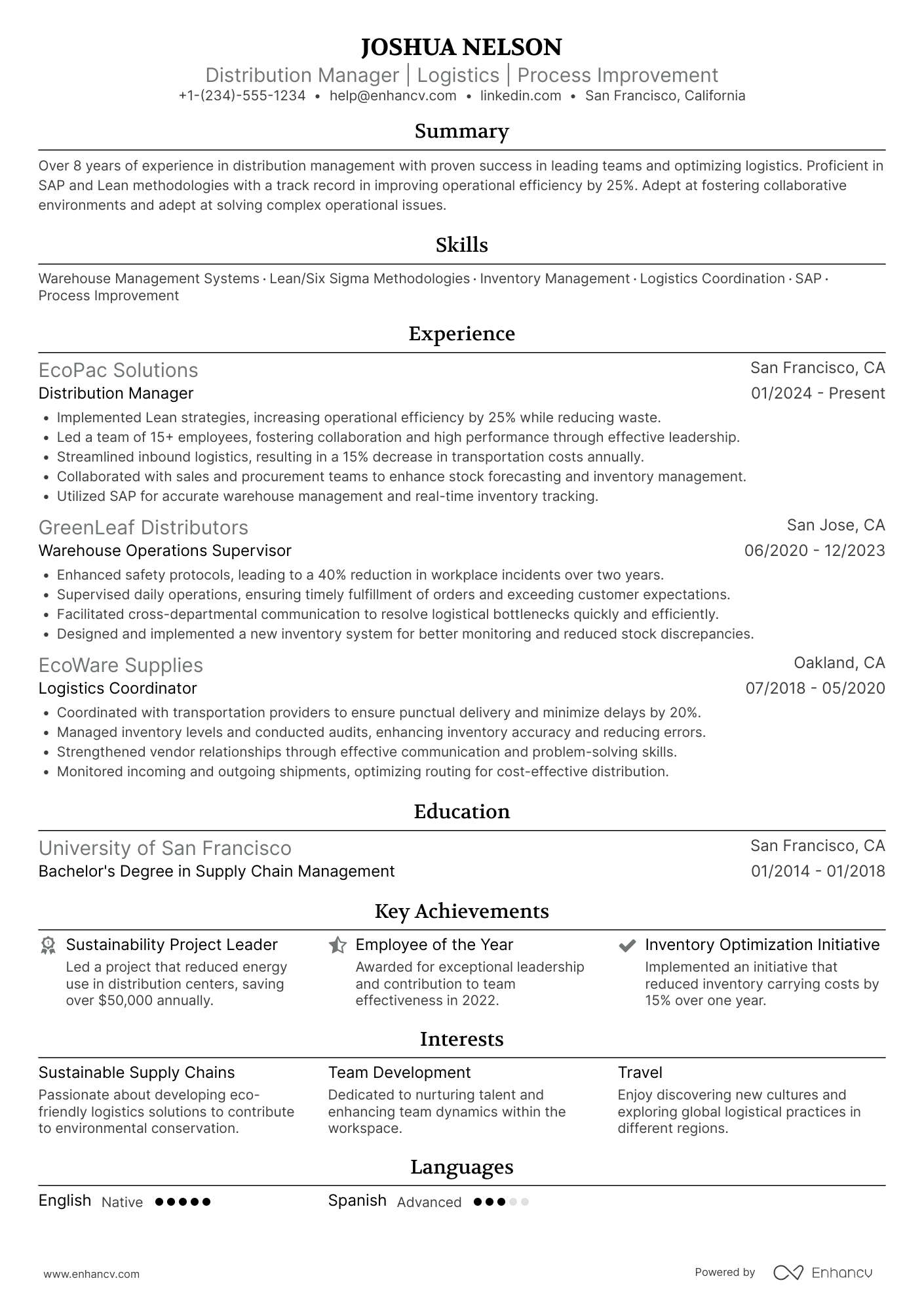
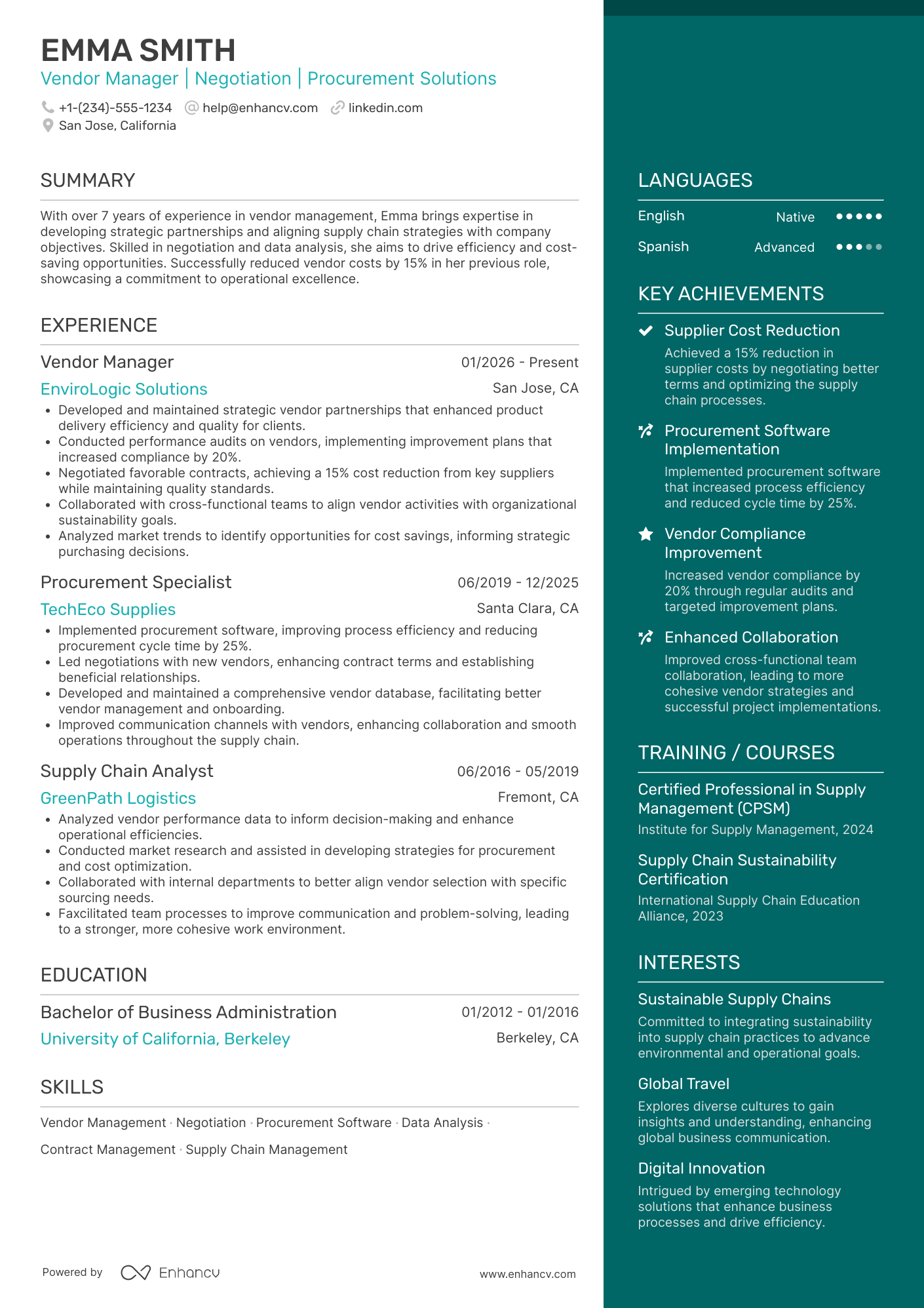
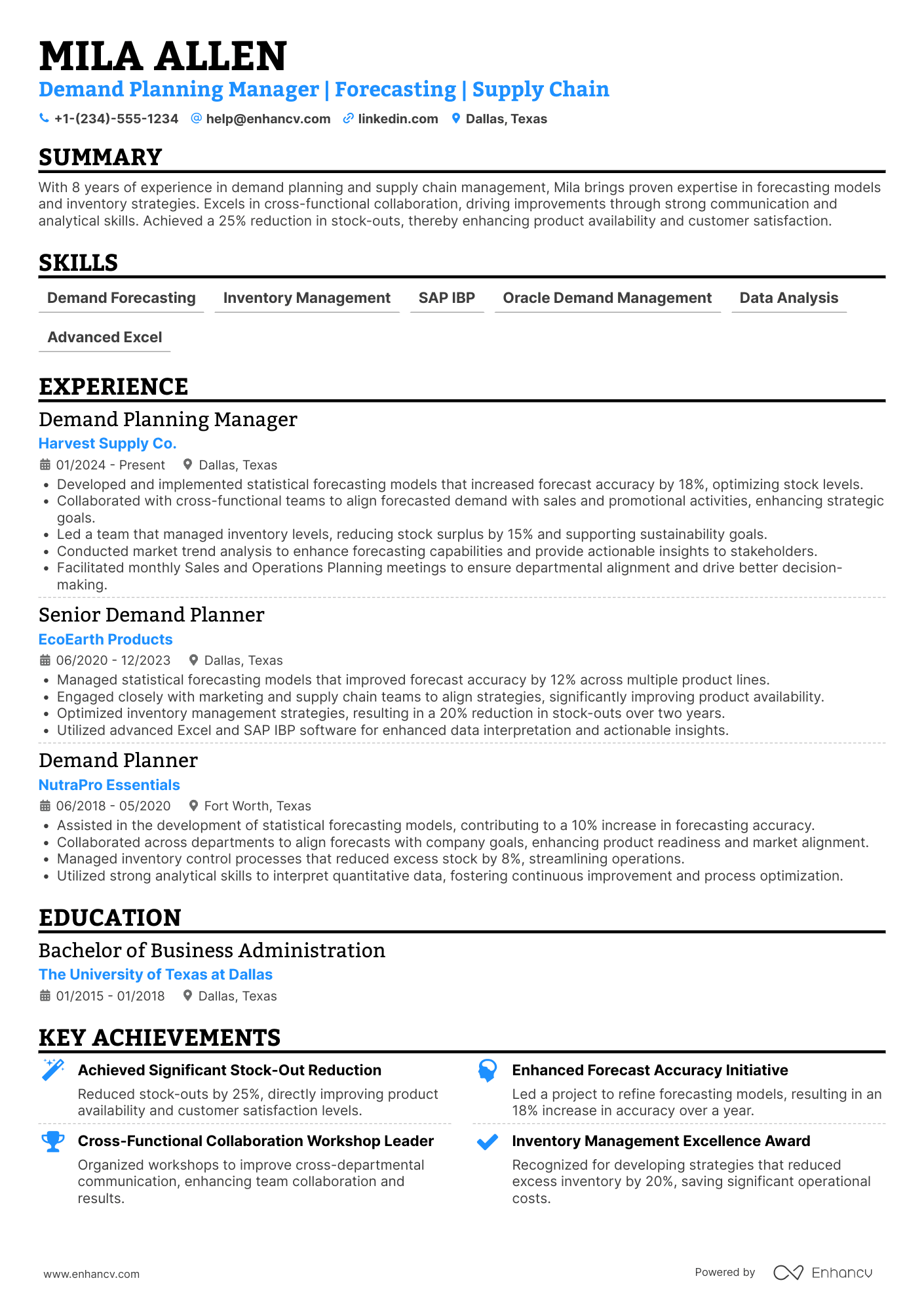
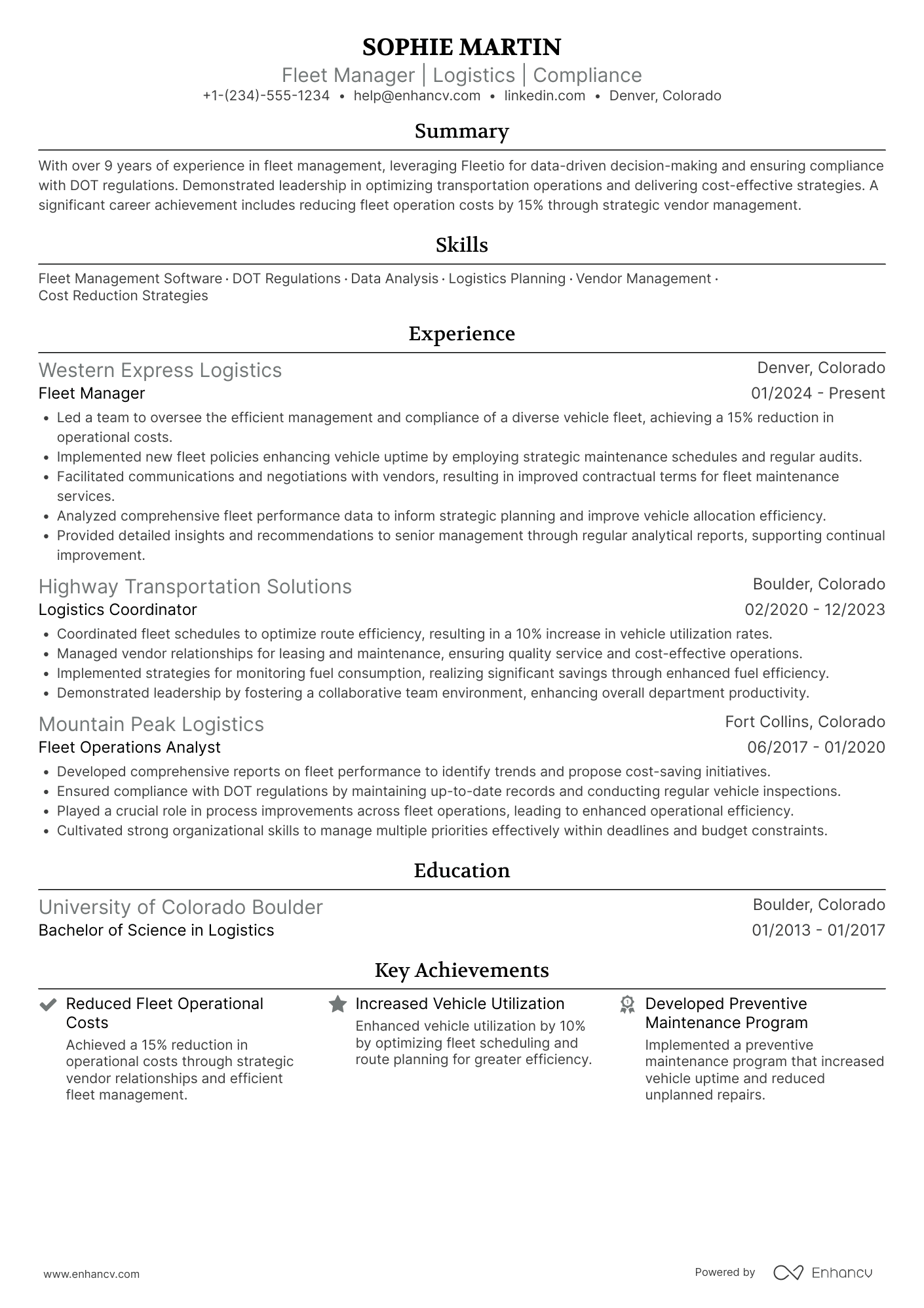
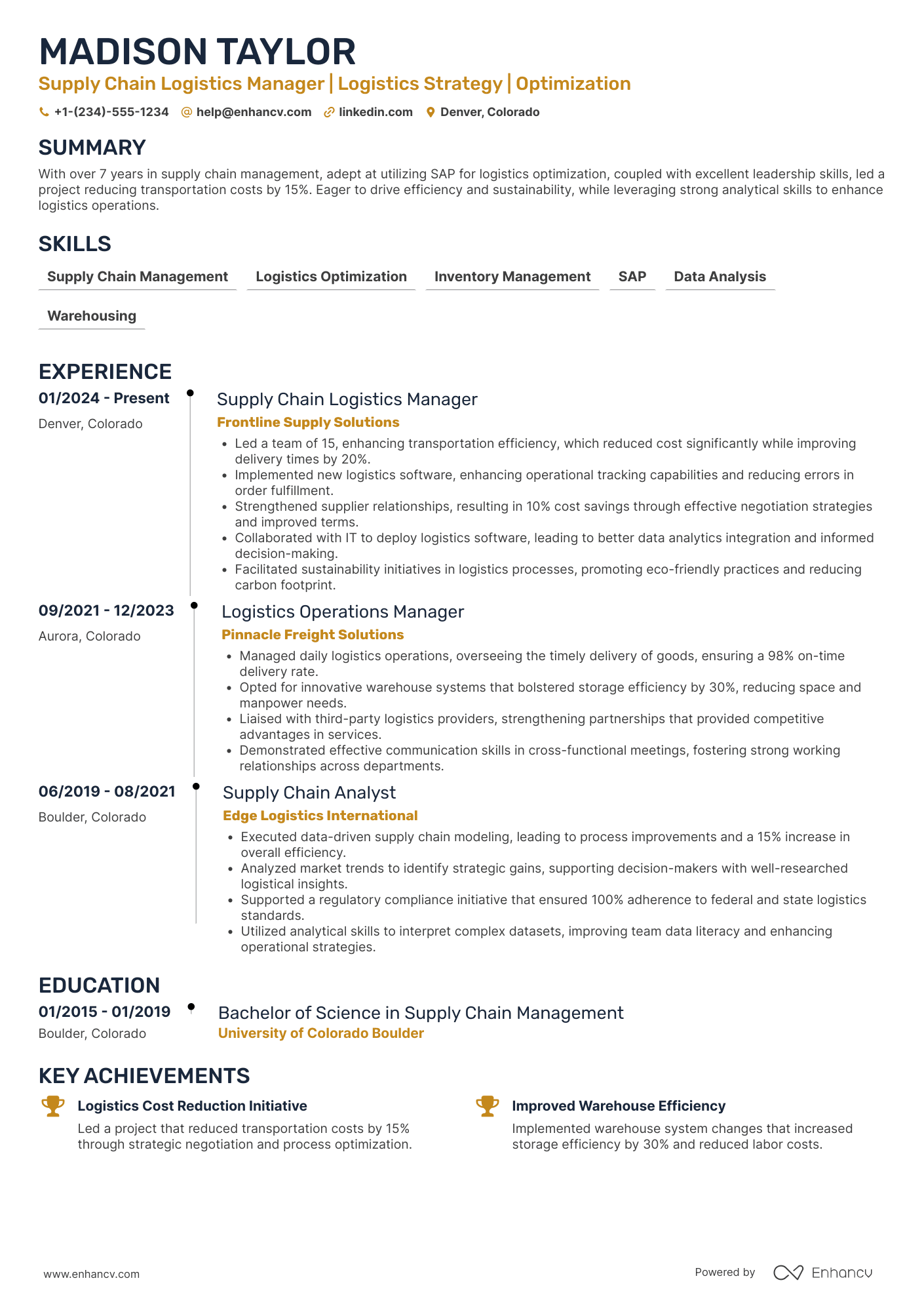
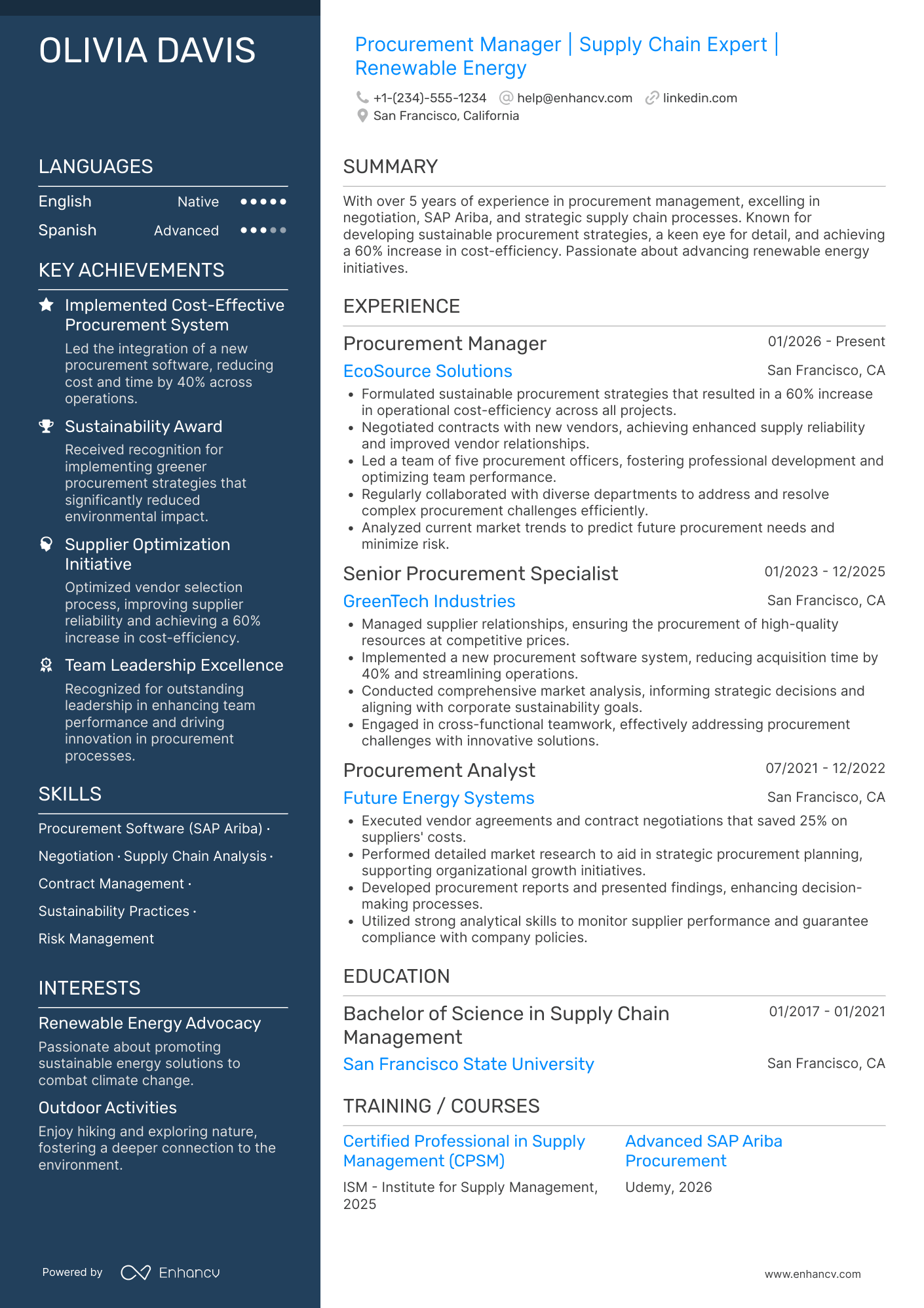
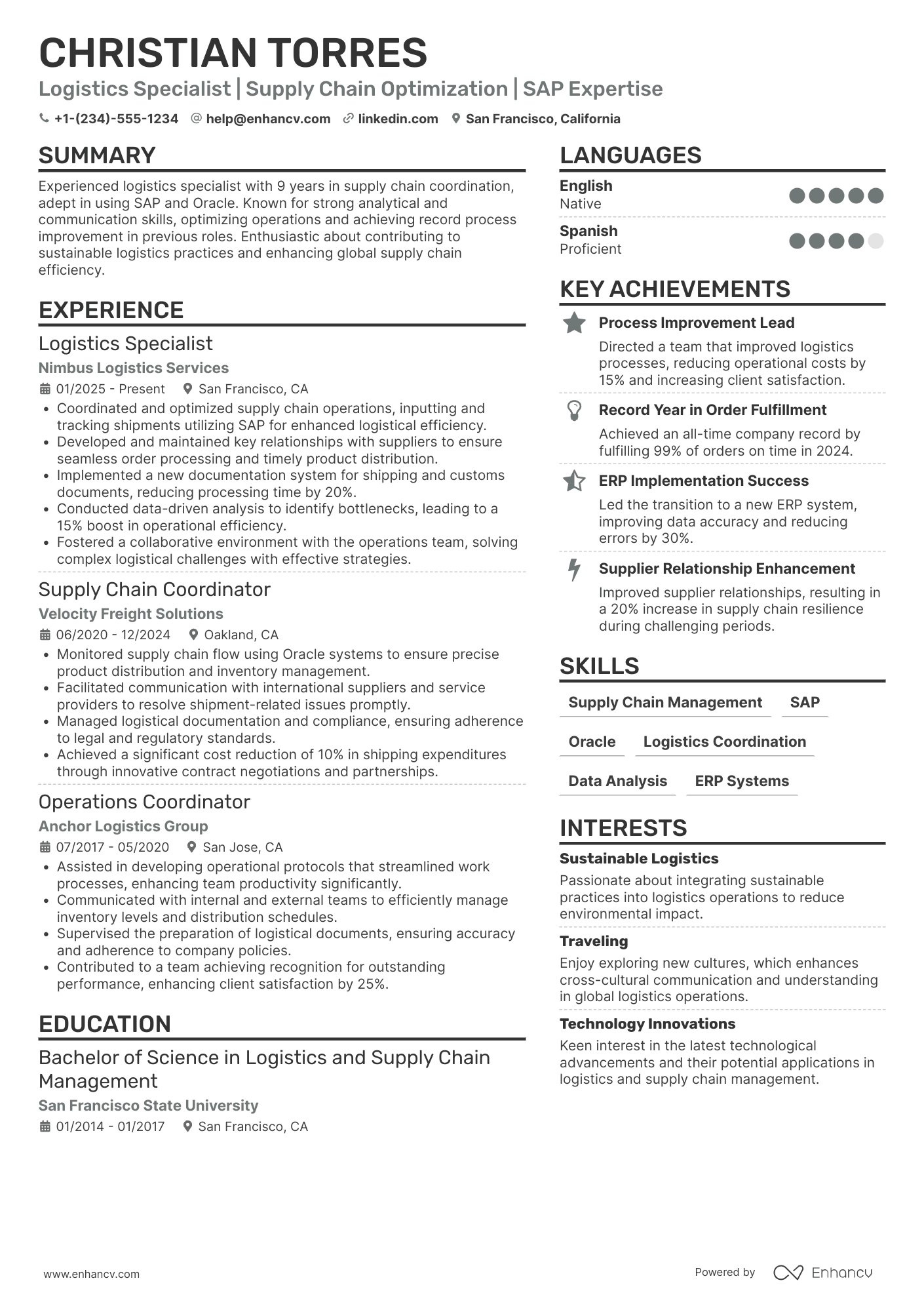
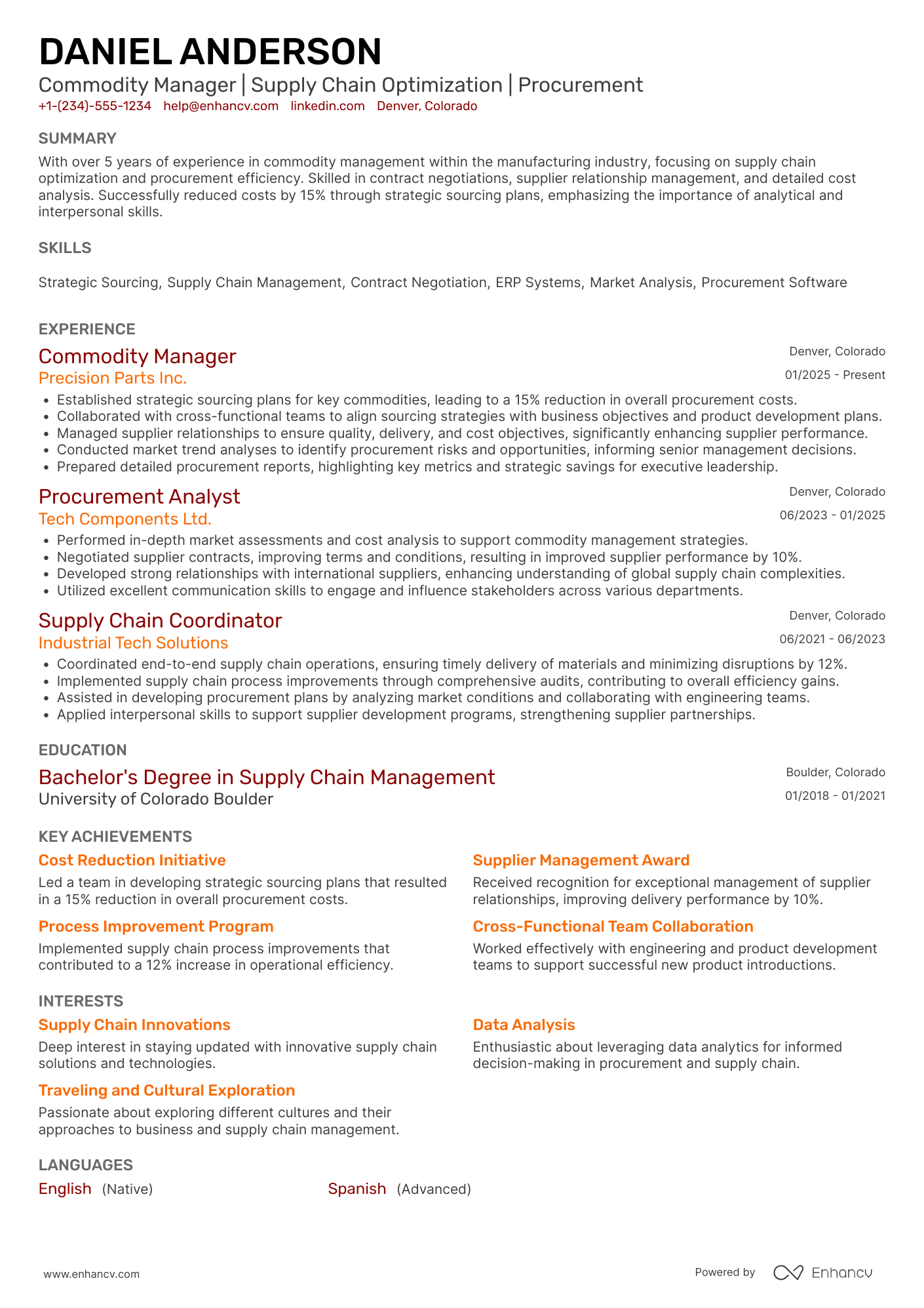
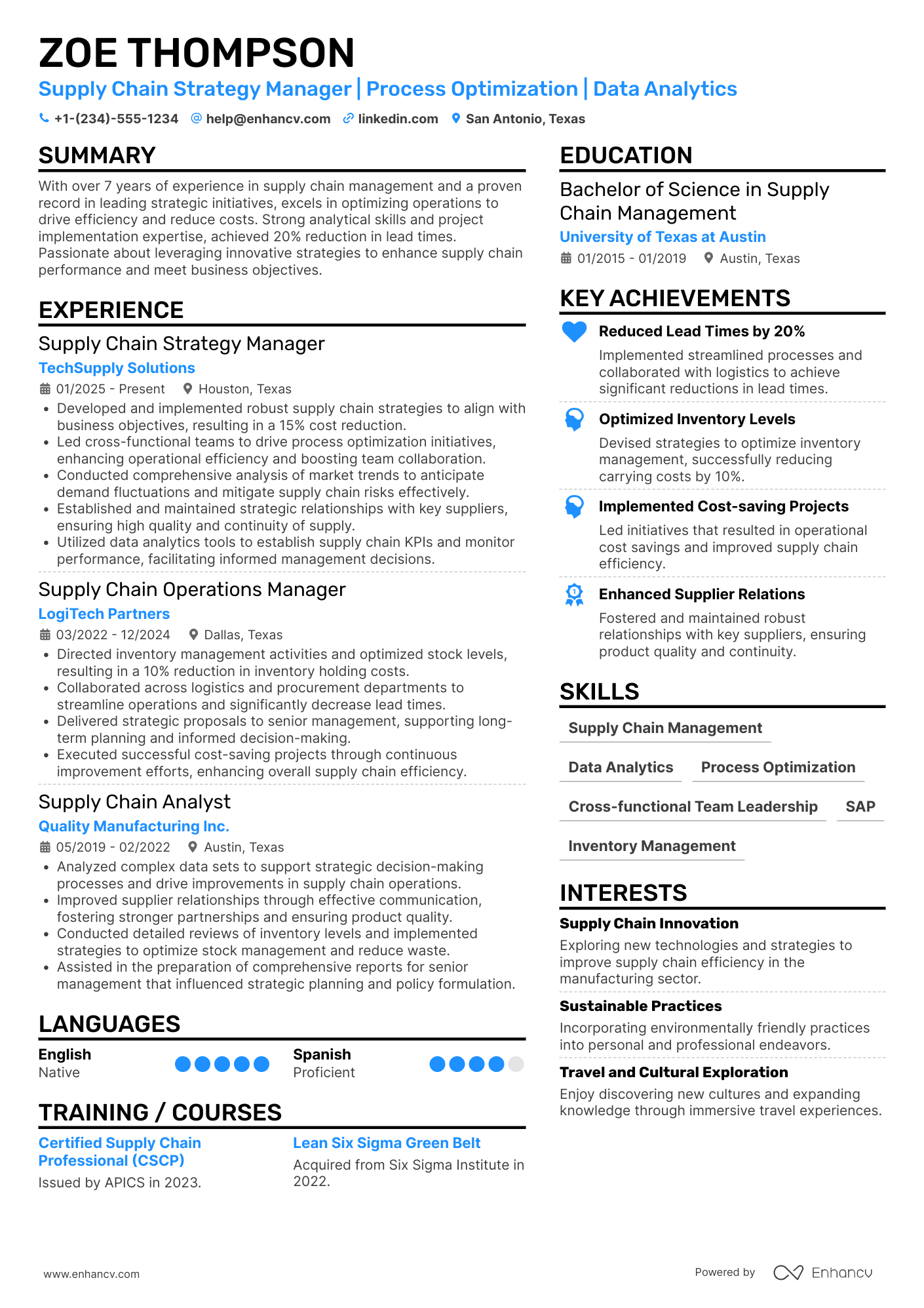
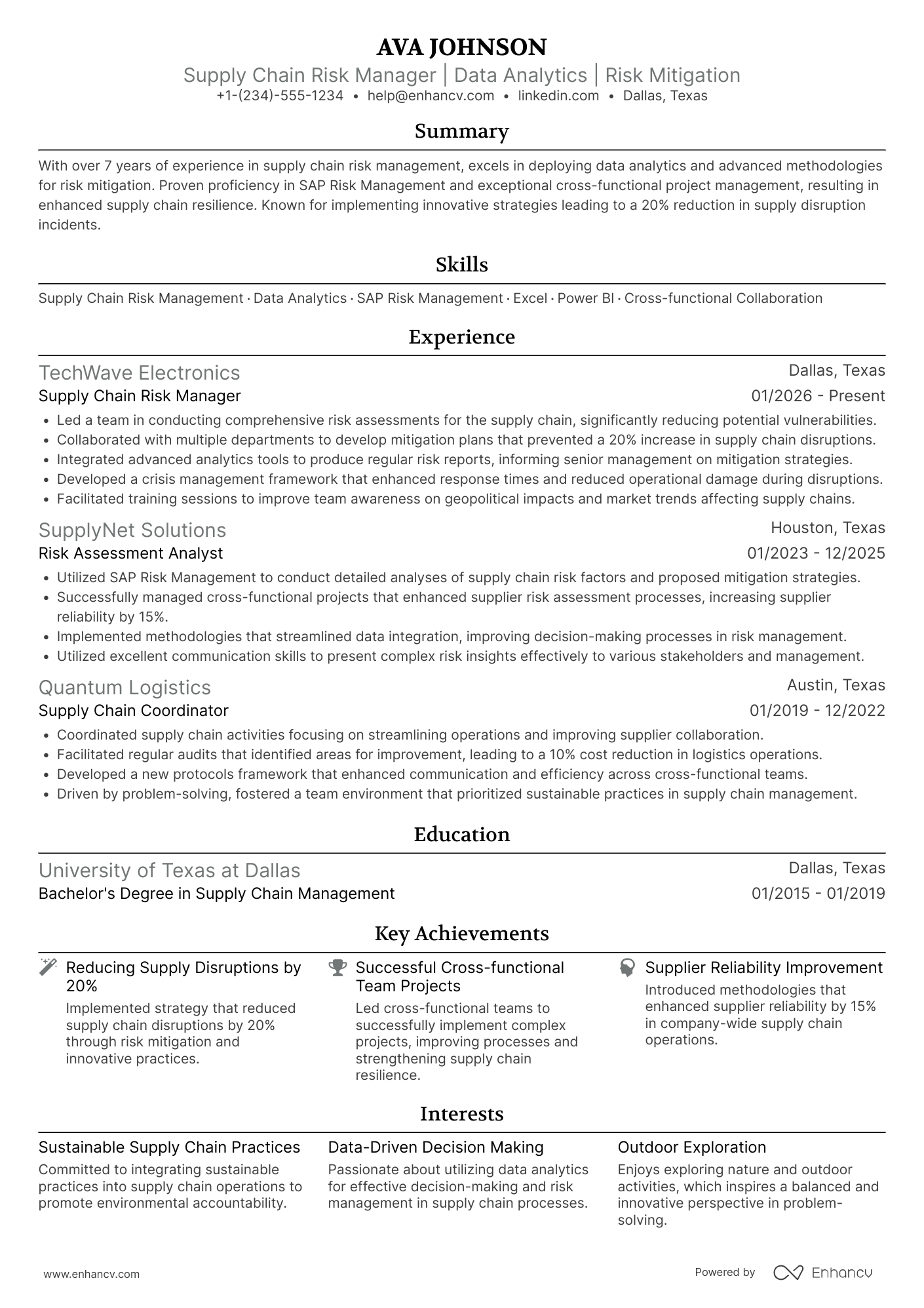
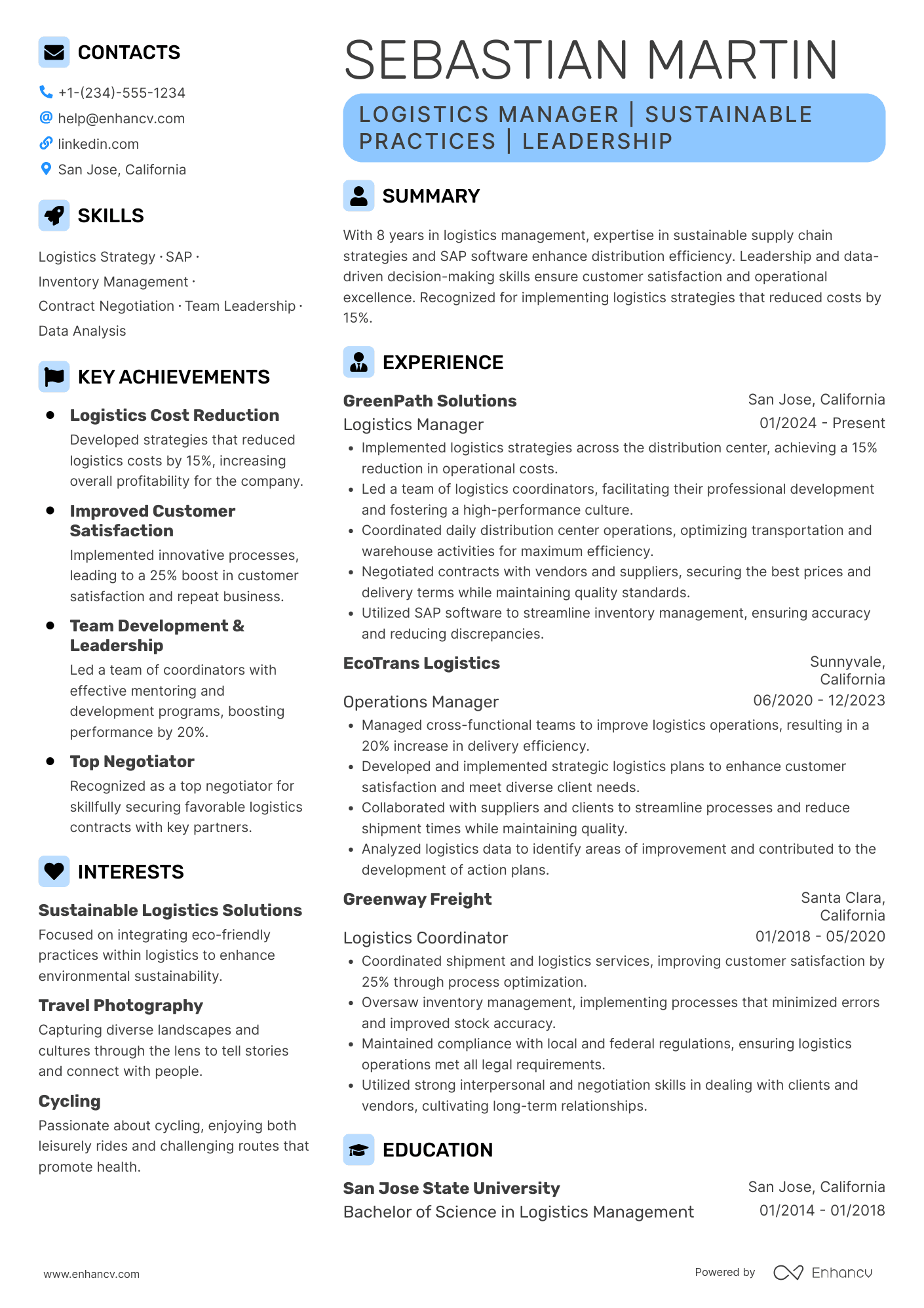
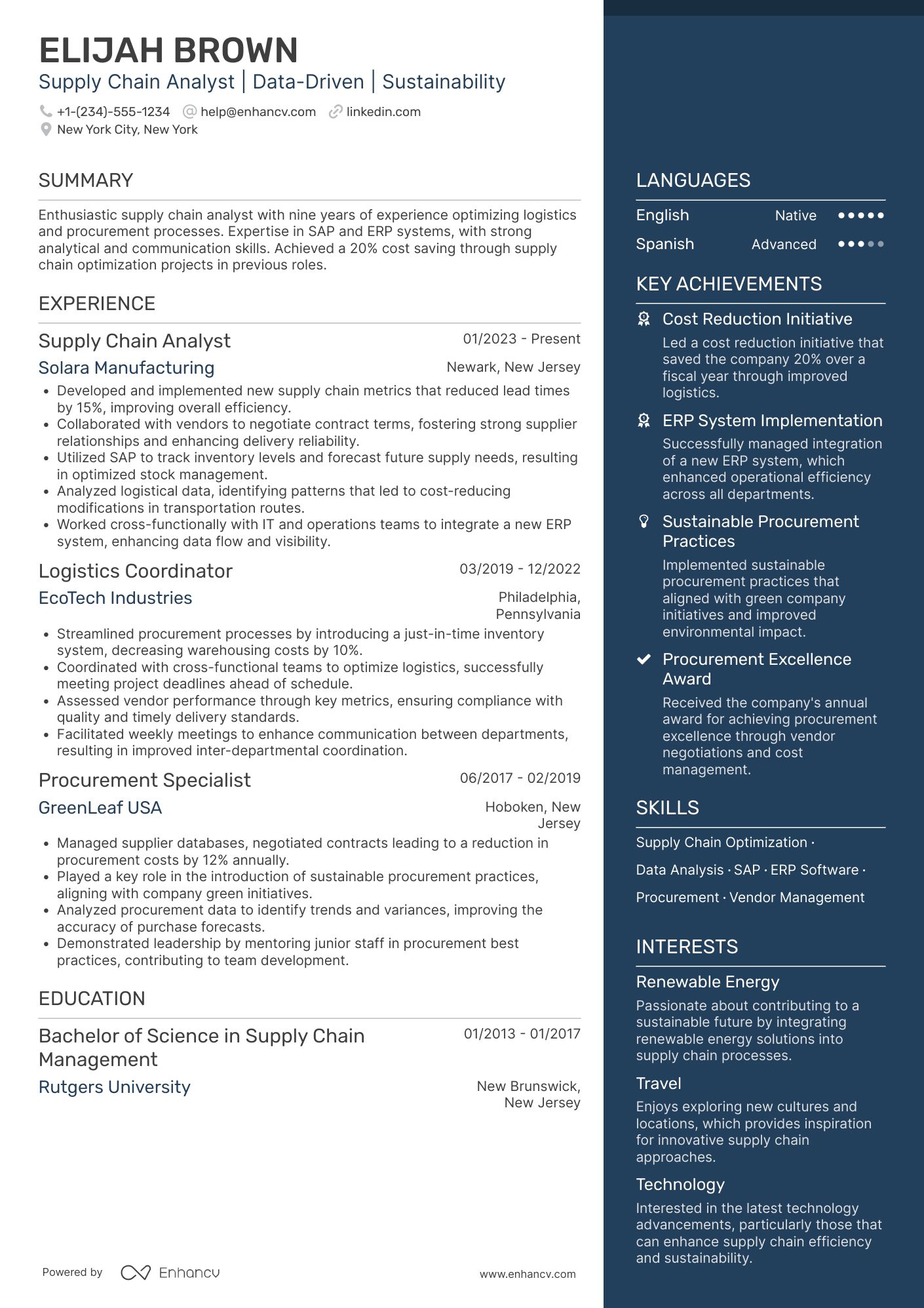
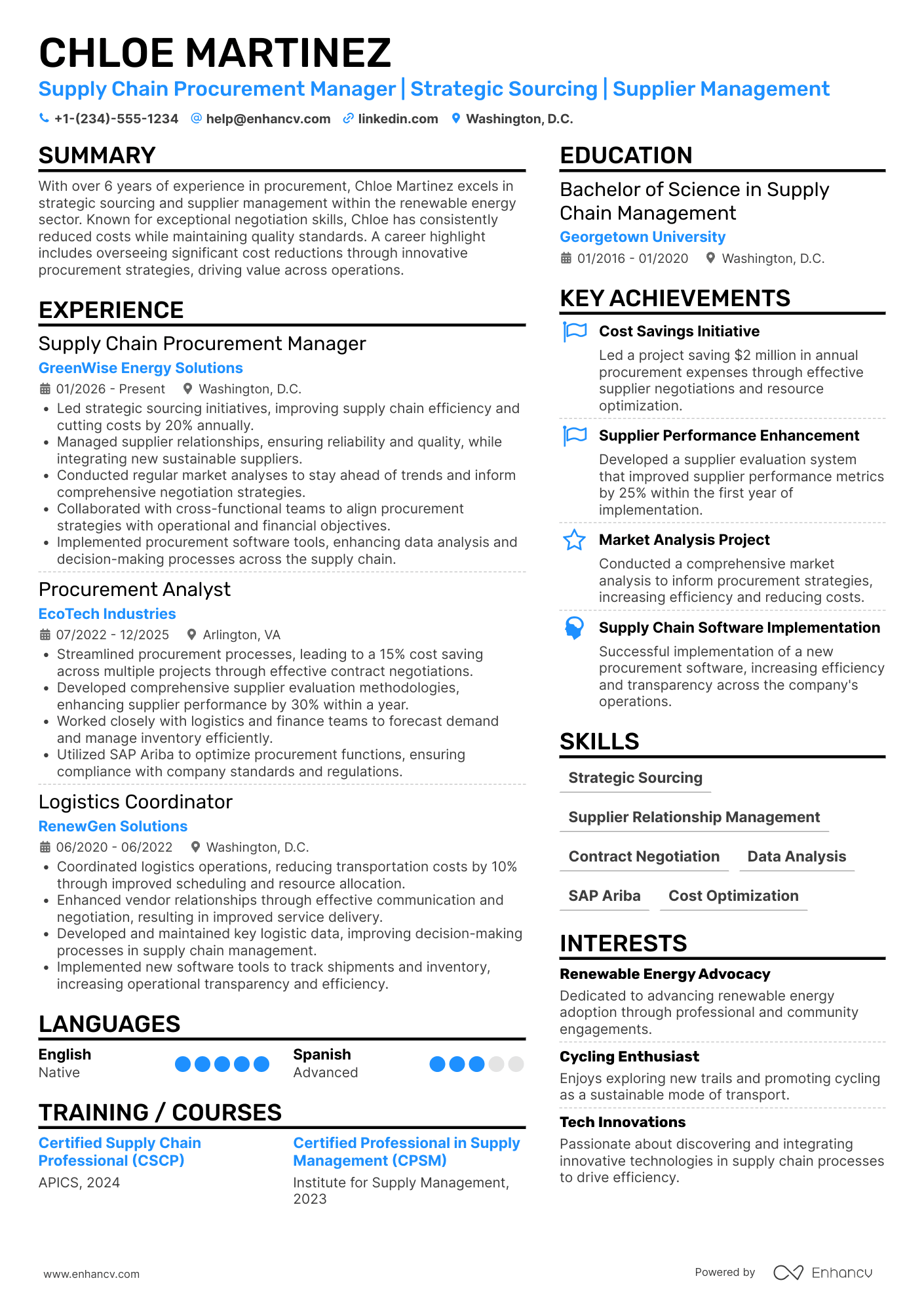
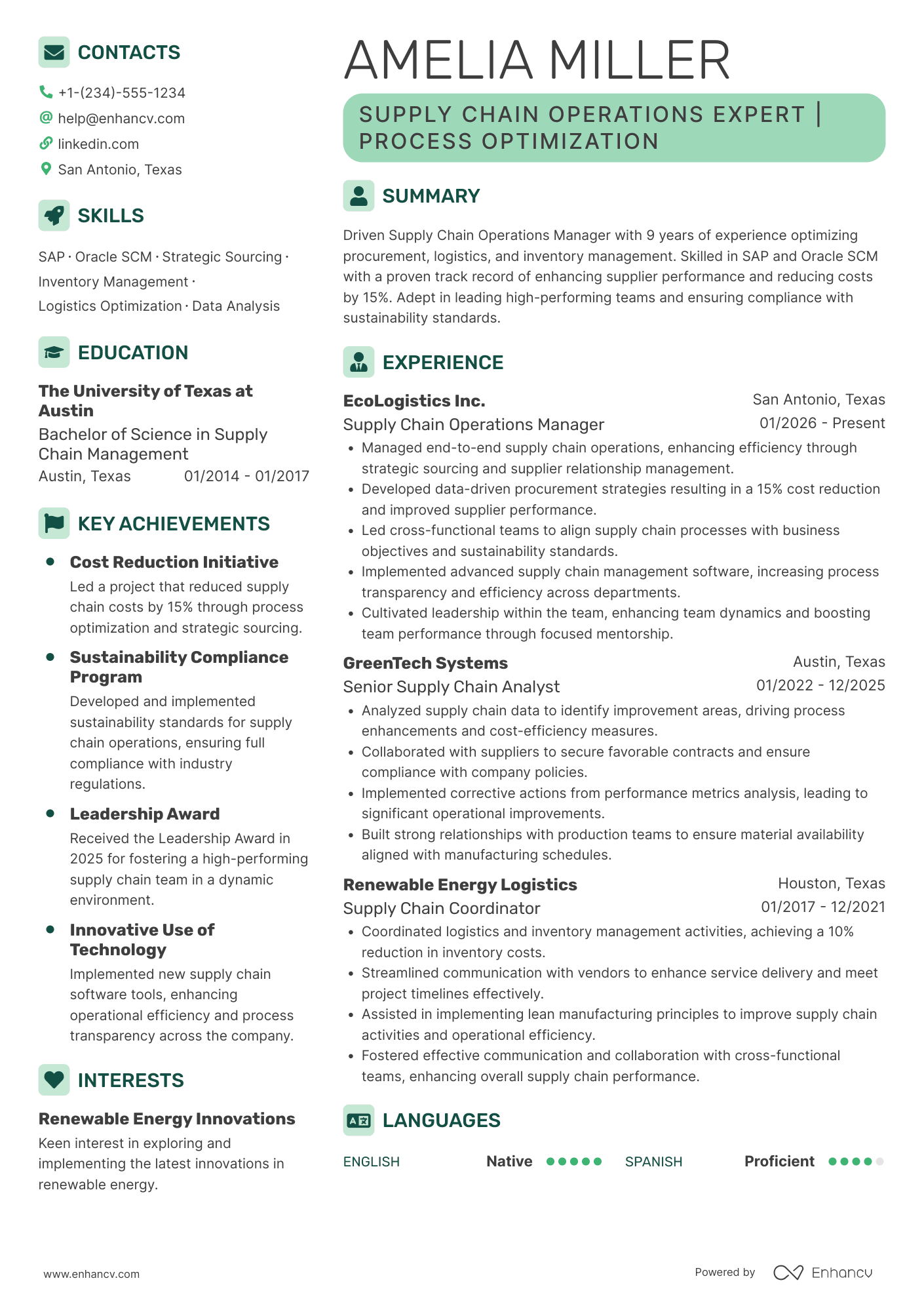
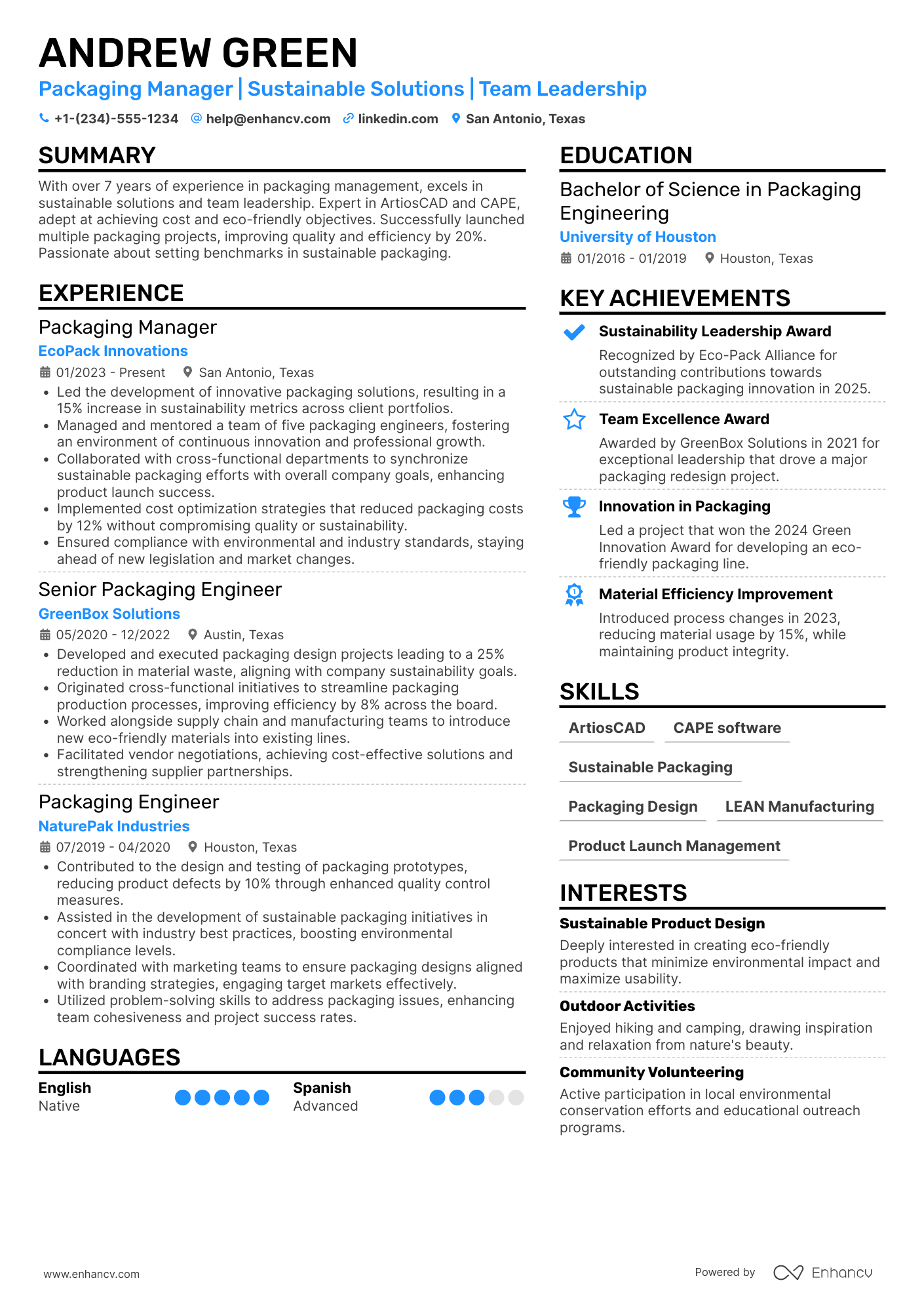
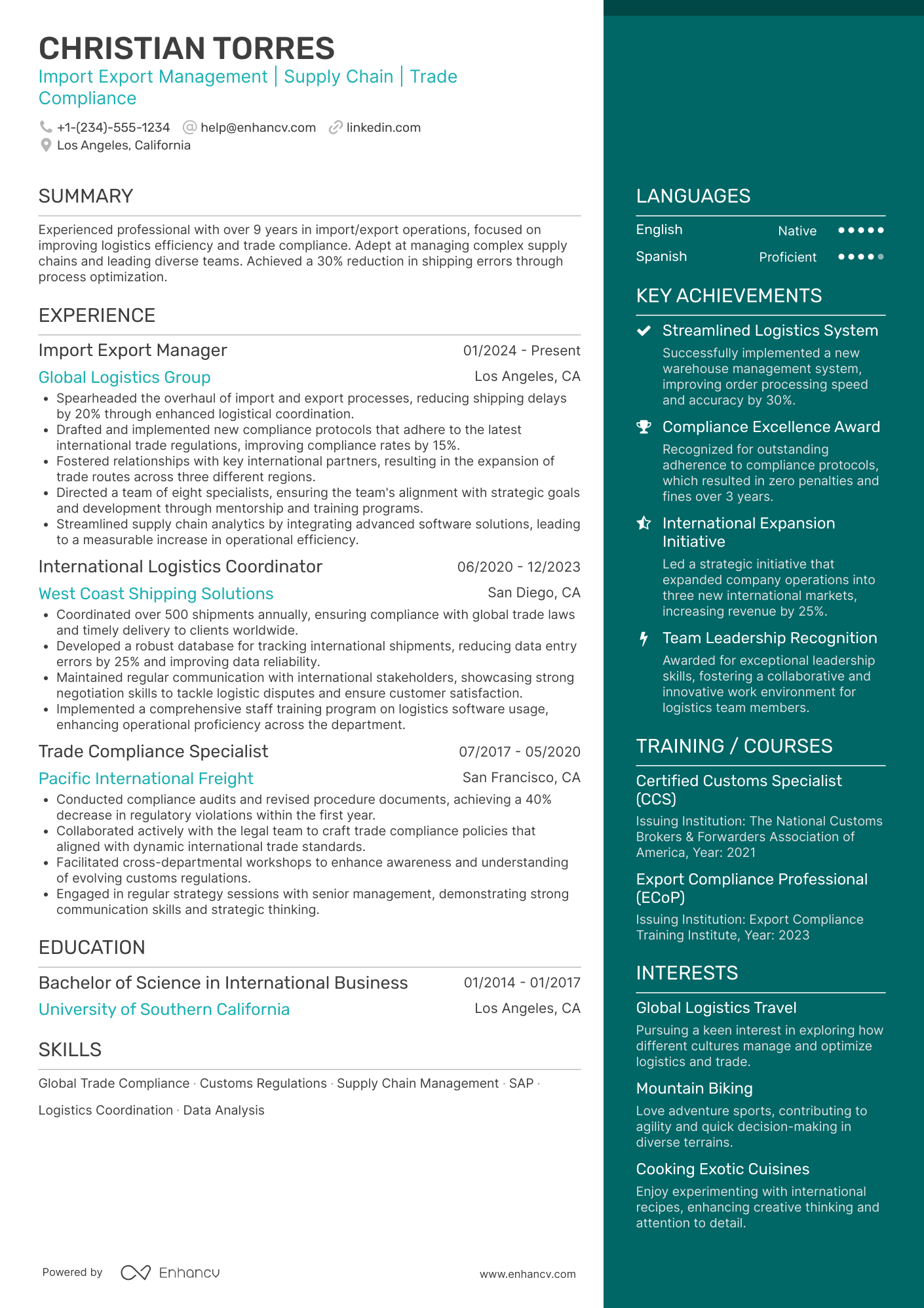
A supply chain manager resume often lists suppliers managed and systems used but skips the cost, inventory, and service results behind them. Recruiters scan quickly, and applicant tracking system (ATS) filters match your tools and metrics to the posting.
To make your supply chain resume stand out, lead with what your network gained. Show lower landed costs, leaner inventory, higher on-time delivery, better forecast accuracy, and fewer stockouts.

Key takeaways
- Lead each bullet with a cost, inventory, or service result.
- Name the ERP and planning systems you've run, such as SAP.
- Use a reverse-chronological format to show growing supply chain scope.
- Mirror the posting's terms for planning, sourcing, and logistics.
- Quantify savings, inventory turns, and on-time delivery rates.
- Use Enhancv's Bullet Point Generator to turn supply chain tasks into measurable bullets.
Job market snapshot for supply chain managers
We analyzed 636 recent supply chain manager job ads from major US job boards. Manufacturers posted 26.3% of them, and five to six years of experience is the most common requirement (37.4%). Use these numbers to gauge employer expectations, target the right industries, match your experience level, and find the companies hiring now.
What level of experience employers are looking for in supply chain managers
| Years of Experience | Percentage found in job ads |
|---|---|
| 1–2 years | 4.7% (30) |
| 3–4 years | 14.8% (94) |
| 5–6 years | 37.4% (238) |
| 7–8 years | 6.0% (38) |
| 10+ years | 8.6% (55) |
| Not specified | 28.5% (181) |
Supply chain manager ads by area of specialization (industry)
| Industry (Area) | Percentage found in job ads |
|---|---|
| Manufacturing | 26.3% (167) |
| Professional services | 25.6% (163) |
| Retail & e-commerce | 22.0% (140) |
| Healthcare | 6.4% (41) |
| Technology | 4.9% (31) |
| Education | 4.9% (31) |
| Real estate & construction | 2.4% (15) |
| Energy | 1.9% (12) |
| Finance & insurance | 1.6% (10) |
Top companies hiring supply chain managers
| Company | Percentage found in job ads |
|---|---|
| PwC | 13.1% (83) |
| Amazon | 11.0% (70) |
| Tesla | 9.3% (59) |
| Accenture | 6.8% (43) |
| Panasonic Corporation of North America | 1.6% (10) |
Role overview stats
These tables show what supply chain managers do day to day and where they work. Managing suppliers and vendors appears in 76.4% of ads, and 93.7% of the roles are on-site. Lead with the duties you've owned, especially cost and supplier results.
Day-to-day activities and top responsibilities for a supply chain manager
| Responsibility | Percentage found in job ads |
|---|---|
| Manage suppliers and vendors | 76.4% (486) |
| Analyze supply chain data | 74.7% (475) |
| Partner with operations and sales | 73.3% (466) |
| Improve supply chain processes | 64.9% (413) |
| Lead demand and supply planning | 63.7% (405) |
| Reduce supply chain costs | 56.9% (362) |
| Oversee logistics and distribution | 54.7% (348) |
| Ensure compliance and quality | 52.2% (332) |
| Manage ERP and planning systems | 51.7% (329) |
| Ensure on-time delivery | 51.4% (327) |
| Lead the supply chain team | 49.8% (317) |
| Manage inventory levels | 48.6% (309) |
Type of employment (remote vs on-site vs hybrid)
| Employment type | Percentage found in job ads |
|---|---|
| On-site | 93.7% (596) |
| Hybrid | 4.6% (29) |
| Remote | 1.7% (11) |
How to format a supply chain manager resume
Hiring managers look first for the cost savings, service levels, and network scope you've delivered. A strong resume format keeps those numbers near the top of every role.
Resume formatting strategy for supply chain managers
| Category | Senior & leadership strategy | Entry to mid-level strategy |
|---|---|---|
| Recommended format | Reverse-chronological | Reverse-chronological or hybrid |
| Core dos | Lead each role with network scope, spend managed, and team size. Name the sourcing, planning, or logistics programs you owned. Tie every bullet to cost, inventory, or service level results. | Put ERP, planning, and analysis skills near the top. Count buyer, planner, or logistics coordinator work as transitional experience. Link each task to a result such as fewer stockouts. |
| Example bullet | Led a 12-person planning and procurement team across 4 plants, cutting inventory by $14M while raising on-time delivery to 97%. | SAP demand planning → rebuilt safety stock levels for 300 SKUs → cut stockouts by 35% in two quarters. |
| Format to avoid | Hybrid and functional formats separate your savings from the networks and years that produced them. Hiring managers can't see your progression from planner to supply chain leader. Keep each result tied to a dated role at this level. | A functional format hides which operations each skill came from. Edge cases: a move from warehouse or retail operations into supply chain, or a return after a career gap. |
A functional resume works only for edge cases, and every skill on it should point to a project and a measured result.
With your timeline easy to follow, the sections you choose decide where your best results appear.
What sections should go on a supply chain manager resume?
Hiring managers expect resume sections that make your network scope, systems, and savings easy to find on a supply chain manager resume.
Use this structure for maximum clarity:
- Header
- Summary
- Experience
- Skills
- Education
- Certifications
- Optional sections: Languages, Professional associations, Awards
Strong experience bullets should emphasize cost savings, inventory and service results, and the size of the network you managed.
Is your resume good enough?
Drop your resume here or choose a file. PDF & DOCX only. Max 2MB file size.
Experience carries the most weight in that list, and it's where your supply chain results need detail.
How to write your supply chain manager resume experience
Your experience section should show the networks you ran and the systems behind them, such as SAP, Oracle, or Kinaxis. Hiring managers prioritize demonstrated impact on cost, inventory, and service over lists of suppliers and shipments.
Each entry should include:
- Job title
- Company and location (or remote)
- Dates of employment (month and year)
Three to five concise bullet points showing what you owned, how you executed, and what outcomes you delivered:
- Ownership scope: the plants, warehouses, suppliers, and spend you were accountable for as a supply chain manager
- Execution approach: the planning methods, ERP systems, and sourcing strategies you used to run the network
- Value improved: changes to cost, inventory levels, forecast accuracy, or on-time delivery
- Collaboration context: how you worked with operations, sales, finance, and suppliers to balance supply and demand
- Impact delivered: results stated as savings, inventory turns, service levels, or risk reduced

Experience bullet formula
A supply chain manager experience example
✅ Right example - modern, quantified, specific.
Supply Chain Manager
Redfield Home Goods | Charlotte, NC
2021–Present
Home goods manufacturer shipping to 2,000 retail stores from 3 plants and 2 distribution centers.
- Led demand and supply planning in SAP IBP with sales and operations, raising forecast accuracy from 68% to 84%.
- Renegotiated contracts with 25 key suppliers alongside procurement, saving $3.2M a year without lowering quality scores.
- Cut finished-goods inventory by $8M with new safety stock rules, while holding on-time delivery at 96%.
- Dual-sourced 40 critical components with engineering after a port disruption, cutting supply risk exposure by half.
- Redesigned outbound freight lanes with the logistics team, lowering cost per shipment by 14%.
A strong example shows what good looks like, and tailoring adapts each entry to the network a specific employer runs.
How to tailor your supply chain manager resume experience
Supply chain manager resumes pass through an ATS before a hiring manager reads them closely. Tailoring to each job description matches your real results to the systems and goals the team names.
Ways to tailor your supply chain manager experience:
- Match the ERP and planning systems the posting names.
- Use the company's terms for planning and sourcing processes.
- Mirror the metrics the role tracks such as fill rate.
- Highlight industry experience that matches the company's products.
- Emphasize supplier management when the posting stresses sourcing.
- Name the logistics or distribution scope the role covers.
- Reflect the cost or inventory goals the job describes.
Tailoring frames your real results in the employer's terms instead of forcing in keywords.
Resume tailoring examples for supply chain managers
| Job description excerpt | Untailored | Tailored |
|---|---|---|
| "Lead demand and supply planning using SAP IBP to improve forecast accuracy and service levels." | Worked on planning and forecasting. | Led SAP IBP demand planning for 1,200 SKUs, raising forecast accuracy from 71% to 86% and fill rate to 98%. |
| "Manage supplier relationships and negotiate contracts to reduce total landed cost." | Managed vendors. | Negotiated contracts with 30 suppliers, cutting total landed cost by 9% and saving $2.4M a year. |
| "Optimize inventory levels across distribution centers while meeting customer service targets." | Kept track of inventory. | Rebalanced inventory across 3 distribution centers, freeing $5M in working capital while keeping service levels above 97%. |
Tailored bullets show fit, and numbers show how much your network improved.
How to quantify your supply chain manager achievements
Adding numbers to your resume turns supply chain work into proof a hiring manager can compare. For this role, the strongest metrics are cost savings, inventory turns, forecast accuracy, on-time delivery, and supplier performance.
Quantifying examples for supply chain managers
| Metric | Example |
|---|---|
| Cost savings | "Saved $4.1M a year by consolidating 60 packaging suppliers into 12 strategic partners." |
| Inventory turns | "Raised inventory turns from 5.2 to 7.8 by redesigning reorder points in SAP." |
| Forecast accuracy | "Improved 12-week forecast accuracy from 65% to 83% with a new demand review process." |
| On-time delivery | "Lifted on-time, in-full delivery from 88% to 97% by adding a daily supply risk review." |
| Supplier quality | "Cut supplier defect rates from 3.1% to 0.9% through quarterly scorecards and corrective plans." |
Turn planning, sourcing, and logistics work into measurable, recruiter-ready bullets with Enhancv's Bullet Point Generator.
Those results show what you delivered, and your skills section shows the systems and methods behind them.
How to list your hard and soft skills on a supply chain manager resume
Hiring managers and ATS filters read your resume skills section for planning and systems expertise, and strong lists pair hard skills like SAP with soft skills like cross-functional influence.
Supply chain manager roles require a blend of:
- Planning and inventory skills
- Sourcing and supplier management skills
- Systems and data analysis skills
- Soft skills
Your skills section should be:
- Scannable (bullet-style grouping)
- Relevant to the job post
- Backed by proof in experience bullets
- Updated with current tools
Place your skills section:
- Above experience if you're junior or switching careers
- Below experience if you're mid/senior with strong achievements

Hard skills
- Demand and supply planning
- S&OP
- SAP S/4HANA, SAP IBP
- Oracle SCM Cloud
- Kinaxis RapidResponse
- Inventory optimization
- Strategic sourcing
- Contract negotiation
- Logistics and transportation management
- Excel, SQL, Power BI
- Lean and Six Sigma
- Supplier scorecards
Soft skills
- Negotiating with suppliers
- Cross-functional influence
- Calm problem solving in disruptions
- Clear communication with sales and operations
- Data-driven decision-making
- Prioritizing under tight deadlines
- Building supplier partnerships
- Coaching planners and buyers
- Escalating risks early
- Holding teams to service targets
How to show your supply chain manager skills in context
Strong skills for your resume should appear in your summary and results, beyond a standalone list.
Show them in:
- Your summary (high-level professional identity)
- Your experience (proof through outcomes)
Here's how a supply chain manager can show them in context.
Summary example
Supply chain manager with seven years in consumer goods manufacturing, skilled in SAP IBP, S&OP, and supplier negotiation. Cut inventory by $6M and raised on-time delivery to 96% across 3 plants.
- States level and industry
- Names planning systems recruiters search
- Proves impact with two metrics
- Shows supplier negotiation skill
Experience example
Supply Chain Manager
Bayline Food Products | Sacramento, CA
June 2020–Present
- Ran monthly S&OP meetings with sales and finance, aligning production plans and cutting expedited freight costs by 38%.
- Negotiated a resin supply agreement with procurement, locking in pricing that saved $1.1M during a market spike.
- Built a Power BI inventory dashboard with IT, helping 6 planners cut slow-moving stock by 27%.
- Every bullet carries a measured result
- Skills show up inside real work
Those examples come from experienced managers, and candidates new to supply chain need a different way to show readiness.
How do I write a supply chain manager resume with no experience?
Even without full-time experience, you can demonstrate readiness through:
- Buyer or planner roles
- Warehouse or logistics coordinator work
- Supply chain internships
- Operations or inventory projects
- Case competitions in operations
- Retail inventory management
- Analysis of real operations data
Focus on:
- Costs or waste you reduced
- Inventory or orders you tracked
- Systems you used on real data
- Suppliers or carriers you coordinated
Resume format tip for entry-level supply chain manager
Use a hybrid format that starts with supply chain projects and system skills, then lists related roles. A resume without work experience still lands interviews when every skill points to a measured result. Do:
- Lead with two or three operations or inventory projects.
- Quantify costs cut, stock tracked, or orders handled.
- List ERP or spreadsheet tools you've used.
- Add a summary that targets supply chain roles.
- Place any supply chain certification near the top.
- Analyzed a campus bookstore's ordering data in Excel for a class project, cutting overstock of slow sellers by 22% in one term.
Projects show what you can do, and your education section shows the operations training behind it.
How to list your education on a supply chain manager resume
An education section on your resume shows hiring teams the operations, business, or engineering training behind your supply chain decisions.
Include:
- Degree name
- Institution
- Location
- Graduation year
- Relevant coursework (for juniors or entry-level candidates)
- Honors & GPA (if 3.5 or higher)
List only the graduation year and skip months and days.
Here's an education entry for a supply chain manager:
Example education entry
Bachelor of Science in Supply Chain Management
Michigan State University, East Lansing, MI
Graduated: 2016
GPA: 3.7/4.0
- Relevant Coursework: Logistics Management, Operations Planning, Strategic Sourcing, Supply Chain Analytics
- Honors: Dean's List (six semesters)
Certifications usually follow education, and supply chain credentials show you know the planning and sourcing standards employers use.
How to list your certifications on a supply chain manager resume
Strong resume certifications show a supply chain manager keeps learning, knows current planning tools, and understands how sourcing affects cost.
Include:
- Certificate name
- Issuing organization
- Year
- Optional: credential ID or URL
- Place certifications below education when they're older or less tied to supply chain work.
- Place certifications above education when they're recent, role-specific, or named in the posting.
Best certifications for your supply chain manager resume
- Certified Supply Chain Professional (CSCP), ASCM
- Certified in Planning and Inventory Management (CPIM), ASCM
- Certified in Logistics, Transportation and Distribution (CLTD), ASCM
- Certified Professional in Supply Management (CPSM), ISM
- Certified Six Sigma Green Belt (CSSGB), ASQ
A current credential adds weight after education, and your summary is where recruiters see it first.
How to write your supply chain manager resume summary
A professional profile gives hiring managers your scope, systems, and best result before they read a single bullet. On a supply chain manager resume, those lines frame every number below.
Keep it to three to four lines, with:
- Your title and years in supply chain.
- The industry or product type you support, such as food manufacturing.
- Core systems and methods, like SAP IBP or S&OP.
- One or two quantified results, such as savings or inventory cuts.
- Soft skills tied to outcomes, like supplier negotiations that held costs.

PRO TIP
At the mid level, lead with network scope, your core systems, and one cost or service result. Skip phrases like "results-oriented" or "logistics expert," and let your savings and service levels make the case.
Example summary for a supply chain manager
Supply chain manager with six years in medical device manufacturing. Runs planning and sourcing for 2 plants in SAP, cutting inventory by $4.5M and raising supplier on-time delivery from 85% to 95%.
Optimize your resume summary and objective for ATS
Drop your resume here or choose a file.
PDF & DOCX only. Max 2MB file size.
With your summary in place, the header above it should make you easy to reach and verify.
What to include in a supply chain manager resume header
A clear resume header lists your name, focus, and contact details, and it's where recruiters first confirm you fit the supply chain role.
Essential resume header elements
- Full name
- Tailored job title and headline
- Location
- Phone number
- Professional email
A LinkedIn link helps recruiters verify your employers, plants, and dates in seconds.
Leave the photo off a supply chain manager resume unless the role is explicitly front-facing or appearance-dependent.
Use the posting's title in your headline, such as global supply chain manager, and name your core system.
Example
Supply chain manager resume header
Kevin Alvarez
Supply chain manager | Demand planning, sourcing, and SAP IBP
Dallas, TX | (214) 555-01XX | kevin.alvarez@enhancv.com linkedin.com/in/kevinalvarez
With the essentials in place, a few extra sections can strengthen your case for global roles.
Additional sections for supply chain manager resumes
Additional sections earn their place when they support global work, such as language skills for overseas suppliers or awards for cost savings.
- Languages
- Awards and recognition
- Professional associations
- Continuous improvement projects
- Volunteer work
- Conference presentations
Those sections add depth, and a cover letter connects your experience to one company's network.
Do supply chain manager resumes need a cover letter?
Many supply chain manager postings treat the cover letter as optional. A short one helps when you're changing industries, moving from planning into management, or targeting a company facing supply disruptions.
Use your cover letter to show:
- Network fit: Connect your experience to the company's products, plants, or channels.
- One result: Describe a savings or service win and the number behind it.
- Business context: Show you understand the supply risks the company faces.
- Career moves: Explain a move from operations, buying, or logistics in one sentence.
Drop your resume here or choose a file.
PDF & DOCX only. Max 2MB file size.
Once your letter makes the case, AI can help you tighten the resume behind it.
Using AI to improve your supply chain manager resume
AI can tighten wording, sharpen structure, and surface the results in your supply chain manager resume. Use well-written AI resume writing prompts on your own drafts, and stop once the language sounds generic.
Try these prompts on specific sections:
- Lead with results: "Rewrite my supply chain manager resume summary to lead with network scope, core systems, and one cost or service result."
- Quantify savings: "Review my supply chain manager experience bullets and suggest where to add savings, inventory, or on-time delivery numbers."
- Name the systems: "Rewrite my supply chain manager bullets so each one names the system or method behind the result."
- Fix weak verbs: "Replace weak verbs in my supply chain manager experience section with precise verbs that show ownership."
- Match the job post: "Compare my supply chain manager skills section with this job description and list the systems and methods to add or remove."
- Tailor by industry: "Adjust my supply chain manager resume for a role in this industry, keeping only claims my experience supports."
- Sharpen key projects: "Edit the key projects on my supply chain manager resume to show the problem, my approach, and the result."
- Polish the headline: "Rewrite my supply chain manager resume headline to name my specialty and industry in under 12 words."
- Connect certifications: "Rewrite my certifications section so each credential ties to a supply chain manager skill such as planning or sourcing."
- Remove filler: "Scan my supply chain manager resume for filler, passive voice, and vague phrases, and suggest direct replacements."
Stop using AI once your resume reads accurate, specific, and true to your real results. AI should never invent experience or inflate claims: if it didn't happen, it doesn't belong on your resume.
Conclusion
A strong supply chain manager resume proves savings and service results with numbers, names your systems, and keeps a structure hiring managers can scan.
Companies will keep needing leaders who move products reliably at lower cost. Keep your resume focused on that record, and you'll be ready for your next supply chain role.